INTRODUCTION
Estimates of plasma parameters, including the simplified analysis of spectroscopic data, are often performed under assumptions that, first, the plasma of interest has a simple shape, and second, electron and ion densities and temperatures are uniform within this shape. The plasma internal energy E(t), radiation emissivity ɛν (t), absorption coefficient κν (t), and other characteristics depend on the distribution of the ion number density, n(t), over ionization degrees and quantum states. Let us denote this distribution n q (t) with the index q running over quantum states of all ionization degrees relevant to a problem, for example, from the ground state of atom to bare nucleus.
In non-LTE plasmas, a computation of n q(t) requires an integration of collisional-radiative rate equations, since the distribution depends on the history of electron and ion densities and temperatures, as well as on the history of the mean specific intensity,  , of the radiation (Mihalas & Weibel-Mihalas, 1984; Griem, Reference Griem1997; Fisher et al., Reference Fisher, Fisher and Maron2007; Rochau et al., Reference Rochau, Bailey, Maron, Chandler, Dunham, Fisher, Fisher, Lemke, MacFarlane, Peterson, Schroen, Slutz and Stambulchik2008). The mean is defined as an average over the plasma volume V and the full solid angle around each segment dr of this volume:

The unit vector Ω shows the direction of a ray toward the point r, and I ν (r, Ω, t) is the radiation specific intensity along the ray. This intensity is the solution of the radiative transfer equation (Mihalas & Weibel-Mihalas, 1984; Griem, Reference Griem1997)

where ℓ is the coordinate along the ray and κ′ν is the absorption coefficient corrected for the stimulated emission. Note that in Eq. (1), the space-averaging is necessary because the uniformity of the plasma density and temperatures does not cause a uniformity of 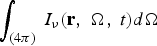 within the volume.
As far as n q (t) and  affect each other, they must be computed self-consistently. The computations are time-consuming because the five-fold integration (1) must be repeated at each step in time for each point of the photon-energy grid, which may be more than 104 points (for satisfactory resolution of all spectral lines and continuum edges). Most commonly, an acceleration of the computations is done by means of the escape probability method (Rybicki, Reference Rybicki and Kalkofen1984; Griem, Reference Griem1997), which excludes
 . For this, the net radiative rate, corresponding to each couple of states, is expressed via the escape factor. However, this expression is justified only if the plasma opacity within a spectral line profile is not affected by other transitions, while in reality spectral lines stand on the continuum pedestal and overlap with the neighboring lines, especially at high density. In particular, the opacity of satellites may be mainly due to the resonance lines. Moreover, expressions for the escape factor are available only for simple plasma shapes (e.g., a cylinder of infinite height) and simple line profiles.
In this paper, we suggest a general method for acceleration of the self-consistent computations of n q (t) and  . Namely, we use the general expressions (1) and (2) to derive a simple formula for
 . This is done for spherical plasmas and cylindrical plasmas of any height-to-diameter ratio.
RADIATION IN CYLINDRICAL AND SPHERICAL PLASMAS
We consider plasmas, for which the external irradiation is negligible. Then, the solution of Eq. (2) is

where L(r, Ω) is the distance along the ray from the plasma surface to the point r in the direction Ω.
Let us consider a cylindrical plasma of a radius R and a height H. In cylindrical coordinates r, θ, z, the plasma volume is given by the conditions 0 < z < H and r < R. It is convenient to introduce a typical specific intensity
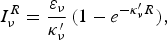
and the ratio of  to this typical intensity

Here the subscript c denotes a cylindrical plasma. Expressions (1) and (3), together with the definition  , yield

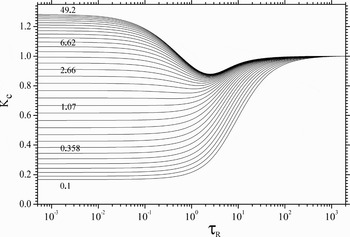
The right-hand side of this expression contains parameters κ′ν, R, and H; however, numerical integrations show that K c depends on two dimensionless combinations of these three parameters, namely, on the ratio H/R and the plasma opacity in one direction, for instance, τR = κ′νR. Computed function K c (H/R, τR) is presented in Figure 1 for 35 values of H/R, namely for H/R = 0.1 × 1.2m with m = 0, 1, … , 34. The substitution of tabulated K c (H/R, τR) in the definition (4) gives the final expression for the mean specific intensity of radiation in cylindrical plasma

For a spherical plasma, a similar consideration results in the expression

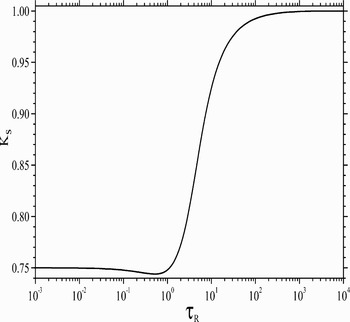
where the subscript s denotes a sphere and R is the radius. Numerical integrations show that function K s depends only on τR = κ′νR. This dependence is presented in Figure 2. An accuracy of the computations is better than 0.5% for both K s (τR) and K c (H/R, τR). Tabulated functions K s (τR) and K c (H/R, τR) will be sent upon request.
Function K c(H/R, τR) for various values of the H/R ratio, which is indicated on part of the curves.

Function Ks(τR).

DISCUSSION AND CONCLUSIONS
For uniform spherical plasmas and uniform cylindrical plasmas of any height-to-diameter ratio the five-fold integral (1) is converted to the simple expressions (6) and (5), respectively. Utilization of these expressions (instead of definitions (1) and (2)) substantially accelerates the self-consistent computations of n q (t) and  . Expressions (5) and (6) provide high accuracy in description of radiation in any spectral interval dν taken in continuum as well as within spectral lines of any profile, including groups of overlapping lines and lines above intense continuum in any spectral range. These expressions may be used for verification of collisional-radiative codes, written in simpler approaches. Besides that, the explicit presentation of
 allows a computation of all radiation-dependent quantities.
We wrote the ion number density n(t) and the distribution n q (t) in terms of one chemical element. Complications in the chemical composition of plasmas affect ɛν (t) and κ′ν (t) with no changes in expressions (5) and (6).
Although we assumed the uniformity of the electron and ion temperatures within the plasma shape, the calculations did not require any particular velocity distribution of free electrons or ions. Therefore, expressions (5) and (6) remain correct for uniform non-Maxwellian plasmas as well.
ACKNOWLEDGMENTS
This work was supported by the Minerva Foundation (Germany) and the Israeli Science Foundation.