Introduction
The ecology of fruit flies in the genus Rhagoletis Loew (Diptera: Tephritidae) has been well studied, but most of the information gathered has been based on only six species out of about 70 total described taxa worldwide. In particular, members of the R. pomonella (Walsh) species complex in North America (primarily Rhagoletis pomonella and Rhagoletis mendax Curran) have been extensively studied and have played prominent roles in elucidating the evolutionary mechanisms of sympatric speciation and for understanding Rhagoletis ecology, in general (e.g., Bush Reference Bush1966; Bush and Smith Reference Bush and Smith1998; Filchak et al. Reference Filchak, Roethele and Feder2000; Feder et al. Reference Feder, Berlocher, Roethele, Dambroski, Smith and Perry2003). In contrast, a species complex whose ecology has received very little attention is the R. tabellaria (Fitch) species complex, which comprises five described species in the United States of America and Canada (Smith and Bush Reference Smith, Bush, Aluja and Norrbom1999; Hulbert et al. Reference Hulbert, Jackson, Hood and Smith2018).
The namesake of the R. tabellaria complex is Rhagoletis tabellaria, a species that has populations in western and eastern North America (Bush Reference Bush1966). In western North America, the fly occurs from California in the United States of America to southern British Columbia in Canada (Foote et al. Reference Foote, Blanc and Norrbom1993), where it attacks red osier dogwood (Cornus sericea Linnaeus; Cornaceae) as its principal host (Smith and Bush Reference Smith, Bush, Aluja and Norrbom1999), a common plant in riparian habitats (Gucker Reference Gucker2012). Very limited data in the Okanagan Valley of British Columbia imply that the fly is rare there and that its peak adult emergence is two weeks later than of western cherry fruit fly (Rhagoletis indifferens Curran) (Madsen Reference Madsen1970). In the eastern population in Illinois, United States of America, the general activity and reproductive behaviour of R. tabellaria on red osier dogwood appear similar to those of other Rhagoletis on their respective hosts (Smith Reference Smith1985).
In addition to the red osier dogwood-infesting population, there is a population of R. tabellaria (or a species near R. tabellaria) in the Pacific Northwest of the United States of America that infests native Vaccinium parvifolium Smith (Ericaceae) (Smith and Bush Reference Smith, Bush, Aluja and Norrbom1999). Although this Vaccinium Linnaeus species is in a different section (Vaccinium section Myrtillus) than the common commercial highbush blueberry (Vaccinium section Cyanococcus), Vaccinium corymbosum Linnaeus, there is still a possibility R. tabellaria could shift to highbush blueberry. This makes R. tabellaria potentially important economically.
The major host relationships of the other four members of the R. tabellaria species complex, except one, appear to be established. The host of Rhagoletis bushi Hulbert and Smith is silver buffaloberry (Shepherdia argentea (Pursh) Nuttall; Elaeagnaceae) (Hulbert et al. Reference Hulbert, Jackson, Hood and Smith2018). The host of Rhagoletis ebbettsi Bush remains unknown (Bush Reference Bush1966; Hulbert et al. Reference Hulbert, Jackson, Hood and Smith2018), but hosts of Rhagoletis electromorpha Berlocher are Cornus drummondii Carl Anton von Meyer, Cornus racemosa Lamarck, and Cornus foemina Miller (Cornaceae) (Berlocher Reference Berlocher1984; Smith and Bush Reference Smith and Bush1997). The known host of Rhagoletis persimilis Bush is Hooker’s fairy bell, Prosartes hookeri Torrey (Liliaceae) (Hulbert et al. Reference Hulbert, Jackson, Hood and Smith2018). In addition to use of host plants, any information on the ecology of these fly species compared with R. tabellaria could shed light into how R. tabellaria species complex flies arose and adapted to their environments.
One important aspect of ecology that remains unknown for R. tabellaria is its pupal responses to chill duration, specifically with respect to the timing of its adult eclosion and related traits. Rhagoletis flies in temperate regions vary in their responses to low temperature, but prolonged chilling is required to maximise adult eclosion in some species. For example, R. indifferens from the Pacific Northwest of the United States of America eclosed as adults in greater numbers from puparia held at 0–4.4 °C for 150 than 120 days (Frick et al. Reference Frick, Simkover and Telford1954) and eclosed progressively earlier after puparia were chilled for 120, 180, and 240 days (Yee et al. Reference Yee, Goughnour, Hood, Forbes and Feder2015a). For Rhagoletis completa Cresson from a temperate humid climate in northeastern Mexico, adult eclosion was greater after puparia were held at 5 °C for eight than for 0–4 weeks (Rull et al. Reference Rull, Lasa, Guillén and Aluja2019). Given that R. tabellaria is native to the same habitats as R. indifferens, a species that attacks native bitter (Prunus emarginata (Douglas ex Hooker) Eaton; Rosaceae) and cultivated cherries (Prunus Linnaeus species), it can be hypothesised that R. tabellaria displays similar responses to chilling as R. indifferens, even though host plant phenology may influence these responses.
A second aspect of the diapause phenotype unknown for R. tabellaria involves the depth or intensity that pupae initiate diapause. In this regard, when Rhagoletis puparia are exposed to prolonged heating and a lack of chilling, a proportion of the pupal population does not enter a deep diapause but develops directly into adults, eclosing after about 30 days. The proportions of such nondiapause pupae that are responsive to development without chilling at 20–23 °C vary among Rhagoletis species. These range from < 1–10% for R. indifferens (Frick et al. Reference Frick, Simkover and Telford1954; AliNiazee Reference AliNiazee and AliNiazee1988; Neven and Yee Reference Neven and Yee2017), R. mendax, and R. zephyria Snow (J.L.F. and W.L.Y. unpublished data) to 40–85% for R. pomonella and 70–90% for R. completa (at least in the Pacific Northwest) (AliNiazee Reference AliNiazee and AliNiazee1988). Differences among these five species could reflect host use as well as climates in the native ranges of the flies. In western North America, all of these species (except R. mendax, not found in that region) can occur in the same sites as R. tabellaria (Frick et al. Reference Frick, Simkover and Telford1954; Madsen Reference Madsen1970; Yee and Goughnour Reference Yee and Goughnour2008). However, whereas R. indifferens and R. zephyria are native, R. pomonella (Sim et al. Reference Sim, Doellman, Hood, Yee, Powell and Schwarz2017) and R. completa (Bush Reference Bush1966) were introduced into western North America from the eastern or central part of the continent.
In addition to responses of R. tabellaria to chilling or the lack thereof, much remains unknown about the ecology of the fly with respect to its parasites. Utetes tabellariae (Fischer) (Hymenoptera: Braconidae) appears to be the major parasitoid of R. tabellaria in the eastern United States of America in Minnesota (Fischer Reference Fischer1970; Marsh Reference Marsh, Krombein, Hurd, Smith and Burks1979) and New York (Fischer Reference Fischer1964; Muesebeck Reference Muesebeck1967; Marsh Reference Marsh, Krombein, Hurd, Smith and Burks1979). It also parasitises R. electromorpha in Iowa (Hamerlinck Reference Hamerlinck2015). Utetes canaliculatus (Gahan) (Opius lectus Gahan in older literature) has also been associated withR. tabellaria in eastern North America (Wharton and Marsh Reference Wharton and Marsh1978). However, these parasitoids have not been reported attacking R. tabellaria in western North America.
Continuing along a similar theme, the eclosion timing of R. tabellaria in relation to that of its parasitoids, as well as its longevity relative to its parasitoids, are unknown although some eclosion traits are predictable. The dependence of parasitoids on their host flies means they must synchronise their eclosion with when fly eggs or larvae are present in fruit. Parasitoids generally eclose after flies postchilling (Rull et al. Reference Rull, Wharton, Feder, Guillén, Sivinski, Forbes and Aluja2009; Hood et al. Reference Hood, Forbes, Powell, Egan, Smith and Feder2015), with relative timing dependent on when a particular race or species of fly ecloses (e.g., within the R. pomonella species complex: Forbes et al. Reference Forbes, Powell, Stelinski, Smith and Feder2009). Chill durations resulting in earlier fly eclosion times should thus also reduce times to parasitoid eclosion (Yee et al. Reference Yee, Goughnour, Hood, Forbes and Feder2015a). Wasp longevity affects how long parasitism can occur for and furthermore can affect interactions among wasp species themselves (e.g., mating and reproductive isolation among wasp species) (Forbes et al. Reference Forbes, Powell, Stelinski, Smith and Feder2009; Hood et al. Reference Hood, Forbes, Powell, Egan, Smith and Feder2015).
Here, we broaden our knowledge of the ecology of Rhagoletis flies by determining the effects of chilling on eclosion traits of R. tabellaria and its major parasitoid wasp, as well as fly and wasp longevity. Results are discussed with respect to fly and wasp natural history and compared with what is known about other Rhagoletis species and fly-attacking parasitoids. The relevance of the results for understanding the coevolution of wasp and fly life history timing, as well as for further studies on R. tabellaria ecology, are also discussed.
Materials and methods
Fruit collection sites
In Washington State, United States of America, red osier dogwood fruit were collected in August 2016 and 2018 at two sites: Roslyn (one location: approximately 47°13′12.22″N, 120º59′16.73″W; 674 m) and Nile (three locations approximately 0.8–1.6 km apart: approximately 46º48′58.84″N, 120º56′32.71″W; 623 m). Collections in Washington were made 11–18 August 2016 and 6–24 August 2018. In Montana, United States of America, fruit were collected on 8–24 August 2016 and 25 August 2018 from one site near Flathead Lake (approximately 48º03′14.84″N, 114º04′28.21″W; 903 m). Fruit were laid on hardware cloth suspended on top of rubber tubs (36 cm long × 31 cm wide × 14 cm high) that contained approximately 20 g of soil (a sand and peat moss mix) in them in a room at 22–24 °C, 30–40% relative humidity, and 16:8 light-dark hours. Puparia were collected every one or two days and held in 30-mL or 473-mL cups (with lids but not airtight) containing moist soil. Numbers of puparia per cup varied from one to 86 depending on how many fly larvae emerged on a given day.
Eclosion of Rhagoletis tabellaria and Utetes tabellariae
In 2016 (for eclosion in 2017), 466 fly puparia were collected (Roslyn, 33; Nile, 376; Montana, 57) from tubs between 10 August and 1 September. Cups containing the puparia and soil were held for 14 days at 22–24 °C. The cups were then held at 4.82 ± 0.004 °C (mean ± standard error; determined using Hobo data loggers; Onset, Bourne, Massachusetts, United States of America) for 195 days to simulate winter, after which they were transferred to a room held at 23.2 ± 0.01 °C (four-month monitoring period) and 16:8 light-dark hours for adult eclosion. Soil in cups was moistened every 2–4 weeks to keep relative humidity at approximately 100%. Eclosion of adult flies and wasps in each cup was followed daily for 100 days.
In 2018 (for eclosion in 2019), 401 fly puparia were collected (Roslyn, 221; Nile, 174; Montana, 6) from 11 August to 8 September and split into three treatment groups. As before, cups containing the puparia and soil were held for 14 days at approximately 22 °C before chill treatments. One group of 103 puparia (48, 49, and six puparia from Roslyn, Nile, and Montana, respectively) was transferred to and held at 2.73 ± 0.02 °C for 150 days. A second group of 100 puparia (53 and 47 from Roslyn and Nile, respectively) was held at the same temperature for 120 days. A third group of 198 puparia (120 and 78 from Roslyn and Nile, respectively; to detect predicted low eclosion rates, a higher number than in the other two groups was used) was transferred to 20.30 ± 0.01 °C in an incubator, as a no-chill treatment. Puparia were kept in the dark. Postchilling, puparia in 2019 were treated similarly as puparia in 2017, except they were held at 24.3 ± 0.03 °C (mean ± standard error; four-month monitoring period) rather than 23.2 °C. Eclosion of adult flies and wasps was followed daily for 75 days for the two chill treatment samples and for 200 days for the no-chill puparia. Puparia in the 150-day, 120-day, and no-chill treatments that did not produce eclosed insects were dissected under a microscope 30 days after the last wasp eclosed. Insects inside were classified as a dead pupa (dried or mushy: brown or grey), a live fly pupa (pale yellow, turgid; distinct head) that did not eclose, or a live wasp larva (white, segmented; no distinct head), or a dead adult wasp. Dead fly pupae included ones that had been parasitised.
Adult Rhagoletis tabellaria and Utetes tabellariae longevity
Flies and wasps that eclosed in 2017 were transferred to paper cartons (8.4 cm wide × 7.8 cm high) covered with tulle and held at 22.9 ± 0.7 °C, 30–40% relative humidity, and 16:8 light-dark hours. Cartons for flies had a water wick and a paper strip covered with food consisting of dry 20% yeast extract and 80% sucrose. Cartons for wasps had a 10% sucrose solution (replaced every 1–2 weeks) in wicks. A total of 139 cartons were set up for flies, each with from 1 to 15 individuals (78% with one to three), depending on how many flies eclosed from a site on a given day. Fifteen cartons were set up for wasps, each with from one to six individuals. Fly and wasp deaths were recorded daily until all insects had died. Dead flies and wasps were stored in 70% ethanol for later identification.
Statistical analysis
Eclosion times (days) for R. tabellaria and wasps of each sex from 2016 fruit collections and fly and wasp longevities were subjected to the Shapiro–Wilk test of normality and Browne–Forsythe test of homogeneity of variances. When data were not normal or had unequal variances, the Kruskal–Wallis test followed by least significant difference tests were performed when there were more than two groups. Otherwise, a one-way analysis of variance was performed followed by least significant difference tests. For R. tabellaria and wasps in the 195-day chill test, proportions of female and male flies and wasps alive at 25, 50, 75, 100, 125, and 150 days were compared using a multiple proportions test (Zar Reference Zar1999). There was no significant eclosion or longevity difference for either flies or wasps across sites, so data from all sites were pooled for analyses. Eclosion days of flies and of wasps from 150-day and 120-day chill treatments were compared using Kruskal–Wallis tests or analysis of variance. Rates of flies or wasps eclosed from chill treatments were analysed using a test of two proportions (Zar Reference Zar1999).
Results
Rhagoletis tabellaria and Utetes tabellariae identifications
All flies reared from red osier dogwood in the study were morphologically confirmed to be R. tabellaria based on their wing band pattern, size, and the presence of a tubular sac or basiphallic vesica on the aedeagus (fig. 123 in Bush Reference Bush1966). Wasps that eclosed from R. tabellaria puparia were identified as U. tabellariae (n = 62) and U. canaliculatus (n = 6) (identified by A.A.F.). Our rearing of these two wasps parasitising R. tabellaria in our red osier dogwood collections therefore represents the first report of either of the species in western North America. Voucher specimens are maintained at the United States Department of Agriculture-Agricultural Research Service Temperate Tree Fruit and Vegetable Research Unit in Wapato, Washington, United States of America.
Eclosion of Rhagoletis tabellaria and Utetes tabellariae, 195-day chill
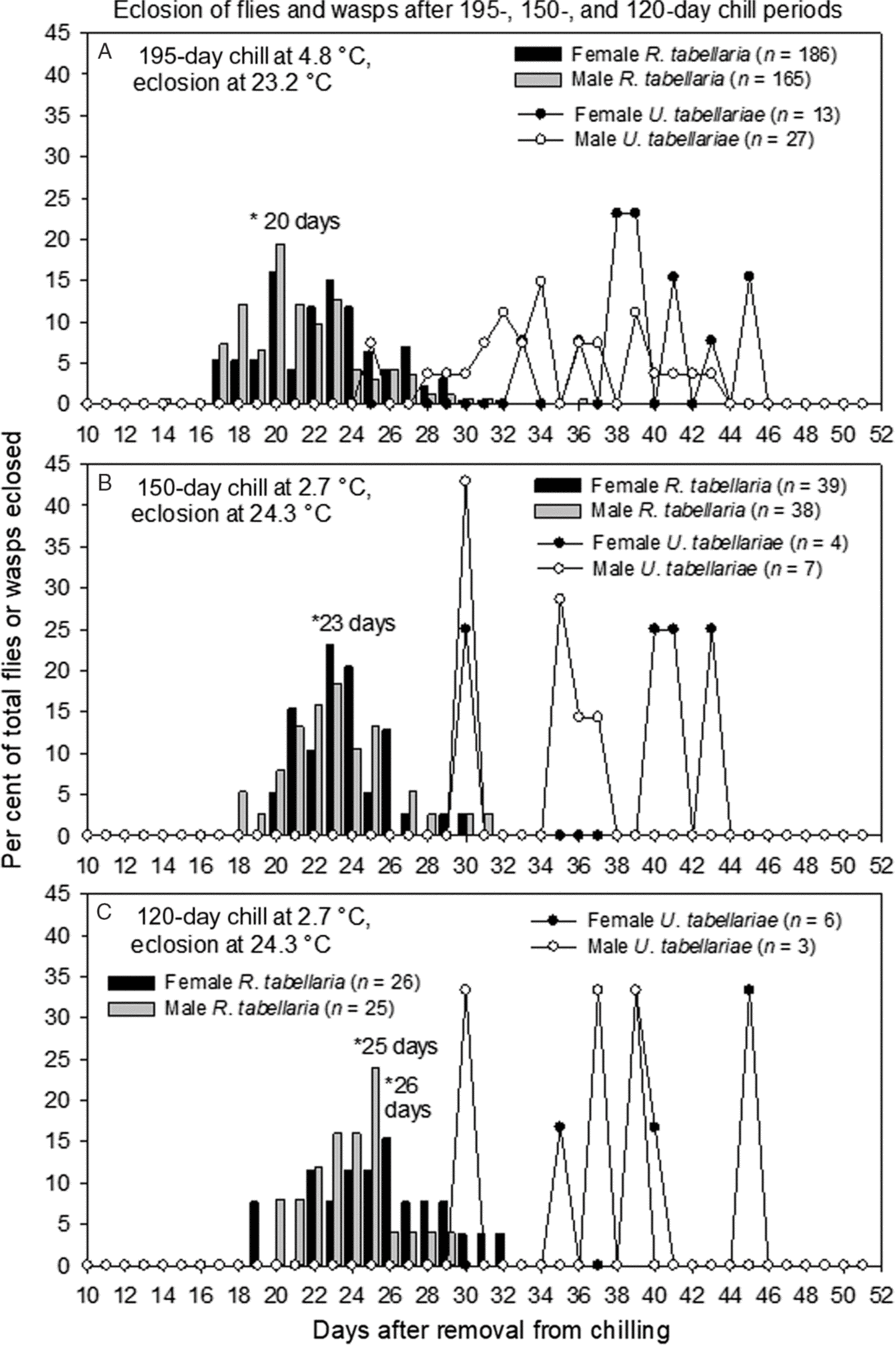
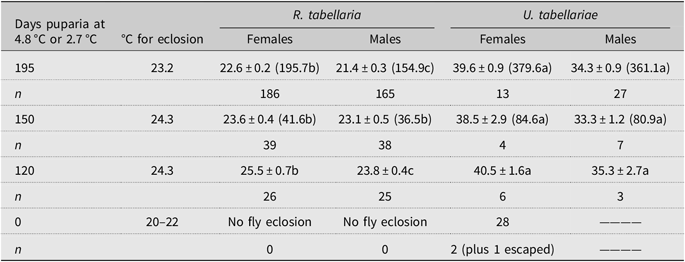
When R. tabellaria puparia were chilled at 4.8 °C for 195 days and held at 23.2 °C (Fig. 1A), eclosion of adult females occurred at 17–32 day postchilling (16-day span) and males at 14–36 days (23-day span), with peaks at 20 days for both sexes. Flies eclosed on average earlier than U. tabellariae, which eclosed from 25–45 days (21-day span; sexes combined) with a peak at 38 days (Fig. 1A). Male flies eclosed earlier than female flies and both eclosed earlier than wasps of both sexes (χ 2 = 114.74; df = 3; P < 0.0001) (Table 1). Male wasps eclosed approximately five days before females, although the difference was not significant (Table 1). One U. canaliculatus eclosed at 63 days, the only individual of this species identified to eclose after chilling in the current study.
Eclosion times of female and male Rhagoletis tabellaria and the parasitoid wasp Utetes tabellariae collected from Washington and Montana, United States of America, after (A) 195-day chill treatment at 4.8 °C and maintenance at 23.2 °C (three sites) and (B) 150-day (three sites) and (C) 120-day chill treatment (two sites) at 2.7 °C and maintenance at 24.3 °C. Puparia were held for 14 days at 22–24 °C before chilling. Numbers with asterisks above bars indicate peak eclosion days for R. tabellaria.

Mean eclosion times (days) ± standard error of female and male Rhagoletis tabellaria and its parasitoid wasp Utetes tabellariae from Washington and Montana (United States of America) experiencing different combinations of rearing conditions, including the duration and temperature of the overwintering chilling period (195, 150, 120, or 0 days, at 4.8 °C or 2.7 °C) and temperature following chilling (24.3 °C, 23.2 °C, or 20–22 °C).

Note: Values within rows (means, or ranks inside parentheses when data not normal) followed by the same letter are not significantly different (P > 0.05).
n, number of individual R. tabellaria or U. tabellariae that eclosed. Rhagoletis tabellaria puparia from Cornus sericea berries collected at three sites: one location in Roslyn (Washington); two or three in Nile (Washington); one in Montana. Numbers inside parentheses are ranks of days when data were not normal. Utetes tabellariae eclosion is reported in terms of the number of days after fly puparia formed.
Of the 466 fly puparia collected, 80.0% produced surviving adult flies (75.3% based on Fig. 1A, which did not include 22 flies that eclosed but whose eclosion dates could not be verified). Based on the U. tabellariae eclosion data, the percentage of fly puparia parasitised by wasps was 10.7%.
Eclosion of Rhagoletis tabellaria and Utetes tabellariae, 150-day and 120-day chill
When R. tabellaria puparia were chilled at 2.7 °C for 150 days and held at 24.3 °C (Fig. 1B), eclosion occurred at 20–30 days (11-day span) for females and 18–31 days (14-day span) for males, peaking at 23 days for both sexes. Both sexes eclosed significantly earlier than female and male U. tabellariae (χ 2 = 28.67; df = 3; P < 0.0001) (Table 1), which eclosed at 30–43 days (14-day span; sexes combined), with a peak at 30 days. Male wasps eclosed approximately five days earlier than females, although the difference was not significant (Table 1).
When R. tabellaria puparia were chilled at 2.7 °C for 120 days and held at 24.3 °C (Fig. 1C), eclosion occurred at 19–32 days (14-day span) for females and at 20–29 days (10-day span) for males, peaking at 25 days for males and 26 days for females. Male flies eclosed earlier than females and both sexes eclosed significantly earlier than female and male U. tabellariae (F = 13.97; df = 3, 56; P < 0.0001) (Table 1, Fig. 1C), which eclosed at 30–45 days (16-day span), with peaks at 30–45 days (due to low sample size). Male wasps eclosed approximately five days earlier than females, but the difference was not significant (Table 1). However, when 195-day, 150-day, and 120-day chill treatments were each considered an observation and analysed using a paired t-test, male wasps eclosed significantly earlier (34.3 ± 0.6) than female wasps (39.5 ± 0.6) (t = 101.29; df = 2; P < 0.0001).
To test for differences between the 150-day and 120-day chill treatments, data for female and male R. tabellaria (P > 0.05) were combined. Flies eclosed on average 1.4 days earlier in the 150-day than 120-day chill treatment, with means of 23.3 ± 0.3 versus 24.7 ± 0.4 days, respectively (rank, 150 days: 57.3; 120 days: 75.4) (χ 2 = 7.47; df = 1; P = 0.0063). In addition, 74.8% of 150-day chill puparia (n = 103) produced flies, whereas only 51.0% of 120-day chill puparia (n = 100) did (χ 2 = 12.29; df = 1; P = 0.0005).
There was no significant difference in mean days to eclosion between U. tabellariae experiencing 150-day versus 120-day chill treatments (sexes combined) (F = 2.86; df = 1, 18; P = 0.1082), although numerically wasps eclosed earlier in the 150-day chill treatment (Table 1; Fig. 1B–C). In contrast to fly eclosion rates, there was no significant difference in wasp eclosion rates per fly puparium (per cent of fly puparia producing U. tabellariae) in the 150-day (10.7%) versus 120-day chill treatment (9.0%) (P > 0.05).
Ninety-two and 77 fly puparia were recovered from soil in the 150-day and 120-day treatment cups, respectively. One live fly pupa was found in the 120-day chill treatment, while two dead adult U. tabellariae were found inside fly puparia in each treatment. Based on the number of dead and eclosed U. tabellariae (Fig. 1), 84.6 and 81.8% of 150-day and 120-day chill U. tabellariae, respectively, survived the experimental treatments and eclosed in the study.
Eclosion of Rhagoletis tabellaria and Utetes tabellariae, 0-day chill
When R. tabellaria puparia were not chilled but kept at 20–22 °C after puparial formation, none of the 198 puparia generated from fruit collected in Roslyn and Nile eclosed as nondiapause, direct developing adults. However, at 28 days postfly pupariation, three U. tabellariae wasps (two were females) eclosed from these 198 puparia (= 1.5%). In addition, at 29 days, five U. canaliculatus (two were females) eclosed from nonchilled puparia from a fruit collection made on 14 August 2018 in Nile, accounting for 2.5% of the puparia collected.
Of 188 puparia recovered from soil in cups in the no-chill treatment from Roslyn and Nile, 85.1% (160) contained live fly pupae. Of the remainder, 8.0% (15) contained dead pupae or were empty due to wasp eclosion, and 6.9% (13) contained live wasp larvae (presumably U. tabellariae). In total, puparia from the no-chill treatment produced or had 16 U. tabellariae or other wasps, so at least 18.8% (3) of U. tabellariae were nondiapausing.
Adult Rhagoletis tabellaria and Utetes tabellariae longevity
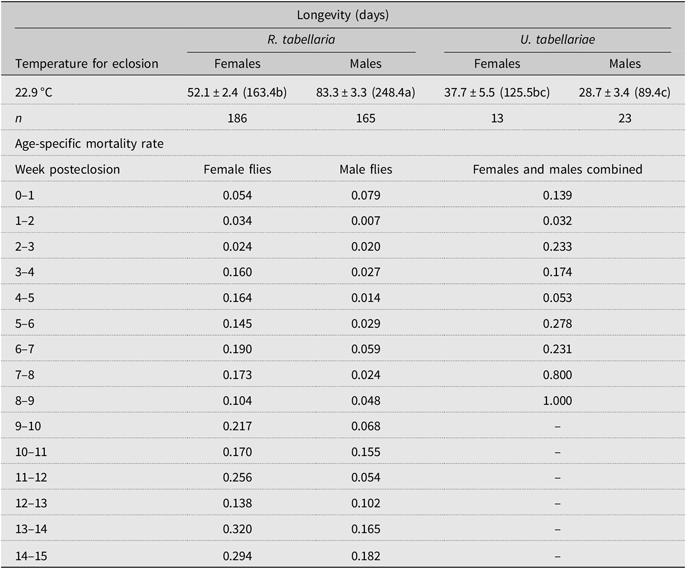
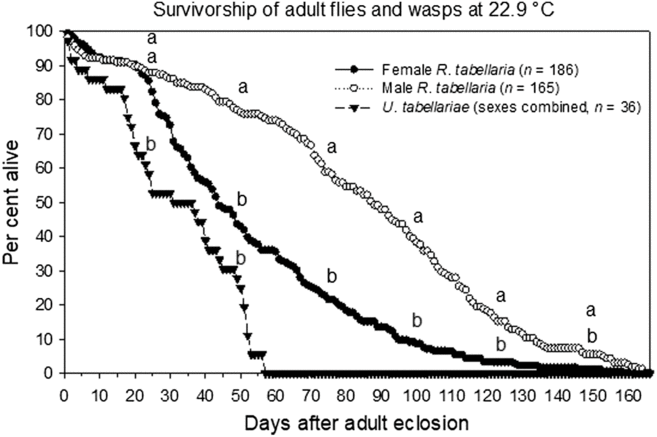
When held at 22.9 °C, male R. tabellaria lived longer on average than female R. tabellaria and both sexes of U. tabellariae, while female flies lived longer than male U. tabellariae (χ 2 = 78.01; df = 3; P < 0.0001) (Table 2). The longest-lived female fly, male fly, and U. tabellariae (one male and one female) survived 159, 165, and 57 days, respectively. The survivorship curve shape of female flies was concave, while that of male flies was convex (Fig. 2). The per cent female and male flies alive at 25 days did not differ, but the percentages of males alive at 50, 75, 100, 125, and 150 days were greater than those for females (Fig. 2). Age-specific mortality (Carey et al. Reference Carey, Liedo, Orozco, Tatar and Vaupel1995) (weekly rather than daily for ease of interpretation) indicated mortality of females was greater than of males throughout most of their life spans (Table 2).
Life spans and age-specific mortality in the laboratory of female and male Rhagoletis tabellaria and its wasp parasitoid Utetes tabellariae collected from Washington and Montana (United States of America).

Note: See Materials and methods for details or rearing conditions. Results are reported for mean longevity ± standard error and age-specific mortality 1–15 weeks posteclosion. Within the row for longevity, mean ranks (inside parentheses) followed by a same letter are not significantly different (P > 0.05).
Last wasp died in week 8–9.
Laboratory survivorship of adult female and male Rhagoletis tabellaria and the parasitoid wasp Utetes tabellariae (sexes combined to increase sample size) collected from Washington and Montana, United States of America (three sites). Survivorship percentages at 25, 50, 75, 100, 125, and 150 days with the same letter are not significantly different (P > 0.05). Tests of multiple proportions, at 25 days: χ 2 = 24.60; df = 2; P < 0.0001; 50 days: χ 2 = 54.40; df = 2; P < 0.0001; Test of two proportions (since zero survival for U. tabellariae), at 75 days: χ 2 = 51.07; df = 1; P < 0.0001; 100 days: χ 2 = 43.86; df = 1; P < 0.0001; 125 days: χ 2 = 15.44; df = 1; P < 0.0001; 150 days: χ 2 = 5.52; df = 1; P = 0.0188.

Per cent of female and male flies alive was greater than that of wasps at 25 days. However, only per cent of male flies alive was greater than that of wasps by 50 days (Fig. 2). Age-specific mortality forU. tabellariae (sexes combined) up to eight weeks posteclosion was relatively high, being > 0.100 for six of eight intervals (Table 2).
Discussion
For R. tabellaria, longer chill durations result in earlier mean eclosion times for adult flies, albeit eclosion curves showed temporal overlap and time differences were only approximately 10% of the means. A similar relationship has been reported for R. pomonella (Neilson Reference Neilson1962), R. indifferens (Brown and AliNiazee Reference Brown and AliNiazee1977), Rhagoletis cingulata (Loew) (Rull et al. Reference Rull, Tadeo, Lasa and Aluja2017), and R. completa (Rull et al. Reference Rull, Lasa, Guillén and Aluja2019). Eclosion of 195-day chill R. tabellaria flies was not statistically different compared with that of 150-day and 120-day chill flies because of the slightly different chilling and adult rearing temperatures used between experiments. However, numerically, 195-day chill flies eclosed slightly earlier at 23.2 °C than the 150-day and 120-day chill flies held at 24.3 °C postchilling, in accord with the chill duration effect. If there was no chill effect, the 23.2 °C temperature may have slightly delayed adult eclosion, which was not the case.
The similar eclosion time responses of R. tabellaria and R. indifferens in the Pacific Northwest to chill duration (Yee et al. Reference Yee, Goughnour, Hood, Forbes and Feder2015a) may have evolved because ancestral hosts of both flies (red osier dogwood and bitter cherry, respectively) live in the same sites and thus are adapted to the same climate. The ripening of host fruit of both flies overlaps in July and August, so eclosion times of the flies must also overlap. Accordingly in the laboratory, R. indifferens puparia held at 3 °C for 100–150 days took 10–12 days for 80% eclosion (Brown and AliNiazee Reference Brown and AliNiazee1977) while similarly, R. tabellaria puparia held at 2.7 °C for 150 and 120 days took eight and nine days, respectively, for 80% eclosion. Any differences in the eclosion responses of the species could possibly be due to the recent adaptation by R. indifferens to cultivated sweet cherry, whose fruit develop earlier than that of both red osier dogwood and bitter cherry. As R. tabellaria populations in the current study were sampled from small portions of the geographic range of R. tabellaria, the pertinence of these interpretations to other fly populations remains to be seen.
Rhagoletis tabellaria when unchilled as a pupa produced 0% adult eclsoion, so the fly appears to be a rigid diapauser. In this regard, R. tabellaria is similar to R. indifferens, which when unchilled as a pupa produces 5.5, 5–10, or 3.3% adult eclosion (Frick et al. Reference Frick, Simkover and Telford1954; AliNiazee Reference AliNiazee and AliNiazee1988; Neven and Yee Reference Neven and Yee2017), and to R. zephyria, which when unchilled as a pupa produces approximately 1% adult eclosion (J.L.F. and W.L.Y. unpublished data). The need for chilling before eclosion could partially explain the northerly distribution of R. tabellaria (Bush Reference Bush1966), which does not match the distribution of red osier dogwood. Specifically, dogwood is found in areas scattered as far south as Arizona and New Mexico, United States of America, and in a few locations in Mexico (Little Reference Little1977), where R. tabellaria has not been reported. However, a systematic sampling effort might reveal R. tabellaria populations do exist in the southernmost range of red osier dogwood.
Results here for nonchilled R. tabellaria puparia were obtained from the puparia at 20–22 °C in the dark, assuming day length was unimportant in diapause development. Whether long day length would have caused R. tabellaria to eclose without chilling needs study. However, 20.4% of R. pomonella pupae (n = 539) as well as a 0.86% of R. zephyria (n = 2689) collected at the same sites as R. tabellaria and all held in the same dark incubator eclosed 92–106 days after pupariation (W.L.Y. unpublished data).
While no nonchilled R. tabellaria puparia produced flies, at least 18.8% of nonchilled U. tabellariae eclosed, suggesting the fly and wasp respond differently to lack of chilling. Eclosion before chilling may most benefit the wasp only if some R. tabellaria also eclose without chilling. Therefore, pre-winter wasp eclosion in the absence of R. tabellaria larvae could force the wasps to exploit later-developing fly species in non-red osier dogwood fruit. Incidentally, bitter cherry fruit develop around the same time as dogwood fruit at the Roslyn site and U. tabellariae and U. canaliculatus have never been reared from R. indifferens (Yee et al. Reference Yee, Goughnour, Hood, Forbes and Feder2015a).
The R. tabellaria-U. tabellariae system appears similar to the R. zephyria-Utetes lectoides (Gahan) system in that very few R. zephyria do not diapause, while many U. lectoides do not undergo diapause, either when held at 14:10 light-dark hours or in the dark (J.L.F. and W.L.Y. unpublished data). Why all Rhagoletis parasitoids studied to date appear susceptible to nondiapause development while fly species vary is an open question. One possibility is that it is a pleiotropic consequence of parasitoids developing faster before winter than flies and, as a result, being prone to continuing development to the adult stage if not halted by cold temperatures. However, its adaptive significance if any is unclear.
The most important difference in fly and wasp eclosion traits is the later eclosion of wasps than flies after prolonged chill periods. Even though there was overlap in fly and wasp eclosion times for some individuals, the mean times that wasps eclosed were always later than the means for flies. Later eclosion times of wasps appears to be the general pattern for wasps attacking Rhagoletis flies (Forbes et al. Reference Forbes, Powell, Stelinski, Smith and Feder2009; Hood et al. Reference Hood, Forbes, Powell, Egan, Smith and Feder2015; Yee et al. Reference Yee, Goughnour, Hood, Forbes and Feder2015a). Although there are no data documenting the time window when U. tabellariae lay their eggs in the eggs or larvae of R. tabellaria, differences in eclosion traits probably arose because wasps had to synchronise eclosion times with when fly eggs and larvae are present, not when adult flies eclose. This may be reflected in responses to chill length as well. Although the slightly earlier eclosion time for U. tabellariae in the 150-day than 120-day chill treatment was not significant, this may have been due to wasp sample sizes being small. Eclosion times of the major parasitoid of R. indifferens, Diachasma muliebre (Muesebeck), were shorter after longer chill durations (Yee et al. Reference Yee, Goughnour, Hood, Forbes and Feder2015a).
The 10–17 day lag between mean R. tabellaria and mean U. tabellariae eclosion was much shorter than between R. indifferens and D. muliebre, which was 31.1 days (Yee et al. Reference Yee, Goughnour, Hood, Forbes and Feder2015a). In addition, lag times between mean eclosion of R. mendax, R. pomonella, R. zephyria, and R. cingulata and of their parasitoids were approximately 20–45 days (Diachasma alloeum (Muesebeck), U. canaliculatus, and Diachasmimorpha mellea (Gahan) for R. mendax and R. pomonella; D. alloeum and U. canaliculatus for R. zephyria; D. mellea for R. cingulata) (Hood et al. Reference Hood, Forbes, Powell, Egan, Smith and Feder2015). Differences in lag times in the current study and those reported elsewhere could be due to different chill temperatures or durations among experiments or reflect actual differences in wasp species responses to chill units. If the latter is the case, then eclosion time traits of different wasp species could depend on the fruiting phenology of the fly host. Another possible explanation for the short lag time in the R. tabellaria-U. tabellariae system is that U. tabellariae could attack and track eggs or earlier-stage larvae than other wasps, but the exact stage the wasp parasitises is unknown.
Female R. tabellaria did not survive as long as males, but for both sexes, survival to reproductive age (presumably 1–2 weeks posteclosion in females) in the laboratory was high. After reproductive maturity, however, there was a steeper decline in survival of females than males in almost all age intervals, a trend not seen in all tephritids (e.g., in Ceratitis capitata (Wiedemann); Carey et al. Reference Carey, Liedo, Orozco, Tatar and Vaupel1995). Perhaps R. tabellaria females have metabolically more active tissues than males, related to egg development or egg resorption, reducing their longevity. Among some insects, females tend to live longer than males that are heterogametic, including Drosophila Fallén (Diptera: Drosophilidae) (Tower and Arbeitman Reference Tower and Arbeitman2009; Linford et al. Reference Linford, Bilgir, Ro and Pletcher2013). However, this does not appear true for R. tabellaria, at least in the laboratory, as males are the heterogametic sex in this species (Berlocher Reference Berlocher1993).
Despite the apparent need to survive only a few weeks, U. tabellariae is a long-lived parasitoid in the laboratory, surviving for more than 28 days on average, suggesting a liquid sucrose diet is optimal for this species. In contrast, mean longevity of D. alloeum, U. canaliculatus, and D. mellea provided water and food in the laboratory was only 12.9, 9.54, and 12.21 days, respectively (Forbes et al. Reference Forbes, Powell, Stelinski, Smith and Feder2009; Hood et al. Reference Hood, Forbes, Powell, Egan, Smith and Feder2015). In addition, Utetes anastrephae (Viereck) on average survived less than 10 days when provided honey (Stuhl et al. Reference Stuhl, Cicero, Sivinski, Teal, Lapointe, Paranhos and Aluja2011), and less than six days without food and water (Poncio et al. Reference Poncio, Montoya, Cancino and Nava2018). If U. tabellariae does survive long periods in nature, then this in addition to the nondiapause trait (discussed above) could further allow individuals to exploit late-developing R. tabellaria or other fly species that develop as larvae in late summer.
Results here can form the basis for testing various hypotheses. One is whether R. tabellaria and other species in its complex are reproductively isolated due to allochronic eclosion. In Montana near our red osier dogwood collection location, R. persimilis (identified as R. tabellaria in Yee et al. Reference Yee, Lawrence, Hood and Feder2015b by W.L.Y.) occurs in fairy bells that may have a slightly different fruiting phenology than red osier dogwood. With identification of a R. persimilis population co-occurring with R. tabellaria, tests to determine eclosion time differences in flies and their associated wasps are possible.
Our results can also form a basis for testing factors associated with the apparently lower abundance of R. tabellaria than R. indifferens reported in the literature (Frick et al. Reference Frick, Simkover and Telford1954; Madsen Reference Madsen1970) and based on field trapping at Roslyn. At the Roslyn site, five traps in red osier dogwood bushes monitored from 29 June to 4 September 2018 resulted in the capture of only 83 R. tabellaria versus over 500 R. indifferens (W.L.Y. unpublished data). Our findings here seem to discount differences in fly eclosion rates, longevity (Yee Reference Yee2003), and parasitism (Yee et al. Reference Yee, Goughnour, Hood, Forbes and Feder2015a) between the species as factors responsible for R. indifferens being trapped more often on the natal host of R. tabellaria. Thus, future studies might focus on factors associated with larval survival in red osier versus cherry host fruit as well as fruit abundance, distribution of plants, and length of availability of fruit to help explain the discrepancy in the abundance of the two species in nature.
The finding of U. canaliculatus parasitising R. tabellaria in the western United States of America is surprising even though this fly-parasite association has been reported in the eastern United States of America (Wharton and Marsh Reference Wharton and Marsh1978). Utetes canaliculatus commonly attacks R. pomonella (Rivard Reference Rivard1967; Forbes et al. Reference Forbes, Hood and Feder2010), but also parasitises R. zephyria, a species near R. pomonella (infesting Cornus florida Linnaeus, flowering dogwood), and R. mendax × R. zephyria hybrids (Forbes et al. Reference Forbes, Hood and Feder2010). Utetes canaliculatus shares behavioural and diapause traits with U. tabellariae in its use of R. tabellaria and its ability to eclose without chilling. Thus, we suspect that some other aspect of the natural history of the two parasitoids may differ, as U. tabellariae is the more common parasite of R. tabellaria.
In conclusion, our results suggest that diapause and developmental traits of R. tabellaria are more dependent on chilling durations and less flexible than those of U. tabellariae. The inflexible diapause requirements of R. tabellaria seem most similar to those of R. indifferens and R. zephyria among Rhagoletis in western North America. As U. tabellariae apparently only parasitises members of the R. tabellaria species complex (Forbes et al. Reference Forbes, Hood and Feder2010; Hamerlinck Reference Hamerlinck2015), wasp eclosion timing and longevity may be adapted to attacking R. tabellaria flies and differ from those of wasps attacking Rhagoletis in other species complexes.
Acknowledgements
We thank Janine Jewett (United States Department of Agriculture-Agricultural Research Service, Wapato, Washington) for laboratory assistance, Tom Lawrence for help with Montana fruit collections, Glen Hood (Wayne State University, Michigan, United States of America) and Juan Rull (Planta Piloto de Procesos Industriales Microbiológicos Biotecnología- Consejo Nacional de Investigaciones Científicas y Técnicas, Laboratorio de Investigaciones Ecoetologicas de Moscas de la Fruta y sus Enemigos Naturales División, Control Biologico de Plagas, Tucumán, Argentina) for reviewing early drafts of the manuscript, and three anonymous reviewers for suggestions that helped improve the manuscript. W.L.Y. was funded in part from a grant from United States Department of Agriculture – Foreign Agricultural Service; J.L.F. was funded in part from grants from the National Institute of Food and Agriculture – United States Department of Agriculture and National Science Foundation.