INTRODUCTION
The smalleyed roundray, Urotrygon microphthalmum (Delsman, Reference Delsman1941), is a small species that reaches a total length of 30 cm (McEachran & Carvalho, Reference McEachran, Carvalho and Carpenter2000) and achieves sexual maturity at around 23 cm (Almeida et al., Reference Almeida, Nunes and Costa2000). This species occurs in shallow, coastal waters of the tropical Western Atlantic, feeding on benthic organisms and plankton, and is considered an opportunistic predator, based on studies of its feeding habits (Almeida et al., Reference Almeida, Nunes and Costa2000). The smalleyed roundray has been recorded in Venezuela, Suriname and French Guyana as well as Brazil, where it occurs off the States of Amapá, Pará, Maranhão, Ceará, Paraíba and Pernambuco (Rosa, Reference Rosa2004; Santander-Neto et al., Reference Santander-Neto, Nunes and Lessa2009).
This paper describes a case of hermaphroditism in a specimen of Urotrygon microphthalmum caught on the coast of the State of Pernambuco (north-eastern Brazil).
MATERIALS AND METHODS
Seventy-one specimens of the smalleyed roundray, Urotrygon microphthalmum (1.21♀:1♂), were caught between February and May 2010 by artisanal vessels in the municipality of Candeias, State of Pernambuco, Brazil (8°11′43″S 34°54′13″W). The coastal zone in which the catches were made is characterized by a narrow, relatively flat continental shelf, with the bottom composed of mud, quartz sand and calcareous algae (Kempf, Reference Kempf1970). The target of the fishery is shrimp, with catches performed using a 10 m bottom gill-net, with a 20 mm mesh in the body and 15 mm in the bag.
The specimens were weighed and sexed, with records made of total length (TL, mm), disc width (DW, mm) and total weight (TW, g). The specimens were dissected in the abdominal region and the gonads were removed to determine the development stage.
The classification of the type of hermaphroditism (normal or abnormal) was based on Atz (Reference Atz, Armstrong and Marshall1964).
RESULTS
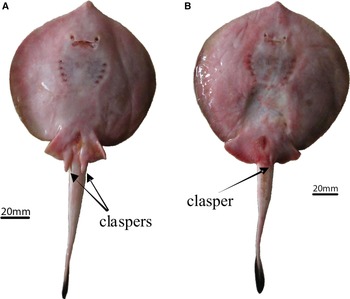
In February 2010, a hermaphroditic specimen of Urotrygon microphthalmum (TL = 232.4 mm; DW = 123.1 mm; TW= 81.97 g) was caught having the external appearance of a male with an abnormality: the left clasper was atrophied and no clasper was associated with the right pelvic fin (Figure 1).
Ventral view of male specimens of smalleyed roundray, Urotrygon microphthalmum: (A) normal male (total length = 204.15 mm); (B) hermaphroditic specimen (total length = 232.4 mm); copulatory organs (claspers) indicated by arrows.

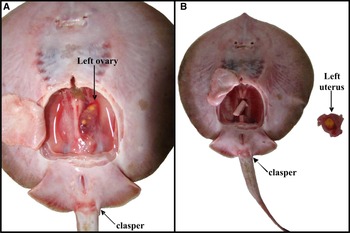
Internally, the specimen had only female reproductive organs. The right ovary was not functional, as reported for some rays in this group (Wourms, Reference Wourms1977; Hamlett & Koob, Reference Hamlett, Koob and Hamlett1999). The left ovary had yellow oocytes (≤ 2.7 mm) (Figure 2A). The left uterus had a yellow ovum (5.85 mm) (Figure 2B), indicating that the individual was in the first stage of pregnancy (White et al., Reference White, Platell and Potter2001).
Hermaphroditic specimen of smalleyed roundray, Urotrygon microphthalmum exhibiting: (A) left ovary with follicles; (B) left uterus with ovum.

DISCUSSION
Hermaphroditism is defined as the presence of both male and female genitalia in a single individual and is rarely found in elasmobranchs (Atz, Reference Atz, Armstrong and Marshall1964), which exhibit a wide variety of means of reproduction, but all are considered gonochoristic (Delvin & Nagahama, Reference Delvin and Nagahama2002). ‘Normal hermaphroditism is that which exists in a uniform manner at some time during the ontogeny of the totality or several members of a species, whereas all other forms of hermaphroditism are, by definition, abnormal' (Atz, Reference Atz, Armstrong and Marshall1964).
Based on the external presentation of a clasper and the internal female reproductive tract, the individual was considered a pseudo-hermaphrodite (Harder, Reference Harder1975).
Elasmobranchs perform internal fertilization and the presence of copulatory organs (claspers) is an exclusive characteristic of males. The presence of a single clasper has been recorded for Raja miraletus and Pteroplatytrygon violacea (Quignard & Capapé, Reference Quignard and Capapé1972; Ribeiro-Prado et al., Reference Ribeiro-Prado, Oddone, Amorim and Capapé2009), whereas the presence of claspers as well as developed ovaries has been recorded in Rhinobatos horkelii and Bathyraja interrupta (Gianeti & Vooren, 2007; Haas & Ebert, Reference Haas and Ebert2008). The presence of claspers indicates that the individual is genetically a male, but the tissue response to hormones at the onset of development may have caused the anomaly through the sexual differentiation of the gonads (Chieffi, Reference Chieffi1959; Dodd, Reference Dodd, Hoar, Randall and Donaldson1983).
Hermphroditism in elasmobranchs is considered rare in comparison to teleosts (Atz, Reference Atz, Armstrong and Marshall1964). This rarity may reflect the lesser diversity in the former group in relation to the latter group. In most cases of hermaphroditism, one or both claspers are found (developed or not) externally and a variety of forms are found internally, such as the presence of male and female structures in a single gonad, separate male and female gonads on each side of the cavity or only female gonads (Quignard & Capapé, Reference Quignard and Capapé1972; Yano, Reference Yano1995; Iglésias et al., Reference Iglésias, Sellos and Nakaya2005; Jones et al., Reference Jones, White and Potter2005; Gianeti & Vooren, 2007; Scenna et al., Reference Scenna, Díaz de Astarloa and Cousseau2007; Haas & Ebert, Reference Haas and Ebert2008; Braccini, Reference Braccini2009; Jones & Potter, Reference Jones and Potter2009; Ribeiro-Prado et al., Reference Ribeiro-Prado, Oddone, Amorim and Capapé2009). Hermaphroditism different from the majority of cases is reported in Centroscymnus coelolepis, with the absence of claspers but both the male and female reproductive tract being found internally (Veríssimo et al., Reference Veríssimo, Gordo and Figueiredo2003).
The only species of elasmobranch reported with normal hermaphroditism is Apristurus longicephalus, with 85% of individuals exhibiting this characteristic (Iglésias et al., Reference Iglésias, Sellos and Nakaya2005). Etmopterus unicolor is not reported as a normal hermaphrodite, but the relatively high occurrence of this characteristic in one sample (~23%) and the presence of one specimen that contained both ovarian and testicular tissues in the left gonad (Yano & Tanaka, Reference Yano and Tanaka1989) suggest that this species could be classified as exhibiting normal hermaphroditism as observed by Capapé et al. (Reference Capapé, El Kamel-Moutalibi, Mnasri, Boumaïza and Reynaud2012).
In the present study, Urotrygon microphthalmum exhibited abnormal hermaphroditism. Along with other records of hermaphroditism in elasmobranchs, this finding indicates a need for more detailed investigations into this event in order to determine the mechanism that causes this anomaly. A number of authors suggest that such events may stem from unfavourable environmental conditions, such as radioactive contamination (Yano & Tanaka, Reference Yano and Tanaka1989), pollutants that may accumulate in the benthic region, which is the habitat of rays and skates (Ribeiro-Prado et al., Reference Ribeiro-Prado, Oddone, Amorim and Capapé2009), and consanguinity within the population.
The majority of cases of hermaphrodites in chondrichthyans are sharks as noted by Capapé et al. (Reference Capapé, El Kamel-Moutalibi, Mnasri, Boumaïza and Reynaud2012) but in Brazil only rays have been recorded with this anomaly until the present. Due to the diversity and abundance of the elasmobranch fauna in Brazil (Lessa et al., Reference Lessa, Santana, Rincón, Gadig and El-Deir1999), the scarce records of hermaphrodites (U. microphthalmum, Rhinobatos horkelii and Pteroplatytrygon violacea) may be due to the incipient level of knowledge about the subject in the region rather than the low occurrence of this anomaly in the populations studied.
ACKNOWLEDGEMENTS
The Brazilian Research Council (CNPq) provided a Productivity Research Grant to the senior author (R.L.) (Proc: 303251/2010-7). The Brazilian fostering agency Fundação de Amparo à Ciência e Tecnologia do Estado de Pernambuco (FACEPE) supplied a Doctor of Science scholarship to J.S.-N. The authors are grateful to the Departamento de Pesca e Aquicultura of the Universidade Federal Rural de Pernambuco for available facilities and to the fishermen of the Pina Association. The authors are also grateful to the referees for useful comments that helped to improve the manuscript.