INTRODUCTION
During the second half of the third millennium bc, the first wheel-made pottery appeared in the Aegean region, disrupting the continuum of hand-forming techniques and introducing an important technological innovation in the history of potting practices.Footnote 1 However, the origins of this phenomenon and the specific mechanisms behind the adoption and transmission of the potter's wheel have until recently remained unexplored. Ceramic studies have hitherto mainly focused on typology and style, with what might be described as a prevailing ecological paradigm emerging in the framework of processual approaches.Footnote 2 According to this standard view of technology (Pfaffenberger Reference Pfaffenberger1992, 493–6), techniques are seen as a neutral human activity, devoid of any particular social and cultural meanings, and, for the most part, dominated by techno-functional constraints. Technical actions are thereby assumed to be ‘extra-somatic’ strategies of adaptation that operate outside of the social sphere, thus liable to physically respond to the socio-economic intentions.Footnote 3 This view of technology has resulted in an ahistorical understanding of techniques and in the alienation of craft actions from the socio-cultural grounding of their performance.Footnote 4 Furthermore, according to this view, technological variability and change typically is thought to follow a linear, cumulative, evolutionary trajectory, where the advantages of each technique act as driving forces for further technological progress and innovation.Footnote 5
In this framework, the appearance of wheel-made pottery in a particular archaeological region has been stereotypically and linearly associated with the invention or adoption of the wheel-throwing technique and the so-called fast wheel.Footnote 6 This approach stereotypically imbues the potter's wheel with a series of intrinsic techno-functional attributes enabling efficiency, standardisation and intensification in pottery production.Footnote 7
Pioneering work by Valentine Roux on the potter's wheel in the Levant from the fifth to the third millennia bc has, however, thoroughly revised this determinism and functionalism of technological approaches; strikingly, early Levantine wheel-made pottery was not wheel-thrown from a lump of clay but rather made by a wheel-coiling technique on rotary devices called tournettes (e.g. Courty and Roux Reference Courty and Roux1995; Roux Reference Roux, Rosen and Roux2009; Roux and Miroschedji Reference Roux and Miroschedji2009, 164–6). Such pottery was the outcome of a more complex phenomenon of technological hybridisation that merged the invention of the potter's wheel – what Roux has called Rotational Kinetic Energy (henceforth RKE) – with traditional hand-building techniques such as coiling (Roux Reference Roux2003; Reference Roux, O'Brien and Shennan2010b; Baldi and Roux Reference Baldi and Roux2016).
Roux's research, along with various other works that focused on the technical processes, highlighted an essential epistemological shift in material culture studies towards an anthropological view of techniques.Footnote 8 Through the revitalisation of the ideas of the anthropological French school of cultural technology,Footnote 9 archaeology has begun to conceive of technology as a ‘total social fact’,Footnote 10 an arena of social practices and cultural habits, and also an expression of politico-economic and social relations (Lemonnier Reference Lemonnier and Lemonnier1993, 4, 9; Dobrès and Hoffman Reference Dobrès and Hoffman1994, 216; Dietler and Herbich Reference Dietler, Herbich and Stark1998, 244–8; Dobrès Reference Dobrès, Dobrès and Hoffman1999, 125; Sillar and Tite Reference Sillar and Tite2000, 10). Instead of being neutral and a-cultural, technologies are unequivocally social phenomena grounded in particular historical contexts that determine ‘local’ ways of doing and consuming things (Gosselain and Livingstone Smith Reference Gosselain, Livingstone Smith, Bosquet, Livingstone Smith and Martineau2005, 42). The specific technical actions are embedded in the society: meaningful human actions where actors, materials, knowledge, skills, senses, products and worldviews are involved (Lemonnier Reference Lemonnier1986, 154; Van der Leeuw Reference Van der Leeuw and Lemonnier1993, 240–1).
The technique, for André Leroi-Gourhan (Reference Leroi-Gourhan1964, 164), ‘is at the same time gesture and tool organised in sequences by a true syntax which gives the operational series both their stability and their flexibility … the operational syntax is suggested by memory and emerges between the brain and the material milieu’.Footnote 11 Built on this definition that establishes the link between technology and human agency (Dobrès Reference Dobrès2000, 155–6; Dobrès and Robb Reference Dobrès and Robb2005, 163), the French anthropologists of techniques have provided archaeology with an essential methodological and epistemological tool known as the chaîne opératoire.Footnote 12 This concept offers a holistic view of the technical action by referring to the operational sequences that transform raw materials into products (Cresswell Reference Cresswell1983; Bensa and Cresswell Reference Bensa and Cresswell1996; see also Dobrès Reference Dobrès2000, 167–287; Dobrès and Robb Reference Dobrès and Robb2005; cf. Skibo and Schiffer Reference Skibo and Schiffer2008, 9–10, 20–2). Chaînes opératoires thus represent particular and context-specific processes perpetrated both by tangible components – such as raw materials, sources of energies, tools and ordered gestures – and intangible elements, such as intentions, social values and local cosmologies (Lemonnier Reference Lemonnier1980, 1; see also Coupaye Reference Coupaye and Soulier2015, 78–80). They are thus both a temporal and spatial activity, a dialectical tangling of material and immaterial agents that condition technological choices in specific socio-cultural, economic and ecological contexts (Lemonnier Reference Lemonnier and Lemonnier1993, 35; Ingold Reference Ingold2000, 314–19; Gosselain Reference Gosselain and Insoll2011b, 251). Viewed in this way, objects are the direct witnesses to craft behaviours that express an entire social system of knowing, conceiving and acting on the material world infused into technological traditions (Chevallier Reference Chevallier and Chevallier1991; Dietler and Herbich Reference Dietler, Herbich and Stark1998; Gosselain and Livingstone Smith Reference Gosselain, Livingstone Smith, Bosquet, Livingstone Smith and Martineau2005).
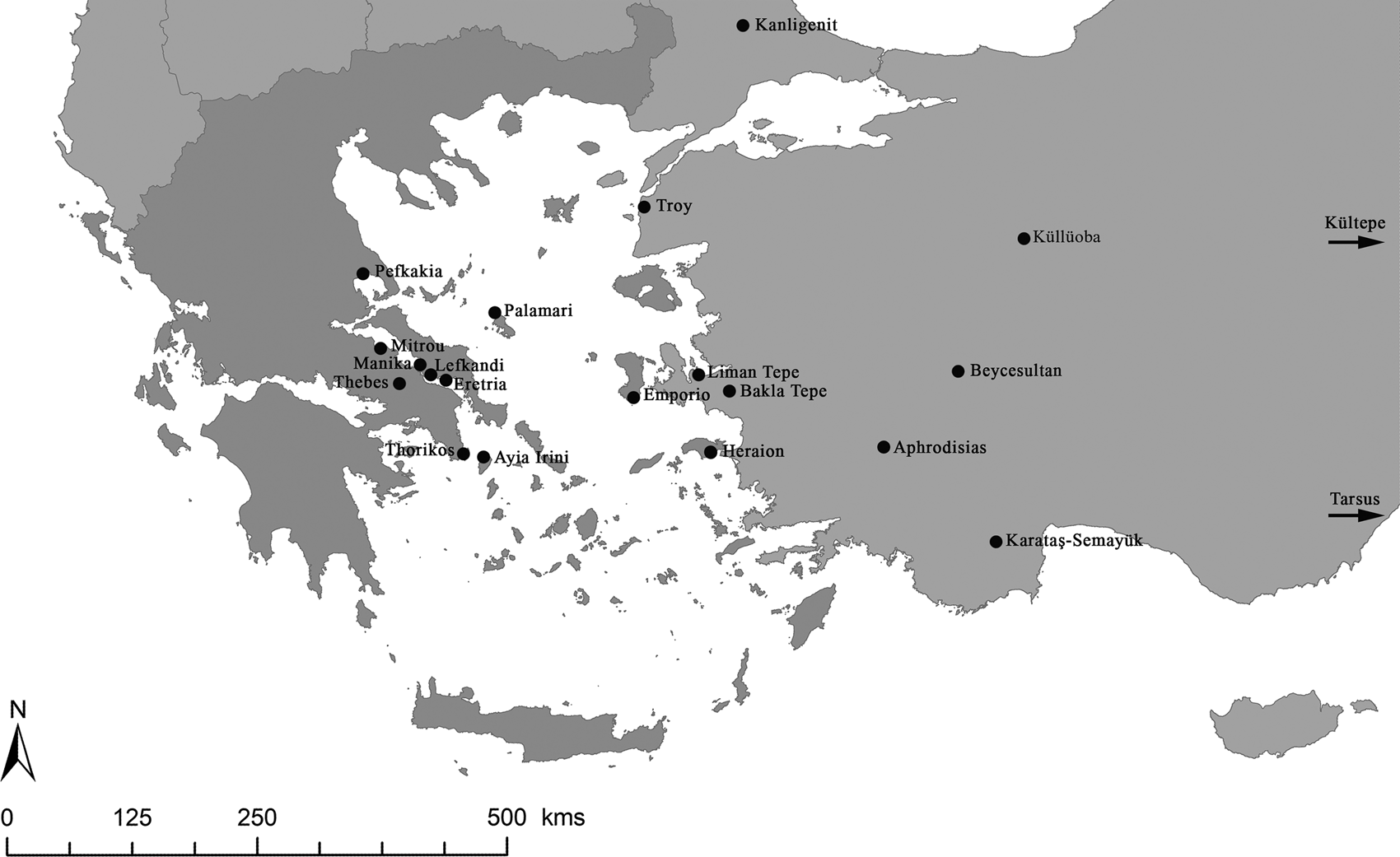
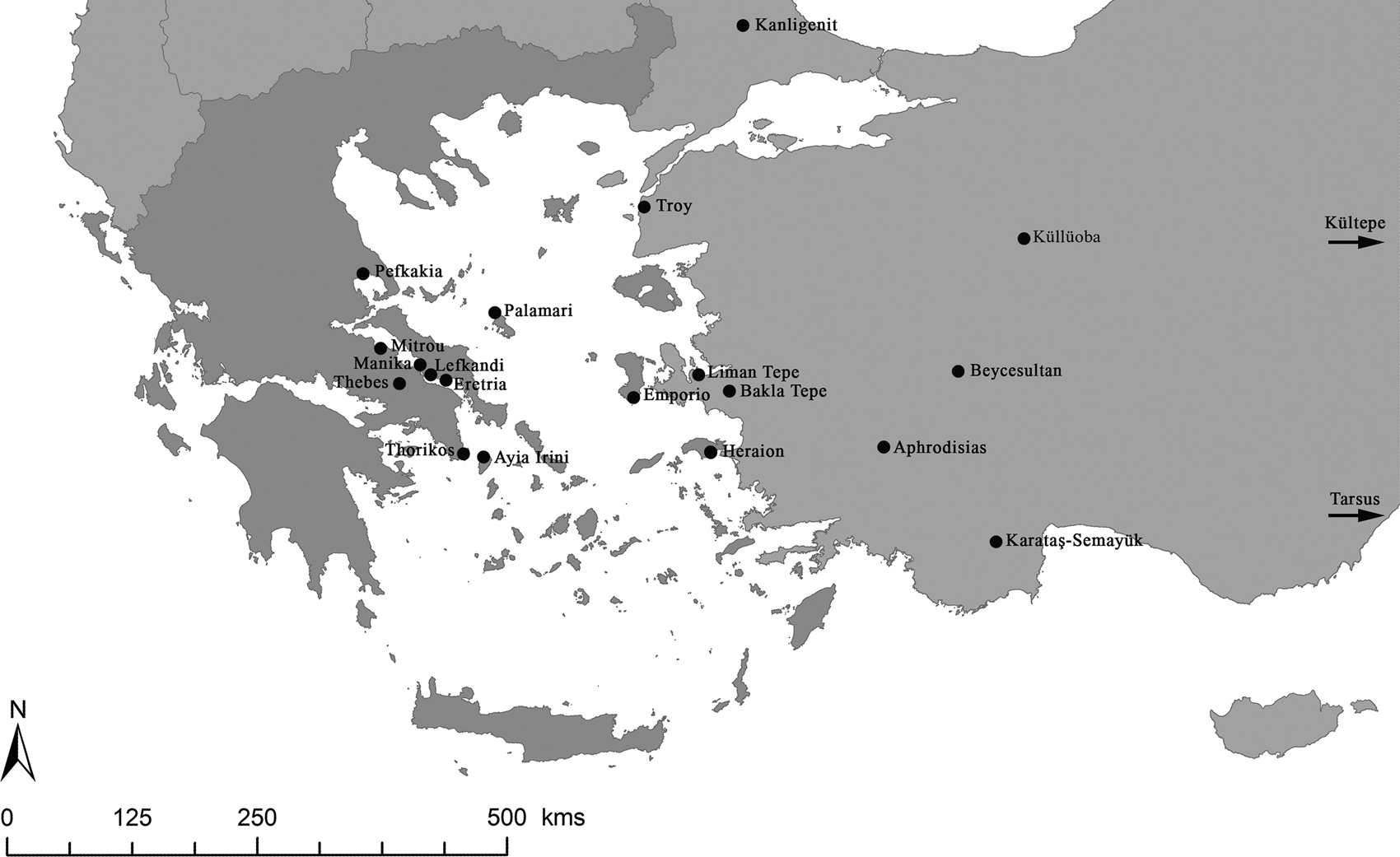
By adopting the chaîne opératoire approach as a theoretical and methodological framework for exploring the socio-technical dynamics of ancient technologies (Roux Reference Roux, Giligny and Méry2010a; Reference Roux2017), the current paper investigates the modalities behind the appearance and dissemination of the potter's wheel in the Aegean during the later phase of the Aegean Early Bronze Age II (henceforth late EBII), c. 2550–2200 bc. To explore this phenomenon, an extended technological study has been carried out, based on the comparative examination of ceramic assemblages from different Aegean sites in order to track the earliest wheel-made pottery and explore the craft behaviours perpetuated by the use of the potter's wheel across the Aegean. The paper thus draws on the wheel-made pots identified at nine representative settlements distributed over three regions: the northern Aegean (Troy), the eastern Aegean islands (Heraion on Samos and Emporio on Lesbos) and the central Aegean, including the coastal central eastern Greek mainland and neighbouring islands (Palamari on Skyros, Ayia Irini on Keos, Pefkakia in Thessaly, Lefkandi on Euboea, Thorikos in Attica and Mitrou in Phocis) (see Fig. 1 and Table 5). The methodology used was based on (a) the identification of macro-features on surfaces and sections of the pots that are indicative of forming and surface treatment techniques, (b) the macroscopic characterisation of fabrics, finishing and firing techniques, and (c) the typological and stylistic classifications of pottery.Footnote 13 By presenting the results of this multi-site study and discussing them together with the archaeological data from both sides of the Aegean, the aim is to (a) trace out the wheel-based technological traditions, (b) explore the socio-cultural context of their learning and transmission, (c) shed light on the regional and interregional connectivity among Aegean and western Anatolian communities that enabled the transfer of the new craft knowledge, and, finally, (d) bring into view the mechanisms behind its appropriation by communities in the Aegean during the late EBII.
Map of main sites preserving wheel-made pottery during the late EBII © map by Christine Spencer.
UNDERSTANDING THE POTTER'S WHEEL
Beyond hand-building: the different ways of using the wheel
The work of Roux on the potter's wheel in the Levant altered our understanding of this technological phenomenon, and does so in particular by recognising two significant moments in the history of the new potting technology: (a) the insertion of a new source of energy, i.e. RKE, into an existing operational sequence of manual techniques (e.g. coiling) and (b) the invention of wheel-throwing via the rotation of lumps of clays (Roux Reference Roux, O'Brien and Shennan2010b, 221–2, fig. 13:1; see also Gelbert Reference Gelbert, Audouze and Binder1994; Reference Gelbert1997). The identification of a transitional wheel-fashioning technique, in between hand-forming and wheel-throwing, emphasised how non-linear and discontinuous the evolution of the wheel innovation might have been in time and space (Roux Reference Roux2003; Reference Roux, Stark, Bower and Horne2008; Reference Roux, O'Brien and Shennan2010b). Such evidence therefore has led scholars of the prehistoric Aegean to look more closely for the particular ways in which the new tool was employed within the context of traditional potting practices.Footnote 14
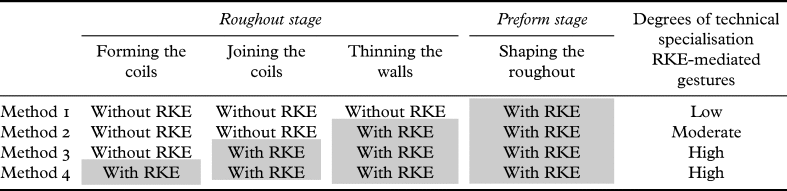
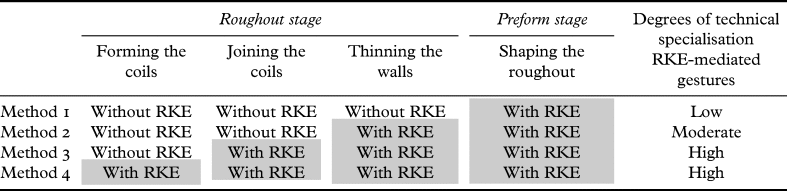
In order to investigate the possible ways of fusing the physical modalities of the coiling technique (the source of energy produced by manual discontinuous pressures on the clay) with those perpetuated by the use of a rotary device (the source of energy produced by continuous pressures on the clay), a series of experiments were conducted by Roux and Courty (Reference Roux and Courty1998), and thereafter by other scholars (Jeffra Reference Jeffra2011; Reference Jeffra2013; Rückl and Jacobs Reference Rückl and Jacobs2016; Thér Reference Thér2016). It was observed that the exploitation of RKE in the coiling sequence is logically possible according to four different wheel-coiling methods (Methods 1 to 4). This classification is conventionally established on the basis of the four elementary operations characterising the two main steps of the forming process, i.e. the construction of the roughout and the shaping of the pre-form:Footnote 15 (a) building the coils, (b) joining them, (c) thinning the coil-built roughout and (d) shaping the preform (Table 1). Earlier use of RKE in forming operations means stronger modification of the coil-built roughouts, marginalisation of manual operations and increasing the degree of expertise in the use of the tool. Each wheel-coiling method implies the acquisition of particular specialised technical gestures and thus a distinct set of learned motor and cognitive skills, to the extent that the passage from one method to the other corresponds to an escalating mastery of the potter's wheel (Roux and Courty Reference Roux and Courty1998, 748, 752–3, fig. 1, table 1).
Description of the four wheel-coiling methods (after Roux and Courty Reference Roux and Courty1998, table 1).
Mastering the potter's wheel
Wheel-throwing and wheel-fashioning can certainly be differentiated on the basis of their different applied physical modalities and on the basis of the rotary device used (Pierret Reference Pierret1995, 26–34; Jeffra Reference Jeffra2011, 43–9). Nevertheless, they both imply an innovative way of doing pottery by introducing the concept of the tool into the craft praxis, which incontrovertibly rearranges the relationship between artisan and matter (cf. Kozatsas Reference Kozatsas2020, 57–70). The new tool actually creates a new reality for the potters by breaking the tradition of hand-forming practices. The affordances (Knappett Reference Knappett, De Marrais, GosDen and Renfrew2004b) of a rotary device entail a qualitative jump in forming techniques, certainly in terms of cognitive, sensory and motor abilities (Gelbert Reference Gelbert1997, 20–1; Roux Reference Roux2003, 10; Reference Roux, Stark, Bower and Horne2008, 87; Reference Roux and Treuil2011, 175–6). For the first time, the technical actions on the clay are mediated by an external source of energy originating from a mechanism with its own physical and mechanical properties that impose a new logical space for technical actions: the axiality of shaping the clay changes from intangible to tangible; the clay itself is now moving when shaped; and new physical constraints intervene, such as how the potter handles momentum, friction and velocity (Roux and Corbetta Reference Roux and Corbetta1990, table 4; Pierret Reference Pierret1995, 26–9).
Overall, the potter's wheel signals the emergence of new skills that are totally original and entirely different from those involved in manual techniques. All the gestures are now subordinated to the tool, i.e. they are what Sigaut (Reference Sigaut and Treuil2011, 189–200) characterised as gestes outillés, entailing various forms of interdependent and interrelated bi-manual coordination (Roux and Corbetta Reference Roux and Corbetta1990, 69, 75–8). Their mastery is long and difficult, requiring highly specialised and complex skills, which vary depending on the forming operation in which RKE is involved (Roux Reference Roux2017, 226–8). In light of this, each way of using the wheel, as a result of specific learning processes, might be the marker of potters who acquired a certain degree of technical specialisation. Apprenticeship presupposes daily and systematic training and the repetition of the required technical gestures; it requires, in fact, exercise through permanent physical contacts between potters (Bril and Roux Reference Bril, Roux, Bril and Roux2002; Gandon et al. Reference Gandon, Casanova, Sainton, Coule, Roux, Bril and Bootsmah2011). The emergence of the potter's wheel into the forming process therefore implies the appearance and establishment of stable contexts of apprenticeship that ensured learning and the transmission of knowledge.
Giving meaning to the potter's wheel
Contrary to the more malleable forms of transmission in morphological and stylistic features, the forming techniques perpetrated by learned cognitive and motor skills are considered as the most stable aspect of craft behaviours; they are internalised only through systematic practice and transformed into rooted habits, resistant to change (Van der Leeuw Reference Van der Leeuw and Lemonnier1993, 256–8; Gosselain Reference Gosselain2000, 192–3; Bril Reference Bril, Bril and Roux2002). From this perspective, they are seen as specific to craft entities and part of a technological tradition within which the artisan is trained.
All technical actions actually presuppose certain processes of apprenticeship (Bril Reference Bril, Bril and Roux2002). It is the ‘arena’ where individuals interact with each other and operate as members of a community of practice (Wenger Reference Wenger1998). The concept of a community, where people are brought together to learn, transmit and perform common activities, shifts the learning from a mere individual procedure of acquiring technical information to a collective experience and a cooperative action (Lave and Wenger Reference Lave and Wenger1991, 65; Sigaut Reference Sigaut and Treuil2011, 205; see also Gosselain Reference Gosselain, Roberts and Vander Linden2011a; Knappett Reference Knappett and Mendoza Straffon2016). The embodied ways of doing things is indeed a type of habitus.Footnote 16 It is this kind of disposition of action that stems from collectively acquired knowledge (Mauss Reference Mauss and Schlanger2009, 89), through which technological traditions are forged and reassessed within the socio-cultural context of production (Dietler and Herbich Reference Dietler, Herbich and Stark1998, 246; Gosselain Reference Gosselain, Roberts and Vander Linden2011a, 219). Craft behaviours are thus learned and transmitted ways of conceptualising, transforming and producing the material world whereby groups constitute social identities and modulate cultural habits (Sigaut Reference Sigaut and Chevallier1991, 40–1; Reference Sigaut and Treuil2011, 203–7; Schlanger Reference Schlanger and Schlanger2009, 19). In light of this, technological traditions might express a concrete set of knowledge, habits, actions and values that are transmitted through learning and embedded through practice (Pfaffenberger Reference Pfaffenberger1988, 244). As such, they might demarcate the social boundaries of distinct communities of practice behind the technological variability of ceramic assemblages (Gosselain Reference Gosselain, Roberts and Vander Linden2011a, 216–17; Reference Gosselain, Kiriatzi and Knappett2016, 200–3; Roux Reference Roux and Treuil2011, 180–3; see also Gosselain and Livingstone Smith Reference Gosselain, Livingstone Smith, Bosquet, Livingstone Smith and Martineau2005).
CONTEXTUALISING THE POTTER'S WHEEL
The earliest evidence for the use of the potter's wheel in the Aegean is documented during the late EBII (c. 2550–2200 bc), a period described by Vasif Şahoğlu (Reference Şahoğlu2002; Reference Şahoğlu2005; Reference Şahoğlu, Şahoğlu, Şevketoğlu and Erbil2019) as the phase of the Anatolian Trade Network.Footnote 17 This period is characterised by profound changes in material culture that are inscribed into a global socioeconomic phenomenon in the eastern Mediterranean, including processes such as early urbanisation, the expansion of fortified settlements, the exploitation of metal sources, the increased development of craft specialisation in metal industries and pottery production, and the establishment of common trade systems (e.g. Maran Reference Maran1998, 450–7; Broodbank Reference Broodbank2000, 276–319; Kouka Reference Kouka2002; Reference Kouka and Molloy2016; Peperaki Reference Peperaki, Barrett and Halstead2004; Şahoğlu Reference Şahoğlu2005; Shaw Reference Shaw2007; Bintliff Reference Bintliff, Pernicka, Ünlüsoy and Blum2016; Çevik and Sağır Reference Çevik, Sağır, Pernicka, Ünlüsoy and Blum2016; Rahmstorf Reference Rahmstorf and Molloy2016; Ünlüsoy Reference Ünlüsoy, Pernicka, Ünlüsoy, S.W and Blum2016; Massa and Palmisano Reference Massa and Palmisano2018). This is a period of long-distance multi-directional maritime and overland networks, intensifying contacts between Aegean and Anatolian communities and contributing to the shaping and adoption of common practices, especially across the coastal regions of western Anatolia and the eastern Aegean islands (Kouka Reference Kouka2002, 299–300; Şahoğlu Reference Şahoğlu2005, fig. 1; Reference Şahoğlu and Lebeau2014, fig. 2; Reference Şahoğlu, Şahoğlu, Şevketoğlu and Erbil2019, 115–17, fig. 1).
The appearance of a new pottery tradition
The emergence and dissemination of a common consumption behaviour, materialised by the appearance of a new pottery repertoire of western Anatolian origin, marks this period of enhanced globalisation. The new pottery repertoire at this time, known as the Lefkandi I assemblage or Kastri group (henceforth Lefkandi I/Kastri group) (Day et al. Reference Day, Doumas, Erkanal, Kilikoglou, Kouka, Relaki and Şahoglu2009, 335–6; Rutter Reference Rutter1979, 408), includes a new set of eating, drinking and serving pottery.Footnote 18 The new tableware set signals a distinctive ‘new style of feasting’ (Mellink Reference Mellink, Emre, Mellink, Hruda and Özgüç1989, 325), breaking with long-standing traditional consumption habits within Aegean and western Anatolian communities.Footnote 19 It mainly consists of fine tableware vessels combined with dark burnished, red slipped and plain wares, and primarily comprised a range of shallow bowls,Footnote 20 a variety of handled cups – the so-called depas cups, bell-shaped cups and tankards – as well as jugs and Syrian bottles (Şahoğlu and Sotirakopoulou Reference Şahoğlu and Sotirakopoulou2011, cat. nos 110–12, 116–22, 124–34, 140–1, 143–8; Rutter Reference Rutter, Maran and Stockhammer2012, 73–9, fig. 8:2; Şahoğlu Reference Şahoğlu and Lebeau2014, figs 2–5; Reference Şahoğlu, Şahoğlu, Şevketoğlu and Erbil2019, fig. 2; see also Fidan, Sari and Türkteki Reference Fidan, Sari and Türkteki2015, 78–9, fig. 12).
The emerging pottery tradition actually reflects a heterogeneous aggregate of new morphological, stylistic and technical features whose specific origins are still debated but whose generation is mainly placed in the regions of western Anatolia (Sotirakopoulou Reference Sotirakopoulou, Doumas and La Rosa1997, 528–35; Eslick Reference Eslick2009, 223–4; Şahoğlu Reference Şahoğlu2011, 139–42; Türkteki Reference Türkteki2012, 87–8). From there, shapes of the new repertoire spread in multiple directions across the eastern Mediterranean, reaching settlements from eastern Anatolia and Cilicia to the inland and coastal areas of western Anatolia, the northern and eastern Aegean islands, the Cyclades and the central Aegean, and as far away as the coastal regions of the central Greek mainland and neighbouring islands (Sotirakopoulou Reference Sotirakopoulou1993, 8–10, fig. 3; Reference Sotirakopoulou, Doumas and La Rosa1997, 528–35, fig. 1; Doumas and Angelopoulou Reference Doumas, Angelopoulou, Doumas and La Rosa1997, figs 6–8, 11, 17–18; Mansfeld Reference Mansfeld2001, 230–43; Angelopoulou Reference Angelopoulou, Vlachopoulos and Birtacha2003, figs 1–10; Kalogerakou Reference Kalogerakou, Vlachopoulos and Birtacha2003; Rahmstorf Reference Rahmstorf2006, figs 3, 5; Eslick Reference Eslick2009, 221–6; Şahoğlu Reference Şahoğlu and Lebeau2014, fig. 1; Reference Şahoğlu, Şahoğlu, Şevketoğlu and Erbil2019, fig. 1). In most cases, they compose small to very small proportions (about 12 per cent) of overall assemblages gradually replacing previous fine-ware shapes and wares while being adopted in variable and uneven ways, with the entire repertoire rarely being present as a complete package (Wilson Reference Wilson1999, 97–100, tables 3.5–6; Reference Wilson2013, 412–26; Broodbank Reference Broodbank2000, 311–13, fig. 103; Nakou Reference Nakou, Day and Doonan2007, 237–9; Day et al. Reference Day, Doumas, Erkanal, Kilikoglou, Kouka, Relaki and Şahoglu2009, 337).
This new pottery tradition dynamically evolved over time, with different shapes appearing in the Aegean in successive phases during the late EBII. In general terms, tankards, bell-shaped cups and shallow bowls are among the earliest ceramic features of the new assemblage during an earlier part of the period, whereas the depas shape is a later addition to the new repertoire and marks an advanced stage of the late EBII (Day et al. Reference Day, Doumas, Erkanal, Kilikoglou, Kouka, Relaki and Şahoglu2009, 339–40 with relevant bibliography; Jung and Weninger Reference Jung, Weninger, Meller, Wolfgang Arz, Jung and Risch2015, 215). The identification of an early and a later component within the new ceramic phase is consistently observable at various sites across western Anatolia and the Aegean, implying a common stepwise and complex process of configuration, diffusion and adoption of a sophisticated consumption behaviour.Footnote 21
The emergence of the potter's wheel
The new pottery assemblage infers a significant change in pre-existing Aegean and western Anatolian potting habits, including, alongside handmade vessels, pottery made by a totally new and innovative manufacturing technology: the potter's wheel. The recent studies by Murat Türkteki (Reference Türkteki2012; Reference Türkteki, Bombardieri, D'Agostino, Guarducci, Orsi and Valentini2013) on the first use of this tool in inland western Anatolia, most notably at the site of Küllüoba, shed light on its origins in the Syro-Cilician region, where the wheel already has a long history of development and use since the fourth millennium bc (Efe Reference Efe2007, 47–55; Türkteki Reference Türkteki2014, 94–5; see also Mellink Reference Mellink and Cadogan1986, 141; Rahmstorf Reference Rahmstorf2006, 56). However, the chronology and diffusion of this new technology, in tandem with new shapes over a wide geographical area in central and western Anatolia and the Aegean, has long been debated, as this technical feature becomes one of the key tools for understanding the relationships between these regions over the course of the late EBII.
Two dissemination routes have been proposed for the introduction of the potter's wheel into western Anatolia and the Aegean from Cilicia:Footnote 22 (a) a maritime route that traversed the coastal regions of south-western Anatolia and reached the Aegean islands from the south-east;Footnote 23 (b) an overland route that travelled across inland western Anatolia and reached its north-western coasts and the eastern and central regions of the Aegean from the north-east (Efe Reference Efe1988, 87, 96; see also Fidan, Sari and Türkteki Reference Fidan, Sari and Türkteki2015, 78–81). Turan Efe (Reference Efe2007) first proposed the latter scenario and the existence of an inland communication network between Cilicia and Troy, now referred to as the Great Caravan Route, which created a diagonal line across central and inland western Anatolia. In line with this, Türkteki argued that the potter's wheel, along with so-called plain ware, arrived simultaneously, during an early phase of the late EBII, at the inland site of Küllüoba in local phase IIIC and at the coastal north-western Anatolian site of Troy in local phase IIb/c (Türkteki Reference Türkteki2012, 76, table 1; Reference Türkteki, Bombardieri, D'Agostino, Guarducci, Orsi and Valentini2013, 193–5; see also Efe Reference Efe2007, 47, fig. 18). According to this scenario, the wheel was firstly adopted by the communities located directly on this route, whereas the presence of wheel-made pottery in south-western Anatolia (e.g. Karataş, Aphrodisias) is considered as evidence of importation and interpreted as accidental. From the northern coasts of western Anatolia, i.e. Troy, the potter's wheel supposedly then disseminated across coastal western Anatolian sites, the eastern Aegean islands and the Greek mainland during a later phase – equivalent to Troy IIg–III and Küllüoba IIIA.Footnote 24
Nevertheless, the insights provided here as the result of a closer examination of the new craft behaviours appearing in the late EBII Aegean and comparison to their western Anatolian counterparts reveal greater complexity in the transfer of the potter's wheel, thus questioning the widely held view of the geographical and cultural diffusionism characterising the above scenario, claiming its linear transmission and its assumed later dating in the Aegean. In line with the consensus of several scholars on the existence of both sea and overland routes connecting Anatolia and the Aegean in the late EBII through multiple and dynamic networks of connectivity (Şahoğlu Reference Şahoğlu2005, 340; Reference Şahoğlu, Şahoğlu, Şevketoğlu and Erbil2019; see also Kouka Reference Kouka and Molloy2016), it will be argued below that the dissemination of wheel-made pottery originally constituted a synchronous technological phenomenon expanded over both sides of the Aegean and triggered by variable forms of regional and interregional interactions that were sustained throughout the late EBII.Footnote 25
MODALITIES OF THE APPEARANCE OF EARLY WHEEL-MADE POTTERY
Geographical distribution
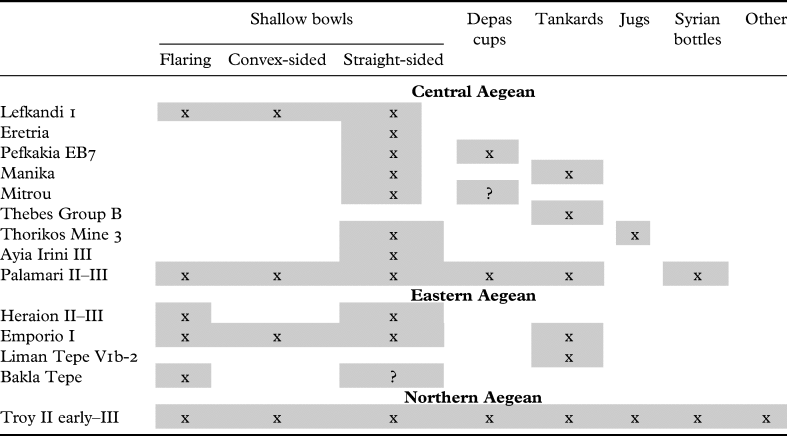
During the late EBII, wheel-made pots only appeared in regions containing Lefkandi I/Kastri vessels and, in contrast to the wide dissemination of handmade variants, they have been documented at a small number of settlements (Choleva Reference Choleva2015a, 151–7 with relevant bibliography, fig. 4:7; Reference Choleva, Caloi and Langohr2018a, fig. 1) (Fig. 1). In the northern and eastern Aegean, they are only present at Troy on the north coast of western Anatolia (Korfmann Reference Korfmann2000, fig. 6; Sazci Reference Sazci2005, 39), at Liman Tepe and Bakla Tepe on the central coast (Şahoğlu Reference Şahoğlu, Erkanal, Hauptmann, Şahoğlu and Tuncel2008, 490–1; Reference Şahoğlu2011, 140–1), and at Heraion (Milojčić Reference Milojčić1961, 42–3, 45) and Emporio (Hood Reference Hood1981–2, ix, 89, 130, 134, 166–9, 545) on the nearby eastern Aegean islands of Samos and Chios respectively.Footnote 26 The absence of wheel-made pottery on the northern Aegean island of Lemnos is worth mentioning given its strong affiliation with contemporary Trojan pottery traditions.Footnote 27 Further west, wheel-made pottery appears at Palamari on the central Aegean island of Skyros (Bonatsos and Romanou Reference Bonatsos, Romanou, Parlama, Theochari, Romanou and Bonatsos2015, 58–62; Choleva Reference Choleva2015a) and at various sites on the east coast of the central Greek mainland: Thorikos in Attica (Nazou Reference Nazou2013, 229, 246); Pefkakia in Thessaly (Christmann Reference Christmann1996, 41); Lefkandi (Popham and Sackett Reference Popham and Sackett1968, 8), Manika (Sampson Reference Sampson1985, 123–46) and Eretria (Charalambidou et al. Reference Charalambidou, Kiriatzi, Müller, Georgakopoulou, Müller-Celka and Krapf2016, 534; Müller-Celka et al. Reference Müller-Celka, Kiriatzi, Charalambidou, Müller, Alram-Stern and Horejs2018) in Euboea; Mitrou in Locris (Choleva Reference Choleva2015a, 152); and Thebes in Boeotia (Konsola Reference Konsola1981, 119–20, 122; see also Psaraki Reference Psaraki and Aravantinos2008). In the Cyclades, where vessels of the new western Anatolian style accumulated in large numbers (Angelopoulou Reference Angelopoulou, Vlachopoulos and Birtacha2003, 159–68; Sotirakopoulou Reference Sotirakopoulou2016, 311, 369, 374, table 7.4), wheel-made pottery appears only at Ayia Irini on Keos.Footnote 28 The narrow geographical distribution of wheel-made variants against the spread of the Lefkandi I/Kastri handmade pots, confined to certain settlements in the northern, eastern and central Aegean, suggests that the potter's wheel composes a non-constant component in the production of the novel shapes.
Morphological and stylistic features of wheel-made pottery
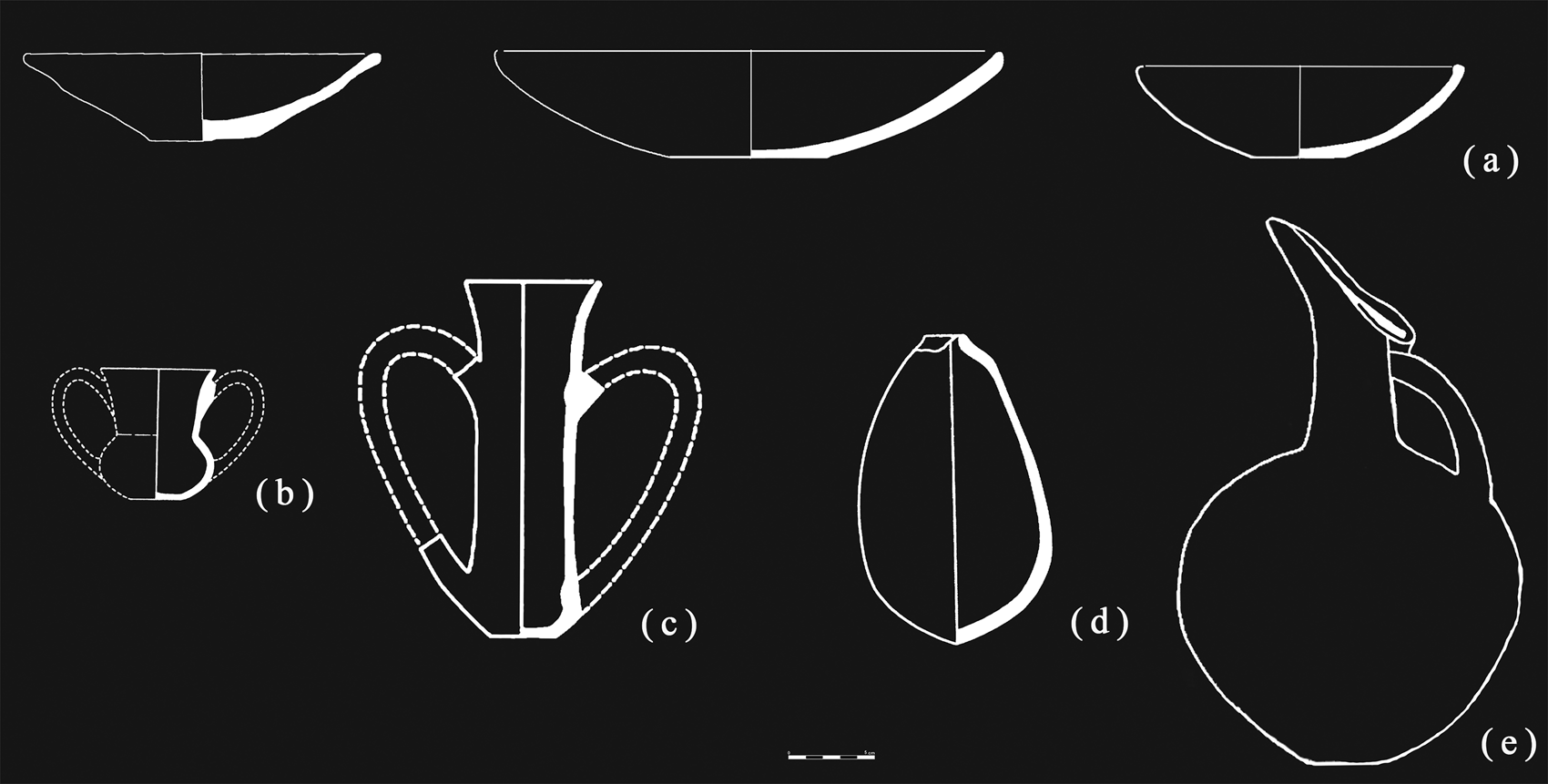
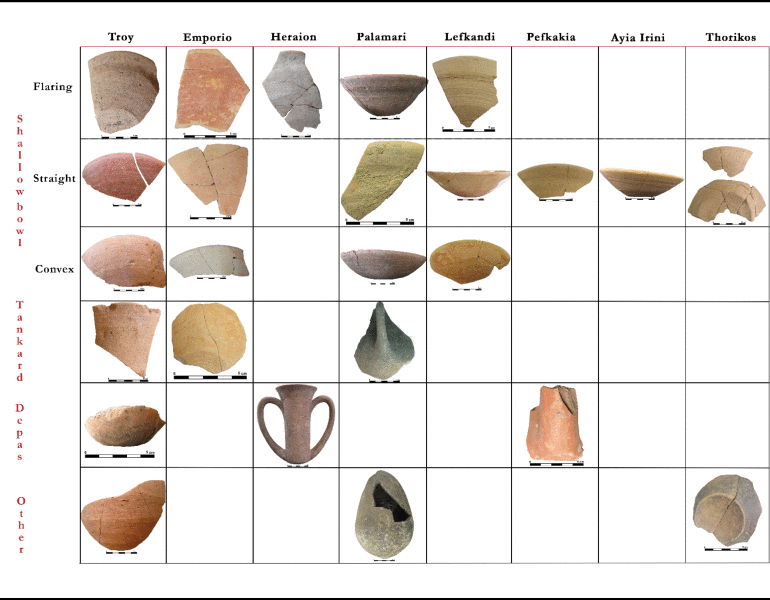
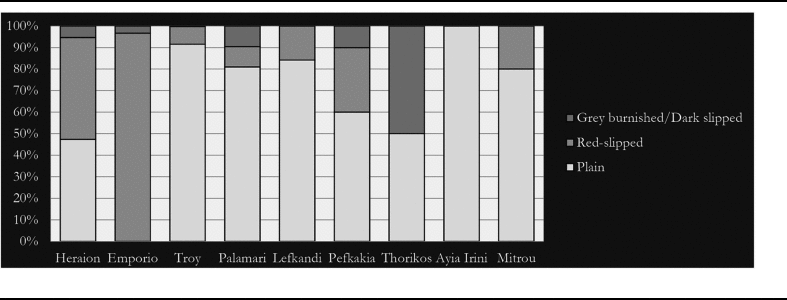
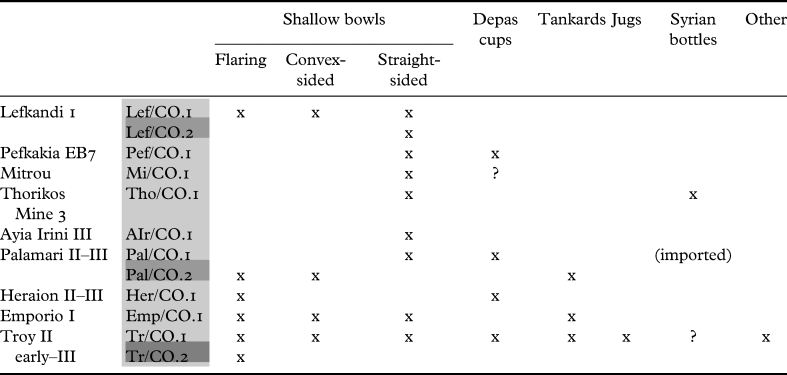
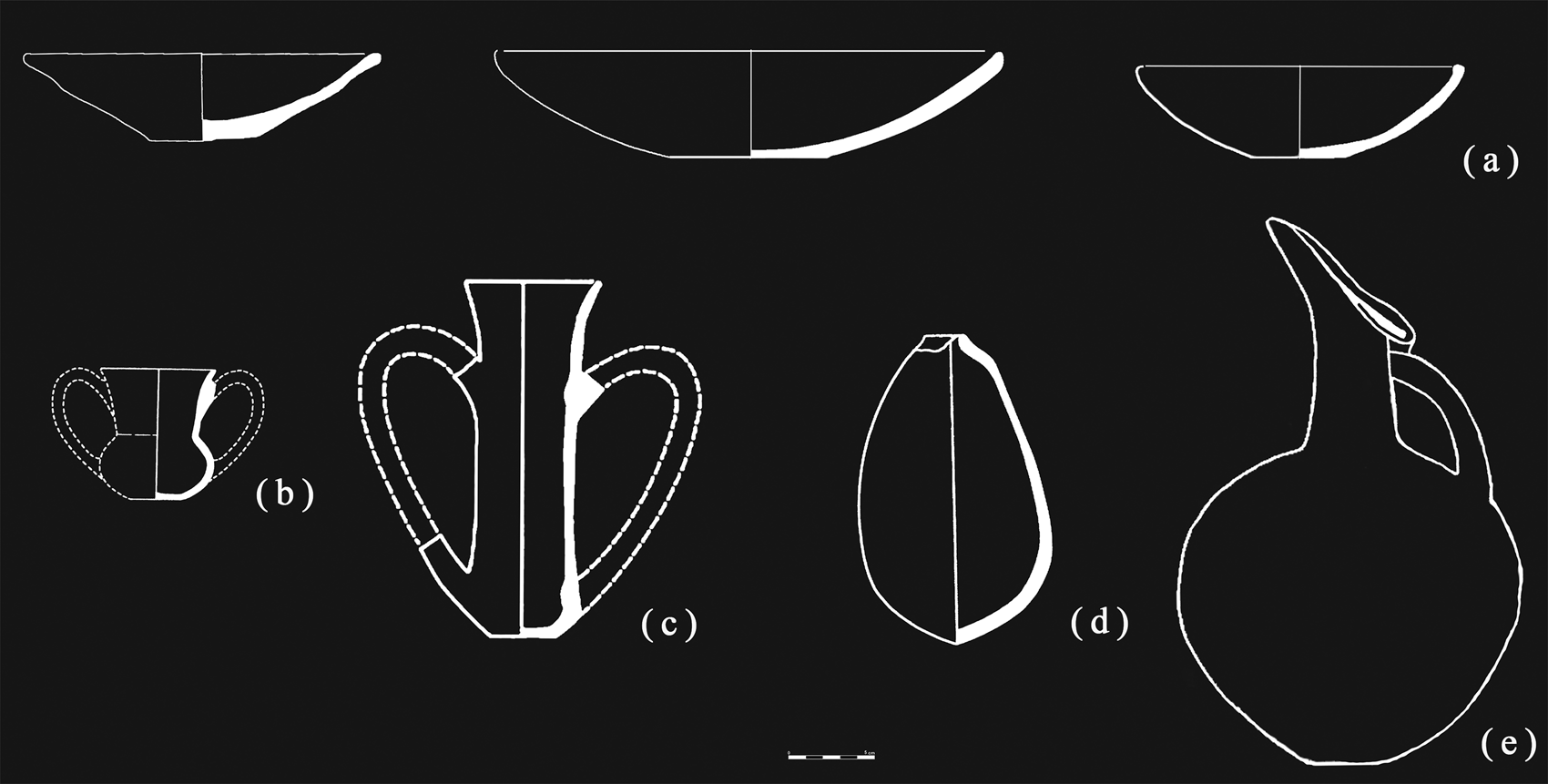
Wherever it appeared in the Aegean, the potter's wheel is always exclusively associated with the manufacture of a new typology of shapes in the western Anatolian style (Table 2). However, its use is unevenly represented across the new typology and varies from region to region. On the one hand, throughout the entire period, the new tool is universally used for the production of a variety of shallow bowls, including the flaring, straight-sided, and convex-sided variants.Footnote 29 While all the variants usually occur together in wheel-made assemblages, the flaring bowl is more commonly encountered across the northern and eastern Aegean, but less frequently at the sites in the central Aegean. In turn, the straight-sided is considered the Aegean version of the flaring bowl and is typically found on the Greek mainland, while the less common convex-sided variant is common on the islands, most notably Skyros (Sotirakopoulou Reference Sotirakopoulou, Doumas and La Rosa1997, 528; Wilson Reference Wilson1999, 142; Bonatsos and Romanou Reference Bonatsos, Romanou, Parlama, Theochari, Romanou and Bonatsos2015, 54–60). On the other hand, the potter's wheel is not systematically used for making other shapes of the Lefkandi I/Kastri group. Apart from the cases of Lefkandi and Ayia Irini, where only shallow bowls appear as wheel-made, the tool is occasionally used for the production of depas cups, tankards or tankard-like pots, and Syrian bottles (Fig. 2). The wheel-made shapes are associated with a limited range of stylistic choices such as buff plain, red-slipped and grey burnished wares. The buff plain and the red-slipped surfaces are typical while the grey burnished ones are rare. Even if we cross-correlate with shapes, it is notable that slipped and burnished wares are common in depas cups and tankards, whereas the shallow bowls preferentially occurred in both buff plain and red-slipped versions. Wheel-made buff plain shallow bowls, however, dominate over red-slipped versions across the northern and central Aegean, while the opposite pattern is typical of the eastern Aegean settlements (Table 3).Footnote 30
The main wheel-made repertoire during the late EBII: (a) variety of shallow bowls: flaring, straight-sided, convex-sided; (b) tankard; (c) depas cup; (d) Syrian bottle; (e) jug (drawings based on Theochari, Parlama and Hatzipouliou Reference Theochari, Parlama, Hatzipouliou, Zerner, Zerner and Winder1989, fig. 3b; Friedrich Reference Friedrich1997, pl. 53–4; Mansfeld Reference Mansfeld2001, fig. 11:9; Rutter Reference Rutter, Maran and Stockhammer2012, fig. 8:2; Wilson Reference Wilson2013, fig.10a).
Wheel-made shapes in the Aegean settlements during the late EBII.
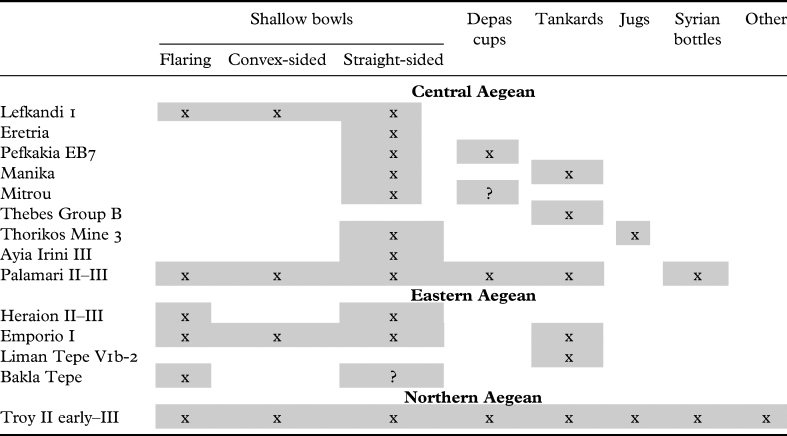
Wheel-made morpho-stylistic types identified at the examined sites.

Interestingly, this different patterning seems to correspond to the different ways in which local communities responded to the new pottery tradition, following the tendencies that occurred in several regions in western Anatolia. More specifically, what we might call regional pottery idioms are configured within this tradition, reflecting shared predilections and preferential consumption – and aesthetic – behaviours, regardless of how the pots were made.Footnote 31 While eastern Aegean settlements participated in a common pottery idiom characterised by small assemblages of red-slipped vessels with settlements in south-western Anatolia and the Cyclades (e.g. Hood Reference Hood1981–2, 544–5; Joukowsky Reference Joukowsky1986, 308, 358–62, 389–91; Şahoğlu Reference Şahoğlu2004, 101; Reference Şahoğlu, Erkanal, Hauptmann, Şahoğlu and Tuncel2008, 490; Reference Şahoğlu2011, 139–41; Eslick Reference Eslick2009, 225–6, 230–1; Kouka Reference Kouka, Manning and Bruce2009, 38; Sotirakopoulou Reference Sotirakopoulou2016, 88–9, 191–2), settlements across the northern and central Aegean shared a differentiated idiom dominated by buff plain vessels with inland western Anatolia. In settlements such as Küllüoba and Troy, there is an abundance of buff plain shallow bowls, particularly in the flaring variant, whereas red-slipped ones are distinct but limited.Footnote 32 At the same time, buff plain shallow bowls, particularly in the convex-sided version, systematically occur at sites such as Poliochni on Lemnos and Palamari on Skyros, and dominate over red-slipped variants (Bernabò-Brea Reference Bernabò-Brea1976, 260–1, fig. CCIVegfj; Choleva Reference Choleva2015a, 144 with relevant bibliography). The same pattern is also observed at central Aegean sites – including Lefkandi (Spencer Reference Spencer2007, 119, 122, figs 4:9, 4:14–15), Pefkakia (Christmann Reference Christmann1996, 57–64) and Ayia Irini (Wilson Reference Wilson1999, tables 3.1, 3.3–3.4) – where buff plain shallow bowls in several versions comprise the prevailing morpho-stylistic type within the Lefkandi I/Kastri group and overcome the number of red-slipped variants (Table 4).
Distribution of stylistic wares over examined wheel-made assemblages.

Presence and integration in local ceramic assemblages
The appearance of the potter's wheel in the Aegean did not result in the marginalisation of traditional potting habits. Hand-forming techniques continued to be maintained in the production of local traditional shapes and used, in many cases, in a significant proportion of new vessels. The limited or marginal character of the new technology thus raises questions about the provenance of the dispersed wheel-made assemblages across Aegean settlements and the subsequent local integration of the tool.
Patterns of integration into local technological milieus
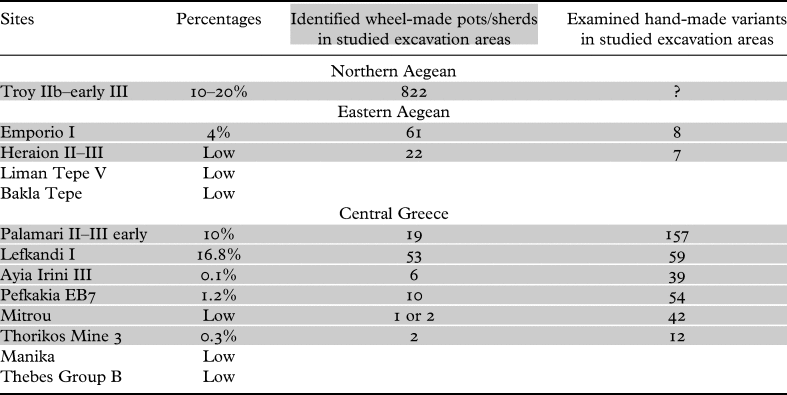
Two different patterns of appearance of wheel-made pottery are observable during the late EBII (Table 5). Firstly, wheel-made pots are rare at the majority of sites throughout the Aegean and only compose small assemblages, usually about one per cent of the total production of pottery. This mainly occurs at sites on the Greek mainland and in the northern Cyclades (e.g. Ayia Irini: 0.1 per cent; Pefkakia 1.2 per cent; Thorikos: 0.3 per cent).Footnote 33 According to the available data, this pottery is usually not of local provenance. For example, Wilson (Reference Wilson1999, 94, 99; Reference Wilson2013, 408) proposed the non-local but Euboean provenance of wheel-made shallow bowls at Ayia Irini. Along the same lines, Christmann considered the few wheel-made shallow bowls and depas cups at Pefkakia as imported.Footnote 34 Although secure percentages cannot be inferred because of the lack of necessary published data, the impact of the new technology on the production of some other settlements in the central and eastern Aegean, such as Palamari and Emporio, also seems to be low, not exceeding four per cent.Footnote 35 The wheel-made pottery at Emporio macroscopically presents a striking divergence from the local handmade production, urging Hood (Reference Hood1981–2, 167–9, 545) to consider it as imported. At Heraion, the provenance of wheel-made shallow bowls is still an open question. Recent petrographic analyses have nonetheless shown that the Samian Lefkandi I/Kastri vessels are made from clay sources of different origins, both of local and off-island provenance, and at least some wheel-made examples comprised of fabrics that are compatible to the island environment (Menelaou Reference Menelaou, Theodoropoulou-Polychoniadis and Evely2015, 31; Menelaou, Kouka and Day Reference Menelaou, Kouka and Day2016, tables 1–2, especially Fabrics 1 and 2 and samples 12/14, 12/29, 12/32, 12/37, fig. 3a). Finally, despite petrographic and chemical analyses never having been carried out at Palamari, most of the wheel-made pots are considered to be made of clays commonly used in the production of traditional Early Bronze Age II pottery and, following the excavators, originated from the island environment.Footnote 36
Quantification and percentages of wheel-made pottery over the total of late EBII ceramic assemblages (highlighted in grey: examined sites containing wheel-made pots).

Secondly, Troy in the northern Aegean and Lefkandi in the central Aegean are the only sites providing much higher percentages of wheel-made pots. This percentage fluctuates from 10 to 20 per cent over the course of the late EBII at Troy (phases IIb/c–III),Footnote 37 whereas at Lefkandi it reaches 17 per cent of the total pottery production of phase 1 (Spencer Reference Spencer2007, fig. 4:12; Choleva Reference Choleva, Caloi and Langohr2018a, 51, figs 3.9–10). Despite the lack of published petrographic and chemical data, the use of the wheel is considered to be associated with the exploitation of local clays at Troy (Sazci Reference Sazci2005, 52, fig. 1 ware 202; see also Choleva Reference Choleva2015a, 208–11 with relevant bibliography). The local provenance of the wheel-made production at Lefkandi, in turn, has already been demonstrated by various petrographic and elemental analyses that disclosed the use of Lefkandiot clay sources, not only for the wheel-made pots but also for similar-looking handmade variants (Spencer Reference Spencer2007, 163–6; Choleva Reference Cholevain press; Reference Choleva, Caloi and Langohr2018a, 54).
The selective use of the potter's wheel within the new assemblage
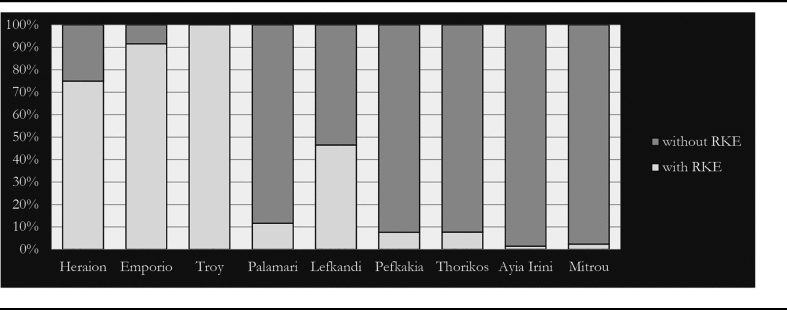
Wherever quantifications are possible, the percentages of wheel-made pottery over the Lefkandi I/Kastri group vary depending on the region (Table 6). Different patterns are distinguished on the basis of the proportions of the typical wheel-made vessel, i.e. shallow bowls, in the overall production of the shape. At the majority of central Aegean sites, the use of the potter's wheel is rare and fluctuates between 1 and 10 per cent of the late EBII assemblages of shallow bowls, which appear basically as handmade: Ayia Irini III 1.1 per cent (Wilson Reference Wilson1999, 91–3, 99–100, tables 3.2, 3.4; Reference Wilson2013, 408–10); Pefkakia 5 per cent (based on Christmann Reference Christmann1996, catalogue in microfilm); Thorikos 8 per cent (based on Nazou Reference Nazou2013, catalogue); and Palamari 10 per cent (based on Choleva Reference Choleva, Parlama, Theochari, Romanou and Bonatsos2015b). The only exception is Lefkandi, where the wheel-made variants exceed 46 per cent of the late EBII assemblage of shallow bowls (Spencer Reference Spencer2007, 125–6, 166; Choleva Reference Choleva, Caloi and Langohr2018a, 51). This settlement follows the pattern occurring in the northern Aegean where, at Troy, the abundant shallow bowls are largely wheel-made (Blegen et al. Reference Blegen, Caskey, Rawson and Sperling1950, 221–2; Blegen, Caskey and Rawson Reference Blegen, Caskey and Rawson1951, 19–20). At the same time, the small amounts of wheel-made shallow bowls appearing in the eastern Aegean settlements of Emporio (Hood Reference Hood1981–2, 545, 547, 550, 553–6) and Heraion (Kouka and Menelaou Reference Kouka, Menelaou, Alram-Stern and Horejs2018, 128, 130) represent the majority of this kind of vessel at the sites.
Presence of wheel-made and handmade variants within the Lefkandi I/Kastri shallow bowls identified at the examined sites.
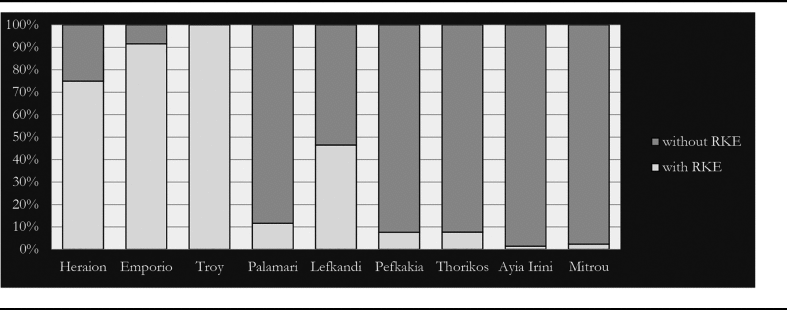
Provided that the same tendencies are also observable within the more occasional production of other western Anatolian shapes,Footnote 38 it seems that the use of the potter's wheel represents geographically a sporadic craft practice within the new pottery tradition that is preferentially related to the manufacture of a particular shape: the shallow bowl. In any case, depending on the region and on the ways in which local communities organised their pottery production (see below), the potter's wheel usually shared the new repertoire with hand-forming techniques.
DATING THE USE OF THE POTTER'S WHEEL
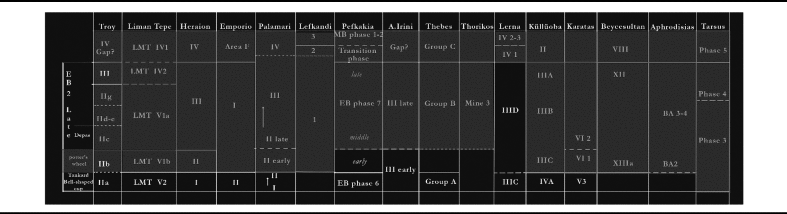
Early phase of the wheel's use (c. 2550–2400 bc)
According to the available published data and the results of the present study, the earliest signs of the potter's wheel are associated with the manufacture of shallow bowls and, occasionally, early forms of tankards. These date to an early component of the new ceramic phase, notably to the intermediary phase between the first handmade tankards, shallow bowls, and bell-shaped cups, and the emergence of the depas shape.
A reference point regarding the synchronisms of the earliest wheel-made pots across the Aegean is the chronological sequence of the new shapes at Troy.Footnote 39 More precisely, use of the wheel, in shallow bowls, is documented during phase IIb (c. 2500 bc), right after handmade tankards and shallow bowls that appeared during phase IIa and before the first depas cups which appeared during phase IIc (Blegen et al. Reference Blegen, Caskey, Rawson and Sperling1950, 205–6, 224–6, 229–30; Weninger Reference Weninger, Aslan, Blum, Kastl, Schweizer and Thumm2002, figs 3, 5; Sazci Reference Sazci2005, 39, 46–7, figs 14–15). The same sequence occurs in the eastern and central Aegean islands: at Heraion, the earliest wheel-made pottery is shallow bowls and dates to phase II, preceding the appearance of depas cups in phase III (Kouka and Menelaou Reference Kouka, Menelaou, Alram-Stern and Horejs2018, 128, 132, 135, fig. 5); at Emporio, the use of the potter's wheel is documented during the last phase of the Early Bronze Age occupation, i.e. phase I, within an assemblage containing shallow bowls and early forms of tankards, whereas depas cups are totally lacking during this phase (Hood Reference Hood1981–2, 544, 724–75; see also Eslick Reference Eslick2009, 223); finally, the first signs of this tool at Palamari are also seen in the production of shallow bowls and tankard-like shapes, and date to an early component of the local phase II, a phase preceded, again, by the first depas cups at the site.Footnote 40 The same phenomenon is also observed at Liman Tepe, where the first wheel-made vessels, probably tankards, appear during phase V 1b, prior to the depas cups of phase V 1a (Şahoğlu Reference Şahoğlu2004; see also Kouka Reference Kouka2013, 573, 576–7). Along the same lines, at Lefkandi on Euboea, the earliest wheel-made production only includes shallow bowls that appear during the earliest occupation of the site, i.e. phase 1, while the depas shape never appears at the site during the entire period (Popham and Sackett Reference Popham and Sackett1968, 8, fig. 7; Spencer Reference Spencer2007, 125).
The systematic appearance of wheel-made shallow bowls and/or tankards before the first depas cups should mean that the early wheel phenomenon might be contemporaneous with a phase that is equivalent to the chronological boundaries between Troy IIb and Troy IIc, bringing into view an interregional synchronic process of technical transfer shared by a range of Aegean sites.Footnote 41
Later phase of the wheel's use (c. 2400–2300 bc)
A series of central Aegean sites located in coastal central Greece and neighbouring islands provides evidence for a later appearance of wheel-made pottery. Settlements such as Ayia Irini during phase III late, Pefkakia during phase EB-7, Thorikos Mine 3, and Mitrou see the first wheel-made pots (a) appearing immediately after the presence of the early shapes of the Lefkandi I/Kastri group (handmade tankards, bell-shaped cups and shallow bowls), (b) coinciding with the appearance of the depas shape at the sites, and (c) including shallow bowls and sometimes depas cups.
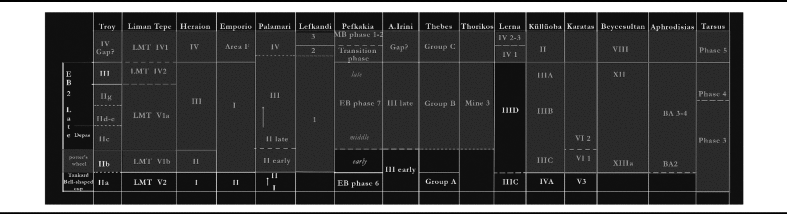
The simultaneous presence of both wheel technology and the depas shape suggests that there was a second phase of dissemination of wheel-made pots corresponding to a regional phenomenon of technical transfer expanding across the central Aegean. Besides, the addition of the depas shape to the wheel-made repertoire in settlements such as Troy during phase IIc, Heraion during phase III, and Palamari during phase II late or III earlyFootnote 42 also indicates the transmission of the wheel technology only within the borders of the new pottery tradition during a period that might be contemporaneous with the later component of the Lefkandi I/Kastri phase or the so-called ‘depas phase’, i.e. Troy IIc onwards (Table 7).
Chronological map showing the local phases of appearance of the potter's wheel.
‘TECHNOLOGICAL’ INSIGHTS INTO WHEEL-MADE POTTERY
The systematic association of the potter's wheel with a spectrum of well-defined morphological and stylistic choices related to the consumption of the new western Anatolian repertoire confers to the wheel-made pottery across the Aegean a coherent and uniform visual appearance. What happens though when we investigate the manufacturing technology of this pottery and look into the invisible craft behaviours that activated the wheel-based chaînes opératoires at the local level?
Knowledge and mastery of the tool
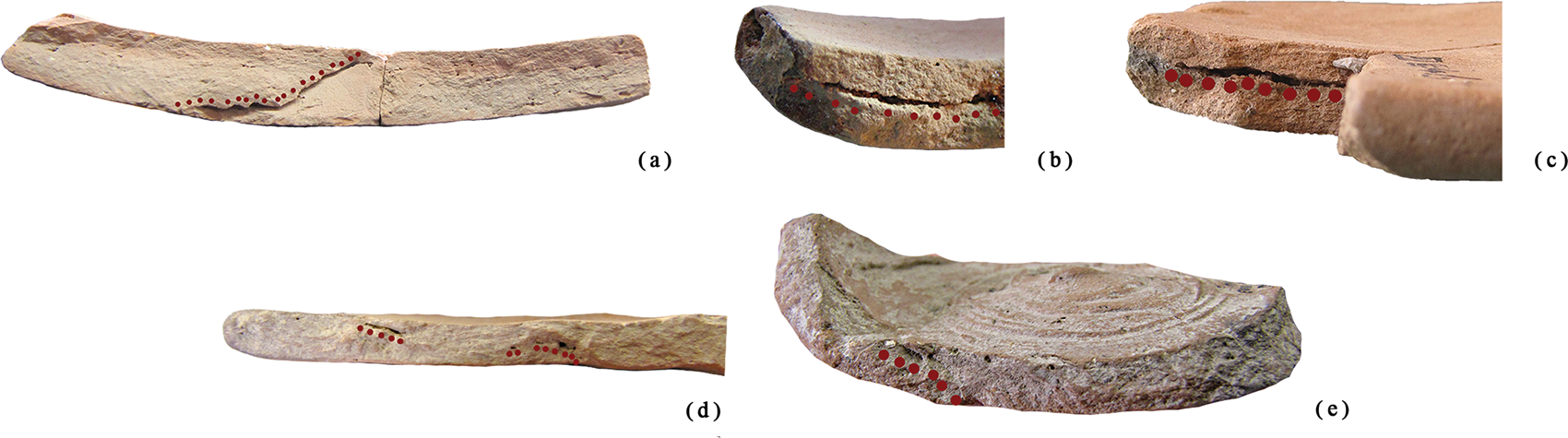
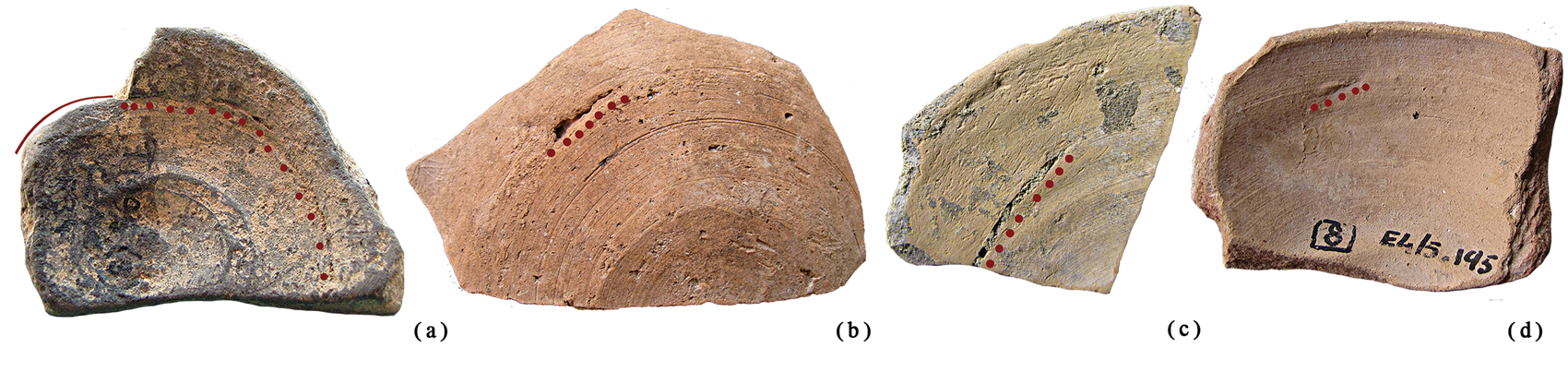
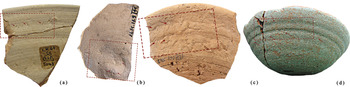
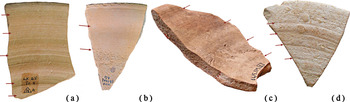
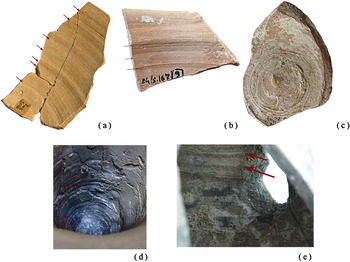
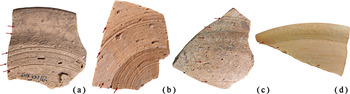
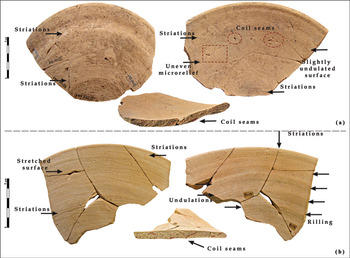
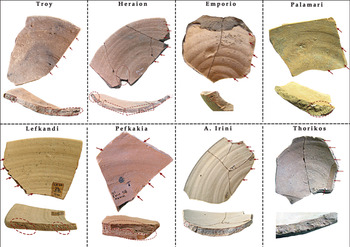
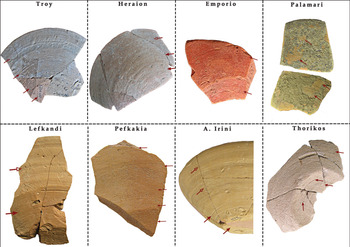
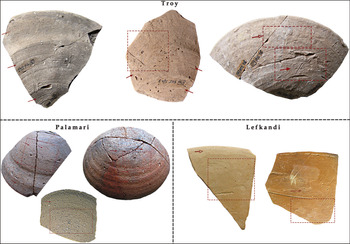
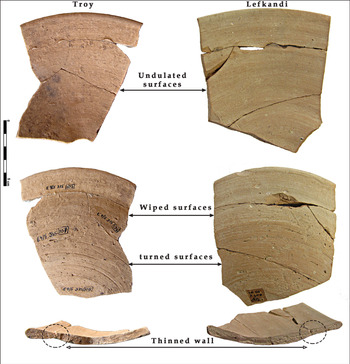
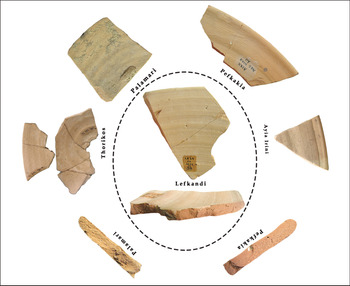
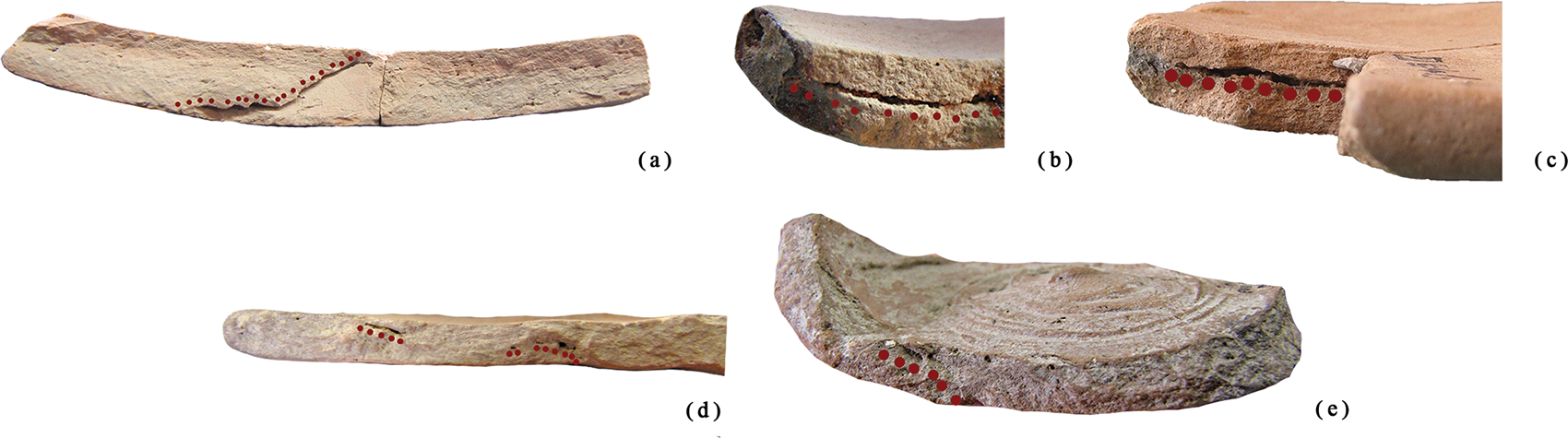
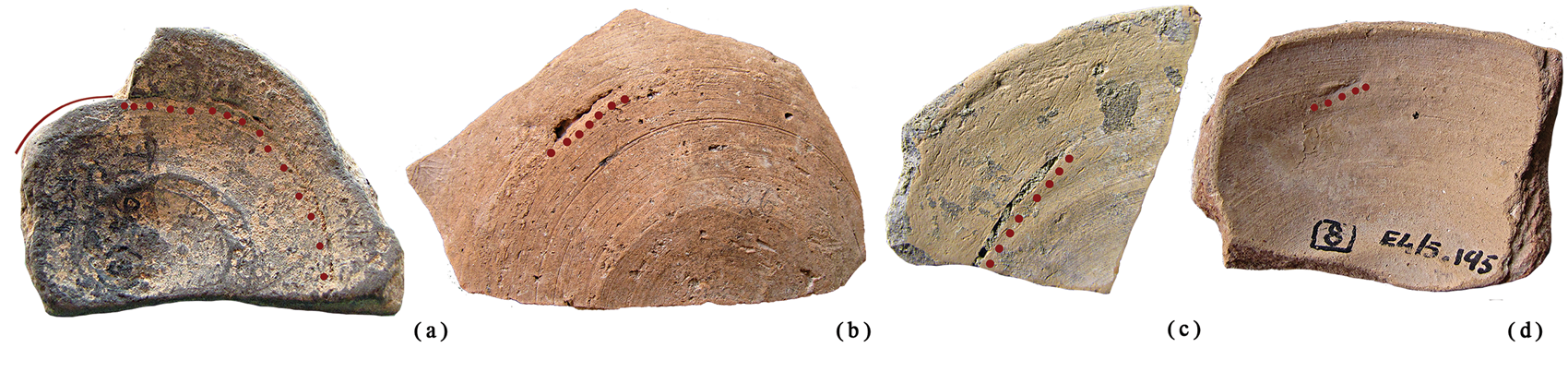
Macroscopic examination of nine ceramic assemblages (see Table 5) has revealed that late EBII wheel-made pots across the Aegean were not thrown from a lump of clay. On the contrary, they were products of forming processes that combined the coiling technique with RKE: macro-features, such as coil seams on sections and on surfaces along with preferred breaks and irregular micro-topographies in relief, bear witness to the presence of coil-built roughouts (Figs 3, 4, 5 and 6), whereas a variety of RKE-derived features, such as undulations, rilling and striations on surfaces, indicate the use of a rotary device involved in the coil-building operations (Figs 7, 8 and 9). The omnipresent wheel-coiling technique therefore represents the main forming technology for producing wheel-made pottery throughout the Aegean.Footnote 43
Coil seams visible on the breaks of shallow bowls from (a) Lefkandi, (b) Emporio, (c) Troy and (d) Lefkandi, and from a depas cup from (e) Pefkakia.
Coil seams visible on the surfaces of a tankard from (a) Emporio and shallow bowls from (b) Troy, (c) Palamari and (d) Troy.
Preferred breaks along coil seams observed in a tankard from (a) Palamari, a depas cup from (b) Troy, and shallow bowls from (c) Troy and (d) Heraion.

Irregular micro-reliefs on the interior surface of shallow bowls from (a) Lefkandi and (b) Troy, and on the exterior surface of shallow bowls from (c) Troy and (d) Palamari.
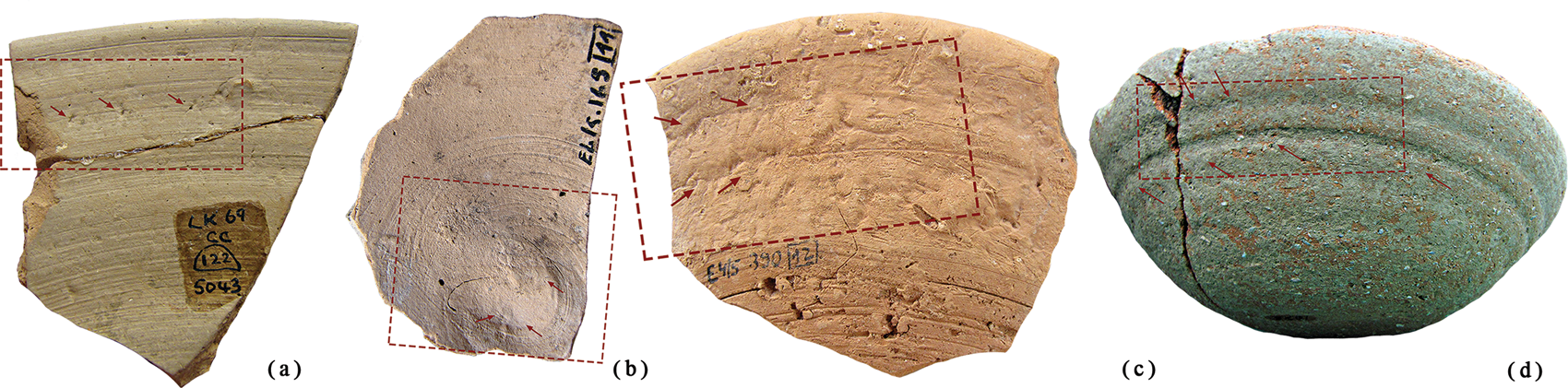
Undulated surfaces observed on the interior surface of shallow bowls from (a) Lefkandi, (b) Pefkakia and (c) Troy, and on the exterior surface of a shallow bowl from (d) Emporio.

Rilling observed on the interior surfaces of shallow bowls from (a) Lefkandi and (b) Troy, depas cups from (c) Pefkakia and (d) Heraion, and a Syrian bottle from (e) Palamari.

Different types of striations on the exterior surfaces of shallow bowls from (a)–(b) Troy, (c) Heraion and (d) Lefkandi.

Nevertheless, the variability in macro-features, suggestive of different degrees of wall modification by RKE, reveals the existence of different ways of exploiting the potter's wheel within the operational sequence of coiling. Overall, two methods have been identified within the examined material following the four-type classification system of wheel-coiling methods proposed by Roux: Method 2 and Method 3 (see Table 1). Pots made by Method 2 provide evidence of slightly modified roughouts characterised by unevenly distributed undulations or non-undulating surfaces and irregular micro-reliefs indicative of discontinuous pressures applied on the walls during early roughout operations (Fig. 10a). Method 2 involves the wheel only during the later phases of the roughout stage for thinning the walls and shaping the coil-built roughout. It is associated with lower degrees of RKE mastery. The major part of the examined material, however, presents macro-features diagnostic of Method 3 and indicative of coil-built roughouts that are highly modified by RKE through continuous pressures during the early roughout stage, including intense even undulations along surfaces, stretched walls and rilling (Fig. 10b). Method 3 is based on the use of the wheel during the early forming operations for joining the coils, thinning the walls, and shaping the coil-built roughout (see Table 1). It presupposes a high degree of RKE mastery and indicates an increased technical specialisation in terms of gestures.
Examples of shallow bowls providing macro-features indicative of (a) the wheel-coiling Method 2 (Troy) and (b) the wheel-coiling Method 3 (Lefkandi).

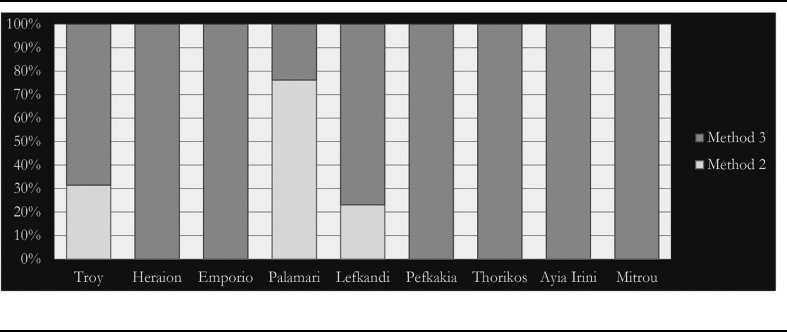
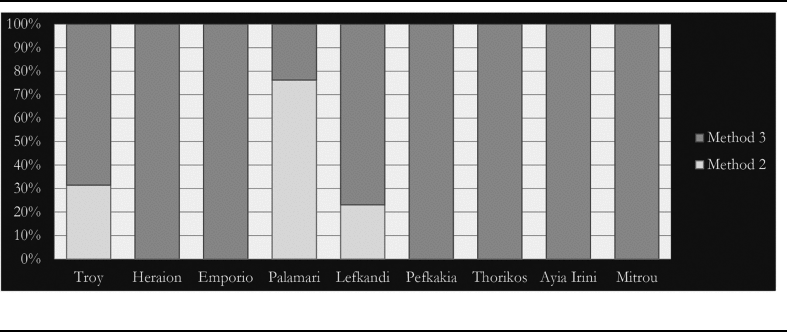
Pots made by Method 3 are widespread. At sites such as Troy and Lefkandi, they dominate the wheel-made production, whereas at eastern (Emporio, Heraion) and central (Ayia Irini, Thorikos, Mitrou, Pefkakia) Aegean sites they represent the unique way of exploiting RKE.Footnote 44 The underlying specialised know-how thus implicates the stable core of craft knowledge associated with RKE mastery and apparently composes the standard and systematic way of using the wheel throughout the Aegean. In contrast, Method 2 is less frequent within the studied assemblages, being unevenly distributed across Aegean sites. It is documented only at Troy, Lefkandi, and Palamari. When occurring, it always coexists with Method 3 and, except for Palamari in Skyros, is sporadic and not systematic within the wheel-based repertoire. The occasional character of Method 2 corresponds, as will be demonstrated below, to local deviations from the dominant way of using the wheel (Table 8).
Distribution of wheel-coiling methods over examined wheel-made assemblages.
Wheel-based chaînes opératoires
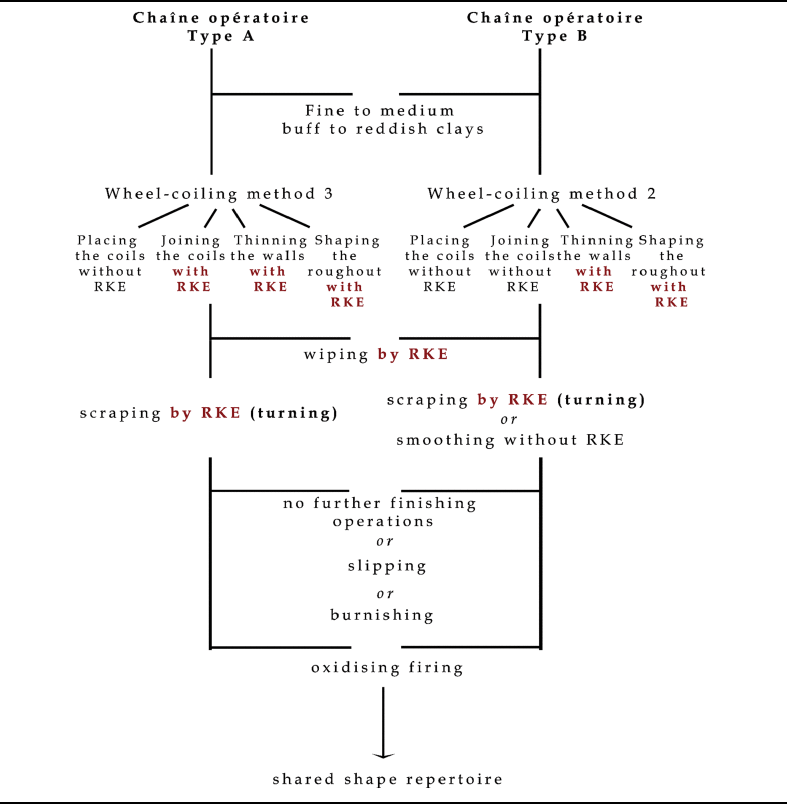
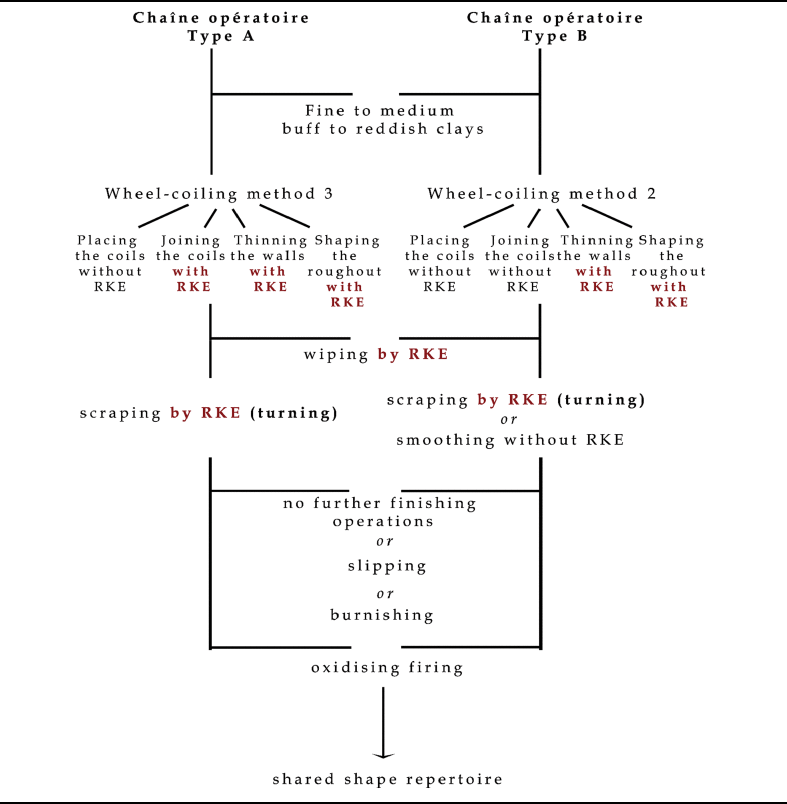
The technological study led to the recognition of a series of local chaînes opératoires that enabled reconstruction of the range of practical knowledge associated with the new tool. On the basis of the two identified wheel-coiling methods, two main types of chaînes opératoires were distinguished: Type A and Type B (Table 9).
The two variants of the wheel-based technological tradition: chaînes opératoires of Type A and Type B.
C.O. Type A: chaînes opératoires of Method 3
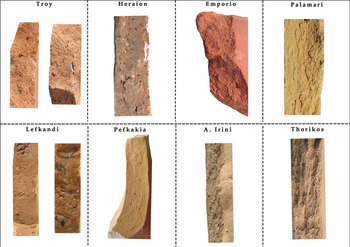
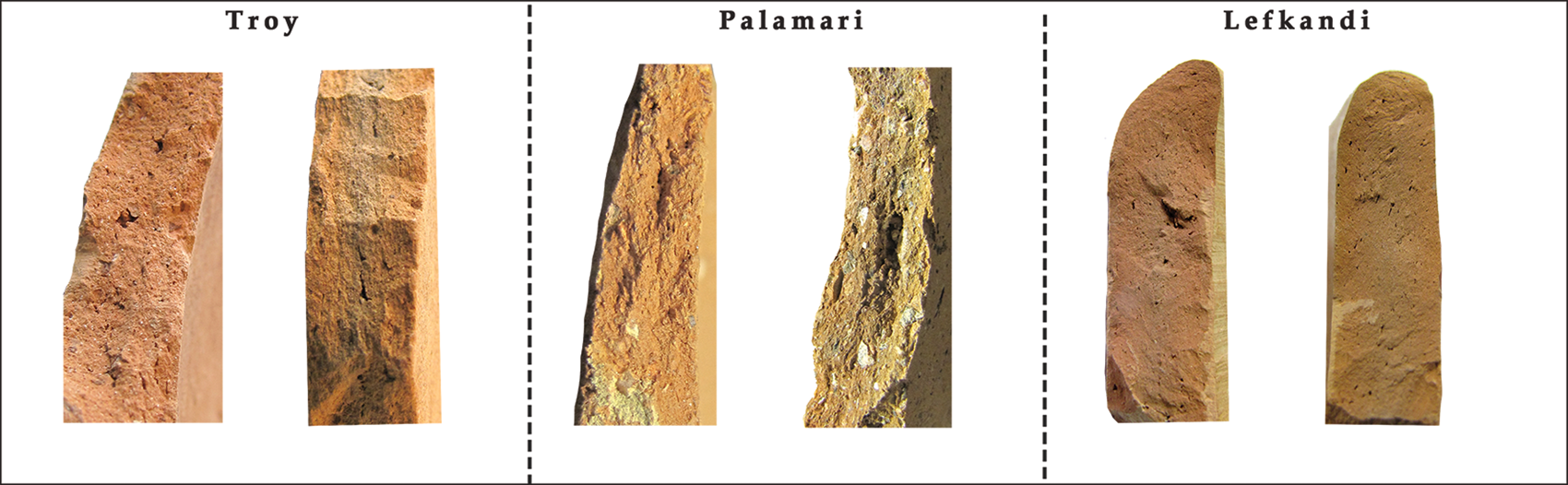
The predominant and most common chaînes opératoires, based on Method 3, share surprisingly comparable technical features and are characterised by a consistent sequence of manufacturing operations: (a) exploitation of buff-reddish clays of red/orange/yellowish tones, fine to semi-fine, depending on the clay sources locally used (Fig. 11);Footnote 45 (b) use of Method 3 for producing the roughout (Fig. 12); (c) surface treatment consisting of wiping the surfaces by RKE (inferred by the presence of horizontal rilling along the interior and exterior surfaces) followed by scraping the lower parts with the help of RKE, i.e. turning when the pots are leather hard and upside-down for achieving the pot preform (as denoted by the presence of profound and sharp rectilinear and concentric striations on the exterior surfaces and underneath the bases) (Fig. 13); (d) leaving the surfaces untreated or slightly smoothing them for the plain vessels; (e) coating/washing the surfaces with a slip for achieving slipped vessels in red/brown/dark brown tones, or burnishing them; and (f) control of the oxidising firing conditions conferring to the clays the typical uniform buff to reddish colours. Chaînes opératoires presenting the aforementioned characteristics are everywhere present and underpin the production of the majority of wheel-made shapes throughout the Aegean (Troy: Tr/CO.1; Heraion: Her/CO.1; Emporio: Emp/CO.1; Palamari: Pal/CO.1; Lefkandi: Lef/CO.1; Pefkakia: Pef/CO.1; Mitrou: Mi/CO.1; Ayia Irini: AIr/CO.1; Thorikos: Tho/CO.1).
Various fine to semi-fine, buff to reddish clays characterising the chaînes opératoires of Type A.

Pots showing macro-features indicative of the wheel-coiling Method 3, typical of the chaînes opératoires of Type A: RKE-derived macro-features (arrows), coil seams (circles and dots), differentiated wall thickness, and uneven microreliefs (rectangles).

Macro-features indicative of RKE surface treatment involved in chaînes opératoires of Type A: RKE-wiped surfaces (empty arrows) along with striations of turning (filled arrows).

C.O. Type B: chaînes opératoires of Method 2
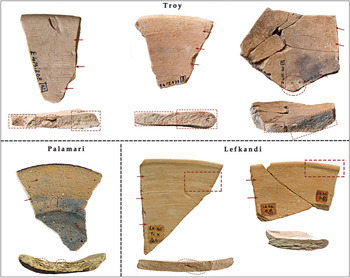
The second type of wheel-based chaînes opératoires is confirmed through the occasional presence of pots made by the wheel-coiling Method 2 at Troy (Tr/CO.2), Lefkandi (Lef/CO.2) and Palamari (Pal/CO.2). These chaînes do not present the same rigidity in technological choices. Regarding the preform operations and surface treatment, there is internal variation and a non-standard use of RKE. In some cases, the forming process involved RKE-wiping followed by turning in the preform stage as the chaînes of Method 3 (Troy); in other cases, it included RKE followed by smoothing or by the application of a type of self-slip (Troy, Lefkandi, Palamari). Furthermore, some of these pots, especially at Troy, presented an experimental character inferred by features, such as roughly and abruptly thickened walls or irregular reliefs and discontinuous striations suggesting incomplete rotations. In terms of fabrics and firing, pots made by the chaînes of Method 2 share common appearances with those of Method 3: they are usually made from fine to medium buff reddish clays, and fired in oxidising conditions (Figs 14, 15 and 16).Footnote 46
Various fine to semi-fine, buff to reddish clays characterising the chaînes opératoires of Type B.

Pots showing macro-features indicative of the wheel-coiling Method 2, typical of the chaînes opératoires of Type B: differentiated wall thickness and uneven micro-reliefs (rectangles), coil seams (circles), and RKE-derived macro-features (arrows).

Macro-features indicative of various RKE surface treatments involved in chaînes opératoires of Type B: RKE-wiped surfaces (empty arrows), striations of turning (filled arrows), and smoothed or self-slipped surfaces (rectangles).

The identification of a common technological tradition
Careful observation of the wheel-based chaînes opératoires of both types A and B reveals the outline of a shared technological tradition behind wheel-made pottery production across the Aegean. This tradition incorporates a well-defined range of potting practices founded on (a) the use of the wheel-coiling technique performed according to two methods that reveals different degrees of specialisation in RKE gestures, (b) a spectrum of well-defined technological choices in terms of fabric techniques, surface treatment and firing that repetitively occurred within all the Aegean wheel-made assemblages, and (c) a very rigid morphological and stylistic repertoire confined to certain new shapes of western Anatolian origin. In sum, those characteristics find a practical application through two types of craft behaviours.
On the one hand, the constant and widespread performance of a forming technique, i.e. wheel-coiling Method 3, coupled with a particular type of wheel-based surface treatment, i.e. RKE-wiping and turning (C.O. Type A), discloses a shared set of technical gestures and a high degree of specialisation in the use of the potter's wheel across the Aegean. The systematic association of this tool's knowledge, specific choices in fabric and firing technology, and particular intentions in production justify reference to them as originating from a common craft behaviour. The latter seems to aggregate, on the basis of specific motor and cognitive skills, materials, techniques and shapes in a very standard way, by orchestrating an embedded technological tradition that is apparently shaped by common contexts of apprenticeship and environments of practice.
On the other hand, the involvement of a less demanding forming technique, i.e. wheel-coiling Method 2, denotes a differentiated set of craft knowledge that activated the potter's wheel in manufacture (C.O. Type B). Evidence, such as (a) the association of Method 2 with local variations in surface treatment, including RKE in a non-systematic way, (b) the experimental character of certain produced wheel-coiled pots, (c) the occasional and sporadic occurrence of the chaînes of Method 2, in practice only at a few sites in the Aegean, and (d) the inclusion of fabric and firing technologies as well as shape repertoires that are typical of the chaîne of Method 3, is suggestive of a differentiated secondary craft behaviour that deviates from the dominant one. This craft behaviour may suggest a different learning process indicating peripheral phenomena of wheel transmission, which are subsumed under the logics of manufacture and integrated into the prominent wheel-based technological tradition. It could thus correspond to a different level of expertise in terms of learned technical gestures and to idiosyncratic ways of appropriating the potter's wheel. Overall, it seems that craft entities with different degrees of expertise in the tool's mastery operated within similar contexts of production across the Aegean, maintaining the knowledge of the potter's wheel through established networks of apprenticeship (Table 10).
Chaînes opératoires and their shape typology by examined site.

The boundaries of the wheel-based technological tradition
The origins of the new technological tradition might be sought outside the production systems of the Aegean, specifically in the craft practices developed in Cilicia (cf. Eslick Reference Eslick2009, 225; Türkteki Reference Türkteki, Bombardieri, D'Agostino, Guarducci, Orsi and Valentini2013, 193–4; Reference Türkteki2014, 94–5 with relevant bibliography). On the one hand, according to current published work, at Tarsus, the vessels of western Anatolian style, which appear as a compact package at the end of the late EBII (equivalent to Anatolian Early Bronze Age III or Tarsus phase 4) (Goldman Reference Goldman1956, 105–6, 131; Mellink Reference Mellink, Emre, Mellink, Hruda and Özgüç1989, 322–6; Mallegni and Vacca Reference Mallegni, Vacca, Bombardieri, D'Agostino, Guarducci, Orsi and Valentini2013), seem to correspond to craft behaviours similar to those giving rise to Aegean wheel-made production. More specifically, as the published macro-features suggest, the wheel-made pottery of the new assemblage is characterised by strongly undulated surfaces, indicative of a high degree of wall modification by RKE along with profoundly sharp concentric striations on the lower parts of the vessels, suggestive of turning. Although the specific forming technology is not known, the chaînes opératoires inferred indicate knowledge of the tool, reminiscent of that involved in the Aegean chaînes opératoires of type A (see Figs 10b, 12). On the other hand, the underlying craft behaviours seem to reproduce long-lived Anatolian wheel-based techniques, thereby perpetuating a local technological tradition, inherited from previous periods, i.e. local Anatolian Early Bronze Age I–II, when the wheel was used for the production of small buff plain and red-slipped bowls.Footnote 47
Furthermore, the relevant macro-features do not only find close parallel to the Aegean pottery of the Lefkandi I/Kastri group, but they also present striking similarities to the published surface features of wheel-made vessels from the inland western Anatolian site of Küllüoba (phase III), which are correlated with the use of the wheel-coiling technique.Footnote 48 Accordingly, the descriptions provided by Eslick (Reference Eslick2009, 5) regarding the wheel-made production at Karataş (phase VI) also suggest pots that are initially made by a manual technique and present highly modified roughouts under the impact of RKE.Footnote 49
On account of these similarities, one might consider that there is a common and widespread technological tradition, which (a) is founded on the appropriation of a specific knowledge of the wheel detectable in the chaînes opératoires found at settlements from Cilicia and western Anatolia to the Aegean that ‘generates’ comparable craft behaviours along with idiosyncratic ways of learning the wheel, and (b) is exclusively associated with a specific common range of pottery shapes and wares. From this perspective, the potter's wheel in the Aegean seems to be part of a wider technological phenomenon with strong links to the Anatolian contexts of production and implicit systems of apprenticeship.
CONNECTIVITY AND LOCAL DYNAMICS
The variability in the modalities behind the appearance of wheel-made pottery in local production systems and the particular ways of adopting and performing the involved craft knowledge could be seen as evidence for understanding the forms of connectivity among settlements on both sides of the Aegean Sea that enabled the formation of shared habits in both consumption and production at the cross-community level, and hence the transfer of the potter's wheel. They could also shed light on the mechanisms and the socio-cultural dynamics behind the dissemination and appropriation of the new technology in the Aegean. The following discussion will thus unpick some of the identified local variations in how the wheel-fashioning technique is adopted by circling around the Aegean (a) from the east and the sites of Emporio and Heraion, (b) to the north and the site of Troy, (c) then to the centre and the sites of Lefkandi and Palamari, and finally (d) on to Pefkakia, Thorikos, Mitrou and Ayia Irini. As it will be shown, the boundaries of the new way of making pottery reveal the actions of particular communities of practice and represent multifaceted mobilities of both potters and pots through changing regional and interregional networks of communication and exchange.Footnote 50
People and objects in movement in the eastern Aegean
The case studies of Emporio and Heraion shed light on the diversity of local dynamics behind the appearance of the potter's wheel in the eastern Aegean. During phase I (early phase of the late EBII), Emporio comes into contact with the new technology via the appearance of a small wheel-made assemblage comprised of red-slipped shallow bowls in a variety of versions (flaring, straight-sided, convex-sided) alongside grey burnished and red-slipped tankards (see Tables 2–4).Footnote 51 These pots, made of very fine red-reddish clays, are the outcome of one coherent and uniform chaîne opératoire belonging to Type A (Emp/CO.1) (see Figs 3b, 4a, 7d, 11, 12, 13). They bear witness to a unique knowledge of the wheel and to a shared craft behaviour, entirely alien to local potting practices (Hood Reference Hood1981–2, 166–9, 171–2, 545–58). The incidental and foreign character of this craft behaviour, the technological uniformity of its products in terms of fabric, surface treatment and firing, as well as its dominance over the new pottery of western Anatolian style at the site, might infer a single event or short-lived production and consumption of wheel-made pots. The circulation of these objects at Emporio suggests the actions of potters originating from a context of apprenticeship that was not part of the local organisation of production and did not have any impact on the pre-existing technological milieu, which was always based on hand-based practices.
The use of the potter's wheel at the Heraion during the late EBII (phases II and III) is also limited, with manual techniques dominating not only over the local but also the new shape typologies. The earliest wheel-made vessels appear in phase II and mainly consist of red-slipped and a few buff plain flaring and straight-sided shallow bowls, whereas the wheel-made repertoire is enriched by a grey burnished depas cup during phase III.Footnote 52 As in the case of Emporio, the wheel-made pottery of both phases is made by a unique chaîne opératoire belonging to type A, thus implying, again, a unique expertise of the tool (Method 3, RKE wiping, turning; Her/CO.1) (see Figs 5d, 8d, 9c, 11, 12, 13). Contrary to Emporio, there is an internal variability in terms of fabrics, which varies between fine to medium coarse, and provenance (both local and non-local). Beyond the wheel-made pots circulating as imported objects in the settlements, two lines of evidence could nevertheless imply the submission of the potter's wheel to a local process of appropriation: (a) exploitation of local clays at least for some of the wheel-made pots and (b) maintenance of a specific way of mastering the tool from Heraion II into Heraion III. This evidence suggests the local activity of a few potters who possessed the same knowledge of the wheel and occasionally participated in the production of the new shapes. Over time, these artisans established a network of apprenticeship that ensured the transmission of the new potting technology throughout the late EBII.
The study of wheel-made pottery at both sites reveals comparable modalities behind the early wheel phenomenon in the eastern Aegean. The potter's wheel, either as an invisible practice behind finishing products or as a locally performed craft, is a minor component in the ceramic assemblages. Moreover, the identification of comparable wheel-based craft behaviours discloses communities of practice trained in the typical wheel-based technological tradition and hence originated from similar processes of learning. Although the precise potting habits underpinning wheel-made production at other eastern Aegean and south-western Anatolian settlements are little known, the pattern of the earliest signs of the potter's wheel identified at Emporio I and Heraion II during the early phase of the late EBII seems to have close parallels with other settlements in the region, thus showing consistency in the emergence of a regional pottery idiom at that time. As mentioned, Liman Tepe has a small number of wheel-made tankards in phase V1b (see above). Similarly, at Karataş, a limited amount of wheel-made pottery appears in phases VI.1–2, mainly comprised of a small number of red-slipped and a few buff plain shallow bowls and tankards.Footnote 53 At Aphrodisias, the wheel-made pottery likewise appears as a small assemblage of red-slipped shallow bowls in local Early Bronze Age phases 2 and 3.Footnote 54
The results of the technological study of the ceramic assemblages from sites in the eastern Aegean and their comparison with the archaeological data from settlements from the wider area designate a common pottery idiom in the adoption process of the new vessels of western Anatolian style, and reveal shared conditions behind the practice of the potter's wheel and an enhanced connectivity between communities of potters operating in both regions. Evidence such as (a) the constant association of the potter's wheel with small assemblages of red-slipped and rarely buff plain shallow bowls, (b) the occasional but recurrent production of early tankards on the wheel at Emporio, Liman Tepe, and Karataş,Footnote 55 (c) similarities among variants of shallow bowls at Emporio, Heraion, and Karataş, including a regional variation of a flaring bowl, (d) the manufacture of both shapes on the wheel before the appearance of the first depas cups (e.g. Joukowsky Reference Joukowsky1986, 390–2; Eslick Reference Eslick2009, 149–51, 159, 173–5), and (e) the identification of common wheel-based practices among various pots identified at Heraion and Emporio could all be considered as indicative of underlying craft behaviours that spread simultaneously across settlements in the eastern Aegean and south-western Anatolia (cf. Hood Reference Hood1981–2, 544, 724–5; Eslick Reference Eslick2009, 223).
The cases of Heraion and Emporio and their close connections with south-western Anatolia could shed more light on the regional mechanisms behind the transfer and appropriation of the potter's wheel. The wheel-made pots appeared as occasional objects in both regions in the context of the adoption of new consumption behaviours by certain subsets of consumers. Their limited circulation might suggest their manufacture in certain ‘centre(s)’ of production, as Eslick (Reference Eslick2009, 233) proposed, where potters who specialised in the wheel produced a comparable shape repertoire on the basis of a common technological tradition. This phenomenon, expanded across both sides of the Aegean, reflects both the mobility of small groups of potters deriving from common contexts of apprenticeship and moving around, and the mobility of their pots through networks of exchange at the cross-community level. An interregional connectivity is therefore visible, which was likely inaugurated during a phase contemporaneous with the early phase of the late EBII and apparently facilitated, among other phenomena, the detachment of the potter's wheel from the long-lived Cilician contexts of production and the dispersion of a few potters who possessed its knowledge. This human mobility highlights well-established maritime routes of communication connecting south-western Anatolian and eastern Aegean communities, accounting for the southwards movement of people and the transfer of the new technology to the Aegean world, as Mellink (Reference Mellink and Cadogan1986, Reference Mellink, Frangipane, Hauptmann, Liverani, Matthiae and Mellink1993; see also Eslick Reference Eslick2009, 224–5) first proposed.
Communities of practice in the northern Aegean
The modalities in the appearance of wheel-made pottery in the northern Aegean bring to light an alternative phenomenon of connectivity, that with inland western Anatolia, which seems to initiate the configuration of a shared pottery idiom and account for the transfer of the potter's wheel at settlements such as Troy. At Troy (phases II and III), according to the available data, the potter's wheel becomes the prevailing potting practice behind the manufacture of the emergent western Anatolian pottery during the late EBII (Mansfeld Reference Mansfeld2001, 230–43). The new tool is gradually transformed into an integral component of the local production system without ever superseding hand-forming techniques. Contrary to the eastern Aegean settlements, the abundant wheel-made pottery at Troy comprises the entire range of new shapes during phases II and III (see Tables 2–4) and is characterised by an internal technological variability expressed through two chaînes opératoires. Both chaînes appear together during phase II early (i.e. Troy IIb/c) in the form of shallow bowls and, for the entirety of the late EBII, seem to be maintained and to share certain common technological choices: the use of buff, red-reddish fine to semi-fine clays considered to be of local provenance; RKE-wiping; slipping when needed; and oxidised firing along with similar intentions in terms of output.Footnote 56 They are, however, different with regard to the wheel-coiling method used, the degree of RKE mastery, and their frequency among pottery.
The dominant chaîne opératoire (Tr/CO.1) belongs to Type A and is founded on more highly specialised knowledge of the tool consisting of Method 3 coupled with turning (see Figs 3c, 4b, 5b, 5c, 7c, 8b, 9a, 9b, 11–13).Footnote 57 Over time, it comprised a wide variety of morpho-stylistic types (flaring-straight-convex-sided shallow bowls, tankards, depas cups, jugs in mainly buff plain, and, less frequently, red-slipped and burnished wares), with the buff plain flaring shallow bowl being the hallmark of the local wheel-made pottery (Blegen et al. Reference Blegen, Caskey, Rawson and Sperling1950, 221–2; Blegen, Caskey and Rawson Reference Blegen, Caskey and Rawson1951, 19–20; Sazci Reference Sazci2005, 46–7, 52–3, 57, 60–3). The second chaîne opératoire (Tr/CO.2) corresponds to Type B and is rare, only used for the production of some buff plain and red-slipped flaring bowls throughout Troy II–III. It is founded on the less demanding wheel-coiling Method 2 and on non-standard surface treatment (turning, smoothing, self-slipping). Despite its low frequency, the constant presence of this alternative over time implies a craft behaviour stemming from different learning processes and functioning, as a peripheral way of using the potter's wheel, alongside the dominant one (see Figs 4d, 6b, 6c, 10a, 14–16). In sum, it seems that two discrete craft entities with different sets of acquired specialised skills operated within the same context of production via relations of apprenticeship and exchange of knowledge, thus ensuring the production of the new shape typology on the potter's wheel (cf. Sazci Reference Sazci2005, 52). Despite their uneven integration into production, they both apparently form part of a visible community of practice that inaugurates in Troy II an early and increasingly dynamic technological tradition. Acting within the borders of this tradition, the potters possessing the knowledge of the wheel forged over time a salient technical identity, notably represented by pots made by Method 3 and turning. On the basis of this identity, a local context of apprenticeship seems to be consolidated that guaranteed the maintenance and transmission of the potter's wheel through the involvement of artisans who developed differentiated technical gestures and habits.
Interestingly, similar processes of appropriation can be tracked at the inland western Anatolian settlement of Küllüoba where the earliest wheel-made pottery appeared at the same time as at Troy, i.e. local phase IIIC, as an integral component of the new pottery repertoire (Fidan, Sari and Türkteki Reference Fidan, Sari and Türkteki2015, 77 with relevant bibliography). According to the data provided by Türkteki (Reference Türkteki2012, 54–71, 72–3, figs 1–5, 6–14, pl. 1–9; Reference Türkteki, Bombardieri, D'Agostino, Guarducci, Orsi and Valentini2013, 195, figs 10, 14), the local wheel-made pottery shares the following comparable characteristics with those identified at Troy: (a) the occurrence of the earliest use of the potter's wheel in the production of shallow bowls during the early phase of the late EBII; (b) the exclusive association of the tool with a wide spectrum of the new shapes, especially in the manufacture of buff plain flaring shallow bowls throughout the late EBII; (c) the dominance of plain wares over red-slipped ones, following the identified interregional pottery idiom; (d) the increasing integration of the new tool into the local production system (from 3 per cent to 13 per cent during phases IIIC–A); (e) the use of the wheel-coiling technique, reminiscent of the dominant Trojan chaîne and the probable use of Method 3 (see above).
These common modalities of appearance and adoption of the potter's wheel at both western Anatolian sites during the late EBII shed light on the profound rearrangement of local production systems by the incorporation of new communities of practice that share a common technological tradition.Footnote 58 Indeed, the parallel emergence of this shared tradition, alien to the indigenous potting habits in either case, denotes the contemporaneous dispersion, arrival and actions of potters trained in long-lived Anatolian potting practices and locally configured within their own contexts of apprenticeship.Footnote 59 These contexts were used to fix a particular habitus that orchestrated the performance of the potter's wheel with precise demands for a specific kind of pottery. In contrast to the eastern Aegean, the boundaries of the northern Aegean wheel-based tradition demarcate an alternative overland route connecting Cilicia, inland Anatolia, and coastal north-western Anatolia, favouring the mobility of potters who had established their own environments of learning and practice within the pre-existing technological milieus and fulfilled specific intentions in production.
Travelling with the potter's wheel in the central Aegean
Certain central Aegean sites, such as Lefkandi on Euboea and Palamari on Skyros, present strong affiliation with the pottery idiom evolved in the framework of the new western Anatolian consumption behaviours in the northern Aegean. Both settlements seem to be part of an intense connectivity that triggered the local appropriation of the potter's wheel. Since its first occupation during the late EBII (phase 1) due to the profound transformations in settlement organisation across the Aegean at the time, Lefkandi was dynamically connected with the material culture typical in western Anatolia (Popham and Sackett Reference Popham and Sackett1968, 5–6, 8; Spencer Reference Spencer2007, 165–7). Based on our current knowledge, it is the only site in the central Aegean where the vessels of western Anatolian style represent more than half of the total ceramic assemblage of the late EBII, and where the potter's wheel is at once integrated dynamically into the local production system. The tool is there for the production of one certain shape of the emergent Lefkandi I/Kastri group: the shallow bowl (Choleva Reference Choleva, Caloi and Langohr2018a, 51).
The wheel-made assemblage is the outcome of two chaînes opératoires of type A and B respectively.Footnote 60 Both chaînes share partially similar technical features in the selection of fabrics (fine buff-reddish clay), finishing operations (RKE wiping followed occasionally by slipping) and firing (oxidised atmospheres), which reveal a common background of manufacturing practices and, as recent studies have shown, shared clay sources (Choleva Reference Choleva, Caloi and Langohr2018a, figs 3:6–3:8; in press) (see Figs 11–16). There are, however, differentiating characteristics, as in the case at Troy, on the basis of technical specialisation in the knowledge of the tool, thus indicating that two craft entities achieved different degrees of RKE mastery and derived from differentiated learning processes. The dominant chaîne opératoire (Lef/CO.1) belongs to Type A and relied on the well-known technical identity of Method 3 and RKE wiping followed by turning (see Figs 3a, 3d, 7a, 7b, 8a, 9d, 10b, 11–13). At Lefkandi, it represents the systematic way of using the potter's wheel, implying a fixed craft behaviour that perpetrated the production of a great variety of buff plain and rarely red-slipped shallow bowls – mainly straight-sided, and less frequent flaring and convex-sided variants. The second chaîne opératoire (Lef/CO.2), Type B, founded on Method 2 and on the surface treatment of RKE wiping followed by smoothing without RKE, has a much more limited presence (see Figs 6a, 14–16). It corresponds to an alternative but marginal way of using the potter's wheel and occurred occasionally in the manufacture of fewer buff plain and red-slipped straight- and convex-sided shallow bowls.
Given that significant proportions of shallow bowls as well as all the other western Anatolian shapes (tankards, bell-shaped cups, jugs) are made by hand-forming techniques, it is striking that at Lefkandi a new technological milieu is consolidated during phase 1 that involves several craft entities using a variety of different forming techniques for producing the vessels of western Anatolian style (Choleva Reference Cholevain press). Among them, it seems that two ways of using the potter's wheel were introduced into the emergent pottery manufacture as two facets of the same wheel-based technological tradition, revealing an active system of apprenticeship and transmission of knowledge over phase 1. They actually bear witness to the adoption of the new tool by a visible community of practice whose members were apparently interconnected through probable relations of learning and exclusively operated within the context of the production of new shapes.
At Palamari, a different example of local appropriation of the potter's wheel is identified. Despite its geographical proximity to the Greek mainland, this long-lived Early Bronze Age settlement presents strong connections to the Anatolian world (Parlama Reference Parlama, Simantoni-Bournia, Laimou, Mendoni and Kourou2007; Reference Parlama, Drougou, Evgenidou, Kritzas, Kaltsas, Penna, Tsourti, Galani-Krikou and Ralli2009; Parlama and Theochari Reference Parlama, Theochari, Parlama, Theochari, Romanou and Bonatsos2015). Among other changes, vessels that are inspired by western Anatolian shapes appear during phases II and III early, breaking down the pre-existing local pottery traditions.Footnote 61 The major part of the new assemblage (shallow bowls, bell-shaped cups, depas cups, tankards, jugs etc.) is systematically made by hand-forming techniques. However, Palamari sees the first wheel-made versions of shallow bowls appearing as soon as phase II early, whereas the wheel-made repertoire embraces vessels like depas and tankard-like shapes along with the unique imported Syrian bottle during phase II late/III early.Footnote 62
Except for the dark-burnished Syrian bottle, which is considered of an off-island provenance and made by the Type A chaîne opératoire (see Fig. 8e),Footnote 63 the other wheel-made products at Palamari present a striking technological variability and can be clearly divided into two clusters of pots made by two entirely different chaînes opératoires reflecting divergent craft behaviours.Footnote 64 On the one hand, most of the wheel-made pots are products of a chaîne opératoire (Pal/CO.2) which, contrary to other Aegean sites, belongs to Type B and is thus founded on the wheel-coiling Method 2 instead of 3. These pots, turned and then smoothed without RKE, are made by macroscopically similar medium fine buff-yellow clays fired under oxidising atmospheres and considered of local provenance (see Figs 5a, 6d, 14–16). This compact package of technological choices appears in phase II early and passes on to phase II late/III early. For the entire period, it characterises the wheel-made buff plain shallow bowls (mainly convex-sided and rarely flaring variants) and the tankard-like vessels. Conversely, a very small group of buff plain straight-sided shallow bowls and a depas fragment made by very fine reddish clays, uncommon to local pottery manufacture, appears in Palamari II late/III early (see Figs 4c, 11Reference Bonatsos, Romanou, Parlama, Theochari, Romanou and Bonatsos–13). These items represent the chaîne opératoire of Type A (Pal/CO.2), an operational sequence including potting practices that are closer to the dominant chaînes at other Aegean sites.
The pots belonging to the chaîne opératoire of Method 3 (Pal/CO.1) have an apparent non-local character in that the underlying technological choices are foreign to those involved in the prevailing wheel-made pottery and wholly alien to the rest of the local pottery production in terms of fabrics and technical operations (see and compare Figs 11–16). They therefore reveal the actions of potters who belonged to another context of production and were trained in the typical western Anatolian wheel-based technological tradition. It could be argued that their products circulated as imported objects at Palamari. In turn, the chaîne opératoire of Method 2 (Pal/CO.2) probably falls under the local practice of the potter's wheel by a craft entity with a specific RKE expertise that is affiliated to the production of a small part of the new western Anatolian pottery. Surprisingly, its products present striking similarities with their handmade counterparts in terms of fabrics (Choleva Reference Choleva, Parlama, Theochari, Romanou and Bonatsos2015b, 153, 157, figs 1–3, 10). They may be connected to the actions of a few potters sharing a wider technological milieu and similar intentions in production with the dominant producers who widely used hand-forming techniques. These characteristics shed light on a community of practice of low visibility in the settlement, which had ensured the learning and transmission of the potter's wheel from Palamari II through Palamari III.
Despite their differences in terms of integration into local production systems, the modalities of adoption of the potter's wheel in Lefkandi and Palamari suggest phenomena of close implicit connectivity with northern Aegean potting habits and reveals an established corridor of communication that enabled the arrival of the new technology, and hence the emergence of new communities of practice in the central Aegean. At Lefkandi, the appearance of a dynamic group of producers possessing the knowledge of the potter's wheel brings to light a process of technical transfer subsuming modalities of technological innovation that occurred in coastal north-western Anatolia. More concretely, the following series of features suggests a pattern of appropriation similar to Troy II early: (a) the significant amounts of wheel-made pottery in the local EBII assemblage (16 per cent in phase 1); (b) the exclusive production of wheel-made shallow bowls in a wide variety of versions along with the general predilection for buff plain wares, typical of north-western Anatolia; (c) the inclusion of a very typical Trojan wheel-coiled variant, the flaring bowl; (d) the development of chaînes opératoires of both Type A and B and hence the organisation of the wheel-made production on the basis of craft entities making pottery according to a differentiated knowledge of the tool (Methods 2 and 3); (e) the association of each wheel-coiling method with a particular surface treatment, i.e. turning for Method 3 (Lef/CO.1, Tr/CO.1) and types of smoothing for Method 2 (Lef/CO.2, Tr/CO.2); (f) the pre-eminence of the chaîne opératoire of type A and thus the appropriation of the technical identity represented by pots of Method 3 at Troy; and (g) the total absence of depas cups not only from the wheel-types but also from the entire western Anatolian set at the site (Fig. 17; see also and compare Figs 5b, 7c, 6a, 6c, 7a, 7b, 7c, 8, 8b, 9a, 9d, 12–13).
Comparable macro-features observed in shallow bowls from Troy (left) and Lefkandi (right).

On account of these similarities, one can argue that the appearance of wheel-made pottery at Lefkandi stresses the clear boundaries of a context of apprenticeship and an environment of practice comparable to the one identified at Troy since the early phase of the late EBII. From this perspective, the potter's wheel clearly emerges at Lefkandi as the basis of a potting habit with obvious north-western Anatolian links. It seems that at the time Lefkandi was settled, an early community of practice also arrived at the site, and transferred and practised its own tradition in the emerging context of the western Anatolian tableware set. If this is true, we might further infer a phenomenon of mobility among potters that could be seen as the mechanism accounting for the adoption of the new technology at Lefkandi and for the configuration of a local resilient technological tradition with western Anatolian characteristics. This highlights an early sea route of communication connecting coastal central Greece and north-western Anatolia, underpinning the movement of particular communities of practice.
At Palamari, in turn, the coexistence of a local and imported wheel-based chaîne opératoire reveals phenomena of both mobility of potters and mobility of objects. The probable local activities of a few specialised potters at Palamari throughout the late EBII are apparently connected with the potting practices recognised within the wheel-made production of both Troy and Lefkandi, including: (a) the adoption and maintenance of a chaîne opératoire of Type B (Pal/CO.2), reminiscent to the Trojan chaîne Tr/CO.2 and Lefkandiot chaîne Lef/CO.2 (see and compare Figs 4b, 4c, 11–13, 15–16); (b) the exclusive manufacture of shapes of western Anatolia style; (c) the prominent production of buff plain shallow bowls since Palamari II early and occurrence, amongst the prevailing convex-sided bowls, of a very typical Trojan variant, the flaring bowl; and (d) the absence of the depas shape when the first wheel-made pots appeared at the site. This evidence shows that the unique wheel-based craft behaviour in practice at Palamari II–III is akin to the secondary craft behaviour traceable in a much more peripheral way in the northern Aegean but also along the Euboean coasts since the early phase of the late EBII. One could therefore assume that the early appearance of the potter's wheel establishes Palamari within the network of maritime communication connecting the central and northern Aegean, revealing again a phenomenon of human mobility triggering the transfer of the potter's wheel at Palamari II early. It implies potters introduced to the local technological milieu and belonged to a small community of practice with obvious connections to aspects of the western Anatolian technological tradition.
In contrast to Lefkandi (and Troy), the preferential production of buff plain convex-sided shallow bowls by Method 2 at Palamari reveals local dynamics in the appropriation of the new technology in the framework of the pottery idiom adopted in the wider region of the northern Aegean. This prominent shape within the wheel-made production at Palamari is very typical of other regions in the northern Aegean, such as the island of Lemnos (see above): at Poliochni Yellow, the buff plain convex-sided variant is typical for the massively produced handmade shallow bowls. Interestingly, at Palamari, this shape is produced by hand-forming techniques in significant amounts, thus indicating a well-established handmade technological tradition finding close parallels to insular northern Aegean potting practices (Bonatsos and Romanou Reference Bonatsos, Romanou, Parlama, Theochari, Romanou and Bonatsos2015, 60; Choleva Reference Choleva, Parlama, Theochari, Romanou and Bonatsos2015b, fig. 1). The local and sporadic production of this morpho-stylistic type on the potter's wheel reveals a different technological tradition rooted in north-western Anatolian craft behaviours (e.g. Troy). It demonstrates the exchange of knowledge through a multifaceted connectivity between Palamari and settlements of the northern Aegean that resulted in the appropriation of features of different origin by a few potters who responded with their own way of making pottery to new regional consumption behaviours.Footnote 65
The identification of a second chaîne opératoire of non-local character at Palamari (Pal/CO.1) during the later phase of the late EBII suggests, however, another community of practice acting outside of the local production system. The underlying craft behaviour represents trivial links with the typical western Anatolian tradition. However, further observation of the objects reveals a striking similarity with the products of the prevailing chaîne opératoire at Lefkandi (Lef/CO.1). More precisely, this pottery (a) is consistent with the prominent and typical wheel-made shape that occurred at Lefkandi, i.e. straight-sided shallow bowls, instead of flaring variants, (b) shares the macroscopic appearance of the Lefkandiot fabrics, and (c) is characterised by macro-features very idiosyncratically similar to those occurring in the wheel-coiled pottery made by Method 3 (Lef/CO.1), thus implying the locally performed craft behaviour prevailing at Lefkandi (see Figs 11–13). While it remains difficult to conclusively identify these pots as imports from Lefkandi without further petrographic and chemical analysis, it seems more than likely that this rare sophisticated pottery of Palamari II late/III early is closely linked with the western Anatolian potting practices, as these have been appropriated by the potters acting and producing pottery at Lefkandi. Its presence at Palamari therefore outlines a distinct regional network of contacts and exchanges that developed among the communities producing and consuming wheel-made pottery on Euboea and on Skyros.
The lines of evidence revealing various episodes of connectivity among potting practices in the central and northern Aegean (shared chaînes opératoires in Troy, Palamari and Lefkandi, and the circulation of products of probable Euboean provenance at Palamari) suggests enhanced inter-community contacts among those settlements and discloses a dynamic and long-lived bi-directional maritime network of communication, perpetuating, in various ways, movements of potters, objects and knowledge. In this network, Skyros seems to have played a nodal role bridging north-western and central Aegean practices, emerging as a stepping stone for multifaceted communication and exchange.
Rejecting the potter's wheel in the central Aegean
The circulation of products made by the wheel-coiling Method 3 at Palamari, similar to those identified at Lefkandi, seem to be part of a wider phenomenon of regional networks of communication manifested through the simultaneous appearance of small wheel-made assemblages at other central Aegean settlements, especially in the coastal regions of central mainland Greece and across the northern Cyclades. These pots appeared as disruptive to the local long-lived hand-based potting traditions during the late component of the late EBII. In contrast to Lefkandi and Palamari, sites such as Pefkakia (phase EB-7 middle), Thorikos Mine 3, Mitrou, and Ayia Irini (phase III late) present a very different pattern of technological innovation, with a limited and sporadic presence of wheel-made pottery. Wheel-made pottery appears everywhere as a very small component within pottery assemblages of western Anatolian inspiration and constantly includes buff plain straight-sided shallow bowls and, occasionally, depas cups (Pefkakia, Mitrou) or jugs (Thorikos), which, in most cases, are considered of non-local provenance.Footnote 66 The examination of the technological choices involved demonstrates that all these pots are the outcome of identical chaînes opératoires belonging to Type A (wheel-coiling Method 3 followed by RKE-wiping and turning; Pef/CO.1, Tho/CO.1, Mit/CO.1, AI/CO.1). Surprisingly, they are made by macroscopically similar fine buff-reddish clays fired under oxidising atmospheres and are reminiscent of the Skyrian pots of chaîne Pal/CO.1. Furthermore, the specific RKE-derived macro-features are more-or-less identical, inferring that they may have involved some kind of commonly applied craft behaviour (see and compare Figs 11–13).Footnote 67 The shared technical features of these sporadic pots are also entirely different from their handmade counterparts, suggesting their alienation from local technological milieus (Choleva Reference Cholevain press).
The homogeneity behind the patterning in appearance of the potter's wheel at the examined sites in the central Aegean along with the striking technological uniformity of wheel-made products assigns, in each case, the borders of a very similar technological tradition, foreign to the local networks of learning and transmission of potting knowledge. In this perspective, the dispersal of these pots across the central Aegean does not necessarily mean the transfer of the new technology to the whole region; their occurrence, in most cases, may have been accidental, the latent innovation not displacing the long-lived hand-based traditions. In this scenario, the new tool was practised by potters working outside of the local context of production; it actually composed an inaccessible knowledge for the members of those communities, who largely insisted on using hand-forming techniques for the manufacture of both traditional and novel shapes. The craft behaviours behind the wheel-made pottery in these settlements might, in fact, lie in the wheel practices identified at the site of Lefkandi. More concretely, comparative study of Lefkandiot wheel-made pots of the chaîne Lef/CO.1 and equivalent vessels produced by the chaînes opératoires of Type A from central Aegean settlements – Palamari included – showed that these pots present a striking convergence in terms of fabrics, forming and finishing operations, firing, and morpho-stylistic choices, and they demonstrate similarities between the RKE-derived macro-features (Pef/CO.1, Tho/CO.1, AI/CO.1, Mi/CO.1, Pal/CO.1) (Fig. 18; see also and compare Figs 3a, 3d, 3e, 4c, 5a, 5d, 8a, 8c, 11–13). Furthermore, the macroscopic and petrographic resemblances of the wheel-made pots at Pefkakia to the local clays used for the major part of the Lefkandiot pottery allude to their provenance from the area of Lefkandi, as Wilson (Reference Wilson1999, 94, 99) had already proposed for Ayia Irini as well (Choleva Reference Choleva, Caloi and Langohr2018a, 61, fig. 3:20; Choleva Reference Cholevain press).
Products of the central Greek wheel-based technological tradition.

In light of this evidence, one can recognise, in the wheel-coiled pots made by Method 3 and dispersed in small quantities over central Aegean sites, the impact of the technological tradition developed at Lefkandi. The latter constitutes, so far, the only settlement where there is concrete evidence for a significant local production and reproduction of wheel-made pottery throughout the late EBII and where a robust community of specialised potters was in action since the early phase of the late EBII. For the time being, the small wheel-made assemblages may represent either direct imports from Lefkandi or objects that originated from the activity of potters trained in contexts of apprenticeship typical of Lefkandi and maintained, over time, the western Anatolian technology within the Helladic milieu. According to the current data, the majority of central Aegean communities were not directly participating in the interregional networks connecting the northern and the central Aegean, networks that allowed the transfer of the potter's wheel to settlements such as Palamari and Lefkandi through the movement of people during an early phase of the late EBII. The traceable boundaries of the Euboean wheel practices outside Lefkandi, which expanded from Skyros to coastal Thessaly and from the coasts of Attica and Phocis to the northern Cyclades, may suggest the communication of central Aegean communities and their participation within a well-established regional network of connectivity developed during a later stage of the late EBII – when the depas shape emerged among the western Anatolian repertoire. Within this network Lefkandi seems to have played a nodal role in perpetuating the circulation of people and exchanges of objects across the central Aegean.Footnote 68
CONCLUSIONS
In the middle of the third millennium bc, the potter's wheel spread over various regions in the Aegean, but its adoption was not triggered by any clear techno-functional motivations (cf. Roux Reference Roux, Stark, Bower and Horne2008 for Levant). It was instead sporadically used and became associated with small-scale craft activities detected among the local production of a few settlements. The potter's wheel actually represents a unique technological choice appropriated by distinctive communities of practice operating exclusively in the framework of the manufacture of a new tableware set of western Anatolian origin and never of traditional Aegean shapes and wares.
The constant and exclusive appearance of the new tool as a component of similar chaînes opératoires introducing a specific forming technique, i.e. wheel-coiling, alongside a coherent technological package and shape typology, suggests the configuration and dissemination of shared craft behaviours across the Aegean. The latter was actually enrolled into a single wider technological tradition comprising two variants, the well-established wheel-coiling Method 3 and the more intermittent Method 2, expressing degrees of specialisation in the technical gestures involved in the mastery of the potter's wheel. This tradition was discerned by an embedded technical identity shaped by clear patterns of apprenticeship, specific to potters who constantly connected particular ways of practicing the tool to the exclusive manufacture of a specific kind of pottery. On account of the complex and prolonged learning that underpinned how a potter might learn to use the wheel, and given the constant cooperation among individuals likely governing any internalisation of cognitive and motor skills, the footprints of this tradition across the Aegean stress the social boundaries of producers who shared common systems of knowledge, values and conceptions about how a pot is made. Through their actions, identified in the span from western Anatolia to the coastal regions of the central Greek mainland, the use of the tool was maintained and transmitted, and the rigid bonds between it and the manufacture of specific objects were constantly being forged.
These inflexible bonds determined the character of wheel-made pottery across the Aegean, which seems to draw its origin from the Anatolian contexts of production. Within these contexts, the potter's wheel, detached from the potting habits of Syro-Cilicia, somehow fused in the middle of the third millennium bc with the emerging ceramic features, and potters specialised in the new tool were incorporated into the manufacture of the new pottery repertoire and therefore exclusively joined the new sophisticated consumption practices of the period (cf. Eslick Reference Eslick2009, 223; Türkteki Reference Türkteki2014, 94–5). This fusion seems to account for the modulation of a prominent wheel-based tradition that demarcated the actions of potters, who acted as members of communities that apparently built an identity through the learning and use of the wheel, and the manufacture of specific vessels. Over the course of its dissemination across the Aegean, the employment of the potter's wheel never got rid of these constraints. The established link between it and a particular type of consumption behaviour of western Anatolian origin was not disrupted, even when the new technology appeared within different socio-cultural milieus and was clearly subject to local appropriation. This resilience suggests that particular communities of practice were constituted on the grounds of a specific habitus defining and orchestrating the performance of the wheel. As far as this kind of habitus is contingent on the social world of craft activities, the use of the potter's wheel might be seen as a wider social practice. It actually represents an embodied knowledge that is rooted in western Anatolian ways of doing things and incarnated by people who negotiate, within the Aegean milieus, aspects of their own socio-cultural identities through their craft practices.
The selective use of the potter's wheel and the parallel involvement of both hand-based and wheel-based forming techniques in the production of the new western Anatolian repertoire at the local scale implies the accumulation of a variety of manufacturing technologies, and hence the mobilisation and engagement of potters who originated from different contexts of apprenticeship. The majority of the communities of potters in the Aegean, in fact, actively resisted the innovation of the potter's wheel. It remained actually inaccessible to producers working nearby through hand-forming techniques. Only subsets of those communities were connected with the pottery, serving the new consumption behaviours by adopting new shapes and wares, and even new craft habits. Nevertheless, they insisted on using manual potting techniques and rejected the new technology, which remained an invisible technical feature masked in the few incoming wheel-made pots that were circulated and consumed in a sporadic way within settlements. From this perspective, both wheel-made and handmade vessels of western Anatolian style reflect facets of a unique and widespread socio-cultural activity in pottery consumption that permeates certain aspects of the social life in various Aegean settlements with different types of socio-economic organisation. In light of this, the potter's wheel can be seen neither as a techno-economic choice arbitrarily adopted for the sake of intensification or effectiveness in production nor as a ‘prestige’ technology that univocally unified specific groups of producers and consumers (cf. Hayden Reference Hayden, Barnett and Hoopes1995; Roux Reference Roux, Stark, Bower and Horne2008). Instead, it appears as a socially mediated technology and emerges as one of the many ways of making the new pottery, suggestive of the cultural habit of a few potters sharing a unique and complex forming technique of western Anatolian origin. Regarding the actual use of the potter's wheel, a strong social or cultural value seems therefore to have been promoted that marked a social differentiation within the context of production of the new pottery and constrained the knowledge of the tool to specific social environments of practice, thus preventing it from being widely generalised or arbitrarily exploited. The wide dissemination of wheel-made pottery in the Aegean during the late EBII does not thus reflect a moment of linear diffusion of a technological innovation. Instead, it reveals a series of diverse episodes of rejection and acceptance representing the multiple facets of human behaviours that expressed the continuous reassessment of ways of doing things as an embedded dimension of social identity.
Given the strong cultural determinations of the wheel's use, one might recognise, behind the appearance of interrelated craft behaviours and objects across the Aegean, multiple phenomena of technical transfer that uncover interaction, connectivity and exchange. Such phenomena were developed among communities, which, in turn, allowed for the mobility of people trained within a western Anatolian technological tradition, along with their ideas, tools and objects. Specialist potters seem to have been dispersed across the Aegean and created sporadic networks of apprenticeship that ensured the reproduction of their craft, therefore establishing the potter's wheel in an enduring transmission process sustained throughout the late EBII. The insight into the micro-history of the wheel phenomenon at each settlement actually reveals diversity regarding the patterns of appropriating and integrating the tool into the technological milieus, depending on the local and regional socio-cultural and economic dynamics. However, this variability brings to light the actions of potters, shaped within a common social system of knowledge, travelling with the potter's wheel in an interconnected network of communities and performing it according to their skills, idiosyncratic behaviours and socio-cultural backgrounds.
Established networks of multiple interregional and regional branches of human communication were active between settlements, and consolidated activity across western Anatolia, the Aegean islands, and the Greek mainland throughout the late EBII. Within a connected and somehow globalised world, people from both sides of the Aegean Sea were moving around, settling in new places, exchanging objects and knowledge, learning new technologies, adopting new practices, interacting, and sharing ideas. In these changing Aegean social milieus, rooted habits behind pottery production and consumption were apparently redefined, and new eating and drinking behaviours were modulated, expressing the appropriation of new cultural practices by small social groups at the cross-community level. From this perspective, the adoption and display of the new pottery shapes of western Anatolian style in the context of a new type of consumption events and feasts seem to entail the creation of new social spaces for the activities of specialised potters, thus triggering mobility of both potters and pots across the Aegean. The production and circulation of wheel-made pots in the Aegean reveals, in fact, various forms of connectivity among communities, thus enabling the movements of people bearing their own material culture. The early history of the potter's wheel in the Aegean thus discloses the complex, non-linear and sinuous trajectory of this major technological innovation in prehistoric potting practices. It sheds light on the resilience of identities and values expressed through the practical engagement of individuals in the production of their material world. Finally, it reveals a multidirectional and dynamic crossing of material cultures that designated a navigable world where traditions, objects and people travelled, mixed and merged in unpredictable ways.
ACKNOWLEDGEMENTS
This research was undertaken over the course of my PhD studies at the University of Paris 1 Panthéon Sorbonne. I would like to express my gratitude to Gilles Touchais, Haris Procopiou and Valentine Roux for providing invaluable support on this study and excellent insights. My particular thanks go to Jannis Kozatsas, Evangelia Kiriatzi, Carl Knappett, Ourania Kouka, Joseph Maran, Sergios Menelaou, Jeremy Rutter and Vasif Şahoğlu for help, invaluable discussions and critical remarks on different aspects of this research and earlier drafts of this paper. I am also grateful to Alberto Benvenutti, Oliver Dickinson, Harald Hauptmann, David French, Christiane Friedrich, Aleydis van de Moortel, Margarita Nazou, Liana Parlama, Peter Pavuk, Ernst Pernicka, Diane Thumm-Dograyan, Eleni Zahou, the French School at Athens and the British School at Athens for facilitating and allowing me to study and publish the material included in this study. I would also like to thank the Ephorates of Chios, Euboea, Eastern Attica, Cyclades, Magnesia, Lesbos, Phocis and Samos, and the Museums of Chios, Eretria, Keos, Lemnos, Lesbos, Samos, Skyros and Volos, for help and assistance. Finally, I sincerely thank Andy Bevan for proofreading an earlier version of this paper and Duncan Howitt-Marshall for proofreading and editing the final draft, as well as the anonymous reviewers for their valuable comments.