

1. INTRODUCTION
In his study of the role played by ‘civil institutions’ in the lives of the working classes in the nineteenth century, Alan Kidd notes that more than half of the savers in savings banks were women and children. The predominance of female savers, he remarks, is ‘difficult to interpret’.Footnote 1
Although a growing literature has identified the activity of middle-class women as savers and investors from the eighteenth century onwards, working-class women in the same period have not been associated with savings activity.Footnote 2 Various arguments, considered in detail later in the paper, have been put forward for their exclusion from savings: their low wages prior to marriage; their inability to do paid work once married; their tendency to spend any available money on the family rather than on themselves; women's limited legal rights over property after marriage. There is, however, also evidence that savings banks were used by working-class women, a fact that has been obscured by the difficulty of interpreting nineteenth-century surveys of savings behaviour and by the shortage of detailed investigations of the area by later historians.
A survey of the extent to which working-class women were savings bank depositors is relevant to a number of debates about their economic activity in the nineteenth century. There is controversy about the ability of married women to control and manage family money, which relates to their access to husbands' earnings and their ability to use a variety of other formal and informal methods of short-term borrowing.Footnote 3 This is linked with two other issues – the extent to which women were employed outside the home during the nineteenth century, and their legal rights over property, including wages earned, before the Married Women's Property Acts (MWPAs) of 1870 and 1882. There has been debate over the possibility that the nature of women's paid work has been misrepresentedFootnote 4 or understatedFootnote 5 – evidence of the extent of savings potentially raises questions about the source of the funds deposited. It also calls into question the assumption that married women's position prior to the MWPAs automatically excluded them from the exercise of any control over property. Robert Morris has found that the law ‘left massive areas of uncertainty’ in women's economic behaviour, and Margot Finn has suggested that married women did in fact ‘enjoy substantially more economic authority than the literature on coverture would suggest’.Footnote 6 The debate over married women's savings, discussed later in this paper, and the evidence provided by savings bank records, offer some support for these conclusions.
The paper begins with a brief survey of the history of savings banks and of their relationship with working-class and women savers, and with an overview of previous studies of UK savings banks. It continues by outlining the results of preliminary surveys of two Yorkshire banks, the Sheffield and Hallamshire Savings Bank (S&H) and the Huddersfield Penny Savings Bank, in the mid-nineteenth century.
2. SAVINGS BANKS
The late eighteenth and early nineteenth centuries saw a range of proposals for ways to improve the condition of the poor by stimulating savings. Institutions that encouraged and rewarded thrift would, it was argued, reduce dependence in old age on the Poor Law: the industrious would be rewarded for their good habits and the idle and vicious would suffer if required to rely on their own exertions rather than on public assistance.Footnote 7 There were suggestions for insurance schemes, state-sponsored friendly societies and a variety of banks to achieve these objectives, including, for instance, Jeremy Bentham's 1797 Frugality Bank, the Children's Bank, which was opened in Tottenham in 1798, and Bone's 1806 scheme for a Tranquillity Retreat for the ill and elderly, funded by savings in an Economical Bank.Footnote 8
It was, though, the Ruthwell Savings Bank of 1810 that provided the model that was followed with increasing enthusiasm during the nineteenth century: a local bank, often based in a church hall, open for a few hours each week and taking savings paid over in small amounts in return for a modest rate of interest. A group of middle-class dignitaries presided over each bank. Deposits per year and in total were limited, and individuals were not allowed to have an account with more than one bank – to prevent the affluent from taking advantage of the provisions.Footnote 9 The 1817 Savings Bank Act provided for savings bank deposits to be placed on account with the Commissioners of the National Debt, yielding 4.5 per cent interest. By then, 101 savings banks had been founded in Great Britain. The following year a further 125 were established, and by 1852 there were 576, with an estimated 1.188 million accounts and savings of £29.9 million.Footnote 10
The institution of the Post Office Savings Bank (POSB) in 1861 created a rival to the savings banks, offering easier access to banking via post offices in towns and cities throughout Britain, but both survived. They were stimulated throughout the century by the promotion of penny banks, described by Samuel Smiles as the ‘poor man's purse’ which were intended to encourage savings amongst the poorest and educate children in habits of thrift.Footnote 11 Penny banks' deposits were often lodged with savings banks, and some of their customers graduated to savings bank accounts of their own. By 1913 total savings banks deposits exceeded £225 million.Footnote 12
3. WOMEN'S ACCOUNTS IN SAVINGS BANKS: EVIDENCE AND RESEARCH TO DATE
This section of the paper looks at the evidence for women's savings behaviour – and the extent to which working-class women were savers – on the basis of nineteenth- and early twentieth-century evidence, reviewed in the light of subsequent historical studies drawing on this material.Footnote 13 Cormac Ó Gráda describes the available evidence as ‘scattered aggregate data’.Footnote 14 As is explored below, assessment of the (class and gender) composition of membership is made difficult both by the dispersal of information and the variety of categories used both in the nineteenth century and later to analyse it.
For Paul Johnson, ‘occupational breakdowns of savings bank membership (were) few and far between’.Footnote 15 Reports used by government and by banks used varying schemes for identifying savers, which are not easy to interpret and to compare. This problem has been increased by the ways in which the nineteenth-century data have been treated by subsequent writers. A substantial difficulty that recurs throughout the majority of existing studies is the lack of clarity in identifying the proportion of women savers and the social classes to which they belonged. This section of the present paper identifies the different methods of analysis that have been used and the assumptions made on the basis of these classifications.
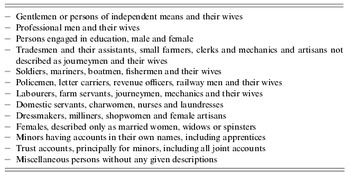
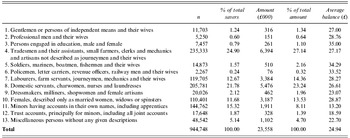
The broadest-based nineteenth-century survey was contained in the 1858 Report of the Select Committee on Acts relating to Savings Banks. This was based on the returns made in 1852 by 404 banks (out of the then existing 576), using a form that tabulated existing savers in thirteen categories, in an analysis partly related to gender and partly to occupation (see Table 1). Six categories of the report were based on professions, trades, or other occupations which it treated as solely open to men. These categories captured male savers working in these fields but also female savers whose husbands followed these occupations – e.g. ‘soldiers, mariners, boatmen, fishermen and their wives’. So these categories represented a mixture of men and women. There was one occupational category explicitly including both men and women working in that type of employment – ‘persons engaged in education both male and female’. Two categories covered work that was apparently assumed to be exclusively female – ‘dressmakers, milliners, shop workers and female artisans’ and ‘domestic servants, charwomen, nurses and laundresses’. There was one category defined by gender only – ‘females described only as married women, widows or spinsters’. Three remaining categories covered minors, trust accounts and ‘miscellaneous persons’.
Categories of savers' occupations from the Report of the Select Committee on Acts Relating to Savings Banks, 1857–1858

Source: Appendix, Table 5, Report of the Select Committee on Acts Relating to Savings Banks, 1857–1858, 337–8.
This analysis had the effect of identifying female investors by marital status in some situations and by occupation in others. It was not, however, clear whether, for instance, all women in the ‘dressmaker etc’ group were single or that the ‘females described only as married women, widows or spinsters’ were invariably unemployed. The effect of this method of analysis is to give some insight into the social class of the savers, but to make it impossible to establish the national proportions of men and women investors, because adult men and women are grouped together in all but three categories, and women savers are potentially unidentified in the ‘and their wives’ groupings.
The 1905 Board of Trade Memorandum was part of a series intended to provide data on British and foreign ‘industrial conditions’. It was based on research designed as a ‘valuable test of working-class prosperity’, an attempt to measure the margin of working-class income available for spending and the rate of growth in that margin.Footnote 16 This, it admitted, was an impossible task, and the memorandum therefore set out to examine the nearest proxy to the margin – the amount saved by working-class depositors. This was also problematic, however. Working-class savings were scattered over a variety of institutions, and not all depositors belonged to the working classes. As a result it conceded that: ‘There are no data enabling a comparison to be made of the total deposits in all institutions in which working-class men deposit their savings.’Footnote 17
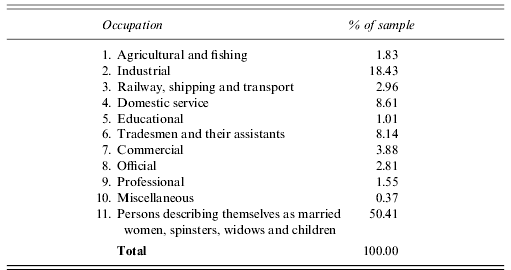
The final words are significant: women's behaviour was not regarded as important in determining the extent of working-class savings and the memorandum's method of analysis makes this clear. The only source of British data came from an 1896 return from the POSB. This is less comprehensive than the 1858 return referred to earlier; it covers depositors who opened accounts within an (unspecified) three-month period (Table 2). The breakdown used in the memorandum is similar to that of the 1858 list, except that the descriptions of savers are more difficult to interpret. Did the occupational categories 1–10 exclude all women? What was the treatment of ‘wives of’ and, would, for instance, an unmarried woman schoolteacher automatically be included in 11, or might she appear in the ‘educational’ category? The memorandum's interpretation of the POSB data completely ignored women's savings activity. It reported that the data did not ‘show what position (subordinate or other) the depositors occupy’ but that ‘it would appear that about 64 per cent of the depositors were members of the working-classes’.Footnote 18 This statistic is calculated by assuming that classes 1–4 represent working-class occupations and then expressing these classes as a percentage of classes 1–10. This is a surprising interpretation: it ignores the fact that the majority of depositors (50.41 per cent) were women or children, and also the possibility that some of these women might have been themselves members of the working classes. The underlying assumption of the 1905 report was that it was only the deposits made by men that could be taken to indicate working-class savings from income, and hence regarded as evidence of working-class prosperity.
Occupations of depositors who opened accounts with the Post Office Savings Bank in the United Kingdom during a period of three months in 1896
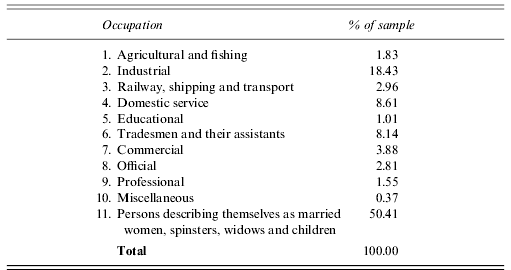
Source: From 1905 [Cd. 2337] British and foreign trade and industry (second series). Second series of memoranda, statistical tables, and charts prepared in the Board of Trade with reference to various matters bearing on British and foreign trade and industrial conditions. Memorandum VI Savings Bank Deposits in the Principal Countries, 192.
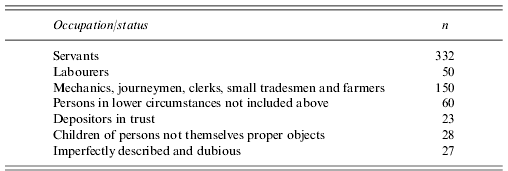
Women's savings activity is not clarified by the summaries published by banks. Their annual reports used a variety of different classifications, or sometimes did not categorise at all, making comparison with the national figures – and with each other – difficult. For instance, Oliver Horne summarises the early savers in a variety of British savings banks, showing that some descriptions were more explicit than others – e.g. women were sometimes ‘unclassified’: at Dundee, only 25 of the first 40 male depositors (and none of the females) were described.Footnote 19 He quotes the first report of the York Savings Bank in 1817, which listed its savers in seven groups (see Table 3) that rarely coincided with those used by the Select Committee discussed above. The Glasgow Savings Bank, discussed below, used a similar classification to that of the Select Committee in its Annual Reports until 1859 and then ceased to disclose savers' occupations because of the ‘disproportionate effort involved’ in compiling the data.Footnote 20
Occupation/status of savers in York Savings Bank, 1817
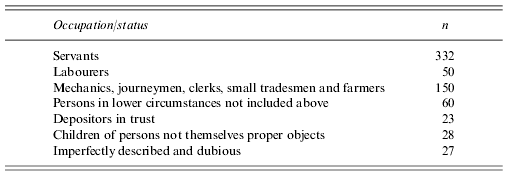
Source: Bank's records, quoted in Oliver H. Horne, A History of Savings Banks (Oxford, 1947), 94.
George R. Porter in a massive survey of 1851, The Progress of the Nation, quoted statistics for two other British banks. For the St Helier bank in Jersey in 1841, he reported that after minors, domestic servants were ‘the most numerous class of depositors’ followed by ‘milliners, shopwomen, and sempstresses’ totalling ‘more than half in number, and nearly one-half in amount, of the entire deposits’.Footnote 21 For the Manchester and Salford Bank in 1842, Porter found that domestic servants (‘seven in eight females’) represented 20 per cent of depositors by number and also by value. The bank had identified only one other female group – ‘milliners, dressmakers and needle-women’ who were 3 per cent by number and by deposit value.Footnote 22
Zoe Lawson, in her study of the banks in Preston, Blackburn, Colne and Kirkham in the mid-nineteenth century, explains some of the confusion as resulting from the different categories used at the time by banks:
Preston did not give children as a separate group but combined them with others in a miscellaneous category with teachers, clerks, apprentices, widows and ‘others of small income’. Blackburn placed tailors with dressmakers, milliners and shopmen or women whereas Preston categorised them with shoemakers, hatters and curriers.Footnote 23
Much of the limited amount of historical writing to date about savings banks has concentrated on the classes to which savers belonged, addressing the claim often made that although the majority of customers of savings banks were working class, the ‘bulk of funds’ belonged to middle-class investors.Footnote 24 This was a concern from the earliest days of savings banks.Footnote 25 Ó Gráda notes arguments about the customers of Irish banks from the 1820s onwards. He records the 1848 newspaper claim that ‘the depositors (in the Cork Savings Bank) are not the humble classes’ and concludes that Irish savings banks attracted a high proportion of the better-off, in the form of accounts for trusts, minors, gentlemen and professionals.Footnote 26 He suggests that ‘most savers were men’ but that ‘the female share was almost certainly boosted by middle-class households operating several accounts in order to get around rules limiting deposit size’ and that, in Ireland, savings banks functioned as a service to the better-off.Footnote 27
Johnson's review of bank and government data leads him to conclude that by 1914 ‘some eight million savings bank depositors were working class’ but that ‘well over half the depositors [were] women and children’ (this is based on the POSB figures in Table 2) and that fewer than four million ‘households’ were likely to be represented by deposits.Footnote 28 The logic here appears to be that it was unlikely that a woman (or child) would be the sole family depositor.
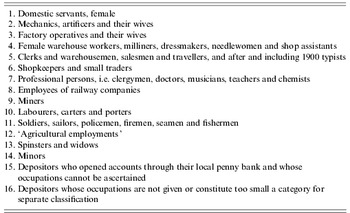
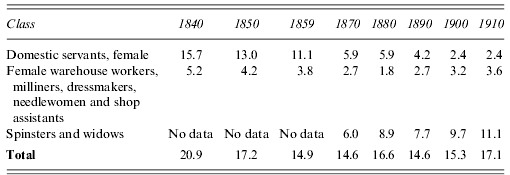
Peter Payne tabulates new savers in the Glasgow Savings Bank at dates throughout the nineteenth century, using some data from management reports (1840–1859) and some from a sample of entries in the bank's declaration books (1870–1910).Footnote 29 The categories he uses are given in Table 4. A comparison shows that some categories – domestic servants, minors – are identical to those in the 1858 parliamentary report, but there is also a good deal of redistribution – e.g. Payne groups soldiers with policemen where the 1857–1858 report adds them to mariners. There are also some puzzles, in particular the absence of ‘gentlemen’ or those of independent means from his table. All the parliamentary categories of male employment add ‘and their wives’; most of Payne's do not. Payne recognises three categories of women savers – 1, 4 and 13 in Table 4 – but not the possibility that any of the other groups might include women.Footnote 30 Payne offers a comprehensive analysis over a substantial period: it is therefore interesting to compare his material with that of the 1858 analysis as an example of the problems that currently exist in analysing savings data. His all-female categories are given in Table 5 and show a decline between 1840 and 1910 due to the apparent steep reduction in the importance of domestic servants as savers, compensated by the growing importance of widow and spinster savers. Payne notes the drop in female domestic servants but does not comment on it.Footnote 31 He observes the growth in the spinster and widow group, but only to make the point later repeated by Ó Gráda, that many of them can be assumed to be ‘drawn from the families of professional persons and small tradesmen’.Footnote 32 Payne's total proportion can be compared with the categories in the 1857–1858 parliamentary report that can be taken to be largely/exclusively female – i.e. categories 8–10 of Table 6: domestic servants, charwomen, nurses and laundresses, dressmakers, milliners, shopwomen and female artisans and females, described only as married women, widows or spinsters. These categories show a total of 35.6 per cent of savers as women. Payne does not point out that his Glasgow figures for women savers are somewhat lower than the near contemporary ones from the parliamentary report (e.g. 17.2 per cent for Glasgow in 1850 and 14.9 per cent in the 1859 report). But this discrepancy raises questions: does it reflect a major difference in savings activity between Glasgow and Britain in general, or is it simply a product of different methods of analysis?
Classification of occupation/status of savers in Savings Bank of Glasgow (as used by Payne, 1967)

Source: P. L. Payne, ‘The Savings Bank of Glasgow 1863–1914’, in P. L. Payne ed., Studies in Scottish Business History (London, 1967), 162.
All-female groups of savers in Savings Bank of Glasgow, 1840–1910
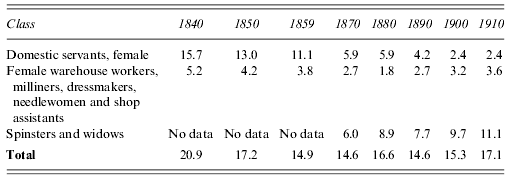
Source: P. L. Payne, ‘The Savings Bank of Glasgow 1863–1914’, in P. L. Payne ed., Studies in Scottish Business History (London, 1967), 162.
1852 Analysis of accounts by status/occupation of account holders, from Appendix 5, Report of the Select Committee on Acts Relating to Savings Banks, 1857–1858

Source: Appendix 5, Report of the Select Committee on Acts Relating to Savings Banks, 1857–1858, 336–7.
In many other studies, there is little attempt to analyse the gender composition of the group of savers observed, and in particular the activity of wives is subsumed into that of their husbands. Pollard summarises the occupations of savers in the S&H at various dates between 1819 and 1861 using four categories: heavy staple trades (i.e. steel-making), light trades (e.g. cutlery and tool-making), other artisans (outside the metal industry) and ‘other’. He explains that ‘[w]ives have been classed with the occupation of their husbands, where known, but unidentified females and minors were classed with “others”’.Footnote 33 Roger Lloyd-Jones and Myrddin Lewis review the occupations of savers in the S&H in greater detail but make no reference to women other than to explain that ‘in the case of investments by married women the occupation of the husband was recorded’.Footnote 34 Lawson notes the behaviour of various women in her study of individual accounts, but does not draw any conclusion about the importance of women in the population of savers.Footnote 35 Beverly Lemire looks at the records of London Provident Institution in the early nineteenth century and notes the high proportion of domestic servants who saved.Footnote 36 She comments on the importance of savings promotion as ‘the benchmark of respectability and the cornerstone of female domestic management’ but has little to say about the extent to which women other than domestic servants were savers.Footnote 37 Duncan Ross looks at ‘penny banks’ in Glasgow between 1850 and 1914; he notes the high level of saving by children, but otherwise does not comment on the identity of savers.Footnote 38 Albert Fishlow notes the high proportion of savers who were (female) domestic servants but does not draw any conclusion about any female propensity to save.Footnote 39
The exception to this tendency to neglect data on women savers is Douglas Pollock in his study of the Bridgeton Cross branch of the Savings Bank of Glasgow in 1881. Pollock looks at the bank's records of individual depositors rather than its classified returns. He reviews the depositors' declarations, which give for each new depositor the name, address, occupation, amount of deposit and (where the depositor was literate) a signature.Footnote 40 This approach is not subject to the limitations noted above that were imposed by the different classifications used by banks. On this basis, he concludes that when Payne in his 1963 study of the Glasgow Savings Bank used only the exclusively female categories – spinsters, widows, servants, milliners, warehouse workers, shop assistants, needlewomen – his figures of between 14.6 and 16.6 per cent women savers in the period 1870–1890 were an understatement. Pollock finds that 851 of the 1933 new adult depositors in 1881, i.e. 44 per cent, were women, 424 of them married.Footnote 41
Pollock's findings are interesting for a number of reasons. By unpacking the aggregate data normally used to review banks' savers, he points to a high percentage of them being women, nearly three times the proportion identified by Payne in studying the same bank. Additionally, Pollock finds that half the women savers (424 out of 851) were married. Out of these 424 married women, 343 (81 per cent) ‘included no reference to their spouses in their depositors’ declarations' – they were opening a savings account for themselves.Footnote 42
These findings immediately present a number of issues for further investigation. Was the proportion of women savers identified by Pollock unique to Glasgow, or did other savings banks also attract a high number of women? What was the class background of women savers elsewhere? How many women savers were married, and was it widespread behaviour for married women to open accounts in their own names? The remainder of this paper attempts to answer these questions. The following sections review the debate concerning women and their savings behaviour in the nineteenth century, and set out specific evidence about women's behaviour from a penny savings bank in Huddersfield and from the S&H in Sheffield, one of the largest British savings banks of the time.
4. CONTROVERSIES OVER WOMEN AND MONEY IN THE NINETEENTH CENTURY
There is a growing literature discussing the involvement of middle-class women in a variety of investment activity from the early eighteenth century onwards, and the case has been made for their activity as investors in government bonds, shares in a wide range of industries, loans and real estate.Footnote 43, Footnote 44 Evidence has been produced of concern over the implications for femininity of such economic behaviour.Footnote 45 Writing about working-class women's activity as managers of their own and their families' money is, however, dispersed, and has generally concentrated on the limitations of their control over their finances. Three areas of controversy are outlined here before the paper moves on to examine them in the light of nineteenth-century debates over women and money.
The historian investigating the extent to which working-class women were savers needs to address different views about working-class women's access to and control of money. Some contemporaries simply claimed that women could not save; for instance, John Duguid Milne flatly asserted in 1870 that it was ‘impossible for a working woman to save money’Footnote 46 and Joseph Chamberlain gave evidence to the Royal Commission in 1893 that women were ‘by the very necessity of their lives … in the majority of cases almost excluded from saving.’Footnote 47 This point has been taken up by some modern historians and opposed by others. Margaret Williamson sums up the controversy:
Historians researching the lives of women in late nineteenth- and early twentieth-century Britain are divided between those who argue that women's oppression can be traced to the growing dependence of unpaid housewives on their wage-earning husbands and those who stress the informal power that these same housewives wielded within the home.Footnote 48
There is a continuing debate about the allocation of money between husband and wife within the household. Jan Pahl, discussing the late twentieth century, identifies four possible patterns of allocation: control by the wife, control by the husband, pooling controlled by the wife or by the husband.Footnote 49 Similar alternatives have been proposed in historical discussions. On one side of the debate, it is argued that married women's management of money was confined to ‘stinting themselves’, while financial control lay with the husband or in a pooling arrangement controlled by him. For instance, Laura Oren stresses the asymmetry of the distribution of earnings within the working-class family.Footnote 50 The wife thus acted as ‘a buffer for her husband’.Footnote 51 She took a smaller share of the family's resources, so that the husband and then the children could be provided for first. The implication is that the wife's role in the family's finances was limited to demanding as little as possible. Ellen Ross and Williamson identify similar regimes in London and North-East England, of husbands' secrecy about earnings and the restriction of wives to pocket money, so that they could carry out budgeting but not exercise control.Footnote 52 The strategies for money management identified as very important by Ross – pawning, sharing, borrowing, making claims on children's wages – can be seen as makeshifts by women with no access to income of their own, dependent on their husbands' generosity.Footnote 53 Barbara Blaszak quotes the example of a 1907 county court judgement that money saved by a wife from the housekeeping came from her husband's earnings and therefore could not be regarded as her own money.Footnote 54
On the other side of the argument Carl Chinn asserts that ‘all the mothers of the poor’ had ‘total command of the family finances’.Footnote 55 They used strategies that he identifies as including pawning family assets, borrowing from small money lenders and using rotating credit associations (‘didly’ or ‘didlum’ clubs).Footnote 56 Elizabeth Roberts' oral history of working-class women over the half-century from 1890 to 1940 is based on responses from 160 men and women from the Lancashire towns of Barrow, Preston and Lancaster. In every family but one, she finds that husband and children handed over their wages to the wife, who took both routine and momentous financial decisions (e.g. about moving house).Footnote 57 She finds that ‘in virtually every family the woman was able to save a little at some point’, and in addition to the strategies listed above she identifies formal methods of saving. All families had death insurance, about one-sixth of the Barrow population belonged to a friendly society, and though no bank accounts were reported, a few families had post office accounts.Footnote 58 Susan Pedersen also attributes to married women an important role as ‘the nexus of the complex system of negotiations and obligations by which working-class families survived’ and she quotes Lady (Florence) Bell's 1907 praise: ‘The husband's steadiness and capacity are not more important than the wife's administration of the earnings.’Footnote 59 Jane Lewis occupies a position somewhere between the two extremes stating that: ‘many wives did not know what their husbands earned’, but wives often ‘exercised considerable control over all but the husbands’ pocket money'.Footnote 60 She again concludes that women's control largely took the form of makeshift strategies – informal savings clubs, pawnshops, small moneylenders, borrowing from family and friends, casual work and poor relief.Footnote 61
A second area of controversy is the debate about the extent of women's employment in the nineteenth century. The assumption of falling levels of activity as paid work moved outside the family has been challenged by Edward HiggsFootnote 62 and most recently by Joyce Burnette.Footnote 63 The latter indicates a number of factors contributing to systematic and pervasive under-recording and also distortion of women's activity. These include a cultural framework for the census takers of 1841 and 1851 leading to reluctance to identify women in a household as paid workers,Footnote 64 the tendency to exaggerate the incidence of women's employment as domestic servants and to ignore seasonal occupations outside the homeFootnote 65 and the elision of the wife in working husband and wife partnerships.Footnote 66 Recent writing on women's self-employment in businesses also suggests that it has been understated in incidence and significance – see, for instance, Katrina Honeyman for a study that draws on a wide range of writing to challenge claims that women were ‘marginalized or excluded’ from the employment market.Footnote 67 Clearly, women's ability to save would to some extent have been determined by their access to paid work outside the household. If census data and government bank records of savers have understated this – and if subsequent recording and analysis of savers have also obscured the extent to which deposits were made by women workers – there is scope for more detailed study of the identity and occupation of individual savers. How far, for instance, does the decline in number of ‘domestic servant’ savers noted above in the Glasgow banking records reflect a change in employment, and how far a change in bank record-keeping over the period?
A third issue relevant to women's ability to save is the extent to which married women were legally able to act as savers, whether on behalf of the family or in their own right. Under common law, the principle of coverture meant that all the personal property of a couple became the husband's on marriage. Under equity a marriage settlement could preserve property for the wife's benefit, and it was very common behaviour among the middle as well as the upper classes to create such settlements. These would preserve assets outside the husband's control for the benefit of the wife, so that she could, for instance, receive bank or bond interest, a safeguard if the marriage broke down or the husband became insolvent.Footnote 68
Common law, however, allowed husbands to dispose of their wives' unprotected personal property. A woman living with, or separated from, an abusive husband could not prevent him from accessing her earnings or savings. It was pointed out by reformers that this was an aspect of the MWPA that hit working-class women particularly hard, because their families could not afford the protection of a marriage settlement.Footnote 69 Working-class women had no protection for earnings, for personal possessions or for savings. Lee Holcombe quotes Albert Venn Dicey's verdict that: ‘The daughters of the rich enjoyed, for the most part, the considerate protection of equity, the daughters of the poor suffered under the severity and injustice of the common law.’Footnote 70
In contrast, Finn points to the extent to which married women did in fact ‘enjoy substantially more economic authority than the literature on coverture would suggest’.Footnote 71 She suggests that evidence of their activity as debtors and creditors indicates that ‘at the level of much day-to-day life the law of coverture is best described as existing in a state of suspended animation’. In describing the activity of working-class women in county courts, she writes of them as ‘able to behave as if they were active economic agents, notwithstanding their common law definition as economic nonentities’.Footnote 72 Morris has further suggested that ‘the gender bargain was … unravelling’, as evidenced by the confusion over married women's ability to enter into contracts to buy goods with their husbands' cash or credit, so that case law was overturning the apparently fixed position created by common law.Footnote 73
Evidence of the extent to which working-class women were savers has the potential to contribute to all these debates, by indicating to what degree women were able to access money and make decisions about what was to be done with it. Themes from contemporary debates, outlined below, can contribute to understanding their situation.
5. THE VIRTUE OF PROVIDENCE
In 1860, an article in the Quarterly Review called for higher levels of working-class savings at a time when, it claimed, workmen's earnings were higher than ever. It noted that the ‘most numerous class of depositors’ reported in the Manchester and Salford Savings Bank were female domestic servants, and quoted examples of women's propensity to save.Footnote 74 A Bradford workman ‘had been a drinker’: but after ‘finding his wife's savings-bank deposit book from which he learnt that she had laid by about 20 shillings’ he followed her example.Footnote 75 Also instanced was a ‘strong muscular mechanic’, recently widowed, arriving at the Bradford savings bank with his two small children. He produced the deposit-books ‘which his wife had previously been accustomed to present’.Footnote 76
This moralising could be attributed to the tendency identified by Jane Lewis for middle-class commentators to regard working-class wives as better household managers than their husbands.Footnote 77 In Thrift (1875), for instance, Smiles celebrates the role of the working-class housewife as ‘wife, housekeeper, nurse and servant, all in one’.Footnote 78 This is a role that includes responsibility for directing her husband's (and sons') financial affairs: ‘Men may hold the reins … but … the women … tell them which way to drive.’Footnote 79 There is, Peter Sinnema finds, an ambiguity in Smiles' account of women's role. He depicts them as ‘conventional helpmeets or deterrents’.Footnote 80 In Thrift, however, he repeatedly gives the example of a husband who is shamed into saving by the surprise discovery that his wife has a bank account.Footnote 81 There is thus a tension between his treatment of women as what Sinnema calls ‘textual ephemera’ and the admission that wives did also set a practical example as savers.Footnote 82
This presents a question – how can these findings be aligned with the prolonged Victorian debate about the law on married women's right to own property? The 1868 Select Committee on the Married Women's Property Bill took evidence on married women's property ownership (or lack of property) from a number of sources. Septimus Hansard, Rector of Bethnal-Green, claimed that there were numerous cases among his working-class parishioners in which separated wives were left destitute because ‘the husbands have come down upon them, finding that they had a little money of their own’.Footnote 83 He argued that women were ‘the great representatives of the virtue of providence amongst the working classes’. The next witness, a London police magistrate, supported him: ‘among the respectable working classes … the wife is quite the treasurer of the earnings of the husband’.Footnote 84 The wife, he argued, was naturally drawn to save. Protection of married women's property would increase the amount of saving in the country as a whole. Similar points were made by other witnesses. The Reverend Thomas Fowle, a clergyman ‘among the labouring classes in Hoxton’, told the story of a woman deserted by her husband, who had called that day ‘to draw out some money which she had put into my savings bank; of course I gave it to her, but if the husband had chosen to prevent me, I could not have done so’.Footnote 85
It can be objected that the arguments contained in this evidence were not about married women's savings habits but again reflected a belief in women's moral superiority, their ‘virtue of providence’, which could be used to set an example to dissolute husbands. But this potential objection is countered by one of the witnesses to the 1868 Select Committee, John Ormerod, the president of the Rochdale Co-operative Society.Footnote 86 The Rochdale society, with 7,000 members, had two important features: married women held savings in their own names, and husbands were not allowed to access them. Society members included ‘many married women’ who continued to hold their shares after marriage. Some had held shares when single and kept them in either their maiden or their married name:
… it is a very common practice of families in Rochdale, that both husband and wife shall be members of our society, and that each shall have money invested in their own names. The husband calls them his, and the wife calls them hers, and they each respect each other's savings.Footnote 87
There were also women who on marriage transferred their shares to their husbands, but these were ‘comparatively rare’.Footnote 88 The Society's managing committee did not allow a husband to access his wife's savings without her permission: ‘[P]ersons have demanded it, and we have always resisted it.’Footnote 89 According to Ormerod, ‘the working men of Rochdale … do their best to secure to the wives their separate shares’ even in the face of threatened legal action. As a result, working-class women savers had substantial savings in the Society – in some cases £50 or £60.Footnote 90
Ormerod's account of the women savers in Rochdale is of interest because it shows a different view of such women from those offered elsewhere. He presents working-class women as managing money by using a formal system rather than makeshift strategies, saving rather than borrowing and supported by their husbands in retaining control of their own money. Was such behaviour possible in Rochdale only because of the high level of local women's employment in textile factories and because the Co-operative Society supported their independent saving? Or does Ormerod's evidence throw any light on the thrifty behaviour of married women savers at the Bradford Savings Bank described, as mentioned above, in the Quarterly Review? This is evidence that seems to support the arguments by Morris and by Finn, quoted above, that there was scope for married women under coverture to succeed in ‘suppressing, subverting, eroding and evading’ the strictures of the common law – in this case by taking independent decisions about their money.Footnote 91
With these questions in mind, the following sections of the paper look at the extent to which women were savers in two banks during the mid-nineteenth century – the Huddersfield Mechanics Institute (HMI) Penny Savings Bank and the S&H – with the aim of assessing the importance of women as savers in that period and of considering what light these findings have to throw on the various views outlined in the paper thus far.
6. HUDDERSFIELD MECHANICS INSTITUTION PENNY SAVINGS BANK
Huddersfield in the mid-nineteenth century was a centre for textile manufacture, an employer of both men and women as factory operatives.Footnote 92 The HMI was formed in 1844 (it was preceded by a Young Men's Mental Improvement Society formed in 1841), with the aim of offering education to working-class men and boys, initially in school subjects and later specialising in scientific and technical education. It was one of a number of institutions making up the Yorkshire Union, whose members were in 1850 encouraged to form savings banks. The proposal came from Charles Sikes, manager of the Huddersfield Banking Company, who became a manager of the Preliminary Savings Bank, later renamed the Penny Savings Bank, when it was set up by the HMI in July 1850. Its founders explained that it was ‘calculated to exercise an immensely beneficial influence over the members’ and to ‘induce and encourage habits of thrift, economy and forethought’.Footnote 93 By January 1851 it had 302 accounts, rising to 350 by 1852 and then falling back to 309 in 1853. By 1875, however, it had increased to 2,962 accounts.Footnote 94 The bank was ‘preliminary’ in the sense that it was intended to encourage savings of modest amounts by welcoming customers who had only a few pence to deposit at a time. Transactions were at low values. In 1857, for instance, customers made 2,016 deposits of a total of £130 19s 11½d – an average of 1s 4d – and 371 withdrawals totalling £126 19s 5½d – an average of 6s 9d.Footnote 95
Table 7 shows the results of a sample of 50 savers from the first volume of the Huddersfield depositors' ledgers and covers the period 1850–1851. Two key features stand out. First, at 15s 3d for men and 8s 2d for women the average balances were much lower than the average of savings banks nationally – the Select Committee report gave an average balance figure of just under £25 overall in 1857–1858 (see Table 6). Second, women represented by far the minority of savers – 18 per cent – and the average value of their savings was just over half that of male investors.
Balances held by Huddersfield savers, by gender, 1850–1851

Source: Huddersfield University Archives, Huddersfield Mechanics Institution Penny Savings Bank ledger, HMI 8/13.
The Huddersfield data have advantages and drawbacks compared with the material drawn from the records of the S&H and discussed in the following section. Huddersfield's records are in the form of a ledger, showing the amounts of money being paid in and out of the accounts, the dates of transactions and the balance outstanding. They also show names and addresses of the savers, but give no information about their age, occupation or marital status. The Sheffield records, in contrast, do not disclose the value of accounts, but give substantial information about personal aspects of the depositors.
7. SHEFFIELD AND HALLAMSHIRE SAVINGS BANK
The S&H was founded in 1819.Footnote 96 By the mid-1840s it had 5,022 savers and £166,000 in deposits, with numbers and values rising to 16,724 and £360,000 in 1863. By the end of the century its deposits were £1,377,000.Footnote 97 Its growth included the opening of several suburban branches (eight simultaneously in 1851) and of school penny banks from 1876 onwards.Footnote 98 The nineteenth century was a period of very rapid growth for Sheffield, whose population trebled between 1801 and 1851 (while that of Great Britain doubled overall), due largely to considerable in-migration.Footnote 99 The city's major industries – steel-making, cutlery manufacture and other types of metalworking – generally employed few women, other than in gold and silver working and some light trades.Footnote 100
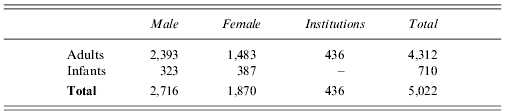
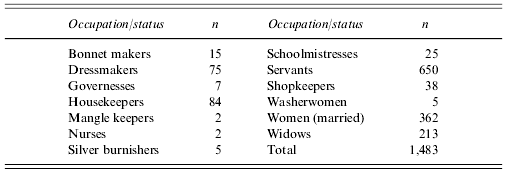
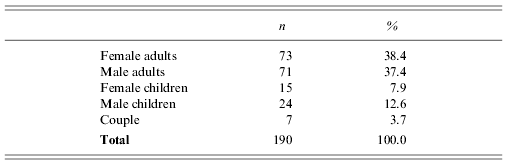
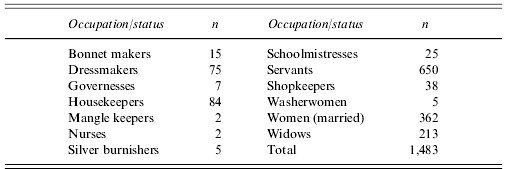
The earliest analysis of savers in the S&H was provided by George Holland's 1843 Vital statistics of Sheffield, summarised in Table 8a.Footnote 101 This showed that just over 38 per cent of adult savers (1,483 out of 3,876) were women. Holland summarised the composition of the group of women in figures shown in Table 8b. The largest single group of women was that of domestic servants, followed by married women and widows. Other smaller groups of women were identified by occupation. (Women were identified by marital status or by occupation, but in Holland's tables never by both.)
Composition of savers in the Sheffield and Hallamshire Bank, 1843
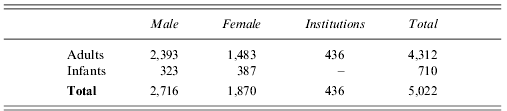
Occupation/status of female depositors in the Sheffield and Hallamshire Bank, 1843
Source: G. C. Holland, Vital statistics of Sheffield (London, 1843), 134.
From the foundation of the S&H there had been claims that it was being used by middle-class savers. Such claims took a very similar line to those described by Ó Gráda as discussed above. Robert Leader quotes a writer in the Northern Star in 1819 claiming that ‘someone had put £700 (in the S&H) in the name of her seven children’ and ‘a lady’ had deposited £200.Footnote 102 It is therefore possible that Holland's figures mask a large middle-class contingent within the groups of married women and widows.
Records of the S&H for 1857–1860 are available at Sheffield City Archives, and the records for 1860–1912 and 1919–1927 are held at the Lloyds/TSB Archive in London.Footnote 103 It is not possible to use the S&H data to make direct comparisons with the Huddersfield records, but they can be used to identify personal details of depositors, by means of the depositors' declarations books in which an entry was made when a saver joined the bank. Each entry gave information about the date of joining and the depositor's identity, but did not specify either the amount deposited or any details of subsequent transactions. Details of the date when the declaration was made were very precise, including the year, month, date and weekday (morning or evening for Saturday) of the transaction. Each entry was identified by a ‘progressive’ number, beginning at 1 for the first transaction made, as well as a reference number for the account. The depositor signed with his or her first and family name, illiterates using an X. The entry identified the depositor's residence, with a level of detail ranging from the name of a village to a street and a house number. There was a range of information about the depositor's occupation. Males were identified by job or ‘out of business’. Females, if married, were described by their husband's name and his job title (e.g. ‘wife of Joseph Grimstone, Engineer’). Single or widowed women were generally described solely by their marital status. The only exceptions to these categories among women were ‘domestic servants’, who were described as such, and, very occasionally, working women who were described by their job titles. Where married couples made a joint deposit they were identified by the husband's job title. Savers of less than 16 years of age were described as ‘boy’, ‘girl’ or ‘infant’, and their father's name and occupation were sometimes given. There was also a spare column for ‘remarks’ against each entry. Apart from the depositor's signature, all entries were made by a clerk.
The review that follows looks at a sample of women investors in the S&H between 1857 and 1863, with the aim of investigating the composition of the sample in terms of a number of issues. What was the savings behaviour of married women before the 1870 MWPA made the first, albeit limited, improvements in property rights for women? Did the women's lack of ownership rights deter them from saving? Did married women open accounts jointly with their husbands? Were middle-class women an important group of savers in these banks, given the contemporary suspicions of the middle-class involvement in savings banks?
The review is based on a sample of 190 reference numbers, selected from the S&H declaration books for December 1857 to May 1860 and May 1860 to January 1863.Footnote 104 The sample was taken by selecting the first entry and subsequent entries at an interval of 140 thereafter for 1857–1860 and the first and subsequent 150th entries for 1860–1863.
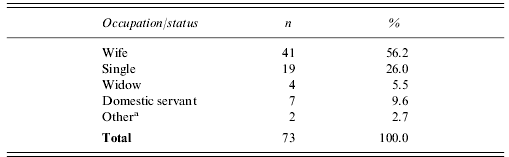
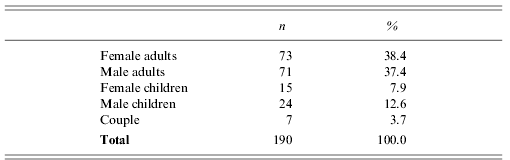
Tables 9a and 9b show the results from the sample. Individual adult male and female savers were almost equal in number, together accounting for 76 per cent of savers (Table 9a). Boys and girls were the next groups in order of size. Married couples opening joint accounts were the smallest group. Table 9b shows that married women formed the largest group of adult women savers making independent deposits in the S&H. Two women were described by occupation as ‘file cutter’ and ‘dressmaker’ but with no marital status given.
Composition of new savers in the Sheffield and Hallamshire Savings Bank, 1857–1863
Occupation/status of adult female savers in the Sheffield and Hallamshire Savings Bank, 1857–1863
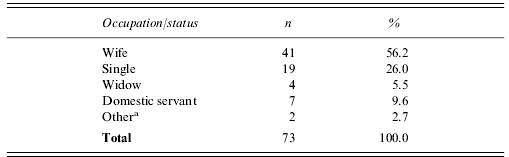
a Described as ‘file cutter’ and ‘dressmaker’.
Source: Sheffield and Hallamshire Savings Bank Declaration Books 1857–1860 and 1860–1863 (Sheffield Archives BUS 7/1/1 and Lloyds Banking Group Archives TD296a/30).
Because married couples are separately and clearly identified, this evidence suggests that individual married women were opening accounts in their own names, and were doing so before the 1870 MWPA gave them ownership of their personal property. This is an interesting observation from a number of aspects.
As a separate exercise, the first 1,000 accounts in alphabetical order in the book for 1857–1860 were reviewed to see in how many cases a husband and wife had each opened a separate account and in how many of these cases the separate accounts had been opened more or less simultaneously – i.e. within a week of each other. There were 40 such accounts (i.e. 20 pairs of accounts opened more or less simultaneously by husband and wife), 24 of which had been opened at exactly or nearly the same time. In 8 out of the other 16 cases, the husband had opened the first account. The women involved appear to have been opening the accounts from scratch after marriage – i.e. the book is not simply showing changes from maiden to married name on an existing account.
The first immediately striking feature is the difference between the proportions of women savers in the HMI and S&H banks. Adult women at the S&H slightly outnumbered adult men as savers, although males prevailed overall (95:88) because of the higher number of boy than girl savers.Footnote 105 Married couples opening joint accounts were the smallest group. The second striking feature is the importance in the S&H of married women as savers. They made up over 56 per cent of all women opening savings accounts, more than twice as substantial as the next group, ‘single women’ so described. If it is assumed that the ‘domestic servants’ and ‘other’ were also single, the ‘single women’ group grows to 38.3 per cent of the total. Widows were the smallest group of savers.
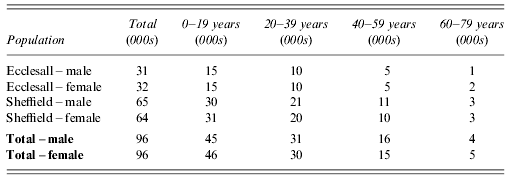
It could be objected that there was a larger female than male population in Sheffield at this time, and that the high proportion of female savers reflects this. However, Table 10, summarising the population of the two adjacent Sheffield registration districts in 1861, suggests that male and female numbers were equally balanced, with slightly more women aged up to 19 years and 60 years or over, and more men aged 20–59 years. (The only group where women decisively exceeded men was the very small one of the over-80s, with 277 women and 164 men). A comparison of the overall male and female populations with the groups of savers thus suggests that adult men and women were equally likely to save, although boys were more likely to have accounts opened for them than girls. Wives made up more than half the group of female savers. This is arguably in excess of their importance in the Sheffield population. Nearly half of Sheffield women in 1861 (46,000 of 96,000) were aged under 20 years and likely to be still single. Women aged over 60 years, the group most likely to include widows, made up 5.2 per cent of the female population, and widows were 5.5 per cent of the female savers, suggesting no particular inclination by widows to save.
Male and female populations of Ecclesall and Sheffield, 1861 census
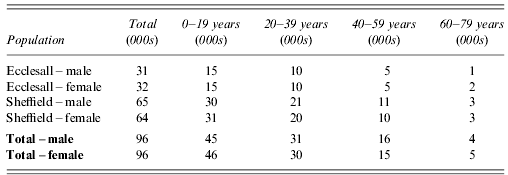
Source: 1861 Census, Division IX, Table 2.
8. DISCUSSION
There is clearly scope for developing the findings set out above in a number of directions. The proportions of women savers in the HMI and the S&H differ markedly: there were far fewer women in the former, but no evidence as to the reasons for this. Was it related to levels of female employment in the two areas? Certainly, prima facie, the higher proportion of women working in textiles than in metal industries makes it surprising that the higher savers were the Sheffield women. The HMI results suggest that women on average saved half as much as men. The Sheffield data examined so far do not include information about accounts and transactions; details of the amounts saved and the pattern of saving, such as regular deposits versus withdrawals, and saving for the long or the short term, are clearly needed to assist in understanding the reasons for operating these accounts. In addition, there are questions to be asked about different patterns of behaviour: did women in Sheffield generally enjoy more control over their own and family earnings than did women in Huddersfield? Did Sheffield banks benefit from a higher reputation or less competition from other formal and informal institutions such as friendly societies or local clubs than did those in Huddersfield?
There is also a need to understand the composition of the population of women savers. The results above can be compared with studies of the behaviour of middle-class women as investors in securities in the nineteenth century, which suggest a rising trend in investment behaviour by women. David Green and Alastair Owens, for instance, note the importance of women as holders of government bonds in the early nineteenth century: ‘By 1840 nearly half of the public creditors were women. It would appear that these women actively and confidently invested in government securities,’Footnote 106 while Green et al. stress the growing importance of women as shareholders in the later nineteenth and early twentieth centuries: ‘[B]etween 1870 and 1935 the proportion of women shareholders rose from 15 per cent to nearly 42 per cent. By value their share rose from about 4 to nearly 30 per cent. In some companies, notably those with household names, women were the majority of shareholders.’Footnote 107
In considering the marital status of women investors, Josephine Maltby and Janette Rutterford, for instance, also find widows the least important group. They find, however, that for a group of companies in the late nineteenth and early twentieth centuries ‘spinsters’ holdings were in many cases more numerous than those of wives and widows, albeit relatively small in value'.Footnote 108
Green et al. also note spinsters' propensity to save in a study of the period 1870–1930: ‘Throughout the study period, single women were the most important group of female shareholders, representing between 39 per cent and 50 per cent of women investors.’Footnote 109
Maltby and Rutterford explain the importance of single women in the investor population as a result of their need to supplement low earnings or to create dividend income from money inherited from parents. Married women were discouraged from investment prior to the MWPAs by their lack of control over their assets, only mitigated by the use of settlements.
The findings of the present study pose a number of questions. They show married women making savings in their own names well in advance of the MWPAs, and suggest that they were more likely to do so than single women. Why were wives more able to save than single women? Were they using funds they had earned or had saved from housekeeping, or were they acting as agents for their husbands? Were these savings known to their husbands? Why did so few married couples choose to open accounts jointly?
Previous studies, such as those quoted above, have tended to assume that women depositors were acting on behalf of their husbands.Footnote 110 They imply that perhaps members of the middle classes were spreading the family's wealth via a number of accounts for the women and minors in the household.Footnote 111 Was this indeed the case, or does the evidence presented here suggest some challenges to views of working-class women as excluded from employment and from economic activity? Burnette has argued that nineteenth-century reporting of women's employment was distorted and understated, on the basis of the tendencies that she finds in censuses to exaggerate the use of the term ‘domestic servant’ as an occupation.Footnote 112 She comments that they also ignore the employment of women who were ‘part-time, seasonal and home workers’.Footnote 113 Are these features also to be found in government and banks' recording of their depositors, compounded by the collapsing of wives and husbands into the husband's occupational group? It could be argued that wives' appearance as depositors is prima facie evidence that they had earnings of their own. More and wider evidence is needed from bank records to investigate this possibility.
Women's appearance as depositors also raises questions about the extent to which married women were able to manage property, even before the increased control given them by the 1870 and 1882 MWPAs. Finn's challenge to the significance of coverture for women in the nineteenth century suggests that working-class women were able to behave as ‘active economic agents’ rather than ‘economic nonentities’.Footnote 114 Certainly, the frequent descriptions in the nineteenth-century literature of wives being found to have savings accounts suggest a tension between views of the wife as a financial dependent and as a self-directed planner.Footnote 115 It is possible to read saving by wives as an act of anxious self-protection,Footnote 116 but an account such as that by Ormerod of the Rochdale Co-operative SocietyFootnote 117 suggests that, in Finn's words, coverture might be ‘in a state of suspended animation’ within the family.Footnote 118 Ormerod's evidence suggests that Rochdale was a town in which independent financial management by husband and wife was expected and endorsed. Are regional differences in culture, as well as employment opportunity, possible influences on savings activity by women? This links with a wider debate concerning the control of money, and surely needs to be revisited in view of the emerging evidence on savings.
An exploration of these preliminary findings has the potential to cast considerable light on the economic activity of working-class women in this period. It appears that working-class wives were not necessarily the guardian angels celebrated by Smiles but also economic agents who could save, literally, on their own account. This suggests the need to reconsider the nature and extent of working-class wives' access to money, either in the form of their own earnings or of those of their husband and family, and their ability to control it during the nineteenth century.
Acknowledgements
Thanks to Linda Perriton of York Management School and Katrina Honeyman of the School of History, University of Leeds, for their advice on this paper, part of a developing project on working-class women and the management of money on which we are engaged. Thanks to the Sheffield and District Family History Society, Hilary Haigh of the Huddersfield University Archives, Karen Sampson of the Lloyds Banking Group Archives and Kirstin Smith of the Sheffield Archives for their invaluable help in locating and using the archival information discussed in this paper.