I. INTRODUCTION
Direct coagulation casting (DCC) is a ceramic colloidal forming method which produces near-net shape ceramic green bodies, basing on the idea that a high solid loading suspension is destabilized by a time-delayed internal reaction using a catalyst. Reference Gauckler, Graule and Baader1,Reference Lewis2 Before the coagulated process, a stable colloidal suspension can be obtained by the addition of a dispersant into the suspension to ensure that the repulsion forces are high enough to overcome the agglomeration of particles. Reference Hidber, Graule and Gauckler3,Reference Tomasik, Schilling, Jankowiak and Kim4 Then the stable colloidal suspension can be coagulated by the decomposition products that may be catalyzed by an enzyme or a self-decomposing reaction, which either shifts the pH of the suspension toward its isoelectric point (IEP) of the ceramic powder system or increases ionic strength of the suspension. Reference Balzer, Hruschka and Gauckler5 However, the wet strength of green bodies prepared by the pH-shift method is too low to handle. The drawbacks of increasing monovalent ionic strength are reflected in the long coagulation time and easy cracking in the green bodies. Reference Balzer, Hruschka and Gauckler6,Reference Yang, Huang, Meier, Wyss, Tervoort and Gauckler7
Considerable progress has been achieved in DCC during the last two decades. To increase the wet strength of green bodies prepared by the pH-shift method, boehmite, alkali-swellable thickeners, and poly(acrylic acid) homopolymers have been added to the suspension. Reference Xie, Yang, Huang, Will and Gauckler8,Reference Hesselbarth, Tervoort, Urban and Gauckler9 The wet strength increases from 10 to 100 kPa. To avoid the use of urea-urease coagulating system, coagulation of the suspension was achieved by the decomposition of coagulating agents through increasing temperature, such as in the addition to the suspension of hydroxyaluminum diacetate which decomposed as the temperature increased to coagulate the alumina suspension. Internal coagulation was mainly due to Al3+ ion release, which permitted a shift of the pH near the IEP, a strong increase in ionic strength, and desorption of the dispersant. Reference Laucournet, Pagnoux, Chartier and Baumard10 Binner et al. proposed a new method of the DCC process called in situ coagulation molding. Reference Binner, McDermott, Yin, Sambrook and Vaidhyanathan11–Reference Binner and Mcdermott13 The in situ hydrolysis of d-gulonic-γ-lactone progressively destabilized the suspension to form a viscoelastic solid within which the homogeneity of the initial dispersion was maintained. A novel near-net-shape DCC method using MgO as the coagulating agent was investigated by Prabhakaran et al. Reference Prabhakaran, Sooraj, Melkeri, Gokhale and Sharma14,Reference Prabhakaran, Raghunath, Melkeri, Gokhale and Sharma15 Sparingly soluble MgO in water forms Mg-poly(acrylate) with the unadsorbed ammonium poly(acrylate) molecules which leads to insufficient dispersant coverage on the alumina particle surface and results in coagulation of the suspension. The precipitated Mg-poly(acrylate) acts as a binder which enhances the strength of the coagulated body. The Schulze–Hardy rule suggests that the low concentration of divalent and trivalent electrolytes is necessary to coagulate the suspension while a high concentration is needed for monovalent electrolytes. Reference Derjaguin16–Reference Hsu and Kuo18 Recently, a modified DCC method via controlled release of high valence counter ions (DCC-HVCI) with the combination of DCC and the Schulze‒Hardy rule was proposed. Reference Xu, Wen, Li, Qi, Xi and Yang19–Reference Xu, Gan, Yang, Qu, Wu and Yang25
The controlled release of high valence counter ions to coagulate the concentrated suspensions in a controllable manner is the key technology for DCC-HVCI. To date, we have developed several methods for controlling the release of HVCIs. Calcium ions were controlled by the release from calcium iodate or reactions between calcium phosphate and hydrochloric acid by increasing the temperature which increased the viscosity of the concentrated alumina suspension. Reference Xu, Wen, Li, Qi, Xi and Yang19–Reference Xu, Wen, Qi, Li and Yang21 However, the calcium is not suitable for some ceramic systems which limit the applications of the method. Thermo-sensitive liposomes were used to encapsulate HVCIs and controlled release of HVCIs was achieved by a phase transition of the liposomes to coagulate the suspensions. Reference Yang, Xu, Wen, Qu, Qi and Xi22 Liposomes can encapsulate different salts for different ceramic systems and provide a wider application range of the method. However, the size of liposomes is ten times larger than that of ceramic particles which leads to defects in the microstructure that may deteriorate the mechanical properties of the sintered samples. More recently, a series work has been reported on DCC-HVCI of ceramics using citrate salts as coagulating agents assisted by glycerol diacetate. Reference Xu, Zhang, Qu, Qi, Zhang and Yang23–Reference Xu, Gan, Yang, Qu, Wu and Yang25 Different ceramic systems can be coagulated by changing citrate salt which contains different HVCIs. The method is one of the promising DCC-HVCI methods that can be widely applied. However, citrate salts used for coagulation are insoluble powders and the particle sizes are difficult to control. Usually, the particle sizes of ceramic powders used for suspension preparation in colloidal forming are in the submicrometer range. Therefore, coagulating agents with submicrometer size are preferred to avoid fewer aggregations and defects which could enhance the properties of the ceramics. Ammonium polyphosphate (APP) is a soluble phosphate salt with good chelating properties in the base region. Reference van Wazer and Callis26 As an inorganic chelate complex, it is likely to decompose with the decrease of pH to acidic region and the increase of temperature during which part of the chelated cations is released.
In this paper, a new colloidal forming method via controlled release of high valence counter ions using APP chelate complex as a source of HVCI was proposed. Sub-micrometer coagulating agent was prepared by APP and calcium chloride to ensure the good dispersion of the coagulating agent in the suspension. Also, the sub-micrometer coagulating agent is small enough as to not produce large voids in the final sintered product. The DCC-HVCI process for the suspension with the addition of the coagulating agent is controlled by shifting the pH value and increasing the temperature. The process is based on that the hydrolysis of glycerol diacetate which assists the release of calcium ions from the chelate complex. The effects of the APP chelate complex and glycerol diacetate on the rheological behavior of the suspensions were studied. The properties of coagulated and sintered samples have been characterized.
II. EXPERIMENTAL
A. Materials
A commercially available alumina powder (CT3000SG, Almatis, Germany) with an average particle size of 0.33 μm (measured by Malvern MasterSize Analyzer 2000, Malvern, Worcestershire, UK) and a surface area of 8.08 m2/g (Automated Surface Area and Pore Size Analyzer, Nova4000, Quantachrome, Boynton Beach, Florida) was used for suspension preparation. Tri-ammonium citrate (TAC) was used as the dispersant, which was purchased from Guoyao, Beijing, China. Calcium chloride (Beijing Chemical Works, Beijing, China) and APP (Sinopharm Chemical Reagent Co., LTD, Beijing, China) were used to prepare the coagulating agent. Glycerol diacetate (Beijing Hengye Zhongyuan Chemical Co., LTD, Beijing, China) was used to tailor the pH value of the suspension. The molecule weights of calcium chloride and glycerol diacetate are 110.99 and 176.17, respectively. Deionized water was used in all preparation processes.
B. Processing details
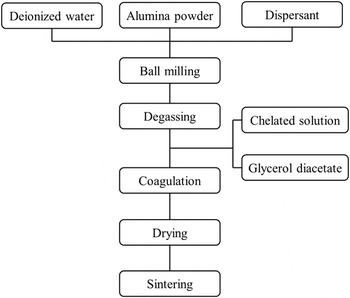
The preparation procedure is shown in Fig. 1. Suspensions with 55 vol% alumina powder and TAC as dispersant of suspension with 0.3 wt% based on alumina powder was mixed in the deionized water and milled for 12 h in polyethylene containers. Zirconia balls with diameters of 5–10 mm were used as grinding media. The mass ratio between grinding media and alumina powder is 1:2. The chelate complex was prepared by mixing 20 wt% APP and 10–15 wt% CaCl2 into the water to obtain chelate complex suspensions. The chelate complex suspensions were ball milled for different times. The alumina suspension was degassed under vacuum condition for 15 min. The APP chelate complex suspensions were added into the alumina suspensions and mixed thoroughly by continuing the tumbling process for another 15 min to obtain a homogeneous suspension. Then, glycerol diacetate was added into the suspension. The suspension was cast into a plastic mold. The samples were placed in a water bath at 40–70 °C for a period of time at a heating rate of 5 °C/min and then demolded. The green body was dried at 80 °C for 24 h. The dried samples were sintered at 1600 °C for 2 h at a heating rate of 5 °C/min.
Preparation procedure of ceramics via DCC-HVCI using APP chelate complex as the coagulating agent.

C. Characterization
The pH value of the glycerol diacetate solution was measured by using a LE438 pH meter (Mettler, Toledo, Switzerland) in the temperature range of 25–60 °C. The rheological properties of the suspensions were measured using a KINEXUS pro rheometer (Malvern Instruments, Worcestershire, UK) attached with a C25 R0634 SS spindle and PC25 C0138 AL cylinder. In all viscosity measurements, the shear rate was set at 10 s−1. For the measurements of the concentration of calcium ions, a 400 mL beaker is filled with 150 mL deionized water, and the pH value is adjusted by using ammonia. Then, calcium chloride and APP were dispersed into each beaker and stirred for 24 h. The above solution is centrifuged in plastic tubes (Centifuge 800-1; Ronghua Instruments, Jintan, China) at 4000 rpm for 1 h. The clear supernatants are drawn out carefully. The calcium ion concentration was measured using inductively coupled plasma-optical emission spectrometry (Varian Vista MPX, Varian, Palo Alto, CA).
For the wet compressive strength measurements, cylindrical bodies with 29.5 mm in diameter and a height between 30 and 37 mm were cast. The wet strength was measured in an AG-IC20KN (Shimadzu, Tokyo, Japan) testing machine with a crosshead speed of 1 mm/min. The pictured data represent mean values from 6 samples. Sintered samples were cut into bars of 3 × 4 × 36 mm. The samples were polished by using serial diamond rubbing powders, W40, W28, W14, W7, and W1 (Henan Tingxin Abrasives Co., Zhengzhou, China). Flexural strength was determined by three-point bending test with a span of 30 mm at a loading rate of 1 mm/min. There were 15 samples for the measurement. The Weibull modulus was calculated from the strength data. The relative density of alumina was measured by the Archimedes' method. The microstructures of chelate complex powder, green bodies, and sintered ceramics were observed by a field emission scanning electron microscope (FE-SEM) (MERLIN VP Compact; Carl Zeiss, Jena, Germany) equipped with a field emission gun.
III. RESULTS AND DISCUSSION
A. Properties of APP chelate complex suspension
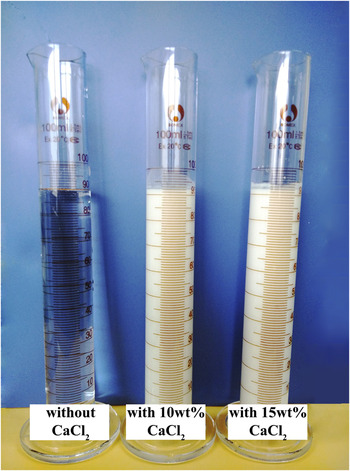
The dissolution characteristics of APP are mainly dependent on the length of the chain of APP. The molecular structure of APP is (NH4) n+2PnO3n+1 and it is soluble when the “n” value is in the range 10–20. It is observed that the solution of 20 wt% APP can dissolve completely without any particles suspended in the solution (Fig. 2). The complete dissolution of APP ensures the uniform distribution of chelate complex in the solution.
The solubility and chelating behavior of APP.

To investigate the chelating ability of APP, solutions of 20 wt% APP with 10 and 15 wt% calcium chloride were prepared. When calcium chloride was added into the solution of APP, a chelate complex forms rapidly through the reaction of chelation between APP and calcium. The chelation reaction can be expressed as follows
 $$2{\left( {{\rm{N}}{{\rm{H}}_4}} \right)_{n + 2}}{{\rm{P}}_n}{{\rm{O}}_{3n + 1}} + n + 2{\rm{C}}{{\rm{a}}^{2 + }} \to {\rm{C}}{{\rm{a}}_{n + 2}}{\left( {{{\rm{P}}_n}{{\rm{O}}_{3n + 1}}} \right)_2} + 2n + 4{\rm{\ NH}}_{\rm{4}}^{\rm{ + }}\quad \left( {10 \,\lt\, n \,\lt\, 20} \right)\quad .$$
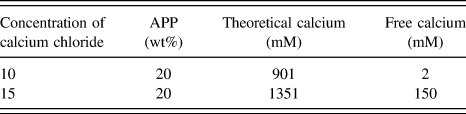
To investigate the chelating properties of APP, the free calcium was measured (Table I). As calculated from Eq. (1), the concentration of calcium ions is 901 mM in the suspension with 20 wt% APP and 10 wt% calcium chloride. The concentration of free calcium ions is 2 mM in the chelated suspension after 12 h which is much lower than the critical coagulation concentration of calcium in alumina suspension (10 mM). Reference Xu, Wen, Li, Qi, Xi and Yang19,Reference Xu, Qu, Xi and Yang20 It is indicated that most of the calcium ions were chelated in the complex. However, for a suspension with 20 wt% APP and 15 wt% calcium chloride, it was difficult to disperse homogeneously. Also the concentration of free calcium ions is 150 mM in the chelated solution which is much higher than the critical coagulation concentration of calcium in alumina suspension, though most of the calcium ions were chelated. A chelate complex suspension prepared from 20 wt% APP and 10 wt% CaCl2 was used in subsequent experiments.
Calcium ions in the chelate complex suspension.

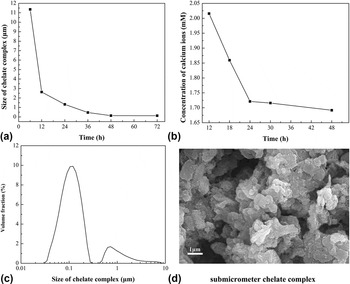
The particle size and the concentration of free calcium ions in the chelated solution as the controlled coagulating agent are crucial factors in the DCC-HVCI process. However, it is difficult to find out a good method to solve the problem. Coagulation agents with particle sizes that are in the same range of ceramic particles which can be dispersed uniformly in the suspension are also acceptable. Figure 3(a) shows that the size of the chelate complex decreases gradually with the increase of the milling time. No great decrease in the size of the chelate complex is observed after 48 h, with an average particle size of 0.13 μm. In addition, Fig. 3(b) demonstrates that the chelate complex suspension has a relatively low concentration of calcium ions after milling for 24 h and the concentration of free calcium ions was approximately 1.7 mM in the chelated solution. Therefore, a chelate complex milled for 48 h was used in subsequent experiments. Figures 3(c) and 3(d) respectively shows the size distribution as well as the microstructure of the chelate complex prepared with 20 wt% APP and 10 wt% CaCl2 for 48 h. It is found that a sub-micrometer chelate complex has been obtained. The average particle size is 0.13 μm with a narrow particle size distribution which is at the same level of alumina particles (0.33 μm).
(a) Size of the chelate complex and (b) concentration of calcium as milling time (time is the stirring time after mixing APP and CaCl2); (c) size distribution and (d) microstructure of the chelate complex (milling time = 48 h).

B. Controlled release of calcium and coagulation of alumina suspensions
It is indicated that 50–55 vol% alumina suspension can be coagulated by using 10–20 mM calcium ions. Reference Xu, Wen, Li, Qi, Xi and Yang19,Reference Xu, Qu, Xi and Yang20 For the chelate complex suspension prepared from 20 wt% APP and 10 wt% CaCl2, theoretical calcium is 901 mM when all of the calcium ions are released from the chelate complex. In this sense, the concentration of calcium ions is 27 mM in the suspension with an addition of 3 vol% APP chelate complex which is enough for the coagulation of the suspensions. Therefore, the suspension with the addition of 3 vol% chelate complex suspension is suitable for the process.
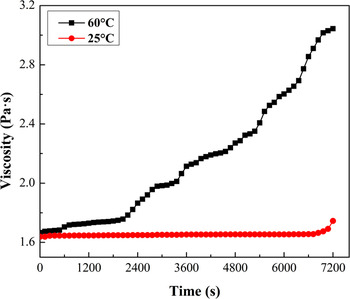
To investigate the influence of the APP chelate complex suspension on the viscosity of 55 vol% alumina suspension, 3 vol% solutions were added into the alumina suspension at different temperatures (Fig. 4). The initial pH value of the suspension after adding APP chelate complex suspension is 10.5. The suspensions with chelate complex suspensions are stable at 25 °C and the viscosity is about 1.7 Pa s. At 60 °C, the viscosity changes very slightly upon the addition of APP chelate complex suspension, and increases from 1.7 to 3.2 Pa s after 2 h. The increase in viscosity is mainly attributed to the release of calcium ions from the chelate complex and then calcium ions compress the electric double layer of alumina particles. However, the suspension is still in a fluid state despite of increasing the temperature. From the analysis above, the chelate complex is well dispersed in the alumina suspension even at a temperature of 60 °C.
Viscosity (shear rate = 10 s−1) of 55 vol% alumina suspension with 3 vol% APP chelate complexes treated at 25 and 60 °C.

To our knowledge, glycerol diacetate is weak acid ester which can hydrolyze and produce acetic acid and glycerol in the alkaline region. The generation of acetic acid lowers the pH value of the solution. The hydrolysis reaction of glycerol diacetate is shown as follows Reference Flory27,Reference Haas28
 $${{\rm{C}}_7}{{\rm{H}}_{12}}{{\rm{O}}_5} + 2{{\rm{H}}_2}{\rm{O}} \to 2{{\rm{C}}_2}{{\rm{H}}_4}{{\rm{O}}_2} + {{\rm{C}}_3}{{\rm{H}}_8}{{\rm{O}}_3}\quad .$$
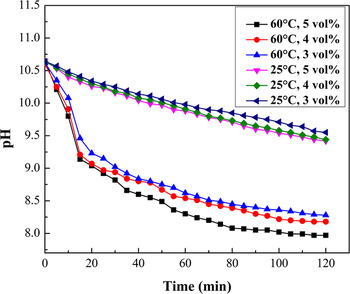
Figure 5 shows the pH values of 55 vol% alumina suspensions with different amounts of glycerol diacetate treated at different temperatures. The initial pH value is set at 10.6. The pH decreases to approximately 8.0–8.5 at 60 °C for 2 h, while the value is 9.6 at 25 °C. A higher concentration of glycerol diacetate is beneficial to decrease the pH value. It is also indicated that the hydrolysis rate can be promoted by increasing the temperature. To get a lower pH value, higher temperature is preferred.
pH values of 55 vol% alumina suspensions with different amounts of glycerol diacetate treated at different temperatures.

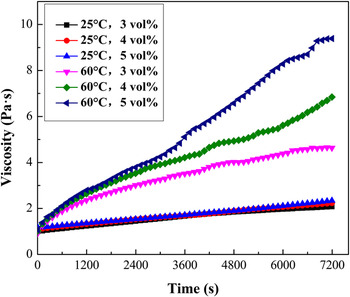
Figure 6 shows the viscosities of 55 vol% alumina suspensions with 3–5 vol% glycerol diacetate treated at 25 and 60 °C. It is observed that the viscosities of suspensions at 25 °C increase to approximately 2.0 Pa s after holding for 2 h. The viscosities of suspensions increase to 4.1, 6.2, and 9.6 Pa s with 3–5 vol% glycerol diacetate at 60 °C which is higher than the viscosity at 25 °C. The increase in viscosity is mainly attributed to the hydrolysis of glycerol diacetate which lowers the pH value to approach the IEP of alumina with absorbed TAC (approximately pH = 4). However, suspensions with the addition of glycerol diacetate are still in a fluid state.
Viscosities (shear rate = 10 s−1) of 55 vol% alumina suspensions with different amounts of glycerol diacetate at different temperatures.

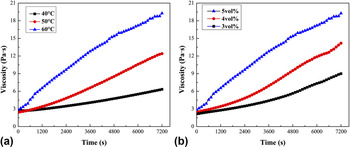
To control further release of calcium ions in the chelated solution to increase the viscosity of the alumina suspension, APP chelate complex suspension and glycerol diacetate are added simultaneously into the suspensions. Figure 7(a) shows the viscosity of 55 vol% alumina suspensions with the addition of 3 vol% APP chelate complex suspension and 5 vol% glycerol diacetate at different temperatures. It was found that the growth rate of suspension viscosity was accelerated by the rise of temperature. The suspension is still in a fluid state at 40 °C when the viscosity of the suspension increases to 6 Pa s after holding for 2 h. The viscosity at 50 and 60 °C increase remarkably and reach 12 and 19 Pa s, respectively, within 2 h which makes the suspension transfer to a semisolid state. However, it is difficult to coagulate the suspension at 50 °C at a rapid rate. The samples tend to show inhomogeneous and cracking phenomenon. Therefore, there is a great relationship between the heating temperature and the coagulation time. With the increase of coagulation temperature, the coagulation time is getting shorter. Glycerol diacetate can rapidly hydrolyze at higher temperature which promotes the release of calcium ions from the chelate complex. When the pH value shifts to a lower value, the chelate complex decomposes as follows
 $${\rm{C}}{{\rm{a}}_{n + 2}}{\left( {{{\rm{P}}_n}{{\rm{O}}_{3n + 1}}} \right)_2} + 2n + 4{{\rm{H}}^ + } \to 2{{\rm{H}}_{n + 2}}{{\rm{P}}_n}{{\rm{O}}_{3n + 1}} + n + 2{\rm{C}}{{\rm{a}}^{2 + }}\quad .$$
(a) Viscosities (shear rate = 10 s−1) of 55 vol% alumina suspensions with 3 vol% APP chelate complex suspension and 5 vol% glycerol diacetate at different temperatures. (b) Viscosities (shear rate = 10 s−1) of 55 vol% alumina suspensions with 3 vol% APP chelate complex suspension and different concentrations of gylcerol diacetate (GDA) at 60 °C.

Figure 7(b) shows the viscosities of 55 vol% alumina suspensions with 3 wt% APP chelate complex suspension and different proportions of glycerol diacetate treated at 60 °C. For a suspension with 3 vol% APP chelate complex suspension and 3 vol% glycerol diacetate, the viscosity increases to 9 Pa s for 2 h which is not high enough to coagulate the suspension. The increase in viscosity is mainly attributed to the release of calcium ions from the chelate complex. The increase of glycerol diacetate can effectively increase the viscosity of the suspension. It is attributed to the hydrolysis of glycerol diacetate which promote the decomposition of the chelate complex at lower pH value. The suspension by the addition of 3 vol% APP chelate complex and 5 vol% glycerol diacetate at 60 °C is most suitable for coagulation and wet coagulated samples can be more easily demolded.
C. Properties of green bodies and ceramics
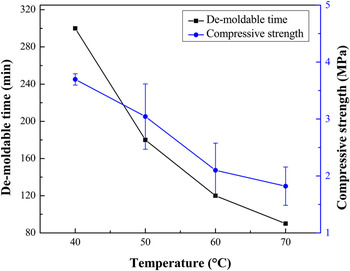
Figure 8 illustrates that the de-moldable time and the compressive strength of wet green bodies which are prepared from DCC-HVCI using 3 vol% APP chelate complex suspensions and 5 vol% glycerol diacetate at different temperatures. The samples of diameter 30 mm and height 37 mm are used in the following experiment. The de-moldable time almost linearly decreases with the increase of temperature, whereas accelerated reaction rates were observed above 70 °C, leading to expedited de-moldable time. At a temperature of 60 °C, the coagulation time reduces to 2 h, in which the production could achieve a good performance. The compressive strength of the wet green bodies decreases slightly with increasing the temperature. The strength is in the range between 1.8 and 3.7 MPa. High strength of wet coagulated samples prepared by the present method has enabled us to fabricate near-net-shape ceramics.
The de-moldable time and compressive strength of wet green bodies from 55 vol% alumina suspensions coagulated at different temperatures.

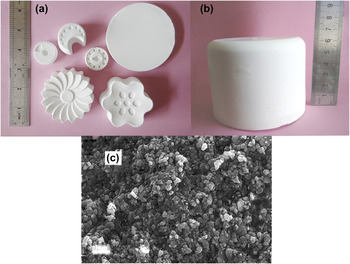
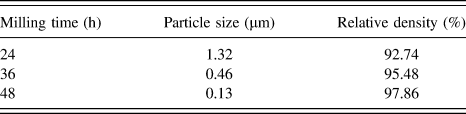
Complex shaped and large size wet coagulated samples have been prepared by this new method which is shown in Figs. 9(a) and 9(b). The coagulated samples are dried at 80 °C for 24 h and a burnout process can be avoided. Figure 9(c) shows the microstructure of the green body prepared from 55 vol% suspensions with 3 vol% APP chelate complex suspension and 5 vol% glycerol diacetate coagulated at 60 °C. A homogeneous microstructure is observed in the sample without large pores. After being entirely dried in an oven, the green body was sintered at 1600 °C for 3 h to obtain a component. Table II compares the density of ceramics prepared from different particle sizes of chelate complex. It is observed that the reduction of particle size increases the density of the ceramics which may be attributed to the fewer large defects in the ceramics causing by the coagulating agent. The ceramics prepared from 55 vol% suspensions with 3 vol% APP chelate complex suspension milled for 48 h and 5 vol% glycerol diacetate show a relative density of 97.86% and the flexural strength was compacted at 388 ± 23 MPa and Weibull modulus of 14. The flexural strength prepared by this method is lower than that of other DCC methods because of lower relative density, yet higher than that by gelcasting. Reference Gauckler, Graule and Baader1,Reference Binner, McDermott, Yin, Sambrook and Vaidhyanathan11,Reference Graule, Baader and Gaucker29–Reference Xu, Zhang, Gan, Zhang, Qu, Ma and Yang31 The SEM photograph of sintered samples is displayed in Fig. 10. Alumina ceramics show relatively uniform microstructure without large pores.
(a and b) Photographs and (c) microstructure of green bodies prepared from 55 vol% alumina suspension with 3 vol% APP chelate complex suspension and 5 vol% GDA coagulated at 60 °C.

Relationship between the particle size of the chelate complex and density of ceramics.

Microstructure of alumina ceramics sintered at 1600 °C.

IV. CONCLUSIONS
DCC-HVCI using APP chelate complex as a coagulation agent has been reported. Calcium ions used as high valence counter ions were chelated by APP and the concentration of free calcium ions is 1.7 mM in the APP chelate complex suspension. The chelate complex shows a narrow particle size distribution with an average particle size of 0.13 μm. Calcium ions release slowly from the chelate complex when glycerol diacetate hydrolyzes to release acetic acid which lowers the pH value of the suspension. It is indicated that the viscosity of 55 vol% alumina suspension with the addition of APP chelate complex suspension and glycerol diacetate increased to approximately 20 Pa s after heating at 60 °C for 1 h, which is high enough to coagulate the suspension. The suspension with an addition of 3 wt% coagulated agent and 5 vol% glycerol diacetate treated at 40–70 °C could coagulate completely and the compressive strength of green bodies is in the range between 1.8 and 3.7 MPa. Dense alumina with a relative density above 97%, flexural strength of 388 ± 23 MPa, and Weibull modulus of 14 can be prepared by this method from 55 vol% alumina suspensions without a burnout process.
ACKNOWLEDGMENTS
Our research work presented in this paper is supported by Natural Science Foundation of China (Grant Nos. 51172120, 51572140) and China Postdoctoral Science Foundation (Grant No. 2015M570094). The authors are grateful for these grants.