Management Implications
Linaria vulgaris (yellow toadflax) is an invasive weed of agricultural and natural areas throughout most of Canada and the continental United States (e.g., perennial and annual crops, pastures, native rangelands). The recently introduced stem-galling weevil, Rhinusa pilosa, is showing promise as a biological control agent of L. vulgaris in western Canada. Rhinusa pilosa requires access to young, vegetative shoots of L. vulgaris for egg-laying and subsequent gall formation. Hence, a model to estimate the emergence of L. vulgaris shoots may serve to facilitate better timing of R. pilosa release to match host-plant development. We developed and validated a growing degree-day model to estimate L. vulgaris shoot emergence and compared our model with the timing of past R. pilosa releases in Nova Scotia, Canada. The initial establishment of R. pilosa following these first releases (2016 to 2017) was found to be most successful at sites with 48% to 58% shoot emergence and high soil moisture, suggesting moisture availability may be another limiting factor to successful establishment of this potential biocontrol agent. Gall formation, however, declined at all sites in the second and third years after release, indicating an inability to establish well in Nova Scotia for reasons unknown. A tentative “window of opportunity” for gall formation between shoot emergence and flower bud formation was identified, and the developed model can be used to estimate the initiation of this window to help improve timing of future R. pilosa releases.
Introduction
Yellow toadflax (Linaria vulgaris Mill.; Scrophulariaceae), is a herbaceous perennial weed of Palearctic origin that has invaded agricultural and natural habitats throughout most of Canada and the continental U.S.A. since its introduction in the 1600s (Saner et al. Reference Saner, Clements, Hall, Doohan and Crompton1995; Sutton Reference Sutton1988; USDA-NRCS 2021). The weed has recently invaded western North America, including both prairie croplands (Leeson et al. Reference Leeson, Thomas, Hall, Brenzil, Andrews, Brown and Van Acker2005) and natural grasslands grazed by livestock and native ungulates (De Clerck-Floate and McClay Reference De Clerck-Floate and McClay2013; Lehnhoff et al. Reference Lehnhoff, Rew, Maxwell and Taper2008). Annual crop weed surveys conducted in 2000 to 2004 identified L. vulgaris as a significant invader of wheat (Triticum aestivum L.), barley (Hordeum vulgare L.), oats (Avena sativa L.), canola/rapeseed (Brassica napus L.), mustard (Brassica juncea L.), and field peas (Pisum sativum L.) in the Peace River area of northern Alberta and the Aspen Parkland ecoregion of Canada’s Prairie Provinces (Leeson et al. Reference Leeson, Thomas, Hall, Brenzil, Andrews, Brown and Van Acker2005). Similar surveys in Atlantic Canada have documented the occurrence of L. vulgaris in cereal crops in New Brunswick and Prince Edward Island (Thomas and Ivany Reference Thomas and Ivany1990; Thomas et al. Reference Thomas, Doohan and McCully1994) and corn (Zea mays L.)and orchard crops in Nova Scotia (S Olmstead, personal communication).
Linaria vulgaris has a wide tolerance for different environmental conditions and habitat types within the temperate regions where it grows; for example, dry or mesic sites as far north as 65°N and elevations from 0 to above 2,000 m in North America (Lehnhoff et al. Reference Lehnhoff, Rew, Maxwell and Taper2008; Saner et al. Reference Saner, Clements, Hall, Doohan and Crompton1995). Spring emergence of vegetative shoots from root buds can begin as early as mid-March in some regions of Colorado and as late as mid-June in other regions of the state (Beck Reference Beck2014). In Canada, peak flowering can occur anytime from mid-June to late July (Saner et al. Reference Saner, Clements, Hall, Doohan and Crompton1995). Linaria vulgaris shoot emergence in northern Germany begins in early April when soil temperatures reach 5 to 10 C (Kock Reference Kock1966), indicating that temperature-based variables such as growing degree days (GDD) may be useful for estimating spring shoot emergence. Emergence and development phenology of this weed species has not been studied in detail in Atlantic Canada.
Linaria vulgaris can be managed with traditional methods such as herbicides and tillage in some situations. Available herbicides are currently limited to preharvest glyphosate applications in several annual crops (Baig et al. Reference Baig, Darwent, Harker and O’Donovan1999) and picloram, aminocyclopyrachlor, and chlorsulfuron in rangeland and pasture (Almquist et al. Reference Almquist, Wirt, Adams and Lym2015; Johnson et al. Reference Johnson, Grovenburg, Jenks, Inselman and Swanson2014; Lym Reference Lym2014). Intraspecific genetic variation in North American populations of L. vulgaris is wide and may reduce efficacy of some herbicides (Ward et al. Reference Ward, Reid, Harrington, Sutton and Beck2008). Intensive tillage and summer fallow can control L. vulgaris (Morishita Reference Morishita, James, Evans, Ralphs and Child1991), but increased adoption of zero- or minimum-till management regimes have reduced availability of this strategy, and L. vulgaris therefore remains a persistent perennial weed of agricultural crops (Baig et al. Reference Baig, Darwent, Harker and O’Donovan1999). Tillage and herbicide applications are also not practical in pastures or natural lands (e.g., native rangelands), necessitating the need for alternative management strategies in these areas.
Given the limited availability of effective control strategies for L. vulgaris, there has been persistent interest in the use of biological control agents as part of an overall management program. This is especially the case for control in pastures or native rangelands where an effective biological control agent could be a feasible alternative to herbicide use. When evaluating a particular biological control agent it is important to understand how the host (plant species) responds to climate shifts (Davis et al. Reference Davis, Willis, Primack and Miller-Rushing2010) and interacts with insect herbivores in time and space (Croy et al. Reference Croy, Pratt, Sheng and Mooney2021). The interaction between biological control agent and host is critical for the successful establishment and control of the target weed (Harms et al. Reference Harms, Cronin, Diaz and Winston2020). Such knowledge will inform when and where to release biocontrol insects using plant growth models that predict optimal times of availability and quality of their host resource (Kriticos et al. Reference Kriticos, Ireland, Morin, Kumaran, Rafter, Ota and Raghu2021).
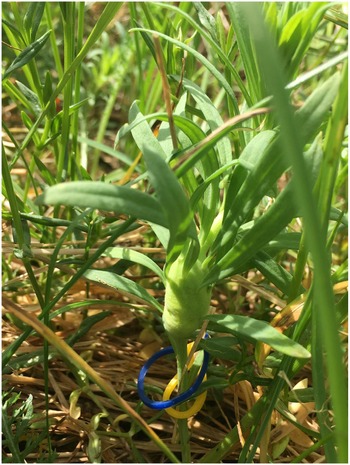
Rhinusa pilosa (Gyllenhal) (Coleoptera: Curculionidae) is a host-specific stem-galling weevil released for biocontrol of L. vulgaris in Canada in 2014. Details on R. pilosa host interactions during oviposition, gall induction, and gall development are described in Barnewall (Reference Barnewall2011), Barnewall and De Clerck-Floate (Reference Barnewall and De Clerck-Floate2012), and Gassmann et al. (Reference Gassmann, De Clerck-Floate, Sing, Toševski, Mitrović and Krstić2014). Briefly, R. pilosa overwinters as an adult and emerges in early spring to mate and feed on the host plant before females deposit eggs into the meristematic apical area of newly emerging, vegetative L. vulgaris shoots (Barnewall and De Clerck-Floate Reference Barnewall and De Clerck-Floate2012). There is only one generation per year, but females are seasonally long-lived and can be available throughout the emergence period of L. vulgaris shoots. However, peak oviposition occurs early in the growing season depending on local environmental conditions (Gassmann et al. Reference Gassmann, De Clerck-Floate, Sing, Toševski, Mitrović and Krstić2014). For such insects, the period of oviposition must be synchronized with the emergence and quality of the specific plant part needed for optimum gall (Figure 1) and offspring development (Aoyama et al. Reference Aoyama, Akimoto and Hasegawa2012; Yukawa et al. Reference Yukawa, Nakagawa, Saigou, Awa, Fukuda and Higashi2013). Hence, an accurate GDD model to predict the timing of L. vulgaris shoot emergence could inform the release timing for R. pilosa and potentially increase the probability for successful establishment at new release sites. The main objective of this research was to develop a GDD model to estimate L. vulgaris shoot emergence.
A stem of Linaria vulgaris with a gall induced by egg deposition of Rhinusa pilosa. Taken at the Antigonish site (Nova Scotia, Canada) in May 2017. Photo credit: Lienna Hoeg.

Materials and Methods
Site Selection
Four sites (two pastures and two non-managed areas) in Nova Scotia were identified as having established populations of L. vulgaris (Table 1). Linaria vulgaris was observed at these sites for 2 to 3 yr before this study, and populations were composed of patches measuring 2 to 4 m2 within each site.
Location, description, and Linaria vulgaris patch size at sites used for release of Rhinusa pilosa and development of growing degree-day models to estimate L. vulgaris shoot emergence in Nova Scotia, Canada.

Emergence and Development Data
Linaria vulgaris shoot emergence was monitored in five permanent 1-m2 quadrats that were randomly placed throughout each site. Quadrats were spaced at least 2 m apart (Scotsburn, Bible Hill, and Antigonish) and up to 4 m apart (MacElmon Pond) to represent all patches of L. vulgaris at the site. Newly emerged L. vulgaris shoots were counted and marked with colored elastic bands once or twice weekly from late April until August. Emergence data were collected in 2017 and 2018 from three sites: Bible Hill, Antigonish, and MacElmon; and from Scotsburn in 2017 only. This provided a total of 7 site-years of emergence data for calibration and validation of the emergence model. Emergence data were expressed on a percent cumulative scale for modeling purposes. Percent cumulative emergence was determined by (1) converting the number of new shoots emerged on each counting date into cumulative emergence (running sum) for each quadrat and (2) expressing cumulative emergence as percent cumulative emergence using the following formula:
 $$\eqalign{\mathop \sum \limits_{i \,=\, 1}^n {\rm{Percent\;cumulative\;emergence}}}{Q_n} = \left( {{{{\rm{Cumulative\;emergence}}\;{Q_n}} \over {{\rm{Total\;cumulative\;emergence}}\;{Q_n}}}} \right)\!\times \!100$$
where i is the first counting date, n is the last counting date, Q n is a given quadrat on a given counting date, cumulative emergence is the running emergence sum on a given counting date in Q n , and total cumulative emergence is the total sum of new shoots emerged in Q n by the end of the emergence period. Galls within these plots and shoots with flower buds were recorded in all quadrats in all sites.
Weather Data
Hourly air temperature at each site was recorded using temperature loggers (Watchdog 1400 series data loggers, Spectrum Technologies, Aurora, IL, USA, 60504). Data loggers were protected by a solar radiation shield and were attached to wooden stakes approximately 0.5 m above the soil surface. Cumulative GDD were calculated using the formula:
 $$GDD = \sum\limits_{i = 1}^n {({T_{mean}} - {T_{base}})} $$
where T mean is the mean daily air temperature, T base is the lowest air temperature at which we assumed L. vulgaris shoot emergence would not occur, and n is the number of days over which GDD are calculated and summed. An upper temperature threshold for L. vulgaris emergence is not known and was not considered in model development. The data loggers, in addition to air temperature, also recorded soil moisture (% v/v) at 5 to 8 cm below the soil surface at 30-min intervals using a SM 100 sensor from Spectrum Technologies.
Development of GDD Models
Cumulative L. vulgaris shoot emergence was plotted as a function of cumulative GDD using nonlinear regression. Fitting of nonlinear equations, as well as parameter estimates for these equations, was conducted using the Gauss-Newton algorithm in PROC NLIN of SAS for Windows (v. 9.4, SAS Institute, Cary, NC, USA). Percent cumulative shoot emergence was related to cumulative GDD with a three-parameter logistic equation of the form:
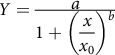
 $Y = {\displaystyle a \over \displaystyle{1 + {{\left( {{x \over {{x_0}}}} \right)}^b}}}$
where Y is cumulative shoot emergence, x is cumulative GDD, a is the theoretical maximum emergence, x 0 is the cumulative GDD at 50% emergence, and b is the slope of the inflection point of the curve (Donald Reference Donald2000). The base air temperature for L. vulgaris shoot emergence was determined by iterating a series of base temperatures (0 to 5 C in 1 C intervals) in Equation 3 using the complete data set until the best fit was obtained between percent cumulative shoot emergence and cumulative GDD (Izquierdo et al. Reference Izquierdo, González-Andújar, Bastida, Lezaún and Sánchez del Arco2009). The best fit was obtained for T base = 2 C. Given no current biological justification for using an alternative T base, 2 C was chosen based on the fit obtained using this value. The model was calibrated using data from four randomly chosen site-years (out of the total 7 site-years) and then validated using emergence data from the remaining 3 site-years.
Assessing Fit of the GDD Model
Goodness of fit for the emergence model was determined by calculating the coefficient of determination (R2), adjusted coefficient of determination R2 Adj), and root mean-square error (RMSE) using formulas available in Bowley (Reference Bowley2008). Values were calculated manually using observed emergence and estimated emergence from the model output in SAS. Goodness of model fit was based on low RMSE and R2 Adj values close to 1.
Validation of the GDD Model
The emergence model was validated with shoot emergence data from 3 site-years (Bible Hill-2017, Antigonish-2017, and Antigonish-2018) not used for model calibration. Linaria vulgaris shoot emergence data from these sites were expressed as cumulative percent emergence and plotted against cumulative GDD at each site. Estimated emergence for each site was determined using the calibrated model. Model estimations were plotted against observed emergence at each site, and the RMSE and R2 Adj described above were used to assess agreement between observed data and model estimates.
Biological Control Agent Release and Monitoring
Rhinusa pilosa were obtained from a laboratory colony maintained at the Agriculture and Agri-Food Canada, Lethbridge Research and Development Centre in May 2016. At the Antigonish, Scotsburn, and Bible Hill sites, 100 weevils (ca. 50:50 ratio females:males) were released on May 27, 2016, and at the MacElmon site on May 31, 2017, in the middle of a patch within each site. Establishment success was determined by visually surveying the entire patch of L. vulgaris at each site on August 24, 2016 (but not MacElmon), October 30, 2017, and August 29, 2018, and counting all galls observed (Figure 1). Galls were located by walking slowly through each site and carefully moving aside the L. vulgaris (approximately 50 to 60 cm in height).
Results and Discussion
Development of the GDD Model
Bud sprouting on perennial weed creeping roots in temperate climates commonly occurs at temperatures between 0 and 5 C (McAllister and Haderlie Reference McAllister and Haderlie1985; White et al. Reference White, Boyd and Van Acker2015), facilitating shoot emergence early in the growing season. Linaria vulgaris shoots emerged between 124 and 244 GDD (April 18 and May 11) and reached 90% emergence between 681 and 1,117 GDD (June 16 and July 20). Linaria vulgaris shoots also emerged in mid- to late April in northern Germany (Kock Reference Kock1966), and Willden and Evans (Reference Willden and Evans2018) reported rapid spring emergence of the related species Dalmatian toadflax [Linaria dalmatica (L.) Mill.] in Utah, USA. The L. vulgaris emergence timing in our study is also similar to shoots of other perennial weeds emerging from creeping roots in Nova Scotia (White et al. Reference White, Boyd and Van Acker2015; Wu et al. Reference Wu, Boyd, Cutler and Olson2013) and elsewhere in North America (Donald Reference Donald2000; Webster and Cardina Reference Webster and Cardina1999) and is likely indicative of the typical emergence timing of this weed species in Nova Scotia.
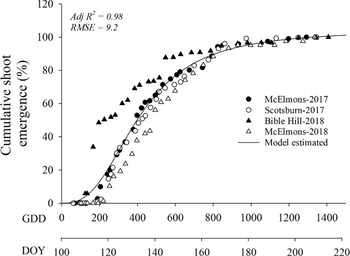
Plotting shoot emergence as a function of GDD improved model fit relative to day of year (data not shown). The proposed emergence model (Table 2) provided good fit to the observed emergence data and accurately estimated cumulative emergence as a function of cumulative GDD (Figure 2). Model estimation for the initiation of emergence was 74 GDD and 10%, 50%, and 90% emergence were estimated to occur at 179, 409, and 811 GDD, respectively. Model estimation for L. vulgaris shoot emergence also generally agreed closely with the observed emergence at each validation site (Figure 3). Each site had a high R2 Adj and low RMSE, though emergence was estimated to occur earlier than observed values at Antigonish-2018 (Figure 3C). Observed emergence between 200 and 300 GDD at Bible Hill-2017 was also more rapid than estimated by the model at this site (Figure 3A).
Parameter estimates for the three-parameter logistic model used to describe the relationship between cumulative Linaria vulgaris shoot emergence and cumulative growing degree days (GDD) calculated from air temperature (T base 2 C) in Nova Scotia, Canada.

a
The model was a three-parameter logistic equation of the form
 $Y = {\displaystyle a \over \displaystyle{1 + {{\left( {{x \over {{x_0}}}} \right)}^b}}}$
, where Y is cumulative shoot emergence, x is cumulative GDD, a is the theoretical maximum emergence, x
0 is the cumulative GDD at 50% emergence, and b is the slope of the inflection point of the curve. Values represent the mean parameter estimate ± 1 SE. Values in brackets are the lower and upper 95% confidence limits of the parameter estimates.
Percent cumulative Linaria vulgaris shoot emergence as a function of cumulative growing degree days (GDD) calculated from air temperature (T
base = 2 C) at sites used for model calibration in Nova Scotia, Canada. Symbols represent the mean of five observations. The line is a fitted nonlinear three-parameter logistic equation of the form
 $Y = {\displaystyle a \over \displaystyle{1 + {{\left( {{x \over {{x_0}}}} \right)}^b}}}$
, where Y is cumulative shoot emergence, x is cumulative GDD, a is the theoretical maximum emergence, x
0 is the cumulative GDD at 50% emergence, and b is the slope of the inflection point of the curve. Parameter estimates are provided in Table 2. Day of year (DOY) is provided for general reference to calendar date. RMSE, root mean-square error.

Observed and calibrated model estimated Linaria vulgaris shoot emergence as a function of cumulative growing degree days (GDD) calculated from air temperature (T
base = 2 C) at sites used for model validation in Nova Scotia, Canada: (A) Bible Hill-2017, (B) Antigonish-2017, and (C) Antigonish-2018. Symbols represent the mean of five observations. Lines are a fitted nonlinear three-parameter logistic equation of the form
 $Y = {\displaystyle a \over \displaystyle{1 + {{\left( {{x \over {{x_0}}}} \right)}^b}}}$
, where Y is cumulative shoot emergence, x is cumulative GDD, a is the theoretical maximum emergence, x
0 is the cumulative GDD at 50% emergence, and b is the slope of the inflection point of the curve. Parameter estimates are provided in Table 2. Day of year (DOY) is provided for general reference to calendar date. RMSE, root mean-square error.

Good fit of the developed model indicates that the model can likely estimate emergence accurately enough to facilitate efficient release of biological control agents based upon where and when there would be optimal availability of high-quality host resources for the agent. Gall-producing biocontrol agents such as R. pilosa are sensitive to the spring phenology of their host plants because they require young, actively growing plants for optimal gall formation and as a source of freshly mobilized carbohydrates to support reproductive success (Harris and Shorthouse Reference Harris and Shorthouse1996; Sedlarević Zorić et al. Reference Sedlarević Zorić, Morina, Toševski, Tomislav, Jović, Krstić and Veljović-Jovanović2019; Weis Reference Weis2014). Rhinusa pilosa avoids oviposition in shoots that have initiated flower bud formation (Barnewall and DeClerck-Floate Reference Barnewall and De Clerck-Floate2012), and galls will therefore not develop on these shoots. The time between shoot emergence and flower bud formation therefore represents the window of opportunity for R. pilosa to oviposit and develop the gall. Observations from this study at the two sites (Bible Hill and Antigonish) where a moderate number of galls were formed in 2016 found this window to range between 95 and 108 d (1,280 to 1,412 GDD) in 2017 and to be narrower in 2018 (52 to 71 d, 540 to 804 GDD) (Table 3). This difference in the available time to capitalize upon the emerging shoots in conjunction with low soil moisture levels in 2017 (Supplementary Table 1) may have negatively impacted the ability of R. pilosa to successfully establish at these sites.
Julian days and growing degree days (GDD, in parentheses) for initiation and conclusion of shoot emergence and gall formation and initiation of flower bud formation for Linaria vulgaris from two sites in Nova Scotia, Canada, in 2017 and 2018. a

a Values reported are Julian days with GDD in parentheses. GDD (T base = 2 C).
b “Window of opportunity” is defined as the time (number of days, GDD in parentheses) between initiation of shoot emergence and initiation of flower bud formation.
Utility of a GDD Model to Improve Rhinusa pilosa Release in Nova Scotia
Release of R. pilosa in 2016 occurred at 445, 399, and 387 GDD, when, according to the shoot emergence model, approximately 58%, 50%, and 48% of the shoots had emerged for Bible Hill, Scotsburn, and Antigonish, respectively. In 2017, the release occurred at 441 GDD, when approximately 61% of the shoots had emerged at MacElmon Pond. It is likely that these releases occurred well ahead of flower bud formation (in July of 2016), allowing adequate time for oviposition and gall formation. Post-release in 2016, there was evidence of high R. pilosa establishment at the Antigonish site (211 galls), moderate establishment at the Bible Hill site (24 galls), and poor establishment at the Scotsburn site (2 galls). The release at the MacElmon site in May of 2017 showed poor establishment in August of the same year, with only 1 gall found, despite having an estimated 60% of the shoots emerged and available as hosts. Furthermore, the number of galls found in the first year after release was 11, 3, 0, and 0 for the Antigonish, Bible Hill, Scotsburn, and MacElmon sites, respectively. Galls were found in the quadrats between May 29 and June 28, 2017 (404 to 888 GDD) at all sites. Surveys in 2018 found no galls at any of the sites. Our shoot emergence model could benefit from a similar flower bud formation model and, used together with current and forecast weather data, could estimate the potential duration of the window of opportunity for any given site in any given year. Such information could serve to move release timings either earlier or later than they are currently occurring (by calendar date).
Linaria vulgaris is reported to grow better and produce more shoots under wetter conditions (Nadeau et al. Reference Nadeau, Dale and King1991), which could contribute to the production of a higher-quality resource for R. pilosa and impact its ultimate success as a biological control agent. Such a relationship between water availability and insect performance has also been reported for other gall-forming weed biological control agents and their host plants (Harris and Shorthouse Reference Harris and Shorthouse1996; Hinz and Müller-Schärer Reference Hinz and Müller-Schärer2000). Average monthly soil moisture and cumulative monthly rainfall showed differences across sites and years in our study, which may explain the poor gall formation at most sites by the end of the study (Supplementary Table 1). For example, in 2016, Antigonish had high soil moisture levels (>30% in April and May, >20% in June, and >10% in July) and the best initial R. pilosa establishment. Bible Hill had soil moisture levels of 10% to 20% over these same months and a lower rate of establishment. Scotsburn had soil moisture levels <10% and the lowest number of galls. Soil moisture levels in April and May 2017 were 20% to 30% in Antigonish, Bible Hill, and MacElmon in April and May but dropped to 10% to 20% during June and July. Similarly, Scotsburn had soil moisture levels just above 10% for April to July. The number of galls observed in 2017 at these sites was lower than in 2016, suggesting that reduced moisture availability in 2017 may have affected R. pilosa. By 2018, despite soil moisture levels being >20% in April and May and 10% to 20% in June and July in Antigonish, Bible Hill, and MacElmon, no galls were found at any site. Results from our study therefore suggest an important role for moisture availability in the quality of shoots of L. vulgaris emerging each year and the subsequent success of R. pilosa. We must also add that we did not evaluate overwinter survival, predation, or competition in this study. Over time, any of these factors, alone or in combination with one another and environmental factors (e.g., moisture availability), may impact R. pilosa establishment and persistence in Nova Scotia. This emphasizes the importance for a high level of establishment during the year of release to ensure population numbers sufficient to withstand these factors in subsequent years.
In conclusion, a GDD model has been developed to estimate the emergence timing for L. vulgaris. Synchronizing release of a biocontrol agent such as R. pilosa to coincide with peak abundance of quality L. vulgaris shoots could very well aid in establishment of sustained field colonies of the weevil. Establishment success has been shown to be positively related to the starting population size of the released insect (e.g., Grevstad Reference Grevstad1999). When the supply of insects for release is small, as is the case with R. pilosa, production of numerous galls during the year of release could help increase the probability of survival into subsequent years. Future studies are now needed to: (1) test the ability of the GDD shoot emergence model to estimate the optimal timing for release of R. pilosa, (2) develop a GDD flower bud phenology model to identify the window of opportunity for successful R. pilosa release, (3) investigate the impact of soil moisture on L. vulgaris shoot quality for gall formation by R. pilosa, and (4) evaluate other factors, that is, overwintering mortality and predation/parasitism for impact on R. pilosa persistence post-establishment.
Supplementary material
To view supplementary material for this article, please visit https://doi.org/10.1017/inp.2022.6
Acknowledgments
We thank Lienna Hoeg for technical support in the field and Kim Hiltz for compiling the data for analysis. Funding was provided by AAFC project J-001321. No conflicts of interest have been declared.