This paper introduces methods to estimate wealth levels and disparities among Muslim inhabitants of 18th-century Ottoman Kastamonu. Our sources in this pursuit are estate inventories of the deceased (sing. tereke) as recorded in Kastamonu court records (sicils), mainly in the first half of the 18th century (1712–60). By analyzing information provided by these sources through a variety of quantitative techniques, we measure levels of inequality among Muslims of Kastamonu and describe the relationship between economic privilege and social, political, religious, and occupational status as well as gender identity. Our work outlines the contours of economic stratification in 18th-century Kastamonu and reveals the relative positions of various social groups within this hierarchy.
Kastamonu was a middle- to small-sized town in north-central Anatolia. By the mid-18th century, Kastamonu subprovince (sancak), located on the Black Sea coast and part of the province (eyalet) of Anatolia, probably had a population of about 30,000 households. The town of Kastamonu—the legal and administrative center of the subprovince—had a population of about 4,000 households, including the inhabitants of its forty-one quarters and the villages located nearby.Footnote 1 Little information exists about the town's demographic composition during the period we are discussing, although we assume that its population was primarily Muslim and Turkish.Footnote 2 Heywood claims that the town remained relatively isolated during Ottoman times due to its distance from the military and courier road network.Footnote 3 Even though court records indicate local and regional trade networks in the area that involved wool, cotton cloth, and copperware, it is not clear to what extent these networks contributed to the town's economic welfare. Compared to other Anatolian urban centers such as Ankara, Bursa, and Kayseri, Kastamonu has not received much attention in modern scholarship. However, because the town's court records are quite complete relative to its size, they are well suited to the type of analysis presented here.
Like many subthemes of economic history, inequality and wealth distribution have not received much attention in Ottoman historiography. In this article, we propose different procedures to measure wealth and inequality levels in a particular historical setting. Furthermore, we introduce techniques that could help us glean economic information from noneconomic data, to a significant degree of precision. Although ours is not the first study to use terekes to explore relevant issues in the Ottoman provincial context,Footnote 4 the quantitative analysis that we introduce here distinguishes our research. As will become clear, one of our major concerns has been finding ways to pursue a meaningful dialogue with our sources. We accomplish this by engaging the parameters inherent to these documents while figuring out ways to overcome the limitations that they impose. The following section illustrates the specifics of this negotiation and presents an overview of the rest of the article.
PLAN OF THE ARTICLE AND METHODOLOGY
We begin with basic calculations of overall wealth levels and disparities among the Muslim population of early to middle 18th-century Kastamonu. Here, we offer observations on contemporary standards of living, calculate average levels in different wealth brackets, and provide a general discussion of wealth disparities. We then present our efforts in understanding wealth variations among different segments of the Muslim community—no easy task, because terekes, like other entries in Ottoman court records, contain little information about their subjects. In fact, what we find in these documents is limited to the full name of the deceased, including his or her father's name, honorary title (if he belonged to the military or religious establishment), religious epithets (signifying if he or she was a descendant of Prophet Muhammad or had made the pilgrimage to Mecca), village or quarter, names of legal heirs, and, occasionally, occupation. Following is the opening section of a typical tereke entry from Kastamonu sicils.
It has been determined that the estate of the late Elhac [pilgrim] Ahmed Efendi bin Abdurrahman Efendi from Kastamonu's Cemalağa quarter should be divided among his widowed wife, Aişe bint Mehmed; his son of legal age, Mehmed; his daughter of legal age, Havva; and his minor daughter, Kerime. What follows [below] is the inventory of the late Elhac Ahmed Efendi's estate, which has been legally divided [by the court] among his abovementioned heirs (recorded in 5 RII 1151 [23 July 1738]).
Most of the individuals encountered in terekes appeared in sicils only once, a fact that limits our knowledge of them to what we find in estate inventories. Hence, studying wealth disparities among different social groups depends on our ability to identify meaningful social categories within estate inventories. In our analysis, we adopt, at least initially, the following title-based categories as our main units of analysis:
• Religious titleholders: members of the religious/judicial establishment (men designated by the titles efendi, molla, halife, şeyh, çelebi, and dede)Footnote 5
• Military titleholders: members of the military/administrative establishment (men designated by the titles ağa, beşe, beğ)Footnote 6
• Men without titles: males not affiliated with the military or religious establishments
In addition to these title-based categories specific to men, we also make calculations for women, who held no military or religious titles.
We assume at this stage of our analysis that military titleholders, religious titleholders, and men without titles constituted relatively exclusive groupings and that these three groups occupied different positions in the Ottoman provincial hierarchy.Footnote 7 Our calculations have helped us determine the extent to which these assumptions held true in early to middle 18th-century Kastamonu.
Any effort to analyze social or economic stratification in the Ottoman provincial context using honorific titles—especially for the 18th century, when affiliation with the military or religious establishments became less a marker of actual occupation and economic status—must proceed cautiously.Footnote 8 Nevertheless, no quantitative research to our knowledge has demonstrated the absence of any such relationship, even for the “postclassical” period.Footnote 9 The fact that clear class distinctions did not necessarily exist among men with different titles does not mean that title-based differentiations lacked any meaning relative to position in the social and economic hierarchy.
We stress again that the adoption of title-based categories as units of analysis is not a matter of choice on our part but a necessity due to the nature of information found in terekes. We compensate for the limitations of these categories in several ways. First, we pinpoint wealth disparities within each title- and gender-based classification, in order to identify wealth variations among subgroups that constituted these categories. This procedure helps us determine the economic cohesiveness of our title- and gender-based clusters and their significance as tools of economic and social analysis.
Second, we identify the economic significance of nontitle- and nongender-based markers in terekes. Our calculations first portray the relative economic positions of Muslim artisans and merchants in 18th-century Kastamonu regardless of their honorific titles.Footnote 10 We also seek to determine if religious designations such as elhac or seyyid (descendant of Muhammad), in addition to being explicit markers of religious privilege, can be taken as indicators of wealth. Our goal is to identify economic segmentations in 18th-century Kastamonu that cannot be detected through a title-based analysis.
Third and finally, we conduct a series of regression analyses to estimate the economic significance of each title as well as various religious and economic markers in isolation from other titles and markers. Having discovered, for example, that men (as compared to women), efendis (as compared to most other men), and pilgrims (as compared to nonpilgrims) were relatively prosperous, we attempt in this section to identify which of these signifiers can be taken as a more reliable indicator of the wealth of someone like Elhac Ahmed Efendi, mentioned previously. In addition to enabling us to overcome the limitations of a title- and gender-based analysis of economic prosperity and wealth variations, this exercise provides a practical apparatus for making realistic assumptions about economic position based on social, religious, and/or occupational affiliations.
Our observations and calculations in this article focus on the overall value of estates rather than their composition. Even though compositional variations in estates might illuminate how different segments of society acquired and maintained wealth, lack of space forces us to leave this important topic to another study.
DATA SET
Our findings are based on 778 estate inventories of Muslim adults from thirty-three court registers covering the forty-eight-year period from 1712 to 1760.Footnote 11 Prepared by a court, an estate inventory provides information about the wealth possessed by an individual at the time of death and contains an itemized list and monetary appraisal of the cash, property, and debt left behind by the deceased, as well as names of heirs and their shares from the estate.Footnote 12
To construct our data set, we processed the figures in estate inventories in the following manner. First, we calculated the net value of individual estates by deducting debts and outstanding obligations of the deceased from the monetary value of their assets.Footnote 13 Second, we deflated the net value of estates by the price index constructed by Süleyman Özmucur and Şevket Pamuk to eliminate the impact of inflation and currency depreciation for our period.Footnote 14 Because a majority of our price observations in the first part of the article are from circa 1745, we used 1740–49 as our base period. Third and finally, we trimmed our data set by removing estate inventories that had extremely high and low monetary values.Footnote 15 A trimming of 1 percent at both ends of our data pool left us with a total of 762 observations, upon which our calculations in the rest of this article are based.
Focusing on late 17th-century Sofia, Rossitsa Gradeva has recently discussed some limitations of terekes as historical sources.Footnote 16 Many of these limitations also apply to the compilation studied here. For example, as in the Sofia documents, women and non-Muslims are underrepresented in Kastamonu inventories; according to our observations, inventories that belonged to women constitute about 26 percent,Footnote 17 and we identified only four inventories for non-Muslims.Footnote 18 Rural inventories also seem to be relatively few in number, although it is difficult to compare urban and rural estates, as many individuals held property both in town and in the countryside.
In addition to such discernable absences, there may be others that we cannot identify. Some legatees probably tried to avoid the court's involvement in the appraisal and division of estates because courts charged a fraction of the estate's overall value as “inheritance tax” (resm-i kısmet) in addition to a number of lump-sum fees for its service.Footnote 19 The court's appraisal and division of estates was not always desired, especially when there was no dispute among heirs. Disagreement over shares of inheritance usually necessitated court preparation of the estate inventory.Footnote 20
Another possibility is that heirs may have tried to conceal portions of their estates from court officials in order to reduce the “inheritance tax” portion of court fees. This could be a serious problem because we cannot guess the real magnitude of underrepresented estates. There is also the issue of the reliability of the court's monetary appraisal of estates. Because we lack information about real market prices of the majority of items listed in inventories and we cannot be sure about the motivations of court officials in preparing them—they may have inflated appraisals to increase their fees—it is impossible to be absolutely sure that terekes represent the real worth of those individuals to whom they belonged. Finally, we assume that elderly individuals are overrepresented in our data, which the court compiled shortly after a death.
Such caveats, we hope, do not invalidate the analysis that follows. Despite their shortcomings, terekes constitute a unique data source for the period under study. Indeed, for reconstructing the economic and social history of Ottoman provincial life before modern times, they remain invaluable.
PRELIMINARY ANALYSIS OF STANDARD OF LIVING AND WEALTH DISPARITIES
Standards of Living
According to our data set, between 1712 and 1760 the average value of inherited estates was 759.2 guruş (in 1745 prices). Our observations indicate significant wealth variation. Estate values ranged from 10.4 guruş to 7,775.9 guruş, and our sample has a standard deviation of 1,092 guruş, that is, about 1.4 times the size of the average estate value.
What do these observations indicate about standard of living in 18th-century Kastamonu? Based on prices in the sicils of circa 1745, we can infer that the average estate was worth about 7,700 kilos of mutton, 14,500 kilos of beef, 2,500 kilos of olive oil, 6,500 kilos of rice, 90,000 loaves of bread, 3,000 kilos of Aleppine soap, 3,000 kilos of honey, 250 stirrups, 380 mattresses, or 30 silver clocks. The same sum of money could also have purchased two to three average-sized houses, five average-sized shops, thirty horses, 120 to 150 cows, or four adult male slaves.
Possible indicators of minimum requirements for survival in early to mid-18th-century Kastamonu are the nafakas reported in sicils. The term nafaka refers to the monetary allowance allocated by the court to divorced or widowed women from the assets of or inheritances from their ex- or late husbands to cover daily household expenses (including children and slaves) for food, clothing, and shelter. Based on fifteen separate observations between 1739 and 1748, nafaka rates for single adult women ranged from nine to twenty-one akçes, depending on their social and economic backgrounds. These amounts suggest a range of 3,184 to 7,434 akçes, or twenty-six to sixty-two guruş per (lunar) year. Based on these figures, we establish thirty guruş per year as the poverty line for a single adult female in early to mid-18th-century Kastamonu. Assuming that a single adult male required more food, he would have needed forty to fifty guruş per year for survival.Footnote 21
Wealth is not income, and thus it is difficult to reach definitive conclusions about standards of living by comparing estate values to costs of living. Bearing this in mind, and assuming that those estates found in Kastamonu court records are generally indicative of economic conditions, we can surmise that poverty was not a pressing problem for most. Yet there are reasons to believe that poor estates are underrepresented in court records, compelling us to be cautious with our suppositions.
Wealth Disparities—Preliminary Observations
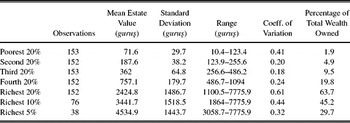
Table 1 divides our data into seven different wealth brackets. The first five rows divide 762 observations into 20-percentile groups (quintiles) according to size, from poorest to wealthiest. The last two rows provide information for the very wealthiest percentiles. Assuming that estates represented in court records correspond to the actual wealth of their owners, Table 1 depicts wealth disparities among Muslims in Kastamonu.
A significant portion of Kastamonu's poorest inhabitants owned estates worth more than the forty guruş per year poverty threshold for a single male adult. At the same time, average estate values among the bottom 40 percent of our observations were less than the price of an average house in Kastamonu (284 guruş). At the other end of the spectrum, the wealthiest segments of our sample seem disproportionately wealthy: the mean estate value in the wealthiest quintile is more than three times the mean estate value of the fourth quintile, and the mean estate value in the fourth quintile is about twice the size of the third quintile, which is also about twice the size of the second one.
Overall, Table 1 provides evidence for significant wealth disparities in early to mid-18th-century Kastamonu. The mean estate value of the wealthiest quintile was about 34 times the value of the poorest quintile and 3.2 times the overall average.Footnote 22 We have calculated the Gini coefficient for our trimmed sample as 0.60326.Footnote 23 Although this is a large value compared to modern standards,Footnote 24 a comparison with Colette Establet, Jean-Paul Pascual, and André Raymond's calculations reveal that wealth disparities in Kastamonu were less pronounced than in contemporary Cairo and Damascus (Gini coefficients of 0.81 and 0.74, respectively).Footnote 25 The difference between our calculations and those of Establet, Pascual, and Raymond is partially due to our elimination of extreme outliers. Yet even with this taken into consideration, it appears that wealth disparity in Kastamonu was less severe than in the other two cities.Footnote 26
Wealth disparities in Kastamonu

How do our calculations compare to levels of inequality for non-Ottoman parts of the world in the 18th century? Economic historians of early-modern America and Britain have studied wealth distribution and inequality measures for various periods by using probate inventories, taxation figures, and other sources. According to recent estimations based on probate inventories, the Gini coefficient calculated for the net worth of free men and unmarried women in the late 18th-century United States is around 0.72, with major regional variations.Footnote 27 In contrast, based on the massive amount of wealth data found in fire-insurance policy registers from all over Britain circa 1780, John James calculated the Gini coefficient for British insurable wealth as 0.73.Footnote 28
Also available for comparison are proportions of wealth owned by the wealthiest layers of the three societies. According to Table 1, the wealthiest 5, 10, and 20 percent of Muslim legators in Kastamonu owned about 30, 45, and 64 percent of the total wealth, respectively. According to Caroline Shammas's calculations, the wealthiest 5 and 20 percent of late 18th-century American adults owned, respectively, 63 and 95 percent of the wealth.Footnote 29 Finally, Peter Lindert's calculations based on probate inventories indicate that the wealthiest 5 percent of adults in England and Wales held 87 percent of the total wealth, circa 1740.Footnote 30
These calculations suggest that economic inequality within the Muslim community of 18th-century Kastamonu may have been relatively mild, but any comparison between our calculations and those from outside the Ottoman Empire should be taken with a grain of salt. Computations made in different contexts exploit distinct kinds of sources that define wealth and owners in incommensurable ways. Furthermore, methodologies to calculate various indices of wealth distribution and inequality vary widely. For example, British and American economic historians have devised ways to adjust their data for tendencies to underrepresent specific age and occupational groups. For this purpose they utilize multipliers, calculated through a comparison of their samples with external sources of information, such as individualized tax lists, which provide information for the entire population.Footnote 31 Because we do not have access to such external data, it is impossible to manipulate our sources in parallel ways.
WEALTH, STATUS, AND GENDER
Gender- and Title-Based Variations
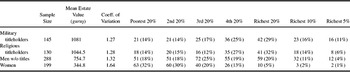
Table 2 reveals significant differences between titleholders in general and men without titles.Footnote 32 Estates belonging to military and religious titleholders were, respectively, about 43 and 38 percent more valuable on average than those belonging to other men.Footnote 33 Thus, although religious and especially military estates were well represented in the wealthiest quintiles,Footnote 34 estates belonging to men without titles were more evenly distributed among different wealth brackets. Also significant is the difference between men and women: the mean value of estates owned by women was less than half that of estates owned by men without titles, and about one-third the mean value of estates owned by either religious or military titleholders.Footnote 35 Indeed, the majority (62 percent) of estates owned by women were counted among the poorest two quintiles in our sample.
Wealth indicators and distribution for Kastamonu

Note: The percentages in parentheses represent the share in the entire category.
It is also noteworthy that despite differences among averages, an appreciable level of variation existed within each title- and gender-based category. The coefficients of variation for different title-based categories, although smaller than the overall average (1.4) and thus demonstrating some degree of cohesiveness within each group, are not negligible and indicate that individuals from all economic levels were represented within each group. As much as 14 percent of military estates and the same percentage of religious ones were counted among the poorest quintile, indicating that military and religious status, although suggestive of economic prosperity, are not always reliable indicators of wealth.
Wealth Variations within Title- and Gender-Based Categories
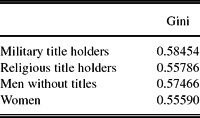
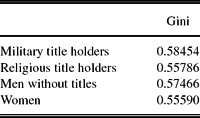
Table 3 presents the Gini coefficients for our main categories. Although the Gini coefficients for each title- and gender-based category are lower than the overall estimate (0.60326), a significant level of inequality existed within each group, a finding that can also be surmised from our calculations of the coefficient of variation for each group (Table 2).Footnote 36
Wealth inequalities within title- and gender-based categories
Wealth Disparities among Military Titleholders
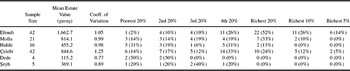
According to Table 4, ağas were the wealthiest subcategory among military titleholders, whose estates were concentrated in the top wealth brackets. In contrast, states owned by other military titleholders were comparatively modest: the mean value of estates owned by beğs and beşes constituted only about 24 and 26 percent of the average estate owned by ağas, respectively, and were concentrated in the second, third, and fourth quintiles.Footnote 37 Variations in the size of estates owned by beğs and beşes were also more considerable compared to estates owned by ağas. Nevertheless, their coefficients of variation are noticeably smaller than the one for the entire sample (1.4) and thus indicative of a relative degree of economic cohesiveness among military subgroups.
Wealth indicators and distribution for military titleholders

Note: The percentages in parentheses represent the share in the entire category.
Wealth Disparities among Religious Titleholders
Table 5 provides clues about wealth disparities within the religious establishment.Footnote 38 Among members of the religious establishment, efendis owned the most valuable estates. Their mean value was more than twice the average value of estates belonging to other members of the religious establishment. In addition, more than half of estates owned by efendis were among the wealthiest quintile of our observations. According to Kastamonu court records, mollas and çelebis were also wealthier than an average legator: the mean value of their estates was larger than the overall average, and the majority of their estates were among the top 40 percent of estates in our sample. Conversely, estates belonging to şeyhs and especially dedes—the two tarikat-affiliated groups—were among the poorest. This finding might indicate an ascetic orientation. It is also possible that they lived primarily off the revenues and property of their orders, rather than their own private wealth. If this was indeed the situation, the value of their estates cannot be seen as indicative of their (especially şeyhs’) standard of living. In any case, the number of estates belonging to şeyhs and dedes is small (nine); these estates do not significantly influence averages for the whole group.
Wealth indicators and distribution for religious title holders

Note: The percentages in parentheses represent the share in the entire category.
Significant variations existed within the religious establishment, although the Gini coefficient we have calculated for this group indicates that wealth inequality among its members was less pronounced than what we have observed for military titleholders. In fact, if we exclude the limited number of şeyhs and dedes, a distinct subgroup with worldviews presumably shaped by ascetic values, the Gini coefficient for the entire religious establishment becomes even lower (0.5201), indicative of the relative economic cohesiveness of this group.
Wealth Disparities among Women
It is impossible to make similar calculations for women because religious and military titles were used only for men. There is, however, one title-like designation occasionally used for women from prestigious and well-known families: hatun (as in Aişe Hatun bint Mehmed Efendi).Footnote 39 In our sample, the mean value of estates owned by females with hatun attached to their names was 1085.6 guruş, with a standard deviation of 1851.9 guruş (based on nine observations; coefficient of variation: 1.7). If we remember that the mean estate value for women was 344.8 guruş, it becomes clear that hatuns were considerably wealthier than other women.Footnote 40
WEALTH DISPARITIES BEYOND GENDER- AND TITLE-BASED CATEGORIES
Occupational Markers: Artisans and Merchants
A small number of terekes contain occupational information about legators, especially artisans and merchants.Footnote 41 This permits us to depict wealth disparities in Kastamonu independent of title-based categories.
Table 6 indicates that estates belonging to merchants and artisans varied significantly in size. The average value of estates owned by merchants was about 36 percent larger than the average owned by male legators in our entire sample (905.6 guruş), about 60 percent larger than those belonging to men whose occupations are unclear, and about twice the value of those owned by artisans. Although half of the merchant estates were among the wealthiest quintile of our sample, estates belonging to artisans were better represented in the third and fourth quintiles. This observation, as well as the average value of artisan-owned estates (578.8 guruş), suggests that artisans, in general, occupied the lower-middle segments of the economic hierarchy in Kastamonu.Footnote 42
The coefficients of variation presented in Table 6 indicate that merchants and artisans were more economically homogeneous than the rest of the population. We estimated the Gini coefficient for merchants as 0.46, for artisans as 0.52, and for the rest of the male population as 0.62, which indicates that wealth inequality among artisans and especially merchants was relatively low.
Wealth indicators and distribution for artisans and merchants

Note: The percentages in parentheses represent the share in the entire category.
Religious Markers
Finally, we analyze wealth disparities among individuals who gained significant socioreligious status within their community by claiming descent from Muhammad (seyyid for men, şerife for women) or making the pilgrimage to Mecca (elhac or hacı for men, hace or haciye for women). Neither qualified these individuals as members of the religious establishment; in fact, the epithets elhac and seyyid were frequently attached to individuals from all status groups, including the military establishment and people with no other title. What interests us is whether these epithets, in addition to their obvious socioreligious significance, can also be seen as indicators of economic status.
There are reasons to suspect that descent from Muhammad and pilgrimage carried economic value. For one, we know that descendants constituted an influential and revered status group with its own semi-independent leadership structure, networks of socialization, and tax responsibilities.Footnote 43 It is possible that many supposed descendants of Muhammad were able to convert their social and religious capital into an economic asset at the local level.Footnote 44 Moreover, pilgrimage to Mecca was a significant financial commitment for individuals who lived far from the Hijaz, and the ability to afford such a trip may have been a sign of economic status.Footnote 45 For such reasons it makes sense to examine wealth disparities among those who had religious markers attached to their names and those who did not.
As is evident in Table 7, the marker elhac appears to be a good indicator of wealth among men: the average value of estates owned by male pilgrims was about 1.7 times the mean value of estates belonging to male legators in our sample (905.6 guruş) and about 2.8 times the mean value of those owned by men without religious markers. The average value of estates owned by male descendants of Muhammad, by contrast, was only slightly larger than the average value of the estates owned by men (a difference that is also statistically insignificant [t = 0.4]) but about 1.9 times the average value of the estates owned by men who were not pilgrims or descendants of Muhammad. Furthermore, about 45 percent of estates owned by male pilgrims were among the wealthiest quintile, with more than a quarter of them (28 percent) among the wealthiest decile. Estates belonging to descendants were well represented among the most valuable estates in our sample, too, although a relatively large number of them, compared to those belonging to pilgrims, were also found among the poorest estates. Finally, the Gini coefficients calculated for male pilgrims (0.5) and male descendants of Muhammad (0.49) indicate that income inequality within these groups, as in the case of merchants and artisans, was less significant than what we have observed among religious and military titleholders as well as men without titles.
Wealth indicators and distribution for pilgrims and descendants of Muhammad (men only)

Note: The percentages in parentheses represent the share in the entire category.
Our sample does not contain any observations about female pilgrims. As for female descendants of Muhammad, the mean estate value was 396.4 guruş, with a standard deviation of 405.2 guruş (eight observations; coefficient of variation: 1.02). This value, although larger than the average for the estates owned by other women, is not substantially so (and the difference between these values is statistically insignificant [t = 0.78]). Hence, the epithet şerife should probably not be taken as an indicator of wealth in the context of early to mid-18th-century Kastamonu.
IDENTIFYING TRUE WEALTH INDICATORS: REGRESSION ANALYSIS
Our analysis has demonstrated that wealth in 18th-century Kastamonu was concentrated in the hands of specific titleholders, pilgrims, descendants of Muhammad, and merchants. The problem with this finding is that none of the social, religious, and economic categories examined above are exclusive of others. For example, there were many pilgrims and descendants of Muhammad among titleholders, and we cannot be sure, based on the techniques we have used so far, if the mean estate value among titleholders was high because of the presence of a large number of pilgrims or descendants among their ranks or vice versa. In what follows, we run a number of regressions to resolve this problem. In particular, we run the regression of estate values in logarithmic scale on the variables discussed above as well as on others that we have not taken into consideration so far.
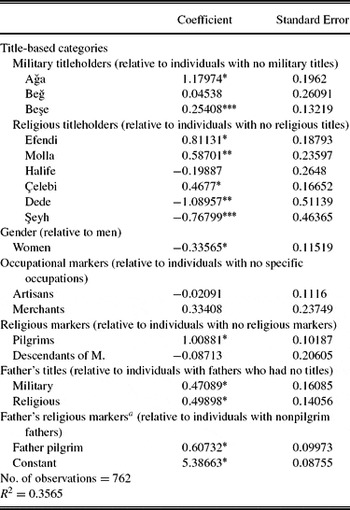
Table 8 presents the economic significance of a series of social, religious, occupational, and generational factors in isolation from each other. The coefficients given for individual variables are indicative of the relative importance of each variable in relation to estate values, with all other variables kept constant.Footnote 46 Converting estate values to logarithmic scale makes interpretation of the regression in Table 8 easier. For example, holding occupation, religious status, father's titles, and father's religious markers constant, estates owned by ağas are estimated to have been 118 percent more valuable than estates owned by individuals outside the military establishment, and estates owned by efendis, mollas, and çelebis were about 81, 59, and 47 percent more valuable, respectively, than estates belonging to individuals outside the religious establishment.Footnote 47 In contrast, estates belonging to those outside the religious establishment were about 109 percent more valuable than estates owned by dedes and about 77 percent more valuable than estates owned by şeyhs. All these estimations are statistically significant at conventional levels.
Regression analysis of estate values (in log. scale) on select variables

Note: Significant at the *1%, **5%, and ***10% level.
aIn our sample, fathers of all individuals who claimed descent from Muhammad are also identified as descendants of Muhammad.
One interesting finding of the Table 8 regression is the positive and statistically significant relationship between the title of beşe and estate values. If we recall that the mean value of estates owned by beşes was only marginally higher than the overall mean estate value in our sample and significantly lower than the average for estates owned by male legators, this result can be seen as corrective of the implications of our initial calculations regarding this title's economic significance. Furthermore, our estimations indicate that the predictive capacities of the titles beğ and halife with respect to wealth are not statistically significant, which means that we fail to reject the null hypotheses that no wealth variations existed between beğs and legators with no military titles, on the one hand, and between halifes and legators with no religious titles, on the other hand. Again, these observations contradict the implications of our previous calculations, which put the average value of estates owned by beğs and halifes at noticeably lower levels than the overall average and, in particular, the average value of estates owned by male legators.Footnote 48 Such findings demonstrate the superiority of regression analysis over simple arithmetic calculations in predicting the economic significance of noneconomic variables in terekes.
According to Table 8, estates owned by women were about two-thirds the value of those owned by men, a finding that is statistically significant at a 1-percent level. Meanwhile, and although the signs of coefficients for artisans and merchants seem consistent with our previous findings, our analysis indicates that occupational characteristics bear no significant relationship to wealth as represented in estate values. This is an important finding, especially in the case of merchants because, as we observed earlier, they owned relatively large estates in early to mid-18th-century Kastamonu. The regression results indicate that in statistical terms, the nonoccupational characteristics of these individuals are stronger indicators of their relative wealth.
Our estimations also confirm that pilgrimage is a very strong indicator of wealth. Indeed, compared to individuals with no religious markers attached to their names, estates belonging to pilgrims were about twice as valuable. Conversely, alleged descent from Muhammad seems to have a negligible relationship to wealth—another important revelation regarding the (lack of) economic significance of this designation, which contradicts our previous findings.
To our knowledge, no study of Ottoman economic history has examined the influence of generational variables on wealth accumulation. This is why the size and statistical significance of coefficients for specific characteristics of legators’ fathers are illuminating. Indeed, according to our calculations, father's title (both military and religious) and status as a pilgrim seem to be very powerful and statistically significant indicators of wealth.Footnote 49 As both can be seen as evidence for the previous generation's relative material prosperity, our findings suggest that considerable levels of wealth transferred across generations. According to Table 8, and all other variables constant, estates owned by legators who had titleholding fathers were about 48 to 50 percent more valuable than those belonging to legators with titleless fathers. Similarly, estates belonging to legators with pilgrim fathers were about 61 percent more valuable than estates owned by legators with nonpilgrim fathers.
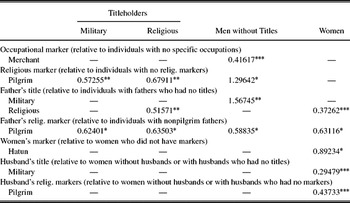
We also individually prepared separate regressions models for title- and gender-based subgroups. For lack of space, we present below only those variables that appear to be statistically significant in at least one of the four regression models.Footnote 50
We can draw the following conclusions based on the information presented in Table 9.
Statistically significant coefficients in regressions for title- and gender-based subgroups

Note: Significant at the *1%, **5%, and ***10% level. (—) The unavailability or statistical insignificance of a specific variable in a particular regression. The R 2 values of the regressions for military titleholders, religious titleholders, individuals without titles, and women are 0.36, 0.34, 0.36, and 0.19, respectively. The number of observations for the same regressions are 145, 130, 288, and 199, respectively.
• Pilgrimage and father's pilgrimage continue to be the most powerful and consistent indicators of wealth among men, for each title-based subgroup.Footnote 51 Father's pilgrimage is also a statistically significant sign of wealth for women, although the lack of female pilgrims in our sample prevents us from making any association for women between pilgrimage and wealth.
• Mercantile status seems to be a good indicator of wealth only for titleless men. Yet because we identified only four merchants among military and religious titleholders, it would be misleading to claim that mercantile activity was not a source for wealth for titleholders. At this point, we can claim only that we lack any evidence that it was.
• Although our calculations for the overall sample (Table 8) portray a powerful association between wealth and father's titles, Table 9 reveals that the strength and significance of this relationship varied across title- and gender-based subgroups. For women and religious titleholders, our models suggest a potent and statistically meaningful connection between the father's religious title and his descendant's wealth. Similarly, titleless legators with fathers who had military titles appear to have been substantially better off than other men without titles. Among military titleholders, however, there seems to be no statistically significant relationship between wealth and father's title.Footnote 52 As mentioned above, we tend to associate the statistically significant relationship between wealth and father's titles as one indicator of wealth transfer across successive generations.Footnote 53 Hence, our findings might suggest that such transfers were particularly noteworthy among ilmiye families, as both sons and daughters with religious fathers appear to have been better off than their counterparts with nonreligious fathers, with other variables held constant.
We can also make the following observations specifically for female legators.
• The regression model for female legators does not contain a number of variables (such as titles and occupational markers) that we used in the regressions for male legators. Instead, we included other variables suitable and available for women. Compared to those for male legators, the regression model for women has a significantly lower R 2 value, which indicates that we cannot explain wealth variations among women as well as we can for men.
• Nevertheless, our calculations confirm that the epithet hatun is a powerful and statistically significant indicator of wealth among women.
• Among husband's characteristics suggestive of a woman's wealth are, again, pilgrimage and military status, although the size and significance level of coefficients for these two variables are less pronounced compared to those for hatun and father's pilgrimage.
CONCLUSION
This article has proposed a variety of procedures to measure economic inequality in an Ottoman context. Except for the estimations of Establet, Pascual, and Raymond for Damascus and Cairo, this important topic has received little attention from Ottomanists. Hence, a main objective of this article has been to develop a quantitative methodology that can be utilized by other researchers to produce comparable results for different locations and periods. It is only through a collective and methodologically consistent effort that a relatively complete picture of regional wealth disparities all over the Ottoman Empire will merge.
Specifically for 18th-century Kastamonu, our analysis has revealed that inequality among different segments of the Muslim community was pronounced, although not extreme, relative to contemporary standards. Men from higher echelons of the military and religious establishments owned estates that were significantly more valuable than those owned by men from lower echelons, men who did not identify with these groups, and women. We also established that wealth disparities cut through title-based differentiations as well. Indeed, pilgrims, descendants of Muhammad, and merchants, regardless of their titles, owned estates that were more sizeable than those of the rest of the population.
It is precisely this revelation—that wealth disparities can be identified in a variety of ways and by utilizing a multiplicity of social, religious, occupational, and status-based categories—that led us to fine-tune our analysis and run a series of regressions to isolate the economic significance of a large number of variables. This procedure allows more reliable estimations concerning the economic characteristics of individuals with specific titles, markers, and epithets than those based merely on historians’ impressions or simple arithmetic calculations.
The results of this exercise in our own context confirm that gender- and title-based variations, for the most part, were closely related to wealth disparities—although in ways not exactly analogous to our earlier findings (in particular for beşes, beğs, and halifes). Descent from Muhammad, in contrast, did not indicate wealth. Likewise, artisanal status seemed to have a statistically negligible relationship to wealth for all groups, and commercial markers indicated wealth only among men without titles. Another noteworthy finding is that title-based generational variables (that is, father's titles) appeared to have a strong relationship with wealth for our entire sample, although the magnitude and statistical significance of this relationship fluctuated in the regressions run specifically for individual title- and gender-based subgroups.
Among the most reliable indicators of wealth for Muslim men were pilgrimage and father's pilgrimage. In fact, for early to middle 18th-century Kastamonu, these two are the only variables that we can reliably perceive as signifiers of wealth distinctions for each and every title-based subgroup. For Muslim women, in contrast, the epithet hatun and a father's status as a pilgrim appear to be the best indicators of wealth. Overall, and assuming that father's pilgrimage (just like father's titles) is indicative of the previous generation's relative prosperity, one important implication of our findings is that intergenerational wealth transfers played a major role in influencing wealth levels among Muslim men and women in 18th-century Kastamonu.