“Information wants to be free.” Although this sentiment dominates the current digital landscape, information about Islamic law and history often remains bound to its physical form and to the price of acquiring it. One should not have to travel to several countries or be associated with the handful of institutions with large collections in these fields to gain access to these sources (which can still be onerous once there). But this is precisely the case for those who aim to do serious, comparative, or otherwise broad-ranging work in Islamic law. For Islamic law, there is a persistent problem of access and ease of use.
To be sure, there are moves to digitize law. Some libraries with relevant manuscripts and books have started to scan portions of their collections. The digitization phenomenon is a recent one even in the United States, which has notoriously been an early adopter of digital technology in law and where digital humanities have quickly followed. But the early adoption has been through proprietary means, with companies such as Westlaw, Lexis-Nexis, and Bloomberg charging a fee for accessing sources. Accordingly, Harvard Law School has undertaken a project to “free the law” by digitizing its extensive collection and making it freely accessible.
In the world of Islamic law, similar moves toward digitization and free access have met with various constraints. First, limited financial and human capacity hold back individual libraries from digitizing and displaying their full collections, and the emerging proprietary digital collections are of limited scope. Second, libraries do not encompass the full range of legal sources, as many Islamic law documents are still in-country in their original institutional homes (e.g., legislatures, courts, administrative agencies, and fatwa-issuing bodies, in addition to academic libraries, educational institutions, and archives). Third, the typical informational architecture and tools now available do not enable easy search or use by researchers looking to make sense of disparate primary sources in Islamic or Middle Eastern history and law. This difficulty is particularly stark in the field of Islamic law, where researchers and lawyers seek to grasp information that traverses the traditional categories of Islamic or Middle Eastern history. These researchers often seek to access or understand Islamic legal texts not only in terms unique to Islamic law, but also as part of larger inquiries into comparative law and legal history.
If information wants to be free, in the case of Islamic law there is no infrastructure to facilitate this freedom. Taking its cue from sister projects, SHARIAsource is a portal housed within the Islamic Legal Studies Program at Harvard Law School that aims to build and continually expand that infrastructure as we go (Figure 1).
The SHARIAsource portal. The portal houses primary sources and commentary from a growing network of students and experts on Islamic law. See https://beta.shariasource.com.

Now that we have laid the foundation, this short piece is designed to share some reflections on why and how we are building a system for Islamic law information access and use, and what challenges we see facing this effort on the horizon. The earlier discussion considered the why; the remainder addresses the how by laying out a few principles that stand out as particularly worthy of reflection as we build the very structure that we simultaneously seek to access, inhabit, and use freely.
A first principle for digital Islamic law is collaboration, in both structure and content. Some subject-matter experts may already have access to and be able to analyze sources on Islamic law. But most do not. Here, the point of SHARIAsource is to expand access to Islamic law sources and in a way that will enrich the field, the work of specialists working in it, and the research and comparative inquiry of nonspecialists. Pursuing this goal naturally calls for building a portal for Islamic law that deploys a thoughtful scheme behind its informational architecture to encompass varied categories of law, history, and cognate fields. The portal's design must consistently be interoperable with the many digitized collections around the globe; facilitate collaborative work with individuals and institutions who would provide content; and be dexterous at incorporating digital tools and applications that make research and resources on the portal more meaningful.
We quickly realized that achieving these multiple aims first meant working with experts in Islamic law and history as well as in design, information, and technology. Accordingly, our construction of the SHARIAsource portal began with some twenty-five scholars of Islamic law, who contributed to the content for the skeletal structure. We organized this structure in collaboration with experts, librarians, and coders, and in partnership with the Berkman Center for Internet and Society at Harvard University.
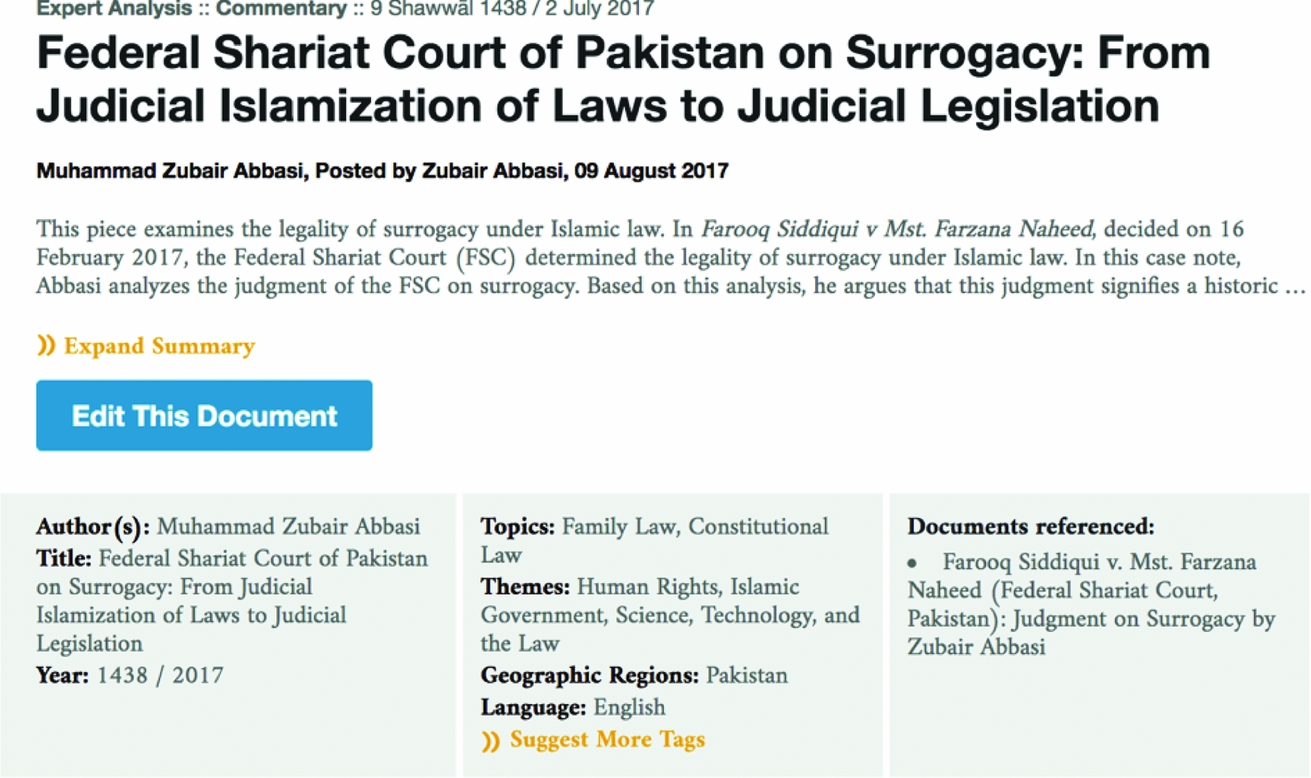
The online portal seeks to fulfill a variety of scholarly, library, and user-search needs. In particular, it aims to integrate physical workspaces into a robust digital arena. This integration applies to almost all phases and parts of the portal. Consider the resources and the research of the scholars and experts who help build it. The acquisition and organization of the texts and scholarly analysis requires an extensive backend schema of metadata that includes—among other basic information—new subject-specific tags that can integrate both with old library cataloging systems and newly emerging tools for online research and data visualization. For example, our collection of tags points to varied types of documents and subjects for Islamic law (taken in its most expansive meaning and with comparative perspective), geographic regions of the modern world, and the various empires and eras of the historical Islamic world. In addition, scholarly analysis and legal commentary typically rely on a set of sources that engage prior research and ideas. SHARIAsource's infrastructure reveals related sources and prior research in each document's “documents referenced” section (Figure 2), and shows which sources or commentaries subsequently reference each. In all these ways, we have sought to build the portal in a collaborative way to make it fully interoperable, a hub for students and scholars dedicated to the academic study of Islamic law, and a site for the development and implementation of digital tools that facilitate the free exchange and use of research and resources on Islamic law.
Documents referenced section. Each document is tagged in a way that naturally allows the reader to access a network of information available on the portal. In addition to basic metadata, and smart tags that help the user access related topic or thematic content, a “documents referenced” option allows readers to immediately contextualize analysis by consulting the primary sources directly.

A second principle relates to accessibility. Before the Internet, the printing press opened up avenues of scholarship that benefit researchers to this day. The ability to disseminate the exact same information at a greatly increased rate of distribution and accuracy widely contributed to new discoveries, insights, and arguments. It gifted time to scholars who preferred to pore over the pages for details, their close reading yielding ideas about distant times and places. The Internet accelerated the extent of access in the wired world for most sources, but access to Islamic legal texts has increased at only a fraction of the speed of other traditions. Notwithstanding the recent and laudable advances in digitization of individual collections and PDF repositories of Islamic and other texts, at present there is simply no centralized online point of access to primary sources for Islamic law. A portal that serves as a digital law library hub can better facilitate the close reading and discussion of texts from various periods in Islamic law.
Consider two examples. When sharing information on the portal, scholars who study the poorly documented practices of judges in early Islamic courts can compare judicial practices from the medieval Eastern and Western Islamic worlds. They can also invite other scholars to contribute examples that help flesh out what is now only a skeletal idea of practices and procedures in those early courts. Or, as a repository of modern legislation, fatwas, and court cases on issues of family law or public health regulations, the portal can become a gathering place for researchers interested in the links between law, religion, and new fields of scholarship. These researchers might, for instance, compare and contrast the brand new questions concerning Islamic law and regulation that emerge with new scientific advances (e.g., DNA evidence or surrogacy and cloning).
Efforts to build the portal have produced the foundations and tools for a digitization and contextualization hub. The next step is to increase content from other venues, that is, to robustly collect and digitize sources on Islamic law and make them available online. To that end, we are currently running a pilot project to digitize the Harvard Law Library's extensive collection on Islamic law, while collaborating with projects such as the Zaydi Manuscript Tradition at the Institute for Advanced Study at Princeton to house Islamic law sources of other digitized collections. A centralized digital collection will give an entire community of scholars of law, history, and other fields greater access to the sources, while also providing the public with access to those same sources as well as the subject-matter experts’ interpretations of them.
A third principle has to do with usability and new types of insight. With Islamic law added to the digital landscape, the fields of Islamic legal studies and Islamic legal history are ripe for the development of tools that will help pave new avenues for scholarly analysis. Here, we are keen to integrate the possibilities of close reading of texts (i.e., careful scholarly analysis of a single text or group of texts) with distant reading of analogous texts in greater quantity (i.e., scholarly analysis of a large volume of related texts based on tags developed from insights gained through the close reading of similar content).
This combined close and distant reading promises new comparisons, visualizations, and analyses not before possible. The scholars behind Open Islamicate Texts Initiative (OpenITI) and the related work of Maxim Romanov provide examples of researchers seeking to leverage digital methods to study the medieval Islamic world in these new ways.Footnote 1 OpenITI is utilizing the network of scholars and specialists working with the Arabic language to create a reliable Arabic optical character recognition (OCR) tool that can be trained and constantly improved with human-corrected data.Footnote 2 As part of their larger goal of creating a machine-readable and metadata-enriched corpus of “premodern Islamicate texts,” they have developed a new open-source Arabic-script OCR program that has achieved impressive levels of accuracy. We are collaborating with OpenITI to finesse the first working Arabic OCR tool, and to turn its digitization of Arabic texts into interactive data points. Our collaboration brings together their OCR pipeline with Islamic law materials and a powerful version-controlled database in a user-friendly interface. This tool will allow computers to read and translate digitized Arabic material into text at a high rate of accuracy, thereby “liberating” many pieces of information in Islamic law and beyond. The resulting texts are to be housed in a database that SHARIAsource is developing in conjunction with Open ITI, through which all registered scholars will be able to access the OCR'ed texts. Furthermore, SHARIAsource and other collaborating institutions will offer mechanisms for scholars within their networks to analyze and interpret those texts at a micro- or macrolevel. When the tool is finished, scholars will be able to tag words, comment on interpretations, and contribute expert analyses that focus either on an entire document or a piece of text. No matter the scope, texts that are thus tagged will offer enriched information to the document and be accessible to other users.
Alongside using Arabic OCR to aggregate and compare digitized information on Islamic law, SHARIAsource plans to develop other research tools designed to analyze this material—including keywords from atomized texts—as a collected body of data. This “big data” approach to assessing trends in Islamic law could recast the content of the documents for researchers in Islamic law and legal history. And it could help researchers view the documents in different, mapped contexts, such as juristic social networks and legal genealogies, legal migrations and transplants, and episodic trends that may have percolated over vast geographies and across centuries. Through a combination of collaboration and deepened accessibility as well as improved usability of information, more scholars will be able to access Islamic law in a way that is useful for robust comparative and Islamic legal studies.