INTRODUCTION
The protectionist approach was the principal conservation paradigm until a move towards more community involvement began three decades ago (Meffe et al. Reference Meffe, Nielsen, Knight and Schenborn2002; Chapin Reference Chapin2004; Robinson & Redford Reference Robinson, Redford, McShane and Wells2004; Berkes Reference Berkes2007). Numerous studies support more community involvement in conservation by demonstrating that local participation can be critical to success (for example Ostrom Reference Ostrom1990; Adams & Hulme Reference Adams and Hulme2001; Thakadu Reference Thakadu2005; Kothari Reference Kothari, Lockwood, Worboys and Kothari2006; Spiteri & Nepal Reference Spiteri and Nepal2006; Horwich & Lyon Reference Horwich and Lyon2007). Participatory conservation approaches have greater potential for generating a legitimate conservation process, namely one that is regarded as right and just by the people most affected (Imperial Reference Imperial1999; Adams & Hulme Reference Adams and Hulme2001; Brechin et al. Reference Brechin, Wilshusen, Fortwangler and West2002; Wilshusen et al. Reference Wilshusen, Brechin, Fortwangler and West2002; da Silva Reference da Silva2004; Spiteri & Nepal Reference Spiteri and Nepal2006; Horwich & Lyon Reference Horwich and Lyon2007; Menzies Reference Menzies2007; Haller et al. Reference Haller, Galvin, Meroka, Alca and Alvarez2008), and can increase compliance and reduce conflicts generated from resource use restrictions (Agrawal & Gibson Reference Agrawal, Gibson, Agrawal and Gibson2001; Barrow & Murphree Reference Barrow, Murphree, Hulme and Murphree2001; Brechin et al. Reference Brechin, Wilshusen, Fortwangler and West2002; Berkes Reference Berkes2007). In turn, community conservation approaches can be more efficient and cost-effective (Thakadu Reference Thakadu2005; Spiteri & Nepal Reference Spiteri and Nepal2006; Menzies Reference Menzies2007).
Local community involvement in conservation efforts varies widely, reflecting a continuum from protectionist approaches typically run by central governments, to programmes driven completely by local communities (Berkes Reference Berkes1994; da Silva Reference da Silva2004; Gavin et al. Reference Gavin, Wali, Vasquez, Kindon, Pain and Kesby2007; Fig. 1). At one end of this spectrum are ‘instructive’ management frameworks, in which government or other external agencies control the management process and local communities are only informed of management decisions. In the middle of the continuum are ‘co-operative’ or ‘collaborative’ processes, in which management is an equal partnership between local communities and external agencies. At the other end of the continuum are ‘informative’ practices, where communities control the management process and inform government about their actions (Berkes Reference Berkes1994; da Silva Reference da Silva2004). Similarly, other authors (for example Barrow & Murphree Reference Barrow, Murphree, Hulme and Murphree2001) have classified conservation projects based on their levels of local participation into: (1) passive participation, where communities are notified of conservation action taken by outsiders; (2) participation via data collection, where communities provide information to external managers; (3) participation via consultation, where communities views are heard and external agents incorporate these views into planning decisions; (4) participation via incentives, where communities are provided with material incentives (such as access to resources) to increase compliance with external agents’ conservation agendas; (5) participation via conservation action, where community organizations tackle the conservation objectives defined by external agents; (6) participation via cooperation, where joint analysis, planning and conservation action is undertaken by communities together with external agents; and (7) participation via self-mobilization, where decisions and conservation actions are made independently by local communities. Therefore, conservation management can encompass a wide variety of different arrangements depending on the relative contribution of the principal stakeholders (Carlsson & Berkes Reference Carlsson and Berkes2005).
The participation continuum (Adapted from da Silva Reference da Silva2004).

However, any examination of community participation in conservation must move beyond just an analysis of power-sharing arrangements to understand the roles relevant stakeholders play in the various components that comprise conservation management (Carlsson & Berkes Reference Carlsson and Berkes2005). Who controls the conservation agenda? Who controls the planning process? Who controls the land and the resources? Which institutions will govern and monitor resource use and management? Who controls the funding? The degree of community involvement can vary across all these different aspects of conservation management.
Systematic conservation planning occurs across a series of stages that form the core of an adaptive management system (Margules & Pressey Reference Margules and Pressey2000; Salafsky & Margoluis Reference Salafsky, Margoluis, McShane and Wells2004). Borrini-Feyerabend (Reference Borrini-Feyerabend1996, p. 8) defined the conservation process as beginning with a stage at which the location of the conservation action is ‘identified, acquired and declared; [then] relevant institutions are built and/or enter into operation; plans are designed and implemented; research is undertaken; and activities and results are monitored and evaluated, as appropriate.’ In turn, conservation is an iterative process with many steps (for example planning, implementation and monitoring) repeated over time (Margules & Pressey Reference Margules and Pressey2000; Salafsky & Margoluis Reference Salafsky, Margoluis, McShane and Wells2004; Berkes Reference Berkes2007), each with an opportunity for different levels of participation.
Studies of conservation and natural resource management have tended to focus on outcomes of participatory processes without distinguishing how participation varies across different management stages (Berkes Reference Berkes2007). If greater levels of local participation are beneficial and deemed a worthy goal, then conservation managers and researchers must pay more attention to how participation varies across management stages. Conservation management frameworks are social-ecological systems, which tend to be dynamic as the social, political, economic and ecological conditions in which the systems are embedded change over time (Carlson & Berkes Reference Carlsson and Berkes2005; Liu et al. Reference Liu, Dietz, Carpenter, Alberti, Folke, Moran, Pell, Deadman, Kratz, Lubchenco, Ostrom, Ouyang, Provencher, Redman, Schneider and Taylor2007). Therefore, as conditions shift and as conservation progresses through different management stages, changes in the potential role of stakeholders should be expected. In addition, because different management stages involve different components of conservation action (such as policy implementation, planning, institution building, enforcement, monitoring and evaluation) distinct barriers and triggers to local community participation may be present at each stage.
Numerous factors can influence the level of community participation present at the different stages of conservation projects. Some potential barriers to participation are related to issues of power. In many cases, to achieve a more participatory model of conservation, governments must be willing to cede at least some power (Barrow & Murphree Reference Barrow, Murphree, Hulme and Murphree2001; Berkes Reference Berkes1994). Thus, community-based conservation projects often face the difficult task of negotiating trade-offs among different interests (Imperial Reference Imperial1999; Adams & Hulme Reference Adams and Hulme2001; Castro & Nielsen Reference Castro and Nielsen2001; Kumar Reference Kumar2002; Chapin Reference Chapin2004;; Wells et al. Reference Wells, McShane, Dublin, O'Connor, Redford, McShane and Wells2004; Menzies Reference Menzies2007). Similarly, land tenure and resource use rights can determine the roles different stakeholders might play in the conservation process (Barrow & Murphree Reference Barrow, Murphree, Hulme and Murphree2001). For example, if government owns the land and legally controls access to resources, community involvement in conservation management may be limited by legal hurdles. In addition, local people may not have the time or resources needed to participate fully in conservation action (Twyman Reference Twyman2000; Thakadu Reference Thakadu2005; Menzies Reference Menzies2007). The amount of funding available and the short-term focus of many funding agencies can also constrain the scope and durability of participation (Adams & Hulme Reference Adams and Hulme2001; Dearden et al. Reference Dearden, Bennet and Johnston2005; Struhsaker et al. Reference Struhsaker, Struhsaker and Siex2005; Menzies Reference Menzies2007).
Other potential barriers to more community participation are associated with context. Greater local dependence on resource extraction can increase vested interest in conservation action and influence levels of local participation in management activities (Adams & Hulme Reference Adams and Hulme2001; Barrow & Murphree Reference Barrow, Murphree, Hulme and Murphree2001). Likewise, certain conservation costs, including loss of land or resource use rights, place acute strains on local livelihoods, and can lead to strong feelings of resentment towards any conservation agenda (Agrawal et al. Reference Agrawal, Redford, Fearn and Fearn2008). Finally, stakeholder perceptions regarding definitions and acceptable levels of participation can determine the actual degree of participation achieved (Twyman Reference Twyman2000). For example, conservation and/or government agencies may perceive participation as a legislative obligation or simply as a means to secure community permission for conservation action, in which cases participation tends to be limited (Imperial Reference Imperial1999; Kumar Reference Kumar2002; Chapin Reference Chapin2004; Mayo & Craig Reference Mayo, Craig, Craig and Mayo2004).
Approximately 13% of Peru's territory falls within the national system of 55 protected areas. The Peruvian Law of Natural Protected Areas (Law N° 26834, article 20) mandates that every protected area has a management plan. These plans must be developed under participatory processes; the law also requires every protected area to have a Management Committee comprised of relevant stakeholders.
The Cordillera Azul National Park (Parque Nacional Cordillera Azul [PNCAZ]) was officially gazetted in 2001. PNCAZ is the first Peruvian national park managed by a non-governmental organization, which was made possible by recent government regulations permitting official management of protected areas by private organizations (Young & Rodríguez Reference Young, Rodríguez and Zimmerer2006).
We use a case study from PNCAZ to fill a gap in the conservation literature by providing the first analysis of how different barriers and triggers to community participation vary across different stages of conservation management. We then discuss the implications of this variation in participation for conservation planning in the region and for conservation research and management elsewhere.
METHODS
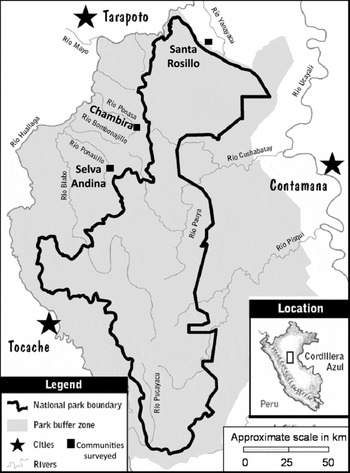
PNCAZ comprises 1.3 million ha, at an altitude above sea level of 200–> 2000 m (Fig. 2). PNCAZ supports high levels of biodiversity, including an estimated 4000–6000 plant species and 500–800 bird species (Instituto Nacional de Recursos Naturales [INRENA] 2006). Prior to the Park's establishment only a few dozen people lived on the land that is now protected, and these families were later relocated outside the Park. PNCAZ's buffer zone consists of over two million hectares, and is home to > 70 000 people mostly concentrated on the Park's north-western boundary (INRENA 2006). The residents of these communities are both indigenous people (Kechwa-Lamista, Shipibo, Cacataibo, Piro, and Yine), who can trace their communities’ roots back hundreds of years, and recent immigrants from other regions of Peru. Before the protected area declaration, local communities extracted resources from the forests inside what is now the Park. This resource use was for subsistence and commercial purposes and focused on hunting, fishing and the extraction of non-timber forest products. Agricultural fields, logging operations, new roads and rapidly growing communities all lie just outside the Park's western border (The Field Museum of Chicago 2007).
The Cordillera Azul National Park in the northern Peruvian Amazon and the location of the three focal communities for the study of participation in the Park's management (modified from Gavin et al. Reference Gavin, Wali, Vasquez, Kindon, Pain and Kesby2007).

A Peruvian non-governmental organization (NGO), Centro de Conservación, Investigación y Manejo de Áreas Naturales (CIMA) manages PNCAZ in partnership with a government agency. The National Institute of Natural Resources (INRENA) was the government agency in charge of national parks through most of PNCAZ's brief history. Contrary to previous national park management strategies in Peru, where protected areas used top-down protectionist strategies, CIMA has attempted to include local communities to varying degrees in the different stages of park management (Gavin et al. Reference Gavin, Wali, Vasquez, Kindon, Pain and Kesby2007).
For the purposes of our case study, we divided PNCAZ's management into three stages. The first management stage included the processes leading to the Park's establishment in 2001. The second stage was the development of the Park's management plan. The third stage involved the implementation of the Park's first management plan and the development of the second management plan in 2008.
Our study focused on the perspectives of three main stakeholders, specifically CIMA, INRENA and local communities. Interviews with CIMA and INRENA officials were conducted in July and August 2008 in the city of Tarapoto, the location of Park headquarters and CIMA's field headquarters. We selected three communities closest to the north-western boundary of PNCAZ (within 0.5–1.5 hr walk): Chambira, Selva Andina and Santa Rosillo (Fig. 2). We selected communities that were representative of the region in terms of population size, livelihood strategies, ethnicity and residence time of community members because conservation values and resource use patterns may be affected by these socioeconomic variables (Thakadu Reference Thakadu2005; INRENA 2006; Spiteri & Nepal Reference Spiteri and Nepal2006; Gavin & Anderson Reference Gavin and Anderson2007). We chose communities closest to PNCAZ's north-western boundary because they would be most affected by the Park's creation. The communities surveyed are located in lowland moist tropical rainforest and support 30–50 families that rely on slash-and-burn agriculture. Many families have cows, pigs and/or chickens for protein, but community members also hunt and fish for subsistence (see results for details on resource use inside the Park). Santa Rosillo's residents are primarily indigenous lowland Kechwa-Lamista families. Families in Selva Andina are nearly all recent immigrants of mixed ancestry from Peru's desert coast and the Andes. Chambira's population is half immigrants and half indigenous Kechwa-Lamista families.
Given the involvement of Michael Gavin and Miguel Macedo-Bravo in different stages of PNCAZ planning and/or management, Emilio Rodríguez-Izquierdo (ERI) administered all questionnaires and conducted all interviews. ERI had not worked in the region prior to this study, thus limiting possible interviewer and response bias. ERI randomly selected households to survey in each community. Six people declined to participate, and one respondent claimed not to know of the Park's existence. Owing to time constraints, ERI only surveyed heads of households. In nearly all cases, the households approached self-selected a man as the head of household. We surveyed 73 community members (29 people in Chambira, 58% of all household heads; 22 people in Selva Andina, 73%; and 23 people in Santa Rosillo, 58%).
The structured questionnaire contained three main sections. In the first section, we gathered information on the respondent's perceptions of levels of participation at each stage of management. In the second section, we examined possible barriers to increased participation in management based on the community-based conservation literature (see Introduction). We asked about relationships with Park staff, perceived levels of responsibility towards the Park, attitudes towards the Park and participation in Park management, and perceived benefits and costs related to the Park. Finally, we recorded basic sociodemographic information from each respondent, namely age, education, residence time, place of birth and wealth indicators (hectares of land and number of animals owned).
To include the perspectives of the Park's other main stakeholders, ERI conducted 11 semi-structured interviews with former and current CIMA and INRENA employees, Park guards and a Field Museum anthropologist. The interviews focused on identifying tools used to encourage participation at each management stage, the levels of participation achieved, and the perceived triggers and barriers to participatory management approaches. We followed a constant comparative analysis in examining the semi-structured interview data (Corbin & Strauss Reference Corbin and Strauss2008). We coded data by comparing similarities and differences in themes arising in each interview.
RESULTS
Levels of participation across management stages
Stage one: PNCAZ establishment
The establishment of PNCAZ began with a rapid biological inventory carried out by Peruvian and USA biologists in 2000 (The Field Museum of Chicago 2007). Based on the inventory's results, members of the team began to lobby the Peruvian government to establish the national park. The team prepared all the technical files and carried out the consultation process required for the creation of the protected area. Late in 2000, a corruption scandal led to the downfall of Alberto Fujimori's government. The interim government of Valentín Paniagua Corazao then chose to act on the recommendations of the inventory team and officially decreed PNCAZ in May 2001.
Evidence from both the semi-structured interviews and the survey of community members indicates that the establishment phase of park management was not participatory. The comments of Fernando Rubio, former director of CIMA's protection team, summarize the overall sentiment shared by all interviewees: ‘In the establishment process there were some workshops to explain to the people [what a national park is], but that was almost a formality. . . I think most of [the communities] are now wondering why they were not asked.’ Others pointed out that the levels of consultation varied widely. Communities closer to the administrative centre of Tarapoto received some visits, but more remote sectors of the Park remained unaware of proceedings until after the Park's official establishment. These perceptions of CIMA and INRENA staff coincide with the views of community members we surveyed. Thirty-two of the 73 heads of household questioned had no idea how, or if, their community was involved in PNCAZ's establishment. Only nine respondents specifically mentioned consultation meetings with Park officials, and none made reference to any active community participation in the Park's establishment.
Stage two: development of the first management plan
The first PNCAZ management plan was developed by INRENA in collaboration with CIMA. The management plan included zoning for the Park. PNCAZ has five types of zones: strict protection zones allow no extraction and minimal human activity, wilderness zones prohibit resource extraction and limit human activity to tourism and research, restoration zones are actively managed to promote recovery from logging and to allow for some resource extraction (such as hunting, fishing and non-timber forest product use) by local communities and special use zones allow activities in support of certain ancestral practices. In order to access the recovery zones for resource use purposes, hunters and fishers required permission from Park guards and then had to record the identities and quantities of resources removed. The management plan defined a participatory adaptive management process in which local communities and Park officials defined resource use regulations and monitored the impact of extraction activities inside the recovery zones.
The development of the Park's first management plan included consultation with communities regarding zoning levels and the location of the different zones. In addition, in order to gather data to support the management plan's development, CIMA employed a technique referred to as ‘Mapping of Social Assets and Resource Use’ (Mapeo de Usos y Fortalezas [MUF]). The MUF combined participatory social asset mapping with resource use mapping in order to obtain socioeconomic and geographic information about the communities surrounding PNCAZ, including details about community organizations and resource-use patterns (Gavin et al. Reference Gavin, Wali, Vasquez, Kindon, Pain and Kesby2007). The first application of the MUF, in 2003, involved local community representatives trained by CIMA and The Field Museum, gathering information from 53 communities (INRENA 2006).
The MUF was discussed extensively by the interviewees, who noted that the process included active involvement by all 53 target communities. Several interviewees considered this process was unique in Peru. Alaka Wali, a Field Museum anthropologist involved in PNCAZ since the earlier stages of management, explained that in many other Peruvian protected areas ‘the standard process for gaining community acceptance of . . .the Management Plan was to hold six or seven workshops . . . we needed to have more participation, and take longer, and use a more in depth methodology.’ Several interviewees also noted that the MUF was relatively participatory, but also a lengthy and resource intensive process.
Given the local involvement in the MUF data gathering exercise, it is not surprising that the vast majority of respondents (61 of the 73) thought that communities participated in the second stage of management. However, the local involvement in management plan decisions was limited. For example, 65 of the 73 respondents could not name any decisions their community had participated in related to management plan development. The eight respondents who did elaborate on key decisions noted that community participation was limited to defining restrictions on resource use inside the protected area and the location of the Park's boundary.
Stage three: active management of PNCAZ
PNCAZ's management plan included three tools that focused on encouraging local participation in management: the Blue Agreements (Acuerdos Azules), the management committee (Comité de Gestión del Área Protegida) and participatory monitoring via repeated MUF exercises. The rationale behind the Blue Agreements was to involve communities in the Park's protection. To do so, Park officials asked communities to sign an agreement committing them to assisting in the Park's protection in exchange for technical support with land planning and environmental education programmes (INRENA 2006). The land planning focused on the promotion of sustainable use of resources in the buffer zone communities. The environmental education programme aimed to increase awareness of the importance of natural resources and their conservation through both formal education (for example school programmes) and via community workshops. The management committee is comprised of public and private representatives who work to support the Park's management and administration. In 2008, CIMA was granted a total management contract, placing the organization officially in charge of PNCAZ's management. Because the Park's initial management plan expired in 2008, CIMA's immediate priority has been the development of a new management plan. This process has included another version of the MUF, in which CIMA staff collected data at meetings of community representatives and the number of communities involved increased to more than 80 communities.
Although the Blue Agreements were a management tool designed to increase community participation through formal commitments between communities and Park officials, interviewees generally felt the Blue Agreements did not live up to expectations. Several interviewees noted a lack of consistency in implementing these agreements, with definitive commitments obtained in some communities, but no clear process defined in other cases. Some interviewees blamed the inconsistent implementation on a process that placed most of the responsibility on CIMA technical field staff, who each acted on their own visions of the agreements. Dave Pogois, PNCAZ Programme Director for CIMA, also noted that the Blue Agreements should have been clearer about the duties and responsibilities both sides were agreeing to: ‘When the [Blue Agreements] concept was misunderstood, and the Blue Agreements were applied without clearly specifying what had been agreed to; signing them without a clear objective and specific idea, then it did not work.’ Not surprisingly, given the difficulties faced in implementing the Blue Agreements, 59 of the 73 community members surveyed had never heard of the Blue Agreements.
In terms of the management committee, interviewees agreed that although local communities had representatives on the committee, the committee played only a very minor role during the third stage of Park management. As Dave Pogois explained: ‘I think the management committee's function should be at the level of decision-making, especially in policies related to the Park's management. But the management committee is not fulfilling that role, and I think we need to empower the management committee.’
Unlike the first MUF (in 2003), the 2008 edition did not involve community facilitators gathering the information. Therefore, there was a clear decrease in the extent to which communities had participated, both in the extent of community involvement and in the duration of the MUF.
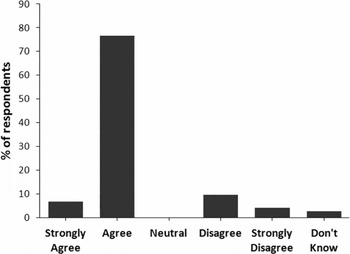
Despite the difficulties faced by the Blue Agreements, the management committee and the 2008 version of the MUF, 59 of the 73 community members surveyed agreed or strongly agreed that local people were involved in the PNCAZ's current management (Fig. 3). However, the types of local involvement noted by community members focused on providing support to Park guards by acting as informal Park guards, limiting the impact of personal resource use and building field huts to house guards on patrol.
Responses of local heads of households (n = 73) to the statement ‘Your community takes part in the Park's (Cordillera Azul National Park) decisions’.

Barriers and triggers to participation
Barriers to participation based in local communities
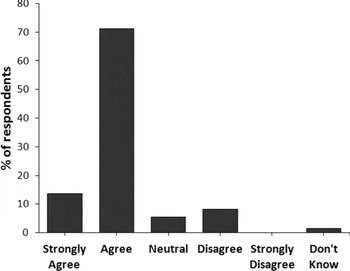
We examined other possible community-driven barriers to participation, such as perceived responsibility for the Park's management and perceived costs and benefits of the Park. Seventy of 73 respondents desired increased community participation in PNCAZ's management. Respondents based their desire for more participation on two main factors, namely the important role the Park played in protecting ecosystem services (for example rain, clean water and fauna) and the potential for community involvement in management to assist with community development. Sixty-two of the 73 respondents agreed or strongly agreed that their community was at least partially responsible for the Park's current management (Fig. 4). Forty-six respondents agreed that they received benefits from the forest inside the Park. Sixty-seven respondents felt they had incurred no costs from the Park. Overall respondents believed the Park provided more benefits than costs. Therefore, from the answers provided by the majority of respondents, we found no evidence of major barriers to participation among community members.
Responses of local heads of households (n = 73) to the statement ‘Your community is to some extent responsible for the Park's (Cordillera Azul National Park) management’.

Barriers to participation from Park officials
Interviewees mentioned two main barriers to greater community participation during the establishment of the protected area, namely expediency and political process. Several CIMA staff members noted that proper consultation and negotiation with hundreds of communities would require a lengthy process. In addition, many recognized that ultimately the government holds the legal power to decree the protected area, and so the communities’ involvement will always be limited in scope. Given the importance of the legislative process in formalizing the Park, other interviewees noted that a narrow political window limited the time available for participation. The team of conservation biologists had lobbied the government following the rapid biological inventory of the region, but it was not until the interim government of President Paniagua came into power that ministers were in place who would seriously consider the possibility of the new protected area. Given that the Paniagua government was only temporarily in office, the conservation team felt they had to act fast to secure the Park's official designation. As Lily Rodriguez, former director of CIMA and principal proponent of the Park's establishment noted: ‘[Communities] were not too involved in the Park's establishment. We had to rush to establish the Park. . . It is not easy to establish a Park, and we had a window of time and political will of the minister to establish the Park; and we took it to the fullest. There, the limiting factor was the time.’
Following the Park's establishment, most interviewees argued that PNCAZ was managed with much greater participation than many other Peruvian protected areas. However, most interviewees also noted that participation levels could have been higher. For instance, Ruben Paitán, current head of PNCAZ for INRENA, stated: ‘I do not think it was totally participatory at the level we would like it to be. But given our limited resources and given the context we operate in now, [the Park] has had quite a high level of participation compared with other protected areas in the system [the Peruvian Protected Areas System, SINANPE].’
Interviewees defined three factors as the principal barriers to greater participation in PNCAZ's management after the establishment phase: First, several interviewees noted a lack of capacity on the part of the communities and in terms of the funding and human resources available to the Park officials. For instance, Alaka Wali noted: ‘I think there is always going to be a need for an external kind of organization or institutional presence that has the time that is needed to find the resources, the monetary resources, to do this kind of work. . .’
Second, Park officials may have been reluctant to share their power with communities. Although the management committee is the principal, and only, means provided for communities to take part in the decision-making process, the committee has not been empowered to fulfil its role. For instance, Dave Pogois stated: ‘not only us [CIMA] but also INRENA has not delegated specific functions to these institutions [management committee], specific functions related to the decision-making process. . . my understanding is that so far, the management committee has not taken any decision. . .’ Fernando Rubio argued that officials might be reluctant to change the status quo: ‘[the management committee] is a good [management] tool, even though it is not legally allowed to manage. There is a lack of trust, from INRENA and the NGOs too. There is a fear that things [may] change too much. . .’
Barriers to participation based on the concept of participation
The final barrier involved how different stakeholders defined participation. The majority of community members surveyed thought their communities were participating in management decision-making (Fig. 3) and that, to some extent, Park management was the communities’ responsibility (Fig. 4). However, most of the conservation officials we interviewed felt participation levels were low. For instance, Dave Pogois mentioned: ‘Communities in the buffer zone are participating in some activities such as communal surveillance, and support for the Park, but apart from that there is no more participation.’ This perception of limited community involvement is not in complete conflict with the community vision of current participation, in which community members view their role as acting as informal Park guards, limiting impact of personal resource use and building field huts to house guards on patrol. None of the community members mentioned a desire for more community involvement in the Park's administration, including no discussion of involvement with the management committee. This limited local vision of participation in the Park's management likely reflects the modes of participation that have been offered to the communities by Park officials. For example, Alaka Wali pointed out that community participation varied depending on the type of decisions: ‘Decisions about what happens inside the Park itself, for example, or where we put the Park guard posts . . . This is almost entirely decided by the Park team. There is very little consultation about that with the community. . . But in other aspects of the Park management, like where the resource use zone is supposed to be [and] how people can meet their resource needs within the Park. . . there was much deeper consultation.’
DISCUSSION
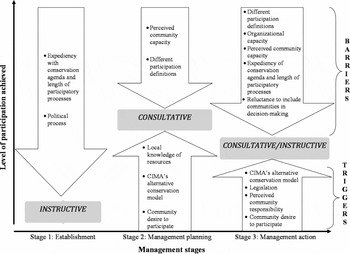
Levels of community involvement in conservation management varied across different management stages in the PNCAZ. At each stage of management different triggers increased the levels of participation achieved, whereas different barriers limited the degree to which participation was possible (see Fig. 5). Local communities did not participate in the establishment of the Park, and many were not even consulted during this process. In turn, the earliest stages of conservation action in the Cordillera Azul can be labelled instructive (see Figs 1 and 5), which indicates the top-down nature of the decision-making process used. However, during the design of the Park's management plan, an extensive participatory research exercise involved 53 communities in the gathering of data critical to the assessment of management options. The level of participation at this second stage of management could be termed consultative, and fell short of a full cooperative approach because community members did not participate in many of decisions that shaped the final management plan. During the execution of the management plan the Park's administration employed several tools in attempts to increase community participation, including another round of participatory data gathering, the Blue Agreements and community representation on the management committee. However limits placed on the implementation of these tools (such as data gathering undertaken by Park staff instead of community representatives, CIMA field technicians not consistently presenting and establishing the Blue Agreements and the management committee failing to play a prominent role in management) have restricted the degree of participation ultimately achieved during this latest phase of management.
Barriers and triggers to participation across three management stages in the Cordillera Azul National Park, Peru.

The management of PNCAZ has clearly demanded greater community involvement than other Peruvian national parks (Gavin et al. Reference Gavin, Wali, Vasquez, Kindon, Pain and Kesby2007). A principal driving force behind the increased levels of participation in PNCAZ was the alternative management model, in which a private conservation organization (CIMA) has been an active partner (and now principal administrator) in the protected area's management (Fig. 2). CIMA was less burdened by the bureaucracy or institutional inertia in many government-led initiatives, which can often stifle innovation and maintain the status quo (Imperial Reference Imperial1999; Castro & Nielsen Reference Castro and Nielsen2001; Chapin Reference Chapin2004; Sayer & Wells Reference Sayer, Wells, McShane and Wells2004). CIMA's willingness to embrace alternative management models led to the development of multiple tools designed to include local communities in the conservation process. Another critical factor was Peruvian law, which requires local community involvement in the management of protected areas, including local representatives on the Park's management committee. In addition, the desire of local communities to participate and their sense of responsibility (Fig. 4) towards the protected area enabled a more participatory management approach and echoed key factors contributing to the success of other community conservation initiatives (Adams & Hulme Reference Adams and Hulme2001; Thakadu Reference Thakadu2005). Local motivation to participate in management is surprising given the resource use restrictions introduced by the Park and the limited development alternatives offered by the Blue Agreements. However, dependence of communities on resource extraction may provide a strong impetus for supporting attempts at more sustainable resource management (Adams & Hulme Reference Adams and Hulme2001; Barrow & Murphree Reference Barrow, Murphree, Hulme and Murphree2001). Although resource use restrictions exist, some local extraction is still permitted in the PNCAZ, and controls on commercial use by non-local people have the potential to protect the local resource base into the future. In addition, local recognition of the non-use values of intact forests, such as their value for ecosystem services, would encourage support for the Park's conservation efforts. Local communities’ knowledge of natural resources and the capacity of community members to gather key data were critical prerequisites for the success of the MUF and the development of an informed management plan.
Overall, the participation levels achieved in the PNCAZ management process were still limited in scope. Although community members were involved in conservation actions, the process could never be considered fully cooperative. Different barriers limited the degree of community involvement in conservation across the first three stages of PNCAZ's management (Fig. 5). The major barrier to participation during the Park's establishment was a sense of urgency on the part of the individuals and conservation organizations pushing for the declaration of a national park. These conservation proponents placed a high priority on rapidly securing the future status of a region with high levels of biodiversity and endemicity. The vision of these organizations reflects the widely held viewpoint that conservation is a crisis discipline, which must develop rapid solutions to cope with imminent threats to biodiversity (Redford & Sanjayan Reference Redford and Sanjayan2003; Wells et al. Reference Wells, McShane, Dublin, O'Connor, Redford, McShane and Wells2004; Struhsaker et al. Reference Struhsaker, Struhsaker and Siex2005; Gavin & Anderson Reference Gavin and Anderson2007). In addition, although alternative conservation strategies exist, including community-driven initiatives, the key players involved in PNCAZ's establishment focused on obtaining national park status for the region. The establishment of a national park requires an official government decree and is a decision which legally lies with the government. During the Park's establishment, conservation organizations sought to take advantage of a narrow window of political opportunity to decree the protected area. Unfortunately, such a scenario is not unique because many countries that harbour biodiversity are politically unstable, and conservation solutions depend largely on reliable government support (Struhsaker et al. Reference Struhsaker, Struhsaker and Siex2005). The solution to this dilemma in the PNCAZ case was to move quickly when a supportive government was finally in power. As is the case with PNCAZ, any and all local participation, even simple consultation with communities, can be viewed as an unnecessary delay in the early stages of the conservation process when urgent solutions are the pre-eminent focus (Kumar Reference Kumar2002; Chapin Reference Chapin2004; Menzies Reference Menzies2007).
The initial phase of management in the Cordillera Azul, in which the government declared the national park, also set the stage for the levels of participation possible throughout the management cycle. Social-ecological systems tend to be dynamic with many factors at multiple scales impacting the trajectory of the system (Liu et al. Reference Liu, Dietz, Carpenter, Alberti, Folke, Moran, Pell, Deadman, Kratz, Lubchenco, Ostrom, Ouyang, Provencher, Redman, Schneider and Taylor2007). Government policies, for instance, can have a lasting impact on local processes. Institutions form the foundation of conservation management and different layers of rules impact these institutions (Kiser & Ostrom Reference Kiser, Ostrom and Ostrom1982; Imperial Reference Imperial1999; Carlsson & Berkes Reference Carlsson and Berkes2005). Kiser and Ostrom (Reference Kiser, Ostrom and Ostrom1982) defined constitutional rules as those which determine access to resources, collective choice rules as those that resolve decision-making processes and operational rules as those that control daily conduct. In the case of the Cordillera Azul, the declaration of a national park exemplified a constitutional rule, which occurred at a national scale outside the influence of local communities. This constitutional rule played a major role in shaping the institutional frameworks at later phases of the management cycle. The designation of the PNCAZ served as a critical threshold (see also Liu et al. Reference Liu, Dietz, Carpenter, Alberti, Folke, Moran, Pell, Deadman, Kratz, Lubchenco, Ostrom, Ouyang, Provencher, Redman, Schneider and Taylor2007), as the social-ecological system shifted from one state and possible trajectory to another. Prior to the Park's declaration, the Cordillera Azul had been de facto open access lands with no limits on resource use. Although flexibility exists in the management of national parks in Peru, the fact that the PNCAZ shifted control of the land and its resources officially into the hands of the government placed major limitations on the level of participation possible (Barrow & Murphree Reference Barrow, Murphree, Hulme and Murphree2001). The management of national parks in Peru, and in many regions, may embrace participation via data collection, consultation or incentives, but more extensive forms of participation via cooperation or self-mobilization are less likely given the legal frameworks surrounding strict resource protection.
Once the government decreed the Park, the sense of urgency of conservation organizations subsided, opening up more opportunities for participation. However, community perceptions of how to define participation and the perceptions of government and conservation organizations related to the capacity of community groups to contribute to management formed critical barriers to even greater local involvement. Although consultation occurred in many communities and the MUF incorporated communities into data collection procedures, community members were not actively involved in the design of specific management tools. In addition, participatory processes can be lengthy and costly endeavours (Kellert et al. Reference Kellert, Mehta, Ebbin and Lichtenfeld2000; Kumar Reference Kumar2002; Sayer & Wells Reference Sayer, Wells, McShane and Wells2004; Spiteri & Nepal Reference Spiteri and Nepal2006; Menzies Reference Menzies2007), and, in turn, the PNCAZ's governing bodies chose to expedite some of the management process (for example streamlined MUF).
Our analysis of participation in the management of the PNCAZ has several important conservation implications. That participation can vary among management stages has significant repercussions when we consider that local participation can add great value to conservation action (Adams & Hulme Reference Adams and Hulme2001; Brechin et al. Reference Brechin, Wilshusen, Fortwangler and West2002; Berkes Reference Berkes2007; Horwich & Lyon Reference Horwich and Lyon2007; Menzies Reference Menzies2007). Therefore, if local community involvement is defined as a critical goal of the conservation agenda and not just a means to an end (Kellert et al. Reference Kellert, Mehta, Ebbin and Lichtenfeld2000; Kumar Reference Kumar2002; Chapin Reference Chapin2004; Sayer & Wells Reference Sayer, Wells, McShane and Wells2004; Menzies Reference Menzies2007), then participation itself should be adaptively managed (Salafsky & Margoluis Reference Salafsky, Margoluis, McShane and Wells2004). This adaptive co-management involves testing, evaluating and revising the institutional arrangements among key stakeholders (Olsson et al. Reference Olsson, Folke and Berkes2004). These stakeholders will need to reach an agreement on how to define and measure participation. Participation levels must be monitored at each management stage, and the conservation process may require adjustment if critical participation goals are not achieved. The monitoring process must be designed to evaluate the different possible barriers to participation which are present at multiple scales, including national policies and law, stakeholder perceptions and capacities, land tenure and resource use rights, and resource use patterns. Another advantage of adaptive co-management is the long-term vision the approach encourages (Berkes Reference Berkes2003; Salafsky & Margoluis Reference Salafsky, Margoluis, McShane and Wells2004; Carlsson & Berkes Reference Carlsson and Berkes2005), which is better suited to the often lengthy processes inherent in more participatory management efforts (Berkes Reference Berkes2003; Sayer & Wells Reference Sayer, Wells, McShane and Wells2004).
A long-term management approach can also conflict with the expediency of a conservation agenda, particularly during the establishment stages of protected areas. Conservation must recognize that while participation has obvious benefits, the process is also costly in terms of time and money (Kellert et al. Reference Kellert, Mehta, Ebbin and Lichtenfeld2000; Barrow & Murphree Reference Barrow, Murphree, Hulme and Murphree2001; Kumar Reference Kumar2002; Sayer & Wells Reference Sayer, Wells, McShane and Wells2004; Spiteri & Nepal Reference Spiteri and Nepal2006; Menzies Reference Menzies2007). Participation may not always be possible or even necessary. For example, some areas, such as the remote interior of the Cordillera Azul, remain uninhabited by people, but house impressive levels of endemic biodiversity. These corners of the planet may not require community-based conservation efforts. Also, in cases where biodiversity is highly threatened or where the political window of possibility for conservation is small, as was the case during PNCAZ's establishment, the opportunity costs of a participatory approach may be difficult for conservation to bear. Conservation must constantly seek solutions which balance the desire for rapid and effective action to conserve threatened biodiversity with the need for socially just, transparent and legitimate processes (Brechin et al. Reference Brechin, Wilshusen, Fortwangler and West2002).
Another critical barrier to greater community-based management is a lack of capacity. In the PNCAZ case study, the government did not have the capacity (including time, funding and management knowledge) to design alternative, more participatory, conservation management tools. A public-private partnership empowered CIMA (and their partner, the Field Museum of Chicago) to implement new management tools in PNCAZ that were not in use in other protected areas in Peru. However, CIMA also faced capacity challenges, particularly in carrying out the Blue Agreements. Participatory methods can be expensive and lengthy processes, which require significant investment either from conservation funds generated from within the Park, or from outside investment (Sayer & Wells Reference Sayer, Wells, McShane and Wells2004; Spiteri & Nepal Reference Spiteri and Nepal2006). If conservation cannot secure investment which supports a long-term vision of management, more community involvement in conservation may not always be feasible (Sayer & Wells Reference Sayer, Wells, McShane and Wells2004; Spiteri & Nepal Reference Spiteri and Nepal2006; Menzies Reference Menzies2007). In addition, if conservation agencies seek community participation in all aspects of management, then greater investment must occur in community capacity building (da Silva Reference da Silva2004; Menzies Reference Menzies2007) and in the design of management methods that empower bottom-up participation. Conservation planners also need to recognize the disproportionate impact that early planning stages can have, when decisions can limit or empower future levels of participation in the conservation management process. Overall, local community involvement in conservation faces numerous challenges and, for success to be possible, community participation must be clearly defined and actively managed across all stages of the conservation project.
ACKNOWLEDGEMENTS
We thank Lucía Ruiz and the staff of the Centro de Conservación, Investigación y Manejo de Áreas Naturales. We also thank Ruben Paitán and Miguel Vasquez for their assistance, and the people of Chambira, Selva Andina and Santa Rosillo for their time and hospitality. Finally, we thank two anonymous reviewers and the editorial team for their comments on previous versions of the manuscript.