Learning to read is fundamentally metalinguistic (Nagy & Anderson, Reference Nagy, Anderson, Wagner, Venezy and Street1998). According to the dual foundation framework of literacy acquisition (Seymour, Reference Seymour, Joshi and Aaron2006; Seymour & Duncan, Reference Seymour and Duncan2001), reading acquisition consists of a developmental interaction between an orthographic system (encoding the characteristics of written language) and a linguistic system (representing features of oral language). To understand how linguistic units are mapped onto written language, learners need to deal explicitly with the structural features of the spoken language (Bowey, Reference Bowey1988; Seymour & Duncan, Reference Seymour and Duncan2001). Hence, metalinguistic awareness, “the ability to reflect on and manipulate the structural features of languages” (Nagy & Anderson, Reference Nagy, Anderson, Wagner, Venezy and Street1998, p. 155), has a crucial role to play in reading development. Research has revealed that various components of metalinguistic awareness, such as phonological awareness (PA), morphological awareness (MA), and syntactic awareness (SA), are closely associated with reading comprehension and literacy development (Kuo & Anderson, Reference Kuo, Anderson, Koda and Zehler2008). Previous inquiries into literacy development have repeatedly confirmed that despite the differences in writing systems, phonological representations play a role in lexical access and other comprehension-related processes (Bialystok, Majumder, & Martin, Reference Bialystok, Majumder and Martin2003; Nagy & Anderson, Reference Nagy, Anderson, Wagner, Venezy and Street1998; Shu, Anderson, & Wu, Reference Shu, Anderson and Wu2000). Of note, phonological forms converted from spoken sounds need to be mapped onto morphemes that carry semantic information to enable reading and writing. Therefore, awareness of morphological structures is critical to reading development as it facilitates the recognition of new or complex words based on their structural properties (Kuo & Anderson, Reference Kuo and Anderson2006). To achieve sentence- and passage-level reading comprehension, children also need to possess syntactic awareness (i.e., the ability to understand how words are combined to make meaningful sentences) to retrieve the meaning of words in a sentence from their mental lexicon and construct a syntactic representation of the sentence (Gombert, Reference Gombert1992; Siu & Ho, Reference Siu and Ho2015; Tong, Tong, Shu, & McBride-Chang, Reference Tong, Tong, Shu, Chan and McBride2014).
One hallmark of skilled reading is the ability to read fluently and with adequate comprehension (Mokhtari & Thompson, Reference Mokhtari and Thompson2006). As Snow (Reference Snow2002) posits, while comprehension involves the process of simultaneously extracting and constructing meaning through interactions with written language, reading fluency may serve as both an antecedent to and a consequence of comprehension because it involves the quick and efficient recognition of words and syntactic parsing to some extent. Given the interdependence of these reading processes, extant research, although limited in quantity and scope, has suggested that the effects of metalinguistic awareness on reading comprehension extend to reading fluency as well (Kirby et al., Reference Kirby, Deacon, Bowers, Izenberg, Wade-Woolley and Parrila2012; Xue, Shu, Li, Li, & Tian, Reference Xue, Shu, Li, Li and Tian2013). Despite our expanding understanding of the individual contributions of PA, MA, and SA to reading ability, very few studies have examined all three components simultaneously to determine their relative importance. The present study examined PA, MA, and SA jointly to better understand their unique contributions to reading development and better inform pedagogical practices.
The roles of PA, MA, and SA in reading comprehension may vary across languages because different writing systems differ in how they represent language in written form (Kuo & Anderson, Reference Kuo, Anderson, Koda and Zehler2008; Ruan, Georgiou, Song, Li, & Shu, Reference Ruan, Georgiou, Song, Li and Shu2018; Seymour, Reference Seymour, Joshi and Aaron2006; Tong, Tong, & McBride, Reference Tong, Tong and McBride-Chang2015). In this regard, English and Chinese provide an interesting contrast for cross-linguistic comparisons. English and Chinese employ an alphabetic system and a morphosyllabic system, respectively; thus, the two typologically distant languages differ in morphology and orthography (Mattingly, Reference Mattingly, Katz and Frost1992; Tong & McBride-Chang, Reference Tong and McBride-Chang2010). A growing number of studies have examined metalinguistic insights related to Chinese reading in monolingual Chinese children (e.g., Li, Anderson, Nagy, & Zhang, Reference Li, Anderson, Nagy, Zhang, Li, Gaffney and Packard2002; Liu & McBride-Chang, Reference Liu and McBride-Chang2010; Wu et al., Reference Wu, Anderson, Li, Shu, Jiang, Chen and Gaffney2009) as well as Chinese–English bilingual children (e.g., Chik et al., Reference Chik, Ho, Yeung, Chan, Chung, Luan and Lau2012; Tong & McBride-Chang, Reference Tong and McBride-Chang2010), and their findings have expanded our understanding of the Chinese metalinguistic underpinnings for learning to read Chinese. Many of these studies, however, focused on the relationship between metalinguistic awareness and decoding skills (such as word reading and spelling). Limited research has examined the within-language effects of PA, MA, and SA on other aspects of reading, such as reading fluency and passage-level reading comprehension in Chinese, especially in monolingual Chinese-speaking children and bilingual children who are learning English and Chinese concurrently. Hence, it is necessary to examine how metalinguistic awareness relates to reading fluency and reading comprehension in Chinese among two less-researched groups of learners: monolingual Chinese-speaking children in Mainland China and English–Chinese bilingual children in Singapore.
Another reason why bilingual children may differ from their monolingual peers can be seen in Koda’s transfer facilitation model, which posits that bilingual children naturally tend to capitalize on metalinguistic skills gained from one language in learning the other (Koda, Reference Koda2005, Reference Koda, Koda and Zehler2008). Recent research examining biscriptal reading of English and Chinese has provided evidence for the cross-linguistic transfer of PA, MA, and SA. However, the majority of previous studies involved either English–Chinese bilingual children who received formal instruction in English only and learned Chinese as a heritage language (e.g., Pasquarella, Chen, Lam, Luo, & Ramirez, Reference Pasquarella, Chen, Lam, Luo and Ramirez2011; Wang, Cheng, & Chen, Reference Wang, Cheng and Chen2006) or bilingual children who learned Chinese as a first language (L1) and English as a second language (L2) in Cantonese-speaking communities, such as Hong Kong (e.g., Siu & Ho, Reference Siu and Ho2015; Tong et al., Reference Tong, Tong, Shu, Chan and McBride2014). Few studies have examined children who are exposed to and learning English and Chinese concurrently. Little is known about whether (and to what extent) the findings of previous research could be extrapolated to such children. To expand our understanding of how metalinguistic awareness contributes to reading comprehension across languages and language learners, the present study examined and compared how various components of metalinguistic awareness may relate to the reading comprehension of monolingual Chinese-speaking children in Mainland China and English–Chinese bilingual children in Singapore. Specifically, we examined the following: (a) the relative contributions of Chinese/English PA, MA, and SA to Chinese/English reading comprehension for monolingual and bilingual children; and (b) the cross-linguistic relationships between Chinese/English metalinguistic awareness and reading comprehension as predicted by Koda’s transfer facilitation model.
Within-language contributions of metalinguistic awareness to reading
The formation of a metalinguistic representation of language units is not one of the natural processes of spoken language but a special change caused by the need to satisfy a particular challenge or demand, such as learning to read (Gombert, Reference Gombert1992; Seymour, Reference Seymour, Joshi and Aaron2006). Thus, in their early school years, children’s implicit awareness of language use and language structure begins to become increasingly explicit (Carlisle, Reference Carlisle2003), and this stage is also when children transform meaning on the page into meaning in the mind (Kintsch & Kintsch, Reference Kintsch, Kintsch, Paris and Stahl2005) and progress from word-level reading (decoding) to sentence- and passage-level reading (comprehension).
PA refers to the ability to reflect upon and manipulate sublexical phonological units, such as syllables, onsets, rimes, and phonemes (Kuo & Anderson, Reference Kuo, Anderson, Koda and Zehler2008). A wealth of research on learning to read English has repeatedly demonstrated the primary role of PA in lexical access as it helps children to establish systematic correspondence between speech sounds and graphemes (Adams, Reference Adams1990; Snow, Reference Snow2002). Because reading comprehension depends on effective word reading, PA is also associated with reading comprehension (Ehri et al., Reference Ehri, Nunes, Willows, Schuster, Yaghoub-Zadeh and Shanahan2001).
As children progress through school grade levels, their reading vocabulary will become more complex and involve more morphologically complex words (Anglin, Reference Anglin1993). Thus, children with more developed MA, that is, the ability to reflect upon and manipulate morphemes (Kuo & Anderson, Reference Kuo and Anderson2006), may be in a better position to acquire and retain multimorpheme words. Research on English MA, although less extensive than on English PA, has provided evidence to suggest that as children progress, MA may contribute to reading competence in at least two ways. First, as mentioned earlier, MA can facilitate children’s vocabulary expansion. Given the close association between vocabulary and reading development, one would also expect MA to facilitate reading competence, and research has documented a strong association of MA with a range of reading measures, and this association is sometimes even stronger than that between PA and reading (Carlisle, Reference Carlisle and Feldman1995, Reference Carlisle2003; Carlisle & Fleming, Reference Carlisle and Fleming2003; Deacon, Tong, & Francis, Reference Deacon, Tong and Francis2017; Kirby et al., Reference Kirby, Deacon, Bowers, Izenberg, Wade-Woolley and Parrila2012). In a series of studies involving native English-speaking children from kindergarten to Grade 5, Carlisle and her colleagues (Carlisle, Reference Carlisle and Feldman1995, Reference Carlisle2003; Carlisle & Fleming, Reference Carlisle and Fleming2003) found that children’s emerging morphological analysis skills played a significant role in their development of reading comprehension skills. This relationship was found in children as young as 6 years old and continued to exist as they grew older. As awareness of morphemes may facilitate the speed of processing words, some researchers posited that MA contributes to reading fluency as well (Kirby et al., Reference Kirby, Deacon, Bowers, Izenberg, Wade-Woolley and Parrila2012). Kirby et al. (Reference Kirby, Deacon, Bowers, Izenberg, Wade-Woolley and Parrila2012) found that the MA of Grade 3 children significantly predicted a range of reading measures, including word reading, reading fluency, and passage reading comprehension, after controlling for nonverbal reasoning abilities and PA. Second, as morphemes carry both semantic and syntactic information (Kuo & Anderson, Reference Kuo and Anderson2006), morphological insights can provide clues for semantic decomposition and the grammatical roles of words in sentences so that familiar morphemes are recognized within an unfamiliar context and are used to construct meaning. Thus, MA may directly influence reading comprehension above and beyond vocabulary knowledge, and several studies involving monolingual English-speaking children have provided evidence in support of this connection (Kieffer & Lesaux, Reference Kieffer and Lesaux2012; Ku & Anderson, Reference Ku and Anderson2003; Nagy, Berningger, Abbott, Vaughan, & Bermeilen, Reference Nagy, Berningger, Abbott, Vaughan and Vermeulen2003). Using a set of MA tasks, Ku and Anderson (Reference Ku and Anderson2003) found that children’s MA was more strongly related to reading comprehension than to vocabulary in English monolingual children in Grades 2, 4, and 6. Similarly, Kieffer and Lesaux (Reference Kieffer and Lesaux2012) found that the MA of Grade 6 English-speaking children made a significant contribution to reading comprehension beyond vocabulary knowledge.
In addition to PA and MA, children also need to develop SA to analyze and determine grammatical requirements and retrieve or generate a form of a word/sentence that not only serves its grammatical role but also does not violate constraints on meaning (Kuo & Anderson, Reference Kuo and Anderson2006). Although SA has been less studied in the context of literacy development when compared with PA and MA, existing studies have shown that SA may be essential to word recognition (Cain; Reference Cain2007; Rego & Bryant, Reference Rego and Bryant1993) and reading comprehension (Brimo, Apel, & Fountain, Reference Brimo, Apel and Fountain2017; Deacon & Kieffer, Reference Deacon and Kieffer2018; Mokhtari & Thompson, Reference Mokhtari and Thompson2006). In a longitudinal study of English-speaking third and fourth graders, Deacon and Kieffer (Reference Deacon and Kieffer2018) reported that SA at Grade 3 predicted gains in reading comprehension between Grades 3 and 4. In another study, Mokhtari and Thompson (Reference Mokhtari and Thompson2006) examined fifth graders’ SA in relation to their passage reading comprehension and reading fluency as measured by a sentence judgement task on decoding speed and the efficiency of text integration. The researchers found that the students’ levels of SA were significantly related to their reading fluency and reading comprehension and suggested that SA could assist reading comprehension by enabling sentence- and text-level integration and ongoing comprehension monitoring.
Compared to English literacy acquisition, the roles of PA, MA and SA appear to vary substantially in learning to read Chinese because the Chinese writing system offers a maximum contrast with alphabetic writing systems in phonological and orthographical features (Anderson & Chen, Reference Anderson and Chen2013; Ho & Bryant, Reference Ho and Bryant1997). The basic units of the Chinese writing system are characters (zi) that are composed of interwoven strokes arranged in a square-shaped form (Mattingly, Reference Mattingly, Katz and Frost1992). Unlike the letter-to-phoneme mapping found in English, the mapping in Chinese is between characters and syllables (Perfetti, Cao, & Booth, Reference Perfetti, Cao and Booth2013; Shu, Chen, Anderson, Wu, & Xuan, Reference Shu, Chen, Anderson, Wu and Xuan2003). That is, each character typically represents one morpheme and maps onto one syllable. Furthermore, the phonological structure of Chinese is simple when compared to that of English because it only has approximately 400 syllables, while English has thousands (Packard, Reference Packard2000). Thus, many morphemes may share one syllable. For instance, the syllable of li represents different morphemes in meili (美丽, beautiful), zhanli, (站立, to stand), lishi (历史, history), liyi (利益, benefit), and liqi (力气, strength). Thus, Chinese morphemes are less distinctively represented in spoken form. Consequently, when learning to read Chinese characters, children need to understand the meaning of the syllable along with its morpheme. In addition, Chinese relies heavily on compounding because over 75% of its words are polymorphemic compounds comprising two or more morphemes, with the meaning of each constituent morpheme usually contributing distinctly to the meaning of the compound (Chung & Hu, Reference Chung and Hu2007). For these reasons, some researchers have hypothesized that MA plays a role analogous to that of PA in learning to read alphabetic orthographies (Kuo & Anderson, Reference Kuo and Anderson2006; Wu et al., Reference Wu, Anderson, Li, Shu, Jiang, Chen and Gaffney2009).
Although limited in scope and quantity compared to research on English reading, findings from several studies support the above hypothesis (Li et al., Reference Li, Anderson, Nagy, Zhang, Li, Gaffney and Packard2002; McBride-Chang et al., Reference McBride-Chang, Cho, Liu, Wagner, Shu, Zhou and Muse2005; Wu et al., Reference Wu, Anderson, Li, Shu, Jiang, Chen and Gaffney2009; Xue et al., Reference Xue, Shu, Li, Li and Tian2013). For example, Li et al. (Reference Li, Anderson, Nagy, Zhang, Li, Gaffney and Packard2002) administered a battery of metalinguistic and reading tests to Grade 1 and Grade 4 monolingual Chinese-speaking children and found that the relationship between MA and reading proficiency was stronger than that between PA and reading proficiency. Wu et al. (Reference Wu, Anderson, Li, Shu, Jiang, Chen and Gaffney2009) also found that when several reading-related skills (including PA) were considered, MA was significantly associated with Chinese Grade 3 children’s passage reading comprehension and reading fluency as measured by a true-or-false sentence judgment task. Using a similar reading fluency task, Xue et al. (Reference Xue, Shu, Li, Li and Tian2013) assessed rapid automatized naming, PA, and MA in 1,332 monolingual Chinese-speaking children at Grades 2, 4 and 6 to investigate how these variables influenced Chinese character naming and reading fluency. While both PA and MA predicted character naming across all grade levels, MA was the strongest metalinguistic predictor for reading fluency for children at higher grades.
Although research on the relationship between SA and Chinese literacy acquisition is notably limited in quantity, it has provided empirical evidence of its connection to reading comprehension at both the sentence (Chik et al., Reference Chik, Ho, Yeung, Chan, Chung, Luan and Lau2012) and discourse levels (Tong et al., Reference Tong, Tong, Shu, Chan and McBride2014; Yeung, Ho, Chan, Chung, & Wong, Reference Yeung, Ho, Chan, Chung and Wong2013; Yeung et al., Reference Yeung, Ho, Chik, Lo, Luan, Chan and Chung2011). In a study involving 272 first graders in Hong Kong, Chik et al. (Reference Chik, Ho, Yeung, Chan, Chung, Luan and Lau2012) found that syntactic skills (measured by a word order task) at Grade 1 significantly predicted sentence reading comprehension at Grade 2 beyond the contribution of PA, MA, and vocabulary knowledge. With a similar sample, Tong et al. (Reference Tong, Tong, Shu, Chan and McBride2014) examined PA, MA, and SA concurrently and reported that SA accounted for unique variance in discourse-level reading comprehension when controlling for PA and MA.
Cross-linguistic contributions of metalinguistic awareness to reading comprehension
A striking difference between bilingual and monolingual children lies in the fact that learning to read in two languages can promote the development of concepts and knowledge that underlie both languages and can be transferred from language to language (Cummins, Reference Cummins2000; Koda, Reference Koda2005; Kuo & Anderson, Reference Kuo, Anderson, Koda and Zehler2008). Recent research on cross-linguistic transfer has focused on identifying the associations and disassociations between L1 and L2 literacy acquisition, and two types of cognitive processes have been proposed: language-general processes and language-specific processes (Genesee & Nicoladis, Reference Genesee, Nicoladis, Hoff and Shatz2007; Geva & Siegel, Reference Geva and Siegel2000). The former refer to common underlying cognitive processes (e.g., working memory and phonological awareness) and thus may be more likely to transfer. In contrast, language-specific processes are linguistic features unique to the language/writing system in question that are less likely to transfer and must be learned afresh. Learning to read in two languages involves both language-general and language-specific processes (Genesee & Nicoladis, Reference Genesee, Nicoladis, Hoff and Shatz2007; Geva & Siegel, Reference Geva and Siegel2000).
Koda (Reference Koda2005, Reference Koda, Koda and Zehler2008) further elaborates on the effects of language-general and language-specific processes on biliteracy development in her transfer facilitation model. The model hypothesizes that metalinguistic awareness developed in one language can be utilized as a resource in learning to read in the other language. Koda (Reference Koda, Koda and Zehler2008) specifies the conditions needed for cross-linguistic facilitation to operate by defining transfer as “an automatic activation of well-established first-language competencies, triggered by second-language input” (p. 78). That is, transfer is nonvolitional and nonselective, and the extent to which well-established L1 competencies such as metalinguistic awareness will facilitate the development of L2 metalinguistic awareness depends on L1 language proficiency and the amount of exposure to L2 print. Thus, the form-function relationships acquired in L1 can be utilized in learning L2 (Koda, Reference Koda, Koda and Zehler2008).
The transfer facilitation model is centrally concerned with print/reading experience, linguistic distance, and language proficiency and provides a conceptual framework for examining cross-linguistic transfer of metalinguistic awareness in bilingual reading (Zhang, Chin, & Li, Reference Zhang, Chin and Li2017). Research examining cross-linguistic facilitation between English and Chinese has provided support for the model by demonstrating strong correlations between bilingual children’s English and Chinese PA (Gottardo, Yan, Siegel, & Wade-Woolley, Reference Gottardo, Yan, Siegel and Wade-Woolley2001; Lin & Johnson Reference Lin and Johnson2010). For example, Gottardo et al. (Reference Gottardo, Yan, Siegel and Wade-Woolley2001) found that Canadian English–Chinese bilingual children’s performance in Chinese rime detection was correlated with English rime and phoneme detection. Moreover, evidence for morphological transfer in English–Chinese bilingual children has been reported in a number of studies (Pasquarella et al., Reference Pasquarella, Chen, Lam, Luo and Ramirez2011; Sun & Curdt- Christiansen, Reference Sun, Curdt-Christiansen, Silver and Bokhorst-Heng2016; Wang et al., Reference Wang, Cheng and Chen2006). Using comparable tasks in English and Chinese, Wang et al. (Reference Wang, Cheng and Chen2006) found that US English–Chinese bilingual children’s English compound awareness significantly predicted their Chinese compound awareness and reading comprehension. In a study of 137 first- to fourth-grade Chinese–English immigrant children in Canada, Pasquarella et al. (Reference Pasquarella, Chen, Lam, Luo and Ramirez2011) also showed that the MA of compounding could be utilized cross-linguistically. The only study of SA transfer that we have been able to locate is Siu and Ho (Reference Siu and Ho2015), who investigated the within-language and cross-language contributions of SA to English and Chinese reading comprehension among 413 primary school children in Hong Kong. Structural equation modeling (SEM) results demonstrated that the SA in L1 predicted L2 reading comprehension cross-linguistically via the mediation of the L2 SA but did not predict the L1 reading comprehension.
While these findings provide useful information on cross-linguistic relationships between metalinguistic awareness and reading, most of the studies did not factor in home language use, which has been recognized as playing a critical role in biliteracy development (Cha & Goldenberg, Reference Cha and Goldenberg2015; Cummins, Reference Cummins2000; De Houwer, Reference De Houwer2007; Ren & Hu, Reference Ren and Hu2013; Sun, Hu, Curdt-Christiansen, Reference Sun, Hu and Curdt-Christiansen2018). According to Seymour (Reference Seymour, Joshi and Aaron2006), metalinguistic (explicit) representations of a linguistic system build on preexisting epilinguistic (implicit) representations developed from oral communication. Inadequate language exposure at home may affect the quality of implicit representations, which may in turn impede the formation of explicit metalinguistic representations. The development of metalinguistic awareness, thus, may be under the influence of language exposure at home as well (Cummins, Reference Cummins2000; Nagy & Anderson, Reference Nagy, Anderson, Wagner, Venezy and Street1998). Involving over 1,400 Spanish–English bilingual kindergarteners in the United States, Cha and Goldenberg (Reference Cha and Goldenberg2015) used a 5-point scale to measure the amount of Spanish and English that adults (parents and other caregivers) and peers (siblings and friends) used at home when they spoke to the child. The results showed that the greater amount of English/Spanish input in the home predicted higher levels of English/Spanish receptive vocabulary and oral language comprehension. Several studies reviewed by Cummins (Reference Cummins2000) also found that bilingual children’s metalinguistic development related to their levels of bilingualism, which in turn depended on their exposure to the two languages at home and beyond. Drawing on survey data for 1,899 Belgian families on home language use, De Houwer (Reference De Houwer2007) reported that varying amounts of exposure to Dutch and another language at home contributed to individual differences in bilingual children’s use of the languages. Ren and Hu (Reference Ren and Hu2013) examined three Singaporean bilingual families and found that less exposure of one language at home led to a slower development of language proficiency in the language concerned. Finally, Sun et al. (Reference Sun, Hu and Curdt-Christiansen2018) found that the amount of home language use of English significantly and negatively predicated English–Chinese bilingual Singaporean children’s writing performance in Chinese. These studies have collectively demonstrated that home language use is a key contributor to children’s metalinguistic awareness and biliteracy development. However, few extant studies on the relationship of metalinguistic awareness to reading have taken home language use into account to develop a comprehensive understanding of how bilingual children learn to read in two languages.
To sum up, although the previous research reviewed above has contributed much to our understanding of metalinguistic awareness and its influence on reading comprehension within and across two languages with contrasting properties, for example, Chinese and English, several aspects deserve further examination. First, with a few exceptions (e.g., Chik et al., Reference Chik, Ho, Yeung, Chan, Chung, Luan and Lau2012; Tong et al., Reference Tong, Tong, Shu, Chan and McBride2014), very few studies have examined PA, MA, and SA concurrently to determine their distinctive contributions to reading comprehension; thus, these studies were unable to address questions of whether and how the contributions of these factors may differ between monolingual Chinese-speaking children and English–Chinese bilingual children. Second, relatively less attention has been given to the potential role of metalinguistic awareness in reading fluency. Third, the bulk of current English–Chinese bilingual research has focused on either English–Chinese bilingual children in North America who live in an English-speaking environment and receive formal instruction only in English at school or Cantonese–English bilingual children living in Hong Kong who speak Cantonese in their daily life and learn Mandarin at school. In contrast, Chinese bilingual children in Singapore are immersed in an English–Chinese bilingual environment (i.e., they grow up with the two languages spoken around them) and receive formal instruction in both languages from kindergarten onward. It remains unclear how applicable conclusions drawn from the abovementioned studies are to Singaporean children who are learning English and Chinese concurrently. Last but not least, most bilingual studies have not considered the potential influence of home language use on metalinguistic awareness and reading development.
Present study
By examining PA, MA, and SA together, this study aims to determine how different components of metalinguistic awareness contribute to reading comprehension (both within-language and cross-language) in English–Chinese bilingual children from Singapore compared with monolingual Chinese-speaking children from Mainland China. Specifically, the following research questions guided the study.
1. What is the relationship between different components of Chinese/English metalinguistic awareness (PA, MA, and SA) and Chinese/English reading comprehension for monolingual Chinese-speaking and Singaporean English–Chinese bilingual children, respectively?
2. Does Chinese/English metalinguistic awareness relate to reading comprehension cross-linguistically for bilingual children? How is this relationship influenced by home language use?
Method
Participants
To address the research questions presented above, two subsamples of Chinese-speaking children were drawn. The monolingual subsample consisted of 200 Primary 3 (equivalent to Grade 3 in the United States) children from a government school in Tianjin, a metropolis in northern China. These children had one or two Chinese language lessons daily, with each lesson lasting 45 min. The other school subjects (i.e., mathematics, nature science, music, arts, social studies, and physical education) were taught in Chinese, the language of communication both inside and outside of the classroom. At the time of data collection, the children had been taking English classes (two 45-min lessons a week) for approximately 2.5 years. The quality of their English learning environment was far from optimal. The English lessons were conducted in Chinese by teachers who were graduates from a local normal university with a bachelor’s degree or a teaching certificate in English. An analysis of the English textbooks reveals that the participating children had been introduced to fewer than 400 English words by the time of the study. A limitation to be noted is that we did not gather information on their access to English extracurriculum class. During school visits, however, our informal conversations with the children in English and with their teachers regarding the children’s English competence showed that their English proficiency was rudimentary because they could only understand short sentences from their textbook and gave memorized answers. Thus, they fitted the broad definition of a monolingual as an individual “who does not have access to more than one linguistic code as a means of social communication” (Ellis, Reference Ellis2007, p. 176). Of the 200 children participating in the study, 10 did not complete all the tests for various reasons. Their incomplete data were subsequently removed from the analysis, and the final data set consisted of the data collected from 190 children (92 girls and 98 boys, mean age = 9.1 years, SD = 0.19).
The bilingual subsample consisted of 418 Primary 3 English–Chinese speaking children from three government-run schools in Singapore. Singapore is a city-state with a population of 5.31 million, and it is generally known as a multiracial and multilingual nation comprising three main ethnic groups: 76.8% Chinese, 13.9% Malays, and 7.9% Indians (Singapore Department of Statistics, 2012). Singapore’s government has adopted a bilingual education policy since the 1970s. Under this policy, all school children study all subjects (except their mother tongue subject and moral education) through the medium of English, and at the same time, they are required to be literate in another language, which is referred to as their official Mother Tongue based on their ethnicity. Therefore, ethnic Chinese children attending government schools are required to learn English and Chinese. The children took one or two 30-min lessons for each language every day. Twenty-eight participating children failed to complete all the tasks due to illness or other circumstances. The final subsample with complete data consisted of 390 bilingual children (181 girls and 209 boys, mean age = 9.1 years, SD = 0.20). An independent-sample t test was conducted and found no significant difference in age between the monolingual and the bilingual children, t (578) = 0.76, p = .23, d = 0.08.
Children in this age group were chosen because they were considered to be at the developmental stage when awareness of language use and language structure may begin to shift from being implicit to explicit (Carlisle, Reference Carlisle2003). Moreover, research (e.g., Anglin, Reference Anglin1993; Carlisle, Reference Carlisle2003) suggests that during this time, certain components of metalinguistic awareness, such as MA, may begin to play a more influential role in literacy development.
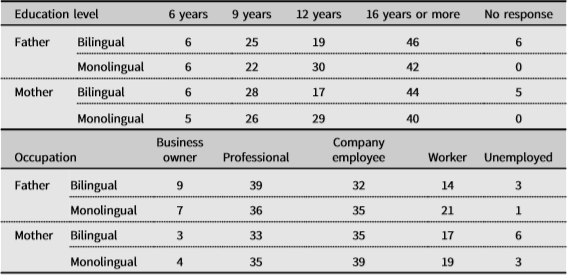
As Baker (Reference Baker2006) points out, it is necessary for comparative studies to match bilingual and monolingual samples on sociocultural class, gender, age, and school type attended. To ensure their comparability, several measures were taken to select the two subsamples for this study. First, only children who spoke Mandarin but no other Chinese dialects were selected for the monolingual subsample because children speaking two different dialects are bilingual rather than monolingual. Second, given the influence of socioeconomic backgrounds on children’s literacy development (Curdt-Christiansen, Reference Curdt-Christiansen2007; Ren & Hu, Reference Ren and Hu2013), only those monolingual children whose demographic backgrounds were similar to those of the bilingual subsample were contacted. The parental education levels and occupations by language group are summarized in Table 1, and chi-square tests did not identify significant between-subsamples differences (ps = .55–.84).
Parents’ education levels (years of education) and occupations by language group (%)

Measures
Phonological awareness
The elision subtest of the Comprehensive Test of Phonological Processing (Wagner, Torgesen, & Rashotte, Reference Wagner, Torgesen and Rashotte1999) was used to measure the bilingual children’s English PA. The test included 20 items that assessed whether a child was able to say a word and then say what was left after removing designated sounds. A syllable deletion and onset deletion test developed by McBride-Chang et al. (Reference McBride-Chang, Cho, Liu, Wagner, Shu, Zhou and Muse2005) was adopted to assess Chinese PA. Modeled on the Comprehensive Test of Phonological Processing elision subtest, this 22-item test assessed whether a child could say a word in Chinese and then say what was left after leaving out designated sounds. For both PA tests, 2 trial items and corrective feedback were provided, and the tests were stopped when a child made three consecutive mistakes.
Morphological awareness
Two MA tasks were adapted from Ku and Anderson (Reference Ku and Anderson2003): a Discriminate Morphemes task and a Select Interpretations task. The former was a 20-item odd-man-out test assessing whether a child understood that a shared component of complex words may have different meanings. The latter consisted of 16 items that assessed whether the children could draw on their morphological knowledge to select correct interpretations for low-frequency complex words consisting of high-frequency base words. Both tests consisted of derivatives and compounds. Both tasks had an English and a Chinese version and were designed for the age range of Grades 2 to 6. For each task, 2 trial items were given. To ensure that the children’s performance on these tasks would not be influenced by their word-reading ability, the test items were read aloud by the test administrators following Ku and Anderson (Reference Ku and Anderson2003). Composite scores were computed for the two tests in each language and used in the statistical analyses.
Syntactic awareness
SA was measured with English and Chinese tests we developed on the basis of an oral test used in Galambos and Goldin-Meadow (Reference Galambos and Goldin-Meadow1990) and a written test designed by Hu (Reference Hu2002). Each test consisted of 20 grammatically incorrect sentences. Upon reading each sentence, the children were required to complete three subtasks: a grammaticality judgment subtask that required them to judge whether the sentence was correct; an error correction subtask that required them to correct the sentence judged to be incorrect; and an error explanation subtask that asked them to state the syntactic rule violated by the error.
A maximum of 3 points were given for each sentence. One point was given when a sentence was judged to be wrong without correction or explanation; 2 points were awarded when a sentence judged to be wrong was corrected. A third point was added for a correct statement of the syntactic rule broken by the error. The corrections and explanations were further classified as grammar oriented and content oriented. The former covered corrections and explanations concerning grammatical structures erroneously used, and the latter consisted of corrections made to the content of the sentences. For example, the sentence “每天我起床六点半” (Every day I get up at six thirty) is erroneous in Chinese because the adverbial phrase of time “六点半” (at six thirty) is misplaced after the verb phrase. To gain 3 points for this item, a child would need to judge the sentence to be wrong, provide a grammar-oriented correction (i.e., put the adverbial phrase before the verb phase, as in “每天我六点半起床”), and explain that the adverbial phrase was misplaced. Content-oriented answers, such as “六点半起床会迟到” (Getting up at six thirty will make you late) or “六点半太早起不来” (Six thirty is too early for me to get up), did not receive any points. To prevent reading ability from influencing the performance on SA tasks, the test sentences were read aloud by the test administrators. Two trained raters scored all the items independently, and the interrater agreement was 94%.
Vocabulary
In view of the relationship between vocabulary knowledge and reading competence found in some of the studies reviewed earlier, the monolingual and bilingual children’s vocabulary knowledge was measured and analyzed as a control variable to better gauge the influence of PA, MA, and SA. The two parallel forms of Peabody Picture Vocabulary Test-4 (Dunn & Dunn, Reference Dunn and Dunn2007) were used to measure oral vocabulary. Age-appropriate items were chosen from Form A to assess English vocabulary, whereas equivalent items from Form B were translated into Chinese to measure Chinese vocabulary. To validate the translation, the translated Chinese words were back-translated to English by another bilingual graduate student. To ensure the appropriateness of the test items, two Primary 3 teachers of Chinese (one from China and one from Singapore) rated the items in terms of cultural relevance and content familiarity for each target subsample and only those items rated as relevant and familiar were included. When the vocabulary tests were administered, a word was read aloud twice and the children were asked to choose from a set of four color pictures the one that best described the word heard. Although the Peabody Picture Vocabulary Test-4 test manual expects the test to be conducted orally on a one-to-one basis, some studies (e.g., Wang et al., Reference Wang, Cheng and Chen2006; Wang, Ko, & Choi, Reference Wang, Ko and Choi2009) modified the test administration procedure and administered it to groups of children when their samples of participants were large. This study also adopted the modified procedure, whereby pictures were projected onto a screen and the participating children heard the words from a CD player and recorded their answers on the answer sheets provided.
Reading fluency
A reading fluency test was adapted from Wu et al. (Reference Wu, Anderson, Li, Shu, Jiang, Chen and Gaffney2009) to assess the participating children’s reading fluency. The children’s silent reading fluency rather than oral reading fluency was assessed because silent reading is the primary mode of reading for proficient readers (Hiebert & Reutzel, Reference Hiebert and Reutzel2010). The test had an English version and a Chinese version, and the two versions consisted of 89 and 90 obviously true or false short sentences, respectively, such as “Tigers like to eat grass.” All sentences were written in easy and familiar words. The children were instructed to read as many sentences as possible within 5 min and indicate whether the sentences were true or false. The test was designed in such a way that few if any children could finish reading all the sentences within the given time. Each child received a score representing the number of syllables (in the English version) or characters (in the Chinese version) found in the correctly identified sentences, and the score was averaged per minute. Two practice items were given to ensure the children’s comprehension of the test requirements.
Reading comprehension
English reading comprehension test was assessed with the 42-item reading comprehension subtest (the Group Form) of the Wide Range Achievement Text—Expanded Edition (Robertson, Reference Robertson2001), which is designed to be administered by classroom teachers to small groups of children in a classroom setting. The children were required to read passages and answer questions assessing both literal and inferential reading skills. The passages included textbook, recreational, and functional reading selections. The Chinese reading comprehension test, adapted from Wu et al. (Reference Wu, Anderson, Li, Shu, Jiang, Chen and Gaffney2009), was similar to the aforementioned English test in terms of test format and reading skills assessed. There were 22 questions based on four reading passages.
Nonverbal reasoning
The nonverbal reasoning subtest of Wide Range Achievement Text—Expanded Edition (Robertson, Reference Robertson2001) was administered to assess the participants’ reasoning ability and control for its potential influence on reading performance. The test was a 35-item odd-man-out task. Each item consisted of five symbols/figures, and the children were instructed to circle one symbol/figure that was different from the other four. The two subsamples took the same test, although that the instructions were translated into Chinese for the monolingual children.
Home language use survey
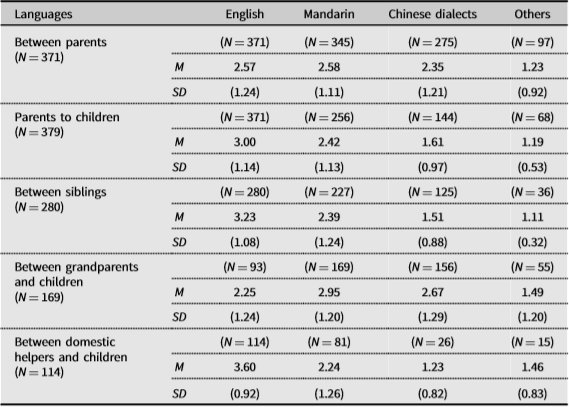
A demographic and home language use survey was completed by the parents of the bilingual children. They were asked to indicate what language or languages were used among family members (between parents, and between the child and other people in the family including parents, siblings, grandparents, and domestic helpers) and how often, on the scale of 1 to 4, with 1 being one-quarter of the time and 4 being all of the time. The languages included in the survey were English, Mandarin, Chinese dialects, and others. Table 2 summarizes the survey responses for the different languages/dialects used for communication between family members. It should be noted that the number of family members for each category may vary because not every family lived with all the family members listed in the table.
Language use between family members

As shown in Table 2, English was used more frequently than any other languages between parents and children, t (230) = 3.99 for Mandarin, t (100) = 7.83 for Chinese dialects, t (27) = 4.35 for others languages, ps < .001; between siblings, t (152) = 4.38 for Mandarin, t (61) = 6.71 for Chinese dialects, t (17) = 4.17 for others languages, ps < .001; and between domestic helpers and children, t (49) = 4.28 for Mandarin, t (34) = 5.13 for Chinese dialects, t (16) = 3.69 for others languages, ps < .001. An interesting pattern was that although parents used English and Mandarin equally frequent, t (306) = 0.49, p = .63, they used English to communicate with their children more frequently than Mandarin, t (230) = 3.99, p < .001. Only grandparents used Mandarin more frequently than any other languages when communicating with children, t (64) = 2.69 for English, t (97) = 2.65 for Chinese dialects, t (28) = 2.39 for others languages, p < .001. Others languages were used least often among family members. Taken together, the reported patterns of the bilingual children’s language use at home indicated that English was more frequently used among family members than Mandarin, although the latter also had considerable presence in the home domain. These patterns are consistent with the language shift observed in other studies (Curdt-Christiansen & Silver, Reference Curdt-Christiansen and Silver2013; Sun & Curdt-Christiansen, Reference Sun, Curdt-Christiansen, Lee and Ma2017).
An exploratory factor analysis was conducted on the survey responses, and three items, namely, frequency of English use between parents, between parents and children, and between siblings, were loaded on the same factor, which appeared to capture English use at home. The items were then entered as indicators into the SEM conducted to answer the third research question.
Procedure
For both subsamples, data were collected at the beginning of the second half of the academic year. After obtaining consent from parents of all participating children, the demographic and family language use survey was conducted with parents of the bilingual children. The battery of written tests was then administered in several sessions to whole groups of students in their classrooms, with each session lasting from 25 to 40 min. The oral tests each lasted 3 to 5 min and were conducted individually in a quiet school room by trained undergraduate students of psychology. To avoid interference with the normal curriculum time, the schools were consulted about the scheduling of the test administration.
Results
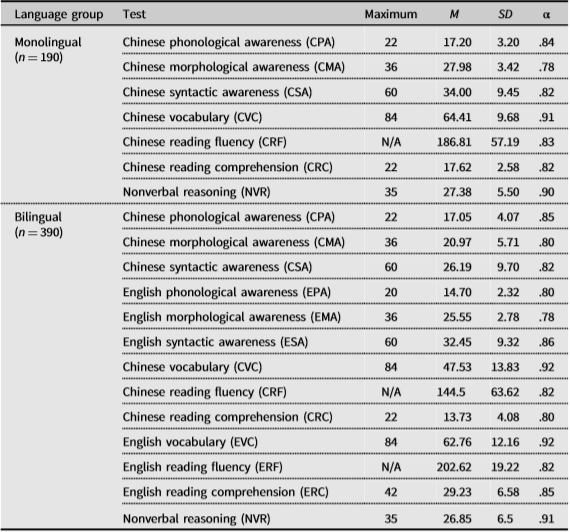
Data were screened for kurtosis and skew, and the scores were found to be normally distributed. Descriptive statistics (means and standard deviations) and reliability estimates are presented by subsamples in Table 3. As noted earlier, the Chinese and English reading fluency scores were based on the number of characters/syllables per minute in the correctly identified sentences.
Descriptive statistics and reliability estimates for all measures by language group

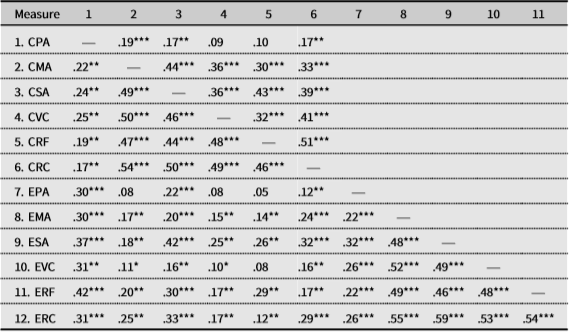
Table 4 presents the partial correlations among the measures by subsample that were obtained after controlling for nonverbal reasoning and age. For both subsamples, the partial correlations between the various components of metalinguistic awareness were significant (rs = .17–.49, ps < .01). The three components of metalinguistic awareness and the reading measures were also significantly correlated within each language (rs = .17–.59, p < .01) except for the correlation between Chinese PA and Chinese reading fluency (r = .10, p = .27) for the monolingual children.
Partial correlations controlling for nonverbal reasoning and age by language group

Note: Partial correlations for the monolingual participants (n = 190) are presented above the diagonal, and partial correlations for the bilingual participants (n = 390) are presented below the diagonal. CPA, Chinese PA. CMA, Chinese MA. CSA, Chinese SA. CVC, Chinese vocabulary. CRF, Chinese reading fluency. CRC, Chinese reading comprehension. EPA, English PA. EMA, English MA. ESA, English SA. EVC, English vocabulary. ERF, English reading fluency. ERC, English reading comprehension. *p < .05. **p < .01. ***p < .001.
Of note, the various components of metalinguistic awareness were significantly correlated cross-linguistically for the bilingual children (rs = .17–.42, ps < .01) except for that between Chinese MA and English PA (r = .08, p = .22). The correlation between English SA and Chinese SA was the strongest. In addition, all three components of Chinese metalinguistic awareness were significantly correlated with the English reading measures (rs = .20–.42, ps < .01) and viceversa (rs = .12–.32, ps < .01) except for that between English PA and Chinese reading fluency (r = .05, p = .19).
Contribution of metalinguistic awareness to reading comprehension
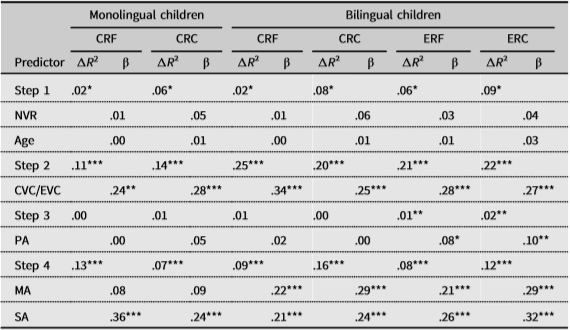
Hierarchical linear regressions were run to examine the relative within-language contributions of PA, MA, and SA to the reading measures for both groups of children. In each analysis, age and nonverbal reasoning were entered first as control variables. Oral vocabulary was then entered as another control variable in Step 2 to gauge its contribution to reading comprehension. As reviewed earlier, English MA may play an increasingly important role over PA for midgrade children (Kirby et al., Reference Kirby, Deacon, Bowers, Izenberg, Wade-Woolley and Parrila2012; Kuo & Anderson, Reference Kuo, Anderson, Koda and Zehler2008). In addition, due to the relatively simple phonological structure of Chinese, Chinese PA has been reported to play a less critical role than Chinese MA in learning to read Chinese. Hence, PA was entered in Step 3. MA and SA were then entered as a block in Step 3 to determine the unique variance accounted for by these two components of metalinguistic awareness after controlling for PA. Results are summarized in Table 5.
Hierarchical regression analyses predicting reading performance from PA, MA, and SA by language and group

Note: CVC, Chinese vocabulary. EVC, English vocabulary. CRF, Chinese reading fluency. CRC, Chinese reading comprehension. ERF, English reading fluency. ERC, English reading comprehension. *p < .05. **p < .01. *** p < .001.
Age and nonverbal reasoning were found to collectively explain significant amounts of variance in all the six regression analyses. Chinese/English vocabulary entered in Step 2 also accounted for significant proportions of variance (ΔR²s = .11–.25, βs = .24–.34, ps < .01). In Step 3, while English PA explained a small but significant amount of variance in English reading (ΔR² = .01, β = .10, p < .01 for English reading fluency; ΔR² = .02, β = .13, p < .01 for English reading comprehension), Chinese PA did not contribute significantly to the Chinese reading measures for either the monolingual or the bilingual children. When entered together in Step 4, Chinese MA and Chinese SA consistently accounted for significant amounts of variance in the Chinese reading measures for both subsamples (ΔR²s = .13 and .07, p < .001 for the monolingual group; ΔR²s = .09 and .16, p < .001 for the bilingual group). A similar pattern was found for English reading, with English MA and SA contributing unique variance to English reading fluency (ΔR² = .08, p < .001) and English reading comprehension (ΔR² = .12, p < .001). A close examination of the standardized regression coefficients revealed a difference between the two subsamples: MA (βs = .21–.29, ps < .001) and SA in both languages (βs = .21–.32, ps < .001) explained unique within-language variance in both reading measures for the bilingual children, but only SA (βs = .25 and .35, ps < .001) accounted for significant and unique amounts of variance for the monolingual children.
Cross-language relationships among metalinguistic awareness, reading comprehension, and home language use
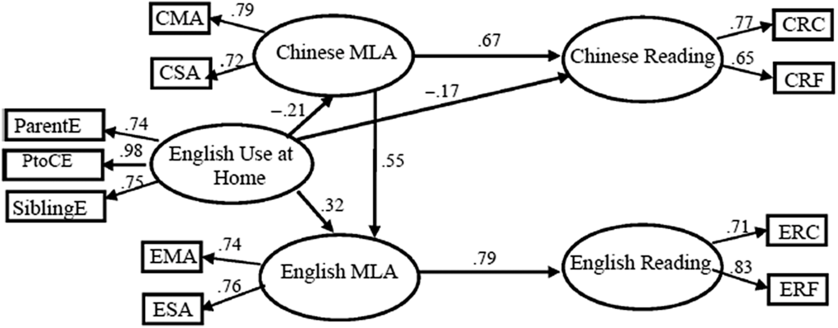
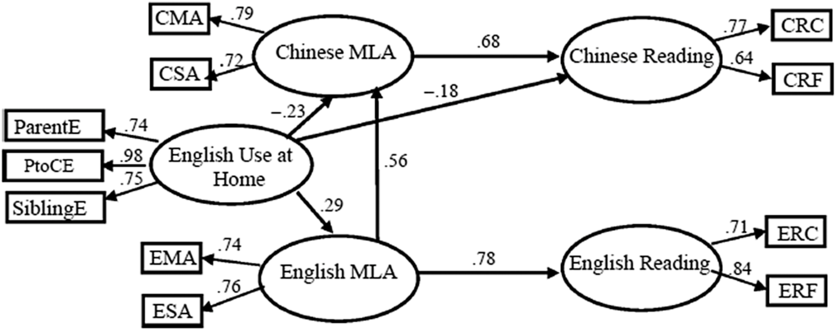
To investigate the cross-language relationships among the bilingual subsample’s English/Chinese metalinguistic awareness, English/Chinese reading, and home language use, we performed SEM using AMOS 25. Informed by Koda’s transfer facilitation model, we hypothesized that English and Chinese reading comprehension were related cross-linguistically via the transfer of metalinguistic awareness between the two languages. That is, Chinese metalinguistic awareness would not only predict reading comprehension in both languages but would also predict English metalinguistic awareness and viceversa. In consideration of the importance of home language use in children’s biliteracy development, the model also hypothesized that home language use would predict metalinguistic awareness and reading comprehension in English and Chinese. Two theoretical models were constructed and submitted to analysis. Each model consisted of five latent variables: (a) Chinese metalinguistic awareness with three indicators (Chinese PA, Chinese MA, and Chinese SA), (b) English metalinguistic awareness with three indicators (English PA, English MA, and English SA), (c) Chinese reading with two indicators (Chinese reading fluency and Chinese reading comprehension), (d) English reading with two indicators (English reading fluency and English reading comprehension), and (e) English use at home with three indicators (i.e., English use at home between parents, parents and children, and between siblings). In both models, within- and cross-language paths were drawn between metalinguistic awareness and reading. English use at home was connected with the metalinguistic awareness of both languages, English and Chinese vocabulary, and reading in both languages by single-headed arrows. The only difference between the two models was that a path was drawn from Chinese metalinguistic awareness to English metalinguistic awareness in the first model and from English metalinguistic awareness to Chinese metalinguistic awareness in the second model to examine the cross-language relations of the metalinguistic awareness of the two languages.
The models were evaluated and three paths were found to produce nonsignificant results and therefore were removed from the models: the path between Chinese metalinguistic awareness and English reading, the path between English metalinguistic awareness and Chinese reading, and the path between English use at home and English reading. The models were evaluated again, and multiple indices showed marginal support, with χ²/df = 2.42, root mean square error of approximation (RMSEA) = .08, confirmatory fit index (CFI) = .93, Tucker–Lewis index (TLI) = .90 for the first model; and χ²/df = 2.43, RMSEA = .08, CFI = .93, TLI = .90 for the second model. A closer examination of the significant loadings for all indicators on their respective constructs revealed that the loadings for Chinese PA and English PA were only .37 and .35, respectively, while the loadings for the remaining indicators were between .65 and .83. According to Hair, Tatham, Anderson, and Black (Reference Hair, Tatham, Anderson and Black2006), .40 is the cutoff value for sample sizes that are larger than 300. Moreover, in consideration of the less critical role of PA in reading development reviewed in previous research and reported in the earlier regression analyses, English PA and Chinese PA were removed from the model. The revised models were evaluated, and the obtained indices indicated excellent model fit: χ²/df = 1.33, RMSEA = .03, CFI = .99, TLI = .98 for the first model; and χ²/df = 1.35, RMSEA = .03, CFI = .99, TLI = .98 for the second model. Figures 1 and 2 present the final models, and all the path coefficients and factor loadings being significant.Footnote 1
Final structural equation model representing intra- and cross-linguistic relationships (from Chinese to English) among metalinguistic awareness, reading performance, and English use at home in the bilingual children. CMA, Chinese MA. CSA, Chinese SA. Chinese MLA, Chinese metalinguistic awareness. CRC, Chinese reading comprehension. CRF, Chinese reading fluency. ParentE, English use between parents. PtoCE, English use between parents and child. SiblingE, English use between siblings. EMA, English MA. ESA, English SA. English MLA, English metalinguistic awareness. ERC, English reading comprehension. ERF, English reading fluency.

Final structural equation model representing intra- and cross-linguistic relationships (from English to Chinese) among metalinguistic awareness, reading performance, and English use at home in the bilingual children. CMA, Chinese MA. CSA, Chinese SA. Chinese MLA, Chinese metalinguistic awareness. CRC, Chinese reading comprehension. CRF, Chinese reading fluency. ParentE, English use between parents. PtoCE, English use between parents and child. SiblingE, English use between siblings. EMA, English MA. ESA, English SA. English MLA, English metalinguistic awareness. ERC, English reading comprehension. ERF, English reading fluency.

The figures clearly show that the paths between Chinese and English metalinguistic awareness were statistically significant (Figure 1: β = 0.65, p < .001; Figure 2: β = 0.66, p < .001), indicating that the bilingual children’s metalinguistic awareness of the two languages were interrelated rather than independent. There was an indirect English metalinguistic awareness effect on Chinese reading comprehension through Chinese metalinguistic awareness (with a standardized indirect coefficient of .38, p < .01, at β = 0.52, p < .001).Footnote 2 Similarly, Chinese metalinguistic awareness did not directly predict English reading comprehension cross-linguistically but had an indirect effect via English metalinguistic awareness (standardized indirect coefficient = .40, p < .01, at β = 0.56, p < .001). In addition, English use at home had a positive direct effect on English metalinguistic awareness and a positive indirect effect on English reading comprehension (Figure 1: standardized indirect coefficients = .25, p < .01, at β = 0.28, p < .01; Figure 2, standardized indirect coefficients = .23, p < .01, at β = 0.28, p < .01). Surprisingly, English use at home negatively and directly predicted not only Chinese metalinguistic awareness but also Chinese reading comprehension. Last but not least, English use at home had an indirect negative contribution to Chinese reading comprehension (Figure 1: standardized indirect coefficients = –.14, p < .01, at β = 0.18, p < .05; Figure 2, standardized indirect coefficients = –.16, p < .01, at β = 0.19, p < .05).
Discussion
Within-language relationships between metalinguistic awareness and reading comprehension
By examining the three components of metalinguistic awareness together with both monolingual and bilingual children, the results obtained in this study provide a more complete picture of the relationships between metalinguistic awareness and reading comprehension in different languages and different language learners. The hierarchical regression results indicated that PA, MA, and SA were differentially involved in reading comprehension across languages and language learners.
The regression results concerning PA suggest that its relationship with reading comprehension may vary across languages. Due to differences in linguistic features of English and Chinese, Chinese PA did not contribute unique variance to reading fluency or reading comprehension for either the monolingual or the bilingual children. In contrast, English PA consistently explained small but significant amounts of variance in the English reading measures. When considered together with similar results obtained from previous research involving monolingual Chinese-speaking children (Li et al., Reference Li, Anderson, Nagy, Zhang, Li, Gaffney and Packard2002; Wu et al., Reference Wu, Anderson, Li, Shu, Jiang, Chen and Gaffney2009; Xue et al., Reference Xue, Shu, Li, Li and Tian2013) and bilingual Chinese–English children in Hong Kong (McBride-Chang et al., Reference McBride-Chang, Cho, Liu, Wagner, Shu, Zhou and Muse2005), considerable empirical evidence shows that Chinese PA may be less involved (compared with MA and SA) in Primary 3 children’s reading in Chinese, regardless of whether they are monolingual and bilingual. Such an interpretation, however, requires additional future research for verification because only syllable and onset deletion tasks were used in the present study.
It is important to note in this connection that although English PA was significantly associated with English reading performance, the proportions of variance explained by it were much smaller than those accounted for by English MA and SA. One possible explanation may be the children’s developmental stage. As some researchers (Carlisle, Reference Carlisle2003; Kuo & Anderson, Reference Kuo and Anderson2006) have pointed out, when English-speaking monolingual children move beyond the first few years of formal education, most of them have achieved an adequate level of phonological analysis. Thus, PA’s role in reading comprehension is diminishing while MA and SA continue to develop to support the process of understanding written words and texts (Carlisle, Reference Carlisle2003; Kirby et al., Reference Kirby, Deacon, Bowers, Izenberg, Wade-Woolley and Parrila2012). Hence, the bilingual children participating in this study were likely going through a similar stage at which the different components of English metalinguistic awareness were reorganizing their roles in the children’s acquisition of English literacy.
Second, our results highlight the critical yet intriguing role of MA in reading development. Both English MA and Chinese MA explained substantial amounts of variance in the bilingual children’s reading fluency and reading comprehension when vocabulary knowledge was controlled for. These findings corroborated results reported in several earlier studies (e.g., Kieffer & Lesaux, Reference Kieffer and Lesaux2012; Ku & Anderson, Reference Ku and Anderson2003; Nagy et al., Reference Nagy, Berningger, Abbott, Vaughan and Vermeulen2003). Ku and Anderson (Reference Ku and Anderson2003) proposed that knowledge about words and word formation rules (i.e., MA) could assist children in learning new words across contexts. That is, morphological insights into new words may assist children in deciphering their meanings based on the morphological clues provided contextually. Thus, MA may influence reading performance directly as evidenced in the results of our study.
An unexpected finding of this study, however, is that MA was not found to be related to reading fluency or reading comprehension for the monolingual children despite the prominence of morphemes in the Chinese writing system. One plausible explanation concerns the number of characters that the children participating in our and other studies had mastered by Primary 3. Of the 2,500 most commonly used Chinese characters, the Taiwanese children in Ku and Anderson (Reference Ku and Anderson2003) were expected to master 1,600 (Taiwan Ministry of Education, 2003) and the Primary 3 Singaporean bilingual children in our study were expected to learn 1,300 (Singaporean Ministry of Education, 2007). In contrast, according to the Chinese Language Syllabus (P. R. Chinese Ministry of Education, 2001), the monolingual children in our study were supposed to learn all the 2,500 characters. As these monolingual children had learned the meanings of most characters, they were unlikely to come across multiple new characters in the reading tests and thus have to draw on morphological clues to arrive at their meanings, which may help explain why MA failed to explain additional variance in the reading measures beyond vocabulary in this study. Together, these findings point to a new hypothesis: once basic character-reading skills are mastered, Chinese MA will cease to make a unique contribution to reading comprehension. As our study was not a longitudinal one, we were unable to test the hypothesis by determining whether a similar pattern would be found once the bilingual children learned a similar number of Chinese characters. Moreover, incorporating different MA and reading tasks will also help to verify the present findings. Thus, future studies need to include different measures and children at different developmental stages to test the hypothesis.
Third, this study revealed the robust role of SA in learning to read. For both the bilingual and the monolingual children, SA significantly predicted reading performance over and above vocabulary, PA and MA (for monolingual children). According to Rego and Bryant (Reference Rego and Bryant1993), knowledge of the constraints of sentential relationships can provide sufficient information for unfamiliar words to be decoded successfully and children with good SA are more likely to benefit from contextual support. As learners progress, decoding words alone is not sufficient for comprehension (Cain, Reference Cain2007). To comprehend a text in meaningful units, learners need to organize the text into higher order syntactic groupings, which requires attention to the syntactic structures of the sentences. Thus, SA can contribute to reading comprehension by means of contextual facilitation. The present study adds to the existing literature by showing that insight into syntactic structures was closely associated with reading development in Primary 3 monolingual Chinese-speaking children and bilingual children who were learning English and Chinese concurrently.
Cross-language relationships between metalinguistic awareness and reading comprehension
Results from the SEM provide strong evidence for a robust cross-language relationship between metalinguistic awareness and reading performance in the two languages. That is, the bilingual children’s English and Chinese metalinguistic awareness were inherently related and supported reading comprehension in both languages. Of note, metalinguistic awareness did not directly influence reading cross-linguistically, and the cross-language effect of Chinese metalinguistic awareness on reading in English was mediated by English metalinguistic awareness and viceversa. These observed cross-language relationships lend strong support to Koda’s transfer facilitation model (Reference Koda2005, Reference Koda, Koda and Zehler2008), which posits that metalinguistic awareness in bilingual children’s two languages are transferable and together provide the cognitive foundation for literacy development.
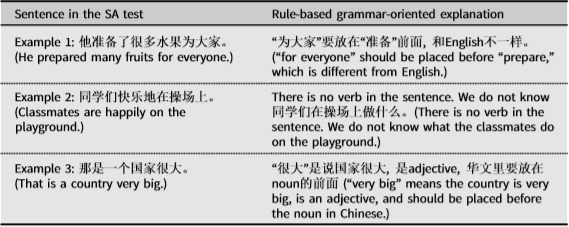
Part of the evidence for this interpretation can be found in the bilingual children’s performance on the Chinese error explanation subtask. Although the bilingual children did not differ from their monolingual peers in the number of correct explanations provided, there was a notable qualitative difference in the explanations produced by the two groups. As explicit grammar teaching starts in Primary 4 for children in China (P. R. Chinese Ministry of Education, 2001), the monolingual children tended to pinpoint an error without specifying its nature. By contrast, approximately 80% of the explanations produced by the bilingual children were rule based and explicitly mentioned the rules that were violated. It should be noted that Chinese grammar teaching is not specified in either the syllabus or the textbooks followed in Singaporean primary schools (Liu & Goh, Reference Liu and Goh2006), and it was unlikely for the bilingual children in our study to have been taught the grammar rules formally. When the explanations were further analyzed, two distinctive features surfaced. First, when explaining errors in the Chinese test sentences, the bilingual children not only stated the rules that were violated but also tended to make cross-language comparisons (see Table 6 for examples). Such comparisons suggested that with exposure to the two languages, the Singaporean bilingual children were able to conduct syntactic analyses of structural features that the monolingual children might have simply taken for granted. For instance, prepositional phrases are normally placed after verbs in English but before verbs in Chinese. In explaining why the first sentence in Table 6 was wrong, the bilingual child identified the misplaced prepositional phrase and related the error to English by highlighting that “(it) is different from English.” Evidently, the child understood that prepositional phrases as structural constituents can be positioned differently in different languages.
Examples of error explanations provided by bilingual children

The second distinct feature of the explanations given by the bilingual children is that most of the metalingual terms used were English ones (e.g., noun, adjective, and adverb), though they were free to explain in either language. This feature can be attributed to the type of English language instruction that Singaporean children typically receive: the English instruction at lower primary grades emphasizes the centrality of explicit form-focused language teaching and introduces metalingual terms, including part of speech, tense, subject, object, phrase, clause, simple sentence, compound sentence, and complex sentence, as learning points for lower primary grades (Singaporean Ministry of Education, 2010). Thus, when asked to undertake the error explanation subtask that required analytic reflection on the underlying syntactic patterns and properties of Chinese, the bilingual children would naturally draw on what they had learned in their English lessons to explain the errors in Chinese sentences in the absence of explicit Chinese grammar teaching. This tendency is consistent with the transfer facilitation model, which postulates that linguistic knowledge of a language made explicit through syntactic analysis is represented in an abstract and general form that facilitates the acquisition of another language. Such knowledge, especially when coded in metalingual terms, has greater explanatory precision, helps children link up newly encountered structures with language knowledge already acquired, and can serve as an anchoring site for the assimilation of new knowledge (Hu, Reference Hu2011).
Another important finding of the present study is the impact of home language use on the bilingual children’s biliteracy development. The SEM results suggested that metalinguistic awareness could be fostered by both formal language instruction and everyday interactions at home. English use at home was found to be positively related to the bilingual children’s English metalinguistic awareness, which supported the previously advanced view that metalinguistic awareness is not the sole product of formal schooling but can also develop as a result of language exposure (Carlisle, Reference Carlisle2003; Nagy & Anderson, Reference Nagy, Anderson, Wagner, Venezy and Street1998). Given the inverse relationship between the use of English and Chinese at home, less exposure to Chinese (i.e., greater use of English at home) was also found to be negatively related to these children’s Chinese metalinguistic awareness and Chinese reading comprehension. These results were consistent with the findings of earlier research (e.g., Cummins, Reference Cummins2000; Sun et al., Reference Sun, Hu and Curdt-Christiansen2018) that children’s metalinguistic and literacy development tends to be inhibited by home environments that lack extensive and quality oral communication. Moreover, according to Seymour’s (Reference Seymour, Joshi and Aaron2006) dual foundation framework of literacy acquisition, limitations in the quality of implicit representations may very likely constrain the capacity to form explicit metalinguistic representations of orthographic structures. This would in turn restrict the developing interaction between the linguistic and orthographic systems and delay literacy development. Taken together, our findings concerning language use at home indicate that while the continual use of English in social interactions in the multilingual context of Singapore contributes to bilingual children’s literacy development in English, the dominance of English as the home language of communication in ethnic Chinese families may disadvantage their children in their development of reading competence in Chinese. While the preponderant presence of English at home was found in this study to facilitate Chinese metalinguistic awareness via its positive impact on English metalinguistic awareness, it remains an empirical question whether the balanced use of two languages at home would lead to larger aggregate gains in metalinguistic awareness of both languages compared with the dominant use of one language at home.
Conclusion
This study has yielded empirical results in support of Seymour’s dual foundation framework of literacy acquisition by demonstrating that the importance of the different components of metalinguistic awareness in supporting reading comprehension varies as a function of the orthographic features of the languages involved, stage of the children’s development, and characteristics of the language learning environments in question. Furthermore, our study has contributed to the existing cross-language research on literacy development by providing empirical evidence of robust cross-language relationships between metalinguistic awareness and reading performance in bilingual children. Finally, our study has also yielded new insights into the multiple and complex routes by which home language can influence the development of metalinguistic awareness and biscriptal reading.
There are several pedagogical and policy implications from the findings of this study. First, in view of the present finding that home language use plays an important role in the development of children’s MLA, promoting the use of Chinese in the home domain at the policy level is recommended to ensure individual bilingualism. Language use patterns in the home domain are profoundly influenced by the national language policy in Singapore (Curdt-Christiansen & Silver, Reference Curdt-Christiansen and Silver2013). While the current bilingual policy gives equal official status to English and Chinese, English is established as the language that provides social and economic advantages for Singapore and represents the lingua franca across communities, whereas Chinese is assigned a role as the repository of tradition and culture (Curdt-Christiansen, Reference Curdt-Christiansen2016; Curdt-Christiansen & Sun, Reference Curdt-Christiansen and Sun2016). Such a separation of the functions of English and Chinese has generated very different attitudes toward these two languages, which has led to a tendency for English to take over the functions of Chinese in the home domain. To change parental attitudes toward Chinese and increase Chinese language use at home, status planning for the Chinese language at the policy level needs to be focused on prestige promotion to make Chinese a functioning language.
Second, in light of the consistent relationship between metalinguistic awareness and reading performance, children with limited metalinguistic awareness are vulnerable in their acquisition of academic/cognitive proficiency; consequently, to provide explicit and systematic instruction with a view to enhancing metalinguistic awareness would be a useful strategy to facilitate reading development. In Singapore, for example, where Chinese language instruction mainly focuses on learning to pronounce and write Chinese characters correctly, the incorporation of morphological instruction into the curriculum could guide English–Chinese bilingual children to analyze and understand the morphological structure of Chinese words so that they can apply their morphological insights to new words encountered (Singaporean Ministry of Education, 2007; Sun & Curdt-Christiansen, Reference Sun, Curdt-Christiansen, Lee and Ma2017). Because of the traditional belief that mastering basic word-reading skills and the most commonly used 2,500 characters is a prerequisite for reading in Chinese, children, teachers, and parents alike put a premium on such rote learning and often regard it as a formidable task (Li & Rao, Reference Li and Rao2000). The findings of this study suggest that the task can be made less daunting if teachers make deliberate efforts to help their students acquire insights into the morphological structures of the Chinese characters they are learning.
Third, the consistently strong relationships between Chinese SA and Chinese reading comprehension found in this study for both the bilingual and the monolingual children point to the potential value of providing early form-focused Chinese instruction to enhance Chinese SA. For bilingual children in Singapore, although simultaneous exposure to two languages helps them notice certain cross-language structural similarities and differences, explicit Chinese grammar instruction can build on their experience to further expand the scope and depth of their Chinese SA. Currently, children in China start to receive explicit grammar teaching only from Primary 4 onward (P. R. Chinese Ministry of Education, 2001). The findings from this study suggest that there is good reason to introduce grammar teaching earlier, such as in Primary 3, especially when SA has been shown to be the only significant predictor of reading measures.
Fourth and finally, the interconnections between metalinguistic awareness of two languages found in this study suggest a need to reconsider separating English and Chinese language instruction as is the case in Singapore. Following traditional instructional practices, English is taught with little reference to Chinese and viceversa. However, the enhanced SA of the bilingual children, which is evidenced in the cross-language comparisons and the bilingual children’s ability to explain Chinese syntactic errors and interpreted in light of Koda’s (Reference Koda2005) postulate about the representational nature of metalinguistic knowledge, suggests that bilingual instructional strategies focusing on phonological, morphological, and syntactical analyses that explicitly draw on cross-language comparisons is likely to give rise to more abstract and generalizable representations of metalinguistic knowledge. For instance, when teaching prepositional phrases in one language, teachers may highlight how prepositional phrases are used in the other language to draw children’s attention to the similarities/differences between the two languages and facilitate language transfer. For this reason, it is worth identifying and exploring the pedagogical activities and practices that can effectively support children’s deliberate efforts to form explicit hypotheses about language and test/revise these hypotheses with linguistic data from two or more languages.
Although the findings of the present study expand our understanding of the role of metalinguistic awareness in reading development, several limitations need to be noted and addressed in future research. First, due to its correlational nature, the empirical results obtained in this study do not warrant firm causal relationships between metalinguistic awareness and reading comprehension. Such relationships can best be established in rigorous experimental research that adequately controls for extraneous variables. Second, although the findings of the present study suggest that the contributions of the different components of metalinguistic awareness to reading development vary in response to learners’ developmental changes, longitudinal research that tracks children (both monolingual and bilingual) through multiple developmental stages is better equipped to capture the dynamic changing relationships between metalinguistic and reading development. Third and finally, given the important role of home language use in metalinguistic and literacy development, further research may employ more fine-grained operationalizations to differentiate language practices at home and map out how different practices shape the various components of metalinguistic awareness and, by extension, literacy development in one or more languages.
Acknowledgments
Part of the data drawn on in this study came from a research project supported by the Education Research Funding Programme (Grant no. OER35/09XLC), National Institute of Education, Nanyang Technological University, Singapore. The views expressed in this paper are the authors’ and do not necessarily represent the views of National Institute of Education. The authors wish to express their gratitude to the participating schools, teachers, and students.