Introduction
Induction chemotherapy is increasingly used for locally advanced unresectable head and neck squamous cell carcinoma, although it does not appear to prolong survival prior to chemoradiotherapy.Reference Cohen, Karrison, Kocherginsky, Mueller, Egan and Huang 1 – Reference Hitt, Grau, López-Pousa, Berrocal, Garcia-Giron and Irigoyen 3 The response rate to docetaxel, cisplatin and 5-fluorouracil (5-FU) induction chemotherapy is high, ranging from 65 per cent to 80 per cent.Reference Cohen, Karrison, Kocherginsky, Mueller, Egan and Huang 1 , Reference Hitt, Grau, López-Pousa, Berrocal, Garcia-Giron and Irigoyen 3 – Reference Posner, Hershock, Blajman, Mickiewicz, Winquist and Gorbounova 5 This should logically lead to improved efficacy and a possible survival benefit, especially for patients with advanced disease, i.e. those with tumour–node–metastasis stage ≥ N2c and N3 tumours, who have a poor prognosis.Reference Brockstein, Haraf, Rademaker, Kies, Stenson and Rosen 6 However, docetaxel, cisplatin and 5-FU induction chemotherapy results in significant morbidity (severe leukopenia, 41.6 per cent; ≥ grade 3 neutropenia, 83 per cent; febrile neutropenia and neutropenic infection, 9.6 per cent; ≥ grade 3 non-hematologic toxicity, 65 per cent) and mortality (2.3 per cent), which may offset any survival advantage it may have.Reference Vermorken, Remenar, van Herpen, Gorlia, Mesia and Desgardin 4 , Reference Posner, Hershock, Blajman, Mickiewicz, Winquist and Gorbounova 5
Initially, combination chemotherapy regimens for head and neck cancer consisted of platinum drugs and 5-FU. Newer regimens built on this backbone by adding a taxane. The three-drug regimens incorporating taxanes (predominantly docetaxel, cisplatin and 5-FU) are superior to the two-drug cisplatin and 5-FU combination.Reference Hitt, Grau, López-Pousa, Berrocal, Garcia-Giron and Irigoyen 3 – Reference Posner, Hershock, Blajman, Mickiewicz, Winquist and Gorbounova 5 Although both taxane and cisplatin undoubtedly add to the regimen's efficacy, it is unclear whether 5-FU is actually necessary for optimal efficacy. However, it is certain that infusional 5-FU adds to the toxicity (especially causing mucositis, diarrhoea and myelosuppression), in addition to making the regimen logistically challenging in busy centres. It is possible that 5-FU removal may decrease the overall toxicity while maintaining efficacy. Therefore, this pilot study aimed to assess the response rate to a docetaxel and cisplatin induction regimen in patients with locally advanced, unresectable squamous cell carcinoma of the head and neck to provide rapid clinical information to help in planning further definitive studies.
Materials and methods
Study design
This multicenter, non-randomised, non-controlled, open-label pilot study evaluated the efficacy and safety of Docetaxel and cisplatin as Induction chemotherapy in patients with unREsectable locally advanced head and neck squamous cell Carcinoma of the head and neck (‘DIRECT’ study). The trial was approved by the Drugs Controller General (India) and was registered with the Clinical Trials Registry of India (number CTRI/2015/08/006080). As this was a pilot study, a formal sample size was not calculated. It was initially decided to recruit 40 patients for the pilot study within a period of approximately three months. The study was opened in seven centres in India: the Tata Memorial Hospital and Jaslok Hospital in Mumbai, the All India Institute of Medical Sciences, the Artemis Hospital in Delhi, the Apollo Hospital in Chennai, the HealthCare Global Hospital in Bangalore and the B.P. Poddar Hospital and Medical Research Ltd in Kolkata. Approval was obtained from the institutional ethics committee of each centre and all patients provided written informed consent. All procedures complied with the relevant national and institutional guidelines on human experimentation (Indian Council of Medical Research) and with the Helsinki Declaration of 1975, as revised in 2008. Data collation and management were conducted by an external clinical research organisation.
Patient recruitment
The study included patients aged 18–65 years with histologically confirmed unresectable locally advanced stage III or IV squamous cell carcinoma of the oral cavity, oropharynx, larynx or hypopharynx, and no evidence of distant metastases. Decisions on organ preservation were made by the head and neck oncology multidisciplinary disease management group tumour board after clinical and radiological assessment. For inclusion, patients had to be treatment naïve (i.e. had not undergone prior chemotherapy, radiation or surgery), have an Eastern Cooperative Oncology Group performance status of 0 or 1, and adequate bone marrow function (absolute neutrophil count ≥ 1500/μl, platelet count ≥ 100 000/μl and haemoglobin level ≥ 10 g/dl), renal function (serum creatinine level ≤ 1.4 mg/dl and creatinine clearance rate ≥ 60 ml/minute, as calculated using the Cockcroft–Gault formulaReference Cockcroft and Gault 7 ) and hepatic function (bilirubin level ≤ the upper limit of normal, serum glutamic oxaloacetic transaminase and serum glutamic pyruvic transaminase levels ≤ 2.5 times the upper limit of normal, and alkaline phosphatase levels ≤ 5 times the upper limit of normal). Patients with peripheral neuropathy or severe illness, including unstable ischaemic heart disease, a history of myocardial infarction in the six months preceding enrolment, significant neurological or psychiatric disease, or active peptic ulcer disease were excluded. Other exclusion criteria were concomitant corticosteroid treatment (except as a pre-medication), the presence of another type of malignancy and severe weight loss (>20 per cent of body weight) in the three months preceding enrolment.
Initial investigation and enrolment
Screening evaluations took place between seven and one days before enrolment. These included a medical history; a medical examination, including weight and height measurement, performance status, neurological examination, recording vital signs (temperature, blood pressure, heart rate), an oral and dental evaluation (general examination and dental X-ray); and laboratory tests, including haematological tests (complete blood cell count, coagulation parameters such as activated partial thromboplastin time and international normalised ratio), biochemical tests (including levels of sodium, potassium, magnesium, bicarbonate, phosphate, calcium, blood urea nitrogen, creatinine, uric acid, glucose, lactate dehydrogenase, serum glutamic oxaloacetic transaminase, serum glutamic pyruvic transaminase, alkaline phosphatase, direct and total bilirubin, and a pregnancy test for women of childbearing age); and a radiological examination (a magnetic resonance imaging (MRI) or contrast enhanced computed tomography (CT) scanning of the head and neck). In addition, CT and/or MRI of the chest, abdomen and/or pelvis and a bone scan were performed if there was any suspicion of distant metastases. If the serum creatinine level was more than 1.5 times the upper limit of normal, the creatinine clearance rate was calculated using the Cockcroft–Gault formula according to age.Reference Cockcroft and Gault 7 Low values required the glomerular filtration rate to be measured by isotope scanning.
Treatment
Docetaxel and cisplatin induction chemotherapy
Patients received a 1-hour intravenous (IV) infusion of 75 mg/m2 docetaxel followed by a 30-minute IV infusion of 75 mg/m2 cisplatin, with pre-medication comprising twice daily 8 mg oral dexamethasone for three days (starting one day prior to docetaxel infusion), 20 mg IV dexamethasone, and the standard IV dose of ondansetron or granisetron. Cisplatin was diluted in normal saline, and patients received pre-treatment and post-treatment saline hydration. Oral medication for delayed emesis comprised either 8 mg ondansetron 3 times per day for 2 days or 0.5 mg/kg metoclopramide 4 times per day for 2 days, starting 16 hours after cisplatin infusion. A twice daily prophylactic dose of 500 mg oral ciprofloxacin was started on day 5 of each cycle, and continued for 10 days. Three chemotherapy cycles were started at 21-day intervals, provided the blood counts were acceptable (i.e. absolute neutrophil count ≥ 1500/μl, platelet count ≥ 100 000/μl). If the patient developed febrile neutropenia following docetaxel and cisplatin induction chemotherapy, subsequent cycles were administered at the full dose with growth factor support providing the febrile neutropenia episode was not associated with septicaemia or a life-threatening infection and the previous chemotherapy cycle was not associated with dose-limiting toxicity (other than febrile neutropenia). When growth factors were administered, they were started at least 24 hours after chemotherapy and continued until the absolute neutrophil count was at least 10 000/μl.
Docetaxel and cisplatin induction chemotherapy: patient evaluation
Prior to each docetaxel and cisplatin chemotherapy cycle, patients were examined: special attention was paid to weight and height measurements, performance status, neurological findings, vital signs, and electrocardiogram (ECG) findings (if medically indicated), evaluation of adverse and serious adverse events, haematology findings (complete blood cell count and coagulation parameters) and biochemistry findings (serum levels of bicarbonate, calcium, sodium, magnesium, phosphate, potassium, alkaline phosphatase, blood urea nitrogen, glucose, lactate dehydrogenase, glutamic oxaloacetic transaminase, glutamic pyruvic transaminase, total bilirubin with direct and indirect bilirubin, and uric acid). If the serum creatinine level was more than 1.5 times the upper limit of normal, then the creatinine clearance rate and, if necessary, glomerular filtration rate were measured as described above.
Chemoradiotherapy
Intravenous cisplatin at 30 mg/m2 was started concomitant with conventional radiotherapy (RT) to the primary tumour and neck, and continued weekly during the RT course. Cisplatin was administered for as long as the absolute neutrophil count was at least 750/μl and the platelet count was at least 75 000/μl.
Radiotherapy treatment planning
Planning target volumes of the primary tumour, lymph node metastases, lymph nodes at risk of metastatic disease, critical organs and major salivary glands were outlined in the planning CT scan. Conformal and/or intensity-modulated RT were used: the dosage for gross disease (primary and neck) was 66–70 Gy in 30–35 fractions, and for subclinical disease 54–60 Gy in 30 fractions. An optional boost of 4–6 Gy in two to three fractions to the gross tumour planning target volume was permitted at the discretion of the radiation oncologist.
Disease assessment
Disease assessment following docetaxel and cisplatin induction chemotherapy
After completion of induction chemotherapy, patients were assessed on day 21 ± 5 by taking a medical history. Patient-reported symptom relief was measured on a scale of 0–100 per cent, in which the initial symptom score was 100 per cent and the patient subjectively quantified the degree of symptom relief. Patients then underwent a clinical examination to assess weight and height, performance status, neurological findings, vital signs, and ECG findings (if medically indicated). Laboratory testing included routine haematological and biochemical tests. A radiological assessment was done within seven days prior to the start of chemoradiotherapy, using the same imaging technique used in the initial assessment.
Disease assessment during and after chemoradiotherapy
During chemoradiotherapy, patients were evaluated weekly. Before treatment, patients underwent a clinical examination (weight and height, performance status, neurological findings, vital signs, and ECG findings (if medically indicated)), toxicity assessment, oral and dental evaluation (general examination, dental X-ray), and routine haematological and biochemical tests. Repeat imaging was performed to assess the response at 8–10 weeks after completion of chemoradiotherapy.
Endpoints
The primary endpoint was the response rate (for a complete or partial response) of patients with locally advanced unresectable head and neck cancer to docetaxel and cisplatin induction chemotherapy. The response rate was calculated according to the new Response Evaluation Criteria In Solid Tumours (i.e. the revised ‘RECIST’, version 1.1).Reference Eisenhauer, Therasse, Bogaerts, Schwartz, Sargent and Ford 8 Secondary endpoints were the safety and tolerability of the docetaxel and cisplatin induction regimen followed by chemoradiotherapy, assessed using the Common Terminology Criteria for Adverse Events (‘CTCAE’) version 4.0. 9
Statistical analysis
Patient data were analysed on an intention-to-treat basis in an exploratory manner using IBM SPSS Statistics software version 17.0 (Chicago, Illinois, USA). Baseline patient characteristics (age, sex and medical history) and laboratory variables (blood counts; levels of serum bilirubin, serum glutamic oxaloacetic transaminase, serum glutamic pyruvic transaminase and serum creatinine; creatinine clearance rate, chest X-ray, CT scanning, and response rate) were analysed. The number (n), mean, standard deviation, and minimum and maximum values were calculated for continuous variables; the frequency and percentage were calculated for categorical variables. The proportion of patients who achieved a complete or partial response was reported as the response rate. Survival analysis was performed using the Kaplan–Meier method.
Definitions of endpoints
Progression-free survival was calculated as the time from enrolment to progression, recurrence or death (regardless of the cause of death). Overall survival was calculated as the time from enrolment until death from any cause. Locoregional control was considered to be achieved if a patient showed a complete response either during treatment or thereafter with no salvage surgery or if a patient who underwent salvage surgery was found to have a pathological complete response.
Results
Patient characteristics
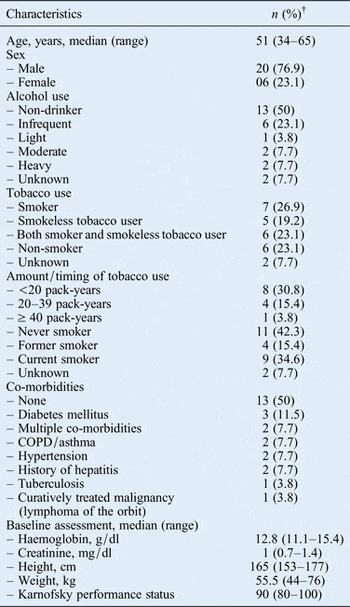
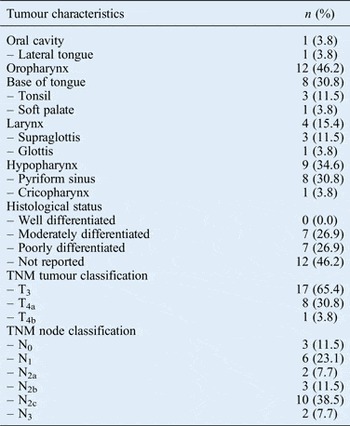
Between March and December 2011, 38 patients were evaluated for the study: of these, 1 refused to participate because of logistical difficulties and 11 were ineligible owing to no measurable lesion on the baseline CT scan (4 patients), abnormal baseline blood test values (3 had raised creatinine clearance rates and 3 had raised liver function test findings) or age over 65 years (1 patient). A total of 26 patients were enrolled from 3 centres: the study was stopped prematurely by the sponsor owing to the slower than expected accrual. Baseline patient and tumour characteristics are shown in Tables I and II.
Baseline patient characteristics*

* N = 26. †Except where otherwise indicated. COPD = Chronic obstructive pulmonary disease
Baseline tumour characteristics*

TNM = tumour–node–metastasis
Docetaxel and cisplatin induction chemotherapy
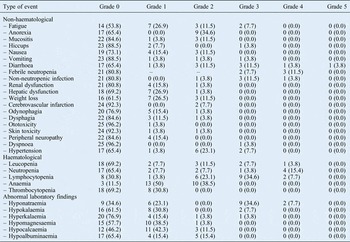
In all, 23 of the 26 patients received all 3 docetaxel and cisplatin chemotherapy cycles. The reasons for prematurely stopping chemotherapy were toxicity after cycle one (acute renal failure and acute exacerbation of chronic obstructive pulmonary disease; one patient), progressive disease after two cycles (one patient) and death due to diarrhoea after one cycle (one patient). Nineteen patients received growth factor (granulocyte-colony stimulating factor) during docetaxel and cisplatin induction chemotherapy: 14 (53.8 per cent) from the start and 5 (19.2 per cent) as secondary prophylaxis. Owing to toxicity, three patients (11.5 per cent) required dose delay, nine (34.6 per cent) required a dose reduction for both docetaxel and cisplatin and one (3.8 per cent) required a dose reduction for cisplatin only. For one patient, carboplatin was substituted for cisplatin after the first cycle because of cisplatin-induced renal dysfunction and hyponatraemia. The adverse events for docetaxel and cisplatin chemotherapy are shown in Table III.
Adverse events regardless of relationship to DC induction chemotherapy*†

Data are n (%). *N = 26. †Grade 0 = no toxicity; grade 1 = mild toxicity; grade 2 = moderate toxicity; grade 3 = severe toxicity; grade 4 = life-threatening toxicity; grade 5 = death. DC = docetaxel and cisplatin; – = grades 1 and 2 febrile neutropenia
Efficacy of docetaxel and cisplatin induction chemotherapy
Subjective responses to docetaxel and cisplatin chemotherapy were recorded: 15 patients (57.7 per cent) reported 75–100 per cent symptom relief, 6 (23.1 per cent) reported 50–75 per cent symptom relief, 2 (7.7 per cent) reported 25–49 per cent symptom relief and 1 (3.8 per cent) reported worsening symptoms. The subjective response of two patients was not documented. The objective response to docetaxel and cisplatin chemotherapy was 65.4 per cent (complete response, 1 patient; partial response, 16 patients). Six patients (23.1 per cent) had stable disease, one (3.8 per cent) had progressive disease, one had disease that was not evaluable by Response Evaluation Criteria In Solid Tumours and one died after one cycle of induction chemotherapy. The clinical response to induction chemotherapy was assessed in 16 patients using a combination of clinical examination and Hopkin's endoscopic evaluation, with biopsy of the suspicious area when clinically indicated. Clinical response evaluation showed a complete response in four patients, a near-complete response in one, a partial response in seven, stable disease in three and progressive disease in one.
Final therapy received
Of the 25 patients who completed induction chemotherapy, 23 (88.5 per cent) received chemoradiotherapy following docetaxel and cisplatin induction chemotherapy; 1 patient defaulted after induction chemotherapy and the only patient with progressive disease received supportive care.
Details of chemoradiotherapy
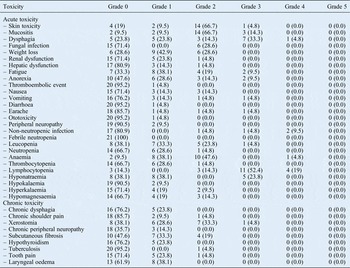
The median RT dose was 70 Gy (range 45–70 Gy) delivered in a median of 35 fractions over a median of 51 days. The concurrent systemic chemotherapy regimen was a weekly dose of 30 mg/m2 cisplatin (median, 6 cycles; range, 1–8 cycles) for 22 patients and a weekly standard dose of nimotuzumab (200 mg; 6 cycles) for 1 patient. Thirteen patients underwent conventional or telecobalt RT, five underwent intensity-modulated RT and three underwent three-dimensional conformal RT (RT details were unavailable for two patients). No patient required a dose reduction during concurrent chemotherapy, seven required dose delay due to toxicity, two had a break in RT due to toxicity and one required secondary growth factors. The reasons for chemotherapy dose delay were mucositis (two patients), renal dysfunction (two patients), skin toxicity (one patient), respiratory infection (one patient) and weakness (one patient). One patient required carboplatin to be substituted for cisplatin after cycle one because of nephrotoxicity. Seven patients required a feeding tube during chemoradiotherapy. Eighteen patients (69.2 per cent) completed the planned course of chemoradiotherapy, two (7.7 per cent) completed definitive RT but did not receive the planned course of concurrent chemotherapy and three (11.5 per cent) did not complete chemoradiotherapy. Toxicity details were available for 21 of the 23 patients (shown in Table IV). The overall response to chemoradiotherapy was 73.1 per cent (complete response, 16 patients (61.5 per cent); partial response, 3 patients (11.5 per cent)). Two patients had stable disease, one had progressive disease and one did not undergo radiological assessment after chemoradiotherapy.
Adverse events regardless of relationship to chemoradiotherapy*†

Data are n (%). *N = 21. †Grade 0 = not toxicity; grade 1 = mild toxicity; grade 2 = moderate toxicity; grade 3 = severe toxicity; grade 4 = life-threatening toxicity; grade 5 = death
Outcome
Locoregional control was attained for 18 patients (69.2 per cent). Of the eight patients with persistent disease following primary therapy, five underwent salvage surgery: four underwent radical neck dissection and one underwent base of tongue composite resection with type II modified neck dissection. Histopathology findings from salvage surgery revealed a pathological complete response in three patients and residual disease in one patient; one patient with unresectable disease underwent an R2 resection. Thus, four patients had persistent disease following primary therapy (three who did not undergo salvage surgery and one underwent R2 resection) and three had tumour recurrence. Thirteen of the 26 patients had laryngeal or hypopharyngeal primary tumours (the larynx was preserved in all). The 3-year larynx preservation rate was 11 out of 13 (85 per cent): of the remaining 2 patients, 1 died at 30 months from recurrent disease with an intact larynx and 1 was lost to follow up at 9 months with an intact larynx.
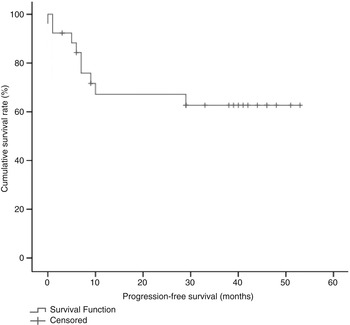
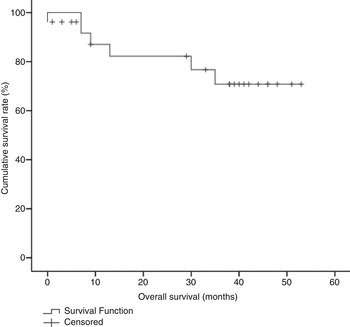
Analysis of the recurrence sites found persistent local disease in three patients (42.8 per cent), locoregional plus distant disease in two (28.6 per cent), and distant metastases in two (28.6 per cent). Sites of distant metastasis included the lungs (two patients) and multiple sites (one patient). Nine patients (34.6 per cent) experienced a progression-free survival event and six (23.1 per cent) died: four from disease, one from toxicity and one from an unknown cause. Therapies for disease progression included salvage surgery (two patients), palliative RT (one patient) and palliative chemotherapy (one patient). Currently, 15 patients (57.7 per cent) are alive without disease, 6 (23.1 per cent) are dead and 5 (19.2 per cent) are lost to follow up. At a median follow up of 44 months (range 1–53 months) for surviving patients, the 3-year progression-free survival rate was 62 per cent and the 3-year overall survival rate was 69 per cent (Figures 1 and 2; median follow up of 44 months).
Progression-free survival times of patients who received docetaxel and cisplatin induction chemotherapy for locally advanced unresectable head and neck squamous cell carcinoma. Nine of the 26 patients experienced a progression-free survival event, so it is not possible to calculate the median progression-free survival time.

Overall survival times in months of patients who received docetaxel and cisplatin induction chemotherapy for locally advanced unresectable head and neck squamous cell carcinoma. Six of the 26 patients died, so it was not possible to calculate the median overall survival time.

Discussion
This study investigated the efficacy and safety of docetaxel and cisplatin induction chemotherapy followed by definitive chemoradiotherapy for organ preservation. The radiological response rate to docetaxel and cisplatin chemotherapy was 65 per cent (complete response rate 3.8 per cent, partial response rate 61.5 per cent). The response rate increased after chemoradiotherapy to 73.1 per cent (complete response, 61.5 per cent; partial response, 11.5 per cent). In the TAX 323 study, the response rates were 68 per cent to docetaxel, cisplatin and 5-FU induction chemotherapy (complete response, 8.5 per cent; partial response, 59.3 per cent) and was 54 per cent to cisplatin plus 5-FU (complete response, 6.6 per cent; partial response, 47 per cent).Reference Vermorken, Remenar, van Herpen, Gorlia, Mesia and Desgardin 4 In the TAX 324 study, the response rate to docetaxel, cisplatin and 5-FU induction chemotherapy was 72 per cent (complete response, 17 per cent) and to cisplatin plus 5-FU was 63 per cent (complete response, 15 per cent).Reference Posner, Hershock, Blajman, Mickiewicz, Winquist and Gorbounova 5 In the Groupe d'Oncologie Radiothérapie Tête Et Cou (‘GORTEC’) study, the response rate to docetaxel, cisplatin and 5-FU induction chemotherapy was 80 per cent (complete response, 41.8 per cent; partial response, 38.2 per cent) and to cisplatin plus 5-FU was 59.2 per cent (complete response, 30.1 per cent; partial response, 29.1 per cent).Reference Pointreau, Garaud, Chapet, Sire, Tuchais and Tortochaux 10 In a Spanish phase II study, the response rate to docetaxel and cisplatin chemotherapy was 70 per cent (complete response, 26 per cent; partial response, 44 per cent).Reference Fonseca, Grau, Sastre, Garcia-Gomez, Rueda and Pastor 11 Thus, the response rate to docetaxel and cisplatin chemotherapy in patients in the present study was within the reported range, although the complete response rate was lower than previously reported. However, this may have been due to the small sample size and the fact that the presence of a residual radiological abnormality was considered persistent disease and not a complete response. We previously reported the difficulty of assessing the response rate of head and neck cancer and possible fallacies.Reference Patil, Noronha, Joshi, Muddu Krishna, Juvekar and Pantvaidya 12 A better way to report response rates for head and neck tumours may be to use a composite system that takes into account the radiological response as well as the response assessed by clinical examination, laryngoscopy and biopsy (when necessary). In the present study, 16 patients underwent clinical evaluation: the response rate of 75 per cent (complete response, 25 per cent; near-complete response, 6.3 per cent; and partial response, 43.8 per cent) compares favourably with previous reports.
Although the best-established method for organ preservation is concurrent chemoradiotherapy, induction chemotherapy followed by definitive RT is also a reasonable option.Reference Corry, Peters, Kleid and Rischin 13 , 14 In the Groupe d'Oncologie Radiothérapie Tête Et Cou study of 2000–2001, Pointreau et al. demonstrated that induction chemotherapy followed by RT with or without concurrent chemotherapy led to a three-year larynx preservation rate of 70.3 per cent, compared with 57.4 per cent after cisplatin plus 5-FU induction chemotherapy followed by RT.Reference Pointreau, Garaud, Chapet, Sire, Tuchais and Tortochaux 10 Other trials that evaluated this approach using cisplatin plus 5-FU as the induction chemotherapy regimen reported a three-year larynx preservation rate of 42 per cent.Reference Richard, Sancho-Garnier, Pessey, Luboinski, Lefebvre and Dehesdin 15 , Reference Lefebvre, Chevalier, Luboinski, Kirkpatrick, Collette and Sahmoud 16 The two-year larynx preservation rate after definitive chemoradiotherapy has ranged from 70 per cent to 88 per cent.Reference Pfister, Laurie, Weinstein, Mendenhall and Adelstein 17 In the present study, docetaxel and cisplatin induction chemotherapy followed by definitive RT with concurrent weekly cisplatin chemotherapy had encouraging results, including a three-year larynx preservation rate of 85 per cent.
In this study, 92 per cent of patients completed docetaxel and cisplatin induction chemotherapy: 88.5 per cent received docetaxel and cisplatin chemotherapy on time and one patient (3.8 per cent) died from acute chemotherapy toxicity. In the TAX 323 study, 75.7 per cent of patients on docetaxel, cisplatin and 5-FU induction chemotherapy and 65.7 per cent on cisplatin plus 5-FU completed the protocol-defined chemotherapy. In the Groupe d'Oncologie Radiothérapie Tête Et Cou study, 3 out of the 110 patients (2.7 per cent) on docetaxel, cisplatin and 5-FU induction chemotherapy died from acute chemotherapy toxicity,Reference Pointreau, Garaud, Chapet, Sire, Tuchais and Tortochaux 10 while in the TAX 323 study, 2.3 per cent of patients who underwent docetaxel, cisplatin and 5-FU induction chemotherapy and 5.5 per cent of those on cisplatin plus 5-FU chemotherapy died from toxicity.Reference Vermorken, Remenar, van Herpen, Gorlia, Mesia and Desgardin 4 In the TAX 324 study, 29 per cent of patients on docetaxel, cisplatin and 5-FU induction chemotherapy and 65 per cent of those on cisplatin plus 5-FU induction chemotherapy had dose delays.Reference Posner, Hershock, Blajman, Mickiewicz, Winquist and Gorbounova 5 An important finding of the present study is that most patients received docetaxel and cisplatin induction chemotherapy on schedule (i.e. without a dose delay) without an excessive increase in morbidity.
There is concern regarding the tolerability of full-dose concurrent chemoradiotherapy following induction chemotherapy, especially when cisplatin is used as the concurrent chemotherapy. In the Groupe d'Oncologie Radiothérapie Tête Et Cou trial, only 16–20 per cent of patients received concurrent chemoradiotherapy following induction chemotherapy; the remainder received definitive RT.Reference Pointreau, Garaud, Chapet, Sire, Tuchais and Tortochaux 10 In the Groupe d'Etude des Tumeurs de la Tête et du Cou (‘GETTEC’), European Organisation for Research and Treatment of Cancer (‘EORTC’) hypopharyngeal study and the Intergroup Radiation Therapy Oncology Group (‘RTOG’) 91–11 study, induction chemotherapy (cisplatin plus 5-FU) was followed by RT alone.Reference Richard, Sancho-Garnier, Pessey, Luboinski, Lefebvre and Dehesdin 15 , Reference Lefebvre, Chevalier, Luboinski, Kirkpatrick, Collette and Sahmoud 16 , Reference Forastiere, Goepfert, Maor, Pajak, Weber and Morrison 18 In the TAX 323 study, patients received up to four cycles of induction chemotherapy comprising docetaxel, cisplatin and 5-FU or cisplatin plus 5-FU followed by RT alone, while in the TAX 324 study, patients received three cycles of docetaxel, cisplatin and 5-FU induction chemotherapy or cisplatin plus 5-FU followed by RT with concurrent weekly carboplatin at a dose determined using the Calvert formulaReference Calvert, Newell, Gumbrell, O'Reilly, Burnell and Boxall 19 (with an area under the curve of 1.5).Reference Vermorken, Remenar, van Herpen, Gorlia, Mesia and Desgardin 4 , Reference Posner, Hershock, Blajman, Mickiewicz, Winquist and Gorbounova 5 The present study found that after an induction chemotherapy regimen of docetaxel and cisplatin, 69 per cent of patients could receive full-dose weekly cisplatin-based chemoradiotherapy and an additional 8 per cent could receive full-dose RT with suboptimal concurrent platinum chemotherapy. Thus, modifying the induction regimen to remove 5-FU may help in delivering full-dose chemoradiotherapy, which is important for larynx preservation and overall outcome. Weekly cisplatin may be a viable concurrent chemotherapeutic option in this setting.
-
• Docetaxel, cisplatin and 5-fluorouracil induction chemotherapy is an efficacious regimen, but toxicity is associated with 5-fluorouracil
-
• Patients with unresectable locally advanced head and neck squamous cell carcinoma underwent docetaxel and cisplatin induction chemotherapy
-
• The overall response and post-chemoradiotherapy response rates were similar to those reported for docetaxel, cisplatin and 5-fluorouracil induction chemotherapy
-
• The 3-year progression-free survival and overall survival were comparable to those reported for docetaxel, cisplatin and 5-fluorouracil induction chemotherapy
-
• Docetaxel and cisplatin induction followed by definitive chemoradiotherapy had a three-year larynx preservation rate of 85 per cent
-
• Docetaxel and cisplatin has comparable efficacy to that historically reported for docetaxel, cisplatin and 5-fluorouracil induction chemotherapy
The three-year disease-free survival and overall survival rates for patients treated with docetaxel, cisplatin and 5-FU induction chemotherapy induction in the Groupe d'Oncologie Radiothérapie Tête Et Cou study were 58 per cent and 60 per cent, respectively.Reference Pointreau, Garaud, Chapet, Sire, Tuchais and Tortochaux 10 In the present study, the three-year progression-free survival and overall survival rates for patients treated with docetaxel and cisplatin chemotherapy were 62 per cent and 69 per cent, respectively. Clinical trials of definitive chemoradiotherapy for larynx preservation have reported similar outcomes: for example, two-year disease-free survival and overall survival rates in the Intergroup Radiation Therapy Oncology Group 91–11 study were 61 per cent and 74 per cent, respectively.Reference Forastiere, Goepfert, Maor, Pajak, Weber and Morrison 18 The different approaches to larynx preservation in various trials have led to similar survival outcomes; this appears to be the case even with an induction regimen lacking 5-FU.Reference Dandekar and D'Cruz 20
Conclusion
Docetaxel and cisplatin induction chemotherapy followed by concurrent chemoradiotherapy led to an overall response rate of 65 per cent (which increased to 73 per cent after chemoradiotherapy), a three-year larynx preservation rate of 85 per cent, and three-year progression-free survival and overall survival rates of 62 per cent and 69 per cent, respectively, with a manageable toxicity profile. The next step is to compare larynx preservation after docetaxel and cisplatin induction chemotherapy vs the current standard (docetaxel, cisplatin and 5-FU induction chemotherapy) and to compare the therapeutic strategy of docetaxel and cisplatin induction chemotherapy followed by concurrent cisplatin-based chemoradiotherapy vs chemoradiotherapy alone.
Acknowledgement
This study was funded by a research grant from Sanofi, India.