Introduction
Archaeologists have long researched trade and cultural contacts between Mesopotamia and Iran (Algaze Reference Algaze1989; Lukonin et. al Reference Lukonin, Sackler, Sackler and Curtis1993; Matthews and Fazeli Reference Matthews and Fazeli2004; Potts Reference Potts1993; Zadok Reference Zadok1976).Footnote 1 These contacts were established very early in history, and during the Chalcolithic period in Mesopotamia and Iran (c.6000–4000 b.c.e.) people established long distance trade networks. To date, scholars have largely focused on the analysis of economic interactions between lowland Mesopotamia and highland Iran. In the fourth millennium b.c.e., lowland Mesopotamia traded items such as animal domesticates and grains in return for metal ores or worked metal from highland Iran (Matthews and Fazeli Reference Matthews and Fazeli2004). Henrickson (Reference Henrickson1983; Reference Henrickson and Kingery1986) discusses the sixth- and fifth-millennium trade, through which the lowland Halaf culture, located in the Diyala River valley of Iraq, influenced the J-ware tradition of the Mahidasht valley in Iran. This contact was conducted over the Khorasan Road following the intermontane valleys and mountain passes of the Zagros range. Investigating overland routes linking northern Mesopotamia to the northwestern Iranian highlands represents a primary objective of the Rowanduz Archaeological Program (RAP) (Danti Reference Danti2014a; Reference Danti2014b; Zettler and Danti Reference Zettler and Danti2017a; Reference Zettler and Danti2017b; Reference Zettler and Danti2017c). This paper examines the Chalcolithic connections of these areas by comparing ceramic styles in order to understand larger contacts between Iraq and Iran.
Halaf Ware
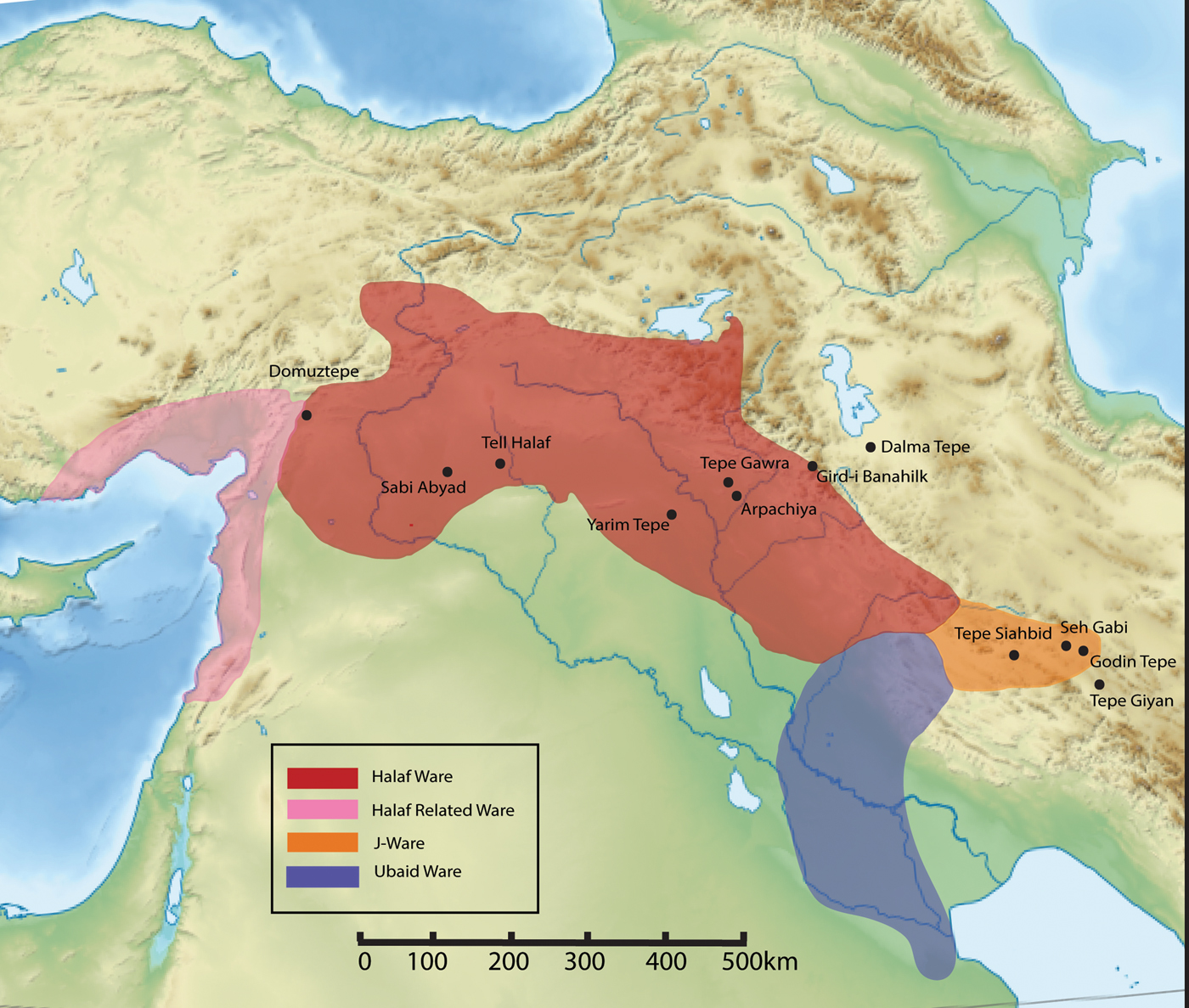
The Halaf Period, 5900–5300 b.c.e., is characterised archaeologically by a relatively homogenous cultural assemblage that developed from pre-existing local cultures located along the dryland farming areas of the Fertile Crescent (Akkermans Reference Akkermans1991; Reference Akkermans, Rouault and Wäfler2000; Reference Akkermans, Orthmann, Matthaie and al-Maqdissi2013; Reference Akkermans, van der Plicht, Akkermans, Brüning, Huigens and Nieuwenhuyse2014, Reference Akkermans, Orthmann, Matthaie and al-Maqdissi2013, Reference Akkermans, Rouault and Wäfler2000, Reference Akkermans1991; Campbell Reference Campbell2007; Spataro and Fletcher Reference Spataro and Fletcher2010). This culture/period/horizon is named for the type-site of Tell Halaf and, at its greatest extent, spread from the Mediterranean Sea to the Zagros Mountains (Fig. 1). Max von Oppenheim excavated Tell Halaf in 1911–1913 and again in 1927–1930 (Oppenheim Reference Oppenheim1943), providing the first archaeological definition and material diagnostics of the archaeological culture, including ceramics, bones, lithics, stone statues, terracotta figurines, sealings, and stamp seals (Campbell Reference Campbell2007). The next large excavation and seminal research on the Halaf occurred at Arpachiyah in the 1930s (Akkermans Reference Akkermans, Steiner and Killebrew2014; Campbell Reference Campbell2000; Hijara Reference Hijara1997; Mallowan and Cruickshank Rose Reference Mallowan and Rose1935). Other sites such as Tepe Gawra produced limited assemblages of Halaf material, but it was not until the 1970s that the excavations at Yarim Tepe in northern Iraq, Domuztepe in Turkey, and Sabi Abyad in Syria expanded the horizon from the Euphrates to the Zagros and into southeastern Turkey (Akkermans Reference Akkermans1991; Reference Akkermans, Rouault and Wäfler2000; Reference Akkermans, van der Plicht, Akkermans, Brüning, Huigens and Nieuwenhuyse2014; Campbell Reference Campbell2007; Spataro and Fletcher Reference Spataro and Fletcher2010). Gird-i Banahilk, in the Zagros Mountains, is located at the eastern edge of the Halaf cultural tradition (Braidwood and Howe Reference Braidwood and Howe1960; Braidwood et al. Reference Braidwood, Braidwood, Howe, Reed and Watson1983).
Map of the Halaf, early Ubaid culture, J-ware, and Halaf related cultures (authors’ modification of Becker Reference Becker2011; basemap Sémhur 2010)

The term Halaf denotes a ceramic tradition(s) or horizon(s) rather than a true period of time, since it spans different time ranges over different areas. The ceramics are handmade, thin walled, highly fired, and made of fine ferruginous clay. The vessel forms vary from round pots with large flaring necks to large deep bowls with angular profiles. The most diagnostic portions of these ceramics are the geometric and animal painted motifs. Most common are triangles, squares, checks, crosses, scallops, small circles, flowers, double axes, Maltese crosses, sitting birds, crouching gazelles, and even leaping leopards. Early Halaf ceramics typically have simple designs on vessel exteriors, usually in red or black. Later assemblages have more elaborate geometric designs in red and black on a white slip, and designs also occur on the interiors of bowls (Akkermans Reference Akkermans1991; Campbell Reference Campbell2007; Cruells and Nieuwenhuyse 2004). The pottery was fired in two-chamber kilns to increase temperatures in order to achieve an oxidising atmosphere, lending a slightly reddish color to the ceramics (Davidson and McKerral Reference Davidson and McKerrell1976, Reference Davidson and McKerrell1980; Cruells and Nieuwenhuyse 2004). Instrumental Neutron Activation Analyses (INAA) analyses have shown that vessels manufactured at regional centres were exported to peripheral sites. For instance, ceramics made at Tell Arpachiyah are found at Tell Brak (Davidson and McKerral Reference Davidson and McKerrell1976; Reference Davidson and McKerrell1980; Cruells and Nieuwenhuyse 2004). This is not to say local centres were not engaged in ceramic production; rather, assemblages at large sites were both locally made and traded over large distances. The potters were highly selective, and the fine ferruginous clays were often imported from distant sources (Davidson and McKerral Reference Davidson and McKerrell1980; Matson Reference Matson and Braidwood1983; Spataro and Fletcher Reference Spataro and Fletcher2010).
J-Ware
The Zagros Early Chalcolithic (5500–4700 b.c.e.) comprises diverse ceramic traditions, of which J-ware is but one. Henrickson (Reference Henrickson1983; Reference Henrickson and Kingery1986) and others (Hole 1987; Levine and McDonald Reference Levine and McDonald1977) have asserted it derived from the contemporary Halaf painted ware, though it is simpler both technologically and stylistically. J-ware has been found at approximately 70 sites in the Mahidasht valley system, in the Shahabad and Hulailan valleys, and in the foothills of the northern and central Zagros (Henrickson Reference Henrickson and Kingery1986).
The ceramics are thin and mainly handmade, with fine mineral inclusions and occasional fine-to-medium straw temper. Sherd cores are typically buff and usually completely oxidised. Some vessels may have been turned on a slow wheel, as indicated by striations on the inside of the sherds (Levine and McDonald Reference Levine and McDonald1977). There are three different types of surface treatment: 1) no treatment; 2) red-slipped, black-slipped, and burnished; and 3) slipped, burnished and painted (Henrickson Reference Henrickson1983; Levine and McDonald Reference Levine and McDonald1977). The paint is predominately red-brown, and sometimes black, grey, or white. Painted motifs imitate Halaf ceramics, and the most common motif is crosshatching in bands or triangles. Other motifs are cables, pendant rim loops, checkerboard designs, and sigmas; sometimes multiple motifs occur on one vessel. Open bowls were typically decorated with a series of narrow horizontal bands at the rim. The forms of the ceramics consist of constricted pots with everted rims, collared jars, bowls with slightly inverted rims, or rounded, pinched, or flattened rims (Henrickson Reference Henrickson1983; Reference Henrickson and Kingery1986). The J-ware comparanda at Banahilk includes crosshatched triangles and squares, as well as pendant rim loops (Fig. 4, nos. 1, 12, 15, 16). Slipped J-ware is unattested in the extant Banahilk assemblage (see below).
Gird-i Banahilk
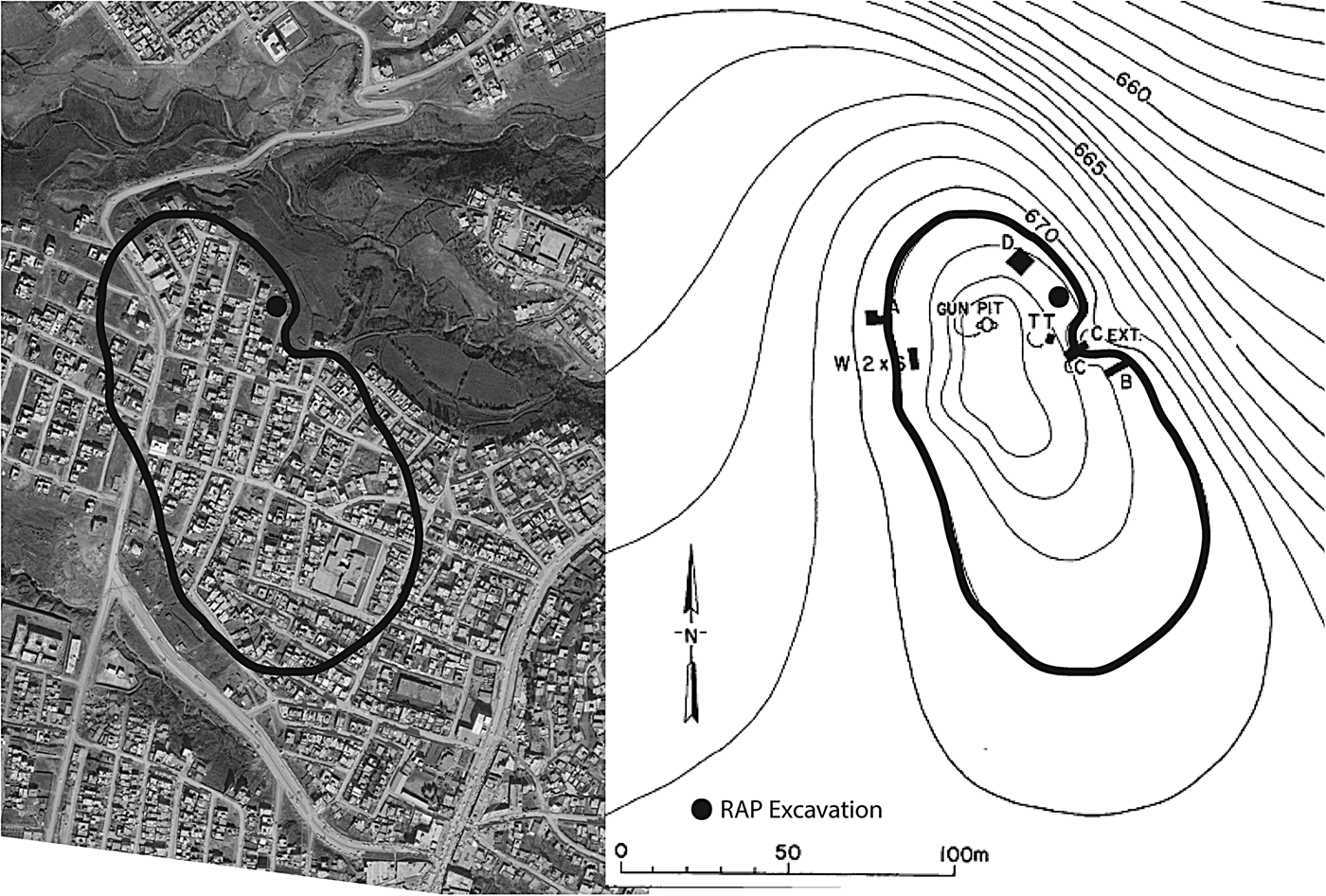
Gird-i Banahilk is a roughly oval mound of 100 × 160 metres, located on the outskirts of modern day Diyana in Iraqi Kurdistan. Patty Jo Watson first excavated Banahilk in 1954 on behalf of the Iraq-Jarmo project, then the Rowanduz Archaeological Project re-opened excavation in 2014. The assemblage mainly dates to the Halaf period, with subsequent Mitanni (second millennium b.c.e.), Ottoman (1500–1900 c.e.), and modern occupations. Since the first excavations residential development has significantly altered the site (Fig. 2; Braidwood and Howe Reference Braidwood and Howe1960; Danti Reference Danti2014a; Reference Danti2014b; Watson Reference Watson and Braidwood1983). As Watson (Reference Watson and Braidwood1983: 545) recalled:
Our reason for selecting Banahilk as one of the three soundings permitted the Iraq-Jarmo Project in 1954–55 was that it offered an excellent opportunity to recover and describe — at one site at least — the context of the well-known painted pottery first found at Tell Halaf early in this century. Hole, Flannery, and Neely (Reference Hole, Flannery and Neely1964, p.4) have remarked that in spite of 100 years of archaeological research in southwestern Asia, no one can say just what ‘Halaf,’ ‘Ubaid,’ ‘Giyan V A,’ and the like mean in terms of whole artefact assemblages representing extinct cultures.
Location of Watson and RAP's excavations on Banahilk, and the development that has covered the site since Watson's excavations (2017 DigitalGlobe; Watson Reference Watson and Braidwood1983: fig. 198)

Watson opened four major operations (A–D) and two minor ones (W, TT) to explore a Halafian community in an intermontane valley of the Zagros Mountains (Fig. 2; Braidwood and Howe Reference Braidwood and Howe1960; Watson Reference Watson and Braidwood1983). In just ten days of excavation, Watson uncovered diagnostic painted pottery, geometrically-incised stamp seals, and stone footings. She also documented a scattering of artefacts of the Middle Bronze Age, Early Iron Age, and Hellenistic periods in thin strata within the upper approximately ten centimetres of deposit (Braidwood and Howe Reference Braidwood and Howe1960; LeBlanc and Watson Reference LeBlanc and Watson1973; Watson Reference Watson and Braidwood1983). The later material resembles the main phases of occupation at Gird-i Dasht, located approximately 7 kilometres to the north (Danti Reference Danti2014a; Reference Danti2014b; Zettler and Danti Reference Zettler and Danti2017a; Reference Zettler and Danti2017b; Reference Zettler and Danti2017c). Radiocarbon dates from Watson's excavation place Banahilk between c.4900 and 4300 b.c.e. (Lawn Reference Lawn1973: 373). These were re-calibrated by Bernbeck (Reference Bernbeck1994) to c.5800–5100 b.c.e.
After Watson's excavations there were no systematic excavations at Banahilk until 2014. In the intervening 50 years, Banahilk withstood many changes. Residential development from Soran's Diyana neighbourhood spread onto the site. The top of the mound was levelled and soil was brought in from outlying areas to construct an irrigated garden. The construction of a road along the north edge of the mound also modified the landscape (Fig. 2). It is unclear how much of the site has been destroyed due to overlying development. Undisturbed archaeological deposits may be preserved under the houses, streets, sidewalks, and intentional fills used to terrace the hillside (Danti Reference Danti2014a; Reference Danti2014b; Zettler and Danti Reference Zettler and Danti2017a; Reference Zettler and Danti2017b; Reference Zettler and Danti2017c). Only the eastern portion of the site, an unused area overgrown by vegetation, remains relatively undisturbed.
The Rowanduz Archaeological Program (RAP) directed by Dr. Michael Danti had its inaugural season in the summer of 2013. During this season Mr. Abdulwahhab Suleiman, the Soran General-Director of Antiquities, asked RAP to survey Banahilk to assess the impact of recent on-site construction and to identify undisturbed archaeological deposits. These questions were further explored from 19 May to 3 June 2014, through the excavation of a 3 × 4 metre sounding on the northern edge of the modern occupation, adjacent to and parallel with a recently constructed cement block garden wall. Immediately north of the wall, the mound's uppermost deposit had been removed to level the area for house construction, creating an exposed section below the wall that revealed rich archaeological deposits (Danti Reference Danti2014b; Zettler and Danti Reference Zettler and Danti2017a). The preserved archaeological deposit proved to be approximately two metres deep with the lower approximately one and a half metres containing Halaf material, and the uppermost stratum (thirty centimetres) containing Early Iron Age deposits. The 2014 excavation revealed an area intermittently occupied over a long span of time near the edge of the Halaf settlement. The stratigraphy consisted of alternating layers of hard-packed use surfaces and trash deposits. The only extant feature was a small rectangular stone alignment associated with painted ceramics, plain ceramics, animal bones, and stone tools. The Early Iron Age material contained plain wares and a possible poorly preserved wall (locus 3, lot 1).
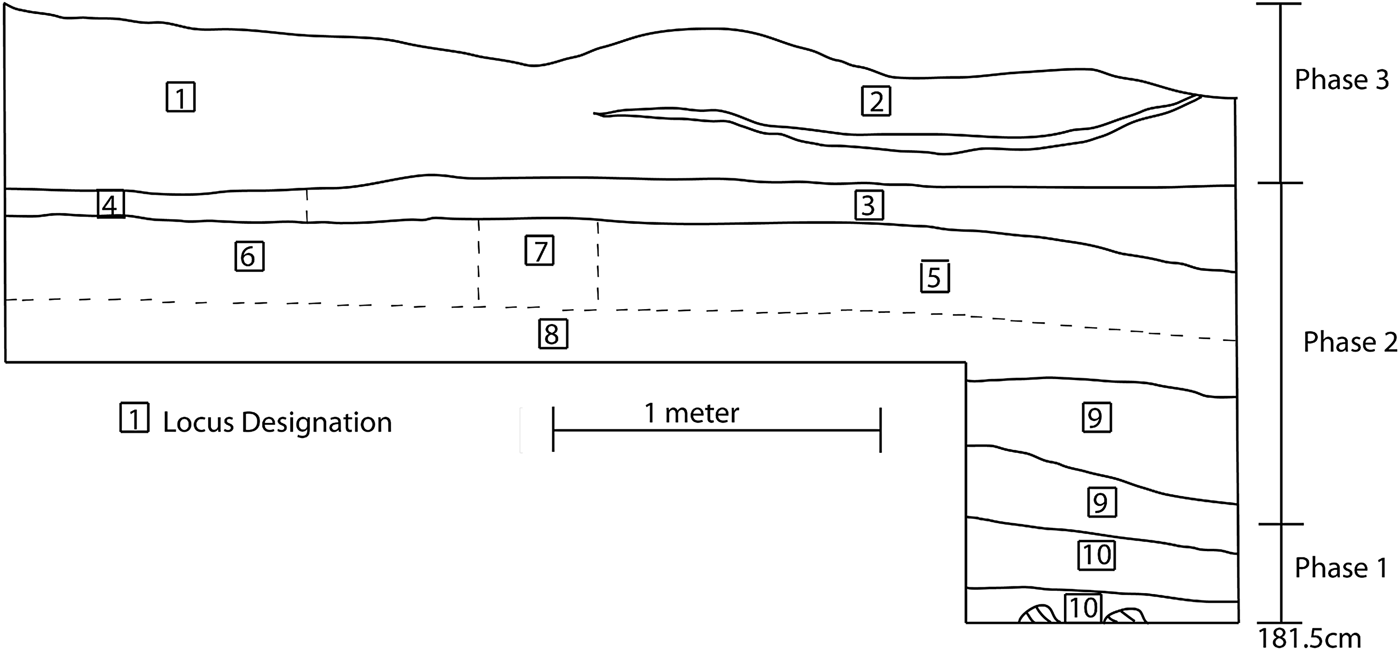
We have identified three phases of Halaf occupation at Banahilk based on the stratigraphic sequence (Fig. 3). The earliest phase, phase 1, comprises the deepest locus, number 10, lying directly above sterile soil—a layer of reddish compact clay. The artefact assemblage predominantly consists of Halaf sherds, with two Hassuna sherds, ground stone, chipped stone, and bone. Phase 2 encompasses loci 3–9, where the excavators recorded interspersed lenses of compact soil with alignments of artefacts, indicating ephemeral living surfaces. The artefactual assemblage consists of Halaf sherds with higher concentrations of lithics and bone than in the lower deposit. A fragmentary packed mud wall with stone footings was identified in this phase (locus 7), but did not connect to any baulk or other feature. Phase 3 represents topsoil, including locus 1 and 2 with a mix of Halaf material with Bronze and Iron Age surface scatter.
Stratigraphy of Banahilk, showing loci and phasing

Ceramic contacts
Banahilk ceramic assemblage
The RAP ceramic assemblage from Banahilk is relatively small in size, with material from both the fifth and fourth millennia, as well as the second and first millennia b.c.e. 2232 sherds were collected, 1911 of which were body sherds. 501 sherds (body and diagnostic) displayed some form of surface treatment: painted, burnished, or slipped. The remaining 321 sherds were diagnostics of formal attributes: rims, shoulders, lids, bases, and trays. Twenty-one sherds were not Halaf. Two were Hassuna, ten were second-millennium (Mitanni) and nine were Iron Age. The non-Halaf sherds reflect peak periods in regional occupation as attested at sites such as the nearby mound of Gird-i Dasht, which is characterised by substantial second-millennium and early Iron Age occupations (Danti Reference Danti2014a; Reference Danti2014b; Zettler and Danti Reference Zettler and Danti2017a; Reference Zettler and Danti2017b; Reference Zettler and Danti2017c). The presence of Hassuna sherds suggests the site may have been settled as early as the terminal Hassuna period; but this remains inconclusive.
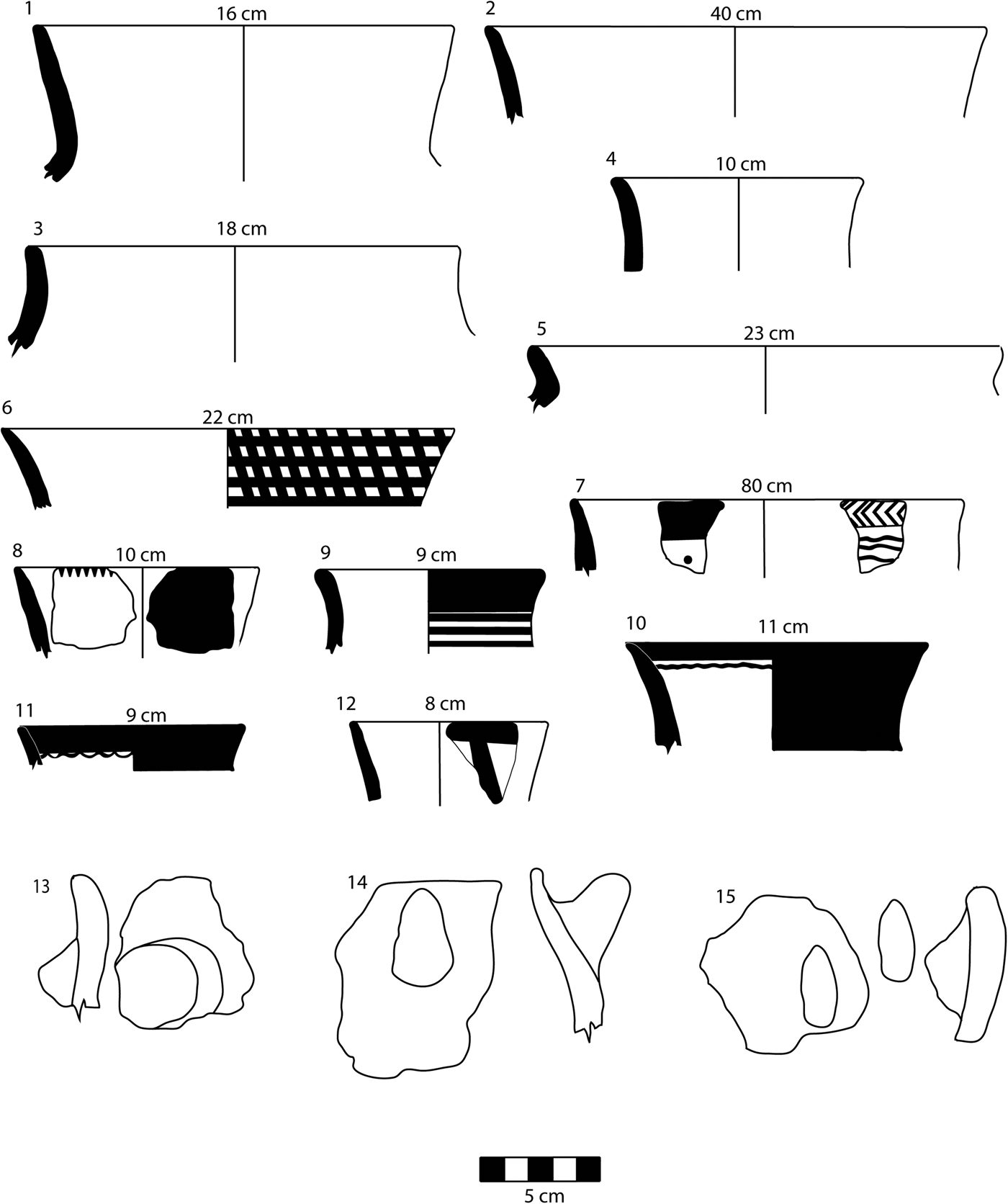
The results obtained from RAP's excavation at Banahilk largely matched Watson's analysis. The size of Watson's assemblage, 4992, was greater than that of the 2014 excavation, at 2232. The 2014 excavation did not recover all the vessel forms reported by Watson.Footnote 2 Highly fragmentary sherds are a particular problem for Halaf ceramics, as multiple vessel shapes exhibit the same rim type. For instance, flared rims are found on “cream bowls”, flared bowls, and flared jars (Mallowan and Cruickshank Rose Reference Mallowan and Rose1935: figs. 62, 69, and 54, no. 3 respectively). As most of the rim sherds from Banahilk were small, few could be assigned a vessel shape. However, from the lack of shoulder fragments and complex body profiles, we may surmise that many of these rims represent flared bowls rather than “cream bowls”, only two of which were also identified by Watson. Due to this ambiguity, the majority of painted vessels are categorised as ‘uncertain painted’ (n = 42; 27 per cent of total rims). This type is followed by round bowls (IA; n = 15; 10 per cent) and flared bowls (ID; n = 11; 7 per cent).Footnote 3 The only painted jars attested have vertical necks (IIIA, e.g., Fig. 5, no. 9; n = 7; 4 per cent). Only two types of painted bases were found: flat (11) and ring (2) bases. Therefore, we have identified a limited range of forms, though depositional activities may have biased this result.
Painted wares made up 22.4 per cent of the entire excavated assemblage. The majority of sherds were at least lightly burnished, though even painted sherds were not burnished to a high degree. All wares could be slipped, either with cream, red, or grey slips, as also noted by Watson (Reference Watson and Braidwood1983: 549). The types of decoration found include both painted and incised sherds, though very few of the latter were identified. Watson's description of the painted ceramics applies directly to our assemblage, though we identified previously unattested motifs (Watson Reference Watson and Braidwood1983: 549–50). Large sherds exhibited a range of paint colours, orange to dark brown, reflecting variable firing conditions within kilns and paint composition. We also noted a high degree of variability in decoration quality, with several poorly executed designs identified. Overall, decorated sherds were common across loci.
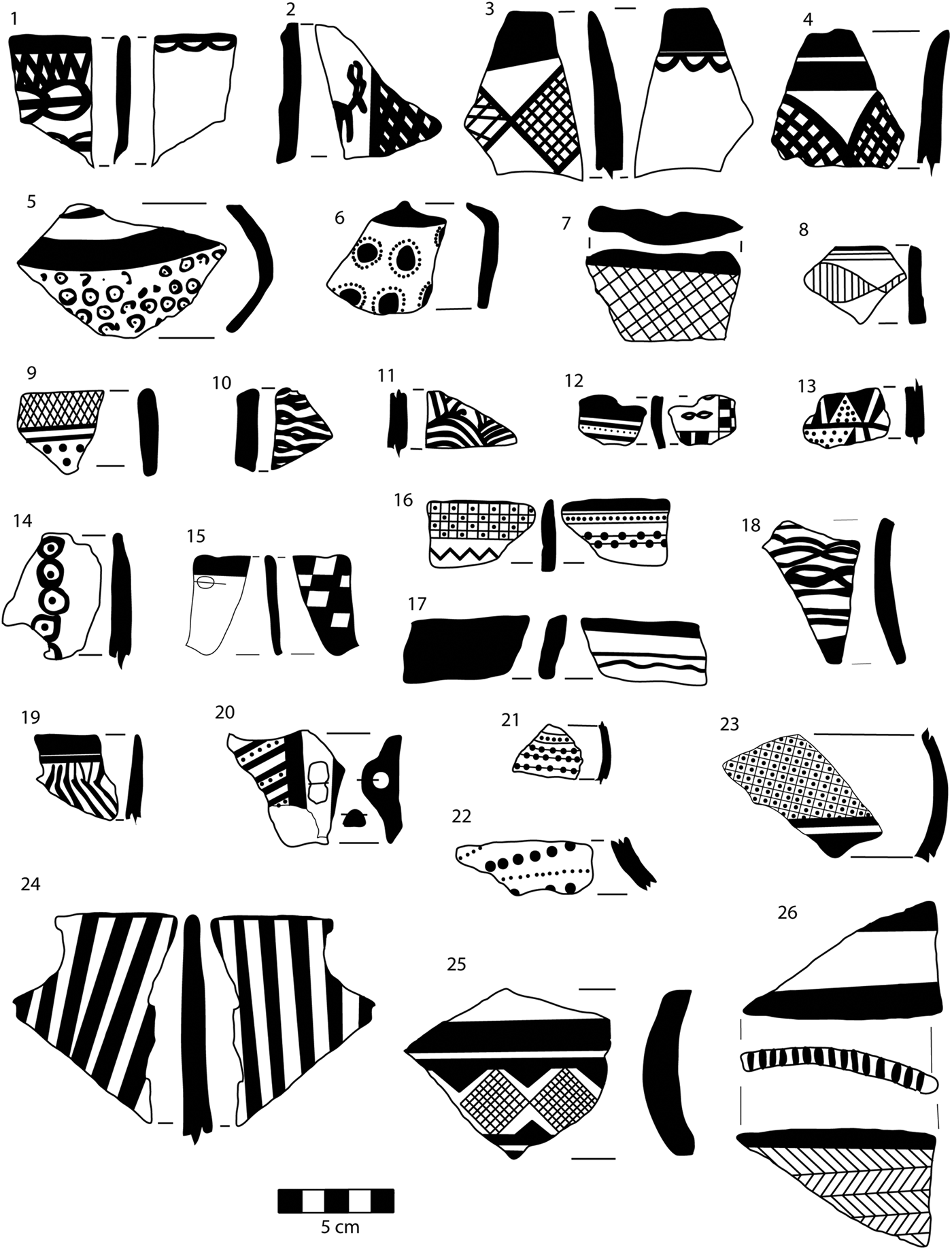
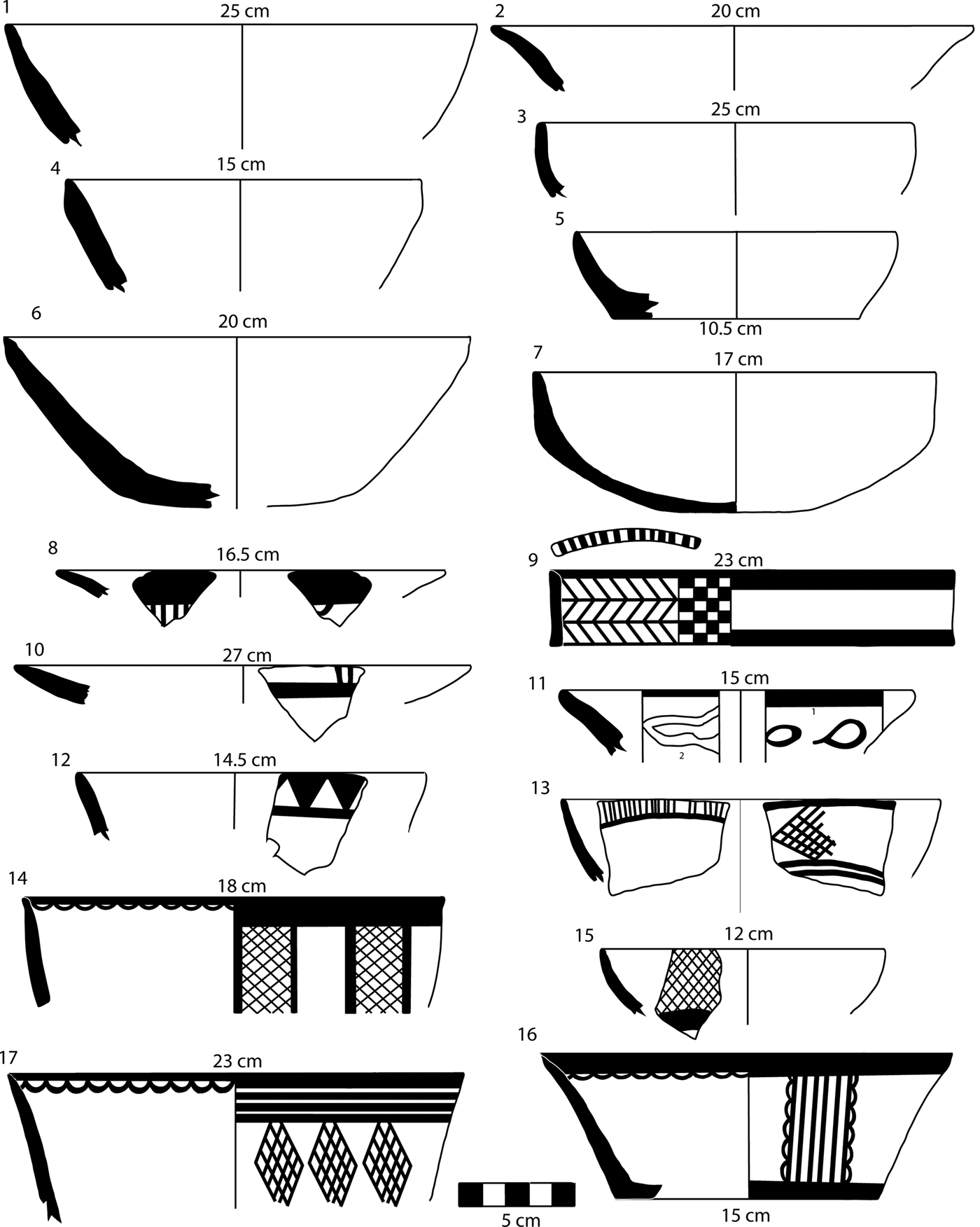
All painted sherds have geometric motifs, with only one zoomorphic motif attested. The most common motifs are annular horizontal bands, many of which were included as part of wider compositions (n = 138; 55 per cent of painted sherds; Fig. 5, no. 17). The second most common design is crosshatching (n = 46 18.4 per cent, Fig. 4, nos. 3 and 4), found also with other motifs, such as bands, lozenges or as part of vertical columns (e.g., Fig. 4, nos. 17–18). Similarly, the rim band combined with a wavy line on vessel interiors (n = 32; 12.8 per cent, Fig. 4, nos. 1 and 3; Fig. 5, nos. 14, 16, and 17) also co-occurs with many other designs. A stag with large antlers is the only zoomorphic design (Fig. 4, no. 2). No examples of “bucrania’” were found. Overall, the wide range of designs (21) stands out, with a small number of sherds in each category.
Painted sherds from Banahilk. 1. Ban.199; Watson's typology: no. 6; reddish yellow with dark reddish gray paint. 2. Ban.177; Watson's typology: no. 4; reddish yellow with red paint. 3. Ban.184; Watson's typology: no. 12B; reddish yellow with very dark gray paint. 4. Ban.284; Watson's typology: no. 6; pink with dark reddish-brown paint. 5. Ban.144; Watson's typology: no. 16; pinkish white with very dark gray paint. 6. Ban. 258; Watson's typology: no. 15 (modified); reddish yellow with very dark gray paint. 7. Ban.275; Watson's typology: no. 12B; pink with dark gray paint. 8. Ban.275; Watson's typology: no. 6C; pink with gray paint. 9. Ban.152; Watson's typology: no. 12B; very pale brown with brown paint. 10. Ban.152; Watson's typology: no. 6; pinkish white with pink paint. 11. Ban.285; Watson's typology: no. 9; pink with reddish yellow paint. 12. Ban.300; Watson's typology: no. 31 (modified); pink with reddish black paint. 13. Ban.223; Watson's typology: no. 13 (modified); pinkish white with Reddish brown paint. 14. Ban.263; Watson's typology: no. 16; pink with very dark gray paint. 15. Ban.243; Watson's typology: no. 7B; pink with very dark gray paint. 16. Ban.243; Watson's typology: nos. 23, 25, and 7; light red with red paint. 17. Ban. 243; Watson's typology: no. 31; reddish yellow with yellowish red paint. 18. Ban.258; Watson's typology: no. 6; reddish yellow with dark reddish gray paint. 19. Ban.263; Watson's typology: no. 18 (modified); very pale brown with very dark gray paint. 20. Ban.258; Watson's typology: no. 25; pink with yellowish red paint. 21. Ban.223; Watson's typology: no. 23; pale yellow with brown paint. 22. Ban.No bag number. No Watson Typology Number; pink with reddish brown paint. 23. Ban.23; Watson's typology: no. 12; pink with very dark gray paint. 24. Ban.196; Watson's typology: no. 2; pale yellow with brown paint. 25. Ban.251; Watson's typology: no. 13A; pink with dark brown paint. 26. Ban.235; Watson's typology: no. 20; very pale brown with dark reddish gray paint; profile not drawn

Bowls and painted bowls from Banahilk. 1. Ban.223; Watson's typology: no. 1Aiii; pinkish white. 2. Ban.144; Watson's typology: no. 1B; reddish yellow. 3. Ban.223; Watson's typology: no. 1B; very pale brown. 4. Ban.263; Watson's typology: no. 1Ai; very pale brown. 5. Ban.277; Watson's typology: no. 1B. Red. 6. Ban.144; Watson's typology: no. 1B; reddish yellow. 7. Ban.185; Watson's typology: no. 1B; reddish yellow. 8. Ban.258; Watson's typology: no. IA, 2; very pale brown with very dark grayish brown paint. 9. Ban.243; Watson's typology: no. IIIA1, 20; pink with dark brown paint. 10. Ban.159; Watson's typology: no. Iaiii, 2; pink with light red paint. 11. Ban.263; Watson's typology: no. IA, 6; pinkish white with brown paint. 12. Ban.300; Watson's typology: no. Iai, 32; pink with dark gray paint. 13. Ban.258; Watson's typology: no. IB, 12; pink with black paint. 14. Ban.243; Watson's typology: no. IB, 12; very pale brown with yellowish red paint. 15. Ban.223; Watson's typology: no. IB, 12; very pale brown with reddish brown paint. 16. Ban.188; Watson's typology: no. IE, 13; reddish yellow with dark reddish-brown paint. 17. Ban.169; Watson's typology: no. IE;, 2; very pale brown with light yellowish-brown paint on the inside

Painted vessel forms that differ most from the old and new excavations are: round-sided (hemispherical) bowls (new 10 per cent, old 18 per cent), shallow bowls (new 2 per cent, old 13 per cent), and deep straight-sided bowls (new none, old 8 per cent). However, unpainted vessels manifest the largest differences between the assemblages. Round-sided bowls comprised 38 per cent of the new assemblage, yet only 15 per cent of Watson's. Additionally, flaring-neck jars comprise a larger part of the newer assemblage (13 per cent) than previously (4 per cent). All other forms were of a similar proportion in both assemblages. Further differences between painted and unpainted vessels can be found in the body sherds: 15 per cent of Watson's assemblage consisted of unpainted body sherds, as compared to 68 per cent of our assemblage. The variation between the percentage of unpainted and painted forms could be due to different uses of space at the site. For example, previously excavated areas of the site may have been associated with particular ritual or feasting occasions, leading to a much higher proportion of painted pottery, the displaying of which may have held an important role in conveying social meanings.
Cooking and food consumption may have occurred at or near this part of the settlement, as reflected by the bowl to jar ratio (Watson's excavation = 4:5 (painted) and 3:5 (unpainted), new excavation = 3:1 (painted) and 2:1 (unpainted)). Jars were far more frequent than bowls in Watson's excavation, whereas the new excavation uncovered a much higher proportion of bowls. Therefore, this deposit may be the remains of everyday food consumption or associated waste disposal, either directly into the open space or in a secondary context resulting from cleaning. From the high number of worn sherds, small rim fragments, and small body sherds, particularly in the earlier loci, we suggest that this area was part of an open courtyard, subject to repeated weathering and cleaning. Alternatively, the variation between the areas could be explained chronologically, as we discuss further below.
To summarise the assemblage, we documented a wide range of motifs and a limited range of forms. There is little variation in vessel forms for phases 1–2. The amounts of painted ware and the number of attested ware types increase over this same period. Overall, the assemblage is comprised of many highly fragmented sherds, the majority of which were unpainted.
Banahilk compared to other Halaf sites
In this section we provide a brief comparison with other Halaf Period sites in northern Iraq. This is not intended to be a comprehensive survey, but a general contextualisation, building on comparisons made already by Watson. The key Halaf sites in northern Iraq, and within the wider Banahilk area, include Arpachiyah (Hijara Reference Hijara1980; Reference Hijara1997; Mallowan and Cruickshank Rose Reference Mallowan and Rose1935), Tepe Gawra (Rothman Reference Rothman2001; Tobler Reference Tobler1950), and Yarim Tepe (Merpert and Munchaev Reference Merpert and Munchaev1987).
Although limited comparisons were made by Watson (Braidwood and Howe Reference Braidwood and Howe1960), a statistical comparative analysis between Banahilk, Arpachiyah, Girikihaciyan, Turlu, Yunus, Tell Halaf, and Tilkit Tepe was later carried out by LeBlanc and Watson (Reference LeBlanc and Watson1973). The results of their analysis demonstrate a clear link between Banahilk and Arpachiyah, far more than with any other site studied. Although the new excavations confirm their analysis as a whole, the recent material questions just how different Banahilk is from Girikihaciyan, one of Watson and LeBlanc's key comparison sites. Like Banahilk (c.100 × 159 metres), Girikihaciyan, located in southeastern Turkey, represents a small (c.175 metre diameter) “peripheral” highland Halaf settlement. First, LeBlanc and Watson (Reference LeBlanc and Watson1973) note that Arpachiyah and Banahilk are similar in terms of the high frequency of medium-size hole-mouth vessels, in contrast to Girikihaciyan, where this form is virtually unattested. The new Banahilk excavations have provided no further hole-mouth vessels, indicating that sampling bias, i.e., the location of trenches, in Watson's excavations may have led to the overrepresentation of hole-mouth vessels. Second, LeBlanc and Watson also demonstrate the similarity between Banahilk and Arpachiyah through the high percentage of painted sherds found, in contrast to Girikihaciyan, which had a much higher percentage of plain wares. Likewise, the new excavations produced few painted sherds, especially in the earlier levels, in comparison to Watson's excavation. The similarities noted by LeBlanc and Watson between Arpachiyah and Banahilk may be more an effect of sampling bias than of chronological contemporaneity or cultural affinities. Thus, when combining the new and old excavations together a more representative picture can be made to situate Banahilk within the wider cultural landscape of so-called peripheral Halaf sites.
Banahilk exhibits a restricted repertoire of types, with few “cream bowls” — a distinctive type of carinated bowls with markedly everted rim (e.g., Mallowan and Cruickshank Rose Reference Mallowan and Rose1935: figs. 60, 62, 63; Merpert and Munchaev Reference Merpert and Munchaev1987: fig. 19; Tobler Reference Tobler1950: fig. 11–13). Our new investigations did not find examples of all Watson's formal types nor did it expand on Watson's typology. For instance, “cream bowls” are well attested at Arpachiyah yet only three have been identified by the old excavations and none by the new. At Arpachiyah these vessels are of very high quality with complex decoration, far more detailed than attested designs at Banahilk (as further commented by Watson (Braidwood and Howe Reference Braidwood and Howe1960)). Although sample size and fragmentation are problems, the much higher proportion in the new excavations of simple, unpainted vessels exhibit a definite shift away from assemblages like those from Arpachiyah, Tepe Gawra, and even the previous excavations at Banahilk, where a small number of more complex forms were found. The key types at Banahilk are rounded bowls and flaring rim bowls, which are well attested at other sites in the region (e.g., Mallowan and Cruickshank Rose Reference Mallowan and Rose1935: figs. 57 and 58 no. 4; Merpert and Munchaev Reference Merpert and Munchaev1987: figs. 14 and 16).
The forms and decoration from Banahilk indicate a less rich assemblage than that of its most comparable site, Arpachiyah (LeBlanc and Watson Reference LeBlanc and Watson1973; Braidwood Reference Braidwood and Howe1960). The attestation of only one zoomorphic sherd and no anthropomorphic designs also sets Banahilk apart from other Halaf sites. Eight sherds with a “bucrania” design were identified by Watson, yet none of this type was found in the new excavations. However, examples of bowls from the early layers from Arpachiyah are directly comparable to vessels from Banahilk. For example, a number of bowls are similar in terms of motif and form with sherds from the new excavations at Banahilk (Mallowan and Cruickshank Rose Reference Mallowan and Rose1935: pl. XXII no. 8, [also shown in fig. 72, no. 2]; fig. 71 nos. 7–9; fig. 72 nos. 1–5) and the old (Watson Reference Watson and Braidwood1983: fig. 198 no. 15; compare to Mallowan and Cruickshank Rose Reference Mallowan and Rose1935: fig. 70 no. 2). Arpachiyah's bowls also have rims similar to those from Banahilk in both style and form (Fig. 4 nos. 3 and 24; Fig. 5: no. 17). Similarly, fig. 69 no. 3 from Arpachiyah (Mallowan and Cruickshank Rose Reference Mallowan and Rose1935) is again almost identical to a full profile from the new excavations at Banahilk (Fig. 5, no. 16), likewise for the old excavations (Watson Reference Watson and Braidwood1983: fig. 198 n. 14 and Mallowan and Cruickshank Rose Reference Mallowan and Rose1935: fig. 72 nos. 3 and 5). A similar example was also found during more recent excavations at Arpachiyah (Hijara Reference Hijara1980: fig. 11 no. 346).
Parallels in decoration can also be found, including: crosshatched lozenges (Fig. 4, nos. 3 and 25; Mallowan and Cruickshank Rose Reference Mallowan and Rose1935: fig. 72, nos. 3 and 5; Hijara Reference Hijara1980: fig. 11 no. 343; Merpert and Munchaev Reference Merpert and Munchaev1987: fig. 8.29 no. 12; Tobler Reference Tobler1950: pl. LXVII fig. b no.11); a banded rim with one row of wavy line motif (Fig. 4, no. 3; Mallowan and Cruickshank Rose Reference Mallowan and Rose1935: fig. 70, nos. 1 and 4–6); rows of dots (Fig. 4, no. 22; Mallowan and Cruickshank Rose Reference Mallowan and Rose1935: fig. 64 nos. 7 and 9; Hijara Reference Hijara1980: fig. 12 nos. 441 and 449; Merpert and Munchaev Reference Merpert and Munchaev1987: 8.27 no. 4; Tobler Reference Tobler1950: pl. LXVII fig. b no. 18); annular bands of bisected ovals (Fig. 4, no. 1; Mallowan and Cruickshank Rose Reference Mallowan and Rose1935: fig. 69 no. 6; Hijara Reference Hijara1980: fig. 12 no. 246; Tobler Reference Tobler1950: pl. LXVII fig. b no. 6); and circles surrounded by dots (Fig. 4, no. 6; Hijara Reference Hijara1980: fig. 12 no. 355; Merpert and Munchaev Reference Merpert and Munchaev1987: fig. 8.25 no. 4; Tobler Reference Tobler1950: pl. LXVII fig. a no. 16). Complex designs, such as a quatrefoil are also attested at both Banahilk and Arpachiyah (Watson Reference Watson and Braidwood1983: fig. 198 no. 81; Mallowan and Cruickshank Rose Reference Mallowan and Rose1935: fig. 60 no. 3).
Within the past few years many projects have started surveying large swathes of Iraqi Kurdistan, providing new knowledge about the Halaf period for the region. The Shahrizor Survey project has published Halaf-Ubaid pottery from Tell Begum and Tell Qortas (Mühl and Nieuwenhuyse Reference Mühl, Nieuwenhuyse and Iamoni2016; Nieuwenhuyse et al. Reference Nieuwenhuyse, Odaka, Kaneda, Mühl, Rasheed and Altaweel2016). To a certain extent, these examples resemble the material from Banahilk in form (e.g., round-sided bowl, Mühl and Nieuwenhuyse, Reference Mühl, Nieuwenhuyse and Iamoni2016: fig. 11 no. 7), yet overall few comparisons can be made, as the authors date these vessels to the late Halaf-Ubaid transition. Altaweel et al. (Reference Altaweel, Marsh, Mühl, Nieuwenhuyse, Radner, Rasheed and Saber2012) published Halaf sherds from Tell Begum, which do show greater similarity in terms of decoration, with classic cross-hatching and herringbone motifs as is common within the wider Halaf tradition rather than specific relationships with the Banahilk material. Closer parallels from new work in Kurdistan come from the Eastern Ḫabur Archaeological Survey (EHAS) (Pfälzner et al. Reference Pfälzner, Sconzo, Beutelschieß, Edmonds, Glissmann, Herdt, Herrmann, Heydari-Guran, Köhler, Müller-Wiener, Puljiz and Sharp.2016). Clear relationships in shape (Pfälzner et al. Reference Pfälzner, Sconzo, Beutelschieß, Edmonds, Glissmann, Herdt, Herrmann, Heydari-Guran, Köhler, Müller-Wiener, Puljiz and Sharp.2016: pl. 2 nos. 11, 12, 14) can be identified, along with band and cross-hatching typical of Halaf decoration. The EHAS material also closely parallels that from the Silopi plain (Kozbe Reference Kozbe2006; Reference Kozbe2007), in both form and decoration (see Pfälzner et al. Reference Pfälzner, Sconzo, Beutelschieß, Edmonds, Glissmann, Herdt, Herrmann, Heydari-Guran, Köhler, Müller-Wiener, Puljiz and Sharp.2016 for comparanda). The Banahilk material thus fits in well with recent findings from “peripheral” Halaf areas in northern Iraq and southeastern Turkey, yet still displays local variation. For instance, the banded rim and wavy line motif is highly characteristic of the Banahilk material, present on the vast majority of painted rim sherds, far more than at sites like Tell Amarna (Cruells 2004). The fact that this motif is not well represented in the survey material from Kurdistan is most likely due to issues of survey methodology and taphonomy. Further publication is necessary to determine whether differences between Banahilk and sites in the Shahrizor are purely chronological or in fact reflect broader cultural differences, a question also raised by Nieuwenhuyse et al. (Reference Nieuwenhuyse, Odaka, Kaneda, Mühl, Rasheed and Altaweel2016). The fact that the polychrome ware from Tell Begum is absent at Banahilk supports an argument for regional variation.
Halaf ware from Banahilk compared to J-ware
The results from Banahilk also raise new questions regarding the connection between cultures in Iraq and Iran. Watson (Reference Watson and Braidwood1983: 238) notes the occurrence of red and black slipped ware, as known in the J-ware tradition. Exact comparanda with the J-ware horizon are limited at Banahilk, with only a few direct parallels. For instance, flared rim jars, with the characteristic painted band on the rim and wavy line below, strongly parallel J-ware from the Mahidasht region (Fig. 6, no. 10; cf. Levine and McDonald Reference Levine and McDonald1977: fig. 1 no. 22; Levine and Young Reference Levine, Young and Huot1987). Indeed, much of the J-ware from Levine and McDonald's survey is indistinguishable from Banahilk in terms of the banded and crosshatched diamonds (Fig. 4, no. 1; cf. Levine and McDonald Reference Levine and McDonald1977: pl. Ib). Tepe Siahbid and Chogha Maran vessels exhibit strong formal similarities to those of Banahilk (Henrickson Reference Henrickson1983: fig. 97 nos. 11 and 14), but less so in terms of decoration. The less elaborately decorated vessels are particularly reminiscent of the J-ware tradition.Footnote 4 For instance, sherds illustrated by McDonald and Levine have painted bands on the rim with crosshatched bands (e.g., McDonald and Levine Reference Levine and McDonald1977: pl. 1 no. 4), along with lozenges (e.g., McDonald and Levine Reference Levine and McDonald1977: pl. Ib) located below. Further, the description of J-ware paint by McDonald and Levine (Reference Levine and McDonald1977) seems almost identical to that from Banahilk, in respect to paint colours and the presence of white slip. At other sites slips are applied in advance of painting (Cruells and Nieuwenhuyse Reference Cruells and Nieuwenhuyse2004), yet at Banahilk this does not seem to be the case due to the high proportion of unpainted slipped vessels. Although new surveys have now been carried out in Iran, few examples of J-ware have been illustrated. This currently makes comparisons difficult but it is hoped that future publication from these projects will further add to these comparanda (e.g., Balmaki et al. Reference Balmaki, Niknami and Harsini2013).
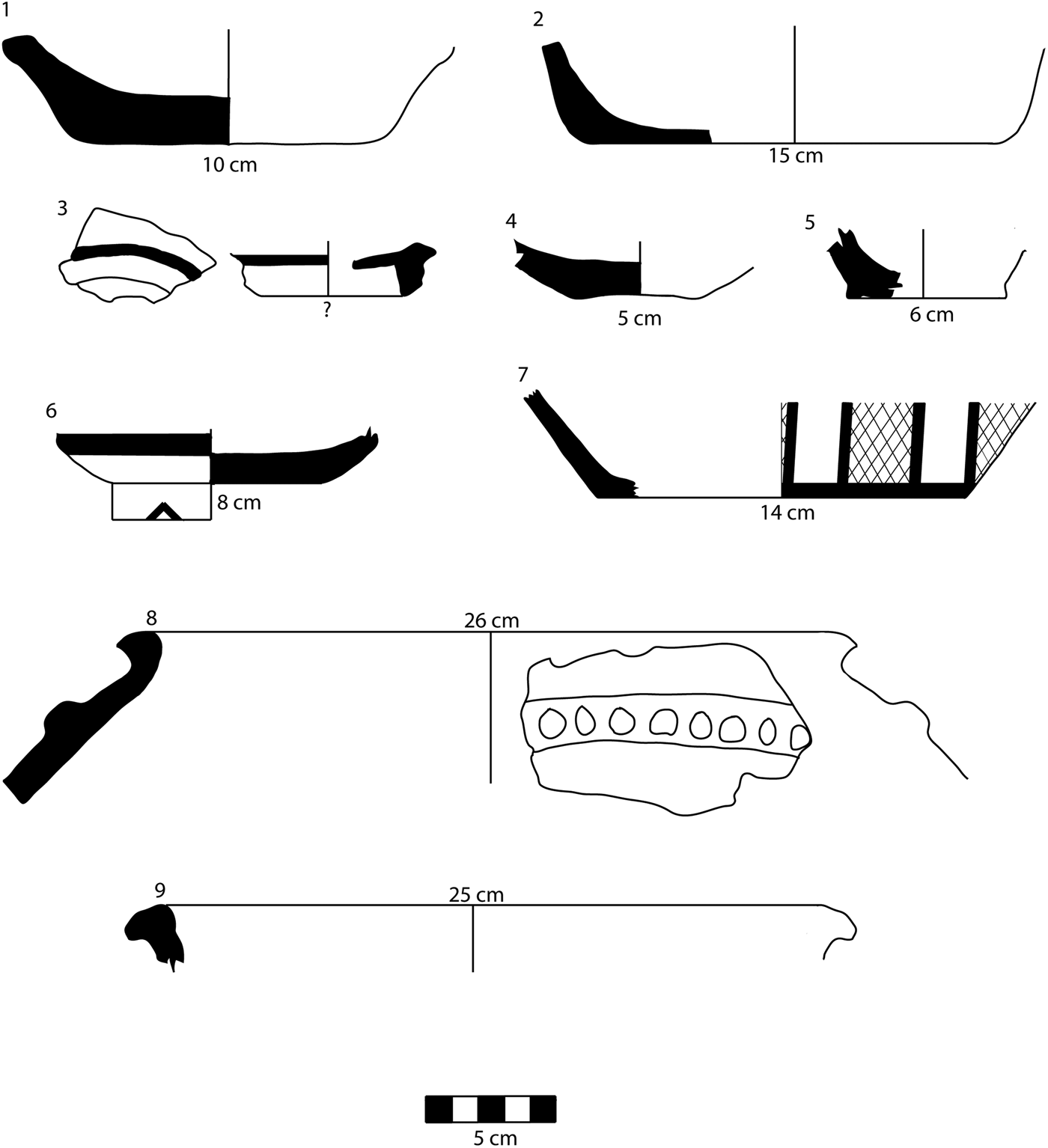
Jars, painted jars, and handles from Banahilk. 1. Ban.188; Watson's typology: no. 2B; very pale brown. 2. Ban.152; Watson's typology: no. 2B; reddish yellow. 3. Ban.223; Watson's typology: no. 2A; pink. 4. Ban.243; Watson's typology: no. 2B; very pale brown. 5. Ban.223; Watson's typology: no. 2A; very pale brown. 6. Ban.159; Watson's typology: no. IIB, 12; pink with light red paint. 7. Ban.141; Watson's typology: no. IIA, 20; very pale brown with dark grayish brown paint. 8. Ban.300; Watson's typology: no. IIAi, 32; reddish yellow with red paint. 9. Ban.172; Watson's typology: no. IIB, 2; pinkish gray with dark brown paint. 10. Ban.152; Watson's typology: no. IIB, 2; very pale brown with dark gray paint. 11. Ban.152; Watson's typology: no. IIB, 2; very pale brown with brown paint. 12. Ban.300; Watson's typology: no. IIB, 2; pink with strong brown paint. 13. Ban.223; Watson's typology: no. IV; reddish yellow. 14. Ban.223; Watson's typology: no. IIA; light brown. 15. Ban.288; Watson's typology: no. IV; grey

Bases, painted vases, and large second millennium jars from Banahilk. 1. Ban.177; Watson's typology: no. IIID; light reddish brown. 2. Ban.258; Watson's typology: no. III; very pale brown. 3. Ban.258; Watson's typology: no. III, 2; pinkish white with very dark brown paint. 4. Ban.223; Watson's typology: no. III; very pale brown. 5. Ban.254; Watson's typology: no. III; reddish yellow. 6. Ban.243; Watson's typology: no. IID, 2; pinkish gray with reddish brown paint. 7. Ban.258; Watson's typology: no. IID, 12; pink with dark brown paint. 8. Ban.223. 2nd mill.; pinkish gray. 9. Ban.223. 2nd mill.; very pale brown

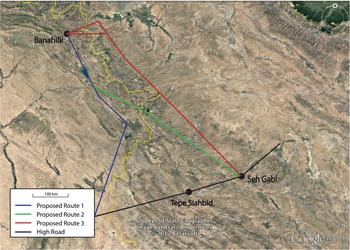
Proposed routes from Banahilk to J-ware sites of Tepe Siahbid and Seh Gabi and the High/Khorsan road proposed by Henrickson (Landsat 2017 basemap with authors’ additions)

Overall, the new material from Banahilk helps advance discussions regarding the relationship between Iraq and Iran during the prehistoric periods. Hopefully this will stimulate further debate, especially for the new survey projects in Iraqi Kurdistan. For instance, the photographed assemblage published by Levine and McDonald closely resembles survey material from the EHAS region; e.g., distinctive jar forms have been identified by both projects (Pfälzner et al. Reference Pfälzner, Sconzo, Beutelschieß, Edmonds, Glissmann, Herdt, Herrmann, Heydari-Guran, Köhler, Müller-Wiener, Puljiz and Sharp.2016: pl. 2 no.14; cf. Levine and McDonald Reference Levine and McDonald1977: fig.1 no. 16). If these two assemblages were found together in the field, they would be virtually indistinguishable. Likewise, the material so far published from Tell Begum may also have parallels with J-ware assemblages in regard to decoration (e.g., Mühl and Nieuwenhuyse Reference Mühl, Nieuwenhuyse and Iamoni2016: fig. 11; cf. Levine and McDonald Reference Levine and McDonald1977: fig. 1 nos. 5, 17, and 23; Henrickson Reference Henrickson1983: fig. 97 no. 8). Indeed, Mühl and Nieuwenhuyse note the lack of parallels with Syrian material and instead draw on those from Iraqi Kurdistan. Future research may support closer links between the Shahrizor region and the J-ware tradition, a question that has not yet been posed for the Halaf period in current publications.Footnote 5
The comparanda discussed above derive from early Halaf period deposits: Arpachiyah TT10–6, Yarim Tepe II, and Tepe Gawra Area A Strata E and F. This suggests a similar dating for the Banahilk assemblage, a dating also suggested by Watson. The Iranian material does not refine this dating; however, the few attested connections suggest cultural contacts during the Halaf period, where perhaps through seasonal migrations people traversed the Zagros Mountains to meet and exchange ideas.
Exchange networks between Mesopotamia and Iran
The high Zagros creates a natural barrier between Iraq and Iran but the intermontane valleys and passes are not insurmountable. Henrickson (Reference Henrickson and Kingery1986: 33) proposed that the trade between lowland Iraq and highland Iran during the Chalcolithic occurred over the Khorasan road, a route which “runs from the vicinity of Baghdad up into the central Zagros through a series of fertile highland valleys, including the Mahidasht and Kangavar, and eventually out onto the high plateau east of the mountains.” This route was eventually incorporated into the silk road and remains a major highway today.
The ceramic assemblage from Banahilk illustrates contacts between J-ware and the northern Halaf culture. Three routes with approximately the same distance can be proposed to link these traditions following modern-day routes between Banahilk and Tepe Siahbid (Fig. 4). The first follows the Gali Ali Beg pass to the Harir plain, travels southwestward to the Rania plain, crosses to the Shahrizor plain near modern day Sulaymaniya, connects to the Diyala river and follows it until the river meets the Khorsan road to Tepe Siahbid. This route passes near other sites in Iraqi Kurdistan that have limited assemblages of Halaf ware, namely Kani Shaie (S. Renette, pers. comm. Reference Nieuwenhuyse, Odaka, Kaneda, Mühl, Rasheed and Altaweel2016) and sites in the Shahrizor plain (Nieuwenhuyse et al. Reference Nieuwenhuyse, Odaka, Kaneda, Mühl, Rasheed and Altaweel2016). The second route follows the Gali Ali Beg pass to the Harir plain, travels southwestward to the Rania plain, crosses the Zagros near Penjwen to Zenibar lake, and then runs down the valley to Seh Gabi.
The third route crosses the Zagros near Banahilk, either through the Haji Omaron pass near Choman, or the Kele Shin pass near Sidekan. Both mountain passes end in the Ushnu-Solduz valley of northern Iran. From there the route follows the Simineh river southward then follows the Zrebar river to the southeast, ending up in the Kangavar valley. Along the Iranian route, no Halafian material has been uncovered but a later painted ware tradition, Dalma ware (4700–4300 b.c.e.) appears in the Ushnu-Solduz valley (Dyson Reference Dyson1993; Hamlin Reference Hamlin1975; Henrickson Reference Henrickson and Kingery1986; Solecki and Solecki Reference Solecki and Solecki1973). The routes crossing the Zagros over the Kele Shin and Haji Omaron have been utilised for millennia, as witnessed by stelae documenting Assyrian and Urartian campaigns and archaeological evidence showing habitation dating from the Neolithic (Danti Reference Danti2014a; Solecki Reference Solecki1963; Zettler and Danti Reference Zettler and Danti2017a; Reference Zettler and Danti2017b; Reference Zettler and Danti2017c). Travel journals from western missionaries and British army captains document that the passes between Soran and the Ushnu-Solduz valleys were used in the nineteenth and twentieth centuries by both travellers and pastoralists (Ainsworth Reference Ainsworth1841; Bishop Reference Bishop1891; Hay Reference Hay1921).
Beale (Reference Beale1973) discusses a four-fold typology of trade, comprising trickle trade, redistributive trade, regional organised trade, and long-distance organised trade, focused on Yarim Tepe. Matthews and Fazeli (Reference Matthews and Fazeli2004), discussing copper trade between lowland Mesopotamia and highland Iran in the late fifth and early fourth millennia b.c.e., identify a combination of trickle trade and local redistributive trade as mechanisms for moving goods between the two areas. This type of interaction is mimicked in modern day pastoral migrations between the lowland and highland areas of Mesopotamia and Iran (Bishop Reference Bishop1891; Hay Reference Hay1921; Henrickson Reference Henrickson and Kingery1986; Thevenin Reference Thevenin2011). The few attested connections between the Banahilk assemblage and the J-ware assemblage suggest that during seasonal migrations people traversed the Zagros mountains, exchanging ideas and possibly goods.
Given Banahilk's location on overland routes linking northern Mesopotamia and the Iranian Zagros, one might predict a “hybridised”, intermediary assemblage combining the stylistic elements of J-ware and Halaf ware. This is what seems to have occurred at Banahilk, and possibly at other sites in Iraqi Kurdistan. Indeed, Henrickson (Reference Henrickson1983; Reference Henrickson and Kingery1986) has noted that decorative motifs from southwestern Iran exhibit close connections to the Halaf ware of northern Mesopotamia. Henrickson argues that Halaf ceramics were not directly imported across the Zagros but that J-ware may instead have been inspired as a result of cultural contact through pastoral migrations. However, the movement does not need to have been restricted to contact between lowland Iraq and highland Iran. Later periods also see contact between highland Iraq and Iran. Some modern Kurdish populations still practice pastoralism, seasonally moving their herds from lowland to highland areas (Thevenin Reference Thevenin2011), so it is not implausible that Halaf influences may have been transmitted as a result of seasonal migrations.
Conclusion
Banahilk measures approximately 1.5 hectares in area and contains a large assemblage of Halafian materials including ceramics, lithics, and seals. The Rowanduz Archaeological Program's excavations in 2014 mirrored the previous excavations carried out by Watson on behalf of the Iraq-Jarmo Project. The biggest difference between the finds of these two excavations was in the painted and unpainted assemblages. The variation between the percentages of unpainted and painted forms could potentially be due to the different use of space at the site. For example, previously excavated areas of the site may have been associated with particular ritual or feasting occasions, leading to a much higher proportion of painted pottery, the displaying of which may have held an important role in conveying social meanings. Banahilk's painted ceramics are similar in form and motif to other large Halaf sites located on the Mesopotamian plain. Halaf period sites tend to be one to three hectares in size and are located in dryland farming areas of the piedmont zone in northern Mesopotamia. Based on radiocarbon dates, Banahilk dates to approximately 5800–5100 b.c.e. (Bernbeck Reference Bernbeck1994), while ceramic evidence from Arpachiya, Tepe Gawra, and Yarim Tepe dates Banahilk to the Early Halaf period (pre-5500 b.c.e.). In comparing Banahilk and Halaf material to J-ware, interesting connections are observed.
The Mahidasht region contains seventy sites that have a J-ware occupation and range up to three hectares in size. These occupations are characterised by semi-permanent hamlets located in an agriculturally rich valley system. The J-ware is unrelated to the previous late Neolithic pottery in the region, made locally, and the painted motifs display lowland Halafian technological and stylistic influence. Henrickson (Reference Henrickson1983) hypothesises this contact as trickle trade, like later trade in the region, occurring along the Khorsan road from lower Mesopotamia to the highlands of Iran.
Henrickson focuses her research on the Khorsan road as the route of exchange between Mesopotamia and Iran. With the discoveries at Banahilk, three new routes can be proposed: one that runs south until it meets the Khorsan road, one that runs south and crosses the Zagros near Penjwen, and a third that crosses the Zagros near Banahilk and runs southward on the Iranian side of the mountains. The first route has archaeological evidence of Halafian materials, especially in the Shahrizor plain and the site of Kani Shaie (Algaze et al. Reference Algaze, Brenties, Bernard Knapp, Khol, Kotler, Lamberg-Karlovsky, Altaweel, Marsh, Mühl, Nieuwenhuyse, Radner, Rasheed and Saber2012; Kopanias et al. Reference Kopanias, MacGinnis and Ur2015). More excavation in the region of Iraqi Kurdistan will help to elucidate more of the Halaf and J-ware interaction. The third route is known from later periods, mainly the Bronze and Iron Ages, but there is also limited archaeological evidence for Neolithic peoples traversing the Zagros (Solecki Reference Solecki1963).
Modern day ethnographies of the region have shown that some Kurdish populations living in the intermontane valleys practice pastoralism, moving from lowland areas in the winter to highland areas in the summer. Modern day roads also connect these places and traverse the same geographic passes as in the past. Both the Halaf and J-ware traditions showcase semi-permanent to permanent settlements in agriculturally rich areas. The development of highly made ceramics with detailed painted motifs during the Chalcolithic period shows a rise in socio-economic complexity, the emergence of an elite, and the beginning of settlement hierarchy. With more excavation in both Iraqi Kurdistan and western Iran, more links will be exposed between these two areas leading to a better understanding of the Chalcolithic in the Near East.