INTRODUCTION
According to the World Conservation Union, the Iberian lynx (Lynx pardinus) is the most endangered felid in the world (Nowell and Jackson, Reference Nowell and Jackson1996) with approximately 160 individuals inhabiting 2 separate areas of Southern Spain, namely Sierra Morena and Doñana (Guzmán et al. Reference Guzmán, García, Garrote, Pérez de and Iglesias2004). Among mammalian predators, felids are especially vulnerable to human action (habitat transformation, road-killing, illegal hunting) and 44% of the species in this taxon experience serious threats (Nowell and Jackson, Reference Nowell and Jackson1996). An increasing concern exists about the role of diseases as a threat for conservation of endangered species (Deem et al. Reference Deem, Karesh and Weisman2001; Haydon et al. Reference Haydon, Laurenson and Sillero-Zubiri2002; Smith et al. Reference Smith, Sax and Lafferty2006). It has been shown that diseases could induce extinction of wildlife species (e.g. Thorne and Williams, Reference Thorne and Williams1988), especially when their population size is small and reservoir hosts are present in the area (de Castro and Bolker, Reference de Castro and Bolker2005).
Cytauxzoonosis is a tick-borne disease caused by Cytauxzoon felis, a piroplasm belonging to the family Theileriidae. Its life-cycle in the vertebrate host includes an intra-erythrocytic phase and a tissue phase consisting of large schizonts that develop in macrophages or monocytes. The tissue phase is necessary for the disease to be fatal (Kier and Greene, Reference Kier, Greene and Greene1998). The bobcat (Lynx rufus) is considered the natural host of C. felis in North America. In this species, C. felis causes a persistent, subclinical infection. In contrast, C. felis infections in domestic cats are characterized by an acute, highly fatal febrile disease (Kier and Greene, Reference Kier, Greene and Greene1998). Cytauxzoon felis was also reported in free-living cougars and Florida panthers (Puma concolor; Rotstein et al. Reference Rotstein, Taylor, Harvey and Bean1999) in North America. Florida panthers may react to C. felis in a way similar to bobcats (Forrester, Reference Forrester1992). A fatal case of cytauxzoonosis was reported in a captive white tiger (Panthera tigris) in the United States (Garner et al. Reference Garner, Lung, Citino, Greiner, Harvey and Homer1996). A closely related piroplasm, C. manul, was reported parasitizing Pallas cats (Otocolobus manul) in Mongolia (Ketz-Riely et al. Reference Ketz-Riley, Reichard, Van den Bussche, Hoover, Meinkoth and Kocan2003; Reichard et al. Reference Reichard, Van den Bussche, Meinkoth, Hoover and Kocan2005). In Iberian lynx, Luaces et al. (Reference Luaces, Aguirre, García-Montijano, Velarde, Tesouro, Sánchez, Galka, Fernández and Sainz2005) reported the finding of a small intra-erythrocytic piroplasm in a blood film of a juvenile animal from Sierra Morena. 18S rRNA PCR amplification and sequencing revealed similarity to C. felis.
The relevance of Cytauxzoon spp. as a threat for Iberian lynx conservation is unknown. The infected lynx reported by Luaces et al. (Reference Luaces, Aguirre, García-Montijano, Velarde, Tesouro, Sánchez, Galka, Fernández and Sainz2005) did not show any sign of disease and haematological and biochemical values were normal. However, although bobcats can develop the tissue phase of the pathogen and may die of experimental cytauxzoonosis (Kier et al. Reference Kier, Wightman and Wagner1982; Blouin et al. Reference Blouin, Kocan, Kocan and Hair1987), it was considered that C. felis could not cause the death of wild bobcats. This view changed when Nietfeld and Pollock (Reference Nietfeld and Pollock2002) reported a free-living bobcat cub that died of acute cytauxzoonosis. These authors suggested that some bobcats may die each year due to cytauxzoonosis, but these cases remain undetected by current surveillance protocols. It is unknown whether the Iberian lynx experiences a similar situation.
Several questions regarding the aetiology and epidemiology of piroplasmosis in the Iberian lynx emerged from the findings of Luaces et al. (Reference Luaces, Aguirre, García-Montijano, Velarde, Tesouro, Sánchez, Galka, Fernández and Sainz2005). As discussed by Nietfeld and Pollock (Reference Nietfeld and Pollock2002), factors such as host age and sex, and C. felis strain may play a role in the epidemiology of the disease. Surveillance for monitoring prevalence of a disease in different areas and age classes is the first step for preventing major disease problems in animal populations (Scott, Reference Scott1988). The retrospective analysis of 50 lynx blood and organ samples (47 from Doñana and 3 from Sierra Morena) revealed no additional positive animal in Doñana (Luaces et al. Reference Luaces, Aguirre, García-Montijano, Velarde, Tesouro, Sánchez, Galka, Fernández and Sainz2005). Thus, it is currently unknown whether Cytauxzoon is distributed in both populations or is currently confined to Sierra Morena. If the latter is true, disease risks may arise if lynx translocations from Sierra Morena to Doñana are carried out (Mathews et al. Reference Mathews, Moro, Strachan, Gelling and Buller2006). The Cytauxzoon sp. described by Luaces et al. (Reference Luaces, Aguirre, García-Montijano, Velarde, Tesouro, Sánchez, Galka, Fernández and Sainz2005) showed maximum homology with the 18S rRNA gene sequence of C. manul obtained from a Pallas cat (Ketz-Riely et al. Reference Ketz-Riley, Reichard, Van den Bussche, Hoover, Meinkoth and Kocan2003) and with a Cytauxzoon sp. from a Spanish domestic cat (Criado-Fornelio et al. Reference Criado-Fornelio, González del, Buling-Saraña and Barba-Carretero2004). However, Luaces et al. (Reference Luaces, Aguirre, García-Montijano, Velarde, Tesouro, Sánchez, Galka, Fernández and Sainz2005) reported only 1 infected animal, which precluded the analysis of Cytauxzoon genetic diversity in Iberian lynx. This information may be relevant to correlate genotypes with pathogenicity and evaluate the possible impact of Cytauxzoon infection on wild Iberian lynx endangered populations.
The aim of the present work was to determine by 18S rRNA PCR and sequence analysis the observed prevalence of Cytauxzoon spp. in Iberian lynx and to characterize the genetic diversity of this pathogen in the Iberian lynx.
MATERIALS AND METHODS
Study areas
The last metapopulations of Iberian lynx persist in Sierra Morena and Doñana, two localities 230 km apart (Guzmán et al. Reference Guzmán, García, Garrote, Pérez de and Iglesias2004). Doñana (37°0′N, 6°30′W) is a protected, coastal area with sandy soils of marine origin. It is isolated by marshland and farmland from other forest blocks. Sierra Morena (38°13′N, 4°10′W) is a hilly area with heights up to 1300 m. In both areas Mediterranean scrubland dominates, and climate is Mediterranean subhumid with mild, wet winters and hot, dry summers.
Animals and sample preparation
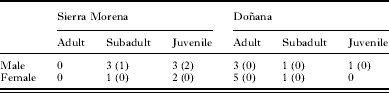
Twenty different free-living Iberian lynxes were surveyed, 11 in Doñana and 9 in Sierra Morena (see Table 1 for detailed sex and age-classes), from November 2004 to June 2006. Lynxes were separated into 3 age classes according to Ferreras et al. (Reference Ferreras, Delibes, Palomares, Fedriani, Calzada and Revilla2004) : juveniles living in the natal area (<1 year old); subadults during the modal natal dispersal period (1–2 years old); and adults (>2 years old). Animals were sampled in 3 seasons, summer (July–August), autumn (November–December) and winter (January–March). Lynxes had to be sampled during captures for incorporations into the Captive Breeding Program, or for radio-collaring, and immobilized with a combination of ketamine (Imalgène®, Merial, France) and medetomidine (Domtor®, Pfizer, Spain). Blood was collected from the brachial vein in tubes with lithium heparin as anticoagulant and stored at −20°C.
Age and sex-classes of the Iberian lynxes sampled for the detection of Cytauxzoon sp.
(Parasitized animals are given in parentheses.)

DNA was extracted from whole blood (400 μl) using the ReadyAmp Genomic DNA Purification System (Promega, Madison, WI, USA) according to the manufacturer's instructions.
Polymerase chain reaction (PCR) and sequence analysis
A 1726-bp region of the 18S rRNA gene from members of Piroplasmorida was amplified by PCR using primers 7549 (5′-GTCAGGATCCTGGGTTGATCCTGCCAG-3′) and 7548 (5′-GACTGAATTCGACTTCTCCTTCCTTTAAG-3′) (Reichard et al. Reference Reichard, Van den Bussche, Meinkoth, Hoover and Kocan2005). One μl (1–10 ng) DNA was used with 10 pmol of each primer in a 50 μl volume PCR (1·5 mm MgSO4, 0·2 mm dNTP, 1X AMV/Tfl reaction buffer, 5u Tfl DNA polymerase) employing the Access RT-PCR system (Promega). Reactions were performed in an automated DNA thermal cycler (Techne model TC-512, Cambridge, England, UK) for 35 cycles. After an initial denaturation step of 1 min at 94°C, each cycle consisted of a denaturing step of 30 sec at 94°C, an annealing step for 30 sec at 65°C and an extension step of 2 min at 68°C. The programme ended by storing the reactions at 10°C. Negative control reactions were performed with the same procedures, but adding nuclease-free distilled water (Promega) instead of DNA to monitor contamination of the PCR. Positive control reactions were done with C. felis DNA, kindly provided by Drs A. Alan Kocan and Mason V. Reichard (Oklahoma State University, Stillwater, OK, USA; Reichard et al. Reference Reichard, Van den Bussche, Meinkoth, Hoover and Kocan2005). PCR products were electrophoresed on 1% agarose gels to check the size of amplified fragments by comparison to a DNA molecular weight marker (1 Kb DNA Ladder, Promega). Amplified fragments were resin purified (Wizard, Promega) and cloned into the pGEM-T vector (Promega) for sequencing both strands by double-stranded dye-termination cycle sequencing (Secugen SL, Madrid, Spain). At least 2 independent clones were sequenced for each PCR.
Multiple sequence alignment was performed using the programme AlignX (Vector NTI Suite V 5.5, InforMax, North Bethesda, MD, USA) with an engine based on the Clustal W algorithm (Thompson et al. Reference Thompson, Higgins and Gibson1994). BLAST (Altschul et al. Reference Altschul, Gish, Miller, Myers and Lipman1990) was used to search the NCBI databases to identify previously reported sequences with identity to those obtained in the study described here.
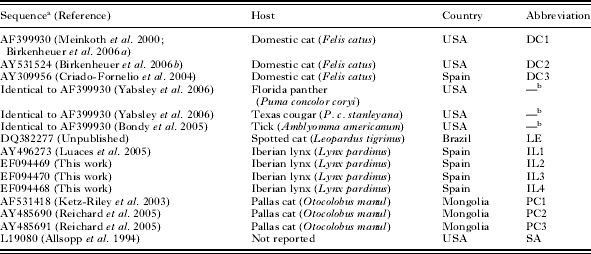
For phylogenetic analysis, nucleotides were coded as unordered, discrete characters with 5 possible character-states: A, C, G, T, or N and gaps were coded as missing data. The phylogenetic analysis was conducted using Mega version 3.1 (Kumar et al. Reference Kumar, Tamura and Nei2004) and the sequence distance method using the Neighbor-Joining (NJ) algorithm of Saitou and Nei (Reference Saitou and Nei1987) with Kimura 2 parameters correction. Stability or accuracy of inferred topology(ies) were assessed via bootstrap analysis (Felsenstein, Reference Felsenstein1985) of 1000 iterations. Cytauxzoon sp. sequences discovered in this study and those reported previously were included in the analysis (Table 2). Character-state changes for C. felis 18S rRNA sequences were polarized by designating Theileria equi (GenBank Accession number AY534882) and Babesia gibsoni (AF158702) as outgroups.
Cytauxzoon species sequences included in the analysis

a GenBank Accession number.
b Sequences identical to AF399930 (DC1).
Sequence Accession numbers
The GenBank Accession numbers for Iberian lynx C. felis 18S rRNA sequences are EF094468-EF094470.
RESULTS
Prevalence of Cytauxzoon spp
Only 3 lynxes were found to be infected (Table 1). The overall observed prevalence of Cytauxzoon spp. in Iberian lynx was 15% (95% CI: 4–37%). All the infected lynxes were young males (1 subadult, 2 juveniles) sampled in the early summer of 2006 in Sierra Morena. Thus, the observed prevalence in Sierra Morena was 33% (95% CI: 10–68%). No positive results were obtained in samples from Doñana. Although all the infected individuals were young males (Table 1), we did not find sex, or age-related differences in the observed prevalence of Cytauxzoon spp.
Molecular characterization of Cytauxzoon spp
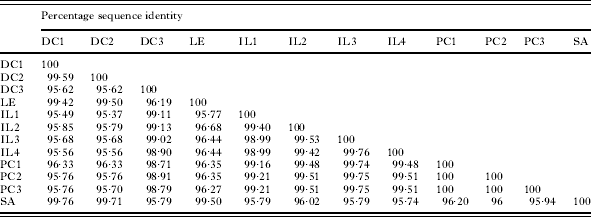
To characterize the genetic diversity of Cytauxzoon spp. globally, we used the sequences reported in this study and those from Cytauxzoon spp. that have been genetically characterized in different domestic and wild felids and ticks from North and South America, Asia and Europe (Table 2). Three different Cytauxzoon sp. 18S rRNA sequences were obtained from the Iberian lynx studied in this work. These sequences differed from each other in a maximum of 0·6% nucleotides but diverged in up to 1·0% with respect to the previously reported sequence of a Cytauxzoon sp. from an Iberian lynx (Luaces et al. Reference Luaces, Aguirre, García-Montijano, Velarde, Tesouro, Sánchez, Galka, Fernández and Sainz2005) (Table 3). Highly identical (>99·4%) 18S rRNA sequences were found in C. felis from cats, wild felids and ticks in North and South America (Table 3). However, these sequences diverged in 3–5% from Asian and European Cytauxzoon spp. sequences, which showed a higher degree of sequence divergence (up to 1·3%) (Table 3).
Percentage identity among 18S rRNA nucleotide sequences between Cytauxzoon species
(Sequences were aligned and percentage identity/similarity was determined using the program AlignX. Abbreviations are described in Table 1.)

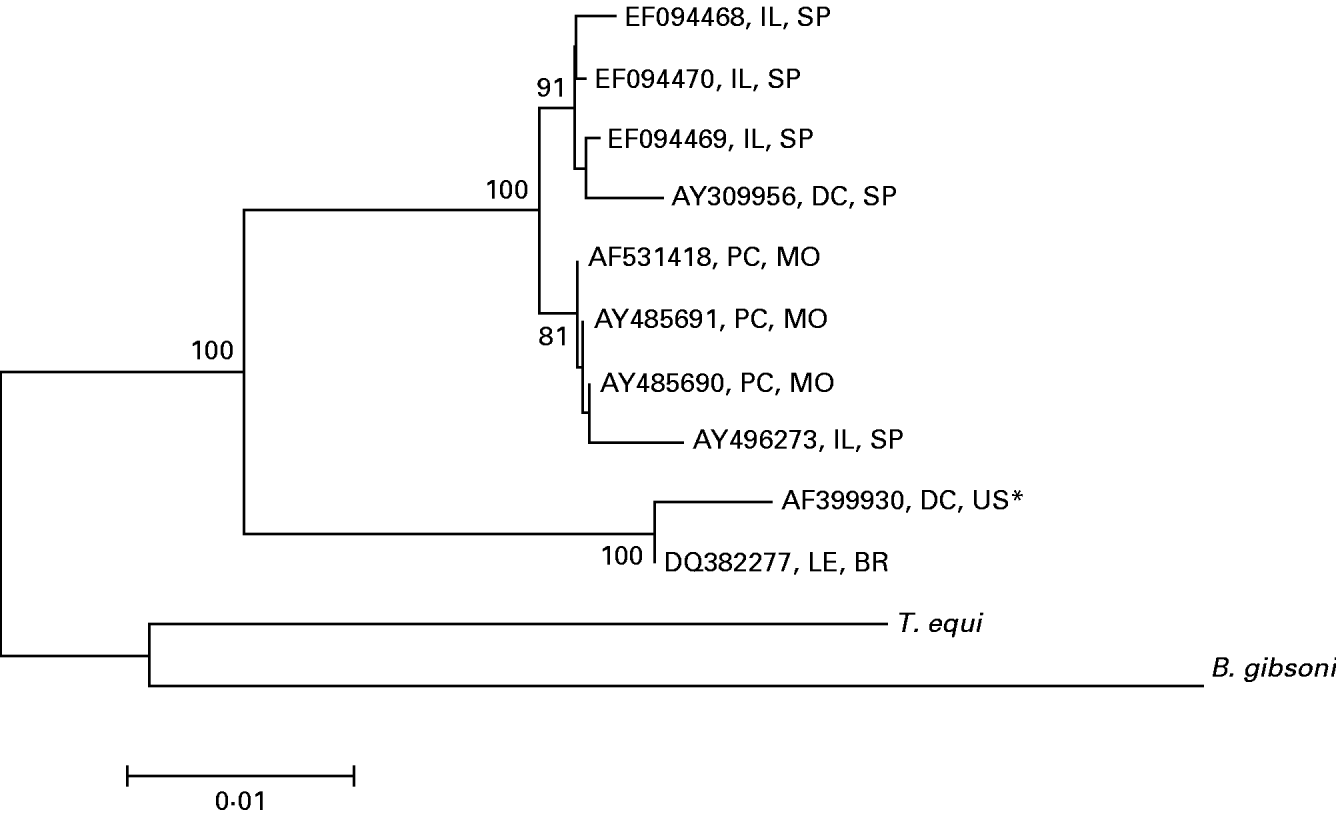
The phylogenetic analysis of Cytauxzoon spp. using the 18S rRNA sequences resulted in 2 well-defined clusters. The Cytauxzoon spp. from Iberian lynx clustered together with organisms obtained from a cat in Spain and Pallas cats in Mongolia (Fig. 1). The second cluster contained C. felis obtained from cats, wild felids and ticks in the United States and Brazil (Fig. 1). The Cytauxzoon sp. from Iberian lynx described here was more closely related to that obtained from the Spanish cat than to the organism previously described in an Iberian lynx, which clustered together with Mongolian Pallas cat C. manul organisms (Fig. 1).
Phylogenetic analysis of Cytauxzoon spp. 18S rRNA sequences based on NJ sequence distance method and 1000 bootstrap iterations. Numbers on branches indicate >70% support for each clade. Cytauxzoon spp. are described in Table 1 and are represented as GenBank sequence Accession number, host, location. Abbreviations: IL, Iberian lynx; DC, domestic cat; PC, Pallas cat; LE, leopard; SP, Spain; MO, Mongolia; USA, United States; BR, Brazil. * Sequences identical to AF399930 have been reported in organisms from Florida panther (USA), Texas cougar (USA) and Amblyomma americanum ticks (USA).

DISCUSSION
Prevalence of Cytauxzoon spp
The primacy of ecological and conservation criteria caused our sample to be age- and sex-biased. Given its conservation status, every capture of a wild Iberian lynx obeyed a very specific purpose. Juvenile lynxes caught in the summer dominated the Sierra Morena sample because this age class was selected to supply the Captive Breeding Program. Adult lynxes were caught in autumn-winter in Doñana because this season was most suitable for concurrent ecological studies.
The prevalence observed in the present study is similar to that reported in bobcats from Oklahoma (United States; Glenn et al. Reference Glenn, Rolley and Kocan1982; Kocan et al. Reference Kocan, Blouin and Glenn1985). The absence of positive results in samples from Doñana agrees with the previous study of Luaces et al. (Reference Luaces, Aguirre, García-Montijano, Velarde, Tesouro, Sánchez, Galka, Fernández and Sainz2005), who did not detect the piroplasm in any of the 47 samples from this area.
The 3 parasitized lynxes were sampled in summer. The lynx analysed by Luaces et al. (Reference Luaces, Aguirre, García-Montijano, Velarde, Tesouro, Sánchez, Galka, Fernández and Sainz2005) was caught in March. In agreement with these findings, Kier and Greene (Reference Kier, Greene and Greene1998) reported that most cases of cytauxzoonosis in domestic cats in the United States were observed between May and September. Although impossible to analyse in this study, the sampling season may affect the prevalence of Cytauxzoon spp. in Iberian lynx due, among other factors, to the life cycle of the currently unknown tick vector in Spain.
Our results did not determine to what extent the parasite is absent from the Doñana area or whether the infection is only detectable during summer months. Sierra Morena and Doñana Iberian lynx populations could have been functionally connected in the past (Rodríguez and Delibes, Reference Rodríguez and Delibes2002). Therefore, the hypothetical absence of Cytauxzoon infections in Doñana would be only possible if the vector tick species is absent from this area or the pathogen has become extinct due to the small population size of the vertebrate host (<50 lynxes; Palomares et al. Reference Palomares, Rodríguez, Laffitte and Delibes1991; Guzmán et al. Reference Guzmán, García, Garrote, Pérez de and Iglesias2004). The possibility of Iberian lynx parasite species becoming extinct together with their host was already suggested for the host-specific louse, Felicola (Lorisicola) isidoroi (Pérez and Palma, Reference Pérez and Palma2001).
Molecular characterization of Cytauxzoon spp
Based on sequence analysis, Reichard et al. (Reference Reichard, Van den Bussche, Meinkoth, Hoover and Kocan2005) proposed a new name, C. manul, for Cytauxzoon sp. found in Pallas cat from Mongolia. The analysis reported here supports the distinction between American and Eurasian Cytauxzoon spp. and suggests that different species or strains may exist in different geographical locations. The results described here also suggest that at least 2 different Cytauxzoon species or strains may infect Iberian lynx in Spain, 1 closely related to C. manul, and a new species described here and different from C. felis and C. manul. However, further analyses with more Cytauxzoon strains will be required to fully address this question.
On the basis of 18S rRNA gene sequences analysed in the present study, the C. felis strains responsible for deaths among cats (Meinkoth and Kocan, Reference Meinkoth and Kocan2005) and presumably in bobcats, the natural reservoir host (Nietfeld and Pollock, Reference Nietfeld and Pollock2002) in the United States are not genetically distinct from the other American C. felis strains that have been obtained and sequenced from non-fatal cases. However, in some instances rRNA sequence analyses cannot differentiate closely related species, subspecies or strains (Fox et al. Reference Fox, Wisotzkey and Jurtshuk1992). Therefore, it is possible that Cytauxzoon spp. strains with different virulence exist but their discrimination may require the use of different gene sequences for analysis.
In conclusion, the present study showed that (i) infections with Cytauxzoon spp. occur in wild Iberian lynx, (ii) the pathogen could be absent from one of the last two lynx metapopulations, and iii) the sequences detected in Iberian lynx are genetically variable and may represent 2 different Cytauxzoon species or strains.
Cytauxzoon felis causes fatal infections in wild bobcat (Nietfeld and Pollock, Reference Nietfeld and Pollock2002) and at least 1 exotic felid, a white tiger, died of cytauxzoonosis in the United States (Garner et al. Reference Garner, Lung, Citino, Greiner, Harvey and Homer1996). These facts reinforce the threat for fatal Cytauxzoon infections in Iberian lynx. Disease risks must be taken into account in the Iberian lynx management strategies, e.g. if translocations or re-introductions are carried out. Coexistence with domestic or feral cats might be an additional source of infection.
The characterization of the genetic diversity in Cytauxzoon spp. isolated from fatal and non-fatal cases of cytauxzoonosis in different feline species and regions of the world may contribute to the understanding of the phylogeny and pathogenicity of different species/strains of the organism and the potential risk for endangered species.
This work is dedicated to Dr A. Alan Kocan† (Oklahoma State University, Stillwater, OK, USA). This is a contribution to the ‘Programa de Actuaciones para la Conservación del Lince en Andalucía II’, Consejería de Medio Ambiente, Junta de Andalucía (CMA). We wish to thank M. A. Simón, R. Cadenas, and the field personnel of CMA; J. V. López-Bao, M. Viota, J. C. Rivilla, F. Palomares and M. Delibes from Estación Biológica de Doñana; F. Martínez and A. Vargas from Iberian Lynx Captive Breeding Program. V. Naranjo was funded by Junta de Comunidades de Castilla – La Mancha, Spain. A. Rodríguez was supported by Consejería de Innovación, Ciencia y Empresa, Junta de Andalucía, Spain.