Bovine milk contains a number of important nutrients such as lipids, vitamins and minerals. Some of the fatty acids in milk, including conjugated linoleic fatty acids (CLA) and the omega-3 group of the polyunsaturated fatty acids, are considered to have positive effects on human health, including anticarcinogenic and antidiabetogenic effects of CLA and improvement of the plasma cholesterol status (Collomb et al. Reference Collomb, Schmid, Sieber, Wechsler and Ryhänen2006, Haug et al. Reference Haug, Hostmark and Harstad2007). The positive effects of CLA are, however, not univocal and are under continuous review. Previous studies indicate that a lower ratio of n-6 to n-3 fatty acids in the human diet is more desirable, reducing the risk of many chronic diseases (Simopoulos, Reference Simopoulos2002; Reference Simopoulos2008).
Vitamins and selenium in milk are also important for the human consumer as well as for the calf and the cow (Haug et al. Reference Haug, Hostmark and Harstad2007, Schrauzer et al. Reference Schrauzer and Surai2009). It is an important quality aspect of milk for human consumption, since milk is generally viewed as a nutritious food and should contain sufficient amounts of naturally occurring vitamins and minerals. Some of the vitamins, such as vitamins A and E, also serve as antioxidants and therefore have a direct impact on the risk of oxidized flavour, one of the most common off-flavour problems in milk (Nicholson et al. Reference Nicholson and St-Laurent1991; Charmley et al. Reference Charmley, Nicholson and Zee1993).
One of the intentions of organic agriculture is to produce high-quality, nutritious food that contributes to health and well-being (IFOAM, 2010). In areas where cows are housed during a significant part of the year, the composition of feed is one of the most important differences between organic and conventional dairy farming. The rules for organic milk production require a more roughage-based feed, no use of genetically modified or synthetic products; the total daily dry matter proportion of concentrates should not exceed 50% during the first 3 months of lactation and thereafter not more than 40%. Furthermore, organically managed cows usually have a longer grazing season than conventionally managed cows. Previous studies of milk composition have concluded that nutrient composition depends partly on the feeding regime (Palmquist et al. Reference Palmquist, Beaulieu and Barbano1993, Butler et al. Reference Butler, Nielsen, Slots, Seal, Eyre, Sanderson and Leifert2008) but factors such as breed, geographical location and season are also influential (Ellis et al. Reference Ellis, Innocent, Grove-White, Cripps, McLean, Howard and Mihm2006; Collomb et al. Reference Collomb, Bisig, Bütikofer, Sieber, Bregy and Etter2008).
There is, however, only a limited amount of information about differences in milk composition between organic and conventional herds. Differences in fatty acid composition in milk between organic and conventional herds have been found (Jahreis et al. Reference Jahreis, Fritsche and Steinhart1997; Ellis et al. Reference Ellis, Innocent, Grove-White, Cripps, McLean, Howard and Mihm2006; Butler et al. Reference Butler, Nielsen, Slots, Seal, Eyre, Sanderson and Leifert2008; Slots et al. Reference Slots, Butler, Leifert, Kristensen, Skibsted and Nielsen2009) and there are indications that milk from organically and conventionally managed herds differ in the content of vitamin E and carotenoids (Nielsen et al. Reference Nielsen, Lund-Nielsen and Skibsted2004; Ellis et al. Reference Ellis, Innocent, Grove-White, Cripps, McLean, Howard and Mihm2007) as well as in the content of selenium (Toledo et al. Reference Toledo, Andrén and Björck2002). However, since organic milk production is becoming more and more common, for example, it now exceeds 7·5% of all Swedish dairy cows (Ekolantbrukarna, 2008), it is important to verify results of previous studies.
The objective of this study was to investigate whether there are differences in the fatty acid composition and the concentration of vitamins and selenium in milk between organic and conventional dairy herds in Sweden.
Material and Methods
Study design, herds and data
Thirty-seven herds, geographically located in a south-eastern area of Sweden (Uppland, Sörmland, Östergötland, and Småland) were included in this study. The selection was done among herds with >40 cows participating in the Swedish official milk recording scheme, and not planning to close down their business, at least not before the year 2007. Only organic farms that had produced milk according to the Swedish organic standards (www.krav.se) for >2 years, and, in accordance with the concurrent rules, fed 95% organic feed and 5% conventional feed were enrolled. Twenty organic and 20 conventional herds were originally selected for the study, but samples were only received from 18 organically and 19 conventionally managed herds. Bulk milk tank samples were collected from each herd during three consecutive months during the winter 2005–2006 (December–February). Information on the average yearly milk yield and herd size originated from the milk recording scheme. Information on housing and roughage/concentrate ratio was collected through herd inspections and questionnaires.
Sample analysis
A total of 111 milk samples were transported on ice to the Danish Institute of Agricultural Sciences, Tjele, Denmark, for analysis of α-tocopherol, β-carotene and retinol contents. Thirty-seven of those samples, one per herd and sampled in February, were also analysed for fatty acid content at the same laboratory. The procedures have been described previously for measuring retinol (Jensen, Reference Jensen1994) and β-carotene, α-tocopherol and fatty acid content (Jensen et al. Reference Jensen and Nielsen1996). Milk selenium content was analysed at the Swedish National Veterinary Institute, Uppsala, Sweden, by procedures described by Galgan & Frank (Reference Galgan, Frank, Brätter and Schramel1988, Reference Galgan and Frank1993). The group of total n-3 polyunsaturated fatty acids comprised 18:3 (n-3) (α-linolenic acid), 20:3 (n-3) (eicosatrienoic acid), 20:5 (n-3) (eicosapentaenoic acid), 22:5 (n-3) (docosapentaenoic acid), 22:6 (n-3) (docosahexaenoic acid) and 18:4 (n-3) (stearidonic acid). The group of total n-6 polyunsaturated fatty acids comprised 18:2 (n-6) (linoleic acid), C18:3 n-6) (γ-linolenic acid) 20:3 (n-6) (homo-γ-linolenic acid) and 20:4 (n-6) (arachidonic acid).
Statistical analysis
Linear mixed models were used to study the possible relations between the main predictor, i.e. management type, and relative bulk tank milk content of total n-3 fatty acids, total n-6 fatty acids, CLA, selenium, retinol, β-carotene and α-tocopherol and the ratio of total n-6 to total n-3 fatty acids. Contents of total n-3, total n-6 and CLA were calculated as percentage of the total fatty acid content in the bulk tank milk. In addition to management type the predictor variables for the analyses of fatty acid composition were: housing type, milk fat percentage in the milk sample, herd size, average milk yield, herd breed, and time on pasture during summer. In the analyses of vitamins and selenium, month of testing was also added to the tested predictor variables.
Owing to repeated measurements in the analyses of vitamins and selenium there were two hierarchical levels in those data. Hence, a random herd effect was included in those models. Management type, housing and milk fat percentage were introduced as dichotomous variables, i.e. organic or conventional, loose housing or tie stall and high or low milk fat percentage, respectively. Herd size, herd average milk yield and weeks on pasture were classified in three categories, i.e. low/small/short, medium and high/large/long. Herds with less than 55 cows were categorized as small, 55–68 cows were categorized as medium and 69 or above as large. Herds with an average milk yield less than 8594 kg/year were categorized as low, herds with 8595–9270 kg/year were categorized as medium and herds above 9270 kg/year were categorized as high-yielding. Herds with less than 16 weeks of pasture were categorized as short, herds with 16–20 weeks of pasture were categorized as medium and herds with more than 20 weeks of pasture were categorized as having long grazing time. Month of testing was introduced as a categorical variable with three classes: December, January and February. Spearman correlation coefficients were used to assess potential collinearity between all possible predictor variables. Model building in all models was done by backward stepwise elimination of main effects with P<0·2 (F test) as the exclusion and re-entering criterion. The variable management type was forced to remain in all the models because it was the predictor of main interest. All possible first-order interactions were subsequently added to the model and the backward stepwise-elimination process was continued until all remaining effects had P<0·1. Confounding was assessed at each step of model development by inspecting changes in parameter estimates. Any changes >20% were considered to indicate confounding.
Fit of the mixed linear models was visually assessed by using plots of standardized residuals against the predicted values at the lowest hierarchical level and by using a normal probability plot in which the lowest level residuals were plotted against the quartiles. Influential observations were detected after examining Cook's distances and ‘difference in fit’ (DFFITS). All statistical analyses were performed using SAS® (SAS Institute, 2004).
Results and Discussion
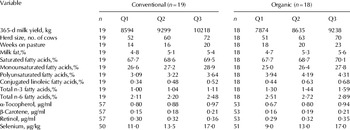
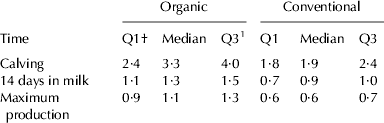
The distribution of the continuous predictors and outcomes are presented in Table 1. In addition, a summary of the median, first and third quartiles of total saturated fatty acids, monounsaturated fatty acids, and polyunsaturated fatty acids are also presented in Table 1. Loose housing was more frequent in organically (12 out of 18) than in conventionally (7 out of 19) managed herds. Questionnaire results on feeding are shown in Table 2 and demonstrate a more roughage-based feed for organically than conventionally managed cows. The herd breed distribution was even between organic and conventional herds. From the organic (n=18) and the conventional (n=19) cohorts, respectively, two and two herds had predominantly (>90%) Swedish Holstein breed, seven and six herds had predominantly (>90%) Swedish red breed, and nine and eleven herds had a mix of breeds.
Overall medians (Q2) and 1st and 3rd quartiles (Q1, Q3) of farm characteristics according to farm type

Dry matter roughage/concentrate ratio at three stages in lactation in 18 organic and 19 conventional Swedish dairy farms
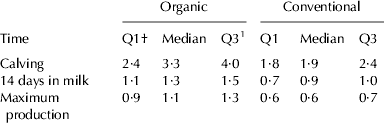
† Q1 represents the 25th percentile and Q3 represents the 75th percentile
Fatty acid composition
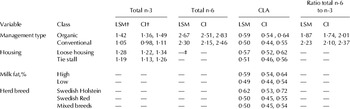
The analysis of relative fatty acid content included 37 samples. Results from the final models of total n-3 fatty acids, total n-6 fatty acids, CLA and the ratio of n-6 to n-3 are presented in Table 3. Management type was significantly associated with total n-3 fatty acids (P<0·001), total n-6 fatty acids (P=0·002), CLA (P=0·008) and the ratio of n-6 to n-3 (P=0·006). Organic management presented higher total n-3, and n-6 fatty acids and a lower ratio of n-6 to n-3.
Effects of various variables on total n-3 fatty acids fatty acids, total n-6 fatty acids, and conjugated linoleic acid (CLA) contents (%) and on the ratio of total n-6 to n-3 fatty acids estimated in linear model analyses

† LSM, least squares mean; CI, 95% confidence interval
‡ — P>0·1
The demonstrated difference in fatty acid composition of bulk tank milk is in accordance with other studies (Ellis et al. Reference Ellis, Innocent, Grove-White, Cripps, McLean, Howard and Mihm2006; Lavrenčič et al. Reference Lavrenčič, Levart and Salobir2007; Bloksma et al. Reference Bloksma, Adriaansen-Tennekes, Huber, van der Vijver, Baars and de Wit2008; Butler et al. Reference Butler, Nielsen, Slots, Seal, Eyre, Sanderson and Leifert2008; Collomb et al. Reference Collomb, Bisig, Bütikofer, Sieber, Bregy and Etter2008; Slots et al. Reference Slots, Butler, Leifert, Kristensen, Skibsted and Nielsen2009). These studies suggest that the main reason for these differences is found in the amounts of grass and grass silage compared with the amounts of concentrates given to the cows. The higher proportion of roughage in the organic herds in our study and the high collinearity between roughage to concentrate ratio and management type, preventing both variables from being included simultaneously in the statistical model, support this hypothesis. We did not find any effects of time on pasture during summer, which also would be related to the amounts of grass and grass silage in the diet, but any effects of pasture length is likely to be reduced considerably at the time of our sampling (December–February) since the pasture season in this part of Sweden usually ends in September–October. However, the fatty acid composition can possibly be affected by the botanical composition of the roughage as well as by a different ruminal ecosystem (Chilliard et al. Reference Chilliard, Ferlay and Doreau2001) and breed differences (Toledo et al. Reference Toledo, Andrén and Björck2002), but we had no information about the former and only found a significant breed effect on CLA content.
The least square means of total n-3 and total n-6 fatty acids were both significantly higher in the organic than in the conventional cohort. Compared with a Swiss study by Collomb et al. (Reference Collomb, Bisig, Bütikofer, Sieber, Bregy and Etter2008), the proportions of total n-3 were quite similar to our study month, whereas a British study by Ellis et al. (Reference Ellis, Innocent, Grove-White, Cripps, McLean, Howard and Mihm2006) demonstrated similar proportions in the organic cohort but a markedly lower proportion of total n-3 fatty acids in the conventional cohort in February. Ellis et al. (Reference Ellis, Innocent, Grove-White, Cripps, McLean, Howard and Mihm2006) found marginally lower proportions of total n-6 fatty acids in both cohorts compared with our study but, in contrast to our study, the total n-6 fatty acid proportion was smallest in the organic cohort. The high ratio of total n-6 to n-3 fatty acids in today's Western diets has been highlighted as a promoter of the pathogenesis of cardiovascular disease, cancer, inflammatory and autoimmune diseases in recent years, whereas increased levels of total n-3 fatty acids (a low total n-6 to n-3 ratio) exert suppressive effects (Simopoulos, Reference Simopoulos2002). According to Simopoulos (Reference Simopoulos2002) the ideal ratio is 1:1 and, in our study, organic milk had a ratio of 1·9:1 compared with the conventional milk with a ratio of 2·2:1. In two British studies (Ellis et al. Reference Ellis, Innocent, Grove-White, Cripps, McLean, Howard and Mihm2006; Butler et al. Reference Butler, Nielsen, Slots, Seal, Eyre, Sanderson and Leifert2008) and a Danish study (Slots et al. Reference Slots, Butler, Leifert, Kristensen, Skibsted and Nielsen2009) there were more distinct differences in the total n-6 to n-3 fatty acid ratio between organic and conventional milk. During the period from December to February the ratio ranged from 1·5:1 to 2:1 in the organic group and from 3:1 to 3·5:1 in the conventional group in one of the British studies (Ellis et al. Reference Ellis, Innocent, Grove-White, Cripps, McLean, Howard and Mihm2006), whereas the average ratio in the study by Butler et al. (Reference Butler, Nielsen, Slots, Seal, Eyre, Sanderson and Leifert2008) was 2·7:1 in the high-input conventional and 1·3:1 in the organic milk. The Danish study (Slots et al. Reference Slots, Butler, Leifert, Kristensen, Skibsted and Nielsen2009) showed a ratio of 1·9:1 in organic and 4·7:1 in conventional milk. In a Slovenian study (Lavrenčič et al. Reference Lavrenčič, Levart and Salobir2007), the differences were in the same direction as in the other studies, but of more marginal size, as in our study. A likely explanation of why the ratio was so similar between organic and conventional milk in our study is that almost all Swedish dairy cow diets are roughage-based, with grass/clover silage as the most common roughage type. This observation is valid for both types of herds, at least within the area of study. The concentrates used in organic and conventional production in Sweden are also rather similar in their nutritional composition. Differences between organic and conventional feedstuffs are thus probably less pronounced in Sweden than in most other countries, where for instance maize silage is more common in conventional systems. Furthermore, in Sweden there are no essential breed differences between organic and conventional production that could affect fatty acid composition. There were, however, significant differences under Swedish conditions as well, even if the biological relevance is uncertain. One difficult condition to meet in performing large-scale field studies is, unfortunately, to obtain accurate information on feed and feed composition. We chose to overlook this shortcoming because we considered it far more important to study the actual bulk tank milk composition under field conditions than to study this under experimental conditions with strict control over the feed.
Lately, the dietary content of CLA has attracted much interest as it is considered to have a positive effect on consumer health. In our study, the organic milk had a higher CLA content than the conventional milk. The main source of CLA for the human consumer is of dairy origin (Voorrips et al. Reference Voorrips, Brants, Kardinaal, Hiddink, van den Brandt and Goldbohm2002) which is why the demonstrated difference could be of nutritional importance for man. A Dutch study on CLA content in human breast milk supports the nutritional importance of dairy products. Mothers, consuming a diet in which milk and meat were predominantly organic, produced milk with a higher CLA concentration than mothers with a diet including little organic milk and meat (Rist et al. Reference Rist, Mueller, Barthel, Snijders, Jansen, Simões-Wüst, Huber, Kummeling, Von Mandach, Steinhart and Thijs2007). Our results (levels and interrelationships) were in accordance with some earlier studies (Jahreis et al. Reference Jahreis, Fritsche and Steinhart1997; Bergamo et al. Reference Bergamo, Fedele, Iannibelli and Marzillo2003; Collomb et al. Reference Collomb, Bisig, Bütikofer, Sieber, Bregy and Etter2008). Ellis et al. (Reference Ellis, Innocent, Grove-White, Cripps, McLean, Howard and Mihm2006) did not, however, demonstrate any significant difference between the groups, but there was a tendency for higher content in organic milk and the levels were similar to the other studies. In a Danish study (Nielsen et al. Reference Nielsen, Lund-Nielsen and Skibsted2004), the CLA contents in organic and conventional storage tank milk at a dairy plant were, however, described as identical.
The study is based on samples from the winter season of 2005–2006, a time when the European legislation specified that organically managed dairy cows were to be fed organically produced feed, although 5% conventionally produced feed was allowed (until 2008). The current legislation (EEC, 2007), prescribes 100% organically produced feed in organic milk production. However, the demonstrated differences in our study probably underestimate the current situation with 100% organic feedstuffs. The nutritional importance of the demonstrated differences in our study may, however, be discussed. A daily consumption of 0·5 l of milk from the respective production systems would, on a yearly basis, make a difference of only 30 g of total n-3 and total n-6 fatty acids and 10 g of CLA.
Vitamins and selenium
The analyses of vitamins included 111 milk samples and the results from the final models did not show any significant differences between organic and conventional management for retinol (P=0·09), β-carotene (P=0·57) or α-tocopherol (P=0·26). None of the predictor variables stayed in any of the three models. The analyses of selenium also included 111 milk samples and the result from the final models did not show any significant difference between organic and conventional management (P=0·14).
An earlier British study (Ellis et al. Reference Ellis, Innocent, Grove-White, Cripps, McLean, Howard and Mihm2007) compared vitamins A (retinol) and E (α-tocopherol) and β-carotene in organic and conventionally produced milk during one year. Farming system was shown to affect the vitamin A concentration, with lower concentrations in organic than in conventional milk. Furthermore the study found effects on vitamin content of factors such as season, herd yield and access to fresh pasture. A Danish investigation of storage tank milk from a dairy plant, performed from May to February, showed elevated concentrations of vitamin E and carotenoids in organic compared with conventional milk (Nielsen et al. Reference Nielsen, Lund-Nielsen and Skibsted2004). The authors suggested that differences in feeding regimens, where maize silage is used extensively in conventional production whereas a considerable amount of grass and leguminous plants are used in the organic production, was the explanation for the differences. In our study, none of the studied vitamins or β-carotene was affected by farming system or, in fact, by any of the potential predictor variables tested. As previously mentioned, the differences in organic and conventional feedstuffs and animal breeds are marginal in Sweden and therefore the lack of differences in our study was somewhat expected. Secretion of vitamins A and E and β-carotene has been shown to be affected by the energy status of the cow where low energy intake and decreased milk vitamin and β-carotene content are associated (Noziere et al. Reference Noziere, Grolier, Durand, Ferlay, Pradel and Martin2006). However, under Swedish conditions there are no signs of differences in energy status between organic and conventional cows (Fall et al. Reference Fall, Grohn, Forslund, Essen-Gustafsson, Niskanen and Emanuelson2008). In support of our findings, Toledo et al. (Reference Toledo and Andrén2003) could not demonstrate any difference in β-carotene or selenium concentrations between organic and conventional milk under Swedish conditions.
In conclusion, there were significant differences in n-3 fatty acid, n-6 fatty acid composition and CLA between Swedish organic and conventional milk; however, the differences were rather small and the biological significance for the consumer may be of minor importance. Both Swedish conventional and organic milk actually show a desirable ratio of total n-6 to total n-3 fatty acids. Concerning vitamin and selenium concentrations there were no significant differences. One of the most likely explanations of the similarities in milk composition between the production systems in Sweden is the relatively similar feeding regimens between organic and conventional management, with a high proportion of grass/clover silage as the most common roughage type.
The authors thank the The Swedish Farmers' Foundation for Agricultural Research for financial support. The authors also acknowledge the Swedish Dairy Association, Søren Krogh Jensen and Lars Petersson for great help in performing the study.