1 Introduction
This article examines the special use of when clauses in examples like the following:Footnote 2
-
(1) The boy was driving like the wind when suddenly we hit something. (BNC DCX 152)
In such sentences when initiates a clause (henceforth w-clause) and links it to a preceding base clause (henceforth b-clause)Footnote 3 in such a way that the w-clause asserts a new situation against the background of the situation expressed by the b-clause. Such w-clauses are called narrative (in the sense defined formally by Labov & Waletzky Reference Labov, Waletzky and Helm1967 and Labov Reference Labov1972: 359ff.) because they express a new foregrounded situation adding to the central storyline presented by the speaker or writer. As Declerck (Reference Declerck1997: 37) puts it, narrative when clauses “push forward the action”. Examples like (1) stand in contrast to regular temporal w-clauses in postposition like:
-
(2) The Clinton team had no real defence plans when it took office. (BNC CR7 1022)
In this sentence it is the b-clause that expresses the central situation (‘the Clinton team having no real defence plans’), while the w-clause simply specifies this situation temporally by relating it to another situation in the context (‘it taking office’). The w-clause here both looks like a subordinate clause and behaves like one: traditionally it is considered fully integrated in the b-clause as a temporal adverbial,Footnote 4 and when is analysed as a subordinating conjunction, i.e. a connector which subordinates the content of the rest of the clause to qualify the b-clause situation. By contrast, although narrative w-clauses look like subordinate clauses they behave more like main clauses and thus belong in a much more general research area dealing with main clause phenomena outside main clauses: MCP – in generative grammar also referred to as root transformations (see Hooper & Thompson Reference Hooper and Thompson1973; Green Reference Green1976; Aelbrecht, Haegeman & Nye Reference Aelbrecht, Haegeman and Nye2012).Footnote 5 That when clauses in postposition have a narrative potential is in fact rather surprising: there seems to be a discrepancy between their syntactic status (which is normally regarded as subordinate) and their communicative function (which is similar to that of main clauses). I have elsewhere referred to this discrepancy as the ‘narrative when enigma’ (Bache Reference Bache, Schatz-Jakobsen, Simonsen and Pettitt2015).
Narrative w-clauses have received little descriptive attention in standard comprehensive English grammars. There is thus no mention of them in Huddleston & Pullum's otherwise impressive – and voluminous – Cambridge University Press grammar from 2002. Quirk et al. (Reference Quirk, Greenbaum, Leech and Svartvik1972, Reference Quirk, Greenbaum, Leech and Svartvik1985) do recognize their existence in a footnote (Reference Quirk, Greenbaum, Leech and Svartvik1972: 744–5; Reference Quirk, Greenbaum, Leech and Svartvik1985: 1084), but have very little to say about them apart from a brief comment on their special stylistic effect. Nor is there any mention of them in my own and Davidsen-Nielsen's Mouton de Gruyter grammar from 1997. However, the construction has been subjected to close examination in more specialized studies on discourse and on grammar, especially by Couper-Kuhlen (Reference Couper-Kuhlen, Matthews and Schmole-Rostosky1988, Reference Couper-Kuhlen and Tomic1989a) and Declerck, who devoted a whole chapter to it in his monograph on w-clauses (Reference Declerck1997: 212–29). Couper-Kuhlen and Declerck do not quite come to grips with the apparent lack of correspondence between form and content in narrative w-clauses, but they do provide an excellent starting point for my attempt in this article to describe the construction in a more satisfactory manner, as will be apparent below.
There are other uses of when in English than the ones illustrated in examples (1) and (2) above: it regularly serves as an adverbial wh-question word, as a relative pronoun in both restrictive and nonrestrictive relative clauses, and as an independent (‘fused’) relative pronoun; for a detailed typology, see Declerck (Reference Declerck1997: 6–44). But narrative w-clauses are often specifically compared with temporal w-clauses in postposition, and it is often assumed that their formal analysis is the same. Two examples from Green (Reference Green1976: 392f.) illustrate both the similarity and the contrast involved:
-
(3) He was washing the dishes when the dog came in. (temporal)
-
(4) He was washing the dishes when in came the dog. (narrative)
Green points out that the syntactic forms are ‘identical’ in these sentences, except for the inversion triggered by the fronting of the adverb in in (4), which is an MCP. She also notes that only (3) is acceptable as an answer to the question ‘When was he washing the dishes?’, which indicates that the w-clause in (3) is a temporal w-clause. In (4), she further argues, the ‘embedded’ w-clause is assertive, and this is why (4) is unacceptable as an answer to the question and why the sentence can be restated (although less vividly) in (5), where the narrative w-clause of (4) becomes the b-clause, and the previous b-clause becomes a temporal w-clause:
-
(5) In came the dog when he was washing the dishes. (temporal)
So what we have in examples like (4) seems to be ‘[a] complete reversal of the normal relation between subordinate and superordinate clauses’ (Quirk et al. Reference Quirk, Greenbaum, Leech and Svartvik1972: 745).Footnote 6 The sentence first and foremost conveys that the dog came in, and that this happened while ‘he’ was washing the dishes. The b-clause sets the scene for what happens in the w-clause. In terms of background and foreground, the b-clause is background and the w-clause is foreground (see Couper-Kuhlen Reference Couper-Kuhlen, Matthews and Schmole-Rostosky1988, Reference Couper-Kuhlen and Schopf1989b).
However, things are even more complex because, strictly speaking, depending on the context, (3) could be interpreted as having an alternative, narrative reading. This becomes very clear if we add the optional adjunct suddenly:
-
(6) He was washing the dishes when suddenly the dog came in.
But even without suddenly the w-clause in (3) may be understood narratively if spoken with what Haegeman (Reference Haegeman, Coene, De Cuyper and D'Hulst2004: 68) calls ‘comma intonation’, i.e. as a prosodically independent tone group, and perhaps with a more dramatic voice. Imagine, for example, an adult reading a story to a child and making his voice husky when he reaches the w-clause:
-
(7) He was washing the dishes, when the dog came in .
The challenge that I want to take up in this article is to provide an adequate description of narrative w-clauses which is sensitive to both the formal and the pragmatic characteristics of the construction, and which examines the possibility of aligning form and content. Before presenting a new approach (section 5), we need to get a better sense of the difficulties involved in the task of describing narrative w-clauses adequately: (a) we must briefly review and comment on some of the characteristics of narrative w-clauses already established in the literature (section 2); (b) we must determine whether narrative w-clauses are in fact ‘subordinate’ like temporal w-clauses (section 3); and (c) we must examine more carefully the precise effect of using a narrative w-clause (section 4).
2 Characteristics of narrative w-clauses
Narrative w-clauses are characterized by a number of features, as generally recognized in the literature:
(A) Postposition
Narrative w-clauses are positionally restricted to postposition while temporal w-clauses may both precede and follow the b-clause (Couper-Kuhlen Reference Couper-Kuhlen and Tomic1989a: 361; Declerck Reference Declerck1997: 218):
-
(3) He was washing the dishes when the dog came in. (temporal)
-
→ When the dog came in, he was washing the dishes.
-
(4) He was washing the dishes when in came the dog. (narrative)
-
→ *When in came the dog, he was washing the dishes.
(B) Iconic sequencing
Sentences containing narrative w-clauses always display iconic sequencing in that the sequence ‘b-clause followed by w-clause’ reflects the actual order in which the situations expressed begin or take place. Sentences containing temporal w-clauses, whether preposed or postposed, are not necessarily iconic in this way (for discussion of situational sequence and constraints on types of situation combined, see Moens & Steedman Reference Moens and Steedman1988). However, the effect of narrative w-clauses cannot be explained simply with reference to the sequence of situations in either the world referred to or the basic storyline. By choosing a narrative when construction, the speaker or writer makes a deliberate choice of circumstantial situation to be referred to by the b-clause in order to prepare the ground for the situation to be referred to by the w-clause. This latter situation is typically unexpected and coincidental in relation to the b-clause situation, and this adds to the effect of the w-clause as a punch line. To create this special effect of the w-clause, the speaker or writer draws on several linguistic resources in addition to iconic sequencing as a presentational strategy, as we shall see below.
(C) Prosodic independence
Narrative w-clauses are typically prosodically independent of the b-clause while temporal w-clauses in postposition are prosodically integrated in the b-clause (Couper-Kuhlen Reference Couper-Kuhlen and Tomic1989a: 360; Declerck Reference Declerck1997: 225) unless other factors like weight and relative communicative prominence intervene. In writing we often (but far from always) get a comma separating the b-clause and the narrative w-clause.
(D) No clefting
Narrative w-clauses do not allow syntactic focus operations like clefting (or lose their status as narrative w-clauses if cleaved); see Declerck (Reference Declerck1997: 218f.):
-
(4) He was washing the dishes when in came the dog. (narrative)
-
→ *It was when in came the dog that he was washing the dishes.
By contrast temporal w-clauses allow clefting:
-
(3) He was washing the dishes when the dog came in. (temporal)
-
→ It was when the dog came in that he was washing the dishes.
As Quirk et al. (Reference Quirk, Greenbaum, Leech and Svartvik1985: 1071) point out, adjuncts more generally (including temporal adverbials) allow clefting, whereas disjuncts and conjuncts, which are more independent of clause structure, do not. The clefting test shows that narrative w-clauses do not qualify as adjuncts, which again indicates that they are more independent of the preceding b-clause than temporal w-clauses.
(E) Main clause phenomena
In narrative w-clauses we find a number of MCP (Declerck Reference Declerck1997: 222f.). As we see in (4), narrative w-clauses allow preposed adverbial particles like in and here in exclamations with full inversion. This feature is predictably blocked in temporal w-clauses. We even find exclamatory onomatopoeic interjections replacing most of the clause:
-
(8) There's this guy walking down Piccadilly, when suddenly – woomph! (BNC GOF 2153)
This reveals a certain illocutionary independence and variation in the narrative w-clause.
Another MCP in narrative w-clauses is the potential use of the dramatic historic present tense independently of the choice of tense in the b-clause:
-
(9) Around two in the morning she was just nodding off when suddenly her telephone rings again. (BNC JYF 1463)
More generally, as Declerck (Reference Declerck1997: 225ff.) shows, the basic choice of tense in narrative w-clauses follows main clause rules. By contrast, in sentences with temporal w-clauses, tense choice in the b-clause governs tense choice in the w-clause.
(F) Aktionsart
Sentences containing narrative w-clauses display a certain regular distribution of Aktionsart in the two clauses, with b-clauses typically expressing unbounded (stative, durative, relational) situations and narrative w-clauses typically expressing bounded (punctual, telic, inchoative) situations (see Couper-Kuhlen Reference Couper-Kuhlen and Schopf1989b: 21ff.; Declerck Reference Declerck1997: 224; for a more general discussion of aspect and Aktionsart as well as the terminology employed, see Bache Reference Bache1982, Reference Bache1986, Reference Bache1997, Reference Bache2008, Reference Bache, Fontaine, Bartlett and O'Grady2013):
-
(10) Fabia was cutting into a slice of cheese when suddenly she halted. (BNC JYF 444)
In the w-clause the bounded expression is often reinforced by adverbials expressing suddenness and unexpectedness (see subsection B above), such as suddenly in (9) and (10). By contrast, in sentences containing temporal w-clauses, the choice of Aktionsart in the two clauses is much more independent.
The characteristics of narrative w-clauses listed above lead to two opposite conclusions not generally recognized in the literature: narrative w-clauses are at once both less dependent and more dependent on the b-clause than temporal w-clauses. Narrative w-clauses are less dependent in that they constitute a separate tone group (and information unit), they fail an important test for adjuncthood (clefting), and they may display certain MCP (inversion triggered by adverbial particle fronting, illocutionary independence, tense choice). But, at the same time, narrative w-clauses are positionally restricted like central obligatory b-clause constituents, they are sequentially iconic and they enter a much tighter Aktionsart pattern with the b-clause than temporal w-clauses. These last features indicate a high degree of dependence on the b-clause.
Part of the descriptive challenge is to capture this special mixture of features characterizing narrative w-clauses. Note also that the presence of several MCP in narrative w-clauses adds another element to the descriptive challenge: the status of a narrative w-clause in relation to the b-clause – a problem that we shall turn to in the next section.
3 Are narrative w-clauses subordinate clauses?
In the preceding sections we have noted that narrative w-clauses look like subordinate clauses and that they are in fact often simply assumed to be subordinate. Quirk et al. characterize sentences containing narrative w-clauses by saying that ‘The more important information is given in the subordinate clause’ (Reference Quirk, Greenbaum, Leech and Svartvik1985: 1084, italics added).
Declerck does not elaborate on the syntactic status of narrative w-clauses, but indirectly he seems to accept that they are formally dependent and embedded, judging from the following comment on tense choice: ‘The claim that a narrative WC [= w-clause] depending on an unembedded clause with an absolute tense form also establishes a domain is confirmed by the fact that . . .’ (Reference Declerck1997: 225, italics added). And a few pages later (Reference Declerck1997: 229) he clearly recognizes a discrepancy between form and function: ‘though syntactically the HC [= b-clause] is the “main clause”, the narrative WC is the “main clause” from the point of view of interpretation’.
Couper-Kuhlen very explicitly refers to narrative w-clauses as subordinate (Reference Couper-Kuhlen, Matthews and Schmole-Rostosky1988: 359, 365; Reference Couper-Kuhlen and Tomic1989a: 362, 368; Reference Couper-Kuhlen and Schopf1989b: 12) and to narrative when as a subordinating conjunction (Reference Couper-Kuhlen and Tomic1989a: 359). But because of the special textual impact of narrative w-clauses, she argues for disconnecting clausal structure and function. In such an analysis subordination is identified and determined on strictly text-functional criteria, and syntax is a ‘secondary consideration’ to be sorted out later independently of the pragmatic interpretation of the construction (see 1989a: 369). In this approach she is inspired by Matthiessen & Thompson's (Reference Matthiessen, Thompson, Haiman and Thompson1988) rhetorical-structure approach to texts with rhetorical nuclei and rhetorical satellites as basic components. Matthiessen & Thompson predict that in clause combinations the main clause codes the rhetorical nucleus and the subordinate clause codes the rhetorical satellite. At the end of their text analysis they conclude that to ‘a satisfying extent, this prediction is borne out’ (Reference Matthiessen, Thompson, Haiman and Thompson1988: 308). For example, a temporal w-clause (as in He was washing the dishes when the dog came in) is unproblematically viewed as having a supporting ‘text goal’, whereas the main clause has a central ‘text goal’ (Reference Matthiessen, Thompson, Haiman and Thompson1988: 310).
Sentences containing narrative w-clauses are special, Matthiessen & Thompson admit, in not following this relationship between syntax and rhetorical structure. In such sentences, it is the w-clause that codes the nucleus and the main clause that codes the satellite. But instead of being disheartened by this counter-evidence to their hypothesis, they consider the existence of such constructions to be a useful exception to the rule, allowing them to fend off any allegations of adhocness and circularity.
It is important to note that in their discussion of syntax and rhetorical functions Matthiessen & Thompson come up with a new, more specialized understanding of what ‘subordination’ means: it is the rhetorical relation in discourse of a satellite to a nucleus, typically but not inevitably realized by main clauses in clause combinations (1988: 309). They conclude that ‘there is no advantage to postulating a grammatical category of “subordinate clause”’(Reference Matthiessen, Thompson, Haiman and Thompson1988: 317), and thus give descriptive priority to function over form.
As discussed in more detail in Bache (Reference Bache, Schatz-Jakobsen, Simonsen and Pettitt2015: 15–17), Cristofaro (Reference Cristofaro2003) also ‘disconnects’ clausal structure and function, giving priority to the latter, at least initially, but for a different reason. She argues that only a truly functional point of departure allows the investigator to carry out a proper typological study of a phenomenon and to compare the typically very different language-specific forms expressing the meaning(s) associated with that phenomenon. Finding inspiration in Langacker's (Reference Langacker1991) cognitive grammar, she defines subordination in terms of ‘the asymmetry assumption’ (2003: 33ff.):
By subordination will be meant a situation whereby a cognitive asymmetry is established between linked SoAs [= states of affairs, situations], such that the profile of one of the two (henceforth the main SoA) overrides that of the other (henceforth, the dependent SoA). This is equivalent to saying that the dependent SoA is (pragmatically) non-asserted, while the main one is (pragmatically) asserted. (2003: 33)
This is not dissimilar to Matthiessen & Thompson's approach, but the asymmetry in Cristofaro's assumption hinges more explicitly on cognition and the notion of pragmatic assertion than on textual structure. According to her definition, the w-clause in the following example is subordinate because the profile of ‘the little boy screaming’ overrides that of ‘the nurse touching his left shoulder’ (and the b-clause is assertive while the w-clause is non-assertive):
-
(11) The little boy screamed when the nurse touched his left shoulder.
The relative profiling of situations is completely different in sentences with a narrative w-clause:
-
(12) Ann was playing the piano when Jack suddenly rushed out of the room.
Here the profiling of ‘Jack suddenly rushing out of the room’ overrides that of ‘Ann playing the piano’. The communicative motivation for saying (12) is not so much to tell the addressee that Ann was playing the piano but to convey that Jack suddenly rushed out of the room and that it happened while Ann was playing the piano. Like the w-clause in (11), the b-clause in (12) thus has a supportive role in relation to the other clause (expressing the circumstance under which the situation referred to by the other clause happened) and is thus, strictly speaking, subordinate on Cristofaro's definition. However, unlike the w-clause in (11), the b-clause in (12) has some assertive force. If someone says (12), our immediate understanding of the sentence is that the speaker asserts both situations, not just one of them: ‘Ann playing the piano’ and ‘Jack suddenly rushing out’, with the situation expressed by the w-clause being pragmatically the primary assertion.
We can now conclude two things: (a) narrative w-clauses are not subordinate in any functional sense – in fact they are functionally superordinate to the b-clause; (b) in sentences with a narrative w-clause, we get a sequence of assertions, the w-clause being pragmatically more strongly assertive than the b-clause. This last conclusion indicates that narrative w-clauses are not simply the product of role-switching between b-clause and w-clause as is often maintained: instead of the sequence ‘assertion + presupposition’ (as in sentences containing a temporal w-clause in postposition) we get the sequence ‘assertion + strong assertion’. I shall argue that the special effect of narrative w-clauses is created in part by this special combination of assertive clauses.
4 A closer look at the special effect of narrative w-clauses
The fact that the narrative w-clause expresses a strong assertion against the background of another assertion (rather than just a presupposition) is significant because it indicates that the narrative w-clause assertion is ‘above’ the ordinary main-clause assertive level of the b-clause. The narrative w-clause is functionally superordinate, not to what is formally expressed by a subordinate clause, but to what is formally expressed by a main clause, and that helps create the special stylistic effect. A narrative w-clause ‘transposes’ the narration to a higher, more dramatic level than the b-clause. As Quirk et al. (Reference Quirk, Greenbaum, Leech and Svartvik1972: 745) aptly say: a narrative w-clause ‘gives dramatic emphasis and climax to the event’. Thus the difficulty of describing narrative w-clauses is not simply that they behave like main clauses (as is often suggested), but that they seem to function at an even higher functional level. An interesting implication of this is that narrative w-clauses are in fact still dependent clauses: to rise to an even higher level of intensity they need the b-clause to first establish the normal narrative level of a main clause.
How is the special balance between the two assertive clauses achieved? One factor is the interrelated choices of Aktionsart in the two clauses. As we saw in connection with the characteristics of sentences containing narrative w-clauses, there is a special recurring Aktionsart pattern, with the b-clause typically expressing an unbounded situation and the narrative w-clause typically expressing a bounded situation. The unbounded situation of the b-clause may be expressed in many different ways (Declerck Reference Declerck1997: 219f.): e.g. by a stative verb (She was a few strides away, when . . .), a progressive form (Ann was playing the piano when . . .), a past perfect indicating resulting state (Jack had just left the building when . . .) or a prospective construction (She was going to / was about to disclose everything when . . .) (for discussion of aspect and Aktionsart and their textual functions, see Bache Reference Bache2008: 102ff.; Reference Bache, Fontaine, Bartlett and O'Grady2013: 89ff.). What these expressions share is that they are communicatively incomplete, despite the fact that they are main clause expressions: they all create an expectation that we are going to hear more, something in relation to the unbounded situation. The narrative w-clause satisfies that expectation by expressing something bounded.
In other words: there is a cohesive bond between b-clause and narrative w-clause, the b-clause creating anticipation and the w-clause offering resolution. As suggested in Bache (Reference Bache, Schatz-Jakobsen, Simonsen and Pettitt2015: 18), sentences containing narrative w-clauses are thus progressively cohesive: the b-clause creates tension to be resolved by the w-clause (for more discussion of the choice of aspect and Aktionsart in relation to text planning and considerations of cohesion, see Bache Reference Bache, Fontaine, Bartlett and O'Grady2013: especially 89–90). The speaker or writer chooses this construction to ‘set the scene’ in the b-clause for what follows in the w-clause. As a result, the rhetorical focus is directed towards the w-clause, whereas in sentences with postposed temporal w-clauses the rhetorical focus remains on the b-clause with extra support from the w-clause, which hence displays regressive cohesion.
5 A new descriptive approach to narrative when
5.1 Why a new approach is necessary
One approach to the description of narrative when and narrative w-clauses is simply to do what most others do: treat narrative w-clauses as manifestations of a special, or exceptional, use of temporal w-clauses (Quirk et al. 1971, Reference Quirk, Greenbaum, Leech and Svartvik1985; Couper-Kuhlen Reference Couper-Kuhlen, Matthews and Schmole-Rostosky1988, Reference Couper-Kuhlen and Tomic1989a, Reference Couper-Kuhlen and Schopf1989b; Matthiessen & Thompson Reference Matthiessen, Thompson, Haiman and Thompson1988; Declerck Reference Declerck1997). But this is unsatisfactory because it leaves too much unexplained: the presence of formal MCP in narrative w-clauses noted in section 2, the superordinate role of narrative w-clauses demonstrated in section 3, and the special cohesive pattern described in section 4.
Another possibility is to let the effect of using a narrative w-clause guide its formal representation to create perfect alignment between function and form: this would make narrative when a superordinator rather than a subordinator (to reflect the fact that narrative when transposes the content of the clause it initiates to a higher level than that of the b-clause). However, to invent a new relation of superordination (or rather ‘supersuperordination’ since it is superordination not in relation to a subordinate clause but in relation to a main clause) in order simply to account for this type of construction would be ad hoc and clearly fall victim to Occam's razor.
Yet another possibility is to describe narrative when in terms of pseudo-coordination. Several scholars (e.g. Declerck Reference Declerck1997: 212) have noted that sentences containing narrative w-clauses allow rough paraphrasis with clauses coordinated by and then:
-
(13) Jane was quietly reading the newspaper when / and then Jack suddenly stormed into the room with his gun drawn.
The fact that narrative w-clauses accommodate MCP and in some respects are more independent of the b-clause than temporal w-clauses could perhaps make them subject to the same quasi-paratactic or ‘orphan’ treatment in generative analyses as other subordinate-looking clauses containing MCP (for discussion see Meinunger Reference Meinunger, Molnar and Winkler2006; Haegeman Reference Haegeman, Shaer, Cook, Frey and Maienborn2009; Frey Reference Frey2012; de Vries Reference de Vries2012). But to treat narrative w-clauses as somehow paratactic misses what is special about the construction. Example (13) with and then is stylistically more factual, and the communicative focus is on the sequence of two equal situations rather than on the dynamic anticipation-resolution pattern in the narrative construction. The fact that both constructions are possible and differ stylistically calls for distinct descriptive treatment.
The more radical idea that narrative w-clauses are orphan constituents in that they are syntactically unattached to the b-clause seems attractive enough at first blush because it allows greater analytic flexibility. As Haegeman (Reference Haegeman, Shaer, Cook, Frey and Maienborn2009: 335) says: ‘their interpretation must be dealt with on the basis of a theory of utterance interpretation’. But by stressing the independence of such constructions, it is easy to overlook the crucial elements of dependence also noted in connection with narrative w-clauses in section 3 above: the special cohesive pattern created by Aktionsart and their fixed, iconic position in the sentence. This close interrelationship between the b-clause and the narrative w-clause indicates some degree of syntactic integration as well.
The rough paraphrasis of narrative when with and then noted above is however similar to another paraphrasis often mentioned in English grammar, that of sentential relative which with and this (for discussion of sentential relative constructions, see Bache & Davidsen-Nielsen Reference Bache and Nielsen1997: 274f., 431):
-
(14) Jim was both late and drunk, which / and this caused somewhat of a scandal.
Here which takes the entire b-clause Jim was both late and drunk as its antecedent. Sentential relative clauses are always nonrestrictive and are traditionally said to offer additional, appended information (for discussion of the characteristics of nonrestrictive relative clauses, see Bache & Kvistgaard Jakobsen Reference Bache and Jakobsen1980). Like narrative w-clauses, sentential relative clauses form a separate tone group and information unit, and both the b-clause and the relative clause are assertive. These features suggest that narrative w-clauses might be categorized as sentential relative clauses – a possibility that will be explored further below. But let me already now indicate that such an analysis does not by itself capture the special impact of narrative w-clauses: although both clauses in (14) are assertive, the b-clause conveys the main message while the relative clause simply offers extra information in relation to the b-clause. In fact, when can be used as an ordinary sentential relative without being narrative (see Bache & Davidsen Nielsen Reference Bache and Nielsen1997: 275):
-
(15) The price of bread rose sharply, since when many have found it difficult to make ends meet.
The relative clause is here clearly more independent of its b-clause than a narrative w-clause, and its assertive force remains at the same level or lower.
5.2 Towards a unified description of when
As argued in the preceding section, an isolated account of narrative when is not viable. What is needed is a comprehensive description which accounts for all major uses of when, including narrative when. Below I shall offer such a description, or rather an outline of such a description since I am not going to go into detail with uses that are irrelevant for the part of the description that deals with narrative when and the constructions with which it is usually compared.
I begin by assuming that when is a flexible function word facilitating a number of specific communicative purposes. This assumption is hardly controversial: we have already mentioned a number of different more specific uses of when, and for one and the same grammatical marker to facilitate them it must be flexible. The descriptive challenge is thus to specify a grammatical rationale specific enough to adequately describe the various uses and at the same time general enough to accommodate them all in a non-ad hoc fashion. In the model I am going to propose, I shall operate with just one general meaning, one syntactic potential, and two different ways of manifesting this potential – plus a limited number of metaphorical extensions (metaphorical in the sense proposed by Halliday; see Halliday Reference Halliday1994: ix; Halliday & Matthiessen Reference Halliday and Matthiessen1999: 7, 227–96; Reference Halliday and Matthiessen2004: 7, 592f., 613ff., 654ff.). While a comprehensive description of when will necessarily be more complex and will have to zoom in on many more subtle distinctions, my model will accommodate all major uses of when and show their basic similarities and differences.
5.2.1 One meaning
The one general meaning associated with when is time. While e.g. where has something to do with place, when has an unspecified general association of time. This meaning may be more or less prominent in different constructions and contexts:
-
(16) He has decided to keep her things for when she returns.
-
(17) The biggest surprise was when Jim turned up at the party.
-
(18) This is what happens in cases when parents ground their kids unfairly.
In example (16) when has a clear temporal meaning (= ‘the time of her returning’). In the other two examples, the temporal association is weaker. In (17) when could easily be replaced by the neutral conjunction that; and in (18) when is ‘case-specifying’ rather than temporal, and in yet other examples the temporal meaning may yield to other more or less related meanings (such as e.g. causality, concession, contrast and condition; see Declerck Reference Declerck1997: 37ff.). However, although the temporal association is somewhat bleached in such cases, there is, in my interpretation, still a temporal ‘colouring’. This becomes clear when we compare e.g. (18) to (18´):
-
(18´) This is what happens in cases where parents ground their kids unfairly.
In (18) the use of when instructs the recipient to construe the antecedent cases as ‘occasions’ (i.e. cases as situations happening ‘at certain times’), whilst where in (18´) instructs the recipient to construe the antecedent locatively (i.e. cases as situations ‘to be in’).
Let us use ±T to represent the time dimension needed for the description of when. ‘T’ simply stands for ‘something to do with time’, and the ‘±’ in front of it turns this conceptual category into a privative opposition allowing us to discuss the different degrees of temporal prominence of when in different constructions and contexts (including cases where time gives way to other meanings). In other words, in my descriptive model all cases of when can be described (if only very provisionally) with reference to ±T.
The time associated with when is never ‘unattached’. Conceptually the speaker or writer will always have the time of a certain situation in mind when using when, and the recipient will always assume the existence of such a situation. Let us call the situation to which T is attached S1. The result of this attachment is TS1. S1 is typically expressed directly but may be implied (in which case it is present in previous text or in the context). When S1 is expressed directly, the expression always follows when, as in the following examples (where the expression of S1 is in italics):
-
(19) When Shelby got back to her flat she at once called her parents.
-
(20) This brings us back to last Tuesday, when Jack and Shelby renewed their vows.
-
(21) Last August was when he did most of his work for the agency.
In example (19) the T of when is attached to the situation of ‘Shelby getting back to her flat’. Similarly, in (20) and (21) the speaker attaches T to ‘Jack and Shelby renewing their vows’ and ‘him doing most of his work for the agency’, respectively.
In the examples illustrating S1 looked at so far, when and the expression of S1 form a constituent. In (19) this constituent is traditionally analysed as an adverbial w-clause; in (20) it is a dependent w-clause embedded within a nominal group with Tuesday as the head; and in (21) it is a subject complement. However, sometimes when is separate from the expression of S1 at clause level:
-
(22) When did you first meet your husband?
Here when is used as a wh-question word, and S1 (‘you first meeting your husband’) is expressed by the rest of the sentence. The speaker presupposes S1 as a situation associated with some T (i.e. as having happened at some point) and asks the receiver to specify that T.
5.2.2 One syntactic potential
The next step in our description of when is to specify its syntactic potential: ±link. It may or may not link S1 temporally to ‘something’ (±link is here to be understood as an equipollent opposition as it relates to a formal either-or choice). What that something is will be discussed later. Let's first look at some examples of unlinking when:
-
(23) When did Shelby get back to her flat?
-
(24) I asked Sally when her train was leaving.
-
(25) When Jim moved to Oxford was last month
-
(26) I have saved this money for when you become a mother.
As we see in these examples, there are two main kinds of unlinking when: (a) when as a wh-question word in direct and indirect speech, as in (23) and (24) respectively; and (b) when in embedded clausal expressions of TS1, as in (25) and (26). In both (23) and (24) when is an adverbial separate from the expression of S1. In examples (25) and (26) when is traditionally regarded as an independent relative, i.e. a ‘fused’ relative without an overt antecedent, also taking up adverbial function in the clause it initiates. The w-clauses are here embedded as the subject of the (pseudo-cleft) sentence (in 25) and as the dependent of the preposition for (in (26)).
What examples of unlinking when share is the focus on the basic attachment of T to S1 . In other words, the speaker or writer is concerned with the time of ‘Shelby getting back to her flat’ in (23), the time of ‘Sally's train leaving’ in (24), the time of ‘Jim moving to Oxford’ in (25), and the time of ‘you becoming a mother’ in (26). A more fine-grained analysis of unlinking when would reveal many more subtypes of especially the independent relative use of when (see Declerck Reference Declerck1997: 12ff.). But my interest in this article is to explore linking when, so I shall now turn to the next level in my descriptive model.
5.2.3 Two different ways of linking
There are two different ways in which when may serve as a syntactic linker:
-
(a) it may link S1 to the meaning of an antecedent time expression Exp(Tx)
-
(b) it may link S1 to another situation S2
The typical lexical expression form type in the first kind of link is a nominal (including nominals governed by prepositions): Nom-Exp(Tx). Conceptually we regard time as an abstract ‘thing’ or ‘dimension’ rather than as an event or situation: we have seconds, minutes, hours, days, months, years, moments, Mondays, yesterdays, tomorrows, pasts, futures, etc. For this reason we consider nominals to be congruent (i.e. typical or ‘natural’) lexical expressions of time (‘congruent’ to be understood in Halliday's sense; see Halliday Reference Halliday1994: xix). Here are some examples of when linking S1 congruently to the meaning of an antecedent Nom-Exp(Tx):
-
(27) I feared [the moment] when she would learn the truth .
-
(28) Jack has postponed the meeting to [next Friday], when the test results will be ready .
The congruent antecedent is in square brackets and the expression of S1 is italicized. Traditionally, the w-clauses are here analysed as relative clauses, and when is analysed as an adverbial within the w-clause. In (27) TS1 (the time of ‘her learning the truth’) restrictively defines the moment. In (28) TS1 (the time of ‘the test results being ready’) nonrestrictively describes next Friday. In both cases, the w-clause characterizes Tx in terms of TS1 , and there is temporal focus (indicated by underlining) on S1 as a situation happening at (or in relation to) Tx. Significantly, in both sentences, the antecedent could be integrated as an adverbial in a main-clause expression of S1:
-
(27´) She would learn the truth [at some moment].
-
(28´) The test results will be ready [next Friday].
As with relative constructions more generally, an element associated with the meaning of the w-clause has thus been recruited by the speaker or the writer to serve a purpose in the b-clause. In the case of examples like (27) and (28), the element recruited is a temporal one (which makes when a congruent choice of relative pronoun). More specifically Nom-Exp(Tx) is a (general or specific) representation of TS1. In (27) this element serves as the object in the b-clause, and in (28) it serves as part of a temporal adverbial. There is a sense in which what is recruited to the b-clause stands proxy for S1. Thus what ‘I fear’ in (27) is not really ‘the moment’ as a moment per se but that ‘she would learn the truth’ (and if that happens, it will happen at a certain point in time). In (28) the meeting is not postponed to Friday because of Friday being Friday, but because the test results will be ready then. The important thing to note in connection with this kind of syntactic link in both examples is that since what is recruited is a temporal element of S1, the temporal focus remains on S1 .
The second kind of syntactic link is when when links S1 temporally to another situation S2. The congruent form type for the expression of this situation is a clause: Cl-Exp(S2). In other words, when links the clause it initiates to another clause in order to provide contextual temporal specification of the situation S2 expressed by this other clause:
-
(29) {Jenny entered the building} when she received the instruction to do so.
-
(30) {Shelby called her parents} when she got back to her flat.
In these examples the clause expressing S2 is in curly brackets and the expression of S1 is italicized. The w-clause here specifies S2 temporally by means of S1, and the focus (indicated by underlining) is on S2 happening at (or in relation to) TS1 . In contrast to examples of the first kind of link, there is no recruitment from S1 here. Arguably, however, when in (29) and (30) incorporates ‘an implicit neutral time expression’ and more or less means ‘(at) the time/moment when’ – an interpretation which supports Declerck's analysis of ‘conjunctive’ when as a free relative (see Declerck Reference Declerck1997: 45ff.). It is important to notice the difference in temporal focus in the two different types of link: in the first kind of link the temporal focus remains on S1 while in the second kind of link the temporal focus is shifted to S2 (TS1 being used to specify S2 temporally).
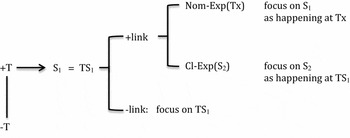
At this point in our description of when we have identified one meaning, one syntactic potential and two different ways of realizing this potential. My suggestion is that this is the backbone of our descriptive model. Diagrammatically it looks like figure 1.
A new descriptive model of when

It is important to note that the diagram in figure 1 is not meant to be a system in the systemic functional sense but a representation of the basic semantics and syntax of when, as well as the resulting focus. This focus is a temporal one – not necessarily the main communicative purpose of the sentence as a whole – and reflects the speaker's or writer's concern with temporal specification: what gets temporally specified and how, and at what level? The difference between the two different ways of linking seems to hinge on either recruitment or implicit incorporation of some representation of TS1. Recruitment results in an ‘analytic’ expression with temporal focus on S1, while implicit incorporation results in a ‘synthetic’ expression with temporal focus on S2.
5.3 Metaphorical extensions
5.3.1 The concept of grammatical metaphor
‘Grammatical metaphor’ is a concept introduced by Halliday (Reference Halliday1994: xix; see also Halliday & Matthiessen Reference Halliday and Matthiessen1999: 7, 227–96; Halliday & Matthiessen Reference Halliday and Matthiessen2004: 592f., 613ff., 654ff.) to describe certain kinds of formal variation over a semantic constant with some added value (or as Halliday would put it: variation in the realization of meanings). The concept presupposes the existence of a congruent, or ‘natural’, relationship between certain types of expression and certain types of meaning. Grammatical metaphors upset this relationship for a communicative purpose. One example is nominalization, whereby instead of referring to a situation (e.g. ‘somebody doing something’) by means of a clause, we can employ a nominal:
-
(31)
-
(a) They donated some money to the project.
-
(b) Their donation of some money to the project turned out to be decisive.
-
In (31a) we have a congruent clausal expression of a situation, while in (31b) we have an incongruent, metaphorical nominal expression of the same situation. In grammatical terms the nominal in (31b) is more compressed and dense (taking up just one slot in the sentence), which enables the speaker or writer to integrate the situation as part of a larger information unit (viz. as the subject).
The basic idea involved in grammatical metaphor is that an incongruent construction is used instead of a congruent one, thereby adding some characteristic association of the incongruent construction to its meaning. In the case of nominalization, situations are referred to and syntactically integrated as if they were ‘things’ (the characteristic meaning of nominals). So I suggest the following formula for grammatical metaphors:
Exp(x qua y)
The result is that x becomes y-like in some respect.
In the following discussion, I shall apply the concept of grammatical metaphor to a number of important of extensions of my basic descriptive model of when.
5.3.2 Nominalization of Exp(S2)
We get metaphorical extensions of both kinds of linking. Let us begin with the second kind of link, whereby when links S1 temporally to another situation S2, as in He got up when the telephone rang, where the congruent expression of S2 is clausal (He got up). Sometimes, however, we instead get a nominal expression of S2, i.e. a nominalization (as in (32)), or a noun expressing some mental or physical state coming about at TS1 (as in (33)):
-
(32) {Jack's medical examination} when he returned from Vietnam revealed a small fracture in his left shoulder.
-
(33) Sally resented {her dad's anger} when he found out about her latest transaction.
The w-clause here offers a temporal specification of S2 (whose nominal expression is in curly brackets) by means of TS1, and the temporal focus (indicated by underlining) is on S2 as happening at (or in relation to) TS1. The metaphor is triggered by the speaker's or writer's wish to integrate the whole expression syntactically in compressed form. Thus the combination of Nom-Exp(S2) and the w-clause is subject in (32) and object in (33). In other words, a w-clause is added to a metaphorical expression and functions in exactly the same way as when it is added to a congruent clausal expression of S2. Syntactically it is a dependent clause in a nominal with the preceding noun as the head (examination, anger). The temporal focus is still on S2 rather than S1 (S1 being simply instrumental in specifying the time and circumstance of S2).
5.3.3 A nominal expression of ‘E qua Tx’
Let us now turn back to the first kind of link, where when links S1 to the meaning of an antecedent expression of time. The congruent expression of time is, as we have seen, Nom-Exp(Tx), where Tx is recruited from S1 as a representation of TS1 (cf. the moment when . . . and next Friday, when . . .). Sometimes, however, we instead get a nominal expression of ‘E qua Tx’, where E is some non-temporal element recruited from S1. When incongruently followed by when, the antecedent gets interpreted as temporally specifiable, i.e. as an ‘occasion’ or ‘circumstance’:
-
(34) Everybody talked about [her wedding] when Jim collapsed after only one drink .
-
(35) They had fond memories of [the conference in Rome] when they first met .
The w-clause here characterizes the occasion expressed by the antecedent nominal (in square brackets), and the temporal focus (indicated by underlining) is on S1 (whose expression is italicized) happening on (or in relation to) that occasion. The metaphor is triggered by when, which superimposes a temporal interpretation on its non-temporal antecedent and links this interpretation to S1. As with the congruent examples in (27) and (28), the antecedent may serve as part of an adverbial in a main-clause expression of S1, and this emphasizes the circumstantial potential of the antecedent and the fact that the antecedent can be viewed as recruited from S1 to serve some purpose in the b-clause:
-
(34´) Jim collapsed after only one drink [at her wedding].
-
(35´) They first met [at a conference in Rome].
There is a limit to what can be recruited from S1 to the b-clause in such metaphorical expressions: for when to superimpose a temporal interpretation on the recruited antecedent this antecedent must be temporally specifiable. Weddings and conferences are not temporal expressions as such but they are temporally specifiable, whereas e.g. books and cars usually are not:
-
(36) !Everybody talked about the book when Jim collapsed after only one drink.
-
(37) !They had fond memories of the car when they first met.
Here when cannot superimpose a temporal interpretation on the antecedent. The two examples are only possible if interpreted in terms of a type two link (with S2 in the b-clause being temporally specified by S1 in the w-clause).
5.3.4 A clausal expression of ‘E qua Tx’
There is another metaphorical extension of the first link, and this extension crucially involves the narrative use of when. Instead of linking S1 to the meaning of an antecedent nominal expression of Tx (. . . the moment when . . . / . . . next Friday, when . . .) or to the meaning of an antecedent nominal expression of E (. . . the wedding when . . . / . . . the conference when . . .), when may link S1 to an antecedent clausal expression of E (where again E is a subordinate element recruited from S1). This results in an interpretation of E as an ‘occasion’ or ‘circumstance’, as in the following examples:
-
(38) [I was walking down the street] when a black car suddenly pulled up behind me .
-
(39) [She was dozing off] when somebody knocked hard on the window near her head .
The w-clause characterizes the occasion expressed by the antecedent clause (in square brackets) and the temporal focus (indicated by underlining) is on S1 happening on (or in relation to) that occasion – in accordance with the allocation of temporal focus in connection with the first kind of link more generally. The metaphor is again triggered by when, which superimposes a temporal interpretation on its antecedent and links this interpretation to S1. Like weddings and conferences, situations are temporally specifiable. As in examples (27), (28), (34) and (35), the antecedent may serve as (part of) an adverbial in a main clause expression of S1 and this emphasizes the circumstantial potential of the antecedent:
-
(38´) A black car suddenly pulled up behind me [when I was walking down the street].
-
(39´) Somebody knocked hard on the window near her head [just as she was dozing off].
What is special about this recruitment is that the expression of E does not serve just as a (subordinate) constituent in the b-clause but becomes the entire b-clause and assumes a higher formal status in the overall composition of the sentence, thereby ‘pushing’ the remaining (superordinate) part of S1 – to be expressed by the w-clause – to an even higher level conceptually. The purpose of this recruitment is thus textual and beyond clause-internal syntactic considerations: it serves to set the scene for what is to follow, i.e. to establish a circumstantial weakly assertive b-clause level as the onset to an even higher, strongly assertive narrative level – a communicative strategy which is reinforced (and signalled) by the choices of Aktionsart in the two clauses.
One gets a sense of the basic mechanism involved in the metaphorical extensions of the first type of link by comparing the following examples directly:
Congruent Nom-Exp(Tx):
-
(28) Jack has postponed the meeting to [next Friday], when the test results will be ready .
Metaphorical Nom-Exp(E qua Tx):
-
(34) Everybody talked about [her wedding] when Jim collapsed after only one drink .
Metaphorical Cl-Exp(E qua Tx):
-
(38) [I was walking down the street] when a black car suddenly pulled up behind me .
In (28) we have the congruent case, where the w-clause characterizes an antecedent nominal time expression. In the next two examples, the w-clause has a similar function but in relation to a metaphorically construed antecedent: in (34) the antecedent is a nominal expression of ‘E qua Tx’ (with time superimposed by when), and in (38) the antecedent is a clausal expression of ‘E qua Tx’ (again with time superimposed by when). In both metaphorical extensions the speaker or writer focuses on S1 as something happening on (or in relation to) the occasion expressed by the antecedent in conjunction with when. Recruitment from S1 takes place in all three examples. In (28), we get a nominal representation at some level of TS1 in the b-clause. In (34) the recruitment is in the form of a nominal expression of a non-temporal element of S1 (construed as an occasion when followed by when), and in (38) a non-temporal element allowing temporal association with S1 is recruited in the form of a clause (construed as an occasion when followed by when) to set the scene for what follows in the w-clause. This recruited b-clause should not be confused with the expression of S2 in the second kind of link, where TS1 is used to specify S2 temporally. Unlike S2, E is defined as an element recruited from S1, where it serves as part of the temporal specification of S1. This is crucial because in the case of such recruitment it is S1, not S2, which gets temporally specified.
5.4 Is narrative when a sentential relative?
In my discussion of possible approaches to narrative when in section 5.1 above, I mentioned the possibility of regarding narrative when as a sentential relative (like which in Jim was both late and drunk, which caused somewhat of a scandal) but expressed some initial scepticism. The reason was that this analysis does not capture the special impact of a narrative w-clause. Sentential relative clauses express additional assertive information, often just as an afterthought to the main assertion in the b-clause. By contrast, although both clauses are also assertive in narrative sentences, it is the w-clause that carries the main assertion, while the b-clause simply conveys circumstantial information.
However, as noted in section 5.1 there are compelling similarities between narrative when and sentential relative which: both allow crude periphrasis with a paratactic construction (which → and this / when → and then) and both items represent the preceding b-clause as a whole. More importantly perhaps, the recruitment mechanism at work in narrative when constructions is similar to the recruitment mechanism characterizing sentences containing relative clauses more generally. And as shown above, narrative when constructions are parallel to examples like (28) and (34), which are traditionally regarded as relative constructions. All this indicates that the constellation of a b-clause and a sentential relative clause is probably the closest we get – using our traditional toolbox – to an overall syntactic frame for the description of sentences containing a narrative w-clause. In such a description the w-clause would be regarded as an adverbial clause, with when as an adverbial within the w-clause.
However, it is important to note that such an analysis of narrative when constructions offers very little in the way of descriptive finesse and explanatory value and therefore must be supplemented with a specification of the factors which affect the assertive balance of the sentence in favour of the w-clause as the dominant partner in the combination, and which transpose the narration to a superordinate level above the main-clause level, thus making narrative w-clause constructions a very special kind of sentential relative. While sentential relative which simply sums up the situation congruently expressed by its antecedent clause qua a situation, independently of the choice of Aktionsart in the two clauses, narrative when superimposes a temporal interpretation on an unbounded clausal antecedent and joins the b-clause and the w-clause together in a tight cohesive pattern, thereby inviting the recipient to construe it metaphorically as an occasion or a circumstance leading up to the bounded situation expressed by the w-clause. This use of when fits very nicely into the very different descriptive approach proposed as an alternative in this article.
6 Conclusion
Narrative when constructions challenge traditional descriptions of w-clauses because although they look like subordinate clauses they behave very differently from other subordinate clauses: they use the preceding b-clause as the onset to a higher level of narration superordinate to the main-clause level established by the b-clause. While the w-clause is still dependent on the b-clause, it is a very different kind of dependency from the one characterizing subordinate clauses more generally. The w-clause needs the b-clause to establish a main-clause level of narration to be able to reach the higher level, and from the perspective of that level, the b-clause merely serves as the expression of circumstantial background. Three factors are important to our understanding of the nature of narrative when constructions: (a) both the b-clause and the w-clause are assertive, but the latter is pragmatically stronger than the former; (b) there is a tight cohesive bond between the b-clause and the w-clause: the unbounded b-clause builds up anticipation and the bounded w-clause offers resolution; (c) the b-clause expresses a situational element recruited from S1 and the narrative w-clause superimposes a temporal interpretation on this element, inviting the recipient to construe it metaphorically as an occasion for the situation expressed by the w-clause.
Instead of attempting isolated alignment between form and content in our description of narrative w-constructions, I propose a simple descriptive framework for the various uses of when which operates with one meaning (±T), one syntactic potential (±link), two manifestations of that potential (one involving recruitment and one involving implicit incorporation, each with a distinct temporal focus) and a small number of regular metaphorical extensions of those two manifestations. The narrative when construction is unproblematically accommodated in this model as a metaphorical extension of the first kind of link motivated by a specific textual strategy.