1 Introduction
In this article, I examine the form and function of right-dislocated lone pronouns in British English, which I shall refer to as ProTags. The pronoun in question can be any personal pronoun with the exception of it (that or this is used instead) or a demonstrative pronoun (1). A personal pronoun used as a ProTag in a ProTag construction (a personal ProTag) appears in the default case for pronouns, which is the objective.Footnote 2 The presence of a ProTag is always optional; all of the examples of ProTag constructions presented in this article would be grammatical/acceptable if the ProTag were omitted.
(1)
(a) I like things a bit offbeat me so I bank with First Direct
(First Direct advertisement 2013)
(b) that was a big store that (DECTE-2007-14/669)Footnote 3
I will consider the following issues with respect to the ProTag construction:
• Which ProTags are used by British English speakers?
• What are the formal features of ProTags in terms of their syntax, information structure and prosody?
• What are the functions of ProTags? Can they be analysed within existing frameworks for the functional classification of tags?
The data that constitute the empirical basis of my research are drawn primarily from corpora. Given the relative infrequency with which ProTags occur even in large-scale corpora of British English (see Appendix, table A1, for further information), my focus here is on a qualitative rather than a quantitative analysis. The rarity of this construction also means that on occasion the corpus data have been augmented with examples taken from the small number of publications which mention the ProTag construction (see section 2.1), in addition to examples I collected from TV and the internet, and the judgements of speakers from north-west Derbyshire including myself (this construction being a feature of my own dialect). This research therefore shares some features with McGregor's (Reference McGregor, Hasan and Fries1995) initial investigation of ‘unusual’ tag questions in Australian English, which he also found ‘rate few mentions in the literature, and are sometimes claimed to be ungrammatical . . . During the following years I recorded over 500 examples of such “unusual” tag types from the speech of those around me, as well as a few from television’ (McGregor Reference McGregor, Hasan and Fries1995: 93). The current qualitative study represents the most comprehensive work to date on ProTags in British English.
I begin by considering relevant work on tags and describing the data on which the current study is based (section 2). After discussing the form of ProTag constructions in British English (section 3), I explore their functions with special reference to Barron et al. (Reference Barron, Pandarova and Muderack2015) and the proposals for classification of tag construction functions therein (section 4). A diachronic perspective is presented (section 5), before I provide my conclusions (section 6).
2 Tags in British English
Tags are widely acknowledged to be an important part of colloquial British English. In their large-scale corpus study, for instance, Tottie & Hoffmann (Reference Tottie and Hoffmann2006) found nine times as many question tags in colloquial British English as in colloquial American English. Before we examine the form and functions of ProTag constructions, it is useful to consider similar constructions and their properties briefly. Perhaps the construction which ProTags most closely resemble at first blush is right dislocation of noun phrases (NPs). This construction involves an NP that corefers with a constituent in the clause to which it is attached. In terms of their form, ProTags and right-dislocated NPs have much in common. The presence of both is optional; without them, the syntactic unit to which they attach is complete. Where the two differ crucially is with respect to their primary functions. A right-dislocated NP has a clarificatory function, and is included to ensure that the addressee is able to identify the relevant entity/entities. A ProTag, on the other hand, provides no such clarification of reference. As a pronoun, it does not provide further information that could be used by the addressee to identify a particular referent. Indeed, a ProTag like that can co-occur in an utterance with a right-dislocated NP whose function it is to clarify the ProTag's referent, as is the case with the record library in this example:Footnote 4
(2) iti’s a good place thati isn't iti [the record library]i (DECTE-TLS20/241)
A ProTag cannot routinely be considered to be an afterthought either: a ProTag has a close relationship with the clause to which it is attached, as evidenced by the fact that by default it is fully integrated prosodically. It is not usual to have a significant pause before a ProTag. I return to the prosody of this construction in section 3.1.
While right-dislocation of a NP and the ProTag construction are similar in form, it is clear that their functions and features are not identical. I therefore treat ProTags as a distinct type of tag construction. With respect to function, we shall see that ProTags have more in common with other types of tags than right-dislocated full NPs, hence the nomenclature that I have chosen to use. After presenting the defining characteristics of ProTag constructions in sections 3.1–3.3, I compare them with question tags (It's broken, isn't it?) and comparable declarative tags (It's broken, is that/that is) in section 3.4. The distinct set of properties that I identify, and in particular the fact that a ProTag cannot be analysed as a ‘reduced’ version of a declarative tag, mean that ProTags must be classified as a separate type of tag construction.
2.1 Previous work on ProTags
Mention of what I term the ProTag construction is relatively scarce in the literature on British English. This construction has received some attention in the sociolinguistics literature, most notably in Snell (Reference Snell2008) and Moore & Snell (Reference Moore, Snell, Gregersen, Parrott and Quist2011). These works focus on the construction's interpersonal function, and the ‘identity-related social work’ which it may undertake in groups of primary school and female high school pupils in Teesside and Bolton, respectively (Moore & Snell Reference Moore, Snell, Gregersen, Parrott and Quist2011: 107). The ProTag construction's functions and how these relate to the work of Moore and Snell are discussed in section 4.2.
The ProTag construction is also mentioned briefly in descriptions of certain dialects of British English; see, for instance, Fyne (Reference Fyne2005) on the dialect of New Mills in north-west Derbyshire and Shorrocks (Reference Shorrocks1999) on the Bolton dialect. Such works do not provide an in-depth analysis of ProTags. The current study's contribution is to provide fundamental information about this construction's form and its functions based primarily on data from corpora of British English as it is spoken around the UK, and in particular from a corpus of data elicited from speakers residing in the Tyneside area of north-east England.
2.2 Data
Large-scale corpora of British English were searched for examples of ProTags. These corpora are: the British National Corpus (BNC), the Global Web-Based English Corpus (GloWbE; Davies Reference Davies2013) and the News on the Web corpus (NOW: Davies Reference Davies2016–). The BNC comprises 100 million words of written (90%) and spoken (10%) British English, intended to be a representative sample of the language from the late twentieth century. The GloWbE corpus contains data from webpages (of the total, ~60% are from informal blogs and ~40% are from a wide variety of frequently more formal genres and text types including newspapers, magazines and company websites) dating from 2012 to 2013. It contains a total of over 380 million words from sources classified ‘Great Britain’. The NOW corpus comprises data from web-based newspapers and magazines from 2010 to the present, and contains a total of over half a billion words from sources classified ‘Great Britain’. Searches of these two corpora were performed on 22 August 2016. All examples identified in the GloWbE and NOW corpora were compared and any duplicates eliminated.
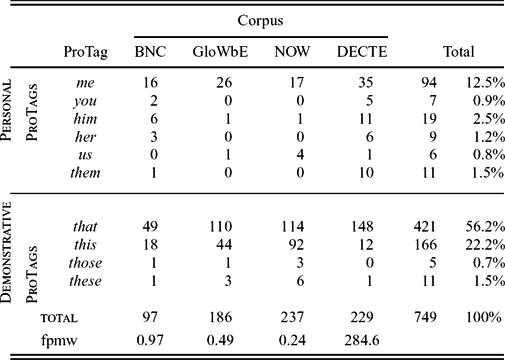
In order to identify possible examples of turn-final ProTags I searched for personal and demonstrative pronouns preceded by a comma and followed by a full stop, then excluded those instances in which such pronouns were clearly not used as tags. In terms of frequency of attestation, this is a conservative approach because it is not necessarily the case that a ProTag will be set off with punctuation marks in exactly the manner described, plus my search did not target turn-medial ProTags (see section 3.3). Regardless of this caveat, it is clear that ProTag constructions are relatively rare, especially when the ProTag is any pronoun other than the demonstrative that.Footnote 5 In these three corpora, frequency per millions words (fpmw) for ProTags is 0.97 (BNC; 97 tokens), 0.49 (GloWbE; 186 tokens) and 0.24 (NOW; 237 tokens). Full frequency findings are presented in the Appendix.
To address the issue of infrequent occurrence, and thus a paucity of data upon which to base conclusions about the form and functions of the ProTag construction, I turned to data from speakers of varieties that had already been identified as using this construction, viz. varieties spoken in the Tyneside area of north-east England. These data come from the Diachronic Electronic Corpus of Tyneside English (DECTE; Corrigan et al. Reference Corrigan, Buchstaller, Mearns and Moisl2012–).Footnote 6 Snell's (Reference Snell2008) work shows that ProTags are a feature of the Teesside dialect of north-east England. The DECTE data confirm that it is also present in other varieties spoken in the north-east; for details, see Appendix, table A1. DECTE comprises 99 interviews (160 speakers; 804,266 words) recorded in the 1960s and 1970s, the 1990s and in the period 2007–10. The majority of DECTE interview transcriptions include minimal or no punctuation, so my searches of this corpus involved checking all occurrences of the relevant pronoun forms, and verifying examples by checking the recordings as necessary. In the DECTE data, ProTags occur with a fpmw count of 284.6 (229 tokens). While this is much greater than in any of the other corpora examined for this study, it is clear that even so ProTag constructions are rare. Interestingly, 24 of the 37 speakers interviewed in the 1960s and 1970s were also explicitly asked for their acceptability judgement of two utterances including a ProTag (personal ProTag: They're useless, them; demonstrative ProTag: It's far too long, this). Of these informants 16 accepted both constructions, two rejected the utterance containing the personal ProTag but accepted the demonstrative ProTag construction, and one speaker rejected both ProTag constructions. Four speakers accepted the personal ProTag example but rejected the slightly different version of the demonstrative ProTag construction with which they were presented (My coat's too long, this i.e. a sentence in which the ProTag corefers with a full NP; see section 3.3); and one speaker rejected both They're useless, them and My coat's too long, this. None of the speakers who rejected a particular ProTag as unacceptable produced that ProTag in their interview. These acceptability judgements provide further support for the claim that the ProTag construction is a feature of varieties of English spoken in the Tyneside area and therefore that they represent a good potential source of data upon which to base generalisations about its form and functions.
3 ProTags: form
Three concepts are central to discussion of the ProTag construction's form: anchor, anchor point and tag. A tag is a ‘supplement to another clause’, while the anchor is ‘the clause to which the [tag] is attached’ (Huddleston & Pullum Reference Huddleston and Pullum2002: 891). The pronoun in the tag corefers with an element in the clause to which it is a supplement. I shall refer to the antecedent as the ProTag's anchor point. In the next three sections, I examine the properties of each element of the ProTag construction in turn, before comparing ProTags with declarative tags and providing an analysis of the ProTag construction in section 3.4.
3.1 The tag: a lone pronoun
As stated in section 1, the pronoun in a ProTag can be a demonstrative pronoun or any personal pronoun with the exception of it. The exceptional behaviour of it amongst the personal pronouns is not unusual. It is commonly replaced by this or that when what is required is a stressed 3sg or non-personal pronoun (Quirk et al. Reference Quirk, Greenbaum, Leech and Svartvik1985: 348).
Personal pronoun ProTags appear in objective (non-nominative) case, which represents the default in PDE.
(3)
(a) he took a loan out for three grand him (DECTE-PVC08/279)
(b) it's gonna be the dirtiest election that there's ever been, this (BNC-KCF/255)
(c) They're nice, those. (BNC-KC9/855)
ProTags are variable monomorphemic tags – an unusual combination of properties in English; compare with variable multiword question tags like doesn't she/won't I and invariant monomorphemic tags like eh and right.
A ProTag cannot appear turn initially, but it can appear within a turn or at the end of one:
(4)
(a) a really unhealthy job that as well (DECTE-PVC14/341)
(b) yes that's funny that because you know a lot of people correct their kids about this (DECTE-TLS29/222)
Example (4a) further shows that the element with which the ProTag corefers need not be overt: [iti is] a really unhealthy job thati as well. I return to this point in sections 3.2 and 3.3.
With respect to prosody, the utterances in (4), as they were produced, exemplify key features of the ProTag construction. These apply regardless of whether the pronoun tag is turn medial or turn final. The pitch movement associated with a lone pronoun tag can be falling or a rise–fall. A ProTag is prosodically fully integrated with the anchor. The ProTags in (4a) and (4b) were part of a single Intonational Phrase; the ProTag was not set off from the rest of the utterance by pauses. This is true even when the ProTag is turn final. A ProTag need not, except in cases of contrast, bear stress. In many cases the pronoun is greatly reduced compared to its non-ProTag counterpart. Sometimes the ProTag is realised just as a schwa (her [ǝ]), or a combination of consonant and schwa (them [ǝm]). The fact that a ProTag can bear stress though provides a possible explanation for the lack of availability of it: as stated previously, this or that is commonly used instead of it when a 3sg pronoun is required to bear stress (Quirk et al. Reference Quirk, Greenbaum, Leech and Svartvik1985: 348).
It should be noted that there appears to be some difference between the use of demonstratives and personal pronouns as ProTags. Biber et al. (Reference Biber, Johansson, Leech, Conrad and Finegan1999: 350), in their discussion of demonstratives in PDE, state ‘other typically conversational structures which may contain the demonstrative pronoun that are tags’, i.e. they are referring to that used as a ProTag. There is no mention in Biber et al. (Reference Biber, Johansson, Leech, Conrad and Finegan1999) of personal ProTags or other demonstrative ProTags, suggesting that their use is less widespread or restricted in some way. While the rarity of the ProTag construction makes it difficult to draw conclusions about frequency and variation based on corpus data (see Appendix), there are some strong tendencies that are noteworthy. The most commonly attested ProTag in the corpora examined for this study is that (56.2%; 421 tokens out of a total of 749). Its relatively high frequency may well be why that alone is identified as a ProTag in Biber et al.’s (Reference Biber, Johansson, Leech, Conrad and Finegan1999) grammar of PDE. What accounts for the large proportion of that ProTags, and to a lesser extent this ProTags (22.2% of all ProTag examples; 166 tokens out of a total of 749)? Firstly, it must be remembered that it cannot be a ProTag, so that/this are the ProTags used when the antecedent is that, this or it. A related issue is the fact that the anchor point for this/that can be an entity or a situation/state/event. This additional possibility means greater frequency is not unexpected. The difference in frequency between this and that as ProTags is unsurprising when one considers that these two pronouns have different roles when they are used as discourse deictic expressions: that is used to refer to a previous part of the discourse (i.e. ‘old’ information, fitting with the characterisation of the information structure of the anchor point and tag to be presented in section 3.3), whereas this is used to refer to the current or a proceeding part of the discourse.
Differences in the occurrence of demonstrative and personal pronouns may be the result of regional variation. However, much like Durham's (Reference Durham2011) work on right dislocation in York speech, my analysis of the DECTE data and those data in the BNC which include limited information about region cannot alone be used to determine whether speakers from certain areas use the ProTag construction, or particular ProTags, more frequently than speakers from other areas of the UK. The same point that Durham (Reference Durham2011: 277) makes about variation and right dislocation more generally holds: ‘only a study of other dialects, both standard and non-standard, will be able to determine this conclusively’.
3.2 The anchor
As a starting point, we can characterise the anchor in a ProTag construction as being a clause expressing a proposition that includes an overt or possibly an elided nominal expression with which the ProTag is coreferential. As is the case with question tags, the ProTag can be attached to a simple or a complex sentence. The pronoun need not necessarily corefer with a constituent in the matrix clause. The relevant propositional information can be expressed in a subordinate clause when the matrix clause is a comment clause:Footnote 7
(5)
(a) I think [shei likes getting bathed] heri (DECTE-PVC15/495)
(b) in fact I think [it'si become more popular again] thati (DECTE-PVC07/1311)
Huddleston & Pullum (Reference Huddleston and Pullum2002: 893) observe that a tag based on a subordinate clause ‘reflects the mismatch between the grammatical structure and its communicative meaning’. Though subordinate in syntactic terms, in such cases ‘communicatively it is the subordinate clause that is primary’ because a matrix clause ‘simply expresses some modal qualification’.
As well as differences relating to which clause is the anchor, another variable is the mood of the anchor. Studies including Holmes (Reference Holmes1982), Kimps et al. (Reference Kimps, Davidse and Cornillie2014) and Barron et al. (Reference Barron, Pandarova and Muderack2015) have explored the issue of anchor mood with respect to question tags, which have been shown to be compatible with declarative, interrogative, exclamative and imperative anchors. While the same is true of the ProTag construction in relation to the first three, the matter is not straightforward when we come to consider imperatives as anchors.
We have already seen examples of ProTags with declarative anchors. Interrogative and exclamative anchors may be less frequent, but they are possible:
(6)

(7)


While it is possible to find examples that apparently comprise a ProTag and an imperative anchor, these are not clear-cut. Consider:
(8) Shut up, you. (BNC-KB1/2201)
It is debatable whether (8) is an example of a ProTag rather than a vocative. Biber et al. (Reference Biber, Johansson, Leech, Conrad and Finegan1999: 1111) describe the use of the second-person pronoun exemplified in (8) as an instance of ‘a relatively rare vocative’; compare it with the equivalent You shut up! Further doubt is cast on the possibility of an imperative anchor by the unacceptability of examples like:Footnote 8
(9) *Let's get a drink, us.
All in all, there is a lack of strong evidence to support the conclusion that imperative can be the mood of a ProTag anchor.
Another fairly common construction involving right-dislocated you is exemplified by the following sentence:
(10) You little raver, you. (BNC-BP7/1552)
Again, it is debatable whether what we have in (10) is an example of a ProTag or a vocative. This construction has been referred to in the literature as an evaluative vocative (Corver Reference Corver2008), but equally Biber et al. (Reference Biber, Johansson, Leech, Conrad and Finegan1999) classify it as an exclamation that superficially resembles a vocative. Because of this uncertainty, I have excluded examples of the type illustrated in (10) from consideration in this article.
I have up to this point been referring to the anchor clause, but the anchor need not be a clause. ProTags can attach to anchors comprising a NP or Adjective Phrase (AdjP). In such examples, a kind of copula ellipsis seems to be involved: the sequence subject pronoun + a form of the copula be appears to have been omitted:
(11)
(a) [real thoroughbreds]NP them (DECTE-TLS03/127)
(b) [not very modern]AdjP, that (BNC-AC3/982)
It is also possible for the ProTag to be coreferential with an elided argument in the anchor, as mentioned in section 3.1. The subject pronoun has been omitted in this example, for instance:
(12) [Could be a good sign], that. (BNC-ALL/791)
Subject drop is not acknowledged as a feature of written English beyond certain genres such as diaries, but it is attested in spoken language (see, for instance, Zwicky & Pullum Reference Zwicky and Pullum1983; Wagner Reference Wagner2016). The ProTag construction is strongly associated with speech or text types that are more conversational in tone, so anchor point elision is to be expected, particularly given the information structure status of anchor points, which I discuss in the next section.
3.3 The anchor point
I refer to the expression in the anchor with which the pronoun tag is coreferential as the anchor point. The ProTag is concordant with its anchor point in terms of person, number and gender features. This does not mean that the two are necessarily identical in form. As mentioned previously, it cannot be used as a ProTag – this or that is used instead. There is also the matter of case. Regardless of the grammatical function/case of the anchor point (which I come to shortly), a ProTag appears in the default case for pronouns, which in PDE is the objective.
We have already seen in (4a) and (12) that the anchor point does not have to be overt. When it is overt, in all of the examples presented thus far, the anchor point has been, like the ProTag itself, a pronoun. The type of pronoun that can be the anchor point is not without restrictions: an indefinite (negative, universal, existential) or expletive pronoun cannot be the antecedent within the anchor. This is another property that makes ProTags distinct from question tags.
(13) Iti seems to be raining, doesn't iti?/*thati.
In relation to both elision and the frequency of pronouns, it must be said that what can qualify as an anchor point could well be less an issue of syntax and more an issue of information structure. Data indicate that the ProTag and the anchor point must refer to an entity that is ‘old’ or can be assumed to be familiar to the hearer. The following examples show that an ‘answer’ constituent (i.e. ‘new’ information, the Focus) cannot be the anchor point for a ProTag.Footnote 9 In this respect, ProTags differ from question tags.
(14)

The property of being familiar, discourse-old information is one that has been ascribed to right-dislocated elements more generally (Lambrecht Reference Lambrecht, Haspelmath, König, Oesterreicher and Raible2001; Ward & Birner Reference Ward, Birner and Goldberg1996). The realisation of the anchor point as a pronoun and the fact that it may be elided is unsurprising in light of evidence that its referent (and that of the pronoun tag, of course) must represent ‘old’ information. This point may also have a bearing on the fact that imperative anchors (9) and expletive anchor points (13) are ruled out, as well as providing an explanation for why DECTE speakers rejected as unacceptable the version of the demonstrative ProTag construction, presented without a context, in which the anchor point was a full NP, as described at the end of section 2.2. In such cases, the anchor point either would not be informative or could not represent ‘old’ information.
In the corpus data examined for this article only one possible example (of reported speech from the NOW corpus) of a non-pronominal overt anchor point was identified out of a total of 749 tokens:
(15) Three world champions is a very good achievement, that. (Davies Reference Davies2015)
Prior to (15), the subject is the training of three world champion boxers (and whether a nomination for an award in recognition of this achievement is appropriate/justified), thus the full NP anchor point in this sentence represents hearer-old and discourse-old information.
Before leaving matters of information structure, I must make one final point. It should be noted that the ProTag construction is not intrinsically contrastive. While a sentence including a ProTag can have such an interpretation, it is no more likely to involve contrast than the anchor would were it stripped of its tag. (Remember that the ProTag is by default prosodically fully integrated with the anchor; see section 3.1.)
Turning next to the issue of grammatical functions, previous examples in this article have included an anchor point that is a subject, similar to a question tag. In fact, this is overwhelmingly the case: in the corpora that I examined, 98–100 per cent of anchor points were subjects. However, in contrast to a question tag, the anchor point for a ProTag must be referential – an expletive subject anchor point is not possible, as (13) shows.
In other respects, ProTags are more permissive than question tags. In the former but not the latter construction, the anchor point can bear a grammatical function other than subject. For example, in the following utterances, the anchor point is the direct object.
(16)
(a) We've often seen heri in the library, heri. (BNC-KCM/994)
(b) I couldn't make themi out them. (DECTE-TLS13/361)
(c) I've done iti loadsa times thati (DECTE-PVC08/724)
There is no restriction on adjacency: a ProTag can immediately follow the pronoun with which it corefers regardless of whether it is identical in form:
(17) got a mouth on heri heri hasn't shei (DECTE-PVC15/244)
It is also possible for a possessor phrase in a NP to be the anchor point, but only when the possessor and the possessed item represent ‘old’ information. For example, the fact that people have names is a standard association, making the entire NP his name old in the relevant sense in (18a). By contrast, the fact that someone has a sister is not a standard association, ruling out the possessor as anchor point in (18b). (Nor can the ProTag her be used to refer to the sister, a referent that constitutes new information as presented here.)
(18)
(a) I can never remember hisi name, himi.
(b) I could never stand his sister, *him/*her.
My corpus searches yielded one example of a possessor phrase anchor point:
(19) burns a hole in hisi pocket himi (DECTE-PVC18/1029)
The nature of the ‘old’ status of his pocket in (19) is slightly different from the case of his name in (18). Here, the ‘old’/predictable nature of his pocket derives from the fact that it is part of an idiom. Nevertheless, this is an important piece of corpus data as it provides evidence that the anchor point in a ProTag construction can be a possessor phrase if the usual information structure requirements are met.
I have not found a naturally occurring example of an indirect object acting as the anchor point for a ProTag. However, examples such as (20) are acceptable to me and other speakers of my dialect:
(20) I'll give him a good hiding, him, if he doesn't shut up.
In English, an oblique anchor point would be a nominal within a Prepositional Phrase (PP; Keenan & Comrie Reference Keenan and Comrie1977). Only one relevant example was identified in the corpora but it does not represent convincing evidence that an anchor point can bear this grammatical function. In the utterance in question, first presented as (17) and repeated here as (21), the ProTag corefers not only with the pronoun in the underlined PP, but also with the omitted subject she (included here in square brackets along with the omitted auxiliary verb for clarity).
(21) [shei’s] got a mouth on heri heri hasn't shei (DECTE-PVC15/244)
In contrast to the case of the indirect object, I am unable to construct a natural sounding example of a ProTag construction including an oblique anchor point. Follow-up research of a different nature, further probing speaker acceptability judgements, will shed more light on the matter of which grammatical functions, if any, an anchor point in the ProTag construction may bear apart from subject, direct object and possessor phrase.
To summarise, there is greater flexibility in terms of the anchor point's grammatical function in a ProTag construction compared to that of a question tag, with direct object and possessor phrase anchor points attested in addition to subject anchor points, which nonetheless represent the vast majority.
3.4 Analysis of the ProTag construction
At this point, it is necessary to consider whether ProTags truly represent a distinct type of tag construction in PDE. The alternative is that ProTags are the pronoun-only version of a type of tag construction that is already acknowledged as being part of the grammar. Two tag constructions are relevant here: question tags and their non-question counterparts, which I shall refer to as declarative tags. In both cases the tag is a clause, or perhaps ‘mini clause’ (Allerton Reference Allerton, Rohdenburg and Schlüter2009: 310), comprising a subject and a finite verb form:
(22)
(23)


Declarative tags can have VS (23b) or SV order (It wants sorting, that does). The former is, of course, identical to a question tag in terms of its word order, but differences relating to the polarity of the tag and the anchor clause to which it attaches distinguish the two, along with the distribution of it.
(24)

Crucial to determining whether or not ProTags are a version of question tags or declarative tags is the extent to which ProTags are equivalent to these other types of tag constructions. The key property of ProTags which rules out collapsing them with either of these other types relates to the nature of the anchor point. For a question tag or a declarative tag that contains a pronoun, the anchor point must bear the grammatical function subject, whereas the anchor point for a ProTag can bear other grammatical functions as well (section 3.3). Thus a ProTag is not simply a ‘reduced’ form of a clausal tag and ProTags are not amenable to an analysis which treats them, for instance, as including an elided finite verb; structurally, ProTags are distinct. In section 4 we shall also see that while ProTags are like question tags in that they are ‘inherently associated with dialogue and most richly exploited in spontaneous speech, their natural context of use’ (Kimps et al. Reference Kimps, Davidse and Cornillie2014: 66), they do not exhibit exactly the same range of functions. I therefore conclude that ProTags represent a separate type of tag construction.
Having ruled out a clausal analysis, and given that they are unquestionably (pro)nominal expressions, I analyse ProTags as belonging to the same category as pronouns generally. This has a bearing on the syntagmatic relation involved in a ProTag construction. Given that a ProTag is not a clause but a lone pronoun that optionally attaches either at the end of an anchor clause/phrase (turn finally) or within a clause (turn medially), we can rule out hypotaxis and parataxis. Rather, the ProTag appears to be an adjunct. This analysis receives further support from data which show that a ProTag can be followed by an adverb such as though:
(25) that's Scotch that though isn't it (DECTE-TLS19/634)
Corpus data such as (25) also show that ProTags can co-occur with other tags, a phenomenon that I shall refer to as tag stacking; in this utterance we have a ProTag and a question tag (isn't it); see also (2) and (17).Footnote 10 The order of ProTags with respect to question tags and adverbial expressions, as well as discourse markers like you know, appears to be flexible.
(26)
(a) it was not a bad place though that really [was it]QUESTION TAG [Chapel Park]NP
(DECTE-PVC09/1223)
(b) that sounds like mam that [doesn't it]QUESTION TAG (DECTE-2010-17/55)
(c) oh aye it's still there [isn't it]QUESTION TAG that (DECTE-TLS37/282)
(d) eeh it was good that you know (DECTE-PVC07/1211)
(e) that's coming back up here this year you know that (DECTE-PVC09/143)
In this section, I have set out defining characteristics of the ProTag construction relating to the ProTag itself, the anchor to which it attaches, and the syntactic relationship between the two, as well as to the anchor point with which the ProTag corefers. A ProTag may be any demonstrative pronoun or personal pronoun in the objective case with the exception of it. The anchor to which a ProTag attaches can be a NP, an AdjP or a clause (simple or complex). An anchor clause's mood can be declarative, interrogative or exclamative. Prosodically, a ProTag is fully integrated with the anchor. The ProTag corefers with an anchor point that can be overt or covert but must be referential and represent ‘old’ information. The grammatical functions of anchor points attested in the corpora are subject, direct object and possessor phrase. Syntactically, ProTags appear to be adjuncts. This combination of properties precludes the ProTag construction being conflated with either right-dislocated NPs or other types of tag construction.
4 Functions of the ProTag construction
Next, I seek to provide an analysis of the functions that the ProTag construction may have, set in the wider context of tag functions more generally. It is important to be clear on two matters before I begin. Firstly, when I refer to function I mean the function of the whole tag construction – i.e. the entire sentence/utterance and not just the lone pronoun tag itself – following Axelsson (Reference Axelsson2011), Kimps et al. (Reference Kimps, Davidse and Cornillie2014) and Barron et al. (Reference Barron, Pandarova and Muderack2015), inter alia. Secondly, I recognise that tags, as a type of discourse-pragmatic variable, are ‘inherently multifunctional’ (Pichler Reference Pichler2013: 193). Thus, when it comes to classifying function, it is important to bear in mind the following caveat (which was originally made in relation to tag questions, but which I believe applies equally to ProTag constructions):Footnote 11
the categories are not mutually exclusive . . . Nevertheless, it has generally been possible to assign utterances to categories which represent their primary or predominant function in a particular context. (Holmes Reference Holmes1982: 47)
It is on this basis that I have analysed ProTag construction function.
4.1 A framework for functional classification
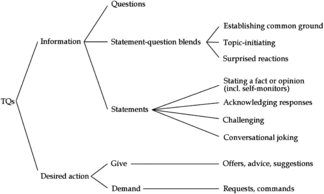
Of all the tag types found in British English, the one that has received most attention and therefore is best understood is the question tag. Previous analyses of the functions of tag questions include Holmes (Reference Holmes1982), Algeo (Reference Algeo2006), Tottie & Hoffmann (Reference Tottie and Hoffmann2006, Reference Tottie and Hoffmann2009), Axelsson (Reference Axelsson2011) and the work of Kimps and colleagues (for example, Kimps et al. Reference Kimps, Davidse and Cornillie2014). Here, I adopt the approach in Barron et al. (Reference Barron, Pandarova and Muderack2015), which builds on the insights of the aforementioned works in order to provide a functional model for tag question classification. Following Kimps et al. (Reference Kimps, Davidse and Cornillie2014), in addition to propositional content, Barron et al. (Reference Barron, Pandarova and Muderack2015) consider the tag construction's wider linguistic context (the material that precedes and follows the tag construction), the relative knowledge status of speaker and co-participant, and the power of a turn to elicit a response in their analysis of tag question functions. The result is the functional classification shown in figure 1, in which TQ stands for tag question.
The functional classification of tag questions proposed in Barron et al. (Reference Barron, Pandarova and Muderack2015: 501)

Of the categories and subcategories in figure 1, ‘Questions’ is not relevant for ProTags because I have found no evidence that ProTag constructions are used to seek/elicit information. The categories ‘Questions’ and ‘Statement–question blends’ are therefore excluded. I also set aside the subcategory ‘Demand’ of ‘Desired action’ because it is not clear for a ProTag construction what would count as an example of this function that would be distinct from a vocative; see section 3.2 for discussion and examples.
Remaining are the other subcategory of ‘Desired action’, i.e. ‘Give’, and the ‘Statements’ subcategory comprising four subtypes. These are defined, based on Barron et al. (Reference Barron, Pandarova and Muderack2015), as follows:
Statement
Used to give information; the primary knower (on which, see Kimps et al. Reference Kimps, Davidse and Cornillie2014) is the speaker; does not expect a response
• Stating a fact/opinion: communicates facts or expresses the speaker's personal beliefs, assessments and attitudes (positive or negative) towards a topic or the addressee
• Acknowledging response: acknowledges the addressee's preceding assertion, signalling interpersonal accord
• Challenging: represents an attack; the subject of the attack is teased, mocked, contradicted, threatened, accused or reproached in order to gain power by undermining their positive face
• Conversational joking: enables the speaker ‘to “present a personality, share experiences and attitudes, and promote rapport” in an entertaining fashion (Norrick Reference Norrick2003: 1345)’ (Barron et al. Reference Barron, Pandarova and Muderack2015: 505); may involve irony or understatement and be accompanied by laughter
Desired action
Commissive or directive used in the exchange of goods and services (rather than information)
• Give: offers, advice, or suggestions
It is important to note that the functions defined above are not contingent upon the anchor's mood. For instance, on spontaneously uttering the ProTag construction containing the interrogative anchor Hasn't she got terrible teeth, her? I neither expected nor required (nor indeed received) a response; I was simply sharing an (unflattering) observation. In functioning as an indicator of speaker attitude, and therefore not requiring a response, ProTag constructions are similar to stance expressions such as adverbials or comment clauses.
4.2 Analysing the corpus data
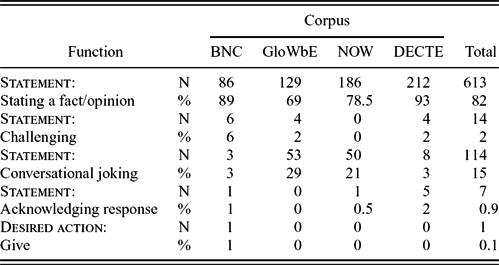
For the 749 examples of ProTag constructions that I identified in the corpora, I tested whether Barron et al.’s (Reference Barron, Pandarova and Muderack2015) taxonomy could be used to classify their functions as well. The results are very promising. Barron et al.’s (Reference Barron, Pandarova and Muderack2015) categories were not just applicable to these examples of the ProTag construction, but sufficient. There were some differences across the corpora. The fact that GloWbE and NOW are corpora of solely written data appears to have had an impact on the functions attested. The definitions of ‘Acknowledging response’, ‘Challenging’ and ‘Desired action’ make these functional categories largely or wholly irrelevant for written data which is not reported speech or direct speech (for instance, as reported in an interview), or is not an exchange between different people posting responses to one another's messages in an online forum or the ‘Comments’ section below an online article or blog post. The ‘Conversational joking’ function is different as it can be employed by a writer to promote rapport with a reader without a response being required. Differences in genre and text type are thus relevant when it comes to ProTag construction functions.
In each of the corpora, stating a fact (27a) or opinion (27b) was the primary function of the ProTag construction (69–93%; 613 tokens out of a total of 749; see Appendix, table A2). This was true regardless of whether the tag was a personal or a demonstrative pronoun.
(27)

The examples of ProTags that Moore & Snell (Reference Moore, Snell, Gregersen, Parrott and Quist2011) discuss involve expressing negative opinions (for instance, I hate her nanna me and She's a liar her). They analyse such negative evaluator personal pronoun tags as being able to play a part in maintaining social group norms, serving as they do to indicate the relationships between speakers within particular communities, whether by reinforcing or by signalling a lack of regard for established social relations.
Examples of the other three subtypes of ‘Statements’ tag function identified in Barron et al. (Reference Barron, Pandarova and Muderack2015) are not so frequent, but they are attested in the corpora. The following exchanges illustrate the ‘Acknowledging response’ function that a ProTag construction can have.
(28)

In both dialogues in (28) Speaker B signals interpersonal accord by acknowledging Speaker A's previous assertion and reinforcing it with his/her own utterance. These examples also illustrate well the inherent multifunctionality of tags: in both cases, the ProTag construction also represents a statement of fact/opinion on the part of the speaker, though in neither case would I identify this as its primary function. (Note that in (28b) Speaker A also employs a ProTag construction, but in this case with the primary function of expressing a fact/opinion.)
Barron et al.’s (Reference Barron, Pandarova and Muderack2015) original definition of the ‘Challenging’ function refers to a direct attack on the addressee. I have modified the wording of this definition slightly because it is possible for a ProTag to have the ‘Challenging’ function without the subject of the attack being the (sole) addressee. A relevant example (of reported speech) occurs in the BNC:
(29) Challenging
A grieving mother pointed an accusing finger across a courtroom at the man accused of murdering her daughter and shouted: ‘He is mine, him.’ (BNC-K4E/820)
In (29), the mother does not address the accused in the most direct manner possible – she does not shout You are mine, you (i.e. I am going to kill you) – and yet it is clear that it was the man in the dock, at whom she was pointing, who was being threatened and therefore challenged. It also appears that the subject of the attack need not be present for the ProTag construction's function to be ‘Challenging’. For instance, the speaker in (30) seeks to gain power by making a threat against a third party who is not present but who is being discussed by the interlocutors:
(30) Challenging
God I'd kill her I'd get rid of her me (DECTE-PVC15/559)
Examples like the ones above, which are otherwise consistent with Barron et al.’s (Reference Barron, Pandarova and Muderack2015) ‘Challenging’ function, necessitate the slight revision of this function's definition which I have provided.
Examples of ProTag constructions with the ‘Conversational joking’ function are also found in the corpora. In the exchange in (31), the doctor's comment appears aimed at promoting rapport with the patient. In line with Barron et al.’s (Reference Barron, Pandarova and Muderack2015: 505) statement that tag constructions with this function ‘do not expect a response but rather punctuate the conversation’, the ProTag construction does not receive a response from the patient, nor is there any follow-up from the doctor. Note also the accompanying laughter.
(31)

The exchange in (32) similarly exhibits the key properties of the ‘Conversational joking’ function proposed in Barron et al. (Reference Barron, Pandarova and Muderack2015).
(32) Conversational joking
A: I wasn't going to move away. I I didn't want to leave my Mam and my Dad. That sounds proper kiddie that <laughter> doesn't it! ‘I don't want to leave my Mam.’ No but I actually didn't want to leave my Mam I think it'd be too much for us <pause> and I couldn't really afford it and
B: It's a bit overwhelming like isn't it? (DECTE-2010-24/12–3)
The utterance in (32) also involves tag stacking (section 3.4): a ProTag and a question tag co-occur. The fact that the two can appear together like this supports my proposal that ProTags and question tags share some functions. The doesn't it question tag could appear as the only tag in the utterance in (32) and the construction would still have the function of ‘Conversational joking’ in the context provided; the same is true for the ProTag that.
Finally, the exchange in (33) occurred during a tutoring session. B is a teacher and A is his student. Given the situation, it is not surprising to find an example of a ProTag construction being used with the ‘Desired action: Give (advice)’ function.
(33) Desired action: Give (advice)
A: Oh zero eight, yeah sorry zero eight.
B: Yeah, okay. That's the only thing to watch, that. (BNC-FM4/1137)
Once again, the inherent multifunctionality of tags is clear: though not its primary function, the ‘Desired action’ ProTag construction in (33) also expresses a statement of fact/opinion. This is similar to the ProTag constructions in (28), which belong to Barron et al.’s (Reference Barron, Pandarova and Muderack2015) separate ‘Statements’ subcategory.
ProTag constructions are also used by speakers when they seek to reproduce or otherwise represent the speech or thoughts of themselves or other speakers. Such ‘quotations’ may be hypothetical (34) or possibly an accurate representation of what was said (35).
(34) as a teacher he should have been looking at my work <pause> right and he should have been saying ‘by this is terrible this’ right and I should have been given private tutors which you would get today (DECTE-2010-09/605)
(35) she calls me immature she says ‘you're so immature you’ I says ‘oh <pause> oh yeah I'm immature and you run off crying to my mam when I insult you’
(DECTE-PVC15/161)
Such ‘quotations’ including a ProTag can be used by the speaker to mock, undermine or express disagreement with the person whose speech or thoughts are being represented. In these cases, the context makes it clear that the ‘quoted’ person's assessment of the situation is at odds with the facts and/or the assessment of the speaker. The result is criticism, ridicule or possibly self-deprecation.
Returning to Moore & Snell's (Reference Moore, Snell, Gregersen, Parrott and Quist2011) study, while their focus is on ProTag constructions with a negative evaluator function, their main hypothesis – that personal ProTags can be used to ‘undertake identity-related social work in interaction’ (2011: 107) – fits well with the functions discussed in the current article. In terms of social relations, it is clear that stating a fact or a negative or positive opinion (whether it be your own or ascribed via ‘quotation’ to another party) can serve to unite interlocutors or distance them from one another, and the same holds for signalling interpersonal accord (acknowledging response); making an attack (challenging); promoting rapport in an entertaining fashion (conversational joking); or expressing an offer, advice or suggestion (desired action: give). The functional classification of ProTag constructions adopted in this article therefore complements Moore & Snell's sociolinguistic research by providing a more fine-grained functional approach which at the same time supports their central hypothesis.
5 A diachronic perspective
There is an interesting historical dimension to the issue of ProTags that requires a paper of its own but warrants mention in the current article. It could be argued that this construction, or something very similar, has been a part of British English since at least the sixteenth century. The key difference between the PDE construction and the one found in earlier varieties of English is the case of the pronoun appearing in the tag: while the objective form is used for personal pronouns in the relevant varieties of PDE, earlier versions include a pronoun in the nominative case. This is unsurprising when one considers that the objective became the default case for pronouns in late Modern English, the nominative having previously fulfilled this role (Denison Reference Denison and Britton1996).
Visser (Reference Visser1963: 56) states that the right-dislocated nominative pronoun construction in earlier varieties ‘was used with striking frequency in the dramatic works of Ben Jonson, Shakespeare and contemporaries’. Examples from Jonson's work show that this construction was used with the full range of both personal and demonstrative pronouns identified and discussed in this article, with the possible sole exception of those. For example:
(36)
(a) Very dreadful that! (Jonson Reference Jonson and Schelling1616)
(b) Nay, we have no art to please our friends, we! (Jonson Reference Jonson and Schelling1600)
The striking similarities between this construction and the PDE ProTag construction lead me to hypothesise that they are in fact the same construction with the two differing only superficially as a result of the default pronoun case undergoing the aforementioned shift from nominative to objective in late Modern English. Furthermore, an initial examination of some of Jonson's nominative pronoun tags and their contexts indicates that their functions may align with the functions of ProTags discussed in section 4. For example, (36a) can be classed as ‘Stating a fact/opinion’, while (36b) is an example of ‘Conversational joking’ (it is a modest denial issued in response to a flattering comment about the quality of the speaker and his colleagues’ work). Detailed examination of diachronic data, similar to research undertaken by Tottie & Hoffmann (Reference Tottie and Hoffmann2009) into the early history of canonical tag questions in English, is required to investigate what the precise relationship is between the form and functions of lone pronoun tag constructions as they appear in PDE and in earlier varieties.
A final typological point is relevant to understanding why ProTags are present in English. Amongst the Germanic languages, English is not alone in having right-dislocated pronouns. They are attested in Scandinavian languages too (Fretheim Reference Fretheim, van Dommelen and Fretheim2001). Which features right-dislocated pronoun constructions share and how they differ across languages, both related and unrelated – French, for instance, also has right-dislocated pronouns (see Lambrecht Reference Lambrecht, Haspelmath, König, Oesterreicher and Raible2001) – may also cast light on the origins of the ProTag construction in English.
6 Conclusion
This qualitative study of ProTag constructions in British English, a complement to the sociolinguistic perspective on the constructions’ interpersonal uses in certain dialects provided by Snell (Reference Snell2008) and Moore & Snell (Reference Moore, Snell, Gregersen, Parrott and Quist2011), sets out characteristic features of their form and functions for the first time. I have presented evidence which shows that, while they share key properties with other types of constructions found in PDE, ProTag constructions also differ from them in important respects and therefore they cannot be conflated either with right-dislocated full NPs or other tag constructions.
Any demonstrative pronoun or objective personal pronoun except for it can be used as a ProTag. The ProTag corefers with an anchor point that can be overt or covert, but must be referential and represent ‘old’ information. Anchor points attested in the corpora had the grammatical function subject, direct object or possessor phrase. Syntactically, ProTags appear to be adjuncts. Analysis of corpus data indicates that Barron et al.’s (Reference Barron, Pandarova and Muderack2015) approach to the classification of tag question constructions can be used to analyse ProTag constructions. My findings suggest that tag constructions share a set of core functions in British English without being altogether functionally identical.
By describing and providing an analysis of their form and functions, this research contributes not only to our understanding of ProTag constructions in British English, but also to our understanding of the features of tag constructions more generally.
Appendix
The occurrence of ProTag constructions in the corpora examined, including the frequency per million words (fpmw) count, is provided in table A1.
Occurrence of ProTag constructions in the corpora

The functions of the ProTag construction tokens identified in the corpora are provided in table A2.
ProTag construction tokens identified in the corpora classified according to function