Implications
Piglet mortality remains a major problem in pig production, with the pre-weaning mortality rate stabilized at around 20%. Selection based on prolificacy has increased the number of live-born piglets to as many as 16 in hyper-prolific sows, resulting in greater heterogeneity of piglet birth weight and a higher number of weak piglets at birth. Providing satisfactory colostrum intake to all piglets is a major challenge, considering the variations in colostrum production between sows and in colostrum intake between piglets. This study aims to determine the minimum amount of colostrum that suckling piglets should ingest to ensure their survival and optimum performance.
Introduction
Insufficient colostrum intake has been identified as one of the major causes of neonatal mortality in pig production (Edwards, Reference Edwards2002). Indeed, 50% of pre-weaning mortality occurs within 3 days after birth (Tuchscherer et al., Reference Tuchscherer, Puppe, Tuchscherer and Tiemann2000) and mainly affects piglets characterized by low birth weight and low weight gain, which can be related to low colostrum intake (de Passillé and Rushen, Reference de Passillé and Rushen1989; Milligan et al., Reference Milligan, Fraser and Kramer2002). Colostrum intake plays a major role in piglet development by providing energy for thermoregulation (Le Dividich et al., Reference Le Dividich, Rooke and Herpin2005), enabling immune transfer from the sow (Rooke and Bland, Reference Rooke and Bland2002) and stimulating intestinal development (Xu et al., Reference Xu, Wang and Zhang2000). The amount of colostrum ingested is highly variable between piglets and depends on both the sow's ability to produce enough colostrum for the whole litter and the piglet's ability to extract colostrum from the teats. Since colostrum production is independent of litter size (Devillers et al., Reference Devillers, Farmer, Le Dividich and Prunier2007), factors influencing a piglet's colostrum intake, such as low birth weight and vitality (Herpin et al., Reference Herpin, Le Dividich, Hulin, Fillaut, De Marco and Bertin1996; Tuchscherer et al., Reference Tuchscherer, Puppe, Tuchscherer and Tiemann2000; Devillers et al., Reference Devillers, Farmer, Le Dividich and Prunier2007), are crucial for its survival. Most of the studies looking at the role of the colostrum in piglet physiology and immunity were conducted in experimentally controlled conditions using force- or bottle-feeding. Studies in naturally suckling piglets are more scarce, because measuring colostrum intake is more difficult under those conditions and necessitates the use of techniques such as the weigh-suckle-weigh method, which influences piglets’ nursing behavior (Pettigrew et al., Reference Pettigrew, Sower, Cornelius and Moser1985). This study used a colostrum intake estimation method based on piglet growth over 24 h (Devillers et al., Reference Devillers, van Milgen, Prunier and Le Dividich2004b) to study the impacts of colostrum intake on the survival, physiology and immunity of piglets in conditions close to commercial conditions.
Material and methods
Animals and measurements
A total of 526 piglets from 40 Landrace × Large White sows (22 primiparous and 18 multiparous), which were inseminated with Piétrain semen, were housed in individual farrowing crates (2 × 2.5 m) with straw bedding. Thirty-seven percent of the parturitions occurred naturally, and the other 63% were induced at 114 days of gestation with 1 ml of prostaglandins (Alfabedyl; CEVA Santé Animale, Libourne, France). Parturitions were watched, but observers interfered as little as possible in the farrowing process. Piglets born in placental membranes were extracted and resuscitated if necessary. No additional help or care was given. The births of the first and last piglets, respectively, were considered to be the beginning (T 0) and end of parturition. At birth, the piglets were weighed, the time of birth relative to T 0 was recorded, and vitality traits, namely umbilical cord already ruptured before birth, difficulty in breathing (more than 5 s until first attempt to breathe after birth) and piglet still inside placental membranes at birth, were assessed. At 24 h after the onset of parturition (T 24), the piglets were weighed again, and rectal temperature and the presence of splayleg were recorded. No fostering was done before T 24. Thereafter, the piglets were weighed every week until 42 days of age. Weaning occurred between 25 and 31 days of age.
Each piglet's colostrum intake between birth and T 24 was estimated according to a previously described equation (Devillers et al., Reference Devillers, van Milgen, Prunier and Le Dividich2004b) with the mean interval between birth and first suckling estimated to be 30 min as previously reported (Devillers et al., Reference Devillers, Farmer, Le Dividich and Prunier2007) and where the piglet's colostrum intake (CI, in g) is calculated from birth weight (BWB, in kg), weight gain (BW–BWB, in kg) and age (t, in min), as follows:

Sampling and analyses
A 100-ml colostrum sample was collected manually from each sow across all teats at T 0 and 2, 4 and 24 h later and was filtered through gauze. Each colostrum sample was analyzed for nutritional composition and immunoglobulin G (IgG) concentration. Nitrogen (N) content was determined according to the Dumas method (Association of Official Analytical Chemists 7 024, 1831) based on sample pyrolysis and direct determination of N2 using an automatic device (LECO FP-428; LECO Corporation, St. Joseph, MI, USA). Crude proteins were estimated as N × 6.38 (Gordon and Whittier, Reference Gordon and Whittier1965), and total lipids were measured according to the Gerber method (Association of Official Analytical Chemists, 1990). Lactose was assayed using an enzymatic method (Lactose/d-galactose test combination, ref. 0176303; R-Biopharm – Roche, Darmstadt, Germany).
A 5-ml blood sample was collected from the jugular vein of six piglets per litter (two with low birth rank, two with intermediate birth rank and two with high birth rank) at T 24 (n = 246) and at weaning (n = 220). The blood samples were collected in heparinized tubes, placed immediately on ice and centrifuged for 10 min at 3000×g and 4°C. Hematocrit was also measured. All samples were stored at −20°C until analysis. The plasma samples taken at T 24 were analyzed for glucose, lactate and cortisol. Lactate and glucose were assayed with commercial enzymatic kits (l-lactic acid test combination, ref. 139084, and d-glucose/d-fructose test combination, ref. 139106; Boehringer, Mannheim, Germany). Cortisol was assayed with a commercial radioimmunoassay (RIA) kit (ref. 2466; IMMUNOTECH, Marseille, France). The assay sensitivity was 1.9 ng/ml. The plasma samples collected at T 24 and at weaning and the colostrum samples were analyzed for IgG concentration using a previously described ELISA method (Devillers et al., Reference Devillers, Farmer, Mounier, Le Dividich and Prunier2004a) with a sensitivity of 23 ng/ml.
Statistics and data analyses
Statistical analyses were done with the Statistical Analysis Systems software program (SAS, 2002). Differences between categories based on mortality were tested with ANOVA using the MIXED procedure (birth weight, colostrum intake, weight gain, rectal temperature and plasma cortisol, IgG, glucose and lactate concentrations) and the GLIMMIX procedure with a logit transformation (birth rank, interval from previous birth and time of birth), or with χ 2 tests (vitality variables). Relationships between colostrum intake, colostrum composition and physiological variables were described using principal component analysis (PCA; PRINCOMP procedure). Further reference to the colostrum concentration of any component corresponds to the estimate of the average concentration of the component [C]A in the colostrum ingested for each piglet, which was calculated from the colostrum composition measured at T 0, T 2, T 4 and T 24 ([C]0, [C]2, [C]4 and [C]24, respectively) and adjusted to the piglet's time of birth (T B in h) according to the following equation:

The average colostrum composition for all sows was published previously (Devillers et al., Reference Devillers, Farmer, Le Dividich and Prunier2007). Regression analyses and Pearson's or Spearman's correlations (REG and CORR procedures) were used to further describe the specific relationship between the two variables. Multiple regression analysis was also used to determine significant factors contributing to variations in plasma IgG concentration at T 24. Synthetic variables were also calculated and analyzed in order to estimate IgG absorption. Such variables included the estimated quantity of IgG ingested between birth and T 24, calculated by multiplying the piglet's colostrum intake until T 24 and the average IgG concentration of the colostrum ingested as calculated in equation (2). In addition, total amounts of IgG present in plasma were calculated, in the manner used by Bland et al. (Reference Bland, Rooke, Bland, Sinclair and Edwards2003), from piglet plasma IgG concentration, live weight and hematocrit at T 24, assuming an average blood volume of 95 g/kg live weight. Piglet weight between T 24 and 6 weeks of age was analyzed for piglets distributed in five categories of colostrum intake according to the 20th, 40th, 60th and 80th percentiles and using the mixed model procedure, with repeated-measures analyses including the factor day, and with colostrum intake, birth weight, litter and the colostrum intake × day interaction as the main factors. Data in the text are means ± s.e.m., or least square means (CI).
Results
Results relative to the influence of piglet and sow characteristics on colostrum intake were published previously (Devillers et al., Reference Devillers, Farmer, Le Dividich and Prunier2007). This study focused on the consequences of colostrum intake for piglet survival and immunity.
Colostrum intake and mortality
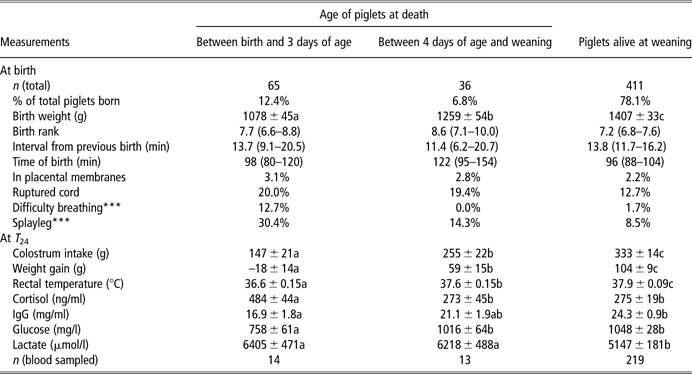
Table 1 describes the live-born piglets’ characteristics and their performances and physiology at T 24 according to the piglets’ age at death in comparison to piglets still alive at weaning. In comparison to live-born piglets, stillborn piglets were characterized by a higher birth rank (10.2 [7.8–12.5]; P < 0.05) and a longer interval from the previous birth (49.8 [31.9–74.4]; P < 0.05). A large proportion of them had their umbilical cord already ruptured at birth (42.9%). The piglets that died before weaning were characterized by lower birth weight, a higher incidence of difficulty taking their first breath after birth and a higher occurrence of splayleg than piglets still alive at weaning, indicating a direct relationship between low vitality at birth and early mortality. After birth, piglets that died before weaning also had a lower colostrum intake, lower weight gain (or even weight loss), lower rectal temperature, higher plasma cortisol concentration and lower plasma IgG and glucose concentrations than piglets still alive at weaning. The principal causes of death for the live-born piglets were weakness (49.5%) and crushing by the sow (34.7%).
Characteristics at birth, growth performance and physiological state of piglets born alive

Data represent the percentage of piglets within the category, least square means ± s.e.m., or least square means (CI).
Numerals followed by different lowercase letters differ significantly at P < 0.05; ***χ 2 test, P < 0.001.
Colostrum intake and piglet physiology and immunology
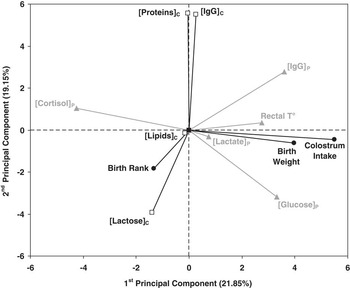
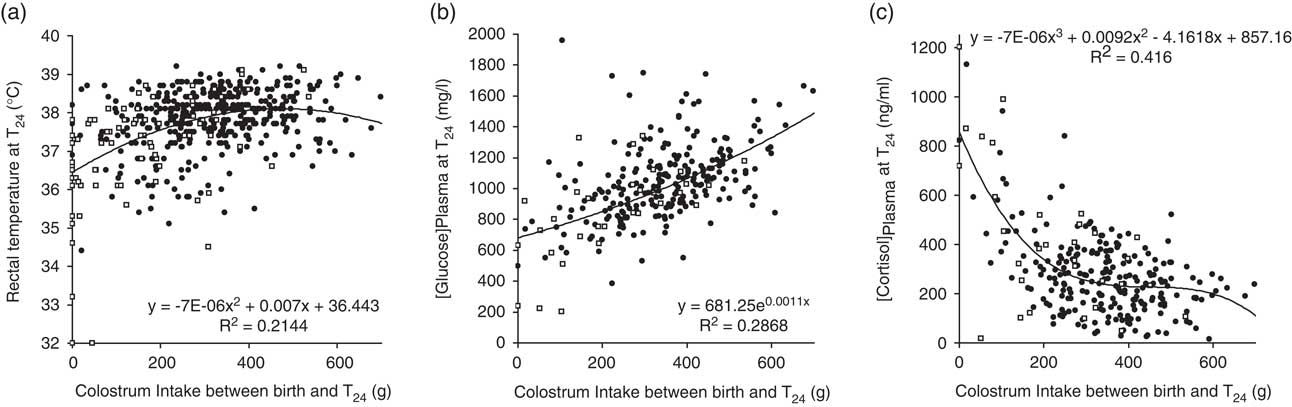
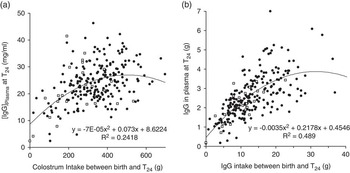
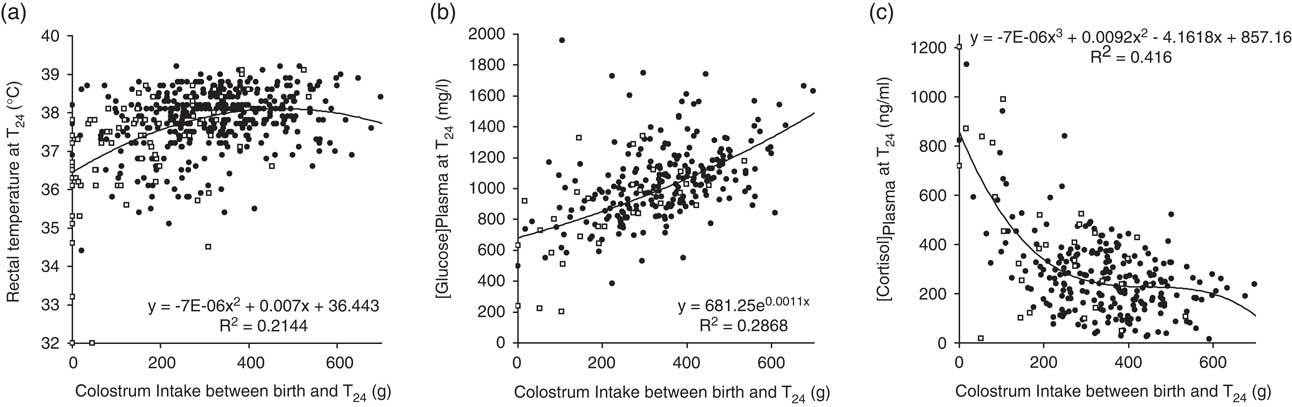
The relationships between colostrum intake and the composition of the colostrum ingested and physiological variables measured at T 24, as determined by PCA, are presented in Figure 1. Many of the variables, including birth weight, rectal temperature and plasma glucose and IgG concentrations, were positively related to colostrum intake, which was negatively related to plasma cortisol concentration. In contrast, plasma IgG concentration was positively related to both colostrum intake and colostrum IgG concentration and negatively related to birth rank and colostrum lactose concentration. Figure 2 shows the significant relationships between colostrum intake and rectal temperature (Figure 2a), plasma glucose concentration (Figure 2b) and plasma cortisol concentration (Figure 2c). The specific relationship between colostrum intake and plasma IgG concentration at T 24 is also presented in Figure 3a. Multiple regression analysis of plasma IgG concentration at T 24 revealed that colostrum intake (P < 0.0001), the IgG concentration in the colostrum ingested (P < 0.0001), birth weight (P = 0.016) and birth rank (P < 0.0001) were significant contributors. The estimated quantity of IgG ingested, calculated from colostrum intake and colostrum IgG concentration, was also negatively related to birth rank (r = −0.145; P < 0.001). The relationship between estimated IgG intake and the total amount of IgG present in plasma at T 24 is presented in Figure 3b. The ratio between the total amount of IgG present in plasma and the amount of IgG ingested with the colostrum was also calculated to estimate IgG absorption and was found to average 0.22 ± 0.008. This ratio was significantly correlated with colostrum intake (r = −0.37; P < 0.0001) and plasma cortisol concentration (r = 0.34; P < 0.0001) but was not correlated with time of birth (r = −0.04; P = 0.52) or birth rank (r = −0.1; P = 0.13).
Results of the principal component analysis (n = 233) describing relationships between the piglets’ physiological state at T 24 (gray triangles), the average composition of the colostrum ingested (white squares) and the piglets’ characteristics (black circles). The biplot of the first two principal components jointly represent 41% of the total variation. [ ]P: plasma concentrations; [ ]C: colostrum concentrations (immunoglobulin G (IgG)).

Relationships between estimated colostrum intake and physiological parameters in piglets 24 h after the onset of farrowing (T 24): (a) rectal temperature; (b) glucose concentration in plasma; and (c) cortisol concentration in plasma. Black circles represent piglets that were still alive at weaning, and white squares represent piglets that died between T 24 and weaning.
Relationships (a) between immunoglobulin G (IgG) concentration in piglet plasma 24 h after the onset of farrowing (T 24) and estimated colostrum intake, and (b) between total amount of IgG in piglet plasma at T 24 and estimated IgG intake. Black circles represent piglets that were still alive at weaning, and white squares represent piglets that died between T 24 and weaning.

Long-term effects of colostrum intake
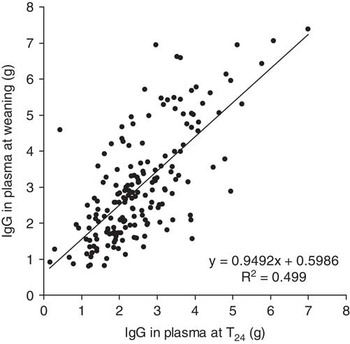
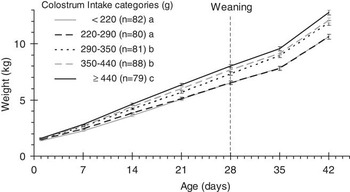
Plasma IgG concentration at weaning averaged 7.2 ± 0.2 mg/ml and was found to be significantly related to plasma IgG concentration at T 24 (r = 0.54; P < 0.0001), to colostrum intake (r = 0.32; P < 0.0001) and to weight gain between T 24 and weaning (r = 0.30; P < 0.0001). A positive linear relationship between the total amount of IgG in plasma at T 24 and the total amount at weaning is shown in Figure 4. The impact of colostrum intake on piglet growth up to 6 weeks of age is presented in Figure 5. Average body weight was 7.19 ± 0.08 kg at weaning and 11.58 ± 0.11 kg at 42 days of age. Growth was significantly affected by colostrum intake, birth weight and age (P < 0.0001). From 21 days of age, the piglets could be divided into three categories of colostrum intake: <290 g, between 290 and 440 g and >440 g. Between those categories, growth significantly differed. The piglets that ingested >290 g colostrum (n = 247) weighed 12.34 ± 0.13 kg on average at 42 days of age. In comparison, the piglets that consumed <290 g of colostrum (n = 162) weighed 10.45 ± 0.17 kg at the same age.
Relationship between total amount of immunoglobulin G (IgG) in piglet plasma at weaning and total amount 24 h after the onset of farrowing (T 24).

Growth of piglets according to colostrum intake between birth and T 24 for piglets still alive at 42 days of age. Data presented are least square means corrected from birth weight and litter effects ± s.e. Different letters at the right side of the legend indicate significant differences (P ⩽ 0.05) between colostrum intake categories on days 21, 28, 35 and 42.

Discussion
The overall mortality rate was 21.9%, which is close to the French national average of 21.0% (Gourmelen and Marouby, Reference Gourmelen and Marouby2007). The stillbirth rate was especially low at 2.7%, compared to the national mean of 8%. Characteristics of the stillborn piglets in this study are in agreement with the results of previous studies (Randall, Reference Randall1972; Zaleski and Hacker, Reference Zaleski and Hacker1993; Le Cozler et al., Reference Le Cozler, Guyomarc'h, Pichodo, Quinio and Pellois2002). The low stillbirth rate observed in this study was probably due to the supervision of the farrowings; however, it did not influence total mortality, because the 19.2% pre-weaning mortality rate in the live-born piglets was high in comparison to the national mean of 14.4%. Therefore, weak piglets that would usually have died just after birth and been categorized as stillborn in commercial conditions probably died a few hours or days later in this study.
Of the live-born piglets that died before weaning, 56.5% and 72.2% died within 3 and 7 days of birth, respectively. In agreement with the results of other studies (Gardner et al., Reference Gardner, Hird and Franti1989; Rydhmer, Reference Rydhmer1992; Quiniou et al., Reference Quiniou, Dagorn and Gaudré2002), the piglets from this study, which died within 3 days of birth, had lower vitality because of lower birth weight, a higher incidence of difficulty in breathing at birth and a higher occurrence of splayleg, a condition that impairs a piglet's ability to reach the udder as well as escape being crushed by the dam. Indeed, death resulted mainly from weakness or crushing, which are related (Weary et al., Reference Weary, Pajor, Thompson and Fraser1996). Lower vitality at birth is also a sign of hypoxia during the birth process, which leads to metabolic acidosis characterized by high plasma lactate concentration and low rectal temperature (Herpin et al., Reference Herpin, Hulin, Le Dividich and Fillaut2001). After birth, those weak piglets which died before weaning consumed less colostrum and therefore lost weight as also observed in other studies (Thompson and Fraser, Reference Thompson and Fraser1988; de Passillé and Rushen, Reference de Passillé and Rushen1989). The same piglets also exhibited hypoglycemia, high cortisol concentration and lower IgG intake, which often characterize piglets that die before weaning as already demonstrated (Tyler et al., Reference Tyler, Cullor, Thurmond, Douglas and Parker1990; Herpin et al., Reference Herpin, Le Dividich, Hulin, Fillaut, De Marco and Bertin1996; Tuchscherer et al., Reference Tuchscherer, Puppe, Tuchscherer and Tiemann2000). Therefore, the present findings support previous observations that weak piglets, whatever the cause of their weakness (low birth weight, hypoxia or malformation), are disadvantaged for colostrum intake (Devillers et al., Reference Devillers, Farmer, Le Dividich and Prunier2007) and enter a vicious cycle where low colostrum intake leads to hypoglycemia and hypothermia (Herpin et al., Reference Herpin, Damon and Le Dividich2002) and beyond to high plasma cortisol and lactate concentrations, which are characteristic of glycogen reserve mobilization and high gluconeogenesis (Lepine et al., Reference Lepine, Boyd and Welch1989). It is therefore all the more important to identify piglets at risk as early as possible and to give them assistance to increase their chance of getting a proper amount of colostrum. Indeed, only 7.1% of the piglets that consumed at least 200 g of colostrum died before weaning, whereas the rate of death before weaning rose to 43.4% in the piglets that ingested <200 g.
When all the piglets are considered, the relationships between colostrum intake and rectal temperature (Figure 2a), glycemia (Figure 2b), cortisol concentration (Figure 2c) and passive immunity (Figure 3a) confirm the important role of the colostrum in thermoregulation (Le Dividich and Noblet, Reference Le Dividich and Noblet1981), glucose homeostasis (Herpin et al., Reference Herpin, Le Dividich and van Os1992) and immune transfer (Klobasa et al., Reference Klobasa, Werhahn and Butler1981). Plasma IgG concentration is logically related to colostrum intake, colostrum IgG concentration and birth rank. Indeed, birth weight is a major determinant of colostrum intake and vitality (Devillers et al., Reference Devillers, Farmer, Le Dividich and Prunier2007), and colostrum IgG concentration decreases quickly after the onset of farrowing (Klobasa et al., Reference Klobasa, Werhahn and Butler1987). Therefore, the piglets born later consumed colostrum with a lower IgG concentration, as demonstrated by Bland et al. (Reference Bland, Rooke, Bland, Sinclair and Edwards2003) in piglets with delayed access to the udder. In this study, however, 92% of the piglets were born within 4 h of the onset of parturition, whereas the major drop in colostrum IgG concentration usually happens between 4 and 12 h after farrowing begins (Bland et al., Reference Bland, Rooke, Bland, Sinclair and Edwards2003; Devillers et al., Reference Devillers, Farmer, Le Dividich and Prunier2007). Thus, most of the piglets probably ingested sufficient amounts of IgG before gut closure. As a consequence, the relationship between colostrum intake and plasma IgG concentration is not very close; after a certain amount of colostrum ingested, about 200 g, plasma IgG concentration does not increase anymore (Figure 3a), as already suggested by Rooke and Bland (Reference Rooke and Bland2002). Therefore, this quantity of colostrum ingested seems adequate to reach the plateau of IgG absorption through the intestinal barrier described by Jensen et al. (Reference Jensen, Elnif, Burrin and Sangild2001). Moreover, the ratio between the estimated amount of IgG present in plasma and the estimated amount of IgG ingested with colostrum is not significantly correlated with time of birth or birth rank, suggesting that the percentage of IgG absorbed at T 24 is independent of the duration of the period piglets had for ingesting colostrum. It also suggests that gut closure happened for most of the piglets after the ingestion of a sufficient amount of IgG. Indeed, the relationship between the estimated amount of IgG present in plasma and the estimated amount of IgG ingested with colostrum is highly significant (Figure 3b) and suggests a plateau starting around 15 g of ingested IgG. This relationship between IgG absorbed and IgG ingested is consistent with the findings by Werhahn et al. (Reference Werhahn, Klobasa and Butler1981) that the amount of IgG absorbed through the intestines is dose-dependent with the amount of IgG ingested with the colostrum, but ingestion must occur before gut closure. Furthermore, the negative correlation between colostrum intake and the absorption ratio of IgG is in accordance with a mechanism of gut closure induced by the amounts of nutrient ingested (Rooke and Bland, Reference Rooke and Bland2002). The ratio was also positively related to plasma cortisol concentration, which is consistent with the stimulatory action of cortisol on IgG uptake (Bate and Hacker, Reference Bate and Hacker1985; Sangild et al., Reference Sangild, Fowden and Trahair2000). However, it has to be noted that these synthetic variables only approximately estimate IgG absorption. Indeed, colostrum intake and colostrum composition change over time, whereas the synthetic variables estimate the IgG absorption from average data over the first day of lactation. Despite this approximation, the results are consistent with the existing knowledge on the IgG absorption mechanisms.
The results of this study also show the long-term effects of colostrum intake. Klobasa et al. (Reference Klobasa, Werhahn and Butler1981) proposed that elevated absorption of IgG after birth delays the synthesis of the piglet's own IgG. In contrast, this study showed a positive relationship between the IgG concentration in the piglets’ blood early in life and that concentration 4 weeks later, as also reported by Rooke et al. (Reference Rooke, Carranca, Bland, Sinclair, Ewen, Bland and Edwards2003). This discrepancy is likely due to the extreme treatments tested by Klobasa et al. (Reference Klobasa, Werhahn and Butler1981), who prevented piglets from naturally consuming colostrum for up to 24 h or artificially fed them with bovine colostrum and milk with different amounts of porcine IgG, whereas this study and the one by Rooke et al. (Reference Rooke, Carranca, Bland, Sinclair, Ewen, Bland and Edwards2003) were done on nursing piglets without modification of their suckling behavior and the colostrum composition. Moreover, Klobasa et al. (Reference Klobasa, Werhahn and Butler1981) found an inverse relationship after 56 days, whereas this study looked at the concentration at 4 weeks of age. Therefore, it is most likely that the acquisition of good passive immunity via the consumption of colostrum is positively related to the development of the piglet's active immunity until weaning, but it would be interesting to study if this relationship persists after weaning. Moreover, the amounts of IgG present in the piglets’ blood at T 24 and at weaning were almost the same and were linearly related (Figure 4). It remains difficult to determine the proportion of the IgG present in plasma at weaning that comes from the colostrum and that depends on IgG half-life. The half-life of IgG in piglet blood was estimated to average 10 to 15 days of age (Curtis and Bourne, Reference Curtis and Bourne1973; Frenyó et al., Reference Frenyó, Pethes, Antal and Szabó1981; Klobasa et al., Reference Klobasa, Werhahn and Butler1981). However, those studies did not take into account the variation in blood volume occurring with piglet growth and probably underestimated the IgG half-life value (Rooke and Bland, Reference Rooke and Bland2002). Therefore, a significant proportion of the IgG present in plasma at weaning may still come from the colostrum as reported by Rooke et al. (Reference Rooke, Carranca, Bland, Sinclair, Ewen, Bland and Edwards2003). Furthermore, independently of the rate of disappearance of the IgG absorbed from the colostrum, the amount of IgG synthesized by the piglet should be proportional to the amount absorbed from the colostrum to maintain a quantity of IgG present in the piglet's blood at weaning equivalent to the one observed at T 24, as shown in Figure 4. Despite this relationship, it is still unclear whether the high uptake of immunoglobulins with the colostrum directly stimulates the development of active immunity. The colostrum also contains maternal lymphoid cells, which participate in the active immunity of the piglets (Tuboly et al., Reference Tuboly, Bernath, Glavits and Medveczky1988), and many immune modulators, such as cytokines, which may participate in the maturation of the neonate immune system (Salmon et al., Reference Salmon, Berri, Gerdts and Meurens2009). Therefore, although the mechanisms still have to be determined, it is most likely that the acquisition of good passive immunity via the consumption of colostrum stimulates the development of the piglet's active immunity.
Colostrum intake also showed long-term effects on piglet growth, with the piglets that consumed >290 g of colostrum gaining about 2 kg more live weight by 6 weeks of age. These results show that variability in colostrum intake leads to variability in growth and, below a certain amount of colostrum ingested, growth is impaired in the long term through a series of events where a piglet with a low colostrum intake has a lower viability and is disadvantaged for the rest of the lactation. Pre-weaning growth was also positively related to plasma IgG concentration at weaning. However, it remains difficult to untie if the higher IgG concentration is just a marker of a higher colostrum intake and is therefore related to growth, or if higher passive immunity transfer can play a positive role on growth.
In conclusion, ensuring that piglets ingest a minimum amount of colostrum is the best way to guarantee that they survive, receive a satisfactory transfer of immunity and achieve satisfactory growth. Early survival is most likely ensured by provision of energy, whereas immune transfer would promote long-term health. On the basis of the results presented, a minimum colostrum intake of 200 g is recommended. However, given that the colostrum production of sows is highly variable and can range from 1.9 to 5.3 kg (Devillers et al., Reference Devillers, Farmer, Le Dividich and Prunier2007), it can be difficult for many sows to adequately nurse more than 10 piglets. Therefore, genetic selection on sow prolificacy should be adjusted to the colostrum production capacity. Otherwise, measures should be taken to collect and store colostrum from some sows and bottle-feed piglets at risk of insufficient intake. This study showed that colostrum intake is very important for the survival and development of naturally nursing piglets and has potential long-term effects on their growth and immunity. However, the mechanisms underlying a stimulatory impact of passive immunity on the development of active immunity have still to be demonstrated.
Acknowledgments
The authors wish to acknowledge the following INRA-SENAH employees: M. Lefebvre, A.M. Mounier and F. Thomas for providing expert technical assistance; and L. Gaillard, D. Boutin, Y. Surel, R. Bouetard, C. Homo and B. Duteil for taking care of the animals. The authors also thank S. Méthot, Agriculture and Agri-Food Canada, for his invaluable help with the statistical analyses. The PhD studentship was funded by ITP (Paris, France) and INRA (Paris, France).