Introduction
Although for centuries experimental sciences have neglected the study of feelings and emotions, more recently an increasing focus has been directed toward the biological substrates of romantic love. Romantic love is a human and universal phenomenon present in all cultures and societies,Reference Jankowiak and Fischer 1 – Reference Aron, Fisher, Mashek, Strong, Li and Brown 3 characterized by specific emotions, cognitive processes, and behaviors. Love involves intense motivation to win a specific mating partner and craving for emotional and physical union, with intrusive obsessive thinking about him/her.Reference Marazziti, Akiskal, Rossi and Cassano 2 Romantic lovers are characterized also by euphoria or mood swings, increased energy, and autonomous nervous system reactions.Reference Liebowitz 4 – Reference Fisher, Aron, Mashek, Li and Brown 6 If some components of these complex processes can be identified also in mammals, what renders romantic love typical of humans is the evidence that the formation of pair bonding in our species is not related only to reproduction, but also to the creation of group structures, social organizations, and family interactions with the ultimate goal of providing a safe environment where newborns can be protected until they become autonomous.Reference Fisher, Aron, Mashek, Li and Brown 6 , Reference Marazziti 7 This is fundamental to human beings, whose offspring are the weakest and require longer care than any other mammal. Nature should have provided mechanisms of increasing complexity for assuring that the focus is limited to one partner only and the sense of safety is formed and maintained, while also rewarding the romantic partners with that feeling of pleasure and completeness that we call love.Reference Marazziti 7
Therefore, it is not surprising that specific brain mechanisms have evolved to accomplish such a goal, that is to say, that romantic love is not regulated by chance, but rather by well-established biological processes for obvious and important consequences from an evolutionary point of view. It is now believed that the different features of love may be regulated by specific neural circuitries and influenced by monoamines [serotonin (5-HT), norepinephrine (NE), dopamine (DA)], peptides (oxytocin), and hormones, likely through intertwined processes.Reference Marazziti, Akiskal, Rossi and Cassano 2 , Reference Fisher, Aron, Mashek, Li and Brown 6 – Reference de Boer, van Buel and Ter Horst 9
The role of DA is mainly supported by data derived from animal studies, particularly those on female prairie voles. Interestingly, during a pair bonding formation, a 50% increase in DA levels occurs in the nucleus accumbens (NAcc), while the injection of DA antagonists abolishes it. Again, DA infusion promotes the female’s preference to any male in the environment.Reference Insel and Shapiro 10 – Reference Carter 12 It is generally believed that DA’s effects are promoted by oxytocin, a nonapeptide hormone synthesized in the paraventricular and supraoptic nuclei of the hypothalamus that is supposed to play a major role in linking social signals with cognition, behaviors, and reward.Reference Insel and Shapiro 10 – Reference Carter 12
Although the role of DA in sexual arousal and behavior in humans is established,Reference Paredes and Agmo 13 , Reference Pfaus 14 data in romantic love are still meager and are mainly based on brain imaging studies. Indeed, some functional magnetic resonance imaging (fMRI) studies showed that, in people intensely in love, exposure to pictures of the romantic partner evoked neural activation in the right ventral tegmental area (VTA), the right caudate nucleus, and the putamen, areas all rich in DA.Reference Bartels and Zeki 15 , Reference Fisher, Aron and Brown 16 The activity in the VTA, which is associated with pleasure, general arousal, focused attention, and motivation to pursue and acquire rewards, is lateralized, in that the right side is specifically activated by faces that participants would work to see longer, whereas left-sided activity is associated with facial attractiveness. The right antero-medial caudate rewards detection and expectation, representation of goals, and integration of sensory inputs to prepare for action, or rather to the intense focused attention on an individual, which is one of the cardinal behavioral signs of romantic love.Reference Aron, Fisher, Mashek, Strong, Li and Brown 3 , Reference Ortigue, Bianchi-Demicheli, Patel, Frum and Lewis 17 , Reference Acevedo, Aron, Fisher and Brown 18
No information is available on direct evaluation of DA and/or DA markers in love. Human blood cells, such as platelets and lymphocytes, express the DA transporter (DAT) protein that is identical to that found in presynaptic neurons.Reference Frankhauser, Grimmer, Bugert, Deuschle, Schmidt and Schloss 19 – Reference Marazziti, Baroni and Catena Dell’Osso 22 The DA transporter (DAT) is a membrane protein that controls the intrasynaptic concentrations of DA by means of reuptake into the nerve terminals, after its release in the synaptic cleft. DAT is a 80-kD glycoprotein belonging to the large Na+/Cl–-dependent transporter family,Reference Giros, Jaber, Jones, Wightman and Caron 23 which is represented mainly in mesolimbic and mesocortical pathways, but also in the frontal cortex, striatum, hypothalamus, and, at lower concentrations, in the olfactory bulbus.Reference Boja, Carroll, Vaughan, Kopajtic and Kuhar 24 At the cellular level, it has been immunolocalized in the somatodendritic and axonal compartments of the dopaminergic cell groups. It is now evident that DAT is also the target of some frequently abused drugs, such as cocaine and amphetamines.Reference Giros, Jaber, Jones, Wightman and Caron 23 Moreover, variants of the DAT gene have been associated with novelty seeking,Reference Sabol, Nelson and Fisher 25 attention deficit hyperactivity disorder,Reference Sabol, Nelson and Fisher 25 cocaine-induced paranoia,Reference Gelernter, Kranzler, Satel and Rao 26 and increased number of sexual partners in males.Reference Guo, Tong, Xie and Lange 27
Given the lack of data on DAT in love, the aim of the present study was therefore to explore this protein in resting lymphocytes of 30 subjects in the early stage of romantic love, as compared with 30 subjects who had a long-lasting relationship. DAT was assessed by means of the binding of [3H]-WIN 35,428 and of the specific reuptake of [3H]-DA to the membranes of resting lymphocytes.
Subjects and Methods
Thirty subjects of both sexes (15 women and 15 men) were included in the study. The entry criteria were the following: age between 20 and 40 years (mean±SD: 29.8±4); absence of medical illness, as shown by common blood and urinary tests and medical check-up; absence of personal or family history of major psychiatric disorders, as assessed by a psychiatric interview; being involved in a romantic relationship for no longer than 6 months (mean±SD: 3±1); total score on the romantic love questionnaire developed by us≥42. They were compared with a similar group of healthy subjects (15 women and 15 men, aged between 20 and 40 years, mean±SD: 29.4±5) who were in a long-lasting (more than 2 years, mean±SD: 27±8 months) relationship.
The romantic love scale, which has not yet been validated, is a self-report instrument developed by us comprising 14 items that explore the presence, frequency, and duration of feelings and behaviors related to love. Items are scored from 1 to 4, with 1 denoting the absence of feelings/behaviors related to love and 4 the highest frequency (or duration) of the behaviors/feelings. The questionnaire proved to be acceptable and required 7 minutes on average to complete. There were no refusals to fill out the instrument. We invited all participants to focus on the current relationship. All subjects confirmed that they were involved in 1 relevant romantic relationship; 56 were heterosexual and 4 homosexual.
Methods
Lymphocytes separation and membrane preparation for binding assay with [3H]-WIN 35,428 were carried out according to our method.Reference Marazziti, Akiskal, Rossi and Cassano 2 The [3H]-DA reuptake was performed according to the method of Amenta et al,Reference Amenta, Bronzetti and Cantalamessa 28 with slight modifications.Reference Marazziti, Baroni and Catena Dell’Osso 22
The equilibrium-saturation binding parameters, ie, the maximum binding capacity (Bmax, fmol/mg protein) and the dissociation constant (Kd, nM), were analyzed by means of the iterative curve-fitting computer programs EBDA and LIGAND.Reference Mc Pherson 29 Kinetics of [3H]-DA reuptake, ie, the maximal velocity (Vmax, pmol/109 plt/min), and the Michaelis–Menten constant (Km, nM) were calculated by regression analysis from Lineweaver-Burk plots.
Statistical analysis
The difference of biological parameters between the 2 groups of subjects was assessed by means of the nonparametric Mann–Whitney analysis, because the values were not normally distributed. The possible effects of age and sex on biological parameters were investigated by means of analysis of covariance, and the correlations between variables were explored using Spearman’s analysis, all with personal computer programs (SPSS version).
Results
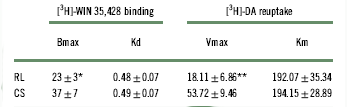
As shown in Table 1, the Bmax values (mean±SD, fmol/mg protein) of the romantic lovers were significantly lower than those of the subjects involved in a long-lasting relationship (23±3 vs 37±7 Mann–Whitney test: U=22, Z=−6.4, P=0.0001), while the Kd (mean±SD, nM) did not show any change (0.48±0.07 vs. 0.49±0.07, respectively).
[3H]-WIN 35,428 binding parameters (Bmax and Kd, mean±SD) and [3H]-DA reuptake parameters (Vmax and Km mean±SD) in lymphocytes of romantic lovers (RL) and control subjects (CS)

Bmax, fmol/mg protein; Kd, nM.
*Significant: Mann–Whitney test: U=22, Z=−6.4, P=0.0001.
Vmax, pmol/109cells/min; Km, nM.
**Significant: Mann–Whitney test: U=1.5.0, Z=–6.7, P=0.0001).
A significant difference was also detected in Vmax (mean±SD, pmol/109cells/min) values that were significantly lower in the patients than in healthy subjects (18.11±11.86 vs 53.72±19.46, Mann–Whitney test: U=1.5.0, Z=–6.7, P=0.0001), while the Km (mean±SD, nM) did not show any change (192.07±35.34 vs 204.15±28.89, respectively) (Table 1).
No correlation was observed between biological markers, individual features, characteristics of the relationship, frequency of sexual intercourse, and the romantic love scale total scores or single items.
Discussion
The results of the present study showed that subjects in the early phase of romantic love were characterized by changes of the DAT, as assessed by means of the specific binding of [3H]-WIN 35,428 to resting lymphocyte membranes, and [3H]-DA reuptake, as compared with a similar group of control subjects. The decreased density of [3H]-WIN 35,428 binding, with no change of the dissociation constant, indicates that the number of the DAT proteins is reduced. In addition, these proteins work less, as supported by the lower maximal velocity (Vmax) values of [3H]-DA reuptake. According to our knowledge, these results represent the first report of alterations of the DAT in lymphocyte membranes of romantic lovers, that is to say, they would indicate an alteration of a peripheral marker of the DA system. It is not possible at this stage to conclude whether the overall alterations of lymphocyte DAT are a primary or secondary phenomenon, although, in any case, they would suggest the presence of increased DA levels in romantic lovers.
However, the limitations in the use of peripheral blood cells as “windows” to the same structures present in the brain should be immediately acknowledged. Without a doubt, if it is true that neurons and blood cells are surrounded by different environments and, therefore, are subjected to different regulations,Reference Gordon and Barnes 30 – Reference Marazziti, Landi and Baroni 32 the similarities between the DAT in lymphocytes and neurons are striking.Reference Frankhauser, Grimmer, Bugert, Deuschle, Schmidt and Schloss 19 , Reference Faraj, Olkowski and Jackson 33 In addition, lymphocytes, like neurons, are capable of synthesizing DA, as they express the catecholamine biosynthetic enzyme tyrosine hydroxylase and are innervated by sympathetic fibers that store and release DA.Reference Bergquist, Tarkowski, Ekman and Ewing 34 , Reference Caronti, Calderaro, Passarelli, Palladini and Pontieri 35
Our results may be considered in agreement with those gathered from functional magnetic resonance imaging (fMRI) studies reporting activation of DA-rich areas in the human brains of romantic lovers. Previously, participants viewing a picture of their beloved partners showed activation of DA-rich areas, such as the VTA and the caudate, which are associated with reward and motivation.Reference Aron, Fisher, Mashek, Strong, Li and Brown 3 , Reference Bartels and Zeki 15 , Reference Acevedo, Aron, Fisher and Brown 18 Further, a recent study with positron emission tomography using [11C]-raclopride to label D2/D3 receptors demonstrated activation of 2 regions belonging to the DA system, the medial orbitofrontal cortex and the medial prefrontal cortex.Reference Takahashi, Mizuno and Sasaki 36 Interestingly, the first area has been implicated in the processes of aesthetic judgment, maternal love, beauty, and reward.Reference Gottfried, O’Doherty and Dolan 37 It is noteworthy that the mentioned brain areas are also rich in oxytocin receptors. Recent data suggest that oxytocin and DA are positively related, so that increased or decreased DA levels would lead to similar fluctuations of oxytocin and vice versa.Reference Baskerville and Douglas 38 Therefore, if increased DA (and oxytocin) concentrations, coupled with low 5-HT levels, might be related to romantic love,Reference Marazziti, Akiskal, Rossi and Cassano 2 , Reference Fisher, Aron, Mashek, Li and Brown 6 our findings would also suggest that low DA coupled with high 5-HT levels might underlie the opposite situation, that is to say, lack or loss of romantic love and desire, as well as the specific syndrome of hypoactive sexual desire disorder (HSDD) that recently is gaining increasing attention. Such a hypothesis also would provide an explanation of the mode of action of flibanserin, effective in HSDD, which raises DA levels and reduces synthesis and extracellular levels of 5-HT.Reference Borsini, Evans, Jason, Rohde, Alexander and Pollenter 39
A reduction of the DAT immunoreactivity in peripheral blood mononuclear cells was reported in neurological disorders, such as Parkinson’s disease (PD)Reference Caronti, Antonini and Calderaro 40 , Reference Pellicano, Buttarelli and Circella 41 and amyotrophic lateral sclerosis.Reference Buttarelli, Circella, Pellicano and Pontieri 42 Moreover, our group described decreased [3H]-WIN 35,428 binding maximal velocity (Vmax) of [3H]-DA reuptake in resting lymphocytes of patients with different psychotic disorders.Reference Marazziti, Baroni and Catena Dell’Osso 22 Therefore, if the decreased density of the DAT proteins in lymphocytes reflects similar changes occurring in presynaptic neuron and, therefore, increased brain levels of DA, our findings would permit some speculations. It is evident and already underlined that some features of romantic love, such as cognitive distortion regarding the qualities of the beloved, euphoria, increased energy, emotional dependency, and craving for union with the partner, resemble some symptoms of different neuropsychiatric disorders, such as a manic phase of bipolar disordersReference Liebowitz 4 or an addiction,Reference Fisher, Aron, Mashek, Li and Brown 6 , Reference Burkett and Young 43 conditions all characterized by increased DA concentrations. The increased DA levels, coupled with the already described lower levels of 5-HT,Reference Marazziti, Akiskal, Rossi and Cassano 2 and the related consequences, including activation of some brain areas and deactivation of those implicated in logical judgment,Reference Bartels and Zeki 15 are “functional” in the early stages of romantic love. In fact, they would be fundamental to motivate the intense longing of the partner and the propensity to and need for physical union (sometimes with dangerous partners) and, ultimately, the reward intrinsic to love. Such biochemical changes would also explain, according to us, how falling in love might constitute a risky situation in vulnerable individuals where it might promote the onset of psychopathological disorders or less controlled and more impulsive behaviors. Our findings would indicate that, from the perspective of the DA system, romantic lovers are similar to patients with different psychiatric disorders, such as psychosis, bipolar disorders, or addiction.
Conclusion
Increased DA functioning appears fundamental for eliciting the rewarding and pleasurable feelings related to love. However, it is probable that the DA increase is regulated by oxytocin, which, alternatively, decreases the functioning of the alarm system. Through the complex and fascinating interplay of these processes, love becomes “a fear with no fear.”Reference Marazziti 44
Disclosures
The authors do not have anything to disclose.