Introduction
Identifying a sensitive cognitive screening tool for accurately measuring individuals’ risk for cognitive decline and/or impairment has become a crucial public health initiative (Montine, Reference Montine2013). Several neurological/psychological measures have been developed to assess cognitive status; however, previous studies suggest these measures do not adequately account for cognitive functioning in minority adults (Black et al., Reference Black1999), particularly Black adults (Manly et al., Reference Manly1998; Rohit et al., Reference Rohit2007). Consequently, many Blacks may be misidentified as having cognitive impairment (Clark et al., Reference Clark2005). Given Blacks are more likely to be diagnosed with cognitive impairment than Whites or other minority groups (Alzheimer's Association, 2013), this raises concern regarding the number of individuals and family members that may be put through unnecessary stress and/or follow-up procedures due to incorrect diagnoses. Thus, it is essential to find ways to effectively and accurately measure cognitive status in this subpopulation. To achieve this, it is important to understand how sociodemographic factors (e.g. the amount and type of education obtained) confound the validity of existing screening tools Mini-Mental State Examination (MMSE).
One of the most commonly used tools to screen for cognitive status over the past 40 years has been the MMSE (Folstein et al., Reference Folstein, Folstein and McHugh1975); however, previous research suggests the MMSE may misclassify Blacks as being cognitively impaired (Albert and Teresi, Reference Albert and Teresi1999; Manly et al., Reference Manly, Jacobs, Touradji, Small and Stern2002). Racial group differences in rates of cognitive impairment, as identified by the MMSE, may be explained by lower levels of education, which are commonly observed in older minority groups (Escobar et al., Reference Escobar, Burnam, Karno, Forsythe, Landsverk and Golding1986). Several studies have attempted to understand the specific MMSE components (e.g. memory, language, and attention/calculation) that are influenced by years of education. Results from these studies have suggested that lower levels of education are associated with greater errors on items measuring orientation (i.e. “season”), attention/calculation (i.e. serial sevens and “world” backwards), and language (i.e. naming objects and writing a complete sentence) (Escobar et al., Reference Escobar, Burnam, Karno, Forsythe, Landsverk and Golding1986; Teresi et al., Reference Teresi, Golden, Cross, Gurland, Kleinman and Wilder1995; Jones and Gallo, Reference Jones and Gallo2002). Furthermore, these studies have indicated that errors on these MMSE components increase the likelihood an individual will meet the established MMSE cut-off risk for cognitive impairment (Escobar et al., Reference Escobar, Burnam, Karno, Forsythe, Landsverk and Golding1986; Jones and Gallo, Reference Jones and Gallo2002).
Few studies, however, have examined MMSE performance (i.e. total score and component scores) as well as the number of adults who would meet the MMSE cut-off risk for cognitive impairment based upon education quality. Similar to education quantity, racial differences in the quality of education have been observed in older adults (Murden et al., Reference Murden, McRae, Kaner and Bucknam1991; Sayegh et al., Reference Sayegh, Arentoft, Thaler, Dean and Thames2014). Although years of education may be equivalent between Blacks and Whites, their schooling experiences (e.g. discrimination, impoverished schools with limited books, teachers, and extracurricular activities) are typically inequivalent, a reflection of disparate education quality. Indeed, studies that have measured for education quality, using performance-based tests of reading level/literacy, have shown that education quality is more strongly associated with MMSE performance than years of education (Weiss et al., Reference Weiss, Reed, Kligman and Abyad1995; Albert and Teresi, Reference Albert and Teresi1999). As a result, education quality measures may provide additional information regarding performance above and beyond the commonly used measure of education quality. Prior studies that have focused on educational quality have typically used performance-based measurements of reading level/literacy. However, studies have not attempted to understand whether adults’ perceptions of their education quality (referred to as self-rated education quality) might be associated with MMSE performance. Self-rated education quality has been estimated in younger adult populations and appears to be a pertinent proxy for education quality (Hill et al., Reference Hill, Lomas and MacGregor2003). Self-rated education quality may not necessarily be tapping into the same construct(s) as performance-based measures of education quality. Specifically, performance-based measures of education quality may be assessing the strategies and/or skills an individual is likely to use during cognitive testing. In contrast, self-rated measure of education quality may be assessing comfort or anxiety levels related to perceived school experiences, which may serve as a psychological barrier to good performance during cognitive testing. As such, the current study incorporates a self-rated, single-item question on education quality to explore whether this measure of education shows similar relationships to MMSE performance as education parameters (years of education and performance-based reading level/literacy) commonly used in existing literature.
In an effort to expand upon the existing literature, the current study explores two specific aims. First, we aimed to expand on previous research and explore the relationship among various measures of education (years of education, reading literacy, and self-reported/subjective quality of education) within Blacks. We hypothesized that low years of education would be associated with low levels of reading literacy and worse self-reported quality of education. Second, we examined the relationship between the MMSE items (total score and MMSE subtest/component scores) and various measures of education within older Blacks. We hypothesized that low years of education, low levels of reading literacy, and worse self-rated quality of education would be associated with worse MMSE total and component scores, even after accounting for socioeconomic (income, financial strain) and current health conditions shown to be related to cognitive performance within older Blacks (Whitfield and Aiken Morgan, Reference Whitfield, Aiken Morgan, Hofer and Alwin2008). Finally, we explored whether years of education or quality of education may be associated with risk of cognitive impairment, based on the commonly used MMSE cut-off score (Folstein et al., Reference Folstein, Folstein and McHugh1975; Folstein et al., Reference Folstein, Bassett, Anthony, Romanoski and Nestadt1991). We hypothesized that a higher number of individuals with low years and/or worse quality of education would be considered at greater risk for cognitive impairment.
Methods
Participants
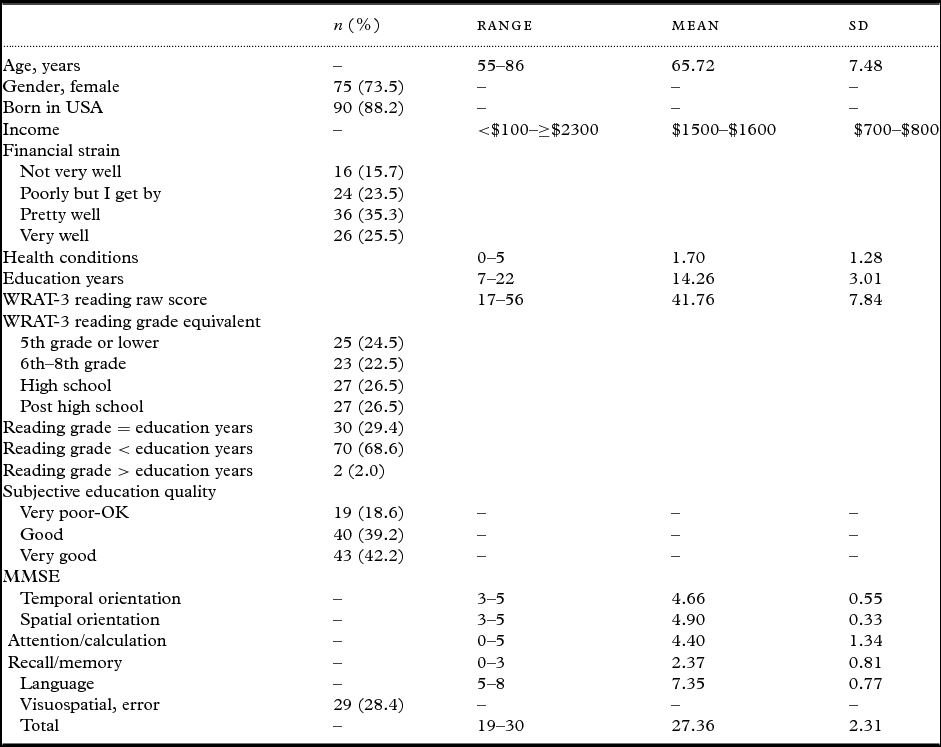
The study consisted of 102 adults, who were independent and community-dwelling residents in the Tampa Bay area. The sample had a mean age of 65 (SD = 7.48, age range = 55–86; Table 1). Eighty-eight percent self-identified as Black and non-Hispanic (n = 90), 6% identified as Black and Hispanic (n = 6), and 6% identified as Black with an unknown ethnicity (n = 6). A majority of the participants were female (n = 75, 74%) and were born in the USA (n = 90, 88%), particularly within southern states (n = 82, 80%). Among the foreign born participants (n = 12, 12%), 42% (n = 5) were born in Jamaica, 25% were born in Trinidad (n = 3), 8% were born in Antigua (n = 1), 8% were born in Honduras (n = 1), 8% were born in the Dominican Republic (n = 1), and 8% were born in the United Kingdom (n = 1). Inclusion criteria included: (1) 55 and older; (2) English proficiency; and (3) African American/Black. Participants were recruited from health fairs, senior recreation centers, churches, and participant referrals. Consenting participants were administered a demographic questionnaire (i.e. education quantity, subjective quality of education, age, sex, income, financial strain, and health conditions), an objective quality of education measure, and the MMSE. This study was approved by the Institutional Review Board at the University of South Florida, and all participants provided informed written consent to participate in this study. Individuals were compensated $5 for their participation.
Sample characteristics

Measures & procedures
The trained study staff met with participants at either the participant's home or a lab located at the University of South Florida, School of Aging Studies. Participants were administered the surveys and cognitive screening measure as described in the prior paragraphs. The testing session lasted between 30 and 45 minutes. At the end of the interview, participants were compensated $5.00 for their participation. Participants were initially asked to self-identify their race and ethnicity based upon three categories: (i) Black race and non-Hispanic/Latino ethnicity; (ii) Black race and Hispanic/Latino ethnicity; and (iii) Black race, but ethnicity unknown. Race and ethnicity were assessed in this study because the older Black community, particularly in the Tampa Bay area, consists of a multi-ethnic community. Furthermore, prior literature has suggested that accounting for the ethnic diversity of the Black community may assist in furthering our understanding of the inter-individual differences often observed within this community (Lyons, Reference Lyons1997; Marshall-Fabien and Miller, Reference Marshall-Fabien and Miller2016).
Three measures of education were included in the current study. One measure assessed education quantity and two measures assessed education quality (self-rated and performance-based). Education quantity was measured by asking participants to report how many years of education they obtained. Self-rated education quality was measured by a question asking participants: “Overall, how good of an education do you think that you got?” The participant used a Likert scale to answer the question, with answers ranging from “Very Poor,” to “Very Good.” Given the low number of participants in the “very poor” (n = 2), “poor” (n = 2), and “ok” (n = 15) categories, these categories were collapsed. Thus, the subjective question for education was recoded as 0 (Very Poor–Ok), 1 (Good), and 2 (Very good). Performance-based education quality was measured by the reading literacy subtest of the Wide Range Achievement Test-3rd Edition (WRAT-3) (Wilkinson, Reference Wilkinson1993). The WRAT-3 reading subtest is designed to assess adults’ ability to correctly pronounce a list of words and letters, but is considered a sensitive measure of education quality (Dotson et al., Reference Dotson, Kitner-Triolo, Evans and Zonderman2009; Manly et al., Reference Manly, Jacobs, Touradji, Small and Stern2002). The total correct amounts of words correctly pronounced were included in the current study's analyses. The WRAT-3 has a maximum score of 57, with higher scores reflecting better education quality. WRAT-3 reading grade equivalent scores were also estimated for descriptive purposes.
The MMSE (Folstein et al., Reference Folstein, Folstein and McHugh1975) consists of 11 questions, with a point scale ranging from 0 to 30. The current study's analyses included the total MMSE score and each of the six MMSE component scores measuring: (1) temporal orientation (e.g. “What year is it?”), (2) spatial orientation (e.g. “What state are we in?”), (3) recall/memory (i.e. ability to recall three objects) (4) attention/calculation (i.e. serial sevens or “WORLD” spelled backward), (5) language (e.g. naming objects, repeating a phrase, or following instructions), and (6) visuospatial skill (e.g. copying an image) (Strauss et al., Reference Strauss, Sherman and Spreen2006). Component scores were estimated by summing all items reflected of five subscales (temporal orientation, spatial orientation, recall/memory, attention/calculation, and language; Table 1 illustrates score ranges). The visuospatial skill component score was a binary variable, where 0 represented an incorrect response and 1 represented a correct response.
Covariates
Several demographic and health measures were also accounted for in the current study. Participants’ age and sex were documented. Income was measured by asking participants to report their total gross family income per month. Financial strain was assessed by a question that asked participants how well their monthly income covered their needs (Szanton et al., Reference Szanton, Thorpe and Whitfield2010). Participants responses to this question could range from the following: (0) Not very well; (1) poorly, but I get by; (2) pretty well; and (3) very well. Health conditions were estimated by asking participants to report whether a doctor or nurse ever diagnosed them with a list of conditions (i.e. diabetes, heart disease, hypertension, asthma, emphysema/COPD, cancer, and stroke) (Whitfield et al., Reference Whitfield2000; Thorpe et al., Reference Thorpe, Szanton, Bell and Whitfield2013). A sum score of these reported health conditions were included in the analyses (range = 0–7).
Statistical analysis
Correlations were conducted to assess the relationship among the various measures of education and to examine whether the educational measures were associated with MMSE total and component scores. Hierarchical regression models were conducted to test which of the education variables was a unique predictor of MMSE performance. For the MMSE total and each component score, two regression models were conducted. The first model tested whether the sociodemographic and health covariates (age, sex, income, financial strain, and health conditions) were significantly associated with MMSE performance. The second model examined the relationship between the education parameters (education years, self-rated education quality, and performance-based education quality) and MMSE performance while accounting for the sociodemographic and health covariates entered into the first model. Since the MMSE visuospatial component score was a binary variable, a logistic regression was conducted. Subsequent non-parametric tests (Mann–Whitney U test) and χ 2 analyses were conducted to identify whether there were significant differences on the educational variables between individuals classified as cognitively normal (MMSE total score ≥ 24) and individuals classified as cognitively impaired (MMSE total score < 24). The MMSE cut-off score of < 24 is a conservative and commonly used criterion for identifying individuals at risk for cognitive impairment (Folstein et al., Reference Folstein, Folstein and McHugh1975; Folstein et al., Reference Folstein, Bassett, Anthony, Romanoski and Nestadt1991). All analyses were conducted utilizing SPSS software (version 23).
Results
The sample included 102 Blacks with a mean age of 65 (SD = 7.48, age range = 55–86; Table 1). On average, the participant sample had total gross monthly income between $1,500 and $1,600, which is considered low socioeconomic status for the general Tampa Bay area (Economic Policy Institute, 2016). Approximately, 40% (n = 40) reported signs of financial strain (e.g. income poorly covers needs but gets by – 24% (n = 24); income does not cover needs very well – 16% (n = 16)). Participants, on average, reported two health conditions. Previous studies have indicated that status of health condition affects cognitive performance (Whitfield and Hayward, Reference Whitfield and Hayward2003).
The participant sample's average years of education was relatively high (M = 14.26, SD = 3.01). The sample average for the performance-based education quality measure (WRAT-3) was 41.76 (SD = 7.84, range 17–56), which is equivalent to an 8th grade education. While a majority of participants (n = 83) reported “good/very good” quality of education (81%), 19% reported “very poor/ok” quality of education (n = 19). The mean MMSE total score for the sample was 27.36 (range 19–30), which is considered to be indicative of normal cognitive performance. Seven participants were classified as cognitively impaired based upon their MMSE total scores being less than 24.
Relationship among education measures
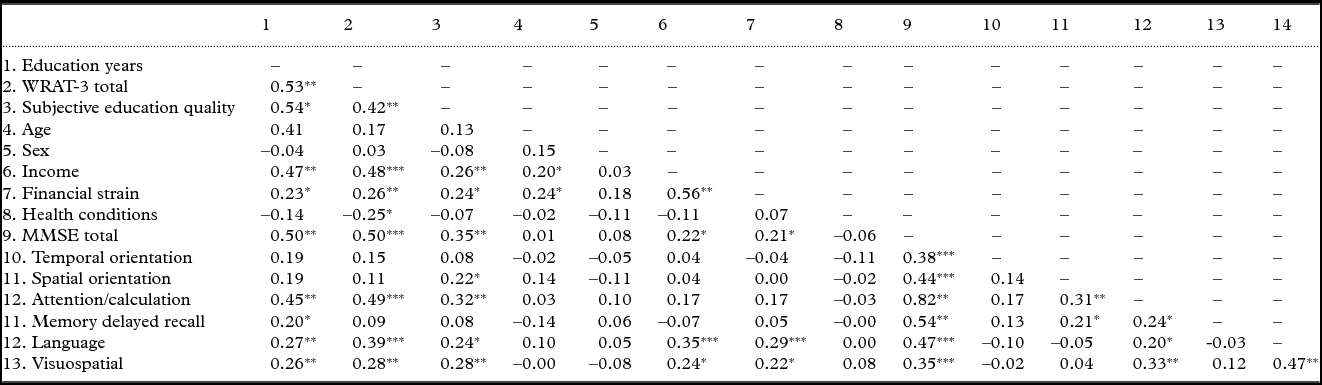
Higher scores on the performance-based education quality (WRAT) measure were significantly associated with more years of education (r = 0.53, p < 0.001) and with self-reports of having a good education quality (r = 0.42, p < 0.001); more years of education were significantly associated with self-reports of having a good education quality (r = 0.54, p < 0.001). However, a majority of the participants (n = 70; 69%) had a WRAT score representing a reading grade level that was less than their reported years of education (Table 1).
Relationship between MMSE and education measures
Pearson correlations identified that the total MMSE score was associated with higher scores on the performance-based education quality measure (r = 0.50, p < 0.001), self-reports of education quality (r = 0.35, p < 0.001), and higher years of education (r = 0.50, p < 0.001; see Table 2). High years of education, self-rated reports of better education quality, and higher scores on the performance-based education quality measure were significantly associated with better performance on the MMSE components of attention/calculation, language, and visuospatial skill (see Table 2). Self-rated reports of better quality of education was significantly associated with better performance on the MMSE component of spatial orientation (r = 0.22, p < 0.05). No other education parameter (performance-based education quality and years of education) was significantly associated with the MMSE component of spatial orientation.
Relationship among education variables and MMSE components and total scores

Note. *p < 0.05, **p < 0.01, ***p < 0.001.
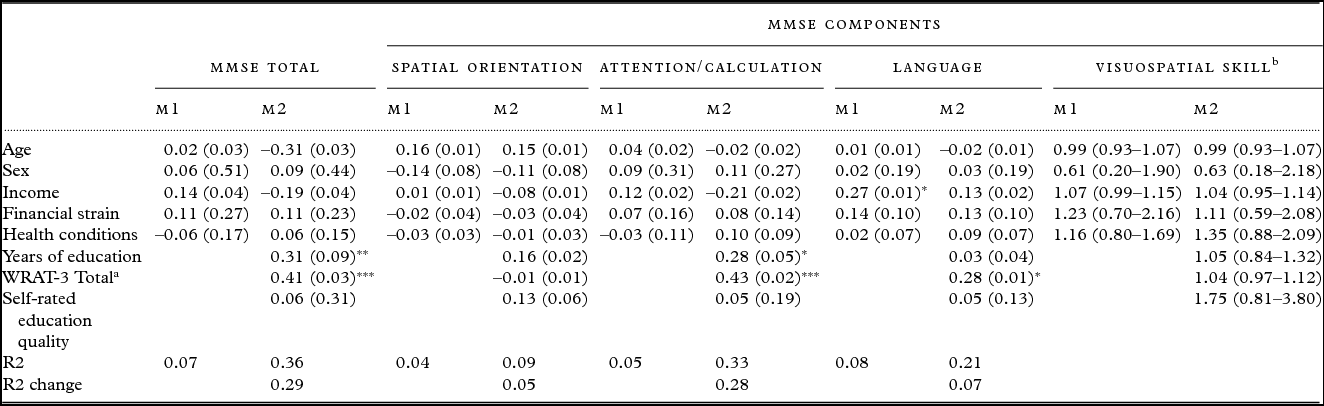
Given significant correlations were observed for MMSE total and MMSE components of spatial orientation, attention/calculation, language, and visuospatial skill, regression models were then conducted for strictly these variables to reduce multiplicity (see Table 3). After controlling for age, sex, income, financial strain, and health conditions, better performance on the objective education and more years of education were significantly and independently associated with higher total MMSE scores. When analyses were run for each of the MMSE components, significant results were observed for the attention/calculation and language components. After accounting for the sociodemographic and health covariates, years of education, and the performance-based education quality measure were significant and unique predictors of better performance on attention/calculation. However, only the performance-based education quality measure was a significant and unique predictor of better performance on language. We ran collinearity statistics for the regression models. The tolerance values were above 0.20 across the education parameters (education years = 0.602; WRAT-3 Total = 0.701; Subjective Education Quality = 0.680). The Variance inflation factor values <5 across the education parameters (education years = 1.662; WRAT-3 Total = 1.426; Subjective Education Quality = 1.470). Thus, the issue of multi-collinearity among the education parameters did not appear to influence the observed findings.
Education variables associated with MMSE total and component scores

Note. *p < 0.05, **p < 0.01, ***p < 0.001. M1 represents the first model of the regression models. M2 represents the second model of the regression models. Self-rated education represents self-rated education quality.
a Performance-based education quality.
b Odds ratio and confidence intervals illustrated for the conducted logistic regression.
A Mann–Whitney U test indicated that education quantity and quality were lower for the participants meeting the criteria for suspected cognitive impairment according to the most frequently used cut-offs (years of education median = 9 and objective educational quality median = 36) than participants not meeting this criteria (years of education median = 14 and objective educational quality median = 44; years of education U = 95.00, p < 0.01, r = 0.31; objective educational quality U = 116.50, p < 0.01, r = 0.28). Among the participants meeting the criteria for suspected cognitive impairment, a higher number of participants reported a “very poor to ok” self-rated education quality (n = 4, 57%) than a “very good” self-rated education quality (n = 1, 14%; X 2(2) = 7.59, p < 0.05) on the self-rated quality of education measure.
Discussion
The purpose of the study was to explore the association among various indicators of education and whether there was a relationship between these educational parameters and MMSE performance. It was hypothesized that Black adults who reported higher years of education also tended to report better quality of education and had higher scores on the performance-based measure of education quality. We observed that the various education parameters were significantly associated with each other, but were not highly correlated suggesting their unique effects.
We also hypothesized that these educational parameters would be significantly associated with performance on the MMSE. Our hypothesis was partially supported in that more years of education and better (self-reported and performance-based) education quality were indicative of better overall MMSE performance. The results indicated that better scores on performance-based measures of education quality and higher years of education were significantly associated with the total MMSE score, particularly after accounting for age, sex, income, financial strain, and health conditions. When we examined the separate MMSE subscales, we found that objective measures of education quality and higher years of education were significantly associated with better performance on the attention/calculation subscale, which has been observed in a previous study (Albert and Teresi, Reference Albert and Teresi1999). We also observed that objective measures of education quality were significantly associated with better performance on language. These result suggests that the attention/calculation and language questions on the MMSE may be particularly vulnerable to poorer performance due to worse education quality even if clinicians/researchers have accounted for demographic and health influences. Additional studies are warranted to examine why particularly the attention/calculation subscale of the MMSE is vulnerable to education effects. Furthermore, participants identified as meeting criteria for suspected cognitive impairment were more likely to have lower levels of education and worse educational quality, based upon the performance-based education quality measure.
While we observed that self-rated education quality was significantly associated with the MMSE total and subscales, this association was no longer significant after accounting for the demographic and health covariates. A possible explanation for these non-significant findings is that there was not much variability in self-reported ratings of education. Specifically, a majority of the participants (81%) rated their education as good to very good. Despite a high number of participants reporting a good/very good education, the sample, on average, has reading literacy scores suggestive of an 8th grade education. Prior studies that included Black adults have also observed educational quality levels equivalent to the current study's sample (Manly et al., Reference Manly, Jacobs, Touradji, Small and Stern2002; Dotson et al., Reference Dotson, Kitner-Triolo, Evans and Zonderman2009). For example, Dotson and colleagues (Reference Dotson, Kitner-Triolo, Evans and Zonderman2009) observed lower WRAT-3 scores, which are indicative of poorer education quality, across a sample of middle-aged Blacks. Specifically, this finding was noted among Blacks of lower socio-economic backgrounds (WRAT-3 score mean = 38.84) as compared to those from higher socio-economic backgrounds (WRAT-3 score mean = 41.07). In contrast, Manly and colleagues (Reference Manly, Jacobs, Touradji, Small and Stern2002) found average WRAT scores of 44.2 in a sample of Blacks aged 65 years and older. While the self-rated and performance-based measures of education quality are significantly associated, the self-rated measure of education may not fully capture the strategies needed to successfully complete the MMSE. Thus, performance-based measures of education quality may be a more impartial measure with regard to reading literacy, which complements self-rated education quality.
We also observed that participants' reported years of education was often not equivalent to their reading grade level. Although, the sample, on average, reported 14 years of education, they had reading literacy scores below this education level. The observed discrepancy between reported years of education and reading literacy further highlights the need to account for both education quantity and quality when interpreting performance on cognitive screening measures. Individuals with the same years of education may likely vary in their performance on a cognitive screening test because they may comprehend the test questions differently and use different strategy skills due to their disparate educational experiences/quality.
Although prior studies have explored the association between education parameters (years of education and reading literacy) and cognitive functioning (Manly et al., Reference Manly, Jacobs, Touradji, Small and Stern2002; Dotson et al., Reference Dotson, Kitner-Triolo, Evans and Zonderman2009), these studies have recruited participants from the Northeast region of the USA (Maryland or New York). The current study expands upon these studies by examining this topic within Blacks from a Southern USA state (Florida). Black adults residing in these different geographic locations are likely to experience disparate educational and social experiences (e.g. resulting from educational policies such as the Brown vs. Board of Education decision to desegregate public schools), which may explain slight differences in education quality across regions (Aiken-Morgan et al., Reference Aiken-Morgan, Gamaldo, Sims, Allaire and Whitfield2015). For example, following the Brown vs. Board of Education decision, many Blacks, particularly in Southern States, were exposed to positive (e.g. more educational resources) and negative outcomes (e.g. greater levels of discrimination within the desegregated school setting and reduced support from racially similar peers). Despite the long-term advantages of this national educational policy, the negative outcomes may have exacerbated stress levels in early life within this cohort of Black adults, which has shown to be associated with cognitive functioning in later adulthood (Whitfield and Aiken Morgan, Reference Whitfield, Aiken Morgan, Hofer and Alwin2008).
These findings are consistent with prior studies that have observed higher number of years of educations and education quality are associated with better performance on cognitive tests (Rohit et al., Reference Rohit2007), such as the MMSE (Albert and Teresi, Reference Albert and Teresi1999). However, the current study expands upon the previous literature by examining all six MMSE components in relation to education quantity and education quality (self-rated and performance-based). Our findings indicate that higher levels of education and better scores on the performance-based education quality measure was significantly associated with better performance on attention/calculation component of the MMSE after accounting for demographic and health factors. Jones and Gallo (Reference Jones and Gallo2002) observed that low levels of education (education quantity) were associated with more errors on the MMSE components of attention/calculation, orientation, and language, which increased the likelihood of meeting the MMSE cut-off for cognitive impairment. However, Albert and Teresi (Reference Albert and Teresi1999) observed that low reading ability (education quality) was associated with worse performance on the MMSE components of attention/calculation and language.
This study extends upon these findings by suggesting that the attention/calculation questions on the MMSE may be particularly vulnerable to poorer performance due to worse education quantity and quality, even if clinicians/researchers have accounted for demographic and health influences. Considering the attention/calculation component comprises 5 of the 30 total points of the MMSE, poor performance in this component alone could put an individual at risk for meeting the clinical cut-off for cognitive impairment (Tierney et al., Reference Tierney, Szalai, Dunn, Geslani and McDowell2000; Hensel et al., Reference Hensel, Angermeyer and Riedel-Heller2007). Although education quantity is typically measured and accounted for when administering the MMSE, our findings further suggest that the lack of attention to education quality will also likely put some individuals at risk for being considered cognitively impaired. On the other hand, the utilization of performance-based measures of education (e.g. WRAT or equivalent) to interpret MMSE scores may increase the risk of missing early signs of cognitive impairment. Longitudinal studies will be needed to address the longstanding dilemma of identifying diagnostic protocols that have high sensitivity and low specificity in detecting cognitive impairment. If longitudinal studies provide evidence of accurate detection for the risk of cognitive impairment when incorporating a performance-based measure of education quality to interpret MMSE performance, this will warrant a standard practice of administering both of these measures when assessing cognitive status, particularly for Black adults.
Furthermore, the inclusion of both years of education and performance-based education quality measures may provide a more accurate gauge of premorbid cognitive functioning, than these measurements alone, and may be a sensitive indicator of neurodegenerative disease (Albert and Teresi, Reference Albert and Teresi1999). Prior studies have observed that individuals with low reading skills are susceptible to more rapid age-related cognitive decline and risk for dementia (O'Carroll et al., Reference O'Carroll, Prentice, Murray, Van Beck, Ebmeier and Goodwin1995; Schmand et al., Reference Schmand, Smit, Geerlings and Lindeboom1997), which supports that education, a proxy of cognitive reserve, can modify the clinical expression of dementia (Stern, Reference Stern2002). Further longitudinal research, however, is needed to confirm that education quality measures of reading ability are associated with cognitive decline, risk for cognitive impairment, and early biomarkers (e.g. beta amyloid deposition and synaptic dysfunction) for Alzheimer's disease and other related dementias, particularly within older Black adults.
Given the MMSE is a commonly utilized measure of cognitive status in research and clinical settings, the current study's findings support the need to account for education quality in addition to years of education when administering the MMSE and, potentially, in the administration of other cognitive screening measures. Incorporating quality and quantity of education will provide a more comprehensive understanding of the individual's performance on cognitive measures, specifically as it relates to cultural differences. Furthermore, research investigators should be cautious when utilizing the MMSE as a cognitive screening tool to determine study eligibility, particularly for Black adults. Without considering education, minorities, particularly Blacks, may be unnecessarily excluded from research projects due to the perception that low scores on this measure reflects cognitive impairment. As a result, this type of study exclusion criteria will likely restrict the inclusion of racially and/or socioeconomically underserved populations in research.
The study is not without limitations. This is a cross-sectional study, so directionality of the observed relationships cannot be determined. It could be argued that the education measures should be mutually adjusted. However, our hypotheses better aligned with individual examination of each education measure. In addition, entering measures of education into one model would likely lead to multi-collinearity and expose the results to bias toward the Type II error beyond what may be considered tolerable. The study sample included a high number of females, which may restrict the ability to generalize the findings to Black males. Previous studies, however, also demonstrated higher samples of Black females compared to Black males (Manly et al., Reference Manly, Jacobs, Touradji, Small and Stern2002). Further research designed to investigate the study's aims with larger samples of Black males will be needed to determine whether the relationship between quality/quantity of education and cognitive screening measure performance varies between sex. Since participants were also recruited from, and resided within, the Tampa Bay Area, the findings may not generalize to Black adults in other geographic locations. However, our findings are consistent with previous studies that have recruited Blacks from other geographic locations. Furthermore, slight differences observed between our study and prior studies, such as reading literacy performance, may reflect a new avenue for future research to explore how Blacks varying educational experiences may be explained by the state or region where they obtained their secondary and/or post-secondary education. In addition, it will be beneficial to explore whether the disparate educational experiences may explain differences in cognitive performance often observed within Black adults (Whitfield and Aiken Morgan, Reference Whitfield, Aiken Morgan, Hofer and Alwin2008). Although the inclusion of a subjective item of education quality had moderate to large associations with commonly utilized measures of education in the previous literature, the current study is unable to clarify the reasons for participants’ perceptions of their education quality. However, the current findings may highlight a new research avenue to further explore the underlying meaning of this subjective educational quality measure and its potential correlates. Given the current study's focus on older Blacks, it is possible that our observations may not be observed in other minority populations. However, prior research has observed that socio-cultural biases can negatively impact performance on cognitive screening measures, such as the MMSE, in other minority populations in the USA (i.e. Mexican Americans) (Black et al., Reference Black1999) and in the United Kingdom (e.g. Afro-Caribbean, Chinese, Pakistani, Punjabi, and Gujaratis) (Parker and Philip, Reference Parker and Philip2004; Parker et al., Reference Parker, Philip, Sarai and Rauf2007). Such findings warrant additional research in this area with more racially/ethnically diverse samples. Last, a small number of individuals were identified as cognitively impaired based upon the MMSE total cut-off score of 24. Therefore, the current findings may not be observed with a larger number of cognitive impaired participants.
In conclusion, the findings highlight the importance of accounting for socio-cultural measures, such as education quantity and quality, when interpreting cognitive performance in Black adults.
Conflict of interest
None,
Description of authors’ roles
A. Gamaldo designed the study, supervised data collection, and wrote the manuscript. A. Sardina assisted with data collection, interpretation of study results, and writing the manuscript. R. Corona assisted with data collection, statistical analysis, and writing the manuscript. K. Willingham assisted with the interpretation of study results and writing the manuscript. R. Migoyo assisted with the literature review and editing the manuscript. R. Andel assisted with the study design, interpretation of the study findings, and editing the manuscript.
Acknowledgments
This research was supported by Byrd Alzheimer's Institute Small Grants Program (BRD215) and the PRIDE Training program (R25 105444-07).