1. Introduction
An exciting legacy of John Ohala's research inexperimental historical phonology (Ohala Reference Ohala, Anderson and Jones1974, Reference Ohala, Solé, Beddor and Ohala2007) has been the empirical examination in thelaboratory of the phonetic mechanismsforcommon and uncommon sound changes. Ohalian approacheshave been particularly beneficial in exploring a number of developments within Germanic; for example, Germanic consonant gemination (Denton Reference Denton2002), Old Englishmetathesis (Blevins & Garrett Reference Blevins and Garrett1998, Ritchie Reference Ritchie, Rauch and Carr1999),Middle Englishpalatalization (Guion Reference Guion1991), and rhotacism in West and North Germanic (Solé Reference Solé, Dressler, Luschützky, Pfeiffer and Rennison1992). Following this tradition, this paper presentsthe results of an acoustic experiment designed to explore the question of the relative timing of two changes: rhotacism and R-umlautin North Germanic. Based on experi-mental data, we argue that PGmc+/z/(< PIE +/s/) was retained as the conservative reflex /z/ in North Germanic, and that this phoneme trig-geredthe Old Norse R-umlautassimilatory sound change prior to /z/ undergoing rhotacismin North Germanic, whereby /z/ merged with the reflex of PGmc+/r/.
2. Old Norse R-Umlaut
Historically, the phonology of North Germanic was characterized by variousumlaut processes (a-umlaut, i-umlaut, etc.) described in standard works(Noreen Reference Noreen1923:§58ff, Gordon Reference Gordon1956:271–273, Heusler Reference Heusler1962:§15ff, Nedoma Reference Nedoma2001:§§7–9.3). The phonetic origin of most of these sound changesisregressive coarticulatory assimilation. One such development, R-umlaut, is the fronting of short and long back vowels before the phonemic runic segment algwiz, <R>, as shown in 1 (see Noreen Reference Noreen1923: 66–67, Gordon Reference Gordon1956:272, Nedoma Reference Nedoma2001:28–29, among others).
(1)

R-umlaut in Old Norse has been traditionally viewedas a “palatalizing” or “fronting”sound change (for example, Gordon Reference Gordon1956:272, Heusler Reference Heusler1962:21, Steblin-Kamenskij Reference Steblin-Kamenskij1963:366), where the coarticulatory effect of <R> is the tongue's shift forward in the oral cavity that causes fronting of back vowel tokens. Translated into acoustic terms, Denton (Reference Denton2003:19–20)has argued that the effect of the segment <R> was “… the raising of the preceding vowels’ F2 with little effect on F1, which generally correlates with vowel height.”
3. Historical Issues with the<R> of R-Umlaut
Despite the seemingly straightforward phonetic explanation outlined above, R-umlauthas traditionally been a source of scholarly contention because, as with many cases of consonantally conditioned vowel mutations in historical phonology, it is uncertain what phonetic value is to be reconstructed for the phonemic speech sound represented bythe futhark rune algwiz<R>. The minimal facts that define the parameters for reconstructing the rune include the following:
(i) PGmc+/z/ derives from PIE +/s/ via Verner's Law, and the algwizrune <R> is a reflex of this segment, as in PGmc+sū-z NGmc+sū-R ON sýr ‘pig’ (see Krahe Reference Krahe1956:§24, Nedoma Reference Nedoma2001:28). Based on reflexes found comparatively, PGmc+/z/ may be recon-structed asa voiced dental or alveolar sibilant fricative. The algwizrune of the Elder Futhark thus may represent a conservative articu-lation such as [z] (Antonsen Reference Antonsen1975, Telemann Reference Teleman1980, Lass Reference Lass, Davenport, Hansen and Nielsen1983,Faarlund Reference Faarlund and Woodard2008).
(ii) PGmc+/z/ undergoesrhotacism (z > r) in North and West Germanic, merging with reflexes of PGmc+/r/ (< PIE +/r/), the latter is generally reconstructed as a voiced apical trill, [r] (see Krahe Reference Krahe1956:§24, Denton Reference Denton2003).Footnote 1 How the merger of +/z/ and +/r/ occurred has always been controversial, but a logical assumption is that (at least some) reflexes of +/z/ must have had an articulation that could develop via a natural phonetic pathway into [r]. Traditional ac-counts claimed abipartite progression of fricative [z] toapproxi-mant [ɹ] via lenition, followed by merger of [ɹ] and [r] (=PIE +/z/ and +/r/, respectively; see Gordon Reference Gordon1956, Steblin-Kamenskij Reference Steblin-Kamenskij1963, among others; see Nielsen Reference Nielsen1998:130ff for a detailed discussion of the merger based ona thorough analysis of the corpus of runic inscriptions).
(iii) R-umlaut in Old Norse only occurs before the segment <R> (=PGmc+/z/) and not before reflexes of PGmc+/r/, represented by the rune raido (see examples in Noreen Reference Noreen1923, Steblin-Kamenskij Reference Steblin-Kamenskij1963). Therefore, the runes algwiz<R>and raido<R> must have represented different speech sounds in orthographic practice, at least initially, prior to any subsequent merger of the phonemes repre-sented by the two runes.
The last point is crucial as it shows that the reflex of PGmc+/r/ (< PIE +/r/), commonly reconstructed as an apical trill [r], does not condition R-umlaut, whereas reflexes of PGmc+/z/, whatever their precise phonetic value, did. Thus, the sound change of R-Umlaut in Old Norse itself furnishes a possible avenue for insight into the reconstruction of PGmc+/z/.
The focus of research on the reconstruction of <R>and the phonetics of PGmc+/z/ has disappointingly focused on fact (ii) at the expense of (i) and (iii). The debate on the rhotacism and merger of +/z/ with+/r/ re-volves around the observation that the corpus of runic inscriptions in Scandinavia show that the rune algwiz<R> (=PGmc+/z/) was kept distinct from the rune raido<R> (=PGmc+/r/) until about 900 C.E. when rune-carvers began to use the two runes interchangeably (see Nielsen Reference Nielsen1998:130). This later confusion led researchers to believe that reflexes of the phoneme /z/ developedarticulatorilyinto a rhotic segment, so-called jüngeres-r ‘younger r’, which allowed it to become confused for and interchangeable with reflexes of the otherrhotic segment in the picture, +/r/,so-calledälteres-r‘older r’ (see, for example, Noreen Reference Noreen1923).
Germanic linguists have taken the noncontrasting usage of the two runic symbols as evidence of rhotacism in action: In practice, R is understood as ashorthand for z > r, an orthographic cover term for anypossiblearticulation on the cline from /z/ to /r/. For instance, Noreen (Reference Noreen1923:33–34)viewsthe phonetic value of the phoneme as “…wo[h]l einfrikativesdorsalesr”, presumably an articulation such as an uvular fricative, IPA [ʁ], or a uvular (fricative) trill, IPA [ʀ], whereas Gordon (Reference Gordon1956:268), among others, speculated that <R> was an “r-colored [z]” or a palatalized approximant [ɹʲ],either of whichwould be distinct from the other liquid phoneme in Old Norse, the apical trill [r]. Gordon (Reference Gordon1956:268) proposes the developmental sequence in 2a, with possible IPA values given in 2b.
(2)
Gordon's palatalized stage [ɹʲ] is ad hoc: <R> is understood to be palatalized at that stageprecisely to explain R-umlaut, that is, after rhotacism but before the youngerr merges with the older r.
This account can be argued against on phonetic grounds as follows. The lenition of an alveolar fricative [z] to alveolar approximant [ɹ] involves the tongue tip gradually lowering and retracting to produce an approximant; just such an articulatory progression is documented for rhotacism phenomena in Spanish and Catalan (see Solé Reference Solé, Dressler, Luschützky, Pfeiffer and Rennison1992) and elsewhere crosslinguistically due to well-understood articulatory and aerodynamic reasons (see Ohala & Solé Reference Ohala and Solé.2008). However, Gordon's progression requires the tongue tip to raise again in palatalization, the opposite coarticulatory shift required for lenition. The proposed se-quence, and numerous accounts like it (see Heusler Reference Heusler1962:21, Steblin-Kamenskij Reference Steblin-Kamenskij1963:366, among others),are basedon the traditional assumption that PGmc+/z/ developed in the following order: (1) Rhotacism of PGmc+/z/ > [ɹ] in early North Germanic, (2) R-umlautconditioned by [ɹ] or something like it in early North Germanic, (3) Merger of [ɹ] reflexes with /r/ (<PGmc+/r/) in later North Germanic.
There is a competing tradition onrhotacism of +/z/ > /r/ in North Germanic that supports an alternative view that R-umlaut precedes rhotacism, that is, the progression occurred (1) R-umlaut, (2) Merger (= rhotacism). Proponents of this sequence argue thatthere is no clear evi-dence for any intermediate stage of development between PGmc+/z/ and its merger with +/r/ in North Germanic; an increasing number of linguists studying the historical phonology of Germanicunderstandthe outcome of rhotacism/lenition of PGmc+/z/ (> [ɹ])as merger of /z/ with /r/ (see Antonsen Reference Antonsen1975, Teleman Reference Teleman1980, Lass Reference Lass, Davenport, Hansen and Nielsen1983, Faarlund Reference Faarlund and Woodard2008, among others). Stemming from PIE +/s/ via Verner's Law, PGmc+/z/ is often taken to have a dental or alveolar realization (for +/s/ in PIE, see Szemerényi Reference Szemerényi1996:51–53; for PGmc+/z/, see Faarlund Reference Faarlund and Woodard2008:220), though some scholars posit a postalveolar realization, such as [ʒ], as this place of articulation may have facilitated merger with reflexes of PGmc+/r/ on acoustic and auditory grounds (see Teleman Reference Teleman1980, Lass Reference Lass, Davenport, Hansen and Nielsen1983, Painter Reference Painter2011).
For instance, Painter (Reference Painter2011) arguesthat certain realizations of voiced coronal fricatives [z, ʑ, ʐ] such as those found in Polish could closely resemble realizations of rhotic approximant [ɹ] and trill [r] in theiracous-tic and auditory properties. This suggests that realizations of PGmc+/z/ may have been reanalyzed as tokens of PGmc+/r/ directly via hyper-correction (Ohala Reference Ohala, Masek, Hendrick and Miller1981, Reference Ohala and Jones1993) without anyintervening stage of develop-ment, such as an observable period where /ɹ/ (<PGmc+/z/) and /r/ (<PGmc+/r/) contrasted in the language. Under this analysis, rhotacismof +/z/ is the equivalent of merger with +/r/ (for the theoretical discussion of this view, see Solé Reference Solé, Dressler, Luschützky, Pfeiffer and Rennison1992, Painter Reference Painter2011). Importantly, from this perspective, the NGmc segment <R>which conditioned the R-umlautcould not have been a rhotic articulation but was more likely an unchanged reflex of PGmc+/z/, that is, an alveolar or postalveolar voiced fricative.
Recent phonetically-informed research onhistorical phonology of PGmc+/z/ and +/r/ seems to delineate plausible developments from im-plausible ones (for example, Denton Reference Denton2003), but even newer accounts remain speculative and open to debate since there is no empirical data to support descriptive phonetic claims. With few further phonetic parameters to be adduced from comparative reconstruction of possible value of <R>, the state of knowledge is a surfeit of theories and no hard data. Consider that under various accounts, the<R> segment, whichconditions R-umlaut in North Germanic, may be any of the articulations in 3.
- (3)
a. voiced dental or alveolar sibilant fricative [z] corresponding to an unchanged pronunciation from the archaic PGmc+/z/ (see Antonsen Reference Antonsen1975 among others)
b. voiced postalveolar or retroflex fricative, [ʒ] or [ʐ] (Teleman Reference Teleman1980, Lass Reference Lass, Davenport, Hansen and Nielsen1983)
c. voice dapicalrhotic with central approximant [ɹ] realizations (Denton Reference Denton2003)
d. voiced “lisped” apical or uvular fricative, [r] or [ʁ] (Noreen Reference Noreen1923:33)
The acoustic experiment reported below explores the issue of phon-etic reconstruction of R-umlaut in Old Norse within the framework of experimental historical phonology (Ohala Reference Ohala, Anderson and Jones1974, Reference Ohala, Solé, Beddor and Ohala2007). We attempt to test the degree of positive movement of F2 (which correlates broadly with vowel fronting) of the segments [z], [ʒ], and [ɹ] on the immediately preceding vowel, and examine the movement of F1 (which inversely correlates with vowel height). This laboratory investigation seeks to address empirically the question of what phonetic value might best be reconstructed for NGmc<R> through studying the acoustic effects of segments often cited as candidates for such a reconstruction. The results may thus partially clarify a long-standing problem in the historical phonology of Old Norse.
The remainder of this paper is structured as follows. The next section, section 4, outlines some phonetic assumptions and hypotheses that informed our experimental design. In sections 5 and 6, we present the methodology and results of our acoustic experiment on segments that condition vowel fronting. Section7discusses the implications of the experimental findings, and section 8 provides a model for the sound change, and presents our conclusions on the phonetic triggers of this sound change within the historical phonology of North Germanic.
4. Phonetic Hypotheses
In a recent discussion on what kind of rhotic in Germanic could condition R-umlaut, Denton proposes an alveolar approximant /ɹ/: “The ‘bunched’ or ‘light’ articulation of American English /ɹ/ has just the sort of tongue dorsum raising toward the palate and concomitant low front tongue position which can centralize vowels” (Denton Reference Denton2003:20; see Lass Reference Lass, Davenport, Hansen and Nielsen1983:79–82). The view that a species of rhotic approximant might con-dition R-umlaut has a long pedigree (going back at least as far as Noreen Reference Noreen1923). Laboratory investigation on the effect of [ɹ] tokens on back vowels shows that their primary effect on the vowel quality is central-ization, not fronting. Clark & Hillenbrand Reference Clark and Hillenbrand2007, an acoustic and perceptual study on the effects of /ɹ/ on back vowels in the American English dialect of the Inland North, show that, in the production of the sequence /aɹ/ as in the word star, there is significant fronting of the vowel nucleus, that is, the rhotic indeed causes F2 to risemarkedly; however, the rhotic also lowers F1, making the offset of the vowel nucleus more raised, and thus the vowel is centralized (Clark & Hillenbrand Reference Clark and Hillenbrand2007:283).
In an earlier experiment, Clark & Hillenbrand (Reference Clark and Hillenbrand2003) had determined that front vowels such as /i/ and /e/ are also lowered and slightly retracted due to the presence of a following /ɹ/. Thus, the global effect of various forms of approximant /ɹ/ is centralization of vowels, that is, they draw vowels inward from the periphery of the vowel space (Clark & Hillenbrand Reference Clark and Hillenbrand2003; Reference Clark and Hillenbrand2007). This centralizing effect of approximant /ɹ/ furnishes a possible explanation for the lowering of high vowels before reflexes of <R> in North Germanic and Old English: OE meord ‘reward’ (Go. mizdo); ON ero (PGmc+izunÞ), OE pronouns we, ge, he, me, Þe and ON pronouns véR, séR, éR, méR, ÞéRin comparison with Gothic weis, jus, is, mis, Þusand OHG wir, ir, mir, dir(examples from Noreen Reference Noreen1923, Campbell Reference Campbell2003; compare Denton Reference Denton2003:19). These examples make a suggestive case that <R> was a form of rhotic approximant that could trigger bothvowel-fronting and vowel-lowering coarticulatoryassimi-lations. However, it is clear from the examples in 1 that the R-umlaut vowel mutation involves more than modest fronting, such as /u/ > /y/ and /o/ > /ø/, which suggests that vowel fronting and vowel lowering/centralization are perhapsdistinct changes in the history of Old Norse.
We hypothesize that vowel fronting in R-umlaut was conditioned by an alveolar fricative /z/ (a conservative reflex of PGmc+/z/),and that this was an independent development from these later vowel lowering changestriggered by a rhotic /ɹ/ after rhotacism in North Germanic. It is worth considering experimentally whether other nonrhotic articulations exhibit positive F2 movement, particularlythe voiced dental sibilant fricative [z] or a voiced postalveolar sibilant fricative [ʒ], the two articu-lations reconstructed for PGmc+/z/ beforerhotacism discussed above (see also Teleman Reference Teleman1980). The main research question considered in the experiment reported below is simply this: Do reflexes of a voiced fricative /z/—phonetically alveolar [z] or postalveolar[ʒ]—condition the fronting of back vowels significantly better than tokens of the AE rhotic approximant /ɹ/?
Based on the previous phonetic research, it is extremely likely that a segment articulated with the tongue tip raised at the dental or alveolar place of articulation would induce the fronting of back vowels, since such a change is fairly well attested, for instance, the fronting of /u/ to /y/ before [t] (several earlier studies are cited in Ohala Reference Ohala, Masek, Hendrick and Miller1981, and more recent empirical evidence is found in Harrington et al. Reference Harrington, Kleber and Reubold2008). In the following acoustic experiment, we investigate, first, what phonetic segments in our test set show the greatest raising of F2 of the preceding vowel, that is, which trigger the most significantvowel fronting. Second, we look at which segments condition movement of F1, that is, which articulations affect vowel height significantly. Lastly, the experiment investigated which phonetic segments create the most distinctive coarti-culatory shift in the value of F2 over the duration of the vowel, since it has been demonstrated that rapid F2 movement can be a useful percep-tual cue for the identification of vowel quality (Ohala Reference Ohala, Masek, Hendrick and Miller1981).
It is predicted that the alveolar fricative /z/ and postalveolar /ʒ/ will induce higher mean values of F2 in an immediately preceding back vowel than the approximant /ɹ/. In view of previous work on vocalic fronting induced by alveolar obstruent segments (Ohala Reference Ohala, Masek, Hendrick and Miller1981, Harrington et al. Reference Harrington, Kleber and Reubold2008), we predict that alveolar [z] will show the greatest degree of fronting of an exemplar back vowel /u/, and that this effect will be greater in faster speech than in citation speech due to an increase in coarticulation. This would suggest that the voiced fricative /z/ is more likely to cause fronted variants of the high back vowels and support the argument that <R> involved in umlautwas phonetically realized as alveolar fricative [z] or something phonetically similar and had not yet undergone rhotacism in Old Norse. In other words, reflexes of PGmc+/z/ and +/r/ were relatively conservative in the early stages of North Ger-manic as an alveolar fricative /z/ and an apical trill /r/, respectively.
5. Experimental Design
5.1. Stimuli
Monosyllabic nonsense words (for example, /CuC/) were recorded under two speech conditions, citation and faster speech. The high back rounded vowel [u] was used in all stimulus items as arepresentitive of back vowels in general. The final target consonants varied among the set [d, z, ʒ, ɹ]. The voiced stop [d] was included as an alveolar baseline against which to measure the relative effects of the hypothesis-dependent choices of [z, ʒ, ɹ].
With respect to the initial consonants, the stimuli were divided into two classes: targets and fillers. The target stimuli included an initial [b] for the following reasons: First, a voiced segment would ensure voicing throughout the production of test items, that is, all target nonsense words would be voiced throughout; second, a labial segment such as a voiced [b] was predicted not to create a bias of tongue position toward coarticu-latory fronting, which might have been possible if a velar [ɡ] or alveolar [d] were employed; third, a stop segment would have a discernable re-lease burst in spectrograms, which is useful as a reference point for taking formant measurements of the following vowel. Therefore, the target class consisted of the four nonsense words [buːd, buːz, buːʒ, buːɹ].
In order to prevent participants from strategizing in the experiment, the filler stimuli were recorded in the same session as the target stimuli, at aratio of 2:1. The filler items included the same vowel and final consonants as the target items and differed solely in theirinitial voiced consonant: [n, l] versus [b]. Thus, there were eight fillers,[nuːd, nuːz, nuːʒ, nuːɹ, luːd, luːz, luːʒ, luːɹ], recorded alongside four targets, [buːd, buːz, buːʒ, buːɹ], presented in quasi-random order. Six of the twelve items, one target and five fillers, were actual English words (booze, nude, news, lewd, loose, luge), but this was considered acceptable as it allowed us to inform the participants that the experimental task was about relative rates of reading speeds for nonsense words versus actual words in English. This mild deception was used so that speakers were not attuned to the true purpose of the experiment, which may have made them con-scious of their pronunciation.
5.2. Participants
We recruited 10 male speakers of American English (AE)between the ages of 18 and24. All speakers were from the western New York area, had not travelled widely outside the region, and were self-reported monolingual English speakers. The participants had grown up and at-tended school within a roughly25 square mile area; this criterion is crucial since the AE speakers were all from the Northern Cities Shift dialect area, and we wanted to control for the regional dialect factor care-fully. Speakers received U.S.$10as compensation for participation to ensure high motivation.
5.3. Procedure
During testing, lists of items were presented to the participantsin a PowerPoint slideshow. The stimuli and filler items were presented in quasi-randomized order. We ensured that items were arranged so that no two consecutive items in the presentation had the same final target con-sonant. Participants were divided into two groups: Group 1 had partici-pants recording the fast block of 24 test items first, followed by a short break, after which the participants recorded the slow block of 24 test items. For group 2, the tasks were reversed.
Every participant began the experiment by undergoing a short training session, where they were given instructions on the pronunciation of IPA /u/ and/ʒ/. In order to avoid potential lexical effects due to ortho-graphy such as <oo> or <u> (for example, <bud> may be read as /bʌd/), we coached participants to read the“double diamonds” symbol <♦♦> as representing the vowel [uː]. Specifically, the participants were instruc-ted that the double diamonds represent a long /u/ sound that rhymes with the vowel in the following words: moo, boo, shoe, and too. For /ʒ/, we used the grapheme <zh> and told the participants that it is the sound found in the following words: mira ge, plea sure, gara ge, a zure, and rou ge. This training session was followed by a practice session, where the participants read aloud eight CVC nonsense words: [duːd, duːz, duːʒ, duːɹ, ɡuːd, ɡuːz, ɡuːʒ, ɡuːɹ]. Each practice item was presented twice, in quasi-random order.
The participants were then recorded reading the experimental items using a Marantz solid-state recorder in a sound proof booth at the univer-sity phonetics lab. All recordings were made at 44,100 kHz. One of the investigators remained in the sound booth during each recording session to control for sound levels on the recorder.
Following similar methodology in Guion 1991:23, two utterances of each CVC nonsense word were recorded under two conditions: faster speech and citation speech. The two speech rates were included in this experiment to investigate whether faster speech tokens could be im-plicated in a vocalic fronting effect based on the value of the final consonant. The participants were not informed about the true purpose of the experiment. Instead, we explained that we were investigating how adept English speakers were at pronouncing nonsense words using their phonological knowledge of real words. To elicit faster tokens, partici-pants were asked to read a question-answer pair as quickly as they could without making any errors in pronunciation. Question: “Could I say the word [CVC] again?” Answer: “I would be delighted to say the word [CVC] again.” The participants were instructed to usea natural questionintonation to ask the question and to say the answer as naturally as possible. The second repetition of the [CVC] item in each question-answer pair was extracted as the faster speech token. The prediction was that this method would produce relatively faster and more phonetically reduced forms. In the citationcondition, the participants were asked to read the same test items in the carrier “Say the word [CVC] again.”The participants were instructed to speak carefully and clearly.
5.4. Formant Analysis
Normalmethods of measuring formants (see, for example, Ladefoged Reference Ladefoged2009) were used to extract values of F1, F2, and F3 in Praat (Boersma & Weenik Reference Boersma and Weenink2007) for two points within the vowel. Following methodology in Guion Reference Guion1991:27, F1 and F2 values were measured (i) at the mid-point of the vowel (F1-V[owel], F2-V[owel]) as measured halfway from the release of the initial /b/ to the onset of the final consonant, and (ii) for the last glottal pulse before the onset of the final consonant (F1-C[onsonant], F2-C[onsonant]), roughly 5 ms before the onset of the consonant. The data on F3 weregathered in the event that the gross movement from F3-V to F3-C shows a rapid transition; a partial analysis of F3 trajectories is provided.
The means of each of these formant values, pooled across speakers, were plotted to show if there was a gross effect of lack of movement of F1 versus a raising of F2 for each segment type. A lack of change in F1 between F1-V and F1-C for a particular final consonant would indicate that there was no coarticulatoryraising of the vowel. For the second formant, a significant change in a positive direction in the value of F2-V and F2-C would indicate a marked fronting of vowel due to the phonetic value of the final consonant.
6. Results
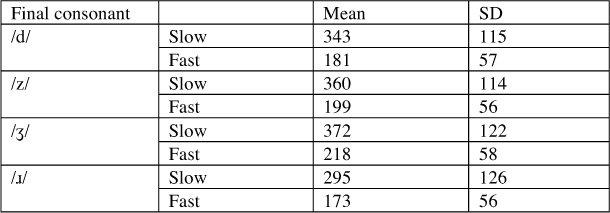
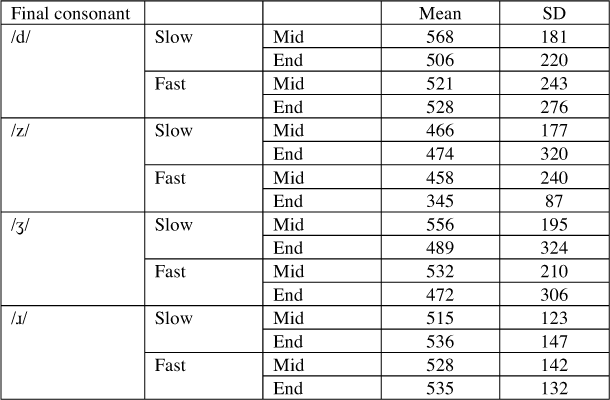
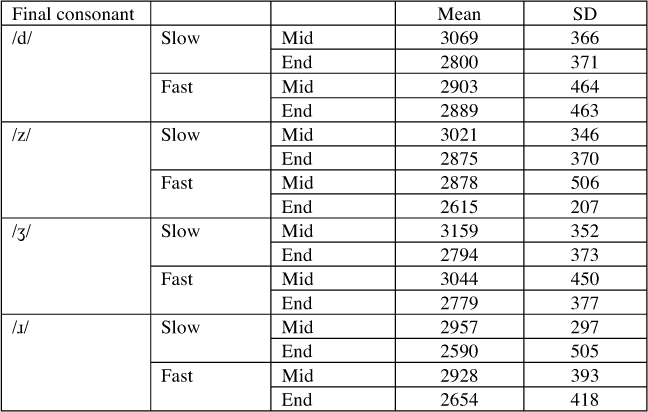
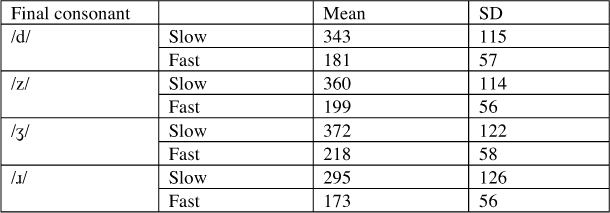
The total number of recorded items included 480 tokens: three initial segments [b, n, l] × four final segments [d, z, ʒ, ɹ]×two repetitions ×two rates × 10 speakers. Of these, 160 were targets (for example,[buC]) and 320 were fillers (for example,[nuC, luC]). Post-hoc sifting of the data revealed no reason to discard data from any of the participants, so all target items were retained in the analysis. The appendix gives mean duration (table 5) and formant frequencies (tables 6–8) of the vowel /u/ in all conditions. For all analyses, we used a linear mixed-effects regression (LMER) analysis, with subjects, items, and lists as random effects. In our regression models, in addition to the consonant environ-ments there were two categorical predictors (levels in parentheses, with the reference level in italics): speed (slow, fast) and vowel position (midpoint, endpoint).
6.1. Duration
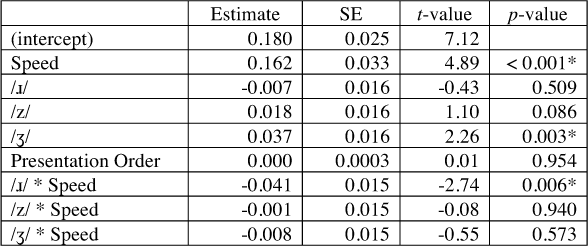
The regression model for vowel duration incorporated three random-effect factors: a by-subject adjustment to the intercept (SD=0.053), a by-item adjustment to the intercept (SD=0.008), a by-list adjustment to the intercept (SD<0.001), and the residual error (SD=0.033). Table 1 summarizes the fixed-effect structure of the regression model on vowel duration, including beta weights, standard errors, t-values, and p-values.Footnote 2
Fixed effects of the linear mixed-effects regression model for vowel duration, with subjects, items, and lists as random effects.

The mean duration of the vowel in both conditions was 267 ms. The model revealed several statistically significant comparisons. As expec-ted, vowel duration was longer in the citation speech than in the fasterspeech (342 msand 192 ms, respectively; β = 0.162, t=4.89, p<0.001). This demonstrates that the speed manipulation did cause the participants to produce the tokens slower or faster depending on the carrier phrase that was used. Additionally, a main effect of [ʒ] was observed, where the vowels occurring before [ʒ] were longer than the mean (μ=295 ms, β=0.037, t=2.26, p=0.003). Finally, an interaction between [ɹ] and speed was also observed: The difference in the vowel duration of the tokens occurring before /ɹ/ (122 ms) wassmaller than the mean difference (150 ms) between the tokens produced under the slow and fast condition (β=-0.041, t=-2.74, p=0.006). All other comparisons were nonsignificantstatistically (for all predictors, p>0.05).
6.2. First Formant
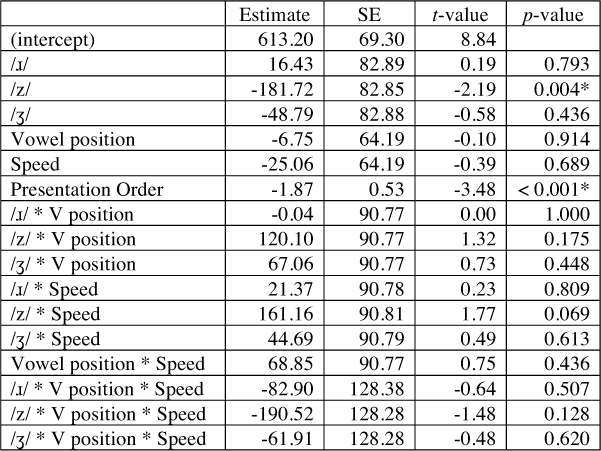
The regression model for the first formant incorporated three random-effect factors: a by-subject adjustment to the intercept (SD=75.85), a by-item adjustment to the intercept (SD=37.04), a by-list adjustment to the intercept (SD=20.40), and the residual error (SD=202.98). Table 2 sum-marizes the fixed-effect structure of the regression model on vowel duration, including beta weights, standard errors, t-values, and p-values.
Fixed effects of the linear mixed-effects regression model for the first formant, with subjects, items, and lists as random effects.
The mean first formant value in both conditions was 501 Hz. The model revealed two statistically significant comparisons. First, the first formant value of the vowel followed by [z] was lower than the mean by 66 Hz (β=-181.72, t=-2.19, p=0.004), suggesting that vowel tokens produced in these environments were higher than in the other environments. This would be an expected coarticulatory effect of tongue tip raising for the articulation of [z]. Second, we also observed an effect of presentation order on the first formant value: First formant values gradually became lower as the experiment progressed, suggesting that vowel height gradu-ally increased during the course of the experiment (β=-1.87, t=-3.48, p<0.001). All other comparisons were nonsignificant (for all predictors, p>0.05).
6.3. Second Formant
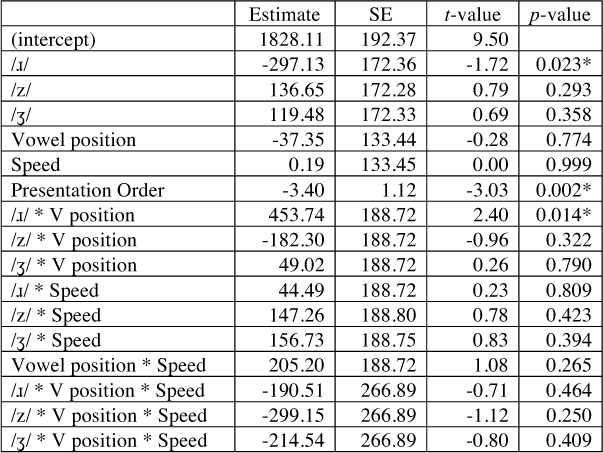
The regression model for the second formant incorporated three random-effect factors: a by-subject adjustment to the intercept (SD=212.21), a by-item adjustment to the intercept (SD=77.04), a by-list adjustment to the intercept (SD=174.05), and the residual error (SD=421.99). Table 3 summarizes the fixed-effect structure of the regression model on vowel duration, including beta weights, standard errors, t-values, and p-values.
Fixed effects of the linear mixed-effects regression model for the second formant, with subjects, items, and lists as random effects.
The mean second formant value for all conditions was 1727 Hz. The model revealed three statistically significant comparisons. First, the second formant value of the vowel occurring before [ɹ] was lower than the mean by 128 Hz (β=-297.13, t=-1.72, p=0.023), suggesting that vowel tokens produced in these environments were further back than in the other environments. Second, as with the first formant, we also ob-served an effect of presentation order on second formant values: Second formant values gradually became lower as the experiment progressed, suggesting that vowel fronting gradually decreased during the course of the experiment (β=-3.40, t=-3.03, p<0.002). Finally, we observed an interaction between [ɹ] and vowel position: Only the vowels occurring with the [ɹ] coda condition had second formant values that were higher in the vowel midpoint than in the endpoint (1811 and 1387 Hz, respectively: β=453.74, t=2.40, p=0.014). All other comparisons were non-significant (for all predictors, p>0.05).
6.4. Third Formant
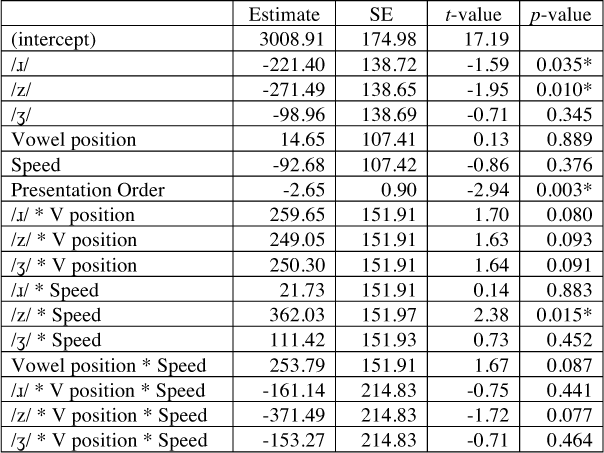
The regression model for the third formant incorporated three random-effect factors: a by-subject adjustment to the intercept (SD=155.15), a by-item adjustment to the intercept (SD=61.99), a by-list adjustment to the intercept (SD=184.28), and the residual error (SD=339.68). Table 4 summarizes the fixed-effect structure of the regression model on vowel duration, including beta weights, standard errors, t-values, and p-values.
The mean third formant value for all conditions was 2872 Hz. The LMER model revealed four statistically significant comparisons. Two main effects of consonant environment on vowel quality were observed: The third formant values of the vowel occurring before [ɹ] and [z] were lower than the mean by 90 and 25 Hz, respectively (for [ɹ]: β=-221.40, t=-1.59, p=0.035; for [z]: β=-271.49, t=-1.95, p=0.010). Additionally, as with the first and second formants, we also observed an effect of presentation order on third formant values: Third formant values gradually became lower as the experiment progressed (β=-2.65, t=-2.94, p<0.003). Finally, we observed an interaction between [z] and speed: Only the vowels occurring with the [z] coda had third formant values that were higher under the citation than in the faster condition (2948 and 2746 Hz, respectively: β=362.03, t=2.38, p=0.015). All other compari-sons were nonsignificant (for all predictors, p>0.05).
Fixed effects of the linear mixed-effects regression model for the third formant, with subjects, items, and lists as random effects.
7. Discussion
As the nature of experimentation in historical phonology becomes more sophisticated by employing advanced techniques, particularly statistical models such as LMERs that include presentational order as factors, much of value about how we conduct experiments comes to the fore. For instance, in the analysis of the results, it became clear that the length of the experiment itself contributed to more naturalistic speech for all par-ticipants. In particular, mean values of F1, F2, and F3 for all participants became lower as the experiment progressed: F1: (β=-1.87, t=-3.48, p<0.001); F2: (β=-3.40, t=-3.03, p<0.002); F3: (β=-2.65, t=-2.94, p<0.003). As it is sometimes claimed that lab-based investigations of human speech do not reflect natural speech conditions (see, for example, Gass & Mackey Reference Gass and Mackey2005:185–186), the results of this experiment show that prolongedtesting in a controlled fashion may induce participants to shift toward producing more natural speech-like tokens. A post-hoc analysis of the data is currently underway, laying groundwork for a future study. We are comparingthe acoustic properties of the tokens produced during the first half of the recording session withthe acoustic properties of the tokens produced during the second half, against a baseline of tokens recorded from fluent discourse.
The main findings of the acoustic experiment are suggestive. Regardless of speed manipulation, there is a difference between the F2 values of the vowelspreceding coda [z] versus coda [ɹ]: The F2 values of [u] tokens before coda [ɹ] are lower, which is indicative of vowel backing over the second half of the vowel (p=0.023). This suggests that the main coarticulatory effect of coda [ɹ] is the retraction of the preceding vowel. This is the exact opposite of what one would expect if a reali-zationof arhotic such as AE /ɹ/were causing a fronting effect such as R-umlaut. This result appears to rule out at least some realizations of AE /ɹ/ as a potential conditioner for the sound change.Footnote 3 Strong evidence for our prime hypothesis would be that tokens of alveolar /z/ caused a consider-able raising of F2 of [u], relative to other segments. Similar to experi-mental findings for alveolars elsewhere (for example, Ohala Reference Ohala, Masek, Hendrick and Miller1981), AE /z/ did have the greatest effect of raising F2 of any segment in the study, raising the formant an average of 136.65 Hz, but this result was not statistically significant (p=0.295). It may be noteworthy that the alveolar /z/ also lowered the mean value of F1 by an average of 181 Hz across the duration of the vowel /u/ (p=0.0004). In other words, this illustrates that coda alveolar /z/ raised the vowel in addition to causing fronting of the vowel. In sum, this suggests that coda /z/ and AE approximant /ɹ/ likely have opposite effects on vowel quality, with /z/ triggering raising and fronting and /ɹ/ lowering and retracting (see Denton Reference Denton2002:20). The results suggest that articulations of a voiced alveolar fricative /z/ are a stronger candidate than a rhotic approximant /ɹ/ for the reconstructed value of the rune alqwiz<R>, but further experimentation would be needed to make a solid case.
Finally, the results reveal that codas [z] and [ɹ] both cause the average value of the preceding vowel's F3 to drop (p=0.01 and p=0.035, respectively). This is likely due to the secondary cavity which is formed at the root of tongue anterior to the constriction in the production of alveolar /z/ and the bunched versions of approximant /r/ (see Johnson Reference Johnson2004:126–127). The shared acoustic characteristic between these two very different types of articulation warrants further study as its existence suggests an auditory component for rhotacism of alveolar fricative /z/ to rhotic approximant /ɹ/ based on a common lowering of F3. There were no statistically significant effects in terms of F1, F2, or F3 of baseline [d] or postalveolar[ʒ] in either speed manipulation.
8. Conclusion: A Model for R-Umlaut in Old Norse
Like other recurrent sound changes, R-umlaut in Old Norselikely has its origins in naturally occurring low-level phonetic variation (see Ohala Reference Ohala, Masek, Hendrick and Miller1981, Reference Ohala, Breivik and Jahr1989, Reference Ohala and Jones1993). The gradual vowel fronting arises when the speaker produces fronted realizations of back vowels in environments where fronting is likely, such as before dental or alveolar segments, and the listener reanalyzes these fronted variants of backvowelsas a better exemplar of the vowel category as a whole (see Ohala Reference Ohala, Masek, Hendrick and Miller1981, Blevins Reference Blevins2004:32–33). The relative frequency of occurrence of fronted variants of back vowels in the phonetic signal may serve as a catalyst to recenter the prototypical vowel category for listeners, since listeners, or more properly, language learners, use these fronted variants when forming phonological categories (see Blevins Reference Blevins2004:37; see also Bybee Reference Bybee2001 on the role of frequency in establishing sound patterns). A model of R-umlautin Old Norse in the fashion of Ohala Reference Ohala, Masek, Hendrick and Miller1981 or evolutionary phonology (Blevins Reference Blevins2004) is presented in 4.
(4)
The coarticulatory effect of <R> (whatever its precise phonetic value, here represented as /z/) is that the Speaker produces several fronted variants of /u/, each with different frequency (step 1). Following Blevins Reference Blevins2004:38ff, the variants are listed by frequency of occurrence, in descending order. In this context, the semifronted [ʉz] has the highest token frequency, followed by the fully-fronted [yz], followed by the un-fronted realization [uz] with the lowest token frequency. Thus, the speech signal contains multiple fronted variations of the high back rounded vowel /u/ (step 2). The listener/language learner hears the fronted variant [ʉ] most frequently in this context and comes to perceive it as the best exemplar of the phoneme (step 3). Through multiple speaker-listener interactions, or more likely, across generations, this gives rise to a conditioned cate-gory shift of the phoneme /u/ > /ʉ/ > /y/ before <z> (step 4). As the sound change progresses, [yz] is now the most frequently occurring fronted variant, and it becomes established as the new prototypical type for this vowel phoneme (Blevins Reference Blevins2004:31–44).
This type of gradual shift of the exemplar of a vowel phoneme has been observed to happen comparatively rapidly across generations of speakers (see Janson Reference Janson1983 on the fronting of /o/ across two generations of Swedish speakers), and it seems likely that the model above reflects certain historical truths about the R-umlautchange. Diachronically, the observed result of this scenario is a regular sound change, /u/ > /y/; the other long and short back vowels in Old Norsewould be fronted via a nearly identical process. It is worth noting that if reflexes of alveolar /z/ trigger the R-umlaut vowel mutation due to natural coarticulation, then the later merger (rhotacism) of +/z/ and +/r/ would be the development which phonemicizes the R-umlaut effect, furnishing the descriptive explanation why reflexes of ON /r/ stemming from PGmc+/z/ cause R-umlaut where those reflexes of /r/ arising from PGmc+/r/ do not.Footnote 4
After the rhotacismand merger of this reflex of PGmc+/z/ with +/r/ via lenition, the resulting rhotic in medial and final position in North Germanic was likely articulated as a kind of a central approximant (for this argument, see Denton Reference Denton2003:20, Painter Reference Painter2011:147ff). In our view, the lowering of high vowels in cases such as ON køro, kȳr ‘cow’ (<PGmc+kūz)or ONør‘out’ (Gothicus-) represents an independent development based on the well-described centralizing effect of rhotic approximants (for example, Clark & Hillenbrand Reference Clark and Hillenbrand2003).
In conclusion, following the tradition of experimental historical phonology (Ohala Reference Ohala, Anderson and Jones1974, Reference Ohala, Solé, Beddor and Ohala2007), this paper has attempted to resolve a long-standing crux in the historical phonology of Old Norse. Our experi-mental data provide support for the hypothesis that coda alveolar [z], and not postalveolar [ʒ] or approximant [ɹ],would trigger a fronting effect on a back vowel, such as [u], similar to what has been found by other researchers in the field (for example, Harrington et al. Reference Harrington, Kleber and Reubold2008). This empirical acoustic data support the position of Antonsen Reference Antonsen1975, Teleman Reference Teleman1980, Lass Reference Lass, Davenport, Hansen and Nielsen1983, Faarlund Reference Faarlund and Woodard2008, among others, that a conservative reflex of PGmc+/z/ (<PIE +/s/) survived relatively unchanged in North Ger-manic as a kind of voiced alveolar fricative before merging with PGmc+/r/. Acoustic evidence strongly suggests thatan alveolar fricative reflex of PGmc+/z/ was the conditioner for R-umlaut, and that this fricative reflex conditioned R-umlaut before rhotacism, not after it, or worse yet, during it, as argued by Gordon (Reference Gordon1956) among others.
Under this analysis, the historical development of phonemes in Old Norse becomes less blurred: The Early Runic distinction between algwiz<R> and raido<R>was not an opposition between postrhotacism approximant /ɹ/ and apical trill /r/, but rather a remarkably conservative contrast between an alveolar fricative /z/ (<PGmc+/z/) and /r/ (<PGmc+/r/). Rhotacism is then a later sound change affecting the reflex of PGmc+/z/ in Old Norse, and this rhotacism is essentially the outcome of merger of /z/ and /r/ due to lenition in the articulations of both segments and subsequent reanalysis of phonologically ambiguous realizations of both phonemes as intended /r/, as argued by Solé (Reference Solé, Dressler, Luschützky, Pfeiffer and Rennison1992) and Painter (Reference Painter2011). While further experiments of this kind with other back vowels, such as /o/ and /a/, would be needed to support this line of argumentation with empirical data, Germanicists may wish to tentatively consider referring to the phenomenon not as R-umlaut but as Z-umlaut, as the evidence seems to suggest.
APPENDIX
Mean and standard deviations of the duration of the vowel /u/ in slow and fast conditions per consonant environment (in ms).
Mean and standard deviations of F1 of the vowel /u/ at the vowel mid- and end-point in slow and fast conditions per consonant environment (Hz).
Mean and standard deviations of F2 of the vowel /u/ at the vowel mid- and end-point in slow and fast conditions per consonant environment (Hz).

Mean and standard deviations of F3 of the vowel /u/ at the vowel mid- and end-point in slow and fast conditions per consonant environment (Hz).