The functioning of British capital markets between 1870 and 1914 is hotly debated in economic history. Since Alexander Gerschenkron (1966, p. 14), the literature has emphasized the high degree of informality of British financial transactions. Entrepreneurs acquired financial capital from personal and familial resources. Banks often lent without collateral, purely relying on trust in their borrowers (see Capie and Collins 1999). The placement of securities depended on intricate webs of personal acquaintances between promoters and investors (see Harrison 1981; and Hannah 2007). This system stood in contrast to what was common practice in continental Europe, where banks took an active role in monitoring and promoting their industrial clients (see Cassis and Tanner 1992; Guinnane 2002; Burhop, Chambers, and Cheffins 2011; and Fohlin 2012). U.S. firms had relatively easy access to funds via both the stock market and the banking system. As in Germany, U.S. investment banks formed close relationships with firms (see Fohlin 2012, pp. 132–33).
Despite such a large amount of work, how the placement of securities worked and in particular the relevance of company promoters and titled directors in marketing shares and bonds has remained in the dark. This is true even for the heavily studied companies listed on the London Stock Exchange. John Armstrong (1990) presents a somewhat Wild West picture of mostly unscrupulous individual promoters, skilled in marketing shares to an unsuspecting public. The formality of preparing a prospectus was described by Armstrong (1990, p. 124) as a: “work of art [that] often owed more to the novelist than the lawyer.” Armstrong suggested the alternatives to a London flotation were issues on the provincial markets or private placements. In all cases, investment banks played a limited role.
Titled directors were used as a marketing device in company promotions. Titled persons include both peers (dukes, earls, barons, etc., many, but not all, of whom sat in the House of Lords), and the landed gentry (e.g., baronets and knights, who did not sit in the House of Lords). In 1896, 167 peers, over a quarter of the peerage, held directorships, most of them more than in one company (see Thompson 1963, pp. 303–08; and Armstrong 1990).Footnote 1 This work advances our understanding of security placement on the London Stock Exchange and analyzes an original data set of 467 British firms traded on the exchange between 1895 and 1904. In particular, we examine the political-firm nexus during one part of the Second Industrial Revolution (1870–1914), and we check whether or not politicians (rather than the previously studied titled persons) aided the emerging class of new technology firms. We define politicians as members of the House of Commons (MPs) or members of the House of Lords. Therefore, there is partial overlap of our definition of politicians with previous studies of titled individuals.
We investigate the value of having political directors on a company board. Having politicians on their boards aided some firms by improving access to both equity and debt markets. New tech (Second Industrial Revolution) firms experienced a one-off rise in their share price of roughly 2 percent to 2.5 percent if one of their directors was elected, or reelected, to the House of Commons, whereas old tech firms experienced no impact of an election on their share price.Footnote 2 The boost to share prices of new tech firms with MP-directors came hand in hand with greater access to external finance, both debt and equity, and improved profitability. We find that a new tech firm with a political director (either an MP or a Lord) was 16 percent more likely to engage in a seasoned equity issue (SEO) and 10 percent more likely to issue new debt over a two year period than an otherwise similar firm that did not have a political director. The rise in the share price of a new tech firm that had a director elected (or reelected) may be due to the increased access to external finance that his election entailed.
We calculate that 26 percent of the firms in our sample had either a member of the House of Commons or the House of Lords on their board of directors. New tech firms with politicians had slightly higher measures of profitability than similar firms without politicians. A one-standard-deviation increase in the proportion of politicians on a new tech board was associated with a 5 percent increase in the return on assets relative to a firm without political connections.
New technologies were not easy for investors to fully understand, which exacerbated the asymmetric information problem associated with any financial relationship. In some cases, the scientific advances were improved production methods (e.g., in cotton textiles, iron and steel, and chemicals). In other cases (e.g., electricity, bicycles, dyes, and the internal combustion engine), completely new products were introduced. At the same time, there was a plethora of proposed innovations that failed. In such an environment of asymmetric information, even good entrepreneurs may have faced problems to obtain external finance. A firm that was able to place a politician (with a commensurately high fee) on a board may have been signaling that it was profitable with a good production process, thereby raising its market value. Less profitable firms would not have found it to be beneficial to pay the politician's (high) fees.Footnote 3 At the same time, a politician may have put the company in touch with wealthy financiers willing to finance the entrepreneurial endeavor.
Although political connections can affect firms in various ways, we focus especially on the external finance channel. We control for firms’ voluntary disclosure of financial information. We find that politicians aided firms to issue new capital beyond what they could have obtained simply by increased disclosure. Therefore politicians were likely to be of more use to new tech firms than to those in traditional sectors such as railways and breweries. We acknowledge other possible effects of political directors and consider them briefly later in the article. It is not even clear, a priori, that a political connection should have been of benefit to a firm in Victorian Britain. For example, Leslie Hannah (2007, p. 26) argues that: “the ‘signal’ that attracted the most negative comments was the appointment of aristocrats or elected members of parliament to boards.”
In our analysis, we also provide some tentative evidence that politicians had a causal effect on a firm's economic performance. To begin, many of our results rely on event study analyses, rather than long-run equilibrium relationships. Second, the endogeneity of political connections would have had to operate in different ways for old and new tech firms in order to reproduce the main result of the article, that only new tech firms were positively affected by political connections. Third, the available historical literature suggests that British politicians did not have particularly good business abilities (see Hannah 2007; and Harrison 1981), therefore they were most likely to have brought the company social connections that may have facilitated the provision of external finance. As a result, it is less likely that our results are driven by the unobservable talents of politicians. Wilfred May (1939) reported that: “sometimes a man with good name, knowing nothing about the business and even without residence in the country, is set up as chairman with the principal duty of reading the annual speech, which has been written out for him, to shareholders.”
This work also contributes to the vast literature on politically connected firms. Brian Roberts (1990), Raymond Fisman (2001), Simon Johnson and Todd Mitton (2003), Mara Faccio (2006), Thomas Ferguson and Hans-Joachim Voth (2008), and Ethan Goldman, Jörg Rocholl, and Jongil So (2009) all show that political connections add value to firms. While this appears to be a well-established fact, the channels through which politicians generate value for the firm are still not fully understood. Various studies point out that politicians could help connected firms to obtain bank credit by putting pressure on banks to deliver extra resources (e.g., Khwaja and Mian 2006; and Claessens, Feijen, and Laeven 2008), other works emphasize the role of politicians in reducing firm risk by guaranteeing firms’ bailouts in moments of financial distress (e.g., Faccio, Masulis, and McConnell 2006). Other research (e.g., Cingano and Pinotti 2011) suggests that politicians may drive public demand towards firms they are associated with or promote regulation favorable to their firms (e.g., Bunkanwanicha and Wiwattanakantang 2008). We suggest an alternative channel; politicians helped firms to access arm's-length external finance via the London Stock Exchange.
POLITICAL CONNECTIONS: LEGISLATION AND REGULATION
By the end of the nineteenth century, U.K. company law provided only a minimal level of protection for outside investors. Between 1856 and 1900 companies were not required to have their financial statements audited. The Companies Act, 1900 mandated companies to appoint an auditor but did not require that the auditor be professionally qualified. Finally, it was not before 1908 that companies had to make public filings of their balance sheets (see Cheffins 2008, pp. 194–95). The London Stock Exchange rules were somewhat more stringent. They forced companies seeking a quotation to have articles of association in a form of which the Committee of the Stock Exchange approved (see Cheffins 2008, p. 197).
One area in which there was some regulation was the issuance of securities to the public. After 1861 any company that sought to make security offerings (initial or secondary) had to produce a prospectus, a public document that provided information about the terms of the offer and the firm. However, until the Companies Act, 1900, there was almost no regulation of the contents of prospectuses (see Cheffins 2001). Even the 1900 prospectus requirements could be avoided if only current shareholders and bondholders were allowed to subscribe for the new issue (Companies Act, 1900, pp. v–vi).
In such an environment, problems of asymmetric information between firms and investors were particularly severe. The problem was also exacerbated by the limited size of institutional investors (who were potential monitors of managerial malfeasance) in the United Kingdom at the start of the twentieth century (see Cheffins 2008, pp. 189–90). In such a context a more informal arrangement, such as the de facto certification of capital issues by politicians or famous people, could have played a role in determining the success of security offerings (see Harrison 1981; and Cheffins 2008, pp. 207–12).
POLITICIANS AND FIRMS AT FIRST GLANCE
The involvement of politicians in business was a relatively new phenomenon in the United Kingdom in the late nineteenth century. Harold Perkin (1989) documents that, after 1850, a prolonged fall in the general price level reduced agricultural prices and rents, after which the landed gentry started to invest in industrial and financial businesses. As a result, the presence of nobles and MPs on companies’ boards became more widespread.
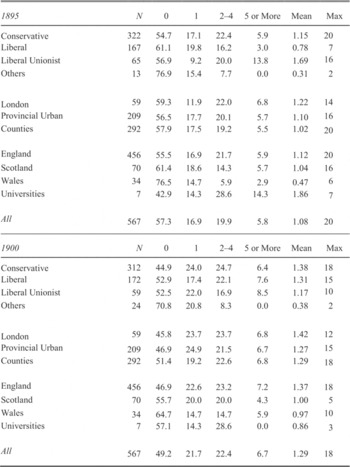
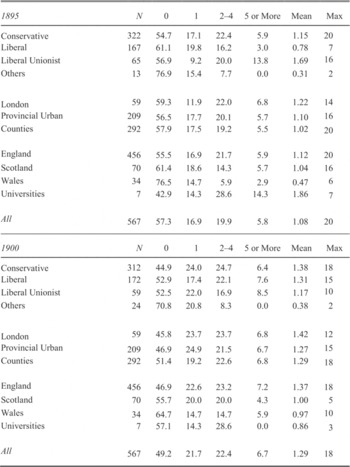
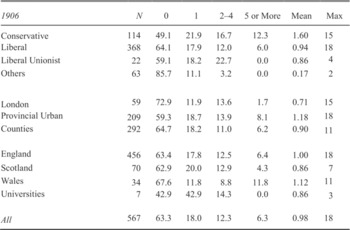
At the start of the twentieth century, the House of Commons was especially connected to the business world. About two-fifths of the Members of Parliament held at least one directorship when they were elected in 1895. Each MP sat on an average of 1.08 boards (see Table 1). MPs returned in 1900 were even more connected: more than half (50.8 percent) sat on one or more boards, with each one holding on average 1.29 directorships. These figures are much higher than contemporary figures for the United Kingdom (13 percent) and the United States (2.6 percent).Footnote 4 Most of the increase from 1895 to 1900 was due to incumbent politicians acquiring more directorships during their time in office, rather than an especially business-oriented cohort entering Parliament in 1900. The election of 1906 saw a large drop in the number of MPs who held directorships (down to 36.7 percent).Footnote 5 There were two reasons for this fall. First, there was a large increase in the number of seats held by the Labour Party. In addition, the landslide in favor of the Liberals resulted in over 200 new MPs, and new MPs were less likely than incumbents to hold directorships.
The 1895 and 1900 parliaments were both heavily Conservative, which may have increased the number of connections between politicians and firms. In the 1895 parliament, the party differences in the business connectivity were large. The average Liberal Unionist member held 1.69 directorships, compared to only 0.78 for the Liberals, with the Conservative MPs in between at 1.15 per member. However, by 1900 most of this gap had disappeared. Fifty-five percent of all Conservative MPs were directors (holding on average 1.38 directorships), compared to 48 percent for the Liberals (average 1.31), and 46 percent for the Liberal Unionists (average 1.17). In the 1906 cohort, a large gap between the average number of directorships of Conservatives and Liberals reemerged. Much of this gap is due to the additional directorships acquired through incumbency (almost all of the Conservative MPs in the 1906 Parliament had retained their seats, rather than been newly elected). The counterpart to this is the low number of directorships held by incoming MPs (who were overwhelmingly Liberal).
DIRECTORSHIPS OF MEMBERS OF PARLIAMENT (1895, 1900, 1906)
Notes:
Data on directorships of MPs at the time of the general elections. N is the number of politicians, 0 is the percentage of MPs who do not hold any directorships, 1 is the percentage holding only a single directorship, and so on. Mean is the average number of directorships held by the MPs, max is the maximum number held by MPs. Others includes all MPs not listed by Craig (1974) as belonging to the Conservative, Liberal, or Liberal Unionist parties.
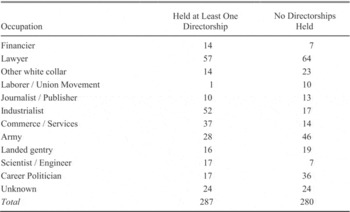
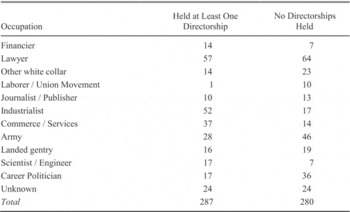
Table 2 details the background of MPs in the 1900 Parliamentary cohort, and how it relates to their sitting on company boards. We search the online websites Who Was Who and List of MPs Elected in the United Kingdom General Election, 1900 from Wikipedia to locate the employment background of an MP, and in particular their first paid job.Footnote 6 We group these backgrounds (or define as “unknown” those we could not uncover) and cross-tabulate by whether or not the MP was a director or not. MPs with backgrounds in finance, science/engineering, industry, and commerce were more likely than not to hold at least one directorship. Politicians with backgrounds in “other white collar,” laborers, army officers, and career politicians were more likely than not to not hold any directorships. The remaining occupational groups were split roughly half and half between director-politicians and non-director-politicians.Footnote 7
BACKGROUND OF MPS (1900)
Notes:
We classify MPs who were elected in the general election of 1900 into 12 occupational categories based on their biographies. Occupation is defined according to the first job the MP held (if any). Landed Gentry are defined as such if they were described as owning a lot of land, if they tended to hold a title (e.g., Marquis, Baronet), and if no other serious occupation was mentioned (hunting is not defined as a serious occupation). Career politicians are defined as such if they entered parliament before the age of 30 and if no other career is mentioned. If we find no mention of an occupation of the MP prior to their entering parliament (and if they entered parliament aged 30 or more) then we classify them as having an unknown occupation.
Directors’ fees were not generally disclosed, although they were probably well-remunerated. For example, the Weardale Steel, Coal, and Coke Co. reported on June 30, 1900 that £4,705 had been spent on “Fees of Directors and Debenture Trustees and Other Expenses.” One political director for whom we do have information is Lord Verulam. In 1894 he was the director of two companies, in 1896 six companies, and by 1913 he was the director of thirteen companies. Lord Verulam's fees varied considerably, from £50 per annum for the Colchester Brewery Co. to £500 per annum for Accles Borneo Rubber, and in aggregate it yielded a substantial income in an era where nominal GDP per capita was a little under £50 per year (see Thompson 1963, p. 306).
POLITICIANS, FIRMS, AND FINANCIAL MARKETS
In perfect capital markets, politicians should not have any impact on firms’ abilities to raise financial capital. However, in a world with asymmetric information political directors could provide some assistance in this respect. First, political directors could be a costly signal for companies with good economic prospects that helps them to distinguish themselves from poorly performing firms. Second, political directors could allow firms to access their networks of acquaintances and establish contacts with bankers and possible financiers (Armstrong 1990, p. 125).
Before an initial public offering, companies searched for political directors, and a company promoter usually had a leading role in placing “puppet” directors on company boards. Ernest Hooley was the most (in)famous company promoter of that era. His technique was to pay members of the nobility to sit on company boards, in order to give his companies the veneer of respectability. Hooley, in his bankruptcy trial in 1898 claimed that he paid Earl de la Warr (a member of the House of Lords) £25,000 to sit on the board of Dunlop Pneumatic Tyre (denied by de la Warr) as well as £11,300 to sit on the board of Dunlop's French affiliate. Hooley claimed to have paid the Earl of Winchelsea (initially an MP, but a Lord by the 1890s) £10,000 to sit on Cycle Manufacturers’ Tubes Co. and Sir Edward Sullivan £2,000 whereas four other directors were only paid £1,000 (The Times of London, July 28, 1898). It appears that Members of the House of Commons also participated in company promotions. In 1890 The Economist complained that too many MPs “lend their names much too readily to company promoters (The Economist, June 28, 1890).”8 J. W. Crombie, MP for Kincardineshire, decried the practice in Parliament, arguing in 1895 that: “there had been other privileges, even less highly to be recommended, which also constituted a money value in the letters “MP” after one's name. It had been, unfortunately, too easy when a man had these letters to obtain directorships.”9 It is premature to say that there was a well-defined market for political directors but in the last years of the nineteenth century, firms increasingly realized the importance of portraying business respectability by placing good sounding names on the board of directors. The belief was that politicians would increase the chances of a successful placement of the firms’ securities.Footnote 10 This effect should have been stronger for firms that found it more difficult to communicate the soundness of their business model to the market, that is for firms that had greater problems of information asymmetry. Firms that worked with new technologies suffered more from asymmetric information, so it is not a surprise that many company promoters worked with these firms. Promoters were extensively involved in new businesses such as bicycles, automobiles, rubber tires, and photographic machines (see Harrison 1981, in particular table IV; Cheffins 2008, p. 199).
Politicians may have allowed investors to infer that firms had good relationships with the important financial centers of Britain. They may not have had any particular business ability; in many cases, their main function was the acquisition of financial capital. In a later period the senior official receiver, H. E. Burgess, provided evidence along these lines (see May 1939, p. 479): “I so frequently find [directors] are expert in nothing at all. They merely get a nice-sounding name to put on the prospectus. They can offer nothing but that name or the acquaintances they have who can be induced to put up capital.” According to Armstrong (1990, p. 125), Henry Brittain, MP for Acton, assisted a company promoter, Birch Crisp, to obtain loans to finance Crisp's enterprises in China and Russia. In addition, Harrison (1981, p. 184) claims that the New Cycle Company was able to raise £75,000 in 1896 (three times the amount raised via an IPO) from: “‘four or five influential men’: perhaps a tribute to Lord Ribbesdale [a member of the House of Lords] of the Nobel Dynamite Trust, and the Hon. Mark F. Napier [an ex-MP who had lost his seat in 1895], vice president of the National Life Assurance Society, who both sat on the company's board.”
Whether politicians added value to firms is an empirical question we seek to answer in this work. Some historical evidence suggests that the experience of firms with political directors was often poor. Hannah (2007) claims that the: “fraudulent promoter, Whitaker Wright, used Lord Dufferin, the retired governor general of Canada, and other gullible peers without business experience, as dummy directors of his London and Globe Corporation. The corporation later collapsed with unpaid claims of over £7 million.” A. E. Harrison (1981), for instance, states that: “the glitter of the prospectus encrusted with the names of aristocrats, willing to serve as company directors, was a device to attract subscriptions from the public.” Despite the negative connotation placed on the available historical evidence by previous authors, it is still possible that politicians could have provided a useful service to firms. Entrepreneurs wishing to float “good” companies may have had an incentive to place (costly) titled directors on their boards. On the other hand, entrepreneurs with “bad” firms may have found the additional directors’ fees too onerous to make it worth their while to employ titled directors.
ALTERNATIVE CHANNELS
An alternative possibility for the United Kingdom's dense political-business environment is that politicians may have provided regulatory assistance or helped firms to avoid the enforcement of such regulations. The Economist remarked on April 18, 1896 (pp. 480–81) that: “we can imagine nothing more prejudicial to our political system than the … belief that members might … use their parliamentary powers to further their own interests or the interests of companies in which they held shares, or in whose employment they were.” Hannah (1979) provides a concrete example of how the allocation of the electricity franchises in the various districts of London was the result of political struggles between different vested interests. In many instances, private electrical enterprises needed the authorization of the local government to expand their activities and open new power stations. If this were the case, politicians may have added value to firms because they could “grease the wheels” of the bureaucracy and reduced the burden of administrative regulations on the side of the firm (Cingano and Pinotti 2012). We more formally test the “regulatory channel” by performing an event study analysis (see MacKinlay 1997) of stock returns around major legislative acts that impinged on business. We study the Factory and Workshop Acts of 1895 and 1901, Electric Lighting (Clauses) Act 1899, Railways (Electrical Power) Act 1903, and the Coal Mines Regulation Act 1903. All these pieces of legislation had a very important impact on the life of firms that were involved. The Factory and Workshop Acts, for instance, regulated the working hours and conditions within factories; and the Electric Lighting (Clauses) Act 1899 regulated how the electricity supply should be distributed within urban districts. If politicians helped firms to escape these new regulations, we might expect firms with politicians on their board to gain more (or lose less) when these laws were introduced. We undertake an event study analysis on the dates of the various votes (known as “readings”) of these bills in the House of Lords and the House of Commons. We find a (statistically) weak positive effect on firms of having a political connection around the Factory and Workshop Act introductions, but no statistically significant effect around the introduction of the other acts. We conclude that politicians may have been placed on boards to aid firms in their regulatory dealings with government, but we find limited evidence that they were useful in this regard.
NEW TECHNOLOGY FIRMS
The years 1870 to 1914 were the years of the Second Industrial Revolution, with many new technologies discovered and new companies floated to exploit the new developments. In some sectors, breakthroughs were made in the development of new equipment or new production methods. This was especially true in the cotton industry (the ring spindle and the automatic loom), iron and steel (the use of phosphoric ores), and chemicals (bleaching powder, fertilizers, and explosives). In other sectors, such as electricity, bicycles, chemical dyes, the internal combustion engine, innovative new products, with no direct predecessors, were developed. New companies in these sectors would have had more information asymmetry between their entrepreneurs and investors than older companies with well-understood production techniques.
We divide firms into two groups, new and old technology firms using a simple procedure. If a firm operated in the chemicals, electricity supply, electricity generation, bicycle, or motorcar sectors, we classify it as new tech. All other firms are classified as old technology firms (e.g., railways, breweries, textiles) except for rare instances where we have details of the technology that the firm used.Footnote 11 We perform this breakdown because previous authors (e.g., Kennedy 1987; Cull et al. 2006) report that the British capital market had a skeptical approach towards new technologies. Therefore, we study whether new tech firms experienced different effects, due to more information asymmetry problems, than old tech firms.
DATA SOURCES
We have annual data on 467 British companies from 1895 to 1904, corresponding to roughly 2,800 firm-years. The sample covers a wide variety of firms in the manufacturing sector: breweries, chemicals, textiles, leather and rubber firms, paper and publishing, and iron and steel. We also consider five nonmanufacturing industries: coal mining, railways, telegraphs, electricity generation, and electricity distribution.
The sample is not random: all the firms are public, joint stock companies, that were traded by members of the London Stock Exchange (i.e., companies that were able to obtain at least some financing through regular channels). We exclude banks, financial firms, firms operating outside Britain (e.g., in the colonies or South America), and the gas and water industries which were heavily regulated. For more details about the sample constructions, see Fabio Braggion (2011). Some of these firms were officially listed on the London Stock Exchange and appeared in the Stock Exchange Daily Official List with bid and ask quotes. Others were traded unofficially in London or officially on provincial exchanges, and financial details of these firms were reported by the Stock Exchange Official Intelligence, an annual publication. Both types of companies had relationships with banks, and many had both debt and equity listed on London or provincial exchanges. If the firms in our sample faced credit constraints, then private firms would have almost certainly faced even more severe constraints.
The sample covers a broad cross-section of British industry. The total market capitalization of the companies in our sample is about £555 million, which corresponds to 25 percent of the London Stock Exchange's capitalization as reported by Moore (2010) and 63 percent of the London Stock Exchange capitalization in 1900 according to Elroy Dimson, Paul Marsh, and Mike Staunton (2002) (which considers only ordinary and deferred shares). The sample is not balanced: some companies became public within our sample period; other companies did not have their balance sheet available at the Guildhall Library for every year in our sample period. Accounting data, the address of the firm's headquarters, and the names of the firm's directors were culled from the original balance sheets of the firms, the Stock Exchange Official Intelligence, and the Directory of Directors. We obtain the annual financial accounts of public companies from the Guildhall Library, London. The accounts for electricity supply and telegraph companies are taken from Garcke's Manual of Electrical Undertakings.
Data on stock prices are obtained both from The Investor's Monthly Manual (IMM), a sister publication of The Economist, and directly from the Stock Exchange Daily Official List for officially quoted firms. Between 1869 and 1929 the IMM published the prices, dividends, and capitalization for firms, usually London listed, but sometimes for firms listed solely on provincial exchanges.Footnote 12 We obtain data on the value of seasoned equity and debt issues from the IMM column British Capital Created During (year).
Much of our evidence comes from the annual report and the balance sheet of companies and one might question its quality. Antony Arnold (1998) claims that during the first quarter of the twentieth century, published accounting statements were of limited value because financial reporting was only lightly regulated. Thus, he argues, informational asymmetry between senior managers and the suppliers of long-term corporate finance was material. However, other authors view British annual reports at the turn of the twentieth century as a generally reliable source. Hannah (2007, p. 658) reports that: “the great majority of companies published more and better information than was legally required. Moreover, in the absence of evidence to the contrary, accounts were treated by contemporary investors as broadly accurate.” Similarly, Richard Sylla and George David Smith (1995) claim that Britain had the best accounting in the Western world. Banks were required to submit audited reports after 1879, and all firms had to follow suit after 1900 (see Hein 1963). Auditors have certified all the firms’ accounting statements we use. Auditors were elected at the AGM (a legal requirement from 1900 onwards). The Companies Act, 1900 required auditors to certify that the accounts reflected a true and correct view of the state of the company's affairs.
Arnold (1996) summarizes the literature on the quality of corporate accounts in Britain at the turn of the twentieth century. Citing several studies that compare companies’ private documents with public accounts, he concludes that: “business historians may find the published financial statements of the latter half of the nineteenth century more reliable than they have supposed, although some caution on their part is still clearly advisable.” We attempt to directly control for the quality of the accounting information by counting the number of headings (both liabilities and assets) presented in each annual report, along the lines of Sean McCartney and Anthony Arnold (2002). In principle, balance sheets that have a larger number of headings may be more transparent than those that have fewer headings.
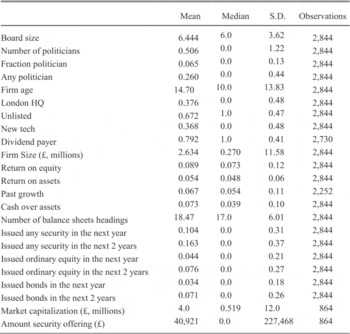
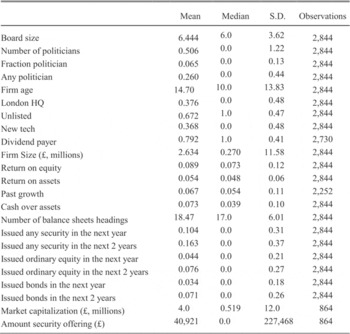
We present summary statistics in Table 3. The average firm had 6.4 directors, of whom 0.5 (6.5 percent) were politicians. One-quarter of all firms had at least one politician serving on its board. An average firm had been incorporated for fourteen and a half years, and around one-third of our firms were headquartered in London. Two-thirds of our firms did not have their ordinary equity listed on the London Stock Exchange. Slightly more than one-third of our firms were new technology firms and almost 80 percent of the firms had paid a dividend during the previous twelve months. The average firm had a book value of assets equal to £2.6 million. We use the book value of assets before depreciation and goodwill.Footnote 13 Firms were quite profitable, with a return on equity (ROE) of almost 9 percent p.a and a return on assets (ROA) of about 5.5 percent. The average firm had been growing at 6.7 percent p.a. Growth is measured as the increase in the book value of a firm's assets plus any dividends disbursed. Although sales growth might be a better measure of a firm's growth, annual reports rarely report sales data.Footnote 14
SUMMARY STATISTICS, 1895–1904
Notes:
Board size is the number of directors. Number of Politicians is the number of MPs or members of the House of Lords on the firm's board. Fraction Politician is the number of political directors divided by the total number of directors for that firm. Any Politician equals 1 if there is at least one political director on the board, and 0 otherwise. Firm age is the number of years since incorporation. London HQ is equal to 1 if the firm's headquarters are in London, and 0 otherwise. Unlisted is equal to 1 if the firm was not officially quoted on the London Stock Exchange and 0 if it was. New tech is equal to 1 if the firm was in the electricity, chemicals, bicycle, or car sectors. Dividend Payer is equal to 1 if the firm paid a dividend in the previous year, and 0 otherwise. Firm size is the book value of assets, in millions of pounds. Return on Equity is profits divided by paid up equity, return on assets is profits divided by the book value of assets. Past growth is the book value of assets in period t plus dividends paid less the book value of assets in period t − 1 divided by the book value of assets in period t − 1. Cash by the book value of assets. Issued any security (ordinary/bonds) in the next year is equal to 1 if the firm issued any security (any equity security / any debt security) on the London Stock Exchange in the following year, and 0 otherwise, and similarly for two and three years. Market Capitalization is the stock market value of the firm's common equity. Amount Security Offering is the value in pounds of seasoned debt and/or equity offerings. Each observation is a firm-year.
We find that 10 percent of firms present in a particular year in our sample went on to issue some form of capital in the subsequent year, and 16 percent issued capital during the following two years. These capital issues were almost equally split between equity and debt.
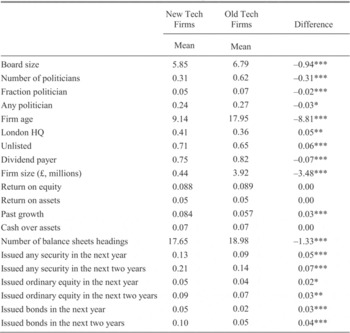
We present summary statistics of new versus old tech firms in Table 4. Unsurprisingly, new tech firms were smaller, younger, grew faster, and were less likely to have paid a dividend in the previous year. New tech firms also had slightly fewer directors, and were slightly less politically connected than old tech firms. Twenty-four percent of new tech firms had one or more politicians on the board, compared to 27 percent of old tech firms. New tech firms were almost 50 percent more likely to issue capital during subsequent years, in both equity and debt forms.
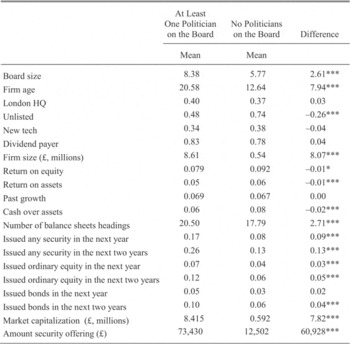
We also divide firms into politically connected firms (those with at least one MP or one member of the House of Lords on the board of directors), versus unconnected firms (those with no politicians on the board) in Table 5. Politicians were more likely to be associated with firms with larger boards of directors (although of course some of this relation will be mechanical), more assets, and those which were officially listed. The average size of a firm with a politician on the board owned assets valued at £8.6 million, compared to firms without politicians (with assets of £0.5 million). Politically connected firms were also older (20.6 years vs. 12.6 years) and slightly less profitable (ROE of 7.9 percent p.a. vs. 9.2 percent p.a.). Politically connected firms were much more likely to issue capital, both within the next year (17 percent vs. 8 percent) and within the next two years (26 percent vs. 13 percent). The descriptive statistics show that politically connected firms accessed capital markets more frequently that other firms. The univariate analysis is tentative evidence that politicians may have helped firms to obtain external finance. Later in the article, we more fully investigate this relation between politically connected firms and capital issues, since it is a candidate reason for why firms with a need for external finance (i.e., new tech firms) matched with political directors.
SUMMARY STATISTICS, 1895–1904
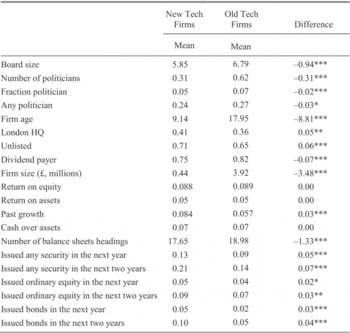
* indicate mean differences are statistically significant at the 10 percent level.
** indicate mean differences are statistically significant at the 5 percent level.
*** indicate mean differences are statistically significant at the 1 percent level.
Notes:
Firms are divided into old tech and new tech firms. Variables are as defined in Table 3.
ELECTION RESULTS
We first investigate if a political connection had any effect on the market value of a firm, by investigating the effect of a firm's director(s) being elected (or not) to the House of Commons in a general election. If a firm would derive benefits by having a director serve as an MP, we would expect to see the firm's share price increase after an election in which a director won a seat, if the election result was at least partly unexpected. However, a rise in the share price will not indicate the channel by which the MP provided benefits to the firm. We use an event study analysis (see MacKinlay 1997) around the general elections of 1895, 1900, and 1906 to see how his (women were not eligible for election as MPs until 1918) election affected the firm's share price. The general elections in these years were all landslides: Conservatives and Liberal Unionists by 234 seats (3.3 percent of votes) over the Liberals in 1895; Conservatives and Liberal Unionists by 219 seats (5.6 percent) in 1900; and the Liberals by 241 seats (5.5 percent) in 1906. Therefore the overall outcome should have already been mostly factored into share prices before the election. However, the results of a particular constituency were much less predictable, and the results in marginal seats may not have been well-predicted pre-election, given that opinion polls were not used until 1937 in the United Kingdom (see King 2001). Therefore, the result of a close election (containing a director) in a particular constituency may have had an effect on the share price of the director's firm.
SUMMARY STATISTICS, 1895–1904
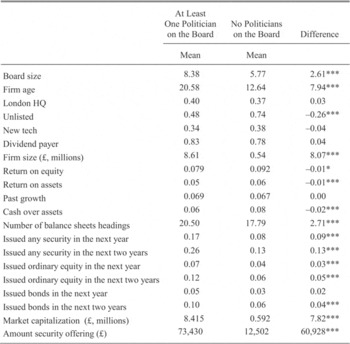
* indicate mean differences are statistically significant at the 10 percent level.
** indicate mean differences are statistically significant at the 5 percent level.
*** indicate mean differences are statistically significant at the 1 percent level.
Notes:
Firms are divided into old tech and new tech firms. Variables are as defined in Table 3.
An event study must take into account that results were released slowly over a span of four weeks after the election. The slow release is not too critical, since most of the results were available relatively quickly: 36 percent within three days and 80 percent within seven days in the 1895 election.Footnote 15 In any case, we must use a longer event window (fourteen days, starting the Friday before the first day of the election) than is usual in studies of this sort. The long event window has the advantage that it covers all the relevant disclosures of information, such as the formal nominations of candidates that only took place a few days before the election and delays in the dissemination of electoral results, but at the same time adds more noise to our estimates. We find that most of the stock price reaction comes in the first week of the election, which correlates with the release of the majority of election results. A further limitation is that we can only study the effects on the share prices of publicly listed firms, roughly one-third of our sample. Consequently, we consider only officially listed firms in London, for which we observe bid and ask quotes from the Stock Exchange Daily Official List. We find 74 firms that had one or more directors who won seats in the general elections of 1895, 1900, and 1906. We also find 40 firms in which at least one director lost his seat.
We run the event study analysis as follows. For each firm for which we have share prices, we calculate the abnormal return rj, on ordinary equity from the last Friday before the first day of the general election to the Friday fourteen days later:

where Rj is the actual return of security j and Rm is the actual return on the market. We use two approaches to calculate the abnormal return. First, we estimate aj and bj with the market model using weekly data from the forty-sixth to the third week before the election announcement:16

As a robustness check, since aj and bj are often imprecisely estimated, we set aj equal to zero and bj equal to one. We use the weekly London market index constructed by Braggion and Moore (2011) to calculate the market return, Rm. We then perform a cross-sectional regression of firms’ abnormal returns on various electoral characteristics of the firms (see Table 6).
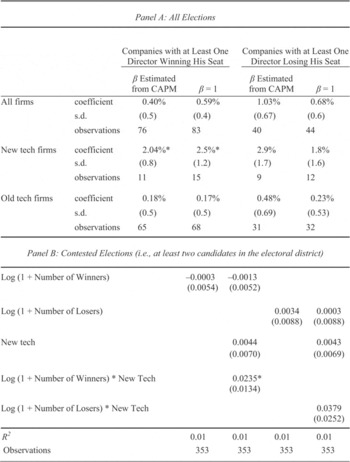
EVENT STUDY ANALYSIS OF ELECTORAL RESULTS
Notes:
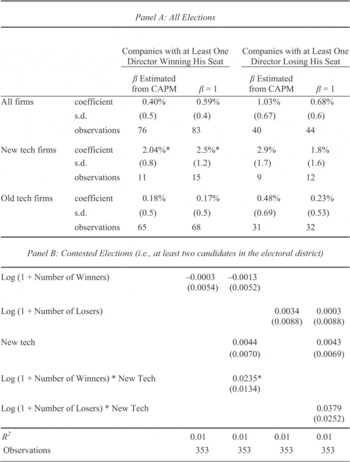
In panel A, we average the abnormal return of firms which had at least one director win/lose his seat at the 1895, 1900, or 1906 general election. For each individual firm we calculate the abnormal return using both a market beta estimated with the CAPM model, and also by assuming the market beta is equal to one. The abnormal return of the firm is calculated over a three-week election window. In panel B, we perform a cross-sectional regression with the dependent variable equal to a firm's abnormal return. Number of Winners is equal to the number of directors from a firm who won their seats at the election. Number of Losers is equal to the number of directors from a firm who lost their seats at the election. Standard errors are clustered by firm and appear in parentheses.
In panel A, we present the abnormal returns of firms that had directors elected versus those that had directors lose their seats and we divide the results also between new tech and old tech firms. When we consider all firms (both new tech and old tech) we do not find any statistically significant effect of an electoral outcome on the firm's share price. When we consider only new tech firms, we calculate that the election of a director was associated with a positive abnormal return to that firm of 2 percent to 2.5 percent during the 14 days surrounding the general election. Although the estimated coefficients for a new tech firm whose directors lost the election is of similar magnitude, it is not statistically significant.Footnote 17 The estimated effects for old tech firms, both winning and losing, are small and statistically insignificant.
Not all constituencies had a contested election, where there was at least some element of uncertainty attached to the result. For example, in 1900 the Conservatives had 163 MPs elected without a rival candidate. In panel B, we again examine abnormal returns, by pooling data for all elections and firms but restrict ourselves to contested elections.Footnote 18 We find that the only variable which is statistically significant is the number of new tech winners, although having a director elected is associated with a positive return for new tech firms for the same reason as outlined in the above footnote.
ACCESS TO FINANCIAL MARKETS
Political connections may have added value to the firm because they enhanced access to financial markets. A director-politician might personally hold part of the firm's debt or equity (if he is an individual of high net worth). He might also have influenced banks to extend credit. Alternatively, he may have lent his name to the firm's efforts to issue equity or debt on the London Stock Exchange. Reliable data do not exist to allow us to identify the direct involvement of director-politicians in equity or debt holdings or bank loans to a firm. Therefore, we focus on whether connections helped firms place stocks or bonds on the market. The funding we consider involved seasoned equity offerings (SEOs) and debt issues. These were often offered pro-rata to existing share and bondholders (to avoid the requirement of preparing a prospectus following the introduction of the Companies Act, 1900).
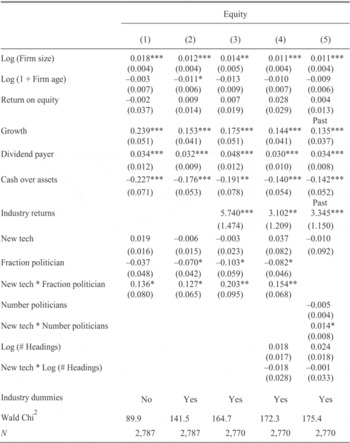
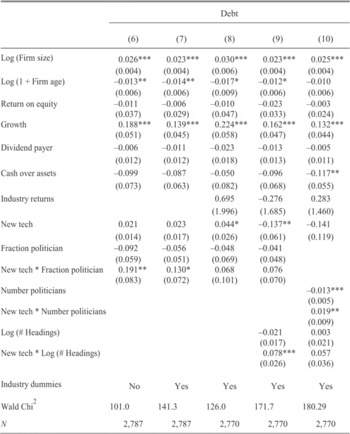
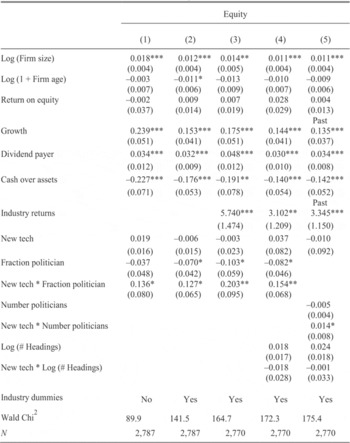
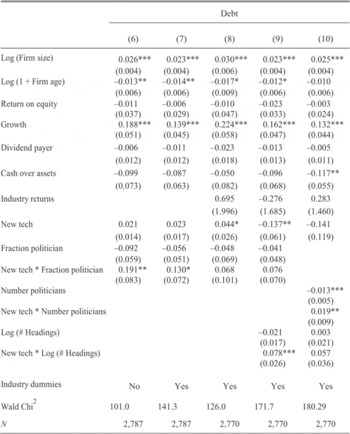
We estimate a probit model of whether or not a firm issued any equity security, or any debt security, in the two following years on firm characteristics in Table 7. Each observation is a firm-year. Politically connected firms (Fraction Politician and Number of Politicians) appear to have issued less new equity and less new debt than their unconnected counterparts. However, political connections for new tech firms are associated with more external finance, since the interaction of New Tech and Fraction Politician (or Number of Politicians) is positive. The economic significance is sizeable: if we look at column 4, a one-standard-deviation increase of Fraction Politician leads to a 1 percentage point increase in the likelihood for a new tech firm issuing equity in the next two years. This corresponds to a 16.6 percent increase in respect to an average non-politically connected firm.Footnote 19 If we add one additional political director to a firm (column 5), this leads to a roughly 1 percentage point increase in the likelihood for a new tech firm to issue equity, which corresponds again to a 16.6 percent increase in respect to an average non-politically connected firm in the sample. We find similar effects for politicians’ effect on debt issuance. Having a political director (Fraction Politician or Number of Politicians) decreased the likelihood that an old tech firm would issue equity or debt, but increased the likelihood for a new tech firm (columns 7 through 9). Adding a politician to a new tech firm increases by 10 percent the probability of issuing debt in the next two years when compared to an average company without political connections.Footnote 20
Firms may have chosen other methods to facilitate the raising of fresh capital. One possibility is that firms which wished to issue equity or debt produced more transparent accounts to entice investors.Footnote 21 We follow the historical accounting literature (e.g., McCartney and Arnold 2002) and measure disclosure as the number of line items in the balance sheet and include that variable in the regression (columns 4, 5, 9, and 10). We find few differences between the specifications that do and do not include financial disclosure. New tech firms which disclosed more information were associated with more debt issuance (columns 9 and 10), and a weaker association with increased equity issues (columns 4 and 5).
CAPITAL ISSUES, 1895–1904
Notes:
We run probit marginal effect regressions of whether or not firms issued equity or bonds in a public offering in the subsequent two years. Past Industry Returns is equal to the unweighted average stock market return of all firms in the same industry over the last 12 months. All other variables are as defined in Table 3. All regressions use year fixed effects. Standard errors are clustered by firm and appear in parentheses.
CAPITAL ISSUES, 1895–1904
Notes:
We run probit marginal effect regressions of whether or not firms issued equity or bonds in a public offering in the subsequent two years. Past Industry Returns is equal to the unweighted average stock market return of all firms in the same industry over the last 12 months. All other variables are as defined in Table 3. All regressions use year fixed effects. Standard errors are clustered by firm and appear in parentheses.
We now test if a political connection can increase the value of equity capital raised by firms: we find that this is indeed the case (unreported). A one-standard-deviation increase in the fraction of politicians on the board of new-tech companies increases the value of capital raised over the next two years by 14 percent, which is statistically significant at the 5 percent level. The results are also economically and statistically significant when we check over the next year, and over the next three years.Footnote 22
As an additional robustness test, we also check if “well-known” individuals rather than politicians had a similar impact on firms’ equity and debt issuance. The market could have absorbed more equity and debt of new tech politically connected firms either because it expected them to be materially helped by politicians or just because politicians were a good marketing device even without any concrete help. In principle, well-known individuals had less political power to materially favor a firm and they should have been more likely to embody a good name/marketing effect. We proxy well-known individuals with the proportion of baronets and knights (who held titles, but were not peers, and thus did not sit in the House of Lords) on the board. In unreported results, we find that new tech firms with baronets and knights were more likely to issue equity and debt than new tech firms without such titled directors (statistically significant at 10 percent to 1 percent levels). Since baronets and knights had limited or no political power, this result suggests a certification role for politicians rather than the direct ability to raise capital.
REAL EFFECTS OF POLITICAL CONNECTIONS
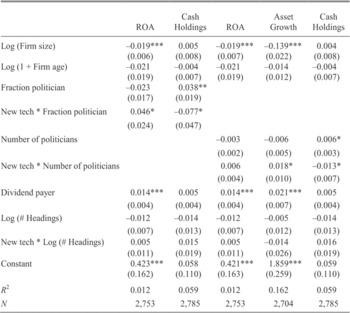
We now turn to the issue of how, other than through improved access to financial markets, political directors were able to assist firms. We regress three measures of firm performance, return on equity, return on assets, and the growth rate of assets, on various controls and the connections of firms. We also investigate the interrelationship between political directors and the proportion of assets held as cash, since large cash balances may reflect more temptations for directors to engage in wasteful spending such as takeovers and/or increased perquisites, say higher directors’ fees, for themselves. In Table 9, we find that political directors were associated with firms that had a lower return on assets in old tech firms, but a higher return on assets in new tech firms. A standard deviation increase of Fraction of Politicians reduces (increases) ROA by 7 percent in old (new) tech firms. Political directors were also associated with slower asset growth and higher cash balances in old tech firms but faster asset growth and lower cash balances in new tech firms. Adding a politician to a new tech firm decreases by about 9 percent its cash holdings with respect to an average firm without political connections. The number of balance sheet headings (which acts as a proxy for firm disclosure), indicates that increased disclosure is also associated with lower cash balances (which suggests that “good” management consists of both high disclosure and low cash balances). Increased disclosure does not eliminate the effect of politicians, there appear to be two separate channels at work. Overall, these results suggest that political directors also had an important real effect on some firms. The larger cash balances held by old tech firms with political directors may also be part of the reason why those firms raised less capital from equity markets. Higher cash balances could have meant fewer investment opportunities for the firm and therefore less reason to seek external finance; higher cash balances could have also signaled the existence of agency problems to investors and compromised the success of equity offerings.
IMPACT OF SEASONED EQUITY OFFERINGS ON FIRM VALUE
As an additional test to see whether politicians had an effect on firms which raised external finance, we study the share price reactions at the announcement of a SEO. The literature in this area has commonly found negative abnormal returns at the announcement of a SEO, consistent with a view that if managers have private information about firms, they will issue additional shares when their firm is overvalued so as to exploit the market's error (see Eckbo, Masulis, and Norli 2008) for a survey of the literature). If politicians helped to resolve asymmetric information problems, we would expect that firms with politicians on board would experience higher abnormal returns at the announcement of the SEO than politically unconnected firms. As we argue before, this effect should be stronger in firms that ex-ante had more asymmetric information problems, the new tech ones. We focus on equity rather than debt issuance because shares are the securities for which asymmetric information problems should be, in principle, more severe and where the role of politicians in resolving these issues should be more important (see Myers and Majluf 1984).
REAL EFFECTS OF POLITICAL CONNECTIONS
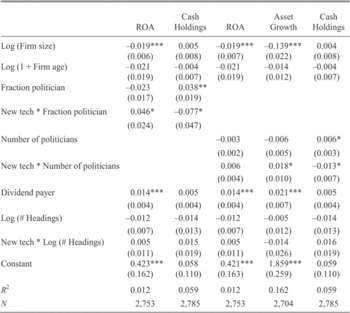
Notes:
We regress firms’ return on assets (ROA), growth rate of assets, and cash holdings (as a percentage of assets) on firm characteristics. All regressions use year and firm fixed effects, with standard errors clustered at the firm level.
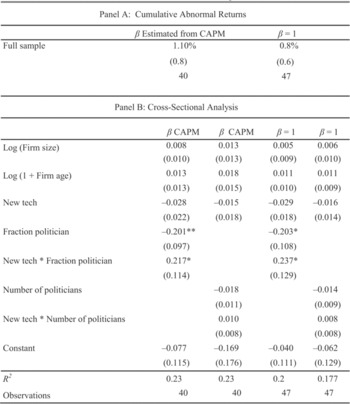
In Table 10, we perform an event study analysis to study the returns of firms following an announcement of a SEO. We perform an analysis of 40 announcements for which we were able to obtain enough prices to compute abnormal returns and for which we could find the actual SEO announcement in The Times of London. The number of announcements increases to 47 when we compute the abnormal returns assuming β =1. We consider an event window of two weeks: the week before and the week of the announcement of the SEO. Table 10, panel A, column 1 presents the abnormal returns for all firms undertaking a SEO (with β from the CAPM equation), whereas panel A, column 2 shows the abnormal returns computed assuming β =1. The abnormal returns vary between 0.8 percent and 1.1 percent. They are never statistically significant, which indicates that, on average, the market does not react negatively to a SEO announcement.
EVENT STUDY ANALYSIS OF SEASONED EQUITY OFFERINGS
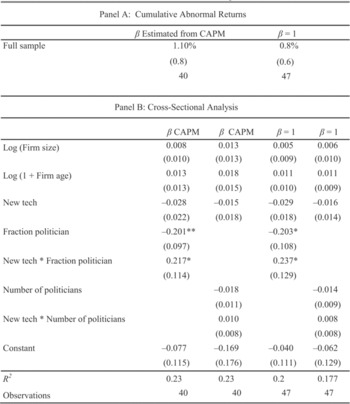
Notes:
Panel A shows the cumulative abnormal returns in the week before and the week of the announcement of a seasoned equity offering. Standard errors are in parentheses. Number of observations appears below the standard error. In panel B, we perform a cross-sectional analysis of cumulative abnormal returns. The dependent variable is the abnormal return of a firm the week before and the week of the announcement of a seasoned equity offering. Standard errors are clustered by firm and appear in parentheses.
Table 10, panel B relates the abnormal returns to the new tech dummy, and the Fraction of Politicians on the board. SEOs undertaken by new tech firms experienced lower returns than SEOs undertaken by old tech firms, although the difference is not statistically significant. Table 10, panel B also shows that old tech firms had lower returns at the time of an SEO announcement the more politically connected they were (either Fraction Politician or Number of Politicians).
In contrast, new tech companies were neither helped nor hindered by their degree of connectedness at the time of an SEO since the coefficients on Fraction Politician (Number of Politicians) and Fraction Politician (Number of Politicians) * New Tech roughly offset each other. The results for old tech firms are consistent with what we related in the previous section: politically connected old tech firms were less likely to undertake SEOs because they knew that the market was likely to respond negatively. The negative reaction could be related to the fact that politically connected firms were older, larger, and at a more mature stage of their life cycle (as indicated by a higher proclivity to pay dividends). A SEO by such firms was more likely to indicate overvalued equity, rather than the discovery of a new market niche to exploit.
We now study the relationship between political connections and firms’ performance over a longer time period. In particular, we investigate how firms’ stock returns behaved in the medium-/long-run following a SEO because the positive relationship we found between short-run returns and politically connected firms in the new tech sector could have been driven by overly optimistic expectations of British investors about the role of politicians in these firms. If politicians failed to meet such expectations, in the medium-/long-run investors would have adjusted downward the price (and hence returns) of these shares.
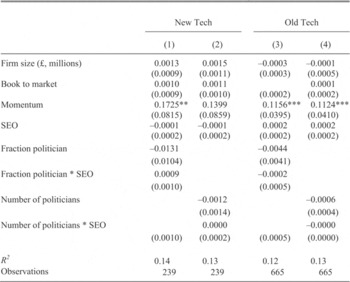
We use the methodology of Jeffrey Pontiff and Artemiza Woodgate (2008) and R. David McLean, Pontiff, and Akiko Watanabe (2009) to study the relation between stock market returns of companies in the months and the year after a SEO and their political connections. We perform the analysis on the two subsamples of old and new tech companies and we look at the interaction between Fraction Politician and SEO. As in McLean, Pontiff, and Watanabe (2009) and Borja Larrain and Francisco Urzua (2011), we consider returns in the year following the SEO both at a monthly and at annual frequency. In each regression, we control for the standard asset pricing risk factors: firm size, momentum, and book to market. Results for new tech and old tech firms are presented in Table 11.
MEDIUM-/LONG-RUN FIRM RETURNS AFTER SEASONED EQUITY ISSUES, 1895–1904
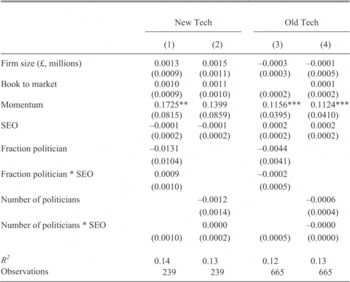
Notes:
We run OLS regressions where the dependent variable is the firm's annual equity return. Momentum is defined as the firm's equity return in the past six months. All the dependent variables are lagged one year and they are as defined in Table 3. All regressions use year fixed effects. Standard errors are clustered by firm and appear in parentheses.
Table 11, columns 1–2 looks at new tech companies. We find no association between companies’ future returns and SEOs. In all the specifications the coefficient on the variable SEO is virtually zero and not statistically significant, which implies that a SEO does not harm a firm's share price in the medium-/long-run. Equally, we find no association between companies’ returns and the Fraction (Number) of Politicians on the board of directors. Politically connected firms that issued equity do not appear to have performed better or worse than their unconnected counterparts, since the coefficient on the interaction term SEO * Fraction (Number of) Politician(s) is not statistically significant. This evidence lends support to the notion that the market did not change its judgment in the year following the SEO. For old tech firms (Table 11, columns 3–4) we find the same, SEOs and political connections do not have an impact on subsequent returns.
In summary, any effect of a SEO was felt immediately, regardless of whether the firm operated in a new tech or old tech industry. Investors made a correct valuation (on average) of these firms at the time of the SEO.
CONCLUSION
The U.K. economy in late Victorian Britain had many links between politicians and firms. Around half of all members of the House of Commons held directorships. Consequently, many British firms were connected, in the sense of being directed, by politicians. Politicians were more likely to be associated with larger, older firms; railways often had one or more MP as a director.
Our study of the results of the general elections of 1895, 1900, and 1906 shows that new tech firms which had directors elected experienced positive abnormal returns of more than 2 percent in the weeks following the election. In contrast, the market value of old tech firms with political directors was little affected by the election. We document one channel by which a connection benefited new tech firms: politicians were successful in allowing those firms to raise external capital, both equity and debt, via the London Stock Exchange.
New technology firms, which tended to be smaller, fast-growing, and less able to access credit through formal channels, benefited from their political connections. Old technology firms which had political directors appear to have received little obvious benefit from them.
We are especially thankful to Jean-Laurent Rosenthal (the editor) and three anonymous referees for their comments. We are indebted to Larry Christiano, Joe Ferrie, Kiminori Matsuyama, Joel Mokyr, and Paola Sapienza for help and guidance. We would like to thank Ran Abramitzky, Federico Boffa, Helge Braun, Lou Cain, Ann Carlos, Bruce Carruthers, Adeline Delavande, Riccardo DiCecio, Mara Faccio, James Foreman-Peck, Leslie Hannah, Bruce Kogut, Luc Laeven, Nisan Langberg, Deirdre McCloskey, Chiaki Moriguchi, Steven Ongena, Harold Perkin, Enrico Perotti, Marcin Peski, Mitchell Petersen, Ian Savage, John Turner, Francisco Urzua, Luis Vasconcelos, Joachim Voth, and Luigi Zingales. We have benefited from seminar presentations at University of Amersterdam, Free University of Amsterdam, University of Antwerp, University Carlos III, Cambridge University, European Central Bank, International Monetary Fund, University of Maastricht, Université de Montréal, Northwestern University, University Nova-Lisboa, Universitat Pompeu Fabra, Erasmus University, Federal Reserve Bank of St. Louis, INSEAD, Tilburg University, Williams College, the Global Scholars Network/IFRI conference, the Long-Term Perspectives on Business, Finance, and Institutions conference, the 2010 EURHISTOCK conference, and the 2011 CNEH conference. The financial support of the Global Scholar Research Network-NYU Stern is gratefully acknowledged.