“America has become shabby”
—Anna S. Richardson,Women’s Home Companion, 1934Since the 1970s, the gentrification of many inner-city areas has shown that houses do not always deteriorate or neighborhoods decline. Many writers have said that this truism was ignored by federal policy for several decades. This article probes that view.
The U.S. government became actively involved in the housing market in 1934, notably through the agency of the Federal Housing Administration (FHA). From then until at least the 1970s, the main thrust of federal policy was to promote the construction, finance, and sale into owner-occupancy of suburban single-family dwellings. The FHA accomplished this by making a revolution in mortgage finance: it normalized long-term, high-ratio amortizing mortgages on new homes in standardized subdivisions. Encouraged by the real estate industry, the agency’s assumption was that such policies facilitated an inevitable process: houses vacated by the new suburbanites would “filter down” to moderate- and then low-income households.Footnote 1 Looking back, however, historical scholars have argued that FHA programs were self-validating: by encouraging the neglect of older homes and neighborhoods, they made filtering inevitable, and with it the decline of older neighborhoods in central cities.Footnote 2
There is some truth to this assessment of federal policy. However, and although the fact has been widely ignored, from the beginning the FHA also sought to improve existing homes and neighborhoods. At first its efforts were led by Title I of the National Housing Act of 1934, which promoted the improvement of homes (and retail stores).Footnote 3 In 1947 an economist who wrote what is still the fullest evaluation of the early impact of the housing aspects of the program claimed that Title I loans were “a new form of credit,” while a later survey of federal policy identified them as one of six major federal innovations in housing finance.Footnote 4 In principle, they were as revolutionary as FHA mortgages because they encouraged home improvement—or what was then referred to as modernization—by offering insurance on installment finance. Moreover, in practice, Title I loans were aggressively promoted by the FHA and to great effect. This article tells the story of the origins, nature, and impact of the Title I program from its inception to its eventual incorporation into the system of mortgage finance in 1954.
The neglect of Title I is part of the wider failure among historical scholars and housing researchers to examine what happens to dwellings after they are built. From the 1920s to the 1970s, contemporaries deplored the disarray of the building industry.Footnote 5 Since then, historians have explored some industry innovations, notably the rise of community builders and the (largely abortive) efforts at prefabrication.Footnote 6 By comparison, on the subject of how dwellings were being maintained, contemporaries said little and historians have written even less.Footnote 7 This neglect is unjustifiable. Today we spend as much—to adapt Stewart Brand’s phrase—in teaching buildings how to learn as we do in bringing them into this world.Footnote 8 The home-improvement industry is huge, sustaining the second-largest retailer in the United States, Home Depot. It is important to understand how that industry emerged. This article argues that although, obviously, most owners have always maintained and improved their properties, and although there were some precedents for modernization credits, Title I played a major role in creating the modern home-improvement industry.
To make this argument, Title I must be set in the context of the markets for housing and consumer credit. To that end, I draw on the three trade journals that were most read by lumber dealers, who initiated four-fifths of all improvement loans.Footnote 9 Other valuable sources are contemporary newspapers, NHA hearings, and the Insured Mortgage Portfolio, the magazine the FHA published to promote its programs to approved lenders.Footnote 10 The first section of the article shows how Title I emerged at the nadir of the Depression. Drawing on precedents established by credit agencies and manufacturers of building materials, and on the recent experience of the Home Owners Loan Corporation, it was intended as a temporary measure to revive the building industry, which, being labor intensive, promised to reduce unemployment and help pull the economy out of the Depression. It proved so popular, however, that it was soon made permanent. The second section shows that, although not wholly novel in form, the Title I program was unprecedented in scale and in the vigor with which it was promoted. As a result, as the third section argues, it successfully encouraged investment and eventually reshaped building retailers and commercial banks. By the time it was partially superseded by new mortgage provisions in 1954, it had widened the scope of installment credit and helped underpin the emergence of a modern consumer society.
ORIGINS AND PRECEDENTS
Credit, of course, played a key role in the building industry long before the Depression. The mortgage was the original installment loan, and for decades lumber dealers had also offered revolving credit to contractors and home owners for building supplies. But mortgages were inflexible, doing nothing to help owners maintain or improve their property, while dealer credit was nominally limited to thirty or sixty days. Those who wished to undertake substantial work on their property had to save first or borrow from family or friends.
During the 1920s, new financing possibilities were developed. This decade saw the emergence of the “new competition.” As the authors of one influential survey put it, “The struggle between producers of similar commodities has largely given place to a struggle between manufacturers of differing commodities representing alternative claims for a share of the consumer’s dollar.”Footnote 11 This competition fueled, and in turn was fed by, a boom in installment credit. As consumers came to accept and then expect credit, manufacturers found that they had to offer it. The automobile industry had led the way. By 1929, the sale of about two-thirds of all automobiles, 85 percent of all furniture, and 75 percent of all radios was being financed, and autos accounted for almost half of the nation’s outstanding installment debt.Footnote 12 Housing was among the first to suffer. House prices rose after 1918, and after they had stabilized they did not decline as rapidly as those of other durables, especially cars. Since 1909, housing had taken a declining share of consumer expenditures, and during the 1920s installment credit exacerbated the trend: in 1930 Wehrwein and Woodbury noted and endorsed the “common opinion that the funds formerly set aside for the purchase of a house and lot are now absorbed by installment payments on … other goods.”Footnote 13
In fact, the problem was even worse, since homes could be remortgaged. As early as 1923, the land economist Richard Ely had commented that “it is frequently said that people are mortgaging their homes to buy automobiles.”Footnote 14 His point was echoed by the Lynds in their study of Middletown, who added that by 1927 there was a “never before equaled array of bidders against the home for Middletown’s dollars.”Footnote 15 The effects on new construction were significant. Housing starts peaked at 937,000 units in 1925 and then slid downward, reaching 509,000 in 1929, while building-permit values fell from $4.0 billion to $2.9 billion.Footnote 16 Over the same four years, the share of GNP going to residential construction fell from 5.8 percent to 3.4 percent. A variety of factors contributed to this decline, but the use of installment credit for other goods was arguably critical. And then the Depression made everything much worse. Housing starts fell further, to 254,000 units in 1931 and then 93,000 in 1933; building-permit values dropped to $1.2 billion and then $383 million, while the industry’s GDP share also fell, to 2.1 percent and then 0.9 percent. By 1933, no major consumer industry was thriving, but none was faring worse than residential construction.
As the business climate worsened, the building industry saw one ray of hope: the relative importance of home improvements grew. It is impossible to judge exactly how large the improvement market was in the United States or in Canada.Footnote 17 So much went unrecorded in building-permit data or tax returns. A study of Saskatoon, Saskatchewan, in 1951, for example, found that although building permits were required, in fact they had been taken out for only a quarter of the dwelling conversions undertaken between 1941 and 1951.Footnote 18 Building industry reports were just as unhelpful: much improvement work involved “under the table” payments, or took the form of owners’ Do-It-Yourself efforts, although the term itself did not become widespread until the 1950s. But available statistics do show the trend. In the United States, during the building boom of the early 1920s, the share of all construction expenditures devoted to additions, alterations, and repairs fell steadily, from about 23 percent in 1921 to 9 percent in 1925.Footnote 19 It then reversed direction, rising to 20 percent in 1929 and 31 percent in 1931. A similar decline and resurgence occurred in Canada.Footnote 20
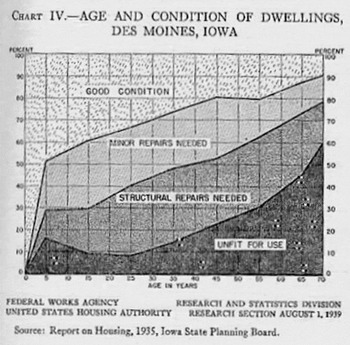
The early increase in improvements was due to home “remodeling,” as it was known at first, or, by 1930, “modernization.” This might mean a new paint job, roof, or siding; an addition; or the replacement of an old veranda. In an era when piped water was still becoming the norm, it might mean a new bathroom or kitchen. As late as 1935, 13 percent of Middletown’s homes lacked running water and 38 percent had no bath.Footnote 21 Moreover, as a detailed study of Des Moines, Iowa, showed, the dwellings most in need of repair or modernization were the oldest, a fact that might seem to have confirmed that deterioration was almost inevitable (Fig. 1). The Depression brought a new trend: dwelling conversions. As male breadwinners lost their jobs, families took in boarders to help cover their costs, or themselves moved in with another family. Sometimes this was easily accommodated, but often dwellings were adapted with the addition of room dividers, entrances, or small kitchens. In Madison, Wisconsin, the rate of dwelling conversions rose during the 1920s and jumped after 1930; a study of Edmonton, Alberta, indicates that the same was true in Canada, where business conditions were similarly awful.Footnote 22 Commentators still spoke in optimistic terms about modernization. By 1931, for example, the Chambers of Commerce in both Middletown and Riverside (California) used this label to promote improvements.Footnote 23 But by 1933, most changes being made to the housing stock were probably to create “small, low-rent units”: they were driven more by necessity than by preference. By then, the annual ratio of new construction to the increase in families had fallen to an unprecedented low of 1:9.Footnote 24 In 1933, statistics suggest that 54 percent of all residential construction took the form of improvements, and the actual figure may have been higher. Here was the industry’s best hope.Footnote 25
Age and condition of dwellings in Des Moines, Iowa, 1935. The deterioration of dwellings with age had been steady, implying that the trend was inevitable.
Source: Edith Elmer Wood, Introduction to Housing: Facts and Principles (Washington, D.C., 1940).

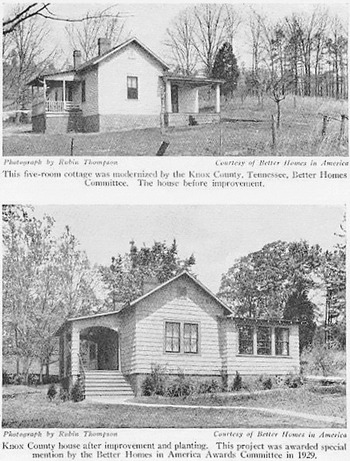
Whether or not they had access to such statistics, everyone associated with the building industry recognized the need to capitalize on the improvement market. Janet Hutchison has suggested that “by 1928 the American building industries had turned their concentrated attention to home renovation as the source of profits.”Footnote 26 This overstates the case. There were still many builders and tradesmen who depended on the market for new homes and apartments. But others, including lumber dealers and the manufacturers of materials, were following the market shift. Early in the 1920s a national organization, Better Homes in America, had attracted the support of Commerce Secretary Herbert Hoover. Under its banner, local committees formed to help build model homes and, by the end of decade, most had introduced “home improvement contests.”Footnote 27 Once the Depression hit, James Ford, executive director of the Better Homes organization, reported that “home improvement, remodeling, care and repair of homes” were the three issues that generated the most letters from interested householders (Fig. 2).Footnote 28 After Hoover became president, he initiated a national conference on home building and home ownership. Ford helped edit the proceedings. Drawing on his experience with Better Homes, and attuned to housing trends, he co-authored the report on “home repair and remodeling,” which included a chapter of “suggestions to householders.”Footnote 29 In principle, by 1931 the federal government had signaled its support for the improvement trend.
Before and after photographs that illustrated the house remodeling that was promoted by the Better Homes in America campaign in Knox County, Tennessee.
Source: John M. Gries and James Ford, Housing and the Community – Home Repair and Remodelling (Washington, D.C., 1931).

Dealers and manufacturers also had their ear to the ground. From 1924, the American Lumberman, the leading trade journal for lumber dealers, promoted remodeling and in 1927 its efforts were reinforced by a trade extension campaign mounted by the National Lumber Manufacturers’ Association.Footnote 30 At a meeting to coordinate this campaign, L. R. Putnam, merchandising counsel for the Southern Pine Association, observed that “new building is slipping … but … the remodeling idea will take hold if presented in the right manner,” and the American Lumberman emphasized that “no dealer can afford to ignore the possibilities of profit in remodeling.”Footnote 31 The following year, prompted by the NLMA campaign Walter Kohler, president of a company that manufactured bathroom fittings, helped hardware and building-supply manufacturers to establish a Home Modernization Bureau. The bureau started an in-house journal and in 1929, with “rapid growth of the modernizing movement,” relaunched this as a monthly consumer magazine.Footnote 32 The first edition of The Home Modernizer hit newsstands in June 1929. Its timing was bad, but by the following year the bureau claimed its promotional efforts had generated $500 million of new business nationwide.Footnote 33
Advertising campaigns were all well and good, but credit is what manufacturers had been teaching consumers to expect. Lendol Calder has suggested that a psychological turning point came in 1927 with the publication of Edwin Seligman’s The Economics of Instalment Credit. Seligman not only documented the new phenomenon in great detail but legitimized it by encouraging people to think of debt as “pay as you use” rather than “buy now, pay later.”Footnote 34 The first initiatives in the home-improvement field were taken by credit agencies, notably the Merchants and Manufacturers Securities Co. of Chicago and the Commercial Credit Corporation of New York and Montreal. The former offered plans for “real estate improvements of all kinds,” while the latter gave credit on furnaces, painting, and roofing; on stoves, refrigerators, and vacuums; and, in an era when many homes were being fitted for electricity, wiring, too.Footnote 35 By the mid-1920s, they were promoting these plans “vigorously,” often via contractors, a typical arrangement being 25 percent down with 10 percent interest over 12 months, this being slightly less generous than the prevailing terms for household appliances.Footnote 36 This market gathered momentum. In 1923, only one percent of all installment credit was for improvements; in two years, the share doubled.Footnote 37 The increase (+96 percent) had been greater than for any other type of business except washing machines (+215 percent) and refrigerators (+450 percent). Data for the latter half of the decade are not available, but the upward trend in market share probably continued.
Manufacturers and retailers jumped on the bandwagon. American Radiator was the first. In 1926, it established a subsidiary, the Heating and Plumbing Finance Corporation, which offered credit to heating contractors and consumers. In 1928, its capital stock was increased from $100,000 to $1 million, and by March 1929 it was enjoying a “rapidly growing business.” By 1930, a few other companies, notably Johns-Manville (roof shingles), were offering credit on their own goods and others, including Libbey-Owens-Ford (glass), followed suit.Footnote 38 In 1932, several formed a Rehabilitation Corporation that offered estimates and credit for the upgrading of income properties.Footnote 39 Individual lumber companies did the same, and so did a few retailers. In 1926 in Atlanta, Georgia, for example, V. H. Kreigshaber and Son, a building supplier, started offering an installment plan for roofing jobs over three months, longer if desired.Footnote 40 More substantially, in May 1929 ten retail chains (known as “line yards”), mostly Midwestern, established the Lumbermen’s Finance Corporation to make first mortgages and offer installment credit.Footnote 41 In 1930, the largest of all retailers, Sears, Roebuck, entered the business. They set aside $5 million for home-modernizing loans of $100 or more, with 10 percent down, a nominal 8 percent interest, and a repayment schedule over two years.Footnote 42 In a little over a year, they had reduced the minimum loan to $50 and extended repayments to five years. As Harvey Harris, head of their home construction division argued, by 1931 home modernization seemed to offer the best prospects for reducing unemployment.Footnote 43
Improvement loans were also a likely way of increasing business. Established lenders began to test the waters. In 1932 the Pennsylvania Mutual Life Insurance Company began a “Renovication Plan,” which placed $17 million in loans in its first two years, while in 1933 the Savings Bank Trust Company of New York started “a campaign for rehabilitation” that yielded a more modest business of $1 million in under a year.Footnote 44 But the most significant and visible initiative was launched by Johns-Manville in the fall of 1932.Footnote 45 Under the leadership of Lewis Brown, and in collaboration with J. Walter Thompson, the country’s leading advertising agency, Johns-Manville launched a national “Million Dollars to Lend” campaign. “Million dollars” was a rhetorical understatement, since the company had created a revolving fund with no effective limit. Exceptionally, although the company did require borrowers to spend at least 25 percent of their loan on the company’s own products, it offered the remaining credits for the purchase of other companys’ materials (though not those of direct competitors). The campaign was promoted aggressively, in trade journals, consumer magazines, and on network radio. It was soon heralded as a success. Johns-Manville earned moral capital for helping put tradesmen back to work. Better still, it boosted sales. The Wall Street Journal reported that in 1934 J-M’s sales were “outstanding among the building material producers”: an increase of 30 percent over 1933 bucked the industry trend and was attributed to the inroads it had made into the improvement market.Footnote 46
By 1934, the federal government was being drawn, at first unwittingly, into this business. Home owners failed to maintain their mortgage payments, lenders foreclosed but then could not sell; depositors lost confidence, withdrew savings, and banks folded. Between 1930 and 1932, more a fifth of the commercial banks in the United States failed.Footnote 47 To restore stability, in 1933 the federal government created the Home Owners’ Loan Corporation. As is generally known, the HOLC refinanced mortgages that were in default, thereby rescuing home owners and lenders. By the time it was liquidated in 1951, it had made a (slight) profit.Footnote 48 What is less widely appreciated is that, to do so, it had to make a huge investment in physical upgrading and alterations. The corporation offered cash loans to repay mortgage and tax arrears and to make improvements. Initially it helped only with “necessary repairs”; in 1934, however, at the instigation of John Fahey, chairman of its supervisory body, the Federal Home Loan Bank Board, guidelines were broadened to include “rehabilitation, modernization, rebuilding, and enlargement,” and by 1935 they permitted “the addition of income-producing features,” with the result that “large properties were frequently remodeled into smaller units.”Footnote 49 The relaxed guidelines were a response to demand. Of the properties actually acquired by the HOLC “most were in need of repair” and within a year the agency had been deluged with 288,000 requests for assistance.Footnote 50 The HOLC soon realized that improvements made good business sense. An in-house study of 1074 properties that the corporation reconditioned showed that $337,000 spent on repairs, broadly defined, raised their estimated market value from $3,688,000 to $4,490,000, a return of better than one hundred percent.Footnote 51 For various reasons, then, the HOLC was soon ready to finance just about anything.
Owners were keen to borrow. The terms offered by HOLC were attractive: owners could borrow up to half the value of their property, paying 6 percent over a fifteen-year term. As guidelines were relaxed, “something was spent [for improvements] on almost every property” that the HOLC refinanced, amounting to just over 12 percent of the selling price of about one-tenth of all mortgaged dwellings in the United States.Footnote 52 The sums involved were huge. In its first five years of operation, it “spent or directed the expenditure of approximately $120 million for the repair of more than 640,000 properties.”Footnote 53 To approve bids and supervise property upgrading, the HOLC developed “an entire reconditioning organization” and by the end of the 1930s was experimenting with a pilot study of neighborhood rehabilitation in Baltimore.Footnote 54 Initially, however, it felt inundated. When, early in 1934, the administration made public its ideas for the Title I program, the HOLC was “overwhelmed” with requests from people who mistakenly believed that the program was up and running and that the corporation was responsible.Footnote 55 John Fahey hastened to express support for the proposed legislation. The need, and the demand, was palpable.
These trends—a decline in new construction, the growth of home improvements and their promotion through installment financing, and the HOLC’s recent experience with home repairs—shaped what became Title I of the National Housing Act of 1934. Residential construction was one of the most labor-intensive of industries, and one with extensive multiplier effects on the demand for a variety of raw materials as well as furnishings, appliances, and other consumer goods. For the new Roosevelt administration as, to some degree, for any incoming government, it was an obvious target and policy tool. When hearings were held for a draft housing bill in May of 1934, in addition to John Fahey, speaker after speaker from the administration emphasized how important it was to extend installment credits for home improvement. Frank Walker, executive director of the National Emergency Council, declared, “I do not think there is any demand at the present time for new housing” and then added, “but I do feel that there is an absolute demand for rehabilitation, modernization and repair.” His judgment was confirmed by a study in Philadelphia whose results were reported at the hearings by H. P. Liversedge, speaking for the Philadelphia Federation of Construction Industries. In 1933, a forty-five-day local campaign to encourage construction had yielded 24,700 pledges, 91 percent of which were for repairs (77 percent), additions (8 percent), and alterations (6 percent), and only 9 percent for new construction. Modernization, Walker judged, would “start the wheels moving.” Picking up the argument, Winfield Riefler, economic adviser to the Executive Council, suggested that for every dollar of insured loans two dollars would be spent in cash. Warming to the theme, Senator Barkley suggested that, wishing to “keep[] up with the Joneses,” neighbors would then follow suit. Summing up the administration’s consensus, Frances Perkins, the Labor Secretary, emphasized that the proposed Title I program was “one of the most essential features of the recovery program.”Footnote 56 Not surprisingly, all of the Building and Loan and industry leaders who spoke at the hearings, including Morton Bodfish, executive vice president of the U.S. Building and Loan League, Hugh Potter, president of the National Association of Real Estate Boards, and Stephen Voorhees, the architect who chaired of the Construction Code Authority for the National Recovery Administration, agreed with this opinion.
It seemed that the only issue worth discussing was whether the proposed program would work. On this matter, the Committee on Banking and Currency was reassured by two speakers, both of whom had been involved in drafting the bill.Footnote 57 Albert Deane, president of the General Motors holding company, which for a decade had successfully pioneered installment sales of automobiles, claimed that research showed that households had become accustomed to monthly payments. Inelegantly, he also suggested that his company’s experience showed that even unsecured loans were safe because “the average individual saying he will do something will do it as long as he can.” But there was a difference between automobiles, which could be repossessed, and home improvements, which could not. That is why Lewis Brown’s evidence was probably critical. Brown spoke of Johns-Manville’s program, which, as he noted, was “substantially the same basic plan as that outlined in this bill.” He reported that after three years of making unsecured loans for up to two years, nominally at 12 percent interest, J-M had experienced losses of only 2.07 percent. Other speakers praised the J-M plan, and on those grounds supported the proposed federal program.Footnote 58 Neither in principle, then, nor in practice was a single dissenting voice raised.
TITLE I AND THE BETTER HOUSING CAMPAIGN
The Title I program came into effect in August 1934 and ran until April 1937. It had been conceived as a “temporary economic recovery measure” but was revived on a permanent basis in February 1938 in response to popular demand.Footnote 59 Under its provisions, any property owner could apply for a modernization loan, along with those tenants whose lease made them responsible for repairs. It appears, however, that the program was primarily used by owner-occupiers.Footnote 60 The terms on these government-insured loans were more generous than those offered by Johns-Manville, or indeed by any other company. The limit was $2,000, although in its early years of operation the average loan was a good deal less, $385, and the average interest rate worked out to be 9.72 percent. Initially, applicants were expected to have a down payment of 12–20 percent, repaid over twelve months, but when loan losses turned out to be minimal these requirements were relaxed to zero down payment and a term of 30–36 months. There were of course no limits as to what type or brand of materials could be used, and in 1935 the program was temporarily extended to include major appliances. It was adapted during the war to facilitate the conversion of dwellings in defense areas in order to address the housing shortage, and then reverted to its prewar format after 1945.Footnote 61
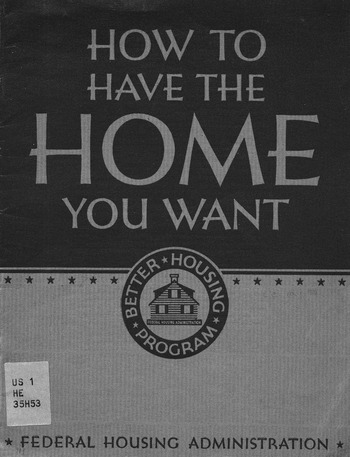
The FHA had been instructed, and was indeed set up, to sell this program very aggressively. Even at the hearings in May, Frank Walker had spoken of a “campaign” rather than merely of policy “implementation.” When asked whether he meant to imply “high-pressure salesmanship,” he backed down. But soon Marriner Eccles, executive secretary of the Treasury, also let slip a reference to the need for “a national campaign” before hastily adding: “I do not mean high-pressure selling.” In fact that is exactly what the administration meant, albeit a campaign that proved so successful that Esperdy suggests that it became a “mass movement” (Fig. 3).Footnote 62 An official history later boasted that when the FHA was established in the summer of 1934, its first administrator, James A. Moffatt, a senior vice president at Standard Oil, “lifted bodily an advertising agency, a time payment crew, a legal department, and a banking and accounting division from the best-known institutions in America.”Footnote 63 Ward Canaday, who had a decade’s experience promoting auto sales as president of the U.S. Advertising Corporation of Toledo, was appointed the FHA’s director of Public Relations, while Roger Steffen, vice president of National City Bank, New York, where he had set up a personal loan department, was made director of modernization credits. By chance, Ray Smythe, a small-town reporter, was hired onto the FHA’s staff, and his breathless account of its first few months of operation makes it clear that Canaday ran what amounted to a sales campaign for “Better Housing.”Footnote 64 Borrowers were offered a free consultation service.Footnote 65 To generate inquiries, there was a “publicity splurge” that included the preparation of Visomatic sound pictures (35 mm. slides, accompanied by a 16-inch record), “Better Housing News Flashes,” which were shown on thousands of cinema screens and supposedly seen by forty million people by 1936, and extensive advertising in consumer magazines and on the radio.Footnote 66
The cover of a promotional booklet that the FHA targeted at housing consumers for its Better Housing campaign. It gave equal weight to the Title I and Title II programs.
Source: Federal Housing Administration, How to Have the Home You Want (Washington, D.C., 1935).

Radio was an especially effective medium since, in a nation where “thirty percent of us are unable to read a newspaper,” it delivered the widest cross section of the population: ownership of radio sets was booming from 32 percent of all households in 1929 to 82 percent by 1938, when more than 40 percent of families tuned in for evening broadcasts.Footnote 67 The Better Housing campaign was launched on air by Administrator Moffatt on August 15, 1934, and within about six months 45,000 radio broadcasts on 609 stations had carried the message everywhere. These included scheduled, network shows five days a week, and in a range of time slots. An especially effective show, “Master Builder,” which featured a “carpenter” who acted as “friendly counselor to the one hundred and twenty millions of Americans,” aired every Saturday, 6:45–7:00 EST. It was heard by the male home owners who were interested in saving money by doing their own home improvements. By the beginning of 1935, the FHA also had a lunchtime show on the Columbia network on Wednesdays. Since at that time of the day it would have been heard mostly by women, they arranged for a female host, Miss Martha Holmes (the “Better Housing reporter”) to carry a “flying microphone” into the homes of “representative Americans who tell true, spontaneous stories of how they have modernized.” They had at least one other show “of special interest to women,” on the American network.Footnote 68 This emphasis on women reflected the prevailing assumption in the building trade that, as one dealer put it, “Mr. Owner may pay the bills but in most cases Mrs. Owner tells him what to pay for.”Footnote 69 Or, as one textbook writer advised, “‘sell’ the wife, and close with the husband.”Footnote 70
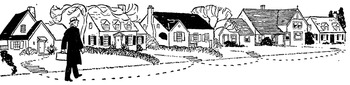
At the FHA head office in Washington, D.C., a large staff, including Smythe, wrote a Property Owner’s Booklet, responded to media inquiries, and prepared printers’ mats and advertising copy for contractors, dealers, manufacturers, and lenders who planned tie-in promotions. They also wrote the texts for speakers who carried the story across the country and who helped generate grass-roots support for the formation of local committees, 5,500 of which had formed by February 1, 1935.Footnote 71 They wrote a manual on how to set up and run such a committee. This scripted a sequence of three “sales meetings”: the first should kick off with the Visomatic show, “Dealer, Architect, and Contractor”; the second should offer advice on sales and marketing, showing how to “appeal to the emotions of men and women”; the third would give nitty-gritty advice on financing and mechanics liens.Footnote 72 In the revised edition of the guide, which was soon prepared, local committees were urged to organize house-to-house canvassing, and every page carried the urgent slogan “Ask ’em to Buy” (Fig. 4).Footnote 73 Local committees responded. They organized cavalcades to generate publicity, rented storefronts that became de facto “one-stop shopping center[s]” in order to pull in pedestrian traffic, and rounded up dozens (and sometimes hundreds) of people to canvass.Footnote 74 In Riverside, California, for example, the Chamber of Commerce helped mount a “Better Housing Campaign” that was piggy-backed onto a house-to-house property inventory. It attracted “enormous publicity” in the local newspaper as canvassers noted conditions, distributed information about Title I loans, and urged householders to complete “pledge cards” that were to be sent to a “clearinghouse” that was financed by local lumber and building companies.Footnote 75 In more than five hundred communities, separate women’s committees were also formed to promote modernization and create jobs.Footnote 76 When the national program was revived in 1938, the new campaign was less extensive but still vigorous.Footnote 77 In perhaps the only understatement of his book, Smythe conceded: “Sometimes we were merchandisers.” A more accurate description of the Better Housing campaign was later offered by the land economist Richard Ratcliff: “flamboyant.”Footnote 78
A canvasser’s path. The FHA showed as clearly as it could what it wanted local Better Housing committees to do. The artist, however, did not get the message: the styles depicted suggest that he houses had been recently built and so presumably would not need to be modernized.
Source: Federal Housing Administration, Selling Better Housing (Washington, D.C., 1935).

Half of the FHA’s sales job was directed at suppliers and lenders. Predictably, the building industry supported the Title I program from the very beginning. As the FHA pointed out, “Building supply dealers and contractors will profit.”Footnote 79 Dealers disliked many of Roosevelt’s housing initiatives, but they loved the Better Housing campaign, and immediately wrote in for advertising tips. Many canvassed and some, like Newton Lumber of Nevada, Iowa, ran a remodeling contest to drum up local interest. The trade press was soon full of stories of dealers who claimed that Title I had given their improvement business a great fillip, and over the first decade of the program dealers generated 80 percent of all loans.Footnote 80 This put them in the driver’s seat in relation to any lending institution with which they chose to work.Footnote 81 Manufacturers signed on, too. They were led by the companies that had already experimented with installment finance: Johns-Manville, American Radiator, Sears, and Weyerhaeuser, with its links to the Lumberman’s Finance Corporation, all set up finance agencies to handle the new form of government-sponsored credit; others, such as Ruberoid, joined in when they began to feel the competitive pressure.Footnote 82 A month after the Better Housing program was launched, the president of the Producer’s Council, the national body that spoke for most of the leading manufacturers, reported that members’ surveys were showing great demand for improvements “such as can be financed under the better-housing program” and that they were “putting before such prospects full information as to their products.” Not surprisingly, at first the finance companies set up by the building suppliers played a key role in making the Title I program work. In 1936, L. H. Goldbright, vice president of the Heating and Plumbing Finance Corporation, claimed that “if it had not been for the finance companies, plus two or three banks that were experienced in the small loan field, the FHA situation [for Title I] would have been a flop for the first two years.” He had a point. After six months, five out of the top eight Title I lenders were finance companies, of which two were subsidiaries of manufacturers, with Goldbright’s corporation leading the pack.Footnote 83
Within a few months, the FHA felt so sure of the manufacturers’ support that they appealed to them to help sell the campaign and to volunteer “their best men from sales and promotional departments to act as instructors in [FHA] sales schools,” which were scheduled to start on February 1, 1935.Footnote 84 In New York State alone, schools were scheduled to run in Albany, Binghamton, Buffalo, Elmira, Rochester, Schenectady, Syracuse, and Troy. Some companies mounted their own, complementary campaigns for home improvement. Weyerhaeuser used this type of campaign to promote its “4-Square” brand of lumber.Footnote 85 The most substantial of the manufacturers’ schemes, however, was that of Johns-Manville’s “Housing Guild,” which from 1936 included promotional materials for a wide range of packages.Footnote 86 The building trade, then, was fully committed to the Title I program, and remained so. By 1940, for example, Weyerhaeuser’s financial subsidiary, Allied Building Credits (ABC), had acquired more than $13.5 million in Title I notes.Footnote 87 Commercial banks, however, were another matter.
The average banker reckoned that installment loans were not only “irresponsible” but “beneath his dignity.” To persuade him otherwise, Albert Deane was seconded from GM, while the American Bankers Association appointed a liaison officer in every state to explain and promote the new program.Footnote 88 FHA staff distributed a series of pamphlets that sketched the experience of the first banks to buy into the program. The first pamphlet highlighted the experience of four lenders in cities that ranged in size from 14,000 (Mattoon, Illinois) to 270,000 (Atlanta, Georgia). Some of the reports were overeager, to the point of stretching credulity. For example, when the National Bank of Mattoon received its first promotional brochure about Title I loans, on a Sunday no less, the head cashier supposedly took it home to read, became enthusiastic, and carried it over to the bank president that afternoon. The next day the bank began to place advertisements in the local paper, with an immediately positive effect on business.Footnote 89 Other banks were urged to follow suit.
At first the FHA could not offer lenders much assurance about risk: loans were insured, but at this point in the Depression no bank wanted to be seen to sue customers for a bad debt. Instead, the FHA played up the possible multiplier and demonstration effects that had been noted at the hearings in May. Smythe reports that several people, including H. H. Dearing of the Commercial Credit Co. of Baltimore, indulged in some informal brainstorming on the subject at a party hosted by newspaperman Ward Mohun at the Shoreham Hotel. Their ideas were developed and then dramatized for CBS in a Wednesday radio series that illustrated “how a single modernization loan can inject new life into an entire community.”Footnote 90 Meanwhile, in its first pamphlet for bankers, the FHA reported how the neighborhood effect of the first Title I loans in Newport News, Virginia, had generated new business for a local lender.Footnote 91 Copycat borrowing was driven as much by the self-interest of builder and dealer as it was by the home owner’s spirit of emulation. In Elkhart, Indiana, for example, Title I loans had revived one “contractor-dealer … whose business has been in the doldrums for years,” to the point that “he hustles out, makes a sale” and then—the key point—“brings the customer right to the bank for starting the loan in process.”Footnote 92 Such evidence of course was anecdotal. As soon as possible, the FHA gathered, and then released to the media, more systematic data that sustained their claims. By November 1934 the New York Times was able to report that in Washington, D.C., the demand for uninsured loans was already exceeding that for Title I paper, while reports from other cities indicate that both types of loans were effectively leveraging much larger cash investments.Footnote 93 In Boston, for example, it appeared that households borrowed only one-third as much as they spent in cash.
While the FHA tried to pull the banks into Title I lending, the dealers pushed. For example, finding that local bankers were “lukewarm” to the new business, one dealer won them over by suggesting that he could screen applicants, work out all the details, and do much of the paperwork first. He also “personally contacted” all contractors in the vicinity and went on the local radio to alert consumers, too. Dealers also had to contend with the home owner’s reluctance to borrow from the banks. In Davenport, Iowa, Mueller Lumber persuaded a local bank to accept its credit assessments so that, even though the bank was making the loan, potential borrowers would not actually have to see a banker at all. At the local level, then, it often fell to the lumber dealer to allay the mutual suspicions of borrower and lender. In time, as the editor of Building Supply News noted, the “lassitude of bankers” was overcome.Footnote 94
Slowly but surely the FHA was able to persuade skeptical lenders that Title I loans were good business. Paradoxically, the Savings and Loans, which had spoken in favor of the program at the hearings, ended up playing only a minor role. The reason was that they were suspicious of all types of FHA insurance and jealous of attempts to bring commercial banks more fully into the mortgage business. Officially, they continued to approve of the Title I loans, but in practice their involvement was limited.Footnote 95 Instead, by 1936 John Fahey was advocating an extension of the HOLC’s “home reconditioning” activity into a program that the bank board might develop for the thrifts.Footnote 96 The outcome, the Federal Home Building Service Plan, never had much impact. The FHA was not particularly concerned about this initiative; its main sales efforts were directed at the commercial banks, and they had the desired effect. By the end of 1934, 11,945 financial institutions had signed up for the program, no fewer than 10,029 being banks.Footnote 97 Many, of course, then proceeded to watch how the program worked out before plunging in. In the first three years of the program only about two thirds of these banks, 6,433 to be precise, actually made a loan.Footnote 98 But it is clear that, from the beginning, the banks were being won over. To be sure, there were hitches. By the mid-1940s, demand for Title I assistance had encouraged a “bad class” of itinerant dealers to begin using the program as a “racket,” for example, by promising customers commissions on any subsequent sales that the dealer was able to make in the same neighborhood.Footnote 99 Of course, no such commissions were paid. Such scams discredited the program and burned both borrowers and lenders. For this reason, and because of innate conservatism, some banks continued to hold back. A survey in 1946 showed that 80 percent of banks were willing to make consumer loans, 63 percent installment loans for automobiles, and 53 percent for other consumer goods, but only 34 percent were willing to participate in the federal modernization program.Footnote 100 Even so, by then banks accounted for about three-fifths of all Title I loans.Footnote 101 They had come on board.
THE IMPACT OF THE TITLE I PROGRAM TO 1954
It is always difficult to assess the impact of a government program since this requires a counterfactual argument, but contemporaries believed that Title I had been a resounding success. Certain facts are clear. First: it soon caught on. In its first ten months of operation, from September 1934 to June 1935, the number of loans granted rose steadily and averaged 22,000 a month.Footnote 102 Over the next ten months, until April 1936, they ballooned to 80,000 a month, before dropping back somewhat. When the loan program was lapsed, the outcry was immediate, and it was restored. Second: the scale was huge. A total of 1.5 million loans were made between 1934 and 1937 and about the same again from 1938 to 1940. By 1946 the number had reached 6.2 million. By any standards these were large numbers. Goldstein has claimed that by 1937, one in eight home owners in the United States had received an FHA-insured modernization loan. Her estimate is a little on the generous side, and slightly misleading in that some loans went to landlords and some borrowers double-dipped. Nevertheless, since the total doubled by 1940 and then doubled again by 1946, it is clear that a large minority of U.S. households received some benefit even before the beginning of the postwar boom.
A third indisputable aspect of the program is that it was associated with a rapid increase in the use of installment finance for home improvements. In 1929, almost half (47 percent) of consumer debt was for automobiles and only 0.91 percent for repair/modernization loans.Footnote 103 By 1936 the gap had narrowed, the proportions being 42 percent and 11 percent, respectively. Some of this shift was caused by new, privately sponsored programs, notably Johns-Manville’s, but the Title I program was many times larger and must have been responsible for the lion’s share of the growth in installment debt for improvements. Given that such debt seems to have been directly associated with cash expenditures at least three times as great, a large multiplier effect may be counted as a fourth fact about the program. If $2.5 billion had been loaned under the scheme by 1946, then it is reasonable to infer that this new debt was associated with a total investment of at least $10 billion.
But of course it is impossible to know how much of this investment would have been made in the absence of Title I loans. The late 1920s and early 1930s saw a relative increase in improvement activity, and this would surely have continued through the early 1930s, and then the early 1940s, as new construction lagged. The need for dwelling conversions became pressing and much would have been undertaken even if the federal government had provided no encouragement at all. One assessment of the net effect of the program is suggested by the experience of the Weyerhaeuser Corporation. Weyerhaeuser was one of the companies that most actively supported home renovations in general, and the Title I program in particular, by setting up its ABC subsidiary. By 1937, its salesmen estimated that ABC increased the company’s sales of building materials and modernization projects by about 10 percent.Footnote 104 There is no way of knowing whether this was a good estimate even for Weyerhaeuser’s experience, still less whether it may be generalized. But if it is at all accurate, the Title I program may be said to have increased investment in residential real estate by about $1 billion from 1934 to 1946.
Although its net effect on property investment was probably very large, the more significant impact of the Title I program was in its effects on how a range of companies associated with the building industry did business. Lenders and lumber dealers, many of whom were encouraged to get into contracting, were the two key groups. Dealers liked the program because it promised to generate sales, but for many it was a new type of business, one that made unfamiliar demands. Historically, dealers had sold mainly to contractors: their salesmen lacked the people skills to handle consumers, especially women; they specialized in lumber and related products, such as millwork, but typically did not stock the range of materials that a household would need for a modernization project; their yards were located beside freight lines in less frequented and attractive parts of town; most lacked a showroom, while displays were minimal, dusty, and unappealing. During the 1920s the success of mail-order-kit manufacturers had pushed many retailers to reorganize their businesses in a more consumer-friendly fashion, but by 1934 the majority still operated more or less as they had done a generation earlier.Footnote 105 The Title I program changed this. It was so large and potentially lucrative that few dealers could afford to dismiss it. The challenge, however, was that in order to effectively participate, they would have to change.
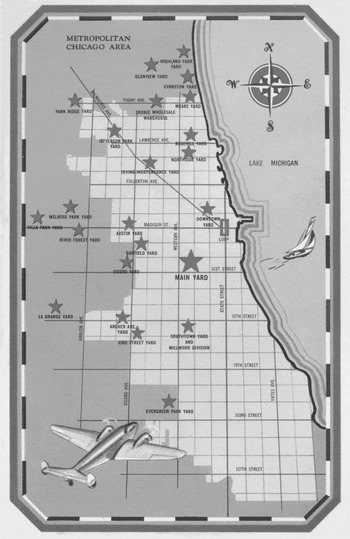
Morris Lumber Co. of Plymouth, Indiana, exemplifies the sort of impact that Title I had on the more progressive retailers. The announcement of the Title I program inspired the owner to undertake a complete survey of the town.Footnote 106 Eager to promote the idea of home improvements, he discovered that his yard only stocked about a quarter of the materials that prospective customers would require. This was typical. A later national survey showed that Title I loans were used mostly to upgrade plumbing and heating (38 percent), for interior or exterior refinishing (24 percent), or for re-roofing (14 percent).Footnote 107 Dealers carried paint and shingles but not usually plumbing supplies or heating equipment. For Mr. Morris, the idea of drumming up so much business that would filter away to other retailers was unattractive. By 1936 he had resolved that he would have to diversify. On a more substantial scale, Title I had a similar effect on Edward Hines, the largest lumber concern in Chicago (Fig. 5). Hines owned stands of timber in the southern and western United States, operated what it claimed to be the nation’s largest wholesale yard on the Chicago waterfront, and ran a score of retail yards distributed throughout the metropolitan area. It regarded itself as efficient and forward-looking, in tune with current trends within the trade. Even so, at the beginning of the Depression its retail operations were still focused on the contractor trade. By 1932, however, the company began to look more seriously at the consumer market. Among other things, this meant “attracting the attention of the women, because the housewife generally has a complete say as to the running of a home.”Footnote 108 As Ralph Hines, the company’s president, pointed out, however, it was only in 1934 that they “hit on the idea of advertising a remodeling service.” In describing this decision, Hines does not indicate what role was played by the federal government’s program, but, given the enormous publicity that accompanied its launch, Hines’s timing was surely more than coincidental.
The distribution of Edward Hines’s retail lumberyards in Chicago, 1942. Along with many other retailers, after 1934 Hines was encouraged to target the modernization market by the Title I program.
Source: Edward Hines Lumber Co., 50 Years (Chicago, 1942). Used with permission.

Many other dealers were realigning themselves in the same way as Edward Hines and Morris Lumber. By 1937 a survey of its dealers that was undertaken by Johns-Manville found that 91 percent supported the idea of promoting home improvements through the use of deferred payments.Footnote 109 This was not a typical group because J-M had been promoting the installment message since at least 1932. A more meaningful statistic is that by 1940 only three out of ten dealers were originating Title I loans.Footnote 110 But if most still held back, it is clear that by the end of the 1930s the promotion of Title I loans had given a strong push for them to become more involved in the consumer market. This in turn primed them to respond quickly to the consumer boom in owner-building and then Do-It-Yourself, which characterized the first postwar decade. In that respect, although the Title I program did not give birth to the home-improvement business, it did give it a big boost.
But contemporaries “generally agreed,” and in 1947 McFarland’s assessment confirmed, that the most significant direct effect of the Title I program was to bring the banks into the market for installment sales.Footnote 111 Between 1934 and 1937, the amount of installment-loan business generated by the banks jumped from $44 million to $258 million at a time when the economy was scarcely growing.Footnote 112 This did not just matter for the housing business. In the first seven years of the Title I program—for almost one of which the program was in abeyance—the banks’ share of all types of installment finance rose dramatically: slowly from 1931 (5.4 percent) to 1934 (7.7 percent), and then rapidly from 1935 (9.7 percent) through 1937 (18.0 percent) to 1941 (33 percent).Footnote 113 In 1946, Kenneth Wells, assistant vice president of the American National Bank and Trust Company of Chicago, claimed that “many banks” that by then were offering consumer credit had been “initiated” into the business by Title I. He was right. In 1938 alone, testimony to that effect was offered by both Manufacturers Trust of New York and the Lincoln-Alliance Bank of Rochester. Manufacturers, for example, opened a department to handle modernization loans in the summer of 1934 and this proved so successful that it initiated a “personal loan service” the following year. This experience was repeated scores, indeed hundreds, of times over, justifying Louis Hyman’s large claim that Title I “remade the institutional structure and assumptions of commercial banking.”Footnote 114 Indeed, as banks found that the improvement loan business was to their taste, they eventually concluded that they could manage on their own. During the public debates that swirled in the months prior to passage of the revised National Housing Act in 1954, the American Bankers Association argued that the FHA should get out of the improvement business that they had started. Here, then, was a different type of multiplier effect, one that the FHA does not seem to have fully anticipated.
Another unanticipated multiplier was felt across the Canadian border. In the United States, the Women’s Home Companion had declared in 1934 that “America has become shabby”; two years later Chatelaine, the leading women’s magazine in Canada, proclaimed that the “vast majority” of Canadian homes “are in need of sprucing up.”Footnote 115 It was commenting on the Canadian government’s Home Improvement Plan, launched in November 1936. The written record of behind-the-scenes debates at the National Employment Commission (NEC) show that the HIP was conceived as “a plan similar to what is known as Title One of the Federal Housing Act of the United States” and for the same reason: to create jobs. Its provisions were also modeled on Title I, and it was promoted in a similar way: the government accepted FHA estimates of a 3 or 4:1 multiplier; neighborhood effects were anticipated; local committees were established, often with a women’s subcommittee attached; lumber dealers supported it; once the program was up and running each applicant received on average $400–500; some building suppliers developed complementary plans and Dominion Radiator, the Canadian subsidiary of American Radiator, led the way.Footnote 116
Socially, the HIP loans were a little more exclusive than Title I. They were available only to owner-occupiers (including resident landlords); media coverage often made reference to architects; and by 1940 only about one in ten home owners had taken advantage of the program, less than half the ratio in the United States. But the stream of promotional press releases issued by the NEC spoke of a wide range of improvements that could be financed. These included many that were very modest in scale and that would probably have been undertaken by home owners for themselves. Press Release 76, for example, suggested that owners might refurbish furniture that would otherwise be discarded, or fit out a guest room in the attic. P.R.164 referred directly to “amateur decorators” who might construct bookcases; speaking of basement rec rooms, P.R.77 noted that “the market is flooded with materials with which rooms of this type may be easily constructed.” Such references in the Canadian program literature are doubly significant. Belying the political rhetoric, which emphasized job creation, they indicate that Canadian bureaucrats knew they were also supporting amateur home repairs. And if this is true in Canada, it must have been even more true of the U.S. Title I program, which reached a wider social cross section.Footnote 117
The Canadian evidence hints at another consequence of the Title I program, this time unintended. Enthusiasm for Do-It-Yourself grew rapidly after 1945: the term itself was coined in the 1910s but became popular only in the early 1950s. Its growth was promoted by a succession of circumstances, including the need for property conversions, felt during the Depression and war, and then a shortage of skilled tradesmen. But Title I also played a part. Promoting home improvement in general, it also gave a fillip to the amateur handyman, and woman.Footnote 118
DISCUSSION
The federal governments in the United States and Canada became permanently, and actively, involved in the housing market in the 1930s. From the beginning they took a substantial interest in the improvement of existing housing as well as the construction of new housing. It is true that in the United States, the Title I home modernization loan insurance program was originally conceived as a temporary measure, but it soon proved so popular that it was made permanent within three years. It drew banks into the business of making consumer loans, with remarkable success and with consequences that we are still discovering. It also helped shape the postwar home-improvement business, encouraging lumber dealers and other building suppliers to think less about selling to the builders of new dwellings and more about servicing the consumers who wanted to fix up homes they already owned. Ironically, given that it had been designed to create jobs in the building industry, it underpinned the amateur do-it-yourself boom that eventually emerged in the early 1950s.
The immediate impact of Title I, and of its Canadian cousin, was to refine and consolidate the housing market. “Housing market” was not a term much used until the 1930s, and only then because it was promoted by the FHA. The agency’s key initiatives are generally thought to have involved the production, appraisal, and financing of new homes, coupled with the generation of market data and the refinement of marketing. The Title I program was just as significant as these other measures. It eased and systematized the financing of property improvement, a field that had previously been neglected. This mattered because improvement was growing in importance, as it has continued to do. The story did not end in 1954, of course, but the Housing Act of that year marks the end of one phase and the beginning of another. It did not abolish the Title I program, which continued to play an important role in the renovation business, but it did introduce what for many property owners turned out to be a better alternative: the open-ended mortgage, which made it possible for the cost of property improvements to be added on to an existing mortgage. From the borrower’s point of view, this reduced monthly payments, and so increased demand. The open-end also raised the possibility that real estate might be used to secure other types of consumer purchases, initially appliances, then other consumer goods, and finally intangibles such as vacations. It unlocked a Pandora’s box of leveraged consumption that many are now trying to close. But that is another story.