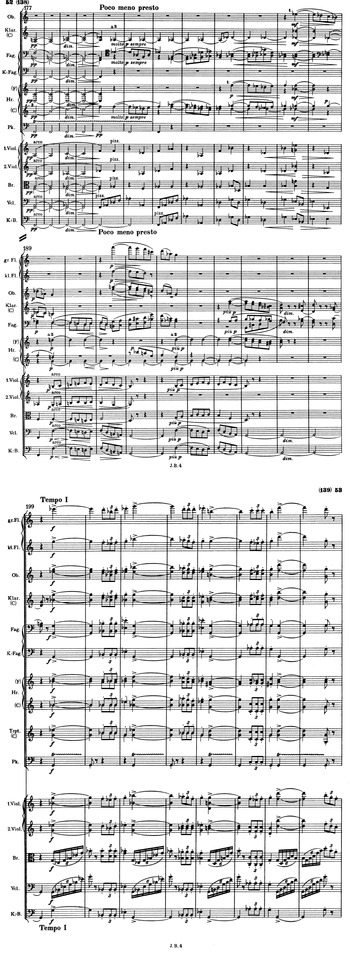
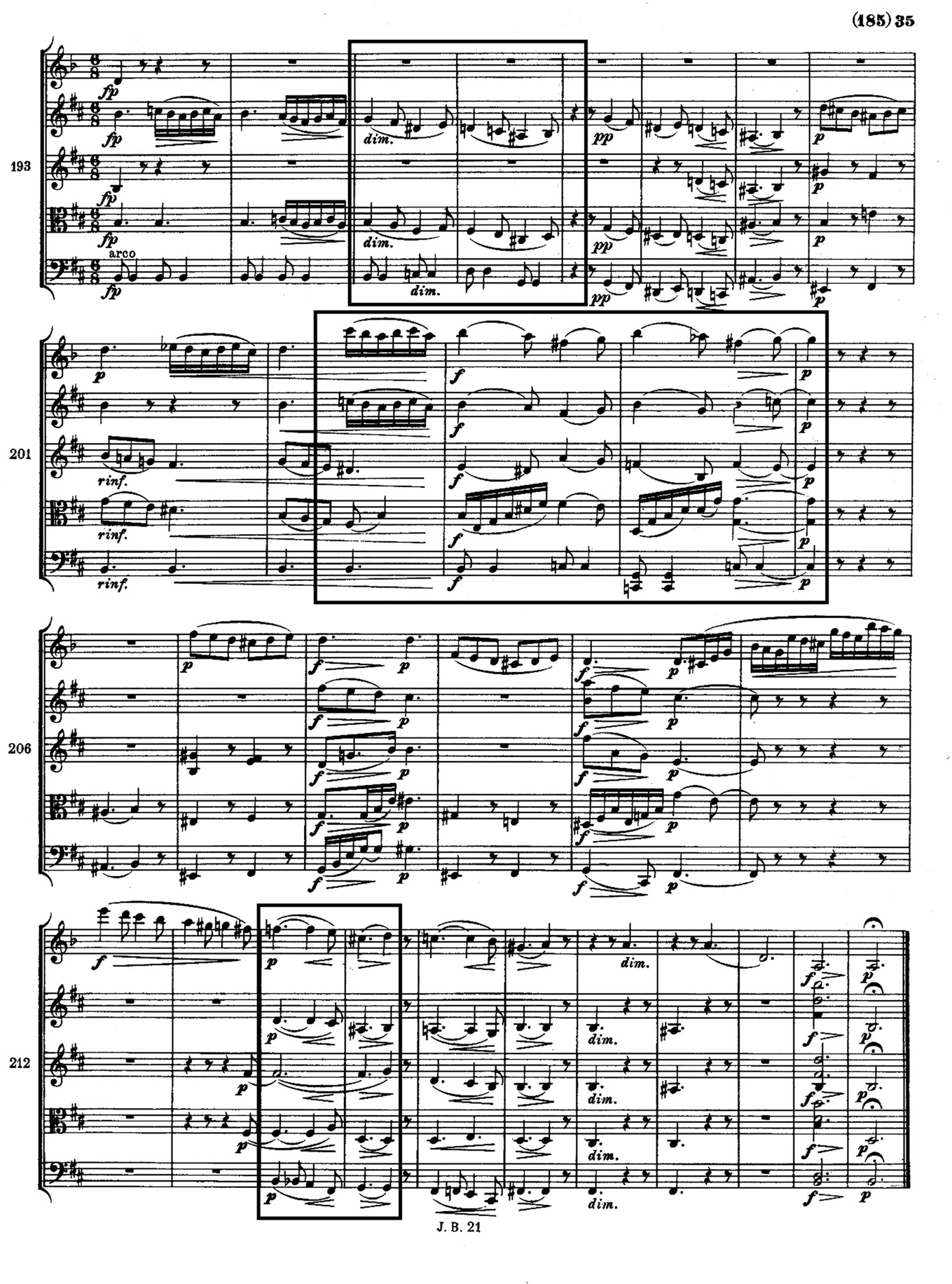
For better or for worse, Johannes Brahms distinguished himself in his time by carrying forward instrumental forms and genres from the turn of the nineteenth century. To those who championed his music, he was no mere epigone to Beethoven (and other predecessors), but rather he breathed new life into classical forms, partly by devising ever more imaginative ways to organize material and develop themes, even as they were being restated. Indeed, the subtle and sensitive attention to integrating returning themes within formal schemes is a hallmark of his style. Occasionally, this takes the form of disrupting the formal plan and the musical flow by reintroducing a theme when it was least expected. A prominent example occurs in the middle of the third movement of Symphony No. 4 (see Ex. 1). Shortly after establishing a trio-like respite from this uncharacteristically boisterous C major scherzo at the poco meno presto of bar 181, a triumphal fanfare from the beginning of the movement crashes in at bar 199. As in its initial appearance, its entrance is syncopated and shifts the tonality unexpectedly from C to E-flat major, pivoting on the common-tone G. It is a disruptive effect, but, as the scherzo form calls for a return of opening material at some point, we know this is coming, even if it arrives when we don't expect it.Footnote 1
Brahms, Symphony No. 4 in E minor, mvt iii, bars 177–206

Even more arresting, however, are a group of multi-movement instrumental works in which Brahms reintroduces themes from one movement into a later one in the same piece, ranging from relatively loose recollections to quite literal restatements. In each of these instances, Brahms positions the recall in such a way, or at such a place, as to invite interpretation and imply expressive meaning. Brahms was certainly not the first to employ this sort of inter-movement thematic recall. In the most thorough study of inter-movement thematic recall, Benedict Taylor's Mendelssohn, Time and Memory (2011), the author defines various versions of thematic recall among a wide array of nineteenth-century composers. Taylor also offers a compelling theory for the emergence of this formal device in the early decades of the century. After considering some strictly musical explanations for the relative lack of such works during the classical period, Taylor posits a purely historical context for the rise of inter-movement thematic recall:
[T]he shape of history of the eighteenth century is the straight line, the path of history linear and unidirectional, moving imperturbably on to the forthcoming Utopia. Much of the romantic movement in Western Europe can be read as a reaction against this linearity, a disillusioned realization that this former dream of human progress was possibly too naïve.Footnote 2
The resulting mindset among romantics – that history was cyclical – is projected in gestures of return in literature and music, according to Taylor. This is most tangibly represented in large-scale instrumental works by the return, near the end of a piece, of one or more themes from the work's outset. In many instances, the return to origins (or the ‘circuitous journey’, to quote A. H Abrams, as Taylor does) represents a dialectic, whereby the subject is transformed by the process of leaving and returning, so that ‘home’ becomes a new place upon the return.Footnote 3
Brahms would certainly have been familiar with many of the examples Taylor adduces, and the end of his Third Symphony in F exemplifies the sort of circuitous journey with a transfigured ‘home' that Taylor describes. And, at a purely musical level, the conclusion of Brahms's Deutsches Requiem, where the end of the first movement is musically restated (although textually transformed), has a similar profile.Footnote 4 Those instances notwithstanding, however, Brahms tends to employ the return of themes across movements in other ways. Specifically, his returning themes more typically appear near, but not at the end of a work, and thus function somewhat differently from the romantic cyclical return type assayed by Taylor. For this effect, Brahms's clearest model was Beethoven. In a well-known handful of examples, Beethoven directly quotes themes from earlier movements in the last or later movement of a cyclical instrumental piece. Elaine Sisman catalogued these occurrences in an essay in which she focuses on fantasy and imagination in the compositional process to explain Beethoven's use of the device.Footnote 5 I will briefly summarize her ideas and juxtapose Beethoven's inter-movement thematic recall with Brahms's. Whereas similar underlying compositional processes may have led him to follow Beethoven's lead, I hope to show that Brahms's use of thematic recall carries a more poetic and narrative quality, infusing its inherent mnemonic function with emotive content, and that his thematic recalls changed over the course of his career, becoming ever more end-oriented in large-scale instrumental works.
As a devotee of the Enlightenment, Beethoven follows different principles in his approach. Sisman introduces Beethoven's use of inter-movement thematic recall as an ‘arresting means for activating memory’.Footnote 6 Surveying a wide variety of philosophies of creativity from Aristotle to Kleist, she focuses on the role of the image to spur imagination and fantasy, and thus as a means for inspiring both improvisation and composition. Specifically, Sisman draws out of these theories the act of recalling an image as a way to make the past present, merging memory and imagination in the service of creating a new idea. Beethoven himself alluded to this practice, telling the English pianist Charles Neate, ‘I always have a picture in my mind, when I am composing’. Memory and imagination ‘are conjured in the powerful rhetorical figure phantasia, in which a speaker uses an image to make an absent thing appear to be present’, writes Sisman, adding, ‘For the composer, such an image may be a locator in memory that stimulates the composition of thematic material’.Footnote 7 This notion lies at the heart of her ensuing analysis of inter-movement recall in seven instrumental works and one song cycle by Beethoven in which this formal device occurs. Sisman is especially drawn to a cluster of Beethoven's works from 1815–16 that feature thematic recall: the Cello Sonata in C major, Op. 102, no. 1; the song cycle An die ferne Geliebte, Op. 98; and the Piano Sonata in A major, Op. 101. These are among Beethoven's most ‘romantic’ works during the years that saw him return to productivity and initiated a musical language that came to be recognized as a ‘late’ style. Lateness has received a great deal of attention in modern Brahms studies (most clearly in the works of Margaret Notley and Reinhold Brinkmann).Footnote 8 And, although it is not a focus among Beethoven scholars, it is worth noting here, in a paper that considers his influence on Brahms in the form of this compositional gambit. I will pick up that thread at the end of the article when examining the last of the works by Brahms in which he employs inter-movement thematic recall.
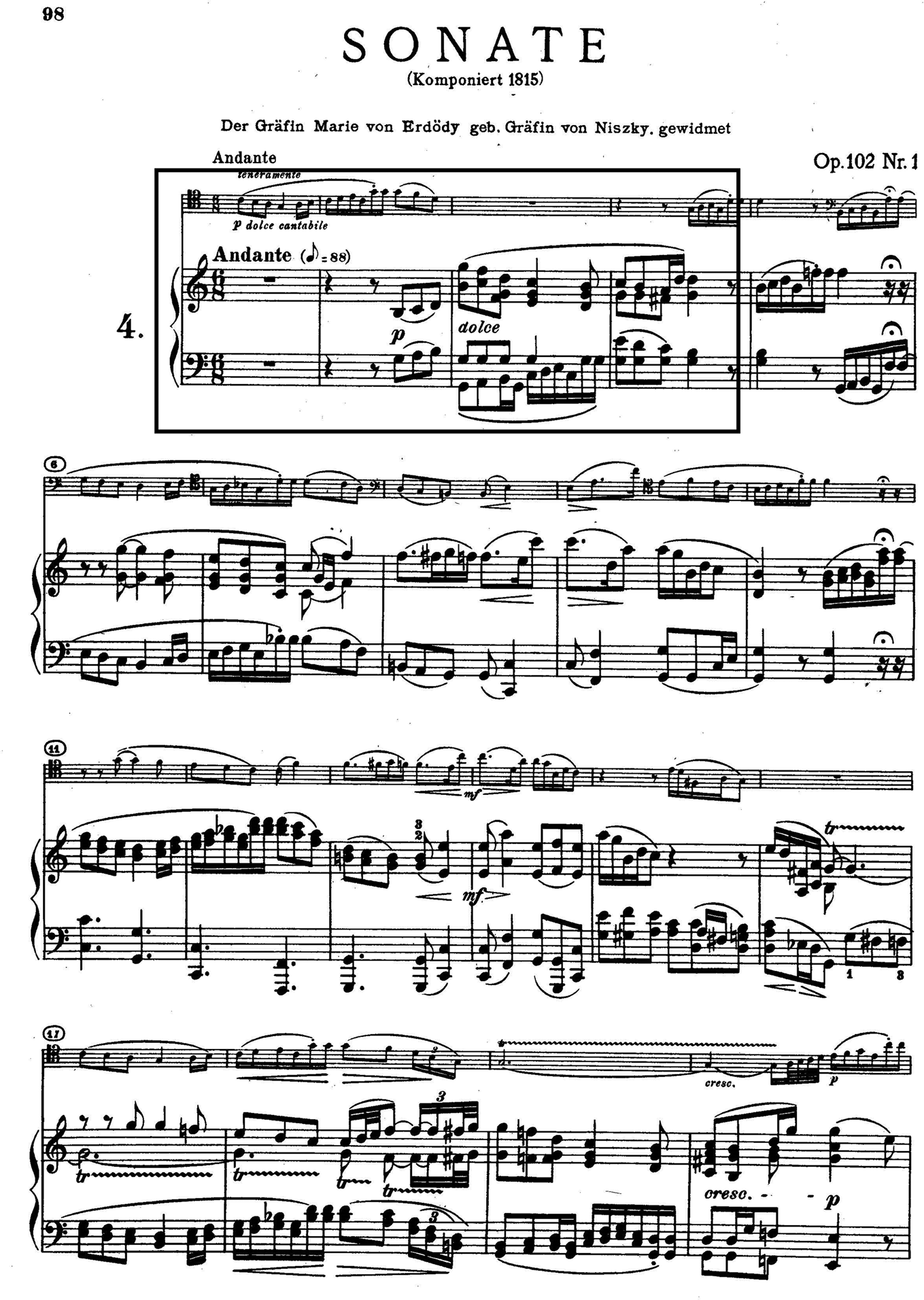
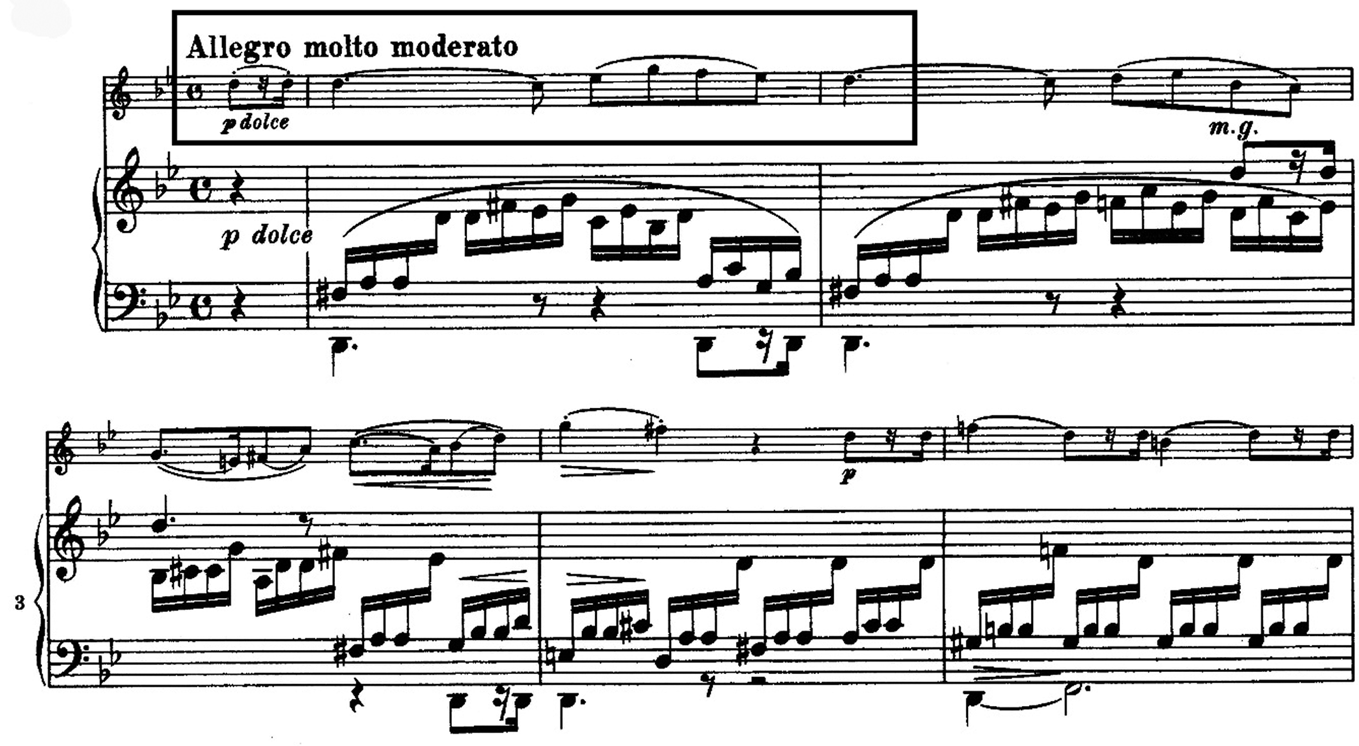
Beethoven, Cello Sonata in C major, Op. 102, no. 1, mvt i, bars 1–20

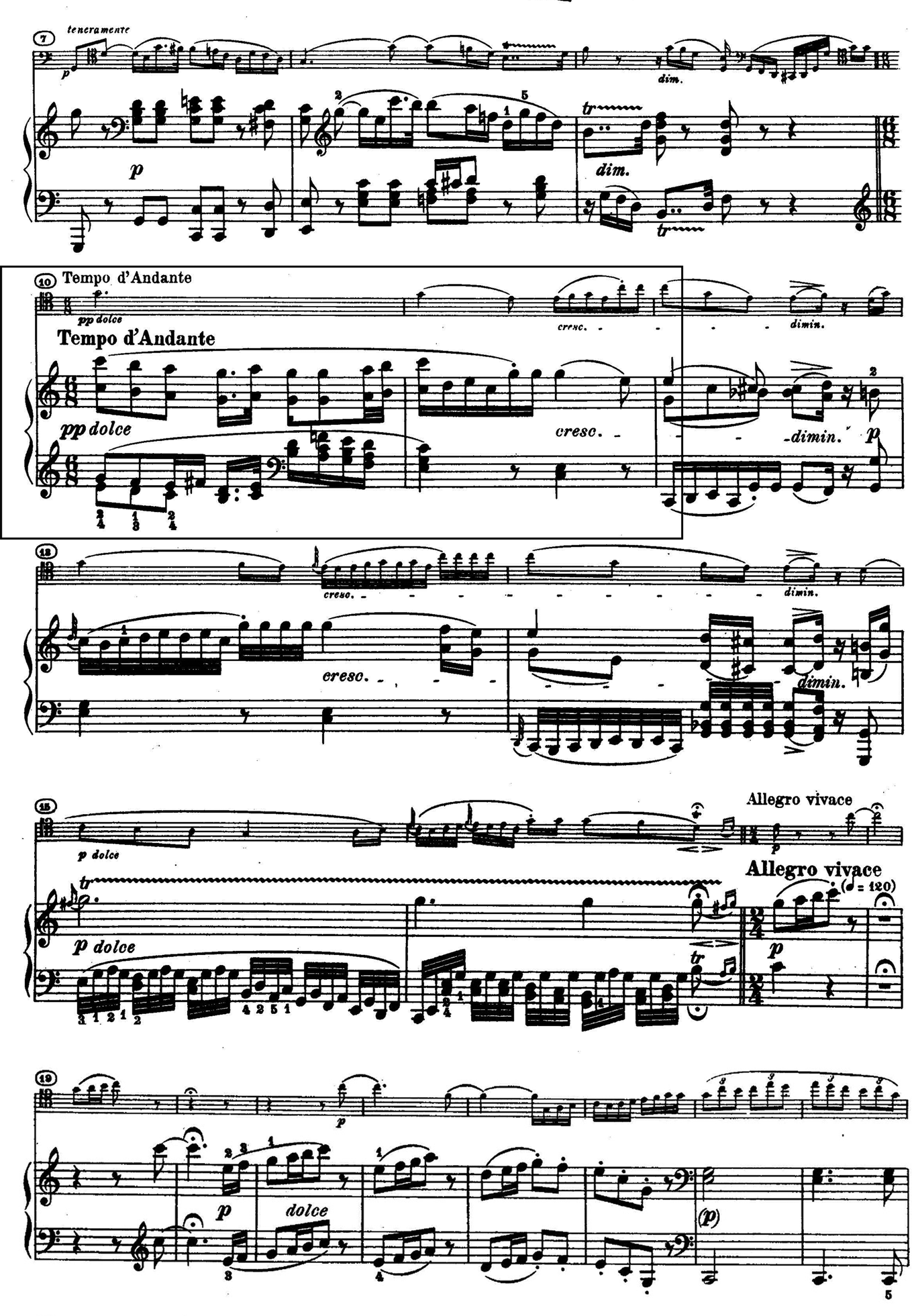
Beethoven, Cello Sonata in C major, Op. 102, no. 1, mvt ii, bars 7–26

All three of the works from 1815–16 bring back the very opening of the piece at a point that, in some way, ushers in its conclusion, in the case of the two instrumental works, their final movements. Potentially, this allows the recalled material to serve as a catalyst for new ideas (i.e. the movement or segment that is about to unfold). As Sisman illustrates, the appearance of opening material in each sonata unfolds a bit differently. As seen in Example 2, the opening andante theme of Op. 102, no. 1 is materially transformed upon its return within the second-movement group. Not only is the texture of the piano's initial statement more complex in the latter appearance, but also the dynamic energy increases, crescendoing across two bars three separate times, and, as the passage unfolds, a visceral escalation is produced by the infusion of demisemiquavers. Now, the andante theme pushes towards a half cadence on the dominant, rather than to the tonic, as it had originally been directed at the outset of the piece. As the ensuing Allegro vivace sputters to life, Beethoven fashions a distinctly new theme out of a critical motive from the Andante: the rising tetrachord from the fifth scale degree to the first. Here, then, the return of the opening material directly leads to the creation of new material, thus ‘stimulating the composition of thematic material’ (to use Sisman's words).Footnote 9
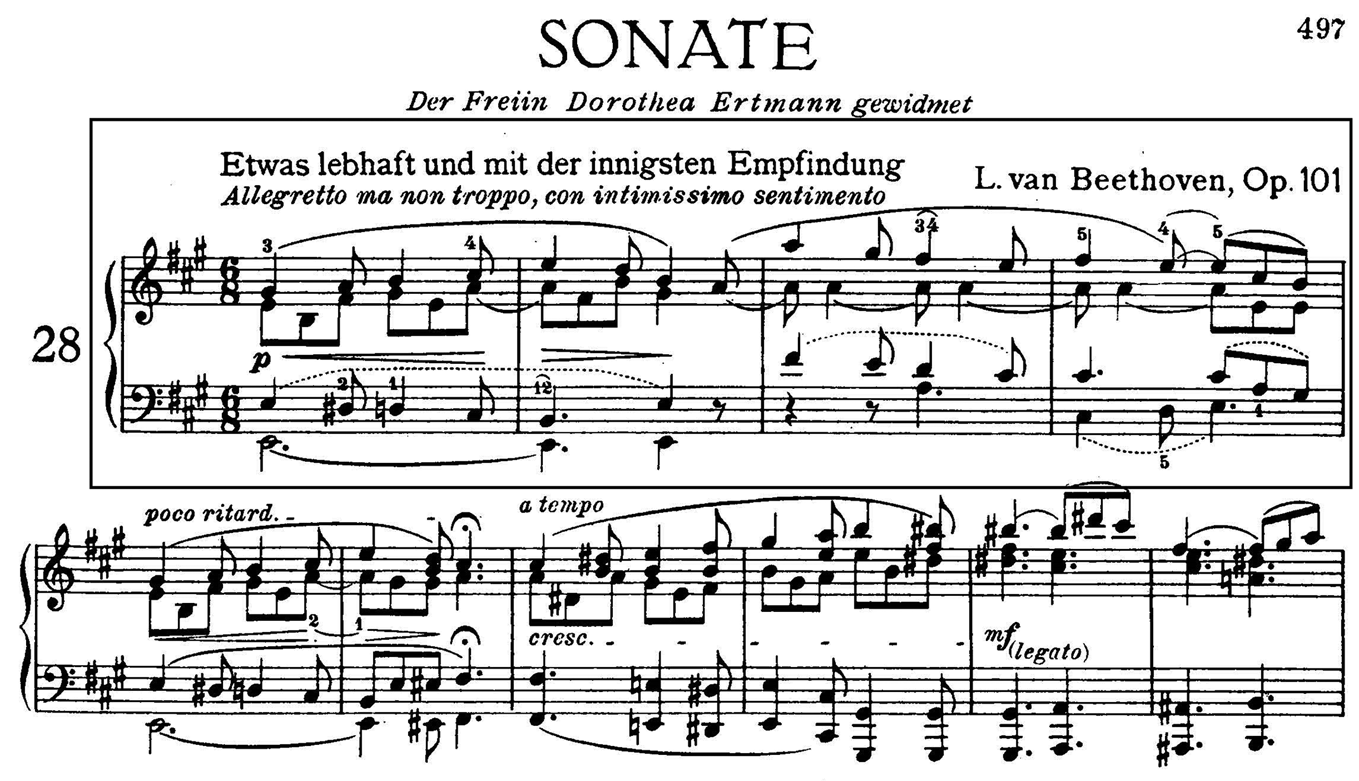
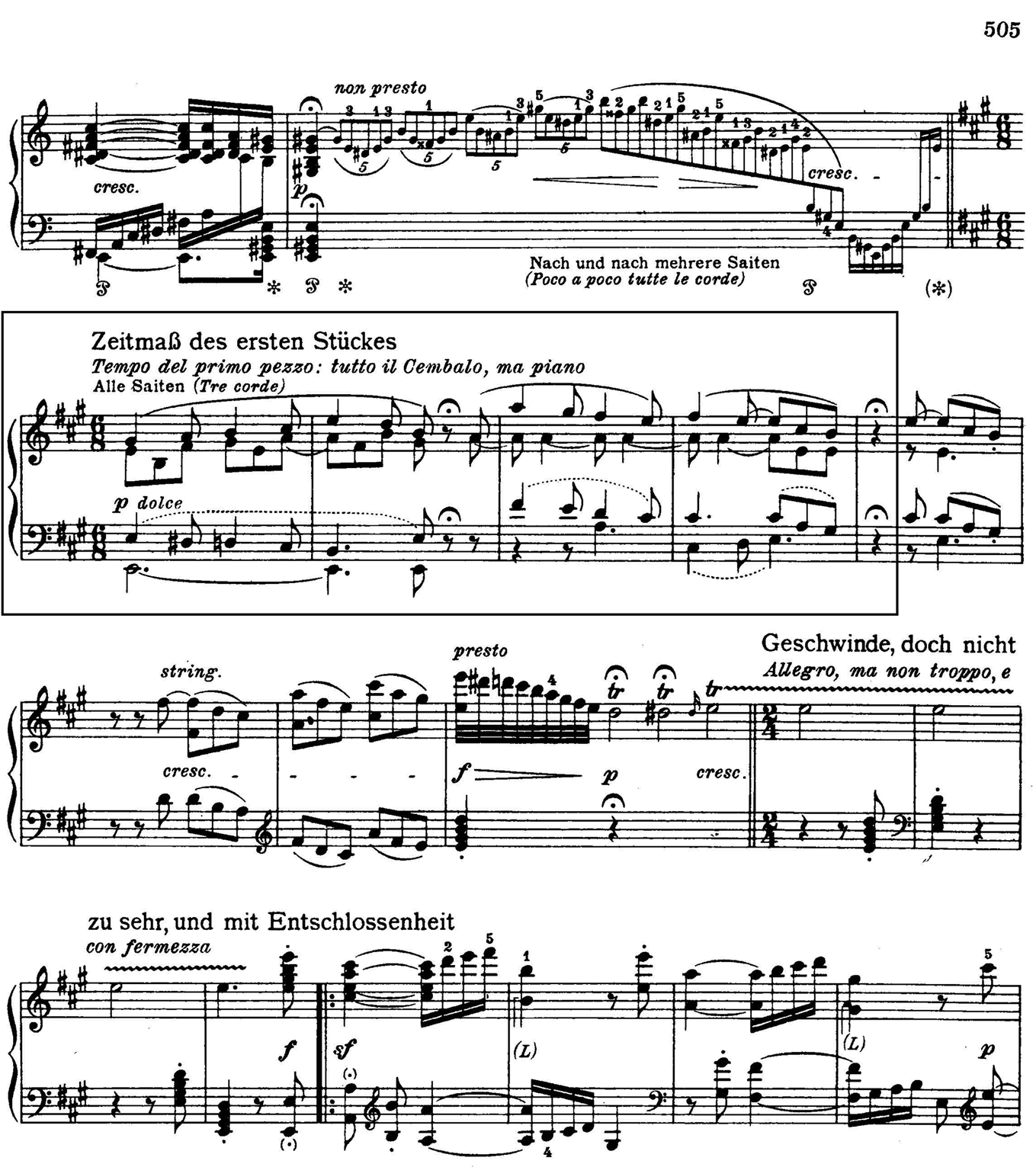
Invoking the opening material of the piece leads to a similar result in Beethoven's Piano Sonata in A major, Op. 101. Although the repeated material is much briefer here, it begins as a far more literal restatement of the opening two bars of the piece. As in the Cello Sonata in C major, once again the thematic recall gives way through a trill to a new theme that ushers in the Allegro, ma non troppo finale (see Ex. 3). However, the material in question in Op. 101 is decidedly different from the opening theme that is recalled in Op. 102, no.1. Beethoven famously begins this piano sonata in medias res, initiating the melody on the leading tone G# and unfolding a dominant-seventh harmony across the first two bars. Such formal and tonal fluidity at the beginning of the A Major Piano Sonata leads the listener to anticipate what will come next, and thus that material is well suited to spark the creation of a new theme and a new movement at the end of the piece. Robert Hatten hears the opening period as projecting a sense of ‘yearning’, characterized by the rising stepwise melodic lines and upward chromatic resolutions.Footnote 10 His interpretation falls within a reading of Op. 101 as governed by the pastoral topos, a subject that is also at the centre of Sisman's take on the work. Each hears the yearning in one or another part of the sonata, but whereas Hatten sees the pastoral as a hermeneutic tool for understanding the piece, Sisman sees it as another vehicle for memory, thereby providing a context in which to understand the return of the opening strain. Just as that thematic return serves as an act of recalling, the pastoral mode itself has long been understood to inherently invoke memory, as Sisman states: ‘A different kind of memory operates in pastoral compositions: an imaginary memory of an imagined golden age. A nostalgia for the never-was’.Footnote 11 Like Hatten, Sisman traces the emergence and suppression of the pastoral across the four movements of the sonata. For her, the inherent element of memory in the pastoral plays out across several planes at once. In both middle movements (the Lebhaft. Marschmässig second movement in F major and the Langsam und Sehnsuchtsvoll third movement in A minor), Sisman hears direct references to musical styles of the past: the chromatic descending bass line in the first strain of the second movement harkens to the Baroque, while both Viennese classical and baroque references appear in the third movement. For Sisman, the baroque features here speak to ‘the rekindling of Beethoven's interest in Bach and Handel’.Footnote 12
Beethoven, Piano Sonata in A Major, Op. 101, mvt i, bars 1–10

Beethoven, Piano Sonata in A Major, Op. 101, mvts iii and iv, bars 19–36

Against an interpretation of the sonata as being in – or a statement on – the pastoral mode, the return of the opening theme here takes on something more than strictly compositional meaning; it moves beyond the anticipatory or catalytic function of the inter-movement thematic recall in Op. 102. (Or, for that matter, in the Piano Sonata, Op. 27, No. 1 and in the Fifth Symphony, earlier works in this category that are cited by Sisman).Footnote 13 There is a reason Op. 101 is frequently mentioned when Beethoven's relationship to a romantic style in music is discussed. Nevertheless, positioning these recalls at the precipice of the finale in each work emphasizes the compositional process above all else; per Sisman, they ‘activate a process of memory, interacting with image, fantasy, and invention’.Footnote 14 One hears this overtly played out in the finale of the Ninth Symphony, as Beethoven musically brings forward the themes of the earlier movements, as if running through memories, and eventually rejects them – first instrumentally, and then verbally – in favour of the new melody that sets Schiller's ‘An die Freude’. As in the pastoral reading of Op. 101, the Ninth Symphony invites many layers of extra-musical interpretation. But above all else, the thematic recalls at the outset of the fourth movement conjure up the act of creating, be it composition or improvisation (or, really, the inherent overlap between them). Bringing the creative process to the surface of the music illustrates what Sisman labels ‘the emergent romantic imagination and its consciousness of creativity’.Footnote 15
Whatever other associations we may bring to bear on these examples from Beethoven, they are a product of a new romantic sensibility in music, one in which memory becomes a subjective component for the composer to exploit freely and not a mere by-product of formal processes. The romantic ‘consciousness of creativity’ and the corresponding perception of a persona in a piece of music that was to become a common mode of reception through the century is one of Beethoven's strongest legacies among composers who continued to work in the German instrumental tradition (his own misgivings towards romanticism notwithstanding). Only a year after his death, one powerfully senses this romantic subjectivity in the slow movements of all four of Schubert's last cyclical instrumental works (the String Quintet in C major and the last three piano sonatas), with their calm outer sections and stormy – to the point of tortured – middle sections. Moreover, the widely acknowledged allusions to Beethoven's music in the work of composers in the next generation (most notably Schumann) suggest that romantic subjectivity could include a continued historical dialogue with Beethoven. (Isn't this what the idea of the ‘footsteps of a giant’ boils down to anyway?)Footnote 16 No composer is understood to have carried on this dialogue more intensely than Brahms. In addition to his general engagement with Beethovenian forms that I cited above, and several apparently direct allusions to themes or motives from Beethoven's music, the very focus on compositional process that marks much of Brahms's music speaks to Beethoven's influence on Brahms.
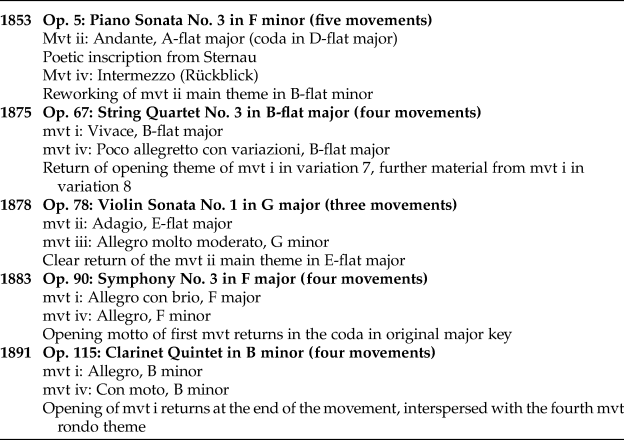
Returning to the process by which Beethoven begins the finale of his last symphony, Brahms's first effort in the genre goes through a related process of cycling through different themes before embarking on a primary subject for the last movement, a theme that was recognized from its first performance as strongly modelled on the ‘Ode to Joy’ melody.Footnote 17 And although several commentators recognize thematic and structural connections to earlier movements in the slow introduction to the finale of Brahms's First Symphony, there is no direct recall of actual themes. But Brahms was hardly averse to this device; we find inter-movement thematic recall in works as early as the first and third Piano Sonatas, Opp. 1 and 5, from 1853 and as late as the Clarinet Quintet, Op. 115, from 1891. Although, as in the finale of the First Symphony, numerous multi-movement instrumental works display possible motivic connections across two or more movements, Brahms directly recalls themes from earlier movements about as often as Beethoven had. Table 1 lists five instrumental works and two choral works in which material from an earlier movement returns in a later movement of the piece. To summarize my comments in the table concerning what material returns and where, a clear distinction emerges between Beethoven's and Brahms's use of inter-movement thematic recall: whereas Beethoven nearly always used this device to initiate new material at or near the end of a larger work, Brahms came more and more to use it to complete a larger work. Notably then, unlike Beethoven's use as explained by Sisman, Brahms does not tend to bring back earlier material to openly enact the creative process; whereas for Beethoven the recalled theme is like an image that, as Sisman puts is, ‘may be a locator in memory that stimulates the composition of thematic material’, for Brahms it acts more like a reflection on what has already occurred, like a coming to terms with the past, rather than recounting it in order to imagine a way forward. Writing on the several instances of cyclical procedures in Brahms's output, Walter Frisch summarizes, ‘Brahms's cyclical processes never give the impression of mere recollection or return. They confirm a distance traveled, a journey completed. They acknowledge that in music, as in life, time implies – indeed, creates – distance and transformation’.Footnote 18
Instrumental works by Brahms containing inter-movement thematic recall

Absent here is the quality of fantasy (or the category of phantasia). Rather than raising a memory and thereby bringing the past into the present, the past emerges later in a piece as something that is already an ongoing part of the present. Brahms's different approach to thematic recall stems from his different historical circumstances and changed attitudes towards memory and the past in the second half of the nineteenth century.
Part of this difference derives simply from the fact that he inherited the romantic musical tradition that Beethoven's works around 1816 helped to launch. Among the elements of that tradition that Brahms's immediate predecessors (Schumann especially) developed was the notion that music could be both ‘poetic’ on the one hand and joined with poetry on the other: two related but ultimately separate ideas. Music's poetic nature was a hot topic among Beethoven's contemporaries. Early romantic writers like Tieck and Hoffmann saw in instrumental music a freedom from determinacy akin to the license that poetry takes with language.Footnote 19 Many later romantics however, including composers of the ‘Romantic Generation’ (as Charles Rosen named them), turned to literature itself – sometimes poetry, sometimes not – for inspiration.Footnote 20 Writing about Schumann's character pieces, for example, Carl Dahlhaus offers that they ‘have a poetry permeated by the spirit of Jean Paul, a poetry of literary and even autobiographical allusions, of mottos and eloquent titles that sometimes appear to mean more than they actually say’.Footnote 21 The young Brahms certainly followed his mentor in this respect, as the motto-driven F-A-E Sonata co-written by those two composers and the young Albert Dietrich illustrates.
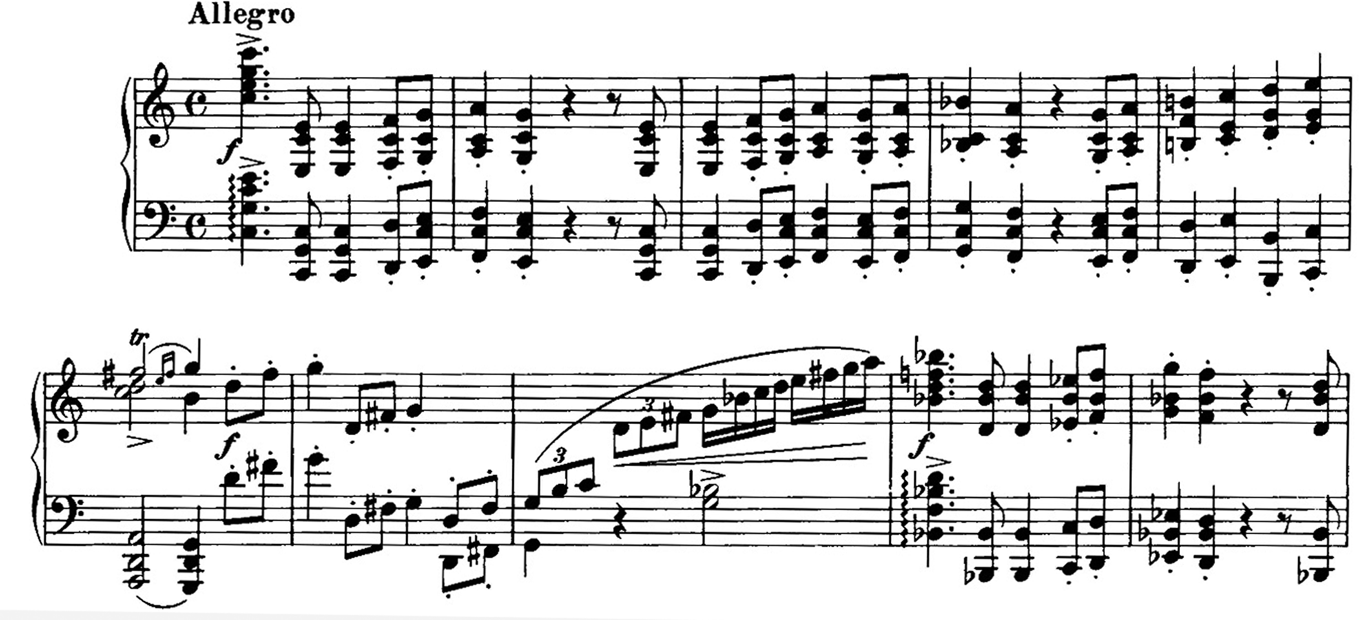
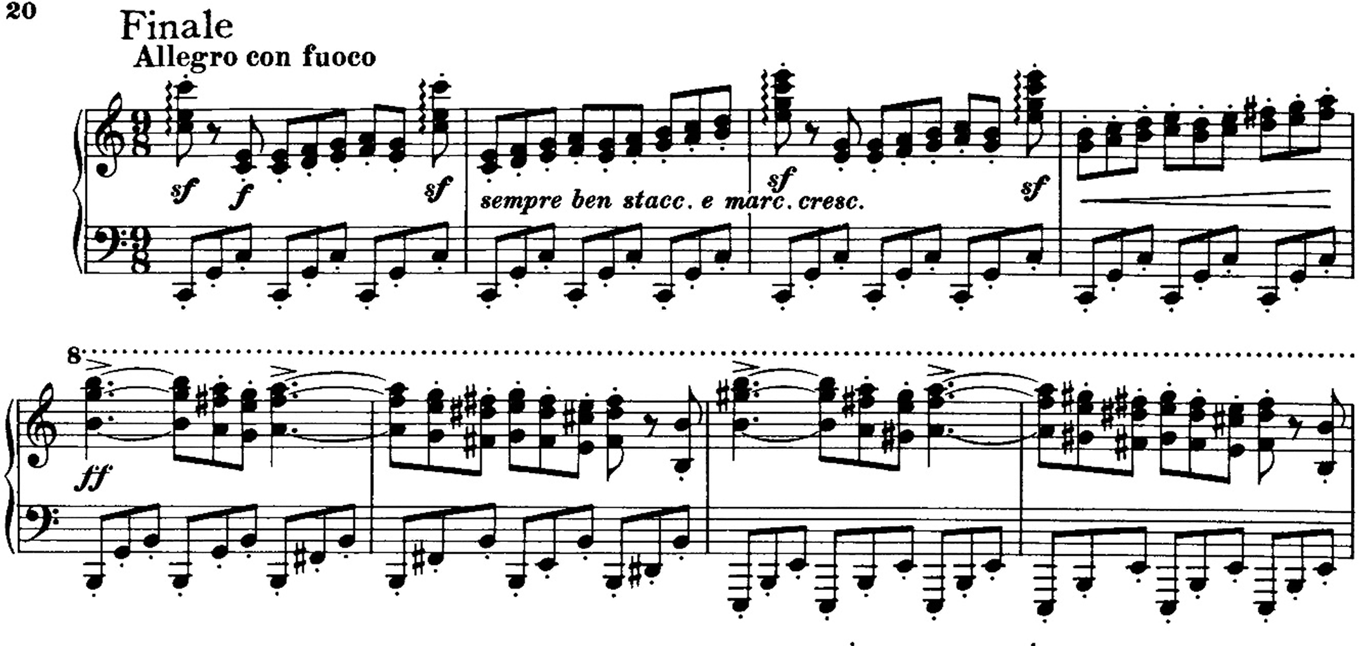
Literary allusion also figures into many of Brahms's earliest instrumental works, particularly the piano pieces published in 1853 and 1854.Footnote 22 Likewise, cyclical features and thematic recall figure into the core of these works: the Piano Sonatas, Opp. 1, 2 and 5. Within that cluster of early works, a distinction may be drawn between the use of thematic ‘resemblance’ and thematic ‘recall’. For example, in Op. 1, as many have noted, the finale's rondo theme is derived unmistakably from the opening of the sonata's first movement (see Ex. 4). Most recently, Jacquelyn Sholes compares the recasting of the theme in the Finale with its original profile at the outset of the work, highlighting the alterations that distinguish its forceful, four-square presentation in the first movement (‘jerky, uneven alternation of eighth- and quarter-notes’) from its dance-like 9/8 rendering in the Finale (‘an even patter of eighths in 9/8’, ‘fluidity’, ‘lighter texture’ ‘a sense of buoyancy’).Footnote 23 In at least two respects, this sort of thematic resemblance differs from the Beethoven examples of thematic recall cited above and from the Brahms examples I will consider below. First, the Finale theme in Op. 1 is a transformation, not a direct recall. This partly accounts for a second distinction: because the theme is altered enough to be heard as something new (its resemblance to the earlier manifestation notwithstanding) it does not contain the element of surprise or disjuncture caused by the thematic recalls on which I am focusing. In each of those cases a theme is recalled where another is expected, or it is introduced in a way the stops the progress of the piece (like the example from the fourth movement of Beethoven's Op. 101 cited above).
Brahms, Piano Sonata in C major, Op. 1, mvt i, bars 1–10

Brahms, Piano Sonata in C major, Op. 1, mvt iv, bars 1–8

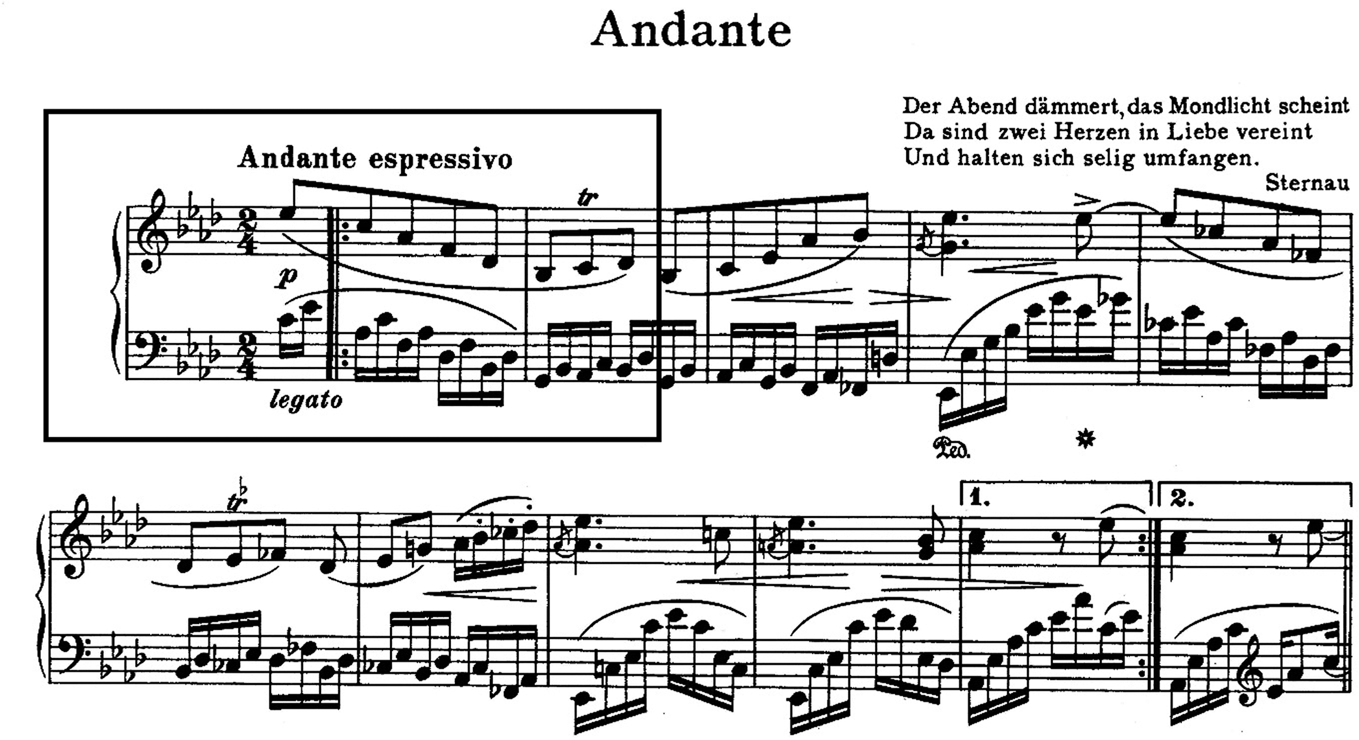
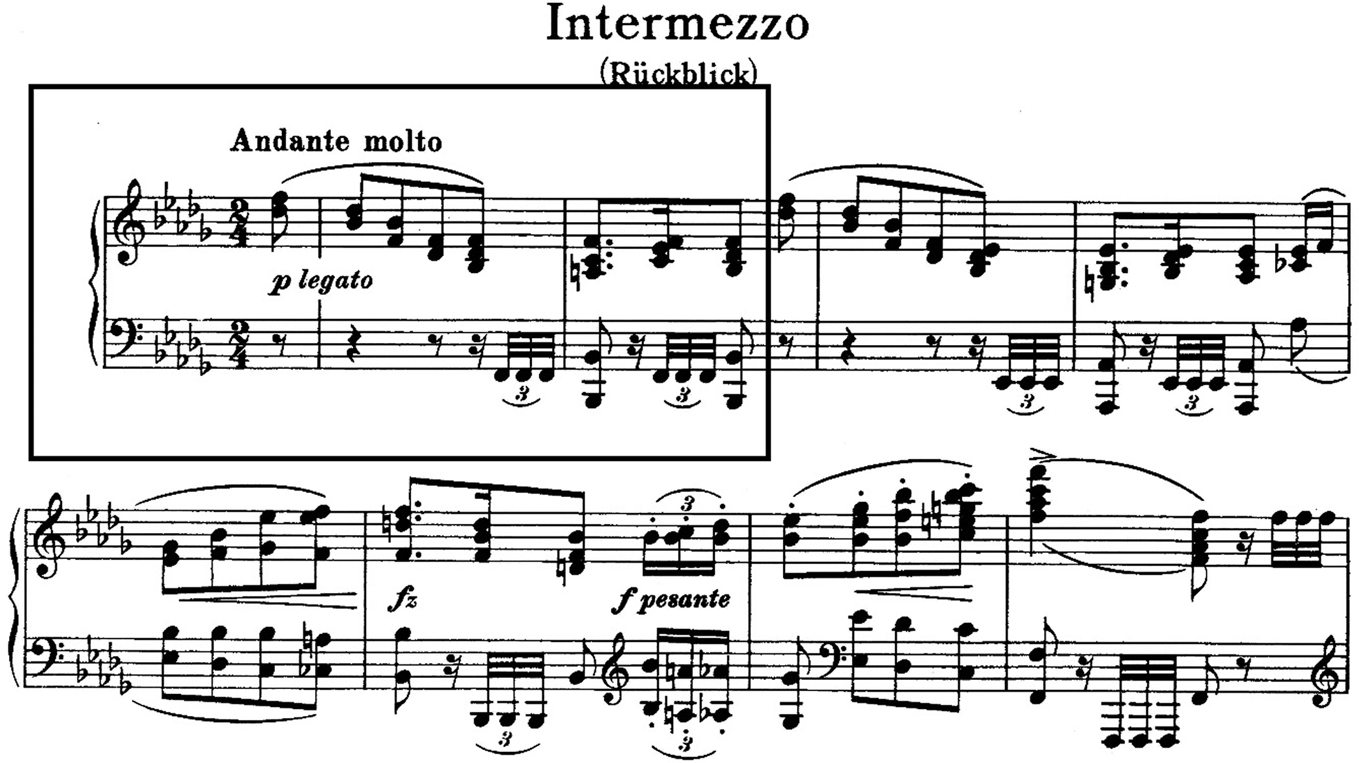
Lying somewhere between thematic transformation and thematic recall are the two andante movements from the Piano Sonata No. 3 in F minor, the first example by Brahms that I will consider. There, the second-movement Andante, bearing the first three lines from C.O. Sternau's poem ‘Junge Liebe’ as an epigraph, is vaguely but unmistakably recalled in the fourth movement, which is labelled ‘Intermezzo (Rückblick)’. What were originally descending thirds in steady quavers (forming tenths against the descending bass) in Movement Two are replaced by a similar gesture of dyads in a descending B-flat minor arpeggio in Movement Four (Ex. 5). In some respects, this inter-movement recall is unlike any that Beethoven had produced earlier or that Brahms would compose thereafter. Rather than interjecting an earlier theme into a new movement, the earlier movement is recalled as a brief echo (or, as Malcolm MacDonald describes it, ‘a spectral transformation in B-flat minor’Footnote 24). The rest of Brahms's inter-movement recalls, like Beethoven's, are somehow blended into the fabric of another movement, not as an entirely separate movement as here.Footnote 25 In the F minor Sonata, the unusual relationship between these two movements stems from two circumstances. First, these two andantes pre-date the rest of the sonata according to Brahms's own handwritten Werkverzeichnis, where he annotates the entry for the complete sonata with the remark, ‘Andante u.[nd] Intermezzo früher’.Footnote 26 Based on this and other features of the two movements, George Bozarth has speculated that ‘they can stand alone as a pair of “character pieces”, the second a variation of the first’.Footnote 27 It is the other features, however, that drive Bozarth's reading of these two andantes and the sonata as a whole. He offers a sensitive reading of the first andante as a musical evocation of the form and mood of Sternau's entire poem (not just the three lines in the epigraph), in which the poem's tripartite form and shifting moods are loosely but convincingly matched by the expansive A–B–A form and content of the second movement. Perhaps more insightful still is Bozarth's reading of the fourth movement, ‘Rückblick’, as an instrumental setting of yet another Sternau poem, ‘Bitte’, that Brahms had copied directly following ‘Der Abend dämmert’ in one of his notebooks of poetic texts.Footnote 28 Bozarth rightly notes that the melody of the fourth movement perfectly fits that poem.
Brahms, Piano Sonata in F minor, Op. 5, mvt ii, bars 1–10

Brahms, Piano Sonata in F minor, Op. 5, mvt iv, bars 1–8

Whereas the first andante (Movement Two) is a clear example of what Dahlhaus calls the ‘poetry of literary and … autobiographical allusions’, Brahms's recall of it in Movement Four is more purely ‘poetical’ in a way that is particular to the post-Beethovenian nineteenth century.Footnote 29 Without the benefit of knowing that Brahms had copied the second Sternau poem into his notebook, the ideal player or listener would perceive the fourth movement as a purely musical event. Yet it is an event that challenges mid-nineteenth-century musical expectations, which would call for a finale to commence after the third-movement scherzo and trio. Memory is just as much a factor here as in the Beethoven examples considered earlier, but it functions here in an entirely different way. The themes of the second movement can be heard not only as a return after the scherzo (which, in fact, they are) but also as a continuing echo and reverberation of that movement, as if that music had never entirely gone away. This works in part because of the unconventional ending of Movement Two and beginning of the Movement-Three scherzo. Numerous commentators have pondered the unusual coda of the A-flat major second movement, which returns to both the melody and the key, D-flat major, from the middle section of the movement. After slowing to an adagio, the second movement ends ‘con molto espressione’ with a IV–iio7–I in D-flat, which could be heard as the subdominant of A-flat, or as the rightful tonic to which A-flat has served as a large-scale dominant. As unstable as this ending is on a global scale (ending the movement in the subdominant), the scherzo crashes in on a viio7 chord in F minor; this scherzo notably lacks any authentic cadences to the tonic: the first and only such cadence arrives at the end of the movement, 98 bars later. Thus, when the fourth movement begins in B-flat minor with an unmistakable bow to the earlier andante, that key functions as the relative minor to the unusual concluding key of Movement Two, while simultaneously re-establishing the andante tempo (andante molto) after the allegro energico tumult of the third movement.
Beethoven's thematic recalls from earlier movements usually signal a new beginning: a retrieval of a musical idea, like a ‘picture’, brought forth in order to consider a new way forward. Here, Brahms evokes an earlier movement, not as something of the past that is absent and must be brought into the present, but rather as something that is already present, but lying dormant through the preceding scherzo. The poetry of this gesture lies in its departure from the normal syntax of classical instrumental forms, whereby one movement ends, another begins, and then another, and so on. Here the second-movement andante is put on hold, only to resurface in the fourth movement. Dahlhaus might not have distinguished this in and of itself from Beethoven's conception of the ‘poetic idea’. Writing specifically about Beethoven, Dahlhaus argues that ‘a poetic idea may be associated with a theme or a complex of themes, or it may emerge from a formal process’, which would seem to describe what we have here.Footnote 30 At the same time, however, Brahms's ‘poetic’ andantes partake directly in the mid-nineteenth-century practice of literary allusion on which I quoted Dahlhaus earlier, one bearing a poetic motto, the other secretly setting a further poem. One might not be surprised to find Brahms in 1853 blending turn-of-the-century romantic/Beethovenian instrumental poetics with the art of allusion that we associate so strongly with his mentor, Robert Schumann.
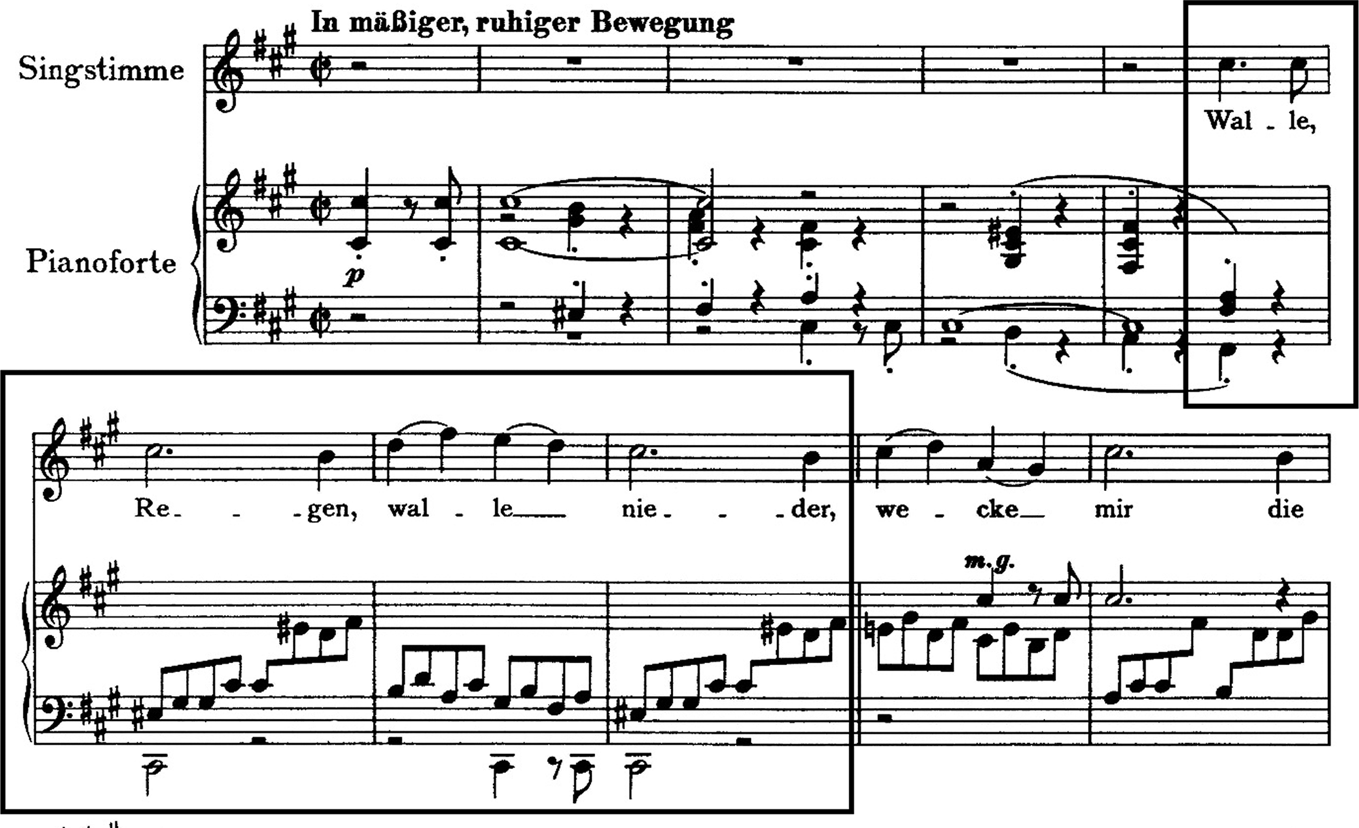
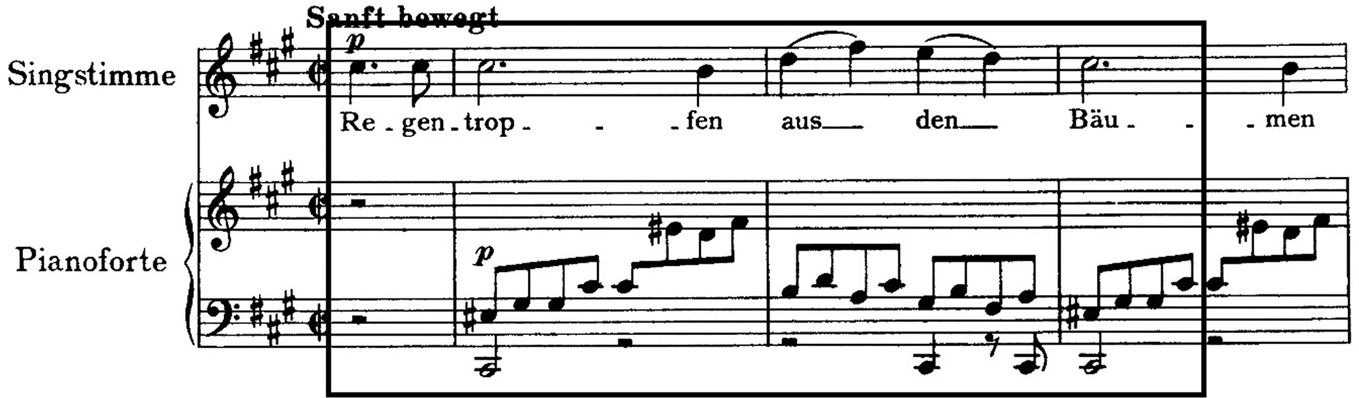
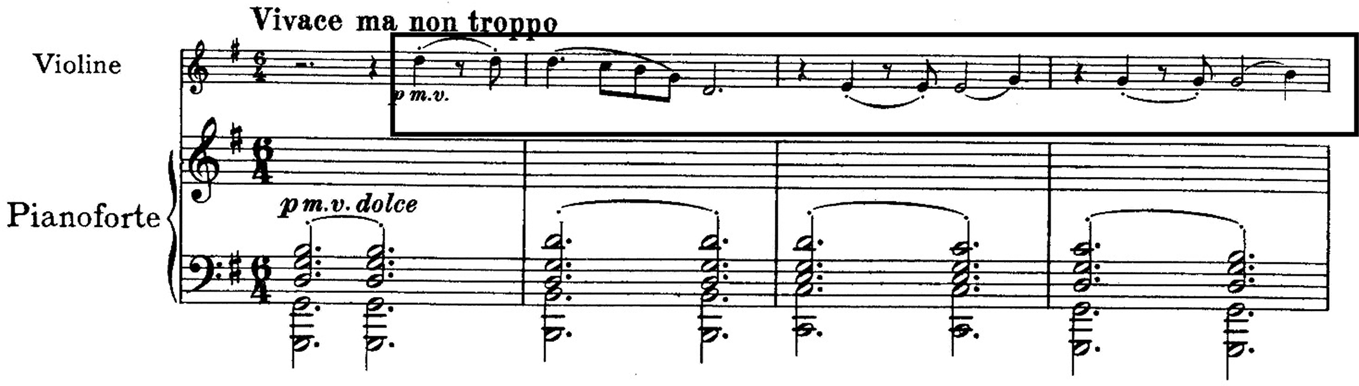
After this cluster of early piano works, Brahms would rarely make such overt literary allusions in his instrumental works, but a very private and hidden (albeit famous) one occurs in the G major Violin Sonata, Op. 78, which is among his best-known allusions and also a strong representative of the type of inter-movement thematic recall that he would employ after his ‘first maturity’. Connections between Brahms's G major Violin Sonata and the songs ‘Regenlied’ (No. 3) and ‘Nachklang’ (No. 4) from his Op. 59 Lieder und Gesänge are so well known that Op. 78 is often referred to as the ‘Regenliedsonate’ or ‘Regensonate’. As can be seen in Example 6, the third-movement finale of Op. 78 (Ex. 6c) grows directly out of music from the Op. 59 songs (Ex. 6a–b). The initial vocal phrases in each song (presaged by the octave piano C#s in Song Three, ‘Regenlied’) supply the rain motive that begins Movement Three of Op. 78. From that direct quotation, the quasi-dotted-rhythm motive that begins the first movement of the sonata (Ex. 6d) can be heard as a more distantly related harbinger of the third-movement rain motive. In this way, Op. 78 builds on the inter-movement thematic relationships of the Op. 5 Piano Sonata andantes and their poetic references: two separate poems by the same author engender shared motivic material between two movements.
Brahms, Lieder und Gesänge Op. 59, no. 3, bars 1–10

Brahms, Lieder und Gesänge Op. 59, no. 4, bars 1–3

Brahms, Op. 78, Violin Sonata in G major, mvt iii, bars 1–5

Brahms, Op. 78, Violin Sonata in G major, mvt i, bars 1–4

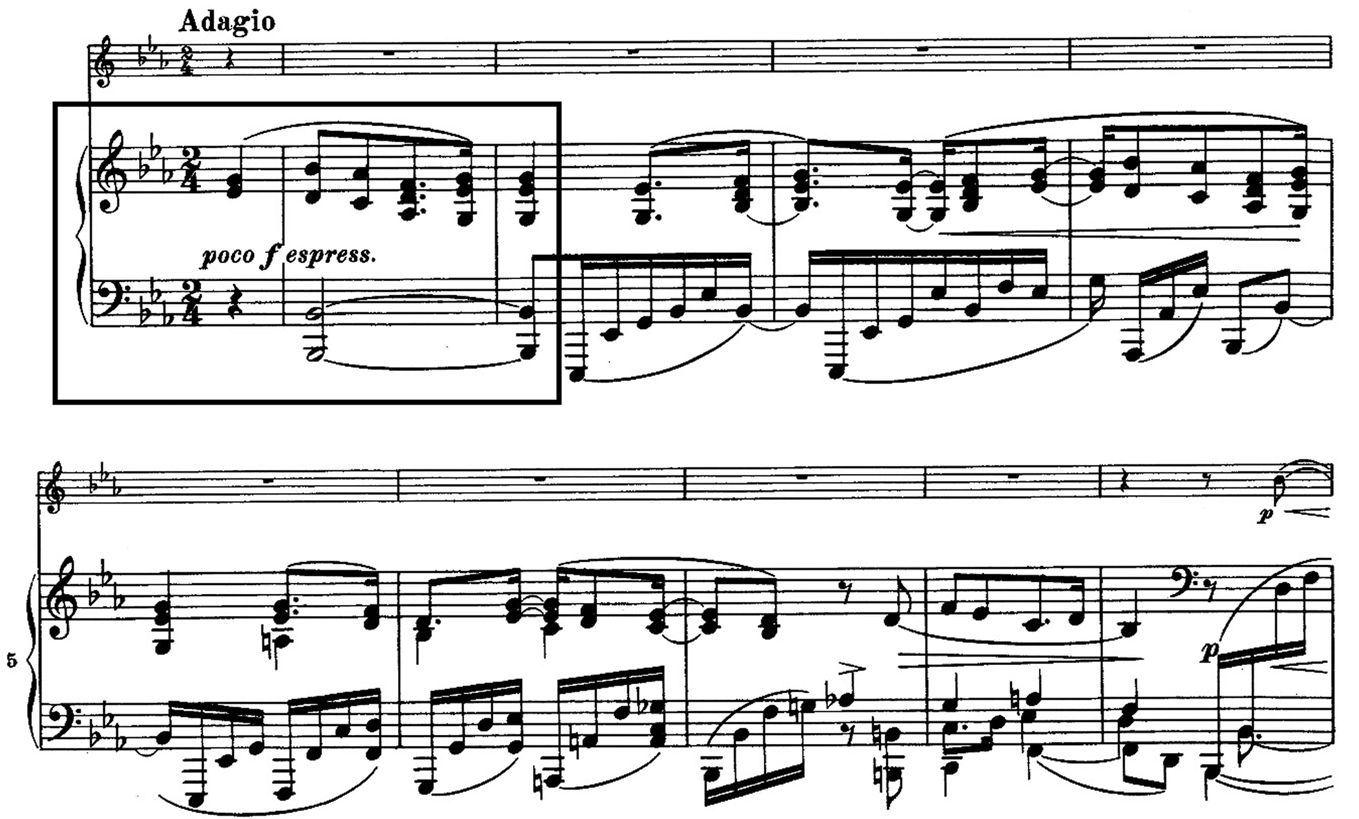
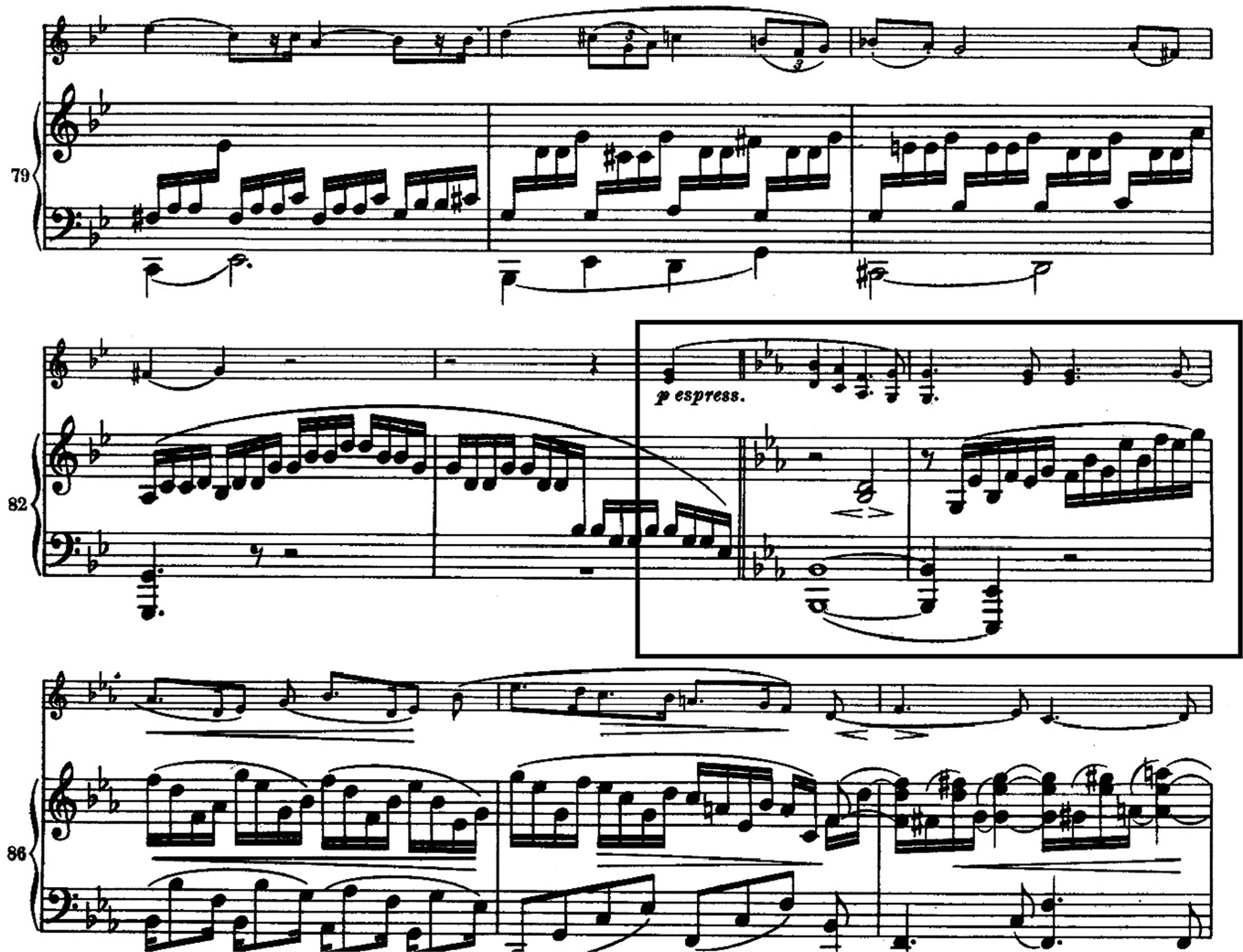
More importantly, however, Brahms's Violin Sonata contains a direct inter-movement thematic recall, one separate from the song allusions. In the middle of the G minor sonata-rondo finale, where a developmental and/or C section would be expected, Brahms returns to the opening theme of the adagio second movement (Ex. 7a) in its original key of E-flat major at bar 84 (despite the immediately preceding cadence to G minor in bars 81–83; Ex. 7b). Unlike the close motivic connections with the first movement through the rain motive, the finale up to this point bears no resemblance to the preceding, second movement, a dissimilarity that is accentuated by the stubbornness of the minor mode through the third movement up to the point at which the adagio theme from the second movement reappears. Because the interjection is so stark and surprising, it is nearly impossible to avoid a strongly interpretive, even programmatic reading (and there are many). There are at least two sources to supply the interpretive impulse with fixed (or nearly fixed) meaning. First are the two songs’ texts (presented below), lurking in the background of the sonata. Klaus Groth's ‘Regenlied’ offers a fairly typical romantic lament on lost youth, as symbolized in nature, while a second poem that he personally supplied to Brahms (and which Brahms labelled ‘Nachklang’ in its Op. 59 setting) expressed the breakdown in the metaphor, for as nature's autumn raindrops will lead eventually to renewal, the poet's corresponding tears will only grow hot upon his cheeks in the spring sun. Although the recalled adagio theme is not impacted by the musical allusion to those songs, it becomes integrated with the rain motives of the finale towards the end of the movement, inviting some consideration of the songs’ emotional content. The second interpretive impetus comes from Brahms's correspondence. In his lengthy consideration of Opp. 59 and 78, Paul Berry delves into the many letters between Clara Schumann and Brahms that connect the sonata to the slow death of her son Felix (1854–1879), who succumbed to tuberculosis around the time Brahms was composing the Violin Sonata. Berry focuses on a letter Brahms sent to Clara as Felix was dying in February of 1879, the back of which contained the opening bars of the adagio espressivo second movement.Footnote 31 He makes a convincing case that Brahms had not yet composed the third-movement finale when he sent this fragment to his grieving friend. If so, the way in which he made use of the adagio theme in the finale could have taken on a personal narrative, and Berry ventures a conjecture along those lines: ‘Correspondence shows that Brahms might well have considered the sonata's overarching trajectory a direct complement to his old friend's current mood.’Footnote 32
Brahms, Violin Sonata in G major, Op. 78, mvt ii, bars 1–9

Brahms, Violin Sonata in G major, Op. 78, mvt iii, bars 79–88

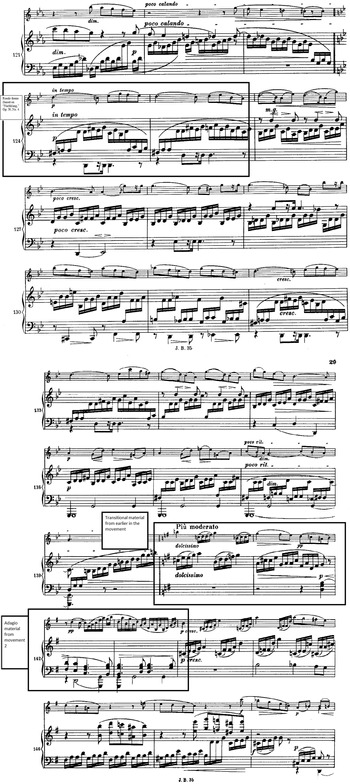
In her brief overview of Brahms's chamber music, Margaret Notley focuses on the effect of thematic recall here and generally in Brahms's music: ‘Referring to another movement in this way … does not just promote unity in a multi-movement composition. Quotation, like reworking an idea from a known source, as we know, reverberates: we hear the original and the new contexts – and the differences between them – almost all at once’.Footnote 33 Now, more than in the Op. 5 Piano Sonata, the returning material is part of an ongoing process in the piece. To paraphrase Dahlhaus again, it is part of a ‘complex of themes’ that ‘emerge from a formal process’, and, hence, it is ‘poetic’. In this instance, the recall is pushed even further towards the end of the work where it has a strong impact on the unfolding of the finale. With the Adagio theme's reintroduction, the rondo pattern is broken: a D minor variant of the rondo theme that comprises the B episode never reappears. And although the ‘Nachklang’ material proper does make a final rondo appearance in the tonic, G minor, at bar 124, it gives way to a Più moderato coda in G major at bar 140 that blends earlier transitional material with the recalled adagio theme, now in G major as well (Ex. 8).
Brahms, Violin Sonata in G major, Op. 78, mvt iii, bars 121–148

Berry concludes, ‘throughout the diachronic unfolding of the finale, expectations consistent with the closed forms of a standard sonata-rondo give way to an open-ended experience in which initially contradictory themes were gradually integrated’, calling the final use of the adagio theme in the coda ‘an emblem of quiet benediction’.Footnote 34 This works in purely musical terms (although Berry intends it to elucidate the biographical backstory), but the inter-movement thematic recall takes on a greater narrative function here than in the earlier Beethoven examples – or at least a quite different narrative quality. As in the Op. 5 Piano Sonata, Brahms's inter-movement thematic recall here is part of an ongoing, unfolding process. What is different in Op. 78 is that the process is entirely end-oriented.
The last group of works to be discussed are distinguished by the return of material from the very opening of the piece at its conclusion: the String Quartet No. 3 in B-flat major, Op. 67; the Third Symphony, in F major, Op. 90; and the Clarinet Quintet in B minor, Op. 115. The latter two works in this group mark Brahms's last use of inter-movement thematic recall. The other, the B-flat major Quartet, has engendered less scholarly or analytical attention than any of the others discussed here, perhaps because the return of earlier themes material – like the piece itself – feels relatively light-hearted and the return of initial material seems emotionally less provocative. Indeed, when the 6/8 ‘horn-call’ theme that began the quartet returns near the end of the variations that form the finale, it restores rhythmic, thematic and harmonic balance to the fourth movement after two disorienting variations. Walter Frisch, whose essay on Op. 67 is one of the few detailed analyses of the work, described the return of the Quartet's opening theme in Variation 7 of the finale as a ‘realignment’.Footnote 35 ‘Although the reappearance of the horn-call theme is surprising, it also feels appropriate. This is in part because Brahms has created the variations theme out of the basic skeleton of the horn-call theme.’ As we shall see momentarily, Brahms employs the same strategy in the theme and variation finale of Op. 115. A clear distinction needs to be drawn between the two examples, however. Here in the String Quartet, the material in question unfolds through a series of repeated two-bar passages over 20 measures (plus a one-bar cadence), dispersing tension in the theme. Whereas the opening of the Clarinet Quintet also parses into two-bar units, that material flows freely thereafter (so free that the tonic key remains in question through bar 18), projecting a more complex process and a degree of anxiety by comparison with the Op. 67 Quartet. And whereas, as Frisch elucidates, the theme for the variations finale of Op. 67 derives from the opening horn-call of the first movement, the variation theme of the finale in Op. 115 completes a process across all four movements of the Quintet.
As far as motivic cyclicity is concerned, the Third Symphony, Op. 90 forms something of a bridge between these two chamber works. In the F major Symphony, the opening theme's gradual emergence is part of a tightly woven web of allusions to the first and second movements of the piece near its end (including a finale which, like Op. 78, begins in the tonic minor and ends in the major). When the actual first theme of the Symphony finally appears in its last nine bars, it carries a strong sense of culmination, even an aura of inevitability.Footnote 36 Of all Brahms's inter-movement thematic recalls, this evokes the least sense of narrative or begs little extra-musical explanation.Footnote 37 And like the Op. 115 Clarinet Quintet (and third String Quartet, for that matter) there is no overt literary allusion here.Footnote 38
A similar claim to purely musical impulses (i.e., extra-musical factors) can be made for the end of the Clarinet Quintet. Yet this case has always evoked stronger emotional reactions. Here, perhaps we find the culmination of the poetic use of the device in its post-romantic form. While still part of a process that develops across several movements, that process lacks the ‘consciousness of creativity’ that Sisman ascribes to Beethoven's thematic recalls. Rather than evoking a memory to stimulate imagination, the return of the opening theme at the end of the Clarinet Quintet is a pure look backwards (see Exx. 9a and 9b). If this is the romantic consciousness that was emerging in Beethoven's poetic use of thematic recall, it is a consciousness that has become world-weary and retrospective. Historians tend to perceive this quality in Brahms's late instrumental works generally. Robert Morgan, for example, deems the six Klavierstücke of Op. 118 from 1893 an expression of reticence, regret, melancholy and longing and hears in them Brahms's reflection on the end of the tonal musical tradition to which he belonged, ‘that twilight moment in Western music's evolution where the traditional language of post-Renaissance composition is reaching the end of its long blossoming’.Footnote 39 Morgan concludes, ‘Brahms's message seems clear: music can continue to exist only by reflecting upon the very difficulty of its continued existence’.Footnote 40
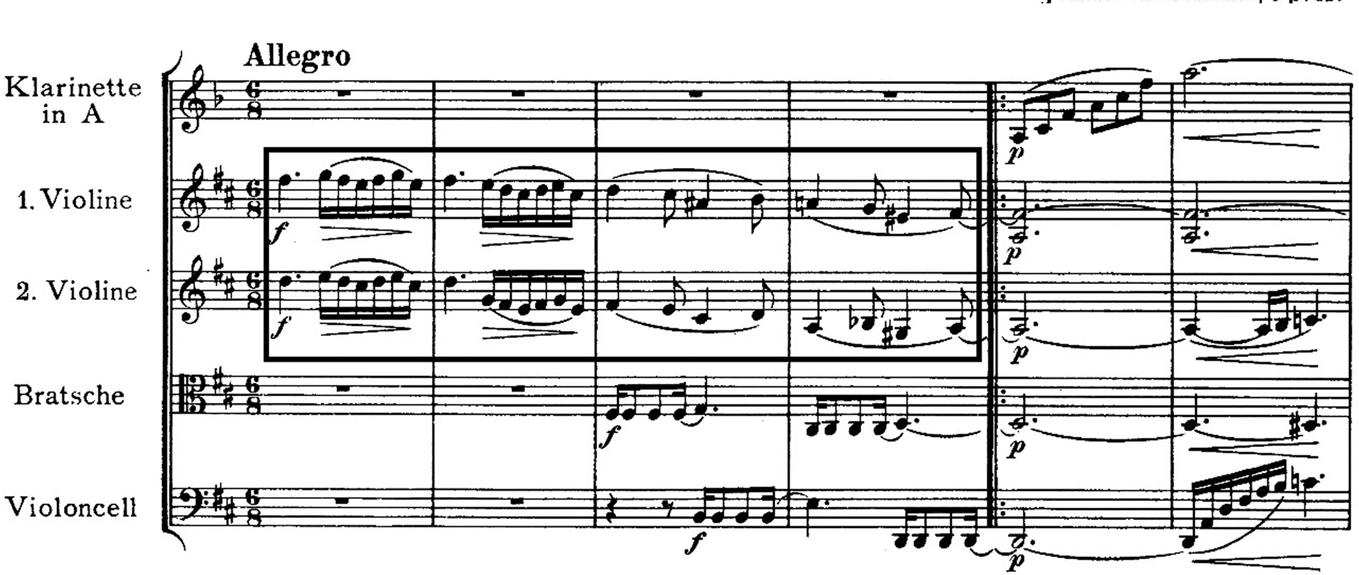
Brahms, Clarinet Quintet in B Minor, Op. 115, mvt i, bars 1–6

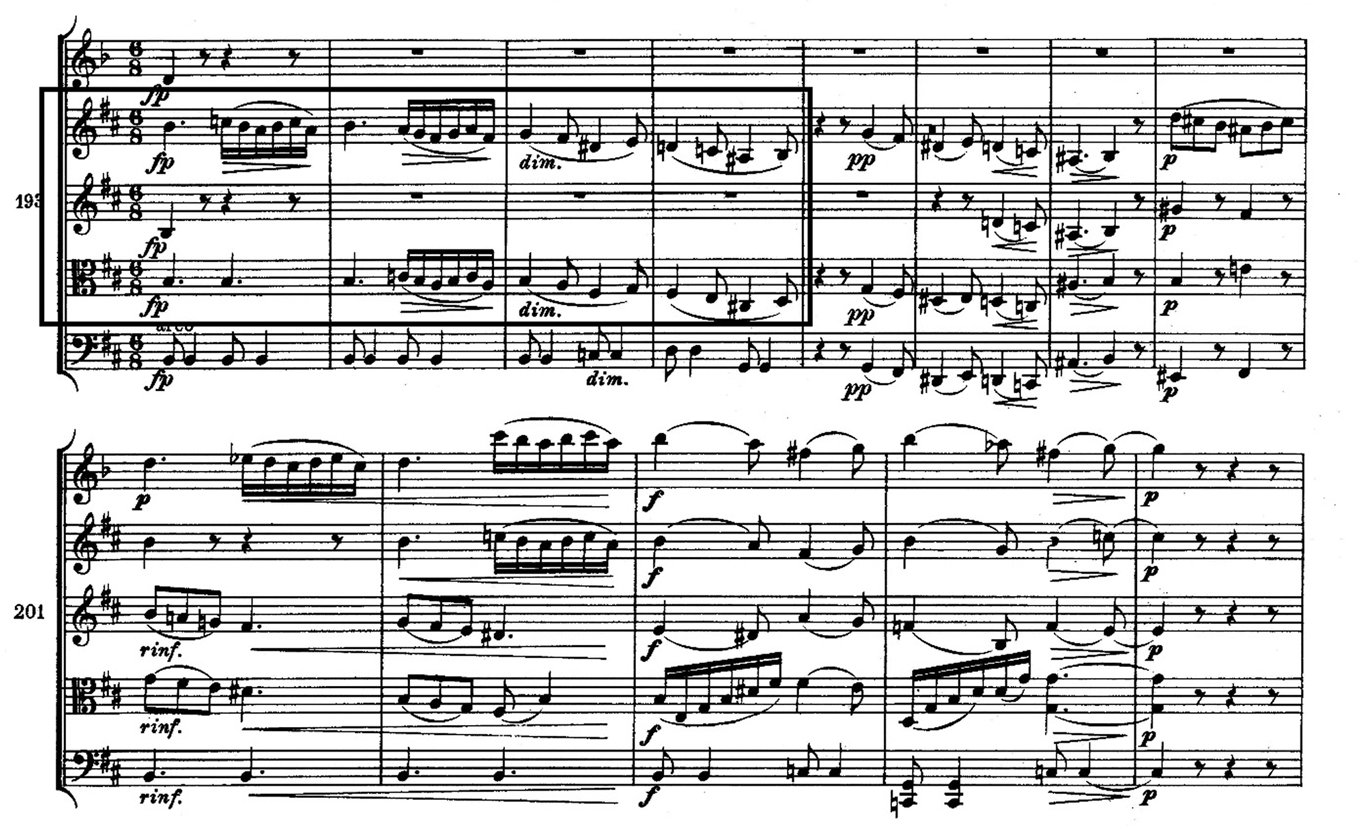
Brahms, Clarinet Quintet in B Minor, Op. 115, mvt iv, bars 193–205

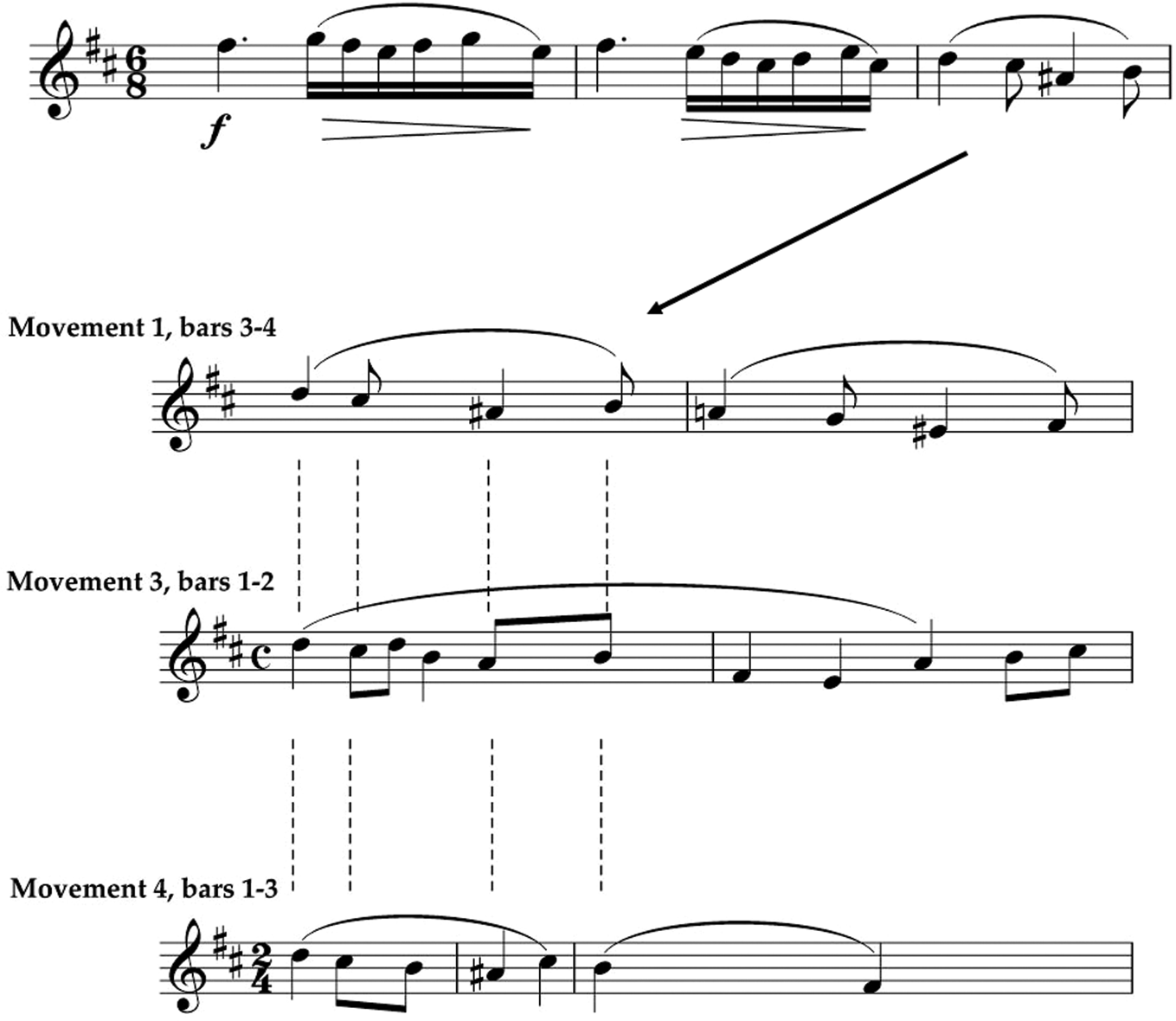
That is not a bad way to describe the effect of the thematic recall at the end of Op. 115. The fourth movement is a set of variations on a theme that, like the theme of the andantino third movement, is derived from the ‘off-phrase’ of the opening movement's main theme (as illustrated in Ex. 10), so the presence of the Quintet's opening theme is felt throughout the fourth movement. After the fifth and final variation (which reintroduces the semiquaver roulades of the first movement theme without completely bringing that theme to the surface), Brahms lays bare in bar 193 the genesis of the finale's theme with a full return to the opening bars of the piece (as shown above in Ex. 7). The last 30 bars of the Quintet peter out into wisps of the two themes (that of the first movement and its derivation in the fourth), briefly tonicizing a number of keys (G major in bars 195–197 and 214–215; C major in bars 203–205); on their way to a final unison B, a vanishing point of sorts – or Morgan's ‘twilight moment in Western music's evolution’ (Ex. 11).
Brahms, Clarinet Quintet Op. 115, mvts i, iii and iv

Brahms, Clarinet Quintet in B Minor, Op. 115, mvt iv, bars 193–222

Perhaps it is the lack of a consistent rhythmic drive to the end that separates this inter-movement recall from the one that ends the Third Symphony. (And the sense of closure that this recall ushers in is utterly unlike the final push provided by the recall in the finale of Op. 67.) Lawrence Kramer hears this as part of a different sort of ongoing process in Op. 115, one that seems to speak directly to Sisman's portrayal of Beethoven's recalls, but, as I have asserted, a recall that signals loss and a backward glance. Kramer argues that at the outset of the work, in ‘the first moment or two the mood is perfectly blissful’, but that ‘the opening moment of fulfillment is never heard again’, adding, ‘the passage recedes into the distance while still seeming close by’.Footnote 41 To Kramer, Brahms's Quintet is a reflection of its time and place. Amidst a rapidly modernizing world that ‘eroded the sense of true community’, Kramer writes, ‘the elder Brahms slipped easily into the role of an “autumnal” figure, and Brahms in general came to embody the prevailing nostalgia, the “transcendental homelessness” that would consolidate the experience of modernity as one of essential alienation’.Footnote 42
In a frequently cited passage from an 1894 letter to Clara Schumann, the 61-year-old Brahms invoked the image of circularity to describe his own career. Speaking of the 49 folksong settings WoO 33 he had just sent her, Brahms asks Schumann,
Has it occurred to you that the last of the songs is in my opus 1? Has something else occurred to you as well? It really should say something, it should represent the snake that bites its own tail; thus saying symbolically: the story is now over, the circle closed’. Footnote 43
The song in question is ‘Verstohlen geht der Mond auf’, whose melody Brahms used as the theme of the second movement of his Piano Sonata in C Major, Op. 1 of 1853: yet another textual allusion of sorts among the early piano works. That sonata is widely understood to stand on the shoulders of Beethoven, with its opening gesture reminiscent of the first theme in Beethoven's ‘Hammerklavier’ Sonata, Op. 106, and Brahms's repetition of his opening eight-bar phrase a step lower echoing the initial gambit of the Beethoven's ‘Waldstein’ Sonata, Op. 54. Brahms likely was not referencing Beethoven here, but it is noteworthy that his sense of ending by returning is tied up with the very composer who served as a predecessor for his own use of inter-movement thematic recall. By 1894, Brahms was a composer aware that his career was coming to a close (despite gaining a second wind after an aborted retirement a few years earlier). The thematic return at the end of the Clarinet Quintet feels very much like a musical reflection of the attitude he expresses in this letter: the story is now over, the circle closed.