Introduction
Although their primary food source is krill, Lobodon carcinophagus (Hombron & Jacquinot 1842) are commonly known as crabeater seals. These seals are the most abundant ‘pinnipeds’ in the world's oceans. Their distribution in the Antarctic is restricted to the shifting pack ice of the circumpolar latitudinal zones, where krill are most abundant. Crabeaters breed in the spring on the pack ice south of the Antarctic Convergence (Laws Reference Laws and Laws1984).
James Ross Island is situated on the eastern flank of the Antarctic Peninsula, where it has a drier, colder environment more similar to a polar continental climate than the polar maritime climate of the Peninsula at the same latitude (Martin & Peel Reference Martin and Peel1978, Reynolds Reference Reynolds1981). The island is situated in the precipitation shadow of the Antarctic Peninsula, with mean annual net precipitation estimated at < 1 m w.e. (water equivalent) over most of James Ross Island. However, it may be much less (< 0.5 m w.e.) in the Brandy Bay area (van Lipzig et al. Reference van Lipzig, King and Lachlan-Cope2004) and this may be a reason for the unusually large area of snow-free ground there, the largest on James Ross Island and exceeded only by that on Seymour Island nearby to the east. The mean annual humidity in this area in 2006 was 76%, and mean temperature for 2000–06 was -8.4°C (data from Marambio Station, Seymour Island).
The occurrence of mummified and desiccated seals observed far inland in Antarctica has mostly been documented in the McMurdo Dry Valleys region of eastern Antarctica. The first discovery of a few mummified crabeaters was during an early British expedition (1901–07; Wilson Reference Wilson1907, Taylor Reference Taylor1916). Ninety crabeater seals and one leopard seal (Hydruga leptonyx) were found almost 60 years later 48 km inland and up to 1000 m above sea level (a.s.l.) in the same region (Pewe et al. Reference Pewe, Rivard and Llano1959). One was radiocarbon dated to between 1600–2600 years (Pewe et al. Reference Pewe, Rivard and Llano1959). Since that time, mummified seals have been studied in many Antarctic and sub-Antarctic regions, including the Antarctic Peninsula, South Shetland Islands, South Georgia, and a few additional localities in East and West Antarctica (e.g. Marini et al. Reference Marini, Orr and Coe1967, Harkness Reference Harkness1979, Mabin Reference Mabin1985, Reference Mabin1986, Clapperton & Sugden Reference Clapperton and Sugden1988, Gordon & Harkness Reference Gordon and Harkness1992).
This short paper is a reconnaissance study. It reports the unusual occurrence of numerous (c. 154) dead, mummified crabeater seals found between January 2002 and February 2007 inland on James Ross Island, and discusses the spatial distribution and taphonomy of the seals and possible explanations for the occurrence.
Distribution
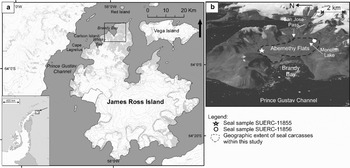
Some 154 deceased crabeater seals were observed during reconnaissance of the Abernethy Flats area in the hinterland backing Brandy Bay, northern James Ross Island (Fig. 1). They were first observed by one of us (JS) in January 2002 and flesh, bone, collagen, and teeth samples were subsequently collected by Anna Nelson and Mark Williams during the 2005–07 field seasons (austral summers). During the final field season, seals were located using low-level helicopter searches and their geographical positions and elevations were fixed using hand-held GPS (Garmin Etrex, “summit” model, pressure-calibrated daily; vertical accuracy c. ± 5–10 m).
Map of a. James Ross Island and its location in the northern Antarctic Peninsula (inset), and b. Digital elevation model (DEM) image looking south-east into Brandy Bay. The numerous dead seals described in this paper were discovered scattered in the low-lying hinterland of Brandy Bay, an area known as Abernethy Flats.

The seals are mostly randomly distributed over a 10 km2 area extending from the north-west facing beach at Brandy Bay, across Abernathy Flats and up to San Jose Pass, up to 6.5 km inland and up to 130 m a.s.l. Seal carcasses were observed along present-day meltwater stream beds and lake shorelines, but they also frequently occur hundreds of metres from any present-day water source. The seal carcasses rest on top of the present-day ground surface and are not partially buried except for minor loess-like wind-blown material adhering to carcass flanks. No carcasses were observed in local moraines or raised beaches. Animal long-axis orientation (i.e. direction seals were heading when they perished) is predominantly south-west, west and north-west directions (> 50% of animals measured), although there were animals orientated in all directions.
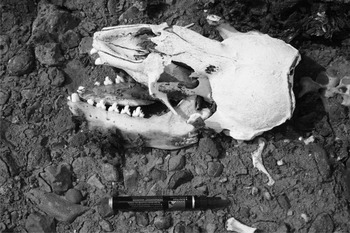
The mummified animals, all crabeater seals, are easily identifiable by their characteristic jagged teeth (Fig. 2). According to censuses conducted between 1968 and 1973, the largest Antarctic population of crabeater seals is in the Weddell Sea (8.2 million), which is also the area of most extensive pack ice, follow0ed by the Amundsen–Bellinghausen Sea (1.2 million crabeater seals; Laws Reference Laws and Laws1984). From our observations, compared to western coastal areas of the Antarctic Peninsula region, James Ross Island is unusually depauperate in animal life apart from small numbers of transient flying birds (mainly Dominican gulls (Larus dominicanus), skuas (Catharacta sp.) and Antarctic terns (Sterna vittata), in decreasing order). Seals of any kind were rarely observed during five summers spent by the authors on the island between 2001 and 2007. A few live Weddell seals (Leptonychotes weddellii) and, on one occasion, a single elephant seal (Mirounga leonina), however, were observed on icebergs and broken pack ice in Brandy Bay, Prince Gustav Channel, Rum Cove, Fjordo Belen, and off Ekelöf Point. Even whales are uncommon, although killer whales (Orcinus orca) were seen spyhopping in leads in fast ice in southern Prince Gustav Channel in January 2004.
Skull of crabeater seal, displaying characteristic jagged teeth.

Taphonomy
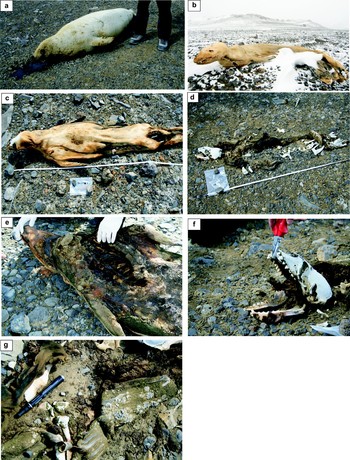
The seal carcasses are in varied states of decay and range from desiccated mummies with skin, muscle and connecting tissue intact (Fig. 3), to collections of bones that have been dispersed mainly by wind and possibly scavengers (Fig. 4). Of the c. 154 seals documented in the study, 34 are largely intact, with the upper surface of the skin not punctured or damaged and the animals completely articulated. One of these intact animals is clearly recently-deceased, shown by its bloated shape (Fig. 3a). The mummified seals (i.e. those that are intact with some degree of soft tissue preservation) are preserved with the lower (ventral) surface of the animal in contact with the ground and show no evidence of post mortem movement by wind or predators. The most labile tissues, such as the eyes and internal organs have clearly decayed, or partly decayed, and some specimens smell of rotting soft tissues. Whilst the upper (dorsal) exposed surface of the carcasses is desiccated and well preserved, the ventral surface is in an advanced state of decay, observationally wet and “leaking” presumptively decayed soft tissues to the ground (Fig. 3e). Nevertheless, some areas of the carcass, such as collagen, muscle and skin, appear largely intact, possibly preserved via wind desiccation. The remaining c. 120 seals are in varying stages of decay, ranging from those with some preserved soft tissues, to those that are fully disarticulated. Soft tissues which are preferentially preserved include large muscles such as the tongue (Fig. 3f). Again, we speculate that this is a product of rapid wind-induced desiccation of exposed soft tissues as the jaws of many specimens are preserved agape.
Mummified crabeater seals in varying stages of decay, including dorsal views of a. recently-deceased specimen, b. sample SUERC-11856, with 80% (estimated) soft tissue preservation, c. a specimen with 70% soft tissue preservation, and d. a specimen with only minor soft tissue preservation, but all skeletal remains are in life position. e. Ventral view of mostly intact crabeater. f. Skeleton with preserved tongue. g. Evidence of microbial decay on the dorsal areas of the seals.

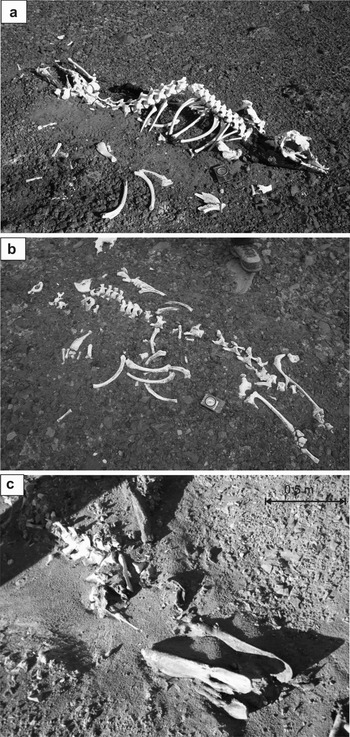
Skeletal remains of crabeater seals, identified by remnant teeth. a. Nearly fully articulated skeleton and b. partially disarticulated skeleton, after wind and scavenger dispersal. c. Sample SUERC-11855, seal showing minimal soft tissue preservation, but skeletal remains largely articulated (14C sample SUERC-11855).

Of those specimens for which only skeletal remains are preserved, some remain largely articulated, whilst others are largely disassociated (Fig. 4). In many instances the process of dissociation appears to be in the direction of the prevailing north-easterly wind (the bodies are orientated at 028°, 038°, 058°). The only scavengers observed in the area were skuas, which were seen picking at the soft tissue remains of intact mummies and which may also have contributed to short distance dispersal of the bones. However, the bones themselves did not show any evidence of breakage by scavengers attempting to extract soft tissues from within them (cf. Asefa Reference Asefa2006).
The geographical distribution of the mummies and skeletal specimens is random, i.e. there are no clear concentrations of intact bodies in any part of the area examined, compared with animals reduced to bones elsewhere.
Although average mean temperatures are ~-8°C for this area, the seal carcasses were exposed to even higher air temperatures (and subsequently much higher ground temperatures) in direct sunlight through the summer months. These increased temperatures, combined with the wind shield provided by the carcass, allowed micro-environments to develop within the carcass and microbial decay to proceed (Fig. 3g).
Radiocarbon dating
As many of the seals described here were in a similar desiccated state to the spectacularly-preserved, very old McMurdo Dry Valley mummified seals, we decided radiocarbon dating would be a useful undertaking. Two mummified seals in different areas of Brandy Bay and exhibiting different stages of decay were sampled for 14C isotopic dating. The animals were selected because they appeared to be among the more decayed and presumably older animals present. Sample SUERC-11855, consisting of skin, bone, teeth, and whiskers, taken from an individual comprised mainly of bones but also with some minimal soft tissue preservation, was located on the northern expanse of Abernethy Flats (Fig. 4c). Sample SUERC-11856, consisting of skin, bone, and teeth, taken from an intact mummy with 80% soft tissue preservation, was located 0.25 km south of Monolith Lake (Fig. 3b). The sample material was collected using penknives and sealed in polythene bags. The samples were stored at ambient temperatures during ship transport and relocated to cold stores (+4°C) upon arrival in the United Kingdom.
Skin samples chosen for radiocarbon dating were prepared to graphite at the National Environmental Research Centre (NERC) radiocarbon laboratory and sent to the Scottish Universities Environmental Research Centre (SUERC) Accelerator Mass Spectrometry (AMS) facility for radiocarbon analysis.
A small sub-sample of the flesh and/or blubber taken from each skin specimen was removed with a clean scalpel and pre-treated by acid-alkali-acid digestion. Subsequently, the samples were homogenized and the total carbon in a known weight of each sample was recovered as CO2 by a single temperature (900°C) combustion in an evacuated sealed quartz tube, with cleaned CuO providing the source of oxygen. A small aliquot of CO2 was analysed on a VG Optima dual inlet mass spectrometer, calibrated to international standard reference materials, and used to normalize 14C results to δ13CPDB‰ -25.
The remaining sample CO2 was converted to graphite by Fe/Zn reduction (Slota et al. Reference Slota, Jull, Linick and Toolin1987). The resulting graphite-Fe powder was pressed into an aluminium target before being sent to the SUERC AMS facility (National Electrostatic Corporation (NEC) 5MV accelerator mass spectrometer) for 14C analysis (Xu et al. Reference Xu, Anderson, Bryant, Cook, Dougans, Freeman, Naysmith, Schnabel and Scott2004).
The uncorrected ages for the two seals are 1197 ± 35 years bp and 872 ± 35 years bp, respectively (Table I). Marine-derived animal material, however, is difficult to date accurately using radiocarbon techniques. In order to arrive at an accurate date, the water must have high 14C/12C ratios, which requires significant CO2 exchange between the atmosphere and ocean carbon reservoirs. Moreover, because the ocean carbon reservoir is much larger than the atmospheric reservoir, significant amounts of 14C decay occur in the oceans, resulting in depleted CO2 exchange and a lack of 14C in marine animals compared to terrestrial ones. The depleted levels of 14C in the world's oceans are accentuated by the fact that there is non-uniform mixing in the marine environment. Therefore, a different reservoir correction factor is applied to different oceanic regions (Gordon & Harkness Reference Gordon and Harkness1992).
Uncalibrated radiocarbon ages for the two seal specimens.

In addition to the limits of radiocarbon dating in the world's oceans, the Southern Ocean radiocarbon reservoir is also affected by both upwelling at the Antarctic Divergence and glacier meltwater input (Gordon & Harkness Reference Gordon and Harkness1992, Berkman et al. Reference Berkman, Andrews, Bjork, Colhoun, Emslie, Goodwin, Hall, Hart, Hirakawa, Igarashi, Ingolfsson, Lopez-Martinez, Lyons, Mabin, Quilty, Taviani and Yoshida1998). There are also natural variations in atmospheric radiocarbon in the Antarctic (Stuiver & Braziunas Reference Stuiver and Braziunas1993).
Another factor to consider is the anthropogenic influence on the radiocarbon reservoir. The surface seawater age of the Antarctic marine radiocarbon reservoir has been altered by the equivalent of more than 500 years during the 20th century due to nuclear explosions (mainly between 1957 and 1962) and fossil fuel consumption (Mabin Reference Mabin1985, Gordon & Harkness Reference Gordon and Harkness1992).
In order to correlate the marine radiocarbon age estimates to the terrestrial chronology, a reservoir correction value is calculated. Modern marine species have been radiocarbon-dated from the Antarctic and sub-Antarctic in order to determine the correction value for different marine materials (Gordon & Harkness Reference Gordon and Harkness1992). The correction values vary depending on the geographical region of Antarctica and the type of sample material. For marine life derived from the coastal regions of East Antarctica and the Ross Sea, Hall et al. (Reference Hall, Hoelzel, Baroni, Denton, Le Boeuf, Overturf and Topf2006) used a 1300-year correction, whereas Emslie et al. (Reference Emslie, Coats and Licht2007) applied a 750–1000 year correction. Shells, seals and seaweed derived from South Georgia, need a 750 year correction, whereas whales from the same region require a correction of more than 1000 years (Gordon & Harkness Reference Gordon and Harkness1992). For marine specimens derived from the South Shetland Islands and the Antarctic Peninsula, a range of 700–1100 years is subtracted from the apparent radiocarbon age (Emslie et al. Reference Emslie, Fraser, Smith and Walker1998, Emslie Reference Emslie2001).
In summary, interpreting 14C ages is neither simple nor straightforward and there are over 25 reservoir corrections that have been proposed for marine material derived from the Southern Ocean, with values ranging from 750 to 5500 years (Berkman et al. Reference Berkman, Andrews, Bjork, Colhoun, Emslie, Goodwin, Hall, Hart, Hirakawa, Igarashi, Ingolfsson, Lopez-Martinez, Lyons, Mabin, Quilty, Taviani and Yoshida1998). However, if we apply any correction values within that range to our conventional radiocarbon ages, the resulting ages suggest the seals are of modern origin, i.e. they probably died within the last 100 years and are essentially undateable.
Discussion
The phenomenon of inland mummified seals in Antarctica has been discussed by many workers in both mid and high-latitude regions, including those from the McMurdo Dry Valleys of eastern Antarctica (cf. Wilson Reference Wilson1907, Pewe et al. Reference Pewe, Rivard and Llano1959) and the more recent occurrences of thousands of seal deaths in the North Sea (cf. Kennedy et al. Reference Kennedy, Smyth, McCullough, Allan, McNeilly and McQuaid1988) and Caspian Sea regions (cf. Stone Reference Stone2000).
Pewe et al. (Reference Pewe, Rivard and Llano1959) suggested that seals occasionally wander inland to freshwater, are unable to find food in lakes they encounter, and do not survive the journey back to sea. It has also been suggested that the mummified seals in the McMurdo Dry Valleys simply did not join the autumnal migration northward (Barwick & Balham Reference Barwick and Balham1967). Conversely, some workers have speculated that dead seals found inland are a result of sea level changes (i.e. references in Stirling & Rudolph Reference Stirling and Rudolph1968), or that the seals travelled inland via glaciers on which they died, and from which they eventually melted out, leaving the bodies exposed far inland. It has also been suggested that seals seek protection inland as old age approaches or parasite infection occurs (Schäfer Reference Schäfer1972). None of these explanations adequately accounts for the Brandy Bay occurrence of seals.
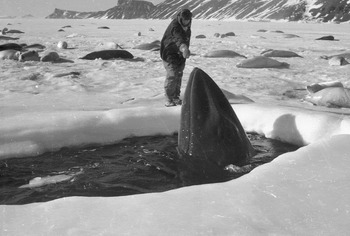
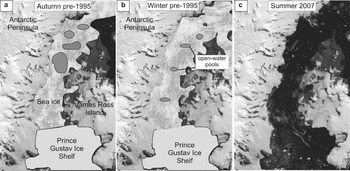
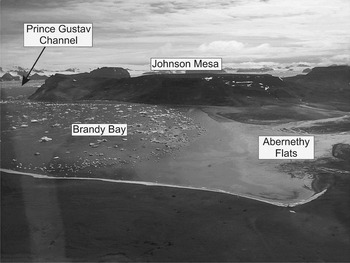
We favour two explanations to account for the Brandy Bay occurrence, and indeed, a combination of these two factors may be responsible. Firstly, there was and still is an annual stranding of seals that become isolated from open water by freezing sea ice. Until 1995, southern Prince Gustav Channel was occupied by its eponymous Ice Shelf. Based on archival records (mainly 1950s), the northern end of Prince Gustav Channel usually freezes first during autumn (April–May), leaving a large expanse of open seawater trapped between the newly formed sea ice to the north and shelf ice to the south (cf. Laws & Taylor Reference Laws and Taylor1957). In June and July, when the sea ice reaches its northernmost extent and greatest thickness, seals are still able to haul out on the ice surface through open-water pools and cracks, some of which may remain open all winter (Figs 5 & 6; Taylor Reference Taylor1955). During that time, it is inferred that many of the seals become stranded and are unable to re-locate to available open water. Adolescent seals, in particular, are liable to become disoriented. If some of those animals wander eastward, i.e. toward James Ross Island via Brandy Bay, they would easily mistake the broad, low-lying, snow-covered hinterland of Abernethy Flats for sea ice (Figs 1b & 7). The seals would then perish inland from starvation and exhaustion. This process could have occurred repeatedly over a number of years, explaining the range of preservation states from intact mummies to disarticulated skeletons.
Photograph (1955, taken by A.F. Lewis) of whale spy-hopping in open water pool in Prince Gustav Channel. Numerous crabeater (pale) and Weddell (dark) seals are seen on the fast ice in the background. Photo source: British Antarctic Survey Archives, AD6/19/2/D381/16.

Conceptual views of palaeogeographical circumstances leading to the stranding of crabeater seals at Abernethy Flats. Views show a. autumn prior to the 1995 breakup of the Prince Gustav Ice Shelf, b. winter also pre-1995, and c. 2007 spring. See text for explanation.

Aerial view of Brandy Bay and Abernethy Flats. Brandy Bay is often dammed by fast- and pack-ice in Prince Gustav Channel during the summer. Note the flat, low-lying Abernethy Flats, which are easily accessed by crabeater seals from Brandy Bay.

There are several supporting lines of evidence for this theory. Firstly, the mummified seals observed on Abernethy Flats are mainly immature individuals (about 90% of our dataset), as determined from their dorsal length measurements (cf. Laws et al. Reference Laws, Baird and Bryden2003). It is known that immature seals are often found outside their normal range, more so than mature individuals (Stirling & Rudolph Reference Stirling and Rudolph1968). As animals have a tendency to migrate away from their birthplace when they become independent, young seals may wander away from the sea if they “were unfortunate enough to have their noses pointed in the wrong direction at the beginning of their journey” (Caughley Reference Caughley1960). Secondly, crabeaters are more agile on ice or land than any other seal species and are known to wander substantial distances (O'Gorman Reference O'Gorman1963). In an extreme case, a live crabeater seal pup was found 113 km inland and at 920 m elevation on a glacier surface near Mount Saunders (Transantarctic Mountains; Stirling & Rudolph Reference Stirling and Rudolph1968). Thirdly, the bodies on James Ross Island show variable states of decay. This suggests that it was not a single event that killed all c. 154 of these seals, but rather the deaths occurred over a period of time, perhaps a few to tens of years, given the radioactive carbon dating results. If all the bodies were in the same state of decay, a single mass dying event could be inferred. The occurrence of one recently-deceased crabeater seal (Fig. 3a) also suggests that the stranding is still happening today. Finally, Abernethy Flats is flat and low-lying, the only such bay on the entire west coast of James Ross Island and would have been easily accessed from the sea ice surface by any seals trapped in Brandy Bay (Fig. 7). All the other bays are either occupied by steep-fronted marine-terminating glaciers or cliff faces. Nevertheless, occasional small groups of dead crabeater seals in various states of decay are found along the coast of James Ross Island elsewhere, for example in valleys to the south and south-west of Terrapin Hill (authors' observations) and on the coast of Seymour Island (Jane Francis, Alistair Crame, personal communication 2007).
We suggest that the second contribution to the large numbers of dead animals present in Brandy Bay involves a recorded mass dying event of 1955 in Prince Gustav Channel. The mass mortality was recorded by members of the British Antarctic Survey base at Hope Bay during multiple expeditions along the frozen Prince Gustav Channel between June and October 1955 (Taylor Reference Taylor1955, Massey Reference Massey1955, Anderson Reference Anderson1957, Laws & Taylor Reference Laws and Taylor1957). In 1954, 200 live crabeater seals and 100 Weddell seals were observed on the sea ice of Prince Gustav Channel. By contrast, 3000 live crabeater seals, 300 Weddell seals, and 10 leopard seals were observed in the same area in early winter (May/June) 1955. The number of whales and seabirds was also significantly increased. Hundreds of dead or dying seals were subsequently observed between September and November 1955 (spring, during sea ice break-up) throughout the length of the channel, but concentrated near Cape Lagrelius, Carlson Island and Red Island. About 90% of the 2500 seals in this region died (Laws & Taylor Reference Laws and Taylor1957).
The base doctor at Hope Bay, P.M.O. Massey, produced an expedition report and a pathological report on the seals (Massey Reference Massey1955). Living seals were lethargic in their activity, contrary to normal expectations for breeding seals during rutting season. The majority of the dead seals, including foetuses, had swollen necks and were bleeding from the corners of the mouth. There were no external injuries to the corpses. Upon dissection, the cervical glands in the neck were severely swollen with pus, nothing obvious was notably peculiar in the lungs, the guts were mainly empty, and the liver was fibrotic. Some of these dead seals were fed to the dogs and even to humans, without negative effect.
Starvation was proposed as an explanation for the mass mortality, as there was a marked increase of seals in the area that year, and therefore potentially less available food through competition. Most of the seals, however, had a thick coat of blubber (~4 cm) and open water was readily available in the spring months, so starvation appears unlikely. Massey also suggested Orca molestation, but there were no external injuries to the animals. The final and probable explanation was disease, most likely a virus, which may have been aggravated due to crowding (Laws & Taylor Reference Laws and Taylor1957). We speculate that an outbreak of phocine distemper virus (PDV) was the probable cause for this particular mass dying event (cf. Bengtson et al. Reference Bengtson, Boveng, Franzén, Have, Heide-Jørgensen and Härkönen1991). Whether it was passed on as canine distemper disease (CDV) from the huskies during the previous season is not known. Huskies can apparently carry CDV and not be visibly affected (Jaume Forcada, personal communication 2007). More recently, PDV was blamed for the deaths of thousands of harbour seals in the North Sea in 1988 and 2002 (Jensen et al. Reference Jensen, van de Bildt, Dietz, Andersen, Hammer, Kuiken and Osterhaus2002, Hall et al. Reference Hall, Jepson, Goodman and Harkonen2006), and CDV was the cause of death for thousands of grey seals in the Caspian Sea in 2000 (Stone Reference Stone2000).
We suggest that some of the seals found in our study, on land in the Brandy Bay area, were victims of the 1955 epidemic. Most of the diseased animals would have perished on the ice, but some may have wandered inland and been stranded on the low-lying Abernethy Flats. A few explanations for the massed dead seals can be eliminated, including an abrupt change in sea level or tsunami-like wave that stranded the seals, and glacier melt-out. Although effects of a tsunami cannot wholly be discounted, Brandy Bay is in a relatively protected position facing the Antarctic Peninsula across Prince Gustav Channel. The channel is just 15 km wide at that point, so the fetch created by an ice collapse or earthquake-generated event(s) would have been small. There is also simply insufficient time (decades at most) for changing sea level or glacier melt-back to have been important influences. Moreover, no animals are buried by moraines or raised beaches.
Although there are currently no experimental or observational data to calibrate the rates of decay of Antarctic seals, it appears that the material in Brandy Bay has been rotting for many years, with seal carcasses accumulating for decades. The Intergovernmental Panel on Climate Change has predicted global average surface temperatures to rise by 1.8 to 4°C by the end of the century (Meehl et al. Reference Meehl, Stocker, Collins, Friedlingstein, Gaye, Gregory, Kitoh, Knutti, Murphy, Noda, Raper, Watterson, Weaver, Zhao, Solomon, Qin, Manning, Chen, Marquis, Averyt, Tignor and Miller2007). If, as expected, temperatures in the Brandy Bay area also show a concomitant increase, carcass decay rates are also likely to increase. Thus, we should expect the evidence for multiple seal deaths that we have observed around Brandy Bay will be removed at a greater rate than previously.
Conclusions
We report the presence of a large number of dead crabeater seals on Abernethy Flats, north-western James Ross Island, in a region that is today depauperate in animal life. A combination of disease and disorientation may have caused these seals to perish. It is clear that there were open pools of water in the northern and central areas of Prince Gustav Channel for whales and seals to access throughout the winter months. These pools will probably develop into much larger areas of open water in the future, however, due to predicted temperature increases. The diminished sea ice concentration will likely result in fewer seal strandings in the region.
There remain several unanswered questions, however: why was there such an increase in crabeater seal numbers in 1955 (200 in 1954; 3000 in 1955); why are crabeater seals so rare in the area today; and why did only crabeaters die ashore, when there were also Weddell and leopard seals observed here in the past? Genetic questions about the disease that affected the crabeaters in 1955 will be addressed in a future paper.
Acknowledgements
This work is a spin-off from the British Antarctic Survey core project GEACEP-ISODYN. The authors thank the captains, officers and crews of HMS Endurance for their essential and unstinting logistical support between 2002 and 2007. We are also grateful to C. Day, M. Laidlaw, T. O'Donovan, R. Smith, T. Spreyer and A. Taylor for their field assistance. We are grateful to J. Rae for the BAS Archive assistance, Steve Colwell (BAS) for providing us with local meteorological data, and J. Forcada for sampling strategy recommendations. Helpful comments and reviews by Joanne Johnson, Roberta Farrell, Phil Wilby, Sarah Gabbott, and an anonymous reviewer are gratefully acknowledged.