Introduction
Pantothenic acid (PA), as the component of coenzyme A and acyl-carrier protein, participates in energy metabolism and fatty acid biosynthesis (Ball, Reference Ball and Ball2006). Recent studies found that addition of a partly rumen-protected PA (RPP) improved growth performance, total tract nutrient digestibility and nitrogen (N) balance in calves (Liu et al., Reference Liu, Wang, Li, Guo, Huo, Zhang, Zhang, Pei and Wang2018a), and increased ruminal total volatile fatty acid (VFA) concentration, relative abundance of cellulolytic bacteria and microbial protein synthesis in steers (Liu et al., Reference Liu, Wang, Li, Guo, Huo, Pei, Zhang and Wang2017). Other studies have observed that ruminal acetate molar proportion increased due to the addition of PA in vitro (Völker et al., Reference Völker, Hüther, Daş and Abel2011) or in dairy cows (Ragaller et al., Reference Ragaller, Lebzien, Sdekum, Hüther and Flachowsky2011). Moreover, Wolin et al. (Reference Wolin, Miller, Stewart, Hobson and Stewart1997) reported that the exogenous PA supply was necessary for the growth of some strains of ruminal amylolytic bacteria.
Folic acid (FA), through the transfer of one carbon unit, is involved in the synthesis of DNA, RNA and protein (Bailey and Gregory, Reference Bailey and Gregory1999). Early in vitro studies demonstrated that FA addition stimulated the growth of Ruminococcus albus and R. flavefaciens, and improved ruminal ammonia N utilization (Slyter and Weaver, Reference Slyter and Weaver1977; Wejdemar, Reference Wejdemar1996). Recent studies observed that ruminal total VFA concentration, relative abundance of R. albus, R. flavefaciens, Fibrobacter succinogenes and Butyrivibrio fibrisolvens and microbial protein synthesis increased with FA addition in calves (Wang et al., Reference Wang, Wu, Liu, Guo, Huo, Zhang, Pei and Zhang2019) or addition of a partly rumen-protected FA (RPFA) in steers (La et al., Reference La, Li, Wang, Liu, Guo, Huo, Zhang, Pei and Zhang2019). Furthermore, increased average daily gain (ADG) and total tract nutrient digestibility were observed with FA addition in calves (La et al., Reference La, Li, Wang, Liu, Guo, Huo, Zhang, Pei and Zhang2019; Wang et al., Reference Wang, Wu, Liu, Guo, Huo, Zhang, Pei and Zhang2019).
The above results indicate that dietary PA or FA addition is beneficial for ruminal microbial growth and nutrient digestion. Additionally, Strickland et al. (Reference Strickland, Hoeferlin, Oleinik, Krupenko and Krupenko2010) reported that both PA and FA require a 4′-phosphopantetheine prosthetic group when participating in fatty acid synthesis or methyl group transfer. Sacadura et al. (Reference Sacadura, Robinson, Evans and Lordelo2008) found that yields of milk, milk fat and milk protein increased with a blend of rumen-protected B vitamins containing FA and PA in early lactation dairy cows. Based on these studies, it was hypothesized that a combined addition of PA and FA would be more effective in promoting ruminal fermentation and microbial growth than single PA or FA. Therefore, the aim of the current study was to evaluate the effects of dietary PA and FA addition on ruminal fermentation, total tract digestibility coefficient of dietary components, ruminal microorganisms, microbial enzyme activity and microbial protein synthesis in dairy bulls.
Materials and methods
Animals and experimental design
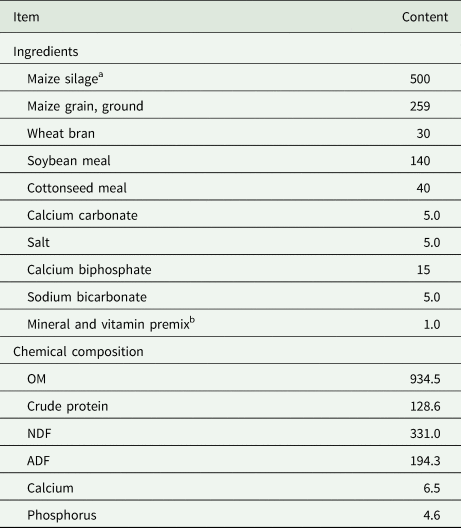
Eight rumen-cannulated Holstein dairy bulls, averaging 10 months of age and 234 ± 7.3 kg body weight (BW; Mean ± s.d.), were allocated to a replicated 4 × 4 Latin square design according to a 2 × 2 factorial arrangement. Diets were supplemented with two levels of FA (0 or 8.0 mg/kg dietary dry matter [DM]) and two levels of PA (0 or 60 mg/kg DM). The supplementary doses of FA and PA were based on the study of Wang et al. (Reference Wang, Wu, Liu, Guo, Huo, Zhang, Pei and Zhang2019) and Liu et al. (Reference Liu, Wang, Li, Guo, Huo, Pei, Zhang and Wang2017), respectively. The supplements of PA (990 g/kg) and FA (990 g/kg) were purchased commercially, diluted 10-fold with silicon dioxide powder and hand-mixed into the top third of total mixed ration (TMR) for each animal before feeding. The maize silage to concentrate ratio of TMR was 50 : 50 on a DM basis (Table 1). The maize silage was made using forage harvested at a full ripening stage after removal of the ear. The experimental period lasted for 100 days, and was divided into four sub-periods of 25 days each, consisting of 15 days' adaption and 10 days of sample collection. Animals were raised in single pens (3.5 × 3 m) during the adaption period and in metabolism cages during the sampling period, and were fed twice daily at 07.00 and 19.00 h with free access to water. On day 13 of each sub-period, amounts of TMR offered to animals were adjusted according to DM intake measured during the first 12 days, so that refusals did not exceed 5% of daily intake during the collection periods. The BW of animals was measured at the beginning and end of each period.
Ingredient and chemical composition of experimental diets (in g/kg DM)

a Ensiled maize forage after removal of the ears.
b Contained per kg premix: 100 mg Co, 8500 mg Cu, 50 000 mg Fe, 30 000 mg Mn, 30 000 mg Zn, 300 mg I, 300 mg Se, 75 00 000 IU vitamin A, 12 00 000 IU vitamin D and 40 000 IU vitamin E.
Data collection and sampling procedure
During each sample collection period, feed offered and refusals of each bull were measured daily to calculate DM intake, and samples of feed and refusals were collected once daily. To determine the total tract digestibility coefficient of dietary components, the total faecal excretion of each bull was recorded daily and the faecal samples (1/12 of wet weight) were collected and mixed with 100 g/l tartaric acid solution (1/4 of samples). The collected samples of feed, refusal and faeces were dried at 55 °C for 48 h and ground with a cutter mill (110, Qingdao Ruixintai instrument Co., Ltd., Qingdao, China) to pass through a 1-mm screen, then pooled by bull for chemical analysis. The entire volume of urine excreted by each bull was recorded daily and urine samples accounting for 0.01 of the total excreted urine were collected, mixed with sufficient 10% sulphuric acid to maintain pH < 3.0, then pooled by bull. The urine samples were diluted five times with distilled water and stored at −20 °C until further analysis.
Ruminal fluid was sampled (~200 ml) from several sites (reticulum, dorsal and ventral sac) at 07:00, 10:00, 13:00 and 16:00 h during days 24 and 25 of each sub-period. After measuring pH with a pH meter (PHS-3C, Shanghai Leijun experimental instrument Co., Ltd., Shanghai, China), ruminal fluid samples were filtered through four layers of cheesecloth. The filtrate (5 ml) used for VFA or ammonia N determination was mixed with 1 ml of 250 g/l (w/v) metaphosphoric acid or 1 ml of 20 g/l (w/v) sulphuric acid for preservation, respectively, and stored at −20 °C. About 5 ml filtrate was kept in a centrifuge tube and frozen at −80 °C for DNA extraction. Another 50 ml filtrate was sonicated with a 30 s pulse rate at 4 °C for 10 min, centrifuged at 27 000 g at 4 °C for 20 min and the supernatant was kept at −80 °C for the determination of microbial enzyme activity.
Chemical analysis
DM (method 934.01), ash (method 942.05), nitrogen (method 976.05) and ether extract (EE; method 973.18) in feed, refusals and faecal samples were analysed according to AOAC (2000). Organic matter (OM) was calculated as the difference between DM and ash. Neutral detergent fibre (NDF) was determined using the method described by Van Soest et al. (Reference Van Soest, Robertson and Lewis1991) using heat-stable alpha amylase and sodium sulphite, whereas acid detergent fibre (ADF) was determined according to AOAC (2000; method 973.18). Rumen fluid sampled at 07:00, 10:00, 13:00 and 16:00 h during days 24 and 25 of each period were pooled on a weight basis for each bull and used for the determination of ruminal VFA, ammonia N and enzyme activity. Ruminal VFA was determined by gas chromatography (GC122; Shanghai Jingke instrument Co., Ltd., Shanghai, China), ammonia N was measured by the method of AOAC (2000) and enzyme activity (carboxymethylcellulase [CMC], cellobiase, xylanase, pectinase, α-amylase and protease) was determined as described by Agarwal et al. (Reference Agarwal, Kamra, Chaudhary, Agarwal, Sahoo and Pathak2002). Concentrations of allantoin and uric acid in urinary samples were measured by a UV-2100 spectrophotometer (UV2100, Shanghai Younike instrument Co., Ltd., Shanghai, China) according to the method of IAEA (1997).
Extraction of DNA and real-time polymerase chain reaction
Microbial DNA was extracted from 1.5 ml ruminal fluid by the repeated bead beating plus column (RBB + C) method (Yu and Morrison, Reference Yu and Morrison2004). In brief, the RBB + C method employs two rounds of bead beating in the presence of sodium chloride (NaCl) and sodium dodecyl sulphate, followed by sequential ammonium acetate and isopropanal precipitations. The precipitated nucleic acids were then treated with RNase A and proteinase K, and the DNA was purified using columns from the QIAGEN DNA Mini stool Kit (QIAGEN, Valencia, CA, USA).
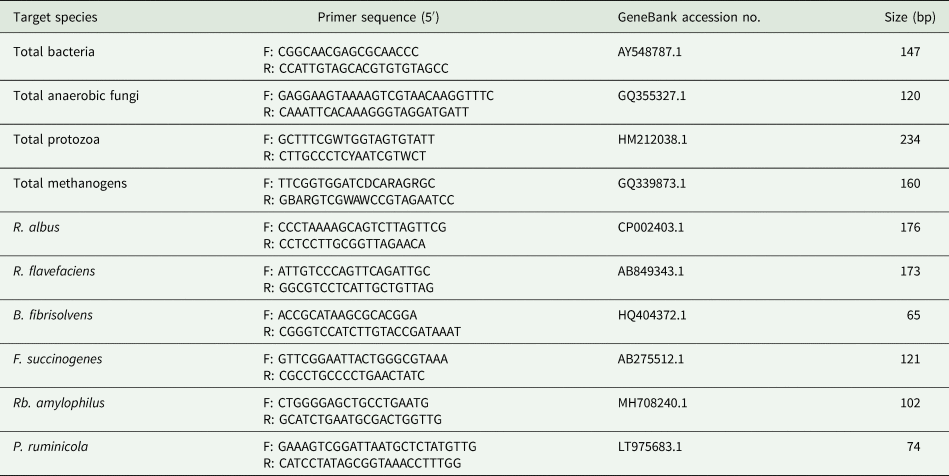
The target populations were total bacteria, total anaerobic fungi, total protozoa, total methanogens bacteria, R. albus, R. flavefaciens, F. succinogenes, B. fibrisolvens, Prevotella ruminicola and Ruminobacter (Rb.) amylophilus. All primer set sequences are shown in Table 2. Ten sample-derived standards of the determined microorganisms were prepared from the treatment pool set of microbial DNA. The regular polymerase chain reaction (PCR) was used to generate sample-derived DNA standards for each real-time PCR assay. Then the PCR product was purified using a QIA quick PCR purification kit (QIAGEN, Inc., Valencia, CA, USA) and quantified using a spectrophotometer. For each sample-derived standard, copy number concentration was calculated based on the length of the PCR product and the mass concentration (Yu and Morrison, Reference Yu and Morrison2004). Ten-fold serial dilution was made in Tris-ethylenediaminetetraacetic acid prior to real-time PCR (Kongmun et al., Reference Kongmun, Wanapat, Pakdee and Navanukraw2010). The conditions for real-time PCR assays of target genes were 1 cycle of 50 °C for 2 min and 95 °C for 2 min for initial denaturation, and 45 cycles of 95 °C for 15 s and 60 °C for 1 min for primer annealing and product elongation. Fluorescence detection was performed at the end of each denaturation and extension step. Amplicon specificity was performed via dissociation curve analysis of PCR end products by increasing the temperature at a rate of 1 °C every 30 s from 60 to 95 °C. For R. albus, the conditions were 30 s at 94 °C for denaturing, 30 s at 55 °C for annealing and 30 s at 72 °C for extension (48 cycles), except for 9 min denaturation in the first cycle and 10 min extension in the last cycle. Real-time PCR amplification and detection were performed in a Chromo 4™ system (Bio-Rad, USA). The Biotools QuantiMix EASY SYG KIT (BandM Labs, S. A., Spain) was used for real-time PCR amplification and samples were assayed in duplicate in a 20-μl reaction mixture containing 4–6 mm magnesium chloride (MgCl2), 10 µl of Mastermix (including; Taq DNA polymerase, reaction buffer, dNTP mixture, MgCl2 and SybrGreen), 2 µl of DNA template and 0.8 µl of each primer (10 µm/μl).
PCR primers for real-time PCR assay

Statistical analysis
Data were analysed as a replicated Latin square by the mixed model procedure of SAS (Proc Mixed; SAS, 2002), accounting for effects of square, period within square, animal within square and treatment. The PA and FA supplementation were considered as fixed effects, while square, period within square and animal within square were random effects. Data for ruminal pH were averaged by sampling time, then analysed by the same mixed model. The P values in Tables are for the main effects of PA (PA− v. PA+), the main effects of FA (FA− v. FA+) and their interaction. Effects of the factors were declared significant at P < 0.05.
Results
Growth performance and total tract digestibility coefficient
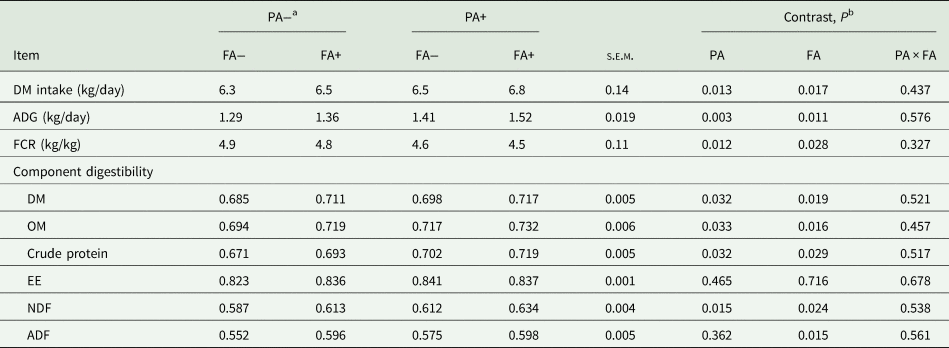
The PA × FA interaction was not significant for DM intake, ADG, feed conversion ratio (FCR) or total tract digestibility coefficient of dietary components (Table 3). DM intake and ADG were higher (P < 0.05) but FCR was lower (P < 0.05) for both supplements. For both supplements, the total tract digestibility of DM, OM, CP and NDF was higher (P < 0.05) but that of EE was unaltered. The digestibility coefficient of ADF in the total tract was not affected by PA supplementation, but was higher (P = 0.015) with FA supplementation.
Effects of PA and FA on growth performance and the total tract digestibility coefficient of dietary components in dairy bulls

a PA−, PA+, FA− and FA+ was with 0 mg PA, 60 mg PA, 0 mg FA and 8.0 mg PA per kg dietary DM.
b PA: PA effect; FA: FA effect; PA × FA: the interaction between PA and FA supplementation.
Ruminal fermentation parameters
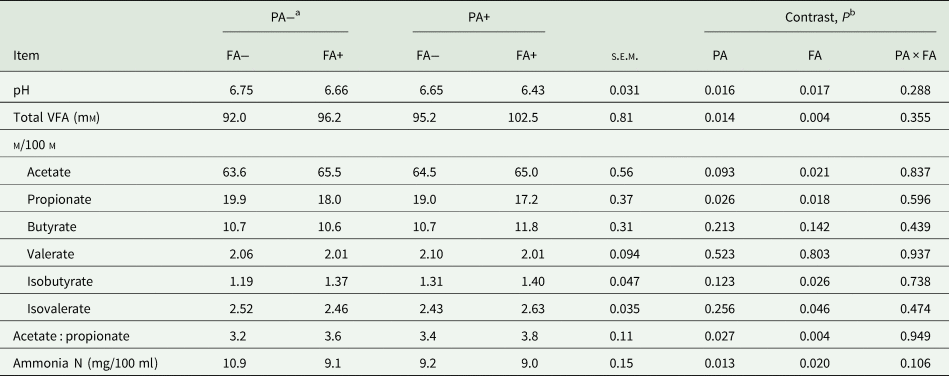
The PA × FA interaction was not significant for ruminal fermentation parameters (Table 4). Lower (P < 0.05) ruminal pH and higher (P < 0.05) total VFA concentration were observed for both supplements. The molar proportion of acetate was not affected by PA supplementation and was higher (P = 0.021) with FA supplementation. The molar proportion of propionate was lower (P < 0.05) for both supplements. As a result, higher (P < 0.05) acetate to propionate ratio was observed for both supplements. Dietary PA supplementation did not affect molar proportions of butyrate, valerate, isobutyrate or isovalerate in dairy bulls. Molar proportions of butyrate and valerate were unchanged, but proportions of isobutyrate and isovalerate were higher (P < 0.05) for FA supplementation. Lower (P < 0.05) ammonia N concentration was observed for both supplements.
Effects of PA and FA on ruminal fermentation in dairy bulls

a PA−, PA+, FA− and FA+ was with 0 mg PA, 60 mg PA, 0 mg FA and 8.0 mg PA per kg dietary DM.
b PA: PA effect; FA: FA effect; PA × FA: the interaction between PA and FA supplementation.
Microbial enzyme activity and microorganisms
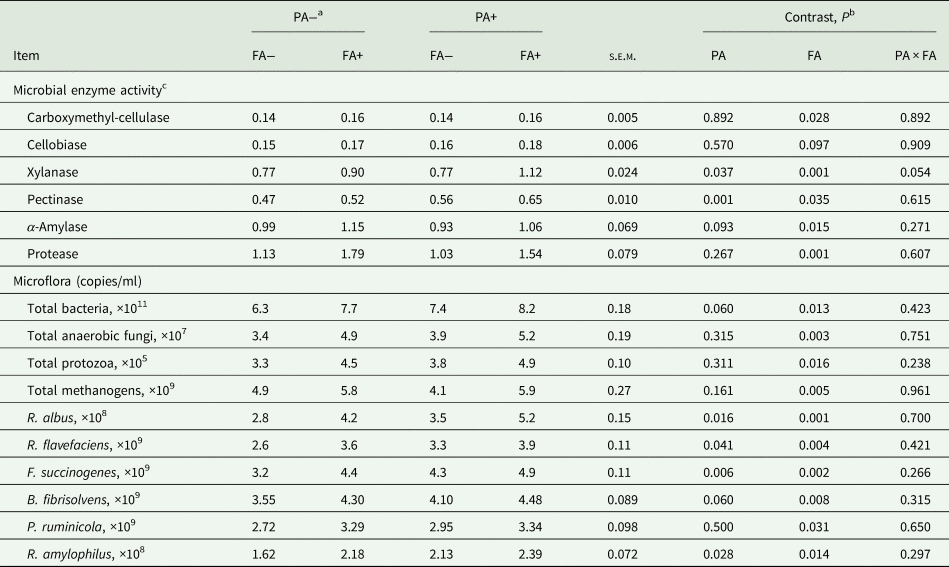
The PA × FA interaction was not significant for microbial population or enzyme activity (Table 5). Activity of CMC, cellobiase, α-amylase and protease was unaltered, but activity of xylanase and pectinase was higher (P < 0.05) for PA supplementation. Higher (P < 0.05) activity of CMC, xylanase, pectinase, α-amylase and protease and unchanged activity of cellobiase were observed with FA supplementation. Populations of total bacteria, fungi, protozoa, methanogens, B. fibrisolvens and P. ruminicola were not affected by PA supplementation, but were higher (P < 0.05) for FA supplementation. Higher (P < 0.05) R. albus, R. flavefaciens, F. succinogenes and Rb. amylophilus population were observed for both supplements.
Effects of PA and FA on ruminal microbial enzyme activity and microorganisms in dairy bulls

a PA−, PA+, FA− and FA+ was with 0 mg PA, 60 mg PA, 0 mg FA and 8.0 mg PA per kg dietary DM.
b PA: PA effect; FA: FA effect; PA × FA: the interaction between PA and FA supplementation.
c Units of enzyme activity are: carboxymethyl-cellulase (μm glucose/min/ml), cellobiase (μm glucose/min/ml), xylanase (μm xylose/min/ml), pectinase (μm D-galactouronic acid/min/ml), α-amylase (μm maltose/min/ml) and protease (μg hydrolysed protein/min/ml).
Urinary purine derivatives
The PA × FA interaction was not significant for urinary purine derivative (PD) excretion (Table 6). Excretion of uric acid was unaltered, but allantoin and total PD excretion were higher (P < 0.05) for both supplements.
Effects of PA and FA on urinary excretion of PDs in dairy bulls

a PA−, PA+, FA− and FA+ was with 0 mg PA, 60 mg PA, 0 mg FA and 8.0 mg PA per kg dietary DM.
b PA: PA effect; FA: FA effect; PA × FA: the interaction between PA and FA supplementation.
Discussion
The main purpose of the current experiment was to study the effects of PA and FA on total tract digestibility coefficient of dietary components, ruminal fermentation, microbial enzyme activity, microorganisms and urinary PD excretion. Due to the shorter experimental period, the data of ADG and FCR only acted as a reference.
Growth performance and total tract digestibility coefficient
The positive response of DM intake to PA or FA supplementation was associated with the increased total tract NDF digestibility coefficient. It has been demonstrated that DM intake was positively related to NDF digestibility in dairy cows, since the reticulo-rumen distension could be relieved by the increased feed fibre digestibility (Allen, Reference Allen2000). The higher ADG resulted from the greater DM intake, digestibility coefficient of dietary components and ruminal total VFA concentration with PA or FA supplementation. In addition, PA, as a part of coenzyme A, participates in the energy release of carbohydrates, protein and fatty acids (Ball, Reference Ball and Ball2006); FA, by the transfer of one carbon unit, plays a major role in the synthesis of DNA, RNA and protein (Bailey and Gregory, Reference Bailey and Gregory1999). La et al. (Reference La, Li, Wang, Liu, Guo, Huo, Zhang, Pei and Zhang2019) observed that both ADG and hepatic mTOR signal pathway gene expression increased with RPFA addition in dairy calves. Therefore, the observed higher ADG might also be related to an improved energy utilization with PA addition, or protein synthesis metabolism with FA addition. Similarly, previous studies observed a positive impact of RPP or FA addition on DM intake and ADG in calves (Liu et al., Reference Liu, Wang, Li, Guo, Huo, Zhang, Zhang, Pei and Wang2018a; Wang et al., Reference Wang, Wu, Liu, Guo, Huo, Zhang, Pei and Zhang2019). The higher total tract digestibility of DM, OM, CP and NDF was associated with an increase in ruminal enzyme activity and microbial population, and indicated that nutrient degradation in the rumen was enhanced with PA or FA supplementation. Previous studies indicated that ruminal degradability of DM, CP and NDF increased with RPP supplementation in steers (Liu et al., Reference Liu, Wang, Li, Guo, Huo, Pei, Zhang and Wang2017), and FA addition increased total tract digestibility in calves (Wang et al., Reference Wang, Wu, Liu, Guo, Huo, Zhang, Pei and Zhang2019). Ragaller et al. (Reference Ragaller, Lebzien, Bigalke, Südekum, Hüthera and Flachowsky2010) also found that ruminal ADF degradability increased with FA addition in a high-forage diet of dairy cows.
Ruminal fermentation
The lower ruminal pH with PA or FA supplementation is consistent with the higher ruminal total VFA concentration. Ruminal pH in the current study ranged from 6.43–6.75, appropriate for microbial growth and nutrient digestion in the rumen (Kolver and DeVeth, Reference Kolver and DeVeth2002). The higher ruminal total VFA concentration resulted from increased DM intake, ruminal microbial population and enzyme activity with PA or FA supplementation. The higher acetate to propionate ratio indicated that the ruminal fermentation mode was altered to more acetate formation with PA or FA supplementation. Ruminal acetate concentration increased by 5.30 and 8.21% due to PA and FA addition, respectively. The results were attributed to the positive impacts of dietary PA or FA addition on the growth of ruminal microorganisms responsible for feed fibre degradation and were consistent with the observed higher total tract digestibility of NDF. Similarly, previous studies found that ruminal total VFA concentration and the acetate to propionate ratio increased with RPP addition in steers (Liu et al., Reference Liu, Wang, Li, Guo, Huo, Pei, Zhang and Wang2017) or with FA addition in dairy calves (Wang et al., Reference Wang, Wu, Liu, Guo, Huo, Zhang, Pei and Zhang2019). Other studies observed that PA addition increased acetate molar proportion in vitro (Völker et al., Reference Völker, Hüther, Daş and Abel2011) or in dairy cows fed a high concentrate diet (Ragaller et al., Reference Ragaller, Lebzien, Sdekum, Hüther and Flachowsky2011). However, Girard et al. (Reference Girard, Benchaar, Chiquette and Desrochers2009) reported that ruminal pH, total VFA concentration and acetate to propionate ratio were not affected by FA addition in dairy cows. The FA required by ruminal microorganisms is from feed, microbial synthesis and dietary addition. If the supply of FA from the diet and microbial synthesis could support the maximal growth of ruminal microorganisms, the response of ruminal fermentation to dietary FA supplementation would be limited. Schwab et al. (Reference Schwab, Schwab, Shaver, Girard, Putnam and Whitehouse2006) reported that the intake and ruminal synthesis of FA were influenced by dietary forage and non-fibre carbohydrate (NFC) content, and ruminal apparent synthesis of FA increased with increasing dietary NFC content in dairy cows. Therefore, the divergent response of ruminal fermentation to FA addition observed in the current study and Girard et al. (Reference Girard, Benchaar, Chiquette and Desrochers2009) were associated with the different dietary composition.
The positive response of molar proportions of isobutyrate and isovalerate to FA addition resulted from the increase in protease activity, indicating that feed protein degradation was enhanced by FA addition. Ruminal branched-chain volatile fatty acids (BCVFA), isobutyrate and isovalerate are products of dietary protein degradation and are essential nutrients for cellulolytic bacteria growth (Cummins and Papas, Reference Cummins and Papas1985). Liu et al. (Reference Liu, Wang, Guo, Huo, Zhang, Pei, Zhang and Wang2018b) reported that dietary BCVFA addition stimulated ruminal cellulolytic bacteria growth and total tract fibre digestion. Therefore, the observed increase in total tract NDF and ADF digestibility and acetate molar proportion was also associated with positive impacts of FA addition on molar proportions of isobutyrate and isovalerate.
Ruminal microbial enzyme activity and microorganisms
The higher activity of xylanase and pectinase was consistent with the greater populations of R. albus, R. flavefaciens and F. succinogenes, and supported the increase in total tract digestibility of NDF with PA addition. The limited response of α-amylase and protease to PA addition was in accordance with the unchanged populations of B. fibrisolvens and P. ruminicola. However, Rb. Amylophilus, which is also responsible for the degradation of starch and protein, increased with PA addition. PA, as a component of coenzyme A and acyl carrier protein, plays a crucial role in energy release, acetyl group transfer and fatty acid biosynthesis (Ball, Reference Ball and Ball2006; Völker et al., Reference Völker, Hüther, Daş and Abel2011). Wolin et al. (Reference Wolin, Miller, Stewart, Hobson and Stewart1997) reported that the supply of exogenous PA was necessary for some strains of ruminal starch degradation bacteria. Liu et al. (Reference Liu, Wang, Li, Guo, Huo, Pei, Zhang and Wang2017) observed that the relative abundance of ruminal primary cellulolytic bacteria and enzyme activity increased with RPP addition in steers.
The increase in activity of CMC, xylanase and pectinase with FA addition was due to higher populations of fungi, protozoa and the dominant cellulolytic bacteria (R. albus, R. flavefaciens, F. succinogenes and B. fibrisolvens), and was the reason for the observed greater acetate molar proportion and total tract digestibility of ADF and NDF. Ruminal fungi, protozoa and cellulolytic bacteria produce cellulolytic enzyme, then degrade feed fibre to acetate (Dijkstra and Tamminga, Reference Dijkstra and Tamminga1995). Moreover, fungi can degrade the most resistant plant cell wall polymers by penetrating the cuticle and lignified tissues of the plant (Trinci et al., Reference Trinci, Davies, Gull, Lawrence, Nielsen, Rickers and Theodorou1994). The higher α-amylase and protease activity with FA addition resulted from the increased populations of total protozoa, B. fibrisolvens, P. ruminicola and Rb. amylophilus, but was inconsistent with the lower propionate molar proportion. This contradiction should be associated with the increase in total protozoa population with FA addition. Ruminal B. fibrisolvens, P. ruminicola and Rb. amylophilus are considered as the dominant bacteria responsible for degrading feed NFC to propionate (Nozière et al., Reference Nozière, Ortigues-Marty, Loncke and Sauvant2010). Nevertheless, some species of ruminal protozoa can decrease feed starch degradation rate by transient storing of starch granules in their cells (Nozière et al., Reference Nozière, Ortigues-Marty, Loncke and Sauvant2010). The increase in total methanogens population was consistent with the increase in cellulolytic bacteria and protozoa population and the decrease in propionate molar proportion. Ruminal methanogens utilize hydrogen, methyl groups and carbon dioxide to synthesize methane; this process provides almost all of the energy required for methanogen growth (Liu and Whitman, Reference Liu and Whitman2008). FA is responsible for the transfer of methyl groups (Bailey and Gregory, Reference Bailey and Gregory1999) and is also a component of coenzyme in the methanogenesis pathway (Liu and Whitman, Reference Liu and Whitman2008). Ruminal fibre degradation produces hydrogen and carbon dioxide and some strains of protozoa provide sites for methanogen growth (Newbold et al., Reference Newbold, Lassalas and Jouany1995). Similarly, early in vitro studies indicated that the growth of R. albus and R. flavefaciens was promoted with FA addition (Slyter and Weaver, Reference Slyter and Weaver1977; Wejdemar, Reference Wejdemar1996). Wang et al. (Reference Wang, Wu, Liu, Guo, Huo, Zhang, Pei and Zhang2019) found that dietary FA addition increased the relative abundance of ruminal dominant cellulolytic bacteria and enzyme activity in dairy calves.
Ruminal ammonia nitrogen and urinary purine derivative excretion
Ruminal ammonia-N is derived mainly from protein degradation and urinary total PD excretion is usually used to reflect microbial protein synthesis (Verbic et al., Reference Verbic, Chen, MacLeod and Ørkov1990). Ruminal microorganisms, especially cellulolytic bacteria, utilize ammonia N and VFA as the N source and carbon skeleton to synthesize protein (Krause et al., Reference Krause, Combs and Beauchemin2002). In the current study, lower ruminal ammonia N concentration was observed but protease activity was unchanged for PA addition and increased for FA addition. This contradiction could be explained by the increased microbial protein synthesis, as indicated by the higher urinary total PD excretion with PA or FA addition. The positive response of total PD excretion was associated with the increased ruminal total VFA concentration and cellulolytic bacteria population, and was also the reason for the observed higher ADG and total tract CP digestibility with PA or FA addition. Similarly, Wejdemar (Reference Wejdemar1996) observed an improved ammonia-N utilization with FA addition in vitro. Previous studies found that urinary total PD excretion increased with RPP addition in steers (Liu et al., Reference Liu, Wang, Li, Guo, Huo, Pei, Zhang and Wang2017) or with FA addition in dairy calves (Wang et al., Reference Wang, Wu, Liu, Guo, Huo, Zhang, Pei and Zhang2019).
Conclusion
Dietary PA or FA supplementation improved growth performance and total tract nutrient digestion in Holstein dairy bulls under the conditions of this experiment. The supplementation of PA stimulated ruminal primary cellulolytic bacteria growth, resulting in an increase in total VFA concentration and urinary total PD excretion. Dietary FA addition stimulated the growth of ruminal bacteria, fungi and protozoa, resulting in an increase in total VFA concentration, activity of cellulolytic enzyme, α-amylase and protease as well as urinary total PD excretion. The PA and FA work through different mechanisms but are not antagonistic as for most variables, numerically, the best response is observed with the combined addition of PA and FA.
Acknowledgements
The authors thank the staff of Shanxi Agriculture University beef unit for care of the animals.
Financial support
This work was supported by a grant from Natural Science Funding projects of Shanxi Province (201801D121241), Key Research and Development project of Shanxi Province (201803D221025-2) and Animal Husbandry ‘1331 project’ Key Discipline Construction program of Shanxi Province.
Conflicts of interest
The authors have declared that there is no conflict of interest.
Ethical standards
The experimental scheme was authorized by the Animal Care and Research Committee of Shanxi Agriculture University.