Introduction
Due to the higher propensity of health conditions in old age, age-related anxiety and health-related worries have been of great interest among researchers in the gerontological field. Centenarians, due to their greater health and functional restrictions and progressive loss of self-sufficiency, have increased odds of experiencing emotional distress, particularly anxiety symptoms. Nevertheless, currently little is known about the specific variables that may contribute to the presence of clinically significant anxiety, and several researchers and clinicians have described the need for more studies on the specific features of anxiety in later life (Mohlman et al., Reference Mohlman2012), particularly among the oldest old.
Prevalence estimates of anxiety in later life range from 1.2% to 14.2% depending on sampling procedures, diagnostic tools used, age cut-offs for classification as an older adult, and exclusion of cases due to general medical conditions (cf. Norton et al., Reference Norton, Ancelin, Stewart, Berr, Ritchie and Carrière2012). Anxiety, either as a symptom dimension or as a disorder satisfying diagnostic criteria, may be extensively experienced in old age, present age-related differences (Cully and Stanley, Reference Cully, Stanley, Laidlaw and Knight2008), and demand specific treatment options. Health-related factors are often studied in connection to late life anxiety due to the crucial role they play in the psychological health of older adults. Frazier and Waid (Reference Frazier and Waid1999), for instance, showed that whereas medical conditions (e.g. high blood pressure and diabetes) did not relate to anxiety, poorer actual and perceived health were related to increased distress and hypochondriacal concerns in a group of community-dwelling elderly adults. More recently, El-Gabalawy et al. (Reference El-Gabalawy, Mackenzie, Shooshtari and Sareen2011) explored the association between co-morbid physical health conditions and anxiety disorders, and found that health problems were associated with increased odds of anxiety, and that such co-morbidity was associated with poorer self-reported health than either medical problems or anxiety alone.
In one of the most extensive comprehensive reviews of risk factors for anxiety (and depression) in the elderly, Vink et al. (Reference Vink, Aartsen and Schoevers2008) concluded there were relatively fewer studies on the risk factors for anxiety compared to those concerning depression. Their findings revealed that there were many similarities between risk factors for both conditions but that conclusions on the identified differences should be approached with caution (namely that biological factors were more important in predicting depression and that there was a differential effect of social factors on both conditions). When specifically examining the findings on anxiety from the 12 cross-sectional and 5 longitudinal studies the authors included in their review, significant associations were found between cognitive impairment, high blood pressure, self-perceived health, vision or hearing loss, and anxiety symptoms, and between the number of chronic conditions, poor self-perceived health, and functional limitations with anxiety disorders. Anxiety traits, dysfunctional coping strategies, and psychopathology were associated with anxiety symptoms and disorders, but limited evidence was found for the association between quantitative (e.g. number of friends) and qualitative aspects (e.g. social support) of social functioning. Studies on the relevance of living conditions were lacking.
Currently, the extent to which anxiety-related constructs predict health anxiety in older adults remains largely unspecified (Gerolimatos and Edelstein, Reference Gerolimatos and Edelstein2012). Contemporary reviews and conceptualization have highlighted the higher prevalence of anxiety in older (as compared to younger) adults, the complexity of health anxiety disorders in later life, and the need for further research on this topic (El-Gabalawy et al., Reference El-Gabalawy, Mackenzie, Thibodeau, Asmundson and Sareen2013). Particularly focusing on the oldest old population, there is an increasing amount of research on emotional distress and associated features (e.g. Van der Weele et al., 2008) but there is not so much information on the presence of anxiety symptoms. Findings from the Georgia Centenarian Study (Arnold et al., Reference Arnold2010) revealed that centenarians did not experience more anxiety relative to octogenarian controls, and data from Buono et al. (Reference Buono, Urciuoli and Leo1998) in their study on quality of life and longevity with a sample of Italian elderly adults presented no differences between three age groups (75–85; 86–99; ≥100 years old) on anxiety scores. Richmond et al. (Reference Richmond, Law and Kay-Lambkin2011) examined the physical, mental, and cognitive functioning of a convenience sample of Australian centenarians and found that 10% had anxiety symptoms. This group found a significant negative correlation between anxiety and quality of life and a significant positive correlation between anxiety and depression; however, no significant associations were found between anxiety and social functioning, physical functioning, or cognitive functioning. In their study entitled “stress in centenarians,” Tafaro et al. (Reference Tafaro2009) presented an inverse correlation between anxiety level and cognitive status. The cognitive deficiency corresponded to low stress adaptability and to higher tendency to anxiety, a finding that highlights the importance of cognitive skills to elaborate environmental stressors even at very old age. According to these authors’ findings, more than half of the centenarians in their study were not depressed and had low trait-anxiety, showing an emotional tendency to react with a low anxiety-intensity to stressful conditions. If there was a relative absence of stressors in their lives or just the presence of favorable personality traits and robust adaptability in the face of stressful events remained unclear. As it remains unclear, to date, what may constitute “stressful events” and anxiety predictors at such an advanced age.
The present study aimed to analyze anxiety symptoms in a sample of centenarians and to identify its predictor variables. First, we examined the presence of anxiety symptoms in two samples of centenarians, one from a population-based study on the north coast of Portugal (Oporto Centenarian Study) and another from a convenience sample of centenarians living in the country's interior region. Then, we examined the extent to which a set of distinct socio-demographic, health-functional, and social factors predicted anxiety. Additionally, information is provided on the use of the Geriatric Anxiety Inventory – Short Form (GAI-SF) in centenarians.
Methods
Participants
A total of 97 centenarians participated in this study. Data from two Portuguese studies on centenarians were considered: 59 centenarians from the Oporto Centenarian Study (PT100) and 38 centenarians from the ongoing Beira Interior Centenarian Study (PT100 Beira Interior). The first is a population-based study comprising a total of 189 centenarians living in Oporto city and its surrounding geographical area (Oporto Metropolitan Area, which comprises a region of approximately 60 km around Porto, in Portugal) and the second refers to a convenience sample of centenarians living in the interior part of the country with a similar geographical extension around the city of Guarda. Only participants with no cognitive impairment or minor cognitive impairment were eligible for this particular study. With regards to this aspect, considering that reduced cognitive functioning represents a risk to the reliability and validity of self-reports, a sequential data collection strategy was used following procedures used in several other studies with centenarians (e.g. Jopp and Rott, Reference Jopp and Rott2006). More specifically, information on the centenarians’ own condition (functional, emotional, overall living circumstances) was only assessed if the individual was not affected by severe cognitive impairment and was willing to divulge such information.
Measures
Anxiety was measured with the GAI-SF (Byrne and Pachana, Reference Byrne and Pachana2011). According to the original study, a score of three or greater was used for detecting anxiety since this cut-off score yields a specificity of 87% and sensitivity of 75% for detecting generalized anxiety disorder (GAD). A question from the psychological components of frailty instrument (Tilburg Frailty Indicator; Gobbens and van Assen, Reference Gobbens and van Assen2012) also assessed whether the individuals felt nervous or anxious during the last month. Additional information was obtained regarding the domains of health and social functioning. Self-perception of general health, vision and hearing, number of current diseases, number of medication presently consumed, and activities of daily living (ADL) were assessed with the Physical Health and Activities of Daily Living subscales of the Duke Older Americans Resources and Services Procedures (OARS; Fillenbaum, Reference Fillenbaum1988; Rodrigues, Reference Rodrigues2008). For ADLs an informant (proxy) indicated the degree of functional dependence of the centenarian on a scale from 7 (fully independent) to 21 (completely dependent). Cognitive status was evaluated according to the Global Deterioration Scale (GDS; Reisberg et al., Reference Reisberg, Ferris, de Leon and Crook1982) and the Portuguese version of the Mini-Mental State Examination (MMSE) adapted for illiterate people and people with very few years of education (Folstein et al., Reference Folstein, Folstein and McHugh1975; Guerreiro et al., Reference Guerreiro, Silva, Botelho, Leitão, Castro-Caldas and Garcia1994). To capture social functioning, two questions from the Social Resources subscale of OARS about the number of visits they had on a regular basis and how often they feel lonely were used. The interview also included information on socio-demographic factors (age, gender, living arrangements, income per month, and income adequacy for medical expenses).
Data analysis
The GAI-SF psychometric properties for this specific population (centenarians) were evaluated using an exploratory factorial analysis. The internal consistency of the scale was evaluated using Cronbach's α and the construct validity of the scale using a concordant overall question (“have you felt anxious or nervous during the last month”). In order to identify potential predictive factors of anxiety, logistic regression models were performed considering as outcome the presence/absence of clinically significant anxiety (GAI-SF score ≥3). Three groups of covariates were considered: socio-demographic factors, health and functionality, and social factors. To decide which variable should be included in the multivariable models, an exploratory analysis was performed by fitting univariable models and considering as candidates for the multivariable models all variables significant at the 0.05 level in these univariate models. All analyses were performed with IBM SPSS Statistics 21.
Results
Participants
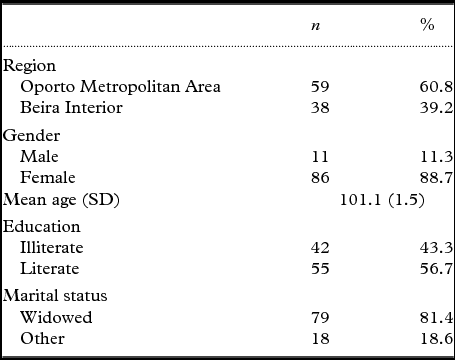
The final sample consisted of centenarians from two different regions of Portugal: 59 centenarians (60.8%) from the Oporto Metropolitan Area and 38 (39.2%) from Beira Interior. Participants comprised 86 (88.7%) females, with an overall mean age of 101.1 years (SD = 1.5 years, range = 100–108); 43.3% (n = 42) of the sample was illiterate and 81.4% (n = 79) was widowed. Table 1 presents the main characteristics of the sample.
Characteristics of the participants in the present study

GAI-SF performance and the prevalence of clinical anxiety
In order to verify the adequacy of using GAI-SF in this population, an exploratory factorial analysis and the evaluation of the internal consistency of the scale were performed. In line with the original longer version of the scale with 20 items (cf. Pachana et al., Reference Pachana, Byrne, Siddle, Koloski, Harley and Arnold2007; Ribeiro et al., Reference Ribeiro, Paúl, Simões and Firmino2011), the results of the exploratory factorial analysis of the GAI-SF Portuguese version revealed the presence of a one-dimensional scale (eigenvalue = 3.091, KMO = 0.837, and p < 0.001 for the Bartlett's Test of Sphericity). All items revealed a factor leading higher than 0.7 (ranging from 0.725 to 0.808). The total variance explained by the five items was 61.8%. Internal consistency for the GAI-SF was evaluated using Cronbach's α. The α coefficient for the five-item scale was 0.845, revealing good internal consistency for the measure. To evaluate the validity of the GAI-SF, the question “have you felt anxious or nervous during the last month” was used as concordance measure and results showed a statistically significant association between GAI-SF and this question (B = 2.167 (0.354); p < 0.001), reinforcing the ability of this instrument to anxiety discrimination. We used a score of three or greater as cut-off points for the GAI-SF (Byrne and Pachana, Reference Byrne and Pachana2011) and 45.4% (n = 44) presented clinically significant anxiety.
Predictive factors of anxiety in centenarians
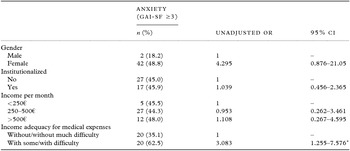
Socio-demographic factors such as gender, living arrangements, monthly income, and income adequacy for paying medical expenses were considered as potential predictive factors of anxiety. Half of the female sample was classified as presenting with significant anxiety (n = 42, 48.8%) and compared to only 18.2% (n = 2) of the male sample. Similar percentages of anxiety were found in institutionalized and non-institutionalized centenarians (45.9% vs. 45.0%) and in the groups of centenarians classified according to their income per month (45.5% reported receiving <250€; 44.3% reported receiving between 250–500€; and 48% reported receiving >500€). When asked about having difficulties in paying medical expenses, 35.1% (n = 20) of centenarians who reported few difficulties or having no difficulties were classified as anxious and 62.5% (n = 20) of those who reported some or much difficulty were found to present with clinical anxiety. When considering the results obtained by univariate logistic regression models, only the variable related to financial inadequacy for medical expenses was identified as a significant predictive factor of anxiety. The probability for suffering anxiety among centenarians in this condition is about 3.1 times more (95% CI = 1.255–7.576) than those centenarians who have no or very little difficulty in paying medical expenses. Overall results are shown in Table 2.
Potential socio-demographic predictive factors of anxiety: percent of anxious, unadjusted OR and respective 95% CI

*p < 0.05.
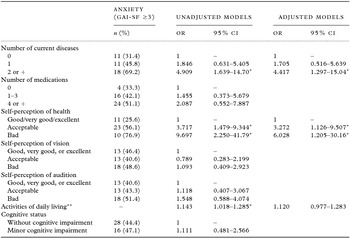
As for health and functionality factors, the number of current diseases, number of medications, self-perception of health, vision and hearing, ADL, and cognitive status were considered as potential predictors of anxiety. The percentage of centenarians classified as anxious increased with the number of diseases present: 31.4% (n = 11) of centenarians without current diseases, 45.8% (n = 11) with one diagnosed illness, and 69.2% (n = 18) with two or more diagnoses were classified as anxious. The same pattern was found when considering the number of medications consumed per day. A worse self-perception of health was associated with a higher percentage of anxious individuals (25.6% for good/very good/excellent self-perception of health, 56.1% for acceptable, and 76.9% for bad). However, self-perception of visual and auditory issues was not associated with anxiety (between 40% and 50% of centenarians were classified as anxious for each category of this factor). The same pattern was found with respect to cognitive status: 44.4% of centenarians without cognitive impairment and 47.1% of those with minor cognitive impairment were classified as anxious. Overall results are shown in Table 3.
Potential health predictive factors of anxiety: percent of anxious, unadjusted and adjusted OR and respective 95% CI

*p < 0.05.
**Score interval [7–21], with higher scores meaning higher difficulty in ADLs.
Number of diseases, self-perception of health, and ADLs were identified as significant predictive factors of anxiety. The probability of experiencing clinical anxiety among centenarians with two or more diseases is about 4.9 (95% CI = 1.639–14.70) times more than for centenarians without any diagnosed illnesses. Additionally, centenarians with a bad self-perception of health had a higher probability of anxiety when compared with centenarians with a good, very good, or excellent self-perception of health (OR = 9.697, 95% CI = 2.250–41.79). Finally, an increase of difficulty in performing ADLs was related to increased odds of presenting with anxiety (OR = 1.143, 95% CI = 1.018–1.285). Considering the factors found as predictive of anxiety in univariate analysis, a multivariable model was considered. Analyzing the results, we found that only objective and subjective indicators of health remained statistically significant.
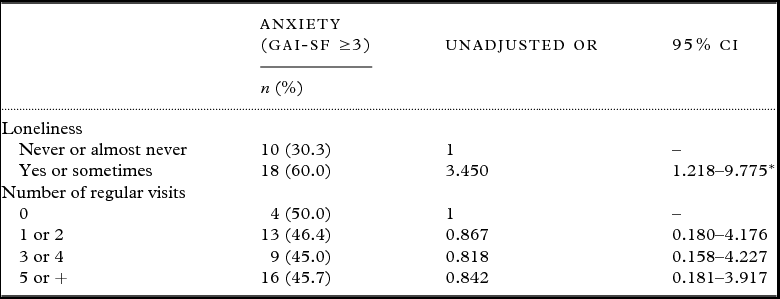
In the third block of factors (social factors), potential predictors of anxiety included the existence of loneliness and the number of visits the centenarian had on a regular basis. We verified that only loneliness was associated with anxiety (OR = 3.450, 95% CI = 1.218–9.775). Most centenarians who presented with anxiety felt lonely, whereas the number of visits they received presented no significant association with feeling anxious (Table 4).
Potential social support predictive factors of anxiety: percent of anxious, unadjusted OR and respective 95% CI

*p < 0.05.
Discussion
With the current cohort of older people living beyond the expected lifespan of previous generations, it may be expected that individuals reaching 100 years and beyond may present with specific sources of anxiety. Centenarians are closer to the end of life and therefore may fear debilitating disease states that they do not have the physical, economic, or social resources to cope with, making them especially susceptible to experience anxiety.
According to our findings, health-related factors (objective number of diseases and perceived health status), income inadequacy for medical expenses, and feeling lonely were found to be related to the presence of clinically significant anxiety. These results reinforce the central role played by health and health-related concerns for older adults. In fact, both worse subjective health perception and an increased number of illnesses were to some extent expectedly related to increased odds of experiencing clinical anxiety (El-Gabalawy et al., Reference El-Gabalawy, Mackenzie, Shooshtari and Sareen2011). Nevertheless, the role played by perceived income inadequacy for medical expenses, which could be interpreted as an apprehension about how to deal with one's own health-related expenses, provides a new insight on the spectrum of worries that may be present at such an advanced age. When interpreting this particular finding, we must take a look at two different aspects: first, the structural circumstances of most Portuguese older people and their low income, which is even lower for this age group; second, the importance centenarians may give to the assurance of their own medical care in face of reduced wealth.
In Portugal, low incomes characterize the daily circumstances of a large number of older people whose main source of income is the state pension, and who may present additional financial challenges to their descendants, particularly if living with family members in private households. Moreover, since centenarians did not expect to live so long, they might be less likely to have enough savings available to face one of their greatest sources of everyday expenditure – medication. The fact that income inadequacy on this matter increased the probability of anxiety in our study may be related to concerns with maintaining one's own health status. When studying the spectrum of worry in community-dwelling elderly, Golden et al. (Reference Golden2011) found that severe worry was highly prevalent in this population (80% of the sample, aged between 65 and 96 years, was worried in the previous month) and that although most severe worriers did not meet criteria for GAD, the authors found that preoccupations about the health of others, about family problems, and about personal finances declined with age, whereas worries about one's own health (present in approximately 40% of the population) showed no relationship with age. From an economic perspective, it is important to highlight that centenarians are a unique group whose working and retirement years tend to be of approximately equal length and thus they might be at greater risk of poverty than younger older people; despite this fact, although there is some research highlighting centenarians’ mental health association with economic resource adequacy (MacDonald and Cho, Reference MacDonald, Cho, Poon and Cohen-Mansfield2011), there remains a dearth of literature examining their wealth and financial circumstances (Serra et al., Reference Serra, Watson, Sinclair and Kneale2011) as well as information on their related worries on this issue. Our findings underscore the need for a better understanding of economic anxiety in extreme old age and echo the proneness older adults may have to feel anxious about their physical health condition and medical related costs. Current research on centenarians has not fully addressed the differential experiences of individuals who have lived beyond the age of 100 years, and therefore more attention should be paid to the objective circumstances and perceptions that can threat one's well-being by inducing clinically significant anxiety.
Within the block of health and functionality factors that could increase the odds of experiencing anxiety, a somewhat surprising finding of our study relates to the fact that worse perception of vision and hearing did not emerge as a predictor of anxiety symptoms. Vision and hearing losses were found to be risk factors for anxiety symptoms in Vink et al. (Reference Vink, Aartsen and Schoevers2008) review, but in this study we did not assess the actual existence of vision or hearing loss but rather asked how centenarians subjectively rated it. Based on this fact we can potentially argue that, in a subjective manner, such loses do not influence directly their emotional functioning due to a positive and resilient adaptation process to extreme longevity and its intrinsic consequences. This explanation, however, deserves further and deeper thoughts on the linkages between psychological variables, like perceptions of control, and anxiety, which have been previously explored with older individuals (Frazier and Waid, Reference Frazier and Waid1999) but not specifically in centenarians. Equally important would be additional clarifications of the relation between sensory functions, functionality, and anxiety in extreme old age since previous studies have also reported that among individuals aged 90 years, anxiety does not add to poor functional status and increased mortality beyond associated with depression (Van der Weele et al., Reference Van der Weele, Gussekloo, De Waal, de Craen and Van der Mast2009). As for the cognitive functioning, contradictory findings have been presented when linking it to anxiety in centenarians (cf. findings of Tafaro et al. (Reference Tafaro2009) vs. findings of Richmond et al. (Reference Richmond, Law and Kay-Lambkin2011)), so again on this subject further insights are needed. Nonetheless, we should recall that in our study we have included only individuals with no cognitive impairment or with only minor cognitive deficits, which might justify the lack of significant differences.
When taking a look at the social factors that increase the likelihood of experiencing clinical anxiety, our study revealed that feeling lonely was a predictive factor. Although social functioning factors remain among the less studied potential predictors of anxiety, we believe that our findings add evidence of the positive relationship between feelings of loneliness and anxiety, as presented by Fees et al. (Reference Fees, Martin and Poon1999) in a sample from the Georgia Centenarian Study. In that study, which compared sexagenarians, octogenarians, and centenarians, higher levels of anxiety were related to higher levels of physical illness and higher levels of loneliness. In turn, age significantly predicted physical illness and loneliness, suggesting that centenarians had higher evaluation of physical illness and experienced greater loneliness. Centenarians are more likely to have lower social resources than octogenarians and are more likely to be socially isolated than other groups (Serra et al., 2011). According to a recent review on centenarians’ social relationships (Araújo and Ribeiro, Reference Araújo and Ribeiro2012), we must look at the specificities of this age group, since the loss of social contacts and relationships may not have a clear association with greater feelings of loneliness. The reduction and withdrawal from the social sphere is suggested as a strategy to offset losses and increase well-being and therefore may have an adaptive value. Our results suggest that centenarians with a greater propensity to clinical anxiety are those presenting with lower adaptive abilities, since the social interaction reduction, common at this stage of life, is having a greater impact in loneliness. The number of visits they had on a regular basis was not found to be related to anxiety, suggesting that the frequency of social contacts may be less influential than the subjective relevance of feeling lonely. Satisfactory subjective social support, rather than network size, has shown to be most strongly associated with subsequent functional disability among older adults (McLaughlin et al., Reference McLaughlin, Leung, Pachana, Flicker, Hankey and Dobson2012) and further studies on the relation of social functioning and anxiety should pay more attention to the multiple aspects of social support, both at an objective and subjective level.
Regardless of the predictive factors of anxiety we have been discussing, special attention should be given to this study's first and primary objective – to assess the presence of anxiety symptoms in a sample of centenarians. We found that almost half of the participants (45.4%) had clinically significant anxiety symptoms and such a high prevalence deserves serious consideration since it clearly is above the numeric figures presented in previous studies with this population (e.g. 10% in Richmond et al., Reference Richmond, Law and Kay-Lambkin2011) even though previous researchers have been careful in interpreting the relatively low prevalence of mental health concerns obtained given the possibility that centenarians, like younger older adults, may under-report anxiety symptoms. Focusing on our findings, a potential explanation for our high number of anxiety cases may be rooted in the cultural context where this study was conducted. The expression of emotional distress in very old individuals has been found to be quite high in several previous studies with Portuguese older individuals. Paúl and Ribeiro (2008), for instance, found that in a sample of 1,067 community-dwelling older persons the prevalence of psychological distress was 30%, with an increase with age (23.7% in the age group of 55–64 years, 29.6% in the age group of 65–74 years, and 37.6% in the age group of 75+ years). A national report on health mentioned in that study also showed that about 40% of people aged 55 years and over in the general population presented with psychological suffering. Such a consistently high prevalence (namely when compared to that reported in other similar international studies and reports) emphasizes the fact that the expression of clinical emotional symptoms may be extended to older age groups including those reaching 90 and 100 years. In fact, although most studies have found no association between anxiety symptoms and advancing age, the likelihood of experiencing this emotional condition may be higher when we focus on extremely old individuals and when we take into account contextual variables of worry about the imminent threat of not being able to economically guarantee one's own medical expenses. Since these two centenarians’ studies are pioneers in the Portuguese context (one corresponds to the first ever population-based study conducted with centenarians), further insights are needed on the presence and numeric expression of other co-morbid emotional disorders/symptoms (e.g. depression) and indicators of well-being (e.g. valuation of life) so that we can correctly consider the relevance of our obtained prevalence of anxiety.
On this matter of prevalence, mention should also be made of the instrument we have used in our study. To the best of our knowledge, this is one of the first studies to analyze anxiety symptoms with use of the GAI-SF in centenarians. Most studies focusing on emotional distress in this population tend to assess depressive symptoms rather than anxiety, and when focusing on anxiety symptoms, they do not include specific instruments for late-life anxiety in their methodology. The most commonly used measures include those assessing neuroticism (by means of personality inventories), measures of state-trait anxiety (STAI), subscales from instruments developed to measure self-perceived well-being in the elderly (such as the Profile of Elderly Quality of Life – PEQOL), scales originally designed for younger populations (such as the Hospital Anxiety and Depression Scale – HADS), or health history questionnaires covering distinct psychiatric disorders. Assessment of anxiety in older adults has been a topic of great importance and recent reviews have highlighted that of the most commonly used measures, the majority lack sufficient evidence to warrant their use in older adults (Cully and Stanley, Reference Cully, Stanley, Laidlaw and Knight2008; Therrien and Hunsley, Reference Therrien and Hunsley2011). The Geriatric Anxiety Inventory is thought to overcome such limitations. Moreover, its short version, good for epidemiological studies, has proved to be a viable replacement for the original 20-item GAI as a screener in community-dwelling individuals (Byrne and Pachana, Reference Byrne and Pachana2011) and among nursing home residents (Gerolimatos et al., Reference Gerolimatos, Gregg and Edelstein2013). Although we only present initial evidence on the use of GAI-SF with the centenarian population, we believe that the psychometric information provided along with its characteristics (e.g. response format – agree/disagree and easy-to-understand items) makes this instrument a useful tool and a measure to be strongly considered. We also believe, though, that further research on anxiety in centenarians would also benefit from the use of an evidence-based list of worries (e.g. fear of falling) that may be particularly relevant in their daily living. Both these sources of information, if and when combined, would strongly contribute to unraveling the experience of emotional distress at such an advanced age and capture the “concerns” of centenarians within their specific context. Moreover, further distinctions of trait versus state anxiety in centenarians would benefit the available knowledge on the relation between this emotion and extreme longevity.
Finally, a brief mention of limitations of our study is warranted. When interpreting our findings, the first point to consider is the cross-sectional nature of our data that limits the extent of the predictive value of the variables considered since we were unable to infer causality. In addition, due to the small sample size a final multivariable model could not be considered. Further studies on the predictors of anxiety in this population should assess the maintenance of significant factors in one adjusted model comprising all health, social, and economic factors.
Conclusions
Presently little is known about which variables may contribute to the presence of clinically significant anxiety symptoms among centenarians. This study demonstrated that both objective and subjective health status play a pivotal role, but that financial inadequacy for medical expenses and feelings of loneliness also are important. Clinical anxiety as a common emotional condition should be further studied in order to increase our understanding of the effects of extreme longevity on anxiety. In addition, it would be important to provide insights on the co-occurrence of anxiety symptoms/disorders with depression since rates of such co-morbidity are high within older populations. Several authors have emphasized the fact that anxiety may be part of the phenomenology of late-life depression, and this may be the case among centenarians; nevertheless, we believe that a first step forward would be to fully recognize the relevance of anxiety symptoms extant in this population.
Conflict of interest
None.
Description of the authors’ roles
O. Ribeiro was responsible for the study conception and design, and supervised data collection; L. Araújo and R.M. Afonso performed the data collection; L. Teixeira performed the data analysis; O. Ribeiro wrote the manuscript; and N. Pachana critically revised the paper for important intellectual content.
Acknowledgments
This work was supported by the Portuguese Foundation for Science and Technology (FCT; Grant PEst–C/SAU/UI0688/2011) and (FCT; Grant PEst–C/SAU/UI0688/2014).