


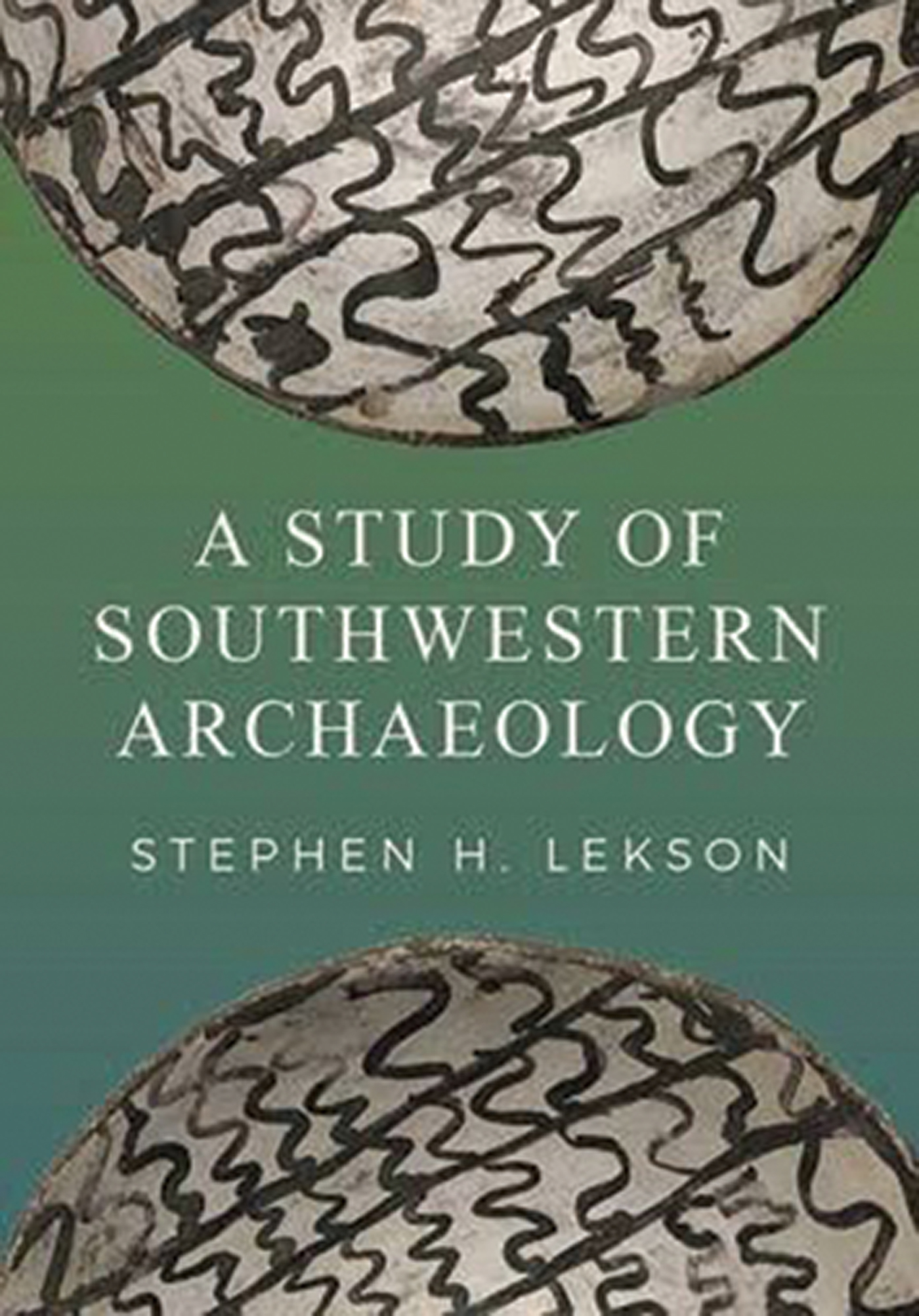
In 1948, Walter W. Taylor published his influential monograph A study of archaeology. A polemic on archaeological method and theory, Taylor's work took his elders to task for approaching historical reconstruction as mere chronicle, instead of investigating relations, functions and meanings. His way forward was his famous conjunctive approach that sought to explore associations and interactions related to the cultural entity under analysis. Taylor's monograph received mixed reactions; some reviewers praised it as thoughtful and thought-provoking, while others panned it as highly opinionated and grandiose.
It takes little predictive skill to say that Stephen Lekson's new book, A study of Southwestern archaeology, will engender similar reviews. Inspired by Taylor's monograph, it is properly read as an elaboration of some of Lekson's earlier ideas. It will infuriate some scholars because of the ways he dispenses with previous scholarship and summarily brackets off Indigenous heritage. But it will be warmly welcomed by others who regard Southwestern archaeology as increasingly insular and too dogmatic.
Lekson asserts that twentieth-century anthropological archaeology has created a biased and inaccurate picture of the ancient Southwest. This bias is encapsulated by his term “Pueblo Space” (p. 1), which he defines as the boundaries and conventions underlying Southwestern archaeology. These consist of the following four attributes about Pueblo Indian people: that they are self-sufficient/inward looking, communal/egalitarian, spiritual/peaceful and eternal/unchanging. He regards Pueblo Space as the product of both anthropology (the Ethnological Method) and popular culture (Pueblo Mystique and Santa Fe Style). His point is that while Pueblo people may be some of these things some of the time, they are none of these things all of the time. The problem then is that archaeological interpretation tends to be constrained by these attributes.
The core of the book is his case for considering Chaco as a state. A review of David Wilcox's ideas would have been welcome here. Wilcox was one of the first archaeologists to question the popular view of Chaco as a larger, albeit more complex, version of the modern pueblos. He proposed the novel idea of Chaco as a militaristic state centred on Pueblo Bonito that demanded tribute from its less prosperous neighbours and incorporated them under its hegemony. Lekson expands upon this idea and posits Chaco as a city (and capital) of a secondary state. He finds a close analogy in the Mesoamerican altepetl or city-state. He writes
The altepetl encompassed a central capital with farming lands surrounding it. At the capital, a half-dozen noble families occupied separate palaces, amid public architecture, and an urban population of commoners. Far more commoners lived in countryside farming villages, many with smaller palaces of secondary nobility, for a total population of 2000 to 40 000 people. The king was first among equals, elected by the nobility from one of the half-dozen highest noble families (p. 82).
This is a fascinating interpretation and certainly worthy of further investigation. It is not the dominant view, however. Lekson expresses his frustration that many of his Southwestern colleagues have been slow to accept the merits of his insights. He thus seeks to strengthen his thesis by considering population thresholds (K-rule, Dunbar's number, the rule of six), diffusion and migration, states (primary and secondary), cities (low and high density), and historical cycles. But whether scholars find his arguments convincing will depend upon how they approach political complexity and weigh different lines of evidence.
Along the way, Lekson delivers a sharp critique of contemporary anthropological archaeology. He sees it as fragmented (which it is) and divided over whether it should be detached, objective scholarship or advocacy and activism (this tension is hardly unique to archaeology). He then asserts that American anthropology “has been a disaster for the study of the pre-history of North America and, even more, the pre-history of the Southwest” (p. 151). Presumably, he is referring here to the ‘tyranny of ethnology’, the tendency to interpret the past using modern Pueblo analogues. But as John Ware and others have noted, the careful application of the direct historical approach has considerable potential to inform about the details of cultural histories. He then claims that cultural anthropology has more or less vanished from the Southwest (not quite true), but admits that biological anthropology and linguistics still survive. All of this causes him to propose that Southwestern prehistory be moved out from under anthropology's fraying umbrella (but to where, he does not say). He then confesses that due to institutional inertial and intellectual tradition, this is unlikely to happen (I agree, but not only for these reasons). For me, Lekson's most controversial position is his separation of history from heritage. He regards history as what happened in the past as understood on Western terms; he sees heritage as the uses of the past in the present. As he puts it, archaeologists should stick to history; Indigenous peoples to heritage; “Ships that pass in the night, hopefully steered away from collision” (p. 162). But if anthropology is anything it is the comparative study of cultures, past and present, and their complex and ever evolving interrelationships. As Clifford Geertz (1973) understood, how different people think about their worlds and their places within them is crucial to the project. Different Pueblo people have their own philosophies of time, space and history, and it can be quite instructive to examine how they both conform to and challenge Western forms of knowledge production.
This position also underpins Lekson's assessment of the new movement known as Indigenous archaeology. He writes, “Archaeology is not Indigenous, any more than physics or economics or political science are Indigenous” (p. 159). Well yes and no. These disciplines certainly have their origins in Western European institutions, but this does not mean that they cannot be broadened. Indigenous perspectives can lead to new questions and answers about what constitutes the archaeological record. They are also revealing valuable insights into the ontologically complex intersections of the past in the present. Crucially, this broadening of archaeology requires, among other things, the provision of new opportunities for Indigenous peoples to obtain training and secure careers in the profession.
In conclusion, the contributions of A study of Southwestern archaeology are twofold. It challenges Southwestern archaeology to confront its dominant theories, received assumptions and unexamined biases. This is entirely congruent with Taylor's message delivered over 70 years ago. Lekson is undoubtedly correct that we have created and reproduced invidious stereotypes in our attempts to understand Indigenous Southwestern peoples and cultures. It also encourages us to consider the Southwest at the appropriate scale—with Chaco positioned alongside other regional polities, such as Tula and Cahokia, in a vast interlinked network incorporating different forms of political organisation, some of which can properly be called states. Yet, in the end, Lekson's exegesis seems more focused on preserving prehistory for archaeologists, than on strengthening Southwestern archaeology for the twenty-first century.


