INTRODUCTION
Neurocysticercosis (NCC), the central nervous system (CNS) infection caused by the larva of Taenia solium tapeworm, is identified as the most common cause of acquired epilepsy worldwide. The disease is clinically pleomorphic with active seizure as the most common manifestation. It is a slowly progressive disease and the severity of the symptoms depends on multiple factors including the intensity of inflammatory reaction in the host brain. However, many individuals with NCC remain asymptomatic (Sciutto et al. Reference Sciutto, Fragoso, Fleury, Laclette, Sotelo, Aluja, Vargas and Larralde2000; Prasad et al. Reference Prasad, Prasad, Gupta, Nath, Pradhan, Tripathi and Pandey2009) and the exact reasons largely remain unexplained. Animal studies have shown the differential breakdown of the blood brain barrier (BBB) depending upon the expression of matrix metalloproteinases (MMPs) that determines infiltration of blood leukocytes, thereby the production of inflammatory cytokines. In murine NCC, inflammatory infiltrates are composed of a diverse population of immune cells and the mechanism that directs the immune response via cleavage of cytokine, chemokine and adhesion molecules can be accomplished by the multiple MMPs (Alvarez and Teale, Reference Alvarez and Teale2008).
Matrix metalloproteinases (MMPs) are a family of closely related Zn2+-dependent endopeptidases, capable of degrading almost all components of the extracellular matrix (ECM) and also non-matrix proteins. They are involved in a wide variety of physiological as well as pathological processes and are necessary for the normal developmental processes along with successful eradication of the infection by the host. MMPs are mainly classified according to their substrate specificity into collagenases, gelatinases, stromelysins, matrilysins and membrane-type MMPs (Visse and Nagase, Reference Visse and Nagase2003). They are produced by a variety of cells including monocytes and macrophages, normally synthesized in an inactive form and later activated by removal of the pro-peptide either by other proteases or MMPs. Increased expression and activity of MMPs is mainly associated with leukocyte influx, either through regulation of BBB, cytokine/chemokine activity, or gradient formation (Manicone and McGuire, Reference Manicone and McGuire2008). These are secreted in response to exogenous insults, inflammatory cytokines such as TNF-α and IL-1β and cell contact dependent signalling (Alvarez and Teale, Reference Alvarez and Teale2008).
In the CNS, MMPs are involved in the cellular infiltration during inflammation by disrupting ECM proteins associated with the BBB and they contribute to enhanced permeability and inflammation in many neurological diseases including NCC. Studies on a murine model of NCC demonstrated that there was increased expression and activity of multiple MMPs including gelatinases (Alvarez and Teale, Reference Alvarez and Teale2008). MMP-2 and MMP-9 are the only gelatinases identified which are able to promote local proteolysis of the BBB and enhance the leukocyte influx into the CNS. Emerging evidence showed that MMP-2 and MMP-9 were specifically involved in BBB eruption, enabling the infiltration of immune cells into the CNS during multiple sclerosis and experimental autoimmune encephalomyelitis (Bar-Or et al. Reference Bar-Or, Nuttall, Duddy, Alter, Kim, Ifergan, Pennington, Bourgoin, Edwards and Yong2003; Abraham et al. Reference Abraham, Shapiro, Karni, Weiner and Miller2005). The present study was aimed to detect the levels of MMP-2 and MMP-9 in the serum of individuals with NCC and further investigate the relationship between the levels of MMPs and clinical outcome of the disease i.e. NCC with and without symptoms (active seizure).
MATERIALS AND METHODS
Study subjects
Individuals with NCC and healthy controls were enrolled in the present study from a rural pig farming community of Mohanlalganj block, Lucknow district, where prevalence of NCC-related active epilepsy as well as asymptomatic NCC cases are one of the highest in the country (Prasad et al. Reference Prasad, Gupta, Pradhan, Tripathi, Pandey, Luthara and Prasad2008). Symptomatic NCC i.e. patients with active seizures and asymptomatic NCC cases were selected on the basis of the criteria as described earlier (Prasad et al. Reference Prasad, Gupta, Pradhan, Tripathi, Pandey, Luthara and Prasad2008). Active epilepsy was defined in a patient who had 2 or more episodes of seizures, one of which had occurred in the previous 5 years, regardless of anti-epileptic drug treatment as prescribed by the International League against Epilepsy. Asymptomatic NCC cases were defined as individuals with no evidence/history of seizure, sensory or motor neuro-focal deficit, cranial nerve involvement and psychiatric or behavioural abnormalities. Healthy controls included in the study were asymptomatic individuals who underwent MRI but did not have any NCC compatible lesion in the brain. The Institute's Ethics Committee approved the study and all individuals included in the study consented for enrollment.
Diagnosis of NCC
Definitive or probable diagnosis of NCC related active epilepsy in patients was based on clinical, immunological, neuroimaging (MRI) and epidemiological criteria (Del Brutto et al. Reference Del Brutto, Rajshekhar, White, Tsang, Nash, Takayanagui, Schantz, Evans, Flisser, Correa, Botero, Allan, Sarti, Gonzalez, Gilman and Garcia2001; Garcia et al. Reference Garcia, Del Brutto, Nash, White, Tsang and Gilman2005). The enrolled subjects underwent MRI on a 3 tesla scanner (GE Electronics, USA). The base line T2 (repetition time (TR)/echo time (TE)/number of excitations (NEX)=4900 ms/85 ms/2), T1 (TR/TE/NEX=650 ms/9 ms/1) used a slice thickness of 5 mm, 0·5 mm inter-slice gap and 256×256 matrix. Gradient echo sequence with corrected phase was performed to detect calcification with TE/TR/FA=40 ms/800 ms/20 (Gupta et al. Reference Gupta, Rao, Jain, Pal, Venkatesh and Rathmore2001). The MRI criteria for the diagnosis of different stages of NCC were based on earlier published reports (Garcia and Del Brutto, Reference Garcia and Del Brutto2003). Subjects were considered positive if they presented cerebral lesions compatible with NCC (cysts and/or rounded hyperdense lesion(s) compatible with nodular brain cysticerci calcification) in the MRI scan. If the MRI scan was doubtful then a CT scan was also performed. Non-conclusive CT or MRI was excluded from the analysis (Fleury et al. Reference Fleury, Gomez, Alvarez, Meza, Huerta, Chavarria, Mezo, Lloyd, Dessein, Preux, Dumas, Larralde, Scintto and Fragoso2003).
Collection of serum sample
Peripheral blood samples were collected from all the subjects and sera were separated, aliquots were made and stored at −80°C till further use.
Serum ELISA for MMP-2 and MMP-9
The total MMP-2 and MMP-9 concentrations were determined in the serum of the studied subjects using commercial ELISA kits (R&D Systems Inc, Minneapolis, MN, USA). All samples were measured in triplicate. According to the manufacturer's recommendations, the serum samples were diluted using assay buffer. For MMP-2 and MMP-9, the sera were diluted to a ratio of 1:10 and 1:100 respectively. The detection limits of the kit for MMP-2 and MMP-9 were 0·16 ng/ml and 0·31 ng/ml respectively.
Detection of MMP-2 and MMP-9 activities by gel zymography
For the detection of MMP-2 and MMP-9 activities, gelatin zymography was performed. The 0·5 μl serum samples diluted in 30μl of SDS buffer were separated in 10% SDS-PAGE gels polymerized with 1 mg/ml gelatin (Invitrogen Life Technologies, Carlsbad, CA, USA). Gels were washed once for 3 h in 2·5% Triton-X-100 and once for 30 min in the reaction buffer containing 50 mm Tris/HCl, 200 mm NaCl, 10 mm CaCl2, and 0·02% (w/v) Brij 35 (pH 7·5). The reaction buffer was changed to a fresh one, and the gels were incubated at 37°C for 24 h. Gelatinolytic activity was visualized by staining the gels with 0·5% Coomassie brilliant blue and was quantified by densitometry (Kim et al. Reference Kim, Min, Cho, Hong, Shin, Park and Cho2005).
Statistical analysis
Data were analysed using SPSS 17·0 statistical software (SPSS Inc., Chicago, IL, USA). ELISA data were expressed as mean±s.d. and range. Differences in the serum concentrations of MMP-2 and MMP-9 between different groups were analysed with one-way ANOVA Bonferroni t-test. The correlation between 2 variables was tested using two-tailed Spearman's rank correlation coefficient. P values ⩽0·05 were considered significant.
RESULTS
Study population
For the present study 36 asymptomatic (male/female: 13/23, mean age±s.d.: 27·42±12·31), 32 symptomatic NCC cases (male/female: 15/17, mean age± s.d.: 26·22±15·32) and 37 healthy controls (male/female: 19/18 mean age±s.d.: 23·43±15·09) were enrolled. All the symptomatic patients have history of seizures i.e. active epilepsy and none of the patients were on anti-epileptic treatment at the time of sampling. In symptomatic NCC patients calcified, multiple stages, degenerating and vesicular cysts were present in 24 (46·90%), 9 (28·00%), 6 (18·80%) and 2 (6·30%) respectively, whereas in asymptomatic cases calcified, multiple stages, degenerating and vesicular cysts were present in 15 (66·70%), 7 (19·40%), 3 (8·30%) and 2 (5·60%) respectively. On the basis of seizure frequency/year symptomatic patients were divided into 5 categories: 48 seizures/year (n=8), 24 seizures/year (n=7), 12 seizures/year (n=5), 2 seizures/year (n=9) and 1 seizure/year (n=3).
MMP-2 and MMP-9 serum concentrations in NCC subjects and healthy controls
The mean values and range of MMP-2 and MMP-9 in NCC subjects and healthy controls are shown in Table 1. The levels of both MMP-2 and MMP-9 were higher in NCC subjects (asymptomatic as well as symptomatic) when compared to healthy controls. The mean±s.d. of MMP-2 levels were 231·09± 23·59 (182·74–269·88), 243·79±35·53 (198·27–331·96) and 142·50±13·41 (121·63–187·45) ng/ml whereas mean±s.d. of MMP-9 levels were 150·46± 24·28 (105·10–224·40), 316·82±45·36 (226·60–411·63) and 134·18±101·70 (74·0–175·70) ng/ml for asymptomatic NCC, symptomatic NCC and healthy controls, respectively.
Serum concentrations of matrix metalloproteinase (MMP)-2 and MMP-9 in different study groups

* HC, healthy controls;
# AN, asymptomatic neurocysticercosis and
^ SN, symptomatic neurocysticercosis.
Association of MMP-2 and MMP-9 serum concentrations with symptomatic and asymptomatic NCC
The levels of MMP-2 and MMP-9 were compared between asymptomatic NCC, symptomatic NCC and healthy controls (Table 1). The higher levels of MMP-2 were significantly associated with symptomatic NCC and asymptomatic NCC compared to healthy controls (243·79±35·53 vs. 142·50± 13·41 ng/ml; P<0·001 and 231·09±23·59 vs 142·50±13·41 ng/ml; P<0·001 respectively). There was no significant difference in the levels of MMP-2 between asymptomatic and symptomatic NCC (231·09±23·59 vs 243·79±35·53 ng/ml; P=0·123).
The level of MMP-9 was significantly associated with symptomatic NCC in comparison to healthy controls (316·82±45·36 vs 134·18±101·70 ng/ml; P<0·001) and asymptomatic NCC (316·82±45·36 vs 150·46±24·28 ng/ml; P<0·001). However, there was no significant difference in the levels of MMP-9 when compared between asymptomatic NCC and healthy controls (150·46±24·28 vs 134·18± 101·70 ng/ml; P=0·110).
Association of MMP-9 serum concentration with different stages of cysts
The level of MMP-9 was significantly higher in symptomatic NCC subjects with all different stages of the cysts compared to asymptomatic NCC populations (vesicular- 311·00±32·88 vs 166·10± 22·76 ng/ml, P=0·063; degenerating- 314·78±67·71 vs 171·93±10·16 ng/ml, P=0·010; calcified- 318·83± 34·20 vs 143·29±20·57 ng/ml, P=0·001; multiple stages- 316·12±53·91 vs 161·37±32·26 ng/ml, P= 0·001).
Correlations between MMP-2 and MMP-9 in healthy controls and NCC groups
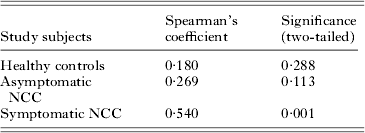
The Spearman's correlations between MMP-2 and MMP-9 serum levels were calculated (Table 2). Analysis showed that there was a positive correlation between the levels of MMP-2 and MMP-9 in symptomatic NCC with r=0·540; P=0·001; however, there was no correlation between the levels of MMP-2 and MMP-9 in asymptomatic (r=0·269; P=0·113) or healthy controls (r=0·180; P=0·288).
Association of up-regulated serum matrix metalloproteinase (MMP)-2 and MMP-9 with symptomatic neurocysticercosis (NCC)

Detection of serum MMP-2 and MMP-9 activities by zymography
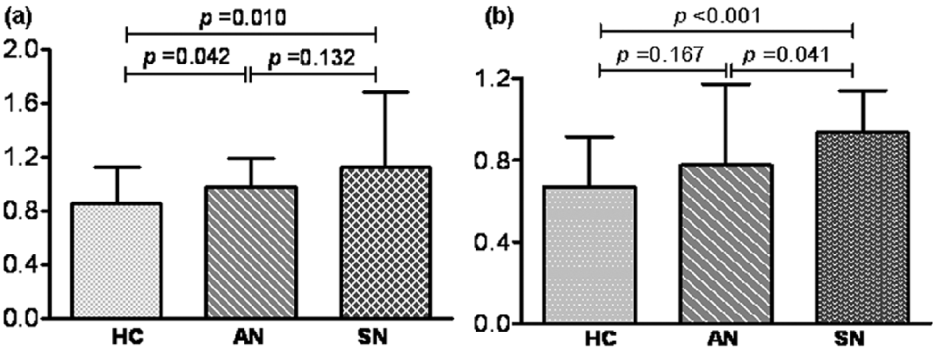
Gel zymography was performed to ascertain the serum gelatinase activities of MMP-2 (Fig. 1a) and MMP-9 (Fig. 1b) in NCC patients. Serum MMP-2 activity was significantly higher in symptomatic NCC and asymptomatic NCC compared to healthy controls (1·13±0·56 vs 0·86±0·28; P<0·010 and 0·98±0·22 vs 0·86±0·28; P<0·042 respectively). There was no significant difference in the serum activity of MMP-2 between symptomatic and asymptomatic NCC (1·13±0·56 vs 0·98±0·22; P=0·132).
Zymography analysis of matrix metalloproteinase (MMP) activities in sera of healthy controls (HC), asymptomatic neurocysticercosis (AN) and symptomatic neurocysticercosis (SN). (a) MMP-2; (b) MMP-9.

The increased serum activity of MMP-9 was significantly associated with symptomatic NCC when compared with healthy controls (0·94±0·20 vs 0·67±0·25; P<0·001) and asymptomatic NCC (0·94±0·20 vs 0·77±0·40; P<0·041). However, there was no significant difference in the activity of MMP-9 when compared between asymptomatic NCC and healthy controls (0·77±0·408 vs 0·67± 0·25; P=0·167).
DISCUSSION
The present study evaluated the serum MMP-2 and MMP-9 levels and their activities in individuals with NCC and found that circulating MMP-2 was higher in patients with NCC whereas higher levels of MMP-9 correlated with the symptomatic NCC patients i.e. patients having active epileptic seizures. Wilczynski et al. (Reference Wilczynski, Konopacki, Wilczek, Lasiecka, Gorlewicz, Michaluk, Wawrzynski, Malinowska, Okulski, Kolodziej, Konopka, Duniec, Mioduszewska, Nikolaev, Walczak, Owczarek, Gorecki, Zuschratter, Ottersen and Kaczmarek2008) demonstrated that MMP-9 was essential for the development of recurrent epileptic seizures and associated plasticity. In the case of temporal lobe epilepsy, aberrant synaptic plasticity was observed depending upon MMP-9, and these aberrant synaptic networks contributed to the severity of disease.
MMPs are critically involved in the pathogenesis of many CNS infections (Harris et al. Reference Harris, Vilaseca, Elkington, Horncastle, Graeber and Friedland2007; Wang et al. Reference Wang, Dai, Bai, Kong, Wong, Montgomery, Madri and Fikrig2008) including the murine model of NCC (Alvarez and Teale, Reference Alvarez and Teale2008). In humans, an elevated concentration of MMPs in the serum/CSF correlated with the severity of the disease (Avolio et al. Reference Avolio, Ruggieri, Giuliani, Liuzzi, Leante, Riccio, Livrea and Trojano2003; Kim et al. Reference Kim, Min, Cho, Hong, Shin, Park and Cho2005). There are several studies which provide evidence regarding the definite participation of MMP-2 and MMP-9 in the BBB eruption, enabling the influx of monocytes and T cells into the CNS (Abraham et al. Reference Abraham, Shapiro, Karni, Weiner and Miller2005). Gelatinolytic activity of MMP-2 and MMP-9 was required for leukocyte extravasation into the CNS during murine NCC (Alvarez and Teale, Reference Alvarez and Teale2008).
In the present study we analysed the seizure frequency in patients with symptomatic NCC that varied from a single episode to 48 episodes per year. A previous study from our centre had reported high prevalence of active epilepsy (5·8%) in this community and 48·3% of them fulfilled either definitive or probable diagnostic criteria of NCC. The treatment gap was also very high and more than 90% of these patients did not receive any anti-epileptic treatment (Prasad et al. Reference Prasad, Gupta, Pradhan, Tripathi, Pandey, Luthara and Prasad2008). Results from the present study demonstrated that the levels of MMP-2 were significantly higher in symptomatic NCC (243·79± 35·53 ng/ml) and asymptomatic NCC (231·09± 23·59 ng/ml) in comparison to healthy controls (142·50±13·41 ng/ml). There was no difference in the levels of MMP-2 in symptomatic and asymptomatic NCC (243·79±35·53 vs 231·09±23·59 ng/ml; P=0·123). However, MMP-9 was significantly up-regulated in symptomatic NCC patients when compared with asymptomatic NCC (316·82±45·36 vs 150·46±24·28 ng/ml; P<0·001) or healthy controls (316·82±45·36 vs 316·82±45·36 ng/ml; P<0·001). MMP-9 was also significantly higher in symptomatic NCC patients with different stages of the cysts when compared to asymptomatic NCC cases. Recent studies have shown that higher levels of MMP-9 are associated with epilepsy (Heuser et al. Reference Heuser, Hoddevik, Taubøll, Gjerstad, Indahl, Kaczmarek, Berg, Lien, Nagelhus and Ottersen2010; Yin et al. Reference Yin, Yang, Zhou and Sun2011). In symptomatic NCC patients, increased levels of MMP-9 may be responsible for the high occurrence of seizures. Similar results were obtained when serum MMP-2 and MMP-9 activities were detected by gel zymography. Zymography results showed that serum MMP-9 activity was higher in symptomatic NCC patients when compared with asymptomatic NCC (0·94±0·20 vs 0·77± 0·40; P<0·041) or healthy controls (0·94±0·20 vs 0·67±0·25; P<0·001) whereas serum MMP-2 activity was higher in both symptomatic and asymptomatic NCC when compared with healthy controls (1·13±0·56 vs 0·86±0·28; P<0·010 and 0·98±0·22 vs 0·86±0·28; P<0·042 respectively).
The data from the present study raise the possibility that MMP-9 worsens the pathology in NCC. In the case of cerebral ischaemia, MMP-9 activation and not MMP-2 aggravates the diseased condition (Piao et al. Reference Piao, Lee, Park, Ryu, Kim and Kim2009). Observations in an in vitro model showed that pro-inflammatory cytokines increased MMP-9 secretion by the choroidal epithelium that led to functional changes in the barrier (Strazielle et al. Reference Strazielle, Khuth, Murat, Chalon, Giraudon, Belin and Ghersi-Egea2003). Our previous study had shown that there was increased expression of adhesion molecule (sICAM-1) and pro-inflammatory cytokines such as TNF-α, IFN-γ and IL-1β in symptomatic NCC (Prasad et al. Reference Prasad, Prasad, Gupta, Nath, Pradhan, Tripathi and Pandey2008). It may be possible that the up-regulation MMP-9 in coordination with augmented levels of sICAM-1 and pro-inflammatory cytokines help in trans-endothelial migration of lymphocytes across the BBB causing increased inflammatory reactions into the brain and leading to the occurrence of symptoms. A study in the murine model of NCC infected with Mesocestoides corti demonstrated that an increase in MMP-9 activity at sites of BBB disruption exhibited leukocyte infiltration (Alvarez and Teale, Reference Alvarez and Teale2007). During immune cell transmigration, MMP-9 is the leading protease involved and is produced by selected cell types including monocytes, tissue macrophages and polymorphonuclear leukocytes. Studies on MMP-9 knockout mice provide evidence regarding the potential role of MMP-9 in BBB and CNS tissue disruption (Asahi et al. Reference Asahi, Wang, Mori, Sumii, Jung, Moskowitz, Fini and Lo2001).
There was significant correlation between the levels of MMP-2 and MMP-9 in the case of symptomatic NCC (r=0·540; P=0·001) compared to asymptomatic NCC (r=0·269; P=0·113) and healthy controls (r=0·180; P=0·288). The close positive correlation between MMP-2 and MMP-9 in symptomatic NCC suggests a possible role of both these MMPs in initiating the NCC symptoms. MMP-2 and MMP-9 are type IV collagenases that cleave type IV collagen in the basement membranes (∼50% of all basement membrane proteins) of BBB (Wang et al. Reference Wang, Dai, Bai, Kong, Wong, Montgomery, Madri and Fikrig2008). Studies on experimental autoimmune encephalomyelitis demonstrated that macrophage-derived MMP-2 and MMP-9 are important for the modulation of basement membranes of the BBB and are crucial for leukocyte infiltration into the brain (Agarwal et al. Reference Agarwal, Andreson, Durbeej, Ivars and Sorokin2006). BBB is comprised of tight endothelium, the basement membrane composed of IV collagen, laminin, proteoglycan, several glycoproteins and astroglial end feet. The existence of a tight endothelial barrier between blood and brain prevents an uncontrolled influx of proteins and cells into the brain. During some pathological conditions, the opening of the BBB and retraction of glial end feet involves degradation of basement membranes which is in part catalysed by MMPs that are produced in the CNS by invading granulocytes, T cells, macrophages, resident glial cells and endothelial cells. During NCC these inflammatory infiltrates may cause a variety of clinical outcomes including seizures, headaches, hydrocephalus and even death (Alvarez and Teale, Reference Alvarez and Teale2007).
In conclusion, this study demonstrated that concurrent increase in the levels of serum MMP-2 and MMP-9 correlated with symptoms (active seizure) in patients with NCC. Up-regulation of MMP-9 in symptomatic NCC patients suggests its role in the development of symptoms. However, further studies are needed on larger patient and control populations from different endemic areas to precisely define the clinical significance of MMPs in NCC.
ACKNOWLEDGEMENTS
The authors Ms A. Verma (09/590 (0138)/2007-EMR-I) and Mr S. K. Singh (09/590/(0147)/2010-EMR-I) acknowledge the Council of Scientific and Industrial Research and Mr K. K. Nyati (80/569/2007-ECD-I) acknowledges the Indian Council of Medical Research (ICMR), Government of India, New Delhi, respectively.
FINANCIAL SUPPORT
The study was financially supported by the ICMR, Government of India, New Delhi, India (5/4-5/11/Neuro/2006-NCD-I).