Palygorskite is a clay mineral with a great variety of industrial applications. It has adsorptive, catalytic and rheological properties that are comparable with other clay minerals. Palygorskite has numerous technological applications due to its physicochemical properties, including its chemical composition, large specific surface area, porosity, fibrous structure with internal channels and fine particle size, among others. These properties render palygorskite an excellent adsorbent. In general, clays are low-cost materials and are efficient adsorbents with a high cation-exchange capacity (CEC) (Suárez & Garcia-Romero, Reference Suárez and Garcia-Romero2006; Sarkar et al., Reference Sarkar, Guibal, Quignard and SenGupta2012; Yeniyol, Reference Yeniyol2012; Draidia et al., Reference Draidia, Ouahabi, Daoudi, Havenith and Fagel2016). The numerous applications of palygorskite include, among others, the adsorption of heavy metals and pollutants in general (Chen & Wang, Reference Chen and Wang2007; Chen et al., Reference Chen, Zhao and Wang2007; Hamdi & Srasra, Reference Hamdi and Srasra2012; Tomašević et al., Reference Tomašević, Kozma, Kerkez, Dalmacija, Dalmacija, Bečelić-Tomin and Rončević2014; Simões et al., Reference Simões, Novo, Felix, Afonso, Bertolino, Silva, Ikhmayies, Li, Carpenter, Li, Hwang and Monteiro2017), as drug carriers and in various industrial applications (Pham & Nguyen, Reference Pham and Nguyen2014; Lahoues-Chakour et al., Reference Lahoues-Chakour, Barama, Barama, Djellouli, Domingos and Davidson2018), including the oil industry (Kong et al., Reference Kong, Ge, Xiong, Zuo, Wei, Yao and Deng2014; Luo et al., Reference Luo, Luo, Duan and Liu2017). These applications render palygorskite a strong candidate for product development, mainly in nanotechnology.
Numerous nanomaterials have been developed recently with various applications (Antilén et al. Reference Antilén, Amiama, Otaiza, Armijo, Escudey, Pizarro and Arancibia-Miranda2015). Nanotechnology has recently gained momentum in the oil and gas industries due to its potential application in enhanced oil recovery and as nanosensors in hydrocarbon reservoirs (Pham & Nguyen, Reference Pham and Nguyen2014). Understanding the engineering transport of nanoparticles in oil wells and hydrocarbon formations is necessary for successful application in oil extraction. In this sense, natural clay composites can stabilize dispersion and facilitate mobility. The link between nanotechnology and natural clays such as palygorskite has facilitated product and process development.
Palygorskite is a hydrated magnesium aluminium phyllosilicate that has structural channels containing various types of water that can be removed by heating, thereby modifying its surface properties. Heat treatment improves the adsorption capacity of palygorskite through the removal of water molecules, thereby unblocking the adsorption sites and increasing the specific surface area. The structural formula of palygorskite is [Si8(Mg,Al,Fe)5O20(OH)2(OH2)4].4H2O, where H2O, (OH2) and (OH) represent zeolitic water, coordinated water and structural water, respectively. At temperatures <300°C, the main compound released from palygorskite is zeolitic water and a fraction of the coordinated water (Chen, Reference Chen, Zhao, Zhong and Jin2011). When the temperature rises to 400°C, the remaining coordinated water and a small amount of structural water are released, which results in the folding of the palygorskite nanopores. Heating at higher temperatures leads to the complete collapse of the pores and, consequently, a rapid decrease in the specific surface area of palygorskite (Wang et al., Reference Wang, Nakajima, Manias and Chung2003; Frini-Srasra & Srasra, Reference Frini-Srasra and Srasra2009; Chen et al., Reference Chen, Zhao, Zhong and Jin2011).
The use of clays to develop nanomaterials has been studied extensively (see Kojima et al., Reference Kojima, Usuki, Kawasumi, Okada, Fukushima, Kurauchi and Kamigaito1993; Cai et al., Reference Cai, Kimura, Wada and Kuga2009; Shah & Imae, Reference Shah and Imae2016, among others). The properties of solvatochromic dyes have also been studied, in particular to identify the polarity of various solvents (Rossetto et al., Reference Rossetto, Beraldin, Penha and Pergher2009; Orvalez et al., Reference Orvalez, Giulieri, Delamare and Sbirrazzuoli2011; Paz et al., Reference Paz, Angélica, Neves, Neumann and da Costa2011; Pham & Nguyen, Reference Pham and Nguyen2014; Campos et al., Reference Campos, Bertolino and Alves2017).
Machado et al. (Reference Machado, Stock and Reichard2014) studied the synthesis and use of betaine dyes and their application in solvatochromic probes. Numerous structural modifications of betaine were presented, as well as its application in various types of solvent. Those authors also described the use of solvatochromic reagents in solids such as various oxides, including SiO2, polymers and organic and inorganic materials. That study reported that the interactions between solvatochromic dyes and solid surfaces occur with a minimum of energy and that the interaction forces differ according to the type of solid.
Developing specific solvatochromic sensors for given solvents has been prolific, with numerous applications in organic chemistry, in organometallic and metallic compounds and in hybrid materials. The application of solvatochromic solvents in fuels has also been described (Budag et al., Reference Budag, Giusti, Machado and Machado2006; Selvakumar et al., Reference Selvakumar, Nadella, Fröhlich, Albrecht and Subramanian2012; Fong & Xue, Reference Fong and Xue2013; Lee et al., Reference Lee, Chang, An, Ahn, Shim and Kim2013).
Budag et al. (Reference Budag, Giusti, Machado and Machado2006) used a solvatochromic dye (Reichardt's dye) to determine the concentration of ethanol in gasoline. Dyes are very soluble in gasoline–ethanol blends, demonstrating preferential solvation in ethanol. The solutions turned bluish-green in 100 vol.% gasoline, greenish-blue in 25 vol.% ethanol in gasoline and violet in 100 vol.% ethanol. These colour changes enabled the visual identification of different concentrations of ethanol in gasoline.
Fong & Xue (Reference Fong and Xue2013) developed a sensor to determine the concentration of biodiesel in petroleum diesel, using Nile blue chloride (NBC) to identify the fatty acid methyl esters (FAMEs) present in biodiesel, with an analytical sensitivity of 0.5–2000 ppm. As NBC is not soluble in petroleum diesel, a film of the solvatochromic dye was created with an ethyl cellulose polymer to immobilize the diesel hydrocarbons, leaving the NBC available to detect the FAMEs from the biodiesel. Dali Youcef et al. (Reference Dali Youcef, Belaroui and López-Galindo2019) studied the adsorptive capacity of a palygorskite from Algeria for methylene blue (MTB) present in effluents. A strong affinity of palygorskite for MTB was observed, suggesting that the mineral can be used in the treatment of textile industry effluents. The maximum adsorption capacity was 57 mg g–1.
Santos et al. (Reference Santos, Cavalcanti, do Carmo, de Souza, Soares, de Souza and d'Avila2020) have shown the potential of the NBC dye in the determination of biodiesel contents in diesel oil/biodiesel blends. The study highlighted that NBC in an alkaline medium (pH = 12) presents relevant colour changes depending on the biodiesel content in the mixtures and the proportion of the mixture components. Enhancements of this method might improve the accuracy and sensitivity for detection of biodiesel in fuel samples. In addition, several studies have demonstrated the adsorption and desorption of various dyes on palygorskite, such as Maya blue (Gettens, Reference Gettens1962; Kleber et al., Reference Kleber, Masschelein-Kleiner and Thissen1967; Arnold, Reference Arnold2005; Kupfer et al., Reference Kupfer, Jaerger and Wypych2015), methyl red (Giustetto & Wahyudi, Reference Giustetto and Wahyudi2011) and MTB (Chen et al., Reference Chen, Zhao, Zhong and Jin2011; Wang et al., Reference Wang, Wang, Kang and Wang2015; Dali Youcef et al., Reference Dali Youcef, Belaroui and López-Galindo2019).
This study examines the physicochemical properties of a Brazilian palygorskite and the effect of the beneficiation process on the adsorption of the solvatochromic dyes NBC, MTB, and dithizone (DTZ).
Materials and methods
Beneficiation of palygorskite
The palygorskite used in this study comes from the Guadalupe region of north-eastern Brazil. The material was beneficiated at the Mineral Technology Center of the Federal University of Rio de Janeiro, CETEM. It was weighed as received, then dried in a forced-air oven at 60°C for 24 h and crushed in a jaw crusher (ESSA, model 185020) with a 2 cm outlet for 1 min at 700 rpm. Subsequently, it was ground in a Sturtevant sample grinder and split manually into aliquots.
Samples were wet sieved with a 20 μm size sieve coupled to a vibrating support. The resulting suspension was allowed to settle for 48 h and subsequently filtered under vacuum. The filter cake was collected, dried in a forced-air oven at 60°C for 24 h, separated magnetically, milled for 30 s (Fritsch Pulverisette 6) at 700 rpm and ground with a pestle and mortar.
Thermal activation of the clay
Heat activation of the <20 μm fraction of palygorskite was conducted in a muffle furnace (EDG 7000) at 350°C for 4 h. Experimental conditions were based on descriptions in the literature (Miller et al., Reference Miller, Haden and Oulton1963; Yan et al., Reference Yan, Tan, Annabi-Bergaya, Yan, Fan, Liu and He2012; Rusmin et al., Reference Rusmin, Sarkar, Biswas, Churchman, Liu and Naidu2016; Xavier et al., Reference Xavier, Santos, Osajima, Luz, Fonseca and Silva Filho2016).
Structural characterization of palygorskite
X-ray diffraction
Mineralogical characterization of the palygorskite sample was conducted via X-ray diffraction (XRD) in a D8 Endeavor diffractometer (Bruker) equipped with a LynxEye position-sensitive detector (Bruker) with the following operating conditions: Cu-Kα radiation (40 kV/40 mA), step size 0.02°2θ, scanning time 0.5 s per step, angular range of 4–80°2θ. The minerals present in the XRD traces were identified using the JCPDS 75-0978 database (2020) in the Bruker DiffracPlus software.
X-ray fluorescence
The chemical composition of the samples was determined by X-ray fluorescence (XRF) analysis with an AxiosmAX (Panalytical) XRF spectrometer. Analyses were semi-quantitative as they were performed without a standard (standardless) and were normalized to 100%. The samples were prepared in a VANEOX press (Fluxana) with 20 mm pressing dies at 20 t pressure for 30 s, using boric acid p.a. (H3BO3; MERCK) as a binder.
Scanning electron microscopy
The mineral textures were examined by scanning electron microscopy (SEM) in the microscopy laboratory of the Materials Metrology division of INMETRO (Brazil). A field emission gun SEM (FEI, Philips) equipped with an energy-dispersive X-ray spectrometer (EDS) was used, operating at 3 kV, using a 0.10 nA sample current, a working distance of 4.6 mm and a horizontal range of 276 μm.
Specific surface area
The specific surface area of the processed palygorskite was determined at CETEM using the Brunauer–Emmett–Teller (BET) method with N2 sorption at 77 K in an ASAP 2000 instrument (Micromeritics). The samples were degassed at 100°C for 24 h.
Thermogravimetric analysis
The thermogravimetric analysis (TGA) of the beneficiated sample was performed at the Fuel and Petroleum Product Laboratory (LABCOM) of the School of Chemistry, Federal University of Rio de Janeiro, in an SDT 650 thermal analyser (TA Instruments). The sample was heated from 22 to 700°C with a temperature ramp of 10°C min–1. Thermal analysis was also used to study the thermal stability of the solvatochromic dyes adsorbed on the palygorskite.
Cation-exchange capacity
The CEC is the ability of a material to exchange cations for other ions in an aqueous solution without altering its structure, showing the total number of cations contained at its surface. The CEC of the beneficiated palygorskite was obtained using the MTB method, which consists of exchanging the natural clay cations for MTB cations. The excess MTB in the solution was quantified using ultraviolet–visible (UV–Vis) spectroscopy.
Fourier-transform infrared spectroscopy
Fourier-transform infrared (FTIR) spectroscopy analyses were conducted in the spectroscopy laboratory of the Department of Inorganic Chemistry, Federal University of Rio de Janeiro. The spectra were obtained using the KBr pellet method in a Nicolet 6700 spectrometer (ThermoScientific), with an average of 16 scans, at 4cm–1 resolution, 0.6329 optical velocity and with a DTGS detector.
Surface charge (ζ-potential)
The ζ-potential, which corresponds to the potential at the shear plane, was determined indirectly and used to estimate the surface charge. This analysis was performed using a Zetasizer Nano ZS (Malvern) at CETEM.
Preparation of the solvatochromic dyes
The solvatochromic dye solutions (NBC, MTB and DTZ) were studied at concentrations varying from 0.001 to 5 g L–1 (InLab PA). Solvatochromic dyes are not soluble in water so ethanol was used as a solvent. The alkaline ethanol solutions (pH 11) for NBC and MTB were prepared by dissolving each solid dye in ethanol with 0.01 mol L–1 NaOH (Isofar PA). The neutral solutions for DTZ were prepared by dissolving the solid DTZ dye in ethanol. Various levels of pH for each dye were determined in previous studies (e.g. Santos et al., Reference Santos, Cavalcanti, do Carmo, de Souza, Soares, de Souza and d'Avila2020).
Adsorption of the solvatochromic dyes on palygorskite
Adsorption tests were performed with 0.1 g of beneficiated palygorskite and beneficiated/heat-treated palygorskite in 2 mL solutions of solvatochromic dye (NBC, MTB or DTZ) at concentrations of 0.001–5 g L–1. Contact time was set at 24 h, according to previous work (Carazo et al., Reference Carazo, Borrego-Sánchez, García-Villén, Sánchez-Espejo, Viseras, Cerezo and Aguzzi2018).
The adsorption of the solvatochromic dyes on palygorskite was studied by means of adsorption isotherms. The adsorption experiments were conducted in an isothermal bath shaker. Determination of the equilibrium concentrations of the supernatant liquids was carried out via UV–Vis analysis at 508 nm for NBC, at 630 nm for DTZ and at 655 nm for MTB. These wavelengths were obtained using the scanning approach to obtain the wavelength of maximum adsorption. Equilibrium concentrations and calibration curves were obtained by using a ThermoScientific Ultimate 3000 analytical system with a diode array detector. The experimental data were fitted with conventional isotherm models (Langmuir and Sips; Eqs 1 and 2, respectively) using a non-linear regression routine with Microsoft Excel 2010.


In Eqs 1 and 2, Q max is the maximum adsorption capacity of adsorbent, bi is the affinity constant, n is the Sips isotherm exponent, C i is the bulk concentration and q i is the amount of compound i adsorbed.
The samples were filtered through a syringe filter and the supernatants were analysed at 508 nm (NBC), 665 nm (MTB) and 630 nm (DTZ). The concentrations of the samples were determined using calibration curves. The adsorption, the concentrations of the adsorption and calibration curves were identical, ranging from 0.001 to 5 g L–1. The concentration of the dye was calculated (as milligrams of dye per gram of adsorbent) using Eq. 3:

where q i is the concentration of dye adsorbed, C i,0 is the concentration of dye in the supernatant before the addition of the clay, C i is the concentration of solute in the supernatant after contact with the clay, V s is the volume of supernatant and m ads is the mass of the adsorbent used.
Transmission electron microscopy
The transmission electron microscopy (TEM) analysis was used to observe the adsorption of the solvatochromic dyes on the surface of the palygorskite. The analysis was conducted at the microscopy laboratory of the Materials Metrology division of INMETRO (Brazil), with a 200 kV TECNAI Spirit (FEI) TEM, LAB6 or W emitter and EDAX module using the Xplore3D tomography package.
Results and discussion
X-ray diffraction
Figure 1 shows the XRD traces for raw palygorskite, beneficiated palygorskite and beneficiated/heat-treated palygorskite. The samples consist of palygorskite, quartz and kaolinite.
XRD traces of raw palygorskite (RAW), beneficiated palygorskite (Paly) and beneficiated/heat-treated palygorskite (PalyTT).

The processed and processed/thermally treated samples display a slight increase in the intensity of the palygorskite peaks compared to the crude sample, whereas the quartz peaks are less intense. The increase in the palygorskite peak intensity of the processed/heat-treated sample is related to the growth of crystals at high temperatures due to the high surface energy of nanostructured materials, which tend to form agglomerates (Suárez & Garcia-Romero, Reference Suárez and Garcia-Romero2006). This behaviour indicates the stability of the palygorskite structure. The kaolinite was identified from the 001 diffraction maximum at ~12°2θ, corresponding to a d 001 of ~7.16 Å.
XRF analysis
The main chemical components of palygorskite are SiO2, Al2O3, MgO and Fe2O3 (Table 1). The heat-treated material has a greater Na2O content and lesser Al2O3 and SiO2 contents than the crude palygorskite. During thermal treatment, loss of crystalline or coordinated water was the first structural effect to occur, followed by dehydroxylation and molecular rearrangements in the crystalline structure of the palygorskite, with increasing Na2O and decreasing Al2O3 concentrations (Miller et al., Reference Miller, Haden and Oulton1963). However, the heat treatment did not significantly affect the adsorption capacity of palygorskite. Previous works reported increases in the MgO, Al2O3 and Fe2O3 contents after heating at 700°C (Miller et al., Reference Miller, Haden and Oulton1963; Chen et al., Reference Chen, Zhao, Zhong and Jin2011; Xavier et al., Reference Xavier, Santos, Osajima, Luz, Fonseca and Silva Filho2016). These results are related to the progressive loss of physically adsorbed water molecules and the condensation of hydroxyl groups in the structure of palygorskite after heat treatment. The heat treatment in the present study reached 350°C for 4 h.
Chemical composition of the palygorskite samples obtained by XRF (wt.%).

LOI = loss on ignition.
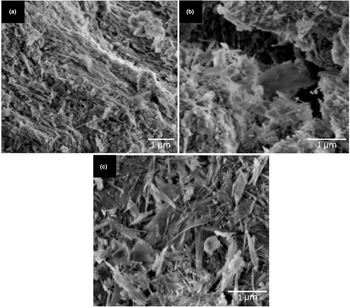
The SEM images of the beneficiated palygorskite, beneficiated/heat-treated palygorskite and raw palygorskite show fibrous and needle-like crystals typical of nano-palygorskite (Fig. 2). The lengths of palygorskite fibres, which range from 20 to 100 nm, also confirm the nanometric dimensions of the mineral. The fine, needle-like, fibrous morphology is similar to that reported for palygorskites from around the world (Aqrawi, Reference Aqrawi1993; Romero et al., Reference Romero, Barrios and Revuelta2004; Güven, Reference Güven2009; Middea et al., Reference Middea, Fernandes, Neumann, Gomes and Spinelli2013). After beneficiation, the sample contains fewer impurities compared to raw palygorskite. Because of its particular morphology and surface properties, palygorskite has been the subject of much attention for the adsorption of cations and other molecules on its surface. In addition, the three-dimensional fibrous structure prevents the clay from swelling when it is dispersed in water, as is observed in other 2:1 clay minerals (Romero et al., Reference Romero, Barrios and Revuelta2004).
SEM images of palygorskite (a) after beneficiation and (b) after heat treatment and (c) of raw palygorskite.

Thermal activation of palygorskite is often used to increase its porosity and improve its surface activity and adsorption properties. Various types of water exist in palygorskite channels, which are removed selectively by heat treatment at various temperatures, modifying the pore, structure and surface properties. Thermal activation may also disrupt Si–O–Si (or M–O–M) bonds, which may improve ion-exchange capacity. More specifically, heat treatment influences the specific surface area and CEC of clay minerals, which are both important for the determination of adsorption capacity (Wang & Wang, Reference Wang, Wang, Wang and Wang2019). Figure 2b shows SEM images of the palygorskite after heating for 4 h at 350°C. Heating partially dehydrated the palygorskite through the removal of coordinated water without any structural changes, which is in accord with the XRD and FTIR results. The temperature of 350°C was selected after the thermal analysis because at this temperature the crystal structure of the palygorskite did not collapse.
Textural analysis (BET model)
The BET-specific surface area provides important information about the surface texture of materials after N2 adsorption at 77 K. As the adsorbate–adsorbent interaction is closely related to surface area, the greater the BET area, the more active adsorption sites are available and the greater the material's adsorption capacity. The specific surface area of the palygorskite sample was 142 m2 g–1, which is in accordance with the value reported by Galán (Reference Galán1996).
Thermal analysis
The thermal decomposition behaviour of palygorskite was studied using thermogravimetric (TG) curves to identify variations in thermal stability (Middea et al., Reference Middea, Fernandes, Neumann, Gomes and Spinelli2013). Figure 3 shows the TG curves of the beneficiated palygorskite and the beneficiated/heat-treated palygorskite.
TG curves of (a) beneficiated palygorskite and (b) beneficiated/heat-treated palygorskite.

The TG curves of the samples can be separated into three regions (Fig. 3): (1) a low-temperature region (<120°C) with an endothermic event at ~64°C due to the release of physically adsorbed water; (2) a region with an endothermic event at 165°C associated with the loss of weakly bonded zeolitic water adsorbed on the palygorskite surface; and (3) a region with an endothermic event at 439.64°C associated with structural water.
A comparison of the thermograms of the palygorskite samples with and without heat treatment shows that heat-treated palygorskite exhibited less mass loss because of the partial loss of adsorbed water prior to thermal analysis.
Cation-exchange capacity
The CEC is greater in the beneficiated palygorskite samples than for the raw palygorskite (Table 2). This result is compatible with previous work (Middea et al., Reference Middea, Fernandes, Neumann, Gomes and Spinelli2013; Xavier et al., Reference Xavier, Santos, Osajima, Luz, Fonseca and Silva Filho2016) and consistent with the XRD results, which demonstrated enhanced reflections for palygorskite and diminished reflections of mineral impurities. These impurities decrease the CEC of palygorskite. The beneficiation of palygorskite removed impurities, as indicated in the XRD results, improving its CEC compared to that of the raw palygorskite.
CECs of raw and beneficiated palygorskite.

FTIR spectroscopy
Figure 4 shows the FTIR spectra of the beneficiated palygorskite and the beneficiated/heat-treated palygorskite.
FTIR spectra of (a) beneficiated palygorskite and (b) heat-treated palygorskite.

The FTIR spectrum of the beneficiated palygorskite has characteristic bands of hydroxyl groups, coordinated with Mg, between 3620 and 3548 cm–1, stretching and deformation bands of zeolitic water at 3423 and 1655 cm–1, respectively, and Si–O stretching bands at 1033–913 cm–1 (Fig. 4) (Madejová et al., Reference Madejová, Jankovi, Pentrák and Komadel2011). The heat-treated samples demonstrated less intense bands at 3519, 3548 and 2926 cm–1, related to the vibrations of water.
Surface charge (ζ-potential)
The ζ-potential was measured to determine the surface charge of beneficiated palygorskite at pH 1.5–12.0. The samples had negative ζ-potentials (–10 to –40 mV) regardless of the pH level.
Adsorption curves of the solvatochromic dyes in beneficiated palygorskite
The adsorption isotherms of the solvatochromic dyes were used to evaluate the correlation between dye concentration in the solvent and that of the dye adsorbed on palygorskite and the maximum adsorption capacity. The parameters for each isotherm model used are given in Table 3.
Parameters of the isotherms for the adsorption of the three dyes on palygorskite.

a Weight (g) of dye adsorbed by weight (g) of adsorbent.
b Units: Langmuir, mL g–1; Sips, mLn g–n.
Calibration curves were used to correlate the absorbance data (mAU) with the concentration data (g L–1) obtained from UV–Vis flow analysis. The calibration and adsorption curves expanded along the same concentration range. The analytical curves were linear with R 2 ≥ 0.989.
The adsorption isotherms for the NBC, MTB and DTZ dyes in beneficiated palygorskite are shown in Fig. 5. The Langmuir model was used to describe NBC adsorption on palygorskite. The NBC adsorption increased rapidly with increasing dye concentration. The maximum adsorption capacity was 8.19 × 10⁻² g g–1. The data fit to the Langmuir model (R 2 = 0.996), suggesting monolayer adsorption (Fig. 6).
Adsorption isotherms for (a) NBC (R 2 = 0.996), (b) MTB (R 2 = 0.969) and (c) DTZ (R 2 = 0.997) on beneficiated palygorskite samples.

TG curves of (a) DTZ and (b) NBC adsorbed on palygorskite.

The MTB adsorption on various palygorskite samples has been studied extensively in the past (Al-Futaisi et al., Reference Al-Futaisi, Jamrah and Al-Hanai2007; Chen et al., Reference Chen, Zhao, Zhong and Jin2011; Sarkar et al., Reference Sarkar, Guibal, Quignard and SenGupta2012; Dali Youcef et al., Reference Dali Youcef, Belaroui and López-Galindo2019). This dye is better adsorbed at alkaline pH levels because of the increased surface charge of the clay. Thus, MTB and NBC were adsorbed on the palygorskite surface at alkaline pH levels. The Langmuir model has also been shown to best fit the MTB data, yielding a maximum adsorption capacity of 1.28 × 10⁻² g g–1 (Fig. 5). The MTB and NBC dyes have a cationic structure at alkaline pH levels, which enables their adsorption on the palygorskite surface with a negative charge (cf. the ζ-potential results).
Unlike MTB and NBC, DTZ was adsorbed on the palygorskite in a neutral medium, which yielded more intense solvatochromic effects than the alkaline (pH = 11.0) or acidic (pH = 2.0) media. This is because DTZ is more stable at neutral pH levels. The isotherms indicate considerable affinity between DTZ and palygorskite. The experimental data were best fitted with the Sips model (R 2 = 0.997) (Fig. 6).
The analysis of the isotherm parameters shows that palygorskite is capable of adsorbing 1.28–10.20 mass% of the dyes. DTZ has the greatest affinity and MTB has the least affinity for palygorskite. Despite its greater affinity for palygorskite, DTZ is less thermally stable (Fig. 6). Compared with NBC, DTZ presented a greater total mass loss at up to 250°C. This suggests that thermal decomposition of DTZ takes place in tandem with the loss of surface and zeolitic water. Possible regeneration of palygorskite after dye adsorption was not studied.
The TG curves of the beneficiated palygorskite and the palygorskite with DTZ and NBC adsorption are similar (cf. Figs 3 & 6). The TG curve of DTZ was completed at 250°C because the dye's melting point (decomposition) is ~170°C. The melting point of NBC is >300°C.
TEM and thermal analysis after dye adsorption
The TEM images show that the dye was distributed heterogeneously, forming uncoated, partially coated and homogeneously coated palygorskite fibres (Fig. 7). Due to its crystal structure, which imparts hydrophilicity, moderately high CEC and the presence of nanopores with a large surface area, palygorskite has the capacity to adsorb organic molecules. Natural palygorskite is an efficient adsorbent of cationic dyes or molecules such as antibiotics (Al-Futaisi et al., Reference Al-Futaisi, Jamrah and Al-Hanai2007; Wang & Wang, Reference Wang, Wang, Wang and Wang2019). In particular, dyes have strong affinity to palygorskite (Al-Futaisi et al., Reference Al-Futaisi, Jamrah and Al-Hanai2007; Giustetto & Wahyudi, Reference Giustetto and Wahyudi2011; Guggenheim & Krekeler, Reference Guggenheim, Krekeler, Galàn and Singer2011). The TEM images suggest that NBC was adsorbed on the surface of the palygorskite without affecting the clay mineral structure. The NBC dye has a red color before adsorption on the palygorskite. The red colour of the dye turned to blue after adsorption on palygorskite. The NBC dye has a predominantly blue colour when dispersed in polar media and a red colour in media containing non-polar solvents. As described in the ‘Materials and methods’ section, during preparation of the solvatochromic dyes, the NBC dye was prepared at basic pH, the colour of which is red when adsorbing on the palygorskite; the colour turned blue, indicating a more acidic surface of the palygorskite (Tajalli et al., Reference Tajalli, Gilani, Zakerhamidi and Tajalli2008; Galgano et al., Reference Galgano, Loffredo, Sato, Reichardt and El Seoud2012; Santos et al., Reference Santos, Cavalcanti, do Carmo, de Souza, Soares, de Souza and d'Avila2020).
TEM images of (a) beneficiated palygorskite and (b) beneficiated palygorskite with adsorbed NBC.

Summary and conclusions
A palygorskite from the Guadalupe region, north-eastern Brazil, was characterized thoroughly and was subsequently processed to remove quartz and kaolinite impurities. Comparison of the beneficiated and beneficiated/heat-treated palygorskite did not show significant differences. The treatments did not cause structural or morphological modifications associated with the release of water from the channels.
The adsorption capacities of the palygorskite for NBC and MTB (fitted with the Langmuir isotherm model) and DTZ (fitted with the Sips model) were estimated at 0.082, 0.013 and 0.102 g g–1, respectively.
The NBC and MTB dyes were best adsorbed at alkaline pH levels because these dyes have a more sensitive colorimetric response. The surface charge of palygorskite was negative regardless of the pH level. The analysis by CEC and surface charge (ζ-potential) showed that the palygorskite has a negative surface charge regardless of the pH value. The dyes (NBC and MTB) have a cationic structure in alkaline pH and, therefore, are easily adsorbed on the surface of the palygoskite. In contrast, DTZ was best adsorbed at neutral pH level, as it is present in keto and enol tautomeric forms in organic solvents, making its neutral form the most stable form, as was shown by the adsorption curves.
Supplementary material
To view supplementary material for this article, please visit https://doi.org/10.1180/clm.2021.16.
Acknowledgements
The authors are grateful to INMETRO for carrying out the electron microscopy analyses and to the Mineral Mineralogy Center (CETEM) and the Chemistry Institute, Universidade Federal do Rio de Janeiro, for carrying out the FTIR spectroscopy analyses.
Financial support
This work was funded by the José Bonifácio University Foundation.
Conflict of interest statement
The authors declare, for due purposes, that this work did not involve any kind of conflict of interest. The authors declare that all of the authors agreed to the submission of this paper. This paper has not been published elsewhere.