Introduction
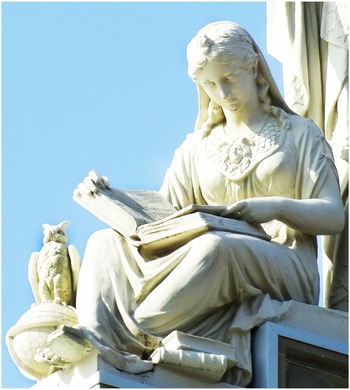
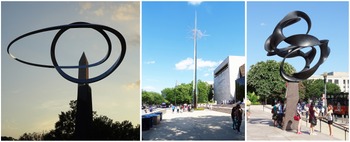
Visiting memorials of science is an entertaining and instructive way to learn about a city and about science. Washington, DC is rich in museums and other institutions that present memorials of science and scientists, and some that are mentioned in this Introduction are iconic (Figures 1 and 2).
‘Science’, symbolized by a girl reading a book, alongside an owl, by Caspar Buberl (1881), at the top of the Arts and Industries Building of the Smithsonian Institution, 900 Jefferson Drive SW.

From left to right: ‘Infinity’ by Jose de Rivera, 1967, in front of the National Museum of American History at 14th Street & Constitution Avenue NW; and two sculptures at the Air and Space Museum, 6th Street & Independence Avenue SW. In the front of the museum, ‘Ad Astra’ by Richard Lippold (1946), and behind the museum, ‘Continuum’ by Charles O. Perry, based on the twists of the Möbius strip with a void in the centre representing a black hole.

In addition to the institutions mentioned in Figures 1 and 2, we note that the National Portrait Gallery (jointly with the Smithsonian American Art Museum), Eighth and F Streets NW, is a rich depository of paintings and busts of scientists, inventors, and related contributors to science, technology, and the betterment of human life and the environment.
The Capitol
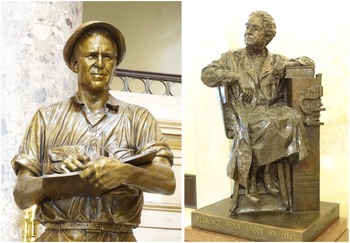
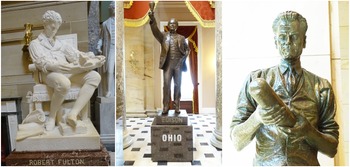
The National Statutory Hall Collection at the Capitol is a special venue for commemoration with its 100 statues. Every state has contributed two statues honouring notable persons in their history (currently Virginia has only one, so the total number of statues is 99). There are some scientists, innovators, and educators among them. Two examples are presented in Figures 3 and 4.
Left: Statue of Norman Borlaug (detail) in the Statuary Hall, by Benjamin Victor (2014). Right: Florence R. Sabin’s statue in the Hall of Columns, by Joy Buba (1959).

Left: Statue of Robert Fulton in the National Statuary Hall by Howard Roberts (1889). Middle: Statue of Thomas Alva Edison in the National Statuary Hall by Alan Cottrill (2016). Right: Statue of Philo T. Farnsworth (detail) at the Capitol Visitor Center by James R. Avati (1990).

Norman E. Borlaug (1914–2009; Figure 3, left) originated from a farmer family in Iowa, and already projected an unusual path when he obtained a bachelor’s degree and a master’s degree (1940) and, finally a doctorate in plant pathology and genetics (1942) from the University of Minnesota. His youthful experience of seeing hunger around him during the Great Depression pushed him to work to feed the hungry. His mutation techniques of adapting crops to specific climate conditions led to a dramatic increase in crop yields of wheat in broad areas of third-world countries. He received numerous awards and other expressions of recognition. Three of them are represented by three medal replicas on the pedestal of his statue, namely, the Nobel Peace Prize, the Presidential Medal of Freedom, and the Congressional Gold Medal. His statue is a gift from Iowa.
Florence R. Sabin (1871–1953; Figure 3, right) was among the first women MDs to graduate from Johns Hopkins University, where she stayed on and, by 1917, had risen to become the first female full professor in an American medical school, with the title of Professor of Histology. In 1925, she was elected a member by the National Academy of Sciences of the USA and was the first woman scientist bestowed with such an honour. In the same year, she was appointed Head of the Department of Cellular Studies at the Rockefeller Institute (as it was then) of Medical Research. She was the first woman appointed full member of the Institute. Her main research was in the pathology of tuberculosis. She studied the responses of the immune system to the tuberculosis bacteria. She retired from the Rockefeller Institute in 1938 and moved back to her native Colorado, where she did a great deal to improve the state’s public health system. Her statue depicts a lifelike Sabin with a book and a microscope. Her statue is a gift from Colorado.
Robert Fulton (1765–1815; Figure 4, left) was an engineer and inventor, and he developed steamboats. He has statues and other memorials in New York. Beneath his bust at the Bronx Hall of Fame there is a quotation: ‘To direct the genius and resources of our country to useful improvements, to the sciences, the arts, education, the amendment of the public mind and morals, in such pursuit lie the real honor and the Nation’s glory.’ His statue is a gift from Pennsylvania.
Thomas Alva Edison (1847–1931; Figure 4, middle) was one of the world’s greatest inventors. He was born in Ohio, grew up in Michigan and New Jersey, and Florida and New York became the principal venues of his activities. Quite a number of future big-name inventors worked for shorter or longer periods in his employment. His statue is a gift from Ohio.
Philo T. Farnsworth (1906–1971; Figure 4, right) was interested in electricity from a young age and designed and built electric motors and even a washing machine. He pioneered an early television system in 1927 and has been called ‘the father of television’. He shares this unofficial title with the Russian-born American inventor, Vladimir K. Zworykin. Farnsworth lost a crucial patent battle with the electronics company RCA (Radio Corporation of America), but many of his patented inventions still went into television receivers. His numerous other patented inventions contributed significantly to the development of radar, the electron microscope, infrared night light, astronomical telescopes, and other profoundly important tools of modern life. His statue is a gift from Utah.
There are also statues of a number of physician innovators representing states, not shown here. Ephraim McDowell (1771–1830) of Kentucky advanced the technique of abdominal surgery, no small accomplishment at the time when surgeries were carried out without anaesthesia. John Gorrie (1803–1855) of Florida was a pioneer of air conditioning and lowered the temperature of his feverish patients. Crawford Long (1815–1878) of Georgia discovered the anaesthetic effect of ether while experimenting with it in surgery.
Albert Einstein and the National Academy of Sciences
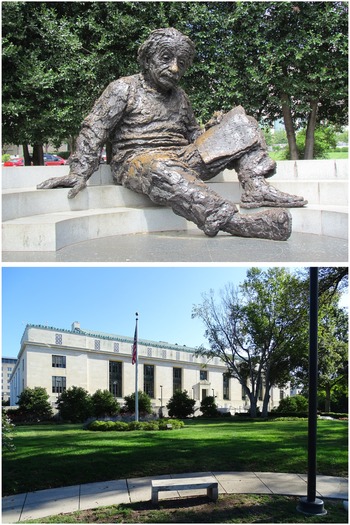
The United States Congress chartered the National Academy of Sciences of the USA (NAS) as an independent institution in 1863 at the time of the American Civil War. Its headquarters were located for a long time at the Smithsonian Institution. Its new headquarters opened in 1924 at its current location, where its magnificent building and the Albert Einstein Memorial (Figure 5, top) form a unified memorial to science. The headquarters serve as the executive offices of NAS (Figure 5, bottom).
Top: Statue of Albert Einstein by Robert Berks (1979), at the southwest corner of the grounds of the National Academy of Sciences; bottom: Headquarters of the National Academy of Sciences, 2101 Constitution Avenue NW.

The architect of the NAS Headquarters was Bertram C. Goodhue, and Lee Lawrie designed the exterior and the interior. Lawrie and Goodhue are depicted as the Roman god Janus on the Constitution Avenue entrance. Lawrie designed the decorations of the eaves of the building, consisting of a repeating pattern of a lynx for observation, an owl for wisdom, and a serpent for medicine. When, in the 1960s, an east wing and a west wing were added to the original building, they blended in so well they can be hardly distinguished from the original building.
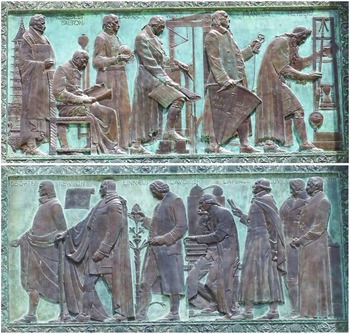
There are six low-relief bronze panels located between the windows on the front façade of the building: three positioned to the left of the entrance and three to the right of the entrance. Each panel depicts six scientists (except for the middle right, which depicts seven). Their order is: extreme left–middle left–centre left–centre right–middle right–extreme right. The middle left and the middle right panels are depicted in Figure 6. The scientists represented by each panel are listed here:
-
Extreme left: Galton, Gibbs, Helmholtz, Darwin, Lyell, Faraday.
-
Middle left (Figure 6, top): Humboldt, Dalton, Lamarck, Watt, Franklin, Huygens.
-
Centre left: Galileo, Leonardo, Hipparchus, Euclid, Democritus, Thales.
-
Centre right: Hippocrates, Aristotle, Archimedes, Copernicus, Vesalius, Harvey.
-
Middle right (Figure 6, bottom): Descartes, Newton, Linæus, Lavoisier, Laplace, Cuvier, Gauss.
-
Extreme right: Carnot, Bernard, Joule, Pasteur, Mendel, Maxwell.
Two of the six bronze relief panels by Lee Lawrie. Top: the middle left panel; bottom: the middle right panel

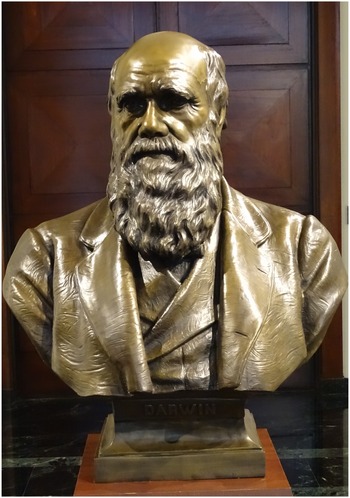
The lobby of the headquarters of the National Academy of Sciences on Constitution Avenue is open to visitors and has a rich assemblage of pieces of art; only a couple of which are mentioned here. William Couper created Charles Darwin’s bust in 1909 for the New York Academy of Sciences to be given to the American Museum of Natural History as part of the celebration of the Darwin Centennial. Sometime in the 1960s, the Museum returned it to the New York Academy of Sciences. The Darwin bust at NAS is one of its copies (Figure 7). There is an extended painting ‘The Genius of Electricity’, also a copy, perhaps a modified version of the original, which is at the Museum of Modern Art in Paris. It is more a representation of scientific progress than a mere display of those involved directly with the story of electricity. A total of 109 scientists and inventors are depicted in it.
Bust of Charles Darwin by William Couper.

The Keck Center at 500 5th Street NW serves as the offices of the large workforce of the three national academies: NAS, the National Academy of Engineering (NAE), and the National Academy of Medicine (NAM). During the First World War, the National Research Council was created, at first temporarily, then as a permanent institution to further the application of science for the national security and welfare. The kinetic sculpture, ‘Slow Rondo’, on the exterior of the Keck Center has a wind-driven mechanism, which is meant to represent the unity of the micro and macro worlds both being equally the concern of the national academies.
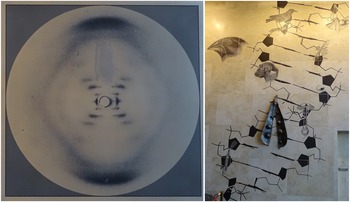
The spacious entrance lobby of the Keck Center is open to visitors. Its murals are symbolic representations of achievements of the sciences, medicine, and engineering. They include contributions from ancient times to the present. It is called, informally, a visual encyclopaedia, and only two of its large collection of discoveries and inventions are presented here, in Figure 8. The two are interrelated images: the X-ray diffraction pattern of DNA (Figure 8, left) which by itself suggests a double-helical structure and a schematic representation of a portion of the DNA double helix (Figure 8, right).
Two components of the murals by Larry Kirkland in the lobby of the Keck Center. Left: Rosalind Franklin and Raymond Gosling’s ‘Photograph 51’ of the X-ray diffraction pattern of DNA. Right: A schematic representation of the double helix structure (detail).

Electric Power
Electricity and its history is amply represented among the memorials. It appears symbolically at Union Station (Figure 9, left). There are then the low-relief stone carvings, by sculptor Carl Mose, on the façade of the Old Potomac Electric Power Company Building (Figure 9, right). It was built in 1929–1930 in art-deco style. There are a total of 18 panels, including four representing symbols and 14 depicting 25 scientists and inventors.
Left: The statue of the Roman god Thales, representing Electricity, by Louis Saint-Gaudens (1908), at Union Station, Massachusetts and Delaware Avenues NW. Right: The Old Potomac Electric Power Company Building, architect Waddy B. Woods (1929), at Tenth and E Streets NW.

The Tenth Street panels, from left to right: start with a panel representing Vesta and Vulcan. The rest show individuals in pairs, from left to right: Thales and Aristotle; Alexander Neckham and William Gilbert; Otto von Guernicke and Stephen Gray; Ewald Georg von Kleist and Benjamin Franklin; and Alessandro Volta and Humphrey Davy.
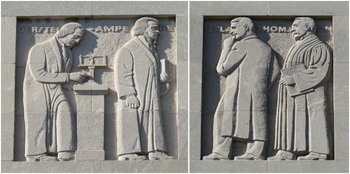
The E Street panels show scientists and allegories, from left to right: Hans Christian Ørsted and André Marie Ampère (Figure 10, left); Georg Simon Ohm and William Sturgeon; Michael Faraday; William Stanley and Robert W. Bunsen; Thomas Alva Edison; light; knowledge; Charles Proteus Steinmetz; Nikola Tesla and Elihu Thomson (Figure 10, right); George Westinghouse and Frank Julian Sprague; Alexander Graham Bell and Samuel F.B. Morse, concluded by another symbol. The representation was very up-to-date as five of the 25 individuals depicted were contemporaneous with the erection of these memorials: Edison, Steinmetz, Tesla, Thomson, and Sprague. Unfortunately, the panels are high up, above the windows of the eighth floor, hence their images on the photographs taken from the street are somewhat compressed, but their identification is still unambiguous.
Two of the low-relief panels narrating the history of electric power. Left: Hans Christian Ørsted and André Marie Ampère. Right: Nikola Tesla and Elihu Thomson.

Physicists at George Washington University
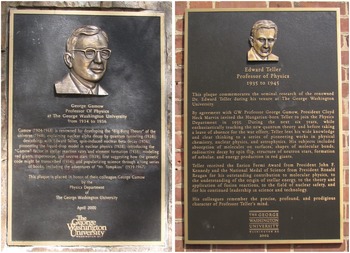
By the mid-1930s, George Washington University (GWU) had established a prestigious law school and medical school. The president of the university, Cloyd H. Marvin, wanted to create a similarly outstanding physics department, for which he had accumulated $100,000, an exorbitant sum at the time. However, even this much money would suffice only to build up modern theoretical physics rather than experimental physics. He invited George Gamow (1904–1968; Figure 11, left) in 1934, the internationally renowned Russian physicist who had recently escaped from the Soviet Union. Gamow needed a partner, hence the invitation to Edward Teller (1908–2003; Figure 11, right) followed. The Hungarian Teller had to leave Germany following the Nazi takeover and, in 1935, at the age of 27 was appointed Professor of Physics at GWU.
Memorial plaques at George Washington University commemorating physics at GWU in the late 1930s. Left: George Gamow. Right: Edward Teller.

Gamow and Teller together made seminal discoveries in nuclear physics. In addition, in order to invigorate scientific life, they initiated an annual conference in theoretical physics in Washington, DC. They selected a central topic for each meeting and many of the best physicists, internationally, participated. They chose low-temperature physics and superconductivity for the fifth meeting in 1939, but current events changed the agenda. On 29 January 1939, one of the star participants from Europe, Niels Bohr, made a surprise announcement in the Hall of Government, Room 209. It was about the discovery of nuclear fission, observed experimentally by Otto Hahn and Fritz Strassmann in Berlin and interpreted by the exile physicists Lise Meitner and Otto Robert Frisch. This discovery eventually led to the Manhattan Project and to the atomic bombs and the possibility of energy production in nuclear power stations. A tablet outside Room 209 commemorates the event and the names of those present (Figure 12).
Remembering Niels Bohr’s announcement on 29 January 1939, about the discovery of nuclear fission at George Washington University.

Individuals
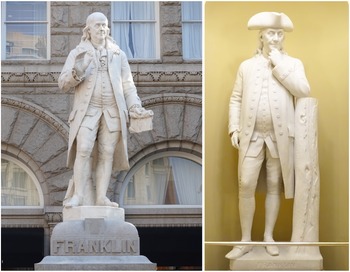
Benjamin Franklin (1706–1790; Figure 13) was a scientist and inventor, and much more. He was born a British citizen in Boston and became an American statesman, one of the Founding Fathers of the United States. He was also a scientist, and showed the electrical nature of lightning in his famous experiment when, in a storm, he used a conducting kite to access current from a lightning bolt. He has a number of memorials in Washington, New York, London, and elsewhere. One of them is at the Capitol, but it is not part of the collection of the statues donated by the states (see above).
Two statues of Benjamin Franklin. Left: By Jacques Jouvenal (1889), after the design of Ernest Plassman, at Pennsylvania Avenue and Twelfth Street NW. Right: By Hiram Powers, in the Hall of Columns at the Capitol.

Louis Daguerre (1787–1851; Figure 14) was a French artist and a pioneer of photography. He was a designer for the theatre, and invented the diorama. He assisted Nicéphore Niépce (1765–1833) in making the first permanent camera photographs. They coated a surface with bitumen, which hardened where exposed to light and the unhardened domains were washed off with a solvent. The extremely long exposure made the procedure impractical. Daguerre continued the work after Niépce’s death and developed the so-called daguerreotype. He produced a light-sensitive silver iodide coating for paper. When this coating was exposed to light, an image could be obtained, again, after a long exposure. At this point, Daguerre made his decisive discovery that even a much shorter exposure produces an invisible image on the coating, which then could be ‘developed’ chemically into a visible image, which needed to be ‘fixed’ to prevent any further impact by light. Because Daguerre could not interest private investors in his invention, he went public with it in 1839. It was presented with great success at the joint session of the French Academy of Sciences and the Académie des Beaux Arts. The French government offered Daguerre and Niépce’s son a lifetime pension and the world the invention for free use.
Memorial of Louis Daguerre by Jonathan Scott Hartley (1890), in the garden of the building housing the American Art Museum and the National Portrait Gallery, 7th Street NW.

Joseph Henry (1797–1878; Figure 15) originated from a family struck by poverty, and was brought up by his grandmother. He taught mathematics and natural philosophy (physics in today’s terms) at the college preparatory boys’ school, The Albany Academy. He experimented with magnetism and with electromagnetism. In 1831, he pioneered a machine that used electromagnetism for generating motion. He made discoveries including some in parallel with, but independent of, Michael Faraday. He found practical applications for electromagnetism. He invented a bell that could be rung from a distance via an electric wire. His electromagnetic relay helped the establishment of the electrical telegraph, invented by two independent individuals, Samuel F.B. Morse and Sir Charles Wheatstone. Henry conducted and supported research about various phenomena of the sun and in aeronautics and Alexander Graham Bell’s invention of the telephone. He is commemorated by the Joseph Henry Laboratories at Princeton University and the unit of inductance is the henry, H, in the SI system.
Memorial of Joseph Henry by William Wetmore Story, 1883, in front of the Smithsonian Institution Building, the ‘Castle’, Jefferson Drive SW, The Mall.

Henry was the inaugural Chair of Natural History at the College of New Jersey – now, Princeton University. In 1846, he became the first Secretary of the Smithsonian Institution. He supported original research. He organized weather reporting, relying on telegraphic transmission, and he introduced innovations for lighthouses. He organized the American Association for the Advancement of Science and was elected its first president in 1849. For ten years he served as President of the National Academy of Sciences. During the Civil War, he organized lectures by noted abolitionists at the Smithsonian Institution, although refused to allow the former fugitive slave Frederick Douglass to speak. Henry has another statue in the rotunda of the Library of Congress, along with Isaac Newton’s statue.
John Ericsson (1803–1889; Figure 16) was born and brought up in Sweden, and showed early talent for tinkering with mechanical devices and constructing machinery. In 1836, he invented the screw propeller for steam vessels. In 1839, he moved to the United States and was engaged in shipbuilding and innovation. He built efficient vessels for the Union forces during the Civil War. In his later years, he carried out research with solar energy and envisioned its practical application. He has another statue, by Jonathan Scott Hartley (1903), in Battery Park, Manhattan.
Memorial of John Ericsson by James Early Fraser (1926), at the intersection of 23rd Street, Ohio Drive, and Independence Avenue, SW, near the Lincoln Memorial and the Arlington Memorial Bridge.

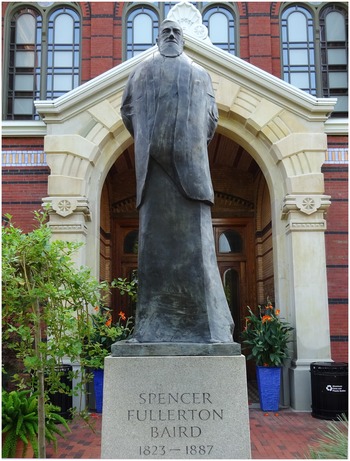
Spencer Baird (1823–1887; Figure 17) was a naturalist studying birds, mammals, reptiles, and fish. He did a great deal of organizational work, founding museums and commissions. Among others, he founded the US National Museum in 1878. Before his functions in Washington, which included the position of secretary of the Smithsonian Institution, he was Professor of Natural History at Dickinson College in Pennsylvania. When he moved to Washington, he brought with him his enormous natural history collection, which formed the nucleus of the National Museum.
Statue of Spencer Baird by Leonard Baskin (1978), in Haupt Garden, on the south side of Smithsonian’s ‘Castle’.

Guglielmo Marconi (1874–1937; Figure 18) was an Italian electrical engineer and world-famous inventor. He is best known for his inventions of long-distance radio transmission. He and Karl Ferdinand Braun (1850–1918) jointly received the 1909 Nobel Prize in Physics ‘in recognition of their contributions to the development of wireless telegraphy’. Casa Italia was created in 1981 for a social and cultural meeting place for Italians living in Washington. There are four statues on its front façade: Giuseppe Verdi, Dante Alighieri, Michelangelo Buonarotti, and Guglielmo Marconi. Verdi was chosen for music, Dante for literature, Michelangelo for sculpture, and Marconi for inventions. The statue at Casa Italia was preceded by the Marconi Memorial at 16th and Lamont Streets NW, for which public collection started one year after the inventor’s death; within three years the memorial was unveiled.
Two memorials of Guglielmo Marconi. Left: Detail, by Nicoli Sculpture Studios, Carrara, Italy, on the façade of Casa Italia, 595½ Third Street NW. Right: By Attilio Piccirilli, 1941, at 16th and Lamont Streets NW.

Samuel Hahnemann (1755–1843; Figure 19) was a German medical doctor who had the idea that diseases could be cured by substances that, when administered to healthy persons, caused similar symptoms to the actual disease. Further, he taught that much smaller doses of drugs should suffice than the customary doses. His teachings are referred to as homeopathy, which became very popular, first in Europe, then, transmitted by immigrant German physicians, in the United States as well. It was at the height of its popularity when the American Institute of Homeopathy had this monument erected in Washington. The American Medical Association has denounced homeopathy and fought it consistently.
Statue of Samuel Hahnemann by Charles Henry Niehaus (1900), at Scott Circle, Massachusetts Avenue and 16th Street NW.

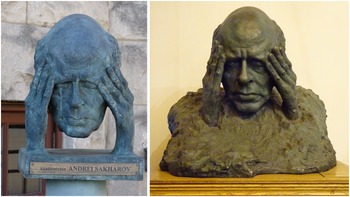
Andrei D. Sakharov (1921–1989; Figure 20; Hargittai, Reference Hargittai2022) was one of the foremost physicists of his time and a fearless human rights activist in the Soviet Union. His memorial stands in front of Russian House in Washington, DC. A similar memorial by the same sculptor is at the Sakharov Centre in Moscow.
Memorials of Andrei D. Sakharov by Peter Shapiro. Left: At 1800 Connecticut Avenue NW in Washington, DC. Right: At the Sakharov Centre, 57 Zemlyanoi Val Street in Moscow.

Concepts
Education
The bas-relief carvings on the red granite panels of the office to the General Accountability Office are supposed to be ‘generalized and impersonal and purely decorative in intent’ (Goode Reference Goode2008, p. 263). This comment made us note, when looking at the two panels depicted in Figure 21, that the left panel presents a boy and a girl with their female teacher and the right panel depicts the moment when a male university officer is handing over the diploma to a male graduate.
Two scenes depicting education in two adjacent bas-relief panels by Joseph Kiselewski (1951), at the entrance to the General Accountability Office.

Howard University is a pre-eminent historically Black private institution of higher education. It was founded in 1867 and has held a commitment to provide education to the disadvantaged in the United States and internationally. Pieces of abstract art by Richard Hunt express the Black experience in America (Figure 22 shows one of them).
‘Freedmen’s Column’ by Richard Hunt (1989), at Cramton Auditorium, Howard University.

On the back façade (the south side) of the beautiful Founders Library (1937), there is a marble panel displaying a profound testimonial about books:
Books are voices
from past ages
Records of the present
Heralds of the future
Torches to the
unenlightened
Common bond of
cultured men
Trusted friends
Developing the mind
Restoring the spirit
Enter thou into
this company
and seek truth
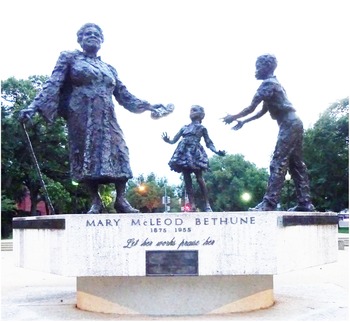
Mary MacLeod Bethune (née McLeod, 1875–1955; Figure 23) was born into a former slave family in South Carolina, and became an outstanding contributor to education, public life, philanthropy, the women’s movement, and civil rights activism. First, she acquired her own education, then, she started a school for African American girls in Florida. Eventually, she developed it into a college and university and she was one of the first female college presidents in the United States. Recently, her statue was unveiled in the Statuary Hall of the Capitol, replacing the statue of a Confederate general as one of Florida’s two representatives in the National Statuary Collection.
Memorial of Mary McLeod Bethune by Robert Berks (1974) in Lincoln Park, East Capitol and Twelfth Streets NE.

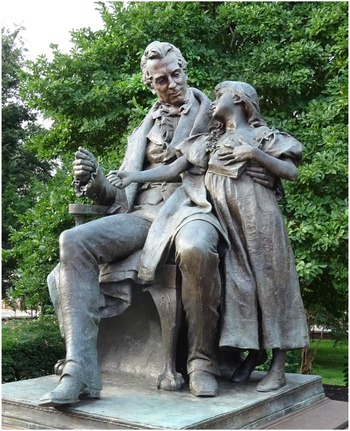
Thomas Hopkins Gallaudet (1787–1851; Figure 24) was an American educator, a graduate of Yale University. His path to the education of the deaf began when, in 1814, he encountered the 9-year-old deaf girl, Alice Cogswell. He learned the methods of communication with the deaf in Europe and, upon his return to the United States, he co-founded the first institution for the education of the deaf in the country. Gallaudet University was named after him in 1894. There is also a statue of Edward Miner Gallaudet by Pietro Lazzari, 1969, on the campus. He was Thomas Hopkins Gallaudet’s son and long-time president of the university.
Statue of Thomas Hopkins Gallaudet and his first pupil, Alice Cogswell, by Daniel Chester French (1889), on the campus of Gallaudet University, Florida Avenue and Eighth Street NE.

Energy
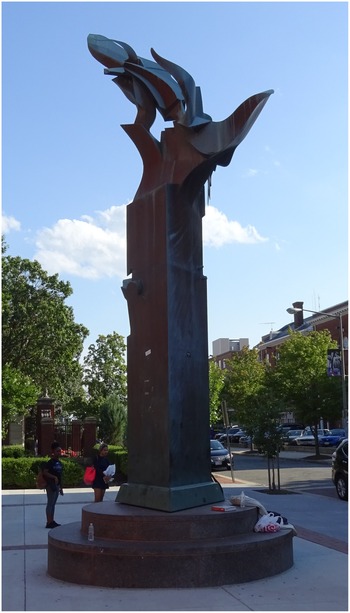
Bia, the god of power, force, and might in Greek mythology, may thus be considered the god of energy. The sculpture, ‘Chthonodynamis’ (Figure 25) might suggest that she is embracing an atom, symbolizing nuclear energy. The location of this monument is apt, not just because it is the Department of Energy, but also because its forerunner was the Atomic Energy Commission. American physics was not in the forefront of physics during the first third of the twentieth century, but by the time the Second World War was over, it had become a world leader in nuclear physics and, accordingly, nuclear energy.
‘Chthonodynamis’ by Robert I. Russin (1992), at the Department of Energy, James V. Forrestal Building, 1000 Independence Avenue SW.

Protecting and Conserving the Environment
Theodore Roosevelt (1858–1919; Figure 26) was President of the United States, 1901–1909, and his presidency gave a big push to the conservationist movement. During his tenure, 18 natural wonders were preserved by law, including the Grand Canyon, and the reserves of national forest tripled. He was called the conservationist president, which is a label most recent presidents would be proud to have. One of the four stone panels (behind the statue) is devoted to ‘Nature.’ Among others, it says: ‘The Nation behaves well if it treats the natural resources as assets which it must turn over to the next generation increased and not impaired in value. Conservation means development as much as it does protection.’ Theodore Roosevelt was the first American recipient of a Nobel Prize; he received the Peace Prize in 1906 for his efforts to end the 1905 Russo-Japanese War.
Statue of Theodore Roosevelt by Paul Manship (1967), Roosevelt Island.

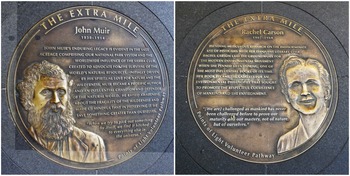
The ‘Extra Mile’ is a memorial consisting of 34 bronze pavement markers embedded in sidewalks, stretching one mile along Pennsylvania Avenue, 15th Street, G Street, and 11th Street NW. The project was initiated by John A. Johansen in 1992 and it was dedicated in 2005. The honourees are American community leaders, activists of great causes, founders of movements for the benefit of various smaller or larger communities. They include two outstanding representatives of protecting and conserving the environment.
John Muir (1838–1914; Figure 27, left) was a British-American naturalist, activist, and author. He was a pioneer in protecting and preserving the environment and helped the establishment of national parks. His publications brought home the idea of conservationism for many Americans. He was a co-founder of the Sierra Club.
Pavement markers on The Extra Mile. Left: John Muir. Right: Rachel Carson.

Rachel Carson (1907–1964; Figure 27, right) started her career as a science writer and combined her literary acumen with scholarship. She observed the damage to the environment through the overuse of DDT and other pesticides and published Silent Spring, which has become a touchstone for the modern environmental movement.
Acknowledgements
We thank Eszter Hargittai for multifaceted assistance and Alban Kellerbauer for critical reading of our manuscript, and both for useful suggestions.
Note
All images in this essay are photographs by and copyright Istvan and Magdolna Hargittai.
About the Authors
Istvan Hargittai is Professor Emeritus (active) at the Budapest University of Technology and Economics. He is a member of the Hungarian Academy of Sciences and the Academia Europaea (London) and a foreign member of the Norwegian Academy of Science and Letters. Among his distinctions are honorary doctorates of Lomonosov Moscow State University, the University of North Carolina, and the Russian Academy of Sciences. He is the author of Martians of Science, Buried Glory, Mosaic of a Scientific Life, and numerous other books.
Magdolna Hargittai is Research Professor of Structural Chemistry, Budapest University of Technology and Economics. She is a member of the Hungarian Academy of Sciences, the Academia Europaea (London), and the European Academy of Sciences (Brussels), and has an honorary doctorate from the University of North Carolina. She is author of Women Scientists and Meeting the Challenge: Top Women in Science, and co-author, with Istvan Hargittai, of Budapest Scientific, New York Scientific, Science in Moscow, and Science in London.