Introduction
Sea urchins of the genus Echinometra have a pan-tropical distribution across the Pacific, Atlantic and Indian Oceans (Palumbi & Metz, Reference Palumbi and Metz1991; Moulin et al., Reference Moulin, Grosjean, Leblud, Batigny, Collard and Dubois2015). The number of valid species in this genus has been debated in the scientific literature for over 180 years (Bronstein & Loya, Reference Bronstein and Loya2013). Two species, Echinometra mathaei and Echinometra oblonga, were first described by Blainville (Reference Blainville1825). Döderlein (Reference Döderlein1906) elevated E. oblonga to a separate genus, Mortensia oblonga based on the gonad spicule morphology, but Mortensen (Reference Mortensen1943) claimed this species is a morph of E. mathaei and named it Echinometra mathaei oblonga. Kelso (Reference Kelso1970) did an extensive study on the ecological distribution and morphological characteristics of these two morphs; E. mathaei and E. mathaei oblonga in Hawaii. He strongly suggested that they were separate species, E. mathaei and E. oblonga.
Further morphological and molecular studies on Echinometra from Okinawa and the Indo West Pacific (Uehara et al., Reference Uehara, Shingaki and Taira1986; Matsuoka & Hatanaka, Reference Matsuoka and Hatanaka1991; Palumbi & Metz, Reference Palumbi and Metz1991; Arakaki et al., Reference Arakaki, Uehara and Fagoonee1998; Landry et al., Reference Landry, Geyer, Arakaki, Uehara and Palumbi2003) revealed the presence of four Echinometra species in these areas. They were distinct, but very closely related species and originally referred to as Echinometra species A, B, C and D. Studies on both morphological characteristics and genetics of these species (Motokawa, Reference Motokawa, Yanagisawa, Yasumasu, Oguro, Suzuki and Motokawa1991; Arakaki et al., Reference Arakaki, Uehara and Fagoonee1998; Landry et al., Reference Landry, Geyer, Arakaki, Uehara and Palumbi2003) asserted that E. sp. B and E. sp. D in Okinawa are indeed E. mathaei and E. oblonga, respectively. Palumbi (Reference Palumbi1996) showed that the genetic and morphological differences among these closely related tropical sea urchins were small, but their reproductive isolation was strong. As such, Echinometra makes a valuable group for studies of marine speciation. The genus Echinometra currently comprises nine species, three of them still undescribed (Bronstein & Loya, Reference Bronstein and Loya2013). As species-level taxonomy of this genus is yet to be completed, more research is needed to clarify the obscure relationship between these species.
Echinometra mathaei is an important species of this genus that has been called the world's most abundant sea urchin (Palumbi & Metz, Reference Palumbi and Metz1991) with a large geographic distribution from Hawaii and Tahiti throughout the Indo West Pacific (IWP), to the Western Indian Ocean (WIO), the Persian Gulf and the Red Sea (Clark & Rowe, Reference Clark and Rowe1971; Russo, Reference Russo1977; Price, Reference Price1983; Lawrence, Reference Lawrence1983; Palumbi & Metz, Reference Palumbi and Metz1991; McClanahan & Muthiga, Reference McClanahan and Muthiga2001). This species is ecologically important because it can control algal growth, and high densities of it can prevent recovery of fish and coral populations following a disturbance (McClanahan et al., Reference McClanahan, Kamukuru, Muthiga, Yebio and Obura1996). It has been mentioned as one of the most important bioeroder sea urchin species which can play a major role in bioerosion and herbivory on coral reefs and reduction of net accretion on these ecosystems (Downing & El-Zahr, Reference Downing and El-Zahr1987; Bak, Reference Bak1990; McClanahan & Kurtis, Reference McClanahan and Kurtis1991; Carreiro-Silva & McClanahan, Reference Carreiro-Silva and McClanahan2001; Bronstein & Loya, Reference Bronstein and Loya2014). New studies on the genus Echinometra in recent decades have revealed that some populations of Echinometra species had been previously mistaken for E. mathaei. One of these species is Echinometra sp. EZ which was identified in Zanzibar (WIO) and Eilat (Gulf of Aqaba/Eilat, northern Red Sea) by Bronstein & Loya (Reference Bronstein and Loya2013) for the first time.
Sea urchins have a significant effect on coral reefs and the intertidal zone in marine ecosystems of Iran, but the taxonomy and phylogeny of most taxa are poorly known. Therefore, the phylogenetic relationships of one of the most abundant species of Echinometra in the area were studied here to illuminate more details about it. Because of the variation in morphological criteria of Echinometra species, different molecular studies have been performed (Palumbi & Metz, Reference Palumbi and Metz1991; Palumbi, Reference Palumbi1996, Reference Palumbi1997; Landry et al., Reference Landry, Geyer, Arakaki, Uehara and Palumbi2003; Bronstein & Loya, Reference Bronstein and Loya2013; Nakano et al., Reference Nakano, Kawamura and Satoh2019). Consequently, we studied the phylogeny of this echinoid, combining molecular analysis and morphology.
Materials and methods
Sample collection and morphological measurements
Echinoids were collected from the intertidal zone of Qeshm Island (26°87′N 56°15′E) and Lengeh Port (26°18′N 54°30′E), both within the Hormozgan Province in the Northern Persian Gulf of Iran (Figure 1). Sampling was carried out in March and December 2017. A total of 15 individuals were sampled and preserved in 96% ethanol in the laboratory. The specimens were first morphologically identified according to Mortensen's criteria (1943), Clark & Rowe (Reference Clark and Rowe1971), Arakaki et al. (Reference Arakaki, Uehara and Fagoonee1998) and Bronstein & Loya (Reference Bronstein and Loya2013). The morphological characters used to identify echinoids in this study were colour of spines, colour of milled rings and skin around the peristome, shape of spicules in the gonads and the number of pore-pairs per ambulacral plate. The test size was measured by Vernier callipers after removing the spines. Measurements were performed to the nearest 0.5 mm. Spicules of the gonad were photographed under a light microscope and analysed using the software ImageJ (Abràmoff et al., Reference Abràmoff, Magalhães and Ram2004). The number of pore-pairs on ambulacral plates (10 columns per individual) was counted from the apical system to the oral plates under a dissecting microscope.
Sampling sites of Echinometra specimens in the Persian Gulf: Qeshm Island and Lengeh Port.

DNA extraction, amplification and sequencing
DNA was extracted from the gonads based on the CTAB protocol following Baker (Reference Baker1999). DNA concentrations were then assessed using a spectrophotometer UV/VIS (biophotometer, RS-232C). A fragment of the mitochondrial cytochrome c oxidase subunit I (COI) gene was amplified using the primers COΙ-F (5′-GGTCACCCAGAAGTGTACAT-3′) and COΙ-R (5′-AGTATAAGCGTCTGGGTAGTC-3′) as suggested by Lessios et al. (Reference Lessios, Lockhart, Collin, Sotil, Sanchez-Jerez, Zigler, Perez, Garrido, Geyer, Bernardi, Vacquier, Haroun and Kessing2012). These primers can amplify up to 670 nucleotides of the COI region. A polymerase chain reaction (PCR) was performed in 25 μl total volume (9.5 μl ddH2O, 12.5 μl Mastermix (Taq DNA Polymerase Master Mix Red – 1.5 mM MgCl2, Ampliqon), 1 μl of each primer (10 pmol) and 1 μl of DNA template (~7 ng μl−1)). Amplifications were conducted with the following temperature profile: an initial denaturation step at 94 °C for 3 min followed by 35 cycles of 94°C for 30 s, 55°C for 45 s and 72°C for 45 s and finished with final elongation of 10 min at 72°C. PCR products were purified using a Thermo Scientific Genomic DNA purification kit and sequenced using the forward PCR primer on a genetic analyser 3130xl sequencer using sequencing analysis software v5.2 (Applied Biosystems).
Data analysis
For analysing the sequence data, chromatograms were checked and edited manually using ChromasPro v2.6.4 (Technelysium Pty Ltd). New COI sequences were deposited in GenBank. Accession numbers of the new sequences are shown in Table 1. For comparison with the other known Echinometra species, additional sequences were obtained from GenBank (Table 2). Sequences were aligned using ClustalW and genetic distances within and among taxa were calculated using the Tamura 3-parameter model (Tamura, Reference Tamura1992) in Mega X v10.0.5 (Kumar et al., Reference Kumar, Stecher, Li, Knyaz and Tamura2018). The phylogenetic tree reconstruction was drawn using both Maximum likelihood (ML) and Bayesian inference (BI) analyses. ML analysis was conducted using Mega X applying 1000 bootstrap replications. The best-fit evolutionary model identified for the ML tree was T92 + G + I, which was selected based on the results from Mega X. Bayesian analysis was performed using MrBayes v3.2.7 (Ronquist et al., Reference Ronquist, Teslenko, Van Der Mark, Ayres, Darling, Höhna, Larget, Liu, Suchard and Huelsenbeck2012) with the generalized time-reversible model GTR + I, which was identified using the Akaike Information Criterion (AIC) in MrModeltest v2 (Nylander, Reference Nylander2004). The BI analysis was conducted with two runs and four chains and sampling every 100 generations. The sampling continued until 5,000,000 generations. The first 25% of the total number of generations was discarded as burn-in and a 50% majority rule consensus tree was calculated from the remaining trees.
GenBank accession numbers of COI sequences of Echinometra sp. EZ examined in this study

Accession numbers of Echinometra species obtained from GenBank

IWP, Indo-West Pacific.
Results
Morphological observations
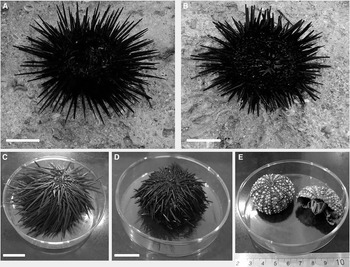
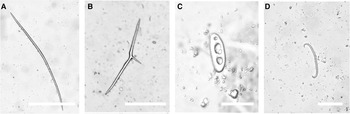
The morphological characters of specimens studied in this research included test height, test length, spine length, colour of spines, colour of milled rings and skin of peristome, and gonad spicule types (summarized in Table 3). The milled rings and the skin colour around the peristome were dark in all of the individuals from the two sampling sites. Observation of the colour of spines showed variation from dark olive (green) to black (Figure 2). The spicules found in the gonads were comprised of four spicule types categorized into needle, triradiate, bihamate (C-shaped) and figure-eight shaped (Figure 3). The gonads presented various combinations of needle spicules with the other spicule types. The percentages of pore-pairs on ambulacral plates of individuals from each sampling site and total specimens are shown in Figure 4. The five-pore-pair percentage (40–75%) was the highest, while the four-pore-pair percentage (10–50%) was the second highest in the individuals of both studied areas. Furthermore, the percentage of five-pore-pairs in the Qeshm individuals was higher than in the Lengeh ones (Figure 4).
Photographs of Echinometra specimens from the Persian Gulf. A and B represent aboral and oral sides of an individual in the sampling site, respectively; C and D: specimens with olive spine colour and black spine colour before fixation, respectively; E: test and Aristotle's lantern of an individual in the current study. Scale bars indicate 2 cm.

Spicule types in the gonads of Echinometra individuals from the Persian Gulf. A: needle spicule, B: triradiate spicule type, C: ‘figure-eight’ shaped spicule and D: bihamate spicule. The longer (A, B) and shorter scale bars (C, D) indicate 50 and 20 μm, respectively.

Pore-pairs ratios of Echinometra sp. EZ from Qeshm Island and Lengeh Port in the Persian Gulf from all individuals analysed in this study (N = 15). The values represent mean proportions ± SE (%). The figures in parentheses indicate sample sizes.

Morphological characteristics of Echinometra sp. EZ from two sampling areas in the Persian Gulf

Multiple: combination of three or more types of spicules; 8 shaped: figure-eight shaped; N: the number of individuals; SD, standard deviation.
Phylogenetic relationship
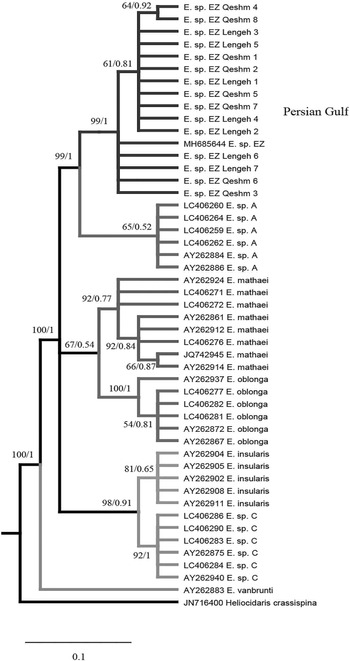
After mitochondrial DNA sequencing of our specimens and sequence alignment, a portion of the COI gene corresponding to the interval between positions 5913–6456 of Strongylocentrotus purpuratus mitochondrial genome was obtained for each individual. Additional sequences of the other Echinometra species were obtained from GenBank. However, some COI sequences of this genus which correspond to positions 6400–7100 in the Strongylocentrotus purpuratus mitochondrial genome, including the sequences of E. sp. EZ of the Bronstein & Loya (Reference Bronstein and Loya2013) study, could not be used for our analyses. We could use complete mitogenome sequences or COI sequences which contained the first fragment or two overlapping fragments of the CO1 gene. Phylogenetic reconstruction of Echinometra specimens from the two sampling sites of this study indicated that the specimens belong to Echinometra sp. EZ. As both Maximum likelihood and Bayesian inference analyses produced the same tree topologies, the phylogenetic trees were depicted in Figure 5. The results of the phylogenetic tree drawn by Bayesian inference and Maximum likelihood methods showed that individuals from the two novel sampling sites were clustered into one of the main clades of Echinometra (Figure 5), corresponding to one of the nine known species in the genus. Our sequences formed a distinct monophyletic clade with E. sp. EZ. These sequences were separated from the other species of Echinometra by high support values (BSP = 99; PP = 1) (Figure 5). The results of genetic pairwise distances of the sequences indicated that intraspecific divergence of E. sp. EZ in the current study and that from GenBank was 0.41% and intraspecific divergence of our sequences was 0.39%. Interspecific divergence values between E. sp. EZ and the other Echinometra species showed that the genetic distance between E. sp. EZ and E. sp. A (2.20%) was smaller than to the others.
Phylogenetic tree of COI sequences of Echinometra specimens analysed in the current study and sequences of Echinometra species obtained from GenBank. The phylogenetic trees were reconstructed by both Maximum-likelihood (ML) and Bayesian analysis. Heliocidaris crassispina (Echinodermata, Echinoidea) (GenBank accession number: JN716400) was used as outgroup. Support values (>50%) of 1000 bootstrap replications of the ML analysis and the posterior probabilities of the BI analysis are shown for each node, respectively.

Discussion
Based on the results of this study, our specimens were identified as Echinometra sp. EZ, which has been previously described by Bronstein & Loya (Reference Bronstein and Loya2013). The study of morphological characters indicated that most features of our specimens are consistent with previous descriptions in the only morphological study of this species (Bronstein & Loya, Reference Bronstein and Loya2013). The colour of spines of our individuals was dark olive (green) or black. Bronstein & Loya (Reference Bronstein and Loya2013) also showed that E. sp. EZ specimens exhibited various colours, including black, light or dark brown, light or dark brown-green and violet. The skin colour around the peristome of our individuals was dark which was consistent with the results of Bronstein & Loya (Reference Bronstein and Loya2013) that indicated the presence of predominant dark-skinned specimens with only a few bright-skinned ones. In addition, the milled rings of our samples were all dark and in Bronstein and Loya's (Reference Bronstein and Loya2013) study, the milled rings of E. sp. EZ individuals were determined as bright, faded or dark. The spicules in the gonads were either of the needle type or various combinations of the needle type with three other spicule types. The observations of Bronstein & Loya (Reference Bronstein and Loya2013) also revealed that in the gonads of this species, needle type spicules were always present either solely or in combinations with other spicule types. Moreover, the figure-eight shaped spicules were presented in the gonads of our specimens as observed in E. sp. EZ specimens in Bronstein & Loya's (Reference Bronstein and Loya2013) study. The results of Bronstein & Loya (Reference Bronstein and Loya2013) also indicated that in the other Echinometra species, these spicules were nearly absent. The results of the number of pore-pairs of the individuals we examined indicated the five-pore-pairs ratio was the highest in contrast to the results of Bronstein & Loya (Reference Bronstein and Loya2013) in which a four-pore-pair ratio was the highest in this species.
The small morphological differences may be due to regional differences in E. sp. EZ populations. Another reason for these differences may be related to the number of samples. In Bronstein & Loya's (Reference Bronstein and Loya2013) study, a larger number of individuals were examined in comparison to the current study, potentially capturing more intraspecific variation. Furthermore, Echinometra may exhibit high morphological plasticity and the currently available morphological keys may be limited in their ability to delineate all species within this genus (Bronstein & Loya, Reference Bronstein and Loya2013). Mortensen (Reference Mortensen1943) mentioned that E. mathaei represents extensive morphological variations in test shape and spine colour. Other studies also showed that Echinometra species exhibited various spine colours (Arakaki et al., Reference Arakaki, Uehara and Fagoonee1998; Bronstein & Loya, Reference Bronstein and Loya2013).
Results of the phylogenetic tree supported by both ML and BI analysis indicated that the sequences of our specimens formed a clearly distinct monophyletic clade with the GenBank sequence of E. sp. EZ. Based on the results of the current study, degrees of divergence of the clade containing E. sp. EZ from the other Echinometra (2.2–5.5%) are well within the interspecific range for this genus. These interspecific relationships are consistent with previous molecular studies on Echinometra species (Landry et al., Reference Landry, Geyer, Arakaki, Uehara and Palumbi2003; Palumbi & Lessios, Reference Palumbi and Lessios2005; Bronstein & Loya, Reference Bronstein and Loya2013; Nakano et al., Reference Nakano, Kawamura and Satoh2019). There are some differences in Echinometra tree topology between our analysis and previous phylogenetic studies of this genus. It can be due to a single and relatively short aim of the current study which was to define the phylogenetic relationship of only one species of Echinometra from the Persian Gulf. Both molecular data and morphological features suggest that the current Echinometra specimens from the northern Persian Gulf are E. sp. EZ. Currently, this species was only reported from Zanzibar (WIO) and Eilat in the northern Red Sea (Bronstein & Loya, Reference Bronstein and Loya2013) and from the southern Persian Gulf (Ketchum et al., Reference Ketchum, DeBiasse, Ryan, Burt and Reitzel2018). It seems that these areas share similar echinoids which are distinct from the rest of the Indo-Pacific and Atlantic sea urchins. However, further phylogenetic studies on this species and the greater Echinometra species complex, across various regions and with additional loci (including nuclear genes) are needed to illuminate the obscure relationship between species of this genus. It will be valuable for increasing our knowledge about distribution, marine speciation and species diversity of Echinometra.
Author contributions
Seyedeh Mojgan Kalantarian: Her role in this study was to carry out the research, analyse the data, interpret the findings and write the article. Bita Archangi: Her role in this study was to formulate the research questions, design the study and support as supervisor 1. Tooraj Valinassab: His role in this study was to collect the specimens from the sampling sites. Hassan Rajabi-Maham: His role in this study was to analyse the data and interpret the findings. Rahim Abdi: His role in this study was to help supervisor 1 as supervisor 2.
Financial support
This research received no specific grant from any funding agency, commercial or not-for-profit sectors.
Conflict of interest
The authors declare none.