





1 Introduction and main result
Additive representations of Waring’s problem over natural numbers by mixtures of squares, cubes and biquadrates are among the more interesting special cases for testing the general expectation that any sufficiently large natural number n is representable in the form
 $ n=x_1^{k_1}+x_2^{k_2}+\cdots +x_s^{k_s}$
, as soon as
 $\sum _{j=1}^sk_j^{-1}$
is reasonably large. With the exception of a handful of very special problems, in the current state of knowledge, this sum must exceed
 $2$
, at the very least, to successfully apply the Hardy–Littlewood method.
In 1999, Brüdern and Wooley [Reference Brüdern and Wooley1] removed a case from the list of those combinations of exponents which have defied treatment. Let
 $\nu (n)$
denote the number of representations of the natural number n as the sum of a square, four cubes and a biquadrate. Then
 $\nu (n)\gg n^{{13}/{12}}$
. It is remarkable that this lower bound is of the same order of magnitude as the main term of the conjectured asymptotic formula for
 $\nu (n)$
predicted by a formal application of the circle method. This result should be compared with the work of Vaughan [Reference Vaughan6], who obtained a theorem of similar strength for the sum of one square and five cubes. The result established by Vaughan [Reference Vaughan6] was strengthened by Cai [Reference Cai2], Li and Zhang [Reference Li and Zhang4] and Xue et al. [Reference Xue, Zhang and Li10].
Based on the result of Brüdern and Wooley [Reference Brüdern and Wooley1], it is reasonable to conjecture that every sufficiently large even integer n can be represented as
 $$ \begin{align*} n=p_1^2+p_2^3+p_3^3+p_4^3+p_5^3+p_6^4, \end{align*} $$
where
 $p_1,\ldots ,p_6$
are prime numbers. This conjecture is probably far outside the reach of current analytic number theory techniques. We shall investigate the exceptional set in the above representation and establish the following result.
Theorem 1.1. Let
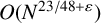
 $E(N)$
denote the number of positive even integers n up to N, which cannot be represented as
 $n=p_1^2+p_2^3+p_3^3+p_4^3+p_5^3+p_6^4$
. Then, for any
 $\varepsilon>0$
,
 $$ \begin{align*} E(N)\ll N^{{23}/{48}+\varepsilon}. \end{align*} $$
2 Outline of the proof of Theorem 1.1
Let N be a sufficiently large positive integer. By a splitting argument, it is sufficient to consider the even integers
 $n\in (N/2,N]$
. For the application of the Hardy–Littlewood method, we need to define the Farey dissection. Let
 $A>0$
be a sufficiently large fixed number, which will be determined at the end of the proof. We set
 $$ \begin{align*} Q_0=\log^AN,\quad Q_1=N^{{1}/{48}},\quad Q_2=N^{{47}/{48}},\quad \mathfrak{I}_0=\bigg[-\frac{1}{Q_2},1-\frac{1}{Q_2}\bigg]. \end{align*} $$
By Dirichlet’s lemma on rational approximation (see, for example, [Reference Vaughan7, Lemma 2.1]), each
 $\alpha \in [-1/Q_2,1-1/Q_2]$
can be written in the form
 $$ \begin{align} \alpha=\frac{a}{q}+\lambda,\quad |\lambda|\leqslant\frac{1}{qQ_2}, \end{align} $$
for some integers
 $a,\,q$
with
 $1\leqslant a\leqslant q\leqslant Q_2$
and
 $(a,q)=1$
. Define
 $$ \begin{align*} \mathfrak{M}(q,a)=\bigg[\frac{a}{q}-\frac{Q_1}{qN},\frac{a}{q}+\frac{Q_1}{qN}\bigg], & \quad \mathfrak{M}=\bigcup_{1\leqslant q\leqslant Q_1}\bigcup_{\substack{1\leqslant a\leqslant q\\ (a,q)=1}}\mathfrak{M}(q,a), \\ \mathfrak{M}_0(q,a)=\bigg[\frac{a}{q}-\frac{Q_0^{200}}{qN},\frac{a}{q}+\frac{Q_0^{200}}{qN}\bigg], & \quad \mathfrak{M}_0=\bigcup_{1\leqslant q\leqslant Q_0^{100}}\bigcup_{\substack{1\leqslant a\leqslant q\\ (a,q)=1}}\mathfrak{M}_0(q,a), \\ \qquad\mathfrak{m}_1=\mathfrak{I}_0\!\setminus\!\mathfrak{M}, & \quad \mathfrak{m}_2=\mathfrak{M}\!\setminus\!\mathfrak{M}_0. \end{align*} $$
Then we obtain the Farey dissection
 $$ \begin{align} \mathfrak{I}_0=\mathfrak{M}_0\cup \mathfrak{m}_1\cup \mathfrak{m}_2. \end{align} $$
For
 $k=2,3,4$
, we define
 $$ \begin{align*} f_k(\alpha)=\sum_{X_k<p\leqslant 2X_k}e(p^k\alpha), \end{align*} $$
where
 $X_k=(N/16)^{{1}/{k}}$
. Let
 $$ \begin{align*} \mathscr{R}(n)=\sum_{\substack{n=p_1^2+p_2^3+p_3^3+p_4^3+p_5^3+p_6^4\\ X_3<p_2,\ldots,p_5\leqslant2X_3 \\ X_2<p_1\leqslant2X_2\\ X_4<p_6\leqslant2X_4 }}1. \end{align*} $$
From (2.2),
 $$ \begin{align*} \mathscr{R}(n) & \,\, =\int_0^1 f_2(\alpha)f_3^4(\alpha)f_4(\alpha)e(-n\alpha)\,{d}\alpha =\int_{-{1}/{Q_2}}^{1-{1}/{Q_2}}f_2(\alpha)f_3^4(\alpha)f_4(\alpha)e(-n\alpha)\,{d}\alpha \nonumber \\ & \,\, =\bigg\{\int_{\mathfrak{M}_0}+\int_{\mathfrak{m}_1}+\int_{\mathfrak{m}_2}\bigg\} f_2(\alpha)f_3^4(\alpha)f_4(\alpha)e(-n\alpha)\,{d}\alpha. \end{align*} $$
To prove Theorem 1.1, we need the following two propositions.
Proposition 2.1. For
 $n\in (N/2,N]$
,
 $$ \begin{align} \int_{\mathfrak{M}_0}f_2(\alpha)f_3^4(\alpha)f_4(\alpha)e(-n\alpha)\,{d}\alpha =\mathfrak{S}(n)\mathfrak{J}(n)+O\bigg(\frac{n^{{13}/{12}}}{\log^7n}\bigg), \end{align} $$
where
 $\mathfrak {S}(n)$
is the singular series defined in (4.1), which is absolutely convergent and satisfies
 $$ \begin{align} 0<c^*\leqslant\mathfrak{S}(n)\ll 1 \end{align} $$
for any integer n satisfying
 $n\equiv 0\,(\bmod\ 2)$
and some fixed constant
 $c^*>0$
; while
 $\mathfrak {J}(n)$
is defined by (4.4) and satisfies
 $$ \begin{align*} \mathfrak{J}(n)\asymp\frac{n^{{13}/{12}}}{\log^6n}. \end{align*} $$
The proof of (2.3) in Proposition 2.1 will be demonstrated in Section 4. For the property (2.4) of the singular series, we shall give the proof in Section 5.
Proposition 2.2. Let
 $\mathcal {Z}(N)$
denote the number of integers
 $n\in (N/2,N]$
satisfying
 $n\equiv 0 \pmod 2$
such that
 $$ \begin{align*} \sum_{j=1}^2\bigg|\int_{\mathfrak{m}_j}f_2(\alpha)f_3^4(\alpha)f_4(\alpha)e(-n\alpha)\,{d}\alpha \bigg|\gg \frac{n^{{13}/{12}}}{\log^7n}. \end{align*} $$
Then
 $$ \begin{align*} \mathcal{Z}(N)\ll N^{{23}{/48}+\varepsilon}. \end{align*} $$
The proof of Proposition 2.2 will be given in Section 6. The rest of this section is devoted to establishing Theorem 1.1 by using Propositions 2.1 and 2.2.
Proof of Theorem 1.1
From Proposition 2.2, we deduce that, with at most
 $O(N^{{23}/{48}+\varepsilon })$
exceptions, all even integers
 $n\in (N/2,N]$
satisfy
 $$ \begin{align*} \sum_{j=1}^2\bigg|\int_{\mathfrak{m}_j}f_2(\alpha)f_3^4(\alpha)f_4(\alpha)e(-n\alpha)\,{d}\alpha \bigg|\ll \frac{n^{{13}/{12}}}{\log^7n}. \end{align*} $$
By Proposition 2.1, we conclude that, with at most
 $O(N^{{23}/{48}+\varepsilon })$
exceptions, all even integers
 $n\in (N/2,N]$
can be represented in the form
 $p_1^2+p_2^3+p_3^3+p_4^3+p_5^3+p_6^4$
, where
 $p_1,p_2,p_3,p_4,p_5,p_6$
are prime numbers. By a splitting argument, we get
 $$ \begin{align*} E(N)\ll\sum_{0\leqslant\ell\ll\log N}\mathcal{Z}\bigg(\frac{N}{2^\ell}\bigg)\ll \sum_{0\leqslant\ell\ll\log N}\bigg(\frac{N}{2^\ell}\bigg)^{{23}/{48}+\varepsilon} \ll N^{{23}/{48}+\varepsilon}. \end{align*} $$
This completes the proof of Theorem 1.1.
3 Some auxiliary lemmas
Lemma 3.1 [Reference Ren5, Theorem 1.1]
Suppose that
 $\alpha $
is a real number and that
 $|\alpha -a/q|\leqslant q^{-2}$
with
 $(a,q)=1$
. Let
 $\beta =\alpha -a/q$
. Then
 $$ \begin{align*} f_k(\alpha)\ll d^{\delta_k}(q)(\log N)^c \bigg(X_k^{1/2}\!\sqrt{q(1+N|\kern1pt\beta|)}+X_k^{4/5}+\frac{X_k}{\!\sqrt{q(1+N|\kern1pt\beta|)}}\bigg), \end{align*} $$
where
 $\delta _k={1}/{2}+{\log k}/{\log 2}$
,
 $d(q)$
is the Dirichlet divisor function and c is a constant.
Lemma 3.2 [Reference Zhao11, Lemma 2.4]
Suppose that
 $\alpha $
is a real number and that there exist
 $a\in \mathbb {Z}$
and
 $q\in \mathbb {N}$
with
 $(a,q)=1, 1\leqslant q\leqslant Q$
and
 $|q\alpha -a|\leqslant Q^{-1}$
. If
 $P^{{1}/{12}}\leqslant Q\leqslant P^{{47}/{12}}$
, then
 $$ \begin{align*} \sum_{P<p\leqslant2P}e(p^4\alpha) \ll P^{1-{1}/{24}+\varepsilon}+\frac{P^{1+\varepsilon}}{\!\sqrt{q(1+P^4|\alpha-a/q|)}}. \end{align*} $$
Lemma 3.3. For
 $\alpha \in \mathfrak {m}_1$
, we have
 $f_4(\alpha )\ll N^{{23}/{96}+\varepsilon }$
.
Proof. By Dirichlet’s rational approximation (2.1), for
 $\alpha \in \mathfrak {m}_1$
, one has
 $Q_1<q\leqslant Q_2$
and
 $qX_4^4|\alpha -a/q|\leqslant Q_1$
. From Lemma 3.2,
 $$ \begin{align*} f_4(\alpha)\ll X_4^{{23}/{24}+\varepsilon}+X_4^{1+\varepsilon}Q_1^{-{1}/{2}}\ll N^{{23}/{96}+\varepsilon}.\\[-34pt] \end{align*} $$
For
 $1\leqslant a\leqslant q$
with
 $(a,q)=1$
, set
 $$ \begin{align} \mathcal{I}(q,a)=\bigg[\frac{a}{q}-\frac{1}{qQ_0},\frac{a}{q}+\frac{1}{qQ_0}\bigg],\quad \mathcal{I}=\bigcup_{1\leqslant q\leqslant Q_0}\bigcup_{\substack{a=-q\\ (a,q)=1}}^{2q}\mathcal{I}(q,a). \end{align} $$
For
 $\alpha \in \mathfrak {m}_2$
, by Lemma 3.1,
 $$ \begin{align} f_4(\alpha)\ll \frac{N^{{1}/{4}}\log^c N}{q^{1/2-\varepsilon}(1+N|\lambda|)^{1/2}} +N^{{1}/{5}+\varepsilon}=V_4(\alpha)+N^{{1}/{5}+\varepsilon}, \end{align} $$
say. Then we obtain the following Lemma.
Lemma 3.4. We have
 $$ \begin{align*} \int_{\mathcal{I}}|V_4(\alpha)|^2\,{d}\alpha=\sum_{1\leqslant q\leqslant Q_0} \sum_{\substack{a=-q\\ (a,q)=1}}^{2q}\int_{\mathcal{I}(q,a)}|V_4(\alpha)|^2\,{d}\alpha \ll N^{-{1}/{2}}\log^{2A}N. \end{align*} $$
Proof. We have
 $$ \begin{align*} \sum_{1\leqslant q\leqslant Q_0} & \sum_{\substack{a=-q\\ (a,q)=1}}^{2q}\int_{\mathcal{I}(q,a)}|V_4(\alpha)|^2\,{d}\alpha \ll \sum_{1\leqslant q\leqslant Q_0}q^{-1+\varepsilon}\sum_{\substack{a=-q\\ (a,q)=1}}^{2q} \int_{|\lambda|\leqslant{1}/{Q_0}}\frac{N^{{1}/{2}}\log^{2c}N}{1+N|\lambda|}\,{d}\lambda \nonumber \\ \ll & \,\,\sum_{1\leqslant q\leqslant Q_0}q^{-1+\varepsilon}\sum_{\substack{a=-q\\ (a,q)=1}}^{2q} \bigg(\int_{|\lambda|\leqslant{1}/{N}}N^{{1}/{2}}\log^{2c}N\,{d}\lambda +\int_{{1}/{N}\leqslant|\lambda|\leqslant{1}/{Q_0}} \frac{N^{{1}/{2}}\log^{2c}N}{N|\lambda|}\,{d}\lambda\bigg) \nonumber \\ \ll & \,\,N^{-{1}/{2}}\log^{3c}N\cdot\sum_{1\leqslant q\leqslant Q_0}q^{-1+\varepsilon}\varphi(q) \ll N^{-{1}/{2}}Q_0^{1+\varepsilon}\log^{3c} N\ll N^{-{1}/{2}}\log^{2A}N. \end{align*} $$
This completes the proof of Lemma 3.4.
4 Proof of Proposition 2.1
In this section, we establish Proposition 2.1. We first introduce some notation. For a Dirichlet character
 $\chi \bmod q$
and
 $k\in \{2,3,4\}$
, we define
 $$ \begin{align*} C_k(\,\chi,a)=\sum_{h=1}^q\overline{\chi(h)}e\bigg(\frac{ah^k}{q}\bigg),\quad C_k(q,a)=C_k(\,\chi^0,a), \end{align*} $$
where
 $\chi ^0$
is the principal character modulo q. Let
 $\chi _2,\chi _3^{(1)},\chi _3^{(2)},\chi _3^{(3)},\chi _3^{(4)},\chi _4$
be Dirichlet characters modulo q. Define
 $$ \begin{align*} B(n,q,\chi_2,\chi_3^{(1)},\chi_3^{(2)},\chi_3^{(3)},\chi_3^{(4)},\chi_4) &= \sum_{\substack{a=1\\ (a,q)=1}}^q \bigg(C_2(\,\chi_2,a)\bigg(\prod_{i=1}^4C_3(\,\chi_3^{(i)},a)\bigg)C_4(\,\chi_4,a)\bigg) e\bigg(\!-\frac{an}{q}\bigg), \\ B(n,q) & =B(n,q,\chi^0,\chi^0,\chi^0,\chi^0,\chi^0,\chi^0), \end{align*} $$
and write
 $$ \begin{align} A(n,q)=\frac{B(n,q)}{\varphi^6(q)},\quad \mathfrak{S}(n)=\sum_{q=1}^\infty A(n,q). \end{align} $$
Lemma 4.1 [Reference Vinogradov8, Ch. VI, Problem 14]
For
 $(a,q)=1$
and any Dirichlet character
 $\chi~\bmod~q$
,
 $$ \begin{align*} |C_k(\,\chi,a)|\leqslant2q^{1/2}d^{\beta_k}(q) \end{align*} $$
with
 $\beta _k=\log k/\log 2$
, where
 $d(q)$
is the Dirichlet divisor function.
Lemma 4.2. Let
 $C_k(q,a)$
be defined as above. Then
 $$ \begin{align} \sum_{q\leqslant x}\frac{|B(n,q)|}{\varphi^6(q)}\ll \log x. \end{align} $$
Proof. By Lemma 4.1,
 $$ \begin{align*} B(n,q)\ll \sum_{\substack{a=1\\ (a,q)=1}}^q|C_2(q,a)C_3^4(q,a)C_4(q,a)|\ll q^3\varphi(q)d^{10}(q). \end{align*} $$
Therefore, the left-hand side of (4.2) is
 $$ \begin{align*} \ll \sum_{q\leqslant x}\frac{q^3\varphi(q)d^{10}(q)}{\varphi^6(q)}\ll \sum_{q\leqslant x}\frac{(\log\log q)^5d^{10}(q)}{q^2} \ll (\log\log x)^5\sum_{q\leqslant x}\frac{d^{10}(q)}{q^2}\ll \log x. \end{align*} $$
This completes the proof of Lemma 4.2.
To treat the integral on the major arcs, we write
 $f_k(\alpha )$
as follows:
 $$ \begin{align*} f_k(\alpha)=\sum_{\substack{X_k<p\leqslant 2X_k\\ (p,q)=1}}e\bigg(p^k\bigg(\frac{a}{q}+\lambda\bigg)\bigg)+O(\log q) =\sum_{\substack{\ell=1\\ (\ell,q)=1}}^qe\bigg(\frac{a\ell^k}{q}\bigg) \sum_{\substack{X_k<p\leqslant2X_k\\ p\equiv\ell \pmod q}}e(p^k\lambda)+O(\log N). \end{align*} $$
For the innermost sum on the right-hand side of the above equation, by the Siegel–Walfisz theorem, we have
 $$ \begin{align*} \sum_{\substack{X_k<p\leqslant2X_k\\ p\equiv\ell\pmod q}}e(p^k\lambda) = &\,\, \int_{X_k}^{2X_k}e(u^k\lambda)\,{d}\pi(u,q,\ell) \nonumber \\ = &\,\, \int_{X_k}^{2X_k}e(u^k\lambda)\,{d}\bigg(\frac{1}{\varphi(q)}\int_2^u\frac{\,{d}t}{\log t}+ O(ue^{-c\!\sqrt{\log u}})\bigg) \nonumber \\ = &\,\, \frac{1}{\varphi(q)}\int_{X_k}^{2X_k}\frac{e(u^k\lambda)}{\log u}\,{d}u+O(X_ke^{-c\!\sqrt{\log N}}) \nonumber \\ = &\,\, \frac{v_k(\lambda)}{\varphi(q)}+O(X_ke^{-c\!\sqrt{\log N}}), \end{align*} $$
say. Therefore,
 $$ \begin{align*} f_k(\alpha)=\frac{C_k(q,a)}{\varphi(q)}v_k(\lambda)+O(X_ke^{-c\!\sqrt{\log N}}), \end{align*} $$
and thus
 $$ \begin{align*} f_2(\alpha)f_3^4(\alpha)f_4(\alpha)= \frac{C_2(q,a)C_3^4(q,a)C_4(q,a)}{\varphi^6(q)}v_2(\lambda)v_3^4(\lambda)v_4(\lambda) +O(N^{{25}/{12}}e^{-c\!\sqrt{\log N}}). \end{align*} $$
From this, we derive
 $$ \begin{align} \int_{\mathfrak{M}_0} & f_2(\alpha)f_3^4(\alpha)f_4(\alpha)e(-n\alpha)\,{d}\alpha \nonumber \\ = & \,\, \sum_{1\leqslant q\leqslant Q_0^{100}}\sum_{\substack{a=1\\ (a,q)=1}}^qe\bigg(\!-\frac{an}{q}\bigg) \int_{-{Q_0^{200}}/{qN}}^{{Q_0^{200}}/{qN}} \bigg( \frac{C_2(q,a)C_3^4(q,a)C_4(q,a)}{\varphi^6(q)}v_2(\lambda)v_3^4(\lambda)v_4(\lambda) \nonumber \\ & \qquad\qquad\qquad\qquad\qquad\ \quad\qquad +O(N^{{25}/{12}}e^{-c\!\sqrt{\log N}})\bigg)e(-n\lambda)\,{d}\lambda \nonumber \\ = & \,\, \sum_{1\leqslant q\leqslant Q_0^{100}}\frac{B(n,q)}{\varphi^6(q)} \int_{-{Q_0^{200}}/{qN}}^{{Q_0^{200}}/{qN}}v_2(\lambda)v_3^4(\lambda)v_4(\lambda) e(-n\lambda)\,{d}\lambda+O(N^{{13}/{12}}e^{-c\!\sqrt{\log N}}). \end{align} $$
Note that
 $$ \begin{align*} v_k(\lambda)=\int_{X_k^k}^{(2X_k)^k}\frac{x^{{1}/{k}-1}e(\lambda x)}{\log x}\,{d}x \ll \frac{N^{{1}/{k}-1}}{\log N}\cdot\min\bigg(N,\frac{1}{|\lambda|}\bigg), \end{align*} $$
using an elementary estimate. If we extend the interval of the innermost integral over
 $\lambda $
in (4.3) to
 $[-1/2,1/2]$
, then the resulting error is
 $$ \begin{align*} \ll \int_{{Q_0^{200}}/{qN}}^{{1}/{2}}\frac{N^{-{47}/{12}}}{\log^6N}\cdot\frac{\,{d}\lambda}{\lambda^6} \ll \frac{N^{-{47}/{12}}}{\log^6N}\cdot\frac{q^5N^5}{Q_0^{1000}}\ll \frac{N^{{13}/{12}}}{(\log N)^{500A}}\ll\frac{n^{{13}/{12}}}{(\log n)^{500A}}. \end{align*} $$
Hence, we obtain
 $$ \begin{align*} \int_{-{Q_0^{200}}/{qN}}^{{Q_0^{200}}/{qN}}v_2(\lambda)v_3^4(\lambda)v_4(\lambda) e(-n\lambda)\,{d}\lambda=\mathfrak{J}(n)+O\bigg(\frac{n^{{13}{/12}}}{(\log n)^{500A}}\bigg), \end{align*} $$
where
 $$ \begin{align} \mathfrak{J}(n) &= \int_{-{1}/{2}}^{{1}/{2}} \bigg(\int_{X_2^2}^{(2X_2)^2}\frac{x^{-{1}/{2}}e(\lambda x)}{\log x}\,{d}x\bigg) \bigg(\int_{X_3^3}^{(2X_3)^3}\frac{x^{-{2}/{3}}e(\lambda x)}{\log x}\,{d}x\bigg)^4 \nonumber \\ & \quad\quad \times\bigg(\int_{X_4^4}^{(2X_4)^4}\frac{x^{-{3}/{4}}e(\lambda x)}{\log x} \,{d}x\bigg) e(-n\lambda)\,{d}\lambda \nonumber \\ & = \int_{X_2^2}^{(2X_2)^2}\! \int_{X_3^3}^{(2X_3)^3}\! \int_{X_3^3}^{(2X_3)^3}\! \int_{X_3^3}^{(2X_3)^3}\! \int_{X_3^3}^{(2X_3)^3}\int_{X_4^4}^{(2X_4)^4}\int_{-{1}/{2}}^{{1}/{2}} \frac{x_1^{-{1}/{2}}(x_2x_3x_4x_5)^{-{2}/{3}}x_6^{-{3}/{4}}} {(\log x_1)(\log x_2)\cdots(\log x_6)} \nonumber \\ & \quad\quad \times e((x_1+x_2+x_3+x_4+x_5+x_6-n)\lambda)\,{d}\lambda\,{d}x_1\cdots\,{d}x_6 \nonumber \\ & \asymp \frac{X_2^{-1}X_3^{-8}X_4^{-3}}{(\log N)^6} \int_{X_2^2}^{(2X_2)^2} \int_{X_3^3}^{(2X_3)^3} \int_{X_3^3}^{(2X_3)^3} \int_{X_3^3}^{(2X_3)^3} \int_{X_3^3}^{(2X_3)^3}\int_{X_4^4}^{(2X_4)^4} \int_{-{1}/{2}}^{{1}/{2}} \nonumber \\ & \quad\quad \times e((x_1+x_2+x_3+x_4+x_5+x_6-n)\lambda)\,{d}\lambda\,{d}x_1\cdots\,{d}x_6 \nonumber \\ & \asymp \frac{X_2^{-1}X_3^{-8}X_4^{-3}}{(\log N)^6}N^5\asymp\frac{N^{{13}/{12}}}{(\log N)^6} \asymp\frac{n^{{13}/{12}}}{(\log n)^6}. \end{align} $$
Therefore, by (5.4) and Lemma 4.2, (4.3) becomes
 $$ \begin{align*} \int_{\mathfrak{M}_0}f_2(\alpha)f_3^4(\alpha)f_4(\alpha)e(-n\alpha)\,{d}\alpha= \mathfrak{S}(n)\mathfrak{J}(n)+O\bigg(\frac{n^{{13}/{12}}}{\log^7n}\bigg), \end{align*} $$
which completes the proof of Proposition 2.1.
5 The singular series
In this section, we investigate the properties of the singular series which appears in Proposition 2.1.
Lemma 5.1 [Reference Hua3, Lemma 8.3]
Let p be a prime and
 $p^\alpha \|k$
. For
 $(a,p)=1$
, if
 $\ell \geqslant \gamma (p)$
, then
 $C_k(p^\ell ,a)=0$
, where
 $$ \begin{align*} \gamma(p)= \begin{cases} \alpha+2 & \textrm{ if}\ p\not=2\ \textrm{or}\ p=2,\,\alpha=0 \\ \alpha+3 & \textrm{ if}\ p=2,\,\alpha>0. \\ \end{cases} \end{align*} $$
For
 $k\geqslant 1$
, we define
 $$ \begin{align*} S_k(q,a)=\sum_{m=1}^qe\bigg(\frac{am^k}{q}\bigg). \end{align*} $$
Lemma 5.2 [Reference Vaughan7, Lemma 4.3]
Suppose that
 $(p,a)=1$
. Then
 $$ \begin{align*} S_k(p,a)=\sum_{\chi\in\mathscr{A}_k}\overline{\chi(a)}\tau(\,\chi), \end{align*} $$
where
 $\mathscr {A}_k$
denotes the set of nonprincipal characters
 $\chi $
modulo p for which
 $\chi ^k$
is principal and
 $\tau (\,\chi )$
denotes the Gauss sum
 $$ \begin{align*} \sum_{m=1}^p\chi(m)e\bigg(\frac{m}{p}\bigg). \end{align*} $$
Also,
 $|\tau (\,\chi )|=p^{1/2}$
and
 $|\mathscr {A}_k|=(k,p-1)-1$
.
Lemma 5.3. For
 $(p,n)=1$
,
 $$ \begin{align} \bigg|\sum_{a=1}^{p-1}\frac{S_2(p,a)S_3^4(p,a)S_4(p,a)}{p^6}e\bigg(\!-\frac{an}{p}\bigg)\bigg| \leqslant48p^{-{5}/{2}}. \end{align} $$
Proof. We denote by
 $\mathcal {S}$
the sum in the absolute value signs on the left-hand side of (5.1). By Lemma 5.2,
 $$ \begin{align*} \mathcal{S}=\frac{1}{p^6}\sum_{a=1}^{p-1}\bigg(\sum_{\chi_2\in\mathscr{A}_2}\overline{\chi_2(a)}\tau(\,\chi_2)\bigg) \bigg(\sum_{\chi_3\in\mathscr{A}_3}\overline{\chi_3(a)}\tau(\,\chi_3)\bigg)^4 \bigg(\sum_{\chi_4\in\mathscr{A}_4}\overline{\chi_4(a)}\tau(\,\chi_4)\bigg) e\bigg(\!-\frac{an}{p}\bigg). \end{align*} $$
If
 $|\mathscr {A}_k|=0$
for some
 $k\in \{2,3,4\}$
, then
 $\mathcal {S}=0$
. If this is not the case, then
 $$ \begin{align*} \mathcal{S}&= \frac{1}{p^6}\sum_{\chi_2\in \mathscr{A}_2} \sum_{\chi_3^{(1)}\in \mathscr{A}_3}\sum_{\chi_3^{(2)}\in \mathscr{A}_3} \sum_{\chi_3^{(3)}\in \mathscr{A}_3}\sum_{\chi_3^{(4)}\in \mathscr{A}_3} \sum_{\chi_4\in \mathscr{A}_4} \tau(\,\chi_2) \tau(\,\chi_3^{(1)}) \tau(\,\chi_3^{(2)})\tau(\,\chi_3^{(3)})\tau(\,\chi_3^{(4)}) \tau(\,\chi_4) \\ &\quad \times \sum_{a=1}^{p-1} \overline{\chi_2(a)\chi_3^{(1)}(a)\chi_3^{(2)}(a)\chi_3^{(3)}(a) \chi_3^{(4)}(a)\chi_4(a)} e\bigg(\!-\frac{an}{p}\bigg). \end{align*} $$
From Lemma 5.2, the sextuple outer sums have not more than
 $$ \begin{align*}((2,p-1)-1)\times((3,p-1)-1)^4\times((4,p-1)-1)\leqslant1\times2^4\times3=48\end{align*} $$
terms. In each of these terms,
 $ |\tau (\,\chi _2)\tau (\,\chi _3^{(1)})\tau (\,\chi _3^{(2)})\tau (\,\chi _3^{(3)}) \tau (\,\chi _3^{(4)})\tau (\,\chi _4)|=p^3$
. Since in any one of these terms
 $\overline {\chi _2(a)\chi _3^{(1)}(a)\chi _3^{(2)}(a)\chi _3^{(3)}(a)\chi _3^{(4)}(a)\chi _4(a)}$
is a Dirichlet character
 $\chi \!\pmod p$
, the inner sum is
 $$ \begin{align*} \sum_{a=1}^{p-1}\chi(a)e\bigg(\!-\frac{an}{p}\bigg)=\overline{\chi(-n)}\sum_{a=1}^{p-1}\chi(-an)e\bigg(\!-\frac{an}{p}\bigg)=\overline{\chi(-n)}\tau(\,\chi). \end{align*} $$
Because
 $\tau (\,\chi ^0)=-1$
for the principal character
 $\chi ^0\bmod p$
, we have
 $ |\overline {\chi (-n)}\tau (\,\chi )|\leqslant p^{{1}/{2}}$
. By the above arguments, we obtain
 $$ \begin{align*} |\mathcal{S}|\leqslant\frac{1}{p^6}\cdot 48\cdot p^3\cdot p^{{1}/{2}}=48p^{-{5}/{2}}. \end{align*} $$
This completes the proof of Lemma 5.3.
Lemma 5.4. Let
 $\mathcal {L}(p,n)$
denote the number of solutions of the congruence
 $$ \begin{align*} x_1^2+x_2^3+x_3^3+x_4^3+x_5^3+x_6^4\equiv n \pmod p, \quad 1\leqslant x_1,x_2,\dots,x_6\leqslant p-1. \end{align*} $$
Then, for
 $n\equiv 0\!\pmod 2$
, we have
 $\mathcal {L}(p,n)>0$
.
Proof. We have
 $$ \begin{align*} p\cdot\mathcal{L}(p,n)=\sum_{a=1}^pC_2(p,a)C_3^4(p,a)C_4(p,a)e\bigg(\!-\frac{an}{p}\bigg)=(p-1)^6+E_p, \end{align*} $$
where
 $$ \begin{align*} E_p=\sum_{a=1}^{p-1}C_2(p,a)C_3^4(p,a)C_4(p,a)e\bigg(\!-\frac{an}{p}\bigg). \end{align*} $$
By Lemma 5.2,
 $ |E_p|\leqslant (p-1)(\!\sqrt {p}+1)(2\!\sqrt {p}+1)^4(3\!\sqrt {p}+1)$
. It is easy to check that
 $|E_p|<(p-1)^6$
for
 $p\geqslant 13$
. Therefore, we obtain
 $\mathcal {L}(p,n)>0$
for
 $p\geqslant 13$
. For
 $p=2,3,5,7,11$
, we can check
 $\mathcal {L}(p,n)>0$
directly provided that
 $n\equiv 0 \pmod 2$
.
Lemma 5.5.
 $A(n,q)$
is multiplicative in q.
Proof. By the definition of
 $A(n,q)$
in (4.1), we only need to show that
 $B(n,q)$
is multiplicative in q. Suppose
 $q=q_1q_2$
with
 $(q_1,q_2)=1$
. Then
 $$ \begin{align} B(n,q_1q_2) = & \,\, \sum_{\substack{a=1\\ (a,q_1q_2)=1}}^{q_1q_2}C_2(q_1q_2,a)C_3^4(q_1q_2,a)C_4(q_1q_2,a) e\bigg(\!-\frac{an}{q_1q_2}\bigg) \nonumber \\ = & \,\, \sum_{\substack{a_1=1\\ (a_1,q_1)=1}}^{q_1}\sum_{\substack{a_2=1\\ (a_2,q_2)=1}}^{q_2} C_2(q_1q_2,a_1q_2+a_2q_1) C_3^4(q_1q_2,a_1q_2+a_2q_1) \nonumber \\ & \,\,\quad\times C_4(q_1q_2,a_1q_2+a_2q_1) e\bigg(\!-\frac{a_1n}{q_1}\bigg)e\bigg(\!-\frac{a_2n}{q_2}\bigg). \end{align} $$
For
 $(q_1,q_2)=1$
and
 $k\in \{2,3,4\}$
,
 $$ \begin{align} C_k(q_1q_2,a_1q_2+a_2q_1) & = \sum_{\substack{m=1\\ (m,q_1q_2)=1}}^{q_1q_2}e\bigg(\frac{(a_1q_2+a_2q_1)m^k}{q_1q_2}\bigg) \nonumber \\ & = \sum_{\substack{m_1=1\\ (m_1,q_1)=1}}^{q_1}\sum_{\substack{m_2=1\\ (m_2,q_2)=1}}^{q_2} e\bigg(\frac{(a_1q_2+a_2q_1)(m_1q_2+m_2q_1)^k}{q_1q_2}\bigg) \nonumber \\ &= \sum_{\substack{m_1=1\\ (m_1,q_1)=1}}^{q_1} e\bigg(\frac{a_1(m_1q_2)^k}{q_1}\bigg) \sum_{\substack{m_2=1\\ (m_2,q_2)=1}}^{q_2} e\bigg(\frac{a_2(m_2q_1)^k}{q_2}\bigg) \nonumber \\ & = C_k(q_1,a_1)C_k(q_2,a_2). \end{align} $$
Putting (5.3) into (5.2), we deduce that
 $$ \begin{align*} B(n,q_1q_2) &= \sum_{\substack{a_1=1\\ (a_1,q_1)=1}}^{q_1} C_2(q_1,a_1)C_3^4(q_1,a_1)C_4(q_1,a_1)e\bigg(\!-\frac{a_1n}{q_1}\bigg) \nonumber \\ &\quad \times\sum_{\substack{a_2=1\\ (a_2,q_2)=1}}^{q_2} C_2(q_2,a_2)C_3^4(q_2,a_2)C_4(q_2,a_2)e\bigg(\!-\frac{a_2n}{q_2}\bigg) \nonumber \\ &= B(n,q_1)B(n,q_2). \end{align*} $$
This completes the proof of Lemma 5.5.
Lemma 5.6. Let
 $A(n,q)$
be as defined in (4.1).
-
(i) We have
(5.4) $$ \begin{align} \sum_{q>Z}|A(n,q)|\ll Z^{-{3}/{2}+\varepsilon}d(n). \end{align} $$
-
(ii) There exists an absolute positive constant
$c^*>0$
, such that, for
$n\equiv 0\!\pmod 2$
,
$$ \begin{align*} 0<c^*\leqslant \mathfrak{S}(n)\ll1. \end{align*} $$


Proof. From Lemma 5.5,
 $B(n,q)$
is multiplicative in q. Therefore,
 $$ \begin{align} B(n,q)=\prod_{p^t\|q}B(n,p^t)=\prod_{p^t\|q}\sum_{\substack{a=1\\ (a,p)=1}}^{p^t} C_2(p^t,a)C_3^4(p^t,a)C_4(p^t,a)e\bigg(\!-\frac{an}{p^t}\bigg). \end{align} $$
From (5.5) and Lemma 5.1,
 $B(n,q)=\prod _{p\|q}B(n,p)$
or
 $0$
according to if q is square-free or not. Thus,
 $$ \begin{align} \sum_{q=1}^{\infty}A(n,q)=\sum_{\substack{q=1\\ q\ \textrm{square-free}}}^\infty A(n,q). \end{align} $$
Write
 $$ \begin{align*} \mathcal{R}(p,a):=C_2(p,a)C_3^4(p,a)C_4(p,a)-S_2(p,a)S_3^4(p,a)S_4(p,a). \end{align*} $$
Then
 $$ \begin{align} A(n,p)&=\frac{1}{(p-1)^6}\sum_{a=1}^{p-1}S_2(p,a)S_3^4(p,a)S_4(p,a)e\bigg(\!-\frac{an}{p}\bigg)\nonumber\\ &\quad+\frac{1}{(p-1)^6}\sum_{a=1}^{p-1}\mathcal{R}(p,a)e\bigg(\!-\frac{an}{p}\bigg). \end{align} $$
Applying Lemma 4.1 and noticing that
 $S_k(p,a)=C_k(p,a)+1$
, we get
 $S_k(p,a)\ll p^{{1}/{2}}$
, and thus
 $\mathcal {R}(p,a)\ll p^{{5}/{2}}$
. Therefore, the absolute value of the second term in (5.7) is
 $\leqslant c_1p^{-{5}/{2}}$
. However, from Lemma 5.3, we can see that the absolute value of the first term in (5.7) is
 $\leqslant 2^6\cdot 48p^{-{5}/{2}}=3072p^{-{5}/{2}}$
. Let
 $c_2=c_1+3072$
. Then we have proved that for
 $p\nmid n$
,
 $$ \begin{align} |A(n,p)|\leqslant c_2p^{-{5}/{2}}. \end{align} $$
Moreover, if we use Lemma 4.1 directly, it follows that
 $$ \begin{align*} |B(n,p)| = & \, \bigg|\sum_{a=1}^{p-1}C_2(p,a)C_3^4(p,a)C_4(p,a)e\bigg(\!-\frac{an}{p}\bigg)\bigg| \leqslant \sum_{a=1}^{p-1} |C_2(p,a)C_3^4(p,a)C_4(p,a)| \\ \leqslant & \,\, (p-1)\cdot 2^6\cdot p^3\cdot 648 =41472p^3(p-1), \end{align*} $$
and therefore
 $$ \begin{align} |A(n,p)|=\frac{|B(n,p)|}{\varphi^6(p)}\leqslant\frac{41472p^3}{(p-1)^5} \leqslant\frac{2^5\cdot41472p^3}{p^5}=\frac{1327104}{p^2}. \end{align} $$
Let
 $c_3=\max (c_2,1327104)$
. Then for square-free q,
 $$ \begin{align*} |A(n,q)| = & \, \bigg(\prod_{\substack{p|q \\ p\nmid n}}|A(n,p)|\bigg) \bigg(\prod_{\substack{p|q \\ p|n}}|A(n,p)|\bigg)\leqslant \bigg(\prod_{\substack{p|q \\ p\nmid n}}(c_3p^{-{5}/{2}})\bigg) \bigg(\prod_{\substack{p|q \\ p|n}}(c_3p^{-2})\bigg) \\ = & \,\, c_3^{\omega(q)}\bigg(\prod_{p|q}p^{-{5}/{2}}\bigg) \bigg(\prod_{p|(n,q)}p^{{1}/{2}}\bigg) \ll q^{-{5}/{2}+\varepsilon}(n,q)^{{1}/{2}}. \end{align*} $$
Hence, by (5.6), we obtain
 $$ \begin{align*} \sum_{q>Z}|A(n,q)| \ll & \,\, \sum_{q>Z}q^{-{5}/{2}+\varepsilon}(n,q)^{{1}/{2}}=\sum_{d|n}\sum_{q>\frac{Z}{d}}(dq)^{-{5}/{2}+\varepsilon}d^{{1}/{2}} =\sum_{d|n}d^{-2+\varepsilon}\sum_{q>\frac{Z}{d}}q^{-{5}/{2}+\varepsilon} \\ \ll & \,\, \sum_{d|n}d^{-2+\varepsilon}\bigg(\frac{Z}{d}\bigg)^{-{3}/{2}+\varepsilon}=Z^{-{3}/{2}+\varepsilon}\sum_{d|n}d^{-{1}/{2}} \ll Z^{-{3}/{2}+\varepsilon}d(n), \end{align*} $$
which proves (5.4), and hence gives the absolute convergence of
 $\mathfrak {S}(n)$
.
To prove item (ii) of Lemma 5.6, by Lemma 5.5, we first note that
 $$ \begin{align} \mathfrak{S}(n)= & \,\, \prod_p\bigg(1+\sum_{t=1}^\infty A(n,p^t)\bigg)=\prod_p(1+A(n,p)) \nonumber \\ = & \,\, \bigg(\prod_{p\leqslant c_3}(1+A(n,p))\bigg) \bigg(\prod_{\substack{p>c_3\\ p\nmid n }}(1+A(n,p))\bigg) \bigg(\prod_{\substack{p>c_3\\ p| n }}(1+A(n,p))\bigg). \end{align} $$
From (5.8),
 $$ \begin{align*} \prod_{\substack{p>c_3\\ p\nmid n}}(1+A(n,p))\geqslant\prod_{p>c_3}\bigg(1-\frac{c_3}{p^{5/2}}\bigg)\geqslant c_4>0. \end{align*} $$
By (5.9), we obtain
 $$ \begin{align*} \prod_{\substack{p>c_3\\ p| n }}(1+A(n,p))\geqslant \prod_{p>c_3}\bigg(1-\frac{c_3}{p^2}\bigg) \geqslant c_5>0. \end{align*} $$
However, it is easy to see that
 $$ \begin{align*} 1+A(n,p)=\frac{p\cdot \mathcal{L}(p,n)}{\varphi^6(p)}. \end{align*} $$
By Lemma 5.4,
 $\mathcal {L}(p,n)>0$
for all p with
 $n\equiv 0\!\pmod 2$
, and thus
 $1+A(n,p)>0$
. Therefore,
 $$ \begin{align} \prod_{p\leqslant c_3}(1+A(n,p))\geqslant c_6>0. \end{align} $$
Combining the estimates (5.10)–(5.11), and taking
 $c^*=c_4c_5c_6>0$
, we derive
 $$ \begin{align*} \mathfrak{S}(n)\geqslant c^*>0. \end{align*} $$
 $$ \begin{align*} \mathfrak{S}(n)\leqslant \prod_{p\nmid n}\bigg(1+\frac{c_3}{p^{5/2}}\bigg)\cdot \prod_{p|n}\bigg(1+\frac{c_3}{p^2}\bigg)\ll 1. \end{align*} $$
This completes the proof Lemma 5.6.
6 Proof of Proposition 2.2
In this section, we shall give the proof of Proposition 2.2. We denote by
 $\mathcal {Z}_j(N)$
the set of integers n satisfying
 $n\in (N/2,N]$
and
 $n\equiv 0 \!\pmod 2$
for which
 $$ \begin{align} \bigg|\int_{\mathfrak{m}_j}f_2(\alpha)f_3^4(\alpha)f_4(\alpha)e(-n\alpha)\,{d}\alpha\bigg| \gg\frac{n^{{13}/{12}}}{\log^7n}. \end{align} $$
For convenience, we use
 $\mathcal {Z}_j$
to denote the cardinality of
 $\mathcal {Z}_j(N)$
. Also, we define the complex number
 $\xi _j(n)$
by taking
 $\xi _j(n)=0$
for
 $n\not \in \mathcal {Z}_j(N)$
, and
 $$ \begin{align*} \bigg|\int_{\mathfrak{m}_j}f_2(\alpha)f_3^4(\alpha)f_4(\alpha)e(-n\alpha)\,{d}\alpha\bigg| =\xi_j(n)\int_{\mathfrak{m}_j}f_2(\alpha)f_3^4(\alpha)f_4(\alpha)e(-n\alpha)\,{d}\alpha \end{align*} $$
for
 $n\in \mathcal {Z}_j(N)$
. Plainly,
 $|\xi _j(n)|=1$
whenever
 $\xi _j(n)$
is nonzero. Therefore, we obtain
 $$ \begin{align} \sum_{n\in\mathcal{Z}_j(N)}\xi_j(n) \int_{\mathfrak{m}_j}f_2(\alpha)f_3^4(\alpha)f_4(\alpha)e(-n\alpha)\,{d}\alpha = \int_{\mathfrak{m}_j}f_2(\alpha)f_3^4(\alpha)f_4(\alpha)\mathcal{K}_j(\alpha)\,{d}\alpha, \end{align} $$
where the exponential sum
 $\mathcal {K}_j(\alpha )$
is defined by
 $$ \begin{align*} \mathcal{K}_j(\alpha)=\sum_{n\in\mathcal{Z}_j(N)}\xi_j(n)e(-n\alpha). \end{align*} $$
For
 $j=1,2$
, set
 $$ \begin{align*} I_j= \int_{\mathfrak{m}_j}f_2(\alpha)f_3^4(\alpha)f_4(\alpha)\mathcal{K}_j(\alpha)\,{d}\alpha. \end{align*} $$
 $$ \begin{align} I_j\gg \sum_{n\in\mathcal{Z}_j(N)}\frac{n^{{13}/{12}}}{\log^7n} \gg \frac{\mathcal{Z}_jN^{{13}/{12}}}{\log^7N}, \quad j=1,2. \end{align} $$
By [Reference Wooley9, Lemma 2.1] with
 $k=2$
,
 $$ \begin{align} \int_0^1|f_2(\alpha)\mathcal{K}_j(\alpha)|^2{d}\alpha \ll N^\varepsilon(\mathcal{Z}_jN^{{1}/{2}}+\mathcal{Z}_j^2), \quad j=1,2. \end{align} $$
It follows from Cauchy’s inequality, [Reference Vaughan7, Lemma 2.5], Lemma 3.3 and (6.4) that
 $$ \begin{align} I_1 \ll & \,\,\bigg(\sup_{\alpha\in\mathfrak{m}_1}|f_4(\alpha)|\bigg) \times\bigg(\int_0^1|f_3(\alpha)|^8\,{d}\alpha\bigg)^{{1}/{2}} \bigg(\int_0^1|f_2(\alpha)\mathcal{K}_1(\alpha)|^2\,{d}\alpha\bigg)^{{1}/{2}} \nonumber \\ \ll & \,\, N^{{23}/{96}+\varepsilon}\cdot (N^{{5}{/3}+\varepsilon})^{{1}/{2}}\cdot (N^\varepsilon(\mathcal{Z}_1N^{{1}/{2}}+\mathcal{Z}_1^2))^{{1}/{2}} \nonumber \\ \ll & \,\, N^{{103}/{96}+\varepsilon}(\mathcal{Z}_1^{{1}/{2}}N^{{1}/{4}}+\mathcal{Z}_1) \ll \mathcal{Z}_1^{{1}/{2}}N^{{127}/{96}+\varepsilon} +\mathcal{Z}_1N^{{103}/{96}+\varepsilon}. \end{align} $$
Combining (6.3) and (6.5), we get
 $$ \begin{align*} \mathcal{Z}_1N^{{13}/{12}}\log^{-7}N\ll I_1\ll \mathcal{Z}_1^{1/2}N^{{127}/{96}+\varepsilon} +\mathcal{Z}_1N^{{103}/{96}+\varepsilon}, \end{align*} $$
which implies
 $$ \begin{align} \mathcal{Z}_1\ll N^{{23}/{48}+\varepsilon}. \end{align} $$
Next, we give the upper bound for
 $\mathcal {Z}_2$
. By (3.2),
 $$ \begin{align} I_2 \ll \int_{\mathfrak{m}_2}|f_2(\alpha)f_3^4(\alpha)V_4(\alpha)\mathcal{K}_2(\alpha)| \,{d}\alpha +N^{{1}/{5}+\varepsilon} \int_{\mathfrak{m}_2} |f_2(\alpha)f_3^4(\alpha)\mathcal{K}_2(\alpha)|\,{d}\alpha = I_{21}+I_{22}, \end{align} $$
say. For
 $\alpha \in \mathfrak {m}_2$
, either
 $Q_0^{100}<q\leqslant Q_1$
or
 $Q_0^{100}<N|q\alpha -a|\leqslant NQ_2^{-1}=Q_1$
. Therefore, by Lemma 3.1,
 $$ \begin{align} \sup_{\alpha\in\mathfrak{m}_2}|f_2(\alpha)|\ll X_2^{{4}/{5}+\varepsilon}+ \frac{X_2(\log N)^c}{(q(1+N|\alpha-a/q|))^{{1}/{2}-\varepsilon}}\ll \frac{X_2(\log N)^c}{Q_0^{50-\varepsilon}} \ll \frac{N^{{1}/{2}}}{\log ^{40A}N}. \end{align} $$
In view of the fact that
 $\mathfrak {m}_2\subseteq \mathcal {I}$
, where
 $\mathcal {I}$
is defined by (3.1), Cauchy’s inequality, the trivial estimate
 $\mathcal {K}_2(\alpha )\ll \mathcal {Z}_2$
, [Reference Hua3, Theorem 4, page 19], Lemma 3.4 and (6.8), we obtain
 $$ \begin{align} I_{21}\ll& \, \mathcal{Z}_2\cdot\sup_{\alpha\in\mathfrak{m}_2}|f_2(\alpha)|\times \bigg(\int_0^1|f_3(\alpha)|^8\,{d}\alpha\bigg)^{{1}/{2}} \bigg(\int_{\mathcal{I}}|V_3(\alpha)|^2\,{d}\alpha\bigg)^{{1}/{2}} \nonumber \\ \ll & \, \mathcal{Z}_2\cdot\bigg(\frac{N^{{1}/{2}}}{\log^{40A}N}\bigg)\cdot (N^{{5}/{3}}\log^c N)^{{1}/{2}}\cdot(N^{-{1}/{2}}\log^{2A}N)^{{1}/{2}} \ll \frac{\mathcal{Z}_2N^{{13}/{12}}}{\log^{30A}N}, \end{align} $$
where the parameter A is chosen sufficiently large for the bounds (6.8) and (6.9) to work. Moreover, it follows from Cauchy’s inequality, (6.4) and [Reference Hua3, Theorem 4, page 19] that
 $$ \begin{align} I_{22} \ll & \, N^{{1}/{5}+\varepsilon}\times \bigg(\int_0^1|f_3(\alpha)|^8\,{d}\alpha\bigg)^{{1}/{2}} \bigg(\int_0^1|f_2(\alpha)\mathcal{K}_2(\alpha)|^2\,{d}\alpha\bigg)^{{1}/{2}} \nonumber \\ \ll & \, N^{{1}/{5}+\varepsilon}\cdot (N^{{5}/{3}+\varepsilon})^{{1}/{2}}\cdot (N^\varepsilon(\mathcal{Z}_2N^{{1}/{2}}+\mathcal{Z}_2^2))^{{1}/{2}} \nonumber \\ \ll & \, N^{{31}/{30}+\varepsilon}(\mathcal{Z}_2^{{1}/{2}}N^{{1}/{4}}+\mathcal{Z}_2) \ll \mathcal{Z}_2^{{1}/{2}}N^{{77}/{60}+\varepsilon} +\mathcal{Z}_2 N^{{31}/{30}+\varepsilon}. \end{align} $$
Combining (6.3), (6.7), (6.9) and (6.10), we deduce that
 $$ \begin{align*} \frac{\mathcal{Z}_2 N^{{13}/{12}}}{\log^{7}N}\ll I_2=I_{21}+I_{22}\ll \frac{\mathcal{Z}_2N^{{13}/{12}}}{\log^{30A}N}+\mathcal{Z}_2^{{1}/{2}}N^{{77}/{60}+\varepsilon} +\mathcal{Z}_2N^{{31}/{30}+\varepsilon}, \end{align*} $$
which implies
 $$ \begin{align} \mathcal{Z}_2\ll N^{{2}/{5}+\varepsilon}. \end{align} $$
From (6.6) and (6.11),
 $ \mathcal {Z}(N)\ll \mathcal {Z}_1+\mathcal {Z}_2\ll N^{{23}/{48}+\varepsilon }$
. This completes the proof of Proposition 2.2.
Acknowledgement
The authors appreciate the contributions of the referee in reviewing this paper.


