Introduction
Borderline personality disorder (BPD) is a serious mental illness associated with suicidal behaviour, severe behavioural and emotional dysregulation, high rates of co-morbid mental disorder, and great costs to society (Leichsenring et al. Reference Leichsenring, Leibing, Kruse, New and Leweke2011). The aetiological trajectories leading to BPD remain only partly elucidated (Crowell et al. Reference Crowell, Beauchaine and Linehan2009), although it is recognized that genetic, neurobiological and psychosocial factors all contribute to the development of this disorder (Schwarze et al. Reference Schwarze, Mobascher, Pallasch, Hoppe, Kurz, Hellhammer and Lieb2013). Several environmental risk factors have been associated with BPD, including harsh parenting (Belsky et al. Reference Belsky, Caspi, Arseneault, Bleidorn, Fonagy, Goodman, Houts and Moffitt2012), physical and sexual abuse (Widom et al. Reference Widom, Czaja and Paris2009), insecure attachment patterns (Fonagy et al. Reference Fonagy, Luyten and Strathearn2011) and being bullied by peers (Sansone et al. Reference Sansone, Lam and Wiederman2010; Wolke et al. Reference Wolke, Schreier, Zanarini and Winsper2012). Nevertheless, these factors only partly explain the development of BPD, suggesting that a lifespan approach (Geiger & Crick, Reference Geiger, Crick, Ingram and Price2010) that considers how very early perturbations (e.g. prenatal adversity) may set the individual on a pathway towards the development of this disorder may offer further insights (Crowell et al. Reference Crowell, Beauchaine and Linehan2009).
BPD in youth (i.e. childhood and adolescence) is a controversial topic. Nevertheless, BPD is unlikely to appear de novo in early adulthood. Instead, it may be considered as the continuation of precursor symptoms that first emerge during childhood or early adolescence (Crowell et al. Reference Crowell, Beauchaine and Linehan2009). There is a growing body of evidence that BPD in individuals under 18 years of age is a valid construct. BPD in both childhood (Guzder et al. Reference Guzder, Paris, Zelkowitz and Marchessault1996; Rogosch & Cicchetti, Reference Rogosch and Cicchetti2005) and adolescence (Gratz et al. Reference Gratz, Latzman, Tull, Reynolds and Lejuez2011; Hankin et al. Reference Hankin, Barrocas, Jenness, Oppenheimer, Badanes, Abela, Young and Smolen2011) has been associated with similar risk factors to those reported in adult BPD. Furthermore, BPD in youth has been found to predict BPD diagnosis, and other negative sequalae, up to 20 years later (Wenning, Reference Wenning1990; Lofgren et al. Reference Lofgren, Bemporad, King, Lindem and O'Driscoll1991; Winograd et al. Reference Winograd, Cohen and Chen2008).
There are several potential mechanisms through which prenatal adversity may increase offspring vulnerability to the development of BPD. First, the Developmental Origins of Health and Disease (DOHaD) hypothesis states that prenatal adversity may permanently alter offspring organ structure and functioning, increasing the risk of mental illness in later life; that is, there may be direct physiological effects on the foetus (Raikkonen & Pesonen, Reference Raikkonen and Pesonen2009; Schlotz & Phillips, Reference Schlotz and Phillips2009). For example, maternal stress during pregnancy may cause alterations to the hypothalamic–pituitary–adrenal (HPA) axis of the foetus (Field et al. Reference Field, Diego, Dieter, Hernandez-Reif, Schanberg, Kuhn, Yando and Bendell2004; O'Connor et al. Reference O'Connor, Ben-Shlomo, Heron, Golding, Adams and Glover2005; Zhang et al. Reference Zhang, Sliwowska and Weinberg2005), manifesting as an inborn tendency towards emotional and behavioural dysregulation (Crowell et al. Reference Crowell, Beauchaine and Linehan2009). Second, prenatal adversities may serve as markers for childhood risk exposure. For example, prenatal anxiety and depression could portend maladaptive parenting in childhood (Lereya & Wolke, Reference Lereya and Wolke2012), which has been found to increase BPD risk. Third, associations between prenatal adversities and BPD could be partly attributable to continuing experience of the same risk during childhood, exposing the child to chronic stressors, increasing allostatic load and heightening the likelihood of mental illness (Hostinar & Gunnar, Reference Hostinar and Gunnar2013). For instance, mothers who smoke during pregnancy are likely to continue smoking following the birth of the child (Eskenazi & Castorina, Reference Eskenazi and Castorina1999).
Despite these theoretical linkages, research regarding associations between prenatal adversities and BPD is sparse. To our knowledge, the first and only study to specifically explore associations between prenatal adversity and BPD reported that patients with BPD were significantly more often exposed to adverse intrauterine conditions, including tobacco consumption and maternal stress (Schwarze et al. Reference Schwarze, Mobascher, Pallasch, Hoppe, Kurz, Hellhammer and Lieb2013). This retrospective study requires replication with prospective longitudinal research to verify the impact of prenatal risk factors on the development of BPD (Schwarze et al. Reference Schwarze, Mobascher, Pallasch, Hoppe, Kurz, Hellhammer and Lieb2013). In the current study we assessed prospective associations between prenatal adversities (tobacco and alcohol consumption and depression and anxiety) and BPD at 11–12 years while controlling for relevant confounders. To ascertain whether prenatal adversity was an independent predictor of BPD rather than proxy for postnatal risk, we simultaneously controlled for exposure to the same risk during early childhood (e.g. when assessing associations between prenatal maternal depression and BPD, we controlled for postnatal maternal depression).
Method
Participants
The Avon Longitudinal Study of Parents and Children (ALSPAC) is a UK birth cohort examining the determinants of development, health and disease during childhood and beyond. The study has been described in detail elsewhere (Boyd et al. Reference Boyd, Golding, Macleod, Lawlor, Fraser, Henderson, Molloy, Ness, Ring and Smith2013). ALSPAC recruited pregnant women in Avon with expected dates of delivery between 1 April 1991 and 31 December 1992. In total, 14 541 pregnant women were initially enrolled in the study, and had returned at least one questionnaire or attended a ‘Children in Focus’ clinic by 19 July 1999. Of these initial pregnancies, there were 14 676 foetuses, resulting in 14 062 live births of which 13 988 children were alive at 1 year of age. When the oldest children were approximately 7 years old, the sample was bolstered with eligible cases who had failed to join the study originally. Consequently, when considering variables collected from the age of 7 onwards, there are data available on 14 701 children (an additional 713 children). The study website contains details of all of the data that are available through a fully searchable data dictionary (www.bris.ac.uk/alspac/researchers/data-access/data-dictionary/).
From the first trimester of pregnancy, parents have completed postal questionnaires about the study child's health and development. The child has attended annual assessment clinics, including face-to-face interviews, psychological and physical tests. There were 11 510 children living in the study area and eligible for invitation to the 11-year annual assessment clinic. A total of 6423 attended and started the interview session, although 373 of these children were excluded because they did not answer at least eight of the nine BPD questions. This study is therefore based on 6050 children (mean age 11.7 years).
BPD interview
BPD was assessed using a face-to-face semi-structured interview: the UK Childhood Interview for DSM-IV Borderline Personality Disorder (UK-CI-BPD; Zanarini et al. Reference Zanarini, Horwood, Waylen and Wolke2004). The UK-CI-BPD is based on the borderline module of the Diagnostic Interview for DSM-IV Personality Disorders (DIPD-IV; Zanarini et al. Reference Zanarini, Frankenburg, Sickel and Yong1996), which is a widely used semi-structured interview for all DSM-IV Axis II disorders. The inter-rater and test–retest reliability of the DSM-III, DSM-III-R and DSM-IV versions of this measure have all proven to be good to excellent (Zanarini et al. Reference Zanarini, Skodol, Bender, Dolan, Sanislow, Schaefer, Morey, Grilo, Shea, McGlashen and Gunderson2000; Zanarini & Frankenberg, Reference Zanarini and Frankenberg2001). The UK-CI-BPD was adapted from the CI-BPD (US version). The convergent validity of the CI-BPD was investigated using 171 adolescents aged 13–17 years; 111 met criteria for BPD and 60 were normal comparison subjects. A Spearman's ρ of 0.89 was obtained when comparing a dimensional score for BPD on the CI-BPD with the total score on the Revised Diagnostic Interview for Borderlines (DIB-R). The inter-rater reliability (κ) of the UK-CI-BPD within this sample was assessed with taped interviews of a subgroup of 30 children. κ values ranged from 0.36 to 1.0 (median value 0.88), with 86% of the κ values within the excellent range of > 0.75 (Zanarini et al. Reference Zanarini, Horwood, Wolke, Waylen, Fitzmaurice and Grant2011). The UK-CI-BPD is the first semi-structured interview assessing DSM-IV BPD in children and adolescents. Similar to DSM-IV criteria, the interview consists of nine sections: intense inappropriate anger; affective instability; emptiness; identity disturbance; paranoid ideation; abandonment; suicidal or self-mutilating behaviours; impulsivity; and intense unstable relationships. Once a trained assessor had explored each section, a judgment was made as to whether each symptom was definitely present, probably present or absent. Each assessor was supplied with the following guideline: a symptom is classed as definitely present if it has occurred very frequently (i.e. daily or at least 25% of the time), and probably present if it had occurred repeatedly but did not meet the criterion for definitely present. The derived outcome variable was BPD probably/definitely present, based on the probable/definite presence of five or more symptoms. Diagnosis of BPD according to the DSM-IV-TR is based on the presence of five or more definite features, making our assessment more sensitive, thereby representing a precursor rather than clinically diagnosed BPD.
Prenatal exposure variables
Prenatal maternal alcohol consumption
Using a postal questionnaire, mothers were asked at 18 and 32 weeks gestation how many days in the past month they had consumed the equivalent of 4 units of alcohol. Responses were coded as none, 1–2, 3–4, 5–10, ⩾10 days or every day. As ⩾4 units of alcohol in a day is considered as moderate to high (Kelly et al. Reference Kelly, Sacker, Gray, Kelly, Wolke and Quigley2009) or binge (Sayal et al. Reference Sayal, Heron, Golding, Alati, Smith, Gray and Emond2009) drinking during pregnancy, we used ⩾1 day as the cut-point.
Prenatal maternal tobacco use
Maternal prenatal tobacco consumption was reported at 18 and 32 weeks gestation. Mothers were asked how many cigarettes they had smoked per day in the past 2 weeks. Consistent with previous research, responses were coded into the following four categories: no cigarettes = 0; 1–9 cigarettes = 1; 10–19 cigarettes = 2; and ⩾20 cigarettes = 3 (Zammit et al. Reference Zammit, Thomas, Thompson, Horwood, Menezes, Gunnell, Hollis, Wolke, Lewis and Harrison2009).
Prenatal maternal anxiety and depression
We used cut-off scores based on established thresholds to define elevated levels of prenatal anxiety and depression because we wanted to identify clinically relevant levels of these features. Maternal prenatal anxiety was assessed at 18 and 32 weeks gestation using the Crown Crisp Experiential Index (CCEI; Crisp et al. Reference Crisp, Jones and Slater1978). This is a validated self-rating inventory (Sutherland & Cooper, Reference Sutherland and Cooper1992). Internal consistencies of the CCEI across pre- and postnatal assessments exceed 0.80 in the ALSPAC sample (O'Connor et al. Reference O'Connor, Heron and Glover2002, Reference O'Connor, Heron, Golding and Glover2003). The scale included items such as ‘Do you ever have the feeling you are going to pieces?’ Consistent with previous research, we created a dichotomous anxiety variable with a cut-point of 9 or more out of a possible 16 points to represent those mothers considered to be clinically anxious (Heron et al. Reference Heron, O'Connor, Evans, Golding and Glover2004).
Maternal prenatal depression was assessed at 18 and 32 weeks gestation using the CCEI, with questions such as: ‘Do you feel that life is too much effort?’ We created a dichotomous depression variable. A score of 0 to 9 was coded as no depression and a score of ⩾10 was coded as depression symptoms (Wolke et al., unpublished data). Prenatal maternal depression was also assessed using the Edinburgh Postnatal Depression Scale (EPDS). Internal consistencies of the EPDS across pre- and postnatal assessments exceed 0.80 in the ALSPAC sample (O'Connor et al. Reference O'Connor, Heron, Golding and Glover2003; Heron et al. Reference Heron, O'Connor, Evans, Golding and Glover2004). In line with previous research, a score of 0–12 was coded as no depression, and a score of ⩾13 as depression symptoms (Evans et al. Reference Evans, Melotti, Heron, Ramchandani, Wiles, Murray and Stein2012). A cut-point of 13 was used as it has been found to predict clinical depression based on diagnostic criteria (Murray & Carothers, Reference Murray and Carothers1990), and is considered to indicate probable depressive disorder (Evans et al. Reference Evans, Heron, Francomb, Oke and Golding2001).
Potential confounders
Sex
Sex (male: 48.6%; female: 51.4%) was incorporated as a confounder into the analysis.
Low birthweight
We dichotomized birthweight into low (i.e. < 2500 g) and normal (i.e. ⩾2500 g) categories. This cut-point is based on the World Health Organization (WHO) definition (Kramer, Reference Kramer1987), and has been used in studies with community populations (Hirve & Ganatra, Reference Hirve and Ganatra1994) and in reference to prenatal adversity specifically (Andersson et al. Reference Andersson, Sundström-Poromaa, Wulff, Åström and Bixo2004).
Postnatal risk exposures
Maternal alcohol use after birth
Mother's postnatal drinking was assessed at 8 weeks, 8 months and 33 months following the birth of the baby and defined in the same way as prenatal alcohol consumption (i.e. ⩾4 units on at least one occasion).
Maternal smoking after birth
Mother's postnatal smoking was assessed 8 weeks, 8 months and 21 months following the birth of the baby and was categorized in the same way as prenatal smoking (i.e. 0, 1–9, 10–19 and ⩾20 cigarettes).
Maternal anxiety after birth
Maternal anxiety was assessed at 8 weeks and 8, 21 and 33 months using the CCEI, and was categorized in the same manner as prenatal anxiety. Mothers with high scores (i.e. ⩾9 items) at any of the four time-points were classed as having anxiety symptoms.
Maternal depression after birth
Maternal depression was assessed at 8 weeks and 8, 21 and 33 months using the CCEI and the EPDS, and was categorized in the same way as prenatal depression. Mothers were coded as having depression symptoms if they exceeded the cut-point (i.e. CCEI ⩾10; EPDS ⩾13) at any time-point.
Family adversity
As family adversity has been previously associated with BPD symptoms, it was incorporated into the analysis as a confounder. Family adversity was assessed at 0–4 years (assessments from 0–2 years and 2–4 years were summed) using the Family Adversity Index (FAI; see Winsper et al. Reference Winsper, Zanarini and Wolke2012). Maternal alcohol consumption, anxiety and depression items were removed (leaving a scale of 0–22) as they were included in the multivariate model as postnatal confounders. As the distribution of the family adversity score was non-normal, we constructed a dichotomous family adversity variable with a cut-point of > 85th percentile.
Maladaptive parenting
The suboptimal parenting index was based on previous research that reported an association between maladaptive parenting and BPD (Winsper et al. Reference Winsper, Zanarini and Wolke2012). It included items pertaining to maternal hostility (preschool and school period), resentment (preschool period), hitting (preschool and school period) and shouting (preschool and school period) from 2 to 7 years of age. Thus, each child had a score between 0 and 7. Because of the non-normal distribution of this variable, we created a dichotomous suboptimal parenting variable with a cut-point of >85th percentile.
The parent conflict index was also based on a previously devised scale found to be associated with BPD (Winsper et al. Reference Winsper, Zanarini and Wolke2012). Items pertaining to physical (physically hurt and throwing things during the preschool period) and emotional domestic violence (during the preschool period) and parent conflict (during the preschool and school period) were included. Thus, each child had a score between 0 and 5. Because of the non-normal distribution of this variable, we created a dichotomous parent conflict variable with a cut-point of >85th percentile.
Internalizing and externalizing symptoms
As there is a high level of co-morbidity between internalizing and externalizing problems and BPD (Eaton et al. Reference Eaton, Krueger, Keyes, Skodol, Markon, Grant and Hasin2011), we controlled for these symptoms in late childhood. The child's internalizing (i.e. negative emotionality) and externalizing (i.e. conduct disorder, hyperactivity) symptoms were assessed using the Strengths and Difficulties Questionnaire (SDQ) when the child was between 9.5 and 11 years of age. Scores on the conduct disorder, hyperactivity and negative emotionality subscales were summed as in previous research (Winsper & Wolke, Reference Winsper and Wolke2014). Because of the non-normal distribution of this variable, we created a dichotomous internalizing/externalizing variable with a cut-point of >85th percentile.
Statistical analyses
All analyses were conducted using SPSS version 21 (SPSS Inc., USA). We conducted a series of logistic regression analyses (using the forced entry method) to assess the associations between prenatal adversities and BPD. Models A, B, C, D and E were conducted separately for each prenatal risk factor: thus, we tested the associations between prenatal maternal alcohol consumption and BPD first in an unadjusted analysis (model A); then controlling for sex and birthweight (model B); then additionally controlling for postnatal exposure to maternal alcohol consumption (model C); then additionally controlling for exposure to family adversity, suboptimal parenting and parent conflict during childhood (model D); and finally additionally controlling for the child's internalizing and externalizing symptoms (model E). We repeated this analytical strategy for each prenatal risk factor in turn. Model C enabled us to delineate prenatal from postnatal risk (i.e. to assess whether prenatal adversity is independently associated with BPD, rather than representing a marker for heightened risk due to postnatal exposure). In supplementary analyses, we also assessed the associations between pre- and postnatal risk factors; pre- and postnatal risk factors and maladaptive parenting; and postnatal risk factors and BPD.
Ethical considerations
Ethical approval was obtained from the ALSPAC Ethics and Law Committee and local research ethics committees.
Results
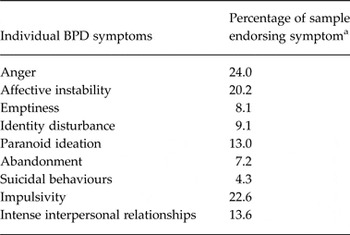
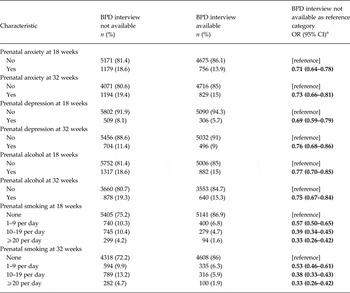
Descriptive statistics
Data were available for 6050 children who completed the UK-CI-BPD at age 11–12 years. Of the children assessed, 444 (male: 7.3%; female: 7.4%) reported five or more probable/definite BPD symptoms. This prevalence of BPD is comparable to that reported (5.9%) in a large national representative study of adults (Grant et al. Reference Grant, Chou, Goldstein, Huang, Stinson, Saha, Smith, Dawson, Pulay and Pickering2008) and in a community population of 11–14-year-olds (moderate BPD, male: 8.3%; female: 11.5%; severe BPD, male: 2.8%; female: 3.8%; Bernstein et al. Reference Bernstein, Cohen, Velez, Schwab-Stone, Siever and Shinsato1993) in the USA. Anger, affective instability and impulsivity were the most commonly endorsed symptoms. Table 1 shows the percentage endorsement of each BPD criterion. A statistical comparison of participants with and without the completed borderline interview indicated that those lost to attrition were more often boys, of ethnic minority, low birthweight and born to mothers of lower educational level. They were also more likely to have been born into family adversity, have a lower IQ and a psychiatric diagnosis at 7–8 years (Winsper et al. Reference Winsper, Zanarini and Wolke2012). Mothers who dropped out of the study were also significantly more likely to smoke or drink and experience depression or anxiety during pregnancy (Table 2).
Endorsement of the individual BPD criteria of the UK-CI-BPD

BPD, Borderline personality disorder; UK-CI-BPD, UK Childhood Interview for DSM-IV Borderline Personality Disorder.
a Based on probable/definite response.
Analysis comparing prenatal factors for those who dropped out to those who remained in the study

BPD, Borderline personality disorder; OR, odds ratio; CI, confidence interval.
a Boldface indicates that the 95% CI does not include 1.00.
Correlations between pre- and postnatal adversity
Binge drinking during pregnancy was significantly correlated with binge drinking after the birth of the baby (at 18 weeks Kendall's τ correlation = 0.21, p < 0.001; and at 32 weeks Kendall's τ correlation = 0.23, p < 0.001). Smoking during pregnancy was very strongly correlated with smoking after the baby was born (at 18 weeks Spearman's correlation = 0.75, p < 0.001; and at 32 weeks Spearman's correlation = 0.81, p < 0.001). Prenatal anxiety at 18 (Kendall's τ correlation = 0.38, p < 0.001) and 32 (Kendall's τ correlation = 0.40, p < 0.001) weeks was significantly correlated with postnatal anxiety. Prenatal depression at 18 (Kendall's τ correlation = 0.30, p < 0.001) and 32 (Kendall's τ correlation = 0.35, p < 0.001) weeks was significantly correlated with postnatal depression. As the correlations between pre-and postnatal smoking were very high (>70%), we conducted a collinearity diagnosis. Variance inflation factors (VIFs) and tolerance values indicated no issue with multicollinearity (Goodarzi et al. Reference Goodarzi, Jensen and Vander Heyden2012).
Associations between pre- and postnatal adversity and subsequent family adversity, maladaptive parenting and BPD
Pre- and postnatal anxiety, depression and alcohol consumption were associated with suboptimal parenting and parent conflict, as shown in the online Supplementary Table S1. Pre- and postnatal smoking were associated with parent conflict. Unadjusted associations between postnatal adversities and BPD are reported in online Supplementary Table S2. Postnatal maternal anxiety, depression, smoking, family adversity, suboptimal parenting and parent conflict were all significantly associated with BPD.
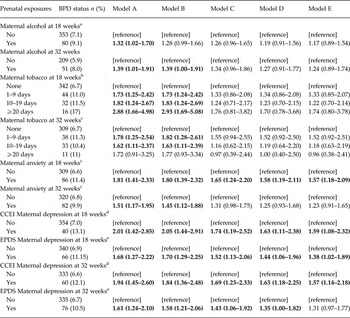
Associations between prenatal risk factors and BPD: unadjusted and adjusted associations
Associations between prenatal risk exposures and BPD are reported in Table 3. Associations between each prenatal risk factor and BPD are presented separately for each model. In unadjusted analyses (model A), all prenatal risk exposures (alcohol, smoking, anxiety and depression) were significantly associated with BPD. Following control for birthweight and sex (model B), alcohol consumption at 32 weeks, prenatal smoking, anxiety and depression remained significantly associated with BPD. After additionally controlling for postnatal exposure to the same risk factor (model C), prenatal anxiety at 18 weeks and prenatal depression at 18 and 32 weeks remained significantly associated with BPD. After additionally controlling for maladaptive parenting and family adversity (model D), prenatal anxiety at 18 weeks and prenatal depression at 18 and 32 weeks remained significantly associated with BPD. These associations remained in the final analysis (model E), which additionally controlled for child's externalizing and internalizing symptoms.
Associations between prenatal adversities and BPD: unadjusted analysis and controlling for confounders

BPD, Borderline personality disorder; CCEI, Crown Crisp Experiential Index; EPDS, Edinburgh Postnatal Depression Scale.
Model A: crude analysis. Model B: controlling for sex and birthweight. Model C: additionally controlling for postnatal risk. Model D: additionally controlling for family adversity from 0 to 4 years (with alcohol, anxiety and depression items removed), suboptimal parenting and parent conflict. Model E: additionally controlling for internalizing and externalizing symptoms. Boldface indicates significant association.
a Alcohol binge based on Sayal et al. Reference Sayal, Heron, Golding, Alati, Smith, Gray and Emond2009 (⩾4 units at least 1–2 days in the past month).
b Based on Zammit et al. (Reference Zammit, Thomas, Thompson, Horwood, Menezes, Gunnell, Hollis, Wolke, Lewis and Harrison2009).
c CCEI (cut-off point based on Heron et al. Reference Heron, O'Connor, Evans, Golding and Glover2004: score of ⩾9).
d CCEI based on Wolke et al. (unpublished data) score of ⩾10.
e EPDS based on Evans et al. (Reference Evans, Melotti, Heron, Ramchandani, Wiles, Murray and Stein2012) score of ⩾13.
Values given as odds ratios (95% confidence intervals).
Discussion
To the best of our knowledge, this is the first study to test the prospective associations between prenatal adversities and BPD at age 11–12 years. Congruent with previous retrospective research, all prenatal adversities were significantly associated with BPD. These associations remained significant after controlling for sex and birthweight, with the exception of alcohol consumption at 18 weeks.
Associations between prenatal anxiety and depression and BPD
Prenatal anxiety and depression were significantly correlated with postnatal anxiety and depression, and postnatal anxiety and depression were significantly associated with BPD. Prenatal anxiety at 18 weeks gestation and prenatal depression at 18 and 32 weeks gestation remained significantly associated with BPD after controlling for postnatal anxiety and depression respectively. This indicates that the associations between prenatal anxiety/depression and BPD were not solely mediated by a link between pre- and postnatal anxiety/depression but instead may represent direct associations from the prenatal period. This speculation is further supported by the observation that further adjustment for childhood risk factors for BPD (i.e. family adversity and maladaptive parenting) only moderately attenuated the associations.
Consistent with DOHaD, maternal cortisol may cross the placenta during pregnancy, disturbing the ongoing development of the foetus (Van den Bergh et al. Reference Van den Bergh, Mulder, Mennes and Glover2005). Thus, prenatal anxiety and depression may have lasting effects on offspring neuroendocrine functioning, impacting on the HPA axis and brain structures such as the amygdala (Welberg et al. Reference Welberg, Seckl and Holmes2000; O'Connor et al. Reference O'Connor, Ben-Shlomo, Heron, Golding, Adams and Glover2005; Davis et al. Reference Davis, Glynn, Schetter, Hobel, Chicz-Demet and Sandman2007; Van den Bergh et al. Reference Van den Bergh, Van Calster, Smits, Van Huffel and Lagae2007; Oberlander et al. Reference Oberlander, Weinberg, Papsdorf, Grunau, Misri and Devlin2008; Glover et al. Reference Glover, O'Connor and O'Donnell2010). Dysregulation of the HPA axis engenders hypersensitivity to stress, a core vulnerability observed in BPD patients (Lieb et al. Reference Lieb, Rexhausen, Kahl, Schweiger, Philipsen, Hellhammer and Bohus2004; Zimmerman & Choi-Kain, Reference Zimmerman and Choi-Kain2009). As BPD patients seem to evince emotional sensitivity and maladaptive temperamental traits (e.g. impulsivity, emotional dysregulation) from infancy onwards (Rogosch & Cicchetti, Reference Rogosch and Cicchetti2005; Crowell et al. Reference Crowell, Beauchaine and Linehan2009; Stepp et al. Reference Stepp, Burke, Hipwell and Loeber2012), it is plausible that they are co-determined by prenatal programming processes (Schwarze, Reference Schwarze2011). As described by the biosocial developmental model of BPD (Crowell et al. Reference Crowell, Beauchaine and Linehan2009), prenatal adversity may initiate an early vulnerability to dysregulation, leading to maladaptive behaviour that elicits psychosocial conflicts across the child's development, further exacerbating emotional, behavioural and cognitive dysregulation. Of note, we observed robust associations between prenatal anxiety and depression and subsequent maladaptive parenting during childhood.
Prenatal alteration of the amygdala (Cratty et al. Reference Cratty, Ward, Johnson, Azzaro and Birkle1995; Welberg et al. Reference Welberg, Seckl and Holmes2000) due to maternal anxiety and depression could also potentially increase risk of BPD. The amygdala is a core brain structure implicated in the processing of emotions, and has been found to be smaller and more active in individuals with BPD (Donegan et al. Reference Donegan, Sanislow, Blumberg, Fulbright, Lacadie, Skudlarski, Gore, Olson, McGlashan and Wexler2003; Minzenberg et al. Reference Minzenberg, Fan, New, Tang and Siever2007; Koenigsberg et al. Reference Koenigsberg, Siever, Lee, Pizzarello, New, Goodman, Cheng, Flory and Prohovnik2009). Hyperactivity of the amygdala is linked to ‘hypermentalization’ (i.e. an enhanced sensitivity to the mental states of others), a tendency observed in adolescents with borderline traits (Sharp et al. Reference Sharp, Pane, Ha, Venta, Patel, Sturek and Fonagy2011). Crucially, hypermentalization and emotional dysregulation may interact dynamically across development. Dysregulation may undermine socialization processes, reducing opportunities to develop appropriate mentalization skills, whereas hypermentalization may further derail the emotional regulation system leading to a vicious cycle of overinterpretation and anxious rumination (Sharp et al. Reference Sharp, Pane, Ha, Venta, Patel, Sturek and Fonagy2011). Subsequently, problematic interpersonal relationships with peers may ensue, further exacerbating burgeoning BPD symptoms (Sansone et al. Reference Sansone, Lam and Wiederman2010; Wolke et al. Reference Wolke, Schreier, Zanarini and Winsper2012).
We found that the association between prenatal depression and BPD did not depend on the timing of gestational exposure. By contrast, prenatal anxiety at 18 weeks only was significantly associated with BPD. Previous studies have been inconsistent regarding the gestational age at which the effects of antenatal maternal anxiety/stress are most pronounced (Van den Bergh et al. Reference Van den Bergh, Mulder, Mennes and Glover2005). O'Connor et al. (Reference O'Connor, Heron and Glover2002, Reference O'Connor, Heron, Golding and Glover2003) reported that antenatal anxiety at week 32 was a stronger predictor of behavioural/emotional problems than antenatal anxiety at week 18. However, other studies have indicated that anxiety/stress during early pregnancy may yield stronger effects, with psychological responses becoming progressively attenuated throughout pregnancy (Martin et al. Reference Martin, Noyes, Wisenbaker and Huttunen1999; Glynn et al. Reference Glynn, Wadhwa, Dunkel-Schetter, Chicz-DeMet and Sandman2001; Laplante et al. Reference Laplante, Barr, Brunet, Du Fort, Meaney, Saucier, Zelazo and King2004; Davis & Sandman, Reference Davis and Sandman2012). Future research may seek to clarify whether there are differential effects of gestational timing, and whether they may reflect different underlying mechanisms (Van den Bergh et al. Reference Van den Bergh, Mulder, Mennes and Glover2005).
Associations between prenatal tobacco and alcohol consumption and BPD
Associations between tobacco consumption and BPD disappeared once postnatal exposure to tobacco was controlled for. This suggests that associations between prenatal smoking and BPD may have been mediated by postnatal smoking. Pre- and postnatal smoking were very highly correlated and postnatal smoking was associated with BPD. Studies have reported significant associations between postnatal tobacco exposure and externalizing features after controlling for prenatal tobacco exposure (Weitzman et al. Reference Weitzman, Gortmaker and Sobol1992; Fergusson et al. Reference Fergusson, Horwood and Lynskey1993; Williams et al. Reference Williams, O'Callaghan, Najman, Bor, Andersen, Richards and Chinlyn1998), and it has been suggested that exposure to maternal smoking during childhood may be even more hazardous than exposure in utero. Childhood may represent a crucial period for the neurodevelopmental effects of smoking, and exposure during this period is likely to be more prolonged (Eskenazi & Castorina, Reference Eskenazi and Castorina1999). Nevertheless, tackling smoking during pregnancy to reduce adverse health effects is important (Heinonen et al. Reference Heinonen, Räikkönen, Pesonen, Andersson, Kajantie, Eriksson, Wolke and Lano2011; Benjamin-Garner & Stotts, Reference Benjamin-Garner and Stotts2013), especially as mothers who smoke during this period are highly likely to continue smoking following the birth of the child (Eskenazi & Castorina, Reference Eskenazi and Castorina1999).
Prenatal smoking was significantly associated with parent conflict and family adversity during childhood, suggesting that the association between smoking and BPD could have been partly mediated by parent conflict and social adversity. It has been speculated that smoking during pregnancy may be an indicator of a passive, neglectful parenting style (Brennan, Reference Brennan, Tremblay, Barr and Peters2005) or maladaptive personality traits (Bagley, Reference Bagley1992), which in turn are associated with problematic child psychosocial development (Brennan, Reference Brennan, Tremblay, Barr and Peters2005).
It is possible that the lack of significant associations between prenatal smoking and BPD following control for postnatal confounders may have been partly attributable to the characteristically mixed symptom profile of BPD. Robust associations between prenatal tobacco exposure and conduct/externalizing problems in offspring have been reported (Button et al. Reference Button, Thapar and McGuffin2005; Froehlich et al. Reference Froehlich, Lanphear, Auinger, Hornung, Epstein, Braun and Kahn2009; Brion et al. Reference Brion, Victora, Matijasevich, Horta, Anselmi, Steer, Menezes, Lawlor and Smith2010) whereas associations with internalizing problems seem to be non-significant (Brion et al. Reference Brion, Victora, Matijasevich, Horta, Anselmi, Steer, Menezes, Lawlor and Smith2010). As BPD comprises both externalizing and internalizing features, this may have diluted associations with the BPD outcome.
Associations between prenatal alcohol consumption and BPD were relatively weak and became non-significant once postnatal alcohol consumption was controlled for. The extant literature reports that alcohol consumption during pregnancy may have several adverse effects on the foetus, sometimes culminating in the development of foetal alcohol syndrome disorder (Mukherjee et al. Reference Mukherjee, Hollins, Abou-Saleh and Turk2005), the features of which have been likened to BPD (Page, Reference Page2003). However, whether low to moderate alcohol exposure during pregnancy is harmful remains controversial (Mukherjee et al. Reference Mukherjee, Hollins, Abou-Saleh and Turk2005; Kelly et al. Reference Kelly, Sacker, Gray, Kelly, Wolke and Quigley2009, Reference Kelly, Sacker, Gray, Kelly, Wolke, Head and Quigley2012).
Our alcohol variable was based on a threshold of ⩾4 units (i.e. two drinks) consumed at any point during the past month (Sayal et al. Reference Sayal, Heron, Golding, Alati, Smith, Gray and Emond2009). This relatively moderate threshold may have lacked precision, as it has been previously reported that 1–2 drinks per week or occasion do not increase the risk of clinically relevant behavioural difficulties (Kelly et al. Reference Kelly, Sacker, Gray, Kelly, Wolke, Head and Quigley2012). As pre- and postnatal alcohol consumption was associated with maladaptive parenting and family adversity, rather than being a direct cause of BPD, moderate prenatal alcohol consumption may be a marker for deprivation and parenting factors that increase the risk of BPD (Belsky et al. Reference Belsky, Caspi, Arseneault, Bleidorn, Fonagy, Goodman, Houts and Moffitt2012; Winsper et al. Reference Winsper, Zanarini and Wolke2012).
Strengths and limitations
This study has several strengths. We used data from a large prospective dataset that contained information on both pre- and postnatal risk factors, enabling us to ascertain whether prenatal risks exerted effects on BPD independent of postnatal exposure to the same risk and other confounders. Furthermore, as we controlled for externalizing and internalizing symptoms in late childhood, this supports the specificity of the observed associations between prenatal anxiety and depression and subsequent BPD. BPD at 11–12 years was assessed using a validated assessment tool. The UK-CI-BPD was adapted from a well-validated instrument, was piloted and administered by trained psychologists, and showed high inter-rater reliability.
The study also has limitations. First, there was selective attrition; those who dropped out were more likely to have experienced prenatal exposure to alcohol and tobacco consumption and maternal anxiety and depression. However, this reduces the statistical power and thus works against our hypothesis rather than inflating associations (Nilsen et al. Reference Nilsen, Vollset, Gjessing, Skjærven, Melve, Schreuder, Alsaker, Haug, Daltveit and Magnus2009). Furthermore, previous simulations with this data resource indicate that selective drop-out may lead to an underestimation of the prevalence of psychiatric disorders but only have a small impact on the associations between predictors and outcomes, even when drop-out is correlated with predictor variables (Wolke et al. Reference Wolke, Waylen, Samara, Steer, Goodman, Ford and Lamberts2009). Nevertheless, potential effects of selective drop-out cannot be totally ruled out. Second, although we used a reliable assessment for BPD (Sharp et al. Reference Sharp, Ha, Michonski, Venta and Carbone2012) with comparable criteria to the adult diagnosis (i.e. five or more symptoms), we do not presently know what proportion of children evincing BPD symptoms will be clinically diagnosed in adulthood. Consistent with the theory of heterotypic continuity (i.e. a change in symptoms over time), it is possible that some of the children evincing BPD in this sample will not be diagnosed with BPD in adulthood (Crowell et al. Reference Crowell, Beauchaine and Linehan2009). Nevertheless, previous research supports the notion that BPD symptoms in childhood and adolescence predict BPD diagnosis in adulthood (Wenning, Reference Wenning1990; Winograd et al. Reference Winograd, Cohen and Chen2008). Furthermore, our results largely converge with those of a clinical study that reported that adult borderline patients were more often exposed to a range of prenatal adversities reported retrospectively (Schwarze et al. Reference Schwarze, Mobascher, Pallasch, Hoppe, Kurz, Hellhammer and Lieb2013). Third, we did not control for genetic factors. Thus, part of the association between prenatal anxiety and depression and offspring BPD may be attributable to an inherited tendency towards mental illness (Belsky et al. Reference Belsky, Caspi, Arseneault, Bleidorn, Fonagy, Goodman, Houts and Moffitt2012). Nevertheless, depression in particular is associated with low heritability and candidate genes have not been reliably identified in genome-wide analysis (Wray et al. Reference Wray, Pergadia, Blackwood, Penninx, Gordon, Nyholt, Ripke, Macintyre, McGhee and Maclean2010). Fourth, prenatal risks were prospectively self-reported by mothers, potentially leading to under-reporting of these factors (Stockwell et al. Reference Stockwell, Donath, Cooper-Stanbury, Chikritzhs, Catalano and Mateo2004). However, we found that the prevalence of reported alcohol consumption (approximately 15% of mothers) greatly exceeded the prevalence reported in a more recent cohort study that used retrospective reporting of alcohol consumption in pregnancy (Kelly et al. Reference Kelly, Sacker, Gray, Kelly, Wolke and Quigley2009). Fifth, because of the observational nature of the study, we cannot conclude that associations represent causality (Hill, Reference Hill1965). Considering that the experimental induction of depression or anxiety is not possible, the prospective collection of data and control for relevant confounders is suggestive of potential causal mechanisms.
Overall, our findings support the hypothesis that exposure to prenatal adversity is prospectively associated with BPD at 11–12 years, and may portend exposure to future risks for BPD, including maternal mental illness and maladaptive parenting. An extension to this work may be the use of structural equation modelling to consider how pre- and postnatal risks combine (i.e. through moderated or mediated associations) to increase risk of BPD. Future prospective studies may incorporate physiological markers (e.g. cortisol) and genetic loci to further elucidate how the development of BPD unfolds from the prenatal period onwards (Beauchaine et al. Reference Beauchaine, Klein, Crowell, Derbidge and Gatzke-Kopp2009). Elucidation of ‘pre-disease’ pathways could facilitate the identification of vulnerable individuals, and furnish the development of early intervention programmes to delay or prevent later life disease (Van den Bergh et al. Reference Van den Bergh, Van Calster, Smits, Van Huffel and Lagae2007). Associations between prenatal anxiety/depression and BPD seem to be especially robust, highlighting the importance of intervention programmes to reduce stress during pregnancy (Van den Bergh et al. Reference Van den Bergh, Mulder, Mennes and Glover2005). Cognitive-behavioural treatment during gestation, or even prior to conception, may offer one fruitful approach (Facchinetti et al. Reference Facchinetti, Tarabusi and Volpe2004).
Supplementary material
For supplementary material accompanying this paper visit http://dx.doi.org/10.1017/S0033291714002128.
Acknowledgements
We are grateful to all the families who took part in this study, the midwives for help in recruiting the participants, and the whole ALSPAC team, which includes interviewers, computer and laboratory technicians, clerical workers, research scientists, volunteers, managers, receptionists and nurses. Special thanks to A. Waylen and J. Horwood for their help in the implementation of the study. The UK Medical Research Council (MRC) (Grant Ref.: 74882), the Wellcome Trust (Grant Ref.: 076467) and the University of Bristol provide core support for the ALSPAC.
Declaration of Interest
None.