… I completed this pamphlet in the capital city of the Caliphate. I penned it while travelling to many places, so it is very sloppy owing to the jolting of the wheels and the rocking of the railway on the desert and the steamship on the sea. I also wrote it when my ears were ringing because of the cannon and rifle fire on the coast of the Dardanelles and in the arenas of war and death …
Because they had a worldwide impact, the Caliphate and the related concept of Pan-Islamism are two notable subjects of late Ottoman historiography, which often examines these concepts by focusing on certain political eras. While the most useful age for studying these concepts is the Hamidian era (1876–1909), the Caliphate as a global discourse and the ideology of Pan-Islamism cannot be limited to the time and policies of Sultan Abdülhamid II. While earlier developments are frequently ignored in scholarship about these issues, they came up during the reign of Sultan Abdülaziz (1861–1876) and continued to gain pace in the Hamidian era as well as during the Young Turk period (1908–1918). The peak of appeal for the caliphate occurred in the last era, as indicated by the fact that a call for jihad was made for all Muslims under the banner of the Caliph during World War I. Therefore, the caliphate in this sense should not be restricted to certain policies of Ottoman sultans, especially not Abdülhamid II; rather, it should be approached in light of global developments, particularly the advent of steam and print technologies that brought to the world fast means of communication. They made it possible for Muslims in distant lands to develop a shared sense of awareness about the world as it was being colonized by European empires. In that era, the Caliph, embodied by the sultan, was widely accepted as the leader of Muslims around the world.
The emergence of Pan-Islamism through the concept of İttihad-ı İslam first appeared in the 1870s, a decade before the French and British occupations of Tunis and Egypt, and it prompted Muslims to strengthen their sense of political solidarity. Turkish intellectual Namık Kemal used the term in an article in 1872 as a means of calling for the unity of Muslims four years before Sultan Abdülhamid ascended the throne. In the same year, Esad Efendi, who was a clerk for the commercial court, wrote a pamphlet entitled İttihad-ı İslam in which he called on all Muslims to unite against the foreign occupation of Muslim lands.Footnote 2 As Karpat demonstrates, the emergence of the concept in 1872, even though it was not a concrete ideology yet, was spurred on by reactions against the Russian invasion of the predominantly Muslim lands of central Asia.Footnote 3 The 1880s, on the other hand, were marked by the increasing spread of ideas concerning solidarity against the colonial powers that were gradually invading Muslim lands.
The idea of Muslim unity against Christian powers gained traction against the backdrop of the events of the 1880s, especially the Russo-Turkish War of 1877–1878, the French occupation of Tunis in 1881 and the British occupation of Egypt in 1882. Aydın, who discusses how Muslims in earlier times did not take up or recognize a collective struggle against the non-Muslim other, identifies those years as a time when the emergence of the idea of the solidarity of all Muslims against colonial powers became salient, and he points out that the creation of an imagined Muslim world was made possible by the events that were transpiring. In spite of the fact that Muslims had established communications through education, trade, pilgrimages and politics, they were not shaped by religious goals formulated in the face of a hostile other. The spread of Sufi sects and the renewal movements of the eighteenth century, from Shah Wali-Allah in India to Uthman dan Fodio in Nigeria, were far removed from the concerns of the global situation of Muslims. The globalization of religions and empires began in the 1860s when the duality of the Muslim world and the Christian West did not yet exist.Footnote 4
It is not sufficient to attribute this emergence solely to political orientations, the influence of colonial powers or certain wars and treaties. Awareness is the most fundamental factor in this regard. It is clear that the emergence of ideas related to Muslim unity, namely, the global Caliphate and Pan-Islamism, was only possible through greater awareness of what was happening in Muslim regions, which only became possible in the age of steam and print. The communication revolution made it possible for Muslims in distant places to know more about each other via news reports, and so the notion of the unity of Muslims against colonial powers became a common theme. It should be noted that while many Muslim lands had been occupied before the 1880s, such as the Dutch attacks on Indonesia or the British occupation of India, those invasions did not trigger the idea of Muslim unity, such as under the caliphate of the Ottoman sultan. The Ottoman state had also lost lands to European states, and cases such as the French occupation of Egypt in 1798 or of Algeria in 1830 did not stir up widespread resentment among Muslims as did the situation of Tunis and Egypt in the 1880s.
India is a prime example of the context of the spreading of awareness through print technology. There were only six vernacular newspapers in India in 1835, and that number increased to ninety-seven in northern India alone by 1878, with a total circulation of about 150,000 copies. By 1880, there were 330 such publications. Those newspapers that were published when the Ottoman Empire was at war with Russia kept Indian Muslims informed on a daily basis about the developments in the conflict thanks to the rapid communications made possible by the telegraph. Many reports were translated into Arabic from Turkish, such as from Tercuman-i Rum and Akhbar dar al-Khilafat, but the most efficient news source was Paik-i Islam, which was an Istanbul-based newspaper published in Turkish and Urdu. As a result of this explosion of print activities, the reputation and profile of the Ottoman Caliph among the Muslims of India was bolstered and their relationship with the Caliphate was strengthened. Correspondingly, many voluntary organizations such as the Anjuman-i Teyyid-i Turkiye were established throughout India, and they urged Muslims to make financial contributions for the sake of the Ottoman state and successfully collected aid from various Indian groups.Footnote 5
Newspapers that announced the invasions of colonial powers and thus helped foster ideas of solidarity around the world also swiftly became tools of propaganda that empires used against each other. Muslim thinkers also took advantage of the opportunity to reach wider audiences in a way that was hitherto unthinkable. Jamal al-Din al-Afghani and Muhammad Abduh, for instance, printed the newspaper al-Urwat al-Wuthqa, which criticized the British invasions of Muslim lands and called on people to resist the colonial powers and save their homelands, property, honour, ethics and religion.Footnote 6 The newspaper was ultimately banned in Egypt and India by the British government. The rulers of European empires, especially the British and Dutch, were concerned about Muslims becoming unified in a struggle against Christian states, and new means of communications and transportation were increasing awareness and interaction among Muslims, as reported to the British Foreign Office.Footnote 7 The press influenced the policies of empires as well, and, for instance, the press in Istanbul played an important role in the support of the Ottoman state for the Aceh Muslims against the Dutch.Footnote 8
The Ottoman sultan, who was the ruler of the most powerful Muslim state at the time, was the leader of all Sunni Muslims through his caliphal title, which had been in existence for several centuries. Steam and print made it possible for the caliphate to become a global title and for the Ottoman sultan to acquire greater clout. In that regard, the following questions take on particular significance: What was the source of the legitimacy of the Ottoman Caliphate, which was accepted by various administrations and widely embraced by Muslims? How did the Ottoman sultan become the leader of the Muslim world on the basis of his caliphal title? The answer to these questions should take into account a number of different dimensions, but the main point is that the Ottomans inherited the caliphate from earlier periods and successfully transformed it into a position of global scope. The first Ottoman ruler to use the caliphal title was Murad I (1326–1389), the third ruler of the Ottoman dynasty, but Selim I (1470–1520), who took control of Egypt, Syria and the Hejaz, was held up as the first Ottoman Caliph in later works. On that issue, control of the Muslim Holy Lands, the transfer of the Sacred Trusts to Istanbul and the elimination of the Mamluk Sultanate played a major role in tracing the lineage of the caliphate. Moreover, in later works, Sultan Selim I was said to have inherited the caliphate from the last Abbasid caliph in Aleppo after his Egypt campaign.Footnote 9
Besides this historical connection, there were other issues in the global era that were invoked as sources of legitimacy for the Ottoman Caliphate. Syed Mahmud, who defended the Ottoman Caliphate in an essay published in Patna, India in 1921, attempted to explain why the caliphate was so widely accepted. According to him, the Ottoman Caliphate was a continuation of the Abbasid Caliphate. Secondly, Sultan Selim I was elected as caliph by the Turkish ulema as well as the scholars of al-Azhar. Thirdly, the Ottomans held the holy cities of Mecca, Medina, Karbala and Jerusalem, and as such the Turkish sultan was known as the servant of the Hejaz, the khadim al-haramayn. Fourthly, the Ottomans were independent, unlike many other Muslim communities. Fifthly, they held the Sacred Trusts of the Prophet, which held symbolic value. Sixthly, there was a consensus among Muslims in terms of recognizing the caliphate of the Ottomans, which is quite significant because the Wahhabis, for instance, who once took control of the Holy Land, could not lay claim to the caliphate because they lacked the support of Muslims. Lastly, the Turks had been holy warriors and hence the protectors of Islam against Western domination throughout the centuries.Footnote 10 These points that Syed Mahmud raised were key elements for asserting the legitimacy of the Ottoman Empire as the leader of all Muslims in an increasingly global era. Some of those contentions were variously defended or criticized by scholars of the time, such as Wilfrid Blunt who wrote The Future of Islam, which was published in 1882. In that text, Blunt discusses five of those issues, raising the arguments of the Hanafi ulema on the legitimacy of the caliphate, and he refutes them.Footnote 11
On the other hand, the timing of the caliphate becoming a global concept is another matter. In contrast to works that focus on the reigns of certain sultans, the issue should be examined as a cumulative process in the history of the Ottoman Empire. The issue of the caliphate gradually expanded politically and geographically, appearing in the early modern period and reaching its peak in World War I. In the classical era, the caliphate was a symbolic title and, there were no policies that had the universal goal of transforming it into an administrative role; rather, it was reconstructed as a mystical term used to define the spiritual leadership of the sultans.Footnote 12 Although Ottoman statesmen emphasized their absolute caliphate (halife-i mutlak) in bilateral negotiations with states such as Iran,Footnote 13 the reflection of this in Muslim communities – that is, how it created awareness – is an issue that cannot be compared with the globalization experienced in the nineteenth century. In earlier periods, the Ottoman sultan was seen as the imam of the Holy Cities by many Muslims outside the empire’s area of control. Evliya Çelebi, a well-known seventeenth-century Ottoman traveller, journeyed to the Funj Sultanate in Sudan, where, he said, some of the administrators had never seen a “white” person, and he wrote that during the Friday sermons Muslims prayed for their rulers as the imams of the region and for the Ottoman sultan as the ruler of Mecca and Medina.Footnote 14 Even if it is true that Sudanese Muslims prayed for the Ottoman sultan every week, this does not demonstrate the existence of a sense of solidarity among Muslims who knew of the Ottoman sultan as the sovereign of the Holy Lands. On the other hand, many Muslims in distant lands confused the sharif of Mecca and the caliph of the Ottoman state, as in the case of Indonesian Muslims.Footnote 15
It is clear that, whether politically or symbolically, the Ottomans did not seek to be recognized as the leaders of all Muslims in the world until the late Ottoman period. When an alliance was struck between Sultan Ahmed III and Ashraf Han, the ruler of Persia, in 1727, the Ottoman sultan was portrayed as the caliph of all Muslims,Footnote 16 but it is not apparent exactly what the two sides meant by “all Muslims.” Nevertheless, the concept probably influenced an argument raised against the Russians in 1774. The Küçük Kaynarca treaty is crucial because it was the first case of the Ottomans arguing that the sultan was the spiritual leader of all Muslims. With the treaty, the empress of Russia, Catherine II, forced the Ottomans to accept the Crimean Khanate as an independent state and, in return, she recognized the religious leadership of the Ottoman sultan over Crimean Muslims. In this way, the Ottomans succeeded in persuading a competitive empire to accept the legitimacy of the Ottoman Caliphate. Even though Russian administrators avoided referring to the Ottoman sultan’s title of caliph in the Treaty of Paris in 1856, the Ottomans had already established the idea that they were the leaders of all Muslims, even outside Ottoman territories.Footnote 17
Even though the symbolic title of caliph was retained for Muslims who lived in territories lost by the Ottoman Empire, a totalizing sense of symbolic Muslim unity did not yet exist. A decade after Küçük Kaynarca, Tipu Sultan (1750–1799), who was the ruler of the Kingdom of Mysore in South India, sent a letter in which he tried to strike an alliance with the Ottoman state against the British Empire. Karpat notes that this was the first instance of a Muslim leader seeking to establish a Muslim political alliance against the “enemies of Islam.” Karpat points out that a third of the letter consisted of praise for the Ottoman sultan as the caliph of Muslims, while the rest reported on attacks carried out by Christians against Muslims, as well as requests for the Ottoman sultan to help mobilize Indian Muslims against the British.Footnote 18 However, it should be highlighted that Tipu Sultan’s alliance with the French, which had been passed down from his father, was still in effect at the time. Although Tipu Sultan, whose prime target was legitimization of his rule in the region,Footnote 19 had sent a large entourage to Istanbul, the alliance was rejected by Abdülhamid I, who cited the problem of the crisis in Crimea with the Russians and chose the strategic move of sustaining collaboration with the British. In other respects, the political collaboration sought by the Indian sultan with the Ottoman Caliph does not signify the emergence of a global caliphate. The spread of the caliphal idea, which was seen as a symbolic title, was restricted because of the difficulty of traversing the great distances between disparate regions. It should be noted that the journey of Tipu Sultan’s entourage started in Seringapatam in South India on 17 November 1785 and ended in Istanbul on 25 September 1787, almost two years later. Furthermore, the entourage managed to return home only by January of 1790.Footnote 20 With such slow communications and transportation, even between Istanbul and India, which had been connected throughout the centuries, how would it be possible for the caliphate to become a global force in the eyes of people living so far apart?
Such great distances were an obstacle for the emergence of a global caliphate. However, a transformation occurred through developments in steam and print technologies. By the 1850s, the Ottomans were becoming more familiar with rapid communications and means of transportation. Those years were also marked by a war against Russia in which the Ottomans acquired the support of the British. The role of the Ottoman–British alliance was bolstered following the Crimean War and it was crucial for spreading the caliphal idea to faraway Muslim lands. For example, during a major rebellion against the British occupation of India in 1857, British rulers appealed to the Ottoman sultan to write a letter as Caliph ordering Indian Muslims to not join the rebellion of Hindus against the British.Footnote 21 However, that alliance was not a key factor in the expansion of the reputation of the caliph around the world. Such alliances of states had already existed in earlier times, and hence they were not essential to spreading a global caliphal idea. Consequently, the caliphate needs to be examined along with developments in communication technologies instead of the reign of certain rulers or some political orientations. In that regard, the adventures of Ottoman scholar Ebubekir Efendi are a significant example of how the Ottoman Caliphate began to emerge as a worldwide phenomenon.
An Âlim on His Speedy Way from Istanbul to South Africa
In 1862, during the second year of the reign of Sultan Abdülaziz, a scholar was sent from Istanbul to South Africa to teach Islam to Cape Muslims. The journey would be the forerunner of caliphal envoys in subsequent decades. The scholar was Ebubekir Efendi of Şehrizor, which is located in modern-day northern Iraq, a Kurdish alim descendant of Amir Suleyman. Ebubekir Efendi’s claim to fame was based on his extraordinary mission to the faraway Cape of Good Hope. He continued to carry out his duties there until his death in 1880, and his son became the Ottoman ambassador to Singapore in 1903; his descendants still live in South Africa. In the literature, Ebubekir Efendi is often referred to as the envoy of Sultan Abdülhamid II,Footnote 22 but he served the sultan for just four years. The first fourteen years of his post in Africa were carried out during the reign of Sultan Abdülaziz, who appointed him.
Ebubekir Efendi, who started his education in his hometown and went on to study in Istanbul and Baghdad, had moved to Erzurum where his family had settled. Because of an outbreak of famine, he was forced to relocate to Istanbul in 1862. In the same year, British administrators asked the Ottoman state to appoint a scholar to Cape Town, where there were three million Muslims who had been taken there from Java by Dutch authorities before the British took control of the region. Because these Muslims lacked religious leadership, a scholar was needed to solve problems along religious lines and to teach religion. British rulers were concerned about security in the region and appealed to the Ottoman state, with whom they were in close contact at the time. Cevdet Pasha was charged with finding an appropriate alim for the mission and he suggested Ebubekir Efendi, who was in Istanbul. Sultan Abdülaziz approved the appointment on 26 May 1862.Footnote 23
Istanbul did not yet have a railway, so Ebubekir Efendi and his assistant Ömer Lütfi EfendiFootnote 24 departed by steamship for Marseille, whence they travelled by train to Paris and then took a ship to London. After a two-month stay in London, he travelled from Liverpool to Cape Town by steamship, arriving on 17 January 1863. He reported that the steamship hoisted its sails at times and arrived in Good Hope after a trip of forty-four days.Footnote 25 During the course of his journey, starting with his departure from Istanbul on 3 September 1862 and ending with his arrival in Cape Town, he spent a total of four-and-a-half months travelling, during which time he stayed in different cities in addition to two months in London.
Nine days after his arrival, on 26 January 1863, Ebubekir Efendi wrote a letter to Münif Mehmed Pasha (1830–1910) in Istanbul. The letter was published one month later in the journal Mecmua-i Fünun by the aforementioned pasha.Footnote 26 Münif Pasha, as a statesman who was a proponent of modernity and would play a role in educational reforms when he served as Minister of Education, placed importance on the education of the nation, aiming to increase literacy. As part of his efforts, he established the Cemiyyet-i İlmiyye-i Osmaniyye (the Ottoman Scientific Society) as well as libraries and reading houses (kıraathane), and he started a public lecture series at Darülfünun.Footnote 27 One of his most significant contributions was the establishment of the scientific monthly journal Mecmua-i Fünun, which published forty-eight issues from 1862 to 1883. The journal kept a distance from political and religious matters and focused on improving Ottoman society through science and culture. Due to high demand, some issues were reprinted.Footnote 28 It is significant that the letters of Ebubekir Efendi, which provided insights about the peoples, religions, cultures and geography of South Africa, taking up a wide variety of issues, were received with so much interest.
Münif Pasha not only published the letters of Ebubekir Efendi but he also explained and interpreted them.Footnote 29 His explanation that South African Muslims, who were trying to solve religious debates and turned for help to the Ottoman sultan, who was also the Grand Caliph, can be cited as an early instance of the global caliphate idea.Footnote 30 Such a perspective is seen in the statements made by Ebubekir Efendi as well. When he mentions the situation of African Muslims, not only in Cape Town but also in Mozambique, Zanzibar and on other islands, he states that many nations located a six-month journey away had commercial contact with those people, but the Ottomans had “regrettably” neglected them. He offers to establish friendly relations between Istanbul and those regions, saying that because of the large number of Muslims living in Africa, they would become strongly connected to the caliphal centre.Footnote 31 In that globalized world, the fame of the Caliph was spreading among Cape Muslims, as seen in the memoirs of his assistant Ömer Lütfi, who writes that they were praying for the Ottoman Caliph, the Caliph of the Prophet, following the sermons of Ebubekir Efendi.Footnote 32
In the fourth month of his stay, on 18 May 1863, Ebubekir Efendi sent a letter about his successes. It was published a month later in June in the newspapers of Istanbul. Mecmua-i Fünun announced that Ebubekir Efendi’s advice and sermons were having a good influence on the African people and bringing to an end quarrels among Muslims that had been ongoing for fifty years. Because of the Efendi’s achievements, the region’s Muslims said they wanted to send a letter of thanks to both the Ottoman sultan, who was the protector of sharia, and the British Queen, who was their ruler. At the end of the news story, the strides forward that Ebubekir Efendi made in that short period of time were praised as a resounding success made possible by his holiness the Caliph.Footnote 33
As someone who also sent proposals to Ottoman administrators asking them to make a political appeal to the British about Muslims in the region,Footnote 34 Ebubekir Efendi addressed the issue of religious faith among African Muslims as a scholar. He taught Islam to common people who held to a conservative form of sectarianism, especially that of the Shafi’i School, and engaged in superstitious practices in their beliefs. In his letters, he gives detailed information about the mistaken beliefs of Muslims in some areas regarding issues such as in marriage, the law of inheritance and food and beverages.Footnote 35 He also provides details about how the people incorrectly recited the Qur’an. Since he was appointed to solve problems among Muslims, he worked to achieve unity among Muslims and to spread the idea that each of the four Sunni schools of thought is correct. The Muslims of the region were fanatical Shafis and refuted all of the other schools. The technologies of steam and print played a role in this way as printed books that were brought from Mecca were sometimes a cause of the quarrels that broke out. He says that some pilgrims returned to the region with copies of a Javanese book by Muhammad Salih ibn Ali from Batavia, who was living in Mecca at the time, and those printed books were distributed among the people. The books dogmatically taught Shafi’i law, so people who held different views rejected such efforts.Footnote 36
In his educational endeavours, Ebubekir Efendi used some classical books about belief and tafsir such as the Fıkh al-Akbar of Abu Hanifa and the Ruh al-Bayan of Bursevî.Footnote 37 Over time, Ebubekir learnt Cape Dutch so he could wield greater influence over the local Muslims and he wrote the Bayan al-Din, which was published in Arabic and Dutch in 1869. The book was based on a well-known handbook of the Hanafi School entitled Multaqa,Footnote 38 and it became known for being the first Dutch book in the Arabic alphabet.Footnote 39 After he completed the book, he sent a copy to Istanbul and he was awarded with a Mecidi order for his work in 1870 by Sultan Abdülaziz. He also wrote another book, the Marasid al-Din, which he distributed to the people in the form of manuscripts. However, he needed more printed versions of the books, so he travelled by steamship to Istanbul in 1877, one year after the dethronement of Sultan Abdülaziz and the accession of Sultan Abdülhamid II. He was able to print 1,500 copies of both books,Footnote 40 and he returned with them to South Africa, where he would die several years later in 1880. In the printed version of Bayan al-Din, he added a Turkish preface, in which he mentions his endeavours to educate people by opening schools and teaching literacy and religious matters, and he discusses how his students became teachers for other people at new schools. He also explains why he needed to print his books for Muslims in South Africa and Mozambique and he mentions the Caliph of the time, Sultan Abdülhamid II, with prayers and much praise.Footnote 41
Ebubekir Efendi’s efforts to establish religious schools, travel to other African cities to give guidance about Islam and connect the African people to the Ottoman Caliphate are an early example of how the worldwide Ottoman Caliphate began to emerge in the globalized world. He travelled by steamship on his long journeys and his letters were sent quickly by steamship as well, thereby reaching wide audiences via journals in Istanbul. Large numbers of his books were published by the printing presses of Istanbul and they had a significant impact on the Muslims of Africa as well as a remedying effect for the problems caused by the Javanese books that were brought from the Hejaz. The influence of Ebubekir Efendi, which continued in the region after his death, began in the first years of Sultan Abdülaziz’s reign and was sustained in the Hamidian era, corresponding to improvements in the technologies of steam and print. By taking him as an example, it is seen that the emergence of a global caliphate and its development needs to be approached as a gradual process.
The Emergence of the Global Caliphate
While the caliphal title had long been used by Ottoman sultans, its global dimension came into being in the second half of the nineteenth century, so Sultan Abdülaziz, who ascended to the throne in 1861, can be seen as the first global Ottoman Caliph in history. As a ruler who was familiar with all the basic technologies of steam and print, he was the first sultan to travel to Europe for reasons other than a war campaign. He set out on a journey that began in Istanbul on 21 June 1867 via a steamship to Toulon, and from there he travelled to Paris by railway. After journeying to London, he returned via Belgium, Vienna and Budapest by railway and steamships on the Danube, arriving in Varna and then Istanbul via steamship on the Black Sea. He concluded his travels on 7 August 1867 in just forty-six days, during which time he met with the rulers of European empires.Footnote 42 The Ottoman diplomat İsmail Ferruh Efendi, who used the same route in 1797, did not even reach London after the same period of time had elapsed.Footnote 43 Istanbul was already familiar with the printing press and steamships before Abdülaziz, but they quickly became more widespread. The telegraph was also brought to the capital several years before from his accession. A railway system, on the other hand, was only established in Istanbul during his reign in 1873 and 1874.
Although discourses about a global caliphate began to emerge thanks to greater awareness of Muslims in distant lands made possible by steam and print, the era of Abdülaziz has largely been ignored in the literature because it has been overshadowed by his nephew’s policies. Of course, the thirty-three-year rule of Sultan Abdülhamid II witnessed many developments regarding the Islamic World, but neither the concepts of the global caliphate nor Pan-Islamism, which were already in place before Abdülhamid II, came to an end after him. The biggest appeal for the caliphate took place when jihad was declared by the caliph, not by Abdülhamid II but by his brother Mehmed V.Footnote 44 Since those cumulative concepts expanded gradually over the years, they need to be taken up as part of a historical process, not confined to the reign of one sultan. The most significant aspect of Abdülhamid II, however, was the fact that he remained on the throne for three decades during the peak of the age of steam and print.
Nonetheless, the reign of Sultan Abdülaziz was crucial in terms of illustrating how the globalization of the caliphate was not about the policies of rulers but rather the characteristics of the new era. Like the use of the term Pan-Islamism, many developments that would reach a high point afterwards began during the reign of Abdülaziz. He was informed about distant Muslim lands and he knew that knowledge about his position, which he had inherited from his predecessors, was spreading far and wide via the telegraph and newspapers. The changing situation influenced policies as well. In this regard, probably the most significant example that demonstrates the gradual development of Ottoman relations was the case of Indonesia.
The relationship between the Ottoman state and the Sultanate of Aceh dated back to the sixteenth century. When the ruler of Aceh had requested help from Süleyman the Magnificent in fighting off the Portuguese in 1563, the Ottomans sent nineteen ships from Istanbul, of which only two managed reach to Aceh. Similar requests were also made in the nineteenth century regarding Dutch attacks, and Javanese envoys were sent to the Ottoman governor of the Hejaz and later to Istanbul to announce the fealty of the Sultan of Aceh to the Ottoman state in the 1850s. In exchange for protecting them from the Dutch threat, the Aceh Sultanate offered to recite the Ottoman caliph’s name in the Friday khutbas, mint coins with the name of the Ottoman sultan and pay tax to the state.Footnote 45 However, those offers were turned down by the Ottoman state on the basis that it was not in a position economically or strategically to offer such aid. However, in 1869, during the reign of Sultan Abdülaziz, the Aceh Sultan Mansur Shah made renewed offers to the Ottoman state. This time, thanks to new means of transportation, the Ottomans sent an envoy, Pertev Efendi, to Aceh. Although the talks failed once again, the sultan was told that the Muslims in the Dutch East Indies referred to him as the caliph of Muslims and he was pleased with his growing reputation. The Ottoman state, which had been on the side of the British against the Muslims of India in 1857, did not support the Dutch Empire in 1873 when Dutch troops landed on Aceh, and the Muslim press in Istanbul played a significant role in that regard.Footnote 46 During the Dutch invasion, the vizier of Aceh, Abd al-Rahman al-Zahir, travelled to Istanbul and his mission was reported about in the public news in an unprecedented manner.Footnote 47 In addition, the fruitless requests for help made by the Muslims of Aceh echoed an agenda that was created by newspapers such as Basiret in Istanbul, leading to widespread public disappointment. As a result, Sultan Abdülaziz discharged Saffet Pasha, the minister of foreign affairs, but that did not have an impact on public opinion. Karpat points out that Sultan Abdülaziz’s perceived inability to carry out his caliphal duties resulted in a loss of public support and madrasa personnel, and encouraged Midhat Pasha’s group in their plans to dethrone him.Footnote 48
Similarly, Muslims in the Comoro Islands were able to contact the Caliph thanks to developments in communication technologies. In 1865, prominent Muslims from the Comoros in the Indian Ocean requested help from Sultan Abdülaziz with a petition in which they addressed the Ottoman sultan as the caliph to the Prophet, the protector of the Muslim Holy Lands and the head of the Muslim ummah. They were asking for help regarding their ruler, Sultan Abdullah, who sought to change the social order in association with the British consul. Those notables, who were mostly from among the ulema, asked Sultan Abdülaziz to provide support for his Muslim subjects and followers in protecting their religious way of life. Consequently, the Ottoman Caliph sent an envoy to the ruler of the Comoro Islands in Hinzuan with the aim of giving advice about the lives and security of Muslims.Footnote 49 Those examples, as seen in the cases of Ebubekir Efendi, Aceh and Comoro, indicate that a worldwide caliphal discourse began with the requests of Muslims from areas outside the Ottoman rule and that new means of communication paved the way for stronger connections and greater awareness.
Symbols of the caliphate began to appear in distant lands during the reign of Abdülaziz as well. One of the most well-known signs of Muslim sovereignty was the recitation of a ruler’s name during the Friday khutba. That tradition had been ongoing since the earliest years of Islam and reciting the name of a ruler during prayers was deemed a sign of legitimacy throughout the Muslim world. The practice of making such mention of the Ottoman Caliph in distant lands varied from region to region, but in the colonial period it seems to have become increasingly common. In many places, the tradition of reciting the name of the Ottoman sultan has been documented, as in the case of Sultan Abdülaziz. In India, for instance, the first mention of an Ottoman Caliph during the khutba in large cities as well as villages occurred in 1862 during the reign of Abdülaziz.Footnote 50
The gradually developing postal system, which allowed for letters to be delivered across great distances, was made possible by steamships, and Sultan Abdülaziz received many letters and gifts from Muslims who sought to offer their respects to the Caliph. Notable Indian thinker Syed Ahmad Khan (1817–1898), for instance, sent a copy of his printed book A Series of Essays upon the Life of Mahomed together with a letter that included a prayer asking that Sultan Abdülaziz continue to grace, defend and strengthen the Caliphal throne for many years.Footnote 51 Postage stamps can also be read as a reflection of politics and ideologies, and they were first introduced in the Ottoman Empire in 1863 during his reign; they were adorned with either the tugra (the Ottoman sultan’s imperial signature) or the star and crescent, the symbol of the caliphate.Footnote 52
Like the postage stamps that rendered possible the quick delivery of letters, people were also travelling, and relations with distant lands improved as the result of technological developments with political ramifications, as in the case of the travels of the Ismail Pasha, who accompanied Sultan Abdülaziz in 1867, and Syed Ahmad Khan in 1869.Footnote 53 The Ottoman ulema and envoys were also able to quickly travel great distances in this period. Such journeys, however, were not just about travel; thanks to them, many Muslims heard about heretofore unknown places and communities in the world. News about the existence of distant Muslim lands quickly spread among the Ottoman people via newspapers and printed books. For instance, while he was travelling to Basra via the Cape of Good Hope as the imam of a steamship, Baghdad scholar Abdurrahman Efendi stopped in Brazil when the ship strayed off course in the Pacific Ocean in 1866, and he stayed there for several years. He penned his observations about the Muslims of that continent in Arabic, and the book was translated into Turkish and published in 1871 in Istanbul.Footnote 54 The introduction of the book affirms the existence of Muslims in South America, which the Ottoman people had not known about, and asserts that Muslims in Brazil had not known there were “white” Muslims in the world.Footnote 55 In light of these cases, it can be argued that the technologies of steam and print paved the way for a common consciousness concerning religious identity among Muslims, who were quickly learning more about each other alongside the emergence of a worldwide discourse of the caliphate, which became further entrenched during the reign of Sultan Abdülhamid II.
Transnational and Intercontinental Networks of the Caliphate
The modern tools of the age of steam and print, which would spread even further in the Ottoman Empire in the Hamidian era, were seen as an obstacle to the caliphal idea by some Western intellectuals in the first years of the new sultan’s reign. In an essay entitled “Street Cars and Absolutism” published in The New York Times in January of 1877, just one month following the first constitutional declaration, tramways were paraded as the real cause of the constitutional revolution. The rail system that had been established in Istanbul several years earlier was held up as a “leveller” of social and political distinctions, and as such marked the doom of absolutism and the Ottoman dynasty. According to the essay, when dervishes, mullahs and pashas rode on the same level on street cars, the authority of the Ottoman Caliph, who had already stooped so low as to wear French-style trousers, was shaken. Such new modes of transportation, which were cited as bringing about the end of Abdülaziz’s era, would erase the oriental characteristics of the city forever. The essay, which emphasizes that the constitution was an imperative and belated declaration, concludes with the claim that the caliphate would revert to Baghdad because it could not coexist with the street cars of Istanbul.Footnote 56 Needless to say, the predictions of the essay failed to come true. In the following year, the new sultan, Abdülhamid II, abolished the constitution in practice for a period of thirty years, and he used the railway as well as other modern technologies in the service of the caliphate, thereby promoting the spread of the global caliphate from Istanbul as its centre.
The global caliphate that had emerged before the reign of Sultan Abdülhamid II quickly spread through the efforts of people who travelled outside Ottoman territories and those who arrived in the capital. The early years of the new sultan’s rule witnessed a major war fought with Russia in 1877 and 1878 and then the occupation of Tunisia and Egypt by the French and British. As discussed earlier, those events were turning points in the emergence of a sense of solidarity in the Muslim world against the Christian West. Those developments also had an impact on the social and political structure of the Ottoman Empire. The Russo-Turkish War resulted in a crushing defeat for the Ottoman Empire, and waves of Muslim immigrants poured in from the Caucasus and Balkans to the remaining Ottoman territories. Millions of refugees were expelled because of their Muslim identity, and the population of non-Muslims in the Ottoman Empire decreased from 40 to 20 per cent. This population shift created a desire for solidarity along the lines of religious identity among the Muslim majority within the Empire.Footnote 57
After this phase, the idea of Muslim solidarity inside and outside the Ottoman state became more visible in policies and among the intelligentsia and society at large. The capital of the caliphate, Istanbul, grew as a centre of correspondence and travels for Muslims, and Sultan Abdülhamid II, who came to the throne at the peak of the age of steam and print, successfully used new technologies as a means of being in contact with distant Muslims. An early example of the new era was observed during the Russo-Turkish War, as scholar Ahmed Hulusi EfendiFootnote 58 was sent to the Afghan Amir Sher Ali Khan in 1877 with a delegation. His mission was to convince the Afghan ruler to support the Ottoman state by attacking the Russians. Also, the Amir was advised to maintain good relations with the British, with whom the Ottoman state tried to form an alliance. The other members of the delegation were tasked with visiting other Muslim rulers in the region, such as Akhund Sahib of Swat. As part of those missions, Sultan Abdülhamid II tried to gain the support of the British against Russia and prove the influence of the Caliphate in the world. However, the delegation was unable to obtain any support except for prayers from the Afghan rulers, who were against the British.
The journey, nevertheless, became a model for the future Pan-Islamic policies of the Ottoman Caliphate. First of all, once again it became clear that the reputation of the Ottoman Caliphate extended beyond the borders of the empire. Also, the mission demonstrated how fast communications had become for Muslims. The journey of Ahmed Hulusi from Istanbul to Kabul was undertaken by steamship, first to Bombay and then by railway to the north, where rail transport was available. The delegation departed from Istanbul on 12 July 1877 and arrived in Bombay on 9 August 1877.Footnote 59 They were welcomed by more than 4,000 Muslims at the pier who had gathered to see the envoys of the Caliphate. The British, who were uneasy about such a reception by a crowd of Muslims, promptly dispatched the delegation to the consulate. However, people showed up there as well, reciting prayers for the Caliph well into the night. One day later, about 50,000 Muslims gathered at the mosque where the delegation had gone for the Friday prayers. The British wanted the delegation to leave the city at night, so they went to Kabul via railway.Footnote 60 Hulusi Efendi arrived in Kabul on 8 September, meaning that the entire trip took less than two months. At the same time, Hulusi Efendi did not need to return to Istanbul personally to deliver the message of Sher Ali Khan, because the reports were telegraphed to Istanbul on 27 October 1877.Footnote 61 Moreover, while the Ottoman administrators in Istanbul had already heard about the global prestige of the Ottoman Caliphate through embassy reports that were penned by Ahmed Behai Efendi, the people also heard about the journey because another member of the delegation, Ahmed Hamdi Efendi, published his travel accounts in Istanbul in 1883.Footnote 62
Another instance of relations with the capital of the caliphate arose from Zanzibar, which was ruled by the Bu Said dynasty. The first formal relations between Zanzibar and the Ottoman state were established during the reign of Sultan Bargash ibn Said, who was the ruler of Zanzibar from 1870 to 1888 and wanted to develop his territories in terms of transportation and communications. Zanzibar had become familiar with regular postal services in 1872 through the British India Steam Navigation Company and in 1879 the telegraph became established with the Eastern Telegraph Company. Also, in 1875, Bargash became the first Omani/Zanzibari Sultan to visit Europe. He also went to the Hejaz for the Hajj in 1877, and thus the foundations were laid for a relationship with the Ottoman Empire, as Sultan Abdülhamid II granted him the Mecidi order in 1879.Footnote 63 The medal was presented by a top Ottoman official, Emin Efendi, who was sent to Zanzibar to establish friendly relations in the service of Islamic unity in the world. Ten years later, Şükrü Bey was sent to Zanzibar to commemorate the accession of the new Sultan, Khalifa ibn Said, with a letter from the Ottoman Caliph, and Şükrü Bey made the journey in just twenty-four days by steamship. Moreover, Abdülkadir Efendi, the chief of the Beirut trade court, was sent to Zanzibar to engage in political intermediacy in the same year, and his mission was reported about in European newspapers. Besides the Ottoman envoys sent on steamships, telegraphed messages allowed for communications between the Ottoman and Zanzibari sultans.Footnote 64 The relationship grew stronger and, in parallel with mercantile connections and common perceptions of Muslim solidarity in international affairs, the Ottoman fez and coat started to be worn as an official uniform in Zanzibar during the reign of Sultan Ali ibn Hamud between 1902 and 1911.Footnote 65 In addition, Sultan Ali, who travelled to Europe by steamship, used the Orient Express from Paris to Istanbul and visited Sultan Abdülhamid II in 1907.Footnote 66
In those years, the Ottoman state, which sent numerous envoys to distant regions with the aim of establishing good relations with other Muslims, also established consulates in different parts of the world. For example, an Ottoman consulate was established in Batavia in 1883. The consular facilities that began operations in the 1850s in India grew to new proportions in the 1890s and honorary consulates were established with Indian Muslims who were Ottoman devotees, as was seen in Madras and Karachi. Those consuls were trying to tie Muslims to the Ottoman Caliph through religion, circulate Ottoman news in the press and have the Caliph’s name recited at the Friday khutba. Their activities were tracked by the authorities in Istanbul via telegraph and also by the colonial rulers of the respective regions. Day after day, the reputation of the caliphate was growing stronger among the Muslim masses and their interest was proving the power of the caliphal idea to the world. One of the Ottoman consuls in India was Abdülhak Hamid, who was a famous poet, and he served in Bombay in 1883. His opinions concerning the influence of the caliphate are notable because he was of the belief that the caliphate was a unique way to attain the sacred notion of unity. Similarly, as was seen in the travels of Hüseyin Kamil Efendi in India, in 1896 thousands of Muslims welcomed the Ottoman consuls because they represented the Caliph.Footnote 67
The numbers of envoys, requests, gifts and news about the Caliph as regards the unity of Muslims under the Ottoman flag increased in the following years. In 1898, when struggles broke out between the local rulers of Kuwait and Qatar, Sultan Abdülhamid II sent Receb Efendi, the Nakibü’l-Eşraf, to the region to solve the problem, as there were concerns that the British would occupy the region as a result of the conflict. The local rulers promptly telegraphed the Ottoman Caliph, expressing their loyalty to him. Thenceforth, the Sultan ordered that telegraphed statements be recited in the official assembly as proof of the prestige of the Caliphate in the region.Footnote 68
In addition to the many people who were posted to distant regions from Istanbul, the city hosted large numbers of Muslims from all over the world as well. Some of them met with the Sultan personally, but most of them were in contact with Ottoman statesmen and ulema. Afterwards, they recounted their adventures in Istanbul when they returned to their homelands, both verbally and in writing. In this way, the reputation of the Sultan travelled as well. The journey of Shibli Numani, an Indian scholar, was one such case. He travelled from India to Istanbul in 1892 and met Ahmed Cevdet Pasha and Gazi Osman Pasha. One of his main aims was to see the Caliph during the Friday Ceremony (Cuma Selamlığı) at Yıldız Mosque, which he managed to do, and he later recounted the event in detail. He mentioned that the sultan occupied a separate place in the mosque that nobody could see. During the khutba, the imam indicated the sultan’s place by reciting prayers for him in Arabic, whereupon Numani became quite excited and wept. With the help of Hüseyin Hasib, a former Ottoman consul in Bombay and an old acquaintance of Numani, he also managed to see the sultan up close outside the mosque. His memoirs were quite popular and widely read; whenever Numani returned to India, he wrote about his journeys in detail, expressing his admiration for the Caliph, and in 1894 he published his travel accounts in Urdu.Footnote 69
In addition, there were many resident scholars who played an active role in the caliphal mission in Istanbul. They built up social circles in Istanbul and hosted guests from different countries, and they visited their hosts whenever they visited Istanbul. Also, they influenced non-Ottoman Muslims as regards the caliphal mission of the Ottoman sultan through their publications. Ebü’l-Hüda Sayyadi of Aleppo, who lived in Istanbul from 1878 until his death in 1909, was very active at his tekke in Beşiktaş, which was located close to Yıldız Palace. As a Sufi sheikh of the Rifai order, he made efforts to host Arab guests and strengthen the Caliph’s mission in Arab lands. For the sake of that mission, he not only played a role in dialogues but he also wrote numerous Arabic books and pamphlets defending the caliphate against its opponents.Footnote 70 Similar to Sayyadi’s mission for Arab lands, the North African territories were connected to Istanbul through the services of another Sufi sheikh, Muhammad Zafir, who was known for being the sheikh of Sultan Abdülhamid II. As a member of the Shaziliyya-Madaniyya order, which was popular in North Africa, Zafir lived in Istanbul between 1871 and 1906, and many African visitors went to his dervish lodge, the Ertuğrul Tekkesi, in Beşiktaş. He also actively intervened in certain political issues concerning North Africa on behalf of the Ottoman Caliph.Footnote 71
Similarly, Sayyid Fadl Pasha, who was a member of the Ba Alawi clan from Hadramawt, travelled to Istanbul in 1886 after a long struggle in Zafar, Yemen. His main aim was to convince the Sultan to retain Zafar, but he failed to achieve his goal; instead, the Sultan kept him on as an honourable guest in Istanbul, where he died in 1900. As an advisor to the Sultan on the issue of Pan-Islamism, he presented several memoranda concerning southern Arabia and the Red Sea to the Sultan, and he wrote books that mentioned the Sultan as the Caliph of Islam.Footnote 72 Also, he hosted visitors from distant countries and some people went to Istanbul to study with him. The African Sufi Ahmad ibn Sumayt, who left Zanzibar in 1886 via steamship, first went to Istanbul and met with Sayyid Fadl. Both of them were from the Alawi Sufi order and Ibn Sumayt became Fadl’s student. They worked together to complete a book about the miracles (Manaqib) of Sayyid Fadl’s father, who had migrated to Malabar in India and died there. After Istanbul, Ibn Sumayt went to Cairo, Mecca, India and Java, and then he returned to Zanzibar in 1888.Footnote 73 Moreover, when he returned from that lengthy but swift journey, he brought with him copies of the Manaqib that was printed in Beirut in 1886.Footnote 74
The well-known Pan-Islamist thinker Jamal al-Din al-Afghani was also a resident of the capital. He was invited to Istanbul by the sultan in 1892 and lived there until his death in 1897. As a Pan-Islamist intellectual, he had been travelling the Muslim world since the 1870s, and he started writing texts that supported Pan-Islamism a decade later.Footnote 75 When he was in Istanbul, he influenced Turkish intellectuals such as Mehmed Emin, a member of the Young Turks who listened to his speeches, as well as Iranians by means of the people he educated in Istanbul and sent to Iran.Footnote 76 Also, he served as a conduit for the caliphate’s mission between Sunnis and Shiites by sending letters to Shiite ulema.Footnote 77
Muslim students were able to travel to Ottoman territories for education thanks to the travel possibilities provided by steamships. Before the age of steam and print, for instance, Russian Muslims in the Volga–Ural region generally preferred to go to Bukhara, as it was cheaper than travelling to Ottoman cities. In the new era, however, Russian Muslims began to travel from Russia’s port cities to Istanbul as well as other Ottoman cities for the Hajj as well as education. Some of these people would go on to become volunteers for the Caliphate and functioned as a bridge between different lands. Abdürreşid İbrahim, who first went to the Hejaz as a poor young poor pupil in 1879, played an active role for Russian and Japanese Muslims, and he is just one instance of many.Footnote 78
All of these examples – and there are many more – demonstrate what had become possible as a result of steam and print. They cannot, however, be confined to the political intentions of Sultan Abdülhamid II. Such a transcontinental circulation of people and ideas would have been impossible in previous centuries, even for Ottoman sultans who bore the title of caliph. Yet, Sultan Abdülhamid II was renowned around the world thanks to new efficient modes of communications and transportation, and, as a result, he tried to strengthen the loyalty of his subjects and reach out to the Muslim world with an emphasis on the Caliphate’s mission, which he had inherited from his predecessors.
Other states also tried to establish a global, symbolic reputation. Britain, for example, which had shaken off some of the stigma of Queen Victoria’s reign, acquired a more religious and virtuous image. The emperor of Austria, Francis-Joseph II, and the tsars of Russia, Alexander III and Nicolas II, emphasized their role as defenders of the faith to strengthen the loyalty of their subjects.Footnote 79 Also, as Bayly argues, in this era, a revived Catholic Church used a global language and its appeal became strong among suppressed peoples in places such as Poland and Ireland.Footnote 80 These cases demonstrate that the global and globalized message of the caliphate cannot be limited to a single reign or region; rather, a global approach is needed as a means of interpreting it in its full scope.
Just as the emergence of the worldwide caliphate, or the idea of Muslim unity, did not begin with Sultan Abdülhamid II, it did not stop after his reign either.Footnote 81 Even though the Young Turks were influenced by positivism and Büchnerian materialism, as Zürcher argues, there was an underlying ideological continuation from Sultan Abdülhamid II to their reign. The idea of Muslim solidarity continued, as a common Muslim identity pulled immigrant Muslims into the folds of the Committee of Union and Progress, and Ottoman Muslim nationalism emerged in the Young Turk era.Footnote 82 Muslim solidarity was stressed during World War I to mobilize populations for war and the Ottoman Caliph declared a jihad against infidels. As will be shown, discussions in the literature about the Caliphate gradually increased until its abolishment in 1924. Similarly, the Caliphate’s perceptions of non-Ottoman Muslims were not restricted to Sultan Abdülhamid II. For them, whoever was on throne was the Caliph of all Muslims, and that understanding left its mark on the age of steam and print.
The Printing Press in the Service of the Caliphate
The role of steam power in the development of discourses about the global caliphate has been examined, but the second prominent feature of the age – printing – was also effectively used in the service of the Caliphate. The printing press began to be used by Muslims in the Ottoman state in the eighteenth century, and despite the limited number of publications, it proved to be fruitful.Footnote 83 However, the spread of the press and the establishment of private publishing houses in the middle of the nineteenth century in the Ottoman Empire had a major impact. Printed books and newspapers affected trends in intellectual life and shaped people’s agendas as well as the travel of ideas in a globalized world. In addition, the printing press influenced the spread and reception of the caliphate’s reputation.
The effects of steam and print on the common consciousness of Muslims was discussed earlier through the example of Ebubekir Efendi, whose efforts abroad were written about in the journals published in Istanbul in the 1860s. From those years until the abolishment of the Caliphate in 1924, the number of pamphlets, books and journal articles about the caliphate continually increased. Those texts led to the creation of a massive corpus that can be classified as a new genre: Caliphate Pamphlets.Footnote 84 Of course, many texts about the caliphate were written in previous times, but they remained as manuscript copies with a few exceptions, such as Şeyhülislam Yasincizade Abdülvehhab’s Hulasat al-Burhan fi Ita‘at al-Sultan, which was published in Istanbul in 1831.Footnote 85 The Caliphate Pamphlets, which Kara categorizes in association with Pan-Islamism after the 1870s and the concept of jihad in World War I,Footnote 86 were unlike anything that had been done in earlier times in terms of numbers of publications and breadth of the targeted audience. The first four volumes of Kara’s work, which cover the period leading up to the establishment of the Republic of Turkey, include forty-two Caliphate Pamphlets.Footnote 87 They were used for propaganda wars and some of them were distributed free of charge. However, these are only the books and pamphlets that were devoted to the caliphate; there were numerous newspaper articles about the caliphate published in various languages as well as other publications that contain sections on the issue, but those should be considered separately.
The writers of caliphate pamphlets differed from each other in many ways. They held various jobs, some of them were from the ulema such as the mufti of Damascus, Mahmud Hamzavi, and the mufti of Yemen, Ahmed Hafzi, some were Sufi sheikhs, like Ebü’l-Hüda Sayyadi, some were statesmen, such as Ali Nazif Süruri, others were intellectuals, like Ahmed Midhat Efendi, and others were from the military, like Ahmed Muhtar Pasha. European writers such as Redhouse, Blunt and Vambery, and Ottoman Armenian Naim Gregor are also among those who wrote Caliphate Pamphlets. The main two divisions among the authors were those who defended the legitimacy of the Ottoman Caliphate and those who rejected it. Some of them argued for the legitimacy of the Caliphate on the basis of historical continuity and control of the Holy Land, while others argued that the Ottoman Caliphate was lacking legitimacy. One argument used to support the latter claim was that the Ottomans were not from the tribe of Quraysh. The places of publication indicate that pamphlets supporting claims to the Caliphate were mainly based in Istanbul, Beirut and Damascus, as well as London and India, while those opposed to such claims were primarily printed in Cairo and Geneva. Because swift means of communications and transportation were readily available, these pamphlets could be sent as manuscripts to large cities so they could be printed there. For example, Ahmed Hafzi, who completed a manuscript about the Caliphate in Yemen, sent it to Cevdet Pasha in Istanbul for the purpose of printing in 1890.Footnote 88
The creation of a genre about the caliphate is significant in terms of worldwide discussions on the global caliphal discourse. It should be noted, however, that the creation and circulation of thousands of pamphlets does not mean that everybody who received them was literate. During the Hajj, for instance, such publications could be distributed to illiterate people who then took them to their homelands, where they gave them to imams, scholars or other literate individuals for elucidation. It is significant that Ebubekir Efendi reported from Cape Town that some people who returned from the Hajj brought back Javanese pamphlets and distributed them.Footnote 89 Nevertheless, such pamphlets that were distributed free seem to have been written using simple language and many of them had vowel points (hareke). Because reading the Qur’an with vowel points was easier and more common than normal reading, the vowel points eased understanding of the contents of the pamphlets. For instance, Hacıbeyzade Ahmed Muhtar, who stated that he wrote two pamphlets on the caliphate when he was in Paris, said that he wrote the books with vowel points since Turkish villagers could read.Footnote 90
Moreover, the pamphlets show that the printing press played a crucial role in winning the loyalty of the common people, whether inside or outside the Ottoman Empire. State administrators used printed books to reach out to other Muslims around the world and the Hejaz was crucial in that regard. As touched upon earlier, Esad Efendi’s pamphlet from 1872 entitled İttihad-ı İslam, which was the first work to discuss Pan-Islamism in detail, was printed in Mecca and widely circulated during the Hajj in the following decades. A pamphlet in Arabic that bore the seals of the four schools’ muftis promoted unity against the Russians and was disseminated in the Hejaz to Central Asian Muslims. The pamphlet was also published in the newspaper Basiret in 1877 in Istanbul and then in India.Footnote 91
The number of printed copies of some pamphlets offers clues about their circulation. For instance, Salih Kamil Efendi of Niksar, a scholar who served as an educator in Benghazi and Tripoli for a long period of time, wrote an Arabic pamphlet titled Nasihat al Ikhwan fi ‘ushri li al-Sultan that stressed the necessity of obedience to the Ottoman sultan. It was printed in Istanbul at a run of 2,000 copies and distributed in Tripoli and Benghazi in 1885 free of charge.Footnote 92 Similarly, Yusuf ibn Isma‘il al-Nabhani, who was the head of the Beirut Civil Court, collected forty hadiths for publication in an Arabic pamphlet entitled Al-Ahadis al-Arbain fi Wujubi Taati Amir al-Mu’minin, which was published in a fourteen-page format in Beirut in 1894. The cover page of the pamphlet states that it was published for the ummah and as proof of loyalty to the Ottoman state, which “is the most auspicious state after the reign of the Companions.” Also according to the cover, 10,000 copies of the pamphlet were printed to be distributed free of charge.Footnote 93
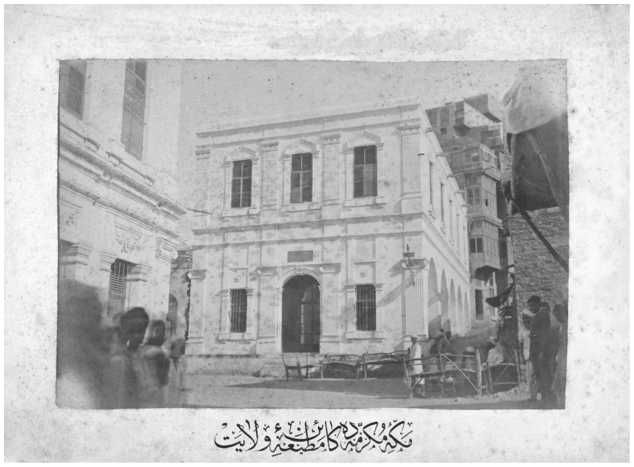
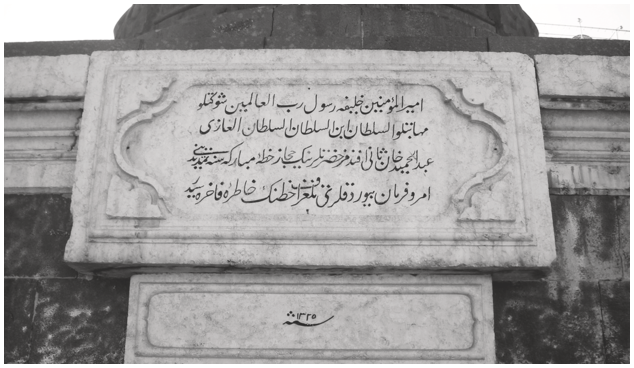
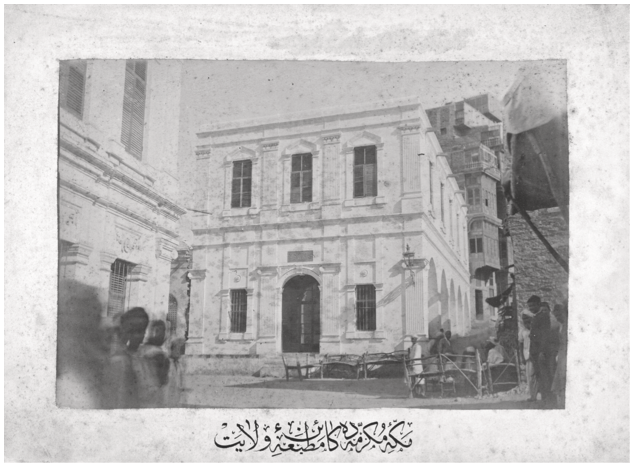
The Hejaz was the most important place for distributing pamphlets as thousands of transnational Muslims convened there every year. Many hajjis returned to their homelands with books about the caliphate or other issues that included prayers to the Ottoman sultan as the Caliph. In the propaganda war, the official printing house of Mecca, the Matbaa-i Miriyye, which was established in 1882, played a crucial role. It had three printing machines and books were printed in Arabic, Turkish, Persian, Hindi and Javanese for distribution throughout the Muslim world.Footnote 94
More importantly, whether the books were about the caliphate or not, statements about the Caliph were added to them. The readers of the texts thus discovered a certain emphasis on the caliphate. In this regard, this question should be discussed as a topic of concern: How did other states react to these pamphlets that were in the hands of their subjects?
On that issue, a particular pamphlet was printed in the same place and year yet travelled to different lands. The pamphlet, Manasik al-Hajj, was about the rules of pilgrimage. It was written by Sayyid Uthman al-Alawi from Batavia, who was the mufti of the Dutch East Indies,Footnote 96 and it was printed at the Matbaa-i Miriyye in Mecca in 1893. At the end of the booklet, the seal of the printing press was included with adornments on the fortieth page, and the other side of the page includes a full page text. That page does not exist in the pamphlet’s other versions, such as the one that was printed in Batavia,Footnote 97 so it is clear that it was added at the printing house in Mecca. The page begins with Malay statements about the publication of the pamphlet and concludes with extended Arabic praises and prayers for the Ottoman Caliph, Sultan Abdülhamid II. He is presented as the protector of the Hejaz and the caliph of the Prophet in statements that are written with vowel points.Footnote 98 More importantly, that page would have been undesirable for non-Ottoman officials who were against the Pan-Islamist activities of the Ottoman state. I found two copies of this pamphlet, each with the same date of printing in Mecca, in two different collections. One is in the Seyfettin Özege collection at the Atatürk University Library in Erzurum and the other is in the Snouck Hurgronje collection in Leiden University Library. While the page about the caliphate is included in the copy held in the Özege collection,Footnote 99 it is not in the copy housed in the Hurgronje collection.Footnote 100 It is a mystery whether the page was removed by Hurgronje himself or by Dutch officials as a form of censorship when Javanese people returned from the Hajj. At the time when the pamphlet was printed in 1893, Hurgronje was in Aceh and probably brought the book, which had been taken from Mecca to Indonesia, with him from Aceh to Leiden in 1906.Footnote 101 Nevertheless, these two books in two different collections suggest that the caliphal stress on the Ottoman sultan in publications may have been perceived differently by different authorities. Also, this Hajj book is a minor example of the pamphlet war over the caliphate because print activities could be used both as a form of propaganda and censorship depending on the discretion and biases of the administrators of different states.
The official printing house of Mecca: Matbaa-i Miriyye.Footnote 95
The same goal was visible in the contexts of pamphlets whose authors and places of inception varied. The aim was to prove the legitimacy of the Ottoman Caliphate. The authors presented various arguments and tried to show that the Ottoman sultan was the one and only leader of the Muslim world. Some of them offered religious arguments based on verses and hadiths, arguing that obeying the Sultan was a religious duty. The Hilafet-i Muazzama-i İslamiye of Nazif Süruri, which was first serialized in the newspaper Malumat and then printed as a pamphlet in Istanbul in 1897, was a collection of hadiths that claimed the religious necessity of obedience to the Ottoman sultan.Footnote 102 Muhammed Emin el-Mekki, on the other hand, detailed the services that Sultan Abdülhamid II, as well as previous Ottoman sultans, had provided for the Muslim Holy Land. They were listed under seventy-seven headings and attempted to demonstrate how Ottoman rulers had looked after the sacred places better than anyone else before, barring the first four Caliphs.Footnote 103
However, publication of the Caliphate Pamphlets was not limited to the reign of Sultan Abdülhamid II; in fact, they continued to an even greater extent after him. For instance, Habib Efendi, who would become the mufti of Mosul, wrote a pamphlet and published it in 1916 during World War I. He defended the Ottoman Caliphate on religious as well as political grounds, arguing that there could be no caliphate aside from that of the Ottomans because only the Ottoman state was accepted as the leader of Muslims by both European states and Muslim communities. Also, he argued that the Islamic caliphate would disappear if the Ottoman state came to an end. As the book was written during World War I, he mentioned the difficulty of the writing process, saying it was difficult to write because of the jolting of the wheels, the rocking of the train in the desert and the steamship on the sea and the fact that his ears were ringing because of cannon and rifle fire.Footnote 104 While he stated that he completed the pamphlet in the capital city of the caliphate, Istanbul, his work was published in Beirut in the same year. This is also a good example of how the long-distance travel of people and ideas was possible in the age of steam and print.
All in all, like these numerous works that defended the Ottoman Caliph, many pamphlets were written against the caliphate of the Ottomans as well. Sometimes they were written with the aim of addressing a wider audience, and sometimes they were direct refutations between authors carried out in the presence of the masses through print publications.
Discussions of the Caliphate in a Global World
The printing press played a crucial role in the propaganda war carried out for and against the caliphate, but certain distinctions should be made regarding those who refuted the legitimacy of the Ottoman Caliphate. Some Ottoman intellectuals, especially Young Turks who were opposed to the reign of Sultan Abdülhamid II, rejected the legitimacy of his authority and thus his caliphate. However, they were not opposed to the caliphate of the Ottomans per se. Rather, they invoked their opposition to the sultan and penned pamphlets for that reason. For example, a certain Hoca Şakir Efendi penned a fatwa pamphlet that was published in Geneva in 1896 and republished in Cairo in 1907.Footnote 105 The pamphlet stressed the necessity of punishing the sultan and it offered “proof” from traditional law books. This was a collective work compiled by Hoca Şakir and the famous Young Turk Abdullah Cevdet, who collected old fatwas and published them to convince people that the regime needed to change.Footnote 106 They only used their arguments against the current sultan, and, as has been seen, Cairo was a useful place for printing the opposition ideas of those who had fled to Cairo from Istanbul. Mehmed Kadri Nasıh’s İstinsaf was one such text, and it was published in Cairo before the Second Constitutional Era and then reprinted in Istanbul after the declaration.Footnote 107
There were also publications that rejected the Ottoman Caliphate in general. Many of these pamphlets argued that the Ottoman Caliphate was illegitimate on the grounds of a hadith that states that rulers can be only from the tribe of Quraysh.Footnote 108 In other words, a legitimate caliph has to be able to trace his lineage to that of the Prophet’s dynasty. Therefore, it was argued, the Ottomans’ arguments were pointless as those who took the hadith to be proof rejected the transference of the caliphate to the Ottomans by Sultan Selim I. For instance, William Muir, who examined the story of the caliphate in detail, argued that the caliphate came to an end with the fall of Baghdad, and the Turks, who had aspirations not only to rule the Muslim world but also the caliphate itself, could never become caliphs because they had no Quraysh ancestry.Footnote 109 Muir had first published his book in 1891 in London and his arguments were heard in different lands, as indicated by the fact that Hafiz Abdülcemil of Peshawar rejected his arguments in 1897 in India.Footnote 110 Since Muir had published the book in the course of discussions about the caliphate in opposition to Sultan Abdülhamid II, in which many British intellectuals argued that the caliphate should be transferred from Istanbul to Arab lands, Hafiz Abdülcemil defended the legitimacy of the caliphate of Sultan Abdülhamid II and argued for the legitimacy of the Ottoman caliphal leadership.
The Quraysh hadith led to interminable discussions on both sides. Those who defended the Ottoman Caliphate interpreted the Quraysh hadith with verses about the necessity of rulers (ulu’l-amr). They tried to show that it is not necessary for the caliph to be from the tribe of Quraysh, and these discussions were carried out in public through printed texts. This kind of debate became more common in Britain in the late 1870s, and some intellectuals such as Sir George Campbell, George Birdwood and Wilfred Blunt insistently argued for the establishment of an Arab caliphate in their essays, while some British citizens like G. P. Badger refuted their arguments.Footnote 111 The famous lexicographer James Redhouse in particular strongly disagreed with the opinions of those who opposed the Ottoman Caliphate based on the Quraysh issue.Footnote 112 Nevertheless, there were more detractors than supporters. Many of them, such as Blunt and MacColl, attempted to demonstrate that the amir of Mecca was the Caliph, not the Ottoman sultan, and these intellectual arguments concerning the new caliphate would underlie the British–Arab relationship during World War I.Footnote 113 In fact, the main target of the print activities of the opposition was to prove the illegitimacy of the Ottoman Caliphate and take the caliphal title from the Ottomans, and such discussions became increasingly common after the 1890s in Britain in parallel with developments in the political relations of the states.
One of the most significant discussions, as Hanioğlu points out, occurred in articles published in The Times newspaper in August and September of 1906. The figures who prompted the debates about the Caliphate were from different countries and cities. That year, the idea of establishing an Arab Caliphate was at its peak in Britain and the border crisis in Aqaba triggered the idea that Sultan Abdülhamid II was using his Pan-Islamist policies against European states. Prince Sabahaddin, who was the nephew of Sultan Abdülhamid II and a member of the opposition, was in Paris at the time, and wrote about the caliphate and the Pan-Islamist policies of the Ottoman state. Sabahaddin, who was trying to dethrone the sultan, was able to publish his opinions, which offered proposals for the British and French to support liberal Ottomans, in the newspaper Tribune in June of 1906. He then penned an open letter to Sir Edward Grey and the letter was published in The Times on 13 August 1906.
In his letter, Prince Sabahaddin explained that liberal Ottomans would establish a cultural Pan-Islamism instead of the aggressive model taken up by Sultan Abdülhamid II. However, his statement that the Ottoman state had been the centre of the caliphate for four centuries triggered discussions all around the world. The Times published statements made by Indian politician Nawab Mohsin al-Mulk about why Indian Muslims should recognize the Ottoman Caliphate three days after Sabahaddin’s letter. Then, on 18 August 1906, priest Malcolm MacColl’s reply to Sabahaddin was published by The Times. MacColl rejected the Ottoman claim to the caliphate on the basis of the Quraysh hadith and stressed the necessity of an Arab caliphate. Another famous figure, Arminius Vambery, rejected MacColl’s claims. Vambery wrote a letter in Austria on 21 August that supported the Ottoman Caliphate, saying that the majority of Muslims around the world accepted the Ottoman sultan as the Caliph, and he referred to the statements made by Nawab Mohsin a few days earlier as well as the financial aid provided by Muslims for the Hejaz Railway. The letter was published in The Times on 28 August, ten days after MacColl’s letter. On the same day, MacColl wrote a new letter in Ripon, England, harshly refuting the arguments put forward by Vambery, and it was published by The Times on 7 September. Three days later, Vambery penned a response in Budapest and his letter was published in The Times on 15 September. Vambery refuted MacColl’s arguments with statements from traditional law books and travelogues, and he mentioned his correspondences with India, arguing that the Ottomans were recognized by Muslims in the past and at the present.
Also in those days, Indian sheikh Mushir Husayn Kidwai, who was the head of the Central Islamic Society in London, was in Istanbul and he got involved in the discussions in The Times. He sent a letter from Istanbul on 9 September, and it was published in The Times six days later. Kidwai defended the legitimacy of the Ottoman Caliphate, citing the historical development of the concept. Abu Bakr, Kidwai argued, became the first Caliph of Muslims because they recognized him, and similarly the Ottoman Sultan Abdülhamid II was the caliph because of the broad support of Muslims.Footnote 114
This long discussion in The Times included similar arguments made by many people from both sides of the debate. It represents a good example of how these transcontinental correspondences that were published in a period of just two months reached a wide readership thanks to the revolution in transportation and communications. The issue of the caliphate thus prompted a worldwide debate as seen in the discussions that were carried out in the press. Also, in such a globalized world, some cities became more important politically as a result of developments in travel.
The Hejaz as a Centre of Travelling People and Ideas
One of the most visible effects of steam and print was observed in the Hejaz, the Muslim holy cities of Mecca and Medina, which was a crucial element of legitimacy for the caliphate. The gradually increasing importance of the caliphate influenced patterns of thought in the Holy Land, which the Ottoman sultans were proud to serve as guardians of the two holy cities. The Hejaz had been part of the Ottoman Empire for more than three centuries and in the age of steam it became even more important. Of course, the symbolic value of those sacred places had always gone without question, but in the new age it acquired even more significance in political terms. In other words, the Holy Land took on political importance in addition to its symbolic importance through the developments that occurred in the new era.
Mecca, as the destination of the Hajj, witnessed a huge increase in the number of pilgrims after the 1860s as a result of steamship travel. The majority of those pilgrims were subjects of colonial empires. Many Ottoman pilgrims, as well as thousands of Muslims ruled over by the British, Dutch, French and Russian Empires, gathered in a place where non-Muslims were forbidden entrance. In that way, the Ottoman Caliphate had at its fingertips the opportunity to reach out to Muslims from all around the world and use the power of the spiritual leadership of Muslims against European empires. The Hejaz, accordingly, became a focal point of the diplomatic struggle between empires.
Steamships made it easier, faster and cheaper to undertake the Hajj, paving the way for people from the middle class to perform the pilgrimage, and the number of hajjis increased four to five times after the opening of the Suez Canal in 1869. While it is difficult to estimate the exact number of pilgrims who travelled by sea and land, roughly 50,000 pilgrims went to Mecca in the 1850s, and that number reached 200,000 in the 1870s and 250,000 in the 1900s.Footnote 115 That change could be seen in the population of the inhabitants of the Hejaz as well. The population of Mecca, Medina and Jeddah swelled to 150,000, while it had been just 75,000 in the first half of the nineteenth century. If other towns and villages are included, the population of Hejaz was between 400,000 and 800,000, which means that 3 to 4 per cent of the total population of the Ottoman Empire was living in Hejaz in the 1890s.Footnote 116 More importantly, there was much multi-ethnic variety, as the residents of the Hejaz came from all around the Muslim world.
In addition, the age of steam affected the routes of the Hajj and in many places overseas travel became preferable. The official pilgrimage caravan of the Ottoman state, the Surre Alayı, had for centuries departed from Istanbul on an overland route in Anatolia through the cities of Konya and Damascus.Footnote 117 However, at a speed of thirty to forty kilometres per day, the trip took more than four months. For instance, a Hajj caravan that departed from Üsküdar on 24 June 1780 arrived in Mecca on 3 December 1780, taking 132 days in total to make the trip.Footnote 118 The classic Hajj route of the Surre Alayı changed in 1864 as hajjis began to travel from Istanbul to Beirut via steamship and then journeyed overland to Damascus and Mecca.Footnote 119 After the opening of the Suez Canal, hajjis travelled from Istanbul to Jeddah, stopping in the port cities of Alexandria and Suez, as seen in the travel letters of Cenab Şahabeddin dating from 1896.Footnote 120
This change was reflected in Hajj pamphlets as well. In the classical age, these booklets existed as manuscript texts and locations along the mainland route were indicated inside. For example, a Hajj manuscript dating from 1842, which is now in the Leiden University Library, depicts a pilgrim’s overland route from Istanbul to Mecca, indicating the distances in hours as well as places to visit in the cities along the way. The pilgrim travelled via Akşehir, Antakya, Damascus and Medina, spending a total of 265 days on the round-trip journey.Footnote 121 However, in the age of steam, Hejaz travellers carried printed books and the places they visited differed from those in the manuscripts of the past. A hymn (ilahi) pamphlet that was published in 1899 in Istanbul indicates that hajjis visited Alexandria, Cairo and Jeddah during the course of their journey.Footnote 122
As the result of new travel opportunities and changing routes, many Muslims could quickly travel to Ottoman cities and visit the capital city of the caliphate directly. Muslims in Russia were a case in point. Before the age of steam, Volga–Ural Muslims had to spend months on treacherous roadways to reach Mecca. As made evident by the travels of İsmail Efendi Bekmuhammadof, who in the eighteenth century journeyed to the Hejaz from Orenburg, Russia via Transoxiana and India and then returned via Damascus and Istanbul, this perilous journey could sometimes take years. Yet, a century later, the trip was trimmed down to weeks. In 1864, five years before the opening of the Suez Canal, Celaleddin ibn Burhaneddin travelled from Kazan to Odessa in twenty-two days and reached Istanbul in just two days; he then journeyed to Alexandria by steamship in six days, reached Suez via Cairo by rail in less than two days, and spent five to six days on a steamship until he reached Jeddah.Footnote 123 Because of this incredible shift in travel time, Rızaeddin ibn Fahreddin, who wrote about these Hajj journeys in a biographical work published in 1908, predicted that travelling from Kazan to Mecca would take less than one to two hours in the future if the world continued progressing in that way.Footnote 124
This rapid travel created a broad, continuous network in the Muslim world. The ulema in the Hejaz had been always active throughout the centuries, but their influence over faraway lands swiftly increased in the age of steam. Large numbers of Muslim students tried to become members of the circles of learning in Mecca and Medina, where many world-renowned scholars were living. As a remarkable instance of this, the Shafi’i mufti of Mecca, Ahmad ibn Zayni Dahlan (1816–1886), was one the most famous scholars of the century, and many ulema had the chance to study with and receive licenses (ijaza) from him. Sayyid Uthman of Batavia was one of those students, and he included Dahlan’s name as his teacher on his ijaza genealogy that went back to the Prophet Muhammad.Footnote 125 Ahmad ibn Sumayt, on the other hand, whose travels were mentioned earlier, arrived in Mecca in late 1886 or early 1887 after Dahlan’s death, and he became the student of Dahlan’s successor, Muhammad Said Babasil.Footnote 126
In this time of rapid circulation and widespread networks, fatwas also travelled in the Muslim world through the central point of the Hejaz. Many Muslims directed questions about Islamic practices to scholars in the Hejaz, and the ulema gave their answers in the form of written texts. Javanese Muslims’ questions, for instance, created the bulk of the fatwas, and a bilingual collection of them was published as a book titled Muhimmat al-Nafais in Mecca in 1892. These fatwas, which number about 130 and include various subjects, were mostly signed by Shafi’i scholars, Ahmad ibn Zayni Dahlan, Muhammad Hasab Allah, Muhammad Said Babasil and Abd al-Rahman al-Fatani, and a few were signed by the Hanafi Mufti of Mecca, Abd al-Rahman al-Siraj. These questions concerned the Java colony in Mecca as well as Muslims of Indonesia. In many cases, muftis were careful to give answers related to the political authorities in Indonesia and that was reflected in their fatwas. Also, the central position of the Hejaz should be taken into account, as the ulema of Mecca had the last word when Indonesian scholars could not reach a consensus in their homeland. The book of fatwas was printed at least five times in different cities and thousands of copies were in circulation in the following decades. As Kaptein states, through those texts Indonesian Muslims gradually became aware that they were part of the global Muslim ummah.Footnote 127 The content of the questions and the fact that it was printed in Mecca also demonstrated that the Hejaz held a crucial position, and the Ottoman administrators who were trying to reach out to all Muslims were well aware of the power of the Holy Land.
The awareness of rulers was also visible in the relationship with the ulema of the Hejaz. The Ottoman state began to give a salary to muftis of all the major Sunni mazhabs in the Hejaz starting in the 1870s, in addition to awards and state medals granted to muftis from the four sects.Footnote 128 However, the state had previously not shown much interest in the appointment or deposal of muftis in the Hejaz other than those from the Hanafi School, as indicated by an archival document dating from 1858.Footnote 129 The aforementioned Ibn Dahlan had been a respected scholar in Mecca since the 1850s, but the Ottoman state appointed him as the chief of scholars (sheikh al-ulema) and mufti of Mecca in 1871, giving him a salary until his death in 1886. As Hurgronje pointed out, Dahlan was the “rector” of Mecca’s university.Footnote 130 Muhammad Said Babasil, an Indonesian scholar, replaced him. In this way, the Ottomans successfully benefited from their connections with the Hejaz through the majority of the Muslim world, appointing people who were from South Asia. There were many Indonesian residents in the Hejaz and the majority of the population adhered to the Shafi’i school.Footnote 131 In addition, Hanafi Mufti Abd al-Rahman al-Siraj, who was born in Mecca, had roots in India,Footnote 132 and that also demonstrates that the Ottomans were trying to wield influence in the Far East, where the majority of Muslims were living, by involving influential scholars in the state apparatus. It is clear that the Caliphate had become the global leader of Muslims and that affected the sectarian policies of the Ottoman state. In that regard, if we recall the framework that Deringil drew up for the Hamidian regime as a Hanafi caliphate,Footnote 133 one question deserves further attention: When we take into consideration the policies concerning areas outside of Ottoman territories, is it possible to limit the Ottoman Caliphate to being one that was strictly Hanafi?
As mentioned earlier, there were advisors to Sultan Abdülhamid II, such as Sayyid Fadl and Sheikh Zafir, who played a role in spreading the caliphate idea to distant lands. There were also Hejazi residents close to the sultan who played a part in the Holy Land as well as in the networks of the Muslim world. Ahmad Asad, who was the father-in-law of the amir of Mecca, was one such person. As Ochsenwald asserts, those figures provided the people of Hejaz with access to the corridors of authority.Footnote 134 So, state rulers utilized Sunni scholars other than Hanafis to strengthen the caliphate’s mission in the world. This also demonstrates that the Ottomans, considered to be proponents of a fanatical form of Hanafism, expanded their sectarian policies, so the caliphate cannot be limited to the Hanafi School. Before the age of steam and print, non-Hanafi scholars would not have had the opportunity to be part of the state. For instance, Abu al-Thana al-Alusi (1802–1854), who is known for his conversion from the Shafi’i to the Hanafi School, sought to gain a place among the ulema hierarchy of the Ottoman state. Ultimately, he was appointed as the Hanafi mufti of Baghdad in 1835.Footnote 135 In the following decades, however, many Shafi’i scholars were appointed by the state and that was related to the Pan-Islamic tendencies of the authorities. This stress on the importance of the four schools of jurisprudence gradually became more visible; for instance, Süleyman Sırrı Efendi, the first fiqh teacher at the Darülfünun, mentioned the righteousness of the four schools, stressing the beliefs of Sunni Islam in a book that he wrote for the pupils of the theology department.Footnote 136 At this point, the existence of Majalla, which is a codification of law based on the Hanafi School and which was administrated in civil courts, had the potential to open the way for contradictions. Majalla was about the centralization policies of the state and it remained in force in many countries after the Ottoman state collapsed.Footnote 137 However, Arabia was exempted from Majalla and it was not imposed in the Hejaz because of its special position.Footnote 138 That special position was closely related with the increased importance of the Holy Land during the age of steam and print.
At the same time, however, increased circulation and the expansion of networks in the Hejaz brought about another issue: the spread of disease. Cholera began to spread port by port via steamships and caused thousands of deaths around the world. The thousands of pilgrims who gathered from different continents led to the spread of epidemics across the world. For instance, there was a cholera epidemic spread by Indian Muslims that struck the Hejaz in 1865 and killed 15,000 pilgrims. In May of the same year, cholera spread to Egypt via returning hajjis and caused 60,000 deaths in Alexandria. Also, it spread to Europe from Alexandria via the port of Marseille and reached New York City by November of the same year. As a result, over 200,000 people lost their lives in major cities alone.Footnote 139 Like other states, the Ottoman Empire took measures to establish health organizations and control the spread of epidemic diseases, and centres were set up in the Hejaz and other cities.Footnote 140 In addition, many quarantine centres were established by states in the fight against what was now a worldwide problem. Consequently, as Low points out, in their struggle to stop the spread of epidemic diseases, European colonial states created Hajj agencies to protect their subjects from illnesses. By doing so, the Muslim Hajj was gradually institutionalized and colonized, and that colonial structure perpetuated its existence in the Red Sea and Indian Ocean through Mecca.Footnote 141
Diseases were not the only cause of diplomatic struggles among the empires; the idea of the caliphate and Pan-Islamism, which was perceived as a possible threat to the policies of the colonial powers in Muslim lands, also drove states to take new measures. Hurgronje, who saw the caliphate as a threat to Dutch rule, insistently argued that the Ottoman Caliphate was not a form of spiritual leadership but a political apparatus that would undermine European administrations. Hajjis returning from the sacred lands aroused the suspicions of colonial powers that feared rebellions. Dutch officials frequently voiced the concern that Indonesian pilgrims would return to the homeland with an Ottoman flag and engage in anti-government activities.Footnote 142 Thus, in the eyes of empires, the holy places under the control of the Ottoman Caliph became a crucial focal point as a gathering place of travelling people and ideas.
The increased importance of the Hejaz also triggered the implementation of increased security measures that depended on clear communications with the capital.Footnote 143 The Holy Land, which had long been the scene of diplomatic struggles among empires, had been connected to Istanbul by an underwater telegraph cable that ran under the Red Sea since the 1880s. Yet, because of imperial competition and security concerns, the Ottomans wanted to establish an alternative telegraph line overland and so the Damascus–Medina line was completed in 1901.Footnote 144 In addition to its political importance and the issue of administrative centralization, the line also had symbolic value and it was celebrated with a monumental column in Damascus. The inscription on the column, which is the same on all four sides, is in Ottoman Turkish but it would have been understandable only to people who read Arabic, and it consists of praise for the Sultan. The first honorific given is “the ruler of believers” (amir al-mu’minin) and the second one is “the caliph of the prophet of the Lord of universe” (halife-i resul-i Rabbü’l-alemin). Moreover, at the top of the column there was a model of Yıldız Hamidiye Mosque, which was the official mosque of Sultan Abdülhamid II.Footnote 145 The symbolic value of the telegraph column demonstrated that the connection of the capital of the caliphate with the Muslim Holy Land was more important than just modern development and that it was related to internal issues as well as the foreign affairs of the state.
After the completion of the second Hejaz telegraph line, another significant project was started and completed in 1908 – the Hejaz Railway project, which stretched to Medina from Damascus and created a direct rail connection between Istanbul and the Hejaz.Footnote 147 With this railway line, which carried political, military, economic and symbolic meanings, the Hejaz was opened up to yet another form of rapid transportation and it represented a challenge to British activities on the Red Sea and in Egypt and Sudan. Before the construction of the Hejaz Railway, the British had established a railway line through Khartoum to suppress the Mahdi movement, and Ahmed Muhtar Pasha, who was the high commander of Egypt, had proposed to the Ottoman state that a railway be built in Damascus as a challenge to British expansion in Sudan.Footnote 148 As Landau asserts, the main goal of the Hejaz railway project was to strengthen the state’s authority in the Hejaz and Red Sea area. At the same time, the line, which was completed up to Medina in 1908, served the needs of transportation until World War I, and carried more than 1,300,000 passengers, both civilian and military, in a period of just five years.Footnote 149
The inscription of the Hamidian Telegraph Monument in Damascus.Footnote 146
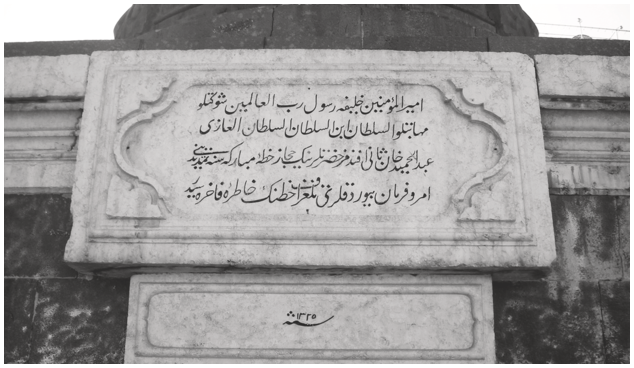
The railway project, which held great meaning for Pan-Islamism, was constructed solely with the financial support of Muslims around the world through appeals made by the Caliph, even though most would never use the railway for their journeys. In that way, the Hejaz Railway was one of the most tangible results of efforts centring on the caliphate and Pan-Islamism. When a Bedouin tribe attacked the Hejaz Railway in Medina in 1910, for instance, news about the incident was published in Sırat-ı Mustakim. The news report stated that the Muslim world needed unity more than ever before, and the Hejaz Railway was portrayed as a means of establishing that union. Moreover, the attack was described as an attack on the heart of the Islamic world, which was depicted as the centre of a unified Muslim community, and the vehicle of unity.Footnote 150
In sum, while the Ottoman Empire struggled against empires that had Muslim subjects, it also tried to strengthen the caliphate mission of the sultan in the eyes of Muslims, so the Hejaz, which was a gathering point for travelling people and ideas, assumed an even more crucial position for the Ottomans in the age of steam and print.
Conclusion
The caliphate as an office of worldwide significance for the leadership of all Muslims and Pan-Islamism as a concept for solidarity against non-Muslim powers first emerged in the second half of the nineteenth century. Those concepts, which are generally taken up as the results of the political tendencies of the Ottoman state, especially the policies of Sultan Abdülhamid II, have largely been seen as the politicization or instrumentalization of Islam for political ends. However, the issue of the caliphate, which had existed for centuries, became a global political phenomenon as a result of the revolution of communications and transportation technologies, and it was the result of a process that had been going on for years. Its first emergence corresponds with the 1860s during the reign of Sultan Abdülaziz, a time when the effects of steam and print technologies became apparent and spread. The steamship, telegraph and railway, along with the printing press, allowed for the rapid travel of news and ideas, leading to a shared consciousness among Muslim societies. The idea of the caliphate spread and was strengthened around the world as the result of the journeys of envoys and representatives on steamships, as well as the travel of news and ideas in journals and pamphlets. In other words, the achievements of the concept of the caliphate came about through widespread acceptance and they were actualized with steam and print technologies.
In that era, empires competing with the Ottoman state were aware that many of their subjects accepted the Ottoman sultan as their caliph, and pamphlets and newspapers became the site of lengthy discussions concerning the legitimacy or illegitimacy of the caliphate of the Ottomans. The idea of transferring the caliphate from the Ottoman dynasty to Arab lands also demonstrates that even those who denied the legitimacy of the Ottoman Caliphate recognized that it was influential among the Muslim masses. The Hejaz, as a source of legitimacy for the caliphate, became more politically important as it was the focal point of people and ideas, and the Ottoman state, which controlled the Muslim Holy Land, made efforts in the Hejaz to reach out to the Muslim world. In that long process, the Ottomans took direct action and claims to the caliphate left their mark on the age of steam and print. However, the Ottomans not only fought against colonial powers but also against Muslims who refuted the caliphate on religious grounds. On the one hand, the caliphate fought to consolidate its policy and power over society, while on the other, opposition movements sought to prevent it from spreading in public. In that age, two opposing Islamic ideologies that drew swords against the caliphate appeared on the global stage and struggled to comprehensively strengthen their positions. Those ideologies, which were a threat for the Ottoman Caliphate, were Wahhabism and Mahdism.