Introduction
Schistosomiasis, a zoonosis caused by Schistosoma japonicum infection in humans, is a major public health concern in the People's Republic of China. Historical records indicate that schistosomiasis has been endemic in China for more than 2100 years (Mao and Shao, Reference Mao and Shao1982; Mao, Reference Mao1987; McManus et al., Reference McManus, Gray, Li, Feng, Williams, Stewart, Rey-Ladino and Ross2010). Since the establishment of the People's Republic of China, great progress has been made in controlling and preventing schistosomiasis. According to reports, 351 endemic counties were found in 12 provinces with 11 million infected cases in the mid-1950s (Mao and Shao, Reference Mao and Shao1982; Xu et al., Reference Xu, Steinman, Maybe, Zhou, Lv, Li and Peeling2016). During the 1950s to the 1980s, control measures primarily focused on waterway management and snail control. With the emergence of the highly effective antischistosomal drug praziquantel, control measures were primarily synchronous chemotherapy for humans and domestic animals in the 1980s to 2004. However, due to the re-emergence of schistosomiasis in China in the early 21st century, an effective integrated schistosomiasis control strategy aimed at infection source control was performed since 2005. Given the schistosomiasis control efforts of the government of China, the endemic intensity has dramatically decreased, and the number of infected people in endemic areas dropped to approximately 185 000 in 2013 (Lei et al., Reference Lei, Zheng, Zhang, Zhu, Xu, Xu, Fu, Wang, Li and Zhou2014; Zhang et al., Reference Zhang, Xu, Bergquist, Yu, Yan, Zhu and Wen2016). In the same year, Sichuan, Yunnan and Jiangsu reached the national criterion of transmission control. Hubei Province fulfilled the criteria for transmission control at the village level in each endemic county, achieving the long-term goal of schistosomiasis control 2 years ahead of schedule. However, other lakes and marshland provinces (Hunan, Jiangxi and Anhui) still remain in the stage of infection control.
On the basis of epidemiological features, schistosomiasis endemic areas in China were categorized into three types: marshland and lake regions, a plain region with waterway networks and mountainous and hilly regions. The majority of schistosomiasis endemic areas include the lake and marshland regions of Hubei, Hunan, Anhui, Jiangxi and Zhejiang provinces and the mountainous areas of Sichuan and Yunnan provinces (Hu et al., Reference Hu, Ward, Xia, Li, Sun, Lynn, Gao, Wang, Zhang, Xiong, Zhang and Jiang2016; Xu et al., Reference Xu, Steinman, Maybe, Zhou, Lv, Li and Peeling2016). Schistosomiasis has been endemic in Hubei Province for more than 2100 years. In 1978, S. japonicum eggs were found in a male corpse buried in 167 BC during the Western Han dynasty in Jiangling County, Hubei Province.
Schistosomiasis control and prevention have made great progress in the last 60 years. Thanks to the implementation of an integrated strategy with an emphasis on controlling the source of S. japonicum infection, the goal of the National Mid- and Long-Term Plan for Schistosomiasis Prevention and Control (2004–2015) in China was achieved in 2015. In 2017, the ‘13th Five-Year’ National Schistosomiasis Control Plan proposed the following control and prevention goals: (1) five provinces (Hubei, Hunan, Jiangsu, Sichuan and Yunnan) reach the standard of transmission interruption and (2) more than 96.5% of endemic counties meet the criteria for transmission interruption or elimination by 2020 (Chen et al., Reference Chen, Xu, Bergquist, Li and Zhou2018a; Jing et al., Reference Jing, Shan, Chun-Li, Shi-Zhu and Xiao-Nong2018). Moreover, the Healthy China 2030 Plan requests that all the schistosomiasis endemic counties reach the criteria of elimination by 2030 (Bergquist et al., Reference Bergquist, Zhou, Rollinson, Reinhard-Rupp and Klohe2017; Sun et al., Reference Sun, Wang, Hong, Li, Liang, Yang and Zhou2017). Given that schistosomiasis remains a serious problem in China, several challenges must be overcome to achieve the goal of schistosomiasis elimination, especially in the lake and marshland areas along the Yangtze River. According to reports, schistosomiasis patients living in the lake and marshland areas along the Yangtze River account for more than 80% of the total patients in China (McManus et al., Reference McManus, Gray, Li, Feng, Williams, Stewart, Rey-Ladino and Ross2010). Hubei Province, located in the mid-reaches of Yangtze River and in the upstream of lake and marshland areas, is one of the most severely infected areas in China. Hubei Province was the first to reach the criteria for transmission control in lake and marshland regions. However, in 2013, 5,449 endemic villages were found in 63 endemic counties, and approximately 10 million people were at risk of infection in this province. Infection sources still exist in endemic regions because bovines are difficult to eliminate in endemic villages.
According to the 2013 annual monitor report, approximately 73 392 bovines thrived in the regions, and snails were present in the 764.85 million m2 land mass (Lei et al., Reference Lei, Zheng, Zhang, Zhu, Xu, Xu, Fu, Wang, Li and Zhou2014). The lake and marshland regions are major hotspots of schistosomiasis transmission due to the presence of buffaloes, which are responsible for up to 75% of disease transmission (Gray et al., Reference Gray, Williams, Li, Chen, Forsyth, Li, Barnett, Guo, Ross, Feng and McManus2009; Zou and Ruan, Reference Zou and Ruan2015; Cao et al., Reference Cao, Zhao, Lee and Wang2016; Wang et al., Reference Wang, Wang and Wang2017). Schistosomiasis transmission risk factors still exist in Hubei Province because the endemic condition has remained fundamentally unchanged. In addition, Hubei Province is adjacent to the lake and marshland areas of Hunan, Anhui and Jiangxi provinces. Humans and bovines with schistosomiasis can enter the provincial junction areas. Moreover, flooding is prone to occur in the Yangtze River and influence schistosomiasis transmission. The transmission of schistosomiasis in the Yangtze River Basin has been influenced by major floods since the early 1990s. Floods can cause the spread of Oncomelania hupensis in areas where they had been previously controlled or eliminated. The recent massive floods surged in 2016, and in 2017, O. hupensis newly occurred in a 429.4 km2 area, affecting 15 villages in Hubei Province. Therefore, floods are the main influencing factor for the control and elimination of schistosomiasis in China, especially in Hubei Province along the Yangtze River (Zhang et al., Reference Zhang, Xu, Dai, Dang, Lv, Xu, Li and Zhou2018). To achieve the national goal, a precise integrated strategy and an efficient surveillance approach must be implemented.
Etiological diagnosis (e.g. Kato–Katz method) was first used for schistosomiasis detection and surveillance in the early stages of schistosomiasis control (Wang et al., Reference Wang, Xu, Zhao, Li, Zhang, He, Swing and Yang2018). The Kato–Katz method has high specificity and remains the gold standard for the diagnosis of schistosomiasis. However, it has limited sensitivity due to the fluctuations in the egg output from stool (Cai et al., Reference Cai, Xu, Steinmann, Chen, Chu, Tian, Chen, Li, Lu, Zhang, Zhou and Chen2014). The sensitivity of the method is also low when the prevalence and intensity of schistosome infections are reduced, particularly in areas with low-intensity infections (Zhu, Reference Zhu2005; Cavalcanti et al., Reference Cavalcanti, Silva, Peralta, Barreto and Peralta2013). The miracidium-hatching test is another etiological procedure that is based on the positive phototrophic behaviour of schistosomiasis miracidia. This method improves the diagnostic sensitivity and proves useful for diagnosis (Zhu et al., Reference Zhu, Xu, Zhu, Cao, Bao, Yu, Zhang, Xu, Feng and Guo2014; Candido et al., Reference Candido, Favero, Duke, Karl, Gutierrez, Woodward, Graeff-Teixeira, Jones and St2015). With the rapid development of immunology techniques, immunodiagnostic methods such as indirect hemagglutination assay (IHA) and enzyme-linked immunosorbent assay (ELISA) have been developed and applied for schistosomiasis detection. IHA and ELISA, which can detect host antibodies against S. japonicum, are used in the field of schistosomiasis surveillance and screening given their relatively high sensitivity, low cost and simplicity. Meta-analysis showed that the sensitivity of IHA was in the range of 0.407–0.951 and that of ELISA was 0.233–0.973. The IHA test has more preferable diagnostic properties compared with ELISA. Moreover, it is easier to operate and only needs an incubator; hence, it is currently the most widely used method in China (Zhu et al., Reference Zhu, Yu, Xia, Dong, Tang, Fang and Du2010). Nevertheless, none of these immunodiagnostic tests are reliable in estimating diagnostic specificity (Zhu et al., Reference Zhu, Yu, Xia, Dong, Tang, Fang and Du2010). Therefore, a two-step approach was selected: IHA was used as the primary screening tool in annual surveillance, and then IHA-positive individuals underwent etiological diagnosis for field surveillance in the schistosomiasis endemic regions of Hubei Province.
A large number of public health problems have been analysed with the geographic information system (GIS) and spatial statistics (Wang et al., Reference Wang, He, Yang and Liang2016; Gomes et al., Reference Gomes, Mesquitta, Wanderley, de Melo, de Paula and Barbosa2018). Depending entirely on the distribution of the intermediate snail host O. hupensis, schistosomiasis is reported to demonstrate temporal and spatial variations in geographic distribution (Sun et al., Reference Sun, Chen, Lynn, Wang, Zhang, Li, Xia, Jiang, Hu, Gao and Zhang2015; He et al., Reference He, Li, Bergquist, Zhang, Shi, Zhao, Wu and Yang2016; Li et al., Reference Li, Chen, Xia, Lynn, Gao, Wang, Zhang, Hu and Zhang2018; Niu et al., Reference Niu, Li, Qiu, Xu, Huang and Qu2018). Considering the spatial variation of schistosomiasis, its prevalence and spatial distribution can be accurately analysed by GIS. Georeferencing cases and in-depth spatial analysis make it possible to construct a risk map. GIS epidemiologic findings and results help in spatializing and predicting the occurrences of schistosomiasis and in planning precise actions of control toward elimination. In the present study, spatial autocorrelation analysis and SaTScan were used to investigate the spatial cluster dynamics of schistosomiasis cases at the village level in the stage after transmission control in Hubei Province, a typical lake and marshland schistosomiasis endemic region along the Yangtze River. The results may provide information to detect the areas with high endemic risk in order to assist in the precise monitor and control measures and achieve the elimination criteria in Hubei Province, especially in the lake and marshland regions.
Methods
Study area
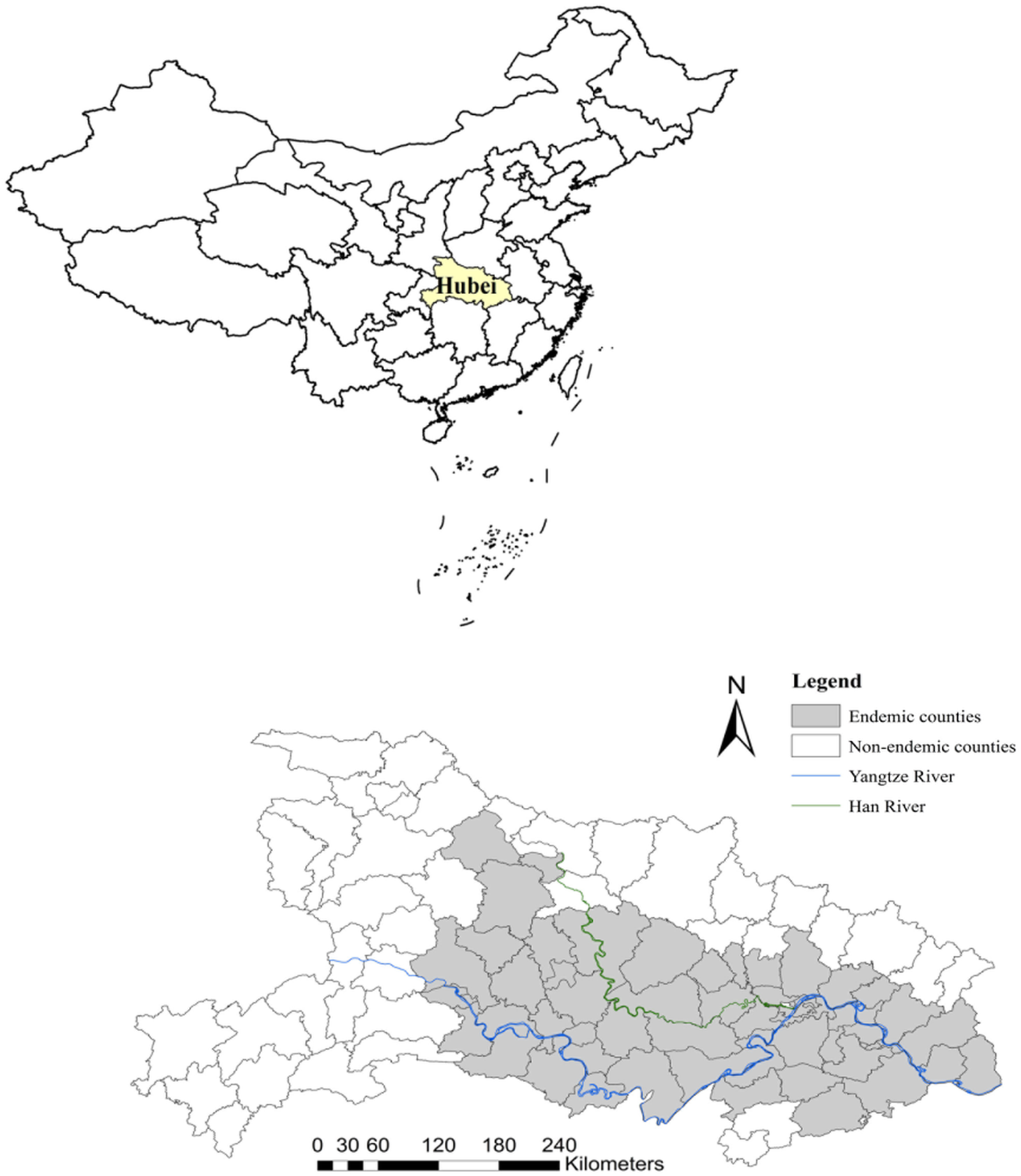
Hubei Province is located at the middle reaches of the Yangtze River in Central China. It has an area of 185 900 km2 and a population of 57.8 million (Fig. 1). Hubei Province is situated upstream of the lake and marshland endemic regions of schistosomiasis. It has 11 main rivers, namely, Yangtze, Fuhuan, Hanjiang, Dongjing, Hanbei, Juzhang, Fushui, Lushui, Tongshun, Axe and Jushui rivers, and four lakes area, namely, Hong, Chang, San, and White dew lake in the schistosomiasis endemic areas of Hubei Province. Our study focused on all endemic villages in 63 endemic counties in Hubei Province from 2013 to 2017.
Location of Hubei province in China.

Schistosomiasis epidemiological data
The schistosomiasis epidemiological data at the village level in Hubei Province from 2013 to 2017 were collected from the Hubei Institute of Schistosomiasis Prevention and Control, China. Surveillance on humans was performed annually in all schistosomiasis endemic villages during the study period. Residents aged 6 to 65 years old participated in the survey. All participants were screened by immunodiagnostic examination with an IHA. Individuals with titers ⩾10 were considered positive by an immunodiagnostic test and were further asked to take etiological examination by a miracidium-hatching technique. Residents found to have schistosome eggs in their stool were considered positive by etiological diagnosis and were confirmed as schistosomiasis cases. Schistosomiases with hepatic fibrosis portal hypertension syndrome or colonic granulomatous proliferation were diagnosed as advanced schistosomiasis.
Spatial database of GIS
First, the latitude and longitude coordinates of each village were measured by using a handheld Global Positioning System (GPS). Then the pooled map with geographic information was integrated with all S. Japonicum cases by matching with the administrative code in the ArcGIS10.5 software. The GIS spatial database of schistosomiasis at the village level of Hubei Province was then established, and spatial analysis for schistosomiasis was performed.
Global spatial autocorrelation analysis
The global spatial autocorrelation mainly analyses the similarity of the values of the regional unit attributes adjacent to the space in the entire study area. Currently, the common indicator is Moran's I with values ranging from −1 to +1. The Moran's I indicator can determine whether the spatial distribution is an aggregation mode, a discrete mode or a random mode. Global spatial autocorrelation is calculated by calculating Moran's I on the basis of z-score and P values.
When Moran's I > 0, a positive spatial autocorrelation exists in the case distribution. The closer the Moran's I value is to 1, the closer the spatial autocorrelation of the case distribution due to distance, the greater the correlation and the stronger the spatial aggregation. When Moran's I < 0, a negative space autocorrelation exists in the case distribution. The closer the value is to −1, the stronger the autocorrelation of the negative space of the case distribution and the larger the spatial heterogeneity of the sample and the overall discrete distribution. When Moran's I = 0, the case is randomly distributed, and no spatial autocorrelation exists.
Clustering and outlier analysis
Clustering and outlier analysis can determine the spatial distribution pattern of schistosomiasis and distinguish the spatial clustering pattern of administrative villages with higher or lower case distribution. Local Moran's I index was adopted in the survey. The z-score and P values represent the statistical significance of the calculated index values. When Local Moran's I > 0, schistosomiasis cases in the neighbouring village have ‘high’ or ‘low’ attributes, which are clustered. When Local Moran's I < 0, schistosomiasis cases in the neighbouring villages are different values and hence are abnormal values. By combining the z-score and the P value, two statistically significant clusters, namely, high-value (HH) clusters and low-value (LL) clusters, and two outliers, namely, high value with low values surrounded (HL) and low value surrounded by high values (LH), can be determined.
Spatial and spatiotemporal cluster analyses
The spatial scan statistical method is the most common technique of disease aggregation analysis. Scan statistic is usually used to detect whether the distribution of an event at a certain location is purely random or has certain clustering characteristics.
SaTScan is the most widely used spatial scan statistical software. According to different research scales, scan statistics can be divided into three types: time, space and spatiotemporal scan statistics.
The time scan statistic is used to identify the clusters over a period of time, and by analysing the relationship of the number of cases in each scan window, the presence or absence of time clustering can be determined. The spatial scan statistic is an extension of the one-dimensional time scale of the time scan statistic to the two-dimensional spatial scale. Spatial scanning is used to detect whether a disease occurs at a spatial scale with aggregation and similar aggregation locations. The spatiotemporal scan statistic is the development of the two-dimensional spatial scan statistic to the three-dimensional spatial scan statistic. In a spatiotemporal scan statistical analysis, the specific features of the spatial location and the specific time points can be simultaneously identified.
For each scan statistic, the basic theory of scanning statistical analysis is basically the same. A scanning window (with circular, cylindrical, elliptical or other shapes) is assumed in the study area. Then, each study area is scanned using the scanning window, of which the size and shape are dynamically changing within the pre-designed upper limit. In this study, spatial and spatiotemporal scanning methods were used to analyse the spatial and spatiotemporal distribution of schistosomiasis cases, respectively. The upper limit of the radius was set to 30% of the total population at risk within the area covered by the window, while the height was set to 50% of the total study period. Clusters were detected through the retrospective spatial and spatiotemporal analysis scanning using the discrete Poisson model.
The theoretical incidence of each scan window was calculated on the basis of the actual number of cases and population, and then the test statistic log likelihood ratio (LLR) was constructed using the actual number of cases and the number of theoretical cases within and outside each scan window. The LLR can determine the degree of aggregation of the number of cases in the scan window. According to the null hypothesis, generating simulation data was set through 999 Monte Carlo replications using the number of cases and the number of people. Statistical significance clusters were calculated as P < 0.05. In addition, the relative risk (RR) was calculated for each statistically significant cluster, indicating the risk within the cluster at a specific time and area compared with the risk outside the cluster.
Spatial and spatiotemporal analyses were performed using the SaTScan™ v9.4 software (http://www.satscan.org/). Furthermore, the final results of the scan statistic were imported by ArcGIS10.5 and generated to visualize the maps for risk cluster analysis.
Results
Schistosomiasis patients in Hubei Province
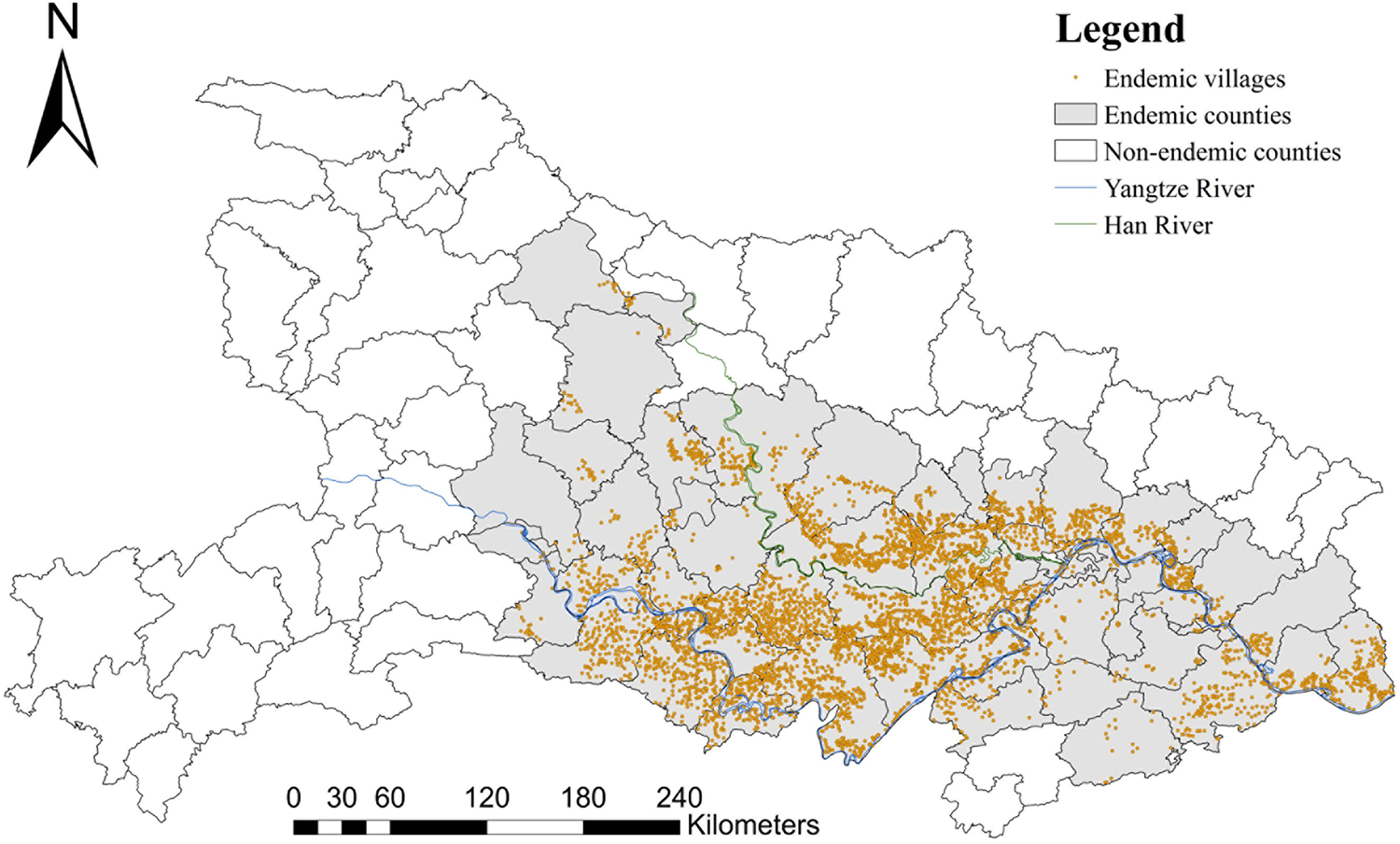
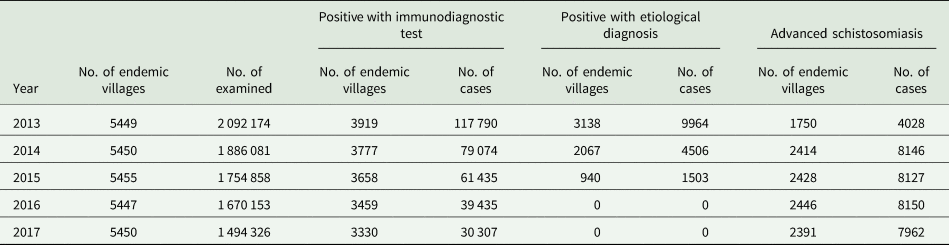
The endemic villages in Hubei Province ranged from 5447 to 5450, with minor changes during the study period (Fig. 2). As shown in Table 1, 117 790 schistosomiasis cases were confirmed positive by the immunodiagnostic test in 3919 villages in 2013. This number decreased to 30 307 in 3330 villages in 2017, showing a decline of 74.27%. The number of cases confirmed positive by etiological diagnosis decreased from 9964 in 3138 villages in 2013 to 0 in 2016, indicating 100% reduction. The cases of advanced schistosomiasis increased from 4028 in 1750 villages in 2013 to 8150 in 2446 villages in 2016 and then decreased to 7962 in 2391 villages in 2017.
Endemic villages with schistosomiasis patients in Hubei Province.

Schistosomiasis patients in Hubei Province (2013 to 2017)

Spatial autocorrelation of schistosomiasis patients
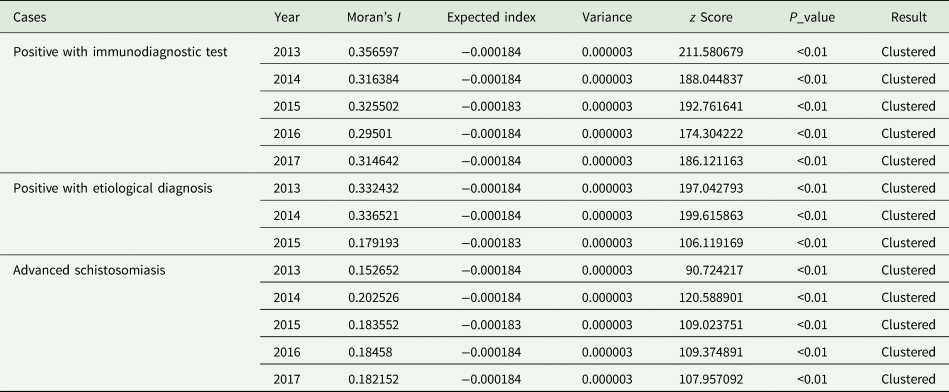
The results of annual global autocorrelation statistics for schistosomiasis patients at the village level are shown in Table 2. The Moran's I value of cases confirmed positive by the immunodiagnostic test ranged from 0.36 to 0.32 during the study years. The Moran's I value of cases confirmed positive by etiological diagnosis ranged from 0.34 to 0.18 in 2013 to 2015. The Moran's I value of advanced schistosomiasis cases ranged from 0.20 to 0.15 during the study period. The Moran's I of the cases confirmed positive by the immunodiagnostic test and etiological diagnosis and that of advanced schistosomiasis cases were all greater than the corresponding expected index, and the results were statistically significant (z-score >0, P < 0.01). Significant global spatial autocorrelation of schistosomiasis patients was found at the village level in the whole province during the study period. Meanwhile, the spatial distribution of schistosomiasis cases remained clustered and unchanged during the study period.
Global autocorrelation analysis of schistosomiasis patients in Hubei Province at the village level (2013 to 2017)

Spatial distribution patterns of schistosomiasis patients
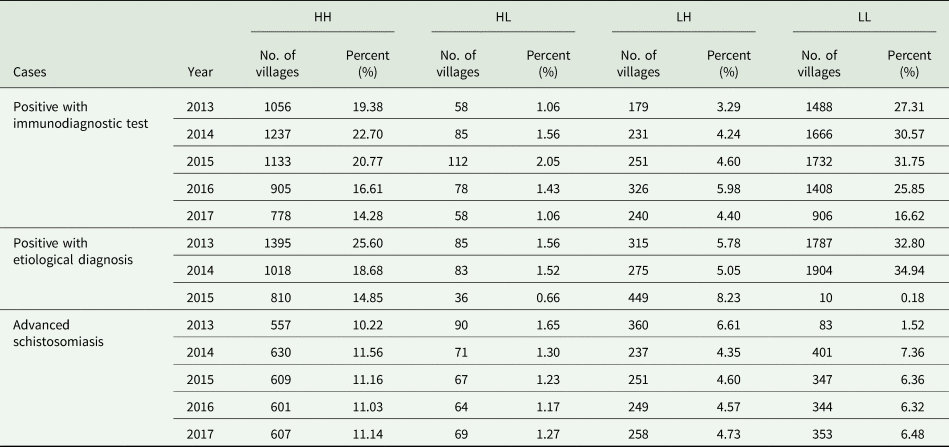
Table 3 presents the spatial distribution patterns of schistosomiasis patients at the village level in Hubei Province from 2013 to 2015. The spatial distribution patterns of the cases confirmed positive by the immunodiagnostic test and etiological diagnosis advanced schistosomiasis cases all showed five types: HH, HL, LH, LL and random.
Statistical table of spatial distribution patterns of schistosomiasis patients in Hubei Province (P < 0.05)

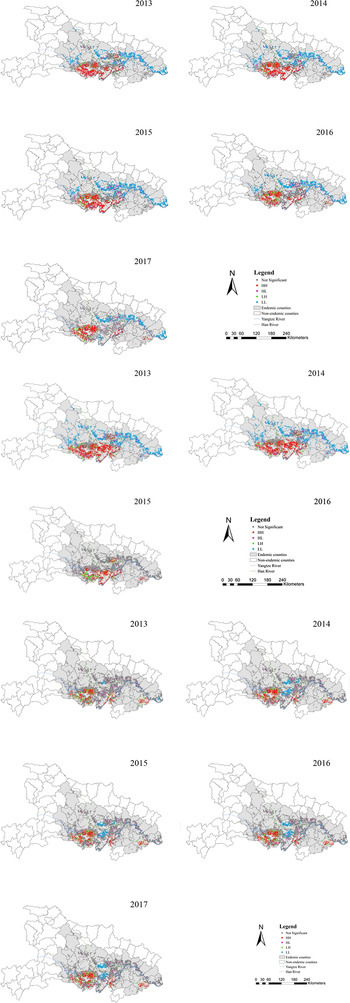
In the cases confirmed positive by the immunodiagnostic test, the number of LL villages was greater than that of HH villages, while HL villages had the least number every year. A total of 1056, 1237, 1, 133 905 and 778 HH villages were detected from 2013 to 2017, respectively, accounting for 19.38, 22.70, 20.77, 16.61 and 14.28% of the total number of villages, respectively. The number of HH villages detected accounted for approximately 20% of the total number of villages in the whole province and the schistosomiasis patients in those villages accounted for approximately 60% of the patients in all endemic villages. Most HH villages were concentrated in Gongan County, Jianli County, Honghu City, Shishou City, Qianjiang City, Hanchuan City, etc. (Fig. 3A).
(A) Spatial distribution patterns of schistosomiasis patients confirmed positive by the immunodiagnostic test in Hubei Province. (B) Spatial distribution patterns of schistosomiasis patients confirmed positive by etiological diagnosis in Hubei Province. (C) Spatial distribution patterns of advanced schistosomiasis in Hubei Province.

The number of HH villages with cases confirmed positive by etiological diagnosis decreased from 1395 in 2013 to 810 in 2015. Most HH villages were concentrated in Gongan County, Xiantao City, Honghu City, Jianli County, Shishou City, etc. (Fig. 3B).
The advanced schistosomiasis cases detected in HH villages were fewer than the cases confirmed positive by the immunodiagnostic test and etiological diagnosis each year. The number of HH villages was greater than those of HL, LH and LL villages each year. A total of 557 HH villages were found in 2013; this number slightly increased to 630 in 2014 and decreased to 607 in 2017. Most HH villages were mainly distributed in Jiangling County, Gongan County, Yangxin County, Shishou City, etc. (Fig. 3C).
Spatial cluster analysis of schistosomiasis patients
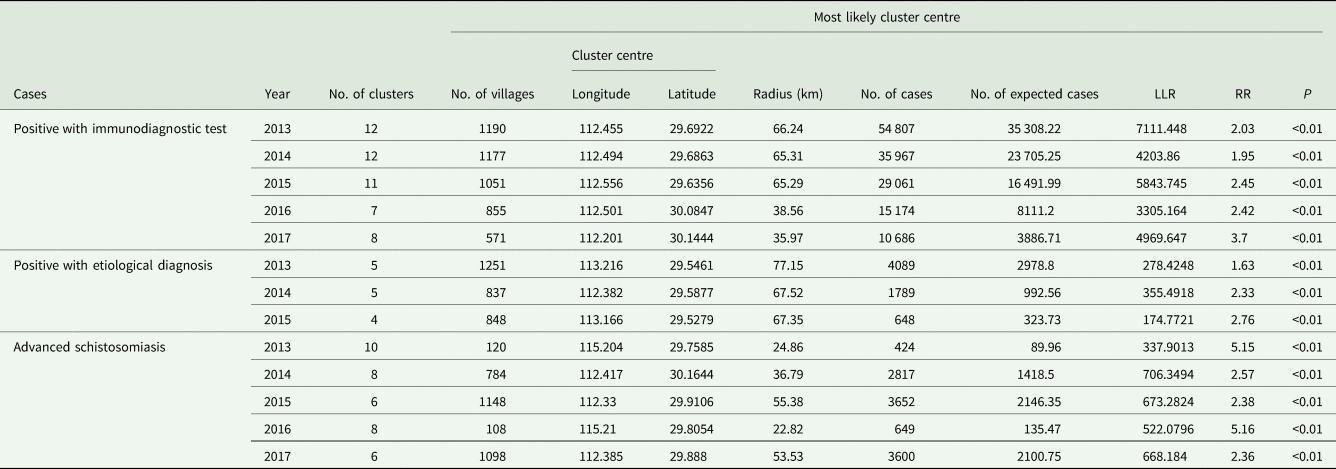
The results of spatial cluster analysis of schistosomiasis patients at the village level are shown in Table 4 and Fig. 4. Significant clusters for the cases confirmed positive by the immunodiagnostic test were found each year during the study period (P < 0.01). Clusters decreased from 12 in 2013 and 2014 to 8 in 2017. Considering the geographical distribution, all the most likely cluster centres were located in Jianghan Plain along the Yangtze River. The most likely cluster centres covered 1190 villages mainly in Xiantao City, Qianjiang City and nine counties in Jingzhou City in 2013 (LLR = 7111, RR = 2.03, P < 0.01). The villages covered in most likely cluster centres decreased from 1190 in 2013 to 571 in 2017. Meanwhile, the GPS coordinates of the centre of the most likely cluster were 112.201°E and 30.1444°N, mainly in Qianjiang City and in seven counties in Jingzhou City in 2017 (LLR = 7111, RR = 2.03, P < 0.01).
Spatial clusters of schistosomiasis patients in Hubei Province (2013 to 2017)

Spatial cluster distribution of schistosomiasis patients at the village level in Hubei Province (2013 to 2017).

The numbers of clusters for the cases confirmed positive by etiological diagnosis detected from 2013 to 2015 were five, five and four, respectively. The most likely cluster centres had an LLR of 278.43 and an RR of 1.63 (P < 0.01), covering 1,251 villages in Jianli County, Honghu City, Shishou City, Jiangling County, Chibi City, Jiayu County, Xiantao City and Qianjiang City in 2013 and 848 villages in the same eight counties in 2015 (LLR = 174.77, RR = 2.76, P < 0.01).
The number of clusters for the advanced schistosomiasis cases ranged from 6 to 10 during the study period, with the number of villages covered fluctuating between 108 and 1148 (P < 0.01) in 5 years. The clusters demonstrated a changing spatial distribution pattern during the study period. Considering the geographical distribution, the major foci changed within Yangxin County, Chibi City, Jiayu County, Xiantao City, Qianjiang City and in seven counties in Jingzhou City.
Spatiotemporal cluster analysis of schistosomiasis patients
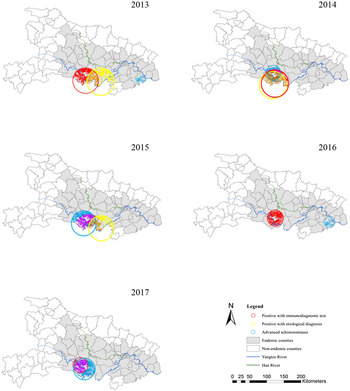
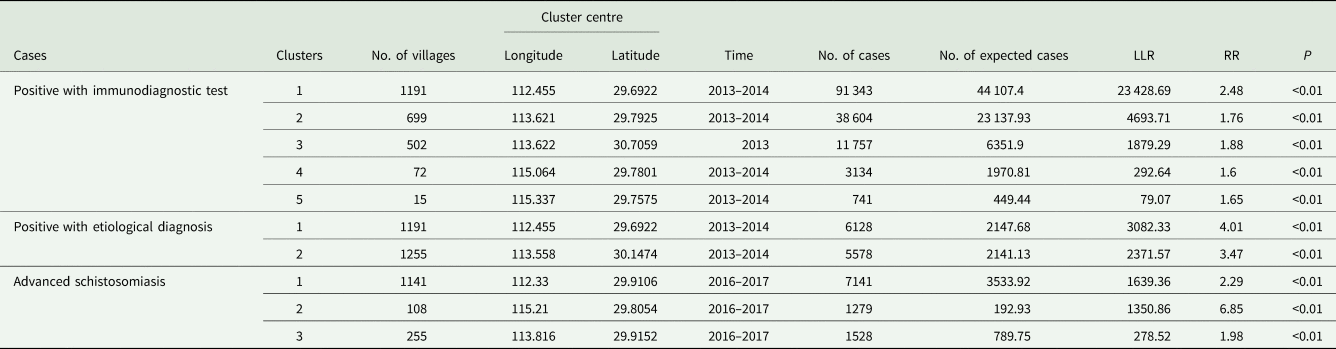
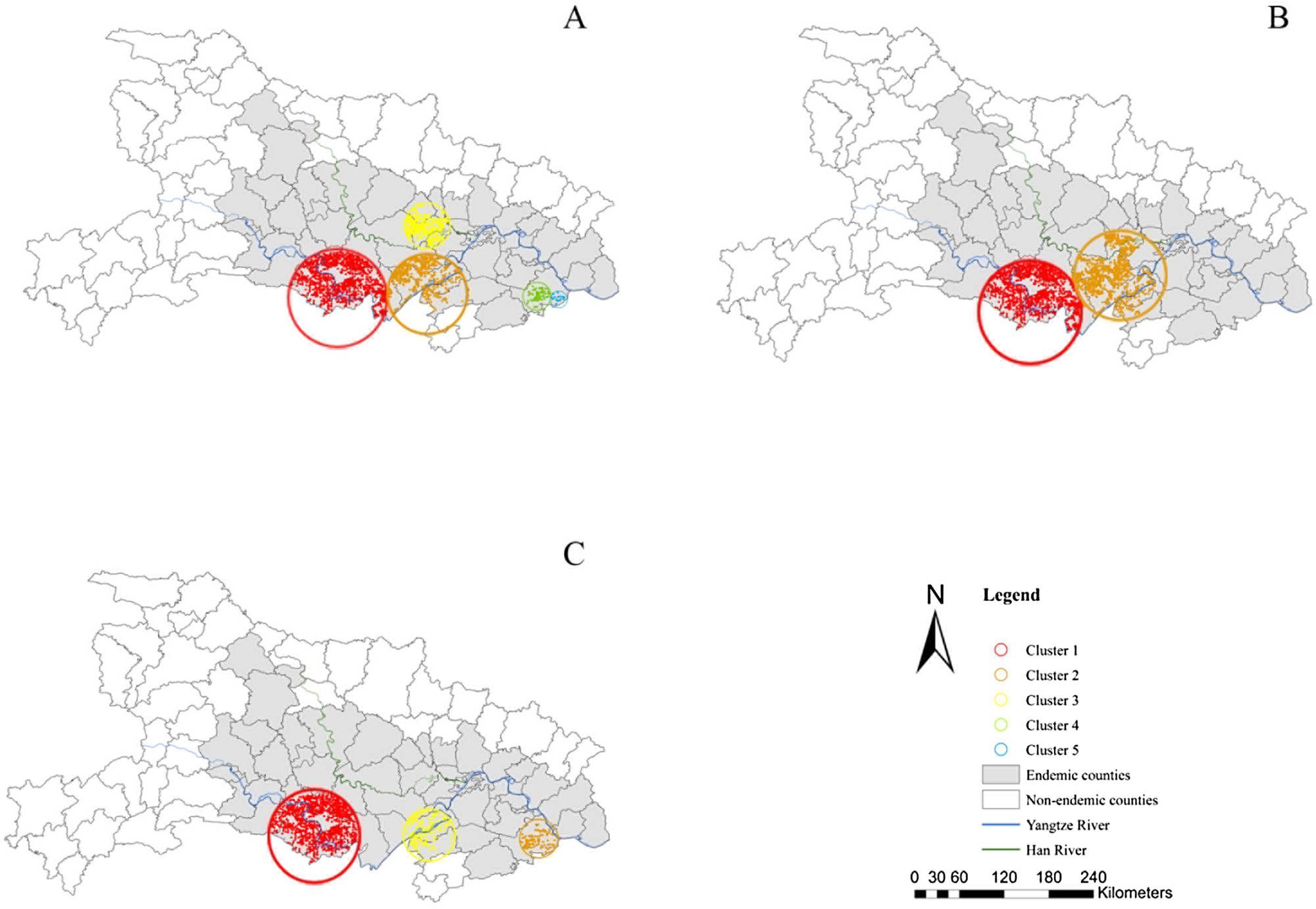
Table 5 and Fig. 5 show the spatiotemporal clusters of schistosomiasis patients detected in Hubei Province from 2013 to 2017 with the largest LLR value of 23 428.69 and the least value of 278.52 (P < 0.01), which indicated significant aggregation in space and time in these areas. The clusters were mainly distributed along the Yangtze River.
Spatiotemporal clusters of schistosomiasis patients in Hubei Province (2013 to 2017)

Spatiotemporal cluster distribution of schistosomiasis patients at the village level in Hubei Province (2013 to 2017). (A) Schistosomiasis patients confirmed positive by the immunodiagnostic test. (B) Schistosomiasis patients confirmed positive by etiological diagnosis. (C) Advanced schistosomiasis.

The cases confirmed positive by the immunodiagnostic test have five statistically significant clusters, four in 2013–2014 (red, orange, green and blue circles) and one in 2013 (yellow circle). The aggregation trend weakened over time. These clusters had the largest LLR value of 4693.71 and the lowest LLR value of 79.07 (P < 0.01). Regarding the geographical distribution, cluster 1 had the widest scope, including a total of 1191 endemic villages in Jianli County, Gongan County, Shishou City, Jiangling County, Qianjiang City, Jingzhoukaifa District, Shashi District, Jingzhou District, Songzi City and Xiantao City and the Jianghan Plain along the Yangtze River (LLR = 23 428.69, RR = 2.48). Cluster 2 had an LLR of 4693.71 and an RR of 1.76, covering 699 endemic villages in Honghu City, Jianli County, Xiantao City, Jiayu County and Chibi City and also along the Yangtze River. In addition, cluster 3 covered 502 villages in Tianmen City, Hanchuan City, Yunmeng County and Yingcheng City, generally located at the Hanbei River Basin (LLR = 1879.29, RR = 1.88). However, clusters 4 and 5 covered 72 and 15 villages both in Yangxin County, along the Yangtze River.
Two clusters for cases confirmed positive by etiological diagnosis were detected in Hubei Province in 2013–2014 (P < 0.01). Considering the geographical distribution, cluster 1 covered 1191 villages in the same counties of cluster 1 for the cases confirmed positive by the immunodiagnostic test (LLR = 3082.33, RR = 4.01). Cluster 2 had an LLR of 2371.57 and an RR of 3.47, covering 1255 endemic villages in Jianli County, Honghu City, Xiantao City, Qianjiang City, Hanchuan City, Jiayu County and Chibi City.
Three clusters were detected for the advanced schistosomiasis cases with the largest LLR of 1639.36 and the least LLR of 278.52 (P < 0.01); both were located along the Yangtze River from 2016 to 2017. Cluster 1 had an LLR of 1639.36 and an RR of 2.29, which covered 1141 endemic villages located at the Jianghan Plain at the middle reaches of the Yangtze River in Xiantao City, Qianjiang City and eight counties in Jingzhou City. Cluster 2 (LLR = 1350.86, RR = 6.85) covered 108 endemic villages in only one county, namely, Yangxin County, located at the lower reaches of the Yangtze River in Hubei Province. Meanwhile, cluster 3 (LLR = 278.52, RR = 1.98) covered 255 endemic villages in Honghu City, Xiantao City, Jiayu County and Chibi City.
Discussion
The lake and marshland areas are the main schistosomiasis endemic areas in China. These areas are present in the four provinces of Hubei, Hunan, Jiangxi and Anhui. The positive schistosomiasis cases confirmed by the immunodiagnostic test, etiological diagnosis in those areas accounted for 81.26 and 99.72% of the total number in China in 2013, respectively. Meanwhile, advanced cases accounted for 77.46%. Hubei Province was one of the most serious schistosomiasis endemic provinces in the four lakes and marshland provinces. It had the largest number of inner embankment O. hupensis snail areas and schistosomiasis cases confirmed positive by the immunodiagnostic test and etiological diagnosis. In 2013, Hubei Province reached the national criterion of transmission control, which is defined as a decrease in human S. japonicum infection to below 1% in all endemic villages. A total of 52 669 cases of S. japonicum infection and 76 485 hm2 of areas infested with O. hupensis snails were reported in Hubei Province in 2013. The geographical environment of the endemic areas did not change fundamentally, and the criss-cross ditches and climate were suitable for snail survival and schistosomiasis endemism. Moreover, schistosomiasis endemism was severely triggered by floods in many areas, especially in villages along the Yangtze River. Therefore, effective implementation and monitoring strategies should be applied to control schistosomiasis on the basis of annual monitoring of humans, livestock and O. hupensis snails in endemic areas. In the present study, the spatial distribution and clusters of schistosomiasis cases were analysed using GIS and SaTScan technologies on the basis of annual village-level monitoring data to provide rapid risk updates for precise control in future strategies.
The numbers of schistosomiasis cases and endemic villages declined in Hubei Province during the research period. The decline of the number of schistosomiasis cases may be largely due to an integrated prevention and control strategy based on S. Japonicum infection source control in schistosomiasis endemic areas in Hubei Province. This strategy included a series of measures, such as replacement of bovines with tractors to prevent domestic animals from freely roaming in marshlands with O. hupensis nails, praziquantel treatment for humans and bovines, molluscicide application and improvement of health education (Chen et al., Reference Cai, Xu, Steinmann, Chen, Chu, Tian, Chen, Li, Lu, Zhang, Zhou and Chen2014; Yang et al., Reference Yang, Zhou, Song, Li, Zhong, Wang, Bergquist, Zhou and Jiang2016; Wang et al., Reference Wang, Wang and Wang2017). However, the number of advanced schistosomiasis cases increased from 4028 in 2013 to 8146 in 2014, which is mainly due to different statistical standards. The number of advanced schistosomiasis cases in 2013 was the number of patients actually treated. Since 2014, the numbers of patients with advanced schistosomiasis were counted as the number of current patients per year due to the change in prevention and control targets.
The global spatial autocorrelation analysis results indicated that the distribution of schistosomiasis cases had spatial heterogeneity at the village level. Schistosomiasis cases decreased due to the implementation of the integrated strategy emphasizing infectious source control in Hubei Province. However, the spatial cluster of schistosomiasis cases did not change significantly. This finding is consistent with that of our previous research (Chen et al., Reference Chen, Liu, Jiang, Li, Shan, Zhang, Cai and Huang2018b). This phenomenon indicated that the main influencing factors of schistosomiasis in Hubei Province, such as natural environmental conditions, climatic conditions and geographic distribution of O. hupensis snail, did not fundamentally change (Hu et al., Reference Hu, Ward, Xia, Li, Sun, Lynn, Gao, Wang, Zhang, Xiong, Zhang and Jiang2016; Xu et al., Reference Xu, Steinman, Maybe, Zhou, Lv, Li and Peeling2016).
In view of the spatial heterogeneity of schistosomiasis cases in the overall scope of the province, Local Moran's I statistics were further analysed to measure the spatial distribution patterns of schistosomiasis patients at the village level. The numbers of HH villages with cases confirmed positive by the immunodiagnostic test and etiological diagnosis decreased within the study period, and the distribution range was mainly located in the foci of Jianghan Plain along the Yangtze River. However, the number of HH villages of advanced schistosomiasis cases was less than those of the other two types of patients. These villages located along Yangtze River, especially on the middle stream of Hubei section in the Yangtze River, were relatively fixed in scope. Thus, future precise prevention and control strategies will focus on these local regions. The measures aimed at controlling the roles of humans and bovines as sources of S. japonicum infection should be implemented as key targeted measures of the integrated control strategy based on local schistosomiasis endemic features.
The purely temporal cluster analysis found that the spatial distribution of the three types of schistosomiasis cases all demonstrated a clustering pattern during the analysis period. By comparing the analysis results of Local Moran's I statistics and purely temporal cluster analysis, we found that most of the endemic village clusters overlapped. For example, the clusters of schistosomiasis cases confirmed positive by the immunodiagnostic test were exactly the same in the 735 villages in nine counties detected by the two methods in 2013. This finding indicated that the two spatial analysis methods have good consistency in detecting clusters. However, given the different spatial analysis units, the clusters detected were not exactly in the same areas. The most likely spatiotemporal clusters of schistosomiasis cases confirmed positive by the immunodiagnostic test were found to be the same, located in 10 counties in Jianghan Plain along the middle stream of Hubei section in the Yangtze River in 2013 to 2014. Clusters were not found after 2015, indicating a downward trend over time. The most likely spatiotemporal clusters of advanced schistosomiasis cases were focused in the location similar to that of the other two types of cases in 2016 to 2017. Obviously, the hotspots mainly overlapped the Jianghan Plain along the middle stream of Hubei section in the Yangtze River, and the downstream, especially Yangxin County, cannot be ignored. The 11 counties of the main spatial foci accounted for approximately 85% of the total schistosomiasis cases in Hubei Province. Jianghan Plain covers a mixture of rivers, lakes and marshlands. A large number of channels, especially small and medium channels, are distributed in embankment; hence, the environment is difficult to completely change by engineering governance measures, such as channel rectification and environmental transformation. Most marshlands were soaked in water in summer and covered with grass as floodwaters recede in winter. Such geographical environmental conditions are conducive for O. hupensis snail growth and reproduction (Xiong et al., Reference Xiong, Zhao, Xu, Liu, Jiang and Dong2016; Zhu et al., Reference Zhu, Fan and Peterson2017; Zhao et al., Reference Zhao, Gao, Zhang, Li, Huang, Tang and Dong2018). The snail areas in these counties were larger than those in other regions. These areas are affected by the water level of the Yangtze River and are prone to floods. Therefore, snails can easily spread with water. Meanwhile, Jianghan Plain is the main rice producing area in Hubei Province. Given the rapid urbanization, more workers migrate from schistosomiasis endemic areas; hence, majority of the population in schistosomiasis endemic villages are middle aged and elderly, and their production and lifestyle are mainly agricultural production or aquaculture. Thus, they may be easily infected by contact with contaminated water. The other main cluster was detected in Yangxin County, which is located in the lower reaches of the Yangtze River in Hubei Province. This county has six water systems and 114 lakes. The most important water system in this county is Fu River, which flows through the county. Most of the rivers and lakes in Yangxin County are connected to the Fu River, which is the only river that flows into the Yangtze River. Approximately 75% of the snail areas in Yangxin County are distributed in the river and lake beaches of the Fu River system. Because the water level of the Fu River system is difficult to control, snails can easily spread due to flooding. Meanwhile, most of the residents in the county are farmers or fishermen. Their lifestyle increases the chance of schistosomiasis infection. In addition, many cattle graze on the lakes and beaches in Yangxin County, resulting in repeated infections.
IHA screening to identify patients who are still shedding parasites among positives would be more efficient than performing stool examination in low-transmission-intensity regions (Zhou et al., Reference Zhou, Xu, Chen, Wang, Huang, Lin, Wang, Tang, Guo, Wu, Feng, Chen, Guo, Chen, Li, Wu and Peeling2011). Furthermore, IHA-positive cases are the target population for selective chemotherapy with praziquantel to reduce the number of infected cases. A positive IHA test can be used to diagnose patients with no eggs. The results of the IHA test can reflect the infection of the group to a certain extent. Studies show that there is a good consistency between the IHA positive rate and schistosomiasis infection rate at the population level. The IHA test is valuable in monitoring and field screening especially in regions of low-level endemicity. Although the clusters of patients confirmed positive by etiological diagnosis were fewer than those confirmed by immunoassays, we found that the distributions of positives diagnosed by immunoassays and etiological examination were consistent along the Yangtze River. As the schistosomiasis endemic and infection extent reduced to a relatively low level, schistosomiasis elimination becomes difficult to achieve. Thus, precision control and prevention are extremely important, especially the precise treatment and management of schistosomiasis patients.
This study has several limitations. The precise chemotherapy measures for schistosomiasis control require sensitive diagnostic techniques for selecting the target subjects. The chosen method for the immunology technique is based on IHA in our study. In terms of IHA diagnostic evaluations, uncertainty and inaccurate assessment affect the prevalence and the morbidity of schistosomiasis. Moreover, the IHA test cannot determine whether the patient has a current infection or a previous infection. This assay may detect some false positive cases that do not require treatment or chemotherapy, and some patients may not be accurately diagnosed. Moreover, the transmissions of schistosomiasis are influenced by complex factors, such as environmental change, water conservancy project, temperature, flood and human behaviour. The clusters of schistosomiasis cases that we detected were only based on the case distribution, and the above-mentioned multivariate factors for analysis were not incorporated. Therefore, further research of these complex variables on the risk of schistosomiasis transmission should be carried out.
Concluding remarks
This study detected hotspots of schistosomiasis cases both spatially and spatiotemporally on the basis of spatial autocorrelation; clustering and outlier, purely spatial and spatiotemporal cluster analyses at the village level from 2013 to 2017 in Hubei Province. The number of schistosomiasis cases dramatically decreased during the study period. Nevertheless, the high-risk regions are mainly distributed in the Jianghan Plain along the middle reach of Yangtze River and Yangxin County in the lower reaches of the Yangtze River in Hubei Province during the 5-year study. The risk of schistosomiasis transmission will persist in those areas because endemic conditions, such as the environment, have not been radically changed. To achieve schistosomiasis elimination, integrated control measures and precise treatment and chemotherapy toward patients will require continued implementation, especially in the middle reaches of the Yangtze River and Yangxin County located at the lower reaches of the Yangtze River in Hubei Province.
Financial support
Financial support was received from the Hubei Province health and family planning scientific research project (WJ2018H251) and Hubei Natural Science Fund Project (ZRMS2019000206).
Conflict of interest
None.
Ethical standards
Not applicable.