Introduction
Effective communication is an important part of managing an emergency. Communications can be challenging when an emergency causes loss of electricity and movement of populations. During an emergency, the ways in which health agencies normally communicate warnings may not reach all of the intended audience. Some groups might have difficulty receiving or understanding information, such as populations with cultural and linguistic barriers or people who do not have access to traditional modes of message delivery. 1
The Federal Emergency Management Agency (FEMA; Washington, DC USA) has developed a “whole community” approach to increase household preparedness and engage with community members to enhance resiliency and security of the nation. 2 This approach is a way for community members, emergency managers, community and organizational leaders, and government officials to collectively understand and assess the needs of their respective populations. 2 To communicate with the whole community, community leaders need to understand communication preferences and trusted sources of information. Previous research has shown that people are likely to take advice from a trusted source they are familiar with, even if that source does not have emergency-related expertise and provides inaccurate information. 1 Because many audiences today are more diverse, risk communicators need to use a variety of communications methods.
During an emergency, some population groups rely on social media as their first source of news. 1 Social media provides interactive, online channels for communication that make it easy for users to participate and contribute content. Social media creates an opportunity to reach out to many people, dispel rumors rapidly, and allows people to receive information from those they consider influencers and trusted sources. These sources include community leaders, celebrities, journalists, friends, and family. Social media includes a wide-range of online tools that enable two-way interaction. 1 People can access social media via smart phones, cellular phones, tablets, and computers. Communicators use social media to spread information and receive feedback through incoming messages, posts, tweets, and polls. Social media users can further drive messages by reposting, sharing, and generating messages about an emergency.
Major public health emergencies prompt those who use social media to become immediately involved, especially if the events are exotic, catastrophic, or the first of their kind.Reference Fraustino, Liu and Jin 3 User-generated content will often be the first publicly provided material (eg, original Twitter [Twitter Inc.; San Francisco, California USA] or Facebook [Facebook Inc.; Menlo Park, California USA] posts). 1 Two-way information flow allows communicators to combine real-time input with traditionally collected data. Some people will provide large amounts of content through videos on YouTube (YouTube LLC; San Bruno, California USA), while others only post quick updates on social media, such as Twitter, Facebook, and Nextdoor (Nextdoor.com Inc.; San Francisco, California USA). Social media use rises during disasters as people seek immediate and in-depth information.Reference Fraustino, Liu and Jin 3 In October 2012, Hurricane Sandy swept across the US East Coast, causing $50 billion in property damage, subway shut downs, and power outages. During Hurricane Sandy, Twitter was a key avenue for information sharing. More than 1.1 million people mentioned the word “hurricane” on Twitter within a 24-hour period, and “Sandy” was the number two most mentioned topic on Facebook in 2012.Reference Fraustino, Liu and Jin 3
One reason social media is so effective is that it shares similar attributes with word-of-mouth (WoM) messaging. Word-of-mouth, an informal process in which one person tells another person about something, is a common method for sharing information. As one of the earliest forms of communication, WoM is effective because information comes from trusted friends, family members, and peers. Word-of-mouth is one of the most valuable forms of marketing. According to Nielsen, 92% of consumers believe recommendations from friends and family over all forms of advertising. Recommendations from a trusted friend or family member are a powerful persuasion tool.Reference Whitler 4 Social media shares the same goals as WoM messaging: spreading messages, discussing ideas, and sharing stories within your social network. Over time, WoM has become word of blogs, texts, posts, tweets, and shares.
Not all communities are the same, and households within communities are diverse. Because different communities prefer different communication methods, community leaders and emergency planners need to know their communities’ preferred methods for seeking information. Emergency planners can assess communication preferences during the preparedness or response phases of a disaster. Public Health Departments frequently use the Centers for Disease Control and Prevention’s (CDC; Atlanta, Georgia USA) Community Assessment for Public Health Emergency Response (CASPER) methodology to collect this information. 5 A CASPER is a rapid needs assessment designed to gather household-based information from a community and is widely used before and after disasters.Reference Malilay, Heumann and Perrotta 6 , Reference Bayleyegn, Schnall and Ballou 7 The CASPER is modeled after the World Health Organization’s (WHO; Geneva, Switzerland) Expanded Programme on Immunization recommended survey technique for estimating vaccine coverage. The CDC has adapted the technique to assess information regarding communities’ health status, public health needs, and preparedness status. 5
This descriptive report explores findings from CASPERs that have collected information on communication preferences, including television (TV), social media, and WoM delivery methods. The CASPERs used a two-stage cluster probability sampling to select a representative group of 210 households from the sampling frame to be surveyed. In the first stage of sampling, 30 clusters were selected with a probability proportional to the number of households in each cluster. In the second stage, interview teams systematically selected seven households for interview within each cluster. For each CASPER, weighted analysis was conducted to take into account the complex sampling methodology and to estimate the projected number and percentage of households with a particular sampling frame. The weight was calculated to account for the probability that the responding household was selected. Weighted analysis was only calculated for cells with five or more households, as shown in the tables. Data were analyzed from 12 previously conducted CASPERs that included questions regarding primary and trusted communication sources. Three questions typically were asked: (1) “What is your household’s most preferred method for receiving information about an emergency event?” (2) “What was your household’s primary source of information about the [emergency event]?” and (3) “What was your household’s most trusted source of information for [emergency event]?”
Report
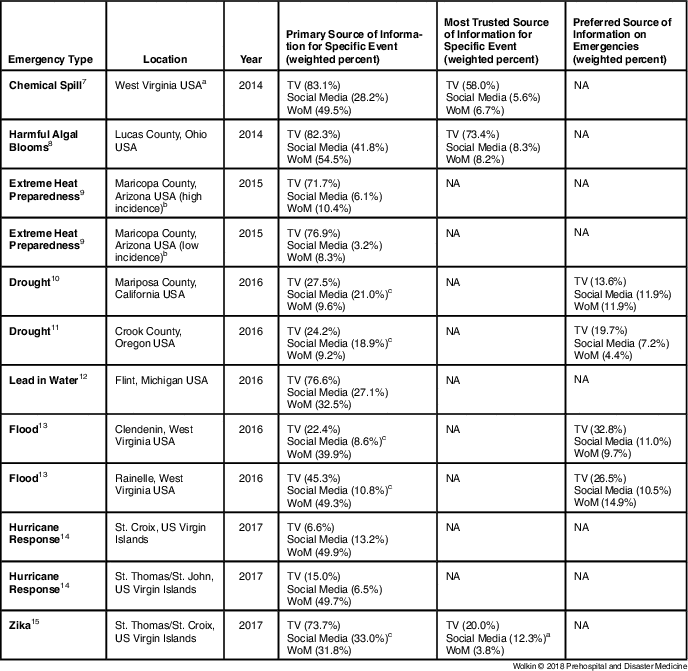
Only CASPERs were included that: (1) were conducted by a health department in collaboration with the CDC, (2) were conducted between 2014 and 2017, and (3) included questions on communication preferences. Twelve CASPERs met these criteria (Table 1). 8 – 16 All CASPERs were conducted as part of preparedness activities or in response to a specific emergency event, including a chemical spill, harmful algal blooms, extreme heat, drought, flood, hurricanes, lead contamination, and Zika virus. Although all CASPERs asked about communication preferences, not all CASPERs asked all three communication questions. Further, response options varied by CASPER; some CASPERs asked for a single response (eg, select one), while others allowed for multiple responses (eg, select all).
Household Communication Preferences Reported in 12 Community Assessments for Emergency Response, United States, 2014-2017

Abbreviations: NA, not applicable (question was not included on the questionnaire); TV, television; WoM, word-of-mouth.
a Nine counties serviced by West Virginia American Water Company (Charleston, West Virginia USA).
b Two CASPERs were conducted in Maricopa County, one sampling frame included non-tribal zip codes in Maricopa County with high incidence of heat-related hospitalizations (≥100 heat-related hospitalizations per 100,000 population) and the other with low incidence of heat-related hospitalizations.
c Social media asked in combination with the internet.
In nine of the CASPERs, households most commonly reported TV as the primary source of information for specific emergency events (range = 24.0%-83.1%). In six of these CASPERs, over 70.0% of households reported TV as the primary source of information. Two of the most recent CASPERs were conducted in response to Hurricanes Irma (2017) and Maria (2017) in the US Virgin Islands. 14 Because the hurricanes caused widespread power outages, TV was less commonly reported as the primary source of information (range = 6.6%-15.0%).
Households reporting social media as their primary source of information differed widely across CASPERs (range = 3.2%-41.8%), with the CASPER addressing the presence of harmful algal blooms having the highest percentage of households (41.8%) reporting social media as their primary source of information. In five of the CASPERs, nearly one-half of households reported WoM as their primary source of information. These CASPERs were conducted in response to a specific emergency (ie, chemical spill, harmful algal bloom, hurricane, and flood). The CASPERs conducted as part of a preparedness activity had lower percentages of households reporting WoM as their primary source of information (8.3%-10.4%).
Of the three CASPERs that asked about most trusted source of information for the specific emergency event, TV was the most common response (range = 20.0%-58.0%). Fewer household reported social media (range = 5.6%-12.3%) and WoM (range = 3.8%-8.2%) as their most trusted information sources.
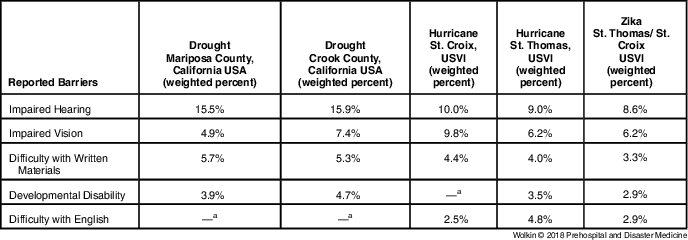
Of the four CASPERs that asked the household’s preferred source of information on emergencies in general, more households reported TV as the most common preferred source than other methods. However, only up to one-third of households reported TV as the preferred source (range = 13.6%-32.8%). In each of these four CASPERs, social media was reported as a primary source of information (range = 7.2%-11.9%) and WoM was reported as a primary source of information (range = 4.4%-14.9%). Only five CASPERs asked households to report communications barriers (Table 2). Households most commonly reported impaired hearing (8.6%-15.9%), impaired vision (4.9%-9.8%), and difficulty with written materials (3.3%-5.7%).
Communication Barriers Reported by Households in Five Community Assessments for Emergency Response, 2014-2017

Abbreviation: USVI, United States Virgin Islands.
a Sample size smaller than five households.
Discussion
Although more households reported TV as their preferred and trusted source of information about emergency events, in all CASPERs, a percentage of households reported social media and WoM as their preferred source. The CASPERs conducted in 2016 and 2017 had a larger percentage of households relying on social media and WoM for information than in previous years. For emergencies with political implications, such as the West Virginia chemical spill (Charleston, West Virginia USA; 2014) 8 and Flint, Michigan (USA) 13 lead contamination of the water supply (2014), there was larger reliance on WoM messaging than for other emergency types. Although the reason for their trusting a specific source over another source was not asked, this finding might reflect a lack of trust in “official” messaging about the politicized emergency event.Reference Manuel 17 In six of the 12 CASPERs, less than one-half of households reported TV as their primary source of information for the specific emergency event. During these events, households preferred to get information from other sources. These preferences may be influenced by the specific emergency event. Both CASPERs conducted in response to drought, less than one-third of households reported TV as the primary source of information.
Drought is a slow-moving, long-lasting disaster. The public health implications develop over time, resulting in longer-term, indirect public health needs. 18 People may not seek drought-related information from TV as they would for a more acute event, such as a chemical spill. Likewise, in the two hurricane-related CASPERs, 15 few households in the US Virgin Islands reported TV as their primary source of information. This is likely because of widespread power outages across the islands. Households had to rely on other sources of information, such as social media and WoM. People also used social media less commonly during these hurricanes, likely because of widespread power and internet outages, which increases their dependency on traditional WoM messaging, as well as radio and handouts.
The West Virginia Bureau for Public Health (Charleston, West Virginia USA) conducted flood CASPERs 14 during the recovery phase of the disaster, one month after the initial flooding. At that time of the assessment, TV may not have been broadcasting information about the flooding. Additionally, in West Virginia, approximately 3,500 people were temporally displaced and were living with family, in group shelters, or in tents. These factors may have influenced their communication preferences. The demographics of the sampled area can also influence communication preferences. Those displaced persons, for example, may have been less dependent on TV for information.
Using multiple ways to deliver information, including TV, social media, and WoM, increases the opportunity to reach and engage the whole community and takes advantage of the different strengths of each of these methods. During an emergency, people often look for message confirmation before taking action, so it can be beneficial to share messaging through multiple communication routes. For example, people may check more than one TV channel to see if the warning is repeated elsewhere. They also may call friends and family to see if they heard and understood the same message, turn to a known credible local leader for advice, or check multiple social media channels to see what is posting. 1
Although social media and WoM messaging are harder to control, these methods are popular and able to quickly reach a large audience. An advantage of social media and WoM messaging is the lack of reliance on the original source to spread the message. Messaging via TV is limited to the number of times the news media decides to provide the messaging. In contrast, social media and WoM messaging is constantly being recirculated through sharing, reposting, and retweeting, with social media enabling rapid amplification of messaging. The original source of the information is no longer the limiting factor for dissemination. Another advantage of these methods over TV is that they allow for two-way communication. People can respond to the messaging through social media and information providers can immediately respond to these questions. For example, the CDC can track responses to posts and disseminate different messages to clarify its messages or provide additional information. Other advantages of social media include the ability to provide immediate information, create rapid connections, and build relationship with the public and the media. Use of social media can also help dispel rumors by rapidly providing accurate information and incorporating website links where the media and public can obtain information that is more detailed. 1 Although social media does not reach everyone, diverse ranges of people increasingly share information through social media. Social media does not replace other forms of communication; rather, social media is used to enhance other communication tools. 1
Various emergency planners and community leaders have begun using social media and WoM communications strategies for risk communication, in addition to traditional methods. For example, the Utah Department of Health (Salt Lake City, Utah USA) worked with several Utah state agencies and leaders of refugee communities to develop a real-time, person-to-person, emergency information network to ensure that refugees could be reached with relevant and current information during an emergency. 19 Because traditional modes of communication and messages written or spoken in English might be ineffective with refugee and immigrant populations, Utah planners created the real-time information network. Participants include emergency managers, public health planners, and refugee community leaders who can spread messages during a disaster. The network has a public information officer that sends out news releases and emergency information and works with a refugee liaison in a health emergency. During an emergency, Utah health agency staff advise the network task force and the public information officer on providing messages that are culturally and linguistically accessible to affected populations. 19
Another example is FEMA’s work with the American Association of Retired Persons (AARP; Washington, DC USA) to address older adults during extreme heat events by encouraging community members to spread heat-related health messaging. 20 Older adults are at increased risk for heat-related health effects because of social isolation, inability to adapt to heat, medications that interfere with their body’s ability to handle heat, mobility limitation, and co-morbidities. 21 Thus, AARP’s “Help Someone Stay Cool During Extreme Heat” 20 is a guide to teaching community members to spread heat-related health messaging via WoM to family, friends, and neighbors. The guide recommends that community members help prevent heat-related illnesses and deaths by checking on people in their community during periods of extreme heat, and if needed, drive them to an air-conditioned location. This program helps reduce and prevent heat-related illnesses and death. The program also lets people know that somebody is looking out for them, strengthens community bonds, and teaches people how to protect themselves and others during periods of excessive heat. Similarly, the CDC recommends protecting older adult relatives or neighbors from heat-related stress by visiting them twice a day and watching for signs of heat exhaustion or heat stroke, encouraging them to drink fluids, and if needed, transporting them to air-conditioned locations. 21
The National Oceanic and Atmospheric Administration’s (NOAA; Washington, DC USA) Weather-Ready Nation initiative is another example of an agency promoting the use of social media and WoM messaging for risk communication. 22 This initiative builds community resilience by motivating individuals and communities to prepare for extreme weather events and to share the preparedness steps with others. The NOAA encourages community members to “Be a Force of Nature,” which includes knowing weather risks for their area, taking action to prepare for emergencies, and being an example in their community by sharing information. The NOAA encourages people to be a positive influence on their community by sharing their weather preparedness story. Also, NOAA recommends that community members tweet that they are prepared with the hashtag #BeAForce, sharing their story on Facebook, and making sure they have a family emergency plan.
Limitations
This descriptive review is subject to several limitations. First, the review only looked at a portion of available CASPERs to review communication preferences. The selected CASPERs may not be representative of all CASPERs. In addition, the percentages of persons using social media may be under-estimated. The population included in the interviews was limited to those who were at home and available. The interviews might not reflect the preferences of younger populations, those less likely to answer the door (eg, those with mobility issues or communications issues), or those with limited English proficiency.
Conclusion
The findings in this report demonstrate the need for emergency plans to include multiple communication models, combining traditional methods with newer technologies to reach the broadest audience. The findings show that people receive their information from a variety of sources, and these sources vary by demographics and hazard. Although TV was the most commonly reported preferred source of information, segments of the population relied on social media and WoM messaging. Further, the ways in which people prefer to receive communication change over time with social media becoming increasingly popular source for information. Future research should assess the impact of decreasing trust of traditional news sources and explore the impact of social media. By using multiple methods for risk communication, emergency planners are more likely to reach the whole community and engage vulnerable populations that may not have access to, trust in, or understanding of traditional news sources. Multiple communication channels that include user-generated content, such as social media and WoM, can increase the timeliness of messaging. Those channels also provide community members with message confirmation from sources they trust and can encourage them to take protective public health actions.