INTRODUCTION
This article is the product of recent research carried out among the Ayöök (Mixe) people of Oaxaca, Mexico, in a small town called Poxoyëm. The investigation aimed to document the on-going use of a Mesoamerican calendar of 260 days in its social context, accompanying ritual activities, and other related worldview symbolisms (Rojas Reference Rojas2014). One of the most interesting revelations of this research was the close and strong bond between the calendar and divination, in this case using the technique of reading maize kernels. Generally, when consulting a daykeeper to learn of possible “good” or “not good” predictions for days that affect illnesses, dreams, presages, conflicts, and afflictions, the daykeeper will also cast maize seeds in order to confirm a preliminary diagnosis, recover more information, and prescribe the most adequate remedy which consist of paying respect to the divinities, such as It Naaxwin (Earth deity), God, the patron saints, and ancestors. This article describes this maize divinatory practice and shows that this data can improve understanding of the people who managed and used the 260-day calendar in precolonial Mesoamerica. In particular, it will be proposed that divination was an integral part of consulting the calendrical and mantic manuals that are now called the Borgia Group codices or the Teoamoxtli (the latter following the terminology of Jansen and Pérez Jiménez Reference Jansen and Jiménez2004). With the support of accounts from colonial sources, it will be suggested that maize divination was physically practiced on the painted pages of these books. The ethnographic data will also be used to better understand some Mesoamerican historical accounts that describe divinatio and examples of visual culture where the casting of maize is portrayed. The aim here is to highlight the strong relationship between, and complementary use of, maize divination and the 260-day calendar in the correct prognostication of, for instance, a disease. In other words, both were most probably used together as one single oracular device.
In this article, the use of sources diachronically, from precolonial Mesoamerica, through colonial to contemporary times, will follow an ethno-iconological approach. Ethno-iconology is based on the premise that contemporary cultures that show cultural continuity, such as in the case of Mesoamerican societies, offer great potential for the interpretation of precolonial visual and material culture. The strong cultural continuity in Mesoamerica complements historical sources, corrects Eurocentric distortion, and explains the meaning and function of religious concepts (Jansen Reference Jansen, Kippenberg, van den Bosch, Leerhouwer and Witte1988:92). That is not to say, however, that indigenous cultures have been stable throughout time: continuity implies development and change. Mesoamerican peoples show a diachronically persistent affiliation to ancestral traditions or, in other words, their cultures, languages, and religions have been resilient to the passage of time, the clash and trauma of colonization being the most dramatic event (see also Bartolomé Reference Bartolomé1997; Gossen Reference Gossen, Carmack, Gasco and Gossen2007:527; López Austin Reference López Austin1990). An ethno-iconological approach has proven to be successful in the study of codices (see Anders et al. Reference Anders, Jansen and van der Loo1994; Oudijk Reference Oudijk2000; van Doesburg Reference Doesburg2001, among others). For instance, based on ethnography study of the their rituals of counting offerings and sacred bundles conducted among the Tlapanec people, we now understand that the Borgia Group codices were employed as manuals by experts in calendars, divination, medicine, and rituals in precolonial times (Anders et al. Reference Anders, Jansen and García1993; Nowotny Reference Nowotny, Everett and Sisson2005 [1961]; van der Loo Reference Loo1987).
Following the scholarship of Nowotny (Reference Nowotny, Everett and Sisson2005 [1961]) and Jansen (Reference Jansen1982), the contemporary use of the calendar and divination can shed light on past practices, symbolism, and the tools related to divination rituals. Calendars, and the ancient codices that contained them, were used by daykeepers as essential tools for healing and worshipping or addressing gods and ancestors. In particular, accounts of divinatory practices in contemporary communities give us the opportunity to understand what “divination” and “diviner” mean within their historical and cultural contexts, and most importantly, in the original indigenous languages. This permits a closer look at indigenous worldviews and thus attempts to correct distortions that were created, in the case of Mesoamerica, by colonial accounts. Hereafter, this work will undertake this challenge and try to give a closer view of Mesoamerican divination, its people, and tools.
AYÖÖK CALENDAR AND MAIZE DIVINATION
The Ayöök calendar and maize divination have an intrinsic bond: consulting the 260-day calendar and its predictions also implies consulting maize. A complete consult with the daykeepers includes asking and learning the prognostications and recommendations of both systems. The 260-day calendar and maize divination complement each other. The following analysis will demonstrate that this would also have been the case in precolonial times.
The Ayöök calendar, besides being used as a notational system to mark the passage of time, works as a prognosticative and prescriptive tool by itself (Rojas Reference Rojas2013, Reference Rojas2014). The 260-day sacred calendar is handled and stored in the memory of the xëë maywë machowë (or xëë maypë machopë), literally the one that “divines and counts the days” (translation by author). Today in the town of Poxoyëm, in the western part of the Ayöök region, it is only female experts who maintain this knowledge. They do so for the benefit of community members seeking medicinal remedies and ritual solutions to alleviate life's afflictions. The most significant source of prognostication and prescription for each day is given by one of the 20 possible signs (see Rojas Reference Rojas2013, Reference Rojas2014 for a complete list and analysis of the days). The numeral, from one to thirteen, gives intensity to the features of the sign. The day signs are ambivalent: they can be not so good in terms of prognostication and still positively suggest following a ritual prescription, and vice versa. Each day has a particular general prediction (good or not good), a ritual recommendation (in which, for example, a marriage celebration could be included), a birth augury, which suggests personality traits or possible risks to the future life of the newly born, and a level of intensity of any of these layers given by its number.
People consult the experts of the days and divination for many reasons. Afflictions are one of the main motives to consult the x ëë maywë (short for xëë maywë machowë). In the context of poverty and marginalization, sickness is one of the main sources of affliction. Susto (or illness caused by fright), derived from a shock or distress, may perhaps be the most common ailment caused by the imbalance of body and the spirit (see Lipp Reference Lipp1991:154–166). It is usually diagnosed after the feeling of a gust of cold wind (mal aire, “bad air”) or by a recurrent, chronic, or aggravating sickness. Those people in the community who are able to experience transformation into animals or natural phenomena, the so-called tso'ok and perhaps more commonly known as the nahualli in Mesoamerican literature, can also visit persons whom they want to harm in dreams, and cause them susto.
Dreams and presages may also be a source of affliction when they announce illness, danger, bad luck, or even death. Presages are events where meaningful signs occur, for example, when an owl sings close to the house, seeing a buzzard or a puma, or when a snake crosses one’s path in direction of the sunset (a presage that in colonial times was interpreted as something that “cuts the thread of life,” according to Serna [Reference Serna, del Paso and Troncoso1953:225]). Similarly, visions in dreams such as burning candles, a wedding celebration, money, blood, being bitten by an animal, a broken pestle, or losing teeth, are a forewarning of risk, physical ailment, or lack of respect to the Earth and the ancestors.
Further causes of distress can be family problems, conflicts with others, infertility, alcoholism, missing persons or objects (money), and relatives moving away. The latter is particularly relevant in Poxoyëm, since most of the adult men have left the village, many of them to migrate to the United States to look for work. The wives and mothers who are left behind constantly pray for them and their lives, work, health, and safe return to the village.
The x ëë maywë are the most capable of knowing the causes of afflictions, susto, and bad announcements, as well as restoring health to the sick by leading acts of respect to the Earth deity, It Naaxwiin. These women then inquire into the context or the symptoms of the illness and link the source of the ailment, dreams, presages, or conflicts between persons, with time, i.e., a day in the calendar. That day offers very important information about the state of the problem. For example, if the persisting ailment started on Jëm (“Ashes”), the xëë maywë will know that it is a serious illness, that it will be difficult to cure, or has been caused by a conflict with someone, perhaps a tso'ok. If a bad dream occurred on Tëëts (“Teeth”), it announces a serious illness, perhaps sent by ancestors who feel unattended to. If no action is taken and no acts of respect are performed, the sickness will continue and could lead to death.
Just as a doctor would, the x ëë maywë inquires about the patient's physical symptoms. In the case of Ayöök medicine, the xëë maywë, like other holistic practioners, will also ask after the emotional status of the patient. All of this information will be connected with the prognostications of the days, with the time in which the ailments started, when the dreams and presages occurred, and when the patient experienced sadness, anger, or conflict. The xëë maywë will then have a preliminary idea of what kind of illness is afflicting her patient, and what would be the remedy to cure it. As in the case of a doctor, who would perhaps asking for blood tests to verify her or his diagnosis, the xëë maywë will also run further tests. It is at this stage that she performs maize divination.
Maize is able to transmit and confirm whether the source of an illness is an upset ancestor, susto, the non-observance of acts of respect to It Naaxwin or the ancestors, or harm sent by another person. Maize reading can also help to ascertain the potential of a job, house, couple or baby, and, according to the Ayöök calendar and the expertise of the xëë maywë, when is it proper to ask It Naaxwin, God, the Virgin Mary, and the saints for any of these things. Maize can also reveal if family members will manage to successfully cross the United States border and if they will have job opportunities. Divination can reveal whether a lost object or stolen money can be recovered, if a love interest will lead to marriage, if the matrimony will have the tendency to be good and fruitful (with children), if infidelity is or could be present, and if somebody has lied, betrayed or gossiped. In the past, people used to consult the xëë maywë before leaving the town in order to know if they would travel safely and find the solution to their problems (for example, when bringing a doctor to Poxoyëm).
After maize divination and after the diagnosis is verified, the x ëë maywë will prescribe the correct medicine. In this case, the remedy consists of following the indicated procedure of offerings and ritual acts, designated on a propitious day and place, so that they will be effective.
MAIZE DIVINATION AS AN INSTRUMENT OF “SEEING”
In Poxoyëm to divine with maize is called mook pajk wëjwë. Mook means “maize,” pajk means “seed,” and wëjwë is “to divine” (translations by author). Maize is a central aspect of the worldview and culture of Mesoamerican civilizations and the Ayöök are no exception. Every one of the seeds, in each cob, is a product of It Naaxwin, the Earth. She is an omniscient and omnipresent entity that witnesses the development of our lives. She knows and hears all; she is everywhere. It could be said that maize is her favourite son, designated as sacred nourishment and a daily source of food. Therefore, as with It Naaxwin, maize deserves respect. Just as It Naaxwin is alive, so is maize. It has a spirit and can see, listen, and feel. If, for example, by mistake, we let maize fall on the ground, we should immediately pick it up and give it a kiss as a gesture of apology. Sahagún (Reference Sahagún2006:268) also stated that if somebody saw a maize seed on the floor, it was his or her obligation to pick it up because if not, it would be taken as an offense to the Maize God, which could result in hunger as a punishment.
It is not strange that maize is a vehicle for divination, as the seeds are capable of communicating what humans are not able to perceive. In this way, we could say that humans are partially blind to the things that happen on Earth. Dreams, presages, and maize divination are vehicles of communication which transmit information, most often about possible dangers to come or the lack of fulfillment toward ethical, societal, communal, and religious values on behalf of It Naaxwin, the ancestors and the Adojk It, literally the “Other Side,” or the Other World. The hills are extensions of the Earth; altars and sacred places are also vehicles of communication, in this case from humans to It Naaxwin, ancestors, and other divinities. The xëë maywë is a genuine mediator between these elements and the people of the community. Her or his work is not easy: she or he has a special gift of helping, healing, and providing ease in moments of affliction.
Among the Ayöök people, someone consulting a daykeeper and diviner will say that he or she wants to know his or her joo'nkjyën ixët. This term is very close to what we understand as “destiny.” Joo'nk means “life,” yën refers to “length,” and ixët comes from the verb “ixp” which means “to see.” All together, the phrase can be translated as “to see [the things] along the course of life.” Joo'nkjyën ixët highlights the capacity to see.
In addition, to divine refers more to “seeing” rather than guessing or foretelling. Accordingly, the etymology of the word “divination” is derived from the Latin divinare, means “to discover what is hidden” (Karcher Reference Karcher1998:215). Lamentably, the development of Western science since the Enlightenment and Positivist movements condemned divination, placing it within the realm of charlatanry and falsehood, without the possibility of becoming a method of gaining knowledge (see extended criticisms in Anders and Jansen Reference Anders and Jansen1993:159; Jung Reference Jung and Hull1980; Raphals 2003:537). The skeptical treatment of oracular topics in the social sciences has, on various occasions, impeded a closer look at divinatory practices in contemporary and ancient societies.
Joo'nkjyën ixët can also be defined as a narration of oneself: an oral representation where time and space intersect, where expectations and personal identifications within a social and historical context connect with other entities, not necessarily only persons but also feelings, events, and situations, among others. The narration of oneself both implies and requires the taking of experiences to a conscious level (Ochs and Capps Reference Ochs and Capps1996:21). Divinatory narratives are constructed by personal experience and molded according to alternations and encounters with (significant) points in time and space (Hatfield Reference Hatfield2002:857). Maize divination provides a graphic representation (images), in which the seeds personify the patient or the client along with other actors and situations or feelings involved in the inquiry (Rojas Reference Rojas2016). It makes visible a complete temporal and spatial scenario, which may well not be clear for the person making the consult beforehand. In this way, the process allows to gain consciousness of oneself. Maize divination is a tool for seeing (and better understanding) a problematic situation.
MOOK PAJK WËJWË: THE SEEDS, THE RESPECT, AND THE REVELATION
Mook pajk wëjwë always implies an act of hope and respect towards It Naaxwin. Every consultation must be made with respect towards the Earth, asking her permission to find out what she can see. The xëë maywë will then invoke some words and pour mezcal for It Naaxwin, asking her for permission, license to consult, to know the things that occur, and to find the best way to help the patient or client. A prayer is also given for the well-being and health of the consultant, who holds a lot of maize and makes the sign of the cross (see Lipp Reference Lipp1991:166–167 for the sacred discourses before casting maize among the Mixe; Tedlock Reference Tedlock1982:153 for those among the K'iche’; and Ruíz de Alarcón Reference Ruíz de Alarcón, del Paso and Troncoso1953:130–132 for those pronounced by sixteenth century Nahua diviners, which are examples of the esoteric and secret language nahuallatolli). Every session will also end with the advice of the diviner with regards to carrying out acts of respect and offerings to It Naaxwin, God, the saints, and ancestors at the proper time and place. Even if the outcome of the maize seeds predicts misfortune, it can always be mitigated or inverted.
The x ëë maywë starts by choosing 13, 16, 18, or 30 maize seeds. In some colonial sources, it was said that the daykeepers used 20 maize grains (Cervantes de Salazar Reference Cervantes de Salazar1971:vol. I, p. 136) or 13 seeds in accordance with the 13 gods that ruled the 260 day-calendar (Balsalobre Reference Balsalobre and del Paso1953:352). Today among the Mixe, the use of 15 maize grains (González Villanueva Reference González Villanueva1989:69) or 13 larger maize seeds, which are submitted to an initiation ritual beforehand, has been recorded (Antonio Martínez from Tamazulapan, personal communication 2010). In Poxoyëm, the xëë maywë say that 16 or 18 seeds are a perfect number with which to obtain a clear reading, as the maize can communicate what is happening; with 30 grains it is more confusing. Some diviners carry their seeds with them all the time, although the seeds can also be obtained from the bags where the family keeps their grains or from a cob found in the kitchen.
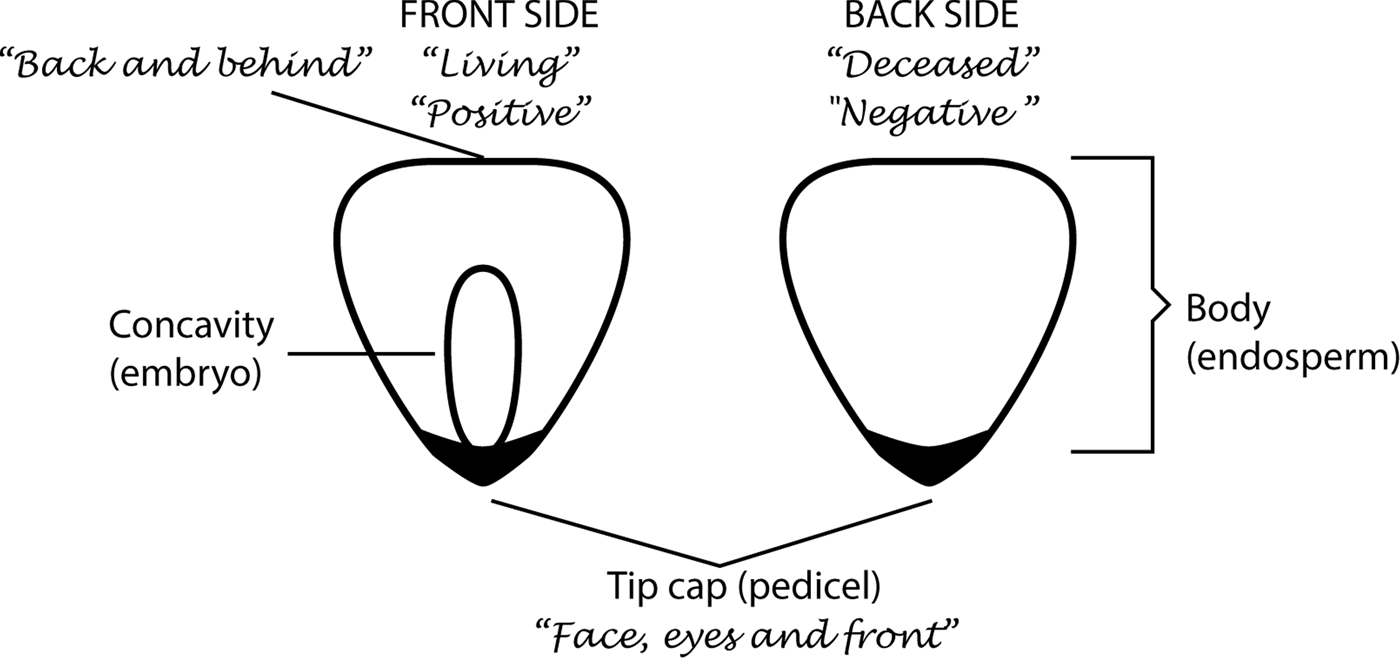
The anatomy of the maize seed is relevant for a correct reading. The tip cap or pedicel, the part that attaches to the cob, and the body or endosperm, should be identified (Figure 1). Every seed has a forepart, like a face with nose and eyes situated where the tip cap is, and a back part that corresponds to the squarish end of the endosperm. On one side of the body, the surface has a concavity, where the embryo is situated, and on the other side the seed is flat. This essential feature determines a living or a deceased person. Ancestors are fundamental figures in every divinatory session. It should be remembered that deceased relatives, if left unattended, may be the cause of diseases, bad dreams, troubles, and bad luck. When a seed falls with the concavity facing upward, it indicates a living person; if the flat surface is facing upward, it signals a deceased individual. Depending on the situation, the seed with a concavity may point to positive answers and good fortune and to the contrary when showing the flat surface. In the seventeenth century, Ruíz de Alarcón (Reference Ruíz de Alarcón, del Paso and Troncoso1953:31) and Serna (Reference Serna, del Paso and Troncoso1953:265) also mentioned that the seeds that fall with their face up signify good luck, that a medicine will appear, or that a lost item will be found, indicating otherwise when the seed falls upside down.
The maize seed and its parts. Drawing by the author.

Since reading the seeds implies the creation of a logical narrative in time and space units, it may be easier to recognize the seeds as agents, either alive or dead, such as parents, grandparents, uncles, sons, daughters, friends or compadres, and agencies that correspond to events or feelings such as love, abandonment, deception, treason, lies, gossip, problems, happiness, triumph, job, money, sickness, anguish, abortion, pregnancy, and so on.
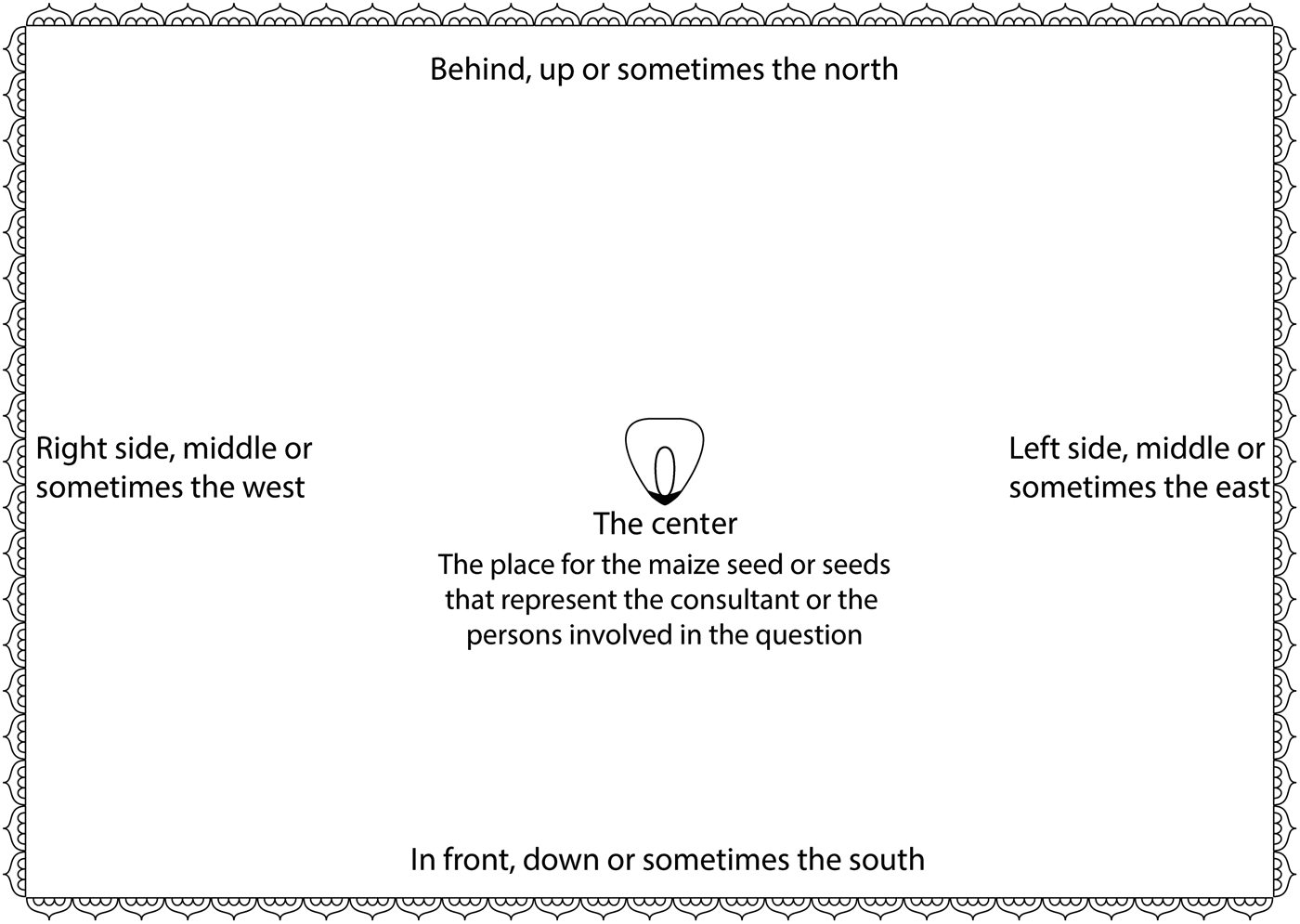
On top of a table or flat surface, the x ëë maywë places a tortilla napkin (sometimes finely embroidered) and casts the maize on it. The tortilla napkin offers a genuine spatial dimension, essential for bringing a logical narrative where time and space intersect (a chronotopic narrative, in terms of Bakhtin [Reference Bakhtin, Holquist and Emerson1981]). The napkin, therefore, represents the geographical space, which can be the house, a part of the town, the town itself, a region, a country, or even the entire world (Figure 2). This is the cloth or lienzo that represents the horizontal ground of the world (López Austin Reference López Austin1967:104). During the reading session, it is common to hear diviners referring to geographical features, for example “your job is out of town,” “a person gossips in the place where the sun sets,” “your road is free of obstacles,” “the north is free” (the way to the United States).
Spatial dimension and the place of the client at the beginning of a divinatory session. Drawing by the author.

There are two ways to cast the maize seeds. One consists of throwing the whole bunch of seeds smoothly with one hand, at once, on top of the napkin (like throwing dice). The second method starts by placing one seed in the center of the napkin. Often, this seed represents the client, so it must be laid in the “living” position, with the concavity upside and “looking” downwards, toward the diviner. It can also be the case, for instance in marriage prognostications, that the diviner will place two “living” seeds parallel to each other. In other situations, regarding an inquiry that deals with more persons, the necessary amount of seeds would be placed on the napkin with a clear identification of the persons involved. Afterwards, the seeds inside one hand will be thrown one by one to the maize in the center, holding them in a “living” form. Once they fall, because they bounce and hit other seeds, their position may stay or change to “alive” or “dead.” With this method, throw after throw, and little by little, the seeds provide images on top of the table, or make the “client” or “people” in the center change place and move in different directions, or change its status to “dead.” The arrangement of seeds when the last seed is thrown brings a final diagnosis. The cast of seeds is performed several times for every question, with one or both methods, until the reading is clear. Three throws is an adequate number for each session (for other forms of divining with maize among the Nahuas, see Sandstrom Reference Sandstrom1991; the K'iché, see Tedlock Reference Tedlock1982; the Ixil, see Colby and Colby Reference Colby and Colby1981; the Tlapanec, see Oettinger Reference Oettinger1979).
In Poxoyëm, when the seeds are thrown on the table, different maize may represent the client in different times and spaces. In other words, in a single cast the client may appear several times and face diverse persons, alive or deceased, circumstances, and feelings. At the end of each casting, the xëë maywë shows her gift, given in part by her intuition and her connection with the hidden sources of wisdom of this and the Other World, to correctly identify the “living kernel” that represents the client as well as the different agents and agencies that influence or affect him or her (see examples below).
There are multiple possibilities for configuration when throwing 18 seeds. It is beyond the scope of this article to make a more in-depth analysis of the reading, although for better comprehension it is sufficient to explain that certain grains are only significant when they comply with a known sign, a convention, which can be placed in logical time and space (chronotopes (Bakhtin Reference Bakhtin, Holquist and Emerson1981); see Rojas Reference Rojas2016). As such, they become resources for the symbols to be explained and expressed in a coherent narrative constructed between the diviner and the client in a dialogical manner. In other words, one sign can appear in different maize divinatory sessions but can only bring significance if it coincides with the given situation (the same happens with Tarot cards, for instance, with “The Lovers” card, which can signify union and a couple falling in love of but, in other instances, it might also be taken as a dilemma or a decision to be made between two options). In this way, ambiguity constitutes a fundamental principle of maize reading. As opposed to the description given by the Colby and Colby (Reference Colby and Colby1981:247) regarding maize divination among the Ixil, in which divination is described as a fixed instructive list similar to a computer program, here there are no definite formulas. A narrative is brought up as a combination of the experience, background and intuition of both the diviner and client, depending on the situation. Some brief examples are given below in order to illustrate the features of maize divination, including the ambiguous character of the images created by the configuration of the seeds.
Maize in Opposition
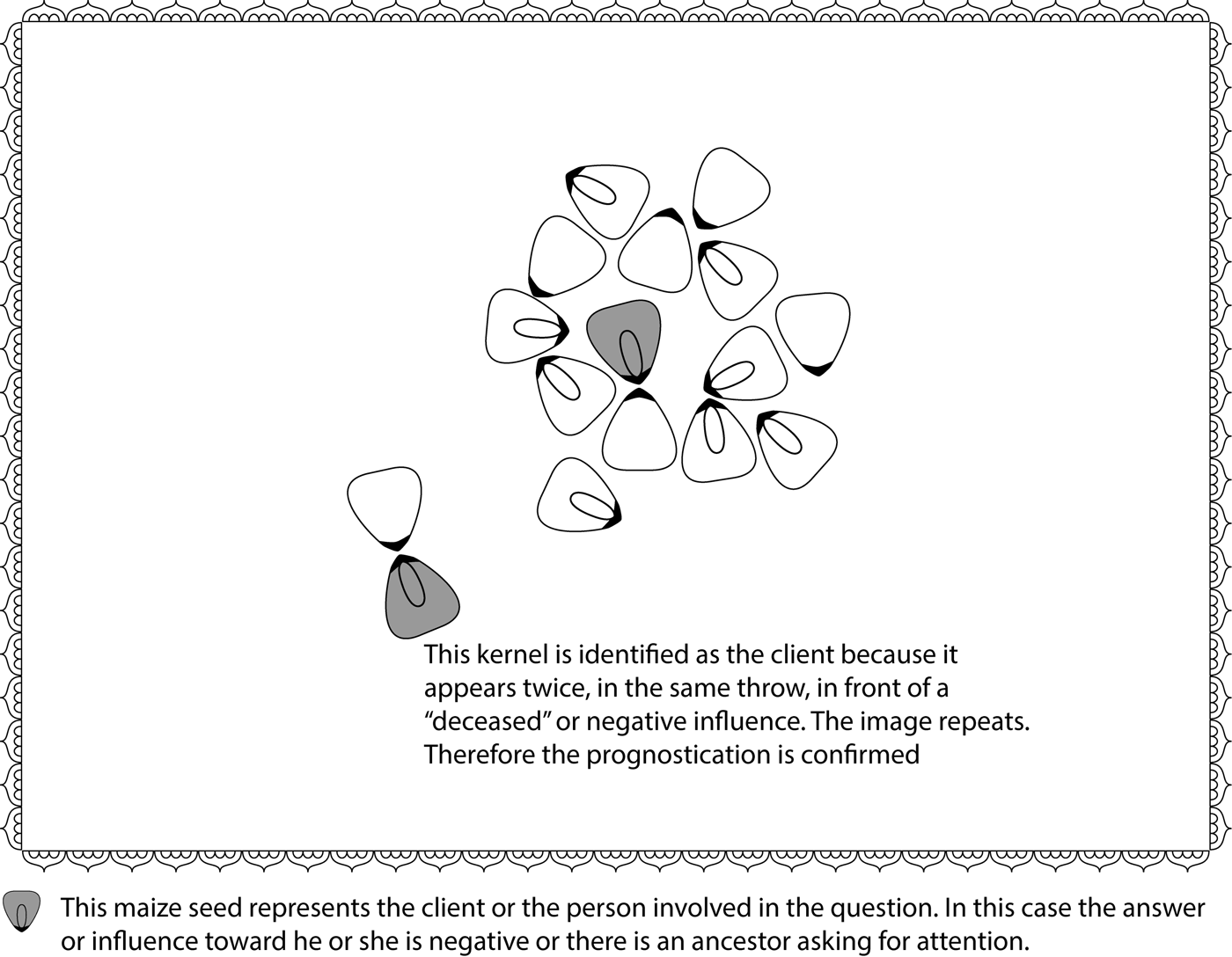
When the maize seed that represents the client lies directly in front of another seed, with both tips touching, the result is clear and straightforward. If it is against a “dead” seed the response is negative. It may mean the thing being looked for or the aim pursued will not be achieved, that there are obstacles on the road, that the question asked is not part of the client's destiny, that the illness is strong, perhaps provoked by someone else by susto (fright) or mal de ojo (the evil eye). Depending on the situation expressed, it may well be the case that a deceased relative is upset and feels abandoned, without offerings and nourishment. He or she may also have left an unfulfilled promise (a manda) to a saint or the hills and so is asking their son or daughter to fulfill it. If this is the case, the xëë maywë would ask if the client has dreamt of certain significant images, perhaps the dead relative, and in such a way the diagnosis would be confirmed (Figure 3).
Seeds in direct opposition. Drawing by the author.

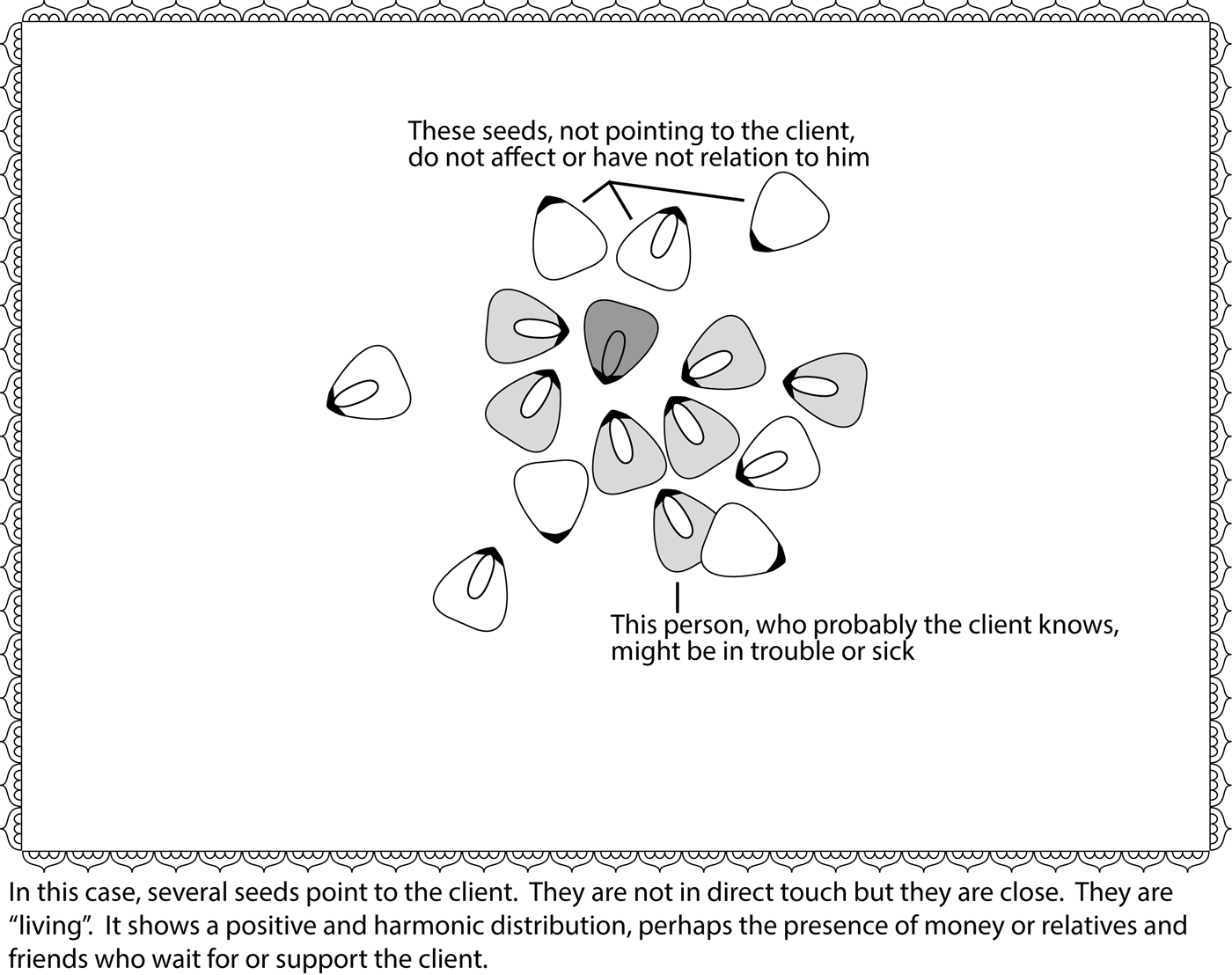
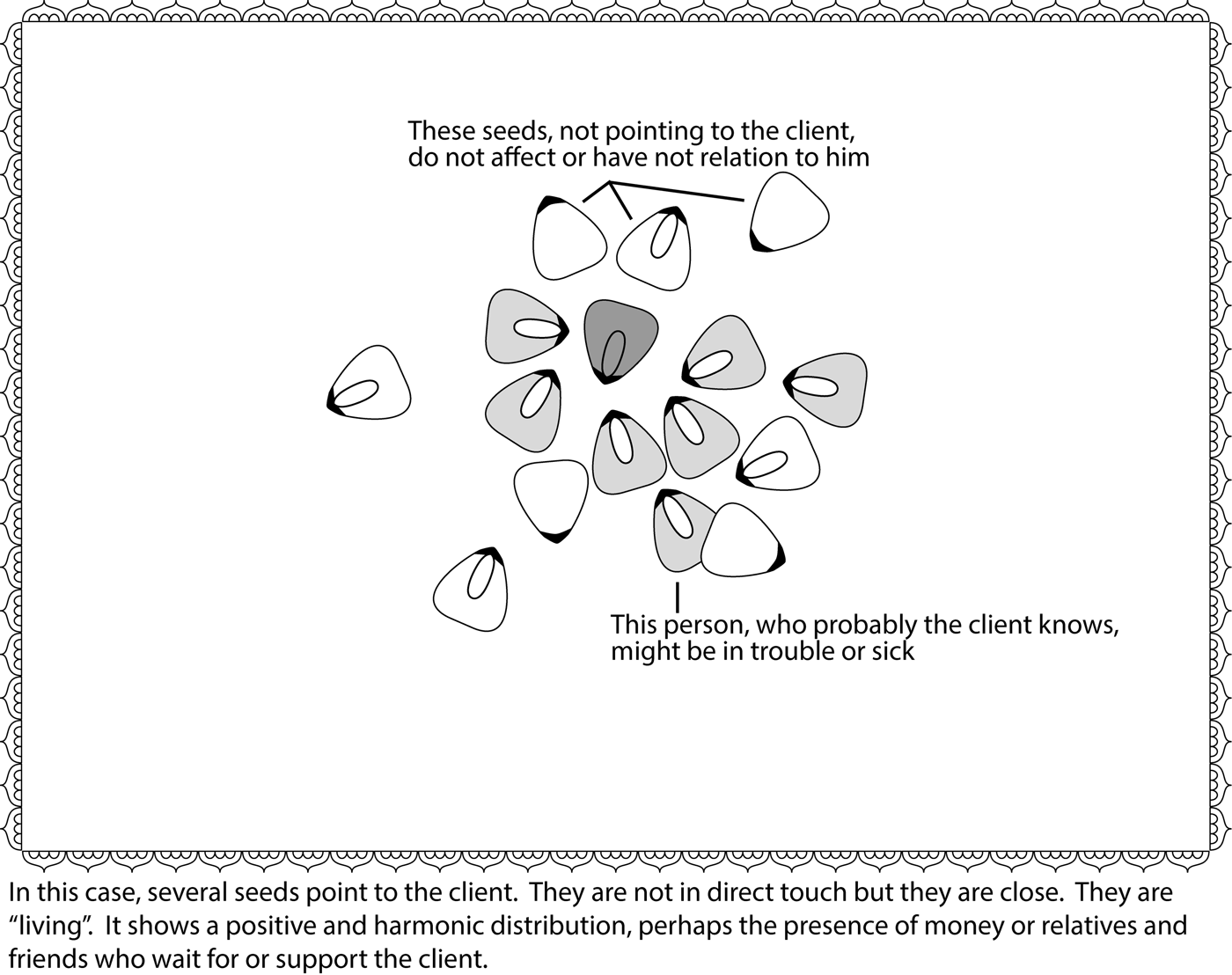
Conversely, if the seed identified as the client is surrounded by other seeds but is not directly touching any and has perhaps slightly moved in another direction, either forwards or behind, it could be a signal of some influence over him or her (Figure 4). These seeds do not badly affect the client, but definitely have value. For instance, if they are “living” agents and they are placed in front of the client-seed, they could be relatives or friends that give support in a positive way or await the arrival of the consultant. They can be interpreted as a good augury, such as the arrival of money or job opportunities. If they are “dead” they could be deceased relatives supporting and protecting the well-being of the client in the same way. If a maize seed falls on top of the “client” seed, it might be an indication that somebody within the family is suffering from an illness or some affliction.
Seeds pointing to others. Drawing by the author.
Free Road
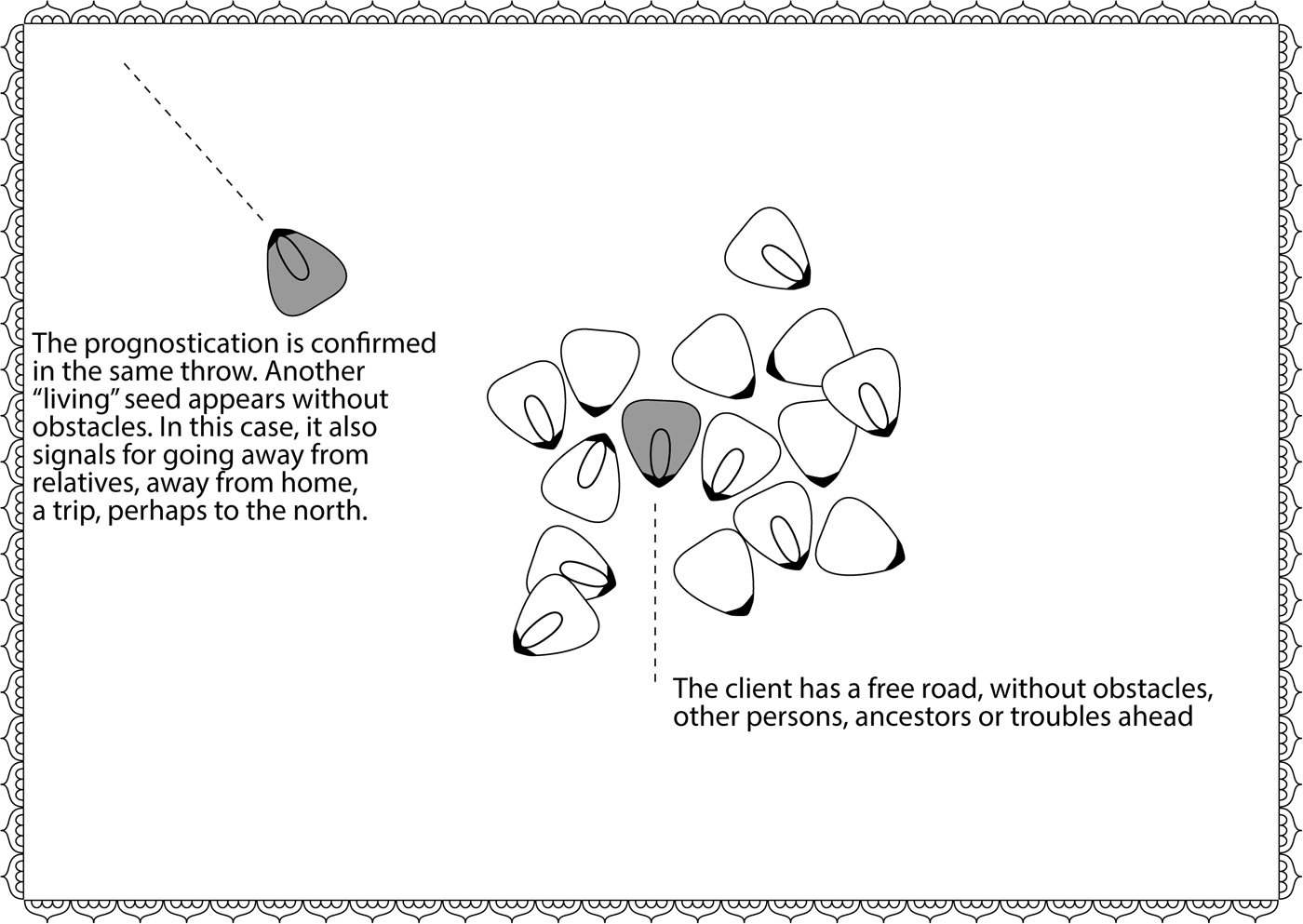
It could also be the case that there are no seeds in front of the client-seed, creating a free road in front of him or her. This indicates good fortune. It might be seen as a road free of obstacles or as the start of a trip or a purpose in life that will not be affected by problems, sickness, envy or third parties (Figure 5). In the same way, if one “dead” maize appears with a free road, maybe even turning to another direction, it might indicate that the ancestors are well, are in a good mood, feel nourished, left no promises unattended, and have no demands to make on the living.
Seeds on top of others. Drawing by the author.

Maize Kernels on Top of Each Other
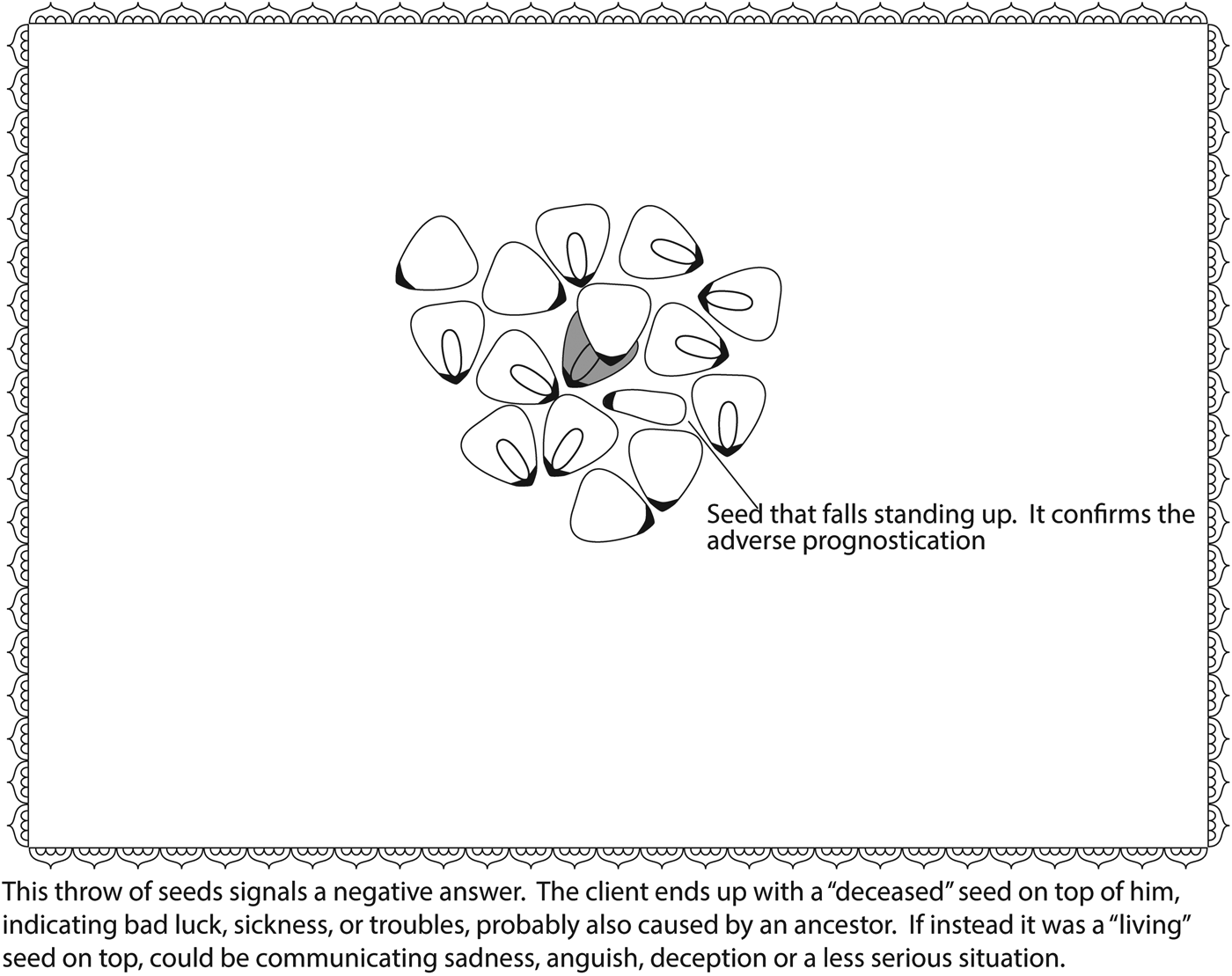
When a seed falls on top of the client-seed, this commonly expresses a negative response or prognostication (Cervantes de Salazar [Reference Cervantes de Salazar1971 (ca. Reference Cervantes de Salazar1560):vol. I, p. 136] asserted the opposite by stating that a maize kernel that lies over another is an indicator of the upcoming cure of an ill person). In Poxoyëm it may be a sign of sadness, offense, deceit, gossip, or anguish. The same conclusion might be reached if the client ends up upside down after casting all seeds toward him or her or if a seeds ends standing up on one of its sides (Motolinía Reference Motolinía and O'Gorman1971:153 and Torquemada Reference Torquemada1986:84 mentioned that if one of the seeds fell “standing up” then this indicated death) (Figure 6). If the seed that falls on top is in the “dead” position, this confirms an adverse outcome such as a serious illness, conflict with others, or evil or bad intentions toward the consultant. It could also be interpreted as problems sent by ancestors.
Seeds with a free road. Drawing by the author.

Maize as Couples
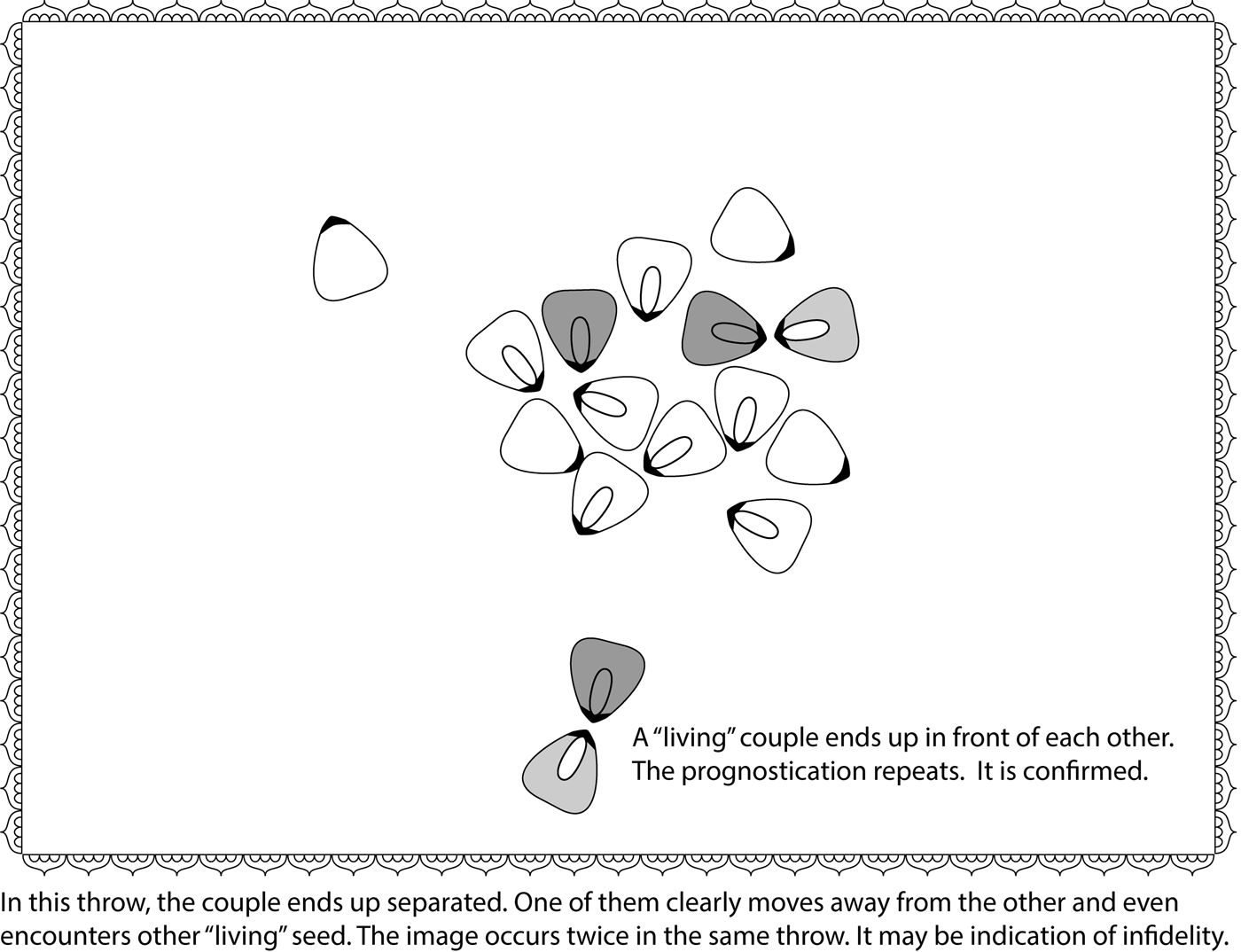
One possible outcome is that two seeds fall lying together, side-by-side, parallel to one another. These may represent the client couple or be an indication of a new relationship or marriage. If they lie with their fronts towards each other, this is a sign of conflict and discussion; if they have their backs to each other then this might signify a separation and the start of different paths. In some cases, in the same throw, the patient-seed lies in front of another maize seed, as though he or she had encountered another person. This case clearly indicates infidelity (Figure 7). This can also happen if, at the beginning, two maize seeds are placed in the center of the napkin when consulting the fortune of a couple that plans to get married. If in the end they still are together, without maize on top or in front of them, with a “free road” ahead of them, this indicates a good augury and fruitful union. If there are living maize kernels nearby in a good alignment, these might be supportive relatives or, even better, babies to come.
Seeds as a couple, ending in separation. Drawing by the author.

MAIZE DIVINATION AFTERMATH: THE PRESCRIPTION
Of high importance in maize divination is the role of ancestors, which is often revealed in the arrangement of the seeds. Similarly, in Momostenango the deceased are asked to help answer the questions of clients (Tedlock Reference Tedlock1982:160). Here again essential notions in the Mesoamerican worldview are emphasized. In the Ayöök vision, the deceased live in Adojk it, the Other World, from where they communicate and interact with the living. They are not at all inert or passive agents. The Western view, based on scientific reasoning, rejects such ideas and sometimes condemns them as “superstitious” or as false beliefs in ghosts and zombies. These judgments hinder a better understanding of the native world vision, specifically regarding the relations between the living and the dead. In fact, the type of interaction that takes place with ancestors is necessarily different to that between equal, living people. Communication with the dead is achieved through prayers, offerings, and candlelight. Ancestors manifest their needs or warnings of possible dangers through dreams, presages, and maize divination. Sometimes, if they feel abandoned (that is, the family has not given them prayers, offerings of food and beverages, or candles), they express their perturbation or annoyance clearly and explicitly by sending sicknesses or bad fortune (also described by Lipp Reference Lipp1991:159). In such cases, the xëë maywë and her maize kernels will determine how to identify any fault and make atonements.
When the reading is finished, it is possible to address It Naaxwin once again, offering words of respect and sips of mezcal to the ground. Then is the moment to prescribe a treatment in aid of the affliction or illness of the client. Every consultation finishes with the recommendation to give respect to It Naaxwin, God, the saints, and ancestors, with emphasis on any particular party depending on the outcome of the maize reading. Messages of danger or serious illness provoked by the tso'ok or ancestors imply the risk of death and, as such, demand urgently-prepared offerings and ritual performance in the appropriate sacred space. For instance, if the maize revealed that the ancestors require attention, prayers and food, it would be necessary to go to the Ujyokm hill or the cemetery to offer special sacred food to the deceased relatives. Even if the outcome of the maize reading was positive and there are no threats to the client, the diviner will still recommend performing rituals and offering respect to It Naaxwin in order to preserve the good augury. Well-being is assured when the obligation toward the divine and natural entities, as well as to the community, are fulfilled.
THE XËË MAYWË AND THE TONALOPOUHQUI
Ayöök contemporary data on maize divination can be used to gain a better understanding of this practice, its practitioners, and associated tools in precolonial Mesoamerica. Nowotny (Reference Nowotny, Everett and Sisson2005 [1961]) was a pioneer in this respect, being the first scholar to acknowledge the potential of the preserved traditions of Mesoamerican cultures to better study the codices that are now in European museum collections. He correctly addressed these manuscripts as the tonalamatl or “books of the days” of the Nahua people and he was the first to recognize that these were tools for the tonalpouhque or “those who count the days” in giving advice and “therapy” to the people who were sick or afraid of an evil augury or bad dream (Nowotny Reference Nowotny, Everett and Sisson2005 [1961]:200). He understood that the Nahua used the books to identify the signs of threat and the methods to counterattack danger, indicating the necessary offerings of paper, incense, and rubber, to a specific god or goddess on a specific day.
As is the case in the present day Ayöök community, in pre-Hispanic times the tonalpouhque and diviners were consulted to determine the origin of sicknesses, to find lost things, establish the compatibility of couples or the potential for a marriage, the fortune of newborn babies, or the augury of a long trip or new enterprise (Durán Reference Durán1967:vol. I, p. 228; Motolinía Reference Motolinía and O'Gorman1971:153; Ruíz de Alarcón Reference Ruíz de Alarcón, del Paso and Troncoso1953:118, 130; Serna Reference Serna, del Paso and Troncoso1953:258). In the past, another time to consult maize was at the moment of the death of a relative, in order to know to which god to make offerings (Balsalobre Reference Balsalobre and del Paso1953:353–354).
It should be first acknowledged that, like the x ëë maywë, the tonalpouhque were knowledgeable persons. The xëë maywë, besides having faultless math skills (to count 260 days and manage them in numerous permutations), know the symbolism associated with each one of these days, with their ambivalences in prognostications and prescriptions in connection with the system of beliefs and social norms which rule this and the Other World (see Rojas Reference Rojas2013). In other contemporary accounts, daykeepers and diviners are also described having high erudition, like in Jacaltenango, Guatemala where they are called the ahbe, literally “those who know” (La Farge and Byers Reference La Farge and Byers1931:153). Among the Nahua of the Huasteca of Veracruz, diviners, healers, and ritual specialists are called tlamátiquetl which literally means “person of knowledge” (Sandstrom Reference Sandstrom1991:233).
In colonial sources, despite the discriminatory and dark discourse towards native cultures, it is also possible at times to find descriptions of diviners as wise men and women. For instance, the diviners of central Mexico were described as people of great respect, figures of authority within their communities, and are even compared to prophets (Torquemada Reference Torquemada1986:196). Among the Zapotec of Sola de Vega, Oaxaca, the specialist of the 260 day count, ritual, and divination with maize was called “letrado y maestro” (“knowledgeable and a master”; Balsalobre Reference Balsalobre and del Paso1953:351–352). Indeed, as is the case today, they were advisers of moral and community life (Anders and Jansen Reference Anders and Jansen1993:73).
THE BOND BETWEEN THE CALENDAR AND MAIZE DIVINATION
Ayöök maize divination and the work of the xëë maywë recalls the strong connection to time of precolonial diviners and their books. The xëë maywë are indeed keepers and guardians of the days. In their name, besides having the “maywë” which describes their capacity “to divine,” “machowë” ascertains that they “count the days.” The Nahua tonalpouhque were the “counters of the days,” a term which is derived from the verb “pouhque” meaning “to count” and which is also related to “read” (Thouvenot Reference Thouvenot2014). Pre-Hispanic diviners and daykeepers were able to count and read signs that were probably not immediately comprehensible to normal people.
Similarly, the diviners (ajk ”ij) of Momostenango stressed the time component in their name because it literally means “timekeepers” (Tedlock Reference Tedlock1982). Among the Ixil, diviners and medicine men read maize by addressing the deities that “reign” on each of the days (Colby and Colby Reference Colby and Colby1981:223). This idea recalls the Codex Borgia (Yoalli Ehecatl) where each of the 20 days have images that signal a general augury of the day and where a god or goddess is painted next to them (Anders et al. Reference Anders, Jansen and García1993:ff. 9–14). Each deity appears seated on a throne, conventionally indicating that he or she “reigns” over that day (Figure 8). As noted by other scholars (Anders et al. Reference Anders, Jansen and García1993:91; Rojas Reference Rojas2012:56), these images coincide with views among the lowland Mixes where the 20 calendar signs are conceived as “seats” used by deities for reaching council (Lipp Reference Lipp1991:62).
Influence and patron deity (Xochiquetzal) ruling over the day Flower (notice the goddess is seated on a throne) in Codex Borgia. Drawing by the author after Anders et al. Reference Anders, Jansen and García1993:f. 9.

The strong link between the calendar and divination as seen in the Ayöök contemporary case coincides with sacred narratives in historical sources and visual culture in Mesoamerican archaeology. According to some creation narratives, the calendar and divination were created together. For the Nahua people of the Basin of Mexico, the divine couple, Cipactonal and Oxomoco, were considered the father of time and days and the mother of divination and healing, respectively (Sahagún Reference Sahagún1577:246v; conversely and most probably mistakenly, Garibay Reference Garibay and Garibay1979a:25 and Mendieta Reference Mendieta1973:60 address Cipactonal as a goddess and Oxomoco as a god). They were born together with the help of Quetzalcoatl and Huitzilopochtli into a world with half a sun and not much light (Garibay Reference Garibay and Garibay1979a:25). Weaving implements were given to Oxomoco and Cipactonal was given sowing tools. From this divine couple, the common people or the macehuales were born, who had to work as their parents did. Maize kernels for curing and soothsaying were then bestowed upon Oxomoco, while the days and months were created and allotted, and in this way, the calendar was created. Both the father and mother of time and divination were evoked during the prayers of diviners and healers among the Aztecs (López Austin Reference López Austin1967:101).
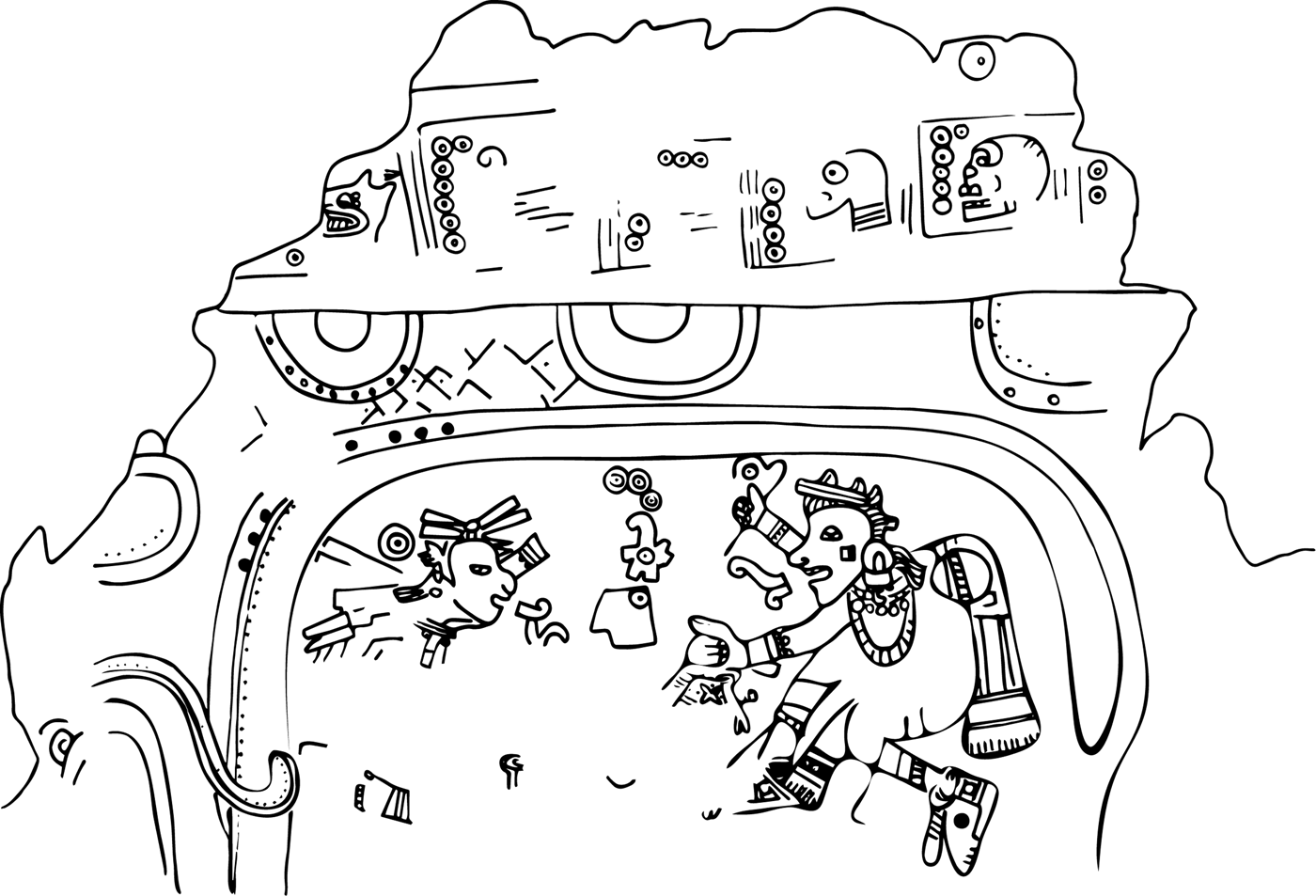
This origin narrative seems also to be portrayed on the Piedra de los Reyes, in Coatlan, Morelos (Figure 9). Here Cipactonal appears with a headdress of an alligator, in representation of the first day of the Aztec calendar, and as master painter of the tonalaque (days), and Oxomoco, with a garment of Itzpapalotl, the goddess of “knives and butterflies,” who seems to be related to Oxomoco (in folio 18v of Codex Telleriano Remensis, Izpapalotl is referred as a sinful manifestation of Oxomoco, “a kind of Eve who was expelled from Tamoanchan” [Quiñones Keber Reference Quiñones Keber1995:182]). This rock engraving is located not far from the province of Cuauhnahuac (Cuernavaca, Morelos) where, according to other sacred narratives, the first man came out of a cave (Garibay Reference Garibay and Garibay1979b:106). Correspondingly, Mendieta (Reference Mendieta1973:60) refers to the story of the invention of the calendar by the peoples of the Basin of Mexico and Tlaxcala in which Cipactonal and Oxomoco were inside a cave in Cuernavaca and asked their grandson Quetzalcoatl for help in naming, counting, and painting the first 13 signs of the calendar. Although Mendieta expresses it differently, it may be possible that Cipactonal provided the first day “1 Cipactli (Alligator),” Quetzalcoatl presented the second day “2 Ehecatl (Wind),” and Oxomoco named the third day “3 Calli (House)” (Anders and Jansen Reference Anders and Jansen1993:77). This would imply that Oxomoco is a deity that is close to house and family healing and ritual activities.
The Piedra de los Reyes, Coatlan, Morelos. Drawing by the author after Guilliem Arroyo Reference Guilliem Arroyo1998:50.

Another image that immediately reflects the strong connection between the calendar and divination is seen in the Codex Borbonicus (Codex of the Cihuacoatl) where Oxomoco and Cipactonal appear in the middle of the page, surrounded by the first half (26 years) of the xiuhmolpilli, the 52 Year Round, from 1 Rabbit to 13 Reed (Anders et al. Reference Anders, Jansen and García1991:f. 21). As has been noted by various scholars (Anders et al. Reference Anders, Jansen and García1991:182; Durand-Forest Reference Durand-Forest1968:10; Quiñones Keber Reference Quiñones Keber1995:254) this image coincides with Sahagún's writings, in which he mentioned that the Nahua tonalpouhque painted the creator couple of the calendar and divination, Oxomoco and Cipactonal, on their books, the tonalamatl (Sahagún Reference Sahagún1577:246v) (Figure 10). Both are seated on thrones inside a golden temple, from which a precious spring emerges, with deer shaped batons placed on the entrance. They are depicted as old and wise, as shown by Cipactonal’s teeth and Oxomoco’s wrinkles. Cipactonal’s name is signalled by a Cipactli glyph behind him. He carries ritual instruments: a smoking censer, a bone awl for the auto-sacrifice of blood, and an incense or copal pouch. She throws what are probably seeds and holds a bowl, perhaps with water: these are divinatory instruments. They both carry a round object on their backs similar to the gourds that contain piciete (tobacco) in Mixtec Codices (Jansen Reference Jansen and Bricker1992:21). Therefore, they are masters of time, ritual, and divination.
Oxomoco and Cipactonal in Codex Borbonicus. Drawing by the author after Anders et al. Reference Anders, Jansen and García1991:f. 21.

Another example of the intrinsic relation between the calendar and divination comes from the archaeology of the Templo Calendárico of Tlatelolco (Figure 11). Its façade of rock panels and the mural on the round structure on its frontal stairway shows a sequence of the first 52 days as well as a portrayal of Cipactonal and Oxomoco inside what seems to be a cave (Guilliem Arroyo Reference Guilliem Arroyo1998). As in the Codex Borbonicus, the man holds a bone awl, a copal pouch, and a tobacco gourd, and the woman, as in the Coatlan cave, has an itzpapalotl (obsidian butterfly) motif in front of her.
Mural in Tlatelolco. Drawing by the author after Guilliem Arroyo Reference Guilliem Arroyo1998:51.

Similarly, the images of central Mexico have parallels with the Popol Vuh, the of sacred origin narratives the K’iche’ Maya. Here it was written that at the beginning of time, still in darkness, when the primordial gods created the world and the first humans, they searched for someone to worship them with offerings and respect. The Framer and the Shaper asked Xpiyacoc and Xmucane, the Seers, to divine by casting maize seeds, to facilitate a new shaping: human beings (Christensen Reference Christensen2003:79–81). Interestingly, Xmucane has similar phonetics to Oxomoco, whose name has been suggested as meaning “Force of the Pregnant” (Anders et al. Reference Anders, Jansen and García1991:183). This etymology is based on the texts of historian Mariano Veytia (Reference Veytia1836:9) who wrote her name as “Otzmozco,” suggesting it derives from otztli meaning “pregnant,” which coincides with the goddess who is also considered the matron of midwives.
READING MAIZE AND READING CODICES AS INSTRUMENTS OF SEEING
In accordance with these references to the primordial “seers”, contemporary Mesoamerican diviners and precolonial tonalpouhque possess enhanced capacities to see (Monaghan and Hamann Reference Monaghan and Hamann1998). Among the Ayöök, this means they see and better understand the conflictive causes and circumstances surrounding the affliction of the patient or client (Rojas Reference Rojas2016). They actually help the patient to see with their own eyes the present conditions affecting him or her, which are represented on the maize kernels on top of a table. They read and interpret hidden messages revealed through maize, which behaves as a well-intentioned emissary of It Naaxwin and the Other World, the long-distance seers of the events and problems that happen on Earth. Reading and seeing were certainly also virtues of the tonalpouhque among the precolonial Nahua.
Contemporary Nahua diviners and healers of the Huasteca also placed an emphasis on this special skill of seeing. Besides tlam átiquetl, they are also called tlachixquetl, which means “one who waits, sees, expects something” (Sandstrom Reference Sandstrom1991:233; similarly the tlachixqui of the Aztecs was “the one who looks at things” López Austin Reference López Austin1967:101). In fact, with the aid of lighted candles, they gaze closely into their trained and highly valued crystals in order to diagnose causes of problems and ailments (Sandstrom Reference Sandstrom1991:235). Extremely fascinating is the fact that these crystals are called mirrors (tescatl) which highlights its capability to enlighten in order to see unclear situations, serving as portals from the Other World. The crystal is not only an instrument of seeing, but also a “seer.” Likewise, among the K'iche’ in Guatemala, divination starts by placing the largest crystal of a bunch of small stones and seeds at the center of the table, called ilol, literally the “seer” (Tedlock Reference Tedlock1982:159).
The tonalamatl or “books of the days” of precolonial times, the same as the maize kernels or the crystals used by Mesoamerican diviners, are instruments of counting, reading, and seeing (Monaghan and Hamann Reference Monaghan and Hamann1998). They were used to observe situations that were believed to be obscure, such as the cause of illnesses (Boone Reference Boone2007:20). As it was described before, Ayöök divinatory sessions with maize are truly read on top of a napkin and on top of a table, similar to the way that a book is read and likewise the tonalpouhque did with their books of the days (for a full analysis and comparison of reading maize and codices, see Rojas Reference Rojas2016). María Sabina, the renowned wise women who lived in the Mazatec town of Huatla and healed using psilocybe mushrooms, remarkably reckoned that she had received her wisdom in visions when she read the “immense” Sacred Book of Language and whose learnings remained thereafter only in her memory (Estrada Reference Estrada1977:57). Similarly, nowadays the xëë maywë keep impeccable record of the days and their symbolisms using their memory alone because they do not have an almanac or book to serve as a codex as in ancient times or like in other Mixe communities where the calendar persists (for example in Camotlán, see Miller Reference Miller1952).
The tonalamatl were essential tools for the precolonial daykeepers and healers on whom they rely to count and keep track of the days and their different permutations, prognostications and ritual prescriptions. Most probably they were made by the tonalpouhque themselves, as Sahagún (Reference Sahagún2006:538) wrote. Codex Borgia (Yoalli Ehecatl) is a good example of how to understand that different chapters meant understanding different ways to arrange the 260 days, useful as different mnemonic devices to apply their knowledge, and expertise in the best manner in different occasions. For instance, the pages of this codex allowed them interpret images of dreams (Anders et al. Reference Anders, Jansen and García1993:ff. 9–14) recommend ritual and offerings to certain deities (Anders et al. Reference Anders, Jansen and García1993:ff. 1–8), prognosticate marriage unions (Anders et al. Reference Anders, Jansen and García1993:ff. 57–60), or suggest the character of the newly born (Anders et al. Reference Anders, Jansen and García1993:ff. 15–17).
If codices and maize were instruments to improve seeing and reading, it would not have been strange that they were used together. Eloise Quiñones Keber (Reference Quiñones Keber and Keber2002), in her analysis of the divinatory ritual representations in the Florentine Codex, concluded that Sahagún's missionary description removed the complexity of the practices related to the calendar and divination, including the lively and intercommunicative reading of the book of the days, the tonalamatl. This suggests that during the reading of codices, besides the interaction between the tonalpouhque and the client, other ritual performances occurred.
In fact, colonial sources also give clues that the Teamoxtli books were used as boards upon which maize seeds were thrown. Among the K’iché, in the town of San Andrés, near Santiago Atitlán, Guatemala, when describing the rituals and oracle consults to a stone monument in the shape of a girl called Cinquimil (“Female Goddess”), it was said:
[…] the elders of the town gathered and took out some old paintings that they had, where they counted the months and years, and threw lots. And on the painting where the lots fell, they learned and understood the time when the war, hunger or pestilence ought to happen, which the demon [Cinquimil] had meant […]. (Villacastín Reference Villacastín and Acuña1982:128, translation by author).
Durán also wrote, when describing the job of diviners when children were born:
[…] the astrologer and soothsayer wizard, took out the book of fortunes and the calendar […] next to these gods the letters of the days of their calendar were painted; over this paper they drew the lots and, depending on how they fell, they prognosticated. And if the fortune fell on top of the god of life, they said it was a long life; if it fell over the death, they said he or she would live little, and so on like this with the rest […] (Durán Reference Durán1967:vol. I, p. 228, translation by author).
Durán might have referred to pages similar to the Codex Borgia (Yoalli Ehecatl) on which Mictlantecuhtli and Quetzalcoatl appear together back-to-back, surrounded by all 260 days arranged by depicting the first day of each 20 trecenas (group of 13 days) on top of a “skeletal earth” (Figure 12; Anders et al. Reference Anders, Jansen and García1993:f. 56). Mictlantecuhtli is the “Lord of Death,” who rules over the world of ancestors, and Quetzalcoatl is the “Life-Giving god,” who helped in creating the world and the first humans by stealing bones from the Other World (Garibay Reference Garibay and Garibay1979b). However, as in all mantic systems, both gods have an ambivalent side since Mictlantecuhtli can also return health to those who are deadly sick and Quetzalcoatl can destroy everything with his lethal wind (Anders et al. Reference Anders, Jansen and García1993:302).
Mictlantecuhtli and Quetzalcoatl painted on a codex page in Codex Borgia, possibly used as a board to cast maize seeds. Drawing by the author after Anders et al. Reference Anders, Jansen and García1993:56.

In fact, many other images of Codex Borgia might also have worked as a surface for casting maize. Two layers of reading could have been achieved by reading the images provided by the kernels and making associations with the paintings and their symbols underneath. In the case of marriage, the same book features pages with couples with diverse predictive symbols (Anders et al. Reference Anders, Jansen and García1993:ff. 57–60), which might also have worked as a surface for casting maize.
DIVINATION AS MEDICINE
Medicine should also be acknowledged as an essential competence of Mesoamerican diviners. As in the present study, several studies on contemporary indigenous peoples give account of the use of divinatory practices to cure ailments. To find the remedy of illnesses, Tlapanec healers of Guerrero measure the arms and read maize kernels (shawha itsu “measure the bone” and shawha ishi “cast the seeds”), interpret the placenta, the smoke of copal, and the stars, and perform rituals with counted offerings (Oettinger Reference Oettinger1979). Among the Zinancantec of Chiapas diviners are able to re-establish the harmony in the body and recover the lost soul by casting 52 maize seeds on salty water (Vogt Reference Vogt1993). Ayöök people are no exception to healing practices in which maize divination plays a central role (Ballesteros and Rodríguez Reference Ballesteros R. and Rodríguez E1974; Beals Reference Beals1945; Kuroda Reference Kuroda1984; Lipp Reference Lipp1991; Rojas Reference Rojas2012).
In colonial accounts, many of the indistinct (and negative) allusions to “wizard,” “trickster,” “soothsayer,” “astrologer,” or “witch” in fact correspond to the offices of the native priests, specialists in the calendar, divination, and medicine (Durán Reference Durán1967:vol. I, p. 228; Motolinía Reference Motolinía and O'Gorman1971:59; Ruíz de Alarcón Reference Ruíz de Alarcón, del Paso and Troncoso1953:24; Sahagún Reference Sahagún2006:94, 538; Torquemada Reference Torquemada1986:304). The Maya priest, or chilan, was an expert in ritual, feasts, divination, and medicine (Landa Reference Landa1978:49). The Zapotec colanij was described as a “master of the science of healing” by divining and interpreting the meaning of presages and dreams and counting the days and festivities (Córdova Reference Córdova1886:203). The tlaciuhque among the Nahuas were the specialists in the art of “looking for things,” the use of hallucinogenic plants, and curing (López Austin Reference López Austin1967). The tlaolxiniani was literally the “maize caster” and was also considered a healer (Ruíz de Alarcón Reference Ruíz de Alarcón, del Paso and Troncoso1953:30). The tetonaltiani, payni, tlachixqui, tlamaceucatzin, and ticitl were different medical practitioners who also divined the origin of illnesses and the location of lost things by consuming and worshipping “spirited plants” such as the ololiuhqui, peyote, and tobacco (Ruíz de Alarcón Reference Ruíz de Alarcón, del Paso and Troncoso1953: 43,133; Serna Reference Serna, del Paso and Troncoso1953:69, 101, 148, 241, 258–260). Eighteenth-century documents that witnessed the use of the sacred calendar among Zapotec and Mixe peoples (used in trials as proof of the persistence of “idolatry”) describe the daykeeper and diviner as a medicine healer, priest, ceremonial executor, and nahualli (Alcina Franch Reference Alcina Franch1993).
The Codex Tudela (see folio 49r; Ministerio de Educación, Cultura y Deporte [ca. Reference Ministerio de Educación1530–1554]) and one of its copies, the Codex Magliabechiano (Anders and Jansen Reference Anders and Jansen1996:f. 78), portrays a divinatory session in which a female diviner casts maize and bean seeds with a shell in front of a Quetzalcoatl effigy in order to consult on behalf of a sick person who appears in tears (Figures 13–14). Both glosses describe how the grains are thrown. Particularly in the case of the Codex Magliabechiano, regardless of the condemning tone, the writer explicitly calls this divinatory practice “medicine” and the diviner “doctor,” along with giving clear prognostications according to the position of the kernels.
Si algun yndio e(n)fermava yvan los parientes ante esta vieja sortilega q(ue) les dixese de q(ue) procedia el mal la qual echava unos granos de mahiz y frisoles sobre un petate arronjandolos con una tablilla como la q(ue) tiene en la mano y estando antel demonio y dezia lo q(ue) se le antojava y llamava al demonio q(ue) se lo declarase y si caya un grano de mahiz uno sobre ot[ro] dezia q(ue) de sometico era su mal tanbien […] (Codex Tudela, f. 49r, reproduced by Batalla Reference Batalla2009:102).
Esta es una manera de medicina diabolica q los indios medicos tenian y es q quando alguno estava enfermo, llaman al medico muger o hombre y luego el tal medico para ver q fin avia de aber la enfermedad. Ponian luego delante desi un idolo y de lante el efermo al qual ydolo le llamavan que çalcoatl, q quiere dezir plumaje qulebra. Y el en medio puesto encima de un petate, puesta una manta de algodón blanca encima, tomava en la mano veinte granos de maíz que es delo que ellos hazen pan y echavalos encima de la manta como quien echa unos dados y si los tales granos hazian en medio vacio o mana decanpo, demanera que los granos estuviesen alrededor, era señal que le avian de enterrar alli, que queria dezir que moriria de aquella enfermedad. Y si un grano caya sobre otro, dezia que su enfermedad le avia venido por sometico. Y si los granos de maíz se apartava la mitad a una parte y la mitad a otra de manera que se pudiese hazer una raya derecha en medio, sin tocar a ninguno grano, es señal que la enfermedad sea de apartar del enfermo y sanar. (Codex Magliabechiano; Anders and Jansen Reference Anders and Jansen1996:f. 78, emphasis by author).
Divination with maize and beans used for medical purposes. Drawing by the author after Codex Tudela: f.49r.

Divination with maize and beans, copy from Codex Tudela in the Codex Magliabe chiano. Drawing by the author after Anders and Jansen Reference Anders and Jansen1996:f. 78.

FINAL REMARKS
As has been previously suggested by Nowotny (Reference Nowotny, Everett and Sisson2005 [1961]) and Jansen (Reference Jansen1982), a valuable corpus of information with the enormous potential of bringing about an understanding of the archaeological past lies in contemporary indigenous languages, knowledge, worldviews, daily lives, and spiritual experiences. These ancient and modern forms of living have proved to be effective and resilient over thousands of years. It is fascinating that the Mesoamerican sacred calendar of 260 days along with maize divination have survived until today. By looking at this corpus of knowledge, it is possible to achieve better comprehension of the use of these sacred and mantic systems, the people that used them, and especially the pictorial manuscripts of the Borgia or Teoamoxtli Group.
The description of mook pajk w ëjwë (maize divination) and the work of the xëë maywë showed that the knowledge of the calendar, along with its symbolisms of prognostications and prescriptions, complements casting maize seeds as a means to achieve further information in the correct diagnosis of afflictions, sickness, bad omens, bad dreams, and bad luck. The xëë maywë is able to read hidden messages transmitted from It Naaxwin and the Other World through the arrangement of maize on a spatial dimension, in this case a napkin on top of a table. The maize fall in patterns that create images, and these can be read with the help of the diviner and the client. These patterns reveal the joo'nkjyën ixët, or the things on the course of life. Consulting the calendar and the maize means to be able to see things more clearly.
The xëë maywe as the tonalpouhque were both wise women and men. They managed and calculated complicated arrangements of numbers, ambivalent prognostications and ritual recommendations, and understand the whole complex of beliefs and social customs that govern their community, Earth, and the Other World. They understand their moral and spiritual obligations and mediate by teaching others how to behave according to this world vision.
Consulting the calendar implies consulting the maize. Just as in oral narratives from central Mexico and evidence in the archaeological record, the calendar and divination were born together and therefore go together. Each has individual rules, however, they work together like one instrument of knowing and seeing: they constitute one oracle. They both aim at well-intentioned targets: to cure illnesses and alleviate afflictions. Complying with the ritual obligations, that is offering respect to It Naaxwin, deities and ancestors, will be the most important road to healing. Just as it exists today, it should be stressed that, in the past, the aim was also related to medicine. X ëë maywë and tonolpouhque are medicine women and men.
The survival of the 260-day calendar and divination in Mesoamerican communities provides the potential to understand beliefs and practices, and archaeological evidence. However, its permanence seems critical in indigenous communities. The calendar has been less likely to survive, while maize divination practices are still found among contemporary Mesoamerican communities. Due to a close association with the calendar, reading maize should be considered a remnant of the knowledge system of the calendar, not as an isolated practice, but actually as evidence of societies where the calendar once existed.
RESUMEN
Una reciente investigación sobre el uso en la actualidad de un calendario de 260 días en una pequeña comunidad de la zona ayöök (mixe) de Oaxaca demostró que éste va de la mano con la práctica adivinatoria de lanzar maíces. En otras palabras, consultar los pronósticos y prescripciones del calendario de 260 días incluye también realizar una lectura de maíz. El presente artículo ofrece una detallada descripción de esta última técnica mántica como un medio para el estudio y mejor entendimiento de prácticas adivinatorias en tiempos precoloniales, así como del oficio de las personas que las manejaban, como los tonalopouhque entre los nahuas, y los instrumentos que usaban, como los tonalamatl, mejor conocidos como los códices del Grupo Borgia. Estas líneas son resultado de una perspectiva etno-iconológica la cual sostiene que en el estudio de las culturas mesoamericanas contemporáneas existe la posibilidad de acercarse al entendimiento de prácticas del pasado y el uso de objetos arqueológicos debido a la fuerte continuidad cultural y arraigo a las tradiciones y cosmovisión que presentan a lo largo del tiempo. De esta manera, a la luz de los datos obtenidos en la documentación de la lectura del maíz entre los ayöök, se ofrecerá una nueva visión a crónicas coloniales, narrativas antiguas sobre el origen de mundo y ejemplos arqueológicos de cultura visual que tienen que ver con adivinación en Mesoamérica. Al final se propone que, de manera similar a lo que sucede en tiempos actuales en la comunidad ayöök, posiblemente en la época precolonial el calendario y la adivinación con maíces se consultaba en la misma sesión. En fuentes históricas existe indicio que los maíces se lanzaban incluso encima de láminas pintadas con el calendario y otras imágenes relacionadas, es decir, sobre códices. Al igual que los “guardianes de los días” y adivinos ayöök del presente, aquellos en tiempos precoloniales también eran considerados mujeres y hombres sabios, expertos en el complicado manejo de los simbolismos de pronósticos y prescripciones de 260 días. Asimismo, se les reconocía como médicos, especialistas en medicina cuyo fin era bien intencionado para brindar alivio a aflicciones y enfermedades. Se espera que estas líneas sean una contribución al estudio de la adivinación del pasado mesoamericano, con una estimación más cercana a la gente y la cultura originarias, alejada de la visión distorsionada y obscura con la que suele describir estas prácticas y creencias debido a la herencia de las fuentes coloniales.
ACKNOWLEDGMENTS
This article was made possible by the financial support from the Nederlandse Organisatie voor Wetenschappelijk Onderzoek and the European Research Council. I thank the reviewers for their constructive and valuable comments, which helped me improve this manuscript enormously. Thanks to Emily Allinson and Laura Osorio for the English revision of this text. My profound gratitude to the town of Poxoyëm, specially to the old ladies xëë maywë, who shared with me their invaluable knowledge, which I attempt to honor here.