Providing client-centred integrated care is considered a hallmark in health care service delivery (Kodner & Kyriacou, Reference Kodner and Kyriacou2000). And yet, as Hébert, Durand, Dubuc, Tourigny, and Group (Reference Hébert, Durand, Dubuc, Tourigny and Group2003) noted, myriad problems abound with providing integrated service, including the inappropriate use of resources, lack of standardized tools, protracted wait times, and inadequate communication of information. In response, health care service providers are being asked to pool resources, abandon their traditional professional silos and work collaboratively within teams (Poochikian-Sarkissian et al., Reference Poochikian-Sarkissian, Hunter, Tully, Lazar, Sabo and Cursio2008).
Teamwork has a longstanding tradition with an extensive body of literature in its support (Buljac-Samardzic, Dekker-van Doorn, van Wijngaarden, & van Wijk, 2010; Cohen & Bailey, Reference Cohen and Bailey1997; Lemieux-Charles & McGuire, Reference Lemieux-Charles and McGuire2006), achieving particular ascendancy in health care systems across the globe (Opie, Reference Opie1997a, Reference Opie1997b). Although fashionable in policy and practice, expertise in the purposeful structuring of teams for successful integration has proved elusive (Challis, Abendstern, Clarkson, Hughes, & Sutcliffe, Reference Challis, Abendstern, Clarkson, Hughes and Sutcliffe2010; Irvine, Kerridge, McPhee, & Freeman, Reference Irvine, Kerridge, McPhee and Freeman2002). An assumption lingers that interprofessional teams will operate effectively simply by virtue of having multiple health professionals present (Goldsmith, Wittenberg-Lyles, Rodriguez, & Sanchez-Reilly, Reference Goldsmith, Wittenberg-Lyles, Rodriguez and Sanchez-Reilly2010); minimal thought seems to be given to the systems and mechanisms that must be in place for them to function optimally. Consequently, health care teams have been shown to be rife with conflict (Atwell & Caldwell, Reference Atwell and Caldwell2006; Mitchell, Parker, & Giles, Reference Mitchell, Parker and Giles2011), low morale, and poor performance (Farrell, Madeline, Schmitt, & Heinemann, Reference Farrell, Madeline, Schmitt and Heinemann2001), beset by issues of power and control, a lack of understanding of professional team roles, and failed expectations surrounding equity and fairness (Goldsmith et al., Reference Goldsmith, Wittenberg-Lyles, Rodriguez and Sanchez-Reilly2010).
Notwithstanding those concerns, evidence is mounting that interprofessional collaboration (IPC) has the potential to produce positive outcomes in client care. Outcomes include lowered hospitalization rates (Mitchell et al., Reference Mitchell, Parker and Giles2011), shortened stays in intensive care units (Temkin-Greener, Gross, Kunitz, & Mukamel, Reference Temkin-Greener, Gross, Kunitz and Mukamel2004), reduced office visits to physicians (Mukamel et al., Reference Mukamel, Temkin-Greener, Delavan, Peterson, Gross and Kunitz2006), improvements in perceived health status of patients (Reed, Cook, Childs, & McCormack, Reference Reed, Cook, Childs and McCormack2005), and decreased service gaps (Desai, Smith, & Boal, Reference Desai, Smith and Boal2008), in addition to reduced service delivery duplication and fragmentation (Mitchell et al., Reference Mitchell, Parker and Giles2011). Data from Kaiser Pemanente Georgia report that high-functioning care teams, defined as practice characterized by a high degree of collaboration and teamwork, performed from 40 to 90 per cent better than low-functioning teams in caring for chronic diseases (as cited in Schuetz, Mann, & Everett, Reference Schuetz, Mann and Everett2010). Teams that work well together are more effective and innovative, even as they experience increased satisfaction (Kilpatrick, Lavoie-Tremblay, Ritchie, Lamothe, & Doran, Reference Kilpatrick, Lavoie-Tremblay, Ritchie, Lamothe and Doran2011) and lower levels of stress (D’Amour, Ferrada-Videla, Rodriguez, & Beaulieu, 2005). Collaborative practice is even more vital when patient needs are complex, requiring a range of services, as is often the case for the chronically ill frail elderly population (Mukamel et al., Reference Mukamel, Temkin-Greener, Delavan, Peterson, Gross and Kunitz2006).
Before delving into a review of current team scholarship, a caveat is in order. Earlier attempts to provide an overarching theory on teamwork are increasingly being jettisoned in favour of team models that account for the particular systemic and organizational context of the team (Lemieux-Charles & McGuire, Reference Lemieux-Charles and McGuire2006). What works for some teams, and within some contexts, does not necessarily work well in others (Buljac-Samardzic et al., Reference Buljac-Samardzic, Dekker-van, van Wijngaarden and van Wijk2010), thus it is important to note that broad-sweeping generalizations on team effectiveness may not hold across projects and environments (Øvretveit, Reference Øvretveit1999, Reference Øvretveit2008). Research is thus needed on interprofessional teams working within specific contexts, in different settings and with different client groups (Buljac-Samardzic et al.; Øvretveit, Reference Øvretveit1996). To date, most primary care team studies have been conducted in acute care settings; few exist in long-term care and other care settings (Buljac-Samardzic et al.). This article describes our study, which aimed to address that gap, exploring interprofessional working (IPW) within the context of a team providing home-based primary care (HBPC) through a community support services (CSS) agency in Canada. Teams are burgeoning in the HBPC field; research on how to make them effective is essential.
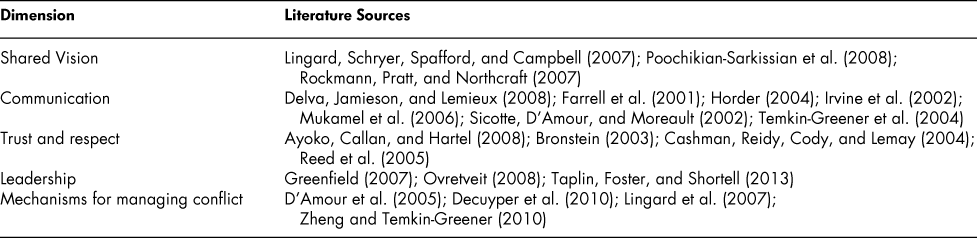
Scholarship on effective team collaboration has noted the presence of a number of key characteristics, without which the achievement of team outcomes is stymied (see Table 1). In addition to these essential ingredients, teams seem to function best when power and decision-making is shared among team members in a horizontal rather than vertical, hierarchical authority structure (Kodner & Spreenwenber, Reference Kodner and Spreenwenber2002; Poochikian-Sarkissian et al., Reference Poochikian-Sarkissian, Hunter, Tully, Lazar, Sabo and Cursio2008; Thylefors, Reference Thylefors2012) and individual roles are meaningful, interesting, and intrinsically rewarding (West & Poulton, Reference West and Poulton1997). Team members must understand how their work contributes to the team’s objectives and outcomes, while recognizing the complementarity of roles that members bring to the group. Here we see fissure in the role of autonomy in team processes. While autonomy is valued (Bronstein, Reference Bronstein2003), allowing practitioners to utilize their specialized expertise, too much autonomy can be detrimental to the team (Hurst, Ford, & Gleeson, Reference Hurst, Ford and Gleeson2002; San Martin-Rodriguez, Beaulieu, D’Amour, & Ferrada-Videla, Reference San, Beaulieu, D’Amour and Ferrada-Videla2005), promoting hierarchy and fragmentation (Raak, Paulus, Merode, & Mur-Veeman, Reference Raak, Paulus, Merode and Mur-Veeman1999).
Key dimensions of effective team functioning by relevant literature sources

We adopt the definition offered by Cohen and Bailey (Reference Cohen and Bailey1997), ubiquitous in the literature, referring to a team as “a collection of individuals who are interdependent in their tasks, who share responsibility for outcomes, who see themselves and who are seen by others as an intact social entity embedded in one or more large social systems” (p. 241). Team scholarship yields a variety of conceptual labels, each defined and understood differently. The terms multidisciplinary, interdisciplinary, transdisciplinary, and interprofessional, for example, are often used interchangeably, although each in practice is quite different. Transdisciplinary teams refer to groups endeavouring to exchange knowledge or skills through consensus-seeking that would transcend traditional discipline boundaries (D’Amour et al., 2005). Johansson, Eklund, and Gosman-Hedström (Reference Johansson, Eklund and Gosman-Hedström2010) consider this model the highest form of cooperation, promoting an integrated assessment and treatment plan based on client needs, which is then carried out by all team members. In contrast, a multidisciplinary team describes a group in which several different professionals work on a project in parallel or independently (Opie, Reference Opie1997b), although generally there is a lack of understanding of the roles and activities of other team members, with little role for the client (Johansson et al., Reference Johansson, Eklund and Gosman-Hedström2010). On the other hand, an interdisciplinary team, comprising a group of health care providers from multiple disciplines (Goldsmith et al., Reference Goldsmith, Wittenberg-Lyles, Rodriguez and Sanchez-Reilly2010), has a greater degree of collaboration, relying on common goals and decision-making processes. Both terms, multidisciplinary and interdisciplinary, have been used to refer to a team of professionals with disparate training who hold shared objectives but make different although complementary contributions (Leathard, Reference Leathard and Leathard2011).
IPW – also labeled joint working, multi-agency/partnership working, or integrated working (Goodman et al., Reference Goodman, Dreenan, Scheibl, Shah, Manthorpe and Gage2011) – refers to interactions between a group of people from different health and social care professions (Atwell & Caldwell, Reference Atwell and Caldwell2006) who come from different training backgrounds but share the goal of working together in the client’s best interest. Recent developments have also included a variety of different sectors and organizations under the interprofessional umbrella; muddying the “professional” waters to include all who work together in client care (Leathard, Reference Leathard and Leathard2011).
The distinction between interdisciplinary and interprofessional teams is an important one. Interdisciplinary teams incorporate the knowledge and skills that each discipline brings to the group, whereas interprofessional teams hinge on the socially constructed term “professionalism” that denotes difference. Thus, team members must learn from each other to mitigate the effects of “profession-centrism” (Pecukonis, Doyle, & Bliss, Reference Pecukonis, Doyle and Bliss2008, p. 420). Barr (Reference Barr and Leathard1994) thus suggested that what makes IPW different from notions of inter/multidisciplinary work is that IPW involves interactive learning. Interprofessional learning is needed to understand with, about, and from the other professionals on the team (the UK Centre for the Advancement of Interprofessional Education [CAIPE], 2002), through both formal and informal opportunities for knowledge creation and social exchange. Good communication is essential to challenge stereotypical views, increasing awareness and respect for the role of each team member (Sargeant, Loney, & Murphy, Reference Sargeant, Loney and Murphy2008). The term also underlines the importance of the client at the centre of joint working (Leathard, Reference Leathard and Leathard2011).
As teams are increasingly expected to work closer together, many have begun to adopt team terminology even though there may be little in their practice that actually demonstrates interdependence and collaboration; they may just be a group of people working beside each other (Sargeant et al., Reference Sargeant, Loney and Murphy2008). This is further compounded by the fact that teamwork tends to mean different things to different people (Rentsch, Heffner, & Duffy, Reference Rentsch, Heffner and Duffy1994). Likewise, IPW is a loosely defined concept (Goodman et al., Reference Goodman, Dreenan, Scheibl, Shah, Manthorpe and Gage2011), situated in a “terminological quagmire” (Leathard, Reference Leathard1994, Reference Leathard and Leathard2011; Reeves et al., Reference Reeves, Goldman, Gilbert, Tepper, Silver and Suter2011) carrying with it a plethora of names and associations, but often linked to IPC and interprofessional education (IPE). The linking of these creates additional conceptual complications: as Reeves et al. (Reference Reeves, Goldman, Gilbert, Tepper, Silver and Suter2011) noted, they may be distinct endeavours albeit often used interchangeably in policy, research, and practice. Freeth, Hammick, Reeves, Koppel, and Barr (Reference Freeth, Hammick, Reeves, Koppel and Barr2005) contend that IPE and IPC occur on a spectrum, with one end focusing on IPE, the other end on IPC, with a blending of interprofessional activities in between.
Although the IPW literature makes a positive case for working together, it is not without its sceptics, and generally for good reason. Numerous issues beset IPW teams: structural (e.g., gaps in service, fragmentation), procedural (e.g., differing budgeting and planning cycles), financial (e.g., varying costs and funding mechanisms), professional (e.g., competing values, self-interest), and status/legitimacy concerns (e.g., differences between elected and appointed agencies; Leathard, Reference Leathard and Leathard2011). Teams face many organizational challenges, including competing visions and organizational differences, difficulty establishing a shared purpose given a lack of understanding of the aims and objectives of a joint initiative, and unclear responsibilities for referral processes and understanding of eligibility criteria (Cameron, Lart, Bostock, & Coomber, Reference Cameron, Lart, Bostock and Coomber2013).
Trivedi et al. (Reference Trivedi, Goodman, Gage, Baron, Scheibl and Iliffe2013) conducted a systematic review of the literature on IPW for older people living in the community. They noted, as did West and Markiewicz (Reference West and Markiewicz2004), that IPW varies significantly according to context, patient need, team composition, and other considerations, although it remains unclear how these differences influence IPW and outcomes for this population. There are a variety of IPW models: case management, collaboration, and integrated teams; and service teams by level of care: acute, chronic, palliative, and preventive. According to the authors, IPW is defined as having one or more of the following components: (a) joint decision making by an interprofessional/multidisciplinary team to develop a shared care plan; (b) joint input from team members to create a shared protocol; and (c) face-to-face team meetings or regular team communications to discuss client care plans. Goodman et al. (Reference Goodman, Drennan, Manthrope, Gage, Trivedi and Dhrushita2012) also suggested that effective IPW is more likely to occur when there are links across a broad network of primary care services; a system of communication and evaluation that considers input of older persons and caregivers; and continuity of care is provided through a recognized key worker or case manager.
Theoretical Framework
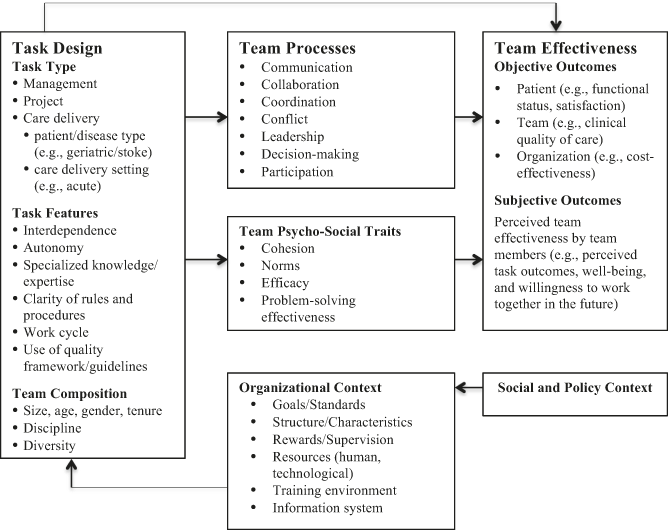
The purpose of our study was to build on IPW team scholarship by exploring, through a case study, the key components of team collaboration within an HBPC team based out of a CSS agency in Ontario, Canada. It explored two questions: (1) Is the case study team an IPW team as defined in recent literature (i.e., Goodman et al., Reference Goodman, Dreenan, Scheibl, Shah, Manthorpe and Gage2011; Reeves et al., Reference Reeves, Goldman, Gilbert, Tepper, Silver and Suter2011; Trivedi et al., Reference Trivedi, Goodman, Gage, Baron, Scheibl and Iliffe2013)?; and (2) What are the barriers that thwart interprofessional team functioning within this HBPC setting? We employed the integrated team effectiveness model (ITEM) advanced by Lemieux-Charles and McGuire (Reference Lemieux-Charles and McGuire2006) in this analysis (see Figure 1).
Integrated team effectiveness model (ITEM). Influenced by the work of Fried, Leatt, Deber, and Wilson (1988) and Shweikhart and Smith-Daniels (1996), Lemieux-Charles and McGuire (2006) outlined the ITEM, which built on (and modified for health care), the complex interactions of task design (type of team, team features, and composition), team processes, team psychosocial traits, and team outcomes delineated by Cohen and Bailey (1997). Source: Lemieux-Charles & McGuire (2006)
This model incorporates Cohen and Bailey’s (Reference Cohen and Bailey1997) team typology, building on the work of Fried, Leatt, Deber, and Wilson (Reference Fried, Leatt, Deber and Wilson1988) and of Schweikhart and Smith-Daniels (Reference Schweikhart and Smith-Daniels1996), to produce a model that reflects the multidimensional nature of team effectiveness (Kilpatrick et al., Reference Kilpatrick, Lavoie-Tremblay, Ritchie, Lamothe and Doran2011) within an input-process-outcome (IPO) framework routinely employed to study IPW (Mathieu, Maynard, Rapp, & Gilson, Reference Mathieu, Maynard, Rapp and Gilson2008). ITEM depicts the myriad factors affecting team functioning, including the task design (team type, features, and composition), team processes and psychosocial traits, objective and subjective outcomes, organizational environment, and the social and policy context. As Lemieux-Charles and McGuire (Reference Lemieux-Charles and McGuire2006) noted, the model is not definitive, but it provides a useful guide through which to understand the multiplicity of dimensions, processes, and outcomes affecting the interprofessional health care team.
Methods
Participants
Team Design and Composition
Traditionally, a “professional” is referred to as an individual associated with a particular profession, having completed a specified training regimen, and holding membership in a licensed professional body. As noted, this notion is changing to incorporate all members in health and social care endeavouring to meet the client’s needs. IPW health care teams now include a wide range of professionals and partners, including nurses, physicians, social workers, occupational therapists, physiotherapists, dieticians, pharmacists, team coordinators, specialists (e.g., geriatricians), semi-professionals (e.g., health care assistants), and/or community workers (e.g., care coordinators, personal support workers, etc.; Leathard, Reference Leathard and Leathard2011). The composition of the case study team consisted of a social worker, a primary care physician, an occupational therapist, a nurse practitioner, and an agency-based team coordinator responsible for intake and system navigation.
The physician held the role of “most responsible physician” and was the clinical team lead. Although the team initially started almost as a collective, not all team members were comfortable with this flat structure as time progressed. Internal pressure was as strong as external pressure in determining the responsibility ladder, and in the end, the team adopted the traditional route of physician lead. This default position, that the physician should be the leader purely by virtue of the role as doctor regardless of competence level (Mickan & Rodger, Reference Mickan and Rodger2000), is beginning to evolve, however, to include other, more flexible and nuanced understandings of leadership. Physicians are increasingly being asked to share primary responsibility with other practitioners (Canadian Medical Association [CMA], 2006). Moreover, the CMA (2006) has suggested that the notion of “most responsible physician” should be expanded to include responsibility for integrating all team members’ opinions in clinical decision-making, and that while doctors may be “best equipped to provide clinical leadership”, this could be delegated to another practitioner. In our study, clinical leadership appeared to reflect this notion of expanded responsibility, a pursuit that endeavours to include the views of all team members and decision-making built on consensus.
The HBPC team delivered primary health care services, geriatric care, chronic disease management, and end-of-life care to frail, homebound elders in their homes with the expressed goal of providing a client-centred model of care that allows clients to live independently at home for as long as possible. The team began as a part-time pilot project in 2007, and acquired government funding to launch as a full time operation in 2009. From the program’s launch, a management group met regularly to provide leadership and strategic direction for the team, and to deal with the inevitable crises that arise in such a program. It is important to note that this management group was made up of the CEOs of the original sponsoring organizations. Thus, they had the authority (power) to infuse resources when needed and articulate a clear message affirming the centrality of interprofessional working in the model. This message was made clear to potential team members applying for the positions.
The “task features” of the team included a mix of both autonomy and interdependence. Although recognizing the group’s interdependence, the team clarified the roles and responsibilities of each member over time, allowing each to work relatively autonomously in their prescribed role. In other words, each professional practiced in accordance with their respective standards of practice and code of ethics. The team was small (only five members), predominantly women, who had worked in the field of health and social care for many years. The team provided care to clients (referred to the team by the CSS agency) in clients’ homes during regular office hours. Visits were at times conducted by a solo practitioner and, at other times, jointly by two or more team members.
Clients of the Team
Clients typically had a range of complex physical, cognitive, and social issues. To be eligible for team services, clients had to (a) be over age 65 (most were over age 80); (b) demonstrate great difficulty accessing traditional office-based primary care; (c) have a valid government-issued health card; (d) be willing to transfer their care from their current physician to the team; (e) be living in the identified catchment area; and (f) not be living in a retirement/nursing home facility or requiring palliative care at the time of enrolment.
Organizational Context
The case study examined an interprofessional HBPC team operating out of a CSS agency, a context that is currently unique in Canada, but likely to grow in the future. Given this connection, the team’s clients were privy to the comprehensive basket of programs and services available through the agency (e.g., adult day programs, health/wellness programming, transportation services, etc.). The team’s focus was not only on providing ongoing medical care to clients but also on linking clients/caregivers to resources within the community to meet their cognitive and social needs. The HBPC team thus had access to agency resources, as well as administrative and managerial support. Although it had a home base at the agency, the team worked relatively autonomously in clients’ homes.
Social and Policy Context
We collected data on this team at a time when population aging and rising health care costs were associated in ways that resulted in a discourse of pending crises unless service approaches changed. In addition, the impact of a global recession was being felt locally, resulting in much uncertainty and economic policy that shifted rapidly from fiscal stimulus to one of restraint (Conference Board of Canada, 2011). However, governments began to recognize that policy change, innovative programs, and resource reallocation were needed to respond to future health care demand, as exemplified by recent increased funding commitments to support HBPC delivery. The recent report submitted to the Government of Ontario, outlining the Seniors Strategy for the province, emphasized the need for enhanced provision of home and community care services (Sinha, Reference Sinha2012), further to the $60 million already allocated to expanding HBPC services announced in August 2011 (Smith-Carrier, Nowaczynski, Akhtar, Pham, & Sinha, Reference Smith-Carrier, Nowaczynski, Akhtar, Pham and Sinha2012).
Procedures
A case study is a methodology (Merriam, Reference Merriam1998) that explores a case or “bounded system” over time through detailed data collection involving multiple sources (Creswell, Reference Creswell1998). Our case study used a mix of qualitative methods (i.e., interviews and participant observations) and quantitative methods (i.e., a survey) to describe the context in which the phenomenon (HBPC) occurred, and to illustrate key findings in the evaluation (Yin, Reference Yin2003). Data were collected on the case study team in the fall of 2011. These interview and participant observation data were part of a broader research program that the second author (SN) conducted (i.e., pilot interviews with clients, family members, and the management team) that informed a comparison study – currently in progress – in which the present HBPC team is compared with hospital-based teams. Approval to conduct the study was provided by both university and agency research ethics boards.
In qualitative research, it is important to give readers a reflexive account, to signal “what is going on” in the research, including the positioning of the researchers and their self-appraisal and critique (Koch & Harrington, Reference Koch and Harrington1998, p. 887). Thus, a brief history is offered here. The HBPC team began as a demonstration project for two days a week over the course of two years. Author SN volunteered to track the team’s progress by documenting events as different agencies came together to fund this innovation and, to secure annual funding, also began gathering routine administrative data (i.e., caseload numbers, services received, etc.) as well as data on client and family satisfaction with the HBPC services. During the team’s third year of operation, author SN participated on a steering committee established to provide high-level oversight, pursue funding opportunities, craft job descriptions, smooth inter-agency conflicts, and so forth. During this time, author SN had minimal involvement with the case study team, although there was an existing relationship. The first author (TS-C) took the lead on this study, gaining insight and perspective on the team and its historical context from author SN. Continual reflexivity was needed on the part of both authors to examine existing assumptions, preconceptions, and conceptual baggage that might influence the data collection, analysis, and interpretation.
Interviews
Using a purposive sampling approach (Patton, Reference Patton1990), one-hour face-to-face individual interviews with all team members (n = 5) were conducted by author TS-C using a semi-structured format. Author TS-C, having no team involvement, conducted all of the interviews. Author SN had a previous relationship with the team and was thus not involved in the interviewing (or survey administration). Team members were first contacted via email to inform them of the study and request their participation. If team members were interested in participating, they were asked to respond by email to schedule an interview (at the agency at a time and date convenient for the participant). All interviews were held at the agency on the same day, although participants were unaware of the times of their colleagues’ interviews. No compensation was provided. The study information and informed letter of consent was reviewed and signed by participants prior to commencing.
Survey
After interviewing each team member, author TS-C administered the Program for All Inclusive Care for the Elderly (PACE) Outcomes survey, a validated instrument (Cronbach’s α = .89) to assess team performance (Mukamel et al., Reference Mukamel, Temkin-Greener, Delavan, Peterson, Gross and Kunitz2006). On a five-point Likert scale (with 1 being “strongly disagree” and 5 “strongly agree”), the instrument taps into eight domains: leadership, team cohesion, communication, coordination, conflict management, team effectiveness, workplace conditions, and workplace resources. A team meeting subscale measured team readiness and effectiveness, communication, leadership, and job satisfaction (Temkin-Greener et al., Reference Temkin-Greener, Gross, Kunitz and Mukamel2004). The option to mail back the survey was provided; however, participants chose to fill out the survey privately and return it in a stamped envelope the same day as their interview.
Participant Observation
Qualitative data from interviews were coupled with field notes from participant observations collected by author SN and a research assistant over a period of a year, based on hallway one-on-one discussions, meetings (both team and management), and home visits. They provided data on team dynamics and further insight into the case context (Baxter & Brumfitt, Reference Baxter and Brumfitt2008), the HBPC setting. Participant observations were undertaken from a non-participant observer stance (Bechofer & Patterson, Reference Bechofer and Patterson2000), and the field notes were recorded, transcribed, and included in the data coding.
Digitally recorded interviews, along with the field notes, were transcribed and coded using QSR International’s NVivo software (v. 9). All transcriptions were read and re-read to ensure accuracy. An iterative coding process was conducted using the constant comparative method. As delineated by Chavez (Reference Chavez2006), the constant comparative method is a process by which abstract concepts and theories are generated through successively comparing data at every stage of analytic development. The first author used an open coding process whereby units of data from one interview were coded into as many categories of analysis as possible, and then explored in subsequent data (i.e., compared in each successive interview transcription). We then explored these categories with other categories to develop concepts, and again compared them to other concepts that emerged in the data. To better integrate emerging categories, the coded data were discussed in regular peer-briefing sessions with author SN (after each coding iteration), allowing for the categories, and their dimensions and relationships, to become integrated into parsimonious conceptual units that shaped emerging themes. Themes were then verified using member checking; team members were asked to provide feedback on the findings to ensure accuracy, enhancing the trustworthiness of the analysis (Patton, Reference Patton1990).
Results
Key themes emerged from the data that we organized within the ITEM typology: (a) psychosocial traits – the need for a shared vision, common goals, and respect and trust between team members; (b) team processes – the need for effective leadership and communication, as well as avenues for dealing with conflict; and (c) work and environmental context – contending with difficult workplace conditions and partnership brokering in HBPC.
Psychosocial Traits: Shared Vision and Common Goals
Psychosocial traits refer to norms and shared mental modes (Lemieux-Charles & McGuire, Reference Lemieux-Charles and McGuire2006). A predominant trait of team members was their commitment to common goals and a shared vision, the team’s raison d’être, as demonstrated in the following comment.
“(T)he team … is very directed together and very passionate about reaching these goals and identifying that we think these goals are really important, and we share the passion about this … actually, being interdisciplinary, we work quite closely and understand how we need to work together because often a frail senior at home has complex needs: it’s not just medical; there’s lots of other needs, so the beauty in having the team is that we’re passionate about the one vision that we actually do very good work together.” (Team Member [TM]1)
The participant went on to explain that the team was formed with this vision in mind. Passion for the team’s vision was a necessary prerequisite for team recruitment.
“I think there was some vision … when people were chosen for the team … I think there was a lot of attention paid to bringing somebody who is passionate about what our vision is, providing the care for seniors … I think that’s one of the things that keeps us gelled is that we share the same passion …” (TM1)
It is instructive that, in the first quote, this team member used the term “interdisciplinary” to describe how the team was able to “work quite closely and understand how we need to work together”. Later, we will see the phrase “professional differences” used to express one source of conflict in the group. The tensions attached to the varied labels in teamwork are not lost in the HBPC context. While team members employed the term “interdisciplinary” to describe the group, it is unclear whether employing this term was intentional (i.e., they affirm that the team was interdisciplinary in its approach), or whether they had not picked up the language of IPW, or whether team members did not feel that IPW appropriately represented what the team was and did.
Psychosocial Traits: Respect and Trust
Every member of the team acknowledged that they respected their colleagues. Respect and trust, two important and connected traits, developed in the team over time. For one participant, having defined roles, and an understanding of these roles, was vital.
“We have those defined roles, we each understand – have a really good understanding professionally – when to make a referral to another person, and [have] respect for the roles, and again there’s nobody trying to encroach [on those roles] and kind of come (on) in [and take over]…” (TM2)
The practitioner’s integrity was also important.
“And everybody works within an ethical framework, you know, with integrity. Everybody is conscious of their professional roles and responsibilities, and we all use a … very client-centred approach to providing care, and I think by and large it works.” (TM4)
This participant described how respect was fostered by listening and attempting to understand the perspectives of others, within an open atmosphere where team members were free to express their opinions without judgement.
“I think that’s what’s nice about us is that we don’t feel that the other professional is judging you, they respect your opinion, you know they may not agree with you all the time … one problem would come up at the beginning of the meeting and by the end of the meeting it would be solved and everybody’s happy.” (TM3)
Here respect is connected to trust, a direct offshoot from the respect team members have for each other. Trust extends beyond professional relationships, spilling into personal lives as well. Respect and trust are thus two attributes of effective team functioning that create a collaborative synergy, the “gel” between team members.
“It’s actually a very good team, we have really gelled, not only professionally but I think on a personal level also, which I think then shows a huge element of trust that it extends beyond professional relationships. We have a lot of fun together which I think is also important; that means we also feel very comfortable with each other, again coming back down to the trust issue.” (TM1)
Team Processes: Leadership
Leadership and joint decision-making were clearly acknowledged as important elements of effective team processes, not only at the team level but organizationally, in the overall direction and promotion of the team.
“I think there needs to be more from the … higher level, like the steering committee, at that level, to really be pushing how to get [the program] out in the community more.” (TM1)
While relying on consensus and majority rule to make decisions, team members still expressed their appreciation for the leader of the group.
“I think that there does need to be … a clinical leader… you could go to and ask advice or, you know, make the tough decisions … there does need to be somebody in the leadership role.” (TM3)
The participant continued:
“Big discussion and there’s lots of compromise but there’s also … ‘I do see your point of view, so okay, we’ll do it that way,’ so it’s not always [the clinical leader’s] decision is the final one … there’s a lot of discussion, and everybody’s opinions are valued.” (TM3)
Participants discussed how the leader must possess certain qualities that promote a collaborative environment. “Not aggressive, s/he’s assertive, that’s a good leadership quality,” explained TM2, adding, “It’s so nice to see a physician who is so open to feedback and team collaboration.” Within a “safe and supported” environment, the team collectively reaches decisions.
“And [name] came to us expressing his/her concerns and we said let’s talk about it in rounds and s/he brought it up and s/he felt safe and supported to bring it up, and [the clinical lead] was overruled … s/he listened openly, s/he didn’t feel threatened, it wasn’t a matter of being defensive … It’s not just like you say ‘because I said so’ … so anyone can bring it up. The discussions aren’t really passionate or heated or debated, it’s just a really good professional discussion on the pros and cons and again there’s a lot of flexibility and give and take…” (TM1)
Team Processes: Dealing with Conflict
Recognizing that there were differences within the team may be the first step to “focus … work on the solution.”
“How do we manage?… Just by recognizing, first of all, that there are professional differences … Our differences actually allow for an ability to isolate a problem really quickly and then to focus our work on the solution. So I think it’s actually a good complement – to have those [two] different perspectives.” (TM5)
Because the team learned to communicate, listen, and try to understand the perspectives of others, it may often seem that they rarely had differences: they did. The following quote illustrates how a disagreement was handled by the team.
“There is one issue that I disagreed passionately about but I was really the only one. But I didn’t feel upset that they didn’t agree with my opinion, but I just said ‘this is my opinion, this is how I feel, don’t ask me to like it but I will never let this interfere with my professional abilities or my professional job.’ I said, ‘you know I would never misrepresent the team or anything like that, I just strongly disagree with this,’ and they were fine with that and I was fine with that. I didn’t feel that I wasn’t listened to because we’re not always going to agree on everything, but I think the beauty is … what’s really neat is that we basically 98 per cent agree on everything.” (TM1)
Team Processes: Communication
Having a variety of mechanisms for communication reduces service duplication. As one participant explained:
“We’ve got weekly rounds, we’ve got joint visits if we need them, we’ve got Blackberries that everybody keeps, we have a communication file, and most importantly we have that electronic record that’s super easy to use as a program, and it’s very easy just to look back and be like ‘ah, the doctor was in here two days ago’ and be able to read the note – before you go in – and have access to have a better understanding, and it’s great because it minimizes duplication, too.” (TM3)
Learning how to communicate, and what tools are best for communicating, is a process. Communication processes were negotiated over time with team members internalizing what the best course of action was.
“That’s a process, and it’s an ongoing process – I mean, because we have access to so many different means of communication … for instance, like with the Blackberry – should we be calling people when there’s an issue, should we be emailing it, do we put it in the communication file, do we just put it in a note and ask somebody to see the note, do we bring it up at rounds? I mean, what is the best process? And we’ve sort of figured it out as we’ve gone along, and a lot of it has to do in terms of the importance and the immediate action that needs to be taken.” (TM3)
The use of the virtual client record was deemed vital but could not replace opportunities for regular face-to-face interaction.
“We meet regularly, so we have weekly team meetings, we sometimes schedule joint home visits so that more than one team member is visiting a client when there is a particularly difficult situation … we often do sort of problem solving around difficult clients at our weekly team meetings or sometimes informally, you know … we work out of the same kind of open area, so we bump into each other in the mornings and we’ll talk about somebody …” (TM4)
Work and Environmental Context
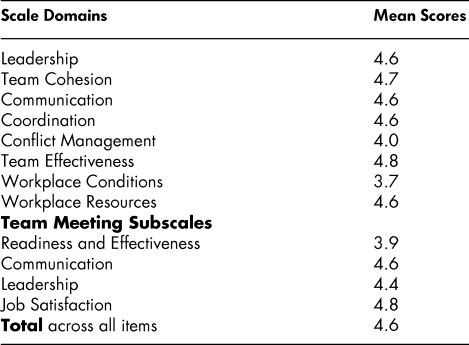
The PACE survey was completed by the five team members (see Table 2). The rationale for presenting the survey is twofold. First, the scale outlines the domains of team functioning validated in the literature. Second, the results demonstrated that team members perceived their group processes to be effective in these significant domains (overall mean score was 4.6 out of 5, and consequently a job satisfaction score of 4.8), albeit with a lower score in a particular area that deserves mention. Workplace conditions, a domain having to do with the organization context and HBPC setting, scored the lowest (mean of 3.7) compared to domains related to team functioning (e.g., communication, cohesion, etc.). It was not the resources associated with the workplace (which scored relatively high with a mean of 4.6) or the CSS agency (participants noted the CSS agency had been extremely supportive) that were scored low. Instead, the low score attached to workplace conditions and the particularity of working within the HBPC setting provide insight, and requires further investigation.
Results from PACE Outcomes Survey
Moreover, there was significant discussion by all team members about the broader environment and the role that partners played in the HBPC setting.
“I find the partnerships are hard because maybe some people are threatened by the team … I think that’s one of the biggest things that hinders the program.” (TM4)
Discussion
According to the key requisites of IPW provided by Trivedi et al. (Reference Trivedi, Goodman, Gage, Baron, Scheibl and Iliffe2013), the case study team does appear to have many elements of an IPW team. The team utilizes joint decision-making processes to develop a shared protocol for clients; team members have joint input into client assessments and care plans; and regular face-to-face meetings and ongoing communication is built into the team’s schedule to review client care plans. The team also reflects some of the IPW components discussed by Goodman et al. (Reference Goodman, Dreenan, Scheibl, Shah, Manthorpe and Gage2011): there do appear to be links across the full range of health and social care services to provide integrated continuity care; shared assessments and shared records are utilized by the team; and performance metrics are in place to evaluate the team’s joint working and associated outcomes. However, to our knowledge this has not as yet included evaluations on the team’s IPW by the client(s) and caregiver(s) (which also did not appear common in Goodman et al.’s study). As Barr (Reference Barr and Leathard1994) proposed, interprofessional learning is one of the defining elements that distinguishes IPW from other models of teamwork.
Goodman et al. (Reference Goodman, Dreenan, Scheibl, Shah, Manthorpe and Gage2011) suggested that organizations create their own taxonomies of joint working over time (known to those inside the organization but not necessarily to those outside), although for the teams in their study, the definition of IPW was clearest for those organizations in which IPW hierarchies were initially shaped through funding streams and policy. That appears to be the case for this team also. Early hierarchies built largely on policy and funding determinations have shifted over time, albeit these shifts were not always apparent to those outside the team. Surprisingly, perhaps, tensions arose between the team and its partners (e.g., team members believed that partners felt threatened by their success). This warrants service user evaluation on the IPW of the full range of service providers (the team and its partners) and suggests that further work is needed to ensure that all practitioners engage in ongoing learning on IPC (Reeves et al., Reference Reeves, Goldman, Gilbert, Tepper, Silver and Suter2011) to develop trust and appreciate the wide diversity of roles necessary for integrated continuity of care (Sargeant et al., Reference Sargeant, Loney and Murphy2008).
The psychosocial traits that surfaced in the data appear congruent with existing scholarship on team collaboration: the importance of having a shared vision and common goals for the effective delivery of client-centred care (McPherson, Headrick, & Moss, Reference McPherson, Headrick and Moss2001; Poochikian-Sarkissian et al., Reference Poochikian-Sarkissian, Hunter, Tully, Lazar, Sabo and Cursio2008); a respectful environment in which trust can be cultivated (Reed et al., Reference Reed, Cook, Childs and McCormack2005); constructive avenues for dealing with conflict (Decuyper, Dochy, & Bossche, Reference Decuyper, Dochy and Bossche2010); the importance of leadership (Øvretveit, Reference Øvretveit2008), and more importantly, of “not aggressive but assertive” leadership, being willing to listen and encourage participation from all team members (Greenfield, Reference Greenfield2007). The latter quality is conducive to the expanded notion of leadership responsibility provided by the CMA as well as to ongoing communication (Gum, Prideaux, Sweet, & Greenhill, Reference Gum, Prideaux, Sweet and Greenhill2012; Santana, Curry, Nembhard, Berg, & Bradley, Reference Santana, Curry, Nembhard, Berg and Bradley2011). Utilizing a variety of communication mechanisms, team members ensure that their schedules have regular face-to-face interaction, and they also employ asynchronous methods to communicate (i.e., the shared electronic health record [EHR]). While people prefer face-to-face contact, asynchronous communication continues to be important (Gum et al., Reference Gum, Prideaux, Sweet and Greenhill2012), perhaps even more so when team members conduct home visits alone and must share vital client information. The EHR is thus essential for this type of team to operate optimally, albeit with the caution that excessive information can be problematic, overwhelming clinicians and thereby diminishing the EHR’s utility (Murphy et al., Reference Murphy, Reis, Kadiyala, Hirani, Sittig and Khan2012; O’Malley, Reference O’Malley2011).
Collaborative practice is also shaped by institutional supports, working culture, and the presence of a collaborative culture within the organization (Gum et al., Reference Gum, Prideaux, Sweet and Greenhill2012). Organizational structures thus contribute to the extent to which teams are able to establish trust and effective working relationships (Weller, Barrow, & Gasquoine, Reference Weller, Barrow and Gasquoine2011). In our case study, the team had the necessary institutional supports in place to effectively develop a collaborative environment (i.e., a management team keenly interested in its success, access to resources, and an existing collaborative culture within the CSS agency). Moreover, the team operated relatively autonomously given that HBPC services were provided inside clients’ homes, unhindered by excessive organizational constraints. What did appear to be issues for this team were the conditions in which they carried out their daily work (the HBPC setting) and the broader environment in which they were situated.
The team we studied served frail elderly clients who presented with multiple chronic conditions, along with their associated medications and interactions, in a home setting. Despite widespread acknowledgement that such profiles will characterize client populations of the future, relatively little remains known about chronic care, the issues that arise, and the form they take, when the person is living in a community setting. The home is generally seen as a desirable location for persons needing chronic care (Stall, Nowaczynski, & Sinha, Reference Stall, Nowaczynski and Sinha2013). It is assumed that under such conditions, an individual will experience a better quality of life than would be possible in an institutional setting. Beyond that, however, the many issues associated with actually delivering care tend to be glossed over.
We argue that the home needs to be conceptualized as a constantly changing complex setting. This describes the circumstances within which this full-time mobile team perform their work. Although at the time of writing, this model may be rare, recent policy statements, as noted, assume its expansion. Research exists that tests the applicability of team theory where the pooling of specialized knowledge is required to handle unanticipated scenarios. In contrast to the daily exchange of knowledge related to ongoing workflow issues, critical knowledge represents the vital expertise, ideas, or insights that enable successful completion of a task. However, to date, research on knowledge-intensive teams has been focused on the field of product innovation (Huang & Cummings, Reference Huang and Cummings2011). We would suggest that Huang and Cumming’s (Reference Huang and Cummings2011) findings – indicating that the arrangement of knowledge-sharing relationships within a team are related to team performance, and more specifically that decentralized teams where critical knowledge is shared equally rather than hierarchically, leads to better outcomes – are relevant to service teams working with the unanticipated scenarios that can arise when working within people’s homes.
Bleakley (Reference Bleakley2013) has assessed some of the assumptions underlying team theory and raised questions about their applicability in an era of “liquid” health care, a context of perpetual change. He noted that
“students within differing health care professions learning ‘teamwork’ will need to appreciate both ‘cool’ networking for stability and ‘hot’ knotworking for adaptability. The latter requires education into tolerance of uncertainty and ambiguity, a key characteristic of persons who are able to collaborate well with others, both intra- and inter-professionally.” (p. 25)
We found this discussion helpful in thinking about the changing context within which our mobile team operated, and within the context of IPW. As our data indicate, team processes that promoted stability were in place and consciously tended to. However, members knew that they could assume little about the home milieu within which they practiced daily. They were constantly adapting the specifics of service plans, requiring adaptability, superb communication, and a high degree of trust. Indeed, the survey data point to the importance of context for IPW in HBPC, a place of work that requires that practitioners travel (at times extensively), carry with them equipment and diagnostic or treatment supplies, and assess the home and social environment of each client, continually on the alert for potential hostile or unsafe situations. Whereas this setting may better allow for client assessment (DeCherrie, Soriano, & Hayashi, Reference DeCherrie, Soriano and Hayashi2012), it may also require a greater level of collaboration than in other health care settings. Effective communication and trust may be potentially more vital given the wider number of factors at play in the HBPC context that may not be present in other institutional settings, thereby requiring a flexible and high functioning IPW team.
The aforementioned situation notwithstanding, in our case study it was the ambiguity associated with collaborating with professionals in other organizations that was more challenging to both team members and the management group (observation by author SN who regularly attended both). Although the team we studied could be described as working in relative isolation (i.e., in clients’ homes), team members needed to interact with other systems. As Decuyper et al. (Reference Decuyper, Dochy and Bossche2010) observed, team effectiveness is not solely determined by the team itself but is negotiated on the boundaries between the team and its environment. Strategically negotiating external relationships can be rough terrain. Establishing relationships across various sectors was ongoing work that consumed considerably more time than initially anticipated. These needed negotiation at the micro level of daily practice, and at the macro level, involving cross-institutional decision makers as well as professional colleagues.
Strengths and Limitations
The study provides unique insight into the interprofessional working of the HBPC team. Many of the psychosocial characteristics of effective team functioning identified in the study resonate with the extant literature. What requires further attention lies in the areas of the broader environmental context of the HBPC teams; teams that must rely on external partners and work within uncertain, often difficult conditions. We recognize that we are limited in the conclusions we can draw from the PACE data given that we did not have baseline measures, a sufficient sample, or a comparison group; however, these data provide an additional source of information on our case, and play a role in triangulation, providing “stronger substantiation of the constructs” (Huberman & Miles, Reference Huberman and Miles2002) of our analysis. The preliminary findings presented, while important, require further exploration and validation.
Conclusion
In conclusion, we find further evidence to support the development of key psychosocial traits (i.e., a shared vision, common goals, respect and trust) and team processes (i.e., effective leadership, mechanisms for handling conflict, communication) that strengthen team functioning. What is unique for the HBPC team is the ambiguity and uncertainty that team members must confront daily as they work in difficult “workplace conditions” – the homes of clients. Negotiating external boundaries and relationships is also important, albeit difficult, and requires further investigation. While many of the challenges presented in acute and chronic care institutions persist, they are acknowledged and thus have been studied. The home in “home care” has largely escaped such scrutiny. Research will need to centre this social institution if we are to develop flexible teams where ambiguity and uncertainty are assumed.