


INTRODUCTION
Governments in low-income, semi-democratic regimes are increasingly adopting participatory institutions to improve political engagement, accountability, and development (Evans, Huber, and Stephens Reference Evans, Huber and Stephens2017; Fox Reference Fox2015; Heller Reference Heller, Centeno, Kohli, Yashar and Mistree2017; McNulty Reference McNulty2011; Touchton and Wampler Reference Touchton and Wampler2014; Wampler, McNulty, and Touchton Reference Wampler, McNulty and Touchton2021). However, building subnational participatory institutions is a daunting challenge in these contexts due to weak state capacity, limited resources, the threat of ethnic conflict, limited civil society engagement, and a history of authoritarian political rule (Mansuri and Rao Reference Mansuri and Rao2012; Olken Reference Olken2010). Broadly, we ask: to what extent do participatory institutions in poor, semi-democratic environments promote accountability? We focus on participatory budgeting (PB), one of the most common participatory institutions created after the Third Wave of democracy (Dias Reference Dias2019; Porto de Oliveira Reference de Oliveira and Osmany2017).
PB incorporates citizens into an ongoing policymaking process through which participants determine how local governments spend a portion of the annual budget (Avritzer Reference Avritzer2002; Baiocchi and Ganuza Reference Baiocchi and Ganuza2017). Ideally, citizens attend meetings where they propose local development projects, deliberate on these projects, and then vote on which projects the local governments will implement. PB, its advocates hope, empowers citizens to emerge from the shadow of local political bosses by distributing resources without too much government interference. PB is designed to leverage participants’ hyperlocal knowledge of their communities and harnessing their preferences to generate budgets that reflect those needs. PB began in Brazil in 1989 and has now been adopted by at least 11,000 municipalities across six continents (Baiocchi and Ganuza Reference Baiocchi and Ganuza2017; Dias Reference Dias2019; Wampler, McNulty, and Touchton Reference Wampler, McNulty and Touchton2021).
PB programs vary in program designs, operational rules, actors involved, and the local sociopolitical contexts where they are adopted (Baiocchi and Ganuza Reference Baiocchi and Ganuza2017; Goldfrank Reference Goldfrank2011; McNulty Reference McNulty2011; Wampler and Touchton Reference Wampler and Touchton2019). We do not know the extent to which this variation in context, actors, and institutions influences PB’s impacts; this is a critical omission given PB’s rapid spread across the Global South. In this article, we help fill these gaps by evaluating new PB programs in Kenya, a semi-democratic, low-income context. Kenyan PB reflects a new PB model across the Global South that is distinct from Brazil’s well-known PB programs in terms of their context, actors, and institutional rules (Baiocchi and Ganuza Reference Baiocchi and Ganuza2017; Dias Reference Dias2019; Wampler, McNulty, and Touchton Reference Wampler, McNulty and Touchton2021).
We find that Kenya’s PB programs act more as technical policymaking tools rather than deliberative, democratic institutions (Baiocchi and Ganuza Reference Baiocchi and Ganuza2017). Moreover, we argue that the expansion of accountability through PB will be quite limited in the context of uncompetitive local elections, the absence of independent CSO participation, and large shifts in program rules relative to the original Brazilian PB programs. We conclude that local governments’ adoption of participatory institutions as technical tools does not necessarily promote democratic accountability. The implication is that the spread of PB across the Global South might bring development projects to communities but is unlikely to bring broader benefits for governance and accountability, much less transform state-society relations.
Kenya decentralized through constitutional reform in 2010 to bring government closer to the population and become more responsive to communities’ policy demands (Cheeseman, Kanyinga, and Lynch Reference Cheeseman, Kanyinga and Lynch2020). Historically, ordinary citizens had almost no role in formal policymaking processes (Mamdani Reference Mamdani2018). Despite decentralization, the new subnational governments are still quite distant from ordinary citizens and improved service delivery has not materialized. In addition, Kenyan officials have used devolution to extend a predatory state and enrich themselves (Cheeseman and Sishuwa Reference Cheeseman and Sishuwa2021). Citizens may feel connected to governments along ethnic lines, but the poor quality and limited public goods provisions mean that citizens are unlikely to hold similar positions as government officials on their communities’ development needs.
We then extend this argument through PB’s founding logic as a form of participation, which is to generate distinctive localized projects that reflect community needs. To work well, any divergence between citizen and government preferences must be sustained through processes of discussion and negotiation; deference to elites is consistent with continued clientelism, not empowerment and accountability. This is the case for all PB programs in the Global South, not just Kenyan programs. Our contention is that PB’s goal of privileging citizens’ knowledge and development preferences over those of government officials will not be met if participants change their preferences to match the governments’ preferences when the two groups disagree.
We use mixed methods to assess citizens’ attitudes and behaviors in four Kenyan counties with PB. We administered a survey experiment (N = 9,928) with PB participants and nonparticipants, which tests key hypotheses on how information, elite signals, and the local sociopolitical context condition attitudes and behaviors on proposing and selecting development projects. We then nested this survey experiment in participant observation and more than 80 interviews with county government administrators, elected officials, and civil society leaders across the four counties to contextualize the survey experiment within local politics and better interpret the results (Lieberman Reference Lieberman2005). Our research team also attended dozens of PB meetings to build comparative knowledge about meeting organization and operations.
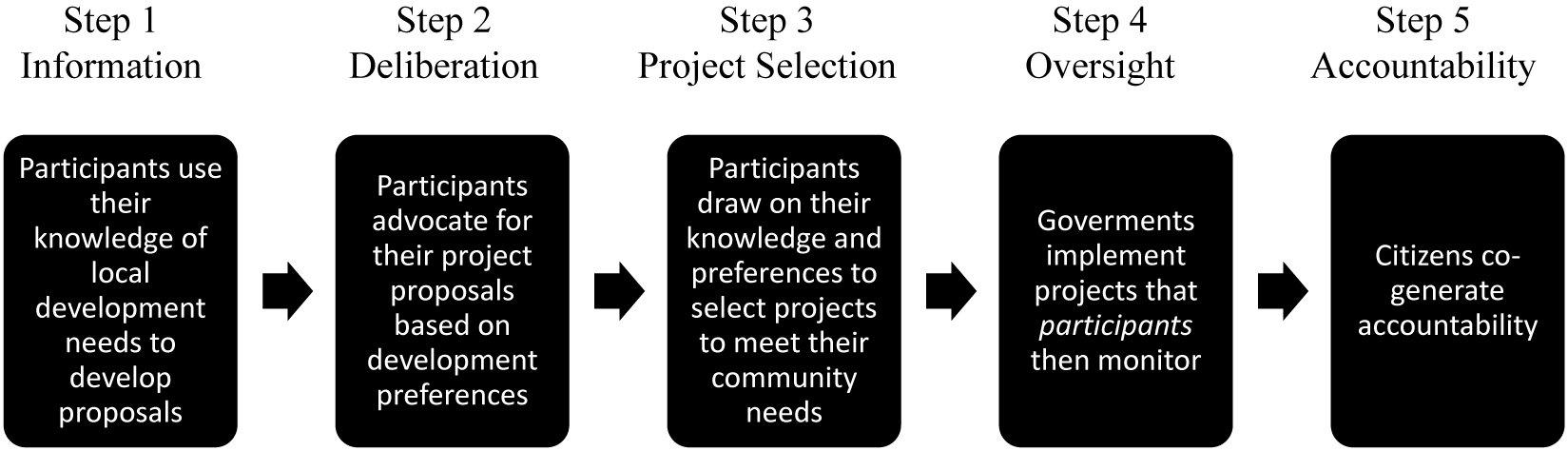
Figure 1 details an ideal-type PB program and how it theoretically improves accountability in development spending.
A Stepwise Model of an Ideal-Type PB Process, based on Porto Alegre, Brazil

In this ideal type, citizens leverage information about their communities’ needs to propose projects that meet those needs, and they deliberate in open venues as relative co-equals, vote on projects, which the government implements, and closely monitor project implementation. Combined, these four steps generate accountability as citizens hold governments responsible for not fulfilling project-based commitments. The hope is that PB’s mechanisms (Steps 1–4) can also promote accountability beyond PB as individuals and CSOs become informed, active participants in policymaking, implementation, and oversight.
However, Kenyan PB programs are fundamentally different from their more famous Brazilian predecessors in three central ways: their local context, their operational rules, and the actors that participate in the process (Avritzer Reference Avritzer2002; Baiocchi, Heller, and Silva Reference Baiocchi, Heller and Silva2011). Our findings demonstrate that partisan domination, limited deliberation, pliant participants, and the lack of independent CSOs lead to few opportunities for citizens to hold governments accountable through Kenyan PB. In theory, participants should form “hard” attachments to community-based preferences as they deliberate to narrow their funding options. Our evidence shows that participants do use their knowledge of local development needs to form preferences on specific budget items, but we find that these participants then change their policy preferences after receiving information on government budgets as well as in the face of government pressure. Thus, most participants cannot sustain policy positions that differ significantly from government positions. This deference to the government undermines citizens’ and CSOs’ efforts to promote accountability through PB.
In PB programs, participants are supposed to signal their preferences to government officials, not the other way around. Moreover, participants are not expected to abandon their preferences in the face of elite signals. Citizens who change their preferences to match those of elites are less likely to use their local knowledge to champion projects that meet local needs. Instead, these participants may follow the government’s suggestions for selecting PB projects, and, more broadly, for prioritizing issue areas. The result in such circumstances would be citizens’ ratification of government preferences, not government responsiveness to citizens’ needs, and very limited accountability through PB.
Of course, under ideal deliberative conditions, changing opinions should signal an openness to persuasion by new information (Esterling, Fung, and Lee Reference Esterling, Fung and Lee2021). However, we find that Kenyan PB programs provide participants with minimal information, that government officials and their closest CSO allies dominate the decision-making process, and that deliberation provides ordinary citizens with few opportunities to voice their preferences or to influence government officials’ behavior.
The remainder of the paper proceeds as follows: we first explain why participatory institutions are now central to democracy and development. We then build theory on these institutions in semi-democratic, low-income environments. Next, we introduce Kenyan PB programs and describe the local context. We then present our survey experiment on attitudes and behaviors in PB. The results of analysis and discussion follow, with a particular emphasis on the implications for accountability in low-income, semi-democratic regimes and new directions for scholarship.
PARTICIPATORY INSTITUTIONS IN SEMI-DEMOCRATIC ENVIRONMENTS
New democratic institutions are cutting-edge efforts to harness citizen participation to enhance development, improve well-being, and deepen democracy (Fox Reference Fox2015; Fung and Wright Reference Fung and Wright2003; Smulovitz and Peruzzotti Reference Smulovitz and Peruzzotti2000; Touchton, Sugiyama, and Wampler Reference Touchton, Sugiyama and Wampler2017; Wampler, Sugiyama, and Touchton Reference Wampler, Sugiyama and Touchton2019). Well-known examples include PB, community-driven development programs, audit institutions, and policy councils (Mansuri and Rao Reference Mansuri and Rao2012; Mayka Reference Mayka2019; Olken Reference Olken2010). New democratic institutions sit at the nexus of government and civil society and “try to improve institutional performance by bolstering both citizen engagement and the public responsiveness of states” (Fox Reference Fox2015, 346). Yet, meta-analyses demonstrate that new democratic institutions’ impact is mixed; some perform well and promote democratic values, but others have no effect or even a negative effect (Fox Reference Fox2015; Gonçalves Reference Gonçalves2014; Grillos Reference Grillos2017; Mansuri and Rao Reference Mansuri and Rao2012; Wampler, McNulty, and Touchton Reference Wampler, McNulty and Touchton2021). Furthermore, similar institutions perform very differently when the initial rules are adapted to new locations (Goldfrank Reference Goldfrank2011; McNulty Reference McNulty2011; Nylen Reference Nylen2014).
Citizens’ direct engagement in local policymaking is central to debates on how participation can improve accountability in poor, semi-democratic environments (Evans, Huber, and Stephens Reference Evans, Huber and Stephens2017; Jablonski et al. Reference Jablonski, Buntaine, Nielson and Pickering2021; Montambeault Reference Montambeault2015; Ostrom Reference Ostrom1990; Pateman Reference Pateman2012; Sheely Reference Sheely2015). Citizens’ empowerment is also integral to current development approaches in the hope that building capabilities among marginalized populations will provide broad benefits (Fox Reference Fox2015; Mansuri and Rao Reference Mansuri and Rao2012; Sen Reference Sen1999). The rationale for direct citizen engagement comes from multiple theoretical sources, which helps to explain why a wide range of institutions, groups, and scholars advocate for these new democratic institutions.
Sen (Reference Sen1999) argues that citizens must be empowered and have basic capabilities to exercise agency in economic, political, and social settings; participatory institutions are vehicles for citizen empowerment. Eleanor Ostrom’s work on collective decision-making demonstrates that local institutions work best when participants help craft the rules, have information about the institutions’ benefits, deliberate with each other, and can sanction others’ behavior. Evans, Huber, and Stephens (Reference Evans, Huber and Stephens2017) propose a Sen-Ostrom model that links these logics and posits that direct citizen involvement in decision-making is critical for empowering citizens and improving state performance.
In parallel to citizens’ engagement, decentralizing decision-making authority to subnational governments was designed to overcome problems of inefficient states and poor service delivery (Campbell Reference Campbell2003; Faguet Reference Faguet2014; Fox Reference Fox2015; Giraudy, Moncada, and Snyder Reference Giraudy, Moncada and Snyder2019; Grindle Reference Grindle2007; Mansuri and Rao Reference Mansuri and Rao2012; Shah Reference Shah2007). Decentralization also created opportunities to build accountability as CSOs place pressure on government officials to respect the rule of law (Smulovitz and Peruzzotti Reference Smulovitz and Peruzzotti2000). This approach assumes that citizens and CSOs have strong preferences that government officials often ignore; citizens use participatory venues to express these preferences to officials (Avritzer Reference Avritzer2002; Fung and Wright Reference Fung and Wright2003; McNulty Reference McNulty2011).
Research on Latin American participatory institutions demonstrates that their performance also requires independent, autonomous civil society (Avritzer Reference Avritzer2002; Baiocchi, Heller, and Silva Reference Baiocchi, Heller and Silva2011; Mayka Reference Mayka2019). Weak civil society limits groups’ abilities to demand better governance (Barron, Diprose, and Woolcock Reference Barron, Diprose and Woolcock2011; Mansuri and Rao Reference Mansuri and Rao2012; Olken Reference Olken2010; Sheely Reference Sheely2015). CSOs aligned with dominant parties often find that patronage helps to sustain their local social service projects and collaborate with government officials to achieve joint outcomes. CSOs that fall out of favor with the “Big Man” must then raise revenue from residents or from international donors. Big Man rule thus discourages formal political opposition and an independent civil society that can provide viable governance strategies.
Clientelism and patronage politics are key features of local politics across significant parts of the Global South and Sub-Saharan Africa—especially when local elections are uncompetitive (Cheeseman, Lynch, and Willis Reference Cheeseman, Lynch and Willis2020; Cleary Reference Cleary2010; Jablonski et al. Reference Jablonski, Buntaine, Nielson and Pickering2021; Sheely Reference Sheely2015; Weitz-Shapiro Reference Weitz-Shapiro2014). Governments and politicians exchange small, but often desperately needed resources for votes (Cheeseman, Lynch, and Willis Reference Cheeseman, Lynch and Willis2020). Clientelism and patronage politics thus weaken electoral accountability because voters do not vote prospectively and retrospectively, but instead let personal exchanges guide their vote (Cheeseman, Lynch, and Willis Reference Cheeseman, Lynch and Willis2020; Cleary Reference Cleary2010; Stokes Reference Stokes2005). Stokes (Reference Stokes2005) argues that machine politics can generate “perverse accountability” whereby political leaders subvert electoral processes by giving voters individualized goods, especially voters with weaker partisan attachments. Although Kenyan elections are largely uncompetitive at the gubernatorial level, Kenyan political parties continue to distribute small goods to voters to build a support base (Cheeseman, Lynch, and Willis Reference Cheeseman, Lynch and Willis2020). The shift in Kenya’s local context, PB’s operational rules, and the actors involved allow governments to use PB for clientelistic practices.
In Sub-Saharan Africa, the shift toward national elections in new democracies expanded basic public goods (Harding Reference Harding2020; Harding and Stasavage Reference Harding and Stasavage2014). National governments are now attentive to voters’ policy interests, many of which are ignored in nondemocratic settings. However, this national-level approach does not account for Kenya’s regionalized politics. Kenyan presidential elections are competitive nationally, but gubernatorial and presidential elections are not competitive within most counties. This leads to “Big Man” rule in many counties, which discourages citizen empowerment and downplays electoral competition that might establish electoral accountability (Cheeseman, Kanyinga, and Lynch Reference Cheeseman, Kanyinga and Lynch2020; Cleary Reference Cleary2010; Mamdani Reference Mamdani2018).
One-party-dominant local political systems also reduce representative democracy’s promotion of citizens’ empowerment and accountability (Cheeseman, Kanyinga, and Lynch Reference Cheeseman, Kanyinga and Lynch2020; Cleary Reference Cleary2010). Many countries with multiparty democracies at the national level have limited local political competition, especially in rural and ethnically homogeneous areas. A single leader and party often dominate local politics, thus discouraging electoral accountability (Cheeseman and Sishuwa Reference Cheeseman and Sishuwa2021; Mamdani Reference Mamdani2018). As mentioned above, deference to public officials is not consistent with PB’s goal of circumventing clientelism in development policy. In Kenya, and many other semi-democratic regimes, popular support for incumbent politicians is high, even when the same surveys reveal great dissatisfaction with some aspects of performance, such as corruption. For example, the 2019 Afrobarometer (Afrobarometer 2019) survey revealed 80% approval rating for President Uhuru Kenyatta, even with 82% of those surveys saying the President and ministers were corrupt. Similarly, 66% of people reported trusting traditional leaders, whereas 64% identified traditional leaders as being involved in corruption. In sum, participatory institutions in low-income, semi-democratic contexts face an inhospitable environment: uncompetitive local elections, weak civil society, and “Big Man” rule decrease the likelihood that new democratic institutions will produce change.
UNDERSTANDING THE KENYAN CONTEXT
The challenging context for Kenyan PB makes our analysis a hard test for new democratic institutions. In this section, we identify three elements that condition how participatory institutions function: decentralization, electoral competition, and civil society engagement.
Decentralization: Kenya’s 2010 constitutional reform created 47 county governments as the primary subnational administrative unit. These governments function like American states, with governors, executive ministries, and elected legislatures. Devolution of service delivery in many areas, such as health and sanitation, accompanied the county governments’ creation. The national government continues to collect most public revenues, however, which means that counties rely on financial transfers to fund most services. Building subnational states is difficult with limited resources, unclear lines of authority, and competition between new and old authorities (Cheeseman, Kanyinga, and Lynch Reference Cheeseman, Kanyinga and Lynch2020; Giraudy, Moncada, and Snyder Reference Giraudy, Moncada and Snyder2019).
Kenya’s constitutional reforms and accompanying legislation require public participation in planning and budgeting processes, with county governments determining the form this participation takes. As of 2022, 6 of Kenya’s 47 counties use PB to meet the constitutional requirement; other countries implemented alternative programs. County officials must simultaneously build local state capacity and incorporate citizens into new participatory processes, which is difficult under the best of circumstances.
Electoral competition: The electoral system also affects participatory institutions (Goldfrank Reference Goldfrank2011). Kenya’s national political system features multiparty elections frequently marred by fraud and irregularities. The country’s political allegiances fall along geographic and ethnic lines, which creates overwhelming majorities for parties within regional and co-ethnic strongholds. In three of the counties in our study, one political party wins presidential elections with 80% vote shares, wins governorships by more than 20%, and secures at least 60% of county assembly seats. The fourth county does have competitive elections (Nairobi City County), with one party winning just over 50% of votes in presidential, gubernatorial, and county assembly elections (Cheeseman, Kanyinga, and Lynch Reference Cheeseman, Kanyinga and Lynch2020a; Independent Electoral and Boundaries Commission 2017; LeBas and Gray Reference LeBas and Gray2021). Voters thus have great difficulty holding elected officials accountable at the county level (Cheeseman, Kanyinga, and Lynch Reference Cheeseman, Kanyinga and Lynch2020).
Civil Society: The configuration of civil society also influences participatory institutions (Avritzer Reference Avritzer2002; Baiocchi, Heller, and Silva Reference Baiocchi, Heller and Silva2011). Kenya’s slow democratic opening of the twenty-first century created greater political and policy space for CSOs. “Kenyan civil society plays both a ‘bottom-up’ role in seeking the emancipation of the disadvantaged and a ‘top-down’ role that stabilizes the status quo” (Lugano Reference Lugano, Cheeseman, Kanyinga and Lynch2020, 311). Kenyan CSOs thus work to improve Kenyans’ basic quality of life but are rarely independent or critical of the government because of their close partnerships.
Kenyan civil society is densest in urban areas (Cheeseman, Kanyinga, and Lynch Reference Cheeseman, Kanyinga and Lynch2020). However, it is not clear that Kenyan CSOs can work independently of governments, even in urban areas. As one CSO leader in Baringo County reported: “We provide government services under contract and support the government; our organization would disappear without the contracts.” (Anonymous CSO Leader 2018a). Moreover, CSOs must register with governments and rely on governments’ continued permission to function. This requirement limits CSOs’ range of activities to promote their interests in public venues. Our field research suggests that local governments invited CSO members attending PB meetings (Cornwall Reference Cornwall2002); CSOs that are critical of the county governments were either not informed or not invited to the meetings; in the most dramatic cases, CSO activists asserted that they were barred from meetings or that meetings were canceled when they arrived.
PB IN KENYA
The World Bank launched the Kenyan Participatory Budgeting Initiative as part of its larger Kenyan Accountable Devolution Program. The World Bank regularly uses PB to promote more efficient development policymaking, with the potential collateral benefit of citizen empowerment and accountability (Shah Reference Shah2007). Baiocchi and Ganuza (Reference Baiocchi and Ganuza2017) argue that the World Bank uses PB more as a “technical tool” than as a program that fosters democracy or citizen empowerment. World Bank programs emphasize improving service delivery more than expanding citizens’ voice in development decision-making or expanding that voice beyond PB. In Kenya, World Bank support came primarily through informational workshops and technical expertise, not direct funding for development projects.
Participation in Kenya’s PB programs typically begins at the village level and extends upward through several layers of administrative units where citizen delegates, selected from lower levels, discuss their policy needs and potential use of funds. More than half a million citizens attend at least one PB meeting a year in Kenya (World Bank 2017); the total number of attendees represents more than 10% of the population in counties with PB. Comparatively, 10% participation rates are relatively high for PB programs (Wampler, McNulty, and Touchton Reference Wampler, McNulty and Touchton2021), which suggests that local governments are successful in inducing participation in PB. According to one Makueni County official: “We have big crowds at the budget meetings with more attending each year. The people love having a voice in decision-making” (Anonymous Public Official 2019).
Kenyan PB programs focus on public works projects that are generally small (e.g., digging wells, adding classrooms to schools, or building water tanks). The scope of projects selected through PB is much narrower than in middle- and upper-income countries due to limited public resources and weak state capacity. The four counties in this study distribute more than 30% of their development budget through PB, which represents approximately 15% of overall county budgets—a larger percentage than most PB programs (Avritzer Reference Avritzer2002; Baiocchi and Ganuza Reference Baiocchi and Ganuza2017; Wampler, McNulty, and Touchton Reference Wampler, McNulty and Touchton2021).
Kenyan PB programs feature three important rule changes from the original PB programs that significantly affect participants and government officials’ engagement. First, Kenyan PB programs do not include specific redistribution mechanisms that ensure funding for historically underserved populations. As a result, poorer communities that are distant from political power participate in PB at low rates. Coupled with the governments “inviting” citizens to participate, this rule change raises the probability that most PB participants will be aligned with the government.
Second, although PB programs are part of democracy’s deliberative turn (Pateman Reference Pateman2012), the combination of rule changes and government dominance in Kenya prevents PB from acting as a deliberative venue. PB is certainly more deliberative than other government-sponsored forums in the country, but we assert, based on interviews and observations, that PB does not meet the minimum criteria established by leading deliberative democrats (Drysek Reference Drysek2002; Esterling, Fung, and Lee Reference Esterling, Fung and Lee2021; Fishkin Reference Fishkin2011; Fung Reference Fung2006; Mansbridge Reference Mansbridge1983). A CSO leader in Makueni County summarized the process as “Government decisions are made in consultation with allies, who are already the strongest voices in the community” (Anonymous CSO Leader 2018b). Government officials and their closest civil society partners dominate the process, providing few opportunities for participants to speak. Women, people under 35 (youths), and people with disabilities face the greatest difficulties in a broader decision-making process devoid of learning, information-sharing, and deliberative exchanges.
In Kenya, and perhaps more broadly across Sub-Saharan Africa, PB does offer something relatively new for the postindependence era: a public venue in which there is discussion of prospective policy goals and retrospective policy implementation. We recognize that these are incipient institutional spaces and managing expectations is important. Nevertheless, qualitative evidence highlights constrained, inequitable discussions with considerable limitations.
Meaningful deliberation requires participants to have preferences and a rationale for those preferences. Then, participants may debate and potentially persuade others to adopt their positions. Like in other contexts, we expect citizens’ preferences to come from information—from their immediate environment, from their neighbors, from the media, and from the government. Druckman and Lupia (Reference Druckman and Lupia2000) show that citizens’ preferences frequently shift through persuasion; for our purposes, deliberative venues represent an opportunity for citizens to persuade each other as well as for experts to influence ordinary participants (Esterling, Fung, and Lee Reference Esterling, Fung and Lee2021). Government officials might also persuade citizens through political and social pressure, cultural deference, and/or through the possibility that the government has more information and knows development needs better than citizens. Persuasion through new information from government officials can often be positive and desirable under the framework of equitable deliberation. However, what we see under conditions of little deliberation and a severe power imbalance is not likely to lead to empowerment or accountability through PB as Esterling, Fung, and Lee (Reference Esterling, Fung and Lee2021) envision.
We ultimately cannot test how preferences form or precisely why they change following exposure to elite signals. Yet, the logic driving PB remains: excising a portion of the budget for direct local allocation is designed to counter clientelism and make governments accountable by giving citizens binding decision-making authority over their own community, which they almost always know best.
Changing preferences in deference to elite signals undermines PB’s operational logic. Furthermore, and more importantly for this paper, the greatest implications of shifting preferences toward the government’s position are for accountability through PB. If preferences change readily in the area where participants should have greater knowledge, the prospects will be low for using project selection and delivery to empower citizens, create accountability within PB, and extend it beyond PB to broader governance.
The third important rule change is that the selection of Kenyan PB projects is advisory rather than binding, which is a key difference from Brazil’s original PB programs. Kenyan PB is thus better understood as a consultative body whose participants are more likely to focus on the status of PB projects that they selected in previous years than on developing proposals that reflect their communities’ current needs.
Overall, these rules shift power toward government officials and away from participants. Furthermore, this suggests that PB programs are not likely to empower citizens when we consider the context of relatively weak civil society, dominant one-party electoral systems, stark social inequalities, and limited deliberation. The result is decreased prospects for empowering citizens and promoting accountability through PB. Kenya’s PB programs produce, at best, incomplete and fragmented completion of each step of the model in Figure 1.
We divide our hypotheses into general and specific categories to evaluate potential relationships between local politics, actors, institutions, and the prospects for accountability at the macro, county level as well as the micro, individual level. Nairobi City County has far greater political competition, greater participation for those identifying with the political opposition, more independent civil society, and stronger state capacity than the other counties in the study. We hypothesize that these differences in Nairobi City County, taken together, represent a sharply different environment for PB than in the other three counties.
Nairobi City resembles many Latin American cities, at least relative to the rest of Kenya, and its experience with PB is also closer to the original PB programs in Brazil. Based on scholarship on these original programs, we expect competitive elections, state capacity, independent civil society, and the participation of government critics to jointly contribute to different behavior among citizens, and to produce different prospects for accountability through PB. The other counties we examine lack these contextual elements and reflect the new circumstances under which PB is now adopted and implemented across much of Sub-Saharan Africa and the Global South.
Our research design does not and cannot test each component above individually; this would be impossible in Kenya due to insufficient PB programs and insufficient variation across these programs. Instead, we compare the two types of PB programs within Kenya from a global point of departure. Our specific tests surround respondents’ preferences and behavior in two distinct PB environments: three counties with similar political contexts, operational rules, and participating actors (which are similar to the new PB programs emerging around the world), and one county with a political context, rules, and actors that more closely resembles earlier PB programs from Brazil. This translates to the following general hypotheses:
-
• The level of electoral competition, PB programs’ operational rules, and actors involved will influence PB’s impact on accountability.
-
• More specifically:
-
○ Uncompetitive electoral systems will limit PB’s impact on accountability.
-
○ Operational rules that curtail participants’ deliberative, voting, and decision-making authority will limit PB’s impact on accountability.
-
○ The absence of independent CSOs or supporters of the political opposition at meetings will limit PB’s impact on accountability.
-
○ PB’s co-founding by external actors (e.g., USAID or World Bank) limits its impact on accountability compared to PB programs initiated by local governments.
-
The following section describes our hypothesis tests, which draw on participant observation of PB meetings, elite interviews, and a large survey experiment of PB participants and nonparticipants in four Kenyan counties.
RESEARCH DESIGN: FOUR KENYAN COUNTIES
There are little data to assess Kenyan PB programs’ performance, and, by extension, the impact of participatory institutions in semi-democratic regimes (Nylen Reference Nylen2014; Rwigi, Manga, and Michuki Reference Rwigi, Manga and Michuki2020). We used mixed-methods research to help fill this gap, including a survey experiment, nested within elite interviews, participant observation of PB meetings, and county-level budgetary and electoral data. By triangulating evidence, we seek to create a comprehensive understanding of how a new context, PB rules, and actors affect the prospects for accountability through PB.
We administered an original survey experiment to 9,928 respondents in four Kenyan counties. Roughly half of the respondents participated in PB, and half did not. This survey collected basic demographic information and randomly assigned treatment prompts across several thematic areas. In parallel, we interviewed more than 80 county government administrators, elected officials, and CSO leaders. Finally, our research team attended dozens of PB meetings to observe deliberation, decision-making, and citizen–government interactions.
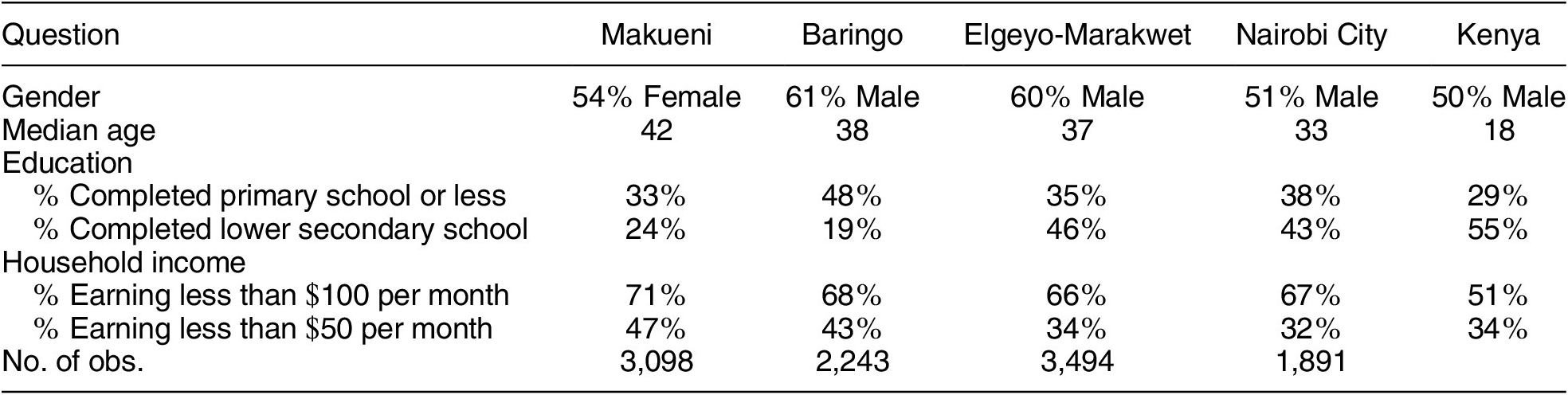
We selected Baringo, Elgeyo-Marakwet, Makueni, and Nairobi City Counties because they represent a cross-section of Kenya, maintained PB programs throughout our investigation, and offer variation on the local context, PB institutions, and PB actors that fall into the two broad sets of conditions described above. Table 1 presents basic information about the counties and Kenyan national averages.
Kenyan County Demography

Makueni County is roughly halfway between Kenya’s two major cities: Nairobi and Mombasa. It is primarily agrarian, but also benefits economically from people and goods moving between the coast and Nairobi. Baringo and Elgeyo-Marakwet Counties are in Kenya’s Rift Valley and are predominantly agrarian. Elgeyo-Marakwet is more economically productive than Baringo and had Kenya’s second-highest per capita Gross County Product in 2017. Politically, Makueni County is an opposition stronghold in national politics, whereas Baringo and Elgeyo-Marakwet’s governors are aligned with Kenya’s president and the leading party in Kenya’s legislature. Yet, Makueni county also carries on traditional practices of Big Man rule; county voters defeated 29 of 30 incumbent Members of the County Assembly (MCAs) when the governor supported their opponents in 2017. Governors’ races in Baringo and Elgeyo-Marakwet Counties have only been slightly more competitive than Makueni. Nairobi City County is Kenya’s most populous and wealthiest county. It is an economic driver with a small but growing middle class coupled with large, impoverished communities. Nairobi City has competitive elections at all levels, based on its multiethnic, multiclass, heterogeneous population. Nairobi City respondents thus provide a second type of subject pool: citizens who are not allies of the county government but may participate in PB.
Our case selection also encompasses the urban/rural divide, with large portions of Kenya and Sub-Saharan Africa remaining primarily rural. Rural areas are associated with “Big Man rule, clientelism, single-party dominance, low civil society, low state capacity, low economic development, and other factors potentially related to the performance of participatory institutions (Cheeseman, Kanyinga, and Lynch Reference Cheeseman, Kanyinga and Lynch2020; Cheeseman, Lynch, and Willis Reference Cheeseman, Lynch and Willis2020; Mamdani Reference Mamdani2018). It is difficult to disentangle the urban/rural setting from other factors, but we acknowledge its potential relevance to outcomes surrounding PB.
WHO PARTICIPATES?
Our field research indicates that governments invite their political allies and community partners to PB meetings. As one Makueni County CSO leader reported: “The government organizes the meetings and coordinates everything through the ward administrator. They work to bring the right people to the PB meetings, who are the most reliable government supporters” (Anonymous CSO Leader 2019). These allies include CSOs’ members and leaders; many, such as teachers’ organizations, rely on government benefits. In contrast, CSOs who are not government supporters are not invited to PB meetings. There is some evidence that these groups are barred from meetings when they discover their timing and location. As a different CSO leader in Makueni County described: “We tried to attend the meetings this past year. Every time the government heard that we were waiting, they cancelled the meeting and held a new one at different location with no advance notice.” (Anonymous CSO Leader 2018c). Drawing from our survey, we found that 65% of respondents received their information about PB meetings from government officials (legislators, chiefs [employed by the national government], and ward administrators), indicating that the government makes a concerted effort to invite allies.
We regularly observed government officials dominating PB meetings. For instance, officials provided instructions for what projects participants should select—especially in terms of large-scale, ward-wide, or county-wide projects. However, we also witnessed more vigorous debate around the government’s failure to implement previously selected projects. One civil society leader in Elgeyo-Marakwet stated, “Implementation is more important than public participation because money is involved…Talk is cheap, projects are not” (Anonymous Public Official 2022). Participants tend to have knowledge about stalled projects in their villages. They then use PB to ask governments to fulfill their promises. This observation is somewhat akin to retrospective voting because citizens process information as they monitor projects on a small scale and then make subsequent claims on public officials. The focus on government officials’ (in)actions suggests that the kernel of a more formalized accountability process as participants, including government allies, uses these budget forums to question public officials about PB projects.
Nairobi City County is an exception to many trends above. Nairobi City is heterogeneous from ethnic and partisan perspectives. Our interviews showed that MCAs use PB to mobilize supporters and gain votes based on delivering services. One MCA told us “MCAs and candidates from all parties attend budget meetings. They try to gain votes by championing local projects and reminding voters of the projects the government delivered [or did not deliver]” (Anonymous Public Official 2021). This activity is especially common in the most competitive wards, where pro-government votes are not guaranteed. In turn, political competition gives politicians in Nairobi incentives to activate meaningful public participation. MCAs place pressure on executive ministries to implement selected projects so that MCAs can take credit and retain office.
In sum, our field research indicates that PB outcomes are mixed: PB participants in most counties are government allies with little formal voice and a low probability of independent behavior during project selection. Moreover, most counties’ population overwhelmingly supports the governments and the PB processes, suggesting a “captured” audience. However, the same individuals are using PB to demand project completion. A different CSO activist stated, “We do not have influence over what is to be done [project selection], but our role is to make sure that things are done correctly” (Anonymous CSO Leader 2022).
SURVEY EXPERIMENT
We administered two waves of surveys in each county on residents’ attitudes and behaviors with both quantitative and qualitative data collected between 2018 and 2022. We randomly selected wards, PB meetings within wards, and then randomly sampled individuals to generate representative samples of participants and nonparticipants. In Makueni County, we surveyed participants at PB meetings (2,034 respondents) and then 1,226 nonparticipants in the same wards. In Baringo, we surveyed 1,005 meeting participants and 1,438 nonparticipants. In Elgeyo-Marakwet, we surveyed 1,234 meeting participants and 1,132 nonparticipants. In Nairobi City County, we surveyed 1,859 randomly selected residents, divided roughly evenly between co-partisans of the governor and supporters of opposition parties.
Our research team surveyed as close to the universe of meeting attendees as possible.Footnote 1 All surveys were professionally translated from English to Swahili, Tugen, Pokot, and Kamba, the most common local languages, and were read to respondents by native speakers. These survey enumerators recorded responses on tablets and uploaded all data to a central repository. Our survey first asks basic demographic questions surrounding respondents’ gender, age, education, and income (see Table 2). We present pooled data for both PB participants and nonparticipants in Tables 2 and 3 because there are only very minor differences between these subjects on demographic or behavioral responses within each county. PB participants are slightly more likely to be male in Baringo and Elgeyo-Marakwet Counties, are 2 years older than nonparticipants, on average, and are slightly more likely to identify as CSO leaders in all counties. Differences in all other variables are not statistically significant across the two pools.
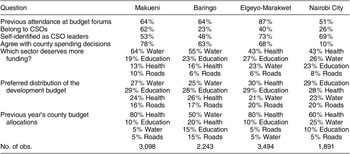
Summary Statistics for Demographic Responses


We also collected data on respondents’ activities related to government processes and civil society. We ask whether respondents have previously attended budget forums, whether they belong to CSOs, and whether they consider themselves CSO leaders. We were able to ask respondents’ political affiliations in Nairobi City, but not in Baringo, Elgeyo-Marakwet, or Makueni Counties. Yet, county voting data, questions about agreement with county budgets, and qualitative interviews suggest that almost all respondents are aligned with their county governor. Finally, we ask questions on what development sector should receive more money among the top four the county funds (water, health, education, and roads).
Treatment
Our experimental treatment was designed to evaluate local knowledge of development needs, development preferences, learning, and advocacy in budget processes. We randomly assigned respondents to a control group or one of two treatment groups as part of the experiment. The mechanics of the experiment are as follows: the first treatment group was primed with their county’s development budget. Then we asked these respondents to allocate a mock county development budget. The second treatment group allocated a mock budget without being shown their county’s development budget. Then this group saw the county’s development budget and reallocated their mock budget. The second treatment (Tb) assesses whether having a clear idea of one’s own preferences makes respondents more resilient to an elite signal from the county development budget.
We compare the responses to the two treatments with those from a control group that allocated a mock budget without receiving any county budget information. Because of random assignment, we view responses that differ between treatment and control groups as evidence of treatment effects, which in turn reveal underlying information about respondents’ preference strength and resilience to government signals. The distribution of control and treatment groups is as follows:
Control (3,312 respondents): No information about government spending, followed by a question on how respondents would distribute resources to create a mock budget.
Ta (3,309 respondents): We provided information about government spending from the previous year, which was then followed by a question on how respondents would distribute resources to create a mock budget.
Tb (3,307 respondents): No information about government spending, followed by a question on how respondents would distribute resources to create a mock budget. This is followed by government spending data from the previous year and a second, identical question on how respondents would create a mock budget.
We seek to understand if providing information “anchors” responses and moves respondents away from their prior development policy preferences (Brown Reference Brown1953; Tversky and Kahneman Reference Tversky and Kahneman1974). In our survey experiment, the information provided was the counties’ previous year’s spending allocations, which are heavily weighted toward health in Makueni and Elgeyo-Marakwet (80%), health in Nairobi as well (60%), and water in Baringo (50%) (Government of Baringo County 2018; Government of Elgeyo-Marakwet County 2018; Government of Makueni County 2018).Footnote 2
We use the previous year’s budget allocation as an “authoritative anchor” to evaluate respondents’ expression and maintenance of their own preferences in the presence of an elite signal. Do respondents maintain their positions based on their first responses surrounding development spending? Or do their preferences change through information about government spending? As discussed above, one of the central motivations for adopting PB is that project proposals and deliberation will reflect citizens’ needs and will alter government spending decisions in favor of citizen-participants’ preferences, not government preferences. Prospects for accountability through new democratic institutions increase as citizens advocate for their preferences in public venues, vote for projects that align with those preferences, and monitor governments to prevent deviation from agreed-upon spending distributions.
We expect that PB participants’ political alignment with county governments, perception as invited guests, and experience with government dominance of PB processes will make them willing to alter their preferences due to the experimental treatment—potentially more so than nonparticipants. Policy knowledge, formal education, and membership in CSOs might mitigate the potential effect of seeing the government’s latest budget allocation because those who are educated and active in their communities will have greater knowledge of long-term development needs than others (Avritzer Reference Avritzer2002). Similarly, priming respondents to first create their own budget allocation prior to seeing the government’s allocation could also mitigate the potential signaling effect of the government’s budget.
Previous research into the relationship between knowledge and anchoring effects shows that more knowledgeable research subjects exhibit smaller effects after exposure to experimental anchors (Smith, Windschitl, and Bruchmann Reference Smith, Windschitl and Bruchmann2013). Furthermore, providing research subjects with real information decreased their reliance on experimental anchoring cues (Smith, Windschitl, and Bruchmann Reference Smith, Windschitl and Bruchmann2013). The implication here is that anchoring effects should be smaller among more knowledgeable participants in PB programs. However, some of the deliberation literature runs counter to this expectation, and holds that more educated, informed participants are most persuadable in deliberative venues (Esterling, Fung, and Lee Reference Esterling, Fung and Lee2021). We note the lack of deliberation in Kenyan PB above, but acknowledge the possibility that educated, informed participants, such as CSO leaders, will shift their budget allocations more than other respondents. This translates to the following hypotheses, which are specific to the survey experiment:
H1: Respondents with no information will allocate funds in accordance with the policy area they believe deserves more funding (identified prior to treatments).
H1(b): CSO members and leaders will allocate funds that are closer to actual county allocations.
H2: Providing budget information will shift mock funds toward actual allocations.
H2(a): Providing budget information will shift mock funds more among PB participants than nonparticipants.
H2(b): Providing budget information will shift mock funds less in the area that respondents believe deserves more funding.
H2(c): Respondents who allocated their own budget before seeing the government’s will shift mock funds less than other respondents.
H2(d): Better educated and higher-income individuals will shift mock funds less than other respondents.
H2(e): Co-partisans of the governor will shift mock funds more than opposition supporters.
RESULTS AND DISCUSSION
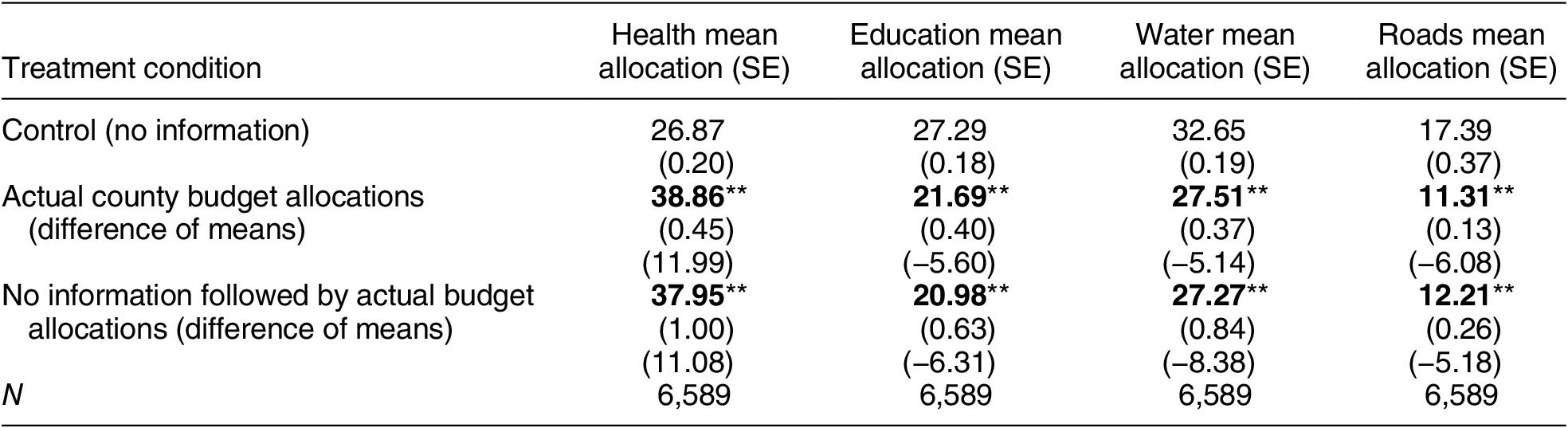
We present the results of estimation below, with separate tables for Makueni and Elgeyo-Marakwet, Baringo, and Nairobi City Counties because of the different development budgets and different crucial questions we could ask respondents. Table 4 presents the difference of means tests for the treatment conditions relative to the control in the respective counties using the Bonferroni correction for multiple comparisons. We pool the results for participants and nonparticipants because these responses are very similar; OLS results using an interaction of treatment condition with participation/nonparticipation in meetings are not significant. We report these results in the Supplementary Material along with OLS models with full covariates following Gomila (Reference Gomila2020). For Table 4, the treatment was the previous year’s actual budget allocation, which was 80% for health, 10% for education, 5% for roads, and 5% for water. Surprisingly, these allocations were almost identical across both Elgeyo-Marakwet and Makueni Counties. We therefore pool these results as well, with separate tables for each county in Tables 29 and 31 in the Supplementary Material at the APSR Dataverse (Touchton and Wampler Reference Touchton and Wampler2023).
Effects of Information Treatment on Preferred Allocation of Makueni and Elgeyo-Marakwet Counties’ Development Budget, by Sector and Percentage

Note: * and ** indicate P > t for difference in means between treatment and control at less than 0.05 and 0.01, respectively.
In Makueni and Elgeyo-Marakwet Counties, we find treatment effects across all issue areas based on providing county budget information. The control group (no information) and the pre-test Tb group allocated budgets as follows before seeing budgets: water (32%), education (28%), health (26%), and roads (18%). Seeing the previous year’s budget raises mock funding for health by more than 50% and decreases funding for education, water, and roads for both treatment groups (Ta and Tb). These results show how budget information anchors respondents by tying them to the government’s budget when respondents see the information before they allocate their own budget; this suggests a shift toward county elites’ policy preferences.
Treatment effects are very similar for respondents that first allocated their own budget, and then saw the actual budget before reallocating. These respondents’ original preferences do not anchor them, which contrasts with what Tversky and Kahneman suggest. Instead, respondents anchor to actual government allocations, not mock budgets. These results suggest that PB participants in Makueni and Elgeyo-Marakwet Counties want to conform to government spending decisions; they also imply deference to government priorities over their own priorities for development projects. For example, 65% of respondents in Makueni believe that water deserves more funding, and water receives the greatest budget percentage among respondents with no budget information. Among treatment groups, however, water drops to second place behind health after respondents learn of the county’s budget allocation.
The changes in the treatment groups’ budget allocation are significant. In Elgeyo-Marakwet and Makueni Counties, treated respondents increase mock health spending by almost 50% relative to the control group. Decreases for roads are similarly large at almost 50% of control group allocations. The shifts toward health are only 11 percentage points in absolute terms, but the reallocation would change the practical budget and the development projects the government implements considerably. For example, Makueni County spent approximately $900 to dig a well (Government of Makueni County 2018). A shift in budget priorities of the size we observe among treated respondents would represent an approximately $300,000 shift in Makueni County’s PB budget allocation, which translates to more than 300 wells. This potential shift is crucial from a development perspective as well as for building accountability through PB: Makueni respondents prioritized water over all areas, with education second, followed by health, and roads. However, if similar shifts to those in our survey experiment occurred in practice, money would be diverted from water and education to health, an area the government preferred, but which respondents prioritized lower.
Our results also shed light on other attitudes and behaviors in Makueni and Elgeyo-Marakwet. Respondents who were not primed with budget information tended to allocate the budget consistently with the sector they previously identified as deserving more funding (Tables 2, 11, 30, and 32 in the Supplementary Material). Thus, the control group maintained their core preferences. Respondents in both treatment groups shifted resources to match the government’s distribution more closely. However, neither treatment group fully shifted resources away from the sector they identified as most deserving. For example, Makueni and Elgeyo-Marakwet respondents in the treatment groups who believe that water deserves the most funding still shifted money away from water and toward health, which then commanded the greatest percentage of the respondents’ budgets. However, these respondents diverted more money away from education and roads to fund their increases for health than from water.
The differences in shifts for the preferred sector are small but statistically significant: respondents relinquish approximately 14% less of the absolute budget allocation from the sector they believe deserves the most funding relative to other sectors. This suggests that elite cues do not eliminate participants’ positions entirely and that anchoring effects are large, but not total—elite signals can readily shift respondents’ attitudes, but the effect is slightly less pronounced for respondents’ strongest held positions. It is therefore possible that PB helps citizens create a space that is not fully under government officials’ control. Citizens operate in public venues in ways that place them at odds with government officials—they largely defer to government officials, but not entirely, which could help to create the foundations for accountability.
Finally, respondents who identify as belonging to a CSO and those identifying as CSO leaders did not allocate the budget any differently than non-CSO respondents (Tables 5, 14, and 23 in the Supplementary Material). Similarly, there are no differences in treatment effects for respondents by education or income (Tables 8, 9, 26, and 27 in the Supplementary Material). Having previously attended a budget forum also does not moderate treatment effects in most models, nor does gender or age (Tables 6, 7, 10, 24, 25, and 28 in the Supplementary Material). As discussed above, this result is opposite to our expectations because anchoring and participatory institutions literature suggests that high-knowledge, more experienced participants behave differently: their preferences are fully formed, and they are less susceptible to outside pressure to change those preferences.
We use Baringo County to test the robustness of the results above against a different development budget allocation, where water spending represented the greatest portion instead of health, as in Elgeyo-Marakwet and Makueni. Note that Elgeyo-Marakwet and Makueni Counties prioritized health spending for 2 of the previous 5 years. Baringo’s results mirror those in Elgeyo-Marakwet and Makueni despite a distinct distribution of the development budget. We present Baringo County’s results in Table 1 in the Supplementary Material, with a description of baseline preferences and results of the survey experiment.
The results surrounding CSOs in all counties suggest that civil society does not influence respondents’ attitudes in the context of intraparty bargaining. Our interviews and PB meeting observations show that attending CSO groups are aligned with the governors’ political parties. Party politics may therefore influence attitudes more than engagement in civil society. No differences for higher income and better-educated respondents also imply that partisan political ties may influence attitudes more than other social characteristics.
Broad support for elected officials among non-PB participants implies that partisan support for incumbent governments is not limited to participants but is relatively consistent across counties. Both PB participants and nonparticipants strongly support their governments, which may make it more difficult to hold government officials accountable as citizens are willing to accept official government policies and priorities. Our results for nonparticipants in Baringo, Elgeyo-Marakwet, and Makueni Counties support this interpretation: nonparticipants also shift their budget allocations to align with the government’s allocations at similar levels to PB participants (Tables 4, 13, and 22 in the Supplementary Material).
Results from Baringo, Elgeyo-Marakwet, and Makueni Counties demonstrate respondents’ reliance on government cues and potential reluctance to challenge government policy positions. The basic survey questions on development priorities show that citizens have different development spending preferences than governments. However, these citizens live in counties where single political parties are dominant and where aspects of Big Man rule continue (Cheeseman, Lynch, and Willis Reference Cheeseman, Lynch and Willis2020). The prospects for taking local knowledge of community needs, translating it into development funding, and following through to ensure that governments implement projects in needed areas are low when participants shift opinions to match government preferences. Thus, establishing accountability through PB will be difficult if citizens alter their priorities to align with the government—for whatever reason, respondents may believe that “the government knows best” in prioritizing development funding. Moreover, our simulated budget exercise likely leads to smaller effects in a survey than in an actual PB meeting, where officials can pressure participants to conform to government preferences and support government priorities. Respondents are more likely to stick to their guns on a survey than in real meetings Thus, the true effect of elite signals may be much greater than what we capture in a survey.
In contrast to our hypotheses, no group allocated their budget in a way that reflected the government’s allocation in the current year without first seeing the government’s allocation. When respondents were shown the budget allocation, those belonging to community groups, identifying as leaders in these groups, those with higher education levels and income, men, and women, young and old, all allocated budgets similarly and all shifted allocations similarly to reflect the government’s distribution. This strongly suggests that participants in PB meetings are simply not informed about the broader county budget. Of course, broad budget knowledge is not common anywhere. However, the relevance here is that these results do not align with one of PB’s goals, which is to inform participants about the development budget. Budget knowledge might not be increasing through participation, even among CSO leaders and participants with more education—two critical populations for deliberation and accountability in participatory institutions. Citizens need basic information to identify development needs, meaningfully deliberate on development spending, and channel resources to marginalized communities.
We report an additional check on the results above by leveraging our village-level data collection for Makueni County and breaking the analysis out from the ward-level data. The results, presented in Table 33 in the Supplementary Material, are even starker: village respondents, who should have the greatest knowledge of their communities relative to county officials, shift their preferences toward the government position at well over twice the levels of respondents in the Makueni’s remaining ward-level sample. This result suggests fewer prospects for accountability through PB for the reasons described above: community knowledge should be greatest relative to government officials at the village level. Ready deference to those officials therefore likely takes village PB projects farthest away from community needs and toward government priorities.
Understanding the results of our survey experiment requires acknowledging the serious challenges for building democratic institutions in Kenya. These challenges extend to much of the Global South, where education tends to be low, civil society is underdeveloped, and deference to government authority remains common. Our results are opposite many perceptions of PB: PB meetings in Brazil’s original programs typically featured some challenges to the status quo, demands for more development projects, improved services, and better governance. Furthermore, participants in Latin American PB programs are disproportionately representative of vulnerable or marginalized groups with many harboring grievances with the government and pent-up demand for development projects due to historically limited service provision (Avritzer Reference Avritzer2002; Baiocchi, Heller, and Silva Reference Baiocchi, Heller and Silva2011). Thus, participants shifting their positions on development spending allocations or, by extension, readily deferring to government spending proposals is unusual (Abers Reference Abers2000; Avritzer Reference Avritzer2002; Baiocchi, Heller, and Silva Reference Baiocchi, Heller and Silva2011; Wampler Reference Wampler2007). In turn, research based on PB in Brazil, Argentina, and Uruguay implies that the Kenyan results are not conducive to building accountability within PB—PB is not empowering citizens to advocate for their preferences surrounding development projects, much less extending that advocacy beyond the development budget (Goldfrank Reference Goldfrank2011; Wampler, McNulty, and Touchton Reference Wampler, McNulty and Touchton2021). Instead, “perverse accountability” may lead to development projects that did not come from citizens’ proposals. These projects are still welcome, but they reinforce the clientelistic exchange of broader political support for development favors and ensure elections remain uncompetitive (Cheeseman, Lynch, and Willis Reference Cheeseman, Lynch and Willis2020; Stokes Reference Stokes2005).
Yet, our results also provide some prospects for building accountability in Kenyan PB programs. Respondents’ revised budget allocations are not identical to governments’ positions and respondents do not shift as many resources away from the area they previously identified as deserving more funding. Thus, it is possible that PB is promoting accountability to some extent. The importance of advocating for one’s preferences in the face of government pressure leads us to ask what explains why citizens maintain their own preferences or shift when they receive elite signals?
Nairobi City County: Administering our experiment to randomly selected residents of Nairobi City County helps answer why citizens maintain their preferences or shift based on elite signals. We selected respondents randomly through a phone bank from the county’s general population. The sample is balanced across potentially relevant demographic elements such as gender, age, income, and education. Importantly, many in the Nairobi sample had attended public participation meetings on development projects and we were able to ask respondents their political affiliation.
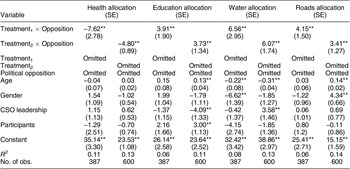
The Nairobi subject pool helps us test an additional hypothesis stemming from the earlier results: namely, that partisan cues drive responses in our survey experiment. Nairobi City County uses PB, but the county is much more politically heterogeneous than the other counties in the study. We also know the respondents’ political affiliations and can evaluate the extent to which co-partisans with the governor respond differently to our treatments than those who align with the political opposition. Table 5 presents the results of OLS estimation for the information treatment interacted with respondents’ partisanship, divided into opposition and support for the governor’s party, with a range of control variables. See Table 3 for Nairobi City County’s 2019 development budget.
Effects of Information Treatment on Preferred Allocation of the Nairobi City County Development Budget, by Sector and Percentage

Note: * and ** indicate P > t for difference in means between treatment and control at less than 0.05 and 0.01, respectively. These models interact treatments and respondents’ partisanship, divided into opposition and support for the Governor’s party. Conditional coefficients are available on request.
Nairobi respondents who support opposition parties shift their allocations away from the government. This implies that these opposition respondents are consistent in their priorities and the government’s “authoritative anchor” or elite signal did not induce them to change their preferences. These respondents do not support the county government and are not swayed by how the government spent the development budget. Instead, these respondents remain true to their personal assessments of community development needs.
The implication of our results in Nairobi City County is that multiparty political competition might keep citizens’ policy preferences focused on community needs, rather than shifting them toward governments’ goals. The Nairobi results also suggest that building multiparty political competition might permit a greater range of policy preferences to be represented in government and serve as an important step toward improving local governance. Ultimately, our survey design does not tell us precisely how individuals form policy preferences or why they shift toward or away from government budgets. However, the Nairobi City County results strongly suggest partisan cues as the key element.
The lack of political competition in the other three counties can stem from many sources, including the urban/rural divide, the lack of civil society, the role of clientelism, the lack of education, and general lack of economic development. These sources could influence citizens to shift their budget allocations, as could a lack of information, assuming the government “knows best,” and not wanting to stand in the way of development. But why respondents shift preferences is ultimately less important for the accountability chain presented in Figure 1 than the knowledge that government supporters do consistently shift toward the government’s position. In conjunction with the new context, institutions, and actors, participants’ behavior is enough to undermine or even break the first three links in the chain of accountability.
CONCLUSION
Many national governments in semi-democratic, low-income regimes have decentralized decision-making authority to participatory venues in the hopes that bringing government closer to the people will improve accountability and development. This article demonstrates the vital importance of the broader sociopolitical context in which these institutions are embedded. We find that respondents change their policy preferences to align with the government in counties with uncompetitive elections. Moreover, those affiliated with the political opposition in a competitive political context (Nairobi City) reject elite cues from the party in power. One crucial implication is that participatory institutions need to be nested within competitive electoral environments to create incentives for governments to respect the public and for the public to advocate for their interests.
We also find that PB’s internal rules matter. Shifts toward consensus-based decision-making and away from the secret ballot, dropping explicit redistributive rules, and curtailing deliberation combine to limit Kenyan PB programs’ potential to generate accountability. Government officials and their allies tend to dominate the “consensus” decision-making process within PB programs, suggesting that the new participatory venues are an additional platform for governments to assert their own preferences. Government allies are more likely to advocate for public works projects that benefit themselves and elected governments over those who are excluded from the meetings and those whose voices go unheard. Partisan political allies are also unlikely to use new democratic institutions hold public officials accountable—at least not in the short time that the institutions have been in place. This finding is particularly important because participatory institutions are being adopted by subnational governments in semi-democratic and authoritarian environments, including China and Russia. We infer from our findings that participatory institutions are more likely to legitimize authoritarian governments rather than act as spaces for building democratic practices when they operate within authoritarian contexts.
However, we do recognize the possibility that PB can contribute to the most basic foundations of accountability. New democratic institutions in semi-democratic, low-income contexts show some potential for beginning a long march toward accountability and for collective action to advance community goals. Respondents are slightly less willing to change their strongest policy preferences, thus indicating some willingness to “hold the line” and create distance between themselves and governments. Fieldwork also shows that citizens are using public meetings to generate retrospective accountability, whereby participants focus on stalled projects. Participants who were “invited guests” in participatory meetings might still use these forums to demand better performance.
Our third key finding is that the presence of a new actor—The World Bank—and the exclusion of opposition or independent CSOs fundamentally alters the political logic within new democratic institutions. Government officials are attuned to the World Bank’s policy agenda, both within PB and beyond, which means that producing development projects is often seen as more important than empowering citizens and generating accountability. By “inviting” civil society allies to participate and by excluding opposition CSOs, PB becomes a format through which perverse accountability begins to take root (Cornwall Reference Cornwall2002; Stokes Reference Stokes2005).
The broader implication of our results is that we should not expect participatory institutions to generate robust accountability in semi-democratic, single-party-dominant or authoritarian systems—certainly not in the short timeframe under investigation. We are highly skeptical of participatory institutions’ prospects for empowering citizens and holding government officials accountable in places like Russia and China. In these contexts, there are too few incentives for government officials to promote deliberation and ensure that a broad cross-section of voices are heard. However, for PB advocates, our results provide a glimmer of hope because participants are using PB to advocate for “retrospective accountability.” We argue that this creates the possibility of establishing accountability’s basic foundations, but that this will also require incremental construction (Fox Reference Fox2015). We thus have some long-term reasons to be optimistic about new democratic institutions’ potential for change in semi-democratic contexts, but many short-term reasons to be skeptical as well.
SUPPLEMENTARY MATERIAL
To view supplementary material for this article, please visit https://doi.org/10.1017/S0003055422001484.
DATA AVAILABILITY STATEMENT
Research documentation and data that support the findings of this study are openly available at the American Political Science Review Dataverse: https://doi.org/10.7910/DVN/NJIIPR.
ACKNOWLEDGMENTS
We are grateful to the World Bank for supporting this research. Stephen Davenport, Tiago Peixoto, Annette Omollo, Rose Wanjiru, and Caleb Wasilwa deserve special thanks. We are also grateful to IPA (Kenya) for assisting us in implementing this research. Frank Odhiambo and Allison Stone deserve extra recognition for supporting the project. Governments of Baringo, Elgeyo-Marakwet, Makueni, and Nairobi City Counties provided exceptional access and cooperation throughout the course of this study, for which we are grateful. We also thank panelists and discussants at the MPSA annual meeting in 2019 and the SPSA in 2020 who read preliminary versions of the article. Finally, we would like to thank the editors of the American Political Science Review and three anonymous reviewers for their valuable comments, suggestions, and feedback throughout the review process.
FUNDING STATEMENT
The research was funded by the World Bank and implemented in conjunction with IPA (Kenya); the authors received no payments as consultants and are co-owners of all data.
CONFLICT OF INTEREST
The authors declare no ethical issues or conflicts of interest in this research.
ETHICAL STANDARDS
The authors declare the human subjects research in this article was reviewed and approved by the Maseno University IRB (Kenya) and the University of Miami IRB. Certificate numbers are MSU/DRPI/MUERC/00612/18 for Maseno and 20180535 for Miami.





Comments
No Comments have been published for this article.