Introduction
Veterans who have served in the Iraq and Afghanistan conflicts report high rates of psychiatric disorders, with particularly high rates of posttraumatic stress disorder (PTSD). An important correlate of veterans' psychiatric disorders is exposure to traumatic events (Brewin & Holmes, Reference Brewin and Holmes2003). This can include factors occurring prior to military service such as childhood adversity (e.g. physical, sexual, or emotional abuse) as well as veteran-specific experiences that occurred during active duty deployment (e.g. combat-related trauma and experiences of military sexual trauma). Recent research has reported that individuals with a military experience report greater childhood adversity than non-military involved individuals (Blosnich, Dichter, Cerulli, Batten, & Bossarte, Reference Blosnich, Dichter, Cerulli, Batten and Bossarte2014). In fact, recent research has noted nearly 85% of veterans receiving treatment for PTSD endorsed at least one category of childhood adversity prior to the age of 18 and 42% reported four or more (Carroll, Currier, McCormick, & Drescher, Reference Carroll, Currier, McCormick and Drescher2017). Not surprisingly, experiences of childhood adversity are associated with greater risk for PTSD, depression, suicidal behaviors, and substance use among veterans (van Voorhees et al., Reference van Voorhees, Dedert, Calhoun, Brancu, Runnals and Beckham2012).
The stress sensitization hypothesis posits that when individuals experience stressful life events, the risk for developing psychiatric problems is heightened for individuals who report experiences of childhood adversity compared to those who have not experienced childhood adversity (Hammen, Henry, & Daley, Reference Hammen, Henry and Daley2000). In the initial study testing the stress sensitization hypothesis, recent stressful events were associated with increased risk for depressive disorders among women with a history of childhood adversity compared to those without a history of childhood adversity (Hammen et al., Reference Hammen, Henry and Daley2000). Others have tested the stress sensitization hypothesis with mixed results. For example, prior work has noted varying degrees of stress sensitization based on low (Hammen et al., Reference Hammen, Henry and Daley2000) or high (Rousson, Fleming, & Herrenkohl, Reference Rousson, Fleming and Herrenkohl2020) levels of stress in association with depressive disorders. Others have noted no evidence of stress sensitization among participants with recurrent depression (Kok et al., Reference Kok, van Rijsbergen, Burger, Elgersma, Riper, Cuijpers and Bockting2014). In a more recent examination of the stress sensitization hypothesis among a representative U.S., non-military, sample, past year stressors were associated with greater odds of meeting criteria for PTSD, depression, and anxiety disorders for those who reported three or more childhood adversities compared to those without a history of childhood adversity (McLaughlin, Conron, Koenen, & Gilman, Reference McLaughlin, Conron, Koenen and Gilman2010).
Despite mixed support for the stress sensitization hypothesis, little is known how these processes play out among veterans. Only a few studies have addressed this issue among military involved samples. Bandoli et al. (Reference Bandoli, Campbell-Sills, Kessler, Heeringa, Nock, Rosellini and Stein2017) used latent class analysis (LCA) to derive profiles of early childhood adversity among recent Army recruits. Results supported the stress sensitization hypothesis for depression and anxiety disorders for all childhood adversity profiles compared to those experiencing no childhood adversity. Using data from two waves of the National Comorbidity Survey study over a 10-year period, Sachs-Ericsson, Joiner, Cougle, Stanley, and Sheffler (Reference Sachs-Ericsson, Joiner, Cougle, Stanley and Sheffler2016) reported greater PTSD scores for those who experienced combat and reported high levels of recent life stressors.
While these aforementioned studies have provided compelling evidence of stress sensitization among both non-military and military-involved samples, there are several ways to advance our understanding. First, while Bandoli et al. (Reference Bandoli, Campbell-Sills, Kessler, Heeringa, Nock, Rosellini and Stein2017) provided the first evidence of stress sensitization within a military sample, the study involved new Army recruits. As such, one cannot infer how the stress sensitization hypothesis applies to veterans during post-deployment periods who experience stressors that accompany discharge from the military and reintegration back into civilian life (Elnitsky, Fisher, & Blevins, Reference Elnitsky, Fisher and Blevins2017). Second, while the national co-morbidity study (Sachs-Ericsson et al., Reference Sachs-Ericsson, Joiner, Cougle, Stanley and Sheffler2016) included two waves of data, these data points are nearly 10 years apart (first wave in the early 1990s), involve older veterans (ages 55+), and do not allow for investigation of how acute changes in perceived stress relate to earlier childhood adversity and subsequent psychiatric problems. Third, though the Bandoli et al. (Reference Bandoli, Campbell-Sills, Kessler, Heeringa, Nock, Rosellini and Stein2017) study used mixture modeling to examine the effect of childhood adversity, the authors were unable to examine how military-specific experiences in combination with childhood adversity may relate to later-life stress sensitization profiles and psychiatric disorders (e.g. PTSD). The present study, therefore, has two main aims. The first aim is to test a stress sensitization hypothesis among veterans focused solely on experiences of early childhood adversity. However, this aim will be slightly different than prior work such that we are assessing how childhood adversity (assessed across different forms of childhood sexual, physical, and emotional abuse) is associated with changes in perceived stress (e.g. longitudinal stress trajectories) and how heterogeneity in sensitization may be related to PTSD symptomology. The second aim is to extend the stress sensitization hypothesis by exploring how childhood adversity in combination with veteran-specific experiences (combat exposure and military sexual trauma), are associated with changes in stress and PTSD.
Methods
Participants & procedures
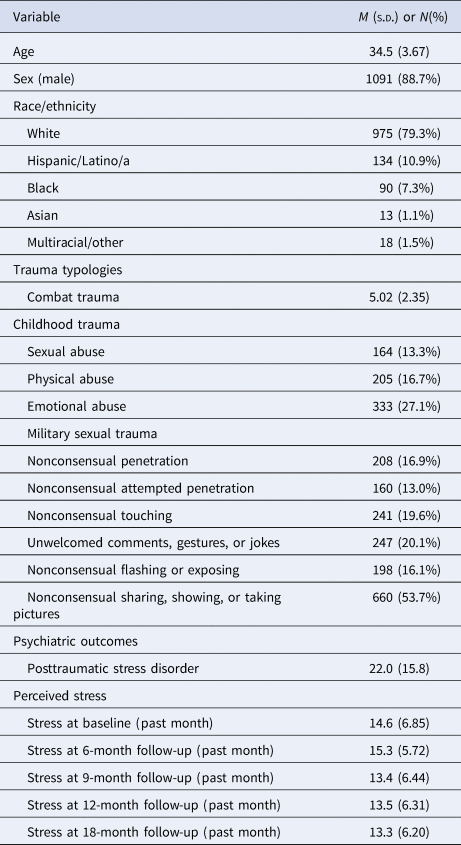
Veterans aged 18 to 40 who had separated from the Air Force, Army, Marine Corps, and Navy were recruited in February 2020 as part of a large survey study to understand young adults veteran attitudes and health behaviors. Advertisements were displayed on social media websites (Facebook, Instagram) and military-specific social media websites and listservs (RallyPoint, We Are the Mighty). The final sample was composed of 1230 veteran participants at baseline (see Supplementary material for participant flow diagram). Participants were later invited by email to complete four follow-up surveys over the course of the coronavirus disease 2019 (COVID-19) pandemic. They were sent follow-up surveys via email at 6-months (August 2020; N = 1025; 83.3% retention from baseline), 9-months (November 2020; N = 1006; 81.8% retention from baseline), and 12-months (February 2021; N = 1005; 81.7% retention from baseline) and 18-month (August 2021; N = 976; 79.3%). See Davis, Castro, Saba, Fitzke, and Pedersen (Reference Davis, Castro, Saba, Fitzke and Pedersen2021) for more information on participant recruitment. On average participants were 34.5 years old, with 88.7% identifying as male. On average, veterans served in the military for 9.6 years (s.d. = 3.7) and had been out of the military for an average of 5 years (s.d. = 3.5). See Table 1 for more participant demographics and Supplementary material for the participant flow diagram. All materials and procedures were approved by the local Institutional Review Board.
Demographic characteristics

Measures
Childhood adversity
To assess childhood adversity, items from the Adverse Childhood Experiences questionnaire (Felitti et al., Reference Felitti, Anda, Nordenberg, Williamson, Spitz, Edwards and Marks1998) were used at baseline. Each item asked participants to indicate whether a specific traumatic event happened to them (yes/no) prior to their 18th birthday. Example items included ‘did a parent or other adult often or very often swear at you, insult you, put you down, or humiliate you?’ and ‘did a parent or other adult often push, grab, slap, or ever hit you?’ Four dichotomous items were created to indicate if the participant had ever experienced emotional abuse (created from three items), physical abuse, sexual abuse, or witnessed parents fight.
Military sexual trauma
Sexual violence was assessed at baseline using five dichotomous items from the 2014 RAND Military Workplace Study to capture nonconsensual sexual violence, including physical assault and attempted physical assault, that occurred while the individual was in the military (Morral, Gore, & Schell, Reference Morral, Gore and Schell2016). To reduce the number of items for analyses and to combine similar items together into broader categories, we created three categories of (1) nonconsensual penetration (two items assessed nonconsensual penetration of the mouth, anus, or vagina); (2) attempted penetration (one item assessed attempted penetration that was unsuccessful); and (3) unwanted sexual touching (two items assessed unwanted sexual touching of one's private parts without penetration). Sexual harassment was assessed using five items from the Campus Climate Survey Validation Study conducted by the Bureau of Justice Statistics and RTI International (Krebs et al., Reference Krebs, Lindquist, Berzofsky, Shook-Sa, Peterson, Planty and Stroop2016) to capture unwelcomed and nonconsensual sexual harassment while the individual was in the military. We again combined similar items together into three broader categories. One item assessed (1) unwanted sexual advances, jokes directed at the individual, or gestures; one item assessed (2) nonconsensual exposing of private parts; and three items assessed (3) sexual harassment via spreading rumors or showing unwelcomed pictures (i.e. the spreading of sexual rumors, nonconsensual sharing of pictures or videos, the individual did not want to see or did not want shared).
Combat exposure
The severity of combat exposure was assessed at baseline using a measure of 11 items from prior work with veterans (Schell & Marshall, Reference Schell and Marshall2008). Example items are: ‘Having a blow to the head from any accident or injury’, ‘Engaging in hand-to-hand combat’, and ‘ever feeling like they were in great danger of being killed’. Participants responded yes/no to each of the 12 items.
Perceived stress
Participants responded the 10-item Perceived Stress Scale (Cohen, Kamarack, & Mermelstein, Reference Cohen, Kamarck and Mermelstein1994) at all waves. Each item asked participants to rank how often they had a specific experience in the past month on a Likert scale from never (0) to very often (5). Example items include ‘how often have you been upset because of something that happened unexpectedly?’, ‘how often have you felt nervous or stressed?’, and ‘how often have you been able to control irritations in your life?’ (reverse scored). A summed score was created for each wave (α mean = 0.76) with higher scores associated with greater stress.
Distal outcomes at the 18-month survey wave
Posttraumatic stress disorder
PTSD symptom severity was assessed using the 20-item Posttraumatic Stress Disorder Checklist for DSM-5 (PCL-5). Participants indicated the extent to which they were bothered by specific PTSD symptoms (e.g. avoidance of internal or external reminders of the traumatic experience, feeling jumpy or easily startled) in the past month from not at all (0) to extremely (4) (Bovin et al., Reference Bovin, Marx, Weathers, Gallagher, Rodriguez, Schnurr and Keane2016). The PCL-5 yields a total sum score ranging from 0 to 80, and had a reliability estimate of α = 0.91 in the current sample. The PCL was also included at baseline (α = 0.96) to control for baseline PTSD severity. Of note, the clinical cutoff for the PCL is 33 and we included this value in figures for visualization purposes.
Analytic plan
To test a stress sensitization model that does not assume a cumulative approach to childhood adversity or a static (no change) assumption of stress but, rather, assumes there is heterogeneity in these constructs (Aim 1), we utilized latent transition analysis (Nylund-Gibson, Grimm, Quirk, & Furlong, Reference Nylund-Gibson, Grimm, Quirk and Furlong2014). For Aim 1, we first used latent class analyis (LCA) to extract heterogeneity in childhood adversity and then used growth mixture modeling (GMM) to extract heterogeneity in perceived stress trajectories over the 18-month study period. A series of models were estimated for childhood adversity and perceived stress, separately, with one to six classes and, as with all mixture models, model fit was assessed with several indicators: lower values of negative two log likelihood (−2LL), and the sample size adjusted Bayesian information criteria (aBIC), a non-significant Vuong-Lo-Mendell-Rubin Likelihood Ratio test (VLRT), Lo-Mendell-Rubin adjusted likelihood ratio test (LRT), and bootstrapped likelihood ratio test (BLRT) indicate better model fit. Of note, for the stress GMM, we excluded baseline values in the estimation of class trajectories in order to account for any overlaps in measurement (e.g. childhood adversity measured only at baseline) because this may be confounded with baseline stress scores and conflate transition effects. We did, however, control for baseline stress in the extraction of our class trajectories.
Once the best fitting LCA for childhood trauma and the best fitting GMM for perceived stress were determined, we utilized latent transition analysis. To model transitions across latent classes we regressed the latent class variable for emergent perceived stress trajectory classes on the latent class variable for emergent childhood adversity classes. This procedure quantifies change as a matrix of transition probabilities between two latent class variables and is used to assess the extent to which membership in a particular childhood adversity class is associated with the probability of transitioning into, for example, a lower or higher-risk pattern of stress over the 18-month study period.
In an attempt to extend the stress sensitization hypothesis to include veteran-specific experiences (Aim 2), we replicated the steps described above. However, in addition to childhood adversity we included veteran-specific stressors in our LCA by incorporating responses to 11 items assessing combat exposure and 6 items assessing military sexual trauma. Once the best fitting LCA was determined, we followed procedures for latent transition analysis as described above using emergent stress trajectories. Doing this allowed us to determine how veteran-specific stressors, in addition to childhood adversity, are associated with transitioning to a lower or higher risk pattern of stress over the study period.
Finally, in an attempt to determine how sensitization may be related to important psychiatric outcomes, we assessed mean differences in PTSD symptomology across transition patterns for both Aim 1 and Aim 2. That is, we assessed how specific transition patterns (e.g. from emergent childhood adversity classes to a high-risk stress trajectory) compare on PTSD symptomatology at the final time point, controlling for baseline PTSD.
Results
Aim 1: heterogeneity in childhood adversity
LCA class enumeration for childhood adversity
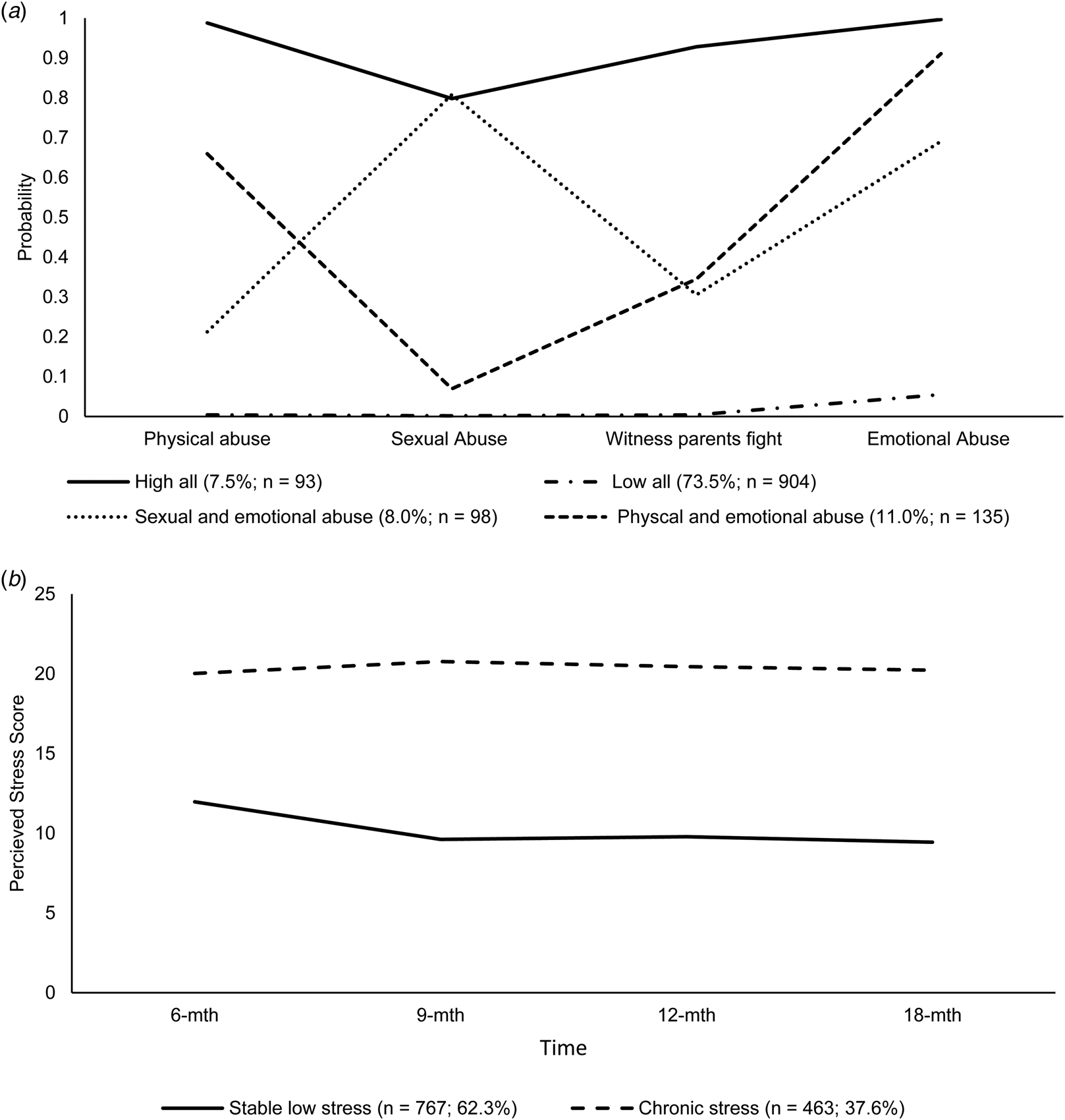
A series of LCA models were estimated. Fit indices for the childhood adversity LCA can be found in Supplementary material. The non-significant VLRT, LRT, and BLRT values for the five-class solution indicated a four-class solution was the best fitting model (See Fig. 1a for visual representation). The high all childhood adversity class represented 7.5% (n = 93) of the sample. Veterans in this class endorsed high rates of all childhood adversity items. The low all class represented 73.5% (n = 904) of the sample. Veterans in this class had a very low endorsement of all childhood adversity items. The Physical and emotional abuse class represented 11.0% (n = 135) of the sample. Veterans in this class had a high endorsement of emotional and physical abuse, but a relatively low endorsement of sexual abuse and witnessing parental violence. Finally, the sexual and emotional abuse class represented 8% (n = 98) of the sample. Veterans in this class endorsed high sexual and emotional abuse with a relatively low endorsement of physical abuse and witnessing parental violence. Note: all fit indices for each mixture model can be found in Supplementary material.
(a) Final model for adverse childhood experiences latent class analysis. (b) Final model for perceived stress growth mixture model. Baseline stress was not used (but was controlled) to avoid measurement dependencies with childhood adversity.

GMM class enumeration for perceived stress
The non-significant VLRT, LRT, and BLRT values for the three-class solution indicates the two-class solution fit the data best. We also plotted the aBIC values to determine any plateau points, which indicated a plateau between the 2 and 3 class solution, further indicating the 2-class solution as the best fitting (see Fig. 1b for visual representation).
The chronic stress class represented 37.6% (n = 463) of participants. Veterans in this class had very little change in perceived stress throughout the study, remaining relatively high and consistent in perceived stress. The stable low class represented 62.3% (n = 767) of the sample. Veterans in this class also had little change in perceived stress, however they remained consistently low in perceived stress throughout the study period.
LTA model: childhood adversity and stress
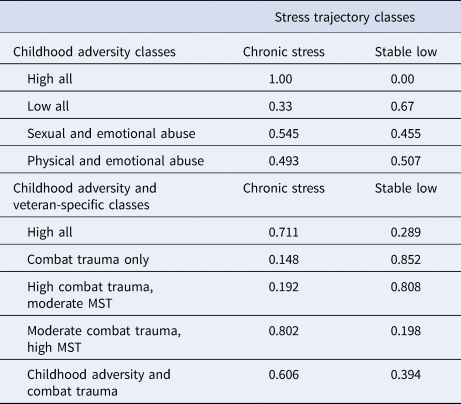
Table 2 presents the transition probabilities describing patterns of movement (e.g. transition) from childhood adversity classes to stress trajectory classes. Veterans in the high all childhood adversity class only showed transition patterns into the chronic stress (probability (P) = 1.00) classes. Among those veterans in the sexual and emotional abuse and the physical and emotional abuse classes, about half transitioned into the chronic stress trajectory class (P = 0.55 and P = 0.49, respectively). Not surprisingly, veterans in the low all childhood adversity class had the highest transition probability to the stable low stress trajectory class (P = 0.67), with some transitioning into the chronic stress (P = 0.33) class.
Latent transition probabilities from childhood adversity and veteran-specific classes to perceived stress trajectory classes

Note. Values are transition probabilities.
Effects of transition patterns on PTSD symptoms
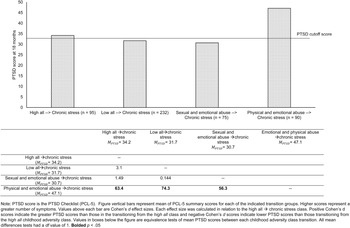
In an effort to understand how stress sensitization is associated with psychiatric disorders, we explored mean differences in PTSD scores across transition patterns. After exploring the transition matrices, we decided to present comparisons of mean differences in PTSD scores across all childhood adversity classes that transitioned into the chronic stress trajectory class. These transition patterns are substantively meaningful as they allow us to explore how veterans' PTSD scores vary among those who transition from each childhood adversity class into a high-risk perceived stress trajectory class. Results of these analyses can be found in Fig. 2. Those veterans experiencing emotional and physical abuse and transitioning to the chronic stress trajectory class had the highest PTSD score (M = 47.1) which was significantly different than all other transition patterns. All other transitions to the chronic stress trajectory showed no significant differences in PTSD scores: sexual and emotional abuse (M = 30.7), high all (M = 34.2), and low all (M = 31.7). We note that only those veterans transitioning from the physical and emotional abuse and high all childhood adversity classes exceeded the clinical cutoff for PTSD (score of 33).
Mean differences in PTSD for transition patterns from early childhood adversity classes to the chronic stress class.
Note. PTSD score is the PTSD Checklist (PCL-5). Figure vertical bars represent mean of PCL-5 summary scores for each of the indicated transition groups. Higher scores represent a greater number of symptoms. Values above each bar are Cohen's d effect sizes. Each effect size was calculated in relation to the high all → chronic stress class. Positive Cohen's d scores indicate the greater PTSD scores than those in the transitioning from the high all class and negative Cohen's d scores indicate lower PTSD scores than those transitioning from the high all childhood adversity class. Values in boxes below the figure are equivalence tests of mean PTSD scores between each childhood adversity class transition. All mean differences tests had a df value of 1. Bolded p < 0.05

Aim 2: heterogeneity in childhood adversity and veteran-specific stressors
LCA class enumeration for childhood adversity and veteran-specific stressors
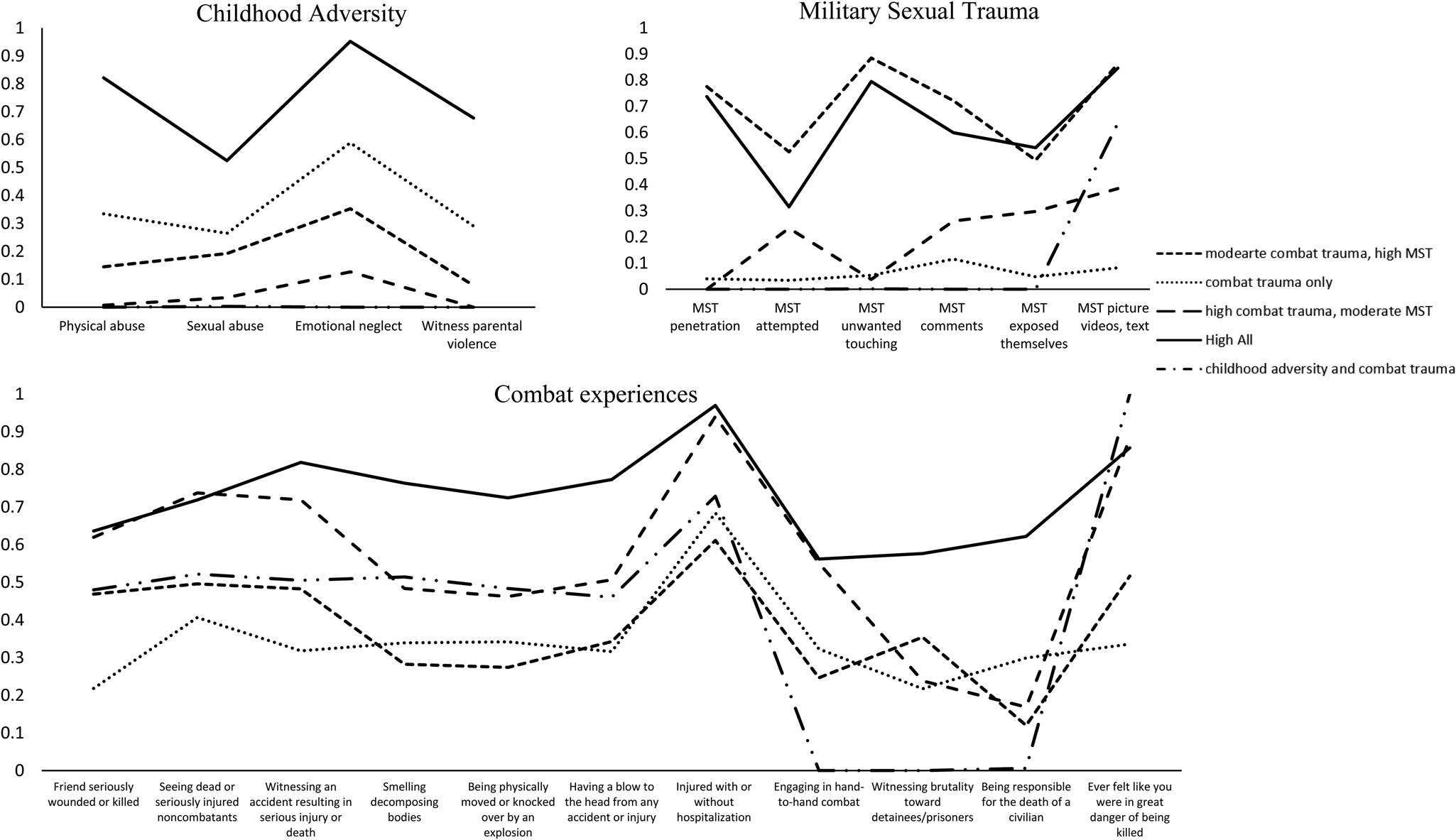
A series of LCA models were fit starting with a one-class model. Fit indices for the polytrauma LCA can be found in Supplementary material. The non-significant VLRT, LRT, and BLRT values indicated a six-class solution may be the best fitting model. However, upon reviewing the plotted classes, the five-class solution not only retained the same class information (i.e. similar class sizes and structure) but it eliminated a repeat class that emerged in the six-class solution. Thus, we chose the five-class solution. In Fig. 3 we present the final class solution, broken out by each adversity type for ease of interpretation.
Plots for childhood adversity and veteran-specific stressors broken out by adversity and military experiences.

The high all class represented 10% (n = 124) of participants. Within this class, participants had a high probability of endorsing all victimization typologies. The moderate combat trauma, high military sexual trauma class represented 11% (n = 135) of the sample. Veterans in this class had a moderate endorsement of combat trauma and relatively high endorsement of military sexual trauma, but a low endorsement of childhood adversity. The high combat trauma, moderate military sexual trauma class represented 12% (n = 148) of the sample. Veterans in this class primarily endorsed combat trauma items with a moderate endorsement of military sexual trauma, and very low endorsement of childhood adversity. The childhood adversity and combat trauma class represented 21% (n = 254) of the sample. Veterans in this class reported moderate levels of both childhood adversity and combat trauma, and little to no reported experiences of military sexual trauma. Our final class, namely combat trauma only, represented 46% (n = 569) of the sample. Here, veterans had the high endorsement of indirect combat trauma items such as fear or danger of being killed but a very limited endorsement of engaging in hand-to-hand combat, being responsible for the death of a civilian, or witnessing the brutality of others. Individuals in this class had next to zero probability of endorsing childhood adversity or military sexual trauma items. See Fig. 3 materials for a visual representation of classes.
LTA model: childhood adversity, veteran-specific stressors, and stress
The bottom of Table 2 presents the transition probabilities describing patterns of movement (e.g. transition) from childhood adversity and military-specific adversity classes to stress trajectory classes over the 18-month follow-up period. Veterans in the high all class had a high probability of transiting into the chronic stress class (probability (p) = 0.71). Similarly, those veterans in the moderate combat trauma, high military sexual trauma (p = 0.80) and the childhood adversity and combat trauma (p = 0.61) class both had a high probability of transitioning to the chronic stress trajectory class. Those veterans in the combat trauma only (p = 0.19) and the high combat trauma, moderate military sexual trauma class had a relatively high probability of transitioning into the stable low stress trajectory class.
Effects of transition patterns on PTSD symptoms
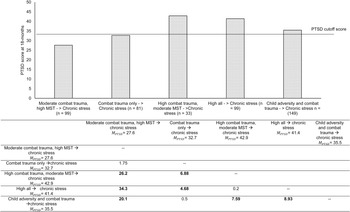
Similar to Aim 1, after exploring the transition matrices we decided to present mean differences in PTSD scores across all childhood adversity and military stressor classes that transitioned into the chronic stress trajectory class (see Fig. 4). Veterans in the high all (M = 41.4) and the high combat trauma, moderate military sexual trauma (M = 42.9) classes who transitioned into the chronic stress trajectory class reported the highest PTSD symptoms at the 18-month follow-up, which were significantly higher than all other transitions. Those veterans transitioning from the indirect combat trauma only (M = 32.7) and the moderate combat trauma, high military sexual trauma (M = 27.6) class had the lowest PTSD scores. Only those veterans transitioning from the high all, child adversity and combat trauma, and high combat trauma, moderate military sexual trauma exceeded the clinical cutoff for PTSD
Mean differences in PTSD for veterans transitioning from early childhood adversity and veteran-specific classes to chronic stress class.
Note. MST = military sexual trauma. PTSD score is the PTSD Checklist (PCL-5). Figure vertical bars represent mean of PCL-5 summary scores for each of the indicated transition groups. Higher scores represent a greater number of symptoms. Values above each bar are Cohen's d effect sizes. Each effect size was calculated in relation to the high all → chronic stress class. Positive Cohen's d scores indicate the greater PTSD scores than those in the transitioning from the high all class and negative Cohen's d scores indicate lower PTSD scores than those transitioning from the high all childhood adversity class. Values in boxes below the figure are equivalence tests of mean PTSD scores between each childhood adversity class transition. All mean differences tests had a df value of 1. Bolded p < 0.05

Discussion
Veterans experience traumatic events at alarming rates, including experiences not directly related to their military service (i.e. childhood adversity) and experiences that occurred during their military service (e.g. combat trauma, military sexual trauma). Understanding the processes though which early childhood adversity alone, or in combination with military-specific traumatic experiences, is related to long-term psychiatric disorders is vitally important. The present study, among a sample of U.S. veterans, revealed the likely impact of stress sensitization on PTSD symptoms. In an attempt to extend our understanding of the stress sensitization hypothesis we used latent transition analysis to understand how profiles of childhood adversity, combat trauma, and military sexual trauma were associated with heterogeneity in perceived stress and, further, how these transition profiles conferred differential risk for PTSD symptomology.
The present study is a natural extension of prior work testing stress sensitization among representative and military-specific samples. In an attempt to expand beyond simply categorizing participants into bins based on the number of childhood adversity experiences (McLaughlin et al., Reference McLaughlin, Conron, Koenen and Gilman2010), we used mixture modeling to extract heterogeneity in childhood adversity. In support of a stress sensitization hypothesis, our results revealed those veterans in the high all childhood adversity class only transitioned into the chronic stress trajectory. A similar pattern was observed for veterans in the sexual and emotional abuse, and physical and emotional abuse classes. These results demonstrated that childhood adversity is associated with a greater likelihood of being in a high-risk stress trajectory, fitting with the stress sensitization model. In addition, we provided some interesting, and compelling, evidence that shows high rates of emotional and physical childhood adversity is a major driver of stress sensitization as it relates to PTSD among veterans. Those veterans in the physical and emotional abuse childhood adversity class who transitioned into the chronic stress trajectory class had the highest PTSD score compared to all other transitions. These results are somewhat in line with prior work which notes equivalent or greater risk for stress sensitization and associated psychopathology among individuals experiencing at least one form of childhood adversity (McLaughlin et al., Reference McLaughlin, Conron, Koenen and Gilman2010). For example, Bandoli et al. (Reference Bandoli, Campbell-Sills, Kessler, Heeringa, Nock, Rosellini and Stein2017) noted greater stress sensitization for past month depression and anxiety across all childhood adversity classes among new Army recruits, compared to no childhood adversity. Others have noted similar results in general U.S. samples, such that stress sensitization did not seem to vary across adversity typologies but, rather, occurred at higher counts of adversity (e.g. 1 adverse event v. 3 or more; McLaughlin et al., Reference McLaughlin, Conron, Koenen and Gilman2010). In the present study, while our results do support previous literature, we show that some profiles of childhood adversity are precursors to greater stress sensitization. Thus, while experiencing a high rate of all childhood adversities (i.e. high all class) resulted in PTSD scores commensurate of probable PTSD, those who experienced high rates of both physical and emotional abuse seem to be at the greatest risk of heightened PTSD symptomology.
To extend the stress sensitization hypothesis, we also sought to explore how early childhood adversity in combination with veteran-specific traumatic events may differentially effect stress sensitization and greater risk for PTSD. In general, it seems that combinations of combat trauma with either early childhood adversity or high levels of military sexual trauma pose the greatest risk for transitioning into high-risk stress trajectory classes. However, those veterans endorsing only combat-related trauma had the lowest probability of transitioning into persistent stress profiles and, further, reported the lowest PTSD scores. Providing more evidence for stress sensitization, our results note the highest PTSD scores came from individuals transitioning from the classes of veterans endorsing high levels of all adverse events (childhood, combat, military sexual trauma) as well as those in classes characterized by high combat trauma, moderate military sexual trauma and high childhood adversity and combat trauma. Thus, while childhood adversity is, indeed, important in understanding long-term risk for psychopathology, one must also consider the impact of trauma experienced later in life – perhaps particularly among those with military experience. In fact, our results suggest that, while stress sensitization is supported, the higher risk stems from veteran-specific experiences (e.g. combat) and it appears that childhood adversity and military sexual trauma act more as ‘multipliers’ for those who have traumatic combat experiences. Our results also reinforce previous work which has noted the effect of combat on PTSD is significant at high, but not low, levels of recent life stress (Sachs-Ericsson et al., Reference Sachs-Ericsson, Joiner, Cougle, Stanley and Sheffler2016).
Indeed, understanding the risk factors that make military personnel and veterans susceptible to the effects of stress and trauma is paramount. Prior work has shown that individuals who have experienced trauma are at greater risk of experiencing subsequent trauma (Frewen, Zhu, & Lanius, Reference Frewen, Zhu and Lanius2019). Thus, this additional exposure can make one more (or less) reactive to new stressful experiences. This may be especially relevant for veterans, who are known to have high rates of both childhood adversity and military-specific adversity. However even among those veterans who have experienced traumatic events, the development of subsequent trauma-related disorders (e.g. PTSD) can vary widely. Previous longitudinal work has shown combat exposure is associated with experiencing a greater number of later life stressors which, in turn, is associated with greater PTSD symptoms (Sachs-Ericsson et al., Reference Sachs-Ericsson, Joiner, Cougle, Stanley and Sheffler2016). However, some individuals who experience a traumatic event early in life may ultimately show remission from PTSD symptomology whereas others do not ever experience enough symptomology to meet the criteria for PTSD. Thus, our study provides a nuanced, and specific, look at who is risk for sensitization to stress based on previous traumatic experiences as well as what transition patters are associated with greater PTSD symptomology.
There are several limitations of our work that must be noted. First, while our sample was large enough to allow for complex mixture modeling techniques, it may not be representative of the entire population of U.S. veterans, and certainly not for veterans serving prior to the wars in Iraq and Afghanistan. Second, while our work was longitudinal in nature, it was still an observational study and thus we are unable to draw definite conclusions about causal relationships between variables. Relatedly, our measure of perceived stress does not ask participants what type of stressor they are experiencing and thus we are unable to capture the effect of different types of stressors on stress sensitivity and related behavioral health outcomes. It is also unclear from our measure of PTSD what specific traumatic experience participants were considering when filling out the measure. Nonetheless, the strengths of our study make it an important addition to the literature on stress sensitivity among a group high in exposure to adversity – military veterans.
The present study rigorously integrates both military-specific and early life adversity into analysis on stress sensitivity, and is the first to examine how sensitivity might affect trajectories of stress over time. Importantly, our work deepens knowledge of risk for PTSD among veterans and thus carries several important implications. For example, we echo calls by prior researchers that clinicians working with veterans with PTSD be cognizant to address the effects of both military-specific trauma and earlier life adversity. Finally, veteran behavioral health researchers should build upon our work and continue to elucidate the ways in which different constellations of adversity impact sensitization to ongoing stress, perhaps exploring the role of specific stressful events later in life or examining differences between men and women or racial/ethnic minority veterans.
Supplementary material
The supplementary material for this article can be found at https://doi.org/10.1017/S0033291722000733
Acknowledgements
None.
Financial support
This research was funded by grant R01AA026575 from the National Institute on Alcohol Abuse and Alcoholism (NIAAA), supplement R01AA026575-02S1, and a Keck School of Medicine COVID-19 Research Funding Grant awarded to Eric R. Pedersen.
Conflict of interest
None.