




No CrossRef data available.
Is the Personal Political? Gender, Sexual Misconduct, and the California Recall
Published online by Cambridge University Press: 26 February 2004
Abstract
An abstract is not available for this content. As you have access to this content, full HTML content is provided on this page. A PDF of this content is also available in through the ‘Save PDF’ action button.
Information
- Type
- Symposium
- Information
- Copyright
- © 2004 by the American Political Science Association
Introduction
Gender issues unexpectedly became central in the California recall election. Five days before Election Day, the Los Angeles Times published an article detailing the accounts of seven women who claimed that gubernatorial candidate Arnold Schwarzenegger had grabbed, undressed, and/or fondled them on movie sets, during media interviews, and, reportedly, even in elevators. By Election Day, 16 women had come forward with similar claims, most of which had been corroborated by the Los Angeles Times. Yet, despite these allegations, the recall won overwhelmingly, and Schwarzenegger won 48.6% of the votes cast for a replacement candidate, with the next closest competitor winning only 31.6%.
What can the Schwarzenegger story tell us about the role of gender in American politics? The obvious expectation was that men and women would respond differently to these allegations and that this would affect their votes. While campaigns are complex, as are the factors driving people's votes, an examination of rhetorical framing provides a useful way to analyze how the Schwarzenegger campaign was able to so effectively limit the impact of these accusations, and raises important questions about Americans' continued ambivalence regarding sexual misconduct.
Gender and Recall Voting
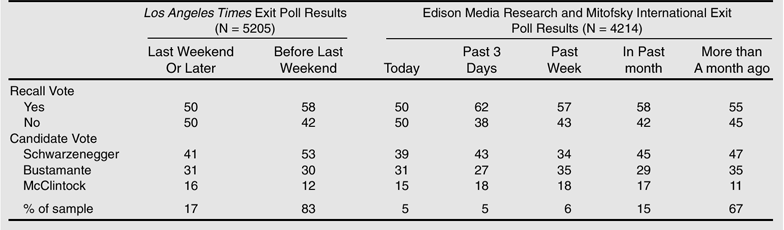
The crucial question is whether the allegations against Schwarzenegger reduced his support among women. It is reasonable to assume that most voters were aware of the story. Since the recall was the main question on the ballot, the campaign received extensive media coverage. As a result, the allegations in the Los Angeles Times received a great deal of attention. A look at the exit poll data indicates, however, that the stories had little effect on how the vast majority of Californians voted. Table 1 shows that, in both the Los Angeles Times and Mitofsky exit polls, over 80% of the respondents reported having decided upon their choice of candidate a month or more prior to the election. Those who decided more recently were less likely to support Schwarzenegger, but they made up only 17–18% of the electorate. The allegations aired in the Los Angeles Times could only affect vote decisions made within the last week of the campaign. Voters deciding on Election Day were less likely to support the recall and less likely to support Schwarzenegger than voters who had decided earlier. On the other hand, voters who decided in the last three days supported both the recall and Schwarzenegger more than either the last minute deciders or those who decided within the last week. This pattern suggests that the stories' effects were limited and affected the final decisions of few voters.

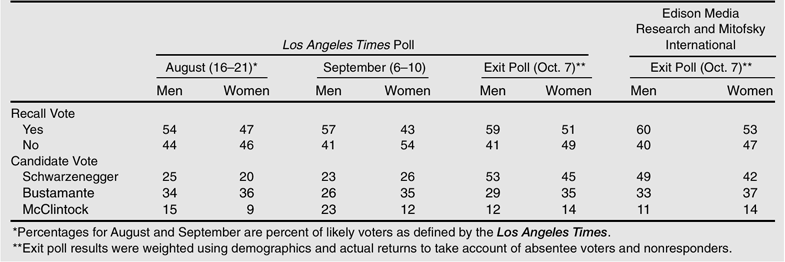
In terms of gender differences, there was a gender gap of 7 to 8 points in votes for Schwarzenegger. Interestingly, this gap is much smaller than that experienced by Republican gubernatorial candidate Bill Simon in November 2002. In that election, 15% more women supported Gray Davis than Simon. So, Schwarzenegger had more support among women than recent Republican candidates in California, which suggests that the sexual allegations did not have a significant effect on his support among women. His appeal among women is surprising since many believed that Schwarzenegger would do better among men because they would be drawn to his movie image and his “terminator-oriented” campaign rhetoric. At the time of this writing, the data are not available for a full analysis, but comparing the vote outcome with the gender gap earlier in the campaign, before the story broke, can provide a rough estimate of its impact. It is important to note that, since the recall election consisted of two, not unrelated, choices, we cannot assume that candidate choice was unrelated to people's vote on the recall. We thus need also to consider gender differences in support for the recall. Table 2 shows the support for the recall and the support for the three leading candidates in the Los Angeles Times and Mitofsky polls.1
In the September Los Angeles Times poll, the Times first asked respondents which candidate they supported, without providing any candidate names. The Times then asked respondents the same question, this time providing the names. Since having the names better reflected the responses in the August and exit polls, we only report the percent support reported when the candidate names were given.

We see in Table 2 that men consistently favored the recall more than women throughout the two months prior to Election Day. In fact, the greatest change is that women became more supportive of the recall during the final month of the campaign. Women also consistently favored Cruz Bustamante in all three polls, although this may be more a reflection of party identification than gender, with women more likely than men to identify with the Democratic Party (Kaufmann and Petrocik 1999). The absolute level of support both for Bustamante and for Republican Tom McClintock remained almost unchanged from August to October. Support for Schwarzenegger does split along gender lines in August in the way many expected—he held a five point larger margin of support among men than among women. By September, however, Schwarzenegger's support was somewhat higher among women than men. By Election Day that had turned around, with men supporting Schwarzenegger by a slightly larger margin (seven to eight points) compared to women. The shift from September to Election Day is consistent with the idea that the stories reduced support for Schwarzenegger among women, but the relatively low magnitude suggests caution in this interpretation. Moreover, the absolute numbers strongly suggest that the jump in Schwarzenegger's support from September to October came from undecided voters almost unanimously going to Schwarzenegger instead of the other top two candidates, with relatively little slippage from the Bustamante and McClintock campaigns.
Sexual Behavior and Political Frames
So, given the severity of the sexual allegations against Schwarzenegger, how can we explain these electoral results? It is true that this was a unique election, where issues and party identification took a back seat to other electoral concerns. Yet, we believe that much of what happened in the final week of the campaign can be explained by looking at the relationship between gender and politics in the United States. Issues of framing, some of which were specific to Schwarzenegger and some of which were reflective of attitudes towards sexual allegations in general, are key to understanding how the story played out and the effect it had on California voters. Linguists such as George Lakoff (2002) and Otto Santa Ana (2002) argue that the framing of issues is important because every word we use is defined relative to a larger conceptual framework. Thus, frames serve as “cues” that help our minds sort through and understand information. We may not consciously understand what a particular frame implies, but it can affect how we react to and interpret events.
In the case of Schwarzenegger, the most important frame was the characterization of his behavior as sexual “harassment” rather than sexual battery, which is the more accurate definition under California law. Legally, sexual harassment is a rather broad category referring to the existence of a hostile work environment normally created by a supervisor who demands unwanted sexual favors or attention from employees. The term sexual harassment raises the image of a very controversial area of law, one that applies to behavior that is seen as highly subjective and open to multiple interpretations. According to the descriptions in the Los Angeles Times, Schwarzenegger's behavior does not fit this definition. He is accused of not only groping women on movie sets, where he was ostensibly their supervisor, but also of accosting women at restaurants, parties, and other social occasions. From a legal standpoint, his behavior should have been described as “sexual battery,” which the California Penal Code defines as when “any person touches an intimate part of another person, when the touching is against the will of the person touched, and is for the specific purpose of sexual arousal, sexual gratification, or sexual abuse” (California Penal Code § 243.4 (e)(1)). Such behavior is considered a misdemeanor, punishable by a fine of up to $2,000, up to six months in jail, or both. By describing the behavior as “harassment,” the media created a rhetorical frame that minimized the severity and importance of that which Schwarzenegger was actually being accused.
The Schwarzenegger campaign also constructed a number of “pre-frames” that helped minimize the impact of the allegations. First, from the beginning of the campaign, the Schwarzenegger camp repeatedly said that his opponents were going to try to use his past sexual behavior as part of a “smear campaign.” That, along with the timing of the story so close to Election Day, made voters less likely to see the Los Angeles Times piece as anything other than politically motivated. The power of these accusations was so great that, after the election, John Carroll, the editor of the Times, felt compelled to publish a piece defending the paper's publication of the story (Carroll 2003). Interestingly, the political consultants running both the McClintock and Schwarzenegger campaigns agreed that the most direct effect of the Los Angeles Times story was that it siphoned support away from McClintock, and likely increased support for Schwarzenegger (Institute for Governmental Studies 2003). By pre-framing any negative allegations as political attacks, the accusations may actually have made voters more rather than less supportive of Schwarzenegger.
Second, the campaign established a “pre-frame” that emphasized Schwarzenegger's connections to powerful Democratic women. His wife, Maria Shriver, was a key part of this strategy. On his campaign web site, Schwarzenegger included a page called “women joining Arnold,” which consisted of pictures of Schwarzengger with Shriver and links to her speeches explaining why she, as a Kennedy and liberal Democrat, supported her husband's campaign. Schwarzenegger and Shriver emphasized the same themes when they appeared on the Oprah Winfrey show. There, they underscored their close personal relationship with Winfrey, and Oprah repeatedly made reference to how much she respected and liked Schwarzenegger. Both Shriver, as a television news correspondent and a Kennedy, and Winfrey, as a progressive Black woman, possess very influential media images. The emphasis on Schwarzenegger's close relationships with these well-known women served to humanize him, and to insulate him from the sexual allegations. It is not by accident that Shriver was very visible, both with Schwarzenegger and alone, in the days after the Los Angeles Times story broke. The implication was, if the allegations were true, then why would she, a liberal Democrat, continue to support him? These images confounded the attempt by feminist groups to frame Schwarzenegger as a misogynist or sexual predator, making it more difficult for the negative attributions to stick.
Feminists were not the only group that had difficulty framing Schwarzenegger's behavior as a problem. The left's general discomfort with approaches that focus on candidates' “character” made it difficult for them to make character an issue in this case. Much of the philosophy of the left is grounded in a moral relativism—the idea that individuals do not have the right to tell other individuals how they should live their lives. This serves as much of the rhetorical justification within the pro-choice and gay rights movements. This was also the position that the left took during the Clinton scandal —that his sexual choices, while improper, should be treated separate from his behavior as a political leader. There exists a fundamental contradiction within the American left between saying, on the one hand, that people's personal choices are their own, while on the other, that their behavior in these kinds of situations should be vilified. That inherent contradiction made them unable to develop a new frame that would effectively undermine those being used by the Schwarzenegger campaign.
For their part, the Schwarzenegger campaign took advantage of this problem by stating that their candidate's behavior was equivalent to that of Bill Clinton. The frame here is that if Democrats supported the former president, they had no right to criticize Schwarzenegger. Here, they minimized the force of the allegations by conflating Clinton's consensual activities (however inappropriate) with nonconsensual assaults. The campaign's maneuver left the right as the only possible source of attack, since that has most often been the place where moral outrage about politicians' character has taken root. Yet, in this campaign, the extreme right was more concerned with getting rid of Davis and capturing control of the governorship than in the particular positions held by their standard bearer. No other interpretation could explain why deeply conservative and ideological Republicans in California endorsed a candidate that was reported to be pro-choice and pro gay rights. The willingness of the right to hold their collective noses and support Schwarzenegger removed the sector of society most able to frame the allegations against him as a moral, and therefore significant, problem. Their silence helped Schwarzenegger frame the charges as he chose, and in effect dismiss the allegations and his own behavior.
Yet, the Schwarzenegger campaign's framing could not have been successful were it not for the fact that Americans are, at best, ambivalent about how to treat sexual impropriety. After the story broke, the campaign employed a two-pronged strategy. On the one hand, they took the bite out of the story by having Schwarzenegger apologize immediately and, without providing any specifics, acknowledge that he had engaged in “playful” behavior on movie sets. On the other, the campaign denied the specific allegations and claimed the need for them to mount an investigation into each particular case. So, they framed the behaviors as not very serious and at the same time questioned the credibility of the women making claims. These frames seem to have worked. In the days before and after the election, many voters reported not believing the women's accusations. Those that did were quoted in news reports saying that the women should have been happy to get attention from such a celebrity. Others, like California Attorney General Bill Lockyer, chalked it up to harmless “frat boy” behavior (Morain 2003). The implication is that being groped is not really harmful, and that the women involved should actually consider it flattering. Both these positions show the degree to which many Americans remain at best ambivalent about this kind of behavior. The burden of proof still falls squarely upon the woman to prove the inappropriate behavior occurred and that it was harmful to them. As a result, despite the corroboration of 16 women, Schwarzenegger was able to weather their allegations with limited political cost or impact.
Conclusion
One of the fundamental arguments of the American feminist movement is that what used to be defined as “personal”—violence against women, women's economic subordination inside and outside the home, and sexual harassment—needs to be reinterpreted as political. Behaviors that used to be considered “customary” in fact are expressions of men's power and therefore must be of concern to liberal-minded men and women (MacKinnon 1987). The Schwarzenegger experience shows the degree to which feminists have not successfully framed these issues in a way that makes Americans define them as political problems, and therefore something that should directly affect how they vote. In most cases, the men involved are powerful and able to hire publicists to frame the issues for them. The women, who many times remain anonymous, in most cases do not have anyone speaking effectively on their behalf. Of course, Schwarzenegger's extreme celebrity, and the fact that this behavior was consistent with his onscreen image, made it easier for him to weather this storm. But, this experience should be a wake-up call to women's rights advocates that they need to be better able to frame these issues in ways that convince Americans to take these behaviors, and the men who engage in them, seriously.
Our thanks to Anthony McGann, Becki Scola and Katherine Tate for their helpful comments.
References
Carroll John S.
2003
“Commentary: The Story Behind the Story.”
Los Angeles Times,
12 October: M5.Google Scholar
Kaufmann Karen M., and
Petrocik John R.
1999
“The Changing Politics of American Men: Understanding the Sources of the Gender Gap.”
American Journal of Political Science
43:
864–
877.Google Scholar
Institute for Governmental Studies.
2003
Conference: The California Recall Election. Webcast available at http://webcast.berkeley.edu/events/details.html?event_id=103.Google Scholar
Lakoff George.
2002
Moral Politics: How Liberals and Conservatives Think,
2nd ed. Chicago:
University of Chicago Press.Google Scholar
MacKinnon Catherine.
1987
Feminism Unmodified: Discourses on Life and Law.
Cambridge:
Harvard University Press.Google Scholar
Santa Anna Otto.
2002
Brown Tide Rising: Metaphors of Latinos in Contemporary American Public Discourse.
Austin:
University of Texas Press.Google Scholar
Decision Timing and the Recall Vote
Gender and the Recall Vote
 You have Access