During the 20 years leading up to the American Civil War, the number and importance of private banks in the country's commercial banking system increased significantly. These were unincorporated banks that operated without charters from state governments, with unlimited liability for their debts, and at a small scale relative to their chartered counterparts. Relatively little has been written on the market niche of the private banking sector within the US banking system, even though private banks comprised 40 percent of all commercial banks and issued 25 percent of all commercial bank deposits in 1860.
In his study of the nineteenth-century American capital market, Sylla argued that the growth of the private banking sector was the way the banking structure responded to westward shifts in the geographic distribution of population and the resulting shifts in the distribution of demand for banking systems, given that the ‘antebellum state (banking) systems were not responsive to these shifts’. His data support this conclusion. On the eve of Civil War, private banks issued 7 percent of deposits in New England, 16-18 percent in the Middle Atlantic and the South, and 60-80 percent of all deposits in the regions with rapid population growth, the East and West North Central regions. In terms of the types of banking services provided, Sylla argued that private bankers ‘functioned in ways very similar to those of the more studied chartered banks’, providing means of payment in the form of deposits and, in some instances, circulating notes, and extending loans.
In this article I explore further the role of private banks in the antebellum US long-distance payments system, building on these insights from Sylla's work. I go beyond Sylla's analysis by considering both the issuance of payments instruments and the subsequent clearing and settlement of payments through banking networks and clearing houses.Footnote 2 While states regulated the issuance of means of payment, the institutions used to clear and settle payments evolved out of practices and policies internal to the banking system. An analysis of these institutions, which took the form of networks and clearing houses, shows the development of a distinct division of labor between chartered banks and private, unincorporated banks. Private banks did substitute for chartered banks in the issuance of means of payment to the nonbank public, more so for deposit-based payments instruments than for circulating payments instruments. However, private banks ultimately played a marginal role in the payments system in that they were excluded from the circle of final settlement of interbank debts arising from the issuance of either circulating notes or drafts.
To make this case, I examine the formation, function and economics of private banking networks in the long-distance payments system using historical evidence from the East North Central states and New York. Private banks in these two regions accounted for two-thirds of all deposits issued by private banks, and, as I show below, were linked through networks of correspondents and agents. From a network point of view, private banks did more than respond to the demand for banking services in the western developing regions: they and their networks were a mechanism for the transfer of long-term financial capital from eastern capital markets, located in eastern cities, to western cities and towns. This function, which the chartered banks avoided after the state debt crisis of the early 1840s, exposed private banks to added capital risk, helping to explain their exclusion from the final-settlement core of the payments system. But it also positioned the private banks to become the underwriters of the Union government's securities during the Civil War (and beyond).
I begin with a discussion of the role of private banking networks in the circulation and redemption of currency after the closure in 1836 of the Second Bank of the United States, which had played a key role in reducing the cost of long-distance payments. The following sections look at the role of private banks in the deposit-based domestic exchange system, seen first from the perspective of hinterland cities and then from the perspective of the financial center, New York. I provide examples of ways in which the private banks combined payments services with the mobilization of financial capital. A final section shows how the pattern of differentiation and specialization between chartered and private banks emerging by the onset of the Civil War shaped, and was reinforced by, choices made by the Union government in the financing of its war effort.
I
Between 1820 and the mid 1830s, the Second Bank of the US issued notes that circulated at or near par throughout the national economy. State banks that kept current in their accounts with the Second Bank were able to circulate their notes at par in the local market area. After 1835, the long-distance circulation of currency took place through the banknote redemption networks of the chartered banks and the banknote markets of the private banks.
Banknote redemption networks, centered around the chartered banks of major cities, were the ‘backbone’ of the payments system, where interbank debts were settled and final validation of the worth of banknotes established. Banknotes issued by banks that belonged to the network were considered ‘current’, meaning that they were received by major banks in repayment of customer loans and interbank debt, and on deposit.Footnote 3 City and country bank members of redemption networks held balances with banks at the center of the network which were used to redeem their notes and settle net interbank debts.Footnote 4 Balances ‘due to’ banks that could not be covered with balances ‘due from’ other banks in the network had to be settled with specie, or with funds considered equivalent to specie.
The issuance of circulating notes was generally the domain of the state-chartered banks. To successfully issue notes that circulated hand-to-hand without third-party validation, issuers of banknotes had to meet a certain threshold in terms of scale and reputation.Footnote 5 Although states generally reserved the right to issue currency to incorporated banks, there were a few private banks that issued instruments that circulated over large geographic areas in the 1840s. E. W. Clark, George Smith and Page & Bacon all operated on a large scale, and were all owned by well-known, wealthy individuals who assumed unlimited liability for the debts of their banks. Perhaps more importantly, these bankers created multi-state networks of offices and agents which were used to redeem their currencies (and only their own currencies) or to withdraw them from circulation before reissue, thereby sustaining confidence in their notes.Footnote 6
Other than these few exceptional firms, private banks were generally too small to successfully issue currency. Instead, they became banknote dealers, buying ‘foreign’ notes that were not accepted in local banknote redemption networks in exchange for locally current banknotes.Footnote 7 Two factors increased the demand for the services of banknote dealers after the closure of the Second Bank, stimulating a high rate of entry into the private banking sector.Footnote 8 First, in 1835, currency redemption networks did not exist between cities previously connected by the Second Bank's branch network, and until those networks were organized, banknote markets provided the only mechanism for converting non-local banknotes into local banknotes. Secondly, with a number of new state-chartered banks in the commercial banking system, it took time for existing redemption networks to incorporate these new banks into their circulation systems.
Entry into banknote dealing in the late 1830s was facilitated by the fact that it could be profitably carried out at a very small scale and on a limited base of equity capital. However, banknote dealing did require the formation of multi-city networks of correspondents and agents, a point missed by the economic history literature. In this literature, banknote prices are thought to be tied, in large part, to the cost of returning the note to the issuing bank and exchanging it for specie, an activity that an individual firm could hypothetically conduct on its own.Footnote 9 But it is hard to see the efficiency, especially in an era of high transportation costs, in returning a wide variety of notes issued by distant banks, often in very small denominations, back to their individual issuers, and then transporting the specie home. Further undermining the specie-redemption view is the fact that, in the late 1830s and early 1840s, exactly when there was a high rate of entry into banknote dealing, all banks except those in New York City had suspended specie payments.
Instead of returning notes for specie redemption, it made more sense for bankers to conduct intercity arbitrage operations in banknotes. The sheer existence of multiple geographically defined currency areas created the potential to earn arbitrage profits from trading in banknotes that were current in one market, but not in another. E. W. Clark & Co., a Philadelphia-based private banking house, bought uncurrent banknotes and sent them to their correspondents in the originating regions, ‘taking from their correspondents notes on banks in the Philadelphia area’, which could then be deposited in a city bank or used to buy more uncurrent notes.Footnote 10 When Clark's correspondents deposited the locally current notes sent from Philadelphia in a local bank, they returned errant notes to the discipline of the interbank settlement process taking place within the chartered banks’ redemption network.
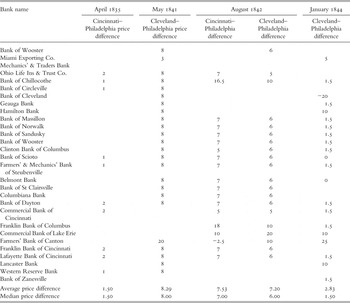
Banknote arbitrage operations were profitable if the intercity banknote price difference exceeded the cost of counting, sorting and shipping the notes and maintaining accounts. In the early 1840s, after the suspension of specie payments, large arbitrage gaps opened up in the market for banknotes, particularly those issued in locations previously regulated by the Second Bank. Table 1 shows the difference between prices of Ohio banknotes in the Cincinnati and Philadelphia markets, and in the Cleveland and Philadelphia markets, for four dates between 1835 and 1845, April 1835 (when all banks in the two states were paying specie for their currency), May 1841 (when banks in both states had suspended specie payments), August 1842 (when banks in both states had recently resumed payments) and January 1844 (when banks in both states had resumed payments for over a year).
Bank note arbitrage opportunities ($ per 100 face value)

Sources: Cincinnati Daily Gazette, various issues, 1835–44; Cleveland Daily Herald, various issues, 1841-4; G. Gorton and W. E. Weber, Quoted Discounts on State Bank Notes in Philadelphia, 1832–1858 (Research Department, Federal Reserve Bank of Minneapolis, http://minneapolisfed.org/research/economists/wewproj.html).
Arbitrage gaps widened after the suspension of specie payments and persisted after resumption. Differences in banknote prices were very small in the mid 1830s, averaging only $1.50 per $100 in face value in April 1835 for 10 banks for which price data were available for both markets on proximate dates. After suspension, in May 1841, almost every Ohio banknote carried an 8 percent discount in the Philadelphia banknote market, but no discount in the Cleveland market. A Philadelphia dealer could therefore buy $100 of Ohio notes for $92 in Pennsylvania notes and send them to his agent in Cleveland, directing the agent to buy Pennsylvania notes with the Ohio notes from a Cleveland banknote dealer. Pennsylvania notes were sold at a 2 percent premium in Cleveland, so the agent could only buy $98 of Pennsylvania notes with $100 of Ohio notes. The Philadelphia dealer would therefore earn $6 of arbitrage income from the operation, minus any commission or fee provided to the agent.Footnote 11 After resumption, in August 1842, the price difference was about the same as in May 1841, but the net arbitrage gap was larger because Pennsylvania notes had fallen to par in Ohio cities. By January 1844, the arbitrage gap was just under $3 in Cleveland. Throughout the period, Ohio notes were valued more highly in Ohio than in Pennsylvania, reflecting the currency of Ohio notes in Ohio, the greater availability of information about Ohio banks in Ohio, and the closer distance to the issuing bank.
Arbitrage was one of several alternative ways the banknote dealer could earn income. The dealer could also earn a bid–ask spread on those notes that could be resold in the local market.Footnote 12 Along these lines, Drexel & Co.'s approach in banknote dealing was ‘to underbid until at this time the difference between buying and selling is reduced to the very smallest fraction. The effect of this has been to give them a most extensive correspondence throughout the United States and a larger Counter business which notwithstanding the low rates yields in the aggregate very considerable profit.’Footnote 13 Or, banknote dealers could hold banknotes in portfolio if their prices were expected to appreciate. A portfolio of equal quantities of the Ohio banknotes listed in Table 1 increased in value almost 8 percent between August 1842 and January 1844, while it fell in value 1.3 percent between May 1841 and January 1844. Speculation was risky, and tied up the firm's limited capital, while arbitrage trades could be executed on a continuous basis and were relatively risk-free, thus requiring less capital.Footnote 14
Although banknote dealers were very small firms, the operating costs of banknote dealing in the early 1840s were similarly modest. Dealers rented small offices and hired a small staff of clerks; profitability depended on the productivity of the clerks in handling currency and maintaining the accounts, rent, the cost of supplies and postage costs. Jay Cooke, who began his career as a clerk with E.W. Clark & Co. in 1839, later recalled that each day, ‘immense quantities’ of uncurrent notes had to be handled, distributed and mailed; a ‘mass’ of silver and gold had to be counted and shipped; collections and drafts had to be mailed, and large numbers of letters with directions to agents and correspondents had to be written.Footnote 15
The US Postal Service's rate structure was favorable to a business that entailed a heavy and frequent flow of correspondence between cities. Dealers paid $.25 per page on distances over 400 miles, and quadruple rates on ‘packets’ containing four or more sheets, so that mailing costs were the same for a bundle of 4 sheets mailed to a city 400 miles away as for a bundle of 20 sheets mailed 600 miles away. In addition, with rates charged on a per-sheet basis, per-dollar mailing costs fell as the face value of the banknotes rose. In the above example, in which the Philadelphia dealer earned arbitrage income of 6 percent, assuming that four or more notes with a combined face value of $1,000 were sent in the packet each way, arbitrage revenue of $60 and postage costs of $8 would have left ample room for other costs to be covered, and a residual for profit.Footnote 16
Of the private banks that organized in Philadelphia following the closure of the Second Bank, two eventually became leading private banking houses. Drexel, Read & Co. originated in 1838 when Francis Drexel opened a currency brokerage on Third Street in Philadelphia. After it had built up its capital base in currency brokerage, the firm began dealing in foreign and domestic bills of exchange, accepting deposits and making loans. Drexel opened a branch in San Francisco in 1851, and bought a partnership share in a New York private bank in 1855, which was renamed Van Vleck, Read, Drexel & Co.; five years later Van Vleck had left the partnership, leaving Read, Drexel & Co. The net worth of the Drexel firm is estimated to have grown from under $15,000 in 1838 to $200,000 in 1851, and between $1m and $2m in 1861.
E. W. Clark & Co. opened in Philadelphia in 1837 as a currency brokerage house on an initial capital investment of $15,000. The Clark group opened a Boston house in the early 1840s, a St Louis house in 1842, a New York house (Clark, Dodge & Co.) in 1845, and a Burlington, Iowa, house in the late 1840s. During this period of disorganized money markets, the firm's capital is said to have increased between two and three times annually.Footnote 17 Even in this early period, private banks combined banknote dealing with bond and stock brokerage, and obtained supplies of ‘foreign’ securities from its correspondents in other cities. E.W. Clark dealt in western and southern city and state securities beginning in the early 1840s. Its predecessor, S. & M. Allen, which operated in New York, similarly combined banknote dealing with stock brokerage in the early 1830s.Footnote 18
In the institutional arrangements that sustained the long-distance circulation of banknotes after the closure of the Second Bank, private banking networks were complementary to, not substitutes for, the state banks’ networks. Private bankers exchanged ‘foreign’ for local banknotes, and local for ‘foreign’ notes, in response to arbitrage opportunities between currency areas. These operations did not themselves clear debt between banks arising from the issuance of banknotes, but rather returned errant banknotes to the clearing discipline of their home redemption networks.
II
Long-distance payments in antebellum America were also made with bank drafts, commonly referred to as ‘domestic exchange’. Unlike currency, drafts were not circulating ‘bearer’ instruments, but orders to pay a specific person issued to a specific bank by that bank's correspondent or agent. Two conditions eased the private banker's entry into the domestic exchange business. First, states did not regulate or restrict the right to issue domestic exchange instruments. Secondly, since drafts were drawn, paid and cleared within the context of repeating relationships among members of payments networks, smaller-scale private bankers could meet the reputational requirements for successful issuance. Private bankers and chartered banks issued the same kinds of exchange instruments using many of the same techniques to manage information costs and credit risk. The banknote redemption and banknote marketing networks of the chartered and private banks, respectively, were easily adapted to the drawing and clearing of bank drafts.
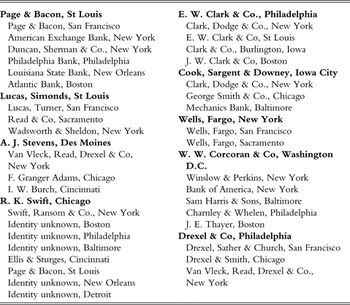
Table 2 lists the members of eight far-flung correspondent banking groups headed by private banking houses in the 1850s. Domestic exchange was created when, for example, Page and Bacon, in St Louis, drew a draft on Duncan, Sherman & Co., its correspondent in New York, directing the latter to make certain payments at a specified time.Footnote 19 The St Louis house was responsible for ensuring that there would be adequate ‘good funds’ in its account with the New York house for the payment to clear. In this fashion, drafts were issued and cleared within self-contained exchange networks.
Private bank correspondent groups (lead house identified in boldface)

Sources: Cook, Sargent & Downey correspondence; A. J. Stevens ledger book; Missouri Republican, various issues; Rottenberg, Man Who Made Wall Street; V. P. Carosso, with the assistance of R. C. Carosso, The Morgans: Private International Bankers, 1854–1913 (Cambridge, MA, 1987), and More than a Century of Investment Banking: The Kidder, Peabody & Co. Story (New York, 1979); Clarke, William Tecumseh Sherman; W. B. Stevens, History of St Louis: The Fourth City (St Louis, 1909); H. Cohen, Business and Politics in America from the Age of Jackson to the Civil War: The Career Biography of W. W. Corcoran (Westport, CT, 1971); Larson, Jay Cooke.
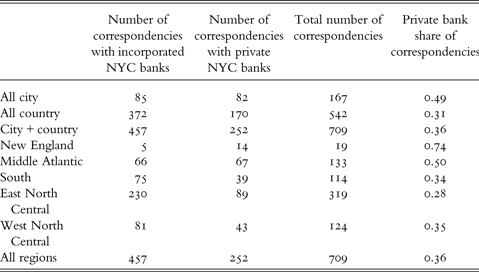
Private bank correspondencies in New York, 1860
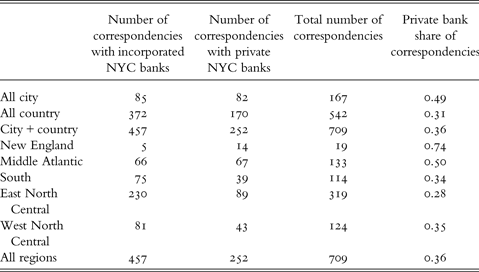
Source: Bankers' Magazine and Statistical Register, 15 (1860-1), pp. 49-63.
The drawing of drafts exposed both parties to credit risk from the other's potential failure to keep promises, and created monitoring costs in the form of regular correspondence about the condition of interbank accounts.Footnote 20 The New York bank faced the risk that the St Louis bank would draw drafts in excess of the funds on hand, or in excess of some permitted line of credit. The St Louis bank faced the risk, if it was typically in a net credit position, that the New York bank would become illiquid or insolvent. One example of the latter problem took place during the 1854 financial crisis. In February 1855, a private bank in Sacramento, part of a New York–St Louis–San Francisco–Sacramento banking group, suffered losses when its New York correspondent failed. The Sacramento bank had remitted funds to its New York correspondent to meet drafts coming due in New York. The New York bank used the funds for other purposes just before it failed, leaving the Sacramento bank's drafts unpaid.Footnote 21
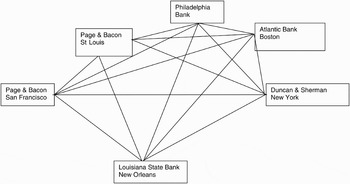
Monitoring costs were reduced by limiting the number of correspondent relationships in a given network, and by centralizing correspondent relationships in a common node (New York). In principle, each bank in a correspondent group could have drawn drafts on each other bank in the group, as illustrated in Figure 1, using the Page & Bacon group shown in Table 2 as an example. If each house drew drafts on each other house, this group of six correspondents would have generated 30 different exchange instruments, and each house would have had five mutual accounts to manage and monitor. To reduce administrative costs and risk, it made sense to only use the correspondent relationship between cities with dense trade and financial flows, where more frequent transactions created greater opportunity to correct undesired overdrafts. Otherwise, agents could be used to provide payments services that did not involve the drawing of drafts, such as collecting commercial paper and monetary instruments for local payees, and purchasing drafts for local payors on a fee or commission basis. Agents were typically sole-proprietor banking firms and attorneys located in small towns.
Mutual drawing accounts in a private banking network

There is ample evidence from bankers' advertisements and correspondence that agents outnumbered correspondents in long-distance payments networks. Banks and bankers would customarily advertise that they collected on ‘all the major cities’, or ‘almost all points’, and ‘bought and sold’ exchange, as dealers, also on a number of different cities, but, in contrast, drew drafts ‘in sums to suit’ (that is, as directed by the customer) only on a limited number of cities (where they held balances). The incoming correspondence of the Iowa City banking house of Cook, Sargent & Downey between 1855 and 1858 consisted largely of requests and acknowledgements regarding collections and remittances on drafts and notes from other private banks, in and out of Iowa. Even within Iowa and northwest Illinois, bills and notes were typically sent for ‘collection and remittance’; in significantly fewer cases, for ‘collection and our credit’, indicating the presence of a correspondent relationship in which the two parties kept running accounts with each other.Footnote 22 Similarly, the Chicago private banking house of R. K. Swift only drew drafts on correspondents in New York, Boston, Philadelphia, Baltimore, Pittsburgh, Cincinnati, St Louis, New Orleans and Detroit, but it made these drafts ‘available in every city of the Union and Canada’ (presumably, everywhere they had agents to sell their drafts to customers).Footnote 23
Drafts on New York became the logical instrument for settling accounts between non-bank parties outside New York, and went hand in hand with the substitution of agents for correspondents within payments networks. To the degree that commercial and financial activity was concentrated in New York, it was imperative for banks outside New York to be able to make payments on behalf of customers in New York funds.Footnote 24 In a fully centralized correspondent banking system, each house outside New York would draw only on New York, further reducing the number of interhouse accounts to five. Receipts would not have to be concentrated in New York: the St Louis house could build up balances with, for example, the New Orleans house, through collections of paper payable in New Orleans, then transfer the balances to New York to cover drafts. With fewer active accounts to manage, these houses outside New York would be able to move more paper with a given amount of clerical labor, reducing the unit labor cost. The New York house would not enjoy a similar reduction in workload, but the concentration of New York bankers' balances at a few banks created efficiencies of a different sort as these banks became specialists in monitoring and managing accounts with interior correspondents.Footnote 25
A variety of evidence from secondary sources and bankers' accounts indicates the prevalent use of New York City funds as a settlement vehicle. According to Myers, 900 private banks kept balances in New York in 1860; Sylla has estimated the number of private banks in the US at 1,108 in that year. Therefore, as a very rough order of magnitude, 80 percent of the private banks kept balances in New York in 1860, with both incorporated banks and private banks.Footnote 26 The account book of Andrew J. Stevens & Co., a private banker in Des Moines, provides further evidence of the centrality of New York in the long-distance payments system. The ledger book covers the three months prior to the reorganization of the firm as a new partnership in late August 1857.Footnote 27
A. J. Stevens maintained mutual running accounts in the mid1850s with Van Vleck, Read, Drexel & Co., in New York City, F. Granger Adams, in Chicago, and I. W. Burch, in Cincinnati. During this period, A. J. Stevens drew 129 drafts on its New York correspondent, 14 on its Chicago correspondent and only 2 on its Cincinnati correspondent. The size of the drafts ranged from under $10 to $5,000. During this period, A. J. Stevens alternated between a net debtor and net creditor position vis-à-vis Van Vleck, Read & Drexel, but was consistently a net creditor vis-à-vis its Cincinnati and Chicago correspondents.Footnote 28 A. J. Stevens was apparently permitted to run overdrafts as large as $5,000 with Van Vleck, Read & Drexel. A. J. Stevens would remit funds whenever the ‘due to’ position approached $5,000, which it typically executed with transfers from its balances in Chicago and Cincinnati and remittances from other banks.Footnote 29
A. J. Stevens's daily account entries also show the details of remittances made at the bank's request (from collections of commercial paper). In most cases, these were drafts drawn by private banks in small towns on banks in New York, or on banks in Albany payable at a bank in New York, presumably the Albany bank's correspondent.Footnote 30 Similarly, in the Cook, Sargent & Downey correspondence, when agents sent instruments to collect and remit, remittance was almost always requested in New York funds.Footnote 31 For private banks on the frontier of settlement, like those in Iowa in the 1850s, much of the collection work was associated with the repayment of loans extended for land acquisition by eastern lenders. The remittance of drafts on a New York bank cleared the payment for the nonbank payor in the interior, but left a remaining interbank debt to settle in New York (except when the New York payee bank, receiving the draft, and the New York payor bank, on which the draft was drawn, were one and the same).
Private banks had several sources of comparative advantage in domestic exchange markets. Because they did not operate under state charters, private banks were not restricted to operating within the states where they initially entered, making it possible to them to become, in effect, multi-state branch banks. For example, in the Clark and Drexel banking groups, partners in the various houses had ownership shares in other houses in the group, which aligned the interests of the various houses. Some private banking networks used kinship relationships and common nationality among partners in the network to manage monitoring costs, mechanisms that were less available to the incorporated banks. One kinship-based private bank with German origins had houses in New York (Gelpcke, Keutgen & Reichelt), Chicago (Hoffman & Gelpcke) and Dubuque (Theodore Gelpcke & Co.). This network extended across the Atlantic; the firm issued ‘drafts and letters of credit in sums to suit, on our correspondents in London, Paris, Frankfort, Hamburg, Berlin, Bremen’, and other German cities, to make international remittances on behalf of recent emigrants and their families.Footnote 32
Finally, private banks realized efficiencies from combining exchange dealing with banknote dealing. Private banks linked exchange dealing and banknote dealing in their advertisements, proclaiming that they ‘buy, sell, and collect bills of exchange on all the chief cities of the US’, and ‘buy all kinds of uncurrent money at the best rates’ (emphasis added). These services became two sides of the same transaction; private bankers in St Louis in the 1850s advertised only the buying rate on currency and only the selling rate on exchange.Footnote 33 Unlike state banks, private banks that sold exchange received current and uncurrent banknotes alike on deposit. This feature, which saved customers the cost of sorting bankable and non-bankable funds, enabled private banks to build up their inventories of banknotes, drafts and bills and realize economies of scope.
By 1860, private banks were a significant presence in the banking sectors of a number of midwestern states, and were competitive enough to dominate banking markets in some midwestern cities. The private banking sector's share of commercial bank capacity rose from 2 to 36 percent in the entire region, and from 8 to 66 percent in the region's three largest cities. The entry and growth of private banks was particularly high in the cities, which were distribution centers for the shipping and financing of agricultural products to eastern markets; in 1860, unincorporated banks supplied two-thirds of the commercial banking capacity in Cincinnati, Chicago and St Louis combined.Footnote 34 These cities were also nodes for the interregional movement of capital, which, like the commodity markets, required the provision of payments services. Finance capital moved west through the private banking network in a variety of ways. Private bankers exported and serviced western municipal and railroad debt, and a variety of claims associated with investment in western lands, such as land warrants issued by the federal government, loans to land buyers on time entry, and titles to the land itself. Western private bankers were in an important respect agents for eastern investors; they delivered claims on western assets, and collected the associated interest and dividends using their payments networks.Footnote 35
In the domestic exchange segment of the payments system, private banks and their networks issued and cleared payment instruments on an equal footing with their chartered counterparts. In some interior cities, much of the exchange on New York that was drawn, was drawn by private banks, evidence of their viability in this segment of the banking business. Over time, a significant share of all domestic exchange was drawn on accounts with New York correspondent banks, which reduced the cost of managing information and credit risk.Footnote 36 As a result, the final settlement of long-distance payments took place in large part through the settlement of debt among the New York banks whose liabilities were used to make payments between parties outside New York. The next section examines the role of the New York private banking sector in this final settlement process.
III
A draft on a New York bank was considered ‘good funds’ in cities around the country, but final settlement rested on its issuer's ability to keep current in payments due to other New York banks. The formation in 1853 of a new organization, the New York Clearing House, created a clear divide between those bank liabilities that were used as an instrument of final settlement (those of Clearing House members), and those which were not (liabilities of non-members). The exclusion of private banks from Clearing House membership institutionalized and reinforced a process of differentiation and specialization that was well under way by the 1850s, the product of state regulation, self-regulation of monetary standards within the banking industry, and competition among different types of banks.
The Clearing House was organized in 1853 for the purpose of facilitating the frequent and timely clearing and settlement of interbank balances. Like the earlier banknote redemption networks, the Clearing House enforced monetary standards through its admissions policies.Footnote 37 Drafts drawn on private banks were deemed, by their more regulated counterparts, to fall short of the specie-equivalent standard required of settlement instruments. By the early 1850s, private banking houses in New York had developed a business model based on the payment of interest on deposits and the investment of funds in the call loan and securities markets. Newer, more aggressive chartered banks also paid interest on deposits, but the older, more conservative banks did not. The exclusion of private banks from Clearing House membership served the conservative members’ interest in protecting against overexpansion, and the newer, more aggressive members’ interest in weakening competitive rivals.
Spreads were wide enough in the short-term end of the market alone for private banks to pay higher interest rates on bankers' balances than their chartered competitors, and still profitably re-lend to brokers in the call loan market, or to replace their own call loans from chartered banks with deposits from interior banks.Footnote 38 One provision of New York banking law allowed the private bankers to pay higher interest rates on deposits than the chartered banks, holding constant the return on assets, by operating with lower reserve ratios.Footnote 39 Under both the Safety Fund Act of 1829 and the General Banking (‘free banking’) Act of 1838, incorporated banks in New York were prohibited from issuing time drafts; their drafts had to be payable on sight, and therefore appropriately reserved.Footnote 40 In contrast, time drafts could be drawn on private banks, which allowed the drawing banks (and their correspondents) to manage their liquidity on a ‘just-in-time’ basis, by matching the maturity of tranches of assets (bills of exchange) and liabilities (drafts). That is, when a bank in the interior drew a time draft on its private-bank correspondent in New York, neither bank had to have a stock of cash on hand from the moment this liability was created; the drawing bank just had to make sure that by the time the draft came due, and was payable at the office of its correspondent, there were funds available in New York to meet the draft.
The business operations of two private banking houses organized in the early 1850s demonstrate how private banks benefited from their regulatory advantage in attracting interior bankers' balances. Duncan, Sherman & Co. and Winslow, Lanier & Co. combined, from the outset, exchange operations and bill discounting with the issuance, marketing and holding of railroad securities; and financed their operations with interest-bearing bankers' balances. Duncan, Sherman was organized with two partners, Alexander Duncan and Watts Sherman, formerly cashier of a major Albany chartered bank. Some part of the firm's assets were financed with bankers' balances; in 1860 Duncan, Sherman & Co. was the New York correspondent for private banks in Philadelphia, Baltimore, Charleston, San Francisco, Iowa, Kansas, Kentucky, Michigan, Missouri, Tennessee, Texas and Wisconsin.Footnote 41
Winslow, Lanier & Co. was formed as a copartnership between James Lanier and Richard Winslow. The ‘chief object’ of Winslow, Lanier was the negotiation of railway securities and ‘in connection therewith, a general banking business’. The bank negotiated the flotation of the first western railroad securities issued in the New York market, and eventually ‘negotiated a million …bonds daily’, earning commissions of 5 percent, on top of which they earned commissions on contracts to purchase rails. The negotiation of securities was ‘followed by arrangements that made our house the agent for the payment of interest accruing on them, as well as transfer agents’ for purchases and sales in the secondary market. At one point the firm was servicing 50 different security issues.Footnote 42 After 1854, the firm confined itself to banking, for which ‘our previous success had opened a wide field’, including the extension of emergency loans to railroads for which they had negotiated securities to maintain timely interest and principal payments. As with Duncan, Sherman & Co., the firm financed its security holdings in part with bankers' balances, holding the correspondent accounts of private banks in Pennsylvania, Indiana, Kentucky, Minnesota and Ohio.Footnote 43
After 1853, drafts drawn on private banks like Duncan, Sherman and Winslow, Lanier could not be cleared through the Clearing House's multilateral exchange process. Private bank drafts were received by the incorporated banks ‘to a limited extent’, but ‘this [threw] on the bank the trouble of collecting them’, and ‘[made] the bank responsible for indorsements in which it has no interest’; consequently, merchants were ‘mostly required to collect them on their own behalf’.Footnote 44 These additional collection costs reduced the attractiveness of private bank deposits as a means of payment in the City, particularly for businesses with high transaction volumes.
The private banks were not impeded by their exclusion from the Clearing House. They could gain indirect access to the clearing services of the Clearing House by keeping a deposit account themselves with one of the member houses, or by engaging one of the member houses as its clearing agent.Footnote 45 The early proto-investment banks (all private bankers) used their balances with Clearing House banks to make payments associated with the underwriting and servicing of capital market instruments. Winslow, Lanier sold bonds for the City of Chicago, the proceeds of which were paid with checks drawn on the American Exchange Bank. Similarly, the New York private banking firm Wadsworth & Sheldon drew checks on the (New York) Bank of Commerce to make interest payments on behalf of the State of Illinois on its internal improvement bonds.Footnote 46 The American Exchange Bank and the Bank of Commerce were both members of the New York Clearing House.
After their exclusion from the Clearing House, private banks continued to be successful in attracting interior bank balances, but not in attracting correspondencies. By 1860, private banks’ issued half of all bankers' balances in New York, but were chosen by a relatively small proportion of all interior banks, chartered and private combined, to be their primary New York correspondent.Footnote 47 Only 5 percent of the incorporated banks, and 12.5 percent of the unincorporated, currency-issuing banks organized under the 1838 ‘free banking’ law chose a private bank as its redemption agent in 1857.Footnote 48 In 1860, 36 percent of the private banks listed in a contemporary periodical, Bankers' Magazine, selected a private bank as their New York correspondent. This evidence, together with information on the numbers of private and incorporated banks respectively, suggests that private banks in New York made up between 10 and 20 percent of all correspondencies.Footnote 49 It follows that a significant number of interior banks must have held two balances in New York City, a safe ‘primary’ balance with a Clearing House bank for the purpose of redeeming notes and covering drafts, and a ‘secondary’ balance, some significant share of which must have been held with a private bank, that earned a higher return (in exchange for lower liquidity and higher risk).Footnote 50
The financial crisis of 1857 demonstrated the financial vulnerability of private bankers, with their greater involvement in security markets, and provided confirmation for the Clearing House's decision to bar them from membership. During the crisis, a Cincinnati newspaper reported that private banking houses in New York City had suffered losses on their loans which had been made ‘more or less on stock and bond collaterals’, and that ‘western correspondents have been withdrawing their balances to a large extent from the private bankers, and placing them with the large and strong banks’.Footnote 51 The share of Ohio chartered banks that kept their New York account with a private banker fell from one-third in 1854 to 6.5 percent in 1868.Footnote 52 Duncan, Sherman & Co. required ‘substantial assistance’ in the crisis of 1857, as did its foreign correspondent George Peabody, due to the decline in American security prices. After Peabody received a loan from the Bank of England, Pierpont Morgan reported from New York that the application to the Bank ‘created a great feeling in the street’ against Duncan, Sherman & Co. The Mercantile Agency, a credit rating agency, noted that the firm was no longer ‘in a position to attract the deposits of Mercantile houses’.Footnote 53 After the crisis of 1857, interior banks, private and chartered alike, placed a greater premium on safety and liquidity in deciding where to place their clearing balances.
By 1860, there was a clear divide between the New York Clearing House banks and the private banking houses in New York. Balances with private banks could be used as a short-term investment, or to make payments between non-bank individuals and businesses, but not to validate ‘money’ through the settlement of interbank claims. The payments and depository services offered by the private banks were increasingly associated with capital market transactions, not commodity market transactions. This pattern of differentiation was further reinforced by choices made by the northern government during the Civil War.
IV
Under the Independent Treasury Act of 1846, the Treasury was required to collect and disburse funds without using banks. Payments into and out of the Treasury were to be made only in gold, silver or Treasury liabilities. The Treasury found ways to reduce the need for specie shipments in transferring funds within the federal government, but payments between the government and the private sector entailed the constant movement of bags of gold.Footnote 54 The Treasury's adherence to arcane monetary and financial practices created significant impediments to its ability to borrow from the state-chartered banks. The marketing of government debt was ultimately accomplished through the exercise of skills developed in the private banking sector over the previous 20 years: banknote dealing (exchanging one form of money for another), domestic exchange (transferring large sums of value over long distances), and investment banking (exchanging long-term securities for money).
Congress tried to free the government from a strict application of the Independent Treasury Act, but Treasury Secretary Salmon Chase insisted on receiving loan proceeds in specie or the Treasury's own ‘demand notes’, and on disbursing government expenditures in Treasury warrants instead of bank checks. This monetary arrangement broke down in fairly short order, leading to the adoption of the Legal Tender Act in February 1862. Greenbacks could be used to purchase government debt and to pay all obligations to the government except customs duties.Footnote 55 The New York Clearing House banks, which had objected to the greenbacks, successfully lobbied for them to be made legal tender in private-sector transactions so that holders of banknotes could be compelled to accept payment in greenbacks instead of specie. Payments between the government and the private sector were placed on a paper basis, and Treasury notes became the ‘standard for all banking operations in current funds’.Footnote 56
The Legal Tender Act also contemplated the replacement of currency finance with long-term bond finance. Greenbacks could be exchanged at par for the newly authorized $500 m issuance of ‘5-20’ bonds (redeemable between 5 and 20 years after issuance) in multiples of $50.Footnote 57 However, conversions of greenbacks into bonds were slow throughout most of 1862, forcing continued reliance on short-term loans and currency finance.Footnote 58 The chartered banks would have had to draw down their holdings of greenback reserves to hold long-term government debt, since the government was still not accepting their notes or deposits in payment for bonds. This they could not do so long as they were expected to pay greenbacks on demand for their own liabilities.
This left it up to the private banks and brokers to sell the government's long-term securities, a task complicated by a tenet of the government's debt policy: its insistence on protecting its credit standing by refusing to sell its debt at a discount from par. But, as Chase himself put it, ‘it is too plain for comment that where the government is always in the market offering her bonds at par for her own notes [the greenbacks and demand notes], subscribers to these bonds in large amounts [buying to re-sell] cannot expect to make profits if they take them at par’. Chase had to find a way to distribute the bonds, at par, for greenbacks only, to retail buyers outside the money centers of the northern states. He had no federally chartered banks to look to, since the legislation authorizing the national banking system was not adopted until February 1863.Footnote 59 Instead, Chase engaged a private banker, Jay Cooke, as the authorized agent for the sale of the 5-20 bonds.
Cooke's experience managing risk in the banknote markets 20 years earlier proved to be essential to his firm's ability to sell the 5-20 bonds under the government's restrictive payments practices. Before depositing the proceeds of bond sales into sub-treasuries and depositories, Cooke had to convert banknotes, checks and drafts into ‘legal money’ (greenbacks or specie), incurring ‘expense and risk in the form of express charges, exchange, danger of loss, and the like’.Footnote 60 By October 1862, the firm had assembled a large network of agents, sub-agents, and travelling agents which eventually included ‘every considerable town and populous district in the loyal states’.Footnote 61 The head office in Philadelphia managed the flow of payments to the Treasury and of bonds from the Treasury to agents and sub-agents.Footnote 62 Sub-agents advertised the bonds, took orders for bonds and transmitted them to Philadelphia; made advances to bond buyers and otherwise took payment for bonds; and delivered the bonds to subscribers. Cooke took full financial responsibility ‘until payment into the treasury of all money subscribed and delivery to subscribers of all bonds subscribed for’.Footnote 63 By March of 1863, Cooke's network was raising, on average, $1m per day from at-par conversions of greenbacks into bonds.Footnote 64
The sale of northern government debt during the Civil War was carried out under extreme payments-system constraints. Private income and wealth was earned and accumulated largely in the form of state bank liabilities, which, under the Independent Treasury System, were not accepted means of payment for government debt. The sale of debt, therefore, had to be coupled with currency exchange transactions to convert state bank liabilities into greenbacks. From a payments system perspective, Jay Cooke's network operated as private banking networks had two decades earlier, in the interstices between currency areas, which were defined now in terms of private and public spheres of circulation, not geographic areas.
V
In this article I have explored the role of private banks in the US payments system between 1835 and 1865 by using banking networks as the unit of analysis, differentiating between the issuance and the clearing and settlement of payments instruments, and drawing on evidence from the midwestern states and New York. I have presented institutional evidence showing that private banks, and the networks they created, connected the multiple currency areas of the antebellum economy and, along with their state-chartered counterparts, provided long-distance payments services in the form of bank drafts. However, private banks were excluded from the circle of final settlement of interbank claims associated with the issuance of currency and drafts. As the private bankers' role in the payments system diminished, their networks were more and more adapted to long-term, interregional intermediation, as demonstrated by their use in marketing the Union government's war bonds.