1. INTRODUCTION
There is a growing body of research focused on developing interest in sound-based music (sbm). Sound-based music is an umbrella term used to describe music where pitch is the main unit rather than the musical note (Landy Reference Landy2007).Footnote 1 In particular the Music, Technology and Innovation – Institute of Sonic Creativity (MTI2)Footnote 2 at DMU has become a centre for this type of research, starting with the I/R project (Weale Reference Weale2005; Landy Reference Landy and Simoni2006), which demonstrated that non-specialist listeners can appreciate this type of music. Part of the reason for this growing body of research is because sbm is largely practised and performed in universities with little recognition beyond this type of context. As the composer Katharine Norman has suggested, the culture of sbm can appear rather insular and inaccessible to newcomers or outsiders:
entire audiences for electroacoustic music can sometimes fade into a collective entity of like-minded peers, still largely situated within either academia or other rather esoteric cliques. (Norman Reference Norman2010: 117)
One promising area identified in some of these projects (see Holland Reference Holland2016) is the role creative engagement can play in developing appreciation, and the workshops that this article will focus on were designed to foster this type of creative appreciation.
The Interfaces project, of which the workshops were a part, is a Creative Europe project with the key aim of bringing new music to new audiences.Footnote 3 The workshops were conducted in two phases. First a pilot project was run that tested the workshop structures and questionnaires. Once improvements and revisions had been made based on the data collected in phase 1, a main set of workshops was completed as part of a second phase. The sbc workshops focused on three key areas: listening, recording and composition and, as will be explained in section 3, activities were designed to support the development of skills in these areas. The goal of the sound-based creavity (sbc) workshops was to demonstrate the value and user-friendliness of new musical creation, but in a manner whereby the approach can be adopted on within the schools and community settings without any other support afterwards. The workshops built on previous work (Chapman and BCMG Reference Chapman2013; Holland Reference Holland2016) with the aim of creating model sessions that less experienced (but enthusiastic) leaders can use to develop their own sessions.
One of the key pedagogical advantages of sbm is that it enables pupils of all abilities to have the opportunity to be creative with sound without the need for previous musical training. This gives pupils the opportunity to discover the potential of sbm for themselves from ‘within’ the music itself. It is then that the concepts and theories that shape the aesthetic decisions made by composers of previous sound-based works become relevant and pupils, with guidance, can discover them in relation to their own work. Sbc also enhances and develops skills that can support learning across the curriculum, especially in subjects such as ICT, music, maths and geography. In non-formal settings, it offers the opportunity for participants to explore their sonic environments and to create work that responds to the act of listening.
All the workshops took place in the midlands (UK) and the total number of participants in phase 2 was approximately 178. This included four schools (108 pupils) with participants ranging from Year 5 to Year 10 (9 to 15 year olds). There were two community workshops organised with approximately 70 participants across all age groups. One of these was run at a family day at an arts centre on a drop-in basis across a whole day, which is why the number of participants is approximate.
The final workshop involved the completion of Intention/Reception (I/R) questionnaires in order to gather data to investigate questions of accessibility to and appreciation of sbm. Following Weale (Reference Weale2005) and Landy’s (Reference Landy and Simoni2006) earlier work on the I/R project in which they collected data to investigate the accessibility of electroacoustic music, the workshops provided an opportunity to collect a larger set of I/R data than ever before (which is a key research action for the Interfaces project). These data, alongside observations, recordings and the participants’ work, have provided the main material for investigating how the participants responded to the musical examples and the experience of creating sbm.
The findings from these questionnaires will be shared, discussed and evaluated in this article. The implications of this for future pedagogical and community projects involving sbc will also be considered. Additionally, the workshop structures and content will be described and compositional work produced by participants reviewed, but first some key projects will be reviewed in order to place this research in context.
2. CONTEXT
As mentioned in the introduction, in particular, the project builds on research conducted at DMU starting with the I/R project (Weale Reference Weale2005; Landy Reference Landy and Simoni2006), and followed by others with a more pedagogical focus (such as Landy, Hall and Uwins Reference Landy, Hall and Uwins2013; Therapontos Reference Therapontos2013; Wolf Reference Wolf2013; Holland Reference Holland2016). In addition, it is inspired by numerous educational projects, such as Sound and Music’s Minute of Listening project (Sound and Music 2012) and Sonic Postcards project (Sound and Music 2014b) as well as projects run by the Birmingham Contemporary Music Group (Chapman and BCMG Reference Chapman2013). This section will briefly outline some of the projects that provided the foundation for the model devised for the sbc workshops.
2.1. Intention/Reception project
The Intention/Reception (I/R) project aimed to discover how accessible E/A music can be (Weale Reference Weale2006: 189). It emerged from Landy’s research into access and appreciation of electroacoustic music and the fact that most of the audience for this music consists predominantly of electroacoustic composers (Landy Reference Landy and Simoni2006: 29). It was ‘an investigation of the relationship between composer intention and listener response in electroacoustic compositions’ (Weale Reference Weale2006: 189).
Listeners were asked to fill in questionnaires about interpretation and appreciation after repeated listening to pieces of electroacoustic music. Responses from three groups of listeners – inexperienced, experienced and highly experienced – were analysed and compared. The composers also filled in questionnaires concerning their intent in terms of the pieces, with each playback more information was revealed to the listeners and their responses were monitored (Weale Reference Weale2006: 189). The study demonstrated that inexperienced listeners, when presented with three works of E/A music using real-world sounds could ‘have an enjoyable and stimulating listening experience that they would like to repeat’ (Weale Reference Weale2006: 196).
Weale designed the I/R methodology as a template for future research. Since then the I/R methodology has been used elsewhere, such as in Australia (Stead Reference Stead2009), as well as being used as part of the Interfaces project. Leigh Landy also used the I/R methodology to carry out his own trials (Landy Reference Landy and Simoni2006), which returned similar results to Weale’s project (Weale Reference Weale2006: 196). Weale and Landy’s methodology has been adapted for the Interfaces project and I/R questionnaires were devised specifically for use in schools (see Appendix). The development of these will be discussed in section 3.5.
2.2. EARS 2
The idea for the ElectroAcoustic Resource Site 2 (Landy et al. Reference Landy, Hall and Uwins2013) was developed at the request of UNESCO as a follow-up to the original EARS site, which had been intended mainly for university students and specialists as ‘a means of sharing knowledge regarding terminology and published research in electroacoustic music studies’ (ibid.: 110). The EARS 2 site was used to support the sbc workshops and was referred to within them. The enhancement of the site, along with its bespoke creative software package Compose with Sounds,Footnote 4 is one of the aims of the Interfaces project.
Motje Wolf’s PhD research created the first prototype for the EARS 2 online resource (Wolf Reference Wolf2013a) and it was intended as an environment for ‘introducing primarily, although not exclusively, children aged 11 to 14 to electroacoustic music’ (Landy et al. Reference Landy, Hall and Uwins2013: 108). The project aims to introduce young people not only to the concepts and music itself but also to creative practice, which is facilitated by the software package Compose with Sounds that has been designed especially for use in education.
EARS 2 emphasises three main areas: understanding (key concepts related to the music and technology), listening (repertoire) and making (creating work using Compose with Sounds) (ibid.: 111). The sbc workshops have in particular focused on the listening and making areas (due to the limited time available) with a view that once pupils have been engaged in creatively experiencing sbm and introduced to EARS 2, conceptual understanding is something that can be developed in the future.
2.3. The HL2 doctoral project
Building on the previous DMU research described above, this PhD project (Holland Reference Holland2016) investigated whether sbm composition can provide an engaging experience for Key Stage 2 (7 to 11 year olds) pupils supported by the development of heightened listening skills. The research involved case studies in eight schools with 241 children conducted from 2013 to 2015. Each case study included a series of workshops in which the pupils developed listening skills, recorded sounds and created sound-based compositions. Qualitative and quantitative data were gathered over three phases through questionnaires, teacher feedback, observations, recordings and pupils’ work. The results of the research indicated that the children had a high level of engagement with the workshop activities. The data also suggested that the heightened listening training helped to support the pupils in their compositional work. The main factor in this engagement appeared to be the opportunity to be creative.
The focus of these workshops on listening, recording and composing provided a useful template for the sbc workshops and included some of the same exercises (such as the same soundwalk instruction sheet). However, this was a set of seven workshops whereas due to time constraints, the sbc workshops were limited to four workshops.
2.4. Minute of listening
This is a project that was launched by Sound and Music (SAM) in 2012 that aims to ‘enable every primary school child to experience the richness and diversity the world of music and sound has to offer’ (SAM 2012: 3) and promote ‘reflective listening’ in schools. One of the aims is also to ‘introduce music and sound as a stimulus for analytical thinking and imaginative enquiry’ (ibid.). This recognition of the importance of listening skills also played a key role in the sbc workshops.
The idea of the project is to introduce 60 seconds of new sounds and music (through a software application created by SAM) into each school day for the children to hear and discuss (ibid.). As part of the project, teachers are provided with training for running a Minute of Listening with their classes. Teachers have noted that the project has a significant effect on the behaviour, ability to talk about music and listening skills of children, as well as their creativity and imaginative abilities (ibid.: 4).
2.5. Sonic postcards
This project run by SAM was aimed at children between 9 and 14 years old from the UK and abroad. It allowed children to share information about the environment they live in through sound. Participants recorded their soundscapes and then posted them online for other children to experience.
The project was interdisciplinary mixing music, geography and ICT and reached over 4,500 children and 400 teachers in 170 schools (SAM 2014b). It aimed to focus attention ‘on the impact of sound on our lives, and the possibilities for creativity through the manipulation of sounds with technology’ (ibid.).
3. DESIGNING THE WORKSHOPS FOR SCHOOLS
Originally plans were developed for three workshops to pilot in schools in the UK.Footnote 5 The three workshops were divided into the themes of listening, recording and composing. As part of a pilot project, these plans were trialled in two schools: one secondary school (in Leicester) and one primary (in Leamington Spa). From this experience, it was decided that not enough time was available for composition and so an extra workshop was added. The intention was that these plans would be suitable, with a little adaptation, for a range of age groups from Year 4 (8–9 year olds) upwards. As discussed in the previous section, the activities devised for the workshops built on previous successful projects with a wide range of age groups (e.g. see Chapman and BCMG Reference Chapman2013; Holland Reference Holland2016). Each workshop was designed as a one-hour lesson, but can be adapted for different circumstances, meaning that exercises can be reduced or extended depending on the time available. Below is a brief outline of what each workshop entailed.
3.1. Workshop 1: listening
The first session focused on listening with the intention that the children would begin to open their ears to the sounds around them through simple listening exercises. It was also the start of a process whereby the pupils could begin to listen like composers (see also, on ‘composerly thinking’, Evans, Faultley and Kinsella Reference Evans, Faultley and Kinsella2018). This workshop aimed to do more than raise their aural awareness, it was also intended that the children would begin to make qualitative judgements about the sounds around them and start to discuss their qualities. The exercises used in this workshop were influenced by the World Soundscape Project (and related projects, e.g., see Cumberland Reference Cumberland2001) and the instruction sheet was adapted from one created by Hildegard Westerkamp (Reference Westerkamp2001).
3.1.1. Gong listening in the classroom
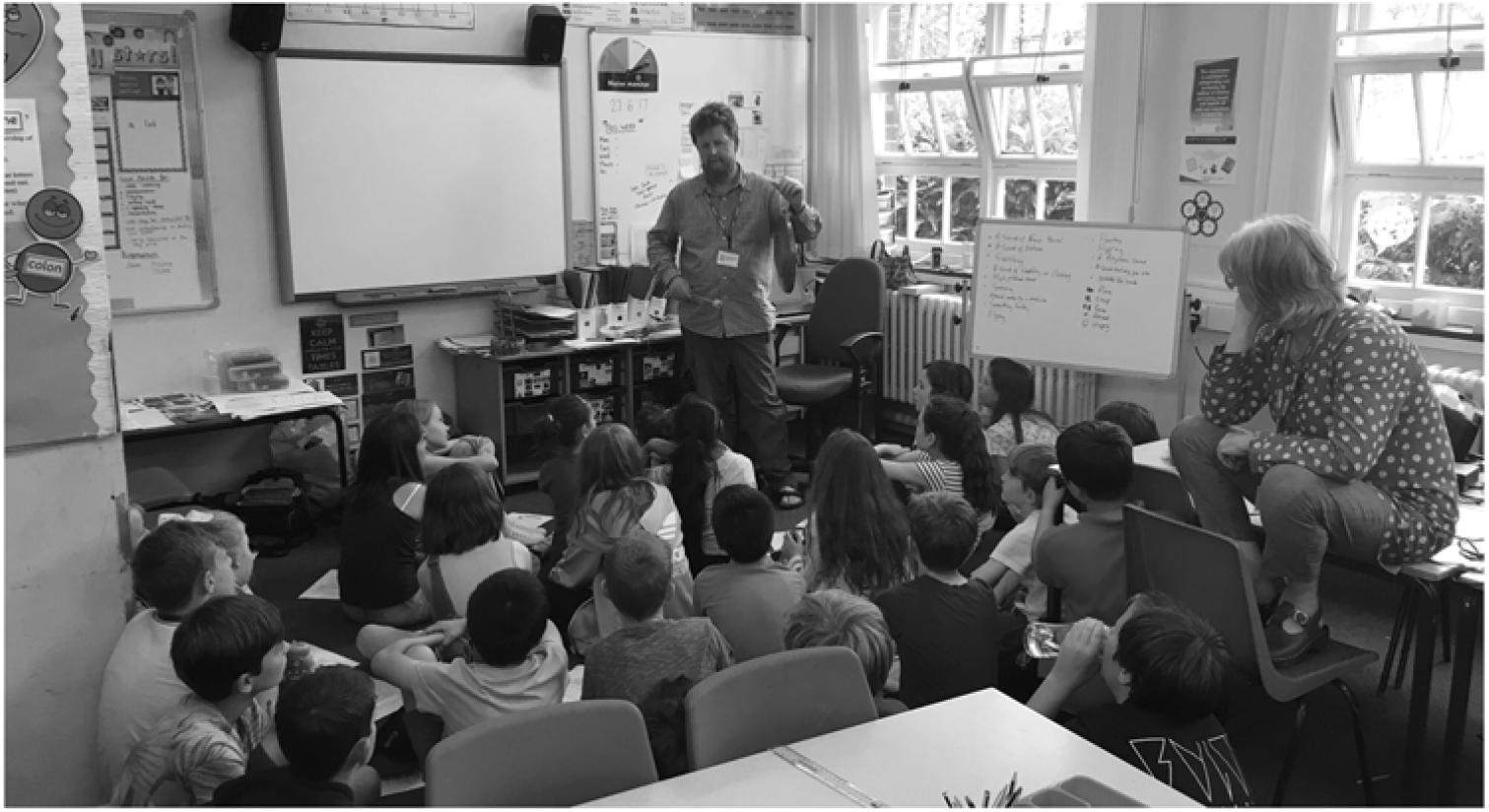
As an introductory listening exercise, this activity (adapted from Chapman and BCMG Reference Chapman2013) was used to help the pupils start to notice the sounds around them. Pupils were asked to close their eyes and listen to how long the sound of a gong lasts when played and put their hand up to indicate when they could not hear it anymore (Figure 1). This was usually done several times, and on the final time pupils were asked to remember what other sounds they could hear just before they opened their eyes.
Gong listening exercise with primary school pupils.

After listening, each pupil was asked to create their own listening list on paper, following which the class collaboratively produced an overall list of all the sounds heard. A further development of this involved creating small ‘soundmaps’, which indicated the spatial location, movement and proximity of sounds heard.
3.1.2. Soundwalk
This was followed by a soundwalk conducted around the school grounds and through the school itself. Beforehand the pupils were given a soundwalk instruction sheet. This facilitated a more focused listening than the gong exercise as it encouraged children to think about sound characteristics (such as pitch, duration and volume), and also make qualitative judgements about which sounds they would keep and which sounds they would scrap if they were the composer of the soundscape. This echoes Murray Schafer’s comment that we should view the whole world as a musical composition (Schafer Reference Schafer1977: 105).
This first session ended with playing an example piece. One of the purposes of the project was to expose the pupils to examples of sbm. However, after using works by composers such as Hildegard Westerkamp and Katerina Tzedaki in the pilot project, it was found that the pupils appeared more engaged when the authors discussed their own work. As a result, works were used by Duncan Chapman, which could therefore be introduced by the composer himself making this a more personal experience for the pupils. It might also have been more inspirational, in terms of the pupils’ own work, to have the composer present to explain how the example pieces were created.
3.2. Workshop 2: recording
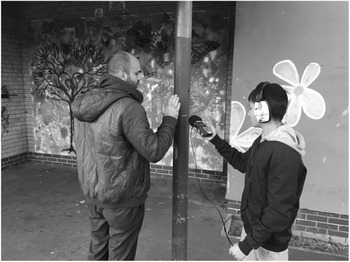
This session focused on collecting sounds and how they can be categorised in different ways. It was intended that in this workshop the pupils would build on the listening skills developed in session 1 and use those skills to make choices about which sounds to record (Figure 2).
Recording sounds at a community centre.

Key to this session was developing strategies for recording sounds. In the authors’ experience, if a group of pupils are given a digital recorder and just asked to collect sounds without much guidance, the results will often lack focus. One way of overcoming this is to have a sonic treasure hunt. This involves creating different kinds of lists of sounds to find. One approach is to create a list that is very prescriptive and identifies exactly what sounds to record (e.g. the sound of a door closing, traffic, birdsong). Another, perhaps more interesting approach, is to create an open and imaginative list that can be interpreted in different ways. For example, ‘a sound made by a machine’ allows for a more open and diverse range of sounds than ‘the sound of a car’. In order to engage the pupils in this process, a collaborative list of these open sound types was created.
Once the pupils learnt how to use the recording devices, they were asked to make sure that they logged the sounds they recorded and that the recordings were short in duration. This is the part that pupils often neglect, but it is important to have a written record of the sequence of the recorded sounds, so it is easy to find them when the pupils come to select sounds for use in compositions.
3.3. Workshop 3: composing
This session focused on listening to the sounds recorded in workshop 2 in order to begin to compose pieces using those sounds. In all these sessions we used the software Soundplant (http://soundplant.org) because this has the advantage of being very simple to install and works on both Mac and PC computers. Soundplant allows users to drag and drop sound files onto keys assigned to the computer keyboard so that they can be played in combination. A series of simple tools (looping, volume, editing, pitch change) allow a basic level of manipulation of the sounds. The original intention was for us to use Compose With Sounds (CwS – see section 2.2), but delays in development of the software meant that this was not in a stable enough state to use in the schools. However, the data we collected during these sessions have formed an important part of the CwS development process, so that in future people will be able to have a more bespoke cross-platform software application to undertake this work.
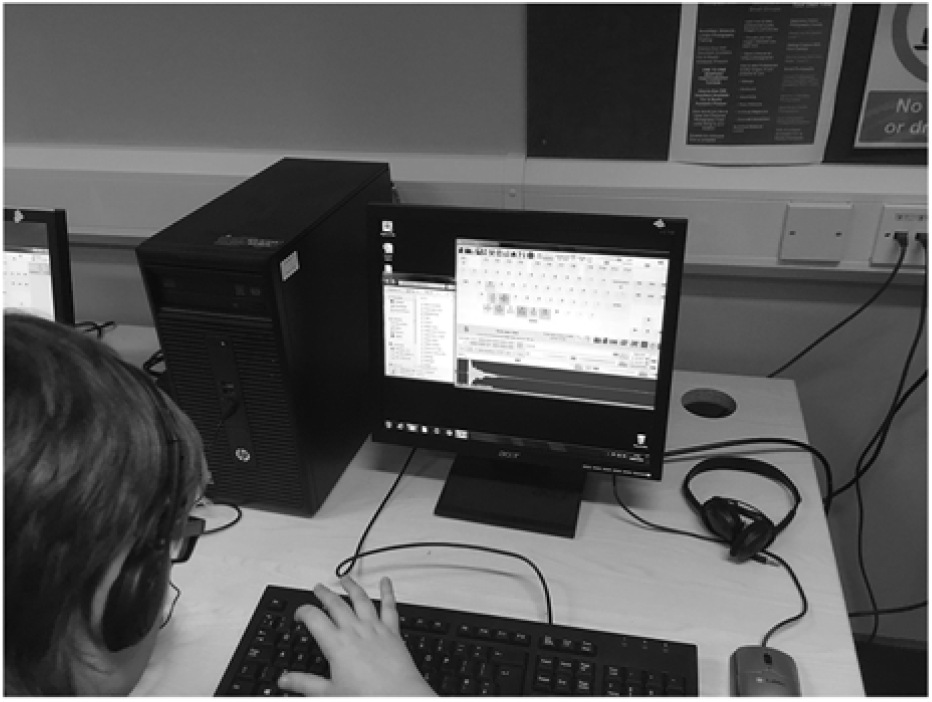
Once the basic functions of Soundplant had been introduced, the pupils were given time to play and experiment freely with the sounds (Figure 3). The necessity of play in creative music education is supported by studies into children’s use of technology for music composition, where experimentation and exploration were shown to be important (Savage and Challis Reference Savage and Challis2002; Nilsson and Folkestad Reference Nilsson and Folkestad2005). More examples from the sbm repertoire were used as guidance on how to develop compositional ideas and advice was provided on how to combine sounds and develop them.
Using Soundplant to compose.

3.3.1. Compositional strategies
Composition has formally been a part of the music curriculum in English schools since the 1988 Education Reform Act (see Swanwick Reference Swanwick1990), which introduced the national curriculum. However, given that the vast majority of music teaching is based around performance of existing musics rather than the creation of new work, there has been considerable neglect of this area in the curriculum. In recent years projects such as ‘Listen, Imagine, Compose’ (SAM 2014a) have attempted, through research and practical work with teachers, to address some of this.
For this research, widening the variety of compositional models and strategies that participants were aware of to give them a greater knowledge of the possibilities, was something that was an important part of the workshops.
Being able to imagine a sound and to then use that to create a composition is something that requires a great deal of learnt skill. Given that, in this project, we were introducing a way of composing based on listening to the sounds of the immediate environment rather than external narrative or structure, we chose to introduce the composition stage of the project through playing with sounds: creating by playing with the sound as opposed to designing an abstract model separately. Similar, in other words, to what has been referred to as a ‘bottom up’ approach to composition (Landy Reference Landy2012: 53).
In the workshop sessions, the composition session typically followed this structure:
Instruction on how to load sounds into the application
Free play with sounds (with no direction)
Instruction on how to manipulate sounds (for those who had not worked it out)
Free play
‘Commissioning’ each participant to create a very short piece (60 seconds) using a limited number of sounds (making choices about which sounds to include)
Participants working on pieces
Discussion (with audio examples) of structural ideas. Starting sounds, contrast, shape of whole piece etc
Participants working on pieces
Listening back to individual compositions as a whole group and reflection on this (using high-quality speakers).
As discussed in section 4, the participants (and teachers) placed great value on an approach based on creative exploration. Having enough time to explore the sounds collected, and using them as the guide to creating pieces, was a strategy that allowed enough structure and freedom for large groups (often a class of 30) to work in a self-directed way. Furthermore, the ‘commission’ of a short piece (linking to a growing interest in ‘miniatures’ in electroacoustic music which connects the practice in schools with what happens in wider musical culture, see Chippewa Reference Chippewa2013) gives enough direction to the compositional activity and allows for discussions around structure, gesture and flow.
3.4. Workshop 4: finishing compositions and sharing ideas
In the final workshop pupils finished their compositions and shared them with the rest of their class. They also completed an I/R questionnaire about their responses to ‘… but the kitchen sink’ by Duncan Chapman (Reference Chapman2013). This was a piece that was originally composed for the EU Culture Compose with Sounds project in 2012. The piece was shortened for use in these workshops to three minutes. This was partly due to time constrictions and because in the pilot project some pupils (particularly in primary) appeared to find it difficult to concentrate when listening to the full version.
In this session the children needed to complete their compositions. This involved a process of evaluation and revision, in which the pupils were encouraged to think about what changes could be made to improve their work. They were given a clear time limit of 30 minutes to make revisions and save their work. Work was then shared with the rest of the class and the children were asked to make comments on what they liked about the different pieces. It was intended that the workshops should help to develop their vocabulary for talking about sounds and discussing each other’s compositional work, and this sharing was an important part of that. As mentioned earlier, following this the I/R questionnaires were completed and the next part of the article will explain their development for the project as well as analysis of the subsequent data.
3.5. Creation of the I/R questionnaires
The questionnaires used by Weale (Reference Weale2005) in the original I/R project were used as templates to be adapted for classroom contexts. The original project was not run in schools and so the language had to be made appropriate for school pupils. Additionally, the questionnaires needed to be short enough to be completed in a 10-minute period at the end of a lesson. As with the original I/R questionnaires, it was decided to collect both quantitative and qualitative data but more scaled quantitative questions were included. This would not only allow pupils to complete the questionnaires relatively quickly but also provide room for them to express their thoughts in their own words.
The original I/R project was just concerned with listener’s responses to examples of I/R music and involved repeated listens to each piece. However, the sbc workshops entailed a wider introduction to sbm through creative participation in sbm composition. Therefore, it was important to collect data in relation to creative engagement as well as responses to the test piece. Time constraints meant that repeated listens would not be possible and so decisions needed to be made on what were the most important questions to include. Therefore, questions were included on how the experience of participating in the workshops had contributed to their appreciation of the piece, and not only if they would like to listen to sbm again, but also whether they would like the opportunity to compose sbm again (see Q11 and Q12 in Appendix). As well as these more general questions, there were questions specific to the composition such as questions 5–10 (see Appendix). Also, demographic data were collected to see whether pupils’ previous musical experience appeared to have an influence on their engagement with the music. This is something that had not been asked in the HL2 doctoral project, although through observation there had appeared to be some differences in responses between children who could play a musical instrument and those who could not. This was not one of the key foci of the project, but it was useful to collect data on this to investigate if particular tendencies emerged. As mentioned earlier, as part of the workshop design these questionnaires were tested in a pilot study with two schools in the summer term of 2017.
4. ANALYSIS OF THE DATA
4.1. Phase 1: pilot study – summer term 2017
This involved tests in a secondary school in Leicester and a primary school in Leamington Spa. During the workshops, it soon became evident that there was more material in the original plans than could be delivered in three workshops. Therefore, a principal outcome of the pilot project was that an additional workshop was added for finishing compositions and completing the I/R questionnaires. Overall, the level of engagement and interest in sbm during these pilot sessions appeared to be high and pupils seemed to enjoy all the activities included. Teachers also responded favourably, especially in the secondary school where the teacher was keen to integrate their work into the BTEC curriculum. Judging by the responses to the I/R questionnaire, interest and understanding of sbm seemed to have been supported by participating in the workshops.
In the pilot project no question was included on whether the pupils would like to make a sbm composition again. It was felt that, as creatively engaging with sbm was one of the main aims of the workshops, it was important to record data from pupils about this, so Q12 (see Appendix) was added for the main project.
4.2. Phase 2: main workshops – January–May 2018
This phase involved visits to four schools as well as running workshops in two separate community settings. A great deal of interesting creative work was produced and, as is reflected in the I/R data, levels of engagement were high. The intention when designing the workshops was always that they should be adaptable to different contexts, whether that be in schools, arts centres or community projects. Often in community contexts it is necessary to run workshops on a ‘drop in’ basis, so this meant it was vital for the activities to work individually as well as part of a series of workshops. However, as result of this it was not always possible to collect I/R data due to time constraints.
4.2.1. Analysis of the Intention/Reception data
In total there were 105 respondents to the questionnaires. The participants were all based in the midlands (UK) with three schools in the east midlands and one community centre in Leamington Spa. The three schools included 96 pupils across five classes of Year 5 (9 to 10 year olds) to Year 9 (9 to 14 year olds). There were nine participants in the community group ranging from 9 to 36 years old.
Demographic information was only collected in the schools, as time was more limited in the community centre in which two workshops were conducted. The community centre results were marginally less positive than in the schools, with 66% of participants answering positively to the questions about whether they would like to listen to sbm again (Q11) and whether they would like to make another sbm composition (Q12). However, there were only nine participants in the community workshops, so this sample is too small to draw any conclusions about the difference fewer workshops made. It is beyond the scope of this article to give a detailed analysis of the results from each individual group, but below is a discussion of the overall results in relation to the key questions in terms of appreciation and engagement.
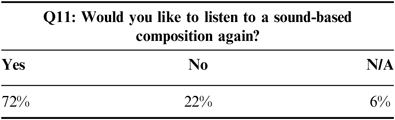
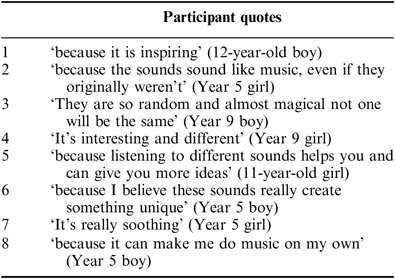
The two key questions in relation to overall engagement and in terms of indicating future interest were Q11 and Q12, and Tables 1 and 2 provide the overall results for both these questions. A clear majority of participants (72%) said they would like to listen to sbm again. As with the original I/R project, the qualitative data from this question were important in order to give the respondents a voice in the research. The most common explanation given was that they found it interesting or fun to listen to sbm. This connects closely to the most common explanation given for positive responses to Q12, which was also that the experience was fun or interesting. It was not always clear in the answers given whether they were differentiating between the two questions, as some explanations to Q11 mentioned being creative with sounds (e.g. see response 8 in Table 2). It is likely that the experience of creatively participating in the workshops influenced responses to Q11, which supports the intention of the project for the participants to learn to appreciate sbm from ‘within’ the music. This also supports the findings from the HL2 doctoral project (Holland Reference Holland2016) in which the experience being interesting or fun was by far the most common theme (this theme is discussed in more detail below).
Responses to Q11

Examples of participant explanations for responses to Q11

There were also a significant number of responses that said they found listening to sbm calming, relaxing or soothing, as shown in response 7 in Table 2. This is interesting as sections of the piece are very dynamic including a high density of different sounds, something that would not usually be associated with calming or soothing music. It might be that they are referring to the general practice of listening that they were introduced to in the workshops, as it was common for pupils to say the soundwalk was ‘relaxing’.
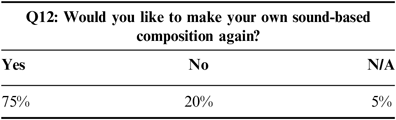
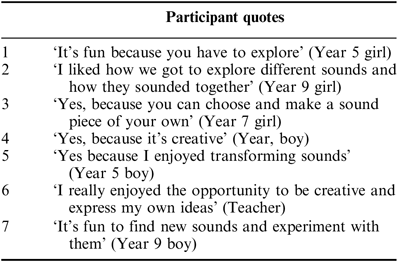
As shown in Table 3, a slightly larger proportion (75%) answered positively to Q12. The dominant theme (evident in over 50% of responses) given in explanations for this was again that it was a ‘fun’ experience. However, there were also a significant number of responses that mentioned the opportunity to create their own piece. As Q12 is actually referring to creative activity in relation to sbm, it can be argued that the explanations that describe the experience as ‘fun’ are also saying that it was ‘fun’ to be creative with sound. This finding very much supports the results of the HL2 doctoral project in which it was found that the opportunity to be creative was the main driver in engagement (Holland Reference Holland2016). This is demonstrated in some of the responses shown in Table 4. There were also a number of responses that stressed autonomy (e.g. see response 3 in Table 4). Autonomy is one of the factors that contribute towards an experience being intrinsically motivating (one participates for the joy of doing it rather than any external reward), as identified by Deci and Ryan (Reference Deci and Ryan1985). The pupils were allowed creative freedom (with guidance) in the workshops to choose sounds and make decisions about how to arrange or transform them, and this appeared to be part of why the experience was enjoyable for some of them.
Responses to Q12

Examples of participant explanations for responses to Q12

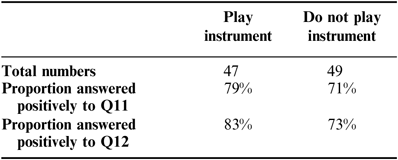
Table 5 shows responses to Q11 and Q12 in relation to whether the respondent played a musical instrument. It is interesting to note the higher proportion of positive responses to Q11 and Q12 from those participants who play a musical instrument. Some 10% more (83% in total) of those who play a musical instrument said that they would like to make a sbm composition again.
Responses to Q11 and Q12 in relation to playing an instrument

This was an interesting finding, as some of the data (although limited in scope) that were collected in the HL2 doctoral project have suggested that pupils with previous musical experience were less inclined to be positive about the experience of creating sbm.
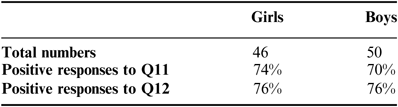
Table 6 shows responses to the same two questions in relation to gender. As can be seen, there is a marginal difference, with the slightly higher percentage (74%) of girls answering positively to Q11 as opposed to 70% for boys. Interestingly, the percentage of positive responses to Q12 was the same for both sexes at 76%. Given the very low percentage of girls on music technology degrees or who become sbm composers, this result surely prompts the question as to why this is the case and what prevents girls from taking this interest further. This question was the not the focus of the sbc workshops, but these results certainly suggest that more research is needed in this area.
Responses to Q11 and Q12 in relation to gender

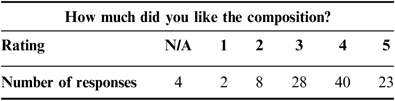
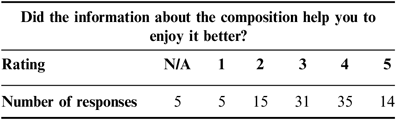
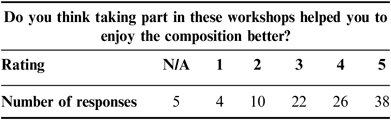
The following questions gathered responses in relation to the example piece ‘….but the kitchen sink’ by Duncan Chapman. As shown in Table 7, the majority of participants (60%) responded favourably to the piece and less than 10% responded negatively. However, as shown in Table 8, just less than 50% said that the information from the composer helped them to enjoy the piece better, while just under 20% said it did not help. As shown in Table 9, just over 60% felt that taking part in the workshops had helped them to appreciate the piece better. This suggests that the experience of creatively engaging with sbm supports the appreciation of sbm.
Overall responses to Q5 (1 = did not like at all; 5 = liked very much)

Overall responses to Q9 (1 = did not help at all; 5 = helped very much)

Overall responses to Q10 (1 = did not help at all; 5 = helped very much)

Previous research into pupils’ experience of sbm (Wolf Reference Wolf2013; Holland Reference Holland2016) has suggested that engagement with sbm appears to decrease slightly with age. However, age did not appear to be a significant factor in these results and actually the most positive group were the Year 9 students, although this group had chosen to do music as an option.
5. COMPOSITIONAL WORK
Given the very short timescale of the sessions, the time restrictions of the pieces and the sharing of ideas within groups, the pieces produced had a number of common features. These are reflective of the ‘making by playing’ strategy adopted in the sessions. Very few participants made pieces that had the kind of gestural phrases that are often found in acousmatic music, which was to be expected given the environments where we were working (noisy classrooms with low-quality computer speakers/headphones which give little sense of spatial image or expansive frequency response). However, as can be seen from the I/R data, the participants expressed considerable interest and curiosity for more developed compositions when we played pieces through high-quality equipment as part of the I/R data collection process.
The most common features of the pieces produced were:
1. Looping – this is something that is very simple to do in Soundplant. Pieces often contained rhythmic material that was looped sometimes with the same sound used in several loops of different lengths.
2. Pitch changing – again this is very simple to do in Soundplant (a simple slider) and produces some extreme and dramatic changes.
3. Layers of sound – in Soundplant it is very easy to create dense textures by simply playing a series of sounds together (either in loops or slowed down).
It was interesting to hear a wide variety of ways in which the pieces were articulated (particularly in their openings) ranging from slow fades, gestures (slamming door sounds being popular) or the gradual addition of looped layers.
However, as can be seen in the features identified above, these were obviously influenced by the functions available within Soundplant and it will be interesting in future projects to see how the more extensive features of CwS (Compose with Sounds) will affect the nature of the pieces produced.
6. CONCLUDING REMARKS
The results from these workshop supports the previous research discussed earlier in the article (in particular Weale Reference Weale2005; Therapontos Reference Therapontos2013; Wolf Reference Wolf2013; Holland Reference Holland2016) that found that non-specialists can engage with sbm. The results also support the findings of Holland (Reference Holland2016) that participating in the process of creating sbm appears to enhance engagement with it, and that autonomy is an important element in this. Despite positive responses being slightly higher among pupils who play a musical instrument, engagement was high across all groups and ages.
It should be taken into account that there are disadvantages in using questionnaires that are particularly relevant in classroom situations with young children. For example, pupils might answer the way they think the teacher might wish them to. Also, for a number of reasons, pupils will not always be inclined to give detailed answers that clearly express their feelings. However, taking these limitations into account, for a type of music that currently has a relatively small audience, the results (alongside similar findings from previous research) are very encouraging for making the argument that sbc can enrich the current music curriculum.
From a pedagogical perspective, sbm has the potential to enable a more democratic form of music education that supports pupils of all abilities and backgrounds. While technology can present difficulties, as inevitably it will sometimes fail, it does not need to be a barrier to sbm becoming part of the curriculum through lessons delivered by non-specialists. Free software, such as Compose with Sounds, and relatively cheap options for recordingFootnote 6 mean that schools do not need to invest lots of money in new resources in order to deliver these kinds of workshops. However, as highlighted in research conducted by Wolf and Younie (Reference Wolf and Younie2018), non-specialist teachers will require training and support to have the confidence to deliver these types of lessons. Building on Wolf and Younie’s work, as well as the work done in the Interfaces sbc workshops, new resources are being developed in Leicestershire (in partnership with the Leicester-Shire Schools Music Service – LSMS) to support teachers in delivering workshops on sound-based creativity as part of a postdoctoral project at DMU through the Midlands4Cities Creative Economy Engagement Fellowship. This means that these types of workshops could reach many more pupils and, with the support of the LSMS, there is the potential for this to be a key demonstrator project for the rest of the UK. Additionally, as part of Interfaces, training sessions have been run with teachers in Greece to enable them to deliver sound-based activities within their own schools. Therefore, the eventual hope is that educators across the UK and Europe can be provided with the resources and training to deliver these workshops themselves, thereby greatly widening the potential reach of sbc in schools.
APPENDIX THE EU INTERFACES PROJECT – INTENTION/RECEPTION QUESTIONNAIRE: SOUND-BASED MUSIC IN SCHOOLS
Date: Name:
Please complete the following questionnaire (in BLOCK CAPITALS).
1. What is your age?
2. Sex (m/f):
3. What type of music do you listen to often? (For example, Pop, Dance, R&B, Metal, Indie, Classical, Folk, Electronica, Jazz or something else?)
4. Do you play a musical instrument? Y/N
If yes, please state which instrument below.
Listening to the sound-based composition
5. How much did you like the composition? Please mark a box under one of the numbers below, where 5 means liked very much and 1 means did not like at all.
6. What did you like about the composition?
7. What did you not like?
8. Which sounds did you recognise in the composition if any?
9. Did the information about the composition help you to enjoy it better? Please mark a box under one of the numbers below, where 5 means helped very much and 1 means did not help at all.
10. Do you think taking part in these workshops helped you to enjoy the composition better? Please mark a box under one of the numbers below, where 5 means helped very much and 1 means did not help at all.
11. Would you like to listen to a sound-based composition again? Y/N
If yes, why? If no, why not?
12. Would you like to make your own sound-based composition again? Y/N
If yes, why? If no, why not?