1 Introduction
In French, schwa may optionally be deleted in various contexts, such as V#C— (Dell Reference Dell1973, Howard Reference Howard1973, Selkirk Reference Selkirk1978, Anderson Reference Anderson1982, Léon Reference Léon and Gamkrelidze1987, Tranel Reference Tranel1987, van Eibergen Reference Eibergen1991, Reference Eibergen1992, van Eibergen & Belrhali Reference Eibergen, Belrhali and Lyche1994, Côté Reference Côté2000, among many others). Deletion may or may not apply to the various schwas in an utterance, yielding multiple phonetic forms for a single word or phrase, as in (1).Footnote 1
(1)


Consonant-cluster prohibitions, some of which are discussed below, preclude certain logically possible deletion patterns.
Schwa deletion has been argued to be particularly vexing for Optimality Theory (OT; Prince & Smolensky Reference Prince and Smolensky1993), because the most common OT-based approaches cannot produce the full range of variation (Riggle & Wilson Reference Riggle and Wilson2005, Nevins & Vaux Reference Nevins, Bert, Vaux and Nevins2008, Vaux Reference Vaux, Vaux and Nevins2008). ‘Re-ranking’ frameworks such as multiple grammars or variable rankings (Reynolds Reference Reynolds1994, Nagy & Reynolds Reference Nagy and Reynolds1997, Anttila Reference Anttila2006, Reference Anttila and de Lacy2007), as well as stochastic rankings (Boersma & Hayes Reference Boersma and Hayes2001), produce optionality by allowing multiple rankings, e.g. *ə≫Max and Max≫*ə. The former ranking favours maximal deletion, and the latter prevents any deletion. No ranking favours forms with intermediate levels of deletion (e.g. [ vidətələdmde]) – these candidates are collectively harmonically bounded (Samek-Lodovici & Prince Reference Samek-Lodovici and Prince1999, Reference Samek-Lodovici and Prince2005, Riggle & Wilson Reference Riggle and Wilson2005) by the ‘extreme’ candidates.
This paper proposes a solution to the collective harmonic bounding problem called Markedness Suppression (MS). Under MS, variation is grounded in the optionality of violation-mark assignment. Markedness constraints may be tagged with an operator ⊙, which grants Eval the freedom to suppress – i.e. remove from the evaluation – any of the violation marks assigned by the ⊙-tagged constraints. The possibility of this analytical strategy has been noted in the literature (Riggle & Wilson Reference Riggle and Wilson2005, Vaux Reference Vaux, Vaux and Nevins2008), but to my knowledge it has not been pursued in any detail.
Tagging *ə with ⊙ triggers optional schwa deletion. Eval may omit any number of violations of *ə for any candidate, so an evaluation of envie de te le demander might proceed as in (2), where each ‘∘’ marks a suppressed violation. (I consider a fuller set of candidates from (1b) in §3.1 and §4.1.)
(2)
By providing access to the harmonically bounded forms, MS achieves better empirical coverage than the approaches mentioned above – without, as we will see, sacrificing the typological and output-frequency modelling capabilities of those theories. MS also has advantages over other frameworks that do not suffer from or are meant to solve the harmonic-bounding defect, such as Serial Variation (Kimper Reference Kimper2011), local constraint evaluation (Riggle & Wilson Reference Riggle and Wilson2005) and the rank-ordered model of eval (Coetzee Reference Coetzee2004, Reference Coetzee2006).
Optionality – and variation more broadly – is extraordinarily common in phonological systems, and any satisfactory phonological theory must include a sound account of it. Indeed, Nevins & Vaux (Reference Nevins, Bert, Vaux and Nevins2008) and Vaux (Reference Vaux, Vaux and Nevins2008) use the harmonic-bounding defect to argue against OT altogether. In this light, the significance of MS is that it reveals that the problem is not with OT itself, but with the specific resources which various proposals make available to OT.
§2 examines the empirical nature of French schwa, and the details of MS are fleshed out in §3. §4 develops an MS analysis of schwa. §5 argues for MS over other OT-based models of variation, and §6 addresses remaining issues and summarises the results of the paper.
2 French schwa
The French vowel labelled ‘schwa’ alternates with ∅ in certain positions and is realised phonetically as something similar to [œ] or [ø] (or [ɛ] in contexts that I will not discuss here; Fougeron et al. (Reference Fougeron, Gendrot, Bürki, Trouvain and Barry (2007) provide evidence that schwa is actually distinct from [œ] and [ø]). Not all instances of [œ]-like vowels alternate with ∅: a useful contrast is seulette ‘lonely (fem)’ vs. pelouse ‘lawn’ (Anderson Reference Anderson1982). Seulette invariably surfaces with [œ] in its initial syllable ([sœlɛt]), but the presence of [œ] between the first two consonants of pelouse is variable ([p(œ)luz]). Hence seulette contains /œ/ and pelouse /ə/.
Various proposals exist about which schwas are underlying and therefore sometimes deleted, and which are epenthetic. I will adopt here a more or less common position on the matter. Schwas that surface morpheme-internally, as in pelouse, are underlying. Were they epenthetic, it would be impossible to predict which words permit epenthesis: place ‘square’, in contrast with pelouse, cannot surface with a schwa between the initial consonants ([plas], *[pœlas]). There is no principled reason for this contrast from the point of view of epenthesis, but under a deletion analysis, the difference is that only pelouse has an underlying schwa.
Clitics such as je (1st person singular subject), te (2nd person singular object) and ne ‘not’ are likewise commonly assumed to have underlying schwas, and I follow that assumption here, though Côté (Reference Côté2000) and Côté & Morrison (Reference Côté and Geoffrey2007) argue that these schwas are epenthetic. The choice has little practical significance for the analysis developed below; the main consequence, apart from the nature of underlying representations, is that Max is the relevant faithfulness constraint instead of Dep.
Finally, I take word-final schwas (clitics aside) to be epenthetic, again following what seems to be a common assumption (e.g. Côté Reference Côté2000). For a different view, see Durand (Reference Durand, Baronian and Martineau2009), who argues that some final schwas are epenthetic and others are underlying.
The type of optionality illustrated in (1) is called iterative optionality by Vaux (Reference Vaux2002) and local optionality by Riggle & Wilson (Reference Riggle and Wilson2005); I will use the latter term here. The choice among the variants in a phrase like envie de te le demander is not entirely free: speakers or particular dialects may exhibit only a subset of the grammatical schwa patterns, perhaps favouring – though not necessarily being strictly limited to – one over the others. This view is expressed by several anonymous reviewers and by Marie-Hélène Côté (personal communication).
However, it does not appear that speakers exhibit no variation at all, with variation arising only across speakers or dialects. A cursory examination of the Phonologie du Français Contemporain (PFC) corpusFootnote 2 reveals some instances of intra-speaker variation: multiple instances of a particular clitic (or other) sequence uttered by the same speaker, but with different patterns of schwa realisation. Some of the best examples from the corpus are presented below. Since properties of the segmental, prosodic, discourse, etc. context can influence the behaviour of schwa, it is crucial that these factors be constant across utterances, otherwise what appears to be intra-speaker variation might instead reflect contextual pressures. These factors are controlled for in (3), at least at the level of detail afforded by the corpus. In each case, the utterances are from a single speaker and match according to the corpus's coding in terms of whether the clitic sequence is: (a) preceded by a consonant or a vowel, or intonational phrase-initial; (b) followed by a consonant or vowel; (c) part of a ‘guided conversation’ or a ‘free conversation’. Often, the contexts are even more similar than this (see especially (3a, d, f, g, s)): the immediately surrounding segments – and sometimes even lexical items – are the same, or the syntactic context (including specific lexical items) is identical. The relevant clitic sequences are italicised, and underlining indicates a schwa which is not realised.Footnote 3
(3)
These examples show that intra-speaker variation exists in some form. It would be best, of course, to have similar evidence for longer sequences of schwas, as in envie de te le demander, with each of the patterns in (1) attested within a speaker. Unfortunately the corpus is too small for this: neither de te le nor te le demander, for example, appears in the corpus at all. Nonetheless, (3) provides evidence for some amount of freedom of choice between variants.
Van Eibergen (Reference Eibergen1992), in her own corpus study, reports regularity in constructions comparable to envie de te le demander involving sequences of schwas. In particular, she notes a preference for deletion of the initial schwa in the sequence and alternating schwas thereafter: faut qu e je m e repose (underlining again marks schwas which are not realised). But she also notes that deviation from this pattern is possible: faut que j e me r e pose. So alongside consistency we also have variation, albeit this time within an entire corpus and not necessarily within a single speaker.
Other evidence also points toward a speaker's access to multiple outputs for a given input. First, we have speaker intuitions: it is clear from the literature that speakers often judge a variety of schwa combinations as grammatical (see especially Côté Reference Côté2000). Marie-Hélène Côté (personal communication) points out that speakers' judgements about which of the variants they are likely to use mirror broader generalisations about where deletion is likely or unlikely to occur. So even if a single speaker's variation is limited, their productions and judgements are tied to broader, population-wide generalisations. Also, corpus data of the sort examined in §4.2 below reveal regularities in the appearance or absence of schwa in various contexts. Such data suggest that there is more organisation to the population-wide variation than is implied by a theory that merely ascribes a single unique output to each speaker.
Nonetheless, variation is not as free as it might be; recall van Eibergen's (Reference Eibergen1992) results, for example. Furthermore, despite the examples in (3), many more examples illustrate consistency in terms of the schwas likely to be omitted or produced in a particular clitic sequence. For example, the sequence je te overwhelmingly favours omission of the first schwa and retention of the second: of the 79 instances of this sequence in the PFC corpus that are coded for schwa, 57 follow this pattern. 16 retain both schwas, three omit both and three omit just the second schwa. Interestingly, these results reflect the broader generalisation identified by Côté (Reference Côté2000) that omitting a schwa immediately after a stop is particularly disfavoured. Space does not permit the detailed and comprehensive corpus study that would be necessary to pin down the level of intra-speaker variation, but it appears that it lies somewhere between ‘no variation’ and ‘variation is freely permissible’.
What is needed, then, is a framework that provides variation but also produces some variants more often than others. MS is such a theory, as we will see. Suppression generates the attested range of variation, but since different candidates begin the evaluation with different violation profiles, some candidates are more likely outputs than others.
Other examples of local optionality with plausibly harmonically bounded forms are found in the literature. In Shimakonde, unstressed mid vowels to the left of stress (which is penultimate) optionally reduce to [a] (Liphola Reference Liphola2001). But a vowel may reduce only if every vowel to its left also reduces, as shown in (4).
(4)
There is no immediately obvious constraint that would favour intermediate levels of vowel reduction, let alone one constraint for each intermediate form. Similarly, in Vata (Kaye Reference Kaye, Kaye, Koopman and Sportiche1982a, Reference Kaye, Hulst and Smithb), [+ATR] optionally spreads from vowel to vowel leftwards across a word boundary. In a string of monosyllabic words, [+ATR] can spread arbitrarily far, as shown in (5) (tones omitted).
(5)
The phenomenon is not described as being sensitive to segmental, prosodic or syntactic properties (except that it targets only word-final vowels), so once again there is no immediately obvious constraint that would favour intermediate levels of harmony. Clearly faithfulness favours [ɔ ka za pi] and the harmony-driving constraint favours [o kʌ zʌ pi], but what would prefer either intermediate form over both ‘extreme’ options?
As (6) shows, incompletive aspect reduplication in Tagalog (Rackowski Reference Rackowski1999) permits variable placement of the reduplicant. Tagalog exhibits local optionality in the sense that the reduplicant can appear at ‘intermediate’ positions in addition to the ‘extreme’ ones.
(6)
Vaux (Reference Vaux, Vaux and Nevins2008) mentions English flapping as another example of local optionality: in a word like marketability, each /t/ may be flapped independently of the other. Caution is warranted here, though: a search of the Buckeye Corpus (Pitt et al. Reference Pitt, Dilley, Johnson, Kiesling, Raymond, Hume and Fosler-Lussier2007) yields few words transcribed with partial flapping. These words, with flappable segments underlined, include compe t i t ive, Sa t ur d ay, au t oma t ic, star t e d, divi d e d, stu tt ere d, devo t e d and benefi t e d. That there are so few results is on the one hand unsurprising, considering that Patterson & Connine (Reference Patterson and Connine2001) find a flapping rate of about 93·9% in disyllables, but on the other hand worrisome. Clearly more work is needed on the question, but the point here is that flapping is at least plausibly locally optional.
French schwa is not alone, then, in requiring some elaboration of OT to arrive at a satisfactory account of local optionality. Markedness Suppression, which provides such an account, is described in the next section.
3 Markedness Suppression
3.1 Harmonically bounded forms as viable outputs
Under MS, markedness constraints can be tagged with ⊙ on a language-particular basis, granting eval the freedom to ignore or eliminate any number of violations that those constraints would otherwise assign. In (7), the faithful candidate is no longer penalised by ⊙*ə, thanks to suppression, and deletion is unmotivated.
(7)
Limiting suppression to markedness constraints is crucial. Tossing out violation marks for faithfulness constraints invites out-of-control evaluations (Riggle & Wilson Reference Riggle and Wilson2005). For example, we can't count on ⊙Dep to block arbitrary amounts of epenthesis. Under MS, Dep and other faithfulness constraints are ineligible for suppression, so this problem is avoided. Suppression simply removes the pressure to undergo a process that a markedness constraint would normally trigger. The only new outputs that MS predicts, then, are those that tend toward greater faithfulness; the input is an upper bound of sorts on the degree of permissible variation.
Of course, the standard way of ‘suppressing’ *ə is to rank it below Max. Consequently, some theories produce variation by attributing multiple rankings to one language. Frameworks such as stochastic OT (Boersma & Hayes Reference Boersma and Hayes2001) and multiple grammars or variable rankings (Reynolds Reference Reynolds1994, Anttila Reference Anttila, Hinskens, van Hout and Wetzels1997, Reference Anttila2006, Reference Anttila and de Lacy2007, Nagy & Reynolds Reference Nagy and Reynolds1997, Ringen & Heinämäki Reference Ringen and Orvokki1999, Kennedy Reference Kennedy2008) might permit both *ə≫Max and Max≫*ə. But these theories do not generate the full range of variation. With only those two rankings, we either get deletion across the board or no deletion at all.Footnote 4
(8)
That is, re-ranking theories cannot produce local optionality.Footnote 5 This problem – addressed more fully below – has been noticed by many researchers, including Riggle & Wilson (Reference Riggle and Wilson2005), Nevins & Vaux (Reference Nevins, Bert, Vaux and Nevins2008), Vaux (Reference Vaux, Vaux and Nevins2008) and Kimper (Reference Kimper2011). MS, in contrast, does produce this optionality, as shown in (9).
(9)
Constraints are never ‘turned off’ under MS. They assign violations as usual (as evidenced by the surviving ⊙*ə violations in (9), but eval may remove some from consideration. Thus MS preserves OT's universality of constraints. Were MS simply a way of turning constraints off, it would result in tableaux containing either the full of set of ⊙*ə violation marks or none of them. Rather, since a subset of the violation marks may appear, ⊙*ə must always be ‘on’.
For any tableau in which a suppressible constraint assigns n violations, there are 2n possible evaluations, some of which may yield identical winners or even identical violation profiles. I assume that suppression randomly targets violations of ⊙-tagged constraints: each violation mark assigned by a suppressible constraint has a probability p of being suppressed, where 0⩽p⩽1.Footnote 6 I also assume that the value of p is set on a language-particular basis, though other arrangements are conceivable; see §6. So, for example, if p=0·7, then the faithful candidate in (7) wins 70% of the time. Obviously, this has implications for modelling corpus frequencies, a topic addressed below.
Where does p come from? Coetzee (Reference Coetzee2006) points out that relying on the phonological grammar alone to derive frequencies for each variant is unrealistic: sociolinguistic factors, speech rate, lexical frequency, etc. (e.g. Labov Reference Labov1972, Malécot Reference Malécot1976, Verluyten Reference Verluyten and Verluyten1988, Hansen Reference Hansen1994) all contribute to variation, too. Under MS, p serves as an interface between these external factors and the formal evaluation – it represents the accumulated effect of factors that influence variation but do not belong in the phonological grammar. Thus p is a function of independent principles; for example, in a particularly formal context, where schwa deletion is less likely, p might be elevated substantially (so ⊙*ə violations survive less often). In an informal context, p might be depressed, so that candidates with more deletion are more likely to emerge. Whether these extragrammatical factors are wholly responsible for p or merely modify a default value is a question I leave for the future, as it requires an extensive examination of all factors that bear on variation, which is beyond the scope of the current paper.
MS imposes certain ranking requirements. Because only markedness constraints are eligible for suppression, when the variants violate the relevant faithfulness constraint to different degrees, the ranking ⊙Markedness≫Faithfulness is required. Under the opposite ranking, the faithfulness constraint will select a winner before suppression comes into play. Furthermore, the suppressible constraint can never be counted on to rule out any candidate: ⊙*ə won't always penalise *[vidətələdəmdeə], with retention of all schwas and epenthesis of an extra one. Some other constraint (e.g. *Hiatus) must be used instead, and this constraint must outrank ⊙*ə to ensure that the epenthetic candidate never wins via suppression. This is true not just for optional processes, but for any process in the language over which the suppressible constraint exerts influence.
It is also worth emphasising that, contrary to Riggle & Wilson's (Reference Riggle and Wilson2005) conception of an MS-style framework, the theory put forth here does not require elaboration of the candidate set. While each unique candidate may have several different possible violation profiles because of suppression, these possibilities are instantiated across evaluations, not within them; each candidate appears just once and with one violation profile in each tableau.
3.2 Choosing among the candidates
Consider (1b) again. A variety of restrictions precludes certain deletion patterns, some of which are examined in §4.1. For now I represent these constraints as ‘Phonotactics’. Also, while (1b) contains a list of licit realisations of envie de te le demander commonly reported to be exhaustive (see e.g. Dell Reference Dell1973), Côté (Reference Côté2000) claims that additional patterns are possible. I return to this issue below.
Phonotactics blocks deletion of three schwas (though see below) or all four schwas in envie de te le demander. With the ranking Phonotactics≫*ə≫Max, deletion of exactly two schwas is optimal (the choice among the winners is taken up shortly, as is the full set of candidates).
(10)
To produce the form with no deletion, *ə must be suppressible. Now the most faithful candidate wins when all of its violations of ⊙*ə are suppressed.
(11)
There are other suppression patterns that favour candidate (a), such as the one in (12). There, candidates (a) and (c) tie on ⊙*ə, and Max selects the former.
(12)
It is not necessary that any violation marks be suppressed, so (10) remains an option, too. While candidates (a)–(e) are all viable given the right suppression patterns, *[vidtldmde] never wins, because it violates high-ranked, non-suppressible constraints.
How do we choose among candidates with equal numbers of schwas, like candidates (c)–(e)? There are two possibilities. First, suppression might target them unequally, as in (13).
(13)
Second, other constraints will choose the winner if suppression results in a tie on the constraints considered so far, as in (14).
(14)
Agree(ObsVoi), which penalties adjacent obstruents that disagree in voicing (Lombardi Reference Lombardi1996), need not be the tie-breaker; any constraint that distinguishes the candidates will do.
Compare this to the situation in re-ranking theories. Under *ə≫Max, the candidates with the maximal allowed deletion are optimal, as in (10). The tie in that tableau is broken by lower constraints, so two of these candidates are permanently unavailable, at least within the ranking for French, if not universally. This is a crucial advantage of MS: ties are not always broken in favour the same candidate.
One could, of course, posit multiple sets of rerankable constraints. Suppose  1 favours [vidtəldəmde], 2 favours [vidtələdmde] and 3 favours [vidətlədmde]. We can produce all three forms with variable rankings between these constraints, in addition to the one between *ə and Max. There are two concerns about this approach. The first pertains to grammatical complexity. Anttila (Reference Anttila, Hinskens, van Hout and Wetzels1997) argues that the more fixed rankings a grammar has, the more complex it is. Under this view, a grammar with variable rankings between 1, 2 and 3 is relatively simple. But it is not clear that this is the right measure of complexity. Other metrics might include the computational cost of projecting a complete order from the partial order on each evaluation, or a summation of the full set of complete orders permitted by a ranking. Seen in this light, a complete ranking is simpler than a partial one, so it is not obvious that abundant variable rankings is advantageous.
The second issue is the identity of 1, 2 and 3. In §4.2, I identify several suppressible constraints that affect the likelihood of deletion in various contexts. These and other such constraints might often fill the role of 1, 2 and 3, tying them to independently identified influences on schwa, and the constraints would be applicable to entire classes of examples. However, such well-motivated constraints may not be sufficient. For example, none of the constraints in §4.2 distinguishes [vidətbatr] from [vidtəbatr] (see (1a)). Suitable constraints may yet be identified, but until then, we must exploit coincidental differences between the candidates: a constraint prohibiting adjacent coronals favours [vidətbatr], and another penalising schwas in closed syllables prefers [vidtəbatr], but since these constraints refer to accidental properties of the example under consideration rather than principles that are claimed to bear on schwa's behaviour more generally, they're unlikely to be of wider service and are exploited only to make both variants possible outputs. There is no independent reason to include them in the analysis.
The issue at hand stems from harmonic bounding. Under a re-ranking analysis, no attested output may be harmonically bounded – the role of 1, 2 and 3 is simply to render candidates non-harmonically bounded, so that they can be favoured by a particular ranking. As pointed out above, several researchers have argued that certain attested candidates are in fact harmonically bounded. For envie de te le demander, these would be the three candidates with deletion of just one schwa – see (8).
Since the constraint set is not codified, claims either for or against harmonic bounding are difficult to verify. But we're not out of the woods even if we assume that none of the attested outputs is harmonically bounded. The resulting re-ranking analysis would be enormously complex: Côté (Reference Côté2000) reports that in fact twelve deletion patterns are possible for envie de te le demander (see (24)), meaning that twelve different rankings are needed. Other examples probably require different constraints to sort out the deletion possibilities in different contexts, so even more rankings are likely necessary. The set of variably ranked constraints is at this point larger than any existing re-ranking analysis I'm aware of, all just to produce the same output set we get with ⊙*ə. Not only is the constraint set large, but depending on how one measures complexity, the resulting proliferation of variable rankings may yield a very complex grammar.
3.3 Factorial typology under MS
What are the typological predictions of MS? Let's consider two situations. First, MS may make several non-harmonically bounded outputs available. Here the situation is no different from standard OT and re-ranking theories, in that each suppression pattern is analogous to a particular ranking. More interestingly, MS makes harmonically bounded candidates available, but only if the ‘harmonic bounders’ are also available. (15) illustrates the point with a hypothetical example of vowel reduction. All five candidates are viable outputs (indicated by ☞), with candidates (b), (c) and (d) being collectively harmonically bounded by (a) and (e). Fatal violations are not shown for such candidates, as these may be affected by suppression.
(15)
We could adopt a constraint against candidate (e), one of the harmonic bounders. A positional faithfulness constraint (Beckman Reference Beckman1999) can prevent changes to the initial syllable.
(16)
But now candidate (d) is no longer harmonically bounded. The remaining harmonically bounded forms, candidates (b) and (c), cannot be viable outputs to the exclusion of candidates (a) and (d). In a grammar where a harmonically bounded candidate C is the only possible output, higher-ranked constraints must eliminate the other candidates. But in that case, C is not in fact harmonically bounded. Consequently, generation of harmonically bounded outputs entails generation of their harmonic bounders too.
On the other hand, constraints can be added to reduce the set of viable harmonically bounded forms. For example, Faith-σ1 eliminates the harmonically bounded [¿i¿e¿e¿e], as shown in (17). So for any input, the range of possible outputs under MS is one or more harmonic bounders (the possible outputs in standard OT) plus a subset of harmonically bounded forms. The predictions of MS are therefore actually quite similar to those of standard OT: both theories predict that a harmonically bounded form cannot be the sole output for a particular input. The difference is that in standard OT such candidates are impossible, while under MS they may surface as variants of the ‘standard’ set of outputs if the right constraints are suppressible.
(17)
This does not mean, however, that all harmonically bounded forms are possible outputs. Since suppression is restricted to markedness constraints, only forms that are harmonically bounded by virtue of having excessive markedness violations may win. For example, [¿i¿i¿i¿itu] is not a possible variant for the input /¿e¿e¿e¿e/.
(18)
Factorial typologies in MS, then, begin with the standard OT factorial typology, and then we must ask whether suppression can render any other candidate optimal.
With the mechanics of MS in place, the following sections develop the analysis of French schwa further. I begin first by exploring the content of Phonotactics, and then I show how MS models output-frequency facts, supplementing data on schwa with an analysis of Finnish coalescence.
4 French schwa and MS
4.1 Categorical restrictions on variation
This section investigates a subset of the constraints represented by Phonotactics to illustrate how categorical generalisations are incorporated into an MS analysis. For any invariant pattern (‘schwa is always required/never allowed in context C’), the constraint capturing the generalisation must outrank ⊙*ə, so that the unattested forms are ruled out before suppression can make them optimal.
The conditions that permit schwa deletion and epenthesis, the principles behind them, and even the grammaticality of specific examples are complex and subtle questions that are the subject of a long strand of research. See, for example, Dell (Reference Dell1973), Noske (Reference Noske, Durand and Laks1996), Tranel (Reference Tranel, Authier, Bullock and Reed1999), Côté (Reference Côté2000) and Côté & Morrison (Reference Côté and Geoffrey2007) for discussion of the issues and a variety of analytical approaches. The factors bearing on schwa are quite diverse; Verluyten (Reference Verluyten and Verluyten1988), to take one author, mentions syllabic, rhythmic, prominence-based, intersyllabic, speech rate-based and sociolinguistic considerations. I can obviously address only a subset of those components here.
Côté (Reference Côté2000) presents an especially detailed investigation of the phonological factors that permit, block and require schwa deletion/epenthesis, and for that reason I draw primarily on her work. She argues for sequential, segment-based generalisations over syllabically grounded ones; I take no stand on the issue here except to note that many of her proposals seem easily translatable into syllabic terms.
Using data such as those in (19) and (20), Côté argues that omission of schwa cannot produce a triconsonantal cluster in which the most sonorous consonant is the middle one.Footnote 7 In (19a), for example, deletion is blocked because it would create a [smʃ] cluster, where [m] is the most sonorous segment.
(19)
But in (20a), [m] is less sonorous than [j], so the cluster is permissible.
(20)
It is easy to view these facts in terms of the Sonority Sequencing Generalisation (Selkirk Reference Selkirk, Aronoff and Oerhle1984a, Clements Reference Clements, Kingston and Beckman1990, etc.), but in keeping with Côté's sequential analysis, I adopt (21).Footnote 10
(21)
As (22) shows, *CNC rules out the illicit clusters in (19) when ranked above ⊙*ə; *[alismʃtɛsa] cannot win under any suppression pattern.
(22)
But [alismjodlɛsa] in (23b) contains no *CNC violation, so deletion is allowed here.
(23)
Côté notes that *CNC-violating clusters are more acceptable when a word boundary (as opposed to the clitic boundaries exemplified above) falls between the second and third consonants. I take up the effects of boundaries in §4.2.1.
Other prohibited configurations can be handled similarly. For example, triconsonantal clusters with a medial stop seem to be strictly regulated, perhaps because stops, lacking robust internal acoustic cues, depend on transitions from and to neighbouring segments for accurate perception (Steriade Reference Steriade1994).
Côté's data indicate that French bans stops surrounded by non-approximants, motivating a constraint *NTN (to be amended in §4.2.1), which penalises [–approximant] stop [–approximant] sequences: la même demande ‘the same request’ ([lamɛmdəmd], *[lamɛmdmd]).Footnote 11 Côté suggests that the crucial property of the cluster-initial segment is whether it's a vocoid, not whether it's an approximant. Thus we might adopt *CTN, banning [+consonantal] stop [–approximant] sequences. But violations of *CTN seem to only degrade forms rather than eliminate them entirely. This is evident from Côté's judgements for all of the logically possible deletion patterns for envie de te le demander in (24).
(24)
The first eight forms are the familiar ones. They violate none of the constraints discussed here. *CNC rules out (i), (l), (o) and (p) because of their [tld] sequences. The two marginal forms, (j) and (n), violate *CTN. Tagging *CTN as suppressible means that (j) and (n) can still win, but they do so less frequently than the other attested forms because they must ‘overcome’ a violation of an additional suppressible constraint. If marginal acceptability reflects a decreased likelihood of winning – not a necessary correlation, but a plausible one – Côté's judgements are accounted for.
Even though MS randomly discards violation marks, it does not predict that every candidate is a possible surface form. High-ranking constraints enforce categorical generalisations, so MS can produce optional phenomena that are obligatory or prohibited in certain contexts.
4.2 Frequency asymmetries in optional phenomena
Often in optional phenomena, certain variants are more common than others. This section addresses such asymmetries from two sources, French schwa and Finnish coalescence (Anttila Reference Anttila and de Lacy2007). It is worth supplementing the French facts with an examination of Finnish, because better data on the relative frequencies of the variants are available for Finnish than for French, and Anttila's analysis of coalescence using the Partial Orders Theory makes a useful point of comparison for MS.
4.2.1 Asymmetries in French schwa
Before embarking on the analysis, an explanation of the frequency predictions of MS is in order. As discussed above, each suppressible violation mark has a probability of suppression p. Thus if a candidate's survival requires suppression of n violation marks, the probability of this happening (and thus the frequency with which the candidate wins) is pn. Conversely, if a candidate's success depends on the preservation of another candidate's suppressible violation mark, that probability is 1–p, and the probability that m violation marks are retained is (1–p)m. If a candidate wins only when n of its violation marks are suppressed and m of another candidate's violation marks are retained, that probability is pn(1–p)m. If a candidate wins under multiple suppression patterns, its output frequency is the sum of the probabilities of those scenarios.
Côté (Reference Côté2000) observes that *NTN-violating clusters are more permissible when they are broken up by larger and larger prosodic boundaries. For example, a consonant cluster at, say, an Intonational Phrase boundary may be more acceptable than the same cluster at a Prosodic Word boundary. Côté (Reference Côté2000) provides the following examples.
(25)
(25) reflects Côté's prosodic hierarchy, with PWd being the smallest unit and IP the largest (aside from Utterance, which I do not consider here). In each example in (25), the absence of schwa (whether by deletion or failure of epenthesis) leaves a [ktm] cluster. When a prosodic boundary separates the [t] and [m], the cluster becomes acceptable. The larger the boundary, the better the cluster. Côté provides comparable examples for boundaries falling between the first two consonants of the cluster.
According to the analysis from §4.1, [ktm] clusters should be banned by *NTN. We can account for the increasing acceptability of the clusters by projecting the family of constraints in (26). Each constraint penalises a [–approximant] stop [–approximant] cluster only if the cluster is wholly contained within the relevant prosodic unit.
(26)
Assuming the Strict Layer Hypothesis (Selkirk Reference Selkirk1984b), a boundary for any prosodic unit will necessarily coincide with boundaries for all smaller units. Consequently, satisfaction of *NTN-SPP by virtue of a cluster-internal SPP boundary entails satisfaction of *NTN-PWd, and satisfaction of *NTN-IP entails satisfaction of the other three constraints.
The ranking in (27) accounts for (25); for completeness, ⊙*CTN is included, because it affects frequency predictions. We will see that it must not hold across IP boundaries, and in fact restricting it to MPP-internal sequences improves the frequency predictions. Other rankings besides (27) produce the correct outputs, but as explained below, (27) provides the best frequency predictions.
(27)
PWd-internally, [–approximant] stop [–approximant] clusters are prohibited, so *NTN-PWd must not be suppressible. In (28d), deletion of both schwas is correctly ruled out: the entire triconsonantal cluster is contained within a single PWd and therefore violates *NTN-PWd. The remaining candidates are all possible winners, depending on the suppression of ⊙*ə.
(28)
The other schwa-less forms in (25) satisfy *NTN-PWd (which is omitted henceforth), but they violate the other constraints to varying degrees, as shown in (29).
(29)
In (29a–c), the schwa-less candidate wins under two scenarios: (i) its violations of the constraints above ⊙*ə (call this number n) are all suppressed while the other candidate's violation of ⊙*ə is not suppressed, or (ii) all the suppressible violations in the tableau (=m) are suppressed. The schwa-less candidate, then, wins with a frequency of pn(1–p)+pm. In (29d), the form lacking schwa violates no constraints and is correctly predicted to always win. The schwas in these examples are word-final and thus epenthetic, so Dep is the relevant faithfulness constraint.
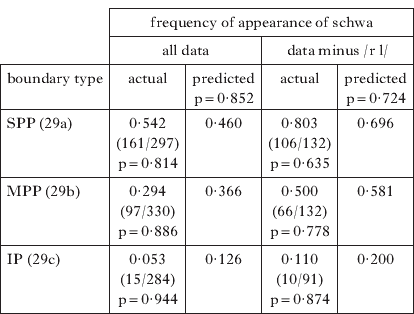
Dell (Reference Dell and Rohrer1977) provides experimental data on the rate of schwa's appearance in these syntactic contexts. Table I compares his results to the predictions of MS. Some of the clusters from Dell begin with [r] or [l] and are irrelevant for our purposes because they don't violate the *NTN constraints. Consequently, the table shows both Dell's full results and the same data minus the [r] and [l] tokens. The columns labelled ‘actual’ provide the frequency with which schwa appeared in Dell's data for each boundary type, plus the value for p necessary to model that frequency perfectly in the corresponding tableau from above.
Comparison of frequency of appearance of [ǝ] in various syntactic contexts, with data from Dell (1977) and predictions of MS under the ranking in (27). The ‘actual’ columns show the p-values under which the MS analysis models each context perfectly.
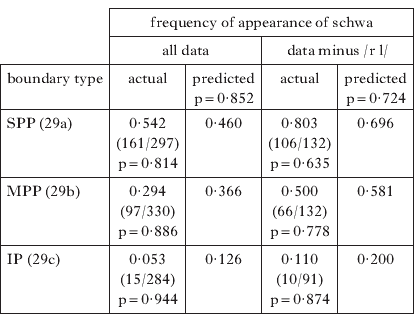
Since my assumption is that p is constant across a language, I also report (in the columns labelled ‘predicted’) the predicted frequencies, assuming that p is the same for all boundary types. These values for p were derived by treating the actual frequencies for the three boundary types as defining a point in a three-dimensional space and calculating the Euclidean distance between that point and the point produced by the MS model's predicted frequencies for the boundary types, testing all values of p between 0 and 1 at intervals of 0·001. This procedure was carried out for a variety of possible rankings. The ranking used here and the p values 0·852 (all data) and 0·724 (/r l/ excluded) produce predicted frequencies with the smallest Euclidean distance from the actual frequencies.
I am unaware of any other analysis that produces frequency predictions for schwa with greater accuracy than that reported in Table I.Footnote 12 However, these results should be viewed cautiously. All of Dell's clusters end with [v], thus giving a limited picture of the phonotactic possibilities. Since the clusters in (25) lack a final [v], they may be governed by slightly different constraints than Dell's examples. Furthermore, two of Dell's stimuli contain cluster-medial fricatives rather than stops. That schwa may be inserted even when the medial segment is not a stop further suggests that constraints outside the *NTN/*CTN family favour epenthesis here, too. Including more suppressible constraints that bear on these examples would yield different values of p and might more accurately model Dell's results. For example, it is easy to imagine constraints penalising schwa at various syntactic boundaries.
Nonetheless, MS predicts the correct relative frequencies, with schwa appearing more often at larger boundaries and less often at smaller ones.
Other asymmetries can be handled in comparable ways: when schwa occurs more often in context C1 than in context C2, the clusters resulting from the absence of schwa in C1 are penalised more severely (i.e. they violate more constraints or higher-ranked constraints) than are the clusters resulting from the absence of schwa in C2. Alternatively, schwa in C2 is penalised more severely than schwa in C1. Space does not permit a detailed analysis of more asymmetries, but see Malécot (Reference Malécot1976), Lucci (Reference Lucci1983), Hansen (Reference Hansen1994) and Côté (Reference Côté2000) for discussion of relative and absolute deletion/epenthesis rates in various contexts.
Frequency asymmetries can also emerge from the tie-breaking constraint below the suppressible constraints. To take a simplified example, a native speaker of Swiss French I consulted prefers [vidətlədəmde] over [vidtələdəmde] for envie de te le demander. The tableau in (30) produces this difference.
(30)
When the candidates tie on ⊙*ə, Agree(ObsVoi) (or any other constraint penalising candidate (a)) favours [vidətlədəmde].
This section has demonstrated MS's ability to account for differences in the likelihood of schwa's appearance in various contexts. Keeping in mind the caveats noted above, the most robust result may be that the analysis predicts the correct relative asymmetries in the cases examined here.
4.2.2 Frequency predictions in Finnish coalescence
Anttila (Reference Anttila, Hinskens, van Hout and Wetzels1997, Reference Anttila and de Lacy2007) and Anttila & Cho (Reference Anttila and Cho1998) use the Partial Orders (PO) Theory to model output frequencies.Footnote 13 Within the set of complete rankings allowed by a partial constraint ranking, some variants win more often than others and are therefore predicted to occur more frequently. Anttila examines vowel coalescence in Finnish, which ‘applies to a sequence of unstressed short vowels, both derived and non-derived, where the second vowel is [+low]’ (2007: 526). He gives the examples in (31).
(31)
Coalescence involving mid vowels is more common than coalescence involving high vowels. Consequently, Anttila posits the ranking *ea≫*ia, where each constraint bans the obvious vowel sequences. Faithfulness constraints are not fixed with respect to this ranking, so on any particular evaluation, if coalescence of [ia] is permitted, so is coalescence of [ea], though the reverse is not true, as shown in (32) (cf. Anttila's (18)).
(32)
Two of the three rankings trigger coalescence of [ea], which therefore has a predicted frequency of two-thirds. But [ia] coalesces under just one ranking, so its predicted occurrence is one-third.
An MS account of these facts requires minor reformulations of the PO analysis. One set of constraints that produces comparable results to Anttila's is ⊙*ea and ⊙*[–low]a. The latter constraint, rather than penalising only high vowels followed by low vowels as *ia does, disfavours any non-low vowel followed by a low vowel. The candidate [suomea] violates both ⊙*ea and ⊙*[–low]a; as (33a) shows, this candidate wins only when both of these violation marks are suppressed. Its predicted frequency is therefore p 2 – lower than that of [ruotsia] in (33b), which is p because this form violates only ⊙*[–low]a.
(33)
Merely tagging *ea and *ia as suppressible does not produce the asymmetry. In each tableau below, the faithful candidate wins with a frequency of p, so coalescence is equally probable in the two cases.
(34)
Adopting *[–low]a accomplishes more than simply giving MS the right asymmetry. Under the resulting stringency hierarchy (de Lacy Reference de Lacy2002), a violation of *ea entails a violation of *[–low]a, but not vice versa. So it is possible to coalesce [ea] while preserving [ia] (under *ea≫Faith≫*[–low]a), but no ranking coalesces [ia] alone. As discussed below, this situation is mirrored by typological facts: the pattern excluded by the stringent analysis is unattested in Finnish dialects. Using *ea and *ia, achieving the same result requires imposing *ea≫*ia as a universal ranking.
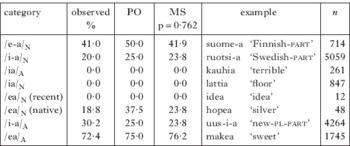
In a corpus study, Anttila investigates the rate of coalescence in mono- and polymorphemic contexts, in adjectives and nouns, and in native and borrowed words. The data are reproduced in Table II (cf. Anttila's (28)), with predictions made by the PO model and the MS analysis developed below. I omit the /e-a/ adjective category, as there are no data to evaluate the models against. The value for p used here was derived via the same method used in the French analysis above. The discussion below explains these predictions.
Comparison of the frequency of Finnish coalescence in various contexts, with data from Anttila (2007) and predictions from his PO analysis and the MS analysis.

Anttila found that /suome-a/-type words (nouns with heteromorphemic [ea] sequences) coalesced at a 41·0% rate. The PO model predicts 50·0%.Footnote 14 Furthermore, /ruotsi-a/-type words show a 20·0% coalescence rate; the PO model predicts 25·0%.
As for MS, the rate of coalescence in /ruotsi-a/ is 1–p (i.e. the probability that [ruotsia]'s suppressible violation in (33b) survives), and for /suome-a/ it is 1–p2 (coalescence happens unless both suppressible violations in (33a) are suppressed). As Table II shows, when p=0·762, MS models the corpus results with better accuracy than the PO model.
Some categories never coalesce: monomorphemic words with [ia] (/kauhia, lattia/) and recent monomorphemic noun borrowings with [ea] (/idea/). PO accounts for the former by ranking FaithRoot over *ia; MS achieves the same result with FaithRoot≫⊙*[–low]a.
(35)
In the PO approach, /idea/-type nouns are subject to a cophonology (e.g. Inkelas & Zoll Reference Inkelas and Zoll2005, Reference Inkelas and Zoll2007) with the fixed ranking FaithRoot≫*ea≫*ia. The same can be done in the MS analysis, replacing *ia with *[–low]a; while the theory aims to replace re-ranking theories as a model of optionality, there is ample evidence that different lexical strata may be subject to different grammars, so there is still room for cophonologies under MS.
Unlike recent borrowings, native nouns with [ea] (e.g. /hopea/) coalesce at a 18·8% rate. The MS analysis already makes reasonably accurate predictions for this word type. In (36), coalescence occurs unless the faithful candidate's violation of ⊙*ea is suppressed. The predicted frequency of [hopee] is thus 1–p=23·8%, an improvement on PO's 37·5% prediction.
(36)
Neither the PO analysis nor the MS analysis distinguishes /uus-i-a/-type words from /ruotsi-a/-type words. Consequently, the frequency predictions are the same for these categories; here, the PO model is marginally more accurate than the MS model, as Table II shows.
Finally, under PO, a separate cophonology for adjectives with *ea≫FaithRoot ensures more frequent coalescence for /makea/-type words. MS produces comparable results with a similar cophonology that includes a suppressible constraint penalising [makee]. So far only (non-suppressible) faithfulness constraints penalise [makee], so we need a new constraint, perhaps ⊙*ViVi, which penalises adjacent identical vowels (and clearly resembles the OCP; Leben Reference Leben1973). ⊙*ViVi outranks a non-suppressible version of *[–low]a – there's no inconsistency in allowing suppression of *[–low]a for one cophonology but not another, just as re-ranking theories don't require preservation of variable rankings across cophonologies.
(37)
Coalescence occurs at a rate of p; with p=0·762, the coalescence candidate's frequency is close to the 72·4% found in the corpus study. This is only slightly less accurate than the PO prediction of 75·0%.
To summarise the analyses, under PO most words are subject to the ranking *ea, FaithRoot≫*ia, with the generic Faith freely rankable within this hierarchy. Adjectives and recent loans are subject to other cophonologies. The MS analysis also adopts these cophonologies, and the rest of the lexicon is subject to the ranking in (38).
(38)
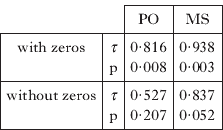
To compare the accuracy of the two models' frequency predictions, I computed Kendall's τ as a non-parametric measure of the correlation between each model and the actual data. For positive correlations, τ ranges between 0 (no correlation) and 1 (perfect correlation). The test was run twice for each model, once including the cases with zero coalescence and once without them (since the correct predictions in those cases are essentially hard-wired into both analyses). The results are given in Table III.
Correlation of the predictions of the PO and MS analyses with observed frequencies of Finnish coalescence as measured by Kendall’s tau (τ). p values are for the null hypothesis that τ=0.
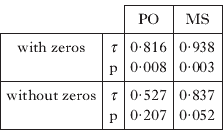
With so little data to evaluate (each row in Table II is one data point), these results should be interpreted with caution. Nonetheless, some of the tests did indicate significant results. When the zero-coalescence cases are included, both models are significantly correlated with the data. But as the τ values show, the MS model is the better predictor of the relative frequencies of coalescence of different word types. When the zero-coalescence cases are excluded, neither model is significant, though MS approaches significance (p=0·052). The problem here may simply be the lack of data, but this simple statistical evaluation suggests that the MS analysis better accounts for the data.
Since Faith is ineligible for suppression, the MS analysis requires one more constraint, ⊙*ViVi, than the PO analysis. Considering the size of the entire constraint set, a difference of one constraint is trivial, especially since *ViVi – essentially an OCP constraint – is likely to be useful beyond the current analysis. On the other hand, the PO analysis is more complex than the MS analysis in that it permits eight different rankings (setting aside the two cophonologies) where MS needs just one, though taking Anttila's (Reference Anttila, Hinskens, van Hout and Wetzels1997) position on grammar complexity renders PO simpler. With no way of calculating cost, evaluating the relative complexities of MS and PO is not easy, and until more work is done on this question, we must turn to other bases for comparison, such as the collective harmonic-bounding issue, corpus data and factorial typological predictions.
On the latter issue, the predictions of MS mirror those of PO. The PO model predicts that any grammar that permits coalescence in /lattia/ should permit coalescence in /hopea/ and /ruotsi-a/, and also that any grammar that permits coalescence in /hopea/ or /ruotsi-a/ should also allow it in /suome-a/. The factorial typology of the constraints used in the MS analysis, computed with the help of OTSoft (Hayes et al. Reference Hayes, Tesar and Zuraw2003) and setting suppression and the cophonology-specific *ViVi aside for the moment, yields six output patterns, which are summarised in (39); cf. Anttila's (25).Footnote 15 Superscripts are explained immediately below.
(39)
Only one ranking produces coalescence in /lattia/, and all three other categories also coalesce under that ranking. As for the other rankings, none results in coalescence in /hopea/ or /ruotsi-a/ but not in /suome-a/, and one ranking produces coalescence in /suome-a/ alone.
Suppression does not alter this result. Superscripts indicate that tagging one or both markedness constraints as suppressible leads to optional coalescence: *ea (superscript e), *[–low]a (l) or both together (b). In each ranking, if coalescence in /suome-a/ is optional, so is coalescence in /hopea/ and /ruotsi-a/, as long as the ranking allows coalescence in /hopea/ and/or /ruotsi-a/ in the first place. The same relationship holds for /hopea/ and /ruotsi-a/ with respect to /lattia/: optional coalescence in the former precludes obligatory coalescence in the latter. These predictions, like PO's, are borne out in the dialects of Finnish. For example, Anttila (Reference Anttila and de Lacy2007) reports that no dialect allows coalescence of [ia] but not [ea], and no dialect has optional coalescence of [ea] with obligatory coalescence of [ia]. Including *ViVi preserves these results: *ViVi penalises all coalescence equally and thus cannot lead to different outcomes for the four conditions. It either bans or, if suppressible, discourages coalescence across the board.
To summarise, MS models frequency data for Finnish coalescence somewhat better than PO. The comparison of the two frameworks is inconclusive in certain respects, but on each of the three criteria listed above (collective harmonic bounding, corpus modelling and factorial typologies), MS performs at least as well as PO, if not decidedly better.
5 Other approaches to optionality in OT
5.1 Serial variation
The theory of variation developed by Kimper (Reference Kimper2011) combines Partial Orders with Harmonic Serialism (Prince & Smolensky Reference Prince and Smolensky1993). Harmonic Serialism is a non-parallel version of OT that involves multiple passes through the constraint ranking with candidates that differ from the input by at most one change. Eval selects the winning form from this set, and that form serves as the input for the next pass through eval. Gen produces new candidates based on this new input, and the gen/eval loop repeats until the input on some step is also the winner – the derivation converges, and that form is the output.
Consequently, in French, schwas are deleted one at a time. If the ranking can change from step to step, different schwas may be affected in different ways: the ranking may be conducive to deletion at one step, but it may prohibit further deletion at the next step. The all-or-nothing problem of re-ranking theories is thereby avoided, but the harmonic bounding issue remains.
The Serial Variation analysis of schwa follows Selkirk's (Reference Selkirk1978) prosodically driven account. This approach assumes that French constructs unary feet, except that a syllable headed by schwa may be parsed as the dependent syllable in a binary foot. The analysis builds iambs from right to left, with each pass through eval adding another foot until the string is exhaustively parsed. One ranking contains *WeakV≫Parse-σ and the other has Parse-σ≫*WeakV, where *WeakV disfavours syllables parsed as the weak member of a binary foot – the first syllable here, since we're dealing with iambs.
Given a sequence like /CəCV/ – i.e. a syllable with schwa followed by a syllable with any vowel – *WeakV≫Parse-σ favours the usual unary foot: Cə(CV), leaving /Cə/ for the next step. The other ranking produces a binary foot, (CəCV), so as to minimise the number of unparsed syllables. This system produces the following parses for envie de te le demander.
(40)
The ranking also disfavours syllables parsed as dependents, and when a (CəCV) foot is built, the schwa is subsequently deleted. Schwas parsed in unary feet remain. Thus the parses in (40) yield the surface forms in (1b). Consecutive schwas cannot be deleted: with maximally binary iambs, adjacent schwas cannot both be in the weak position of a foot.
There is little evidence for the posited feet. French has final primary stress, and there is evidence for initial secondary stress (e.g. Verluyten Reference Verluyten, van den Broecke and Cohen1984, Hoskins Reference Hoskins and Mazzola1994), but independent evidence for feet in other positions – not to mention the specific parses in (40) – is unavailable.
More significantly, the analysis always rules out deletion of consecutive schwas. As we have seen, this is a vast oversimplification of the facts. Consecutive schwas may in fact be deleted under circumstances that are related, in part, to segmental factors that a purely prosodic analysis cannot accommodate.
The analysis may also have difficulty producing all of the forms in (40).Footnote 16 Consider ()(vi)(də)(tə)(lədə)(m)(de): footing moves from right to left, giving first vidətələdəm(de), then vidətələdə(m)(de). To trigger deletion of the schwa in le, that schwa must be parsed as the weak member of a foot – vidətə(lədə)(m)(de) – meaning the ranking Parse-σ≫*WeakV is necessary. But with Parse-σ high-ranked, the candidate vidə(tələ)(dəm)(de) is favoured at this point, as (41) shows. McCarthy (Reference McCarthy2008) posits that just one stressed syllable can be added per step, and the mapping vidətələdə(m)(de)→vidə(tələ)(dəm)(de) obeys this restriction, since extending a foot's reach does not introduce a new head.
(41)
To render le the weak member of a foot, we need the opposite ranking at this stage, followed by Parse-σ≫*WeakV, as in (42).
(42)
But this puts de in position to undergo deletion, too. There's no way to delete just the schwa in le.
Pruitt's (Reference Pruitt2010) strict inheritance condition solves the problem by banning changes to existing feet, rendering the winner from (41) is illicit. Candidate (c) wins instead. But this condition introduces new difficulties. If existing prosodic structure is inalterable, what do we do with the consonants that are left over after deletion? For example, in the output under consideration here, [vidətəldəmde], the most plausible syllabification of the [l] is as a coda. But since deletion operates on ()(vi)(də)(tə)(lədə)(m)(de), yielding ()(vi)(də)(tə)(ldə)(m)(de), resyllabification moves the [l] to a new foot, which seems to be what strict inheritance blocks. Moving the [l] into the following onset means altering prosodic structure at the syllabic level. So strict inheritance cannot prevent prosodic readjustments of all types – Pruitt does not claim otherwise, but it is not clear which readjustments, and why just those, are permitted.
Recasting the analysis in terms of an interaction between *ə and Max is counterproductive, because it encounters the problem that faces other re-ranking theories. To simplify matters, consider the choice among the four realisations that delete just one schwa in envie de te le demander. The ranking *ə≫Max on the first step triggers deletion of a schwa, with lower constraints determining which schwa-deletion form wins. (43) shows this with a tie-breaking constraint penalising non-prevocalic stops (Steriade Reference Steriade1994).
(43)
For any of the other deletion candidates to win, we need a variable ranking between *Non-PreV Stop and a constraint that favours one of the other candidates. This requires at least four different rankings of lower constraints. The situation is a familiar one: proliferation of constraints and variable rankings in the hope of solving the collective harmonic bounding problem. Unless each candidate in (43) is favoured by a different ranking – meaning there's no harmonic bounding – the analysis cannot access at least one viable output as well as all other outputs whose derivations begin with that form. The same goes for subsequent deletions: all candidates representing permissible deletion of a second schwa must not be harmonically bounded. Serial Variation aims to solve the harmonic bounding problem, but the analysis works only if that problem doesn't exist in the first place.
5.2 Rank-ordered model of eval
The rank-ordered model of eval (ROE; Coetzee Reference Coetzee2004, Reference Coetzee2006), like MS, provides multiple outputs under one ranking. Rather than merely selecting the optimal candidate, an OT grammar ‘imposes a harmonic rank-ordering on the full candidate set’ (Coetzee Reference Coetzee2006: 338). All candidates are available as outputs (with an important caveat), but more harmonic candidates are more likely outputs. To restrict the range of variation, Coetzee adopts a ‘cut-off line’ that divides the ranking into two parts. Constraints ranked above the cut-off line function as in standard OT and can eliminate candidates from consideration. Only candidates that survive to the cut-off line are eligible variants.
To illustrate, a ROE analysis of schwa might proceed as in (44), using the ranking *CNC≫*ə≫Max from §4.1. The cut-off line falls between *CNC and *ə (indicated with a bold line between those columns): violations of *CNC are fatal, but candidates violating *ə may surface even though they're not the most harmonic forms. The first three candidates are all possible outputs, and the last of these is the most likely because it performs best on the constraint ranking.
(44)
The constraints below the cut-off line are functionally similar to suppressible constraints, in that violating them decreases a candidate's likelihood of winning but does not render it entirely impossible. Consequently, ROE allows collectively harmonically bounded outputs. While more harmonic variants are proposed to be more frequent, ROE purposely makes no absolute frequency predictions: Coetzee correctly points out that room must be left for extragrammatical factors to influence a variant's frequency, and a theory that derives frequencies entirely from phonological considerations is unrealistic.
But ROE goes too far in limiting the sway of phonological factors. Within a single tableau, the relative frequencies of two candidates depend on their relative harmony, but no such comparison across tableaux is possible. There is, for example, no way to compare the frequencies of the most harmonic candidates in separate evaluations. Yet as we have seen, phonological factors can play a crucial role in such asymmetries. As discussed in §4.2.1, clusters that violate *CNC are more acceptable and more common in French when they straddle larger prosodic boundaries. The MS analysis of these facts correctly predicts a more frequent absence of schwa in l'insecte mangeait ‘the insect was eating’ than in insecte marron ‘brown insect’, but ROE does not. Since [l sɛktmʒɛ] and [sɛktmar
 ] are not viable candidates within the same tableau, we cannot say that one is more harmonic than the other (at least not in the way that ROE determines relative frequencies), and ROE makes no prediction in this case. The crucial difference between l'insecte mangeait and insecte marron is phonological, so their different (relative) frequencies should therefore stem from the phonological grammar.
A more serious potential issue concerns consistent placement of constraints above or below the cut-off line. As Coetzee notes, ROE predicts that a constraint below the cut-off line can never rule a candidate out entirely. A plausible situation in which a constraint must be both above and below the cut-off line comes from flapping (e.g. Patterson & Connine Reference Patterson and Connine2001) and word-final t/d-deletion (e.g. Neu Reference Neu and Labov1980) in American English. Both phenomena are variable, as the cited work demonstrates: /t/ and /d/ optionally flap intervocalically following a stressed vowel (e.g. butter), and they also optionally delete after a consonant word-finally (e.g. send). Since the processes are optional, the constraints motivating them – say, *VtV and *Ct# – must be below the cut-off line. Deletion is not a viable strategy for satisfaction of *VtV, so Max must outrank *VtV and appear above the cut-off line, as in (45).
(45)
But deletion does occur to satisfy *Ct#, so it must be below the cut-off line.
(46)
The analyses are incompatible. In MS, on the other hand, the ranking ⊙*Ct#≫Max≫⊙*VtV is sufficient. This permits deletion to satisfy ⊙*Ct# but not ⊙*VtV, as in (47).
(47)
A potential solution to ROE's problem is to use some constraint besides Max to rule out bu[∅]er, such as Onset or *Hiatus. But since English tolerates both onsetless syllables and hiatus, these constraints must rank below Max anyway, and placing either one above the cut-off line in (45) entails Max's concomitant placement above the cut-off line, too.
In sum, ROE predicts that if a constraint cannot prevent variation in one instance, it cannot prevent it in any instance. Flapping and word-final deletion appear to show that this prediction is incorrect.
5.3 Local Constraint Evaluation
Under Local Constraint Evaluation (LCE; Riggle & Wilson Reference Riggle and Wilson2005), each constraint is decomposed into freely rankable position-specific constraints. When two ‘parent’ constraints are unranked in a language, this indeterminacy can be resolved separately for each position in the form. Thus for schwa deletion we can have *ə≫Max for one vowel and Max≫*ə for another vowel. This means the formerly harmonically bounded forms can be produced. The analysis is illustrated in (48).
(48)
Since *ə and Max are not crucially ranked in the grammar at large, their position-specific versions can be interleaved. For each position except position 1 in (48), Max outranks *ə. Deletion is thus banned at positions 2, 3 and 4, but with *ə@1≫Max@1, deletion of the first schwa is required. LCE produces local optionality by effectively creating a separate grammar for each position at which the process could apply.
Riggle & Wilson (Reference Riggle and Wilson2005) are careful to point out that certain details of LCE's formalism remain unclear. For constraints like *ə, determining the locus of violation is trivial: *ə@i is violated if a schwa has the index i. But other constraints, like *N (Pater Reference Pater, Kager, Hulst and Zonneveld1999), refer to multiple segments. For these constraints it is not clear how to determine which segments (one?; both?) their position-specific versions are concerned with.
Epenthesis is also problematic. Although Riggle & Wilson provisionally suggest a way to assign indices to epenthetic segments, they note that the issues are not simple. It may or may not be necessary for epenthetic segments at different positions in different candidates to receive distinct indices, and consistent indexation of material shared by multiple candidates (e.g. [trab] vs. [tərab], the latter with an epenthetic [ə]) is crucial, or else position-specific constraints won't provide an adequate comparison of this common material.
The status of position-specific constraints invites more questions. Are they always present in the grammar, or are they projected as needed in each evaluation? If the latter, by what mechanism does projection occur? If the former, how many such constraints are available, and does this put an upper bound on the length of phonological representations? Can each position-specific constraint be ranked independently of its sisters, aside from resolving unspecified rankings between parent constraints? For example, is the ranking *ə@4≫Max@1 … Max@n≫*ə@1 … possible, so that schwas may appear anywhere in the language except as the fourth segment in a word?
It is also not clear whether LCE makes useful frequency predictions. The ranking in (48) is no more or less likely than any other permutation of the constraints, so all deletion patterns are equally likely.
MS, in contrast, has none of these uncertainties. The only new mechanism is eval's ability to ignore violation marks for certain constraints. MS does not entail a massive expansion of the constraint set, and it makes accurate frequency predictions.
5.4 Tied winners and tied constraints
Some research relies on ties of one kind or another to produce multiple outputs. Hammond (Reference Hammond1994) and Odden (Reference Odden, Vaux and Nevins2008) argue that multiple winners can emerge if the constraint set underdetermines the outcome of an evaluation. That is, if no constraint distinguishes two candidates, they can both emerge as optimal under the right ranking.
Odden (Reference Odden, Vaux and Nevins2008) considers a similar approach that imposes ties between constraints. The violation marks for these constraints are essentially lumped together – violating one constraint is no worse than violating the other. For example, if *ə and Max are tied, then the three candidates in (49) are equally optimal.
(49)
Relying on ties is dangerous, because it is highly unlikely that no constraint will distinguish the tied candidates (see also Lee Reference Lee2001, Vaux Reference Vaux2002, Riggle & Wilson Reference Riggle and Wilson2005).
Baković & Keer (Reference Baković, Keer, Legendre, Grimshaw and Vikner2001) point out a particularly implausible prediction of approaches that rely on candidates having exactly the same violation profiles. Such candidates are equally harmonic under all rankings, so if a process is optional in one language, it should be optional universally. This is clearly not the case.
6 Conclusion
OT has proved to be a powerful tool for investigating variation, and much of the work cited in this paper places variation in a central analytical position. Markedness Suppression provides a new approach to the subject that avoids the pitfalls of other proposals.
While MS replaces re-ranking theories in accounts of local optionality, multiple grammars remain indispensable. Control of multiple dialects or languages means knowledge of multiple grammars, after all, and as the above analysis of Finnish shows, cophonologies are still useful tools. But there is an important distinction between multiple grammars derived from variable rankings and those that exist side by side as cophonologies or grammars of separate languages. The latter are unavoidable and do not require a theory of variable rankings, but to my knowledge the former are used only to account for variation within a single language variety. As this is the territory covered by MS, variable rankings seem superfluous. This view returns us to the position taken by Prince & Smolensky (Reference Prince and Smolensky1993) that an OT grammar is a total order on the constraint set. Speakers may possess multiple total orders, but these do not result from different resolutions of a ‘master’ partial order.
An important prediction of MS bears repeating. The theory produces harmonically bounded candidates with intermediate levels of process application, but since MS cannot generate such forms to the exclusion of the harmonic bounders, there should be no language in which just the harmonically bounded form is attested. We should find no French′, in which exactly one schwa is always deleted in a phrase like envie de te le demander. That is, MS predicts an implicational hierarchy: if a language allows one intermediate form, it should also allow its harmonic bounder(s).
A significant remaining question concerns the range of constraints eligible for suppression. The reasons for excluding faithfulness constraints were discussed above, but further restrictions may be necessary. For example, suppressible Alignment might prove useful in Tagalog reduplication; see (6). But if an alternative analysis is available, we can ask whether alignment constraints are indeed eligible for suppression. Similarly, it may turn out that suppressing certain other constraints yields unattested patterns. In this case, we may want to restrict the set of suppressible constraints to some (hopefully principled) proper subset of markedness constraints.
Finally, a very different view of suppression from the one presented here is possible. It is conceivable that the rate of suppression p is set on a constraint-particular basis. For the constraints that don't appear to be suppressible, p=0. The learner's task is not to determine which constraints are suppressible, but to derive p for each markedness constraint, much as Stochastic OT requires learners to determine each constraint's numerical ranking. Under such an approach, suppression is more deeply integrated into con than under the view of p taken here. This possibility may be worth pursuing, but I have opted not to do so, because the more restrictive language-particular p is satisfactory for the cases at hand.