Introduction
Sudden sensorineural hearing loss (SNHL) is defined as rapid-onset hearing impairment occurring within a 72-hour window, consisting of a decrease in hearing of 30 dB or more and affecting at least three consecutive frequencies.1 Although it is most commonly idiopathic, known possible causes of sudden SNHL, such as vestibular schwannoma, Ménière's disease, stroke, malignancy, autoimmune inner-ear disease, noise exposure and use of ototoxic medications, are sought. Magnetic resonance imaging (MRI) is routinely recommended for all patients presenting with sudden SNHL in order to screen for vestibular schwannoma, which is identified in approximately 5.4 per cent of patients.Reference Sweeney, Carlson, Shepard, McCracken, Vivas and Neff2
The recently published American Academy of Otolaryngology – Head and Neck Surgery (AAO-HNS) guidelines update for sudden hearing loss stated that the audiological evaluation of sudden SNHL should include the measurement of bone conduction hearing thresholds at 3 kHz in addition to octave intervals 0.25–4 kHz.Reference Chandrasekhar, Tsai Do, Schwartz, Bontempo, Faucett and Finestone3 The recommendation for specifically evaluating 3 kHz as a standard measurement for sudden SNHL had not been included in previous guidelines.Reference Stachler, Chandrasekhar, Archer, Rosenfeld, Schwartz and Barrs4
The importance of measuring the bone conduction threshold at 3 kHz was established in previous studies, which demonstrated that an asymmetric SNHL of progressive or sudden nature at 3 kHz is the most important of all frequencies to predict the probability of vestibular schwannoma.Reference Sweeney, Carlson, Shepard, McCracken, Vivas and Neff2,Reference Saliba, Martineau and Chagnon5,Reference Saliba, Bergeron, Martineau and Chagnon6 Saliba et al.Reference Saliba, Martineau and Chagnon5,Reference Saliba, Bergeron, Martineau and Chagnon6 proposed the ‘rule 3000’, which is defined as an asymmetric SNHL of 15 dB or more at 3 kHz. Compared to other definitions of asymmetric SNHL reported in the literature, this audiometric criterion was found to be the most reliable and to have the highest positive predictive value in screening for vestibular schwannoma.Reference Sweeney, Carlson, Shepard, McCracken, Vivas and Neff2,Reference Saliba, Bergeron, Martineau and Chagnon6
Nevertheless, thresholds at 3 kHz are not universally measured in routine audiometry, and are therefore often missing on audiograms.Reference Gurgel, Popelka, Oghalai, Blevins, Chang and Jackler7 Missing data at 3 kHz present a dilemma for researchers and clinicians. A calculated value at 3 kHz using the mathematical average of the measured values at 2 kHz and 4 kHz was reported to closely approximate a measured threshold at 3 kHz.Reference Gurgel, Popelka, Oghalai, Blevins, Chang and Jackler7 However, that analysis was conducted on audiograms of individuals with no specific pathology, and the side assessed was randomly chosen; therefore, approximately 50 per cent of the thresholds in the analysis were in the normal range.
To the best of our knowledge, the measured bone conduction threshold at 3 kHz has not been previously compared to the calculated threshold at 3 kHz in patients with idiopathic sudden SNHL, Ménière's disease or vestibular schwannoma. In this study, we compared the audiometrically measured bone conduction pure tone threshold at 3 kHz with the 3 kHz threshold calculated based on the 1:1 average of measured values at 2 kHz and 4 kHz in patients with newly diagnosed sudden SNHL. We aimed to evaluate how accurately the calculated 3 kHz threshold predicts the measured 3 kHz threshold in this study population, and determine whether there is any difference between idiopathic sudden SNHL and sudden SNHL secondary to vestibular schwannoma or Ménière's disease.
Materials and methods
Materials
This study protocol was approved by the research ethics committee of our tertiary referral medical centre (0580-12-TLV). A retrospective analysis was performed on the medical records of all adult patients (aged 18 years or more) diagnosed with unilateral sudden SNHL who received treatment in our institute between 2015 and 2019. Patients were identified based on their history, physical examination findings and formal audiogram at the initial encounter, before the initiation of treatment. The data collected from the records included age, sex, side and degree of hearing loss, and pure tone bone conduction thresholds at 2 kHz, 3 kHz and 4 kHz for the affected ear.
Methods
In each audiogram, the 3 kHz bone conduction threshold was obtained independently and was also calculated as the 1:1 average of the bone conduction thresholds at 2 kHz and 4 kHz from the same audiogram. The measured and calculated 3 kHz thresholds were then compared. All audiograms included in the study used 5 dB increments for threshold measurements.
Patients were separated into groups according to diagnoses of: vestibular schwannoma, based on MRI studies; Ménière's disease, based on clinical criteria; and idiopathic sudden SNHL, based on a lack of identifiable aetiology for the sudden SNHL. The groups were then compared.
Patients were excluded from the study if their audiograms did not measure the 3 kHz pure tone bone conduction threshold, or audiograms showed low-tone sudden SNHL in which the frequencies of 2 kHz or more were not affected. Additionally, patients with known previous hearing loss, middle-ear disease, inner-ear disease other than idiopathic sudden SNHL, vestibular schwannoma or Ménière's disease, degenerative central nervous system disorders, previous intracranial surgery or radiotherapy, or craniofacial abnormalities were excluded.
Statistical analysis
Categorical variables were summarised as frequencies and percentages. Continuous variables were evaluated for normal distribution with histograms and Q–Q plots; they were reported as means and standard deviations (SDs) when the variables were normally distributed, or as medians and interquartile ranges when they were not normally distributed. A Pearson correlation coefficient was used to evaluate the correlation between the two methods of 3 kHz assessment, and a scatterplot was applied to demonstrate it. A paired samples t-test was used to evaluate the absolute difference between the two methods. The Kruskal–Wallis test and Mann–Whitney test were used to compare the differences between the selected pathologies. All statistical tests were two-sided, and p value of less than 0.05 was considered significant. All statistical analyses were conducted using SPSS Statistics for Windows software, version 25 (IBM, Armonk, New York, USA).
Results
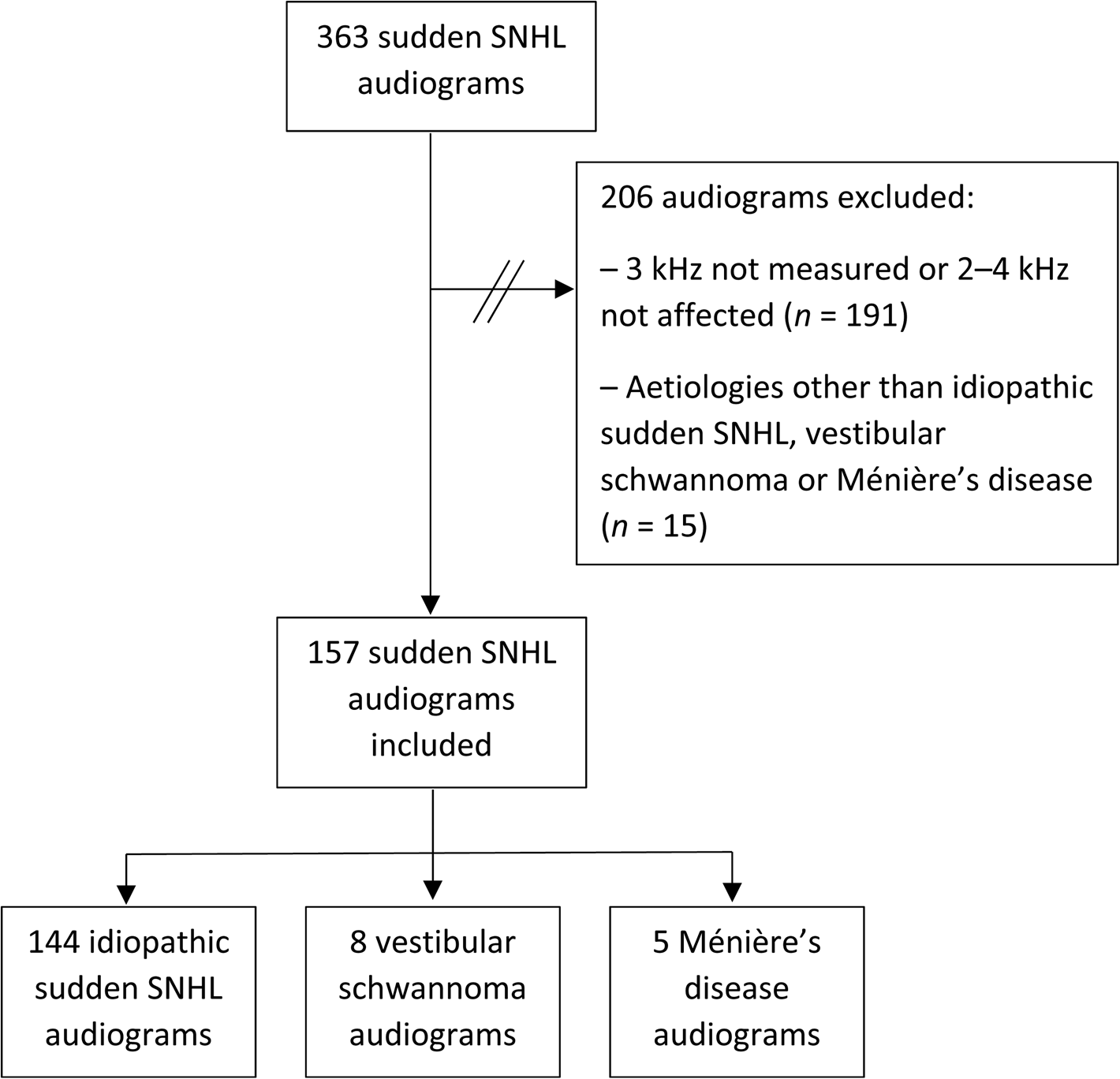
A total of 363 patients with sudden SNHL were screened. Of these, 191 were excluded because the 3 kHz threshold was not measured or the 2–4 kHz frequencies were not affected. Another 15 audiograms were excluded because the patients had sudden SNHL due to other known aetiologies, such as an infectious cause, barotrauma, an inner-ear disease other than vestibular schwannoma or Ménière's disease, intracranial surgery, or radiotherapy. These exclusions left a total of 157 patients with sudden SNHL.
Of the 157 patients included in the study, 144 (91.7 per cent) had idiopathic sudden SNHL, 8 (5.1 per cent) had ipsilateral vestibular schwannoma according to a subsequent MRI scan, and 5 (3.2 per cent) had Ménière's disease based on clinical criteria (Figure 1). The mean age of the entire cohort at the time of the first audiometry was 53 years (range, 20–88 years). Ninety patients were male (57.3 per cent) and 67 were female (42.7 per cent).
Flowchart of the studied audiograms. SNHL = sensorineural hearing loss

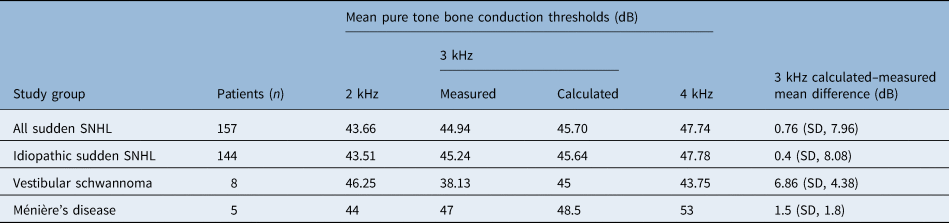
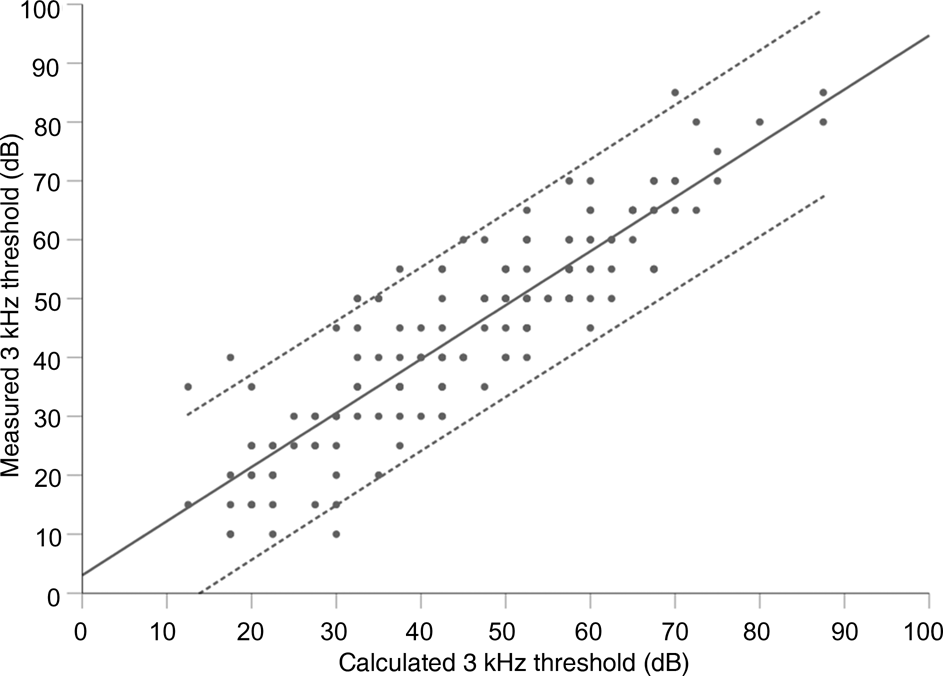
The mean bone conduction thresholds at 2 kHz, 3 kHz and 4 kHz were 43.66, 44.94 and 47.74 dB, respectively. The mean calculated 3 kHz threshold was 45.7 dB, based on averaging the measured 2 kHz and 4 kHz bone conduction thresholds (Table 1). The mean difference between the calculated and measured 3 kHz thresholds was 0.76 dB (SD = 7.96). The r value for the correlation between the two methods of 3 kHz assessment was 0.887 (p < 0.001) (Figure 2). The paired samples t-test showed no significant difference between the calculated and measured thresholds (p = 0.231). The difference between the calculated and measured 3 kHz thresholds was within ± 5 dB in 49.6 per cent, ±10 dB in 76.4 per cent and ± 15 dB in 94.2 per cent of the audiograms.
Pure tone bone conduction thresholds at 2 kHz, 3 kHz (measured and calculated) and 4 kHz

SNHL = sudden sensorineural hearing loss; SD = standard deviation
A scatterplot demonstrating the correlation between 157 measured and calculated 3 kHz thresholds (r = 0.887). Each dot represents an audiogram. The two broken lines represent 95 per cent confidence intervals.

The results were similar for the same analyses of the idiopathic sudden SNHL group alone (n = 144). The mean calculated and measured thresholds at 3 kHz were 45.24 and 45.64 dB, respectively, with a mean difference of 0.4 dB (SD = 8.08). The r value was 0.886 (p < 0.001). The paired samples t-test results were also not significant for the idiopathic sudden SNHL group (p = 0.554).
The mean difference between the calculated and measured 3 kHz thresholds in the vestibular schwannoma group was 6.86 dB (SD = 4.38), which is significantly different compared to the findings for the idiopathic sudden SNHL group (p = 0.013). However, similar analyses of the idiopathic sudden SNHL group versus the Ménière's disease group, and the vestibular schwannoma group versus the Ménière's disease group, did not reach significance (p = 0.992 and p = 0.065, respectively).
The measured 3 kHz threshold value did not lie within the range between the 2 kHz and 4 kHz thresholds in 41 cases (26 per cent), of which 38, 2 and 1 were from the idiopathic sudden SNHL, vestibular schwannoma and Ménière's disease groups, respectively. However, the measured 3 kHz threshold value was more than 5 dB out of the 2–4 kHz range in only 10 cases (6.4 per cent).
Discussion
Sudden SNHL is a common diagnosis in otolaryngology practice. The pathogenesis of idiopathic sudden SNHL is not known, but temporal bone analyses of patients with idiopathic sudden SNHL have reported that the pathology is primarily sensory and not neural.Reference Schreiber, Agrup, Haskard and Luxon8 The ‘gold standard’ for the diagnosis of sudden SNHL is a formal audiogram. The most commonly used criterion for the diagnosis of sudden SNHL is a loss of 30 dB at each of three consecutive frequencies occurring within 3 days.
A formal audiogram is a functional two-dimensional reconstruction of the subject's cochlea. It is established by plotting hearing threshold as a function of frequency in a low to high order. As the human cochlea is arranged in a tonotopic manner, the independent axis (frequency) can easily be replaced by an anatomical axis that indicates the distance from the round window, resulting in a mapping of lesion severity as a function of location along the cochlear duct. Ideally, pure tone thresholds should be plotted on a millimetric scale throughout the cochlea in order to yield a comprehensive estimation of the sensory inner-ear insult.
Performing this kind of audiogram may take a considerable amount of time, and its validity is questionable in light of behavioural learning. As a result, definitive, highly selected frequencies are chosen, to provide a general impression of lesion extent, even though this method is theoretically liable to miss audiometric data, such as when the lesion is localised in-between two consecutive frequencies. For example, according to the anatomical frequency scale (‘Schuknecht scale’) of the human cochlea,Reference Merchant and Nadol9 the distance between 2 kHz and 4 kHz is about 3 mm. Therefore, hypothetically, a small lesion within this portion of the cochlea may not be reflected in the audiogram unless 3 kHz is measured as well.
In order to allow the standardisation of hearing data, it is necessary to evaluate hearing thresholds in uniform frequencies. The AAO-HNS guidelines for reporting hearing results recommend audiometric standards that also include the threshold at 3 kHz as a standard measurement for the evaluation of hearing handicap, and for various specific auditory conditions, such as vestibular schwannoma, Ménière's disease and conductive hearing loss.10–Reference Monsell, Balkany, Gates, Goldenberg, Meyerhoff and House13 Additionally, similar audiometric standards that include measuring the threshold at 3 kHz were recommended for evaluating chemotherapy-induced ototoxicity.Reference Chang14 Nevertheless, measurement of the bone conduction hearing threshold at 3 kHz was only recently defined as a key component of a standard audiological evaluation of sudden SNHL, according to the update of the clinical practice guidelines for sudden hearing loss,Reference Chandrasekhar, Tsai Do, Schwartz, Bontempo, Faucett and Finestone3 while previous guidelines for sudden SNHL did not specifically recommend the measurement of 3 kHz frequency.Reference Stachler, Chandrasekhar, Archer, Rosenfeld, Schwartz and Barrs4 Consequently, the 3 kHz frequency is not universally measured in routine audiometry and is often missing.
The importance of measuring the bone conduction threshold at 3 kHz in cases of asymmetric SNHL has become evident over the past few years. Along with the fact that 3 kHz represents higher frequencies which are known as the first to be affected by vestibular schwannoma, previous studies have also demonstrated that asymmetric SNHL at 3 kHz is the most predictive for vestibular schwannoma compared to other reported audiometric definitions for asymmetric SNHL.Reference Sweeney, Carlson, Shepard, McCracken, Vivas and Neff2,Reference Saliba, Martineau and Chagnon5,Reference Saliba, Bergeron, Martineau and Chagnon6 The ‘rule 3000’ was proposed by Saliba et al.,Reference Saliba, Martineau and Chagnon5,Reference Saliba, Bergeron, Martineau and Chagnon6 and it is defined as an asymmetric SNHL of 15 dB or more at 3 kHz. This audiometric criterion is the most reliable and has the highest positive predictive value in screening for vestibular schwannoma compared to other audiometric definitions for SNHL reported in the literature.Reference Sweeney, Carlson, Shepard, McCracken, Vivas and Neff2,Reference Saliba, Martineau and Chagnon5
In an attempt to address the problem of not measuring the 3 kHz frequency in routine audiometric practice, a study by Gurgel et al.Reference Gurgel, Popelka, Oghalai, Blevins, Chang and Jackler7 was undertaken to determine whether a calculated value at 3 kHz using measured values at 2 kHz and 4 kHz on audiograms would closely approximate a measured threshold at 3 kHz. In their study, the calculated threshold accurately approximated the measured threshold at 3 kHz, leading them to conclude that it could ‘replace’ a missing 3 kHz threshold value with minimal error. However, the analysis was conducted on a randomly selected pool of ears, some of which had normal audiograms, while the affected ears had heterogeneous disease entities. Furthermore, that study analysed pure tone thresholds obtained via air conduction and not bone conduction.
Our study was conducted to evaluate whether it is feasible to approximate the bone conduction pure tone threshold at 3 kHz in audiograms of patients with sudden SNHL by averaging the values of 2 kHz and 4 kHz bone conduction thresholds. Unlike the study by Gurgel et al.,Reference Gurgel, Popelka, Oghalai, Blevins, Chang and Jackler7 we selected only ears that sustained sudden SNHL which affected frequencies from 2 kHz and above. The objective was to investigate whether any audiometric information is missed by calculating the bone conduction threshold at 3 kHz according to the bone conduction thresholds at 2 kHz and 4 kHz. We applied this assessment to the sudden SNHL population as a whole, as well as to individual subgroups with idiopathic sudden SNHL, or sudden SNHL due to vestibular schwannoma or Ménière's disease.
Our results showed that the 3 kHz threshold value can be reliably replaced by a mathematical average of the 2 kHz and 4 kHz thresholds in the audiograms of idiopathic sudden SNHL patients. However, this did not hold true for cases of sudden SNHL due to vestibular schwannoma, in which the calculation of the 3 kHz threshold did not predict the measured value accurately. The mean difference between the two values was almost 7 dB in the vestibular schwannoma group, compared to 0.4 dB in the idiopathic sudden SNHL group. This group discrepancy was statistically significant (p = 0.013). Thus, an attempt to approximate the 3 kHz threshold in patients presenting with sudden SNHL may miss important audiometric information provided by the asymmetric SNHL at this specific frequency.
The results in the Ménière's disease group were similar to the idiopathic sudden SNHL group, with a mean difference of 1.5 dB between the measured and calculated 3 kHz thresholds. As the SNHL in Ménière's disease mainly involves low frequencies, the significance of these findings is questionable.
The findings of the current study reinforce the body of evidence suggesting that the frequency of 3 kHz is most important for predicting vestibular schwannoma in asymmetric SNHL cases. Measuring the bone conduction threshold at 3 kHz is particularly relevant in patients treated for sudden SNHL before vestibular schwannoma has been excluded; these tumours often cause hearing loss predominantly in the high frequencies, and the 3 kHz threshold can be used as a stratification parameter for an MRI scan. Even though systemic steroidal treatment is recommended in vestibular schwannoma induced sudden SNHL, intra tympanic administration is not effective and is contraindicated. The finding of bone conduction hearing loss at 3 kHz can be used to schedule an MRI scan in a timely fashion in the event of systemic steroid treatment failure for sudden SNHL, before salvage intra-tympanic treatment is initiated.
• In routine audiometry of sudden sensorineural hearing loss (SNHL) patients, the 3 kHz bone conduction threshold should be independently measured
• The 3 kHz value may provide important audiometric information regarding the possibility of a vestibular schwannoma
• A discrepancy between calculated and measured 3 kHz thresholds in sudden SNHL cases may raise suspicion of vestibular schwannoma
Based on our results, we recommend that the 3 kHz bone conduction threshold be included in the routine audiometry of patients presenting with sudden SNHL, in preference to a calculated threshold. The calculated 3 kHz threshold may, however, approximate the measured value in cases of idiopathic sudden SNHL where vestibular schwannoma is not suspected or has been excluded. This method may be useful for idiopathic sudden SNHL population based retrospective studies of aggregate audiograms, with a minimal chance of error.
Limitations of our study include a relatively small cohort, especially in the vestibular schwannoma and Ménière's disease groups, which included only eight and five patients, respectively. However, 5 per cent is the expected rate of vestibular schwannoma among sudden SNHL patients according to the medical literature. Another limitation relates to the audiometric measurement method: pure tone threshold measurements were carried out with 5 dB increments, which is common practice, but shorter increments would have provided greater accuracy.
Conclusion
Our study supports the latest AAO-HNS recommendations to include the 3 kHz bone conduction threshold in routine audiometry of patients presenting with sudden SNHL, given that the 3 kHz value may provide important audiometric information regarding the possibility of an underlying vestibular schwannoma as an aetiology for the sudden SNHL. Based on our results and in light of previous studies that emphasised the importance of 3 kHz in predicting vestibular schwannoma, a discrepancy between the calculated and measured 3 kHz thresholds in sudden SNHL cases may raise the suspicion of vestibular schwannoma, and this could be used as a stratification parameter for scheduling MRI scans in a timely fashion. A larger sample size of patients with sudden SNHL, and those with vestibular schwannoma, is required to confirm our study results and to consider the measured–calculated 3 kHz threshold discrepancy as a valid audiometric criterion for vestibular schwannoma in the future.
Acknowledgement
Esther Eshkol, the institutional medical and scientific copyeditor, is thanked for editorial assistance.
Competing interests
None declared