


Introduction
Although China is widely recognised as the earliest region associated with silk, current scholarship increasingly emphasises the complexity of the early development of this material rather than focusing solely on a single point of origin. Sericulture (the practice of breeding and rearing silkworms to obtain raw silk) and weaving techniques may have developed across multiple regions from the Neolithic (10 000–2000 BC) to the Bronze Age (2000–500 BC), including the Yellow River Valley, the Yangzi River Valley and the Sichuan Basin. Interaction and technological exchange among these areas likely contributed to the gradual formation of an interconnected silk cultural tradition.
The Sichuan Basin, the cultural heartland of the ancient kingdom of Shu, possesses favourable environmental conditions for mulberry cultivation and silkworm rearing, and later historical documents suggest the presence of sericultural traditions (Tan Reference Tan2017). Although there is no direct archaeological evidence for silk production in the early Shu region, archaeological discoveries nevertheless indicate the presence of silk at Late Shang (1300–1046 BC) and Zhou (1046–256 BC) sites on the Chengdu Plain, particularly at Sanxingdui and Jinsha.
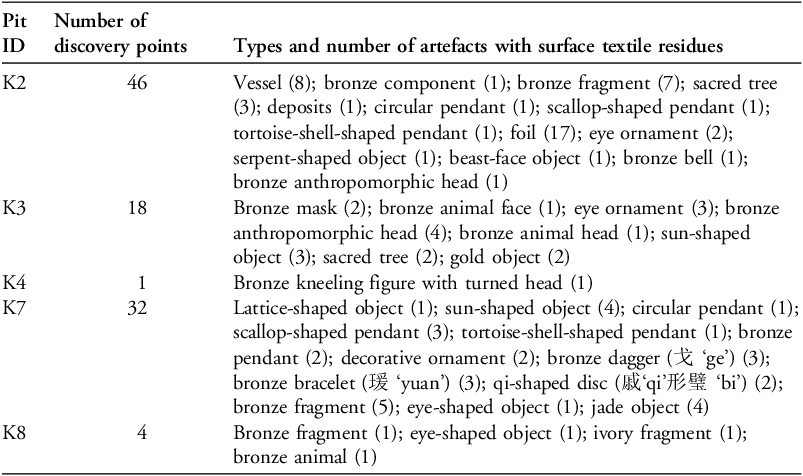
The Sanxingdui site, located in western Guanghan, Sichuan, dates to the Late Shang period (Ge & Linduff Reference Ge and Linduff1990; Li et al. Reference Li2023) (Figure 1a & b). First discovered in 1927, the site underwent several phases of investigation between 1934 and 1980. Excavation of Sacrificial Pits K1 and K2 in 1986 first revealed the distinctive bronze culture of Sanxingdui. More than 780 bronzes were recovered from these two pits, representing the earliest and largest Shang-period bronze assemblage identified thus far in the Sichuan Basin. Between 2019 and 2022, six additional sacrificial pits were excavated (Figure 1c) (Sichuan Provincial Institute of Cultural Relics and Archaeology 1999). Systematic investigations identified silk residues adhering to the surfaces of 101 artefacts from Sacrificial Pits K2–K8, including bronze, gold, jade and ivory objects (Table 1; Guo et al. Reference Guo2022, Reference Guo2025). This article presents the results from the analysis of a sample of these artefacts, examining excavation contexts and preservation conditions and exploring what the residues reveal about fibre composition, colouring practices and weaving techniques. The findings of these integrated analyses help clarify the functional and cultural significance of silk as a core element of the Sanxingdui ritual system.
Location map (a) and plan view (b) of the Sanxingdui site; c) photographs of the eight sacrificial pits during excavation (figure by Sichuan Provincial Institute of Cultural Relics and Archaeology).

Types and quantities of textile identified in Sacrificial Pits K2–K8.

Table 1 Long description
The table presents data on the types and quantities of textile residues identified on artifacts from Sacrificial Pits K2 to K8. It consists of four columns and five rows, including a header row. The columns are labeled ‘Pit ID’, ‘Number of discovery points’, and ‘Types and number of artefacts with surface textile residues’. The table lists the pit identification codes, the number of discovery points, and the types and quantities of artifacts with textile residues. Each row provides detailed information about the artifacts found in each pit, including the specific types of artifacts and the number of each type. The table includes a variety of artifacts such as vessels, bronze components, pendants, and various decorative objects made from materials like bronze, gold, jade, and ivory.
Methods
To investigate the weaving characteristics of the textiles, six samples (K3QW:86, K7QW-T-251, K3QW:697, K3QW:871, K7QW-Y-196 & K8XY1-12) were examined using a VHX-7000 digital microscope (Keyence, Japan). To understand the colouring of the material and the preservation states of the textiles, four samples (K7-T-250:g45, K7-T-250:d89c89, 20SXD-K2:02, & K7-T-250:442-5) were examined using a Smartzoom 5 microscope (Zeiss, Germany).
Scanning electron microscopy (SEM) was further undertaken on three samples (20SXD-K2:02, K7QS-T-254 & K8XY1-12) using an EVO 18 scanning electron microscope (Zeiss, Germany) to identify fibre types and preservation. The samples were coated with gold for 100 seconds before being placed in the specimen chamber. The microscope was operated at an accelerating voltage of 5kV, using secondary electron (SE) signal mode, with a working distance of 9.9–10.6mm. Energy-dispersive x-ray spectroscopy (EDS) was also performed on the red and yellow surface particles of sample 20SXD-K2:02, using an X-Max N 50 spectrometer (Oxford Instruments, UK), to analyse the colouring material.
The chemical structural characteristics of four archaeological samples (K3QW:86, K3QW:144, K7QS-T-254 & K8XY1-12) and a modern sample of natural Bombyx mori silk were examined using a LUMOS II micro-Fourier-transform infrared (FTIR) spectrometer (Bruker, Germany). Measurements were conducted in attenuated total reflectance single-reflection mode, with signals collected using a Mercury Cadmium Telluride detector cooled by liquid nitrogen. Spectra were recorded over the wavelength range 4000–750cm−1, with a resolution of 4cm−1 and 16 scans per measurement; an air background spectrum was acquired prior to sample testing. All spectra were processed using OPUS 7.5 software, including automatic baseline correction and min–max normalisation.
Further investigation of colouring material was undertaken using an inVia confocal Raman spectrometer (Renishaw, UK). This analysis focused on the red and yellow surface of sample 20SXD-K2:02 and the red surface of sample K7-T-250:442-5. A 532nm laser was employed, with an output power of 18mW and the operating power set to 5%. Spectra were collected using a 50× objective lens and a back-scattering diffraction grating of 1800 l/mm. The spectral acquisition range was 100–2000cm−1, with three accumulations and an integration time of 30 seconds per scan. Baseline correction and smoothing of the spectrum were performed in Origin 2018.
Fabric material identification
SEM images (Figure 2) show that all three of the analysed samples preserve relatively intact surface textile structures (Figure 2a, d & g) as well as radial (Figure 2b & e) and cross-sectional (Figure 2c, f & h) morphological features. The fibre surfaces are smooth and uniform, lacking scales or nodes, with an average diameter of approximately 10µm. Cross-sections of the fibres are broad triangular or wedge-shaped with rounded angles and no central cavity (Figure 2c & h). An exception is K7QS-T-254, which exhibits a hollow structure (Figure 2f). These characteristics correspond closely to the morphology (Liu et al. Reference Liu2011; Li et al. Reference Li2013; Gao et al. Reference Gao2024) and dimensions (Pérez-Rigueiro Reference Pérez-Rigueiro1998) of natural mulberry silk, supporting the interpretation of these residues as silk. The hollow structure observed in K7QS-T-254 may result from copper mineralisation, a phenomenon commonly observed in textiles adhered to bronze artefacts (Sibley & Jakes Reference Sibley and Jakes1982).
SEM images of samples. Sample 20SXD-K2:02: a) surface image; b) radial-section image of silk fibres; c) cross-section image of silk fibres. Sample K7QS-T-254: d) surface image; e) radial-section image of silk fibres; f) cross-section image of silk fibres. Sample K8XY1-12: g) surface image; h) cross-section image (figure by authors).

The infrared spectra of the four archaeological textile samples are shown in Figure 3, alongside the spectrum for natural Bombyx mori silk. With the exception of K3QW:144, the samples exhibit absorption peaks in the range 1550–1660cm−1, corresponding to the amide I band, which arises from the stretching vibration of the C=O group in peptide bonds (Garside et al. Reference Garside2005; Li et al. Reference Li2013). All samples display an absorption peak at approximately 1527cm−1, corresponding to the amide II band, associated with C–H stretching vibrations and N–H bending vibrations. In addition, all samples show a weak, broad peak around 3300cm−1, indicative of the amide A band, typically arising from N–H stretching vibrations. These signals confirm that the samples are proteinaceous in composition. Given the historical context of textile production in ancient China, protein-based textile fibres are likely to derive from silk or animal hair. Based on the tightly woven structures and smooth surface morphology of the fibres, animal hair can be excluded, supporting the identification of the samples as silk residues.
Infrared absorption spectra of samples and reference Bombyx mori silk (figure by authors).

Comparison with the spectrum of natural Bombyx mori silk shows that all archaeological samples lack both the amide B band and the amide III band. The latter, together with the amide I band, reflects the crystalline β-sheet and random-coil α-helix structures in silk fibroin (Garside et al. Reference Garside2005; Li et al. Reference Li2013). The absence of these signals likely results from chemical bond cleavage and the loss of certain components during long-term ageing. Furthermore, the amide I band of sample K7QS-T-254 (1634cm−1) is significantly red-shifted (reduced frequency) compared with that of natural silk (1660cm−1), consistent with hydrolytic ageing (Li et al. Reference Li2013). Notably, the archaeological samples exhibit strong absorption peaks near 1396, 1001, 871 and 804cm−1, which may be attributed to contaminants such as carbonate (CO3 2−) or siloxane (Si–O–Si) from soil (Kim Reference Kim1997), or to additional functional groups exposed during fibre degradation.
The colouration of the silk
Evidence of colouring was observed on some silk residues from the Sanxingdui site. For example, examination under an optical microscope revealed that a bright-red spotted region (Figure 4a, designated Red-1) and a yellow region (Figure 4b, designated Yellow) on the surface of sample 20SXD-K2:02 both exhibited particles of coloured substances unevenly adhering to the fibre surfaces. SEM-EDS analysis revealed that iron (Fe) is the dominant element in Red-1, while the Yellow region primarily contains carbon (C), oxygen (O) and calcium (Ca) (Table 2). Results of Raman spectroscopy indicate strong correspondence between Red-1 and hematite (Fe2O3; Figure 4d) (Anthony et al. Reference Anthony1990; De Faria & Lopes Reference de Faria and Lopes2007; Sparavigna Reference Sparavigna2023), identifying the red pigment as ochre, and between Yellow and calcite (CaCO3; Figure 4d) (Anthony et al. Reference Anthony1990; Dandeu et al. Reference Dandeu2006), which is typically white but was likely discoloured through long-term soil contact.
Microscopic images (a–c) and Raman spectra (d) of coloured surface regions on samples 20SXD-K2:02 and K7-T-250:442-5: a) Red-1; b) Yellow; c) Red-2 (figure by authors).

Elemental composition of red and yellow surface particles on sample 20SXD-K2:02.

Table 2 Long description
The table presents the elemental composition in weight percent of red and yellow surface particles on sample 20SXD-K2:02. It has two rows labeled Red-1 and Yellow, and six columns labeled C, O, Ca, K, Fe, and Cu. Row 1: Red-1, C, 23.74, O, 41.41, Ca, 3.47, K, 1.73, Fe, 16.40, Cu, 13.26. Row 2: Yellow, C, 9.29, O, 35.96, Ca, 54.74, K, /, Fe, /, Cu, /.
In sample K7-T-250:442-5, a large, uniformly coloured deep-red area (Figure 4c, designated Red-2) shows penetration of the dye into the fibre interior. Its Raman spectrum exhibits characteristic peaks at 1321 and 1590cm−1 (Figure 4d), corresponding to C–H bending (Miranda et al. Reference Miranda2014) and C=C stretching vibrations (Hadjiivanov et al. Reference Hadjiivanov2021) in organic compounds, indicating that the red colour likely derives from an organic dye. Red organic dyes commonly used in antiquity include madder (Aceto Reference Aceto2021), safflower (Zhao Reference Zhao1987) and cochineal (Celis et al. Reference Celis2021); however, the specific type used at Sanxingdui requires further verification.
The term ‘stone dyeing’ typically refers to a technique in which natural mineral pigments are ground and applied to the surface of textiles through immersion or brushing (Liao et al. Reference Liao2016). This method was employed in China during the Neolithic period (Zhang & Gao Reference Zhang and Gao1999) and appears frequently in textile artefacts from the Western Zhou to the Warring States periods (1046–221 BC; Li et al. Reference Li1976; Chen Reference Chen1984; Ma et al. Reference Ma2009). The application of colour observed at Sanxingdui appears similar to this method; however, there is currently insufficient evidence to confirm whether the silk underwent a complete ‘stone dyeing’ process and whether this occurred at the site or elsewhere. In addition, in textiles from the Central Plains, pigments are typically found as localised deposits or associated with specific decorative patterns. This differs from the Sanxingdui samples, which exhibit large, concentrated areas of deep red pigmentation.
Ochre was a widely used pigment on textiles worldwide (Verma & Gupta Reference Verma and Gupta2017; Adjaye Reference Adjaye2024; Balasubramanian & Manickam Reference Balasubramanian, Manickam and Saxena2025), and its presence on the Sanxingdui silk residues provides direct evidence for the early development and use of mineral pigments in silk colouring in the Shu region. Calcite is typically used as a mordant, helping to bind dyes in textile processing (Sumang & Panpho Reference Sumang and Panpho2024). However, in sample 20SXD-K2:02, calcite appears as large, densely packed particles covering the silk surface, suggesting a function beyond conventional mordanting, potentially serving as a coating.
In comparing the Sanxingdui silk with contemporaneous textile traditions from the Central Plains and other early regions, a broad tradition of mineral pigment use is apparent, though distinctive technical approaches and visual expressions are simultaneously exhibited. This suggests that Sanxingdui may have been part of a cross-regional network of technological exchange, yet retained relatively independent craft practices and aesthetic preferences.
The excavation location and weaving structure of the silk
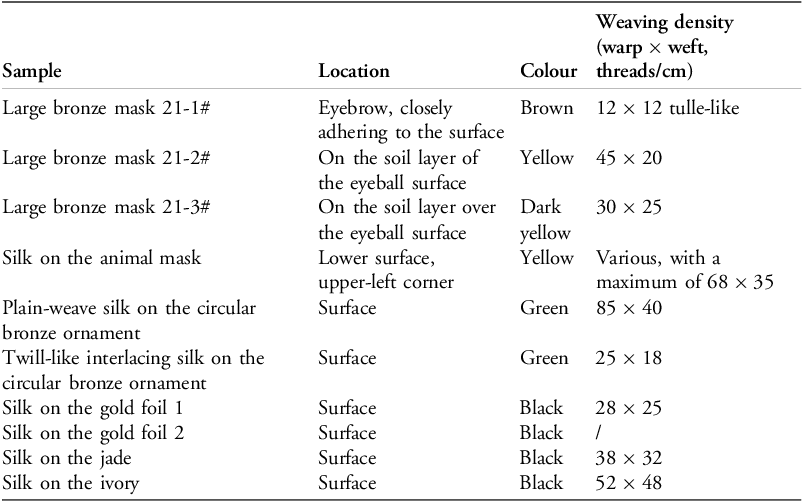
The largest quantities of silk residues were observed on the surfaces of bronze artefacts, occurring on 94 items across 28 types of vessels. On one large bronze mask (K3QW:21), three areas of silk residue were identified on the surface of the right eyebrow and right eyeball (Figure 5a). Microscopic observations reveal notable differences in attachment state, weaving structure and preservation condition (Table 3), suggesting the use of multiple, different pieces of silk to cover or decorate the mask, or perhaps to fulfil ritual functions. Silk residues were also found on animal masks (e.g. K3QW:86, Figure 5b), other bronze artefacts (e.g. the circular ornament K7QW-T-251, Figure 5c), gold foil (K3QW:697, Figure 6a; K3QW:871, Figure 6b), jade (K7QW-Y-196, Figure 6c) and ivory (K8XY1-12, Figure 6d) (Table 3).
Examples of silk residues adhering to the surfaces of bronze artefacts from the Sanxingdui site: a) large bronze mask K3QW:21 (upper left), location of silk found in the eye area (left), detailed photos of silk 21-1# (upper right), silk 21-2# (middle right) and silk 21-3# (lower right); b) animal mask K3QW:86 (upper left), detailed photo of silk (upper right) and micrographs of silk (lower); c) circular ornament K7QW-T-251 (upper left), detailed photo of silk (left), and micrographs of silk (right) (figure by authors).

Detailed information on selected silk unearthed from the Sanxingdui Site.

Table 3 Long description
A table with 10 rows and 4 columns detailing silk residues on various artefacts. The columns are Sample, Location, Colour, and Weaving density (warp x weft, threads/cm). Row 1: Large bronze mask 21-1#, Eyebrow, closely adhering to the surface, Brown, 12 x 12 tulle-like. Row 2: Large bronze mask 21-2#, On the soil layer of the eyeball surface, Yellow, 45 x 20. Row 3: Large bronze mask 21-3#, On the soil layer over the eyeball surface, Dark yellow, 30 x 25. Row 4: Silk on the animal mask, Lower surface, upper-left corner, Yellow, Various, with a maximum of 68 x 35. Row 5: Plain-weave silk on the circular bronze ornament, Surface, Green, 85 x 40. Row 6: Twill-like interlacing silk on the circular bronze ornament, Surface, Green, 25 x 18. Row 7: Silk on the gold foil 1, Surface, Black, 28 x 25. Row 8: Silk on the gold foil 2, Surface, Black, /. Row 9: Silk on the jade, Surface, Black, 38 x 32. Row 10: Silk on the ivory, Surface, Black, 52 x 48.
Examples of silk residues adhering to other artefacts from the Sanxingdui site: a) gold foil K3QW:697 (left 1), detailed photo of silk (left 2); b) gold foil K3QW:871 (right 1), micrograph of silk (right 2); c) jade Ge (戈) K7QW-Y-196 (left)), micrographs of silk (right); d) ivory fragment K8XY1-12 (left), micrographs of silk (middle and right) (figure by authors).

Textile technology was assessed through observable criteria, such as the type of weave, the uniformity and regularity of the fabric, and the warp and weft densities. The silk textiles unearthed at Sanxingdui generally preserve clear warp-weft structures, with plain weave (an alternating one-over-one-under sequence) as the dominant pattern and occasional use of more complex techniques, such as twill-like interlacing (where the weft thread passes over and then under two or more warp threads). The weaving densities of these textiles vary considerably, ranging from loosely woven sha (纱 gauze/muslin) to tightly structured juan (绢 silk). The structural characteristics of the textiles likely reflect their social and functional roles as different types of yarn and silk that served distinct purposes: higher-density silk fabrics were likely used for writing materials, outer garments or decorative items, while lower-density gauze was more suitable for the production of undergarments or lightweight clothing. The Sanxingdui silk residues exhibit a variety of weave types, as well as average and maximum densities that reach or even surpass the technological levels documented at contemporaneous core regions of the Central Plains, such as Yinxu and Taixicun (Gao et al. Reference Gao1979). These findings demonstrate that, by the Late Shang period, the silk fabrics found in the Shu region were technologically comparable to those of the Central Plains.
Distribution of the silk residues across the assemblage varies. Some samples, such as K3QW:21 (Figure 5a), exhibit a single layer, while others, such as K7QW-T-251 (Figure 5c), show up to five discernible layers. Analysis of the stratigraphic contexts of the artefacts bearing silk residues indicates that most were concentrated in Layer 3 of pit K2. This highly concentrated distribution suggests that the silk was intentionally and systematically placed at the time of deposition. Unfortunately, as pit K2 was excavated in 1986, precise three-dimensional spatial information was not recorded, preventing reconstruction of the exact positions of the silk finds. Figure 7 illustrates the locations of artefacts with silk residues from the more recent excavations of pits K3 and K7. In pit K3, silk residues were found exclusively beneath the artefacts, with a vertical distribution height of approximately 0.20m (Figure 7a, left) and a planar distribution concentrated in the southern-central area of the pit floor (Figure 7a, right). In pit K7, with the exception of a bronze grid-shaped object where silk was present on both upper and lower surfaces (Zheng et al. Reference Zheng2024), artefacts exhibited silk residues only on their lower surfaces. The silk in pit K7 is concentrated in the north-eastern section of the pit floor (Figure 7b, right), with a vertical distribution height of approximately 0.10m (Figure 7b left).
Schematic diagrams showing the locations of silk in pits K3 (a) and K7 (b); from left to right) vertical, horizontal and planar distributions (figure by authors).

Both the distribution patterns of the silk residues and their concentrated occurrence within the pits indicate that the silk was not laid out randomly in a single layer but was deliberately arranged in multiple layers. Given the unique sacrificial deposition context of the Sanxingdui artefacts, which were frequently smashed or burned (Sacrificial Area Archaeological Team of the Sanxingdui Site 2023; C. Xu et al. Reference Xu2025), it can be inferred that the silk had a close functional relationship with the bronze and other artefacts. The silk likely served to cushion, cover or wrap the objects before or during deposition, or it may have constituted an important sacrificial offering in its own right. In any case, the silk, together with the bronze objects, formed one of the material components of the ritual activities at the Sanxingdui site.
Preservation condition of the silk
The state of preservation of the silk residues can be classified into three categories: mineralised (Janaway Reference Janaway1985; Angiorama et al. Reference Angiorama2020); carbonised (Gong & Yang Reference Gong and Yang2013); and well preserved. Most residues have undergone mineralisation, a process closely associated with the corrosion of bronze artefacts. In the burial environment, metal ions promote silk preservation through a dual mechanism. First, certain metal ions, such as copper, inhibit microbial activity, thereby protecting silk proteins from degradation (Jakes & Sibley Reference Jakes and Sibley1983; Edwards Reference Edwards1989). Second, copper, lead and other metal ions—or their corrosion products—interact with the silk fibres and are substituted for organic matter, stabilising and preserving the original tissue morphology (Sibley & Jakes Reference Sibley and Jakes1982; Reynaud et al. Reference Reynaud2020). A typical example is sample K7-T-250:g45, the surface of which is covered with a green crust (Figure 8a). Under magnification, the fibres appear green (Figure 8b), with a rough outer wall and smooth inner wall (Figure 8c), are hollow and retain a triangular cross-section (Figure 8d). EDS detected high concentrations of copper (19.03 wt%) and lead (9.51 wt%) in the crust of sample K7-T-250:g45 (Figure 8e), representing a typical ‘negative mineralisation’ product (Sibley & Jakes Reference Sibley and Jakes1982; Reynaud et al. Reference Reynaud2020). It should be noted, however, that the presence of copper ions can also accelerate the degradation of organic matter (Hao et al. Reference Hao2025; J. Xu et al. Reference Xu2025).
Microscopic images of silk fibres in different preservation states: a) green corrosion crust on the surface of K7-T-250:g45; b) green-coloured silk fibres from K7-T-250:g45; c) longitudinal view of K7-T-250:g45 silk fibres; d) cross-section of K7-T-250:g45 silk fibres; e) elemental distribution maps of copper (Cu) (upper left) and lead (Pb) (lower left) in K7-T-250:g45 silk fibres, cross-section of the silk fibres (right); f) silk residues attached to the ivory fragment K8XY1-12 (×20); g) surface morphology of carbonised silk (×100); h) surface of K7-T-250:d89c89; i) silk fibres from K7-T-250:d89c89; j) longitudinal view of K7-T-250:d89c89 silk fibres; k) cross-section of K7-T-250:d89c89 silk fibres (figure by authors).

Carbonised silk residues appear black, with surface morphology resembling high-temperature charring and an extremely fragile texture. Silk attached to the ivory fragment K8XY1-12 (Figure 8f) exhibits this condition, which is attributed to prolonged thermal effects during burial. The organic components have completely decomposed, leaving residues highly enriched in carbon and ultimately forming the black, brittle morphology (Figure 8g) (Gong & Yang Reference Gong and Yang2013; Yang Reference Yang2014). The third category comprises well-preserved silk residues, in which the original chemical composition and structural features of the fibres are relatively intact, retaining considerable mechanical strength. In sample K7-T-250:d89c89, the silk fibres are morphologically complete and structurally clear (Figure 8h & i), with smooth radial surfaces (Figure 8j) and solid triangular cross-sections (Figure 8k).
In certain cases, a single residue may be mineralised on one side and carbonised on the other, reflecting subtle variations in the local microenvironment. While mineralisation contributes to the retention of fibre morphology, carbonisation substantially weakens the mechanical integrity of the residues. These observations demonstrate that microenvironmental conditions play a decisive role in shaping the preservation state of archaeological silk.
Discussion
The discovery of silk residues at Sanxingdui fundamentally enriches our understanding of textile archaeology during the Late Shang period and provides crucial evidence for evaluating the advanced level of cultural development in the Shu region. Much like its bronze culture (Ge & Linduff Reference Ge and Linduff1990; Guo et al. Reference Guo2026), the Sanxingdui silk assemblage may ultimately reveal distinct local characteristics.
These silk residues provide important new data for interpreting ritual practices at Sanxingdui. Since the 1986 excavations, scholarly debate has surrounded the nature of the site and the function of the sacrificial pits. The recovery of silk offers material evidence for analysing depositional contexts and ritual behaviour. The residues are frequently found in association with various bronze artefacts, showing no discernible differentiation in textile type or quality across vessel categories. Based on structural characteristics, such as weave density, it appears that different textiles served distinct functions. Silk, along with bronzes, jades and ivory, was among the material components of the local ritual system and, owing to its material value, may have been regarded as a significant offering.
From a broader perspective, the Sanxingdui silk residues provide crucial archaeological evidence for the diversity and sophistication of textile practices in the region. Textile tools unearthed at the Sanxingdui site, including spindle whorls and net sinkers, further provide material evidence for textile production during this period (Guo et al. Reference Guo2022), which may suggest local silk production. Taken together, these demonstrate the use of silk in Sichuan in the Late Shang period, highlight distinctive regional expressions of silk use and contribute to a broader understanding of how local practices may have participated in wider technological and cultural networks in early China.
The discoveries also open new avenues for investigating the possible presence of writing or symbolic systems in ancient Shu. Although the Central Plains had already developed a mature writing system by the Shang period, Sanxingdui—despite possessing comparable bronze technology and cultural sophistication—has not yet yielded systematic written records. In this context, if writing existed, it may have been on perishable organic media such as silk. As a highly valued material imbued with ritual significance, silk could have functioned not only as an offering but also as a medium for inscribing texts or symbols.
Conclusions
Analysis of textile residues unearthed at the Sanxingdui site in Sichuan Province confirms that all examined samples are composed of silk and identifies the presence of ochre, calcite and organic dyes. These observations demonstrate that silk textiles used in the ancient Shu region were subject to pigment-based colouring practices, reflecting localised technological knowledge and ritual aesthetics.
The textiles are predominantly plain weave, although evidence of more complex techniques is also present, and their weave density varies substantially. Preservation also varies, reflecting the influence of microenvironmental conditions. Frequent co-occurrence with bronze and gold objects and other ritual implements in the sacrificial pits suggests that silk was used to wrap, cover or cushion ritual objects and may have functioned as an independent offering, forming an integral component of the Sanxingdui ritual system. These residues therefore provide important insights not only into the regional diversity of silk use, but also into the technological, functional and symbolic significance of silk in early Shu society, offering a perspective for situating regional textile traditions within the broader context of early Chinese silk use.
Acknowledgements
During the preparation of this work, the authors used ChatGPT (GPT-4o model, via the official ChatGPT web interface, accessed between November and December 2025) to assist with language polishing and grammatical correction. After using this tool, the authors reviewed and edited the content as needed and take full responsibility for the final content of the publication.
Funding statement
This study was supported by the 2025 Sichuan Provincial Special Fund for Cultural Heritage Conservation through the project ‘Multidisciplinary archaeological research of the Sanxingdui site in 2025’.
Author contributions: CRediT categories
Jianbo Guo: Conceptualization-Lead, Data curation-Lead, Formal analysis-Lead, Methodology-Lead, Project administration-Lead, Writing - original draft-Lead, Writing - review & editing-Equal. Ruochen Ge: Conceptualization-Lead, Data curation-Lead, Formal analysis-Lead, Methodology-Lead, Project administration-Lead, Writing - original draft-Lead, Writing - review & editing-Equal. Qiutong Cai: Data curation-Equal, Investigation-Equal, Methodology-Equal, Writing - review & editing-Equal. Jingyu Tian: Data curation-Supporting, Formal analysis-Supporting, Investigation-Supporting, Methodology-Supporting. Lu Yang: Funding acquisition-Lead, Project administration-Lead, Resources-Lead, Supervision-Lead, Writing - review & editing-Equal.







 Open access

