Diabetic foot ulcers (DFUs) are a common complication of diabetes mellitus, which is widespread in the Canadian population. They are associated with major morbidity and in many cases lead to a lower extremity amputation (LEA). Hyperbaric oxygen therapy (HBOT) has been suggested as an adjunct to standard methods of care in the management of DFU. Its use may increase the success of healing DFUs and decrease the risk of infection and LEA.
There is only limited information available on the economic aspects of adjunctive HBOT for management of DFU, particularly in the Canadian population. Several cost studies have suggested that use of adjunctive HBOT could produce cost savings (Reference Abidia, Laden and Kuhan1;2;Reference Cianci7;Reference Kalani, Jörneskog and Naderi15;16). An economic study by Guo et al. indicated that HBOT in the treatment of diabetic ulcers is cost-effective, particularly based on a long-term perspective (Reference Guo, Counte and Gillespie13). The analysis presented here formed part of a project by the Canadian Agency for Drugs and Technologies in Health, which was undertaken at the request of health ministries to provide healthcare decision makers with relevant information to assist with policy formulation (Reference Hailey, Jacobs and Perry14).
METHODS
Effectiveness of HBOT Versus Standard Care
A literature review was conducted to obtain information on the reported effectiveness of adjunctive HBOT, using all common bibliographic databases. We selected studies that were controlled trials which compared adjunctive HBOT used in the treatment of DFU and standard wound care.
Outcomes of interest (numbers of LEAs, numbers of healed wounds, and numbers of unhealed wounds) for the HBOT and control groups were recorded for each study. Totals for each outcome were expressed as proportions of the numbers of patients in the HBOT and control groups. Quality of the reviewed papers was assessed using an approach that considers both study design and study performance. Further details of the approach taken in the review have been published elsewhere (Reference Hailey, Jacobs and Perry14).
Economic Model
Our decision model was based on the analysis of Guo et al. (Reference Guo, Counte and Gillespie13) applied in a Canadian context and altered to allow for a wider range of outcomes and Canadian data. The patient population was a 65-year-old cohort with DFU and the care setting included both inpatients and outpatients. The perspective was that of a Ministry of Health. The comparative interventions were HBOT plus standard care and standard care alone. The time horizon was 12 years, which is equal to the expected longevity of a 65-year-old person in Alberta further adjusted for the expected lifetime of a person with diabetes (4;Reference Gu, Cowie and Harris12).
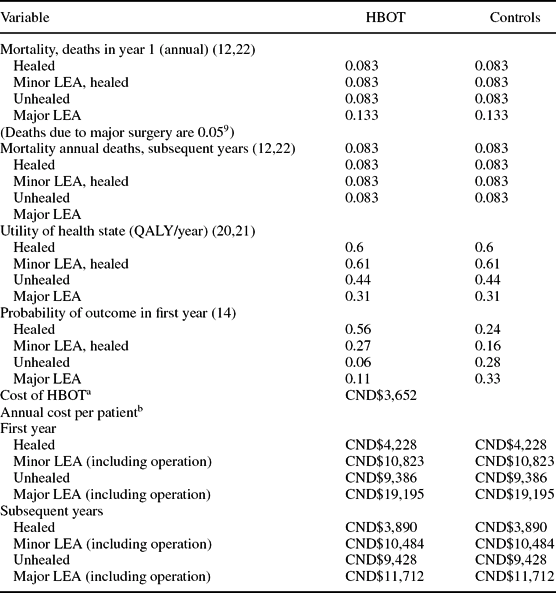
The cohort will receive one of the two interventions. With either intervention, there can be four outcomes: patients can be healed with or without a minor LEA, they can have a major LEA, or they can remain unhealed. The probabilities of the four outcomes for each intervention are shown in Table 1. It is assumed that the LEAs occur in the first year following HBOT; that if patients are healed in the first year, they will not subsequently have an LEA; and that patients who are unhealed in year 1 will remain so for the remainder of their lifetime and will receive wound care intermittently.
Assumptions in the Decision Model

aFacility costs: estimated 30 dives at CND$110/dive: Misericordia Hospital, Edmonton, AB. Physician fees for first day only, minor consult, and additional time, CND$352 (3)
bBase value is annual cost in Saskatchewan for all persons with diabetes (Reference Doctor, Pandya and Supe8,Reference Simpson, Corabian, Jacobs and Johnson25) adjusted for relative ratio of costs for persons with diabetes and with/without DFU (2.61 first year, 1.56 subsequent years)22. Ratio costs of first and subsequent years for persons with foot problems with no LEA (ratios are 1 and 0.92), minor LEA (ratios are 2.22 and 2.23), and major LEA (ratios are 4.54 and 2.77)5. All costs adjusted to 2004 values using Consumer Price Index (http://www.statcan.ca). Annual wound care costs were based on Netherlands costs, adjusted for time in healed, non-infected and infected states.23 Euro values were converted to Canadian values using the 2004 exchange rate (CND$1.60=1 euro, http://www.finance.yahoo.com).
HBOT, hyperbaric oxygen therapy; LEA, lower extremity amputation; QALY, quality-adjusted life-year.
Mortality is based on life expectancy of 12 years and is expressed in terms of the number of deaths per year (0.083 deaths per person). The mortality rate will, therefore, increase with each passing year (Reference Gu, Cowie and Harris12). There is a 5 percent addition to the mortality rate in the first year only for persons who have a major LEA (Reference Eckman, Greenfield and Mackey9). After the first year, the number of deaths per year is the same for all persons with DFU, including those who have had a minor or major amputation (Reference Ramsey, Newton and Blough22).
Utilities and costs for each year, in each health state, and health-related outcomes for those who either receive or do not receive HBOT are also shown in Table 1. HBOT costs include overhead and amortized machine costs. The efficacy estimates are derived from data retrieved in the literature review (Reference Hailey, Jacobs and Perry14). Costs of HBOT and medical costs of diabetic persons with foot ulcers were derived from Canadian provincial data supplemented by estimates on subgroups that were obtained from the literature (Table 1). Utility data for the various conditions of diabetic persons with foot ulcers were obtained from Ragnarson Tennvall and Apelqvist who conducted a survey of persons with diabetic foot ulcers using the Euroquol EQ-5D measure (Reference Ragnarson Tennvall and Apelqvist21). Based on the model, a cost-utility ratio was measured.
Two sensitivity analyses were conducted to assess the stability of the model. In the first analysis, the outcome probabilities were changed to make them more favorable to routine care. The probability of healing was reduced by 10 percent and the probability of not being healed was increased by 10 percent. In the second sensitivity analysis, the cost of HBOT was increased until the total costs of the two interventions were the same.
Budget impact analysis
An analysis was undertaken to determine the net impact on the healthcare budget of providing HBOT to patients with DFU who are eligible for such services, following the approach used for Quebec by Agence d'Evaluation des Technologies et des Modes d'Intervention en Santé (AETMIS) (2). In this, the proportion of DFU cases that could benefit from HBOT was derived by first estimating the number of hospitalized DFU cases and then adjusting this value upward by a factor obtained from the literature to account for patients treated solely on an outpatient basis during the previous 12 months.
The potential demand for adjunctive HBOT for patients with DFU at a given period in time was calculated as the product of the number of patients with diabetes, the prevalence of DFU, and the percentage of patients with DFU whose conditions warrant HBOT. There were 1,195,000 patients with diabetes in Canada (17), prevalence of DFU in that population was 6 percent (Reference Ramsey, Newton and Blough22), and the proportion of those with DFU eligible for HBOT was 22–30 percent (2;Reference Reiber, Smith and Carter24). The number of prevalent cases was, therefore, 15,774 to 21,510.
For our capacity/cost analysis, we assumed that each HBOT chamber has a capacity of 2,000 operating hours per year (8 hours per day for 250 days per year). A complete treatment was assumed to range from thirty to forty dives, based on data from the Misericordia Hospital, Edmonton (personal communication) and AETMIS (2). Each dive is between 2 and 2.5 hours in duration, including setup and posttreatment. Therefore, the total number of DFU cases that could be treated with one chamber annually, ranges from twenty-two to thirty complete treatments if there were no other uses for the HBOT machines. The corresponding range for a seven-person machine is 155–207 treatments per year (2). We assumed that the HBOT machines are used for DFU cases only.
In our base-case analysis, we focused on the additional cost of HBOT care that is needed to treat all eligible DFU cases. The cost per patient treated is CND$3,652 to CND$4,752 (i.e., assuming thirty or forty dives per treatment). These estimates include amortized equipment costs. Post-HBOT downstream costs were not considered in our budget impact analysis.
We also used different assumptions on how long it will take to clear the current number of cases, making estimates for time frames of 1 to 4 years. We assumed equal annual depreciation charges for all scenarios; that is, even if the backlog were cleared in 1 year, the machine would have other purposes for its remaining life.
RESULTS
Seven studies were identified that met the selection criteria for our literature review (Reference Abidia, Laden and Kuhan1;Reference Baroni, Porro and Faglia6;Reference Doctor, Pandya and Supe8;Reference Faglia, Favales and Aldeghi10;Reference Kalani, Jörneskog and Naderi15;Reference Zamboni, Wong, Stephenson and Pfeifer26). Numbers of major LEAs were reported in all studies, providing results for 149 patients who received adjunctive HBOT and for 156 controls. There was a substantially lower proportion of major LEAs in patients who received adjunctive HBOT as opposed to standard care alone (11 percent versus 32 percent). Numbers of minor LEAs were reported in six of the seven studies, providing results for ninety-eight patients treated with HBOT and ninety-two controls. The rate of minor LEAs was higher in HBOT-treated patients when compared with controls in three studies where such amputations occurred (Reference Abidia, Laden and Kuhan1;Reference Doctor, Pandya and Supe8;Reference Faglia, Favales and Aldeghi11).
The 12-year cost for patients receiving HBOT was CND$40,695 compared with CND$49,786 for patients receiving standard care alone. The outcomes of the two arms were 3.64 quality-adjusted life-years (QALYs) for HBOT and 3.01 QALYs for controls. Adjunctive HBOT used with standard care is the dominant strategy, because outcomes are better and costs are less in the HBOT arm.
Much of the difference in outcomes can be attributed to the rather dramatic probabilities of being healed that were found in the literature, in conjunction with the large increase in QALYs when comparing healed and unhealed persons. The life expectancy in the HBOT arm was 5.96 life-years and 5.84 life-years in the control arm. However, the probability of being healed with HBOT increased to 56 percent from 24 percent, while the probabilities of being unhealed or having a major LEA fell to 6 percent and 11 percent, respectively. The utilities of individuals who were healed were almost 0.2 greater than those for persons who were unhealed and 0.3 greater than those for patients with major LEAs.
In the first sensitivity analysis, HBOT remained the dominant strategy. The difference in the cost-effectiveness ratio was narrowed by approximately one third, which indicates that the outcomes were well into the dominant range. The same is true for the second sensitivity analysis. The break-even point would occur when the cost of HBOT was above CND$17,000. Given that the current cost is CND$3,652 (Table 1), HBOT remains dominant.
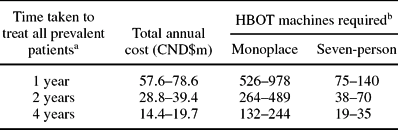
The most relevant variable in the budget impact analysis is the number of years it will take to treat the entire disease-prevalent group. The results of patient treatment scenarios are shown in Table 2 and take account of the ranges of estimated caseload and dives per treatment. Numbers of HBOT machines required include the alternatives of using monoplace or seven-person chambers.
Budget Impact of Expanding HBOT Care in Canada

aPrevalent patient numbers: 15,774–21,510.
bNumber of dives per treatment: 30–40.
There are no Canada-wide data on operating capacity. However, based on Alberta experience, the new investment needed is substantial, compared with existing capacity. Alberta has three monoplace chambers, and half of their capacity is devoted to diabetes cases. If the excess demand were to be cleared in 4 years, a total of thirteen machines would be needed, a major addition to existing capacity. If the capacity data for a seven-person multiplace machine are applied to the estimated Canadian demand for HBOT and 100 percent of machine time was used for DFU cases, then additional national needs would range from nineteen machines (15,774 cases are treated over a period of 4 years) to thirty-five machines (21,510 cases are treated in 1 year).
DISCUSSION
Our economic model, using efficacy measures obtained from a review of clinical studies, indicates that adjunctive HBOT for treatment of diabetic ulcer is cost-effective when compared with standard care. A sensitivity analysis, applied to key variables, shows that the model is robust.
In our budget impact analysis, we obtained estimates of the cost of providing adjunctive HBOT to treat all patients with DFU in Canada, based on prevalence rates obtained from the literature. Our analysis only considered costs of HBOT; however, if downstream costs were also included, it is likely that overall cost savings to the healthcare system would result. Our analysis also indicates that substantial additional HBOT capacity would be required to meet the estimated demand for services. Both the large number of persons with DFU who could benefit from HBOT and the time-consuming nature of this treatment are important factors.
There were some limitations in our analysis. The data (notably cost data) upon which the variables in the economic model were based, are not of high quality. In some cases, estimates from foreign resources had to be relied on in deriving results for a Canadian setting. For example, the utility measures were based on a Swedish study in which the number of observations of persons who had major amputations was very small. In recent years, the number of such amputations has fallen considerably, and so there will be difficulties in obtaining large numbers of subjects. Cost data for HBOT were based on data from only a few centers, and reporting was not standardized. Nevertheless, there is considerable confidence in the finding that adjunctive HBOT used for the treatment of DFU is economically attractive.
POLICY IMPLICATIONS
Diabetic foot ulcer is a major health problem in Canada. Technologies that effectively reduce the burden to patients and health services through reducing the risk of LEA associated with this condition would make an important contribution to health care. Our results suggest that HBOT is a cost-effective approach to management of DFU and that its wider use in this application should be encouraged. However, our conclusions are subject to several qualifications that should be considered by healthcare service providers and policy makers.
The majority of patients with DFU are managed successfully using standard care. Guidelines would need to be applied to identify those patients most appropriately treated with HBOT. Severity of ulceration and delay in response to treatment using standard care are important considerations in deciding who should receive therapy.
While, overall, there might well be cost savings through increased use of HBOT, procurement of additional machines to meet the projected Canadian demand for DFU treatment would place pressures on budgets. Consideration would also need to be given by different providers to the types of HBOT machines that should be acquired. Selection of multiplace machines would reduce the number of units required. However, from a clinical perspective, it could be difficult to use a multiplace chamber to maximum efficiency. Various conditions that are treated with HBOT use different protocols. Therefore, it would not always be possible to mix patients with different diagnoses in the chamber at the same time to fill it to capacity.
Policy makers may also need to consider the place and availability of alternative technologies. For example, newer types of dressings are becoming available for treatment of diabetic ulcers, so that the comparative advantage of adjunctive HBOT may change.
As a final point, the clinical data supporting the effectiveness of adjunctive HBOT for DFU remains limited. Good quality studies are required to confirm the comparative benefits of this technology in Canadian health care. A randomized trial being conducted in Toronto by the Program for Assessment of Technology in Health (19) will help to meet this need.
CONTACT INFORMATION
Anderson W. Chuck, PhD (achuck@ihe.ca), Adjunct Assistant Professor, Department of Anesthesiology and Pain Medicine, University of Alberta, 113 Street 83 Avenue, Edmonton, Alberta, T6G 2G3, Canada; Health Economist, Manager, Decision Analytic Modeling Unit, Institute of Health Economics, 1200 10405 Jasper Avenue, Edmonton, Alberta, T5J 3N4
David Hailey, PhD (dhailey@ozemail.com.au), Adjunct Professor, Department of Community Health Sciences, University of Calgary, 3330 Hospital Drive NW, Calgary, AB, Canada T2N 4N1; Senior Advisor, Institute of Health Economics,:#1200, 10405 Jasper Avenue, Edmonton, AB, Canada T5J 3N4
Philip Jacobs, PhD (pjacobs@ihe.ca), Professor, Department of Medicine, University of Alberta, c/o Institute of Health Economics, 10405 Jasper Avenue, Edmonton, Alberta T5J 3N4, Canada
Douglas C. Perry, MD, CCFP (perrydc@telusplanet.net), Assistant Clinical Professor, Departments of Emergency, Medicine and Family Medicine, University of Alberta, 8440-112 Street, Edmonton, Alberta T6G 2B7; Emergency and Hyperbaric Physician, Misericordia Hospital, 16940 87 Avenue NW, Edmonton, Alberta T5R 4H5, Canada