Background
According to reports of the World Health Organization (WHO) (2015), more than 800 000 individuals die due to completed suicide, and more than 16 million people attempt suicide worldwide every year. Most suicide attempts are committed in early adulthood. Suicide is one of the leading causes of death among adolescents and young adults. There is a large heterogeneity between countries in the prevalence rates of suicide attempts. For instance, in Europe, prevalence rates range from 3.2/100 000 inhabitants in Greece to 26.1/100 000 in Lithuania. Unfortunately, Poland, where the current study was conducted, is among those countries with the highest prevalence rates of suicide. A mean of 18.5 people in 100 000 inhabitants committed suicide in 2015, with an absolute number of 7110 deaths each year.Footnote †Footnote 1 The number of suicides in Poland is 1.73 times higher than the mean number of suicides in the world (10.7 per 100 000 inhabitants) and 1.55 times higher than the mean in Europe (11.9 per 100 000 inhabitants).
Suicidal behavior is a complex phenomenon, and thus theoretical models that consider the interplay between different markersFootnote 2 related to this behavior may improve our understanding of these dramatic acts (O'Connor, Reference O'Connor2011). Indeed, suicide is related to biological (Chang et al., Reference Chang, Franklin, Ribeiro, Fox, Bentley, Kleiman and Nock2016), social (Compton et al., Reference Compton, Thompson and Kaslow2005; Milner et al., Reference Milner, Page and LaMontagne2013) and psychological markers (Jager-Hyman et al., Reference Jager-Hyman, Cunningham, Wenzel, Mattei, Brown and Beck2014; Gvion et al., Reference Gvion, Levi-Belz, Hadlaczky and Apter2015) and these markers dynamically interact in shaping the risk of suicide (Wu and Bond, Reference Wu and Bond2006; Joiner, Reference Joiner2007; Brodsky, Reference Brodsky2016). No single marker predicts suicide and different risk markers cumulatively increase the risk of suicidal behaviors (Phillips et al., Reference Phillips, Yang, Zhang, Wang, Ji and Zhou2002). One of the major and consistently replicated proximal markers related to increased risk of suicidal behavior is a diagnosis of major depression and other affective disorders. Depression is associated with a three-fold increased risk of suicidal thoughts and attempts (Chen and Dilsaver, Reference Chen and Dilsaver1996) with the suicide mortality rate of 59 persons per 100 000 (Simon and VonKorff, Reference Simon and VonKorff1998). Furthermore, it is estimated that from 5% (Palmer et al., Reference Palmer, Pankratz and Bostwick2005) to 13% (Caldwell and Gottesman, Reference Caldwell and Gottesman1990) of patients with psychotic disorders, mostly with schizophrenia spectrum disorders, commit suicide, which accounts for about 28% of the mortality in this group (Brown, Reference Brown1997). A recent study reported a high prevalence of suicidal thoughts (66%) and attempts (18%) among people at clinical risk of psychosis (Taylor et al., Reference Taylor, Hutton and Wood2015). This is consistent with studies showing the highest risk of suicidal behaviors in early phases of psychosis (Kuo et al., Reference Kuo, Tsai, Lo, Wang and Chen2005; Alaräisänen et al., Reference Alaräisänen, Miettunen, Räsänen, Fenton, Koivumaa-Honkanen and Isohanni2009). Furthermore, there are an increasing number of studies that investigate the relationship between subclinical psychotic symptoms or psychotic-like experiences (PLEs) and the risk of self-injurious behavior, including suicidal ideation, plans and attempts (see meta-analysis: Honings et al., Reference Honings, Drukker, Groen and van Os2016).
PLEs comprise various experimental phenomena lying on the continuum of psychosis which are, in the majority of cases, not associated with severe distress, pervasiveness and lack of insight (Kelleher et al., Reference Kelleher, Connor, Clarke, Devlin, Harle and Cannon2012a). In contrast to the relatively rarity of psychotic disorders, the prevalence rates of PLEs in the general population is 7.2% (Linscott and Van Os, Reference Linscott and Van Os2013). Growing evidence suggests that the frequency of PLEs has a meaningful negative impact on well-being (Armando et al., Reference Armando, Nelson, Yung, Ross, Birchwood, Girardi and Nastro2010), social functioning (Rössler et al., Reference Rössler, Riecher-Rössler, Angst, Murray, Gamma, Eich, van Os and Gross2007) and interpersonal violence (Kinoshita et al., Reference Kinoshita, Shimodera, Nishida, Kinoshita, Watanabe, Oshima, Akechi, Sasaki, Inoue and Furukawa2011). A line of recent studies has also confirmed that PLEs predict an increased risk of suicidal behavior in the general population (Saha et al., Reference Saha, Scott, Johnston, Slade, Varghese, Carter and McGrath2011; Capra et al., Reference Capra, Kavanagh, Hides and Scott2015; DeVylder et al., Reference DeVylder, Lukens, Link and Lieberman2015) and adolescents and young adults in particular (Nishida et al., Reference Nishida, Sasaki, Nishimura, Tanii, Hara, Inoue, Yamada, Takami, Shimodera and Itokawa2010; Kelleher et al., Reference Kelleher, Lynch, Harley, Molloy, Roddy, Fitzpatrick and Cannon2012b; Jang et al., Reference Jang, Lee, Cho, Cho, Shin and Kim2014; Nishida et al., Reference Nishida, Shimodera, Sasaki, Richards, Hatch, Yamasaki, Usami, Ando, Asukai and Okazaki2014; Martin et al., Reference Martin, Thomas, Andrews, Hasking and Scott2015). Importantly, a longitudinal study among adolescents suggested that co-occurring PLEs significantly predicted persistence of suicidal ideation among non-clinical adolescents (Kelleher et al., Reference Kelleher, Cederlöf and Lichtenstein2014), which suggests psychotic experiences may be an important indicator of risk for more severe and/or persistent suicidal behavior. A recent meta-analysis confirmed that PLEs predict suicide behavior even after controlling for important confounding factors (e.g. depression and anxiety) (Honings et al., Reference Honings, Drukker, Groen and van Os2016).
Although the relationship between proximal markers such as depression or PLEs and the risk of suicide is well established, the role of more distal markers and their contribution to suicidal behavior is less clear. One of the distal markers that has been investigated in the context of suicide is exposure to childhood trauma (Barbosa et al., Reference Barbosa, Quevedo, da Silva, Jansen, Pinheiro, Branco, Lara, Oses and da Silva2014). Consistent findings have shown that different types of childhood trauma significantly increase the risk of suicidal ideation, plans, and attempts (Barbosa et al., Reference Barbosa, Quevedo, da Silva, Jansen, Pinheiro, Branco, Lara, Oses and da Silva2014; Park et al., Reference Park, Hong, Jeon, Seong and Cho2015; de Araújo and Lara, Reference de Araújo and Lara2016). A recent meta-analysis (Zatti et al., Reference Zatti, Rosa, Barros, Valdivia, Calegaro, Freitas, Ceresér, da Rocha, Bastos and Schuch2017) found that the odds ratio (OR) for the relationship between childhood trauma and suicide attempts ranges from 3.42 to 3.98, suggesting severe life adversity is associated with a substantial increased risk for future suicidal behavior.
Suicide is likely a result of the interplay between distal (e.g. childhood trauma) and proximal (e.g. psychopathology) markers (Park et al., Reference Park, Hong, Jeon, Seong and Cho2015). However, a limited number of studies have addressed this important issue. For instance, it has been shown that among patients diagnosed with depression and psychosis, early exposures to traumatic events significantly increased the risk of suicide (de Mattos Souza et al., Reference de Mattos Souza, Molina, da Silva and Jansen2016; Hassan et al., Reference Hassan, Stuart and De Luca2016; Xie et al., Reference Xie, Wu, Zheng, Guo, Yang, He, Ding and Peng2018). It has also been shown that among patients with treatment-resistant depression, being exposed to severe traumatic events in childhood significantly increases the risk of psychotic symptoms as well as the risk of suicide (Tunnard et al., Reference Tunnard, Rane, Wooderson, Markopoulou, Poon, Fekadu, Juruena and Cleare2014), which tentatively suggests these markers interact with each other in predicting suicidal behaviors.
In the current study, we investigated the role of the interplay between exposure to childhood trauma, cognitive biases, PLEs and depression in predicting suicidal behaviors (i.e. suicidal ideations, plans, and attempts) in young adults. Our model is based on studies showing that childhood trauma, PLEs, and depression are related to risk of suicide. Furthermore, based on recent studies, we hypothesized that childhood trauma influences the risk of psychosis via dysfunctional changes in cognitive processes (e.g. cognitive biases) (Gawęda et al., Reference Gawęda, Pionke, Krężołek, Prochwicz, Kłosowska, Frydecka, Misiak, Kotowicz, Samochowiec and Mak2018a, Reference Gawęda, Prochwicz, Adamczyk, Frydecka, Misiak, Kotowicz, Szczepanowski, Florkowski and Nelson2018b; Gibson et al., Reference Gibson, Reeves, Cooper, Olino and Ellman2018), which is also a risk marker for suicide (Jager-Hyman et al., Reference Jager-Hyman, Cunningham, Wenzel, Mattei, Brown and Beck2014). The model tested in this study is that exposure to childhood trauma changes cognition, which increases the risk for more frequent PLEs (the risk of psychosis) that, in turn, possibly due to trauma-related intrusive thoughts, leads to changes in mood (depression) and increased suicidality. We also investigated whether these markers have an additive effect on suicidality.
Methods
Participants
A total sample of 4088 young adults, aged 18–35 years, were recruited from the general population to participate in an online survey. In total, 3495 (85%) of these recruits completed the full battery of questionnaires. A computer-assisted web interview method was used. Completing the online survey took about 20–30 min. Participants were enrolled from three large Polish cities: Warsaw (1 700 000 inhabitants), Krakow (770 000 inhabitants) and Wroclaw (640 000 inhabitants) that form a Research Consortium investigating mechanisms associated with psychosis risk. Exclusion criteria for participants included: history of psychotic and neurological disorders or history of a substance dependence disorder in the previous 6 months. These results are the part of larger project on the mechanisms of the relationship between exposures to early trauma and the risk of psychosis. The ethics committee of the Medical University of Warsaw approved the study.
Assessments
Suicidality
To assess suicidality, we used three questions designed to gather information on suicidal ideation (‘Have you ever seriously thought about committing suicide?’), plans (‘Have you ever made a plan for committing suicide?’) and attempts (‘Have you ever attempted suicide?’) that have been used in previous independent studies (Johnston et al., Reference Johnston, Pirkis and Burgess2009). Lifetime suicidality was calculated as the sum of the answers (‘yes’ or ‘no’) to these three questions with Cronbach's α of 0.69.
Psychotic-like experiences (PLEs)
For the measurement of PLEs we used the Prodromal Questionnaire-16 [PQ-16; Ising et al. (Reference Ising, Veling, Loewy, Rietveld, Rietdijk, Dragt, Klaassen, Nieman, Wunderink and Linszen2012)], which is a 16-item self-report scale to screen for psychosis risk operationalized in the presence of PLEs. It is a shortened version of the 92-item PQ and consists of items that assess perceptual abnormalities and hallucinations, unusual thought content, delusional ideas and paranoia as well as negative symptoms. The original PQ-16 includes two scales: present v. non-present (true v. false) and distress associated with the experience (four-point Likert scale). In the current study, we focused only on the first scale (presence v. absence), which we modified to better reflect the frequency of PLEs. Specifically, we used a four-point scale: ‘never’, ‘sometimes’, ‘often’, and ‘almost always’. The PQ-16 has satisfactory psychometric characteristics in the assessment of PLEs with a specificity and sensitivity of 87% in discriminating patients meeting the criteria of Ultra High Risk for Psychosis (UHR) from those who do not meet UHR criteria (Ising et al., Reference Ising, Veling, Loewy, Rietveld, Rietdijk, Dragt, Klaassen, Nieman, Wunderink and Linszen2012). We used a Polish version of the questionnaire that was prepared using a back-translation procedure and which has been used in prior studies (Gawęda et al., Reference Gawęda, Pionke, Krężołek, Prochwicz, Kłosowska, Frydecka, Misiak, Kotowicz, Samochowiec and Mak2018a). Cronbach's α for the total score calculated in our sample was 0.86.
Childhood trauma
In our study, we focused on emotional, physical and sexual abuse that took place during childhood. To measure emotional neglect and abuse we used two items from the Traumatic Experience Checklist [TEC; Nijenhuis et al. (Reference Nijenhuis, Van der Hart and Vanderlinden1999)]. The original version of the TEC is a 29-item self-report questionnaire addressing a variety of potentially traumatizing life events and has been used among patients with psychiatric disorders (Nijenhuis et al., Reference Nijenhuis, Van der Hart and Kruger2002). We used the following items: ‘When you were a child or a teenager have you ever felt emotionally neglected (e.g. being left alone, insufficient affection) by your parents, brothers or sisters?’ and ‘When you were a child or a teenager have you ever felt emotionally abused (e.g. being belittled, teased, called names, threatened verbally, or unjustly punished) by your parents, brothers or sisters?’. We also included one item to assess bullying: ‘When you were a child or teenager, did you experience psychological violence (e.g. nicknames, teasing) or physical abuse (e.g. jerking, beating) from your peers?’. To evaluate sexual trauma we took three items from the Childhood Experience of Care and Abuse Questionnaire [CECA.Q; Smith et al. (Reference Smith, Lam, Bifulco and Checkley2002)], which is a self-report scale that measures the childhood experience of care and abuse. We selected the following items: ‘When you were a child or teenager did you have any unwanted sexual experiences?’, ‘Did anyone force you or persuade you to have sexual intercourse against your wishes before age 17?’ and ‘Can you think of any upsetting sexual experiences before age 17 with a related adult or someone in authority e.g. teacher?’. We used a Polish version of the items that were prepared using a back-translation procedure. Cronbach's α for the total score calculated in our sample was 0.64.
Cognitive biases
To measure cognitive biases we used the Davos Assessment of Cognitive Biases scale [DACOBS; van der Gaag et al. (Reference van der Gaag, Schutz, Ten Napel, Landa, Delespaul, Bak, Tschacher and de Hert2013)]. The 42-item DACOBS consists of: (1) four subscales that assess cognitive biases associated with psychosis (Jumping to Conclusions, Belief Inflexibility bias, Attention for Threat bias, and External Attribution bias); (2) two subscales that assess social cognition (Social Cognition Problems and Subjective Cognitive Problems); and (3) a behavioral coping strategy subscale (Safety Behaviors). Due to the length of this scale and the nature of our study (online screening) we decided to use two subscales (Safety Behaviors and Attentional Biases) of the DACOBS-18 that have been proven to be the best predictors of psychosis risk (Gaweda et al., Reference Gawęda, Prochwicz, Krężołek, Klosowska, Staszkiewicz and Moritz2018c). The DACOBS-18 has satisfactory psychometric properties (Cronbach's α 0.84). Two subscales included in the study consist of nine items that assess Safety Behaviors and Attentional Biases (items 6, 7, 24, 27, 29, 31, 33, 34, 35). Cronbach's α for the total score was 0.80.
Psychiatric diagnoses and substance use
A history of any psychiatric diagnosis, both familial and personal, was screened with a self-report questionnaire (‘Have you ever been diagnosed with the psychiatric disorder?’; ‘Has any of your family ever been treated for psychiatric disorders? If so, specify the disorder.’). Substance use was assessed with questions about having ever used marijuana or amphetamines. Demographic information (age, gender, education, professional situation) was also obtained.
Data analysis
First, we excluded participants from analysis who reported a history of schizophrenia as we were interested in PLEs and not psychosis itself. In the next step, we conducted a series of univariate logistic regression analyses to investigate whether the variables which were significantly correlated with lifetime suicidality made an independent contribution to suicidal thoughts and plans as well as attempts. We combined two questions of suicidal thoughts and plans into one variable so that participants with positive answers to both of these questions were classified as endorsing suicidal ideation and plans. Negative answers to one or two of these questions were coded as having no suicidal ideation and plans. Analyses for suicidal attempts were performed separately. Our independent variables were: PLEs, depression, family history of psychiatric disorder, childhood traumatic events, cognitive biases, marijuana and amphetamine use, and history of any psychiatric diagnosis other than depression. With regard to childhood trauma and cognitive biases, we divided participants into two groups using a cut-off of 2 s.d. from the mean. Thus participants who responded ‘yes’ to five or six childhood traumatic events were classified as traumatized, and those who scored at least 45 points (with 63 as the highest) on the DACOBS were classified as endorsing cognitive biases. As for PLEs, we followed the criteria used by Ising et al. (Reference Ising, Veling, Loewy, Rietveld, Rietdijk, Dragt, Klaassen, Nieman, Wunderink and Linszen2012), i.e. a score of 6 or more experiences, a cut-off which has 87% sensitivity for identifying UHR. We re-coded our four-point scale so that answers ‘sometimes’, ‘often’ and ‘almost always’ were regarded as having PLE (‘present’) and ‘never’ as having no such experiences (‘absent’). To control for potential confounders, we included age, sex and years of education in regression models. Then multivariate logistic regressions were carried out using all predictors included in univariate analyses in order to control for each variable. The potential additive effect of PLEs, depression, childhood trauma and cognitive biases in predicting suicidality was also investigated. Thus, we searched for different combinations of these markers in our participants to investigate their cumulative effect on the risk of suicidality.
In the next step, we built a structural equation model to further investigate relationships found in the regression analyses. Path analysis was conducted with continuous variables (except for depression), and for the outcome variable we used lifetime suicidality (the combined score of suicidal ideation, plans, and behaviors). Initially, we performed confirmatory factor analyses (CFA) of the latent variables. In cases where the original structure of the variables did not reach satisfactory model fit, we modified them by excluding unsatisfactory items. We used the bootstrap method to calculate the indirect effect as recommended by Preacher and Hayes (Reference Preacher and Hayes2008). We examined possible multicollinearity between variables using the variance inflation factor (VIF) indicator. Goodness of model fit was verified following guidelines from literature (Hu and Bentler, Reference Hu and Bentler1999): RMSEA < 0.06 (The Root Mean Square Error of Approximation); SRMR < 0.08 (The Standardized Root Mean Square Residual); CFI > 0.95 (Confirmatory Fit Index); GFI > 0.95 (Goodness-of-Fit) and TLI > 0.95 (Tucker-Lewis Index).
Regression analyses were conducted using the Statistical Package for Social Sciences (SPSS), version 25.0. CFA and path analysis were performed with the AMOS software package for SPSS 25.0.
Results
Characteristics of the sample
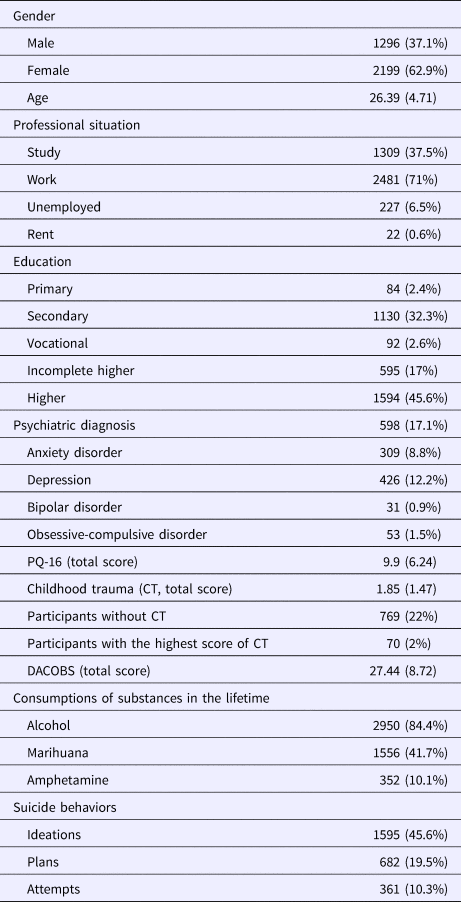
Nineteen participants (0.54%) with a diagnosis of schizophrenia were excluded from analyses. Table 1 presents sample characteristics. The frequency of PLEs is presented in online Supplementary Materials (Fig. S1).
Sample characteristics

PQ-16, Prodromal Questionnaire; DACOBS, Davos Assessment of the Cognitive Biases Scale.
Logistic regression analyses
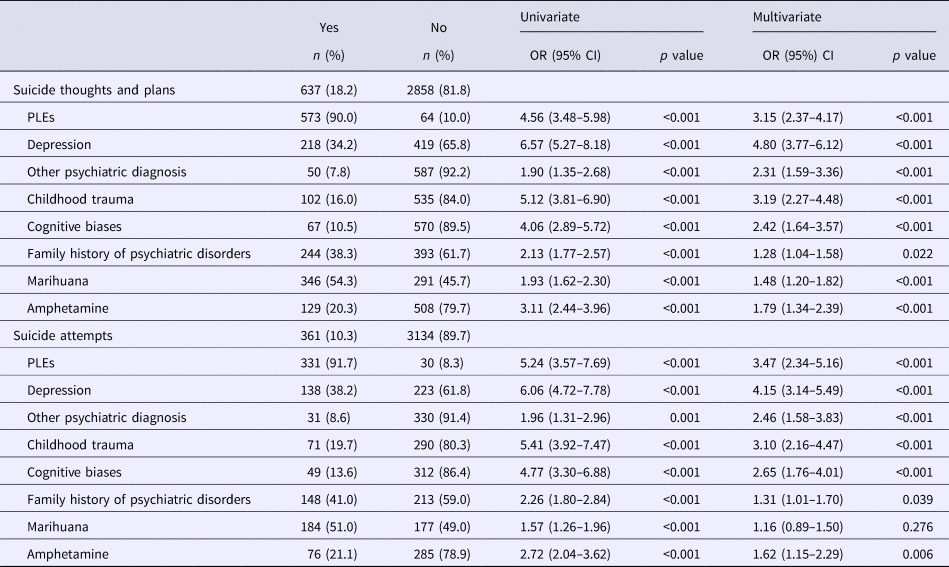
Univariate regression models showed that all predictors were statistically significant. Participants who experienced five or six traumatic events during childhood were above five times more likely to develop suicidal thoughts and plans and to have suicide attempts, compared to those who had not. People with depression had the highest risk of suicidal thoughts and plans (OR 6.57, 95% CI 5.27–8.18, p < 0.001) as well as attempts (OR 6.06, 95% CI 4.72–7.78, p < 0.001). Individuals with a higher frequency of PLEs (six or more positive PLEs on the PQ16) were four and a half times more likely to report suicidal ideations and plans and above five times more likely to endorse suicidal behaviors. Participants with higher levels of cognitive biases had a four-fold increased odds of suicidal thoughts and plans, and were above four and a half times more likely to have suicide attempts. Reporting psychiatric diagnosis other than depression was related to nearly two-fold increased odds of suicidal ideation and plans as well as behaviors. Having a relative with psychiatric disorder was associated with two-fold increased odds of suicidal thoughts, plans or attempts. Participants who had used marijuana were nearly twice as likely to report suicidal ideation and plans and had one and a half times the odds of having attempted suicide. Individuals who had ever used amphetamine were three times more likely to report suicidal thoughts and plans, above two and a half times more likely to have suicide attempts. Multivariate regression analyses showed that all predictors remained significant, except for marijuana use, in the model for suicidal attempts. Detailed results are presented in Table 2.
OR from univariate and multivariate logistic regressions predicting suicide ideations and plans, and attempts

OR, odds ratio; CI, 95% confidence interval.
Adjusted for age, gender and years of education.
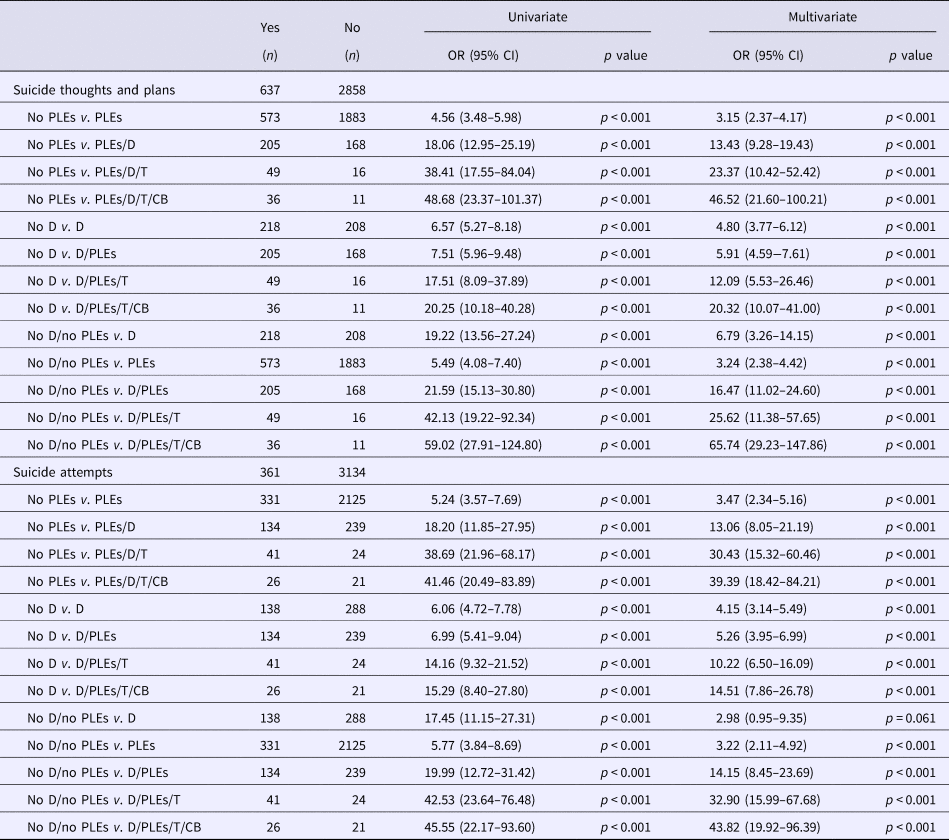
Furthermore, analysis of variable additivity showed that risk markers such as PLEs, depression, cognitive biases and trauma cumulate in their effects in a way that adding each subsequent marker increases the risk of suicidality. For example, having only PLEs was associated with three-fold risk of suicidal thoughts and plans, but this risk increased to 48.68 when we considered people who also had depression, cognitive biases and childhood trauma. Detailed results are presented in Table 3.
Additivity effect of the interplay of different risk factors for suicidal thoughts and behaviors, and attempts

PLEs, psychotic-like experiences; D, depression; CB, cognitive biases; T, trauma; OR, odds ratio; CI, 95% confidence interval.
Adjusted for age, gender and years of education.
Path analyses
Confirmatory factor analyses showed a good fit for all scales except for PQ-16. Thus we decided to include in the path analysis only seven items that were the most highly correlated with the suicidality scale (the cut-off was ρ = 0.20) and represented positive symptoms only. Thus, we excluded from correlational analyses two items (1 and 7) that represent experiences related to depressed mood. Detailed results are presented in the online Supplementary Material (Table S2).
We tested the hypothesized model with paths from childhood trauma to cognitive biases, PLEs and lifetime suicidality; from cognitive biases to PLEs; from PLEs to depression and lifetime suicidality and from depression to the outcome variable. Initially, we also included in the path analysis substance use, a psychiatric diagnosis other than depression, and family history of mental disorders. However, we decided to remove these variables from the final model as they reduced model fit and had very weak relationships with the outcome variable (β < 0.1). There was no sign of multicollinearity as indicated by the VIF of all predictors <1.5. This model explained 40.3% of the variance in lifetime suicidality. All of the model fit indices were satisfactory: RMSEA = 0.040 (90% CI 0.039–0.042; p = 1.0), CFI = 0.93, SRMR = 0.049, GFI = 0.957, TLI = 0.92. The model with standardized path coefficients is presented in Fig. 1.
Model of the relationship between childhood trauma and lifetime suicidality with cognitive biases, PLEs and depression as mediators.

The bootstrapping estimate revealed a significant standardized indirect effect of childhood trauma through all other variables to lifetime suicidality (β = 0.108, 95% CI 0.090–0.127, p < 0.001). To examine if mediation of cognitive biases, PLEs and depression was full or partial, we checked for a standardized direct effect of childhood traumatic life events on lifetime suicidality. It emerged as significant (β = 0.40, 95% CI 0.340–0.455, p < 0.001), meaning that mediation by the other variables was partial. The total effect of childhood trauma on lifetime suicidality was also significant (β = 0.508, 95% CI 0.457–0.556, p < 0.001).
Conclusions
In the current study, we hypothesized that the risk of suicidal behaviors (i.e. suicidal ideation and plans and suicide attempts) results from the interplay between distal (childhood trauma) and proximal (cognitive biases, PLEs, and depression) markers in the non-clinical population of young adults. We confirmed previous findings showing the significant role of childhood trauma and the risk of suicidal ideation and plans and suicide attempts (de Araújo and Lara, Reference de Araújo and Lara2016) by obtaining very similar values of OR (mean OR respectively 3.19 and 3.10 controlling for other markers) to a recent meta-analysis (Zatti et al., Reference Zatti, Rosa, Barros, Valdivia, Calegaro, Freitas, Ceresér, da Rocha, Bastos and Schuch2017). For the very first time, our structural equation model revealed that paths from childhood trauma to suicidality among young adults go through important, but partial mediators – cognitive biases, PLEs, and depression. Hence, the interplay between these processes may be considered important, but not exclusive, mechanisms for predicting lifetime suicidality. Furthermore, we found that exposure to childhood trauma, cognitive biases, PLEs, depression have a clear additive effect on predicting suicidality.
Although previous studies confirmed the role of childhood trauma (Zatti et al., Reference Zatti, Rosa, Barros, Valdivia, Calegaro, Freitas, Ceresér, da Rocha, Bastos and Schuch2017), cognitive biases (Jager-Hyman et al., Reference Jager-Hyman, Cunningham, Wenzel, Mattei, Brown and Beck2014), PLEs (Saha et al., Reference Saha, Scott, Johnston, Slade, Varghese, Carter and McGrath2011) and depression (Rotenstein et al., Reference Rotenstein, Ramos, Torre, Segal, Peluso, Guille, Sen and Mata2016) in suicidality, this study considered these markers in combination for the first time, as well as their additive effect. Non-adjusted OR for the relationship between considered markers and suicidality reduced in the multivariate logistic regression, controlled for all markers included in the analysis and adjusted for age, sex and education; however, childhood trauma, PLEs, cognitive biases and depression remained significant predictors of suicidal ideation and plans and suicide attempts. Thus, our results suggest that all of these markers have a meaningful (ORs around the value of 3.0) and independent contribution to suicidal behaviors in the non-clinical population of young adults. In addition, we also found that consumption of illicit drugs and history of psychiatric diagnoses (other than depression) were associated with increased risk of suicidal behavior, which is in line with well-established findings (Poorolajal et al., Reference Poorolajal, Haghtalab, Farhadi and Darvishi2016). However, this relationship with suicidal behavior was not as strong as the relationship between suicidal behavior and childhood trauma, cognitive biases, depression, and PLEs.
Even though multivariate logistic regression provided results suggesting an independent contribution of these markers to suicidality, it did not shed light on their potential additive effect. Our subsequent analysis of variable additivity revealed that childhood trauma, cognitive bias, PLEs and a lifetime diagnosis of depression has the strongest impact on suicidality when present in combination (i.e. a cumulative effect). The general picture is that by adding every subsequent marker the risk of suicidality increases substantially. For instance, when people have only depression or PLEs the risk for suicide attempts increases about three-fold comparing to people without depression and PLEs. However, the OR increases to 48.68 for those who have all risk markers of depression, PLEs, cognitive biases and childhood trauma. This strongly suggests that these important markers should be considered in combination during screening for risk of suicidal behavior. Our subsequent analyses (see online Supplementary Materials Tables S5 and S6) revealed that the cumulative effect is also observed with all separate markers. It was particularly visible that those exposed to more sexual traumas had higher risk of suicide attempts. Furthermore, we also found (see online Supplementary Materials Tables S3 and S4) heterogeneity in the extent to which different PLEs and childhood trauma predict suicidal thoughts, plans and attempts. It seems that delusional ideas relating to being controlled and thoughts being heard aloud are particularly important for predicting suicide attempts. With regard to trauma, in line with previous studies (Davidson et al., Reference Davidson, Hughes, George and Blazer1996), our results suggest that sexual trauma is the strongest predictor of suicidality compared to other traumatic experiences. Hence, a combination of sexual trauma and these PLEs, along with depression, may have the strongest predictive power of suicidality and thus may be of special interest for clinical screening and future investigations.
Despite progress in researching mechanisms responsible for suicidality, there is still little known about how potential markers might interact causally on each other in predicting suicidal behaviors. We aim to provide a theoretical causation model (SEM) that recognized the complexity of suicidal behaviors (Joiner, Reference Joiner2007) and extended existing knowledge by showing that the risk of suicide is explained largely (44.6% of the variance) by the interplay between childhood trauma, cognitive biases, PLEs, and depression. ‘The causal triangle’ between childhood trauma, cognitive biases and PLEs has been suggested in some theoretical accounts (Howes and Murray, Reference Howes and Murray2014) and has recently been confirmed in independent studies (Gawęda et al., Reference Gawęda, Pionke, Krężołek, Prochwicz, Kłosowska, Frydecka, Misiak, Kotowicz, Samochowiec and Mak2018a, Reference Gawęda, Prochwicz, Adamczyk, Frydecka, Misiak, Kotowicz, Szczepanowski, Florkowski and Nelson2018b; Gibson et al., Reference Gibson, Reeves, Cooper, Olino and Ellman2018). A recent study (Schmidt et al., Reference Schmidt, Schultze-Lutter, Bendall, Groth, Michel, Inderbitzin, Schimmelmann, Hubl and Nelson2017) on ultra-high risk for psychosis patients showed that exposure to early life adversities is related to the risk of suicidality through cognitive disturbances and beliefs (e.g. negative self-concept and external attributions). For the very first time in non-clinical young adults, we extended the model in order to search for further explanation of the risk of suicide among those who have cumulative experiences of trauma, dysfunctional cognitions and PLEs by showing that these markers may further provide the background for mood change and finally exaggerate the risk of suicidality among young non-help seekers.
Our model has a clinical relevance and can be used in daily clinical practice to detect the risk of suicidal behavior in different clinical contexts [e.g. post-traumatic stress disorder (PTSD), depression, psychosis, clinical risk states]. Our results suggest that considering the interplay between trauma, cognition, psychosis and depression may be beneficial for enhancing the risk for suicide screening procedures in which all markers should be extensively assessed. In terms of applications of our model to therapeutic interventions, it should be noted that cognitive biases (Moritz et al., Reference Moritz, Andreou, Schneider, Wittekind, Menon, Balzan and Woodward2014), depression and PTSD (e.g. van der Berg and van der Gaag, Reference van der Berg and ven der Gaag2012) have been already proved to be successfully addressed in Cognitive Behavioral Therapy for psychosis protocols. This study helps to build and support a clinical theory such as that which was preliminary developed by Tarrier et al., (Reference Tarrier, Kelly, Maqsood, Snelson, Maxwell, Law, Dunn and Gooding2014) for suicide in psychosis.
The results of the study should be interpreted in light of its limitations. Although our theoretical SEM model assumes causal relationships between considered markers, the cross-sectional design of the study preclude empirical verification of causality. It should however be recognized that causality in psychiatry is often circular (Young, Reference Young2015), and a model of reciprocal causation should be considered. Our sample was limited to young adults, and thus generalization to the general population should be approached cautiously. This is why we used term ‘non-clinical’ rather than ‘general’ population. Given the design of our study, we were not able to use detailed analysis of suicidality and childhood trauma, and thus our methods should be considered as a global estimation of these markers. However, our methods are comparable to previous studies (e.g. Johnston et al., Reference Johnston, Pirkis and Burgess2009). Our primary aim was to focus on the interplay between trauma, depression, PLEs and cognitive biases related to psychosis, however, future studies may benefit from considering the role of negative self-schema or other cognitive biases, which may play a role in suicidality (e.g. Beevers and Miller, Reference Beevers and Miller2004). Finally, we were not able to consider markers related to personality, e.g. borderline personality features, which are significantly related to all markers included in the SEM model and are an important predictor of suicidality (Rogers and Joiner Jr, Reference Rogers and Joiner2016), particularly if complicated by psychotic experiences (Slotema et al., Reference Slotema, Niemantsverdriet, Blom, van der Gaag, Hoek and Sommer2017).
To conclude, our results suggest the PLEs and cognitive biases along with depression play an important role in the relationship between childhood trauma and suicidality. The findings suggested that these markers have a clear cumulative effect on suicidality among young adults and thus should be considered in combination when screening for suicide risk.
Supplementary material
The supplementary material for this article can be found at https://doi.org/10.1017/S0033291718004026.
Author ORCIDs
Łukasz Gawęda, 0000-0001-6578-1846
Author contributions
ŁG designed the study; ŁG supervised the data collection; RP and MK performed data analyses under ŁG supervision; ŁG, DF, and BN interpreted the results; ŁG wrote the first draft of the manuscript; DF, BN, and AC edited the manuscript. All authors approved the final version of the article.
Financial support
This study was supported by OPUS grant from National Science Centre, Poland (ŁG, 2016/21/B/HS6/03210). ŁG was supported by the Ministry of Higher Education and Science of Republic of Poland (0295/E-393/STY/10/2015 and 1258/MOB/IV/2015/0). BN was supported by an NHMRC Senior Research Fellowship.