Introduction
A number of studies have found that 20–30% of community-dwelling individuals with dementia are living alone (Webber et al., Reference Webber, Fox and Burnett1994; Ebly et al., Reference Ebly, Hogan and Rockwood1999; Prescop et al., Reference Prescop, Dodge, Morycz, Schulz and Ganguli1999; Nourhashemi et al., Reference Nourhashemi, Amouyal-Barkate, Gillette-Guyonnet, Cantet and Vellas2005). Compared to persons with dementia living with others in the community, these studies demonstrate that individuals with dementia who are living alone tend to be older, female, and less cognitively impaired. Dementia impacts on functioning in multiple arenas and is associated with impaired judgment and decision-making (Kim et al., Reference Kim, Karlawish and Caine2002). This raises questions about the safety of individuals with dementia who live alone and about how the needs of such individuals can be detected. Yet recent studies indicate that individuals with dementia who live alone may have difficulty accessing needed health and home care services. Webber et al. (Reference Webber, Fox and Burnett1994) noted that living alone with dementia is a significant predictor of no community service use. Nourhashemi et al. (Reference Nourhashemi, Amouyal-Barkate, Gillette-Guyonnet, Cantet and Vellas2005) found that patients with Alzheimer's disease living alone were more likely to be malnourished than those living with others. Tierney et al. (Reference Tierney, Charles, Naglie, Jaglal, Kiss and Fisher2004) reported that in a sample of 139 community-residing persons aged 65 years and older, who had cognitive impairment and lived alone, 21.6 % had an incident of harm requiring emergency intervention when followed prospectively for 18 months. These studies suggest that people with dementia who live alone may under-utilize needed community support services and therefore may be at risk for adverse outcomes. In addition, Yaffe et al. (Reference Yaffe2002) found that living alone with dementia and having at least one difficult behavior increased the risk for nursing home placement compared with subjects who lived with others.
Previous work has suggested that dementia is often under-diagnosed by close informants and physicians (Sibley et al., Reference Sibley2002; Lopponen et al., Reference Lopponen, Raiha, Isoaho, Vahlberg and Kivela2003). Since cognitive impairment is clearly related to safety, it is particularly important to detect dementia among those individuals living alone, so that clinicians can then assess whether additional supportive services are needed that would enable them to continue living at home safely.
In the present study, drawn from community-based samples of people aged 65 or older, persons with dementia living alone were compared with persons with dementia living with others to better characterize the cognitive, functional, and psychiatric factors which correlate with their living situation, and to examine whether recognition of dementia by caregivers, physicians, and patients themselves is different among individuals with dementia living alone compared with living with others.
Methods
Participants
This study used data from the Memory and Medical Care Study (MMCS) and was approved by the Institutional Review Board for the Johns Hopkins Bloomberg School of Public Health. Details of the study design are available elsewhere (Black et al., Reference Black2003). The MMCS study prospectively followed a cohort of cognitively impaired older individuals in the community to learn how dementia is diagnosed and treated. Subjects were identified from three previously established community-based epidemiologic studies (Eaton et al., Reference Eaton1997; West et al., Reference West1997; Kasper et al., Reference Kasper, Shapiro, Guralnik, Bandeen-Roche and Fried1999), all of which used the Mini-mental State Examination (MMSE) as a screening instrument (Folstein et al., Reference Folstein, Folstein and McHugh1975). Subjects were considered eligible for the MMCS if they were 65 years of age or older, had a score of <24 on the MMSE, or had declined at least 4 points over two administrations of the MMSE. Of the 1802 individuals who met initial eligibility requirements, 724 were not institutionalized at the start of the MMCS, and of these, 512 agreed to be enrolled as participants. Each subject was asked to identify a knowledgeable informant (KI) who helped most often with any daily activities and was familiar with the subject's health status. The KI became the informant who was interviewed for the study. Subject and KI interviews and neuropsychological testing were conducted by trained interviewers. Subjects were administered the MMSE and four neuropsychological tests with age and education norms: the Word List Memory Test, 15-item Boston Naming Test, the Verbal Fluency Test (Welsh et al., Reference Welsh, Butters and Mohs1994) and the WAIS-R Digit Symbol subtest (Wechsler, Reference Wechsler1981). Subjects were identified as having dementia if they scored two standard deviations below the mean in two of the four tests (Black et al., Reference Black2003). Only the 349 subjects classified as having dementia (68.2%) were used in this study. All data presented in this report are from the interviews and tests administered at baseline in the MMCS.
Assessment measures
Cognitive impairment
Severity of cognitive impairment was measured by the MMSE scores. A MMSE score of <18 was used as a cut-point to indicate severe cognitive impairment (Tombaugh and McIntyre, Reference Tombaugh and McIntyre1992; Chatfied et al., Reference Chatfield, Matthews and Brayne2007). Information about subjects’ own sense of cognitive impairment was derived from the subject interviews in which each subject responded to the question “How would you rate your memory now compared to when you were younger?” by selecting one of five choices: better now than before, as good as it has ever been, a little worse than before, moderately worse than before, or much worse than before. Diagnosis of dementia by the subject's primary care physician was based on review of the primary physician's medical record or a dementia diagnosis recorded in Medicare claims in the two years prior to the baseline study interview, or if the KI reported that the subject's physician had made a diagnosis of dementia. KI recognition of dementia was derived from the KI's response to structured interview questions inquiring about the subject's cognitive abilities.
Helpers
Identification of the subject's number of helpers was obtained from structured interviews with KIs. A helper was defined as anyone who provided regular assistance with any functional activity. Helpers included family members, friends, neighbors or hired assistants.
Functional impairment:
Information regarding functional impairment was derived from structured interviews with KIs using the standardized activities of daily living index (ADL; Katz and Ford, Reference Katz and Ford1963), and instrumental activities of daily living (IADL; Lawton and Brody, Reference Lawton and Brody1969).
Psychiatric symptoms:
Depressive symptoms in the subjects were assessed using the depression subscale of the Neuropsychiatry Inventory (NPI; Cummings et al., Reference Cummings1994) that asked KIs about the presence of symptoms in the subject over the preceding four weeks. Psychotic symptoms and symptoms of agitation were assessed using the 12-item Behavior Symptom Rating Scale (BSRS; Rabins, Reference Rabins1994). A subject was rated as experiencing psychotic symptoms if the KI reported that the subject “seems afraid or suspicious of others” or “hears, sees, tastes, or smells things others do not”. Agitation was assessed as being present if a KI reported any of the following six behaviors: physically aggressive, yells or curses, resists help in toileting, resists help in other ADLs, repeats questions, or wanders.
Statistical analysis
Data were analyzed using the SPSS statistical package (SPSS, Inc, 2008). Univariate analyses were used to describe the subjects and bivariate analyses (χ2, t-test) were used to examine differences between subjects living alone and subjects living with others. A correlation matrix was constructed to examine the relationships among the variables that were found to be significantly associated with participants’ living situation based on bivariate analyses. Stepwise multiple logistic regression analysis was used to identify a final model that includes correlates of living alone with dementia. P-values < 0.05 were considered statistically significant.
Results
Of the 349 individuals with dementia in this study, 97 (27.8%) were living alone and 252 (72.2%) were living with others. Of those living with others, 64 lived with a spouse or spouse and adult child, 150 lived with an adult child or child-in-law, 11 lived with a sibling, and 27 lived with a non-relative. The mean age of the total sample was 81.8 years (SD = 7.1) and mean education level was 7.8 (SD = 3.6) years. Most participants were female (81.4%), non-white (63.0%), and widowed (64.2%).
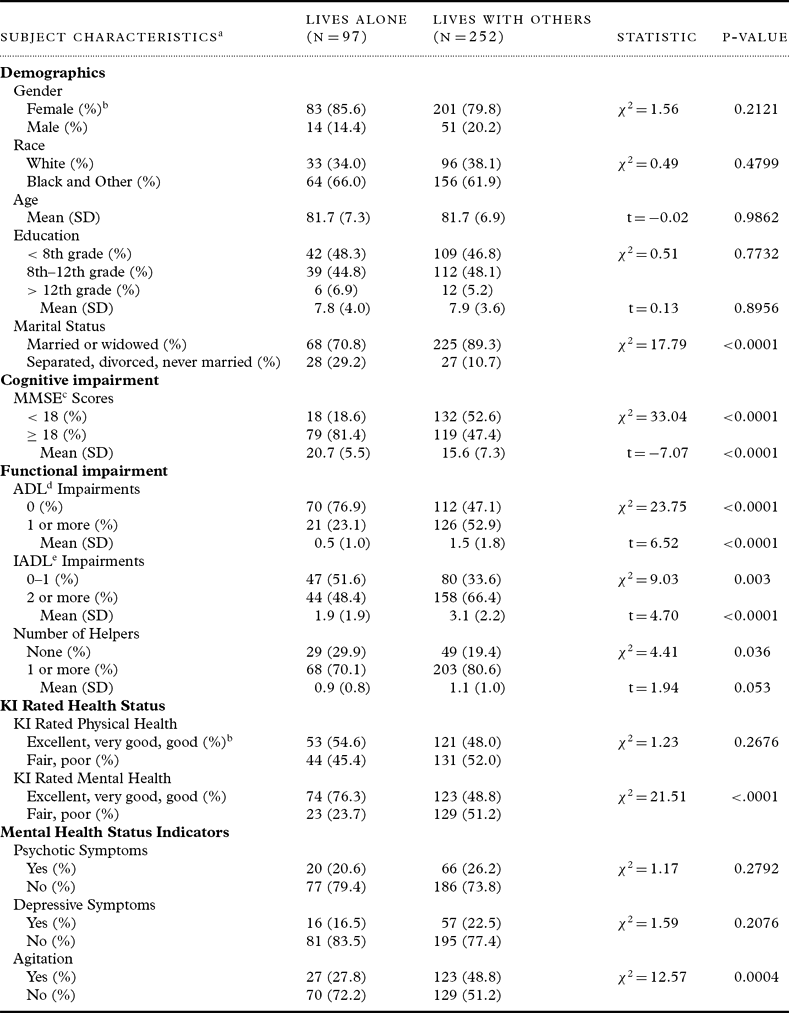
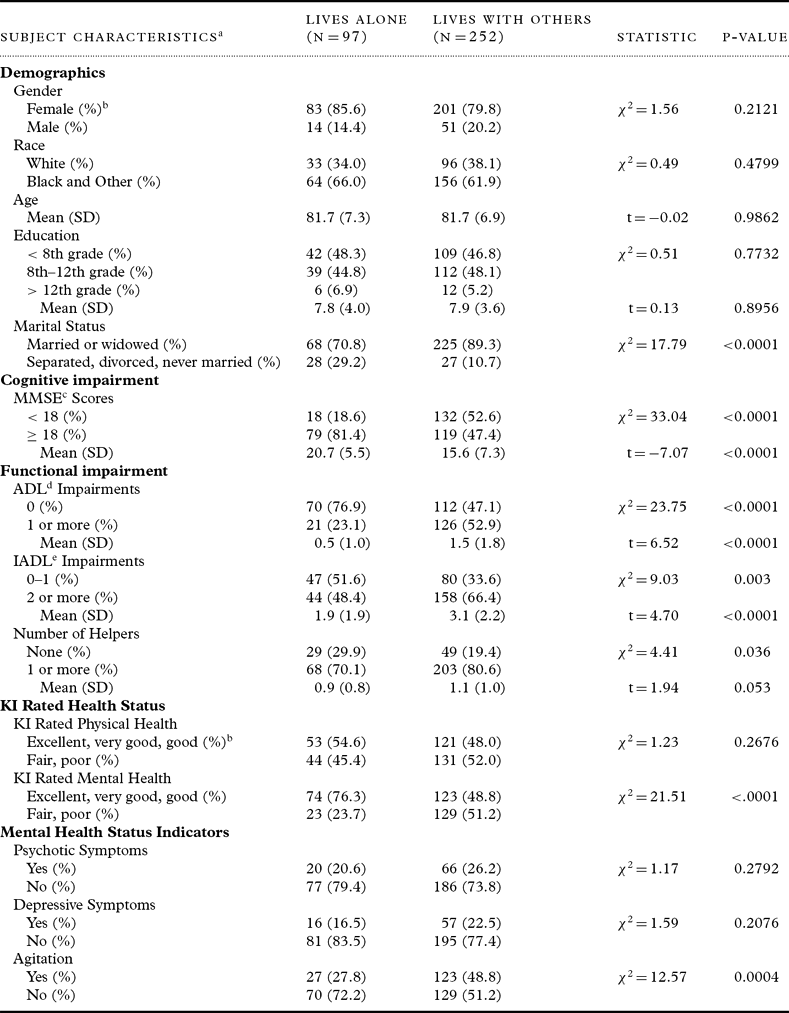
Table 1 compares the characteristics of persons living alone with dementia to those of people with dementia who were living with others. Marital status was the only demographic characteristic significantly associated with living situation. Mean MMSE scores were significantly higher for persons living alone compared with people with dementia who were living with others. Subjects with dementia who were living alone also had significantly fewer ADL and IADL impairments and significantly fewer helpers. Persons living with others were significantly more likely to be agitated but not more likely to be depressed or to have psychotic symptoms. In addition, subjects with dementia who were living with others were more likely to be rated by their KI as having fair or poor mental health. Physical health ratings by KIs did not significantly differ between the two groups.
Characteristics of persons with dementia living alone and living with others
aMissing data: education (n = 29), marital status (n = 1), MMSE (n = 1), ADLs (n = 20), IADLs (n = 20)
bAll percentages are column percentages.
cMMSE = Mini-mental State Examination
dADL = activities of daily living
eIADL = instrumental activities of daily living
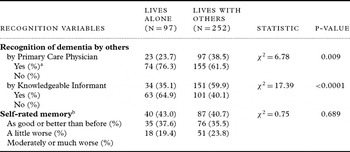
As shown in Table 2, physicians detected dementia in 38.5% of subjects living with others and in 23.7% of subjects living alone (p < 0.009). Physician detection of dementia was related to MMSE scores (p = 0.000, t = 7.373, 95% confidence limits 4.456, 7.124). KIs recognized dementia in 59.9% of cases when the subject lived with others, but in only 35.1% of cases when the subject lived alone (p < 0.001). KI recognition of dementia was also related to MMSE scores (p = 0.000, t = 7.732, 95% confidence limits 4.014, 6.754). Neither subjects living alone nor persons living with others were likely to recognize their own cognitive impairment. Of note, 42 subjects with severe dementia (four who were living alone and 38 who were living with others) were unable to provide a self-rated evaluation of their memory.
Recognition of cognitive impairment

aAll percentages are column percentages
bMissing data – self rated memory (n = 42)
Stepwise logistic regression final model: correlates of living alone

aVariables listed in order of entry
bVariables not included in the final model: instrumental activities of daily living (IADL) difficulties, number of helpers, agitation, KI-rated mental health, physician recognition, KI recognition
cMMSE = Mini-mental State Examination
dReference group – Married/Widowed
eADL = activities of daily living
While marital status, MMSE scores, ADL and IADL impairments, number of helpers, agitation, KI and physician recognition of dementia all correlated with living with others in bivariate analyses, a correlation matrix using these variables showed significant correlations between each variable at p < 0.05. However, stepwise multiple logistical regression analysis using marital status, MMSE, ADL and IADL impairments, number of helpers, presence of agitation, KI and physician recognition of dementia indicated that ADL impairment, marital status, and MMSE scores independently correlated with living with others. Those living alone had higher cognitive function, fewer ADL impairments, and were more likely to be single, divorced or never married.
Discussion
In this community-based sample, over one-quarter of persons with dementia were living alone. This is similar to findings reported by others (Webber et al., Reference Webber, Fox and Burnett1994; Ebly et al., Reference Ebly, Hogan and Rockwood1999; Prescop et al., Reference Prescop, Dodge, Morycz, Schulz and Ganguli1999). Although gender differences distinguish living alone among the elderly as a whole in the U.S.A. (National Center for Health Statistics, 2009), this was not the case among the elderly with dementia living alone in this study. Subjects living alone with dementia were unlikely to recognize their own cognitive impairment. Moreover, both physicians caring for individuals with dementia and their knowledgeable informants were less likely to recognize cognitive impairment if the subject lived alone. The finding that both MMSE and ADL impairment were significantly correlated with living situation in a stepwise regression analysis suggests that they contribute independently to whether an individual with dementia lives alone or with others. Indeed, functional impairment, especially ADL impairment, was more common among subjects who lived with others but nearly half of the individuals with dementia living alone were found to have two or more impairments in IADLs. In the Canadian Study of Health and Aging, (2001) over half of cognitively impaired seniors had some IADL disability, and an association between cognitive impairment and functional disability has been reported by others (McGuire et al., Reference McGuire, Ford and Ajani2006; Scanlon et al., Reference Scanlan, Binkin, Michieletto, Lessig, Zuhr and Borson2007). Our findings further suggest that among individuals who are living alone with dementia, problems performing tasks which are critical to daily living may both arise and go undetected.
In most cases, the progression of dementia is gradual and insidious. In addition, dementia is often accompanied by loss of insight and impaired judgment, making the care of patients living alone a clinically challenging situation. In their prospective study of cognitively impaired people living in the community, Tierney et al. (Reference Tierney, Charles, Naglie, Jaglal, Kiss and Fisher2004) found that 21.6% of persons living alone with dementia experienced an incident of harm which resulted in physical injury or property damage over the study period. We found that many individuals with dementia do not acknowledge having a significant problem with their memory. Indeed, subjects with dementia tended to underestimate the severity and importance of their cognitive deficits, whether living alone or with another person, and self-recognition of memory problems was not correlated with living situation. While the individuals living alone with dementia were less cognitively impaired as a group, 18.6% had a MMSE score less than 18, placing them in the moderately or severely cognitively impaired group. This level of cognitive impairment heightens concerns about their safety since they may be less likely to recognize dangerous situations.
The loss of insight and judgment that accompanies dementia suggests that a close family member or primary care physician would often be in a better position than the person with dementia to recognize signs of cognitive impairment and to find solutions to an impaired person's problems or needs. In this study, both KIs and primary care physicians were more likely to detect dementia in subjects with lower MMSEs. However, it is concerning that both KIs and primary care physicians were less likely to detect dementia in persons living alone. Our findings are consistent with those of others who have found that primary care physicians document dementia in less than half of affected individuals and they are less likely to detect dementia in persons who live alone (Lopponen et al., Reference Lopponen, Raiha, Isoaho, Vahlberg and Kivela2003; Wilkins et al., Reference Wilkins, Wilkins, Meisel, Depke, Williams and Edwards2007). This places those persons living alone with dementia at even greater risk for dangerous health and safety situations, both due to insufficient self-awareness as well as inadequate recognition on the part of others. Clinicians, especially primary care physicians, should therefore pay particular heed to assess routinely the cognitive functioning and safety in all older individuals who are living alone. Taking proactive measures such as helping families arrange for additional home services may help prevent instances of harm related to impaired judgment and functioning.
In this sample, psychiatric symptoms were common. While there was no significant difference in the prevalence of psychotic symptoms or depressive symptoms between subjects with dementia living alone and those who lived with others, persons with dementia who lived with others were significantly more likely to be agitated and to be rated by their informant as having fair or poor mental health. As a cross-sectional study, it was not possible for us to determine the etiology of this finding. Plausible explanations include recognition bias since those who lived with others were observed more closely by their informant. It is also possible that more frequent social contacts led to friction and perhaps caused more frequent agitation on the part of the person with dementia. Another possibility is that the presence of agitation contributes to a decision for the individual with dementia to live with others.
Other limitations of this study include the use of a single question with multiple choice responses to determine subjects’ assessment of their memory, although the interviewers who performed the structured interview were trained to ask the questions in a standardized manner (Black et al., Reference Black2003). Another limitation was that the study design required that subjects with dementia should have a knowledgeable informant, whether they were living alone or were living with others. It is likely that individuals living alone with dementia who do not have an identified KI may be at more risk for harm and may be less likely to access needed medical and social services.
This study confirms the findings of others that many individuals with dementia live alone and demonstrates that such individuals suffer high rates of functional impairment and psychiatric symptoms. Adding to these vulnerabilities is the frequent lack of awareness of cognitive impairment by the affected individuals, their knowledgeable informants, and their physicians. Because individuals living alone with dementia are unlikely to recognize their own limitations, they are unlikely to seek the help they may need The fact that their vulnerability is often not recognized by others makes it imperative that primary care physicians more aggressively and routinely screen their older patients for cognitive and functional impairments.
Conflict of interest
None.
Description of authors’ roles
Susan W. Lehmann, Betty S. Black, and Peter V. Rabins contributed to the data analysis and the writing of the paper. Betty S. Black, Judith Kasper and Peter V. Rabins contributed to the study design and collection of data. Andrew Shore provided statistical analysis of the data.
Acknowledgments
The study was funded by the National Institute of Mental Health and the National Institute on Aging, grant no. MH56412